Lightning Web Components
Episode 3 – Component Communication and Aura
Interoperability
March 15, 2019 | 11:00 a.m. IST
Satya Sekhar
Sr. Developer Evangelist
Salesforce
Shashank Srivatsavaya
APAC Head, Developer
Relations, Salesforce
Forward-Looking Statement
Statement under the Private Securities Litigation Reform Act of 1995:
This presentation may contain forward-looking statements that involve risks, uncertainties, and assumptions. If any
such uncertainties materialize or if any of the assumptions proves incorrect, the results of salesforce.com, inc. could
differ materially from the results expressed or implied by the forward-looking statements we make. All statements
other than statements of historical fact could be deemed forward-looking, including any projections of product or
service availability, subscriber growth, earnings, revenues, or other financial items and any statements regarding
strategies or plans of management for future operations, statements of belief, any statements concerning new,
planned, or upgraded services or technology developments and customer contracts or use of our services.
The risks and uncertainties referred to above include – but are not limited to – risks associated with developing and
delivering new functionality for our service, new products and services, our new business model, our past operating
losses, possible fluctuations in our operating results and rate of growth, interruptions or delays in our Web hosting,
breach of our security measures, the outcome of any litigation, risks associated with completed and any possible
mergers and acquisitions, the immature market in which we operate, our relatively limited operating history, our
ability to expand, retain, and motivate our employees and manage our growth, new releases of our service and
successful customer deployment, our limited history reselling non-salesforce.com products, and utilization and
selling to larger enterprise customers. Further information on potential factors that could affect the financial results
of salesforce.com, inc. is included in our annual report on Form 10-K for the most recent fiscal year and in our
quarterly report on Form 10-Q for the most recent fiscal quarter. These documents and others containing important
disclosures are available on the SEC Filings section of the Investor Information section of our Web site.
Any unreleased services or features referenced in this or other presentations, press releases or public statements are
not currently available and may not be delivered on time or at all. Customers who purchase our services should
make the purchase decisions based upon features that are currently available. Salesforce.com, inc. assumes no
obligation and does not intend to update these forward-looking statements.
Go Social!
Salesforce Developers
The video will be posted to YouTube & the
webinar recap page (same URL as registration).
This webinar is being recorded!
@salesforcedevs
Have Questions?
● Don’t wait until the end to ask your question!
● Technical support will answer questions starting now.
● Respect Q&A etiquette
● Please don’t repeat questions. The support team is working their
way down the queue.
● Stick around for live Q&A at the end
● Speakers will tackle more questions at the end, time-allowing
● Head to Developer Forums
● More questions? Visit developer.salesforce.com/forums
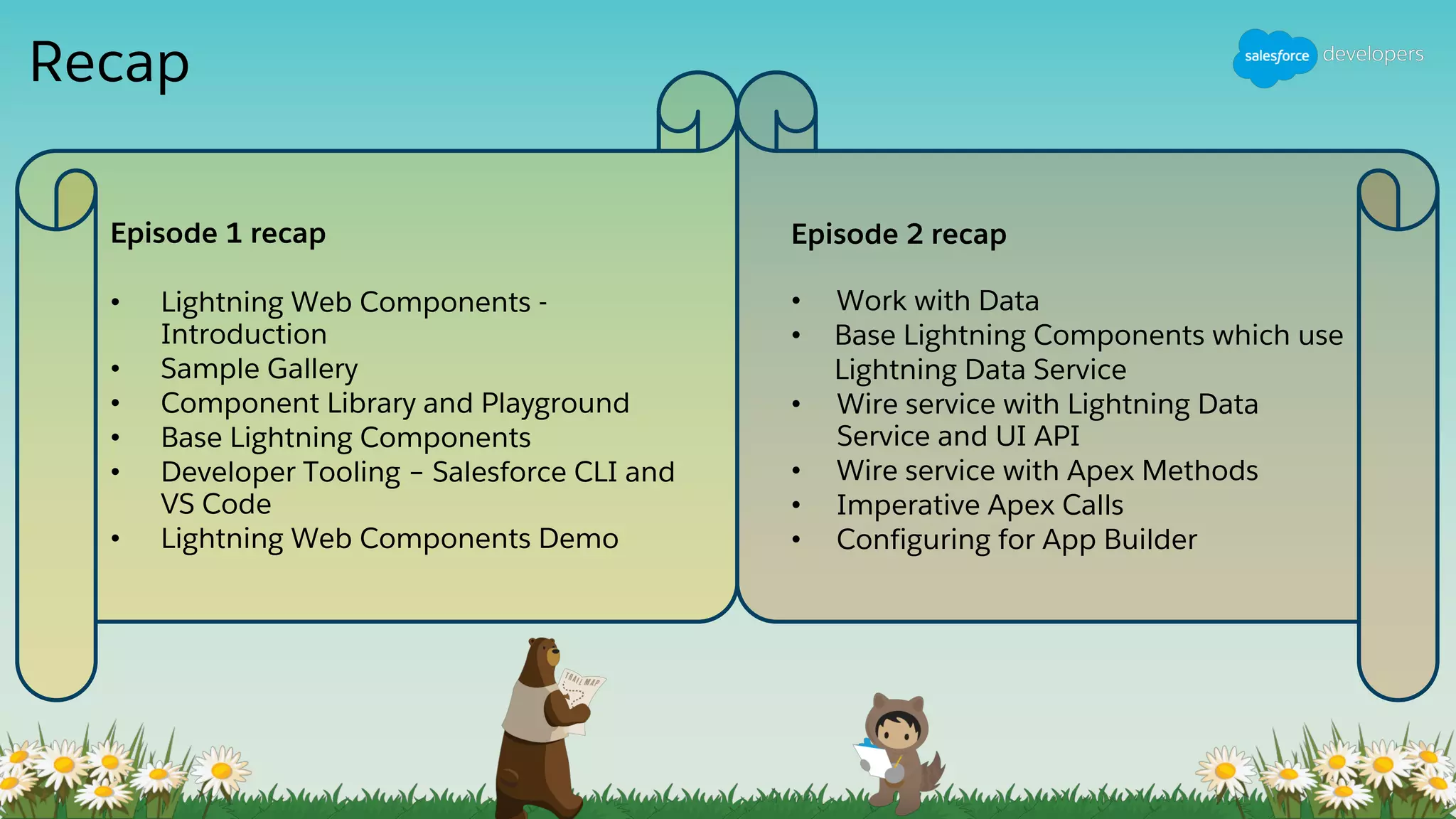
Recap
Episode 1 recap
• Lightning Web Components -
Introduction
• Sample Gallery
• Component Library and Playground
• Base Lightning Components
• Developer Tooling – Salesforce CLI and
VS Code
• Lightning Web Components Demo
Episode 2 recap
• Work with Data
• Base Lightning Components which use
Lightning Data Service
• Wire service with Lightning Data
Service and UI API
• Wire service with Apex Methods
• Imperative Apex Calls
• Configuring for App Builder
Agenda
● Component Composition
● Inter Component Communication and Events
● Lifecycle hooks
● Pub sub communication
● Interoperability and Co-existence with Aura
Component Composition
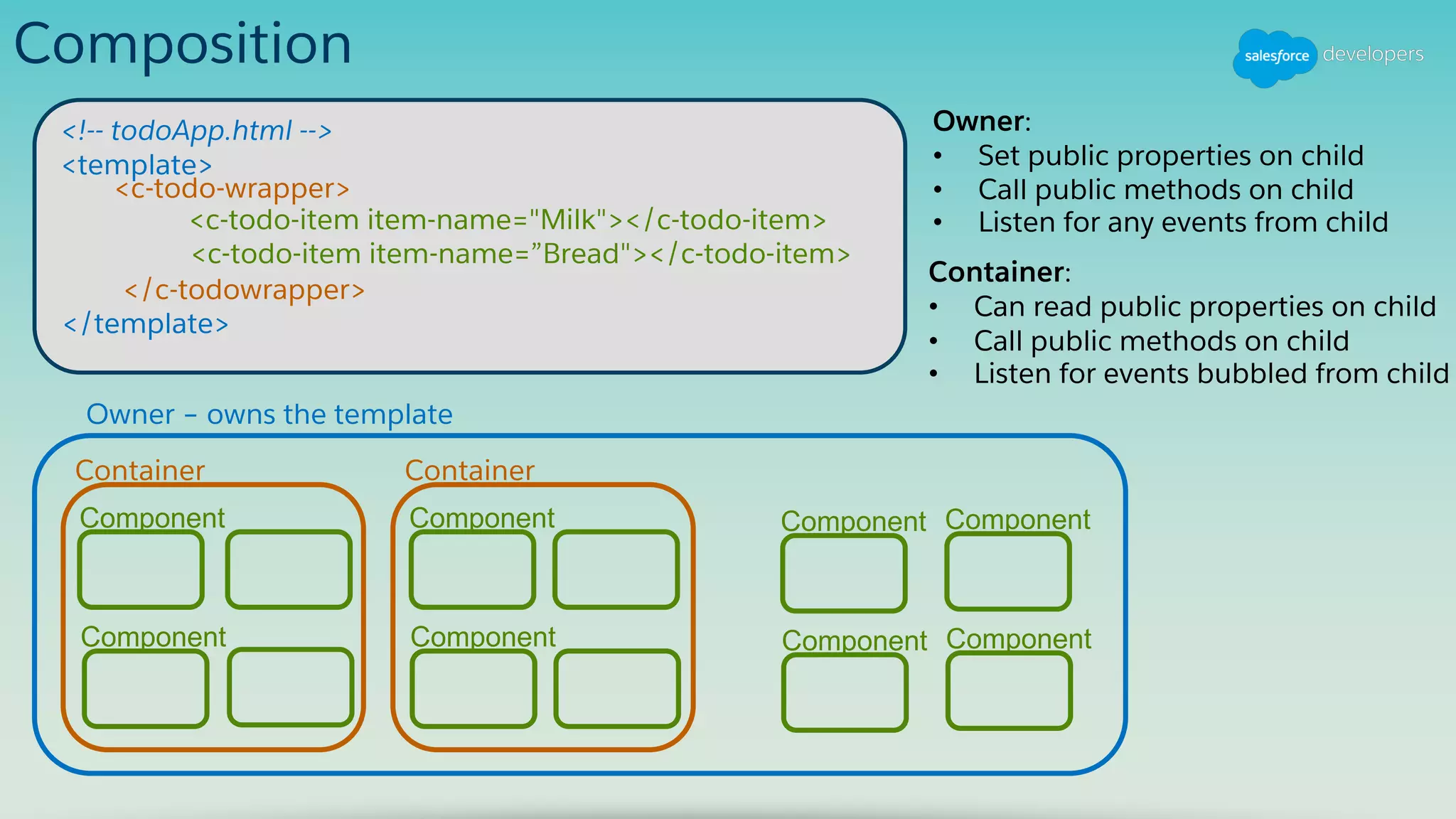
Composition
Owner – owns the template
Container
Component
Component
Container
Component
Component
Component
Component
Component
Component
<!-- todoApp.html -->
<template>
<c-todo-wrapper>
<c-todo-item item-name="Milk"></c-todo-item>
</c-todowrapper>
</template>
<c-todo-item item-name=”Bread"></c-todo-item>
Owner:
• Set public properties on child
• Call public methods on child
• Listen for any events from child
Container:
• Can read public properties on child
• Call public methods on child
• Listen for events bubbled from child
Inter Component Communication
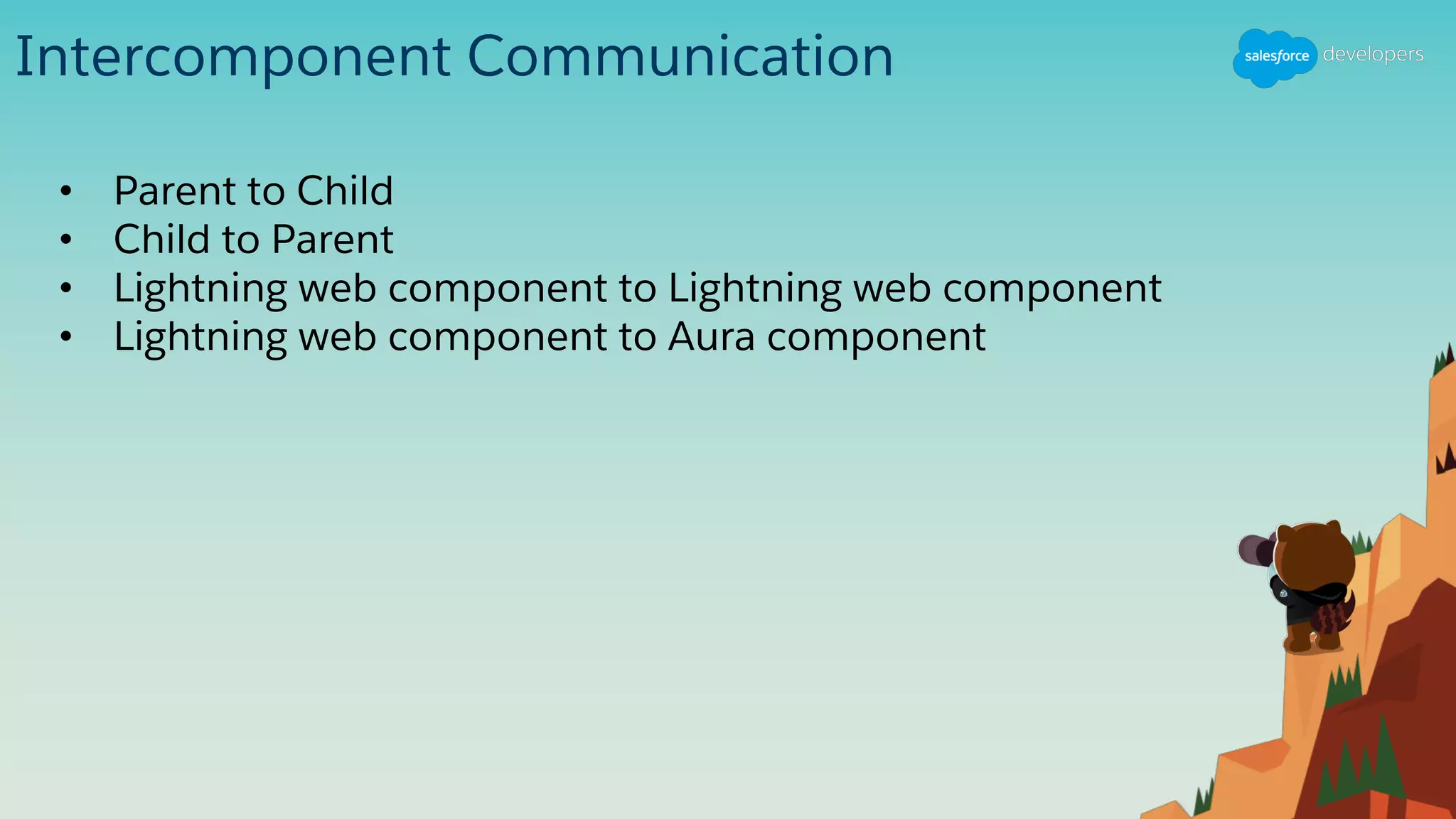
Intercomponent Communication
• Parent to Child
• Child to Parent
• Lightning web component to Lightning web component
• Lightning web component to Aura component
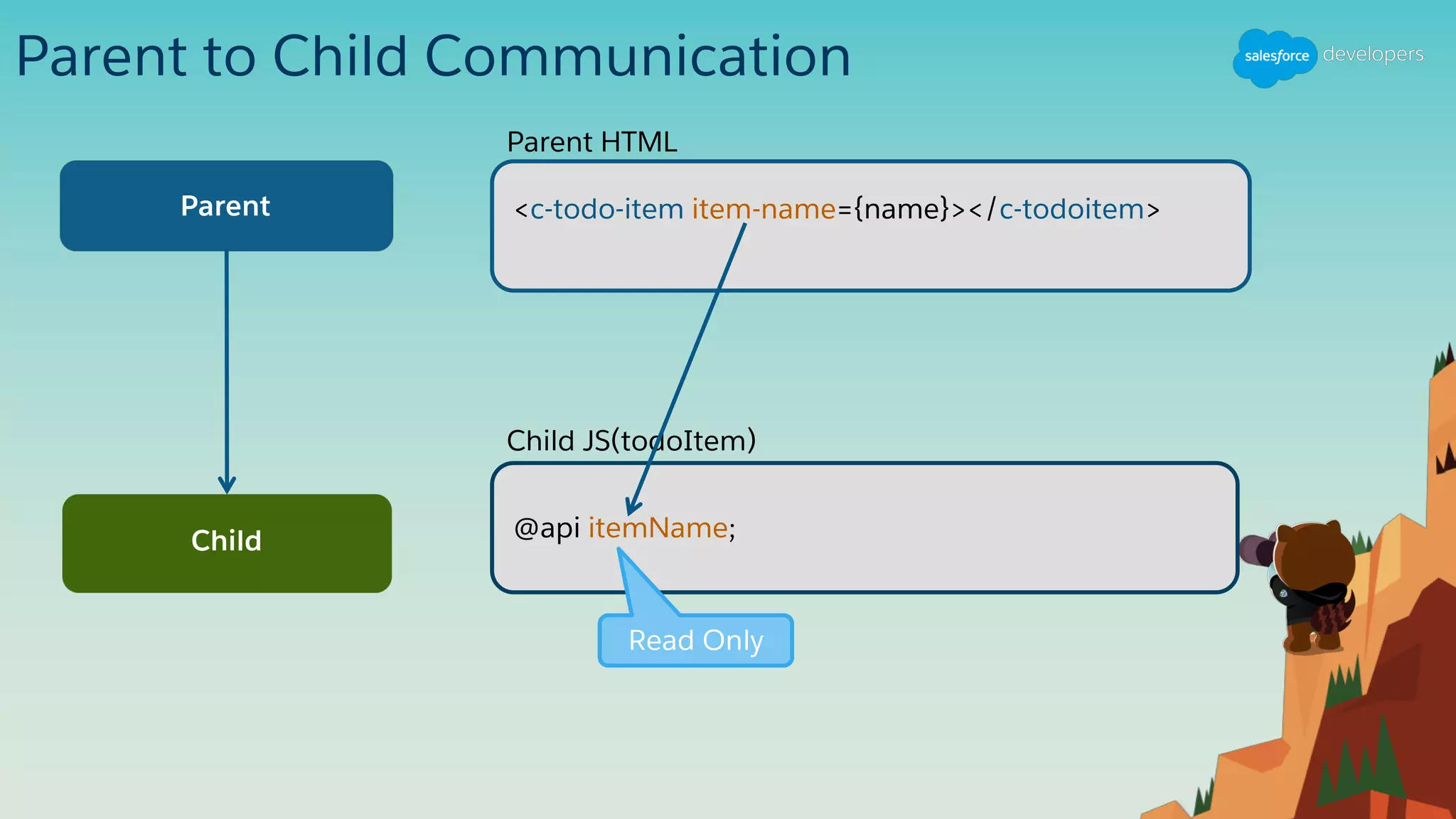
Parent to Child Communication
Parent
Child
<c-todo-item item-name={name}></c-todoitem>
@api itemName;
Parent HTML
Child JS(todoItem)
Read Only
Demo
Parent to Child Communication
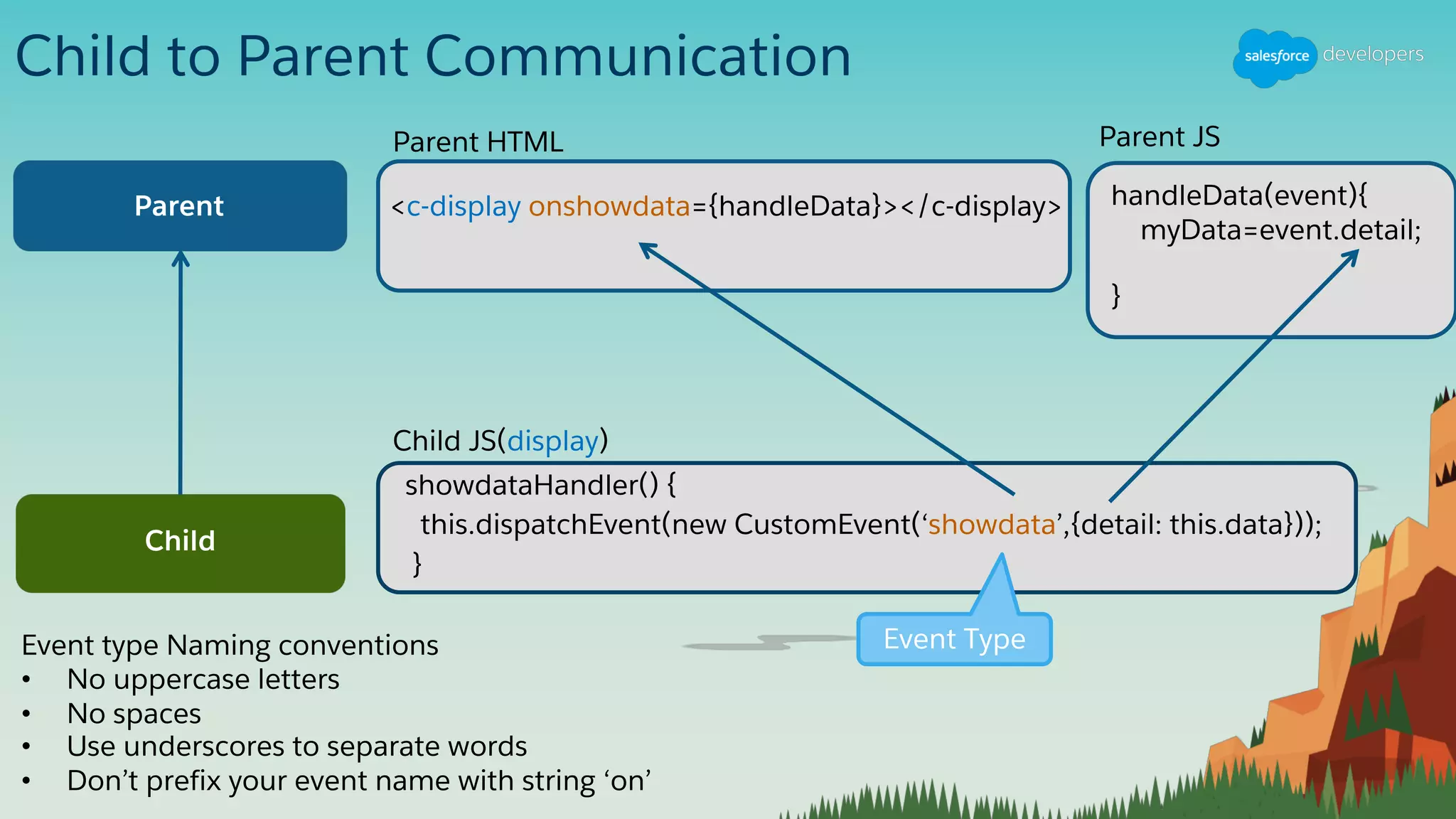
Child to Parent Communication
Parent
Child
Parent HTML
Child JS(display)
Event TypeEvent type Naming conventions
• No uppercase letters
• No spaces
• Use underscores to separate words
• Don’t prefix your event name with string ‘on’
<c-display onshowdata={handleData}></c-display>
showdataHandler() {
this.dispatchEvent(new CustomEvent(‘showdata’));
}
this.dispatchEvent(new CustomEvent(‘showdata’,{detail: this.data}));
handleData(event){
myData=event.detail;
}
Parent JS
Demo
Child to Parent Communication
Shadow DOM
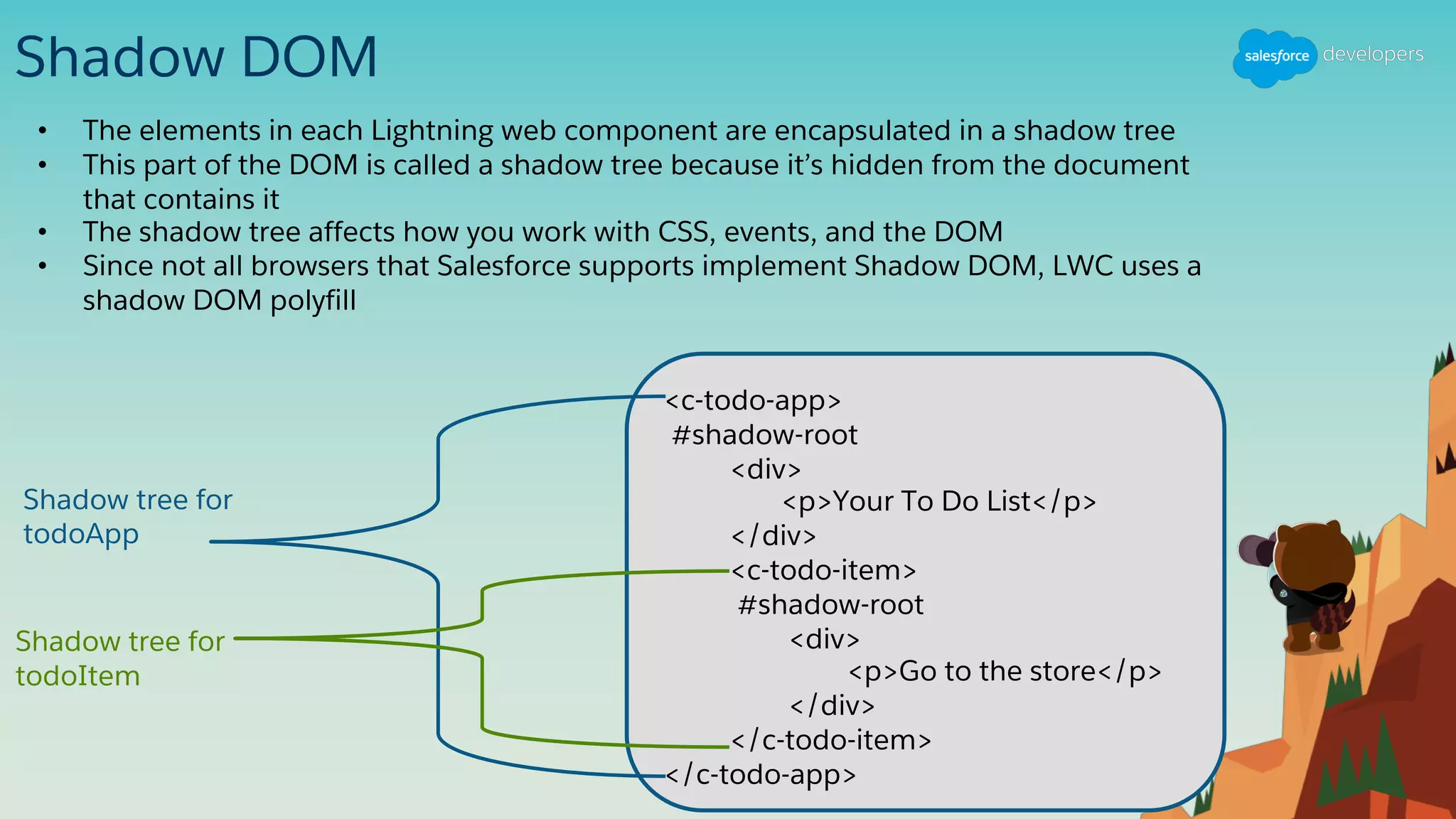
• The elements in each Lightning web component are encapsulated in a shadow tree
• This part of the DOM is called a shadow tree because it’s hidden from the document
that contains it
• The shadow tree affects how you work with CSS, events, and the DOM
• Since not all browsers that Salesforce supports implement Shadow DOM, LWC uses a
shadow DOM polyfill
<c-todo-app>
#shadow-root
<div>
<p>Your To Do List</p>
</div>
<c-todo-item>
#shadow-root
<div>
<p>Go to the store</p>
</div>
</c-todo-item>
</c-todo-app>
Shadow tree for
todoApp
Shadow tree for
todoItem
Event Propagation Phases
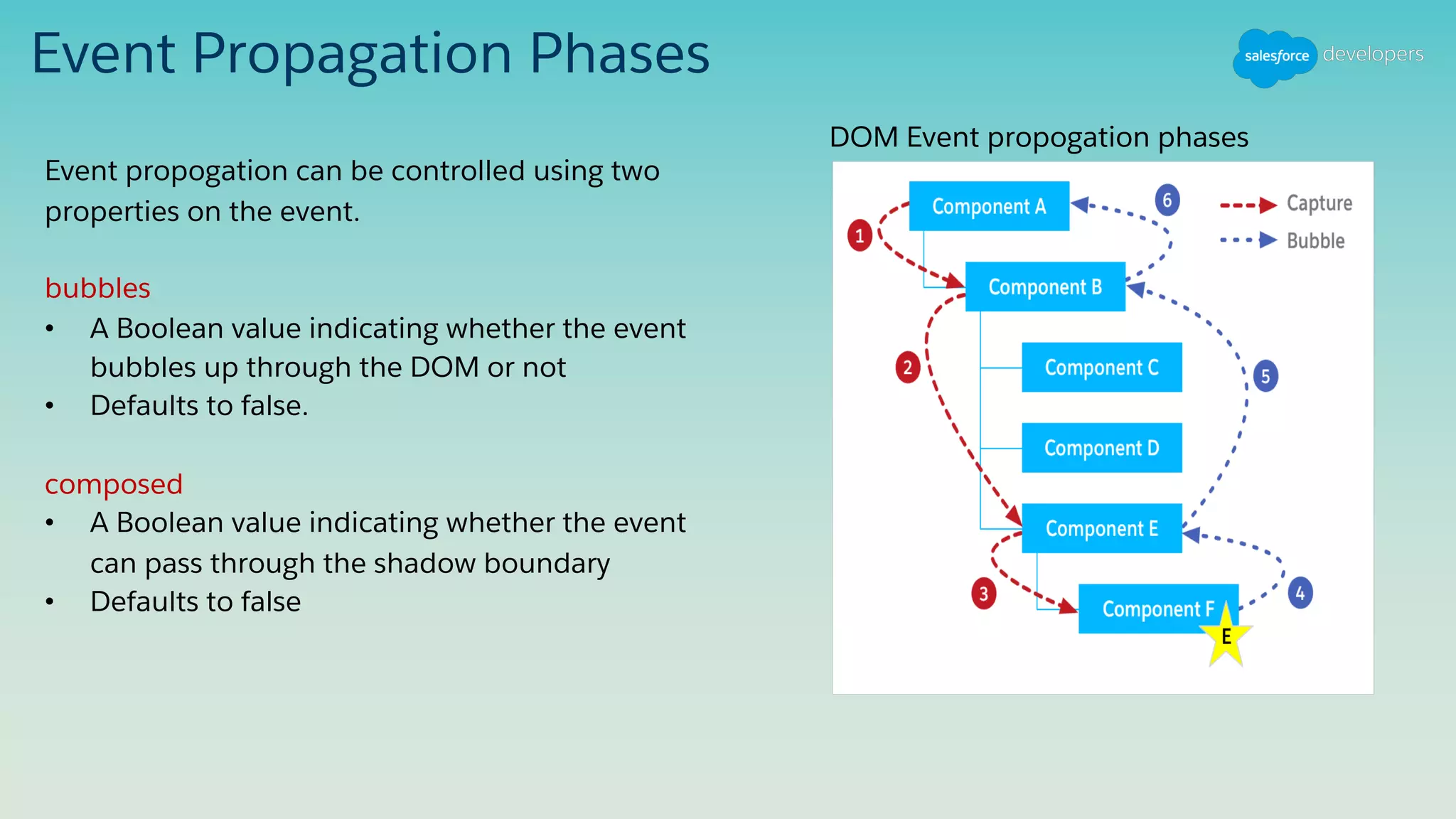
Event propogation can be controlled using two
properties on the event.
bubbles
• A Boolean value indicating whether the event
bubbles up through the DOM or not
• Defaults to false.
composed
• A Boolean value indicating whether the event
can pass through the shadow boundary
• Defaults to false
DOM Event propogation phases
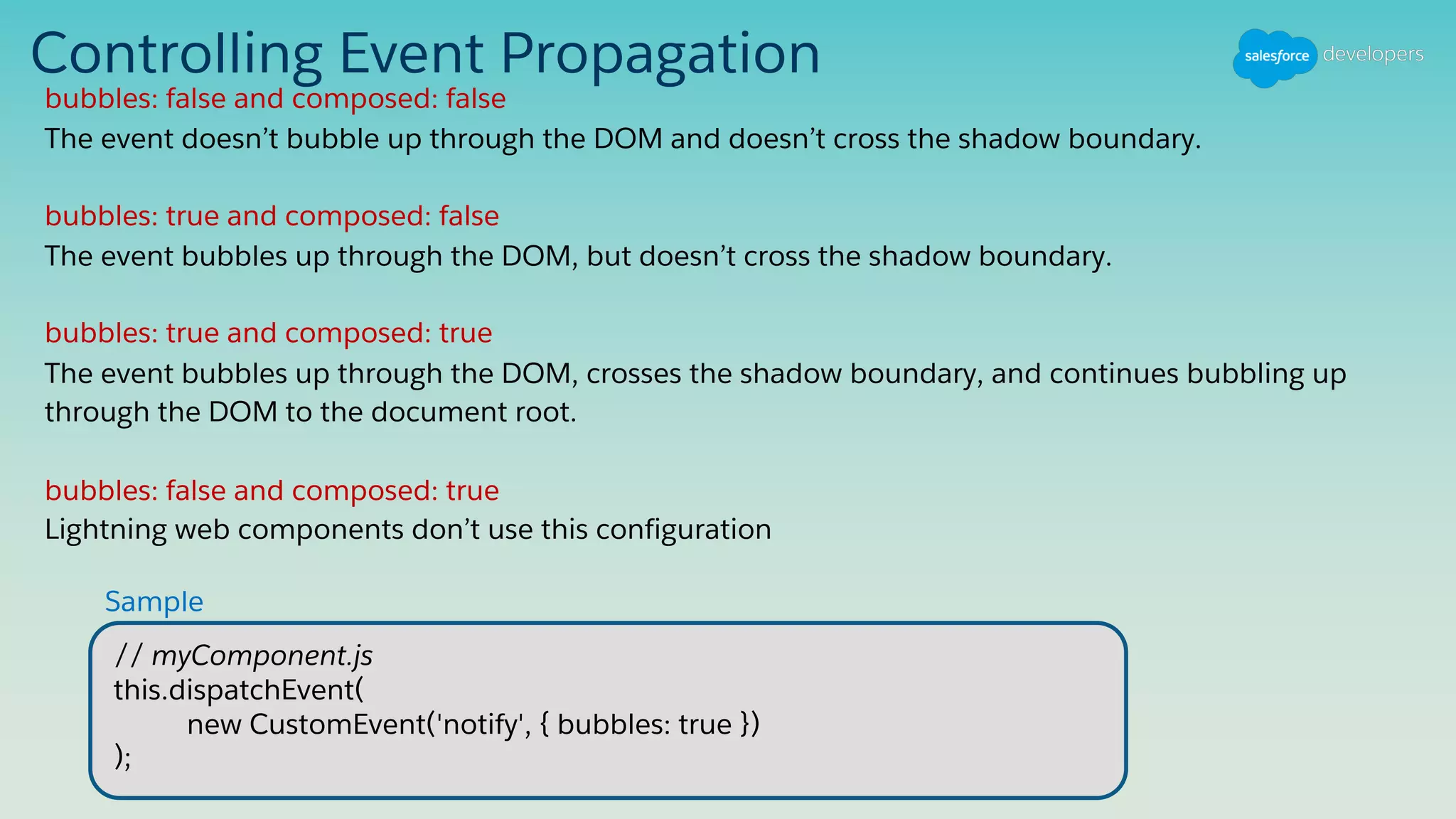
Controlling Event Propagation
bubbles: false and composed: false
The event doesn’t bubble up through the DOM and doesn’t cross the shadow boundary.
bubbles: true and composed: false
The event bubbles up through the DOM, but doesn’t cross the shadow boundary.
bubbles: true and composed: true
The event bubbles up through the DOM, crosses the shadow boundary, and continues bubbling up
through the DOM to the document root.
bubbles: false and composed: true
Lightning web components don’t use this configuration
// myComponent.js
this.dispatchEvent(
new CustomEvent('notify', { bubbles: true })
);
Sample
Lifecycle Hooks
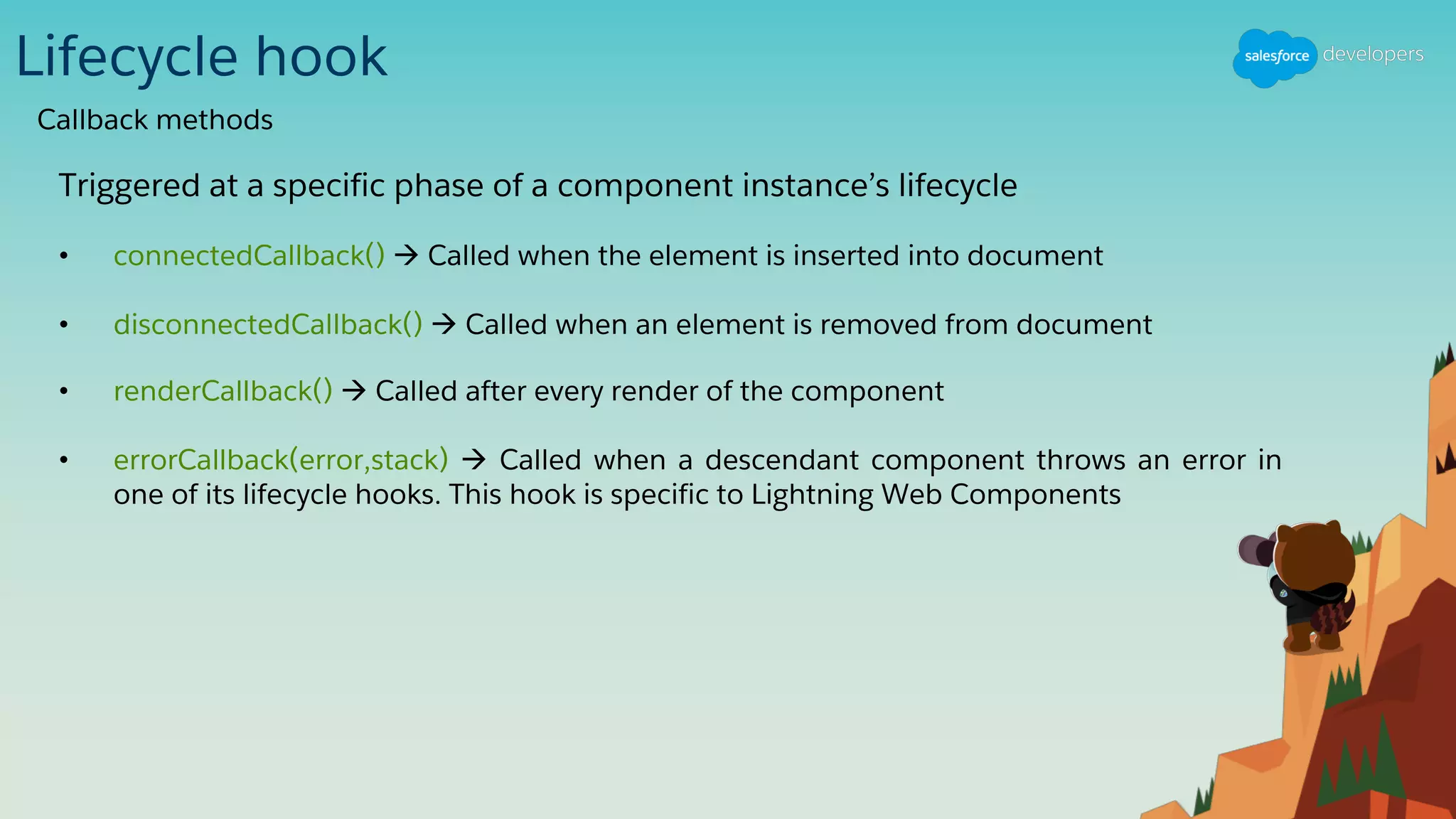
Lifecycle hook
Triggered at a specific phase of a component instance’s lifecycle
• connectedCallback() à Called when the element is inserted into document
• disconnectedCallback() à Called when an element is removed from document
• renderCallback() à Called after every render of the component
• errorCallback(error,stack) à Called when a descendant component throws an error in
one of its lifecycle hooks. This hook is specific to Lightning Web Components
Callback methods
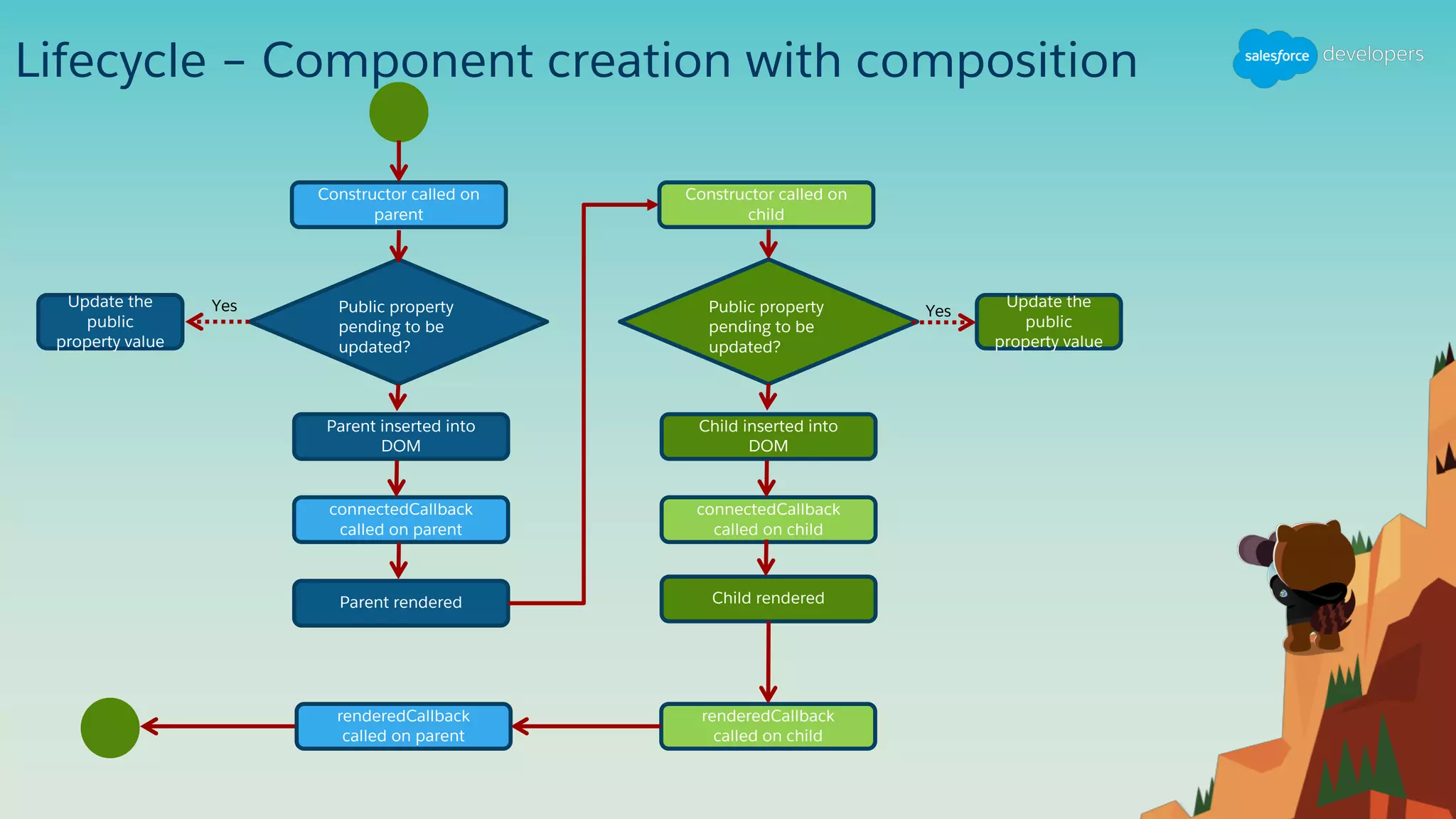
Lifecycle – Component creation with composition
Constructor called on
parent
Public property
pending to be
updated?
Update the
public
property value
Parent inserted into
DOM
connectedCallback
called on parent
Parent rendered
Constructor called on
child
Public property
pending to be
updated?
Child inserted into
DOM
connectedCallback
called on child
Child rendered
renderedCallback
called on child
renderedCallback
called on parent
Update the
public
property value
Yes Yes
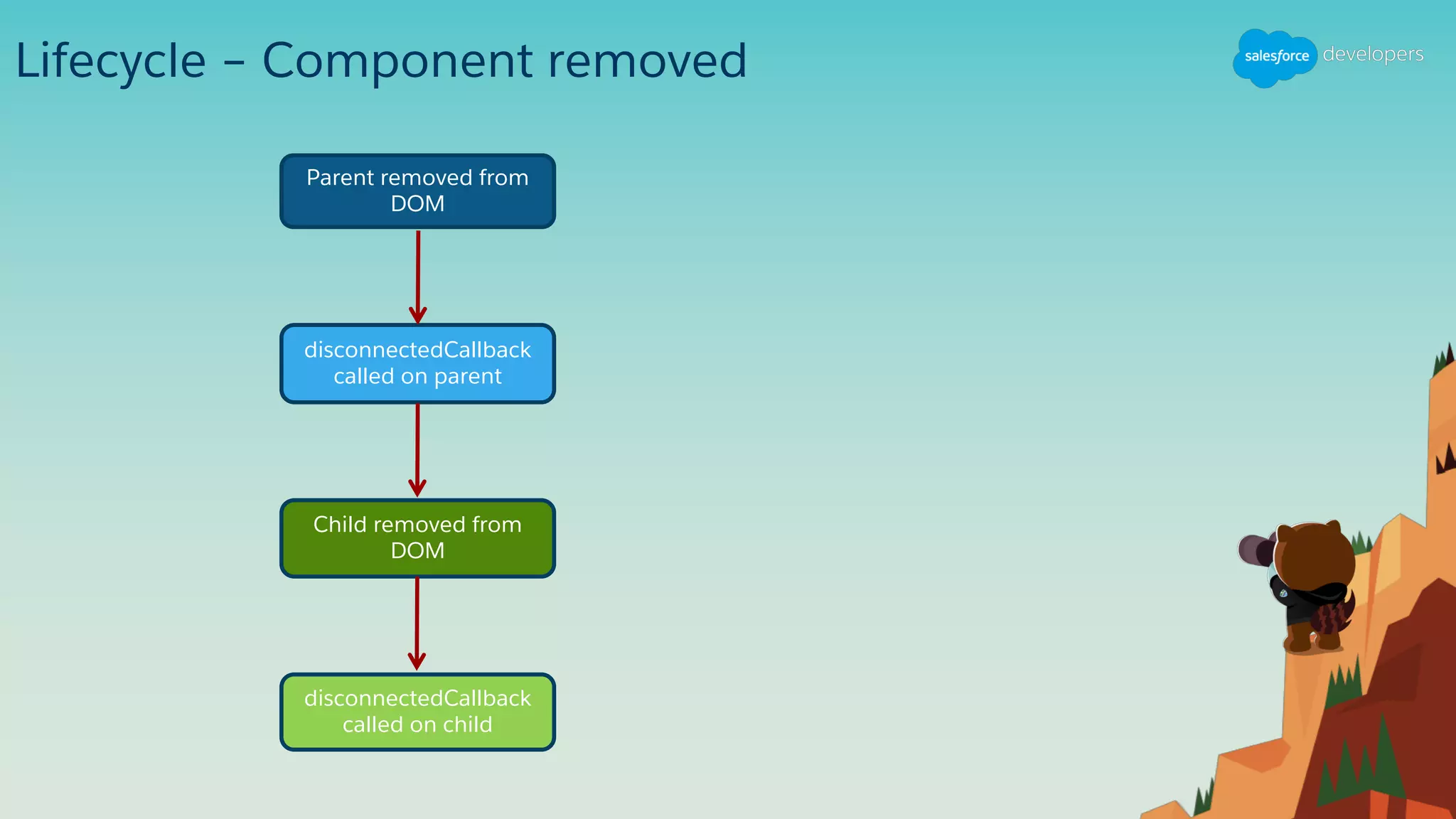
Lifecycle – Component removed
Parent removed from
DOM
disconnectedCallback
called on parent
Child removed from
DOM
disconnectedCallback
called on child
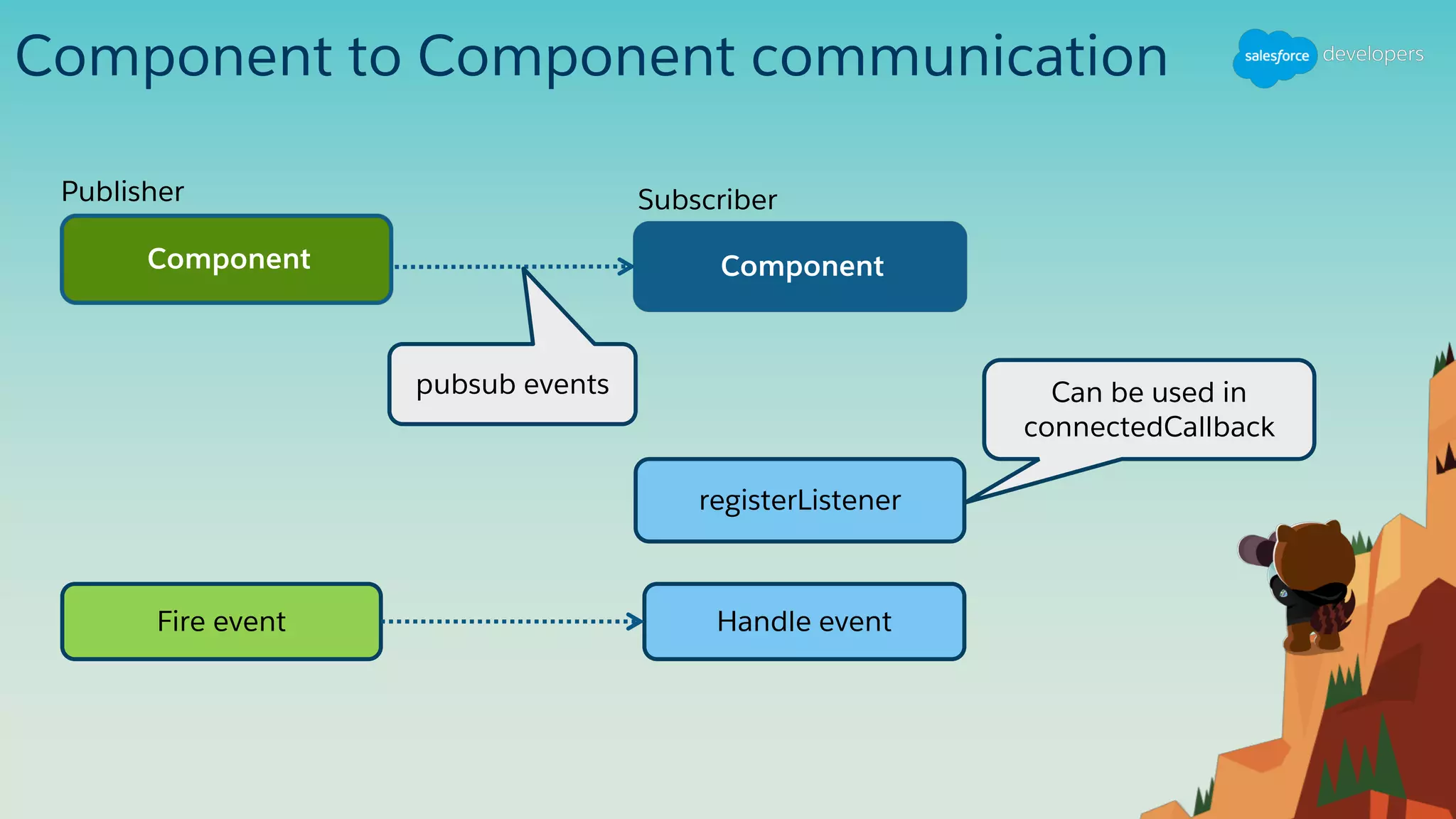
Component to Component communication
Component Component
Publisher Subscriber
registerListener
Fire event Handle event
pubsub events Can be used in
connectedCallback
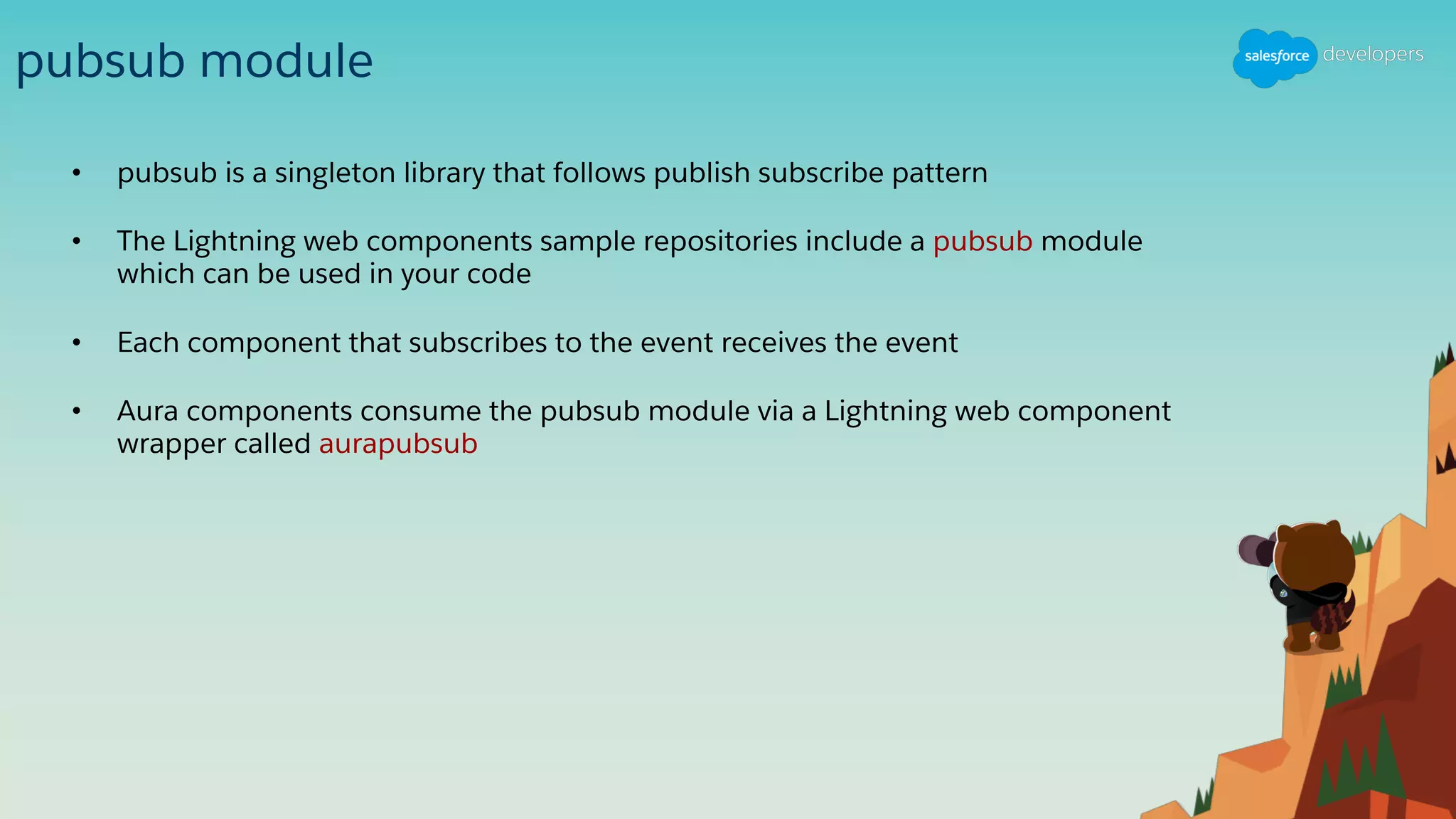
pubsub module
• pubsub is a singleton library that follows publish subscribe pattern
• The Lightning web components sample repositories include a pubsub module
which can be used in your code
• Each component that subscribes to the event receives the event
• Aura components consume the pubsub module via a Lightning web component
wrapper called aurapubsub
Demo
Inter component Communication
Aura Interoperability
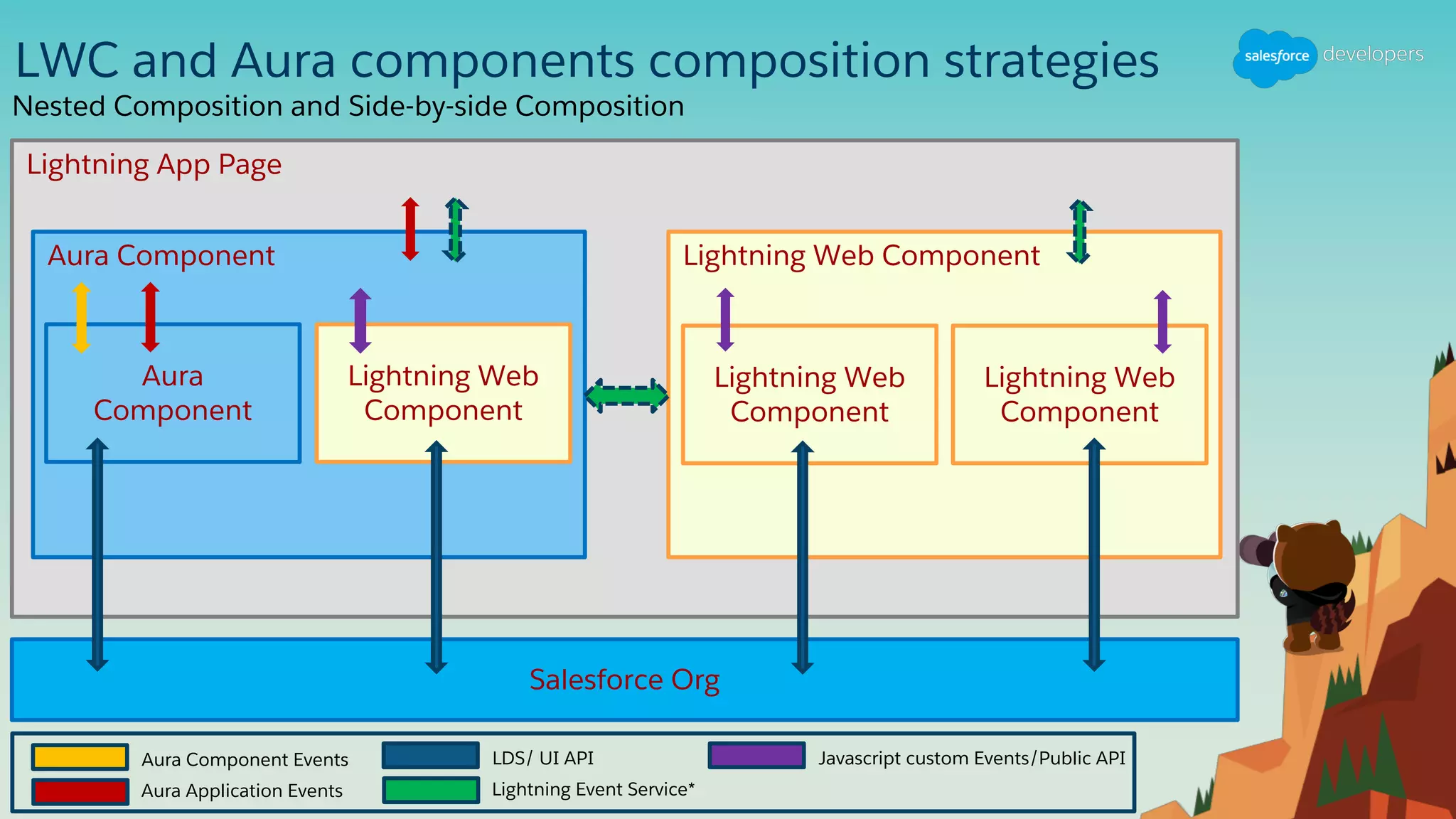
LWC and Aura components composition strategies
Nested Composition and Side-by-side Composition
Lightning App Page
Aura Component Lightning Web Component
Aura
Component
Lightning Web
Component
Lightning Web
Component
Lightning Web
Component
Salesforce Org
Aura Component Events
Aura Application Events
LDS/ UI API
Lightning Event Service*
Javascript custom Events/Public API
Demo
Aura Interoperability
Aura Migration?
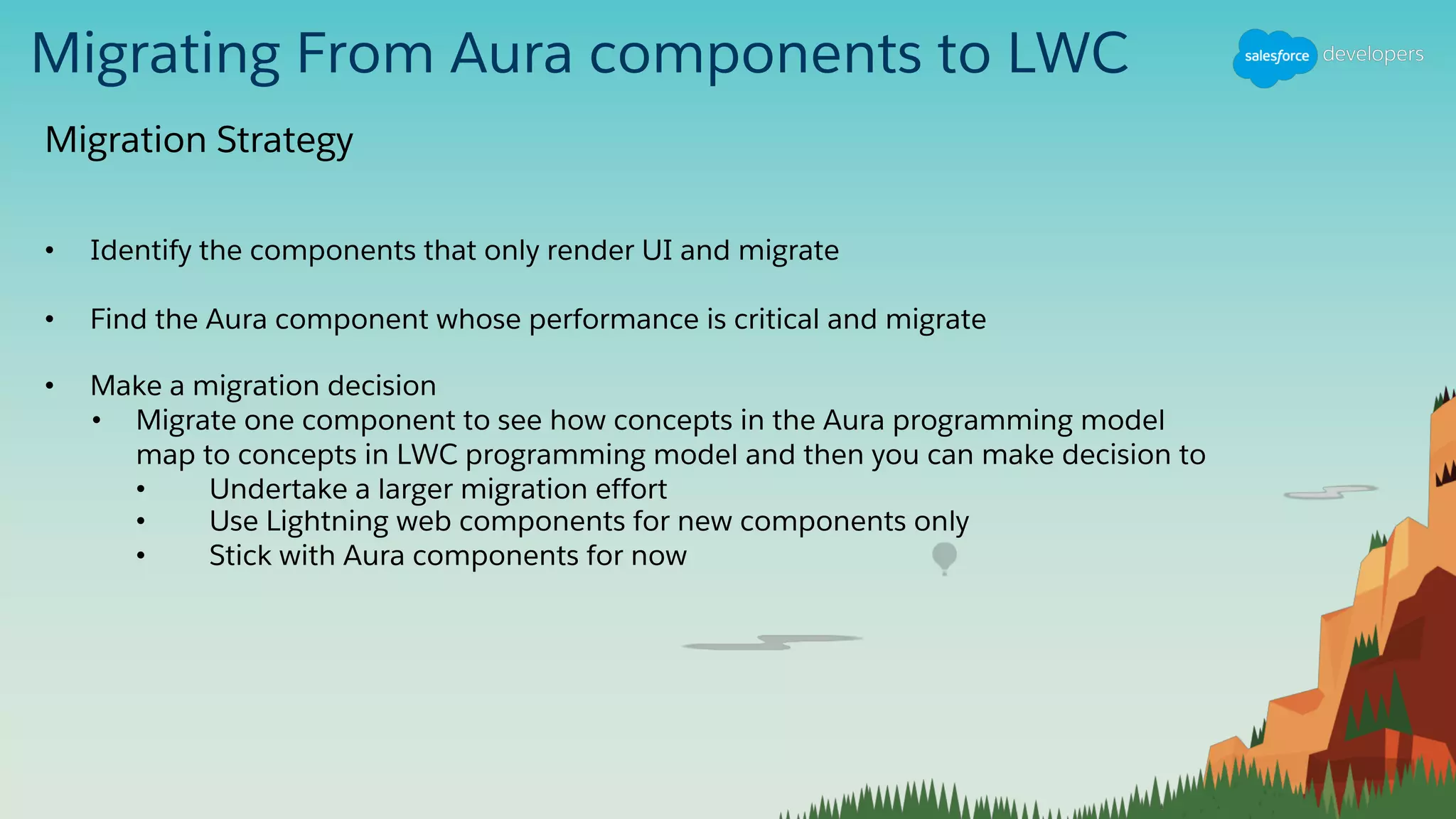
Migrating From Aura components to LWC
Migration Strategy
• Identify the components that only render UI and migrate
• Find the Aura component whose performance is critical and migrate
• Make a migration decision
• Migrate one component to see how concepts in the Aura programming model
map to concepts in LWC programming model and then you can make decision to
• Undertake a larger migration effort
• Use Lightning web components for new components only
• Stick with Aura components for now
Lightning Web Components – Episode 4
● Static resources and custom/3rd party javascript
● External API
● Security: Locker
● Testing with Jest
Security and Testing
Lightning Web Components – Episode 5
● Implement for user scenarios
● Live coding testing and debugging
● Best Practices
Let’s Live Code LWC
Get Hands On with a Trailmix!
sforce.co/lwcModern Javascript
Developement
Q & A
Try Trailhead: trailhead.salesforce.com
Join the conversation: @salesforcedevs
Join Trailblazer Community Group: bit.ly/webinarinapac
Survey
Your feedback is crucial to the success of our
webinar programs. Please fill out the survey at
the end of the webinar. Thank you!
LWC Episode 3- Component Communication and Aura Interoperability

LWC Episode 3- Component Communication and Aura Interoperability

  • 1.
    Lightning Web Components Episode3 – Component Communication and Aura Interoperability March 15, 2019 | 11:00 a.m. IST Satya Sekhar Sr. Developer Evangelist Salesforce Shashank Srivatsavaya APAC Head, Developer Relations, Salesforce
  • 2.
    Forward-Looking Statement Statement underthe Private Securities Litigation Reform Act of 1995: This presentation may contain forward-looking statements that involve risks, uncertainties, and assumptions. If any such uncertainties materialize or if any of the assumptions proves incorrect, the results of salesforce.com, inc. could differ materially from the results expressed or implied by the forward-looking statements we make. All statements other than statements of historical fact could be deemed forward-looking, including any projections of product or service availability, subscriber growth, earnings, revenues, or other financial items and any statements regarding strategies or plans of management for future operations, statements of belief, any statements concerning new, planned, or upgraded services or technology developments and customer contracts or use of our services. The risks and uncertainties referred to above include – but are not limited to – risks associated with developing and delivering new functionality for our service, new products and services, our new business model, our past operating losses, possible fluctuations in our operating results and rate of growth, interruptions or delays in our Web hosting, breach of our security measures, the outcome of any litigation, risks associated with completed and any possible mergers and acquisitions, the immature market in which we operate, our relatively limited operating history, our ability to expand, retain, and motivate our employees and manage our growth, new releases of our service and successful customer deployment, our limited history reselling non-salesforce.com products, and utilization and selling to larger enterprise customers. Further information on potential factors that could affect the financial results of salesforce.com, inc. is included in our annual report on Form 10-K for the most recent fiscal year and in our quarterly report on Form 10-Q for the most recent fiscal quarter. These documents and others containing important disclosures are available on the SEC Filings section of the Investor Information section of our Web site. Any unreleased services or features referenced in this or other presentations, press releases or public statements are not currently available and may not be delivered on time or at all. Customers who purchase our services should make the purchase decisions based upon features that are currently available. Salesforce.com, inc. assumes no obligation and does not intend to update these forward-looking statements.
  • 3.
    Go Social! Salesforce Developers SalesforceDevelopers Salesforce Developers The video will be posted to YouTube & the webinar recap page (same URL as registration). This webinar is being recorded! @salesforcedevs
  • 4.
    Have Questions? ● Don’twait until the end to ask your question! ● Technical support will answer questions starting now. ● Respect Q&A etiquette ● Please don’t repeat questions. The support team is working their way down the queue. ● Stick around for live Q&A at the end ● Speakers will tackle more questions at the end, time-allowing ● Head to Developer Forums ● More questions? Visit developer.salesforce.com/forums
  • 5.
    Recap Episode 1 recap •Lightning Web Components - Introduction • Sample Gallery • Component Library and Playground • Base Lightning Components • Developer Tooling – Salesforce CLI and VS Code • Lightning Web Components Demo Episode 2 recap • Work with Data • Base Lightning Components which use Lightning Data Service • Wire service with Lightning Data Service and UI API • Wire service with Apex Methods • Imperative Apex Calls • Configuring for App Builder
  • 6.
    Agenda ● Component Composition ●Inter Component Communication and Events ● Lifecycle hooks ● Pub sub communication ● Interoperability and Co-existence with Aura
  • 7.
  • 8.
    Composition Owner – ownsthe template Container Component Component Container Component Component Component Component Component Component <!-- todoApp.html --> <template> <c-todo-wrapper> <c-todo-item item-name="Milk"></c-todo-item> </c-todowrapper> </template> <c-todo-item item-name=”Bread"></c-todo-item> Owner: • Set public properties on child • Call public methods on child • Listen for any events from child Container: • Can read public properties on child • Call public methods on child • Listen for events bubbled from child
  • 9.
  • 10.
    Intercomponent Communication • Parentto Child • Child to Parent • Lightning web component to Lightning web component • Lightning web component to Aura component
  • 11.
    Parent to ChildCommunication Parent Child <c-todo-item item-name={name}></c-todoitem> @api itemName; Parent HTML Child JS(todoItem) Read Only
  • 12.
    Demo Parent to ChildCommunication
  • 13.
    Child to ParentCommunication Parent Child Parent HTML Child JS(display) Event TypeEvent type Naming conventions • No uppercase letters • No spaces • Use underscores to separate words • Don’t prefix your event name with string ‘on’ <c-display onshowdata={handleData}></c-display> showdataHandler() { this.dispatchEvent(new CustomEvent(‘showdata’)); } this.dispatchEvent(new CustomEvent(‘showdata’,{detail: this.data})); handleData(event){ myData=event.detail; } Parent JS
  • 14.
    Demo Child to ParentCommunication
  • 15.
    Shadow DOM • Theelements in each Lightning web component are encapsulated in a shadow tree • This part of the DOM is called a shadow tree because it’s hidden from the document that contains it • The shadow tree affects how you work with CSS, events, and the DOM • Since not all browsers that Salesforce supports implement Shadow DOM, LWC uses a shadow DOM polyfill <c-todo-app> #shadow-root <div> <p>Your To Do List</p> </div> <c-todo-item> #shadow-root <div> <p>Go to the store</p> </div> </c-todo-item> </c-todo-app> Shadow tree for todoApp Shadow tree for todoItem
  • 16.
    Event Propagation Phases Eventpropogation can be controlled using two properties on the event. bubbles • A Boolean value indicating whether the event bubbles up through the DOM or not • Defaults to false. composed • A Boolean value indicating whether the event can pass through the shadow boundary • Defaults to false DOM Event propogation phases
  • 17.
    Controlling Event Propagation bubbles:false and composed: false The event doesn’t bubble up through the DOM and doesn’t cross the shadow boundary. bubbles: true and composed: false The event bubbles up through the DOM, but doesn’t cross the shadow boundary. bubbles: true and composed: true The event bubbles up through the DOM, crosses the shadow boundary, and continues bubbling up through the DOM to the document root. bubbles: false and composed: true Lightning web components don’t use this configuration // myComponent.js this.dispatchEvent( new CustomEvent('notify', { bubbles: true }) ); Sample
  • 18.
  • 19.
    Lifecycle hook Triggered ata specific phase of a component instance’s lifecycle • connectedCallback() à Called when the element is inserted into document • disconnectedCallback() à Called when an element is removed from document • renderCallback() à Called after every render of the component • errorCallback(error,stack) à Called when a descendant component throws an error in one of its lifecycle hooks. This hook is specific to Lightning Web Components Callback methods
  • 20.
    Lifecycle – Componentcreation with composition Constructor called on parent Public property pending to be updated? Update the public property value Parent inserted into DOM connectedCallback called on parent Parent rendered Constructor called on child Public property pending to be updated? Child inserted into DOM connectedCallback called on child Child rendered renderedCallback called on child renderedCallback called on parent Update the public property value Yes Yes
  • 21.
    Lifecycle – Componentremoved Parent removed from DOM disconnectedCallback called on parent Child removed from DOM disconnectedCallback called on child
  • 22.
    Component to Componentcommunication Component Component Publisher Subscriber registerListener Fire event Handle event pubsub events Can be used in connectedCallback
  • 23.
    pubsub module • pubsubis a singleton library that follows publish subscribe pattern • The Lightning web components sample repositories include a pubsub module which can be used in your code • Each component that subscribes to the event receives the event • Aura components consume the pubsub module via a Lightning web component wrapper called aurapubsub
  • 24.
  • 25.
  • 26.
    LWC and Auracomponents composition strategies Nested Composition and Side-by-side Composition Lightning App Page Aura Component Lightning Web Component Aura Component Lightning Web Component Lightning Web Component Lightning Web Component Salesforce Org Aura Component Events Aura Application Events LDS/ UI API Lightning Event Service* Javascript custom Events/Public API
  • 27.
  • 28.
  • 29.
    Migrating From Auracomponents to LWC Migration Strategy • Identify the components that only render UI and migrate • Find the Aura component whose performance is critical and migrate • Make a migration decision • Migrate one component to see how concepts in the Aura programming model map to concepts in LWC programming model and then you can make decision to • Undertake a larger migration effort • Use Lightning web components for new components only • Stick with Aura components for now
  • 30.
    Lightning Web Components– Episode 4 ● Static resources and custom/3rd party javascript ● External API ● Security: Locker ● Testing with Jest Security and Testing
  • 31.
    Lightning Web Components– Episode 5 ● Implement for user scenarios ● Live coding testing and debugging ● Best Practices Let’s Live Code LWC
  • 32.
    Get Hands Onwith a Trailmix! sforce.co/lwcModern Javascript Developement
  • 33.
    Q & A TryTrailhead: trailhead.salesforce.com Join the conversation: @salesforcedevs Join Trailblazer Community Group: bit.ly/webinarinapac
  • 34.
    Survey Your feedback iscrucial to the success of our webinar programs. Please fill out the survey at the end of the webinar. Thank you!