LTE-Quick Introduction
Session for Wi-tribe
A Interactive video About LTE
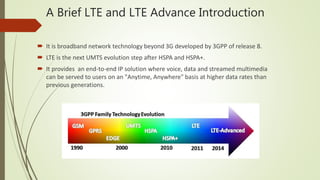
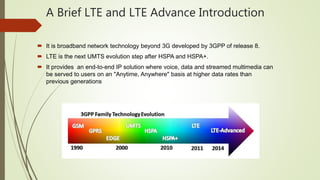
A Brief LTE and LTE Advance Introduction
 It is broadband network technology beyond 3G developed by 3GPP of release 8.
 LTE is the next UMTS evolution step after HSPA and HSPA+.
 It provides an end-to-end IP solution where voice, data and streamed multimedia
can be served to users on an "Anytime, Anywhere" basis at higher data rates than
previous generations.
A brief look on Cellular Network
Technology(1G,2G,3G,Wimax &4G)
First Generation (1G)
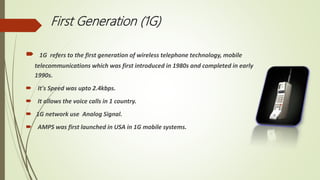
 1G refers to the first generation of wireless telephone technology, mobile
telecommunications which was first introduced in 1980s and completed in early
1990s.
 It's Speed was upto 2.4kbps.
 It allows the voice calls in 1 country.
 1G network use Analog Signal.
 AMPS was first launched in USA in 1G mobile systems.
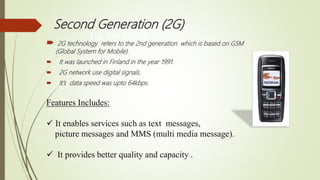
 2G technology refers to the 2nd generation which is based on GSM
(Global System for Mobile).
 It was launched in Finland in the year 1991.
 2G network use digital signals.
 It’s data speed was upto 64kbps.
Features Includes:
 It enables services such as text messages,
picture messages and MMS (multi media message).
 It provides better quality and capacity .
Second Generation (2G)
TECHNOLOGY
3rd Generation
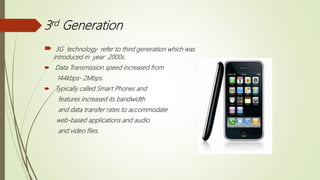
 3G technology refer to third generation which was
introduced in year 2000s.
 Data Transmission speed increased from
144kbps- 2Mbps.
 Typically called Smart Phones and
features increased its bandwidth
and data transfer rates to accommodate
web-based applications and audio
and video files.
FEATURES OF 3G TECHNOLOGY
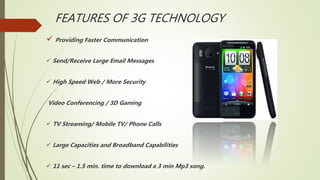
 Providing Faster Communication
 Send/Receive Large Email Messages
 High Speed Web / More Security
Video Conferencing / 3D Gaming
 TV Streaming/ Mobile TV/ Phone Calls
 Large Capacities and Broadband Capabilities
 11 sec – 1.5 min. time to download a 3 min Mp3 song.
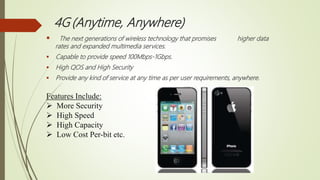
4G (Anytime, Anywhere)
 The next generations of wireless technology that promises higher data
rates and expanded multimedia services.
 Capable to provide speed 100Mbps-1Gbps.
 High QOS and High Security
 Provide any kind of service at any time as per user requirements, anywhere.
Features Include:
 More Security
 High Speed
 High Capacity
 Low Cost Per-bit etc.
4G TECHNOLOGY Features
 4G technology refer to or short name of fourth Generation which was
started from late 2000s.
 Capable of providing 100Mbps – 1Gbps speed.
 One of the basic term used to describe 4G is MAGIC.
 MAGIC:
 Mobile Multimedia
 Anytime Anywhere
 Global Mobility Support
 Integrated Wireless Solution
 Customized Personal Services
 Also known as Mobile Broadband Everywhere.
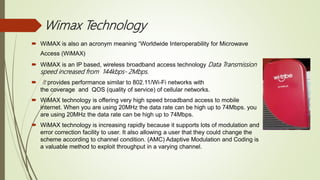
Wimax Technology
 WiMAX is also an acronym meaning “Worldwide Interoperability for Microwave
Access (WiMAX)
 WiMAX is an IP based, wireless broadband access technology Data Transmission
speed increased from 144kbps- 2Mbps.
 It provides performance similar to 802.11/Wi-Fi networks with
the coverage and QOS (quality of service) of cellular networks.
 WiMAX technology is offering very high speed broadband access to mobile
internet. When you are using 20MHz the data rate can be high up to 74Mbps. you
are using 20MHz the data rate can be high up to 74Mbps.
 WiMAX technology is increasing rapidly because it supports lots of modulation and
error correction facility to user. It also allowing a user that they could change the
scheme according to channel condition. (AMC) Adaptive Modulation and Coding is
a valuable method to exploit throughput in a varying channel.
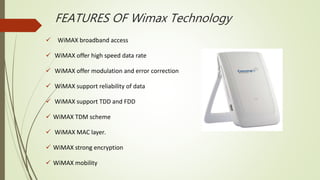
FEATURES OF Wimax Technology
 WiMAX broadband access
 WiMAX offer high speed data rate
 WiMAX offer modulation and error correction
 WiMAX support reliability of data
 WiMAX support TDD and FDD
 WiMAX TDM scheme
 WiMAX MAC layer.
 WiMAX strong encryption
 WiMAX mobility
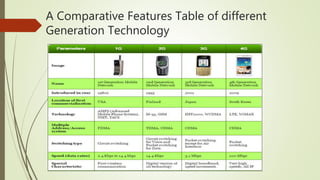
A Comparative Features Table of different
Generation Technology
A Brief LTE and LTE Advance Introduction
 It is broadband network technology beyond 3G developed by 3GPP of release 8.
 LTE is the next UMTS evolution step after HSPA and HSPA+.
 It provides an end-to-end IP solution where voice, data and streamed multimedia can
be served to users on an "Anytime, Anywhere" basis at higher data rates than
previous generations
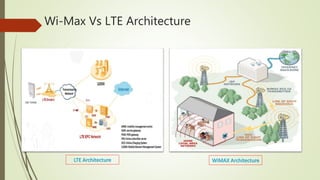
Wi-Max Vs LTE Architecture
LTE Architecture WiMAX Architecture
 • Peak data rates for DL – 100 Mbps and peak UL data rates are 50Mbps.
 • Up to 200 active users in a cell (5 MHz)
 • Enhanced multimedia broadcast service.
 • Spectrum flexibility: 1.25 ~ 20 MHz.
 • Duplexing supports FDD & TDD.
 • Spectral Efficiency – SC - FDMA & OFDMA.
 • Modulation type : QPSK,QAM
LTE Targets
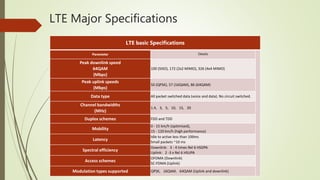
LTE Major Specifications
LTE basic Specifications
Parameter Details
Peak downlink speed
64QAM
(Mbps)
100 (SISO), 172 (2x2 MIMO), 326 (4x4 MIMO)
Peak uplink speeds
(Mbps)
50 (QPSK), 57 (16QAM), 86 (64QAM)
Data type All packet switched data (voice and data). No circuit switched.
Channel bandwidths
(MHz)
1.4, 3, 5, 10, 15, 20
Duplex schemes FDD and TDD
Mobility
0 - 15 km/h (optimised),
15 - 120 km/h (high performance)
Latency
Idle to active less than 100ms
Small packets ~10 ms
Spectral efficiency
Downlink: 3 - 4 times Rel 6 HSDPA
Uplink: 2 -3 x Rel 6 HSUPA
Access schemes
OFDMA (Downlink)
SC-FDMA (Uplink)
Modulation types supported QPSK, 16QAM, 64QAM (Uplink and downlink)
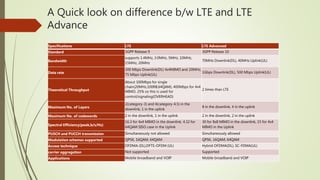
A Quick look on difference b/w LTE and LTE
Advance
Specifications LTE LTE Advanced
Standard 3GPP Release 9 3GPP Release 10
Bandwidth
supports 1.4MHz, 3.0MHz, 5MHz, 10MHz,
15MHz, 20MHz
70MHz Downlink(DL), 40MHz Uplink(UL)
Data rate
300 Mbps Downlink(DL) 4x4MIMO and 20MHz,
75 Mbps Uplink(UL)
1Gbps Downlink(DL), 500 Mbps Uplink(UL)
Theoretical Throughput
About 100Mbps for single
chain(20MHz,100RB,64QAM), 400Mbps for 4x4
MIMO. 25% os this is used for
control/signaling(OVERHEAD)
2 times than LTE
Maximum No. of Layers
2(category-3) and 4(category-4,5) in the
downlink, 1 in the uplink
8 in the downlink, 4 in the uplink
Maximum No. of codewords 2 in the downlink, 1 in the uplink 2 in the downlink, 2 in the uplink
Spectral Efficiency(peak,b/s/Hz)
16.3 for 4x4 MIMO in the downlink, 4.32 for
64QAM SISO case in the Uplink
30 for 8x8 MIMO in the downlink, 15 for 4x4
MIMO in the Uplink
PUSCH and PUCCH transmission Simultaneously not allowed Simultaneously allowed
Modulation schemes supported QPSK, 16QAM, 64QAM QPSK, 16QAM, 64QAM
Access technique OFDMA (DL),DFTS-OFDM (UL) Hybrid OFDMA(DL), SC-FDMA(UL)
carrier aggregation Not supported Supported
Applications Mobile broadband and VOIP Mobile broadband and VOIP
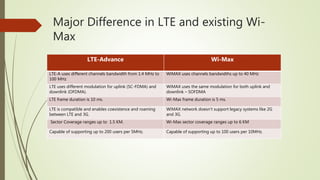
Major Difference in LTE and existing Wi-
Max
LTE-Advance Wi-Max
LTE-A uses different channels bandwidth from 1.4 MHz to
100 MHz
WiMAX uses channels bandwidths up to 40 MHz
LTE uses different modulation for uplink (SC-FDMA) and
downlink (OFDMA).
WiMAX uses the same modulation for both uplink and
downlink – SOFDMA
LTE frame duration is 10 ms. Wi-Max frame duration is 5 ms.
LTE is compatible and enables coexistence and roaming
between LTE and 3G.
WiMAX network doesn’t support legacy systems like 2G
and 3G.
Sector Coverage ranges up to 1.5 KM. Wi-Max sector coverage ranges up to 6 KM
Capable of supporting up to 200 users per 5MHz. Capable of supporting up to 100 users per 10MHz.
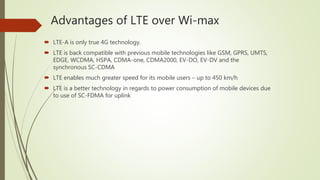
Advantages of LTE over Wi-max
 LTE-A is only true 4G technology.
 LTE is back compatible with previous mobile technologies like GSM, GPRS, UMTS,
EDGE, WCDMA, HSPA, CDMA-one, CDMA2000, EV-DO, EV-DV and the
synchronous SC-CDMA
 LTE enables much greater speed for its mobile users – up to 450 km/h
 LTE is a better technology in regards to power consumption of mobile devices due
to use of SC-FDMA for uplink
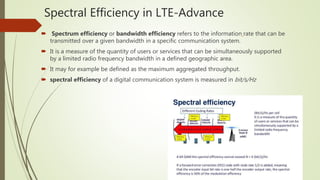
Spectral Efficiency in LTE-Advance
 Spectrum efficiency or bandwidth efficiency refers to the information rate that can be
transmitted over a given bandwidth in a specific communication system.
 It is a measure of the quantity of users or services that can be simultaneously supported
by a limited radio frequency bandwidth in a defined geographic area.
 It may for example be defined as the maximum aggregated throughput.
 spectral efficiency of a digital communication system is measured in bit/s/Hz
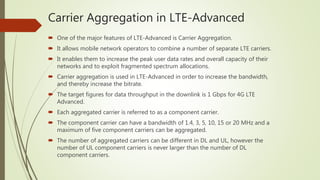
Carrier Aggregation in LTE-Advanced
 One of the major features of LTE-Advanced is Carrier Aggregation.
 It allows mobile network operators to combine a number of separate LTE carriers.
 It enables them to increase the peak user data rates and overall capacity of their
networks and to exploit fragmented spectrum allocations.
 Carrier aggregation is used in LTE-Advanced in order to increase the bandwidth,
and thereby increase the bitrate.
 The target figures for data throughput in the downlink is 1 Gbps for 4G LTE
Advanced.
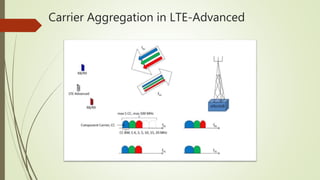
 Each aggregated carrier is referred to as a component carrier.
 The component carrier can have a bandwidth of 1.4, 3, 5, 10, 15 or 20 MHz and a
maximum of five component carriers can be aggregated.
 The number of aggregated carriers can be different in DL and UL, however the
number of UL component carriers is never larger than the number of DL
component carriers.
Carrier Aggregation in LTE-Advanced
Significance of Carrier Aggregation
 Increasing the number of users and the total bandwidth supported in both the
downlink and the uplink.
 Supporting a greater number of frequency bands and combinations of frequency
bands.
 Using Carrier Aggregation between cells to enhance the support of small cells and
Heterogeneous Networks
 Enabling flexible aggregation of FDD and TDD LTE carriers.
 Supporting LTE Carrier Aggregation between licensed and unlicensed spectrum.
A Brief Look on MIMO Feature in LTE
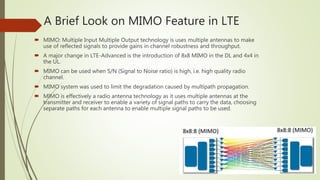
 MIMO: Multiple Input Multiple Output technology is uses multiple antennas to make
use of reflected signals to provide gains in channel robustness and throughput.
 A major change in LTE-Advanced is the introduction of 8x8 MIMO in the DL and 4x4 in
the UL.
 MIMO can be used when S/N (Signal to Noise ratio) is high, i.e. high quality radio
channel.
 MIMO system was used to limit the degradation caused by multipath propagation.
 MIMO is effectively a radio antenna technology as it uses multiple antennas at the
transmitter and receiver to enable a variety of signal paths to carry the data, choosing
separate paths for each antenna to enable multiple signal paths to be used.
A brief description on 4T4R Antennae used
in Wi-tribe proposed LTE
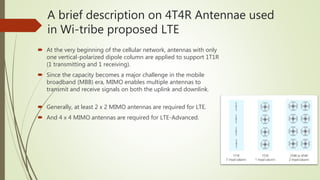
 At the very beginning of the cellular network, antennas with only
one vertical-polarized dipole column are applied to support 1T1R
(1 transmitting and 1 receiving).
 Since the capacity becomes a major challenge in the mobile
broadband (MBB) era, MIMO enables multiple antennas to
transmit and receive signals on both the uplink and downlink.
 Generally, at least 2 x 2 MIMO antennas are required for LTE.
 And 4 x 4 MIMO antennas are required for LTE-Advanced.
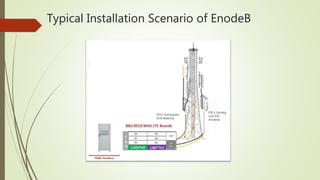
Typical Installation Scenario of EnodeB
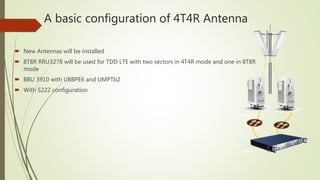
A basic configuration of 4T4R Antenna
 New Antennas will be installed
 8T8R RRU3278 will be used for TDD LTE with two sectors in 4T4R mode and one in 8T8R
mode
 BBU 3910 with UBBPE6 and UMPTb2
 With S222 configuration
BBU3900
2*RRU3278
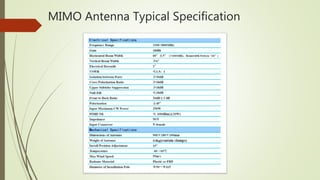
MIMO Antenna Typical Specification
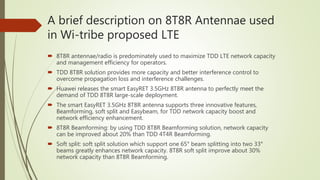
A brief description on 8T8R Antennae used
in Wi-tribe proposed LTE
 8T8R antennae/radio is predominately used to maximize TDD LTE network capacity
and management efficiency for operators.
 TDD 8T8R solution provides more capacity and better interference control to
overcome propagation loss and interference challenges.
 Huawei releases the smart EasyRET 3.5GHz 8T8R antenna to perfectly meet the
demand of TDD 8T8R large-scale deployment.
 The smart EasyRET 3.5GHz 8T8R antenna supports three innovative features,
Beamforming, soft split and Easybeam, for TDD network capacity boost and
network efficiency enhancement.
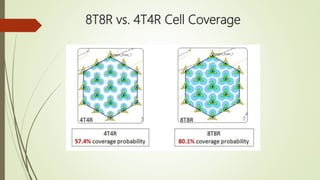
 8T8R Beamforming: by using TDD 8T8R Beamforming solution, network capacity
can be improved about 20% than TDD 4T4R Beamforming.
 Soft split: soft split solution which support one 65° beam splitting into two 33°
beams greatly enhances network capacity. 8T8R soft split improve about 30%
network capacity than 8T8R Beamforming.
8T8R vs. 4T4R Cell Coverage
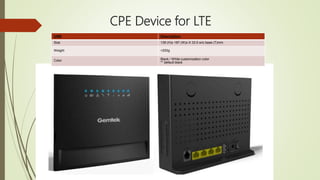
CPE Device for LTE
USB Description
Size 139 (H)x 187 (W)x X 33.5 w/o base (T)mm
Weight <200g
Color Black / White customization color
** default black
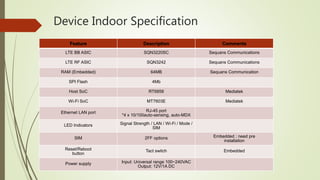
Device Indoor Specification
Feature Description Comments
LTE BB ASIC SQN3220SC Sequans Communications
LTE RF ASIC SQN3242 Sequans Communications
RAM (Embedded) 64MB Sequans Communication
SPI Flash 4Mb
Host SoC RT6856 Mediatek
Wi-Fi SoC MT7603E Mediatek
Ethernet LAN port RJ-45 port
*4 x 10/100auto-sensing, auto-MDX
LED Indicators Signal Strength / LAN / Wi-Fi / Mode /
SIM
SIM 2FF options Embedded ; need pre
installation
Reset/Reboot
button
Tact switch Embedded
Power supply Input: Universal range 100~240VAC
Output: 12V/1A DC
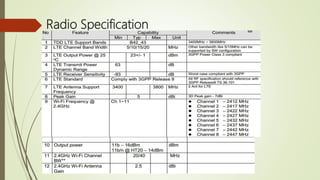
Radio Specification
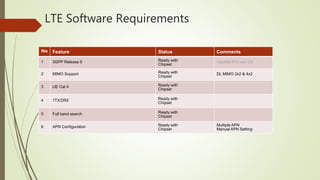
LTE Software Requirements
No Feature Status Comments
1 3GPP Release 9 Ready with
Chipset
capable R10 w/o CA
2 MIMO Support Ready with
Chipset
DL MIMO 2x2 & 4x2
3 UE Cat 4 Ready with
Chipset
4 1TX/2RX Ready with
Chipset
5 Full band search Ready with
Chipset
6 APN Configuration Ready with
Chipset
Multiple APN
Manual APN Setting
Questions
LTE quick introduction session Training

LTE quick introduction session Training

  • 1.
  • 2.
  • 3.
    A Brief LTEand LTE Advance Introduction  It is broadband network technology beyond 3G developed by 3GPP of release 8.  LTE is the next UMTS evolution step after HSPA and HSPA+.  It provides an end-to-end IP solution where voice, data and streamed multimedia can be served to users on an "Anytime, Anywhere" basis at higher data rates than previous generations.
  • 4.
    A brief lookon Cellular Network Technology(1G,2G,3G,Wimax &4G)
  • 5.
    First Generation (1G) 1G refers to the first generation of wireless telephone technology, mobile telecommunications which was first introduced in 1980s and completed in early 1990s.  It's Speed was upto 2.4kbps.  It allows the voice calls in 1 country.  1G network use Analog Signal.  AMPS was first launched in USA in 1G mobile systems.
  • 6.
     2G technologyrefers to the 2nd generation which is based on GSM (Global System for Mobile).  It was launched in Finland in the year 1991.  2G network use digital signals.  It’s data speed was upto 64kbps. Features Includes:  It enables services such as text messages, picture messages and MMS (multi media message).  It provides better quality and capacity . Second Generation (2G) TECHNOLOGY
  • 7.
    3rd Generation  3Gtechnology refer to third generation which was introduced in year 2000s.  Data Transmission speed increased from 144kbps- 2Mbps.  Typically called Smart Phones and features increased its bandwidth and data transfer rates to accommodate web-based applications and audio and video files.
  • 8.
    FEATURES OF 3GTECHNOLOGY  Providing Faster Communication  Send/Receive Large Email Messages  High Speed Web / More Security Video Conferencing / 3D Gaming  TV Streaming/ Mobile TV/ Phone Calls  Large Capacities and Broadband Capabilities  11 sec – 1.5 min. time to download a 3 min Mp3 song.
  • 9.
    4G (Anytime, Anywhere) The next generations of wireless technology that promises higher data rates and expanded multimedia services.  Capable to provide speed 100Mbps-1Gbps.  High QOS and High Security  Provide any kind of service at any time as per user requirements, anywhere. Features Include:  More Security  High Speed  High Capacity  Low Cost Per-bit etc.
  • 10.
    4G TECHNOLOGY Features 4G technology refer to or short name of fourth Generation which was started from late 2000s.  Capable of providing 100Mbps – 1Gbps speed.  One of the basic term used to describe 4G is MAGIC.  MAGIC:  Mobile Multimedia  Anytime Anywhere  Global Mobility Support  Integrated Wireless Solution  Customized Personal Services  Also known as Mobile Broadband Everywhere.
  • 11.
    Wimax Technology  WiMAXis also an acronym meaning “Worldwide Interoperability for Microwave Access (WiMAX)  WiMAX is an IP based, wireless broadband access technology Data Transmission speed increased from 144kbps- 2Mbps.  It provides performance similar to 802.11/Wi-Fi networks with the coverage and QOS (quality of service) of cellular networks.  WiMAX technology is offering very high speed broadband access to mobile internet. When you are using 20MHz the data rate can be high up to 74Mbps. you are using 20MHz the data rate can be high up to 74Mbps.  WiMAX technology is increasing rapidly because it supports lots of modulation and error correction facility to user. It also allowing a user that they could change the scheme according to channel condition. (AMC) Adaptive Modulation and Coding is a valuable method to exploit throughput in a varying channel.
  • 12.
    FEATURES OF WimaxTechnology  WiMAX broadband access  WiMAX offer high speed data rate  WiMAX offer modulation and error correction  WiMAX support reliability of data  WiMAX support TDD and FDD  WiMAX TDM scheme  WiMAX MAC layer.  WiMAX strong encryption  WiMAX mobility
  • 13.
    A Comparative FeaturesTable of different Generation Technology
  • 14.
    A Brief LTEand LTE Advance Introduction  It is broadband network technology beyond 3G developed by 3GPP of release 8.  LTE is the next UMTS evolution step after HSPA and HSPA+.  It provides an end-to-end IP solution where voice, data and streamed multimedia can be served to users on an "Anytime, Anywhere" basis at higher data rates than previous generations
  • 15.
    Wi-Max Vs LTEArchitecture LTE Architecture WiMAX Architecture
  • 16.
     • Peakdata rates for DL – 100 Mbps and peak UL data rates are 50Mbps.  • Up to 200 active users in a cell (5 MHz)  • Enhanced multimedia broadcast service.  • Spectrum flexibility: 1.25 ~ 20 MHz.  • Duplexing supports FDD & TDD.  • Spectral Efficiency – SC - FDMA & OFDMA.  • Modulation type : QPSK,QAM LTE Targets
  • 17.
    LTE Major Specifications LTEbasic Specifications Parameter Details Peak downlink speed 64QAM (Mbps) 100 (SISO), 172 (2x2 MIMO), 326 (4x4 MIMO) Peak uplink speeds (Mbps) 50 (QPSK), 57 (16QAM), 86 (64QAM) Data type All packet switched data (voice and data). No circuit switched. Channel bandwidths (MHz) 1.4, 3, 5, 10, 15, 20 Duplex schemes FDD and TDD Mobility 0 - 15 km/h (optimised), 15 - 120 km/h (high performance) Latency Idle to active less than 100ms Small packets ~10 ms Spectral efficiency Downlink: 3 - 4 times Rel 6 HSDPA Uplink: 2 -3 x Rel 6 HSUPA Access schemes OFDMA (Downlink) SC-FDMA (Uplink) Modulation types supported QPSK, 16QAM, 64QAM (Uplink and downlink)
  • 18.
    A Quick lookon difference b/w LTE and LTE Advance Specifications LTE LTE Advanced Standard 3GPP Release 9 3GPP Release 10 Bandwidth supports 1.4MHz, 3.0MHz, 5MHz, 10MHz, 15MHz, 20MHz 70MHz Downlink(DL), 40MHz Uplink(UL) Data rate 300 Mbps Downlink(DL) 4x4MIMO and 20MHz, 75 Mbps Uplink(UL) 1Gbps Downlink(DL), 500 Mbps Uplink(UL) Theoretical Throughput About 100Mbps for single chain(20MHz,100RB,64QAM), 400Mbps for 4x4 MIMO. 25% os this is used for control/signaling(OVERHEAD) 2 times than LTE Maximum No. of Layers 2(category-3) and 4(category-4,5) in the downlink, 1 in the uplink 8 in the downlink, 4 in the uplink Maximum No. of codewords 2 in the downlink, 1 in the uplink 2 in the downlink, 2 in the uplink Spectral Efficiency(peak,b/s/Hz) 16.3 for 4x4 MIMO in the downlink, 4.32 for 64QAM SISO case in the Uplink 30 for 8x8 MIMO in the downlink, 15 for 4x4 MIMO in the Uplink PUSCH and PUCCH transmission Simultaneously not allowed Simultaneously allowed Modulation schemes supported QPSK, 16QAM, 64QAM QPSK, 16QAM, 64QAM Access technique OFDMA (DL),DFTS-OFDM (UL) Hybrid OFDMA(DL), SC-FDMA(UL) carrier aggregation Not supported Supported Applications Mobile broadband and VOIP Mobile broadband and VOIP
  • 19.
    Major Difference inLTE and existing Wi- Max LTE-Advance Wi-Max LTE-A uses different channels bandwidth from 1.4 MHz to 100 MHz WiMAX uses channels bandwidths up to 40 MHz LTE uses different modulation for uplink (SC-FDMA) and downlink (OFDMA). WiMAX uses the same modulation for both uplink and downlink – SOFDMA LTE frame duration is 10 ms. Wi-Max frame duration is 5 ms. LTE is compatible and enables coexistence and roaming between LTE and 3G. WiMAX network doesn’t support legacy systems like 2G and 3G. Sector Coverage ranges up to 1.5 KM. Wi-Max sector coverage ranges up to 6 KM Capable of supporting up to 200 users per 5MHz. Capable of supporting up to 100 users per 10MHz.
  • 20.
    Advantages of LTEover Wi-max  LTE-A is only true 4G technology.  LTE is back compatible with previous mobile technologies like GSM, GPRS, UMTS, EDGE, WCDMA, HSPA, CDMA-one, CDMA2000, EV-DO, EV-DV and the synchronous SC-CDMA  LTE enables much greater speed for its mobile users – up to 450 km/h  LTE is a better technology in regards to power consumption of mobile devices due to use of SC-FDMA for uplink
  • 21.
    Spectral Efficiency inLTE-Advance  Spectrum efficiency or bandwidth efficiency refers to the information rate that can be transmitted over a given bandwidth in a specific communication system.  It is a measure of the quantity of users or services that can be simultaneously supported by a limited radio frequency bandwidth in a defined geographic area.  It may for example be defined as the maximum aggregated throughput.  spectral efficiency of a digital communication system is measured in bit/s/Hz
  • 22.
    Carrier Aggregation inLTE-Advanced  One of the major features of LTE-Advanced is Carrier Aggregation.  It allows mobile network operators to combine a number of separate LTE carriers.  It enables them to increase the peak user data rates and overall capacity of their networks and to exploit fragmented spectrum allocations.  Carrier aggregation is used in LTE-Advanced in order to increase the bandwidth, and thereby increase the bitrate.  The target figures for data throughput in the downlink is 1 Gbps for 4G LTE Advanced.  Each aggregated carrier is referred to as a component carrier.  The component carrier can have a bandwidth of 1.4, 3, 5, 10, 15 or 20 MHz and a maximum of five component carriers can be aggregated.  The number of aggregated carriers can be different in DL and UL, however the number of UL component carriers is never larger than the number of DL component carriers.
  • 23.
  • 24.
    Significance of CarrierAggregation  Increasing the number of users and the total bandwidth supported in both the downlink and the uplink.  Supporting a greater number of frequency bands and combinations of frequency bands.  Using Carrier Aggregation between cells to enhance the support of small cells and Heterogeneous Networks  Enabling flexible aggregation of FDD and TDD LTE carriers.  Supporting LTE Carrier Aggregation between licensed and unlicensed spectrum.
  • 25.
    A Brief Lookon MIMO Feature in LTE  MIMO: Multiple Input Multiple Output technology is uses multiple antennas to make use of reflected signals to provide gains in channel robustness and throughput.  A major change in LTE-Advanced is the introduction of 8x8 MIMO in the DL and 4x4 in the UL.  MIMO can be used when S/N (Signal to Noise ratio) is high, i.e. high quality radio channel.  MIMO system was used to limit the degradation caused by multipath propagation.  MIMO is effectively a radio antenna technology as it uses multiple antennas at the transmitter and receiver to enable a variety of signal paths to carry the data, choosing separate paths for each antenna to enable multiple signal paths to be used.
  • 26.
    A brief descriptionon 4T4R Antennae used in Wi-tribe proposed LTE  At the very beginning of the cellular network, antennas with only one vertical-polarized dipole column are applied to support 1T1R (1 transmitting and 1 receiving).  Since the capacity becomes a major challenge in the mobile broadband (MBB) era, MIMO enables multiple antennas to transmit and receive signals on both the uplink and downlink.  Generally, at least 2 x 2 MIMO antennas are required for LTE.  And 4 x 4 MIMO antennas are required for LTE-Advanced.
  • 27.
  • 28.
    A basic configurationof 4T4R Antenna  New Antennas will be installed  8T8R RRU3278 will be used for TDD LTE with two sectors in 4T4R mode and one in 8T8R mode  BBU 3910 with UBBPE6 and UMPTb2  With S222 configuration BBU3900 2*RRU3278
  • 29.
    MIMO Antenna TypicalSpecification
  • 30.
    A brief descriptionon 8T8R Antennae used in Wi-tribe proposed LTE  8T8R antennae/radio is predominately used to maximize TDD LTE network capacity and management efficiency for operators.  TDD 8T8R solution provides more capacity and better interference control to overcome propagation loss and interference challenges.  Huawei releases the smart EasyRET 3.5GHz 8T8R antenna to perfectly meet the demand of TDD 8T8R large-scale deployment.  The smart EasyRET 3.5GHz 8T8R antenna supports three innovative features, Beamforming, soft split and Easybeam, for TDD network capacity boost and network efficiency enhancement.  8T8R Beamforming: by using TDD 8T8R Beamforming solution, network capacity can be improved about 20% than TDD 4T4R Beamforming.  Soft split: soft split solution which support one 65° beam splitting into two 33° beams greatly enhances network capacity. 8T8R soft split improve about 30% network capacity than 8T8R Beamforming.
  • 31.
    8T8R vs. 4T4RCell Coverage
  • 32.
    CPE Device forLTE USB Description Size 139 (H)x 187 (W)x X 33.5 w/o base (T)mm Weight <200g Color Black / White customization color ** default black
  • 33.
    Device Indoor Specification FeatureDescription Comments LTE BB ASIC SQN3220SC Sequans Communications LTE RF ASIC SQN3242 Sequans Communications RAM (Embedded) 64MB Sequans Communication SPI Flash 4Mb Host SoC RT6856 Mediatek Wi-Fi SoC MT7603E Mediatek Ethernet LAN port RJ-45 port *4 x 10/100auto-sensing, auto-MDX LED Indicators Signal Strength / LAN / Wi-Fi / Mode / SIM SIM 2FF options Embedded ; need pre installation Reset/Reboot button Tact switch Embedded Power supply Input: Universal range 100~240VAC Output: 12V/1A DC
  • 34.
  • 35.
    LTE Software Requirements NoFeature Status Comments 1 3GPP Release 9 Ready with Chipset capable R10 w/o CA 2 MIMO Support Ready with Chipset DL MIMO 2x2 & 4x2 3 UE Cat 4 Ready with Chipset 4 1TX/2RX Ready with Chipset 5 Full band search Ready with Chipset 6 APN Configuration Ready with Chipset Multiple APN Manual APN Setting
  • 36.

Editor's Notes