LOGISTIC REGRESSION
Presented by
Mr. Vijay Singh Rawat
Ms. Shweta
(Research Scholar)
Ph. D
Course work 2017-18
Lakshmibai National Institute of Physical Education, Gwalior, India
(Deemed to be University)
INTRODUCTION
• Logistic regression is a predictive analysis.
• Used in a situation when a researcher is interested to predict
the occurrence of any happenings.
Objective of Logistic Regression
• The objective of Logistic regression is to find the best fitting
model to describe the relationship between the dichotomous
characteristics of interest and a set of independent variables.
Continuous vs. Categorical variables
• Independent variables (x):
– Continuous: age, income, height- use numerical value.
– Categorical: gender, city, ethnicity – use dummies
• Dependent variable (y):
– continuous: consumption, time spend- use numerical value
– categorical: yes/ no
Examples of Binary Outcomes
• Should a bank give a person loan or not.
• What determines admittance into a school.
• Which consumers are more likely to buy a new product.
Uses of Logistic Regression
• Prediction of group membership
• It is also provides knowledge of the relationship and strength
among the variables.
• Casual relationship between one or more independent
variables and one binary dependent variables.
• Used to forecast the outcome event.
• Used to predict changes in probabilities.
Assumptions
• The relationship between the dependent and independent
variable may be linear or non-linear.
• The outcome variable must be coded as 0 and 1.
• The independent variable do not need to be metric.
• Independent variable linearly related to the log odds.
• It requires quit large sample size.
Key terms in Logistic Regression
• Dependent variable
– It is binary in nature.
• Independent variable
– Select the different variables that you expect to influence
the dependent variable.
• Hosmer-lemeshow test
– It is commonly used measure of goodness of fit.
• Odd ratio
– It is the ratio of the probability of success to the probability
of failure.
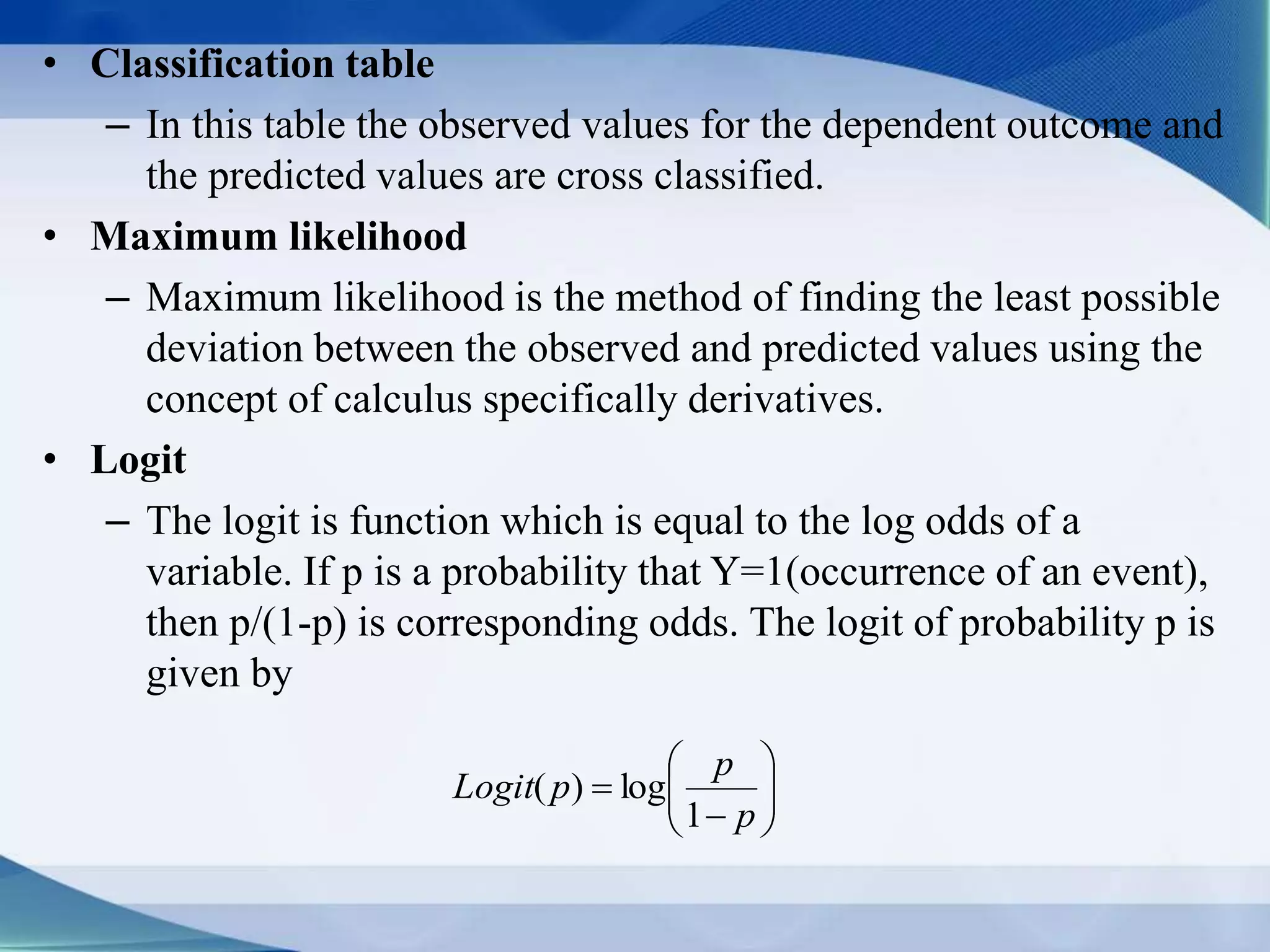
• Classification table
– In this table the observed values for the dependent outcome and
the predicted values are cross classified.
• Maximum likelihood
– Maximum likelihood is the method of finding the least possible
deviation between the observed and predicted values using the
concept of calculus specifically derivatives.
• Logit
– The logit is function which is equal to the log odds of a
variable. If p is a probability that Y=1(occurrence of an event),
then p/(1-p) is corresponding odds. The logit of probability p is
given by








p
p
pLogit
1
log)(
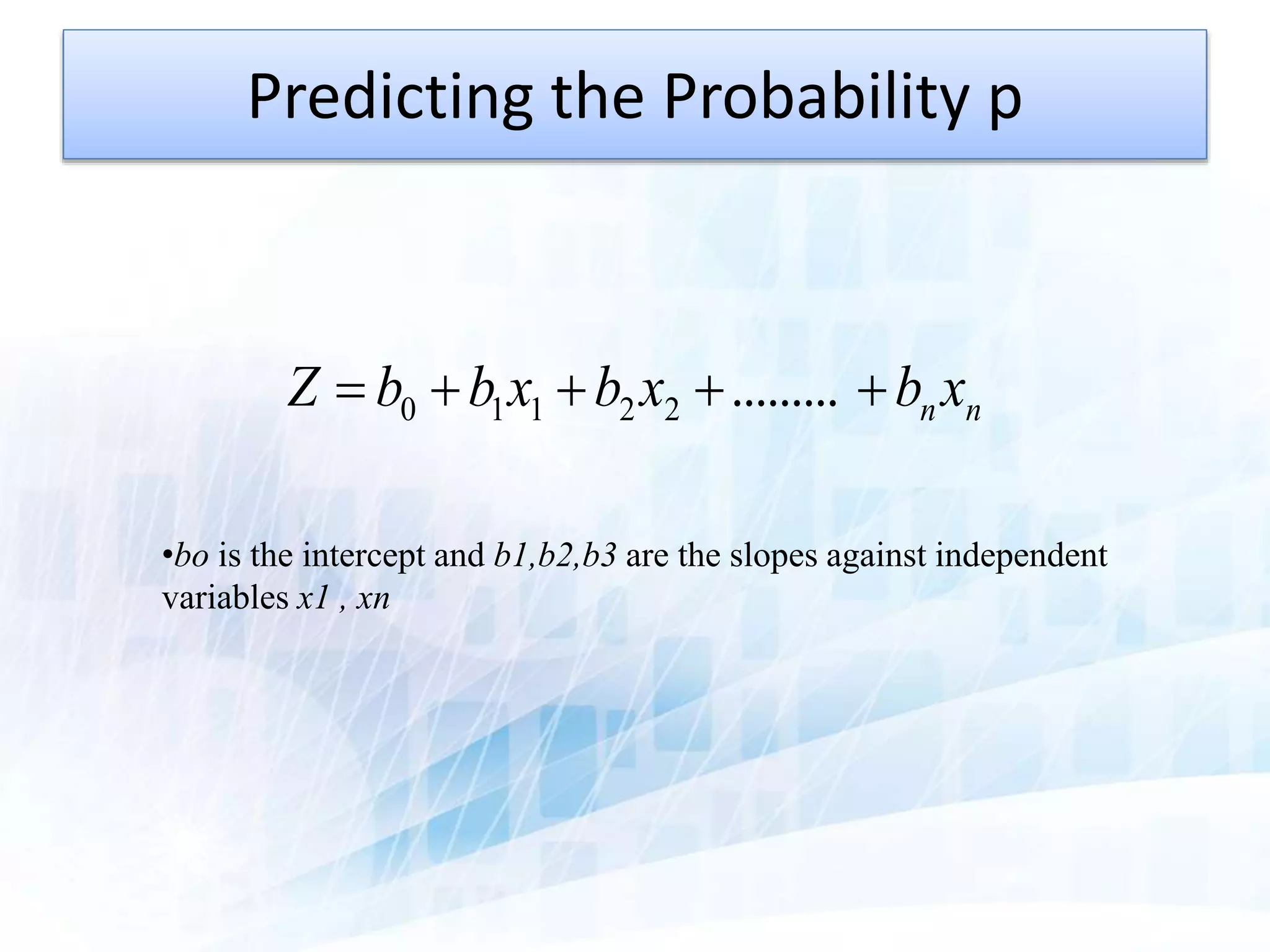
Predicting the Probability p
nn xbxbxbbZ  .........22110
•bo is the intercept and b1,b2,b3 are the slopes against independent
variables x1 , xn
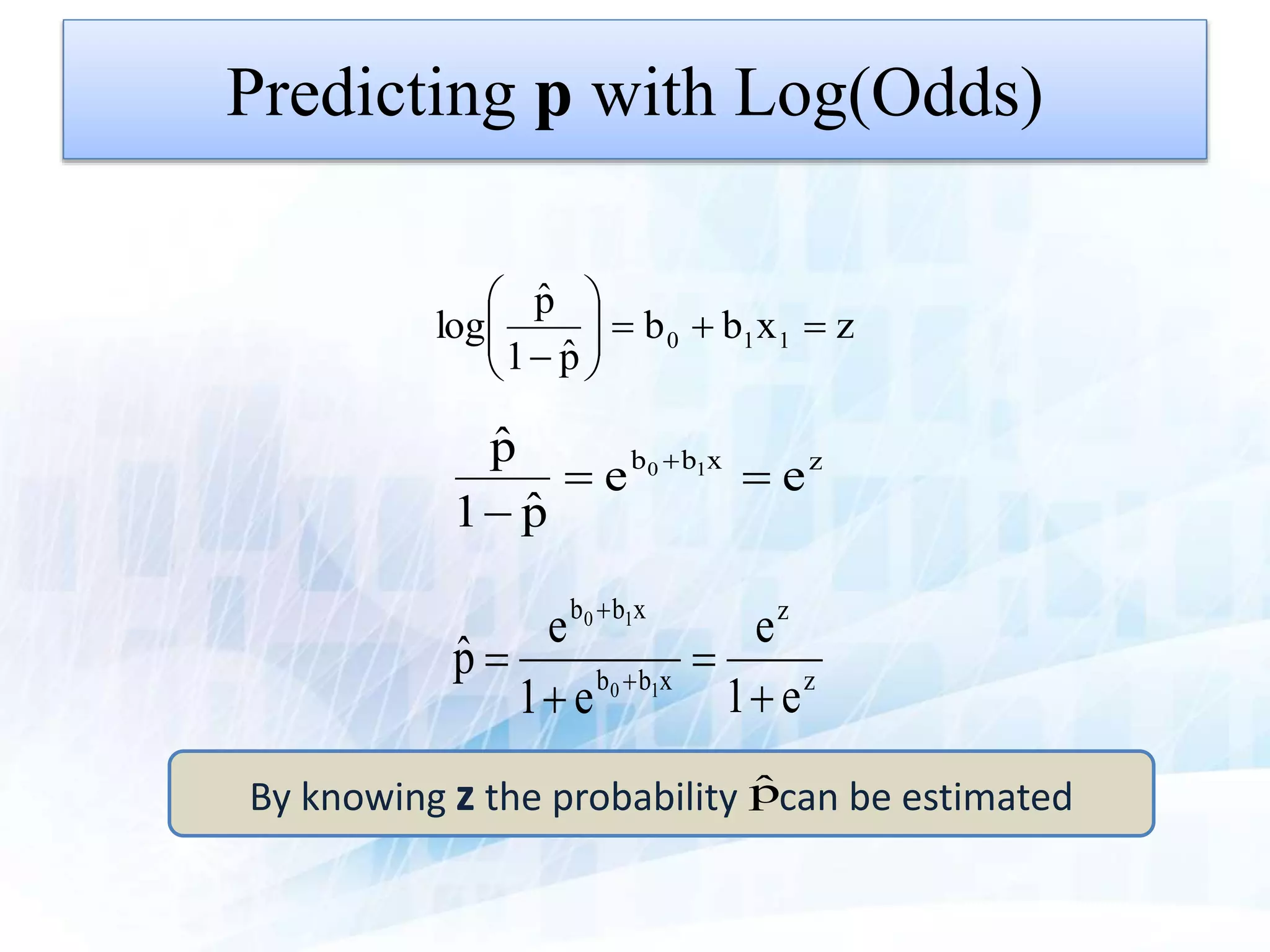
Predicting p with Log(Odds)
zxbb
pˆ1
pˆ
log 110 






zxbb
ee
pˆ1
pˆ 10



z
z
xbb
xbb
e1
e
e1
e
pˆ
10
10



 

By knowing z the probability can be estimatedpˆ
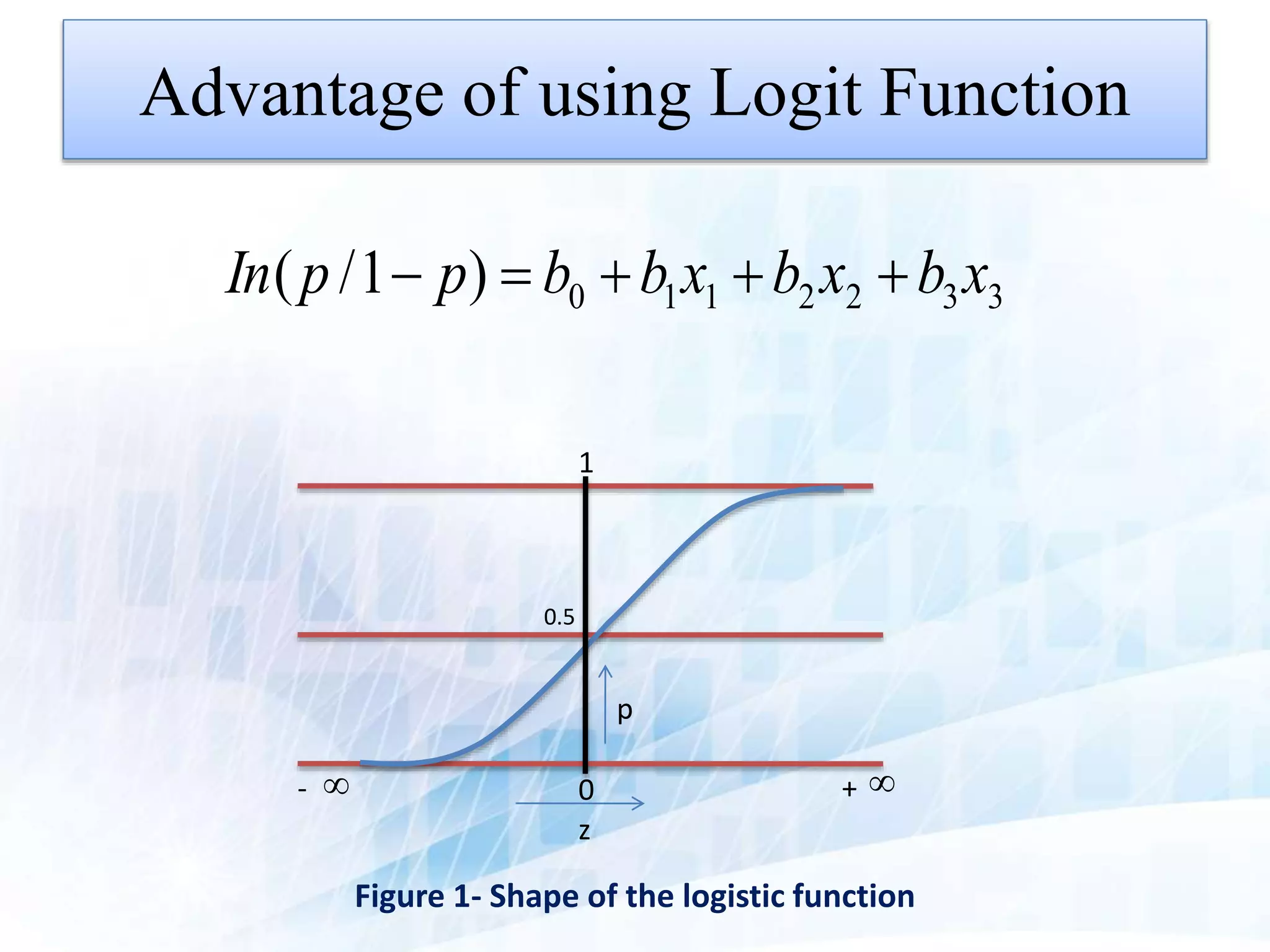
Advantage of using Logit Function
3322110)1/( xbxbxbbppIn 
+-
0.5
p
1
z
0
Figure 1- Shape of the logistic function
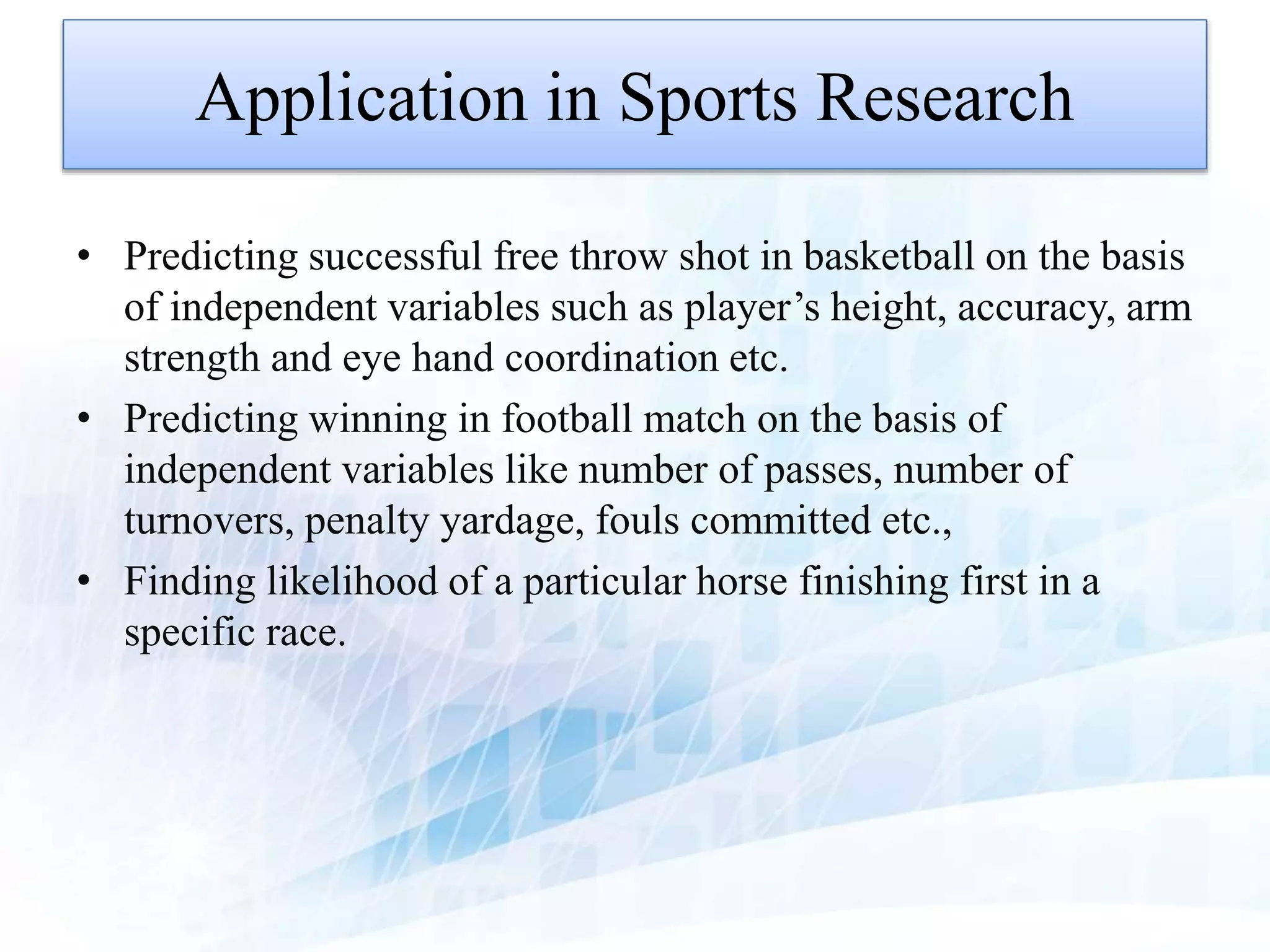
Application in Sports Research
• Predicting successful free throw shot in basketball on the basis
of independent variables such as player’s height, accuracy, arm
strength and eye hand coordination etc.
• Predicting winning in football match on the basis of
independent variables like number of passes, number of
turnovers, penalty yardage, fouls committed etc.,
• Finding likelihood of a particular horse finishing first in a
specific race.
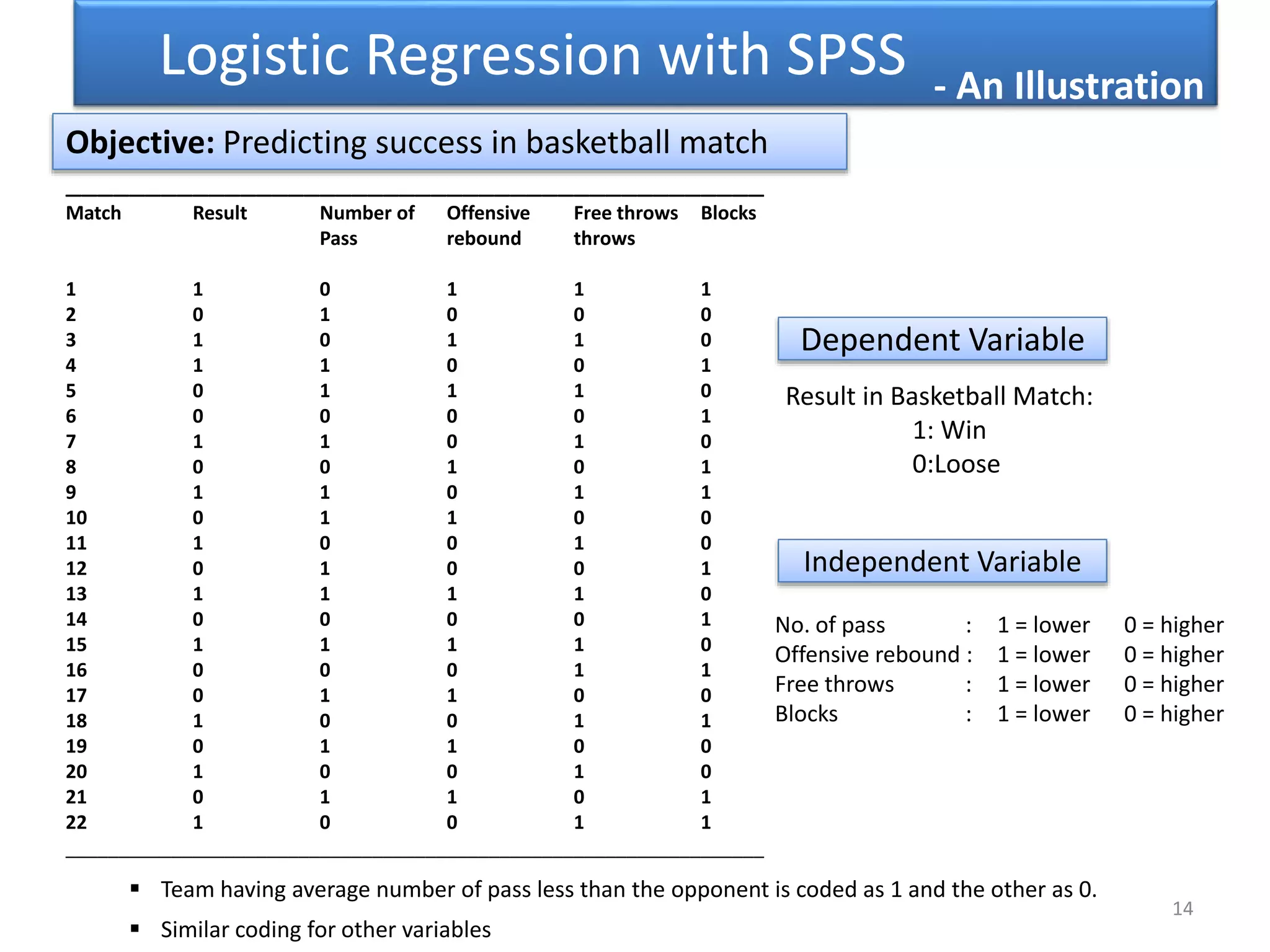
Logistic Regression with SPSS
Objective: Predicting success in basketball match
____________________________________________
Match Result Number of Offensive Free throws Blocks
Pass rebound throws
1 1 0 1 1 1
2 0 1 0 0 0
3 1 0 1 1 0
4 1 1 0 0 1
5 0 1 1 1 0
6 0 0 0 0 1
7 1 1 0 1 0
8 0 0 1 0 1
9 1 1 0 1 1
10 0 1 1 0 0
11 1 0 0 1 0
12 0 1 0 0 1
13 1 1 1 1 0
14 0 0 0 0 1
15 1 1 1 1 0
16 0 0 0 1 1
17 0 1 1 0 0
18 1 0 0 1 1
19 0 1 1 0 0
20 1 0 0 1 0
21 0 1 1 0 1
22 1 0 0 1 1
__________________________________________________________________
Dependent Variable
Independent Variable
Result in Basketball Match:
1: Win
0:Loose
No. of pass : 1 = lower 0 = higher
Offensive rebound : 1 = lower 0 = higher
Free throws : 1 = lower 0 = higher
Blocks : 1 = lower 0 = higher
 Team having average number of pass less than the opponent is coded as 1 and the other as 0.
 Similar coding for other variables
- An Illustration
14
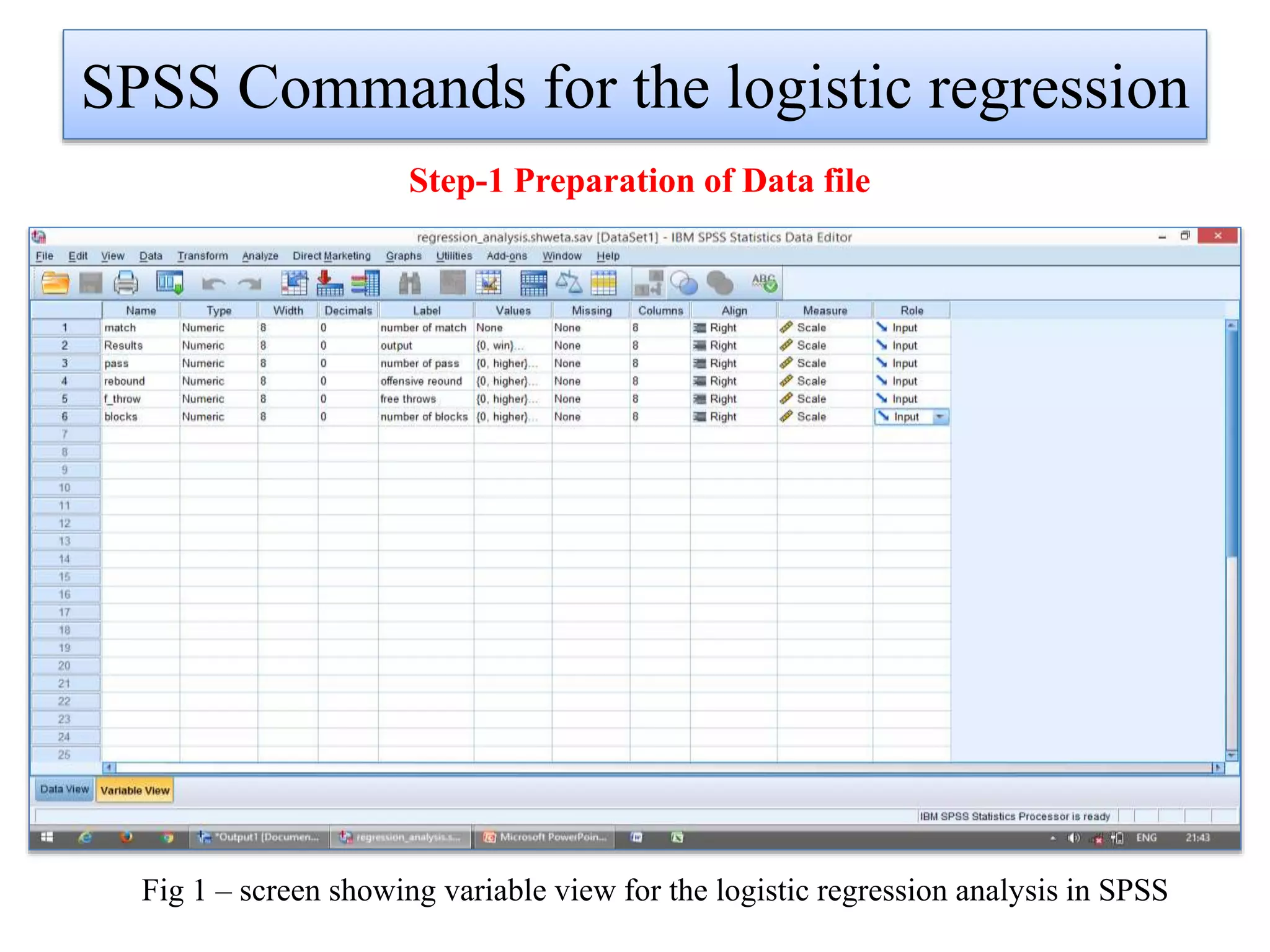
SPSS Commands for the logistic regression
Step-1 Preparation of Data file
Fig 1 – screen showing variable view for the logistic regression analysis in SPSS
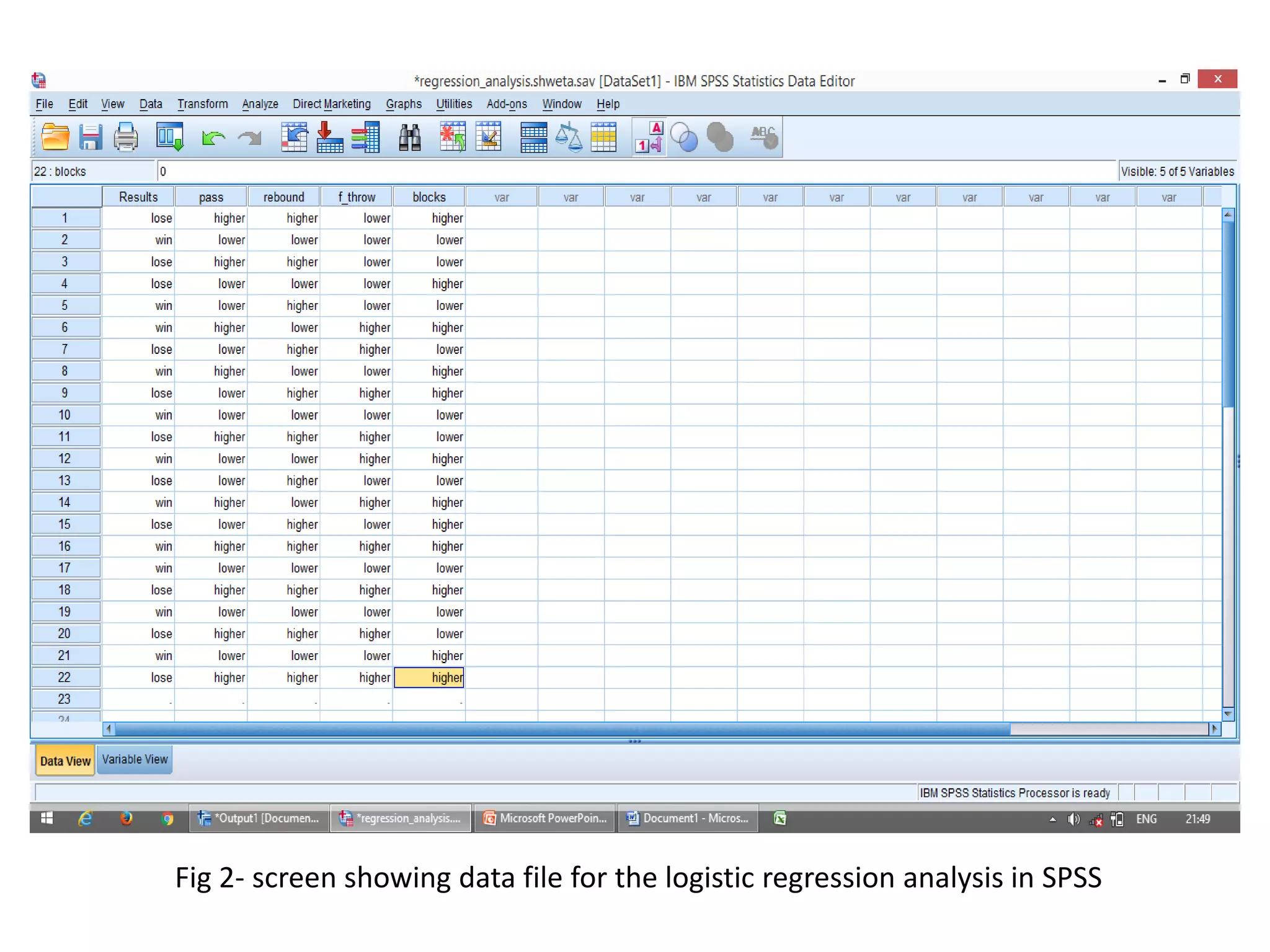
Fig 2- screen showing data file for the logistic regression analysis in SPSS
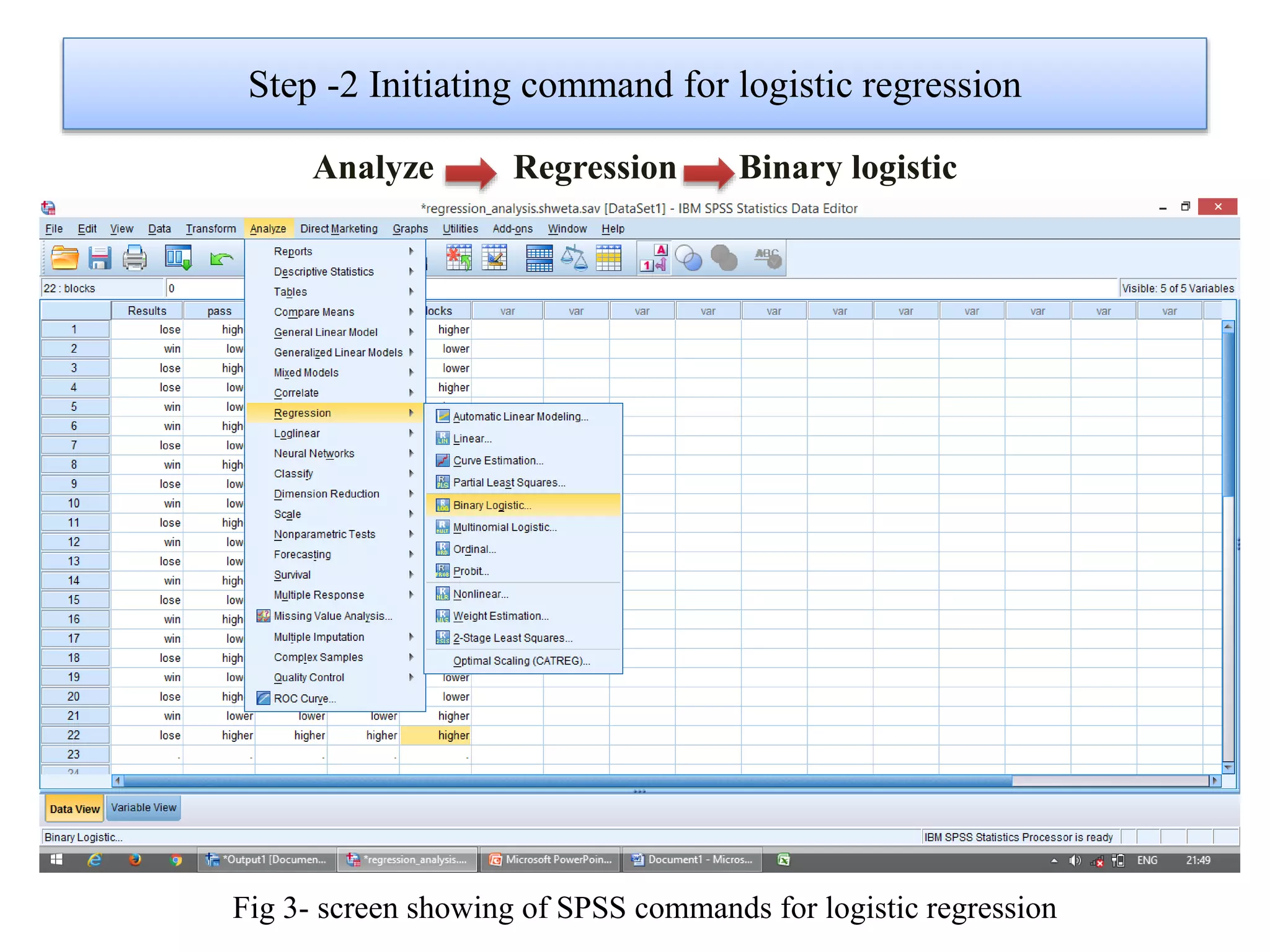
Step -2 Initiating command for logistic regression
Fig 3- screen showing of SPSS commands for logistic regression
Analyze Regression Binary logistic
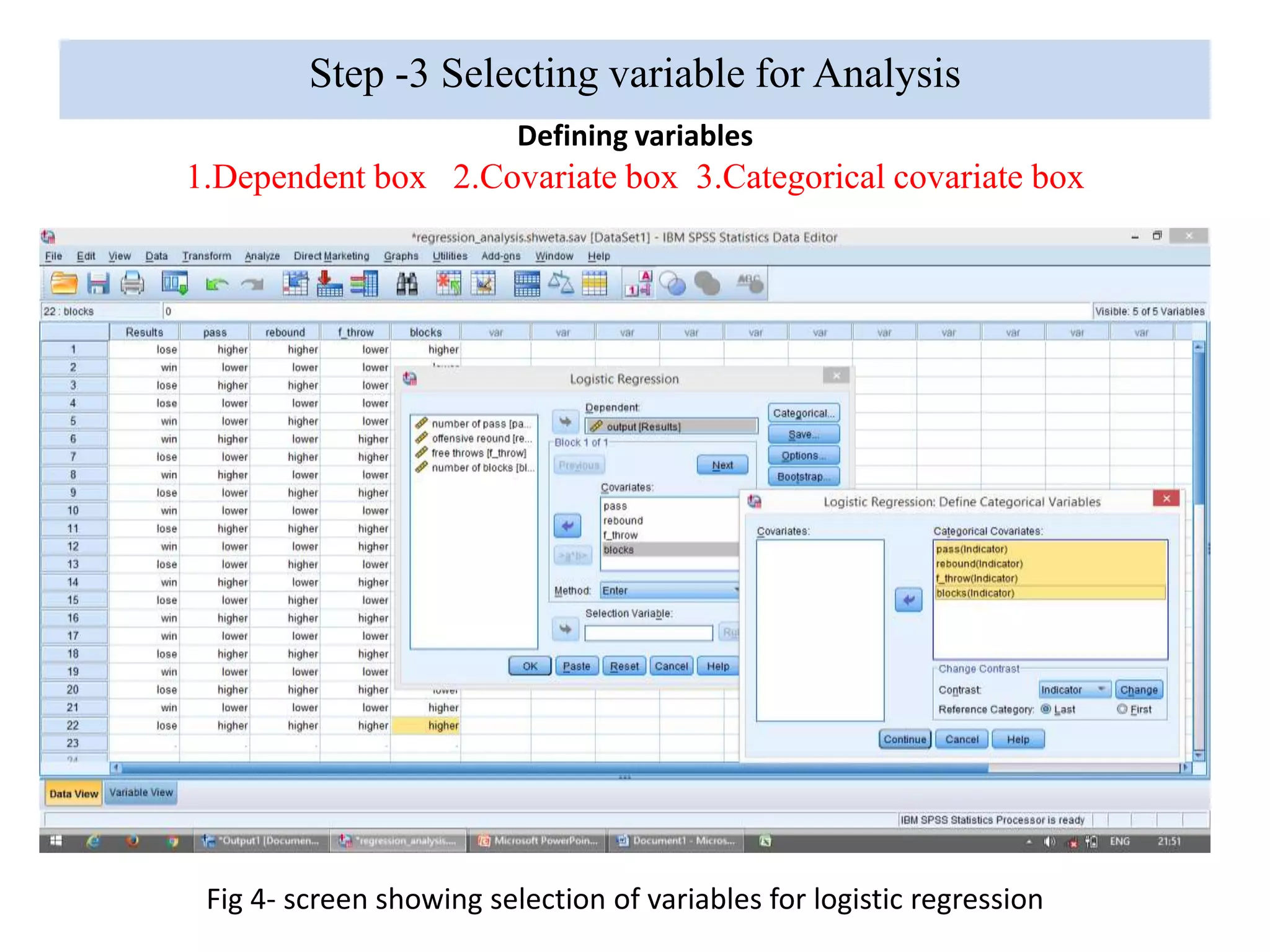
Fig 4- screen showing selection of variables for logistic regression
Defining variables
1.Dependent box 2.Covariate box 3.Categorical covariate box
Step -3 Selecting variable for Analysis
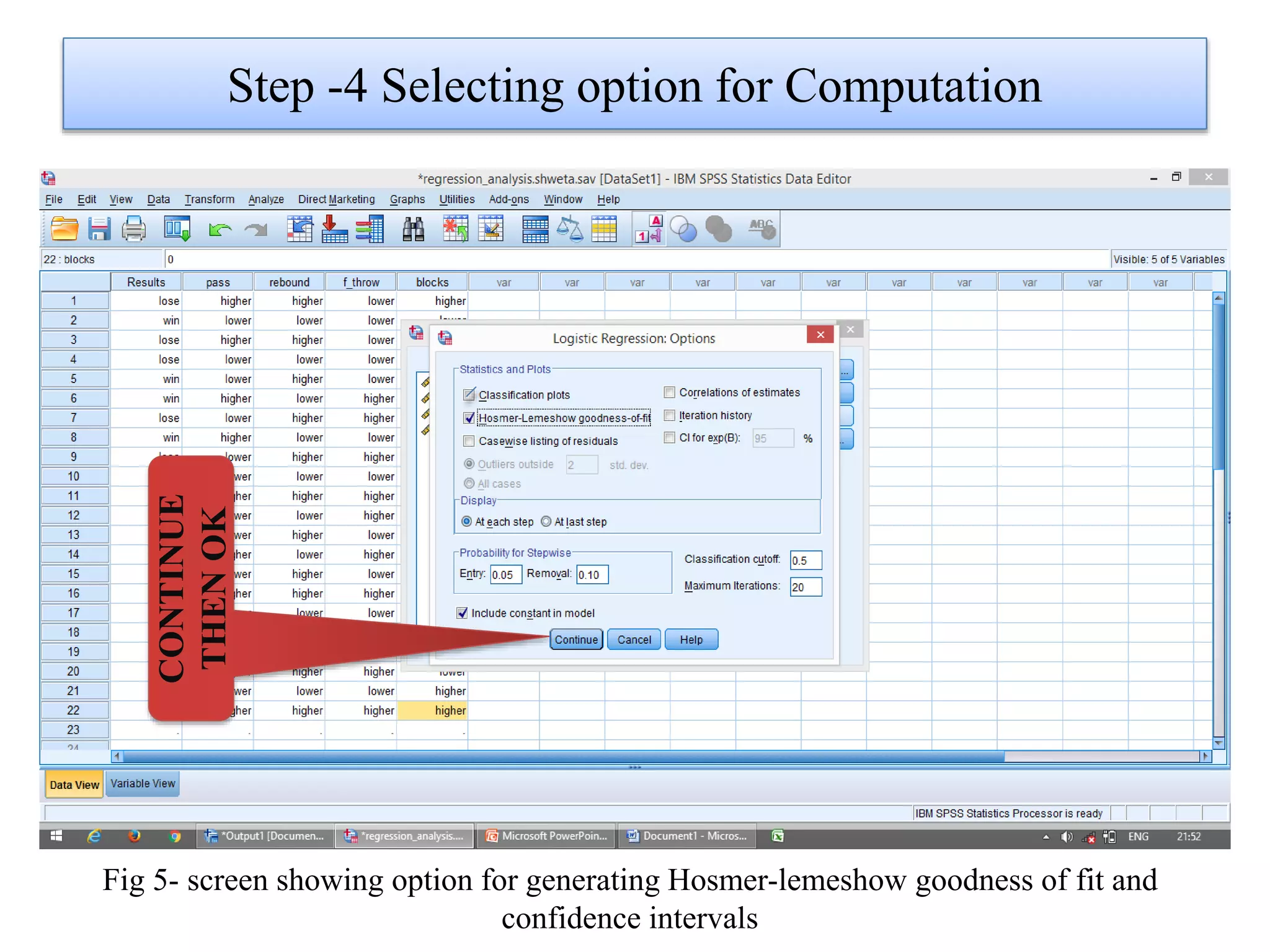
Step -4 Selecting option for Computation
Fig 5- screen showing option for generating Hosmer-lemeshow goodness of fit and
confidence intervals
CONTINUE
THENOK
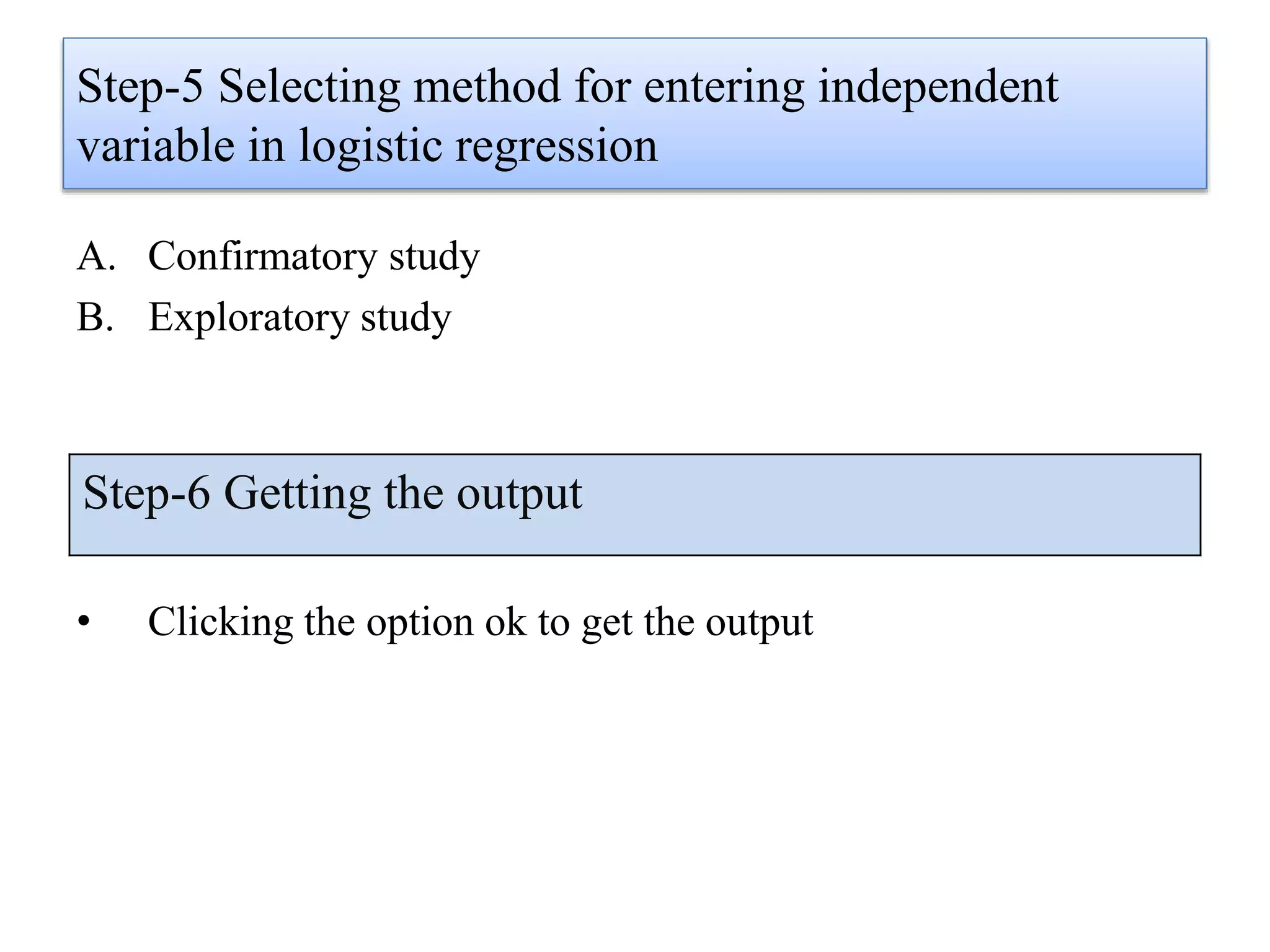
Step-5 Selecting method for entering independent
variable in logistic regression
A. Confirmatory study
B. Exploratory study
• Clicking the option ok to get the output
Step-6 Getting the output
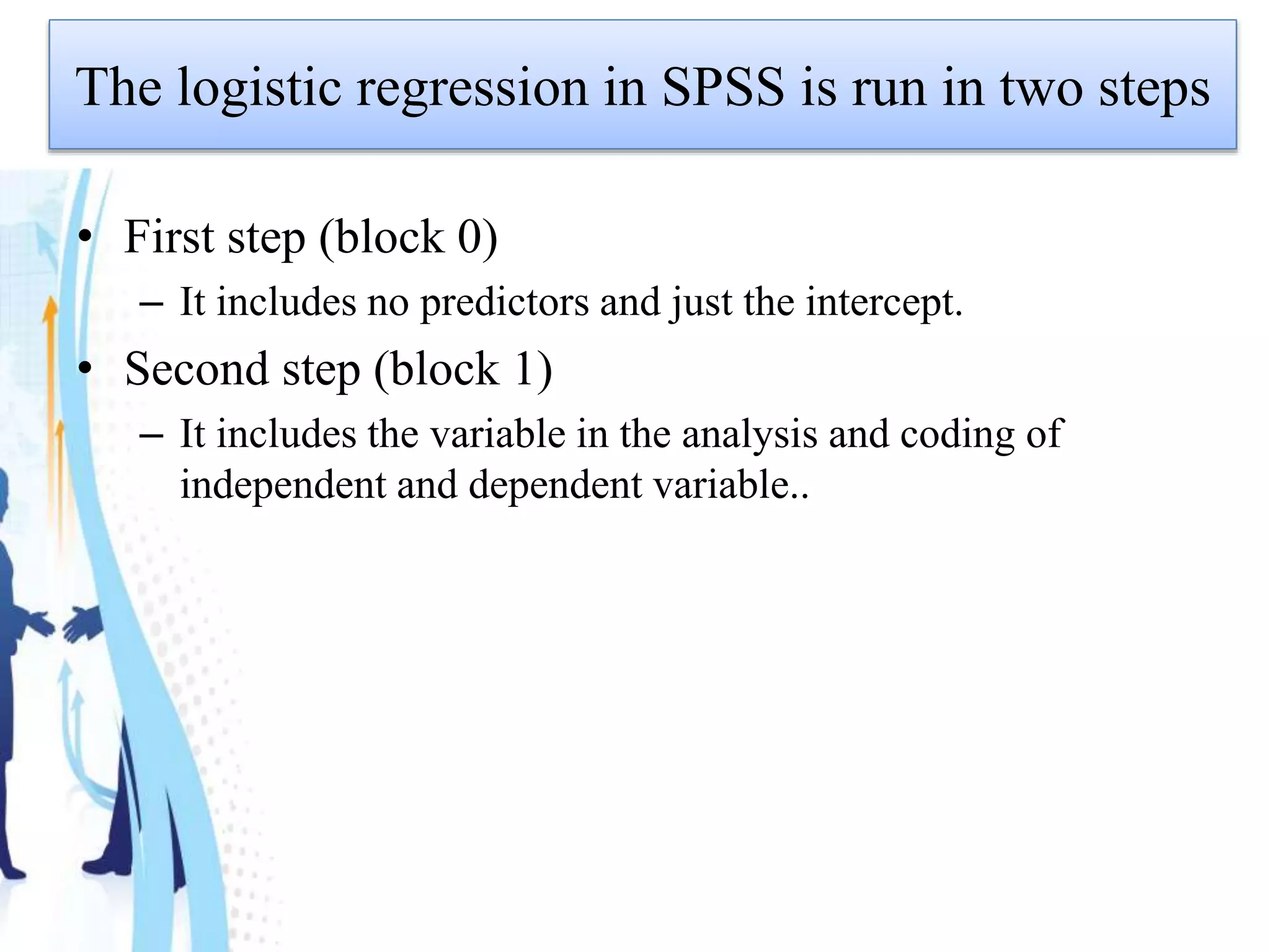
The logistic regression in SPSS is run in two steps
• First step (block 0)
– It includes no predictors and just the intercept.
• Second step (block 1)
– It includes the variable in the analysis and coding of
independent and dependent variable..
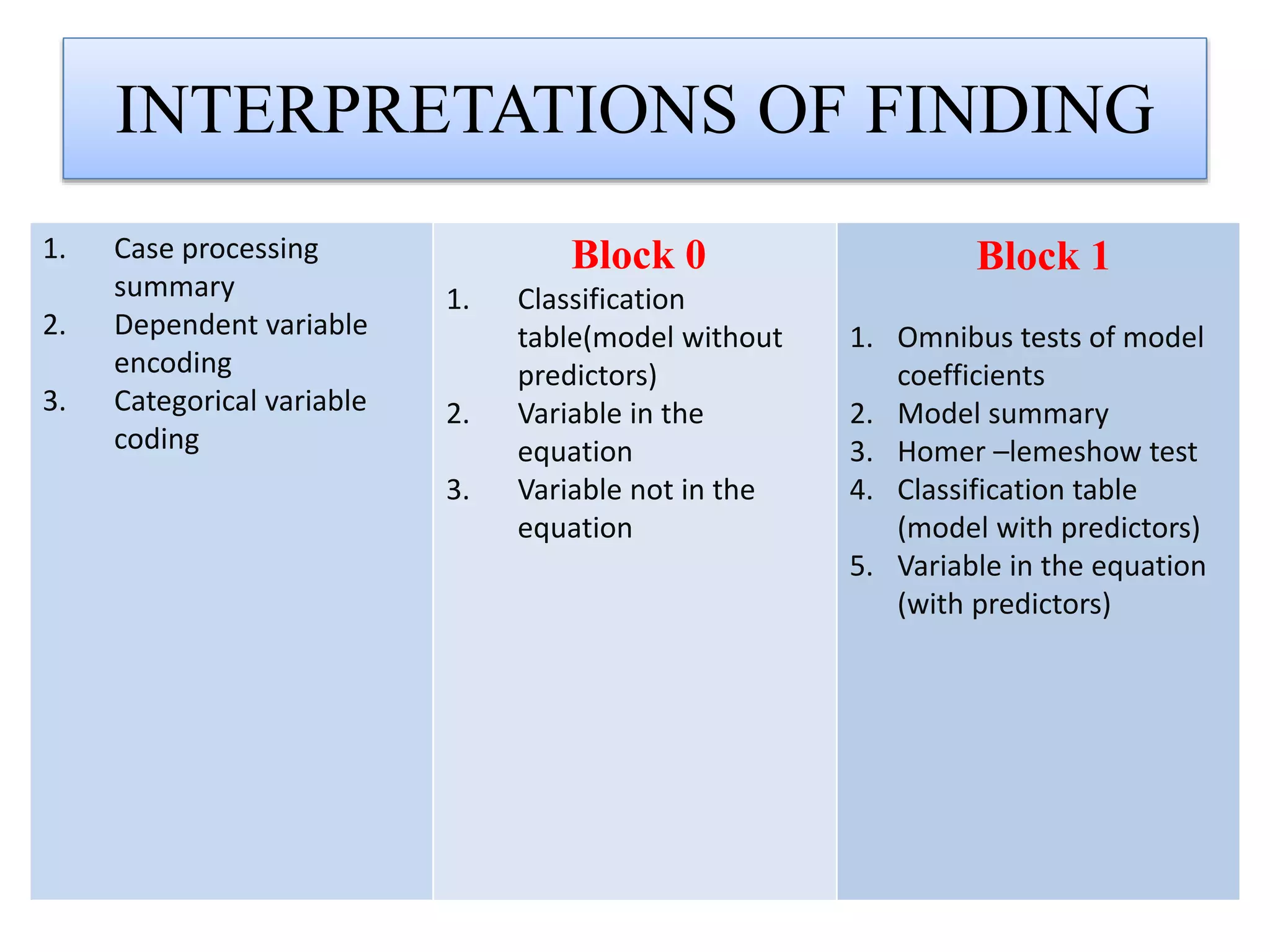
INTERPRETATIONS OF FINDING
1. Case processing
summary
2. Dependent variable
encoding
3. Categorical variable
coding
Block 0
1. Classification
table(model without
predictors)
2. Variable in the
equation
3. Variable not in the
equation
Block 1
1. Omnibus tests of model
coefficients
2. Model summary
3. Homer –lemeshow test
4. Classification table
(model with predictors)
5. Variable in the equation
(with predictors)
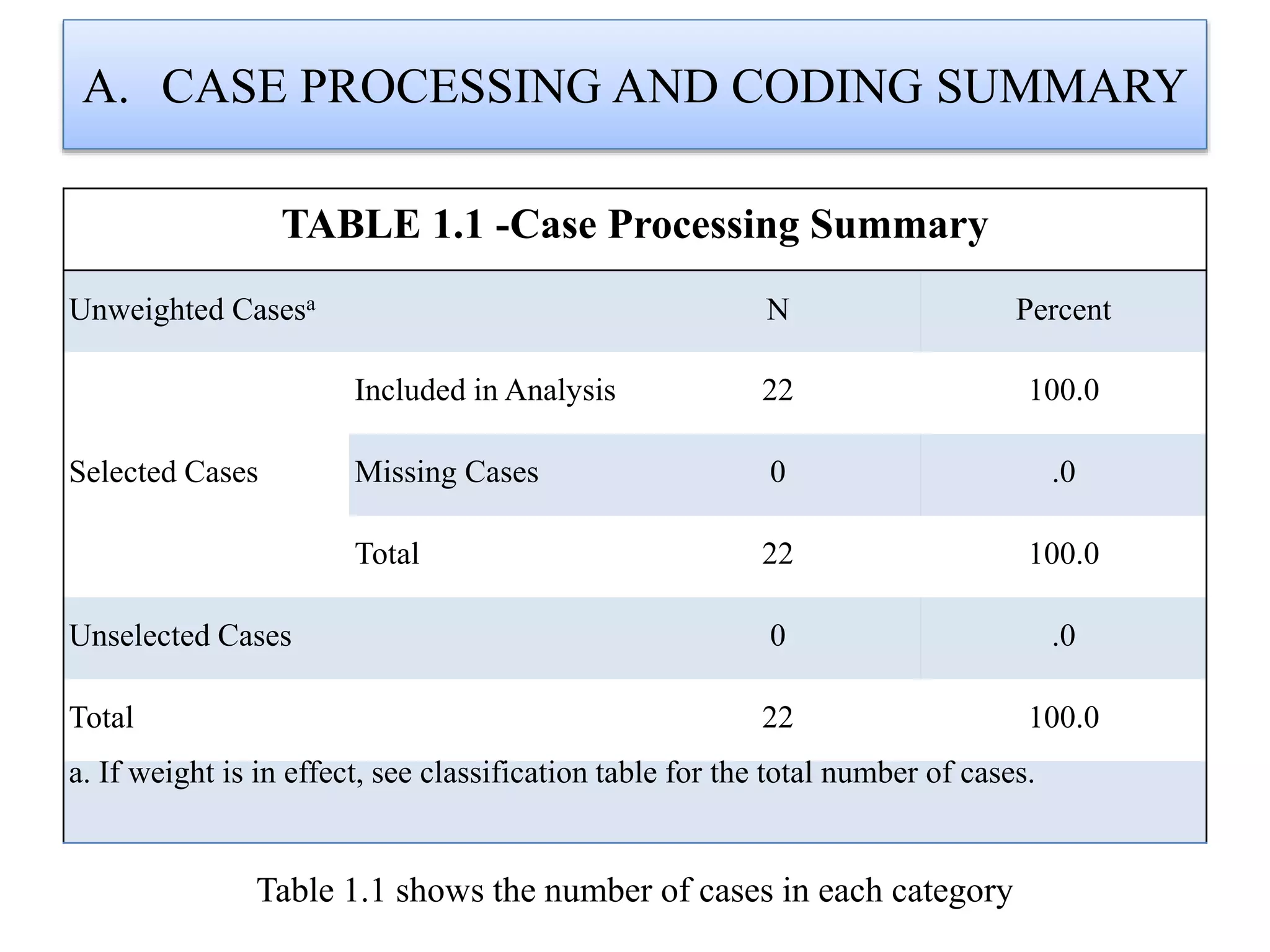
A. CASE PROCESSING AND CODING SUMMARY
TABLE 1.1 -Case Processing Summary
Unweighted Casesa N Percent
Selected Cases
Included in Analysis 22 100.0
Missing Cases 0 .0
Total 22 100.0
Unselected Cases 0 .0
Total 22 100.0
a. If weight is in effect, see classification table for the total number of cases.
Table 1.1 shows the number of cases in each category
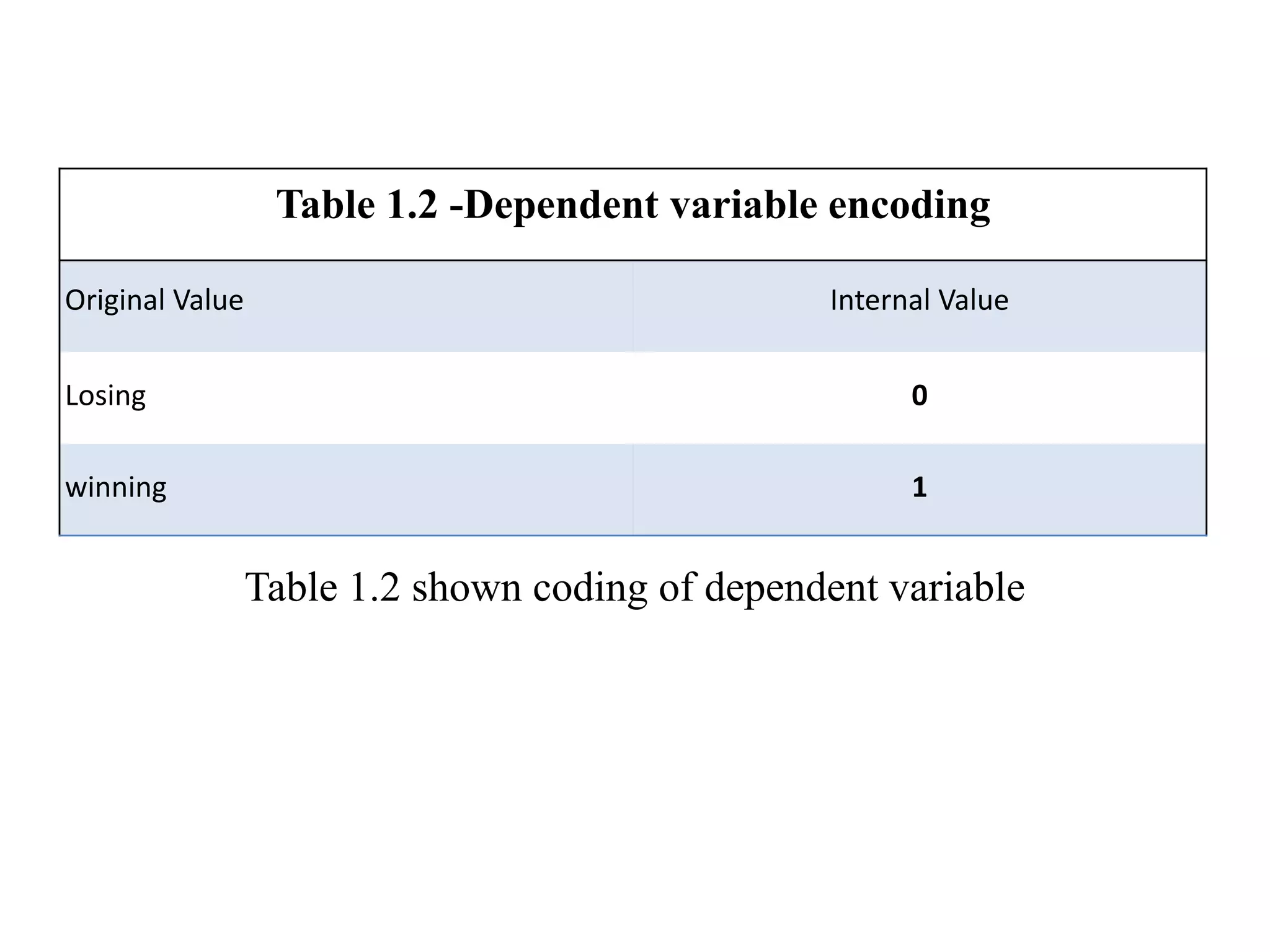
Table 1.2 shown coding of dependent variable
Table 1.2 -Dependent variable encoding
Original Value Internal Value
Losing 0
winning 1
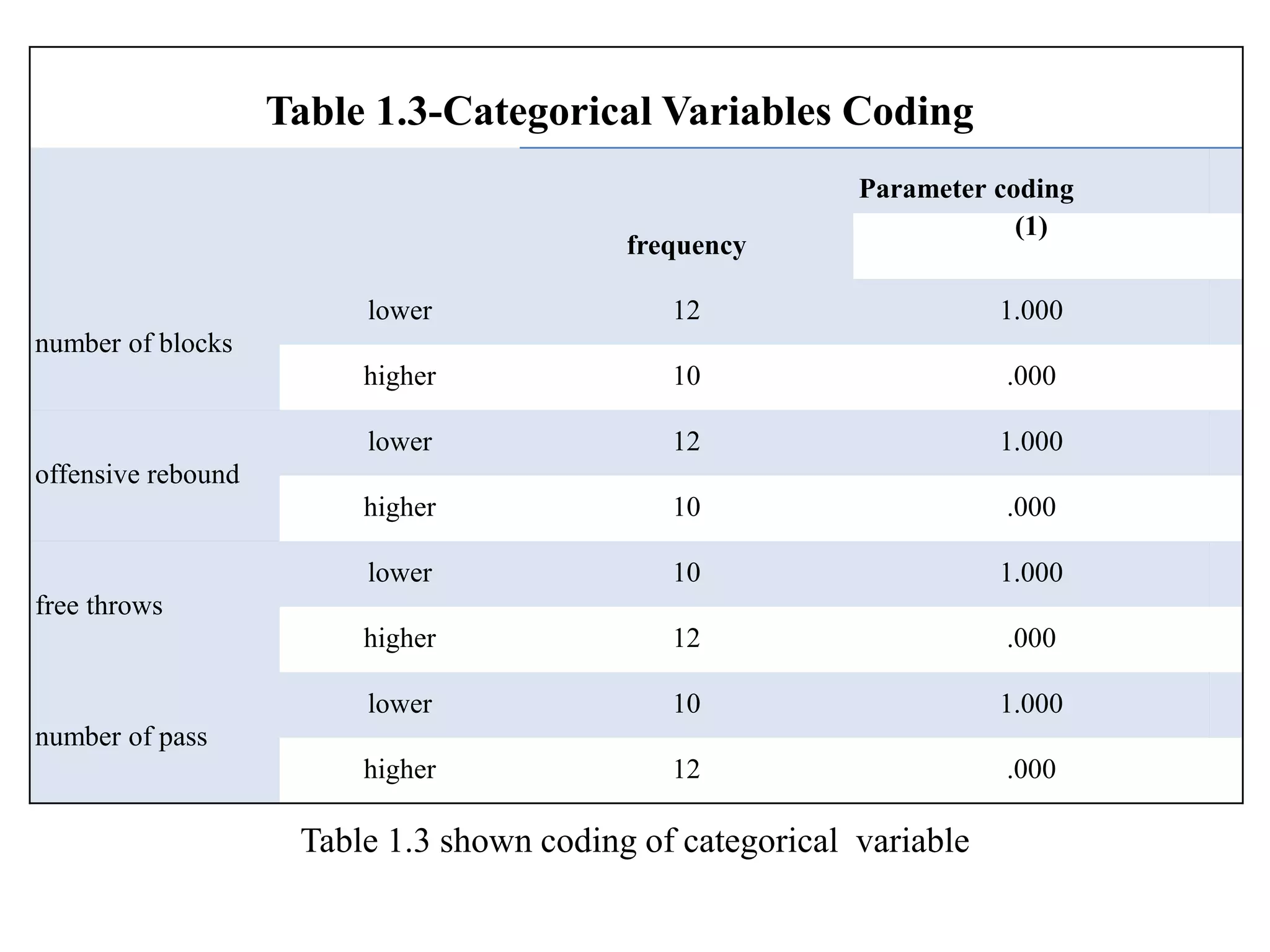
Table 1.3-Categorical Variables Coding
frequency
Parameter coding
(1)
number of blocks
lower 12 1.000
higher 10 .000
offensive rebound
lower 12 1.000
higher 10 .000
free throws
lower 10 1.000
higher 12 .000
number of pass
lower 10 1.000
higher 12 .000
Table 1.3 shown coding of categorical variable
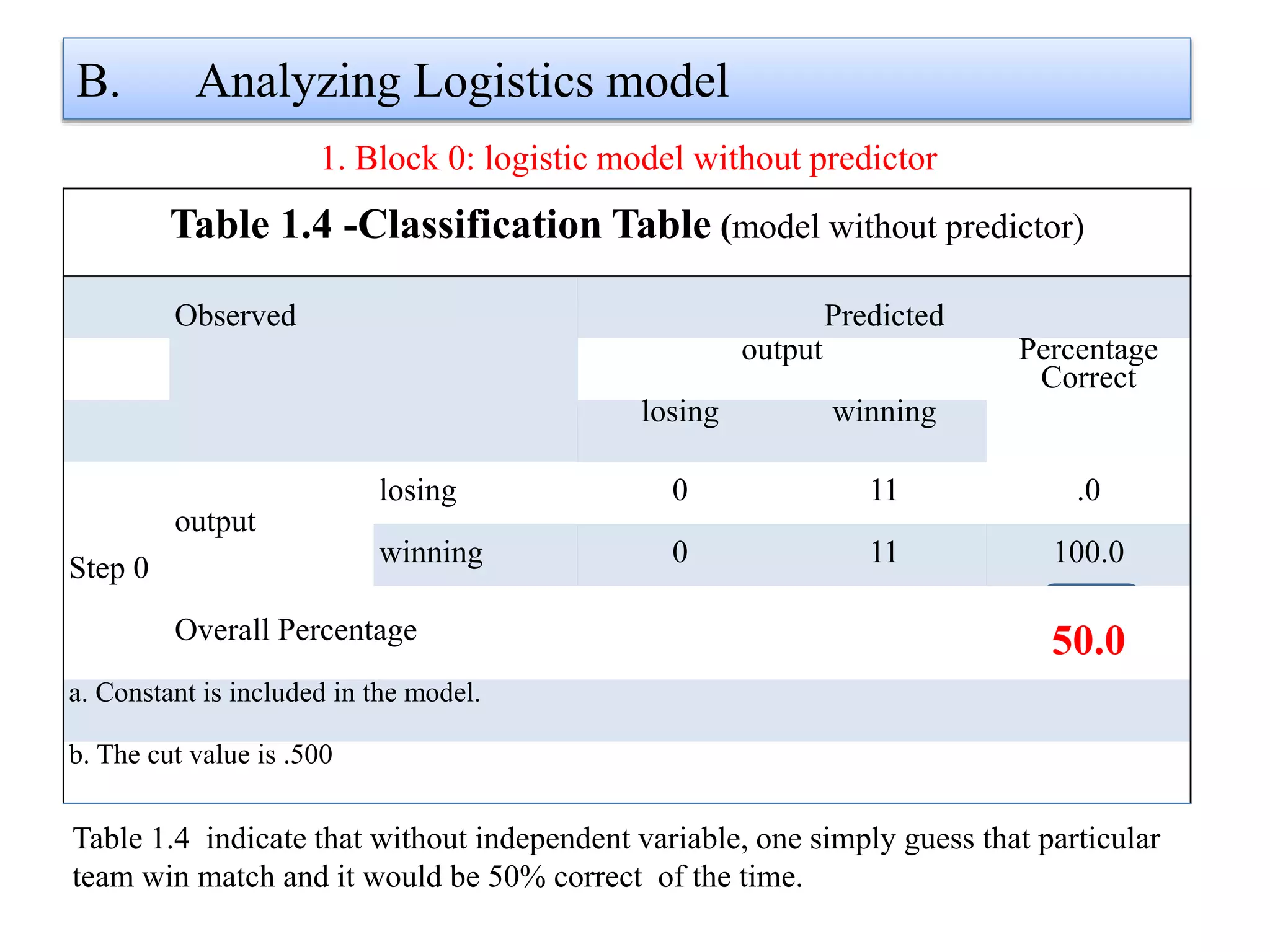
B. Analyzing Logistics model
Table 1.4 -Classification Table (model without predictor)
Observed Predicted
output Percentage
Correct
losing winning
Step 0
output
losing 0 11 .0
winning 0 11 100.0
Overall Percentage 50.0
a. Constant is included in the model.
b. The cut value is .500
Table 1.4 indicate that without independent variable, one simply guess that particular
team win match and it would be 50% correct of the time.
1. Block 0: logistic model without predictor
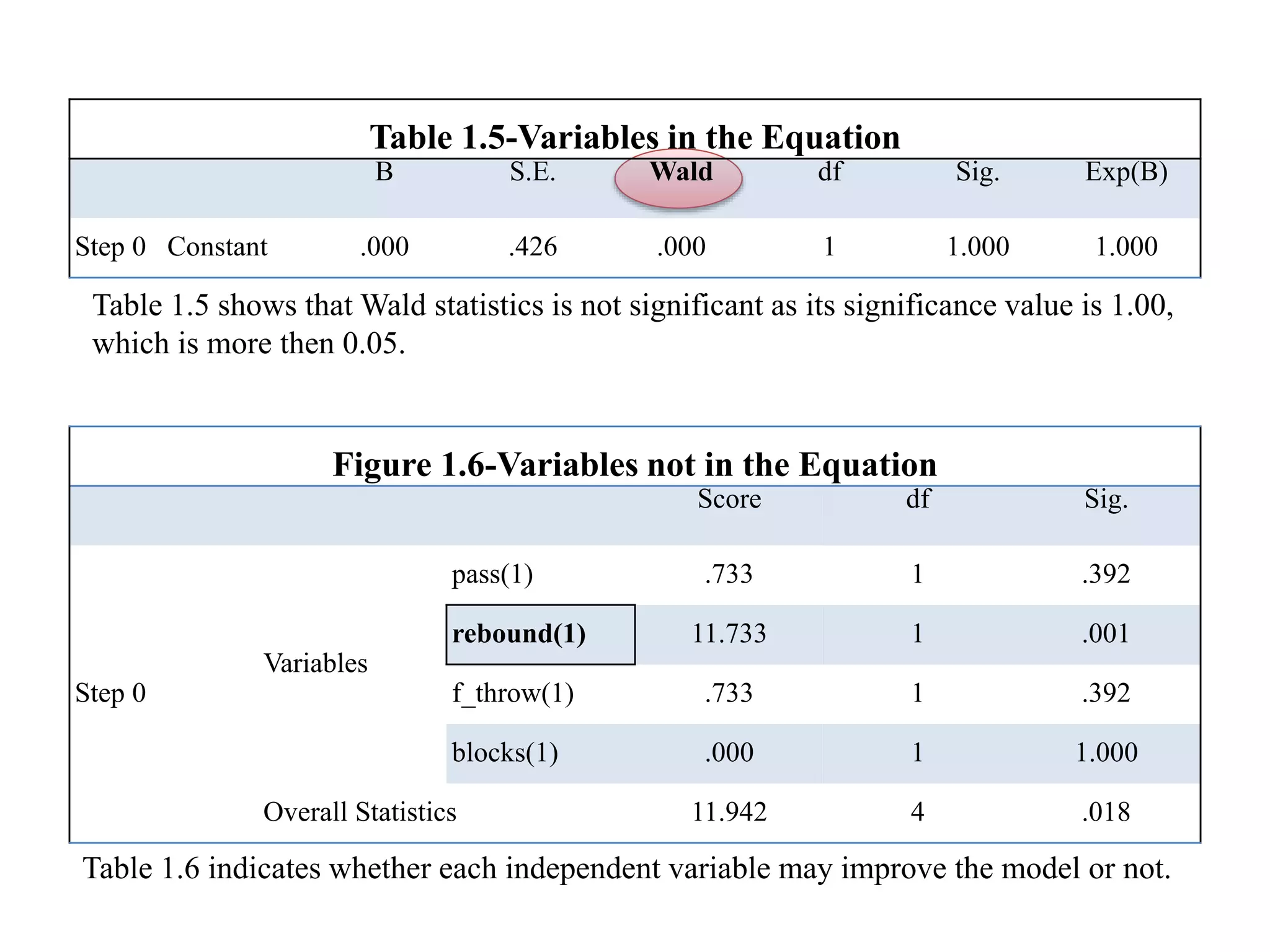
Table 1.5-Variables in the Equation
B S.E. Wald df Sig. Exp(B)
Step 0 Constant .000 .426 .000 1 1.000 1.000
Figure 1.6-Variables not in the Equation
Score df Sig.
Step 0
Variables
pass(1) .733 1 .392
rebound(1) 11.733 1 .001
f_throw(1) .733 1 .392
blocks(1) .000 1 1.000
Overall Statistics 11.942 4 .018
Table 1.5 shows that Wald statistics is not significant as its significance value is 1.00,
which is more then 0.05.
Table 1.6 indicates whether each independent variable may improve the model or not.
2. Block 1 logistics model with predictors
(testing significance of the model)
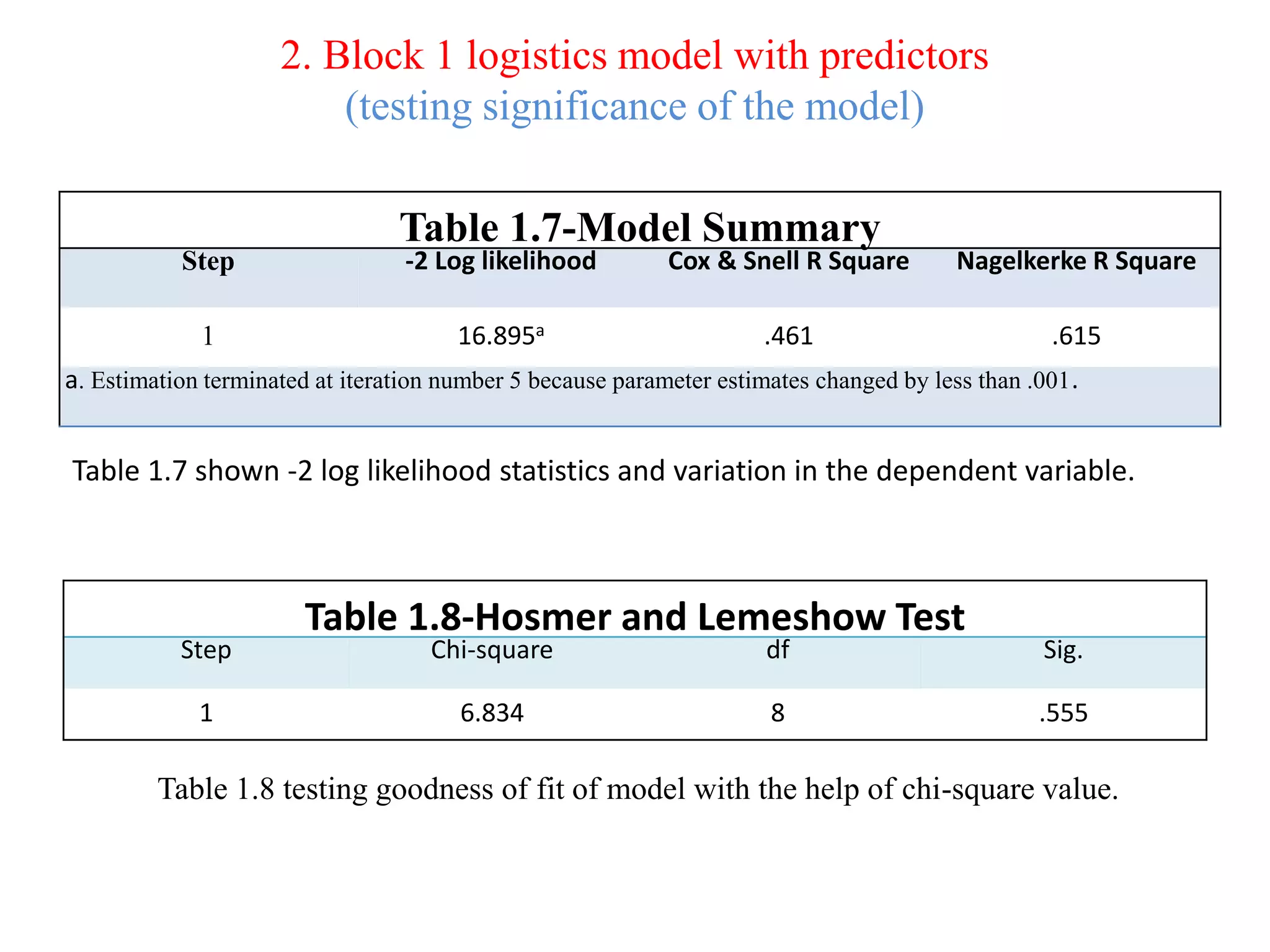
Table 1.7-Model Summary
Step -2 Log likelihood Cox & Snell R Square Nagelkerke R Square
1 16.895a .461 .615
a. Estimation terminated at iteration number 5 because parameter estimates changed by less than .001.
Table 1.7 shown -2 log likelihood statistics and variation in the dependent variable.
Table 1.8-Hosmer and Lemeshow Test
Step Chi-square df Sig.
1 6.834 8 .555
Table 1.8 testing goodness of fit of model with the help of chi-square value.
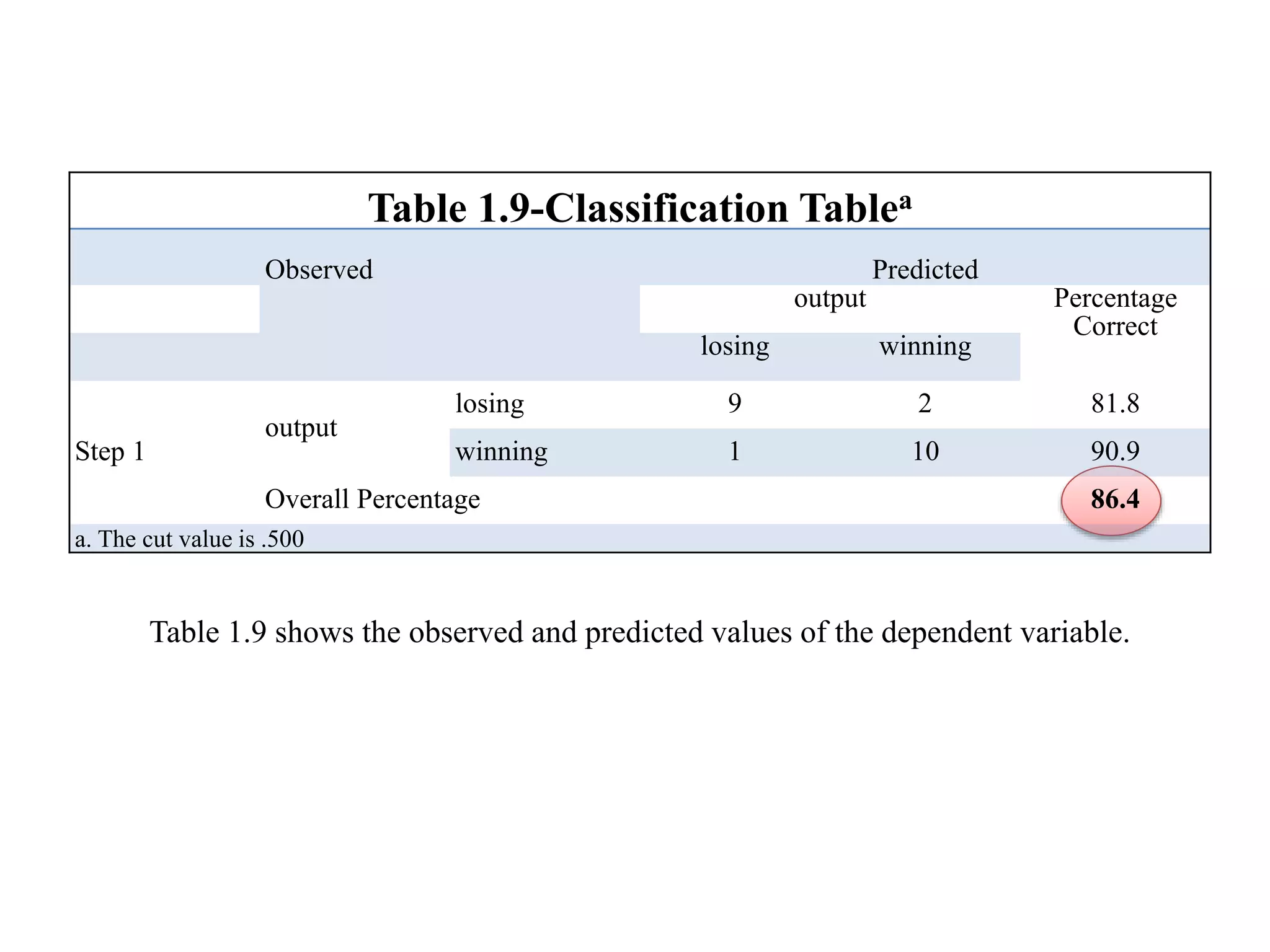
Table 1.9-Classification Tablea
Observed Predicted
output Percentage
Correct
losing winning
Step 1
output
losing 9 2 81.8
winning 1 10 90.9
Overall Percentage 86.4
a. The cut value is .500
Table 1.9 shows the observed and predicted values of the dependent variable.
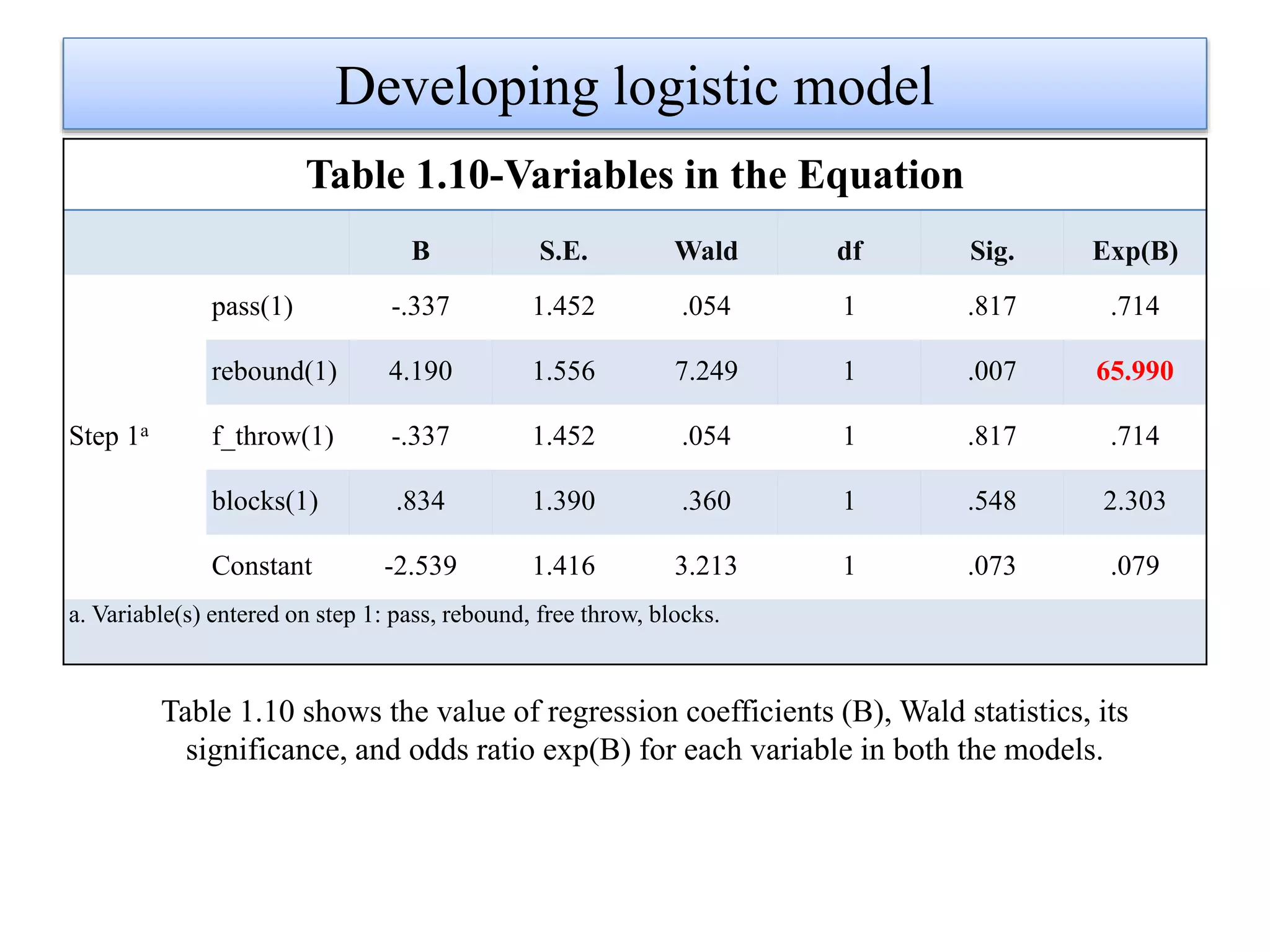
Developing logistic model
Table 1.10-Variables in the Equation
B S.E. Wald df Sig. Exp(B)
Step 1a
pass(1) -.337 1.452 .054 1 .817 .714
rebound(1) 4.190 1.556 7.249 1 .007 65.990
f_throw(1) -.337 1.452 .054 1 .817 .714
blocks(1) .834 1.390 .360 1 .548 2.303
Constant -2.539 1.416 3.213 1 .073 .079
a. Variable(s) entered on step 1: pass, rebound, free throw, blocks.
Table 1.10 shows the value of regression coefficients (B), Wald statistics, its
significance, and odds ratio exp(B) for each variable in both the models.
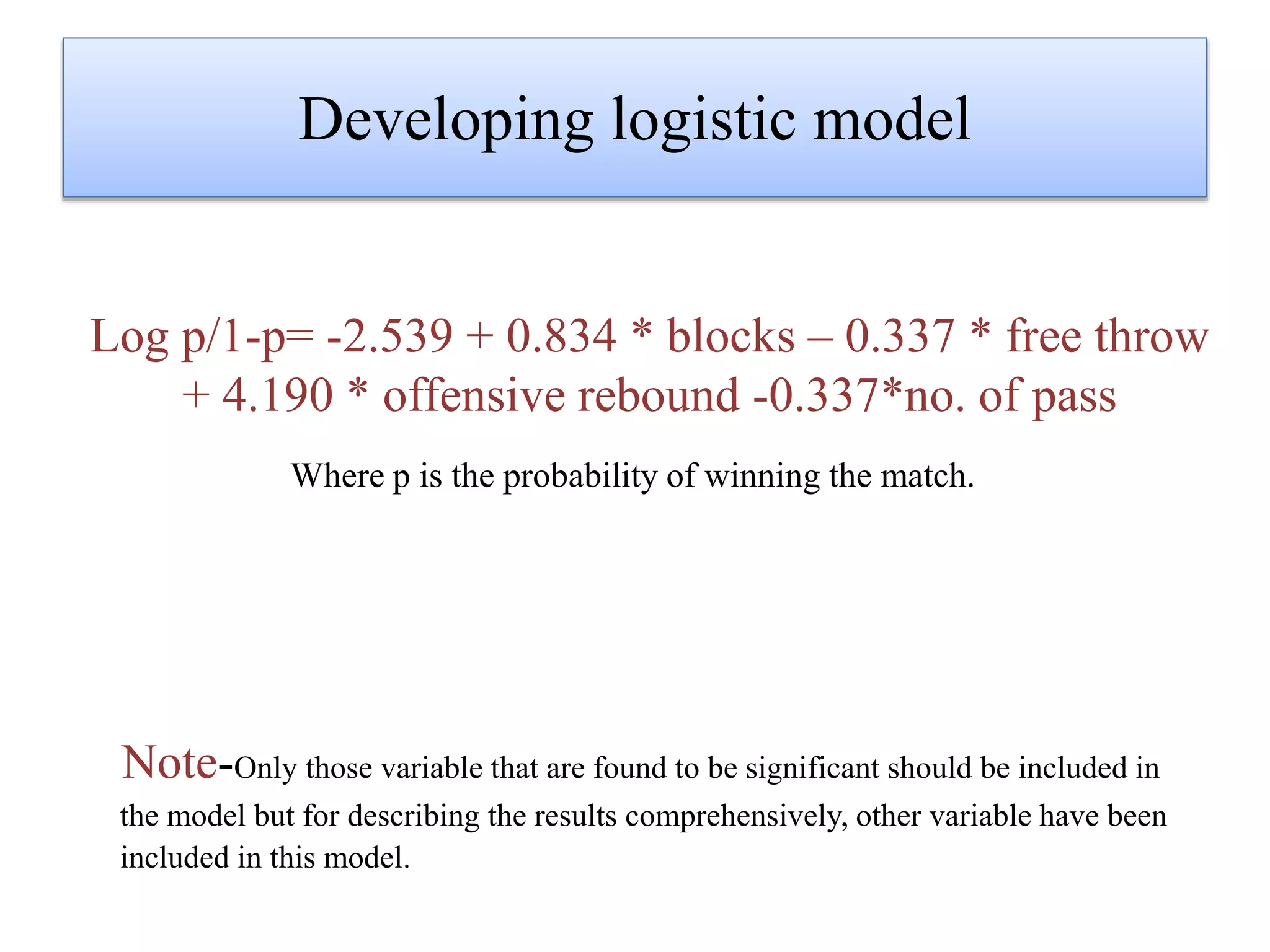
Developing logistic model
Where p is the probability of winning the match.
Note-Only those variable that are found to be significant should be included in
the model but for describing the results comprehensively, other variable have been
included in this model.
Log p/1-p= -2.539 + 0.834 * blocks – 0.337 * free throw
+ 4.190 * offensive rebound -0.337*no. of pass
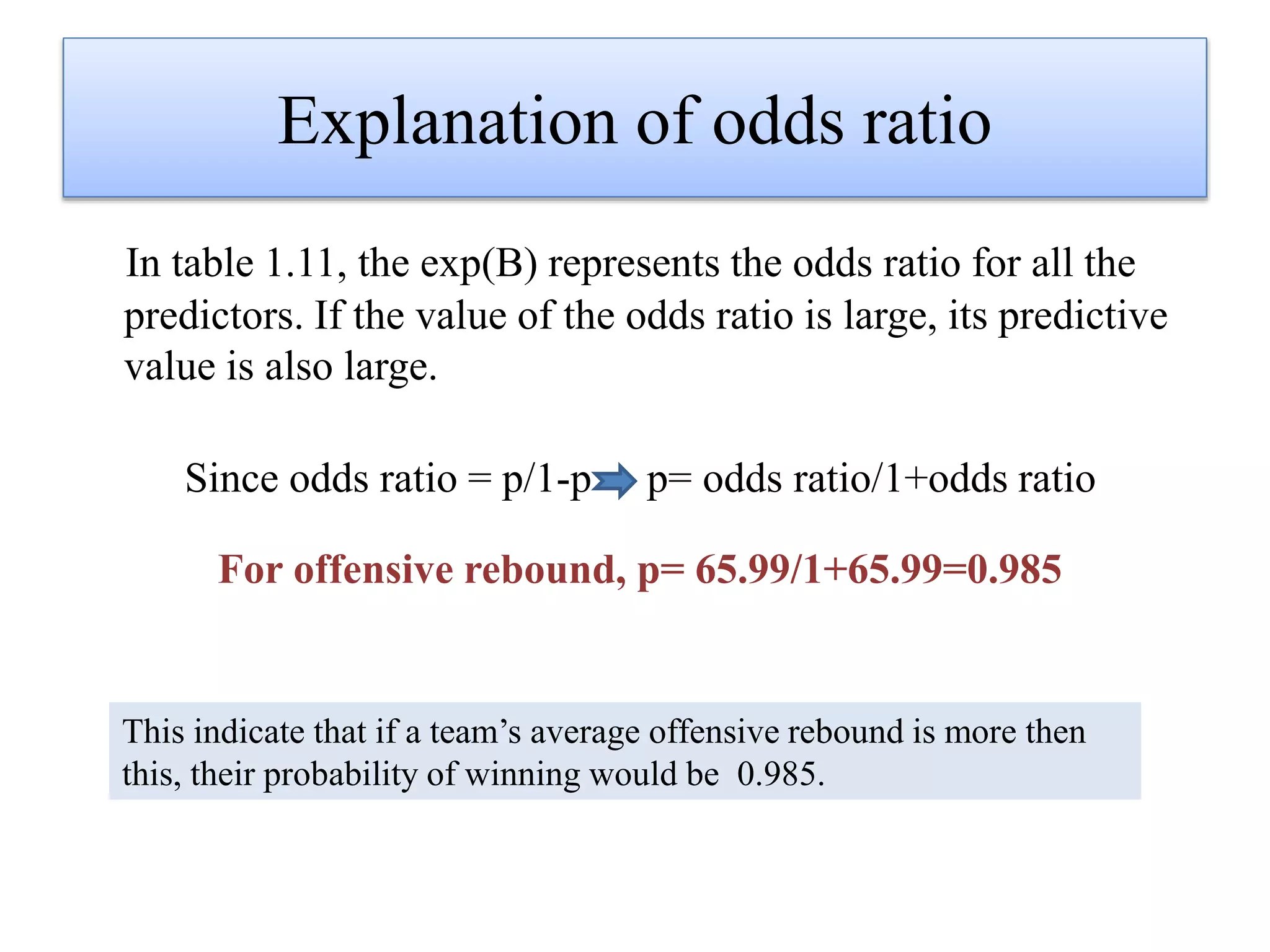
Explanation of odds ratio
In table 1.11, the exp(B) represents the odds ratio for all the
predictors. If the value of the odds ratio is large, its predictive
value is also large.
Since odds ratio = p/1-p = p= odds ratio/1+odds ratio
For offensive rebound, p= 65.99/1+65.99=0.985
This indicate that if a team’s average offensive rebound is more then
this, their probability of winning would be 0.985.
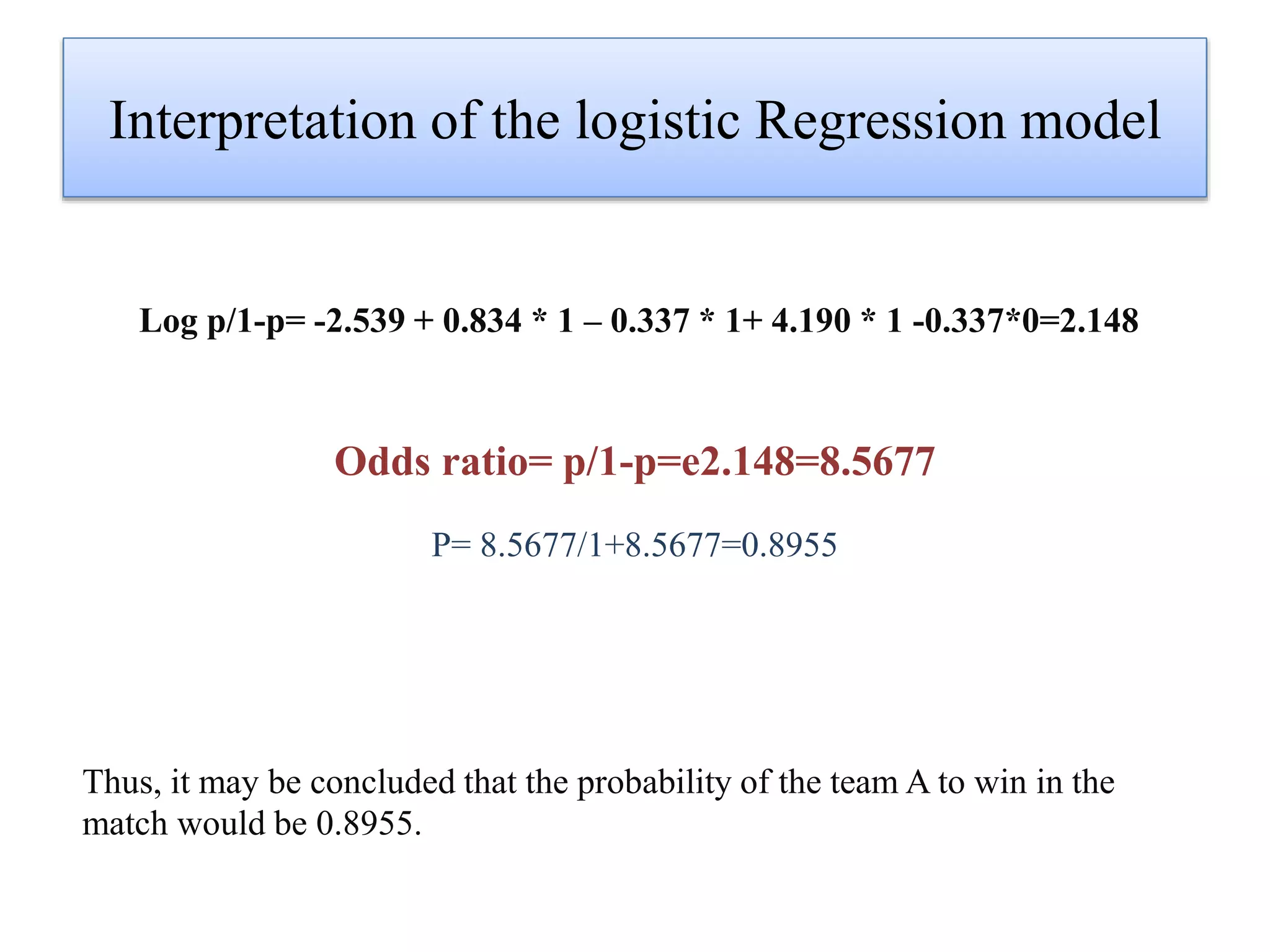
Interpretation of the logistic Regression model
Log p/1-p= -2.539 + 0.834 * 1 – 0.337 * 1+ 4.190 * 1 -0.337*0=2.148
Odds ratio= p/1-p=e2.148=8.5677
P= 8.5677/1+8.5677=0.8955
Thus, it may be concluded that the probability of the team A to win in the
match would be 0.8955.
s

Logistic regression with SPSS

  • 1.
    LOGISTIC REGRESSION Presented by Mr.Vijay Singh Rawat Ms. Shweta (Research Scholar) Ph. D Course work 2017-18 Lakshmibai National Institute of Physical Education, Gwalior, India (Deemed to be University)
  • 2.
    INTRODUCTION • Logistic regressionis a predictive analysis. • Used in a situation when a researcher is interested to predict the occurrence of any happenings.
  • 3.
    Objective of LogisticRegression • The objective of Logistic regression is to find the best fitting model to describe the relationship between the dichotomous characteristics of interest and a set of independent variables.
  • 4.
    Continuous vs. Categoricalvariables • Independent variables (x): – Continuous: age, income, height- use numerical value. – Categorical: gender, city, ethnicity – use dummies • Dependent variable (y): – continuous: consumption, time spend- use numerical value – categorical: yes/ no
  • 5.
    Examples of BinaryOutcomes • Should a bank give a person loan or not. • What determines admittance into a school. • Which consumers are more likely to buy a new product.
  • 6.
    Uses of LogisticRegression • Prediction of group membership • It is also provides knowledge of the relationship and strength among the variables. • Casual relationship between one or more independent variables and one binary dependent variables. • Used to forecast the outcome event. • Used to predict changes in probabilities.
  • 7.
    Assumptions • The relationshipbetween the dependent and independent variable may be linear or non-linear. • The outcome variable must be coded as 0 and 1. • The independent variable do not need to be metric. • Independent variable linearly related to the log odds. • It requires quit large sample size.
  • 8.
    Key terms inLogistic Regression • Dependent variable – It is binary in nature. • Independent variable – Select the different variables that you expect to influence the dependent variable. • Hosmer-lemeshow test – It is commonly used measure of goodness of fit. • Odd ratio – It is the ratio of the probability of success to the probability of failure.
  • 9.
    • Classification table –In this table the observed values for the dependent outcome and the predicted values are cross classified. • Maximum likelihood – Maximum likelihood is the method of finding the least possible deviation between the observed and predicted values using the concept of calculus specifically derivatives. • Logit – The logit is function which is equal to the log odds of a variable. If p is a probability that Y=1(occurrence of an event), then p/(1-p) is corresponding odds. The logit of probability p is given by         p p pLogit 1 log)(
  • 10.
    Predicting the Probabilityp nn xbxbxbbZ  .........22110 •bo is the intercept and b1,b2,b3 are the slopes against independent variables x1 , xn
  • 11.
    Predicting p withLog(Odds) zxbb pˆ1 pˆ log 110        zxbb ee pˆ1 pˆ 10    z z xbb xbb e1 e e1 e pˆ 10 10       By knowing z the probability can be estimatedpˆ
  • 12.
    Advantage of usingLogit Function 3322110)1/( xbxbxbbppIn  +- 0.5 p 1 z 0 Figure 1- Shape of the logistic function
  • 13.
    Application in SportsResearch • Predicting successful free throw shot in basketball on the basis of independent variables such as player’s height, accuracy, arm strength and eye hand coordination etc. • Predicting winning in football match on the basis of independent variables like number of passes, number of turnovers, penalty yardage, fouls committed etc., • Finding likelihood of a particular horse finishing first in a specific race.
  • 14.
    Logistic Regression withSPSS Objective: Predicting success in basketball match ____________________________________________ Match Result Number of Offensive Free throws Blocks Pass rebound throws 1 1 0 1 1 1 2 0 1 0 0 0 3 1 0 1 1 0 4 1 1 0 0 1 5 0 1 1 1 0 6 0 0 0 0 1 7 1 1 0 1 0 8 0 0 1 0 1 9 1 1 0 1 1 10 0 1 1 0 0 11 1 0 0 1 0 12 0 1 0 0 1 13 1 1 1 1 0 14 0 0 0 0 1 15 1 1 1 1 0 16 0 0 0 1 1 17 0 1 1 0 0 18 1 0 0 1 1 19 0 1 1 0 0 20 1 0 0 1 0 21 0 1 1 0 1 22 1 0 0 1 1 __________________________________________________________________ Dependent Variable Independent Variable Result in Basketball Match: 1: Win 0:Loose No. of pass : 1 = lower 0 = higher Offensive rebound : 1 = lower 0 = higher Free throws : 1 = lower 0 = higher Blocks : 1 = lower 0 = higher  Team having average number of pass less than the opponent is coded as 1 and the other as 0.  Similar coding for other variables - An Illustration 14
  • 15.
    SPSS Commands forthe logistic regression Step-1 Preparation of Data file Fig 1 – screen showing variable view for the logistic regression analysis in SPSS
  • 16.
    Fig 2- screenshowing data file for the logistic regression analysis in SPSS
  • 17.
    Step -2 Initiatingcommand for logistic regression Fig 3- screen showing of SPSS commands for logistic regression Analyze Regression Binary logistic
  • 18.
    Fig 4- screenshowing selection of variables for logistic regression Defining variables 1.Dependent box 2.Covariate box 3.Categorical covariate box Step -3 Selecting variable for Analysis
  • 19.
    Step -4 Selectingoption for Computation Fig 5- screen showing option for generating Hosmer-lemeshow goodness of fit and confidence intervals CONTINUE THENOK
  • 20.
    Step-5 Selecting methodfor entering independent variable in logistic regression A. Confirmatory study B. Exploratory study • Clicking the option ok to get the output Step-6 Getting the output
  • 21.
    The logistic regressionin SPSS is run in two steps • First step (block 0) – It includes no predictors and just the intercept. • Second step (block 1) – It includes the variable in the analysis and coding of independent and dependent variable..
  • 22.
    INTERPRETATIONS OF FINDING 1.Case processing summary 2. Dependent variable encoding 3. Categorical variable coding Block 0 1. Classification table(model without predictors) 2. Variable in the equation 3. Variable not in the equation Block 1 1. Omnibus tests of model coefficients 2. Model summary 3. Homer –lemeshow test 4. Classification table (model with predictors) 5. Variable in the equation (with predictors)
  • 23.
    A. CASE PROCESSINGAND CODING SUMMARY TABLE 1.1 -Case Processing Summary Unweighted Casesa N Percent Selected Cases Included in Analysis 22 100.0 Missing Cases 0 .0 Total 22 100.0 Unselected Cases 0 .0 Total 22 100.0 a. If weight is in effect, see classification table for the total number of cases. Table 1.1 shows the number of cases in each category
  • 24.
    Table 1.2 showncoding of dependent variable Table 1.2 -Dependent variable encoding Original Value Internal Value Losing 0 winning 1
  • 25.
    Table 1.3-Categorical VariablesCoding frequency Parameter coding (1) number of blocks lower 12 1.000 higher 10 .000 offensive rebound lower 12 1.000 higher 10 .000 free throws lower 10 1.000 higher 12 .000 number of pass lower 10 1.000 higher 12 .000 Table 1.3 shown coding of categorical variable
  • 26.
    B. Analyzing Logisticsmodel Table 1.4 -Classification Table (model without predictor) Observed Predicted output Percentage Correct losing winning Step 0 output losing 0 11 .0 winning 0 11 100.0 Overall Percentage 50.0 a. Constant is included in the model. b. The cut value is .500 Table 1.4 indicate that without independent variable, one simply guess that particular team win match and it would be 50% correct of the time. 1. Block 0: logistic model without predictor
  • 27.
    Table 1.5-Variables inthe Equation B S.E. Wald df Sig. Exp(B) Step 0 Constant .000 .426 .000 1 1.000 1.000 Figure 1.6-Variables not in the Equation Score df Sig. Step 0 Variables pass(1) .733 1 .392 rebound(1) 11.733 1 .001 f_throw(1) .733 1 .392 blocks(1) .000 1 1.000 Overall Statistics 11.942 4 .018 Table 1.5 shows that Wald statistics is not significant as its significance value is 1.00, which is more then 0.05. Table 1.6 indicates whether each independent variable may improve the model or not.
  • 28.
    2. Block 1logistics model with predictors (testing significance of the model) Table 1.7-Model Summary Step -2 Log likelihood Cox & Snell R Square Nagelkerke R Square 1 16.895a .461 .615 a. Estimation terminated at iteration number 5 because parameter estimates changed by less than .001. Table 1.7 shown -2 log likelihood statistics and variation in the dependent variable. Table 1.8-Hosmer and Lemeshow Test Step Chi-square df Sig. 1 6.834 8 .555 Table 1.8 testing goodness of fit of model with the help of chi-square value.
  • 29.
    Table 1.9-Classification Tablea ObservedPredicted output Percentage Correct losing winning Step 1 output losing 9 2 81.8 winning 1 10 90.9 Overall Percentage 86.4 a. The cut value is .500 Table 1.9 shows the observed and predicted values of the dependent variable.
  • 30.
    Developing logistic model Table1.10-Variables in the Equation B S.E. Wald df Sig. Exp(B) Step 1a pass(1) -.337 1.452 .054 1 .817 .714 rebound(1) 4.190 1.556 7.249 1 .007 65.990 f_throw(1) -.337 1.452 .054 1 .817 .714 blocks(1) .834 1.390 .360 1 .548 2.303 Constant -2.539 1.416 3.213 1 .073 .079 a. Variable(s) entered on step 1: pass, rebound, free throw, blocks. Table 1.10 shows the value of regression coefficients (B), Wald statistics, its significance, and odds ratio exp(B) for each variable in both the models.
  • 31.
    Developing logistic model Wherep is the probability of winning the match. Note-Only those variable that are found to be significant should be included in the model but for describing the results comprehensively, other variable have been included in this model. Log p/1-p= -2.539 + 0.834 * blocks – 0.337 * free throw + 4.190 * offensive rebound -0.337*no. of pass
  • 32.
    Explanation of oddsratio In table 1.11, the exp(B) represents the odds ratio for all the predictors. If the value of the odds ratio is large, its predictive value is also large. Since odds ratio = p/1-p = p= odds ratio/1+odds ratio For offensive rebound, p= 65.99/1+65.99=0.985 This indicate that if a team’s average offensive rebound is more then this, their probability of winning would be 0.985.
  • 33.
    Interpretation of thelogistic Regression model Log p/1-p= -2.539 + 0.834 * 1 – 0.337 * 1+ 4.190 * 1 -0.337*0=2.148 Odds ratio= p/1-p=e2.148=8.5677 P= 8.5677/1+8.5677=0.8955 Thus, it may be concluded that the probability of the team A to win in the match would be 0.8955.
  • 34.