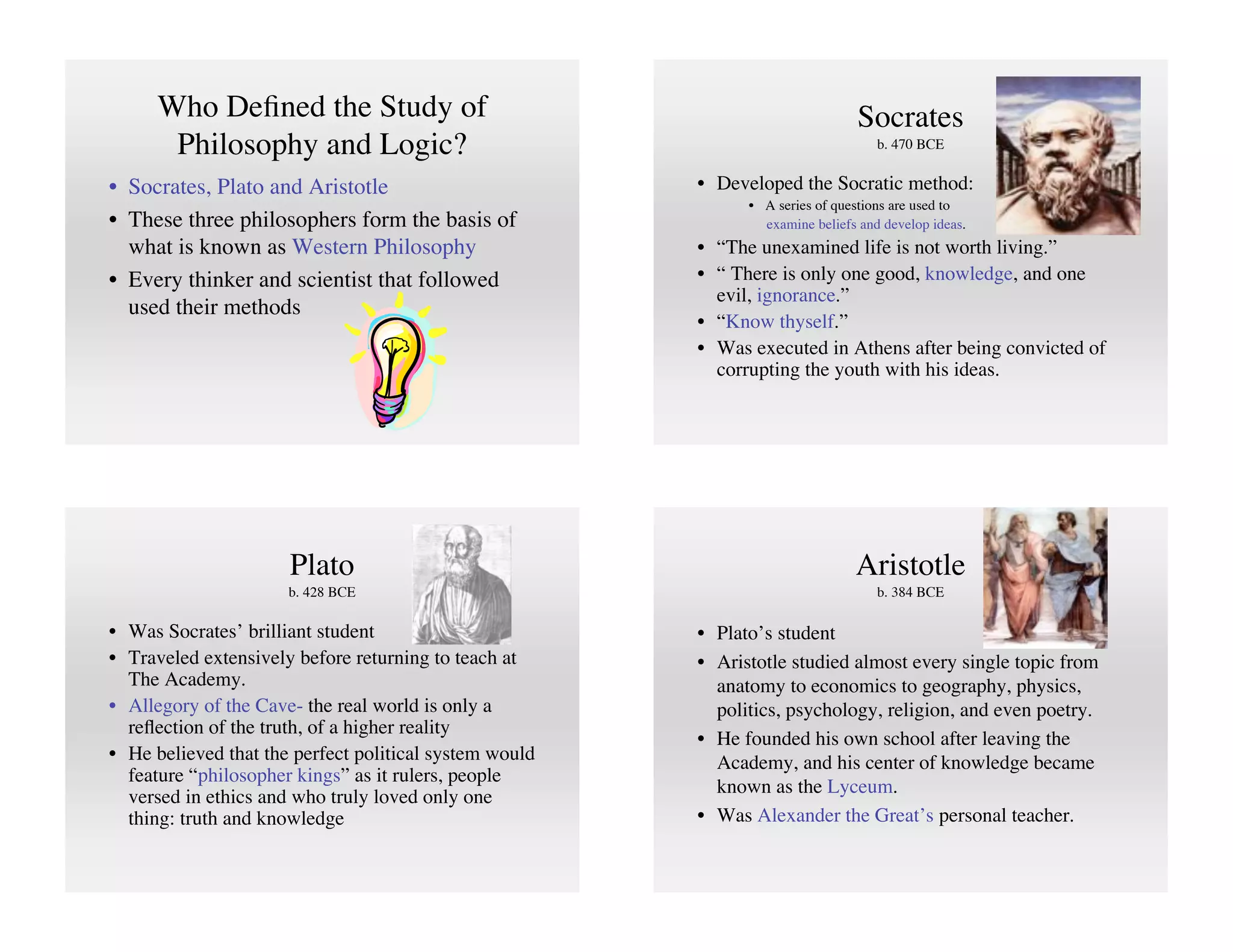
Who Defined the Study of                                                   Socrates
       Philosophy and Logic?                                                       b. 470 BCE


• Socrates, Plato and Aristotle                         • Developed the Socratic method:
                                                              • A series of questions are used to
• These three philosophers form the basis of                    examine beliefs and develop ideas.
  what is known as Western Philosophy                   • “The unexamined life is not worth living.”
• Every thinker and scientist that followed             • “ There is only one good, knowledge, and one
                                                          evil, ignorance.”
  used their methods
                                                        • “Know thyself.”
                                                        • Was executed in Athens after being convicted of
                                                          corrupting the youth with his ideas.


                      Plato                                                    Aristotle
                      b. 428 BCE                                                   b. 384 BCE

• Was Socrates’ brilliant student                       • Plato’s student
• Traveled extensively before returning to teach at     • Aristotle studied almost every single topic from
  The Academy.                                            anatomy to economics to geography, physics,
• Allegory of the Cave- the real world is only a          politics, psychology, religion, and even poetry.
  reflection of the truth, of a higher reality
                                                        • He founded his own school after leaving the
• He believed that the perfect political system would     Academy, and his center of knowledge became
  feature “philosopher kings” as it rulers, people
                                                          known as the Lyceum.
  versed in ethics and who truly loved only one
  thing: truth and knowledge                            • Was Alexander the Great’s personal teacher.
What is Logic?
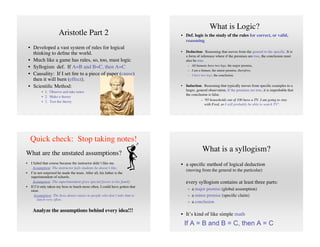
                       Aristotle Part 2                                        • Def. logic is the study of the rules for correct, or valid,
                                                                                 reasoning.
    • Developed a vast system of rules for logical
                                                                               •   Deduction: Reasoning that moves from the general to the specific. It is
      thinking to define the world.                                                 a form of inference where if the premises are true, the conclusion must
    • Much like a game has rules, so, too, must logic                              also be true.
                                                                                    – All humans have two legs, the major premise,
    • Syllogism def. If A=B and B=C, then A=C
                                                                                    – I am a human, the minor premise, therefore,
    • Causality: If I set fire to a piece of paper (cause)                           – I have two legs, the conclusion.
      then it will burn (effect).
    • Scientific Method:                                                        •   Induction: Reasoning that typically moves from specific examples to a
            • 1. Observe and take notes                                            larger, general observation. If the premises are true, it is improbable that
                                                                                   the conclusion is false.
            • 2. Make a theory
            • 3. Test the theory                                                              – '95 households out of 100 have a TV. I am going to stay
                                                                                                with Fred, so I will probably be able to watch TV".


     Quick check: Stop taking notes!
What are the unstated assumptions?
                                                                                              What is a syllogism?
•    I failed that course because the instructor didn’t like me.               • a specific method of logical deduction
      Assumption: The instructor fails students he doesn’t like.
                                                                                   (moving from the general to the particular)
•    I’m not surprised he made the team. After all, his father is the
     superintendent of schools.
      Assumption: The superintendent gives special favors to his family            every syllogism contains at least three parts:
•    If I’d only taken my boss to lunch more often, I could have gotten that
     raise.                                                                         – a major premise (global assumption)
       Assumption: The boss denies raises to people who don’t take him to           – a minor premise (specific claim)
          lunch very often.
                                                                                    – a conclusion

      Analyze the assumptions behind every idea!!!
                                                                               • It’s kind of like simple math
                                                                                   If A = B and B = C, then A = C
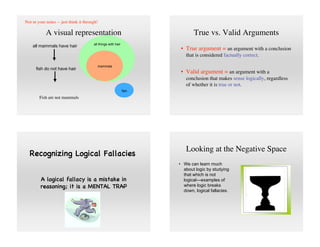
Not in your notes -- just think it through!

            A visual representation                                          True vs. Valid Arguments
                                        all things with hair
    all mammals have hair
                                                                       • True argument = an argument with a conclusion
                                                                         that is considered factually correct.

                                          mammals
      fish do not have hair
                                                                       • Valid argument = an argument with a
                                                                         conclusion that makes sense logically, regardless
                                                                         of whether it is true or not.
                                                               fish

        Fish are not mammals


                                                                         Looking at the Negative Space
  Recognizing Logical Fallacies
                                                                      • We can learn much
                                                                        about logic by studying
                                                                        that which is not
         A logical fallacy is a mistake in                              logical—examples of
         reasoning; it is a MENTAL TRAP                                 where logic breaks
                                                                        down, logical fallacies.
1. Over-generalization                                  2. Arguing in Circles
                                                 • Def: Supporting an opinion not with evidence but with the same
 • Drawing too wide a conclusion from the          opinion, slightly disguised (restating the argument in different
                                                   words). Using the word you’re defining in the definition is a classic
   given facts                                     example.
 • Example:                                      • Example:
                                                    – Education is important for kids, so they should get an education.
    – All kids cause trouble.
                                                    – Everybody likes ice cream because it is liked by all.
    – Timmy is a kid.                               – “Belligerently” means in a belligerent way.
    – Therefore, Timmy causes trouble.
                                                  Fix it by making sure you are giving support, not just
     Fix this by recognizing qualifiers                 repeating the idea. Never use the word you’re
                                                                  defining in the definition.
         (many, few, some, all, etc.)


3. Black & White Thinking                                            4. Red Herring
                                                    • Def. Presenting an irrelevant topic to divert
 • Def. An opinion that claims there are only         attention away from the original issue.
   two alternatives (when there might be more)
                                                    • Also known as Ad hominem: getting
 • Examples:                                          personal as you discredit someone.
   – You’re either for it or against it.
                                                    • Examples:
   – Are you a jock or a nerd?
                                                        – What do you know? You’re just a kid.
  Fix this by remembering that the world is a
   complicated place and that on most issues            – I got an F. Mr. X hates me.
            there are many alternatives.
                                                       Fix this by staying focused on the topic;
                                                             watch out for those who don’t.
5. Loaded Questions and                                                                     6. Statistical Fallacies
                  Statements                                                                              & False Authority
                                                                                   • Def. People usually believe in numbers and experts without
   • Def. A question or a statement that                                             questioning them. Here statistics are used to misrepresent
     conceals an opinion or assumption.                                              rather than describe.
   • Examples:                                                                     •    Examples:
                                                                                         – 3 out of 4 dentists prefer Crest. (Did Crest pick the dentists?)
       – Do you still beat your dog?
                                                                                         – I surveyed 100 people and they all agreed with me. (I chose my friends).
       – You don’t think that, do you?                                                   – Dr. X says this is the fastest and safest way to lose weight. (Did he/she get paid?
       – All intelligent people agree that …                                                Where do they practice?)
                                                                                       Fix this by analyzing the evidence. Where did the support come from? Is there
                                                                                                      self interest involved? Did you get the whole picture?
        Fix this by listening carefully and
           separating fact from opinion.


       7. Faulty Causal Relationship                                                                8. Misleading Comparison
                                                                                            • Def. Mistakenly believing that two
             (also called Post Hoc)
                                                                                              situations or people can be compared.
• Def. To excuse an action or belief by making it sound sensible.
  Often this assumes that anything that came before an event caused                         • Examples:
  it to happen.                                                                                 – Jill looks good in red. I’ll buy red pants, too.
• Example:                                                                                      – Forcing students to read books is like herding
   – I stole the towel from the hotel. They expect people to take them.
                                                                                                  cattle to slaughter.
   – Eating 5 energy bars and drinking 2 Cokes helps me get better grades. I did
     this and got an A on my history test.                                                      – You gave him extra time on the test, so I should
Fix this by examining the relationship between ideas. Make sure the                               get extra time too.
     facts precede the theory and the reasons precede and cause the
                                                                                                – Saddam Hussien is Hitler.
                                 belief.
                                                                                            Fix this by remembering that every person
                                                                                             and situation has different circumstances.
9. Bandwagon
• Def. Lots of people do this, so you should,
  too.
• Examples:
  – Adults are smoking, so it is ok to do so.
  – The American people do not stand for . . .


Fix this by making decisions based on facts,
               not popularity.

Logic+Fallacies Notesfor Web

  • 1.
    Who Defined theStudy of Socrates Philosophy and Logic? b. 470 BCE • Socrates, Plato and Aristotle • Developed the Socratic method: • A series of questions are used to • These three philosophers form the basis of examine beliefs and develop ideas. what is known as Western Philosophy • “The unexamined life is not worth living.” • Every thinker and scientist that followed • “ There is only one good, knowledge, and one evil, ignorance.” used their methods • “Know thyself.” • Was executed in Athens after being convicted of corrupting the youth with his ideas. Plato Aristotle b. 428 BCE b. 384 BCE • Was Socrates’ brilliant student • Plato’s student • Traveled extensively before returning to teach at • Aristotle studied almost every single topic from The Academy. anatomy to economics to geography, physics, • Allegory of the Cave- the real world is only a politics, psychology, religion, and even poetry. reflection of the truth, of a higher reality • He founded his own school after leaving the • He believed that the perfect political system would Academy, and his center of knowledge became feature “philosopher kings” as it rulers, people known as the Lyceum. versed in ethics and who truly loved only one thing: truth and knowledge • Was Alexander the Great’s personal teacher.
  • 2.
    What is Logic? Aristotle Part 2 • Def. logic is the study of the rules for correct, or valid, reasoning. • Developed a vast system of rules for logical • Deduction: Reasoning that moves from the general to the specific. It is thinking to define the world. a form of inference where if the premises are true, the conclusion must • Much like a game has rules, so, too, must logic also be true. – All humans have two legs, the major premise, • Syllogism def. If A=B and B=C, then A=C – I am a human, the minor premise, therefore, • Causality: If I set fire to a piece of paper (cause) – I have two legs, the conclusion. then it will burn (effect). • Scientific Method: • Induction: Reasoning that typically moves from specific examples to a • 1. Observe and take notes larger, general observation. If the premises are true, it is improbable that the conclusion is false. • 2. Make a theory • 3. Test the theory – '95 households out of 100 have a TV. I am going to stay with Fred, so I will probably be able to watch TV". Quick check: Stop taking notes! What are the unstated assumptions? What is a syllogism? • I failed that course because the instructor didn’t like me. • a specific method of logical deduction Assumption: The instructor fails students he doesn’t like. (moving from the general to the particular) • I’m not surprised he made the team. After all, his father is the superintendent of schools. Assumption: The superintendent gives special favors to his family every syllogism contains at least three parts: • If I’d only taken my boss to lunch more often, I could have gotten that raise. – a major premise (global assumption) Assumption: The boss denies raises to people who don’t take him to – a minor premise (specific claim) lunch very often. – a conclusion Analyze the assumptions behind every idea!!! • It’s kind of like simple math If A = B and B = C, then A = C
  • 3.
    Not in yournotes -- just think it through! A visual representation True vs. Valid Arguments all things with hair all mammals have hair • True argument = an argument with a conclusion that is considered factually correct. mammals fish do not have hair • Valid argument = an argument with a conclusion that makes sense logically, regardless of whether it is true or not. fish Fish are not mammals Looking at the Negative Space Recognizing Logical Fallacies • We can learn much about logic by studying that which is not A logical fallacy is a mistake in logical—examples of reasoning; it is a MENTAL TRAP where logic breaks down, logical fallacies.
  • 4.
    1. Over-generalization 2. Arguing in Circles • Def: Supporting an opinion not with evidence but with the same • Drawing too wide a conclusion from the opinion, slightly disguised (restating the argument in different words). Using the word you’re defining in the definition is a classic given facts example. • Example: • Example: – Education is important for kids, so they should get an education. – All kids cause trouble. – Everybody likes ice cream because it is liked by all. – Timmy is a kid. – “Belligerently” means in a belligerent way. – Therefore, Timmy causes trouble. Fix it by making sure you are giving support, not just Fix this by recognizing qualifiers repeating the idea. Never use the word you’re defining in the definition. (many, few, some, all, etc.) 3. Black & White Thinking 4. Red Herring • Def. Presenting an irrelevant topic to divert • Def. An opinion that claims there are only attention away from the original issue. two alternatives (when there might be more) • Also known as Ad hominem: getting • Examples: personal as you discredit someone. – You’re either for it or against it. • Examples: – Are you a jock or a nerd? – What do you know? You’re just a kid. Fix this by remembering that the world is a complicated place and that on most issues – I got an F. Mr. X hates me. there are many alternatives. Fix this by staying focused on the topic; watch out for those who don’t.
  • 5.
    5. Loaded Questionsand 6. Statistical Fallacies Statements & False Authority • Def. People usually believe in numbers and experts without • Def. A question or a statement that questioning them. Here statistics are used to misrepresent conceals an opinion or assumption. rather than describe. • Examples: • Examples: – 3 out of 4 dentists prefer Crest. (Did Crest pick the dentists?) – Do you still beat your dog? – I surveyed 100 people and they all agreed with me. (I chose my friends). – You don’t think that, do you? – Dr. X says this is the fastest and safest way to lose weight. (Did he/she get paid? – All intelligent people agree that … Where do they practice?) Fix this by analyzing the evidence. Where did the support come from? Is there self interest involved? Did you get the whole picture? Fix this by listening carefully and separating fact from opinion. 7. Faulty Causal Relationship 8. Misleading Comparison • Def. Mistakenly believing that two (also called Post Hoc) situations or people can be compared. • Def. To excuse an action or belief by making it sound sensible. Often this assumes that anything that came before an event caused • Examples: it to happen. – Jill looks good in red. I’ll buy red pants, too. • Example: – Forcing students to read books is like herding – I stole the towel from the hotel. They expect people to take them. cattle to slaughter. – Eating 5 energy bars and drinking 2 Cokes helps me get better grades. I did this and got an A on my history test. – You gave him extra time on the test, so I should Fix this by examining the relationship between ideas. Make sure the get extra time too. facts precede the theory and the reasons precede and cause the – Saddam Hussien is Hitler. belief. Fix this by remembering that every person and situation has different circumstances.
  • 6.
    9. Bandwagon • Def.Lots of people do this, so you should, too. • Examples: – Adults are smoking, so it is ok to do so. – The American people do not stand for . . . Fix this by making decisions based on facts, not popularity.