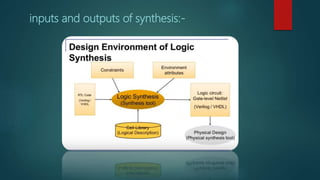
inputs and outputs of synthesis:-
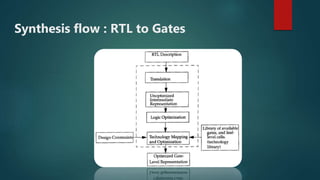
Synthesis flow : RTL to Gates
 logic synthesis def:-
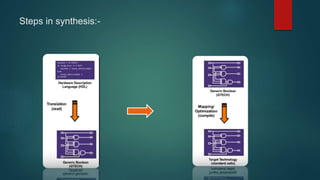
its nothing but converting the RTL(register transfer language) code in to
optimized GATED LEVEL NETLIST
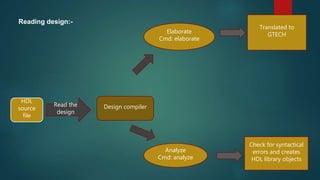
Elaborate
Cmd: elaborate
Analyze
Cmd: analyze
HDL
source
file
Translated to
GTECH
Check for syntactical
errors and creates
HDL library objects
Read the
design
Design compiler
Reading design:-
Steps in synthesis:-
Stage in Synthesis flow
 RTL description :
the designer describes the design at a high level by using RTL constructs.
 translation :
the RTL description is converted by the logic synthesis tool to an unoptimized, intermediate, internal
representation.
 logic optimization :
the logic is now optimized to remove redundant logic. various technology independent Boolean logic
optimization techniques are used.
 technology mapping and optimization :
in this step, the synthesis tool takes the internal representation and implements the representation in gates,
using the cells provided in the technology library
Technology library : the technology library contains library cells provided by abc inc. the term
standard cell library and the term technology library are identical and are used interchangeably.
Design constraints : design constraints typically include the following:
Timing-
the circuit must meet certain timing requirements. An internal static timing analyzer checks timing.
Area-
The area of the final layout must not exceed a limit.
Power-
the power dissipation in the circuit must not exceed a threshold.
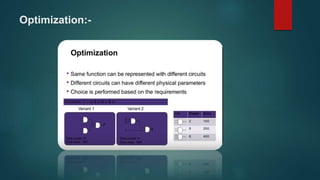
Optimization:-
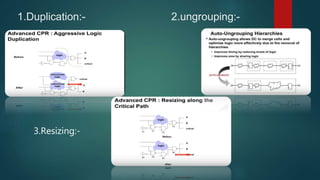
1.Duplication:- 2.ungrouping:-
3.Resizing:-
Compile strategy:-
 We can use three types of compilation strategies for the
hierarchical
Designs.
 Top_bottom compile
 Bottom_top compile
 Mixed compile
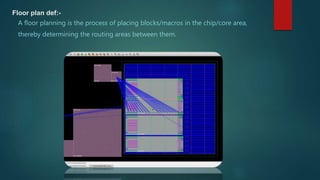
Floor plan def:-
A floor planning is the process of placing blocks/macros in the chip/core area,
thereby determining the routing areas between them.
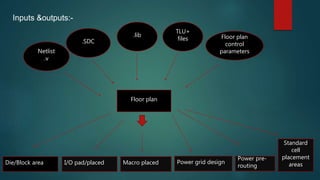
Netlist
.v
.SDC
.lib
TLU+
files Floor plan
control
parameters
Floor plan
Die/Block area I/O pad/placed Macro placed Power grid design
Power pre-
routing
Standard
cell
placement
areas
Inputs &outputs:-
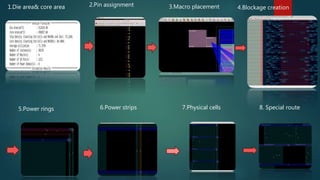
2.Pin assignment 3.Macro placement1.Die area& core area 4.Blockage creation
5.Power rings 6.Power strips 7.Physical cells 8. Special route
Floor plan constraints:-
 Minimize the total chip area.
 •Make routing phase easy (routable).
 •Improve the performance by reducing signal delays.
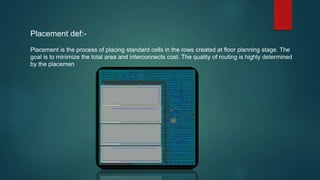
Placement def:-
Placement is the process of placing standard cells in the rows created at floor planning stage. The
goal is to minimize the total area and interconnects cost. The quality of routing is highly determined
by the placemen
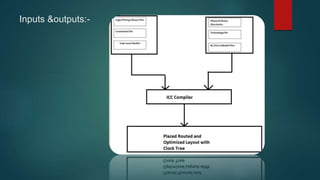
Inputs &outputs:-
Checklist after placement:-
 Timing
 Congestion
 utilization
Logic synthesis,flootplan&placement

Logic synthesis,flootplan&placement

  • 2.
    inputs and outputsof synthesis:-
  • 3.
    Synthesis flow :RTL to Gates
  • 4.
     logic synthesisdef:- its nothing but converting the RTL(register transfer language) code in to optimized GATED LEVEL NETLIST
  • 5.
    Elaborate Cmd: elaborate Analyze Cmd: analyze HDL source file Translatedto GTECH Check for syntactical errors and creates HDL library objects Read the design Design compiler Reading design:-
  • 6.
  • 7.
    Stage in Synthesisflow  RTL description : the designer describes the design at a high level by using RTL constructs.  translation : the RTL description is converted by the logic synthesis tool to an unoptimized, intermediate, internal representation.  logic optimization : the logic is now optimized to remove redundant logic. various technology independent Boolean logic optimization techniques are used.  technology mapping and optimization : in this step, the synthesis tool takes the internal representation and implements the representation in gates, using the cells provided in the technology library
  • 8.
    Technology library :the technology library contains library cells provided by abc inc. the term standard cell library and the term technology library are identical and are used interchangeably. Design constraints : design constraints typically include the following: Timing- the circuit must meet certain timing requirements. An internal static timing analyzer checks timing. Area- The area of the final layout must not exceed a limit. Power- the power dissipation in the circuit must not exceed a threshold.
  • 9.
  • 10.
  • 11.
    Compile strategy:-  Wecan use three types of compilation strategies for the hierarchical Designs.  Top_bottom compile  Bottom_top compile  Mixed compile
  • 13.
    Floor plan def:- Afloor planning is the process of placing blocks/macros in the chip/core area, thereby determining the routing areas between them.
  • 14.
    Netlist .v .SDC .lib TLU+ files Floor plan control parameters Floorplan Die/Block area I/O pad/placed Macro placed Power grid design Power pre- routing Standard cell placement areas Inputs &outputs:-
  • 15.
    2.Pin assignment 3.Macroplacement1.Die area& core area 4.Blockage creation 5.Power rings 6.Power strips 7.Physical cells 8. Special route
  • 16.
    Floor plan constraints:- Minimize the total chip area.  •Make routing phase easy (routable).  •Improve the performance by reducing signal delays.
  • 18.
    Placement def:- Placement isthe process of placing standard cells in the rows created at floor planning stage. The goal is to minimize the total area and interconnects cost. The quality of routing is highly determined by the placemen
  • 19.
  • 20.
    Checklist after placement:- Timing  Congestion  utilization