Logan’s Logo

So Logan has devised a logo for her company which is a square divided into 3 sections with 2
functions. Our objective is to find what functions fit the two curves on her logo and also make it
fit on two other sizes of her logo. Just looking at the shape of the lines 2 types of functions
immediately jump into my head, sinusoidal and cubic. I first traced a grid onto the original copy
of the logo I was given in order to get points to start trying to form a function to match the
design. The grid I used had 4 squares per inch. I then plotted 7 points on each curve shown in
the table below.

Upper Curve                                       Lower Curve
X                        Y                        X                        Y
0                        4                        0                        1
1                        2                        2                        1
3                        2                        5                        4
5                        5                        6                        5
7                        8.5                      8                        6
9                        9.5                      9.5                      5
10                       9                        11                       3


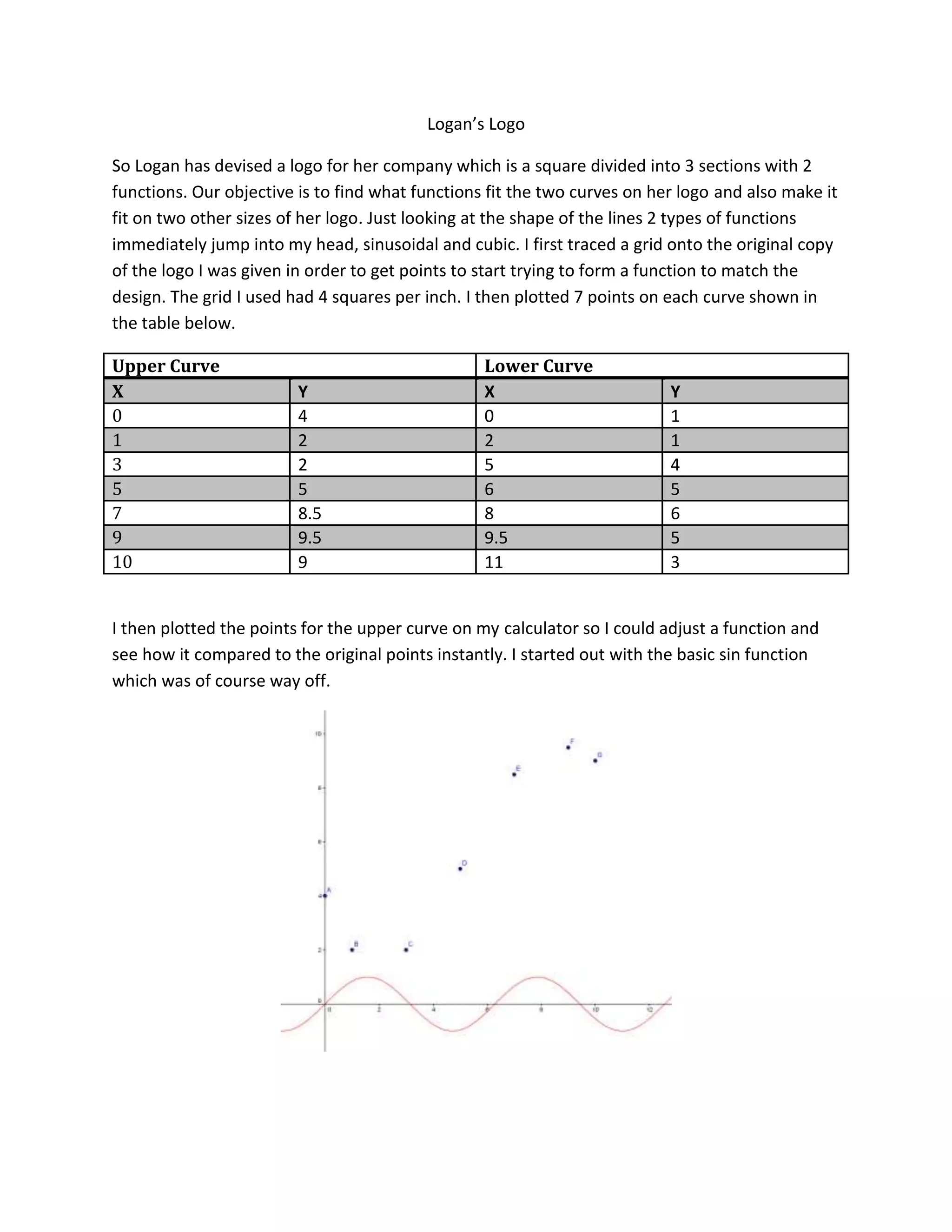
I then plotted the points for the upper curve on my calculator so I could adjust a function and
see how it compared to the original points instantly. I started out with the basic sin function
which was of course way off.
I knew I had to increase the amplitude to get it to reach the highest point and I estimated that
the midline of the sinusoid would be at about 5 so that would mean I would have to add a
vertical shift as well. I changed the function to be 4sin(x)+5 which was still off.


 I saw that I had to change the period because it was not rising and falling with the points as
well as flip the amplitude because it was high while the points were low and vice versa. I came
up with -4sin(0.5x)+5 I made a few more adjustments because the amplitude I had picked (4)
was too high for the highest point (9,9.5) and because the function was rising and falling too
quickly so I had to shrink the period. I also had to add a horizontal shift to the left to better
make the function fit. I did this by adding something to the x within the parentheses. After all of
those adjustments I came up with -4.3sin(0.55(x+0.9))+5 shown below
I then decided to try a cubic function because I thought it might fit the data better because the
difference between a sinusoidal function and a cubic function that I needed for this situation
was that the sinusoidal function has a constant period which was making it hard for it to match
the data and the cubic function does not.

I started with the basic cubic function again which was off of all my scales so I had to shrink it
down it quite a bit to even see it with my viewing window. I tried 0.5x3 but it was still off the
charts. I finally found that it had to be -0.05x3+0.8x2-2x to even make it appear on the screen. It
seemed to match the second half of the equation well so then I added 4 to try and get the first
part of the function higher which did work but then the second part was too high. To fix this I
subtracted a little more x. Now my equation looked like -.05x3+0.8x2-2.7x+4
Now the second part of the equation was still not lining up, and I knew to fix that I had to add
more x2 so I changed my equation to -.05x3+0.84x2-2.7x+4
This made the line go slightly above the points but I think it fits the data better that way. To
check how close I was I did a cubic regression and got


                            -0.05210x3+0.83910x2-2.68971x+3.95631


Which was very similar to what I got, below is a graph with the regression in green, my cubic
function in light blue, and my sinusoidal function in red


Clearly you can see that the regression is the best fit, but my cubic function is much better than
my sinusoidal function. So I chose the cubic function to be the equation for the top curve.
Now onto the bottom curve! Just from looking at it I can determine that a sinusoidal function
will probably fit because it seems to have a more constant period and amplitude, it fluctuates
less. This time I have to plot the points for the second function and then I started with a vertical
shift of 4 because I estimated 4 to be the midline of this design and an amplitude of 3 because
the design spanned more than 1 and got this.
I could tell that obviously the period needed to be slowed down by about half so I added a
coefficient within the paranthesees to x, flipped the amplitude, and shifted it over slightly.
Which gave me -3sin(0.5(x+2))+4


Now that the function is pretty close to where I want it to be I start doing some fine tuning! I
changed the vertical shift because it was just a liiiittle too much so I changed it to 3.42 which
helped me see that the period was still slightly too fast so I reduced that as well to 0.48.
So now my final functions for both curves were…..

-.05x3+0.84x2-2.7x+4 for the upper curve

And

-3sin(0.48 (x + 2)) + 3.42 for the lower curve

Which looks like


Which isn’t perfect but it is pretty good. Now the problem asked us what we would do for
Logan’s t shirts with the logo on the back that is twice as big. So this would mean that instead of
covering 110 squares it’s going to have to cover 220 squares. This is kind of a hard task because
now the period of both functions must be stretched, but the amplitude must also be stretched
it is odd because to stretch the period you make the number smaller, to stretch the amplitude
you make the number bigger. So for the cubic function you will end up with

-0.0094x3+0.1820x2+0.0799x+2.6616

(I was not able to get a graph of this because the increments are very exact and the program I
was using rounded them to 2 decimal places which no longer matches the data)

For the sinusoidal function you will end up with

-6sin(0.24 (x + 4)) + 3.42

The vertical shift stays the same for that one because you still want the center line to be the
same.

Logan also wants to print business cards which are 9cm by 5cm where the original box was 6.7
cm by 6.4 cm. To make my equations fit in that space I would cut down the amplitude slightly
and increase the period so it would fit in the condensed space. For the square to be
proportional the box will be 5.23 cm wide if the design is 5 cm tall. (5x6.7/6.4)=5.23 which
allows for 64 squares. But also with it being this size it will take up 58% of the card’s surface so
she won’t have much room to write anything else on it.

Logan's logo

  • 1.
    Logan’s Logo So Loganhas devised a logo for her company which is a square divided into 3 sections with 2 functions. Our objective is to find what functions fit the two curves on her logo and also make it fit on two other sizes of her logo. Just looking at the shape of the lines 2 types of functions immediately jump into my head, sinusoidal and cubic. I first traced a grid onto the original copy of the logo I was given in order to get points to start trying to form a function to match the design. The grid I used had 4 squares per inch. I then plotted 7 points on each curve shown in the table below. Upper Curve Lower Curve X Y X Y 0 4 0 1 1 2 2 1 3 2 5 4 5 5 6 5 7 8.5 8 6 9 9.5 9.5 5 10 9 11 3 I then plotted the points for the upper curve on my calculator so I could adjust a function and see how it compared to the original points instantly. I started out with the basic sin function which was of course way off.
  • 2.
    I knew Ihad to increase the amplitude to get it to reach the highest point and I estimated that the midline of the sinusoid would be at about 5 so that would mean I would have to add a vertical shift as well. I changed the function to be 4sin(x)+5 which was still off. I saw that I had to change the period because it was not rising and falling with the points as well as flip the amplitude because it was high while the points were low and vice versa. I came up with -4sin(0.5x)+5 I made a few more adjustments because the amplitude I had picked (4) was too high for the highest point (9,9.5) and because the function was rising and falling too quickly so I had to shrink the period. I also had to add a horizontal shift to the left to better make the function fit. I did this by adding something to the x within the parentheses. After all of those adjustments I came up with -4.3sin(0.55(x+0.9))+5 shown below
  • 3.
    I then decidedto try a cubic function because I thought it might fit the data better because the difference between a sinusoidal function and a cubic function that I needed for this situation was that the sinusoidal function has a constant period which was making it hard for it to match the data and the cubic function does not. I started with the basic cubic function again which was off of all my scales so I had to shrink it down it quite a bit to even see it with my viewing window. I tried 0.5x3 but it was still off the charts. I finally found that it had to be -0.05x3+0.8x2-2x to even make it appear on the screen. It seemed to match the second half of the equation well so then I added 4 to try and get the first part of the function higher which did work but then the second part was too high. To fix this I subtracted a little more x. Now my equation looked like -.05x3+0.8x2-2.7x+4
  • 4.
    Now the secondpart of the equation was still not lining up, and I knew to fix that I had to add more x2 so I changed my equation to -.05x3+0.84x2-2.7x+4
  • 5.
    This made theline go slightly above the points but I think it fits the data better that way. To check how close I was I did a cubic regression and got -0.05210x3+0.83910x2-2.68971x+3.95631 Which was very similar to what I got, below is a graph with the regression in green, my cubic function in light blue, and my sinusoidal function in red Clearly you can see that the regression is the best fit, but my cubic function is much better than my sinusoidal function. So I chose the cubic function to be the equation for the top curve.
  • 6.
    Now onto thebottom curve! Just from looking at it I can determine that a sinusoidal function will probably fit because it seems to have a more constant period and amplitude, it fluctuates less. This time I have to plot the points for the second function and then I started with a vertical shift of 4 because I estimated 4 to be the midline of this design and an amplitude of 3 because the design spanned more than 1 and got this.
  • 7.
    I could tellthat obviously the period needed to be slowed down by about half so I added a coefficient within the paranthesees to x, flipped the amplitude, and shifted it over slightly. Which gave me -3sin(0.5(x+2))+4 Now that the function is pretty close to where I want it to be I start doing some fine tuning! I changed the vertical shift because it was just a liiiittle too much so I changed it to 3.42 which helped me see that the period was still slightly too fast so I reduced that as well to 0.48.
  • 8.
    So now myfinal functions for both curves were….. -.05x3+0.84x2-2.7x+4 for the upper curve And -3sin(0.48 (x + 2)) + 3.42 for the lower curve Which looks like Which isn’t perfect but it is pretty good. Now the problem asked us what we would do for Logan’s t shirts with the logo on the back that is twice as big. So this would mean that instead of covering 110 squares it’s going to have to cover 220 squares. This is kind of a hard task because now the period of both functions must be stretched, but the amplitude must also be stretched
  • 9.
    it is oddbecause to stretch the period you make the number smaller, to stretch the amplitude you make the number bigger. So for the cubic function you will end up with -0.0094x3+0.1820x2+0.0799x+2.6616 (I was not able to get a graph of this because the increments are very exact and the program I was using rounded them to 2 decimal places which no longer matches the data) For the sinusoidal function you will end up with -6sin(0.24 (x + 4)) + 3.42 The vertical shift stays the same for that one because you still want the center line to be the same. Logan also wants to print business cards which are 9cm by 5cm where the original box was 6.7 cm by 6.4 cm. To make my equations fit in that space I would cut down the amplitude slightly and increase the period so it would fit in the condensed space. For the square to be proportional the box will be 5.23 cm wide if the design is 5 cm tall. (5x6.7/6.4)=5.23 which allows for 64 squares. But also with it being this size it will take up 58% of the card’s surface so she won’t have much room to write anything else on it.