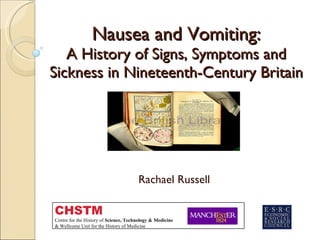
Nausea and Vomiting: A History of Signs, Symptoms and Sickness in Nineteenth-Century Britain Rachael Russell CHSTM Centre for the History of  Science, Technology & Medicine & Wellcome Unit for the History of Medicine
Research Questions Main research question:  How did medical understandings and management of nausea and vomiting change throughout the nineteenth-century? This will be pursued through five sub-sections, addressing:  Bedside Medicine, 1800-1833 Hospital Medicine, 1834-1869 Laboratory Medicine, 1870-1900 Case study: Sea-sickness Case study: Morning sickness
Historiography and Sources Subject matter Method and theory Sources But why nausea and vomiting? Three theoretical/historical reasons Plus interest of case studies… Coloured etching by I. Cruikshank, 1800.
The Experience of Sea-Sickness “ How ill, not a few of us know; so ill that this illness makes us forget every other suffering and every danger.  The moral and the physical prostration are equally complete.  Far from fearing death, we are indifferent to it, wish for it, even pray for it.  “Oh do throw me into the sea, and drown me!” is not a rare entreaty to escape from despairing victim’s lips” -  Anon., ‘Sea-Sickness,’  All the Year Round (1872)   8:195 , p. 342.
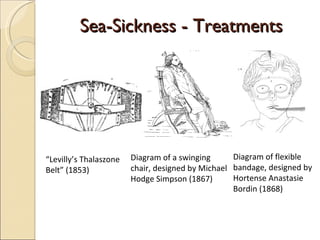
Sea-Sickness - Treatments “ Levilly’s Thalaszone Belt” (1853)   Diagram of a swinging chair, designed by Michael Hodge Simpson (1867)   Diagram of flexible bandage, designed by Hortense Anastasie Bordin (1868)
Morning Sickness American Patent Medicine (~1850-1900) “ The secret is out” Letter from Elizabeth Shaw to John Shaw, 31 st  March 1815, Shaw/43a, Birmingham University “ A woman, after conception, during the time of her being with child, ought to be looked upon as indisposed or sick, though in good health; for child-bearing is a kind of nine months’ sickness, being all the time in expectation of many inconveniences which such a condition usually causes to those that are not well governed during that time.” Aristotle’s Works:  (London: Printed for the Booksellers, 1861), p. 20
Thank you… Questions? [email_address]

Lit Sci Med Vomiting

  • 1.
    Nausea and Vomiting:A History of Signs, Symptoms and Sickness in Nineteenth-Century Britain Rachael Russell CHSTM Centre for the History of Science, Technology & Medicine & Wellcome Unit for the History of Medicine
  • 2.
    Research Questions Mainresearch question: How did medical understandings and management of nausea and vomiting change throughout the nineteenth-century? This will be pursued through five sub-sections, addressing: Bedside Medicine, 1800-1833 Hospital Medicine, 1834-1869 Laboratory Medicine, 1870-1900 Case study: Sea-sickness Case study: Morning sickness
  • 3.
    Historiography and SourcesSubject matter Method and theory Sources But why nausea and vomiting? Three theoretical/historical reasons Plus interest of case studies… Coloured etching by I. Cruikshank, 1800.
  • 4.
    The Experience ofSea-Sickness “ How ill, not a few of us know; so ill that this illness makes us forget every other suffering and every danger. The moral and the physical prostration are equally complete. Far from fearing death, we are indifferent to it, wish for it, even pray for it. “Oh do throw me into the sea, and drown me!” is not a rare entreaty to escape from despairing victim’s lips” - Anon., ‘Sea-Sickness,’ All the Year Round (1872) 8:195 , p. 342.
  • 5.
    Sea-Sickness - Treatments“ Levilly’s Thalaszone Belt” (1853)   Diagram of a swinging chair, designed by Michael Hodge Simpson (1867)   Diagram of flexible bandage, designed by Hortense Anastasie Bordin (1868)
  • 6.
    Morning Sickness AmericanPatent Medicine (~1850-1900) “ The secret is out” Letter from Elizabeth Shaw to John Shaw, 31 st March 1815, Shaw/43a, Birmingham University “ A woman, after conception, during the time of her being with child, ought to be looked upon as indisposed or sick, though in good health; for child-bearing is a kind of nine months’ sickness, being all the time in expectation of many inconveniences which such a condition usually causes to those that are not well governed during that time.” Aristotle’s Works: (London: Printed for the Booksellers, 1861), p. 20
  • 7.
    Thank you… Questions?[email_address]