NOTANORIGINALDOCUMENTCREATINGATRAININGSTRATEGY
NOT AN ORIGINAL DOCUMENT
Current state.
I had just completed my first 90 days in role as head of People Development.
The existing strategy in place was built solely on the excellent theory of the
70/20/10 rule.
Although we had an impressive learning platform in place it held mainly e-learning
materials and a book store. The content on the site was very much push and pull
only.
People Development team was divided into 3 teams, design, e-learning and
implementation.
The business continued to attract volumes of gen Y colleagues and its primary focus
was on embedding its sales tool within its sales journey.
To be fully prepared to support the business deliver its future needs it was clear to
me that we had to make a transformational change to our People Development.
Much like every business one key leaver to driving great volumes is to get new
colleagues up to speed as quickly as possible and then to maintain/improve on these
levels.
NOTANORIGINALDOCUMENT
THEFIRSTSTEP–SETPRINCIPLES
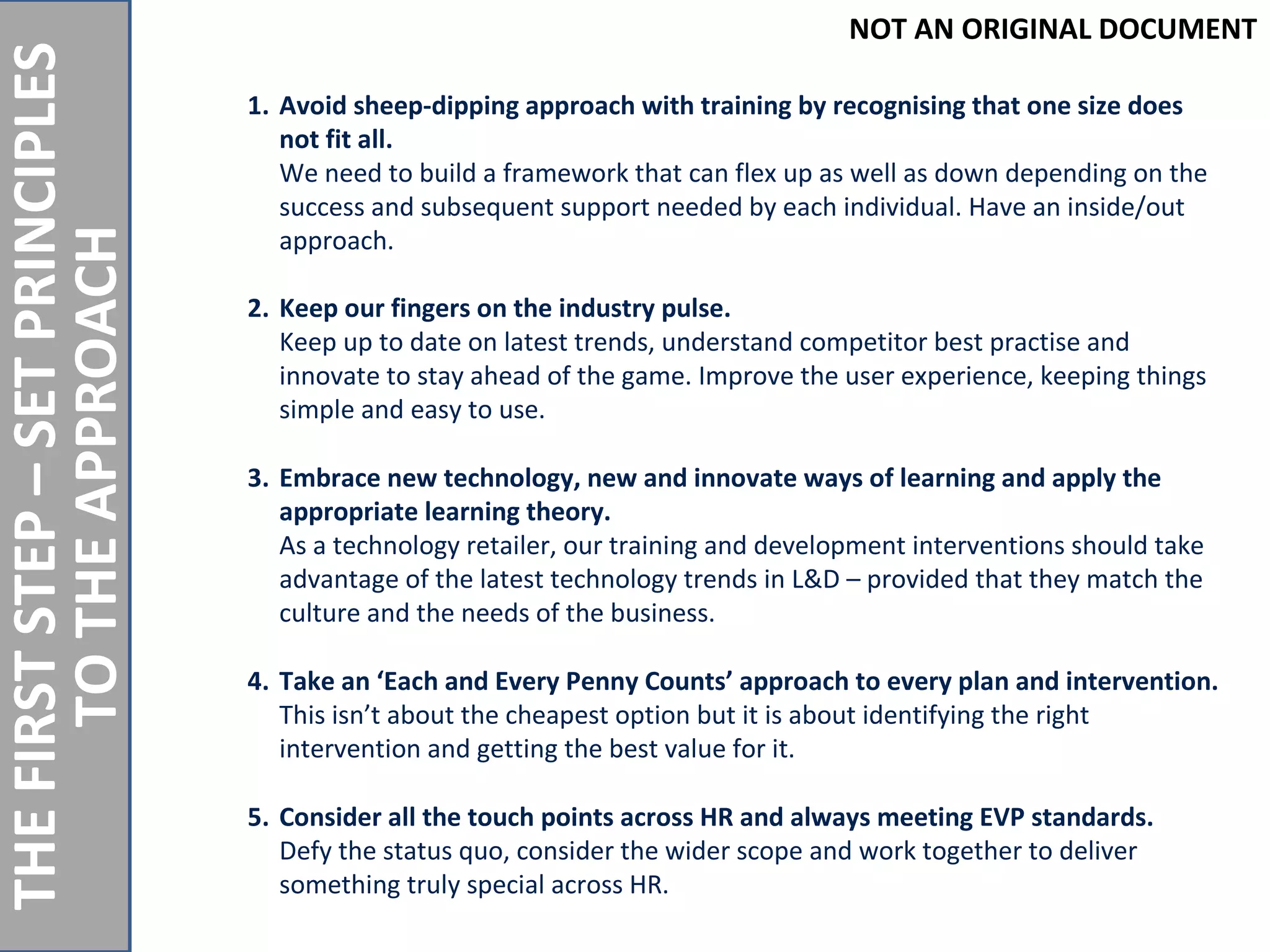
TOTHEAPPROACH 1. Avoid sheep-dipping approach with training by recognising that one size does
not fit all.
We need to build a framework that can flex up as well as down depending on the
success and subsequent support needed by each individual. Have an inside/out
approach.
2. Keep our fingers on the industry pulse.
Keep up to date on latest trends, understand competitor best practise and
innovate to stay ahead of the game. Improve the user experience, keeping things
simple and easy to use.
3. Embrace new technology, new and innovate ways of learning and apply the
appropriate learning theory.
As a technology retailer, our training and development interventions should take
advantage of the latest technology trends in L&D – provided that they match the
culture and the needs of the business.
4. Take an ‘Each and Every Penny Counts’ approach to every plan and intervention.
This isn’t about the cheapest option but it is about identifying the right
intervention and getting the best value for it.
5. Consider all the touch points across HR and always meeting EVP standards.
Defy the status quo, consider the wider scope and work together to deliver
something truly special across HR.
NOT AN ORIGINAL DOCUMENT
NOTANORIGINALDOCUMENT
FUTURELEARNINGNEEDS
Mentoring
Articles
On the job
Podcasts
Coaching
Webinars
Books
Websites
User Generated
Content
FriendingRatings
Blogging Best practice
Videos
Commenting
E-Learning
Physical Classroom
Virtual Classroom
Forums
Game-based
Learning
Conferences
Source - Flat Army: Creating a Connected and Engaged Organisation (Wiley,2013)
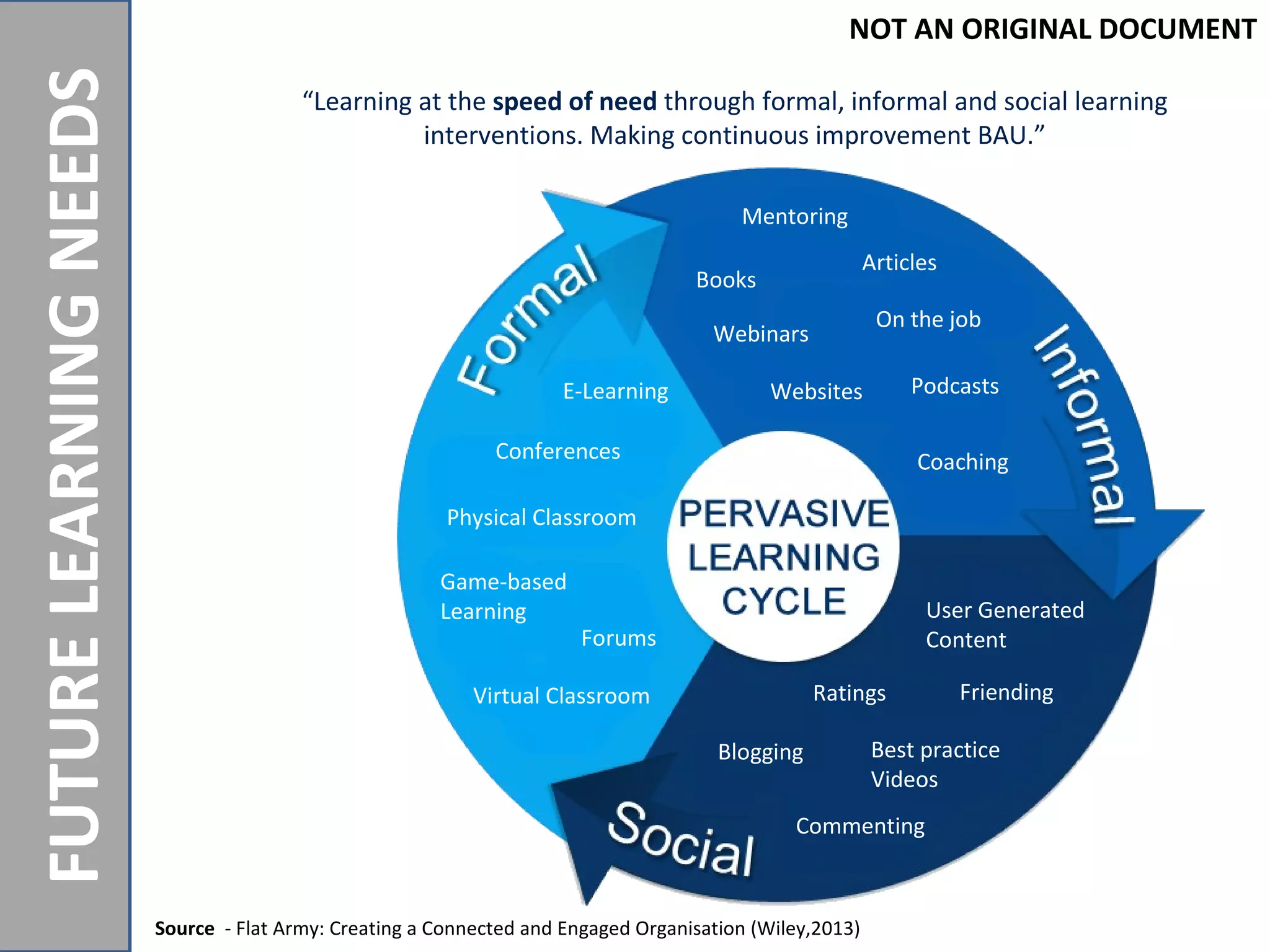
“Learning at the speed of need through formal, informal and social learning
interventions. Making continuous improvement BAU.”
NOT AN ORIGINAL DOCUMENT
NOTANORIGINALDOCUMENT
FROMNOVICETOEXPERT
Advanced
Beginner
Competent Proficient ExpertNovice
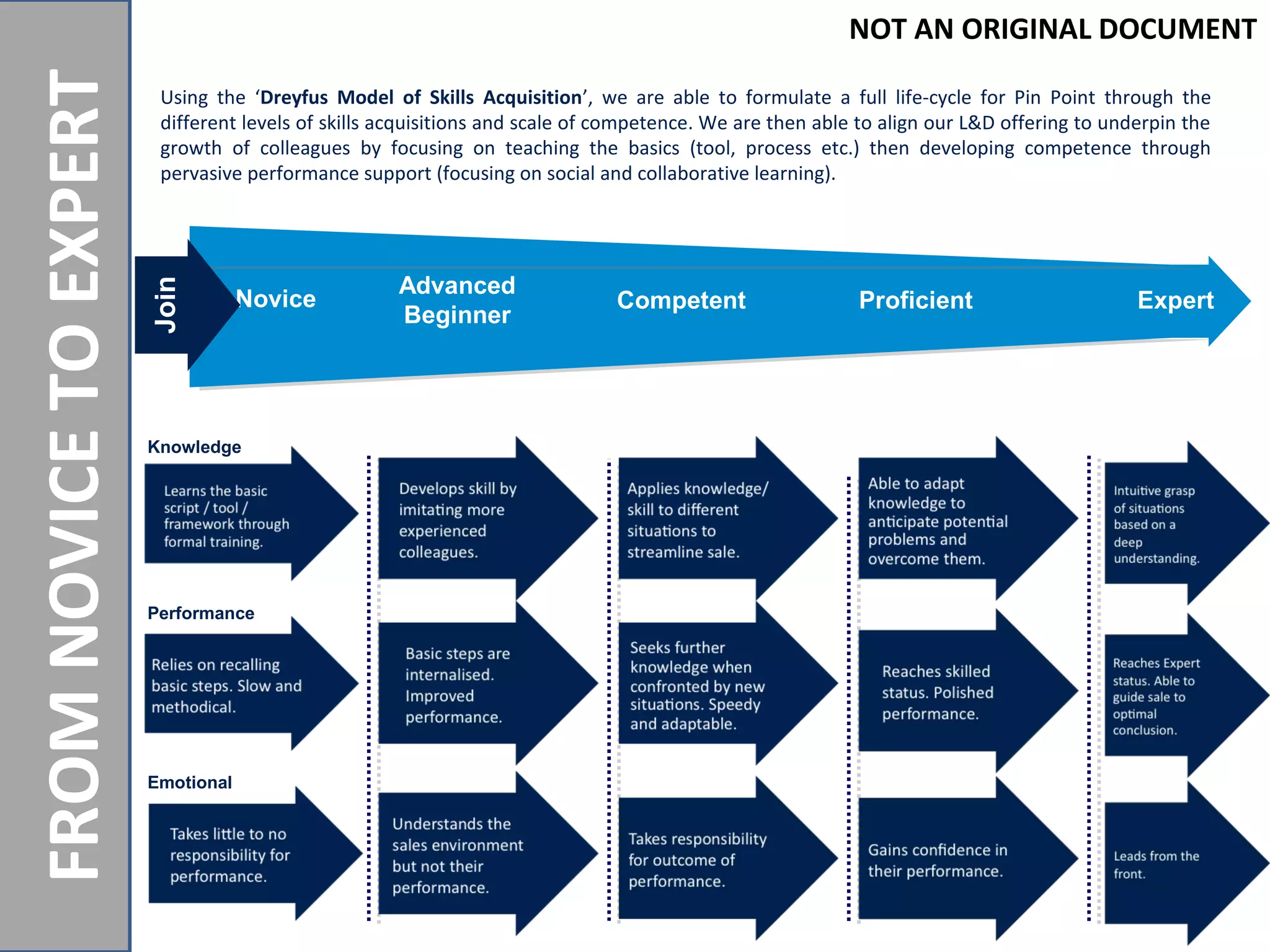
Using the ‘Dreyfus Model of Skills Acquisition’, we are able to formulate a full life-cycle for Pin Point through the
different levels of skills acquisitions and scale of competence. We are then able to align our L&D offering to underpin the
growth of colleagues by focusing on teaching the basics (tool, process etc.) then developing competence through
pervasive performance support (focusing on social and collaborative learning).Join
Knowledge
Performance
Emotional
NOT AN ORIGINAL DOCUMENT
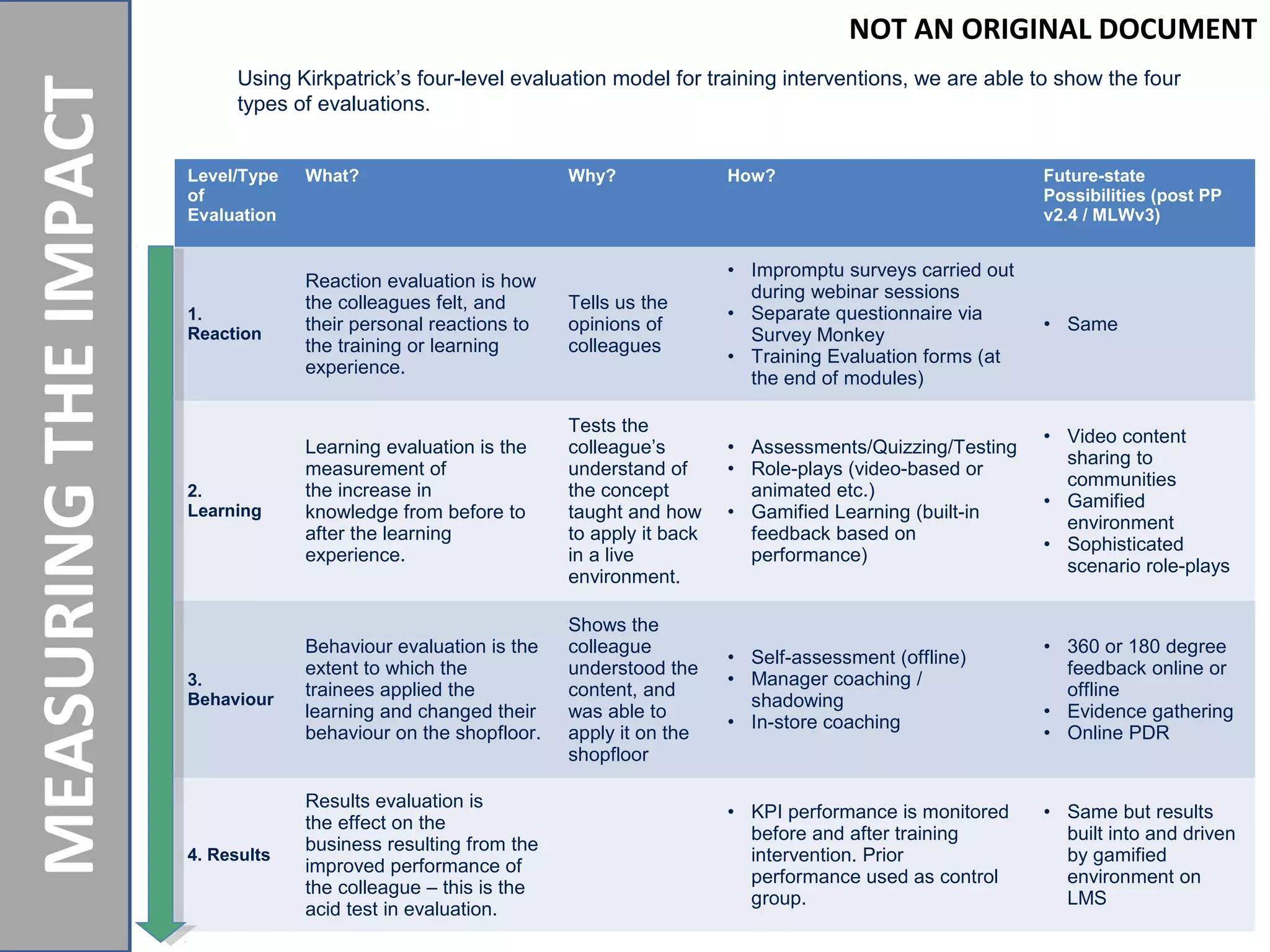
Using Kirkpatrick’s four-level evaluation model for training interventions, we are able to show the four
types of evaluations.
Level/Type
of
Evaluation
What? Why? How? Future-state
Possibilities (post PP
v2.4 / MLWv3)
1.
Reaction
Reaction evaluation is how
the colleagues felt, and
their personal reactions to
the training or learning
experience.
Tells us the
opinions of
colleagues
• Impromptu surveys carried out
during webinar sessions
• Separate questionnaire via
Survey Monkey
• Training Evaluation forms (at
the end of modules)
• Same
2.
Learning
Learning evaluation is the
measurement of
the increase in
knowledge from before to
after the learning
experience.
Tests the
colleague’s
understand of
the concept
taught and how
to apply it back
in a live
environment.
• Assessments/Quizzing/Testing
• Role-plays (video-based or
animated etc.)
• Gamified Learning (built-in
feedback based on
performance)
• Video content
sharing to
communities
• Gamified
environment
• Sophisticated
scenario role-plays
3.
Behaviour
Behaviour evaluation is the
extent to which the
trainees applied the
learning and changed their
behaviour on the shopfloor.
Shows the
colleague
understood the
content, and
was able to
apply it on the
shopfloor
• Self-assessment (offline)
• Manager coaching /
shadowing
• In-store coaching
• 360 or 180 degree
feedback online or
offline
• Evidence gathering
• Online PDR
4. Results
Results evaluation is
the effect on the
business resulting from the
improved performance of
the colleague – this is the
acid test in evaluation.
• KPI performance is monitored
before and after training
intervention. Prior
performance used as control
group.
• Same but results
built into and driven
by gamified
environment on
LMS
MEASURINGTHEIMPACT
NOT AN ORIGINAL DOCUMENT
NOTANORIGINALDOCUMENT
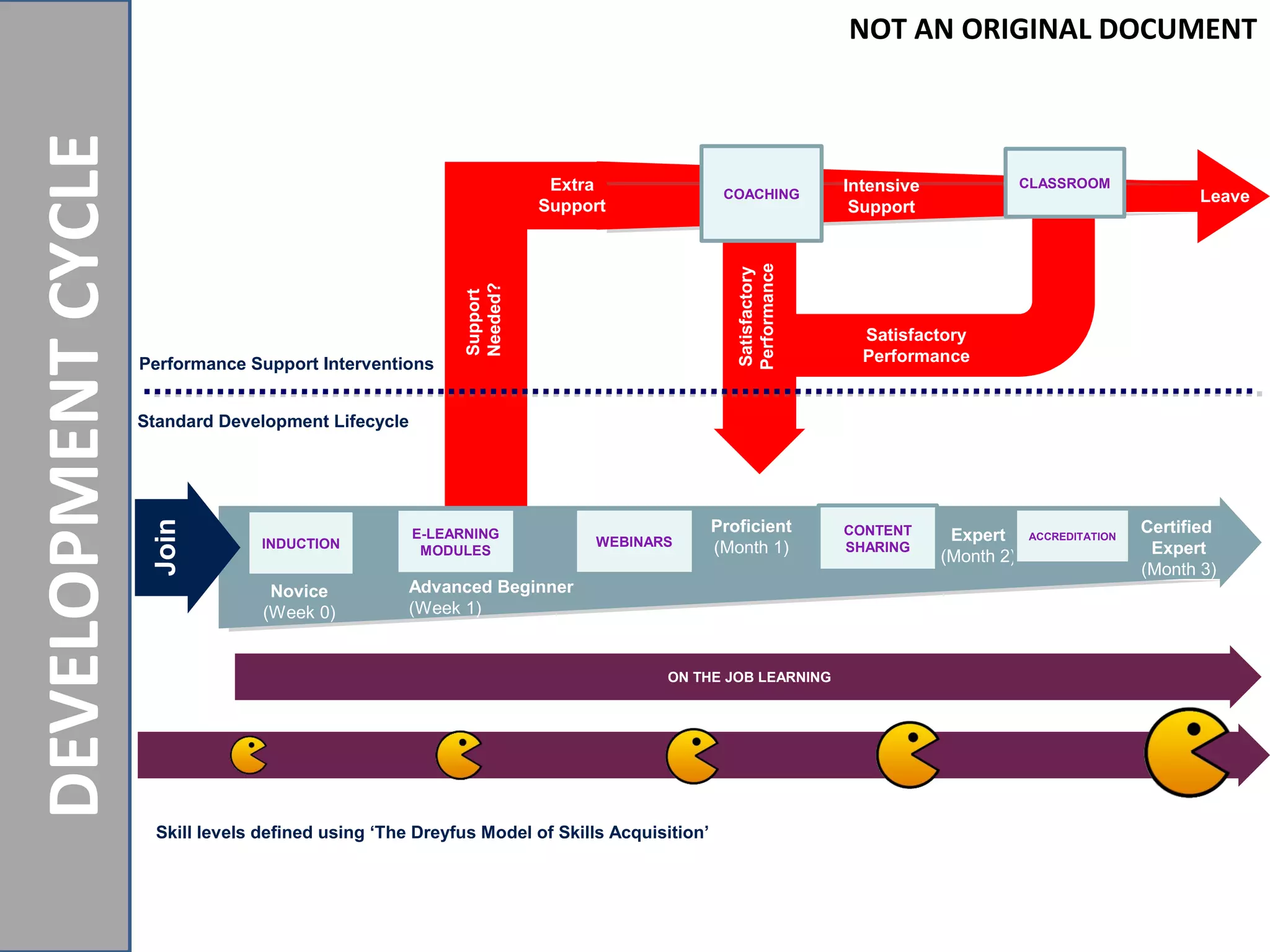
DEVELOPMENTCYCLE
Advanced Beginner
(Week 1)
Proficient
(Month 1)
Expert
(Month 2)
Certified
Expert
(Month 3)
Novice
(Week 0)
Extra
Support
Leave
Intensive
Support
Support
Needed?
Performance Support Interventions
Standard Development Lifecycle
Join
INDUCTION
E-LEARNING
MODULES
WEBINARS
CONTENT
SHARING
Skill levels defined using ‘The Dreyfus Model of Skills Acquisition’
COACHING
CLASSROOM
ACCREDITATION
ON THE JOB LEARNING
Satisfactory
Performance
Satisfactory
Performance
NOT AN ORIGINAL DOCUMENT
NOTANORIGINALDOCUMENT
WEAVEGAMIFICATION
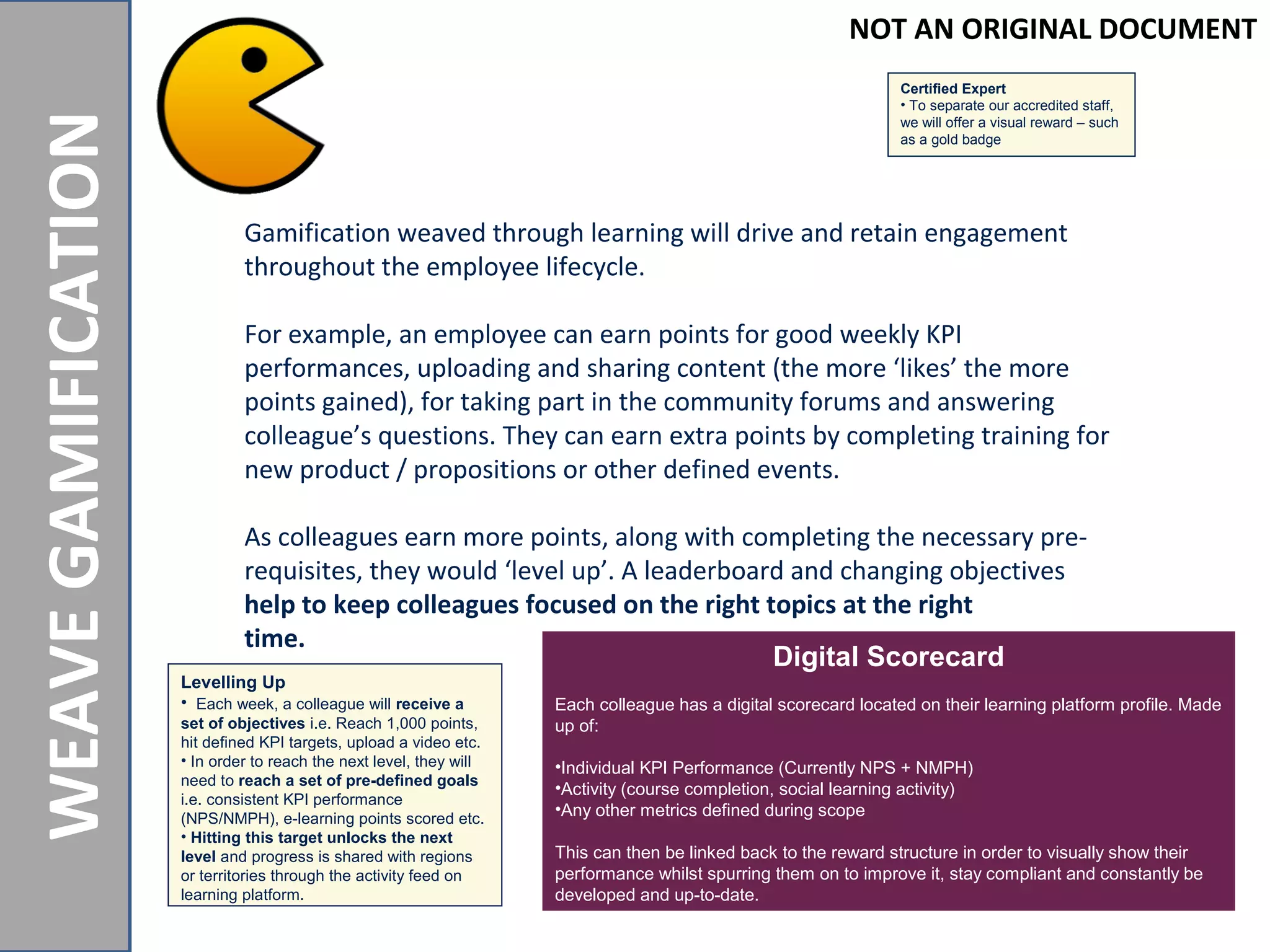
Gamification weaved through learning will drive and retain engagement
throughout the employee lifecycle.
For example, an employee can earn points for good weekly KPI
performances, uploading and sharing content (the more ‘likes’ the more
points gained), for taking part in the community forums and answering
colleague’s questions. They can earn extra points by completing training for
new product / propositions or other defined events.
As colleagues earn more points, along with completing the necessary pre-
requisites, they would ‘level up’. A leaderboard and changing objectives
help to keep colleagues focused on the right topics at the right
time.
Digital Scorecard
Each colleague has a digital scorecard located on their learning platform profile. Made
up of:
•Individual KPI Performance (Currently NPS + NMPH)
•Activity (course completion, social learning activity)
•Any other metrics defined during scope
This can then be linked back to the reward structure in order to visually show their
performance whilst spurring them on to improve it, stay compliant and constantly be
developed and up-to-date.
Certified Expert
• To separate our accredited staff,
we will offer a visual reward – such
as a gold badge
Levelling Up
• Each week, a colleague will receive a
set of objectives i.e. Reach 1,000 points,
hit defined KPI targets, upload a video etc.
• In order to reach the next level, they will
need to reach a set of pre-defined goals
i.e. consistent KPI performance
(NPS/NMPH), e-learning points scored etc.
• Hitting this target unlocks the next
level and progress is shared with regions
or territories through the activity feed on
learning platform.
NOT AN ORIGINAL DOCUMENT
Complexityof
releaseNOTANORIGINALDOCUMENT
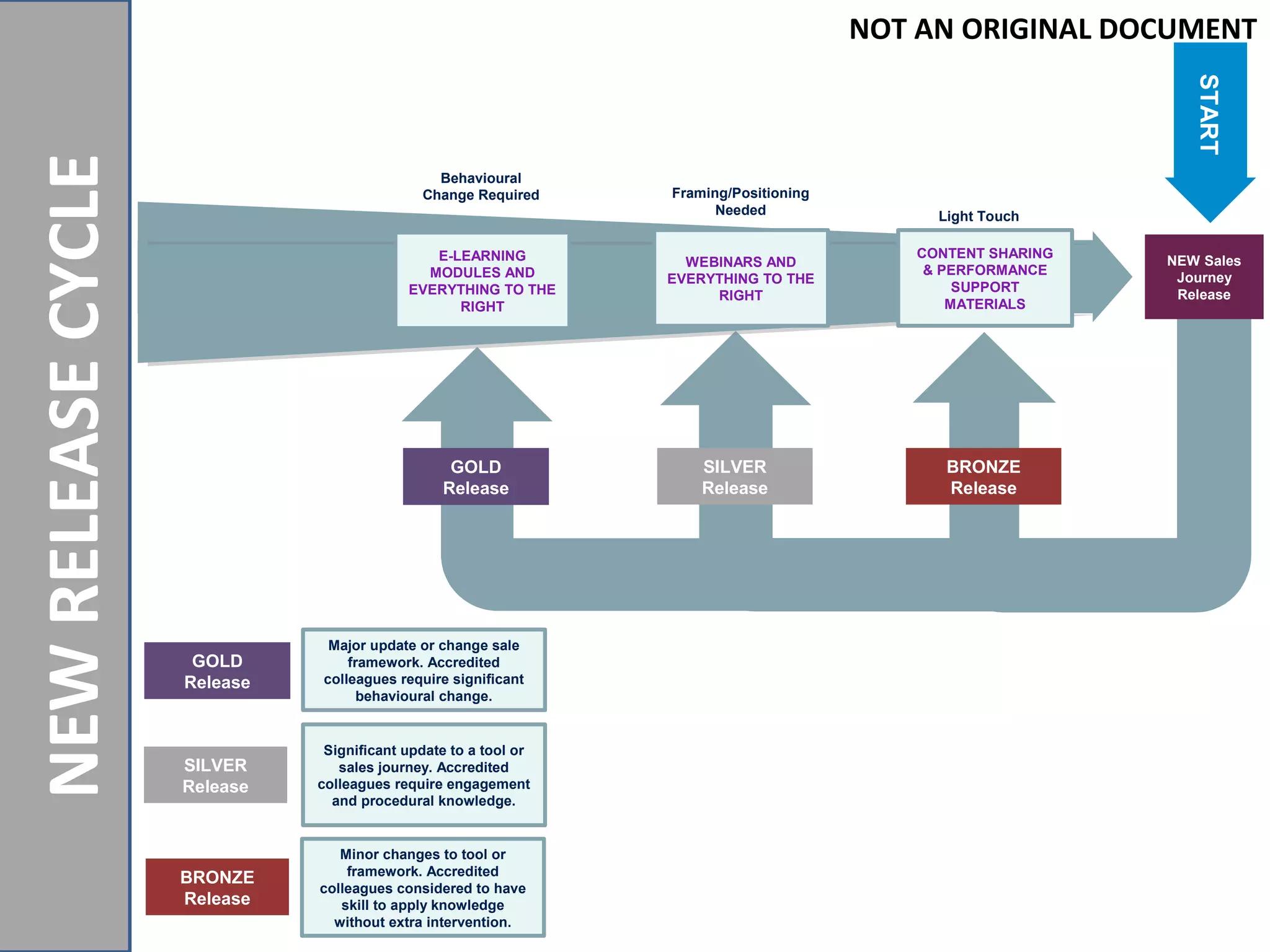
NEWRELEASECYCLE
E-LEARNING
MODULES AND
EVERYTHING TO THE
RIGHT
WEBINARS AND
EVERYTHING TO THE
RIGHT
CONTENT SHARING
& PERFORMANCE
SUPPORT
MATERIALS
NEW Sales
Journey
Release
SILVER
Release
BRONZE
Release
GOLD
Release
Light Touch
Behavioural
Change Required Framing/Positioning
Needed
GOLD
Release
Major update or change sale
framework. Accredited
colleagues require significant
behavioural change.
SILVER
Release
BRONZE
Release
Significant update to a tool or
sales journey. Accredited
colleagues require engagement
and procedural knowledge.
Minor changes to tool or
framework. Accredited
colleagues considered to have
skill to apply knowledge
without extra intervention.
START
NOT AN ORIGINAL DOCUMENT
NOTANORIGINALDOCUMENT
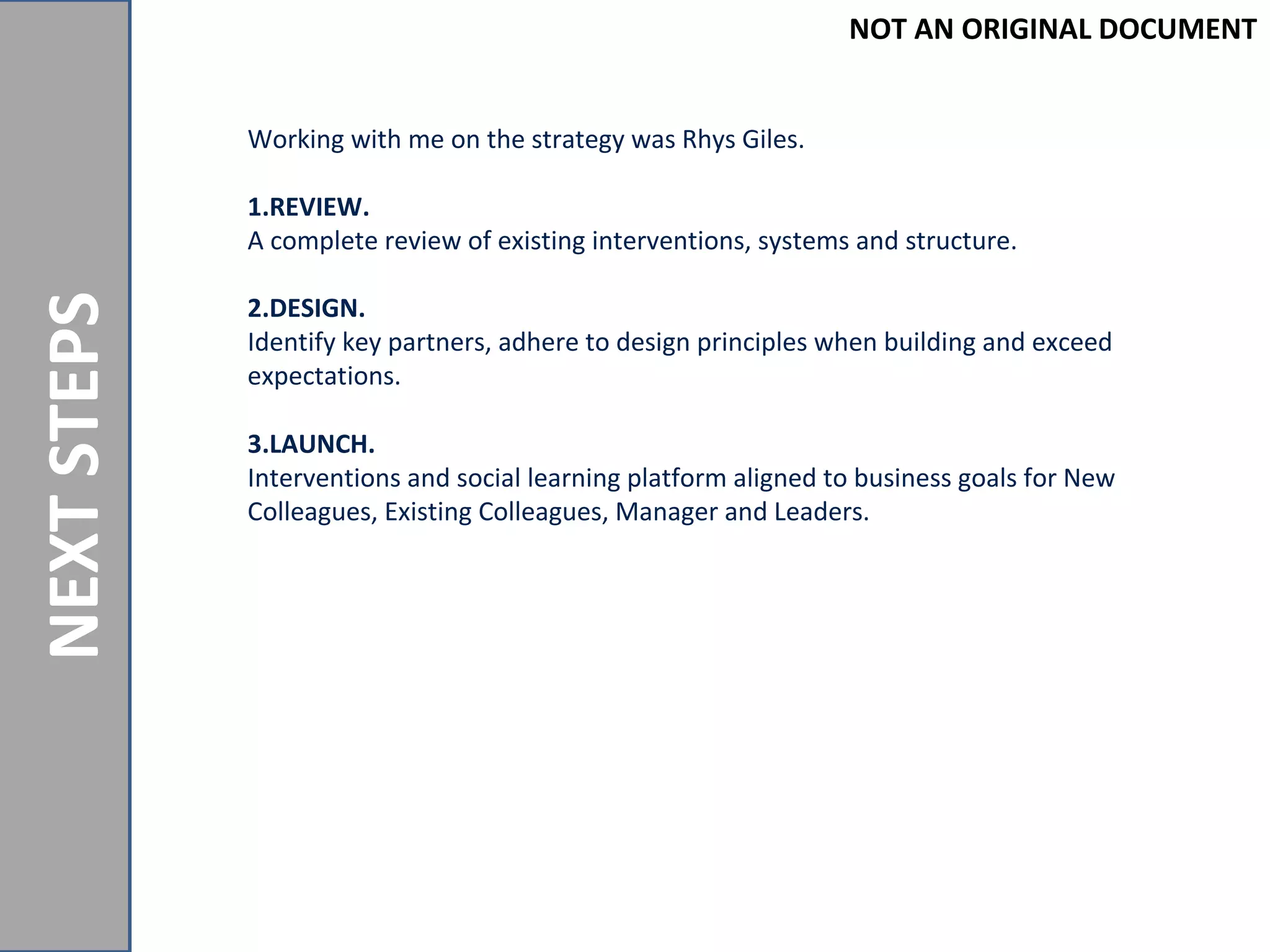
NEXTSTEPS
Working with me on the strategy was Rhys Giles.
1.REVIEW.
A complete review of existing interventions, systems and structure.
2.DESIGN.
Identify key partners, adhere to design principles when building and exceed
expectations.
3.LAUNCH.
Interventions and social learning platform aligned to business goals for New
Colleagues, Existing Colleagues, Manager and Leaders.
NOT AN ORIGINAL DOCUMENT
NOTANORIGINALDOCUMENT
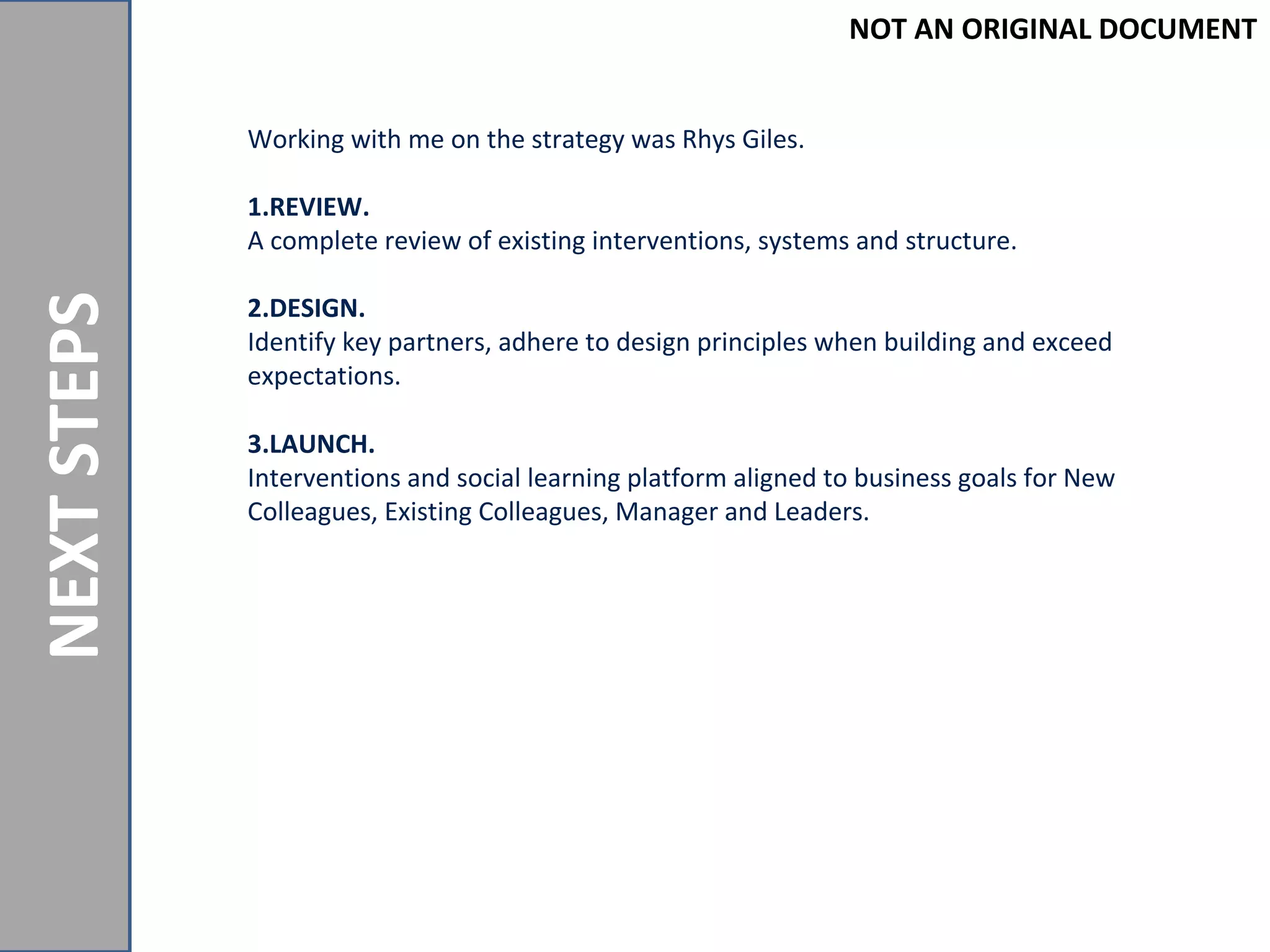
NEXTSTEPS
Working with me on the strategy was Rhys Giles.
1.REVIEW.
A complete review of existing interventions, systems and structure.
2.DESIGN.
Identify key partners, adhere to design principles when building and exceed
expectations.
3.LAUNCH.
Interventions and social learning platform aligned to business goals for New
Colleagues, Existing Colleagues, Manager and Leaders.
NOT AN ORIGINAL DOCUMENT

Linked In Training Strategy Documents

  • 1.
    NOTANORIGINALDOCUMENTCREATINGATRAININGSTRATEGY NOT AN ORIGINALDOCUMENT Current state. I had just completed my first 90 days in role as head of People Development. The existing strategy in place was built solely on the excellent theory of the 70/20/10 rule. Although we had an impressive learning platform in place it held mainly e-learning materials and a book store. The content on the site was very much push and pull only. People Development team was divided into 3 teams, design, e-learning and implementation. The business continued to attract volumes of gen Y colleagues and its primary focus was on embedding its sales tool within its sales journey. To be fully prepared to support the business deliver its future needs it was clear to me that we had to make a transformational change to our People Development. Much like every business one key leaver to driving great volumes is to get new colleagues up to speed as quickly as possible and then to maintain/improve on these levels.
  • 2.
    NOTANORIGINALDOCUMENT THEFIRSTSTEP–SETPRINCIPLES TOTHEAPPROACH 1. Avoidsheep-dipping approach with training by recognising that one size does not fit all. We need to build a framework that can flex up as well as down depending on the success and subsequent support needed by each individual. Have an inside/out approach. 2. Keep our fingers on the industry pulse. Keep up to date on latest trends, understand competitor best practise and innovate to stay ahead of the game. Improve the user experience, keeping things simple and easy to use. 3. Embrace new technology, new and innovate ways of learning and apply the appropriate learning theory. As a technology retailer, our training and development interventions should take advantage of the latest technology trends in L&D – provided that they match the culture and the needs of the business. 4. Take an ‘Each and Every Penny Counts’ approach to every plan and intervention. This isn’t about the cheapest option but it is about identifying the right intervention and getting the best value for it. 5. Consider all the touch points across HR and always meeting EVP standards. Defy the status quo, consider the wider scope and work together to deliver something truly special across HR. NOT AN ORIGINAL DOCUMENT
  • 3.
    NOTANORIGINALDOCUMENT FUTURELEARNINGNEEDS Mentoring Articles On the job Podcasts Coaching Webinars Books Websites UserGenerated Content FriendingRatings Blogging Best practice Videos Commenting E-Learning Physical Classroom Virtual Classroom Forums Game-based Learning Conferences Source - Flat Army: Creating a Connected and Engaged Organisation (Wiley,2013) “Learning at the speed of need through formal, informal and social learning interventions. Making continuous improvement BAU.” NOT AN ORIGINAL DOCUMENT
  • 4.
    NOTANORIGINALDOCUMENT FROMNOVICETOEXPERT Advanced Beginner Competent Proficient ExpertNovice Usingthe ‘Dreyfus Model of Skills Acquisition’, we are able to formulate a full life-cycle for Pin Point through the different levels of skills acquisitions and scale of competence. We are then able to align our L&D offering to underpin the growth of colleagues by focusing on teaching the basics (tool, process etc.) then developing competence through pervasive performance support (focusing on social and collaborative learning).Join Knowledge Performance Emotional NOT AN ORIGINAL DOCUMENT
  • 5.
    Using Kirkpatrick’s four-levelevaluation model for training interventions, we are able to show the four types of evaluations. Level/Type of Evaluation What? Why? How? Future-state Possibilities (post PP v2.4 / MLWv3) 1. Reaction Reaction evaluation is how the colleagues felt, and their personal reactions to the training or learning experience. Tells us the opinions of colleagues • Impromptu surveys carried out during webinar sessions • Separate questionnaire via Survey Monkey • Training Evaluation forms (at the end of modules) • Same 2. Learning Learning evaluation is the measurement of the increase in knowledge from before to after the learning experience. Tests the colleague’s understand of the concept taught and how to apply it back in a live environment. • Assessments/Quizzing/Testing • Role-plays (video-based or animated etc.) • Gamified Learning (built-in feedback based on performance) • Video content sharing to communities • Gamified environment • Sophisticated scenario role-plays 3. Behaviour Behaviour evaluation is the extent to which the trainees applied the learning and changed their behaviour on the shopfloor. Shows the colleague understood the content, and was able to apply it on the shopfloor • Self-assessment (offline) • Manager coaching / shadowing • In-store coaching • 360 or 180 degree feedback online or offline • Evidence gathering • Online PDR 4. Results Results evaluation is the effect on the business resulting from the improved performance of the colleague – this is the acid test in evaluation. • KPI performance is monitored before and after training intervention. Prior performance used as control group. • Same but results built into and driven by gamified environment on LMS MEASURINGTHEIMPACT NOT AN ORIGINAL DOCUMENT
  • 6.
    NOTANORIGINALDOCUMENT DEVELOPMENTCYCLE Advanced Beginner (Week 1) Proficient (Month1) Expert (Month 2) Certified Expert (Month 3) Novice (Week 0) Extra Support Leave Intensive Support Support Needed? Performance Support Interventions Standard Development Lifecycle Join INDUCTION E-LEARNING MODULES WEBINARS CONTENT SHARING Skill levels defined using ‘The Dreyfus Model of Skills Acquisition’ COACHING CLASSROOM ACCREDITATION ON THE JOB LEARNING Satisfactory Performance Satisfactory Performance NOT AN ORIGINAL DOCUMENT
  • 7.
    NOTANORIGINALDOCUMENT WEAVEGAMIFICATION Gamification weaved throughlearning will drive and retain engagement throughout the employee lifecycle. For example, an employee can earn points for good weekly KPI performances, uploading and sharing content (the more ‘likes’ the more points gained), for taking part in the community forums and answering colleague’s questions. They can earn extra points by completing training for new product / propositions or other defined events. As colleagues earn more points, along with completing the necessary pre- requisites, they would ‘level up’. A leaderboard and changing objectives help to keep colleagues focused on the right topics at the right time. Digital Scorecard Each colleague has a digital scorecard located on their learning platform profile. Made up of: •Individual KPI Performance (Currently NPS + NMPH) •Activity (course completion, social learning activity) •Any other metrics defined during scope This can then be linked back to the reward structure in order to visually show their performance whilst spurring them on to improve it, stay compliant and constantly be developed and up-to-date. Certified Expert • To separate our accredited staff, we will offer a visual reward – such as a gold badge Levelling Up • Each week, a colleague will receive a set of objectives i.e. Reach 1,000 points, hit defined KPI targets, upload a video etc. • In order to reach the next level, they will need to reach a set of pre-defined goals i.e. consistent KPI performance (NPS/NMPH), e-learning points scored etc. • Hitting this target unlocks the next level and progress is shared with regions or territories through the activity feed on learning platform. NOT AN ORIGINAL DOCUMENT
  • 8.
    Complexityof releaseNOTANORIGINALDOCUMENT NEWRELEASECYCLE E-LEARNING MODULES AND EVERYTHING TOTHE RIGHT WEBINARS AND EVERYTHING TO THE RIGHT CONTENT SHARING & PERFORMANCE SUPPORT MATERIALS NEW Sales Journey Release SILVER Release BRONZE Release GOLD Release Light Touch Behavioural Change Required Framing/Positioning Needed GOLD Release Major update or change sale framework. Accredited colleagues require significant behavioural change. SILVER Release BRONZE Release Significant update to a tool or sales journey. Accredited colleagues require engagement and procedural knowledge. Minor changes to tool or framework. Accredited colleagues considered to have skill to apply knowledge without extra intervention. START NOT AN ORIGINAL DOCUMENT
  • 9.
    NOTANORIGINALDOCUMENT NEXTSTEPS Working with meon the strategy was Rhys Giles. 1.REVIEW. A complete review of existing interventions, systems and structure. 2.DESIGN. Identify key partners, adhere to design principles when building and exceed expectations. 3.LAUNCH. Interventions and social learning platform aligned to business goals for New Colleagues, Existing Colleagues, Manager and Leaders. NOT AN ORIGINAL DOCUMENT
  • 10.
    NOTANORIGINALDOCUMENT NEXTSTEPS Working with meon the strategy was Rhys Giles. 1.REVIEW. A complete review of existing interventions, systems and structure. 2.DESIGN. Identify key partners, adhere to design principles when building and exceed expectations. 3.LAUNCH. Interventions and social learning platform aligned to business goals for New Colleagues, Existing Colleagues, Manager and Leaders. NOT AN ORIGINAL DOCUMENT