SEQUENCES
The following worksheets contain solved examples for linear , quadratic and cubic
sequences.
w
w
w
.sm
arteduhub.com
www.smarteduhub.com 1
Sequences
Sequence:
A sequence is a list of numbers (or other things) that changes according to some
sort of pattern In mathematics this pattern is called a common difference or ratio.
Term:
 Each number in a sequence is called as a term.
 For example the first term is the term that occurs first in a sequence.
 The 5th term is the term that occurs in the fifth place of the sequence.
 The nth term is the term that occurs in the nth position of the sequence.
Examples of sequences:
 1,4,9,16,25,36.........
 0,2,4,6,8,10........
Types of sequences:
 Arithmetic (Linear)
 Quadratic
 Cubic
 Geometric
w
w
w
.sm
arteduhub.com
www.smarteduhub.com 2
Linear sequence:
A linear sequence is a sequence with the first difference between two consecutive
terms constant.
Examples:
a. 0,2,4,6,8,10,.......
0, (0+2), (2+2), (4+2)..............the common difference is 2
b. 30,35,40,45,50,55,.......
30, ( 30+5), (35+5), (40+5),......the common difference is 5
c. 48, 46, 44,42,.......
48, (48-2), (46-2), (44-2),.......the common difference is -2
Formula for calculating the nth term of an arithmetic ( linear sequence)
is a+( n-1) d
where:
a= 1st term,
d= common difference &
n = the term you need to find out.
Example:
In the sequence 'a' above; first term is =a=0, d= common difference =2 and n=7th term
would be calculated in the following way:
tn= a+(n-1)d
So, t7= 0+ (7-1)2= 0 + 6(2) = 0+12 =12
Do itself yourself
Find the common difference and also the next two terms for the following
sequences:
 −15, −7, 1, 9, ...
 −40, −240, −440, −640, ...
 31, 21, 11, 1, ...
 38, 138, 238, 338, ...
w
w
w
.sm
arteduhub.com
www.smarteduhub.com 3
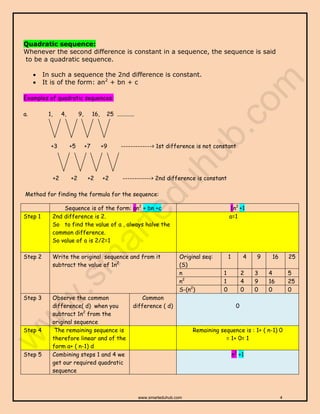
Quadratic sequence:
Whenever the second difference is constant in a sequence, the sequence is said
to be a quadratic sequence.
 In such a sequence the 2nd difference is constant.
 It is of the form: an2
+ bn + c
Examples of quadratic sequences:
a. 1, 4, 9, 16, 25 ............
+3 +5 +7 +9 -------------> 1st difference is not constant
+2 +2 +2 +2 ------------> 2nd difference is constant
Method for finding the formula for the sequence:
Sequence is of the form: an2
+ bn +c 1n2
+1
Step 1 2nd difference is 2.
So to find the value of a , always halve the
common difference.
So value of a is 2/2=1
a=1
Step 2 Write the original sequence and from it
subtract the value of 1n2
Original seq:
(S)
1 4 9 16 25
n 1 2 3 4 5
n2
1 4 9 16 25
S-(n2
) 0 0 0 0 0
Step 3 Observe the common
difference( d) when you
subtract 1n2
from the
original sequence
Common
difference ( d) 0
Step 4 The remaining sequence is
therefore linear and of the
form a+ ( n-1) d
Remaining sequence is : 1+ ( n-1) 0
= 1+ 0= 1
Step 5 Combining steps 1 and 4 we
get our required quadratic
sequence
n2
+1
w
w
w
.sm
arteduhub.com
www.smarteduhub.com 4
Cubic sequences:
Sequences where the 3rd difference is constant are known as cubic sequences.
Cubic sequences are of the form:
an3
+ bn2
+ cn + d
Examples:
0 12 10 0 -12 -20
1st difference +12 -2 -10 -12
2nd difference -14 -8 -2
3rd difference +6 +6
3rd difference is constant so it is a cubic sequence .
It is of the form: an3
+ bn2
+ cn + d = n3
-13n2
Step 1: Value of a= 1/6 X( 3rd difference) = 1/6 X (6) = 1 . Hence a=1.
Step 2: Write original sequence and subtract an3
i.e. n3
from it as shown below.
S 0 12 10 0 -12 -20
1n3
1 8 27 64 125 216
s-1n3
= our new sequence -1 +4 -17 -64 -137 -236
1st Common difference
2nd common difference
+5 -21 -47 -73
-26 -26 -26
2nd common difference 2nd difference is constant so our new sequence is quadratic and of the
form bn2
+ cn +d; where b=-26/2 = -13
Performing this operation:
[S-( n3
-13n2
)];
leaves us with a linear
sequence and we get the
part cn+d
S 0 12 10 0 -12
n 1 2 3 4 5
( n3
-13n2
) (1-13)=
-12
8-52=
-44
27-117=
-90
64-208
=-144
125-325
=200
Finally the required
sequence is
s-( n3
-13n2
) 12 56 100 144 -212
Common difference is
44.Sequence is linear +44 +44 +44 +44
Formula for the linear
sequence is 12 + (n-1) 44 = 12 + 44n-44 = 44n+32
Ans: Cubic sequence is n3
- 13 n2
+ 44n +32
w
w
w
.sm
arteduhub.com
www.smarteduhub.com 5

Linear, Quadratic and Cubic sequences

  • 1.
    SEQUENCES The following worksheetscontain solved examples for linear , quadratic and cubic sequences. w w w .sm arteduhub.com www.smarteduhub.com 1
  • 2.
    Sequences Sequence: A sequence isa list of numbers (or other things) that changes according to some sort of pattern In mathematics this pattern is called a common difference or ratio. Term:  Each number in a sequence is called as a term.  For example the first term is the term that occurs first in a sequence.  The 5th term is the term that occurs in the fifth place of the sequence.  The nth term is the term that occurs in the nth position of the sequence. Examples of sequences:  1,4,9,16,25,36.........  0,2,4,6,8,10........ Types of sequences:  Arithmetic (Linear)  Quadratic  Cubic  Geometric w w w .sm arteduhub.com www.smarteduhub.com 2
  • 3.
    Linear sequence: A linearsequence is a sequence with the first difference between two consecutive terms constant. Examples: a. 0,2,4,6,8,10,....... 0, (0+2), (2+2), (4+2)..............the common difference is 2 b. 30,35,40,45,50,55,....... 30, ( 30+5), (35+5), (40+5),......the common difference is 5 c. 48, 46, 44,42,....... 48, (48-2), (46-2), (44-2),.......the common difference is -2 Formula for calculating the nth term of an arithmetic ( linear sequence) is a+( n-1) d where: a= 1st term, d= common difference & n = the term you need to find out. Example: In the sequence 'a' above; first term is =a=0, d= common difference =2 and n=7th term would be calculated in the following way: tn= a+(n-1)d So, t7= 0+ (7-1)2= 0 + 6(2) = 0+12 =12 Do itself yourself Find the common difference and also the next two terms for the following sequences:  −15, −7, 1, 9, ...  −40, −240, −440, −640, ...  31, 21, 11, 1, ...  38, 138, 238, 338, ... w w w .sm arteduhub.com www.smarteduhub.com 3
  • 4.
    Quadratic sequence: Whenever thesecond difference is constant in a sequence, the sequence is said to be a quadratic sequence.  In such a sequence the 2nd difference is constant.  It is of the form: an2 + bn + c Examples of quadratic sequences: a. 1, 4, 9, 16, 25 ............ +3 +5 +7 +9 -------------> 1st difference is not constant +2 +2 +2 +2 ------------> 2nd difference is constant Method for finding the formula for the sequence: Sequence is of the form: an2 + bn +c 1n2 +1 Step 1 2nd difference is 2. So to find the value of a , always halve the common difference. So value of a is 2/2=1 a=1 Step 2 Write the original sequence and from it subtract the value of 1n2 Original seq: (S) 1 4 9 16 25 n 1 2 3 4 5 n2 1 4 9 16 25 S-(n2 ) 0 0 0 0 0 Step 3 Observe the common difference( d) when you subtract 1n2 from the original sequence Common difference ( d) 0 Step 4 The remaining sequence is therefore linear and of the form a+ ( n-1) d Remaining sequence is : 1+ ( n-1) 0 = 1+ 0= 1 Step 5 Combining steps 1 and 4 we get our required quadratic sequence n2 +1 w w w .sm arteduhub.com www.smarteduhub.com 4
  • 5.
    Cubic sequences: Sequences wherethe 3rd difference is constant are known as cubic sequences. Cubic sequences are of the form: an3 + bn2 + cn + d Examples: 0 12 10 0 -12 -20 1st difference +12 -2 -10 -12 2nd difference -14 -8 -2 3rd difference +6 +6 3rd difference is constant so it is a cubic sequence . It is of the form: an3 + bn2 + cn + d = n3 -13n2 Step 1: Value of a= 1/6 X( 3rd difference) = 1/6 X (6) = 1 . Hence a=1. Step 2: Write original sequence and subtract an3 i.e. n3 from it as shown below. S 0 12 10 0 -12 -20 1n3 1 8 27 64 125 216 s-1n3 = our new sequence -1 +4 -17 -64 -137 -236 1st Common difference 2nd common difference +5 -21 -47 -73 -26 -26 -26 2nd common difference 2nd difference is constant so our new sequence is quadratic and of the form bn2 + cn +d; where b=-26/2 = -13 Performing this operation: [S-( n3 -13n2 )]; leaves us with a linear sequence and we get the part cn+d S 0 12 10 0 -12 n 1 2 3 4 5 ( n3 -13n2 ) (1-13)= -12 8-52= -44 27-117= -90 64-208 =-144 125-325 =200 Finally the required sequence is s-( n3 -13n2 ) 12 56 100 144 -212 Common difference is 44.Sequence is linear +44 +44 +44 +44 Formula for the linear sequence is 12 + (n-1) 44 = 12 + 44n-44 = 44n+32 Ans: Cubic sequence is n3 - 13 n2 + 44n +32 w w w .sm arteduhub.com www.smarteduhub.com 5