
Mv Dinesh
S. Sumanth
Sree Vidyanikethan engineering college
Tirupati.
A presentation by
Light-Fidelity
CONTENTS
 INTRODUCTION
 ISSUES WITH RF COMMUNICATION
 VISIBLE LIGHT COMMUNICATION
 PRINCIPLE OF LI-FI TECHNOLOGY
 WORKING OF Li-Fi
 COMPARISON BETWEEN LI-FI AND WI-FI
 APPLICATIONS
 ADVANTAGES
 LIMITATIONS
 CLOSURE
 REFERENCES
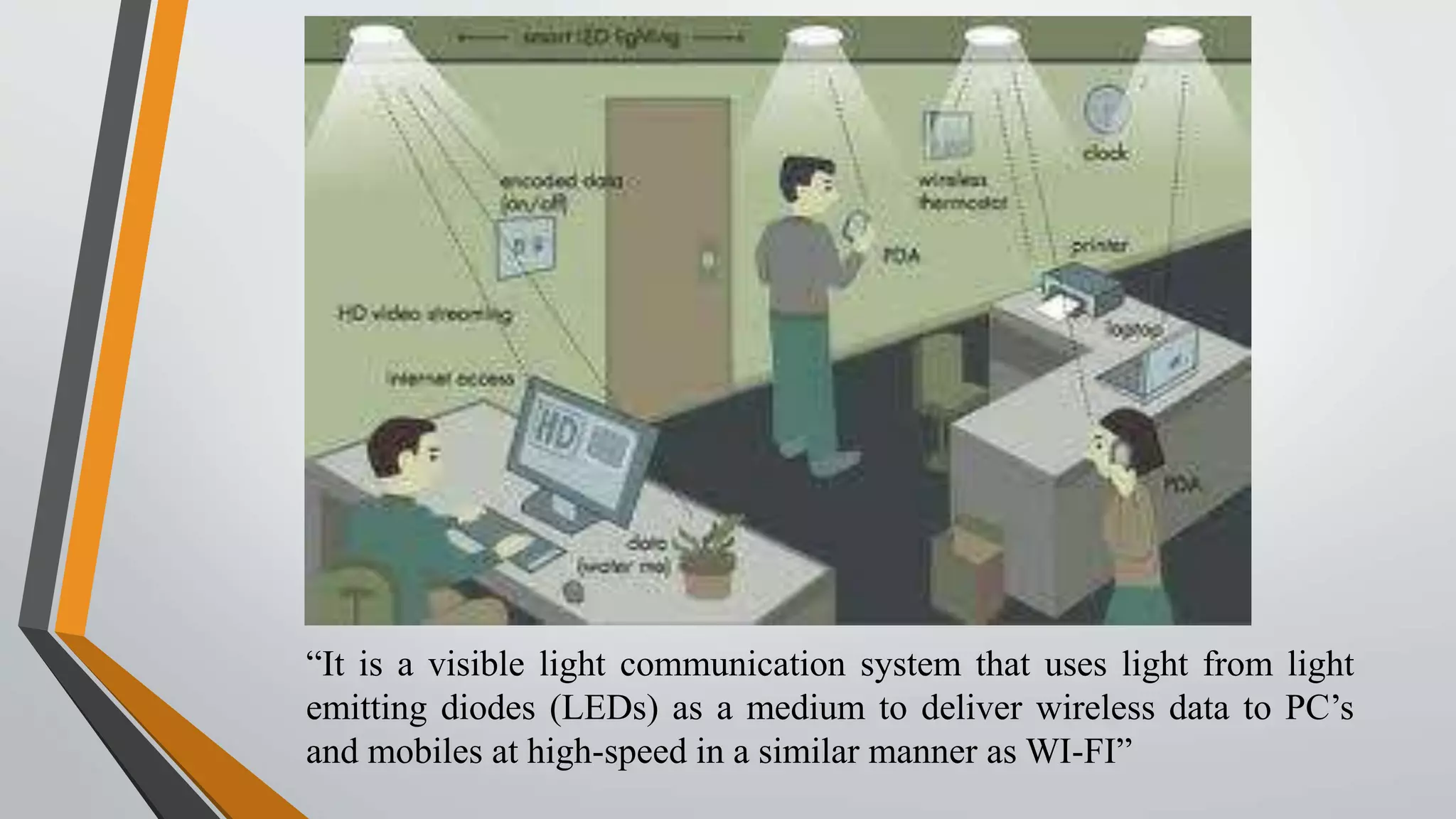
“It is a visible light communication system that uses light from light
emitting diodes (LEDs) as a medium to deliver wireless data to PC’s
and mobiles at high-speed in a similar manner as WI-FI”
Present Scenario
Radio Spectrum is congested but the demand for wireless data extending
very fastly. Every thing, it seems require wireless data but the capacity is
drying up.
1.4 Million 5 Billion
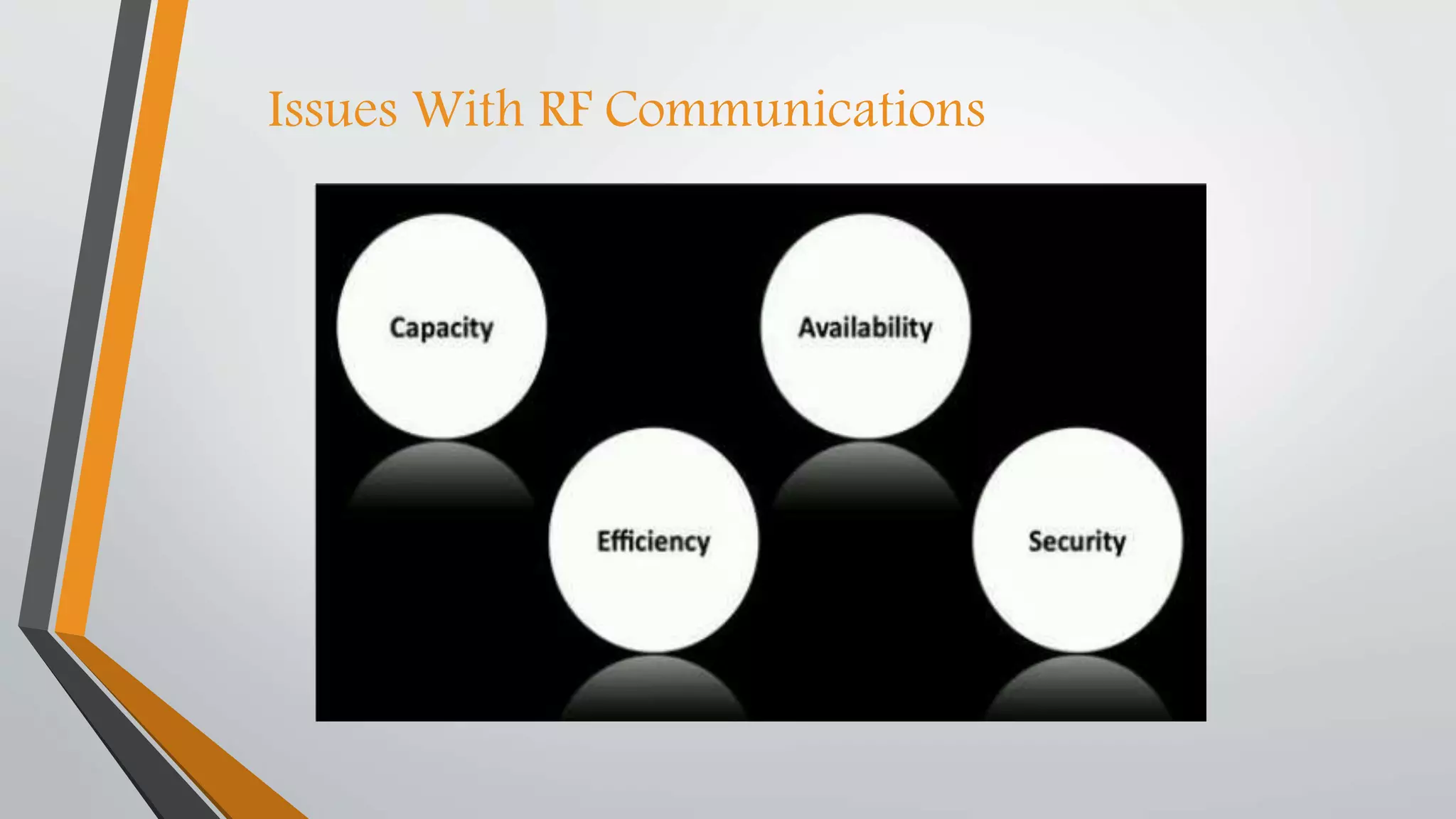
Issues With RF Communications
CONTD…
CAPACITY:
• Radio waves.
• cost and expensive.
• Less Bandwidth compared to other spectrums.
• Insufficient Spectrum for increasing data.
EFFICIENCY:
• Millions of base stations consume huge energy for
1. Transmitting the radio waves.
2. To cool the base station cabins.
• 5% Efficiency
CONTD…
AVAILABILITY:
• Available within the range of Base stations
• Limited availability
• Unavailable in air crafts
SECURITY:
• Less Secure (Data can Pass through walls)
WHY VLC ?
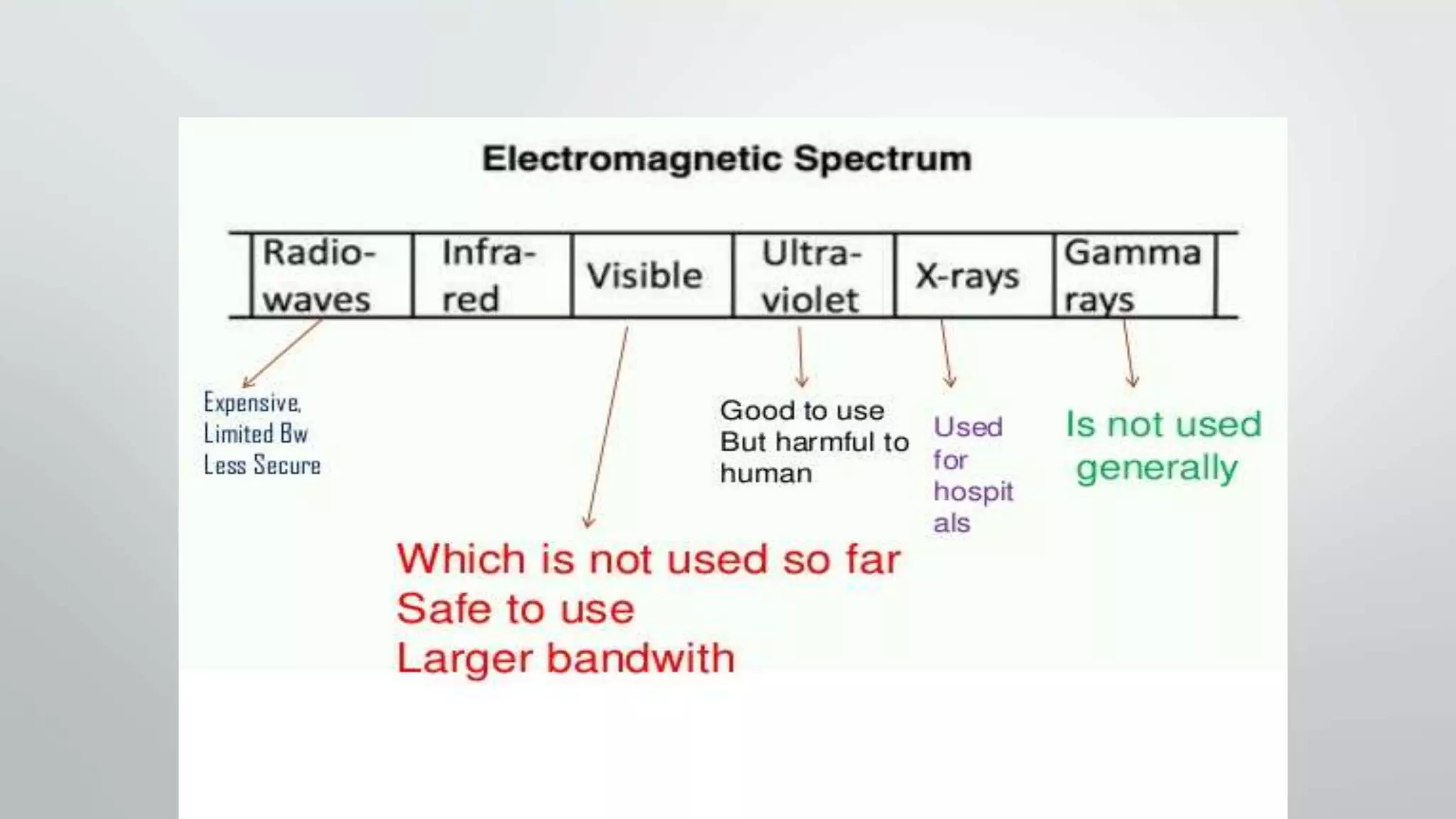
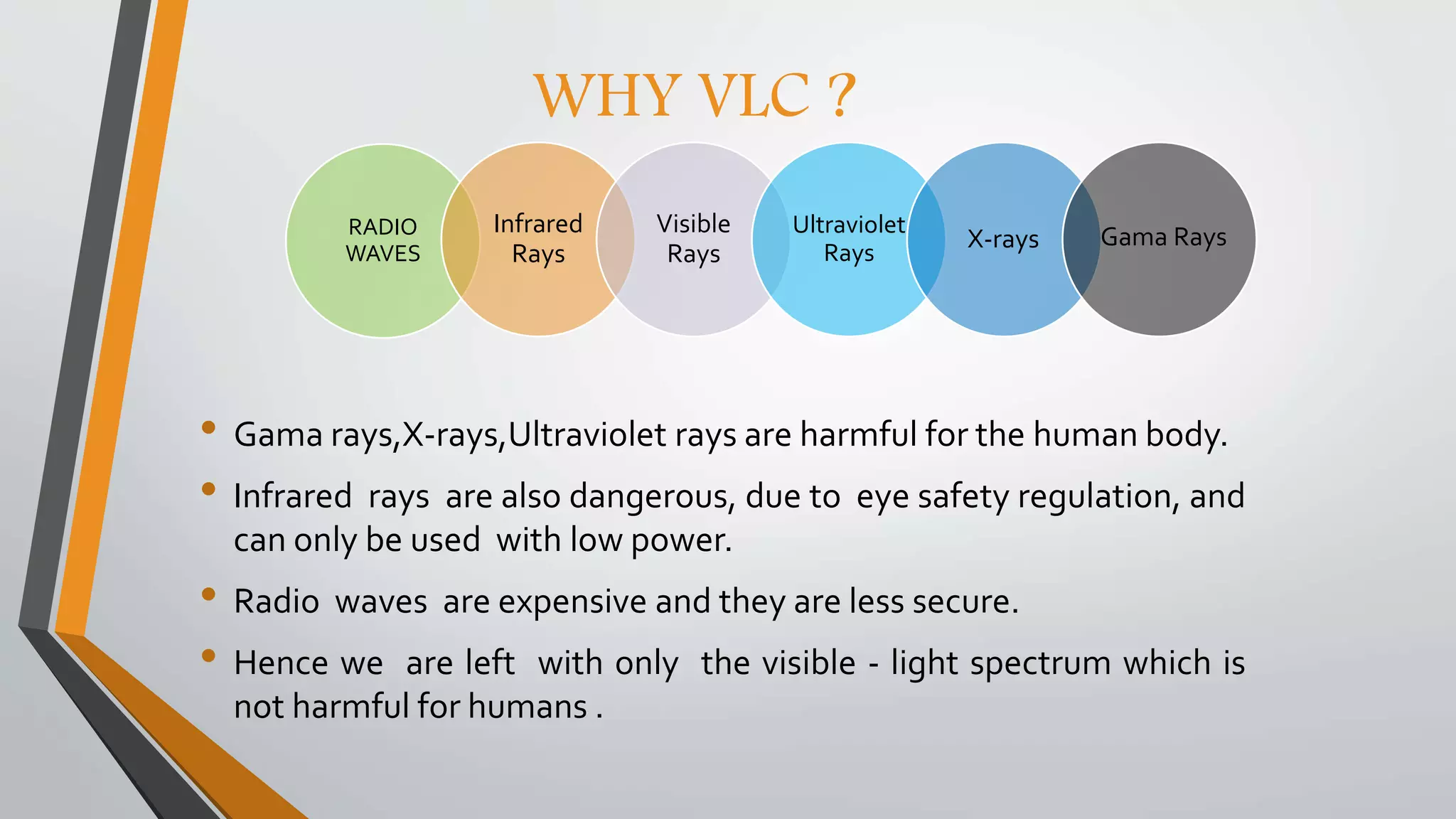
• Gama rays,X-rays,Ultraviolet rays are harmful for the human body.
• Infrared rays are also dangerous, due to eye safety regulation, and
can only be used with low power.
• Radio waves are expensive and they are less secure.
• Hence we are left with only the visible - light spectrum which is
not harmful for humans .
RADIO
WAVES
Infrared
Rays
Visible
Rays
Ultraviolet
Rays
X-rays Gama Rays
Principle of LI-FI technology
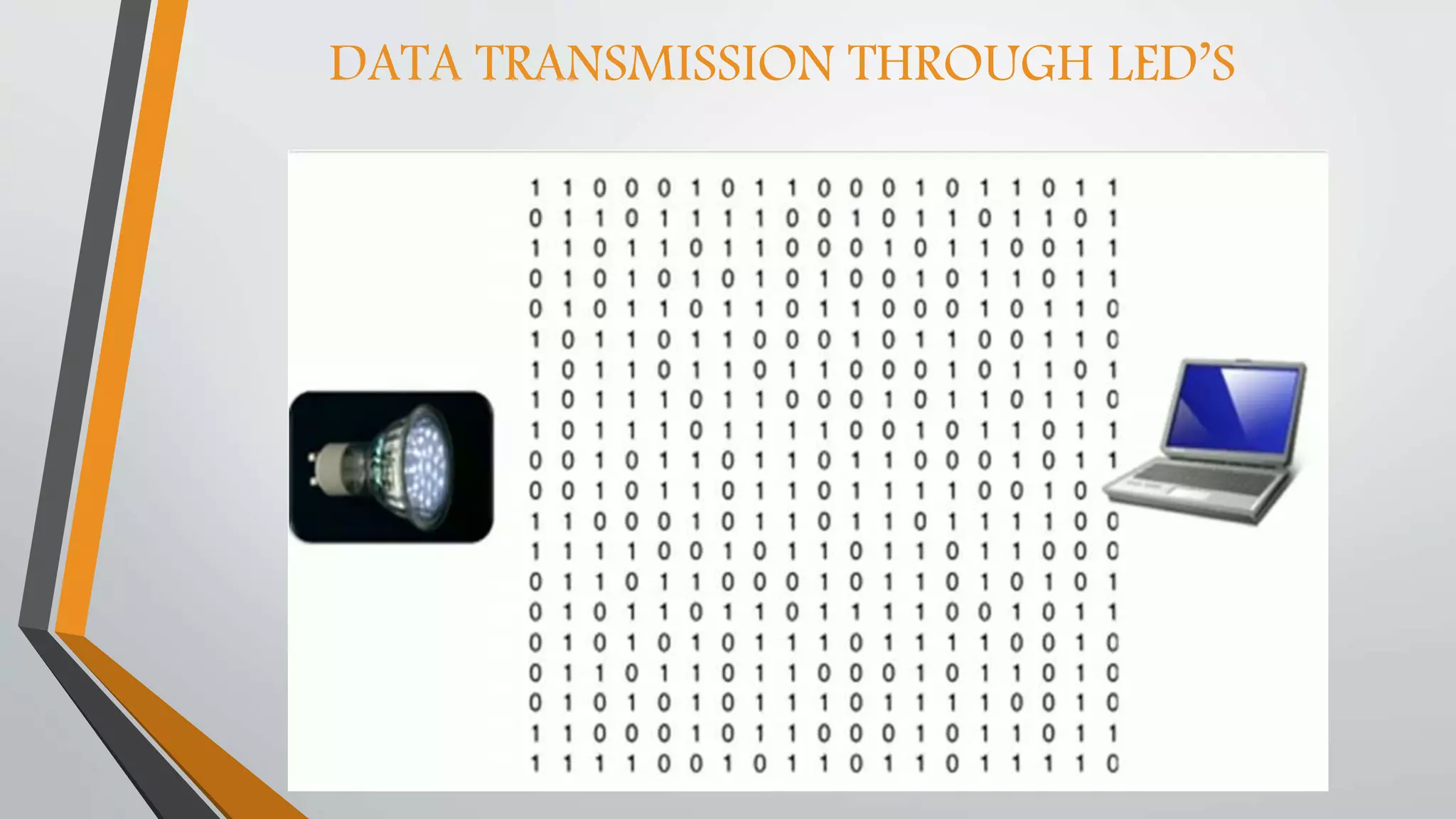
 Heart of Li-Fi technology is high brightness LED’s.
 The LED bulb will hold a micro-chip that will do the job of processing the data.
 The on/off activity of LEDs enables data transmission using binary codes.
 Switching on an LED is a logical ‘1’; switching it off is a logical ‘0’.
 A light sensitive device (photo detector) receives the signal
and converts it back into original data.
How Li-Fi Works ?
 Li-Fi is implemented using white LED light bulbs at downlink transmitter.
 By fast variations of the current, optical output can be made to vary at extremely
high speeds.
 An overhead lamp fitted with an LED with signal processing microchip streams
data embedded in its beam at ultra high speeds to the photodiodes.
 A receiver dongle then converts the tiny changes in amplitude into an electrical
signal, which is then converted back into a data stream & transmitted to a
computer or mobile device
DATA TRANSMISSION THROUGH LED’S
COMPARISON BETWEEN LI-FI AND WIFI
Sl.No Parameters Light Fidelity Wireless Fidelity
1 Speed for data transfer Faster transfer speed (>1 Gbps) DataTransfer speed (150
Mbps)
2 Medium through which
data transfers occurs
Used Light as a carrier Used Radio spectrum
3 Spectrum Range Visible light spectrum has 10,000
time broad spectrum in
comparison to radio frequency
Radio frequency spectrum
range is less than visible
light spectrum.
4 Cost Cheaper thanWi-Fi because free
band doesn’t need license and it
use light.
Expensive in comparison to
Li-Fi because its uses radio
spectrum.
5 Network topology Point to point Point to point
6 Operating frequency Hundreds ofTera Hz (THz) 2.4 GHz
APPLICATIONS
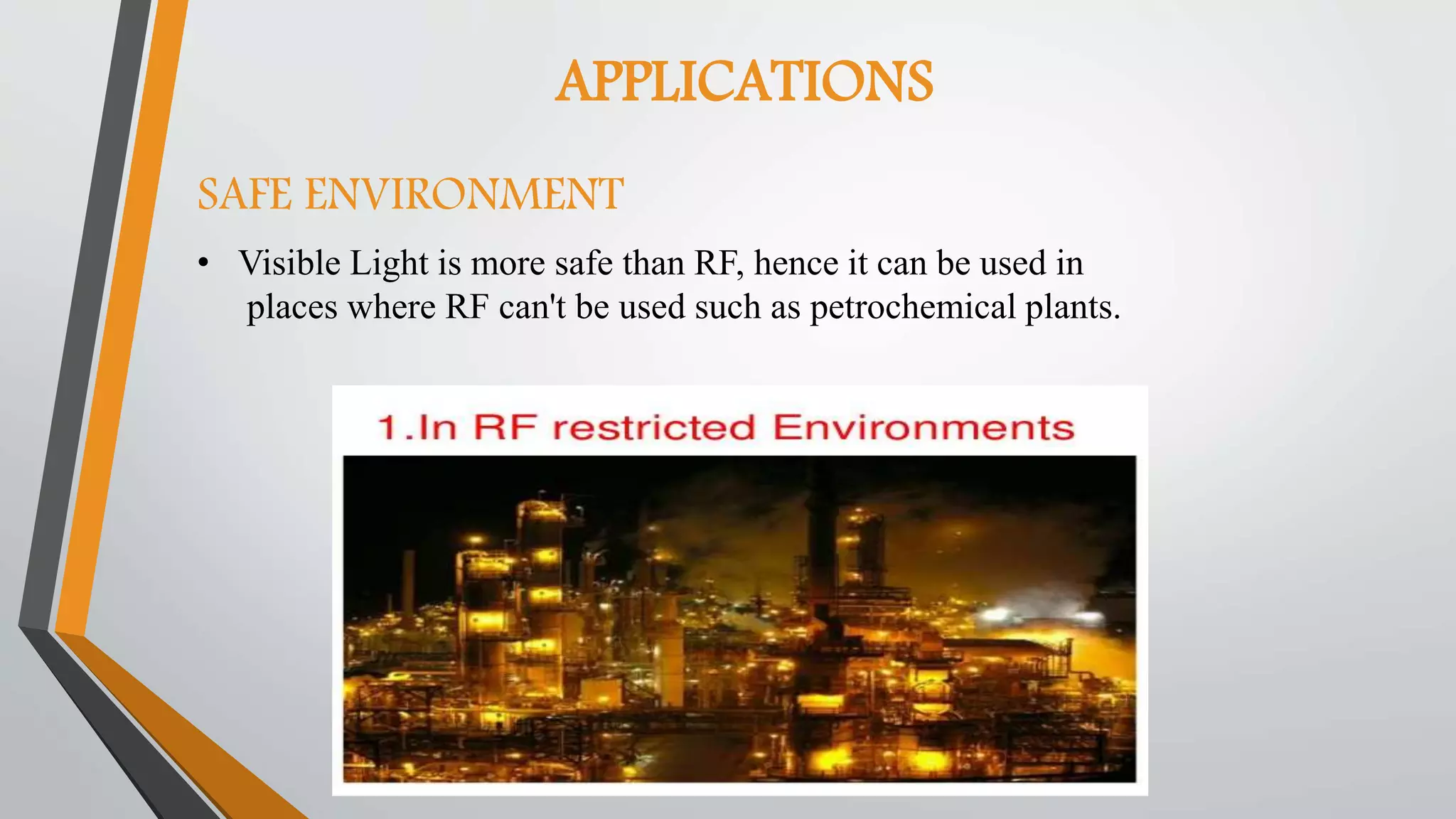
• Visible Light is more safe than RF, hence it can be used in
places where RF can't be used such as petrochemical plants.
SAFE ENVIRONMENT
CONTD…
AIRLINES:
• Airways communication are performed on the basis of radio waves.
Using communication causes interference between the two systems. To
overcomes this drawback on radio waves , li-fi is introduced.
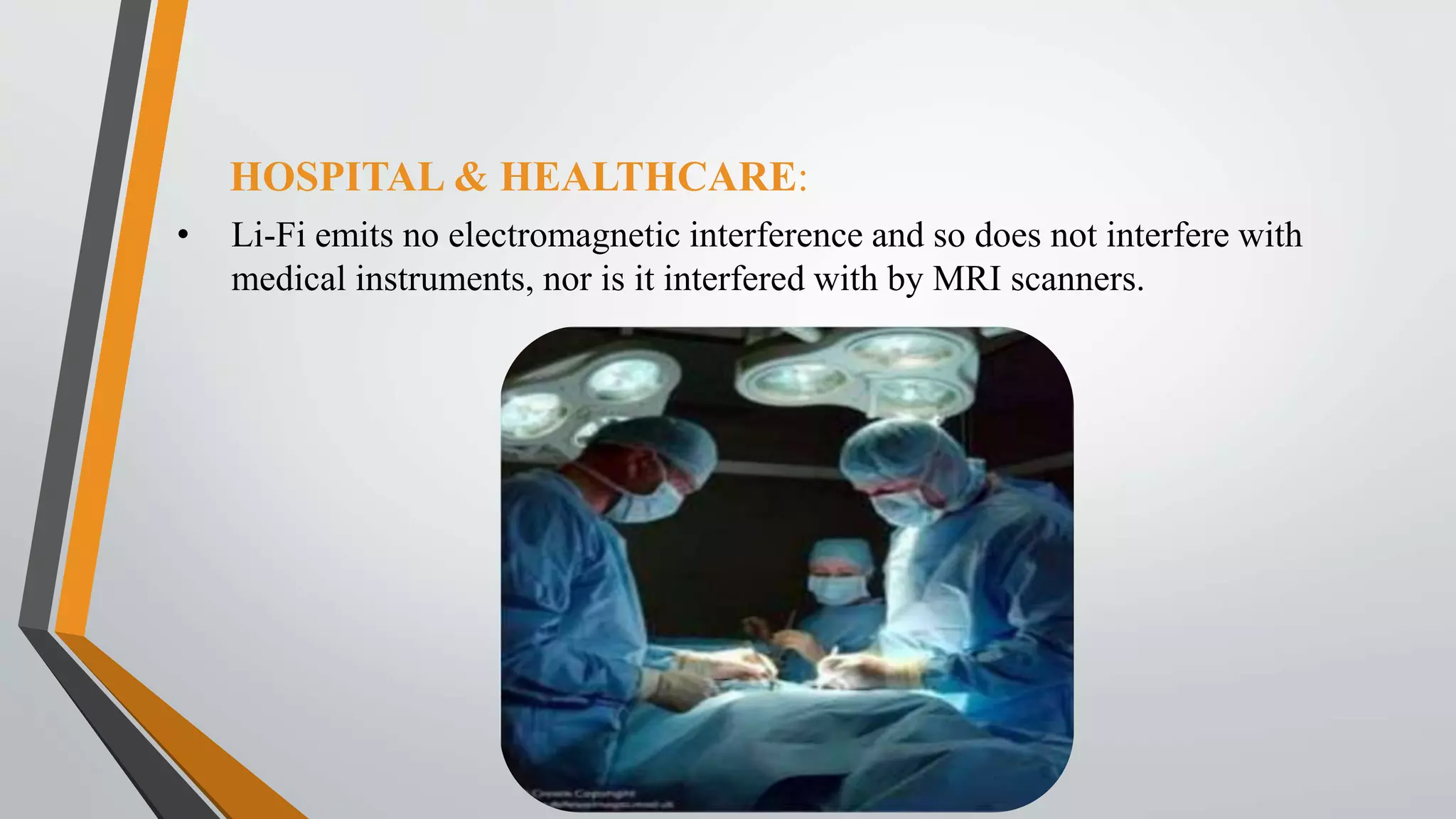
• Li-Fi emits no electromagnetic interference and so does not interfere with
medical instruments, nor is it interfered with by MRI scanners.
HOSPITAL & HEALTHCARE:
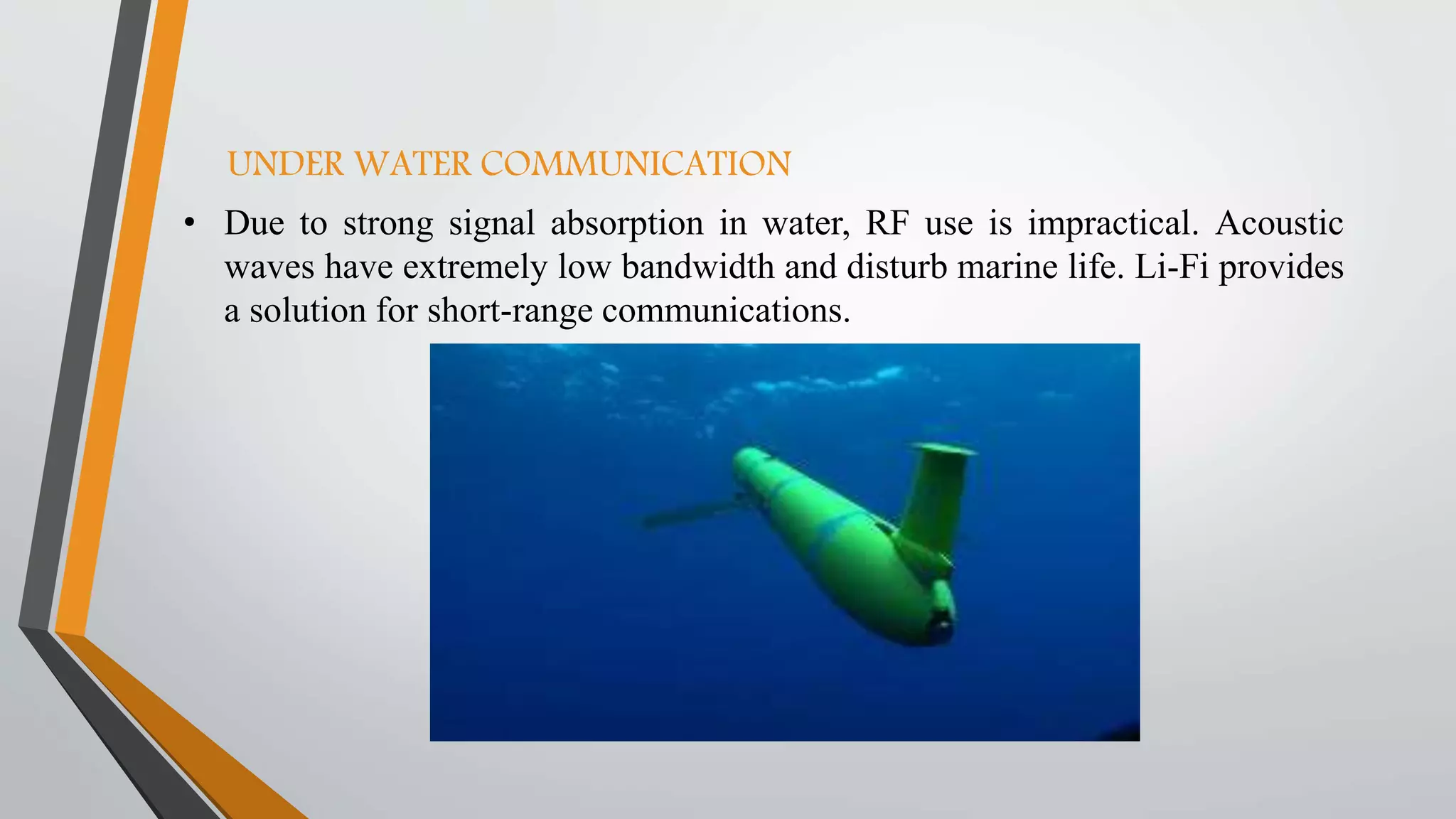
UNDER WATER COMMUNICATION
• Due to strong signal absorption in water, RF use is impractical. Acoustic
waves have extremely low bandwidth and disturb marine life. Li-Fi provides
a solution for short-range communications.
SMART LIGHTING
• Street lamps can be used as a source of Li-Fi hotspots
ADVANTAGES OF LI-FI:
Li-Fi removes the limitations that have been put on the user by the Wi-Fi.
a) CAPACITY:
Visible light has 10000 times wider bandwidth than radio waves . So, Li-Fi has
got better capacity and also the equipment's are already available.
b) EFFICIENCY:
Data transmission using Li-Fi is very cheap. LED lights consume less energy
and are highly efficient.
c) AVAILABILITY:
There are billions of light bulbs worldwide, they just need to be replaced with
LED’s for proper transmission of data.
d) SECURITY:
Light waves do not penetrate through walls. So, they can‘t be intercepted and misused.
LIMITATIONS
• Interference from external light sources like sun light in the path of transmission
will cause interruption in the communication.
• The light waves cannot penetrate walls.
• This technology was demonstrated and it was detectable up to a distance of 10
meter.
• Installation cost of VLC systems are high
• It is easily blocked by somebody simply walking in front of LED source.
CLOSURE:
As a growing number of people and their many devices access wireless internet,
making it more and more difficult to get a reliable, high-speed signal.
This may solve issues such as the shortage of radio-frequency bandwidth
 Every light source in homes and offices could potentially be a “Li-Fi” hotspots
within 20 years.
When this technology becomes feasible like the Wi-Fi, then our life will be
awesome on earth.
“Forget wireless ,get faster internet through light bulbs..!”
REFERENCES
 https://www.google.co.in
 http://seminarprojects.com/Thread-report-on-li-fi-technology
 http://www.technewspaper.net/best-five-benefits-of-li-fi-technology/
 http://en.wikipedia.org/wiki/Li-Fi
 http://www.youtube.com/watch?v=gjqSgsKbagQ
 http://www.purelifi.com/
 http://lificenter.net/solutions/lifi-solutions
 https://lificonsortium.org/
Light-Fidelity [Li-Fi}

Light-Fidelity [Li-Fi}

  • 1.
    Mv Dinesh S. Sumanth SreeVidyanikethan engineering college Tirupati. A presentation by
  • 2.
  • 3.
    CONTENTS  INTRODUCTION  ISSUESWITH RF COMMUNICATION  VISIBLE LIGHT COMMUNICATION  PRINCIPLE OF LI-FI TECHNOLOGY  WORKING OF Li-Fi  COMPARISON BETWEEN LI-FI AND WI-FI  APPLICATIONS  ADVANTAGES  LIMITATIONS  CLOSURE  REFERENCES
  • 5.
    “It is avisible light communication system that uses light from light emitting diodes (LEDs) as a medium to deliver wireless data to PC’s and mobiles at high-speed in a similar manner as WI-FI”
  • 6.
    Present Scenario Radio Spectrumis congested but the demand for wireless data extending very fastly. Every thing, it seems require wireless data but the capacity is drying up. 1.4 Million 5 Billion
  • 7.
    Issues With RFCommunications
  • 8.
    CONTD… CAPACITY: • Radio waves. •cost and expensive. • Less Bandwidth compared to other spectrums. • Insufficient Spectrum for increasing data. EFFICIENCY: • Millions of base stations consume huge energy for 1. Transmitting the radio waves. 2. To cool the base station cabins. • 5% Efficiency
  • 9.
    CONTD… AVAILABILITY: • Available withinthe range of Base stations • Limited availability • Unavailable in air crafts SECURITY: • Less Secure (Data can Pass through walls)
  • 11.
    WHY VLC ? •Gama rays,X-rays,Ultraviolet rays are harmful for the human body. • Infrared rays are also dangerous, due to eye safety regulation, and can only be used with low power. • Radio waves are expensive and they are less secure. • Hence we are left with only the visible - light spectrum which is not harmful for humans . RADIO WAVES Infrared Rays Visible Rays Ultraviolet Rays X-rays Gama Rays
  • 14.
    Principle of LI-FItechnology  Heart of Li-Fi technology is high brightness LED’s.  The LED bulb will hold a micro-chip that will do the job of processing the data.  The on/off activity of LEDs enables data transmission using binary codes.  Switching on an LED is a logical ‘1’; switching it off is a logical ‘0’.  A light sensitive device (photo detector) receives the signal and converts it back into original data.
  • 15.
    How Li-Fi Works?  Li-Fi is implemented using white LED light bulbs at downlink transmitter.  By fast variations of the current, optical output can be made to vary at extremely high speeds.  An overhead lamp fitted with an LED with signal processing microchip streams data embedded in its beam at ultra high speeds to the photodiodes.  A receiver dongle then converts the tiny changes in amplitude into an electrical signal, which is then converted back into a data stream & transmitted to a computer or mobile device
  • 17.
  • 18.
    COMPARISON BETWEEN LI-FIAND WIFI Sl.No Parameters Light Fidelity Wireless Fidelity 1 Speed for data transfer Faster transfer speed (>1 Gbps) DataTransfer speed (150 Mbps) 2 Medium through which data transfers occurs Used Light as a carrier Used Radio spectrum 3 Spectrum Range Visible light spectrum has 10,000 time broad spectrum in comparison to radio frequency Radio frequency spectrum range is less than visible light spectrum. 4 Cost Cheaper thanWi-Fi because free band doesn’t need license and it use light. Expensive in comparison to Li-Fi because its uses radio spectrum. 5 Network topology Point to point Point to point 6 Operating frequency Hundreds ofTera Hz (THz) 2.4 GHz
  • 19.
    APPLICATIONS • Visible Lightis more safe than RF, hence it can be used in places where RF can't be used such as petrochemical plants. SAFE ENVIRONMENT
  • 20.
    CONTD… AIRLINES: • Airways communicationare performed on the basis of radio waves. Using communication causes interference between the two systems. To overcomes this drawback on radio waves , li-fi is introduced.
  • 21.
    • Li-Fi emitsno electromagnetic interference and so does not interfere with medical instruments, nor is it interfered with by MRI scanners. HOSPITAL & HEALTHCARE:
  • 22.
    UNDER WATER COMMUNICATION •Due to strong signal absorption in water, RF use is impractical. Acoustic waves have extremely low bandwidth and disturb marine life. Li-Fi provides a solution for short-range communications.
  • 23.
    SMART LIGHTING • Streetlamps can be used as a source of Li-Fi hotspots
  • 24.
    ADVANTAGES OF LI-FI: Li-Firemoves the limitations that have been put on the user by the Wi-Fi. a) CAPACITY: Visible light has 10000 times wider bandwidth than radio waves . So, Li-Fi has got better capacity and also the equipment's are already available. b) EFFICIENCY: Data transmission using Li-Fi is very cheap. LED lights consume less energy and are highly efficient. c) AVAILABILITY: There are billions of light bulbs worldwide, they just need to be replaced with LED’s for proper transmission of data. d) SECURITY: Light waves do not penetrate through walls. So, they can‘t be intercepted and misused.
  • 25.
    LIMITATIONS • Interference fromexternal light sources like sun light in the path of transmission will cause interruption in the communication. • The light waves cannot penetrate walls. • This technology was demonstrated and it was detectable up to a distance of 10 meter. • Installation cost of VLC systems are high • It is easily blocked by somebody simply walking in front of LED source.
  • 26.
    CLOSURE: As a growingnumber of people and their many devices access wireless internet, making it more and more difficult to get a reliable, high-speed signal. This may solve issues such as the shortage of radio-frequency bandwidth  Every light source in homes and offices could potentially be a “Li-Fi” hotspots within 20 years. When this technology becomes feasible like the Wi-Fi, then our life will be awesome on earth. “Forget wireless ,get faster internet through light bulbs..!”
  • 27.
    REFERENCES  https://www.google.co.in  http://seminarprojects.com/Thread-report-on-li-fi-technology http://www.technewspaper.net/best-five-benefits-of-li-fi-technology/  http://en.wikipedia.org/wiki/Li-Fi  http://www.youtube.com/watch?v=gjqSgsKbagQ  http://www.purelifi.com/  http://lificenter.net/solutions/lifi-solutions  https://lificonsortium.org/