GEO, 2010
SOLID WASTE MANAGEMENT
28TH
May 2010
Dr. N. Sai Bhaskar Reddy, CEO, GEO
http://e-geo.org
Centre for Social Initiative
and Management
GEO, 2010
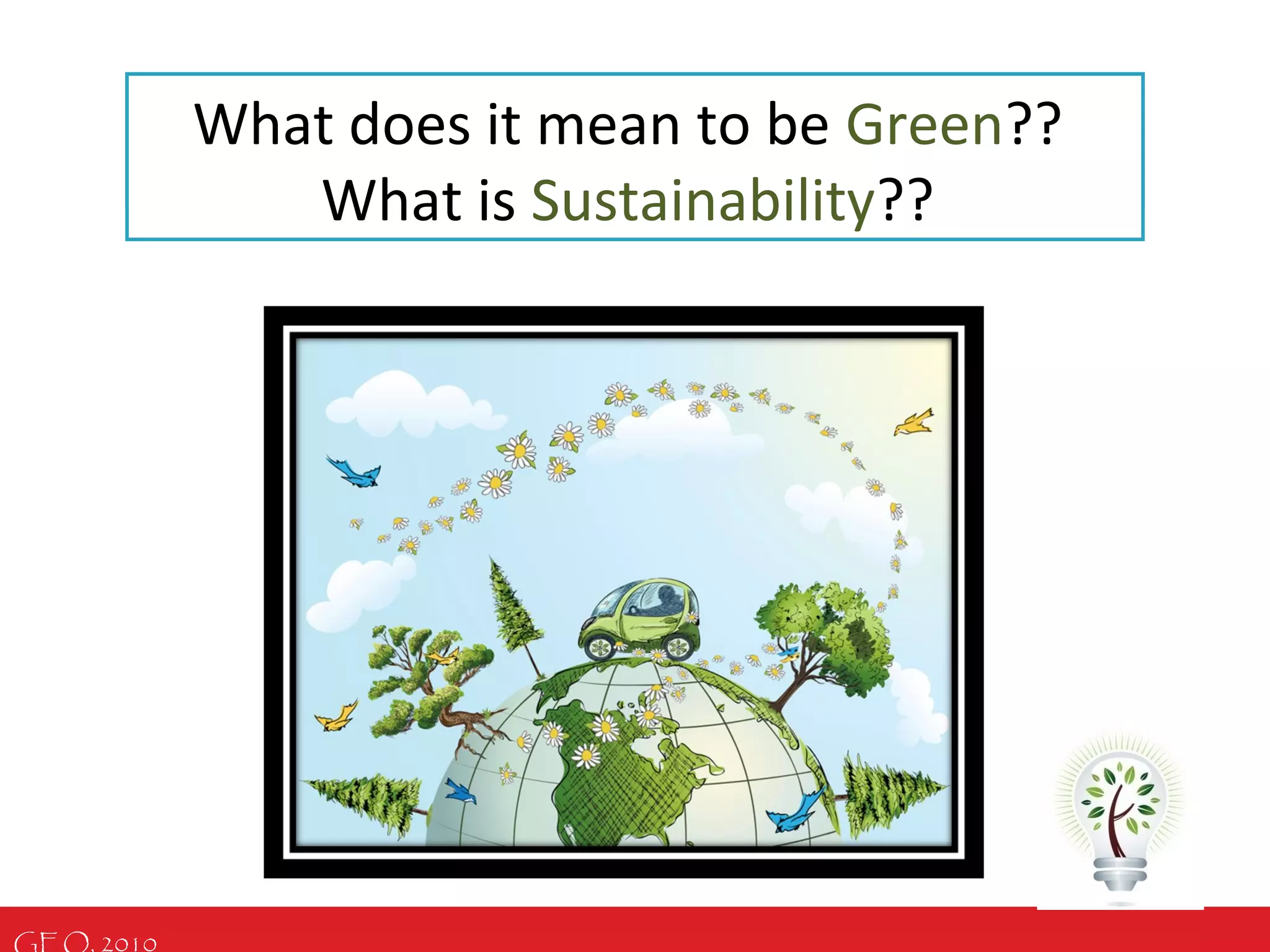
What does it mean to be Green?? What is
Sustainability??
What does it mean to be Green?? What is
Sustainability??
What does it mean to be Green?? What is
Sustainability??
What does it mean to be Green?? What is
Sustainability??
What does it mean to be Green??
What is Sustainability??
GEO, 2010
Sustainability
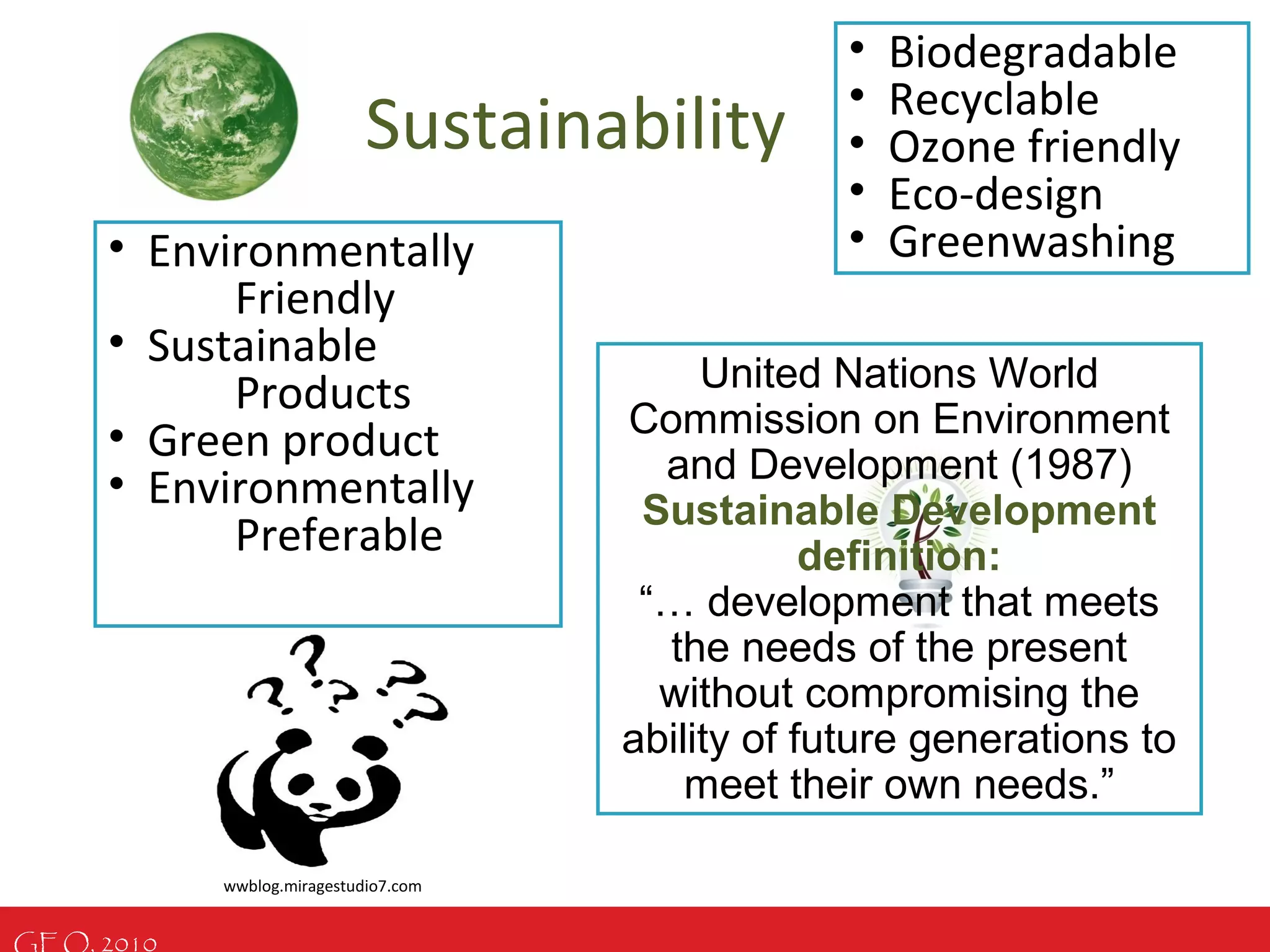
United Nations World
Commission on Environment
and Development (1987)
Sustainable Development
definition:
“… development that meets
the needs of the present
without compromising the
ability of future generations to
meet their own needs.”
• Biodegradable
• Recyclable
• Ozone friendly
• Eco-design
• Greenwashing• Environmentally
Friendly
• Sustainable
Products
• Green product
• Environmentally
Preferable
wwblog.miragestudio7.com
GEO, 2010
What Can the Earth Handle?
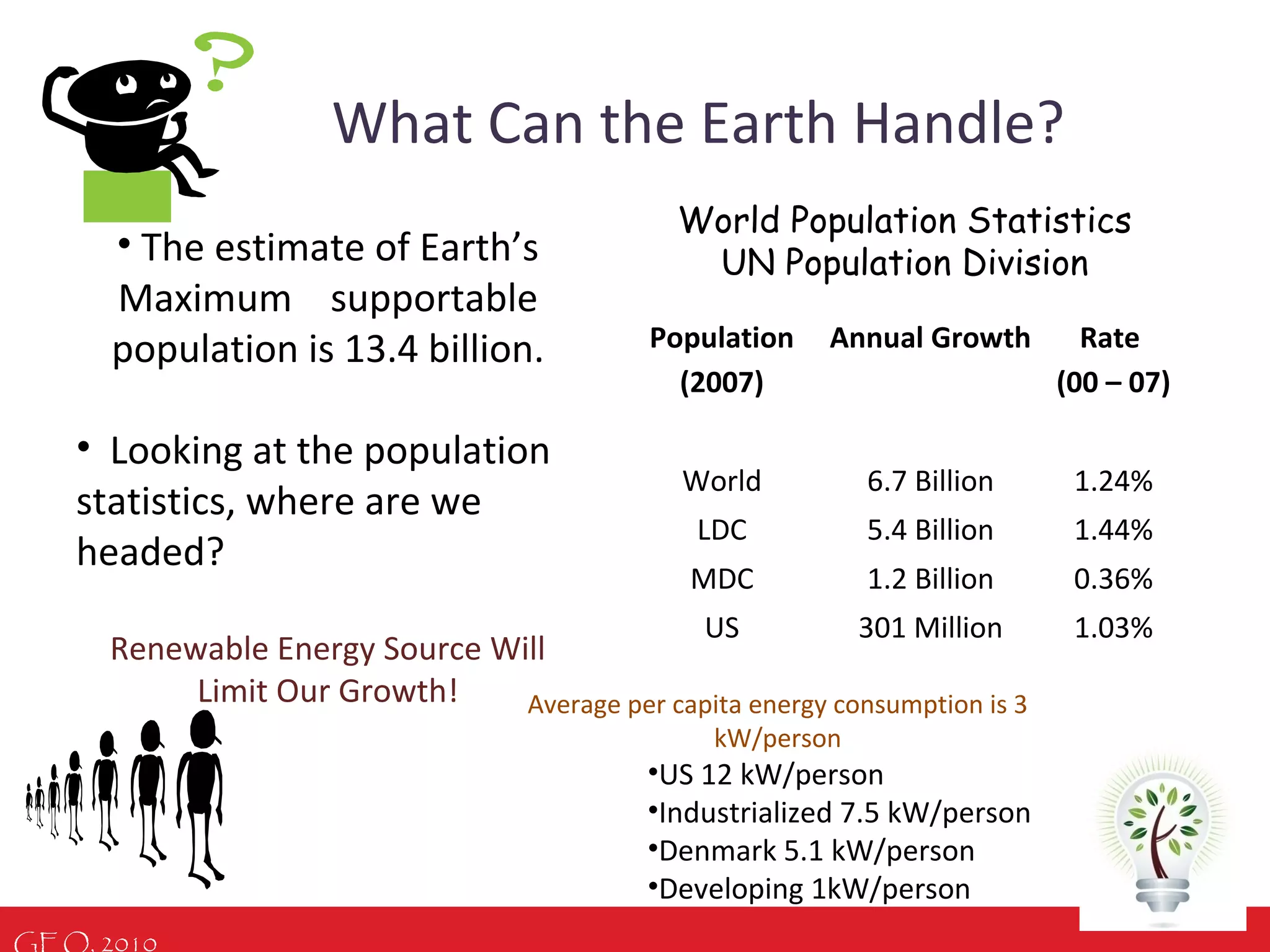
Population
(2007)
Annual Growth Rate
(00 – 07)
World 6.7 Billion 1.24%
LDC 5.4 Billion 1.44%
MDC 1.2 Billion 0.36%
US 301 Million 1.03%
World Population Statistics
UN Population Division• The estimate of Earth’s
Maximum supportable
population is 13.4 billion.
• Looking at the population
statistics, where are we
headed?
Renewable Energy Source Will
Limit Our Growth! Average per capita energy consumption is 3
kW/person
•US 12 kW/person
•Industrialized 7.5 kW/person
•Denmark 5.1 kW/person
•Developing 1kW/person
GEO, 2010
Being Green is Trendy . . . . . . . . . . .
What Does Science Say?
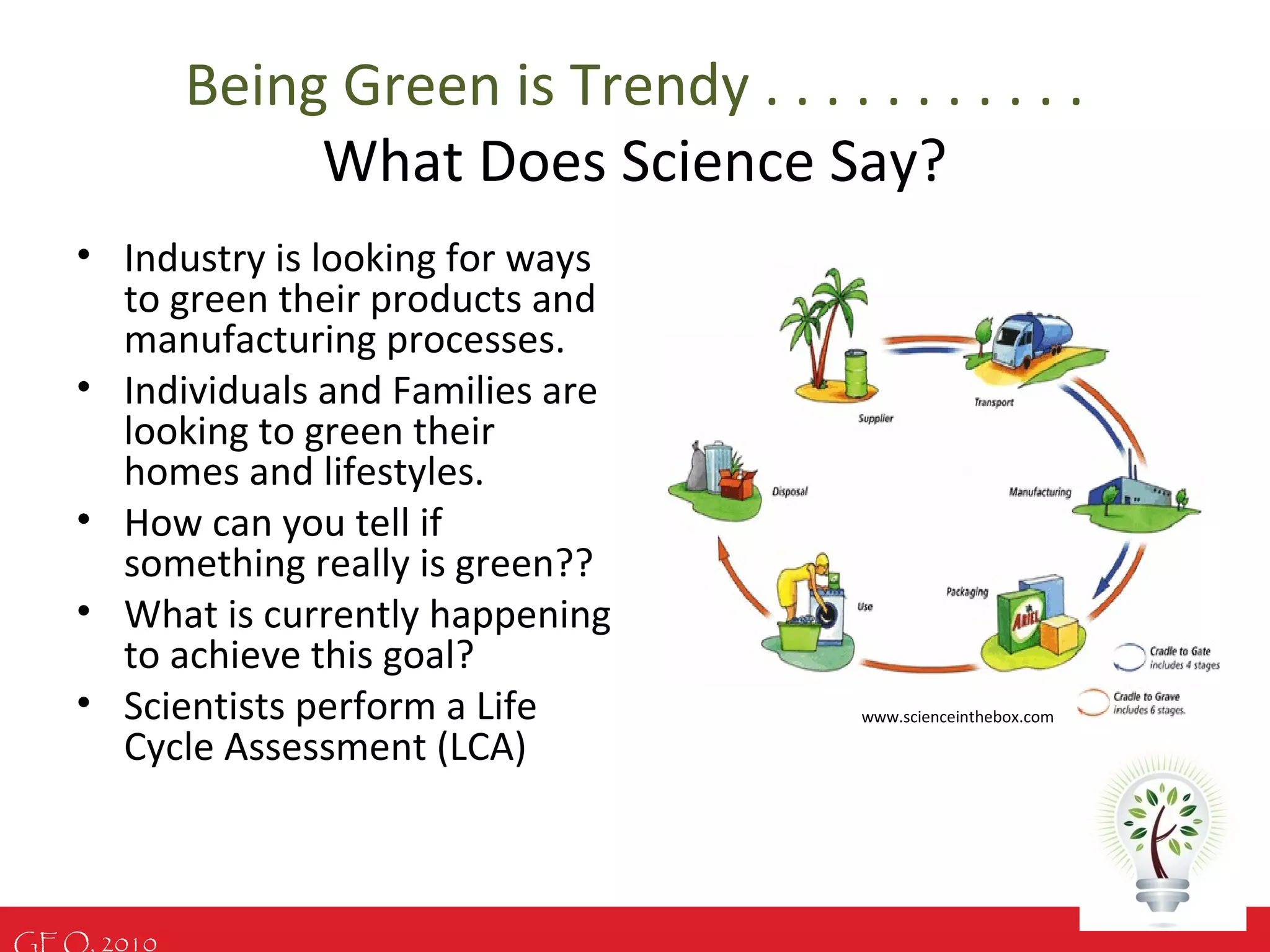
• Industry is looking for ways
to green their products and
manufacturing processes.
• Individuals and Families are
looking to green their
homes and lifestyles.
• How can you tell if
something really is green??
• What is currently happening
to achieve this goal?
• Scientists perform a Life
Cycle Assessment (LCA)
www.scienceinthebox.com
GEO, 2010
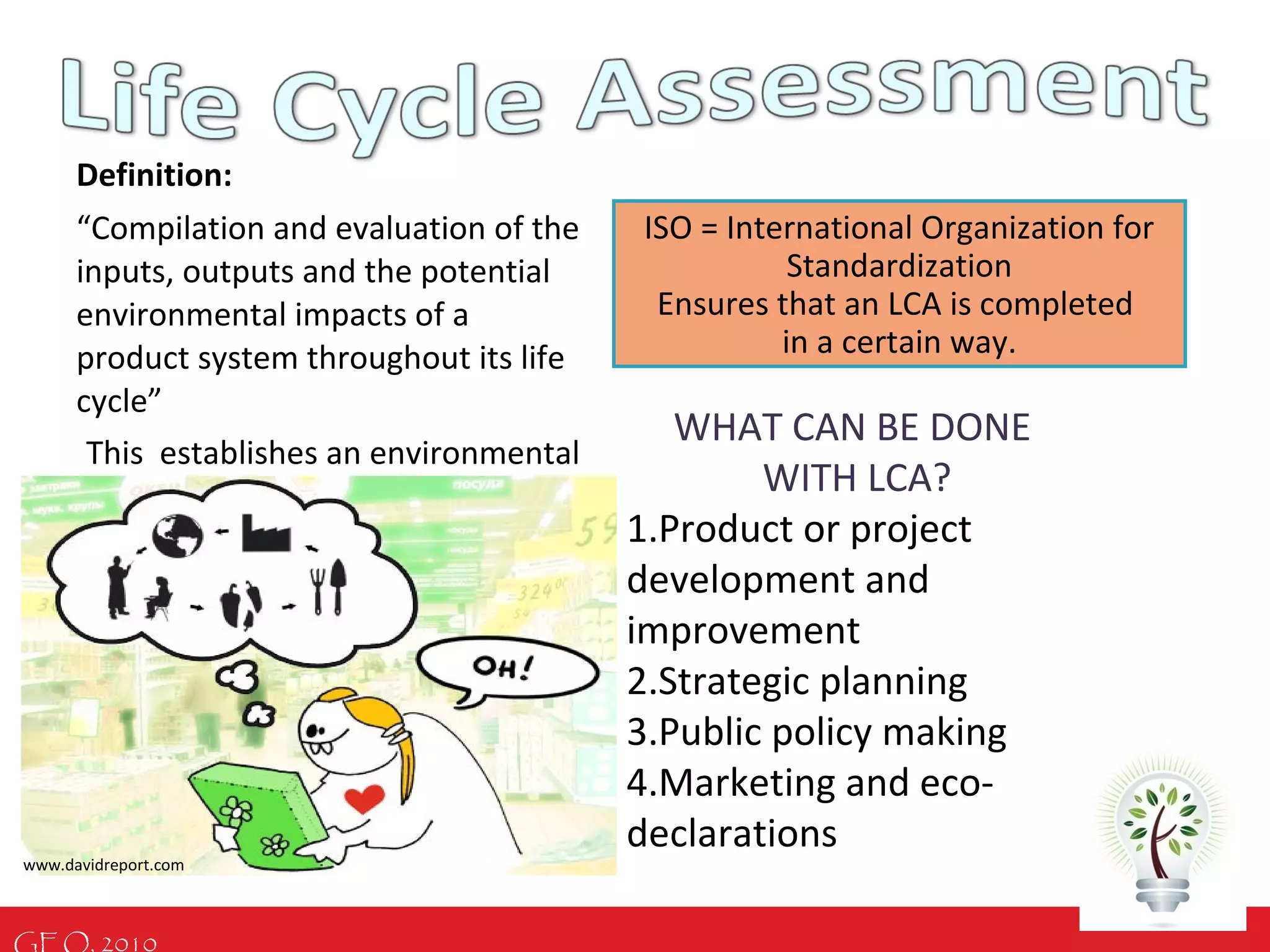
Definition:
“Compilation and evaluation of the
inputs, outputs and the potential
environmental impacts of a
product system throughout its life
cycle”
This establishes an environmental
profile of the system!
ISO = International Organization for
Standardization
Ensures that an LCA is completed
in a certain way.
WHAT CAN BE DONE
WITH LCA?
1.Product or project
development and
improvement
2.Strategic planning
3.Public policy making
4.Marketing and eco-
declarations
www.davidreport.com
GEO, 2010
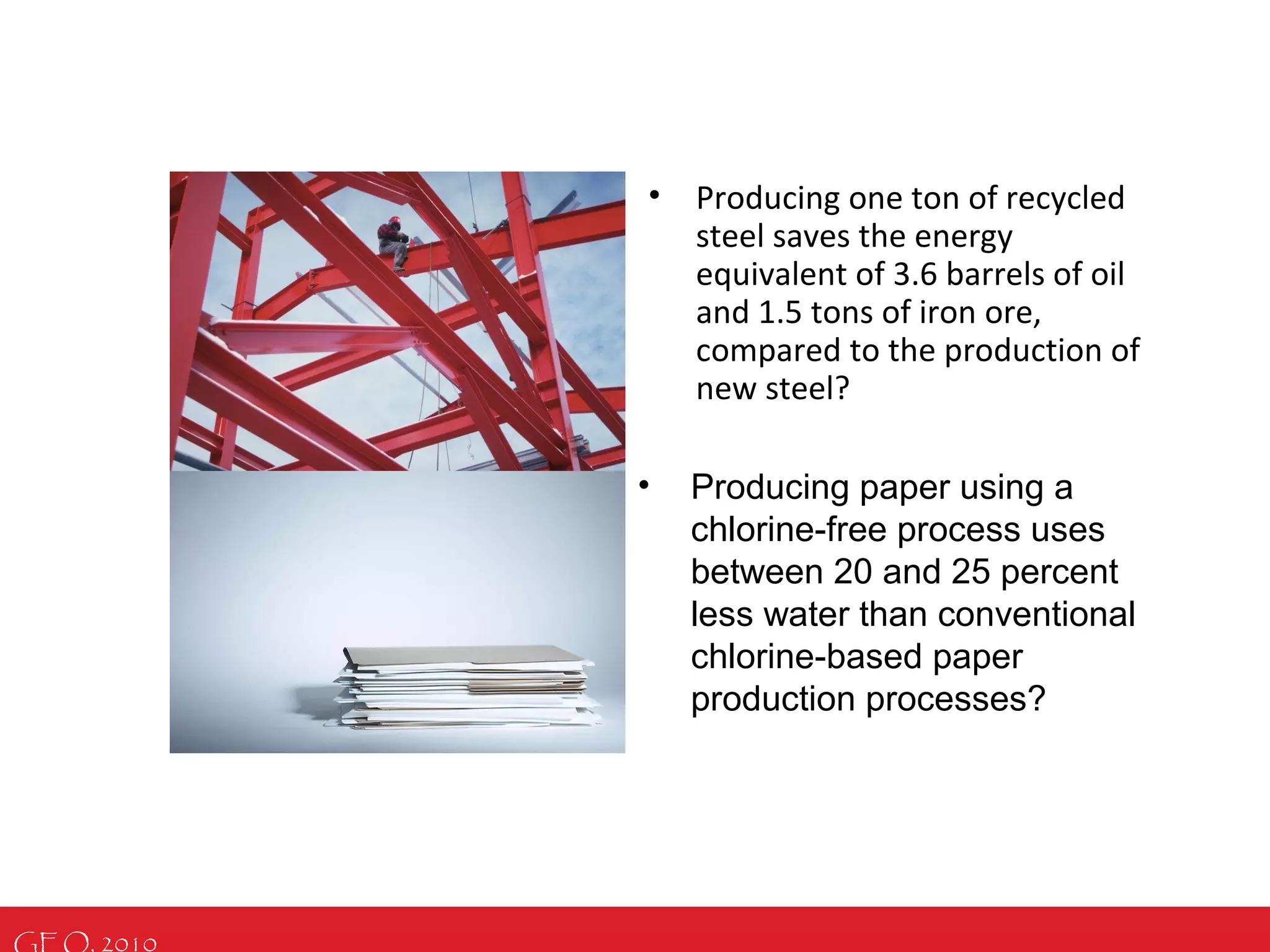
• Producing one ton of recycled
steel saves the energy
equivalent of 3.6 barrels of oil
and 1.5 tons of iron ore,
compared to the production of
new steel?
• Producing paper using a
chlorine-free process uses
between 20 and 25 percent
less water than conventional
chlorine-based paper
production processes?
GEO, 2010
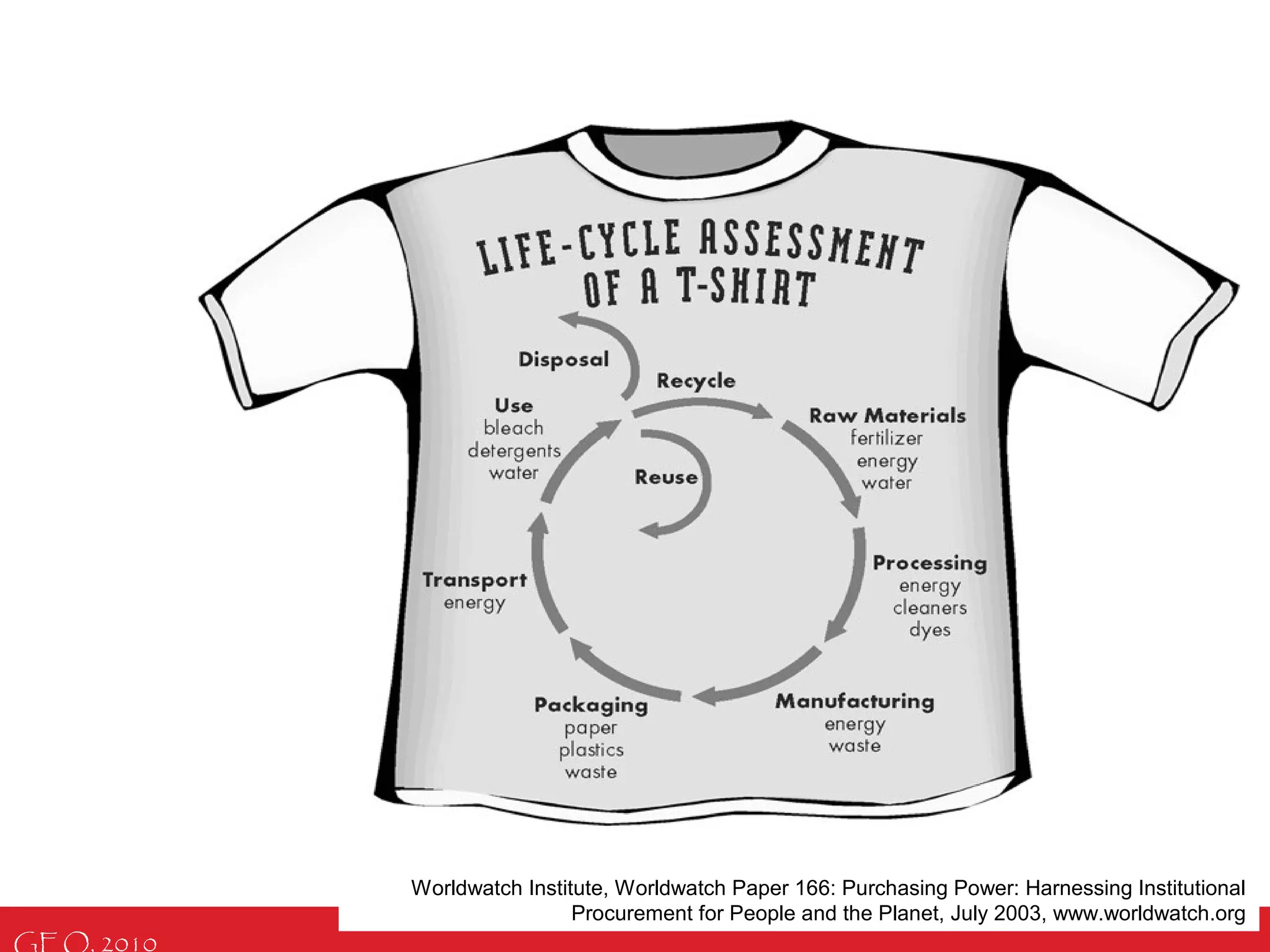
Worldwatch Institute, Worldwatch Paper 166: Purchasing Power: Harnessing Institutional
Procurement for People and the Planet, July 2003, www.worldwatch.org
GEO, 2010
Life Cycle Assessment
A process to evaluate the environmental burdens
associated with a product by identifying and
quantifying energy and materials used and wastes
released into the environment; to assess the impact of
those energy and material uses and releases to the
environment; and to identify and evaluate
opportunities to affect environmental improvements.
(SETAC, 1991)
GEO, 2010
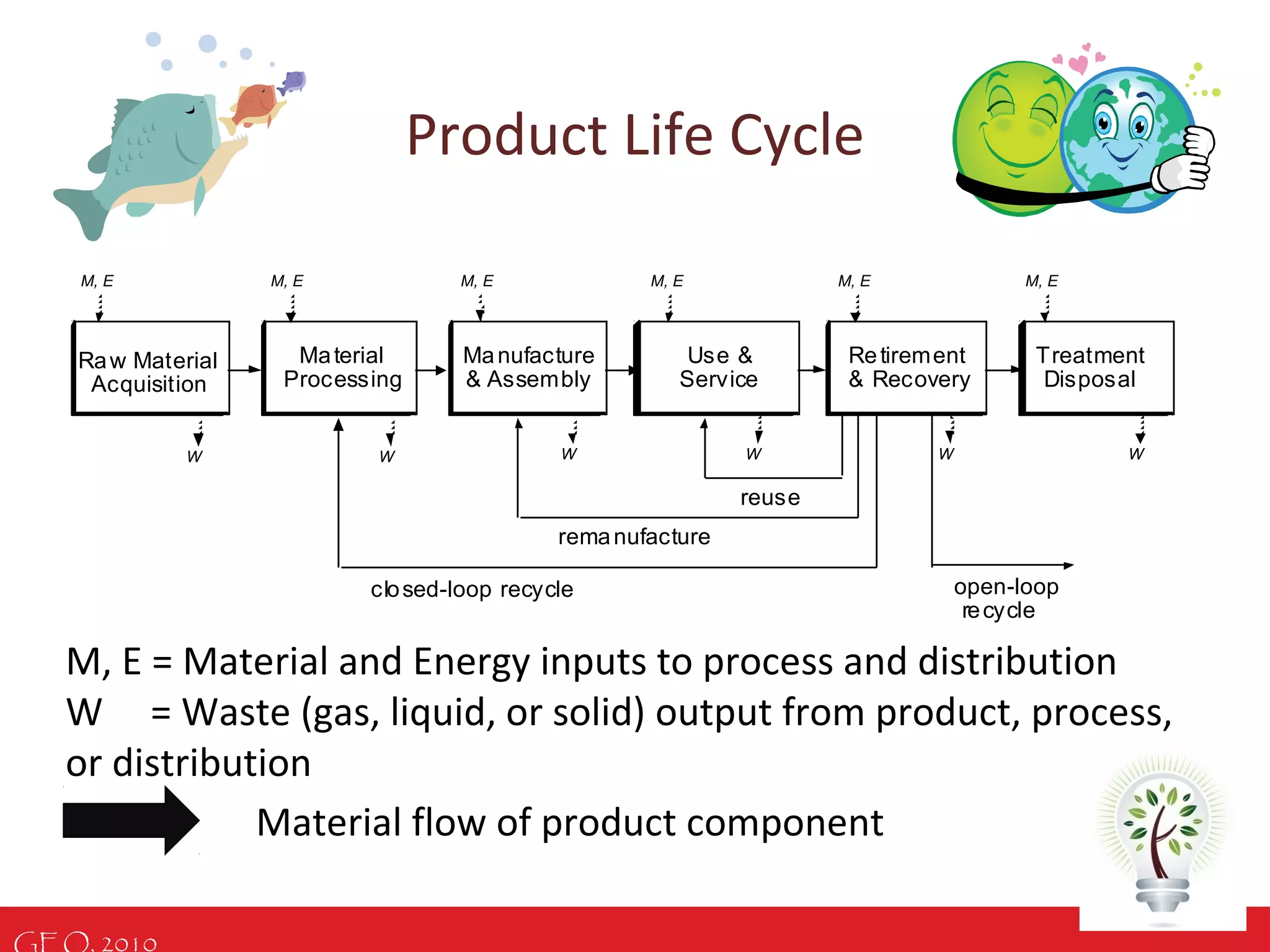
Product Life Cycle
Raw Material
Acquisition
Material
Processing
Manufacture
& Assembly
Use &
Service
Retirement
& Recovery
Treatment
Disposal
open-loop
recycle
reuse
remanufacture
closed-loop recycle
M, E
W W W W W
M, E M, E M, E M, EM, E
W
M, E = Material and Energy inputs to process and distribution
W = Waste (gas, liquid, or solid) output from product, process,
or distribution
Material flow of product component
GEO, 2010
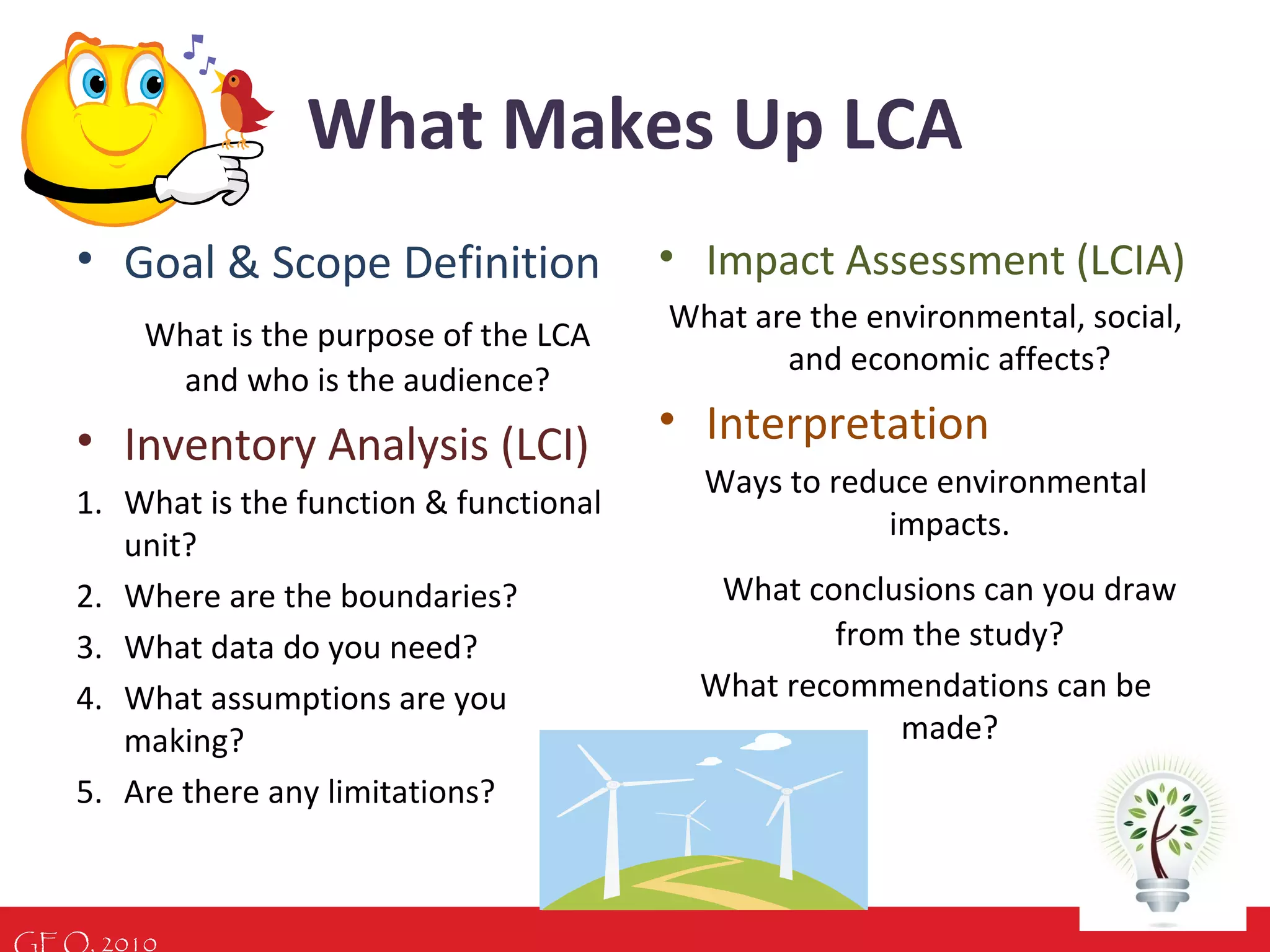
What Makes Up LCA
• Goal & Scope Definition
What is the purpose of the LCA
and who is the audience?
• Inventory Analysis (LCI)
1. What is the function & functional
unit?
2. Where are the boundaries?
3. What data do you need?
4. What assumptions are you
making?
5. Are there any limitations?
• Impact Assessment (LCIA)
What are the environmental, social,
and economic affects?
• Interpretation
Ways to reduce environmental
impacts.
What conclusions can you draw
from the study?
What recommendations can be
made?
GEO, 2010
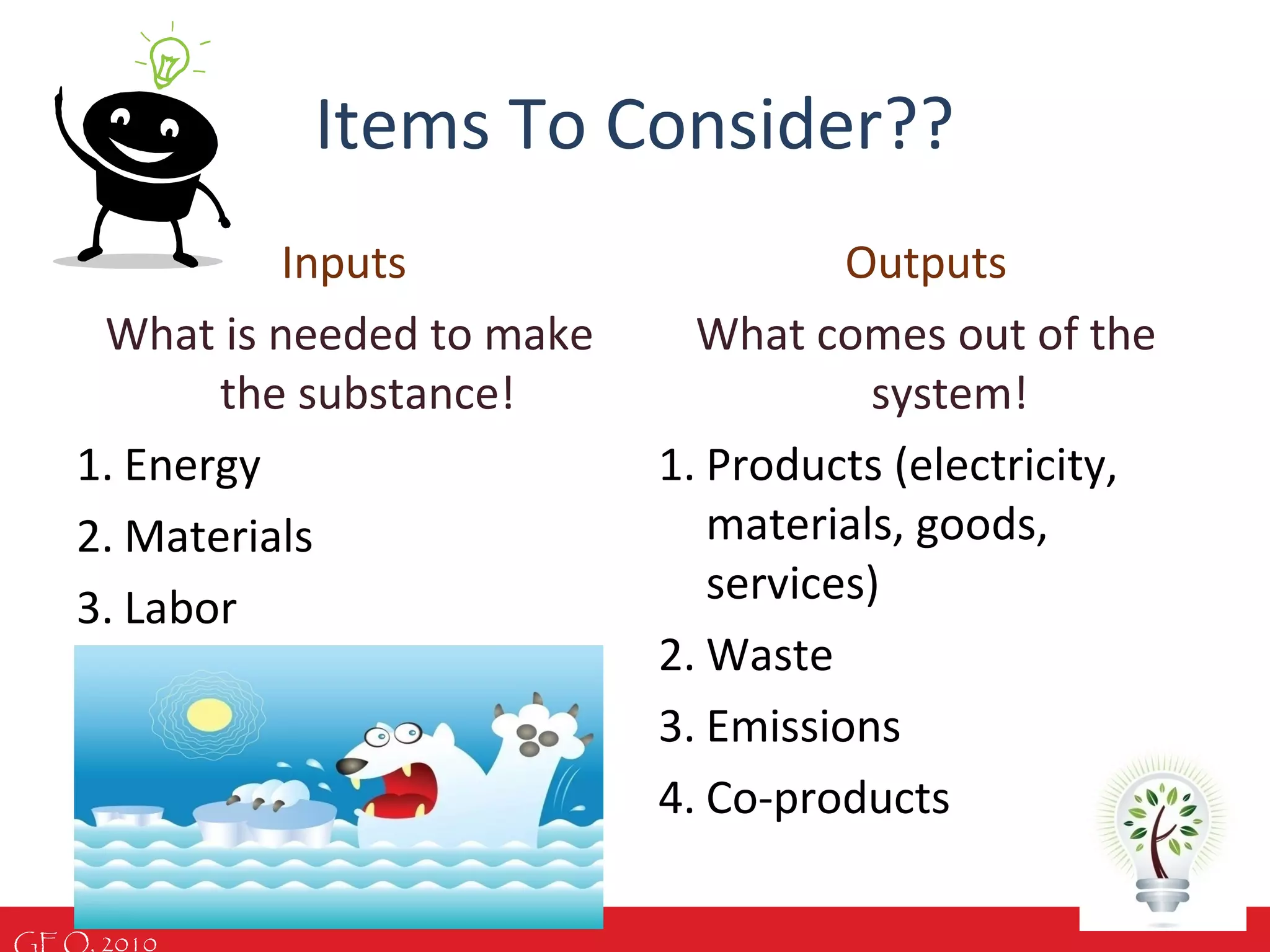
Items To Consider??
Inputs
What is needed to make
the substance!
1. Energy
2. Materials
3. Labor
Outputs
What comes out of the
system!
1. Products (electricity,
materials, goods,
services)
2. Waste
3. Emissions
4. Co-products
GEO, 2010
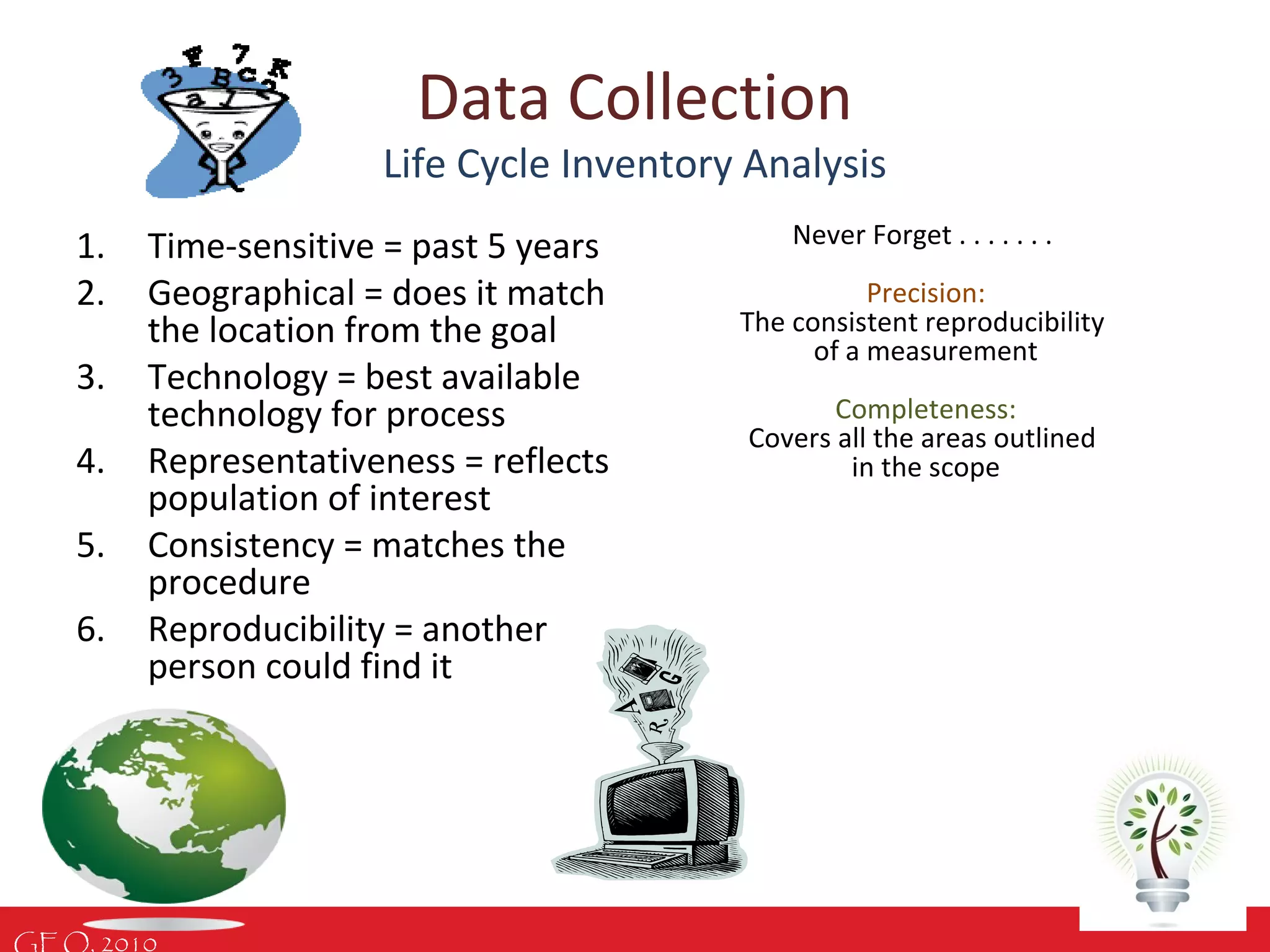
Data Collection
Life Cycle Inventory Analysis
1. Time-sensitive = past 5 years
2. Geographical = does it match
the location from the goal
3. Technology = best available
technology for process
4. Representativeness = reflects
population of interest
5. Consistency = matches the
procedure
6. Reproducibility = another
person could find it
Never Forget . . . . . . .
Precision:
The consistent reproducibility
of a measurement
Completeness:
Covers all the areas outlined
in the scope
GEO, 2010
LCA in Action: Think About It!
Paper Plate vs. China (Plate You Wash & Reuse)
 What is the function?
 What is the functional
unit?
 What materials &
resources are used?
 What does it take to
produce both?
 What are the impacts
to the environment?
 Is there waste?
 Does washing the
China produce waste?
 What types of data do
you need?
 How do you know
which is better?
GEO, 2010
Data Analysis
Environmental Impact Categories
Global Warming Potential
• Gases in the
atmosphere that absorb
and emit radiation
• Trap heat from the sun
• Water vapor, CO2 , CH4 ,
ozone, NO2
Abiotic Depletion
• Consumption of non-
living resources
Human Toxicity Potential
• Value that shows harms
to humans from
chemicals
Land Use
• How much land is
needed
GEO, 2010
Environmental Impact Categories
Continued . . . . .
Eutrophication
• Increase in chemical
nutrients containing
nitrogen or phosphorus
• land or water
• overgrowth of plants
• killing organisms at
bottom of water
Water Use
Mercury
Acidification
• caused by pollution from
fuels & acid rain
• low pH
Smog (Winter or Summer)
Energy Use
Solid Waste
Oil
. . . . . . . AND MANY MORE!!
GEO, 2010
Where Do We Go From Here?
• What is the purpose of
all this data??
• Scientists can make
recommendations of
choices that are less
impactful
• Scientists can analyze a
particular impact and
focus on a solution
• Industry & Individuals
can take a closer look at
how they can make a
difference
Class Project
Evaluate 2 products using
the LCA method and
make change!
GEO, 2010
Where Does Our “Stuff”
Come From?
Let’s check it out with . . . .
“The Story of Stuff”
http://www.storyofstuff.com/
GEO, 2010
What is LCA?
• Enables estimation of cumulative environmental impacts results
from all stages of the product life cycle
• A “cradle-to-grave” approach “for assessing the environmental
aspects and potential impacts associated with a product by;
– compiling an inventory of relevant inputs and outputs of a
system
– evaluating the potential environmental impacts associated with
these inputs and outputs
– interpreting the results of the inventory and impact phases in
relation to the objectives of the study.” (ISO 14040)
GEO, 2010
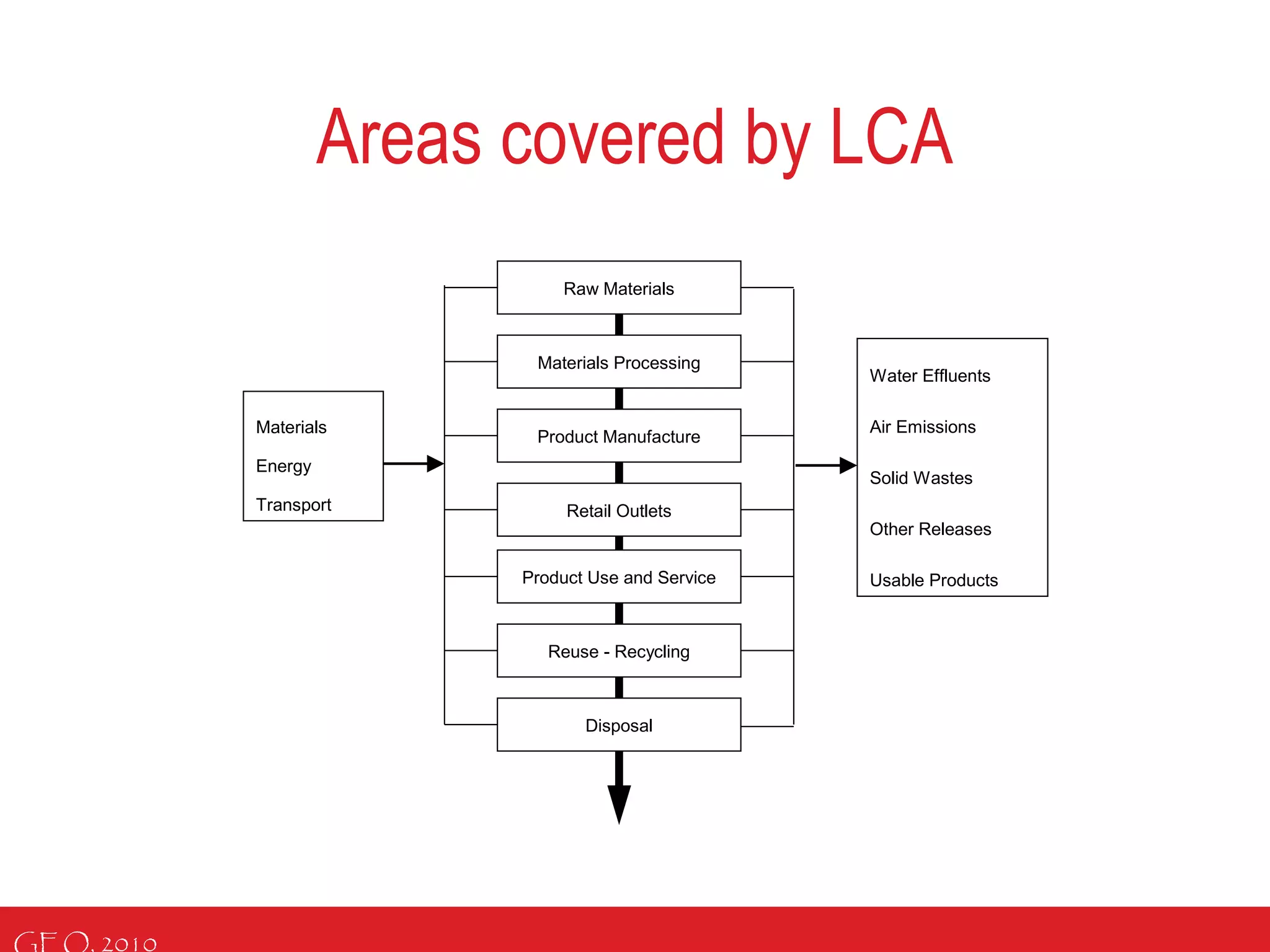
Raw Materials
Materials Processing
Product Manufacture
Retail Outlets
Product Use and Service
Reuse - Recycling
Disposal
Materials
Energy
Transport
Water Effluents
Air Emissions
Solid Wastes
Other Releases
Usable Products
Areas covered by LCA
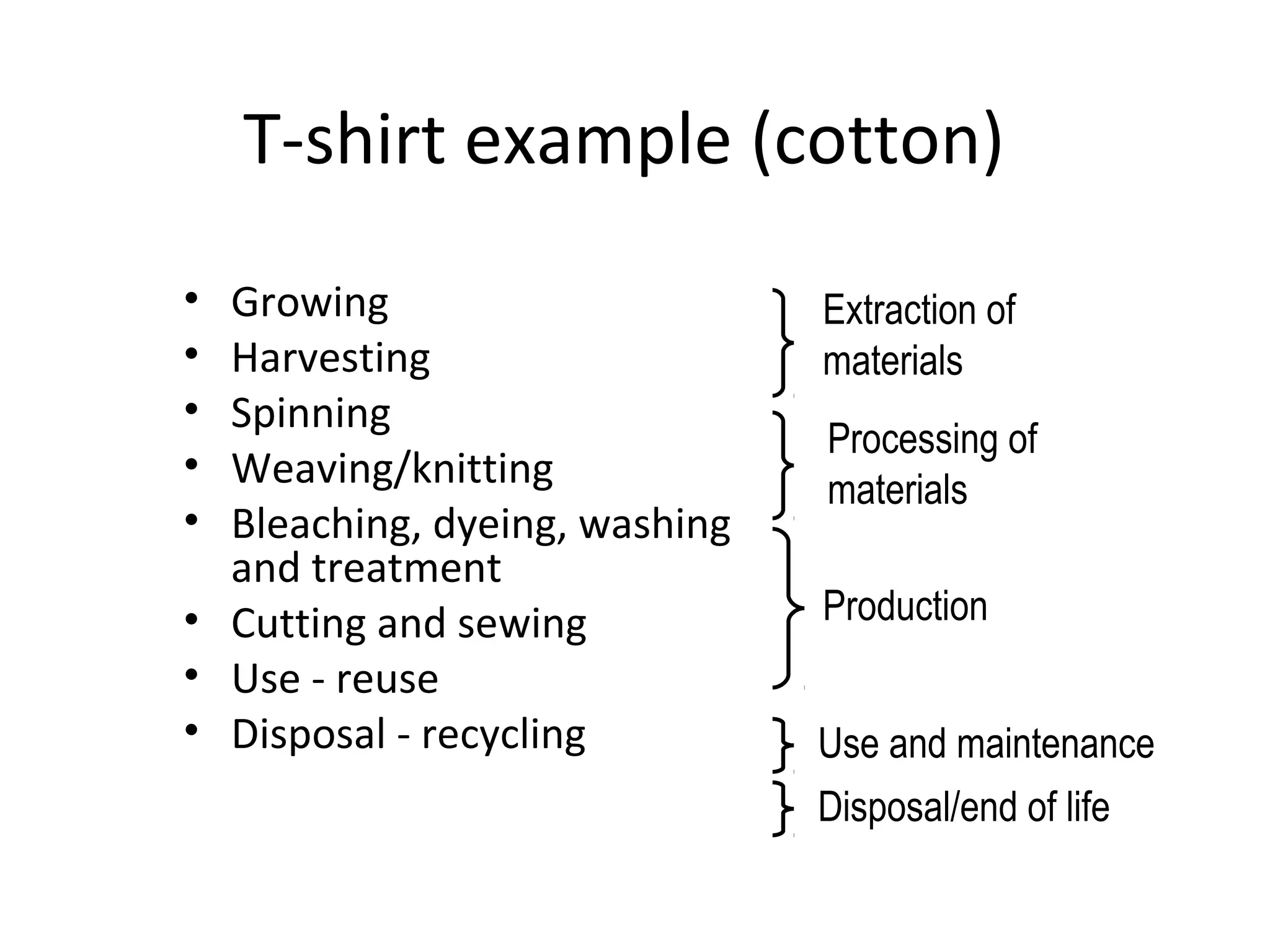
T-shirt example (cotton)
• Growing
• Harvesting
• Spinning
• Weaving/knitting
• Bleaching, dyeing, washing
and treatment
• Cutting and sewing
• Use - reuse
• Disposal - recycling Use and maintenance
Disposal/end of life
Processing of
materials
Production
Extraction of
materials
GEO, 2010
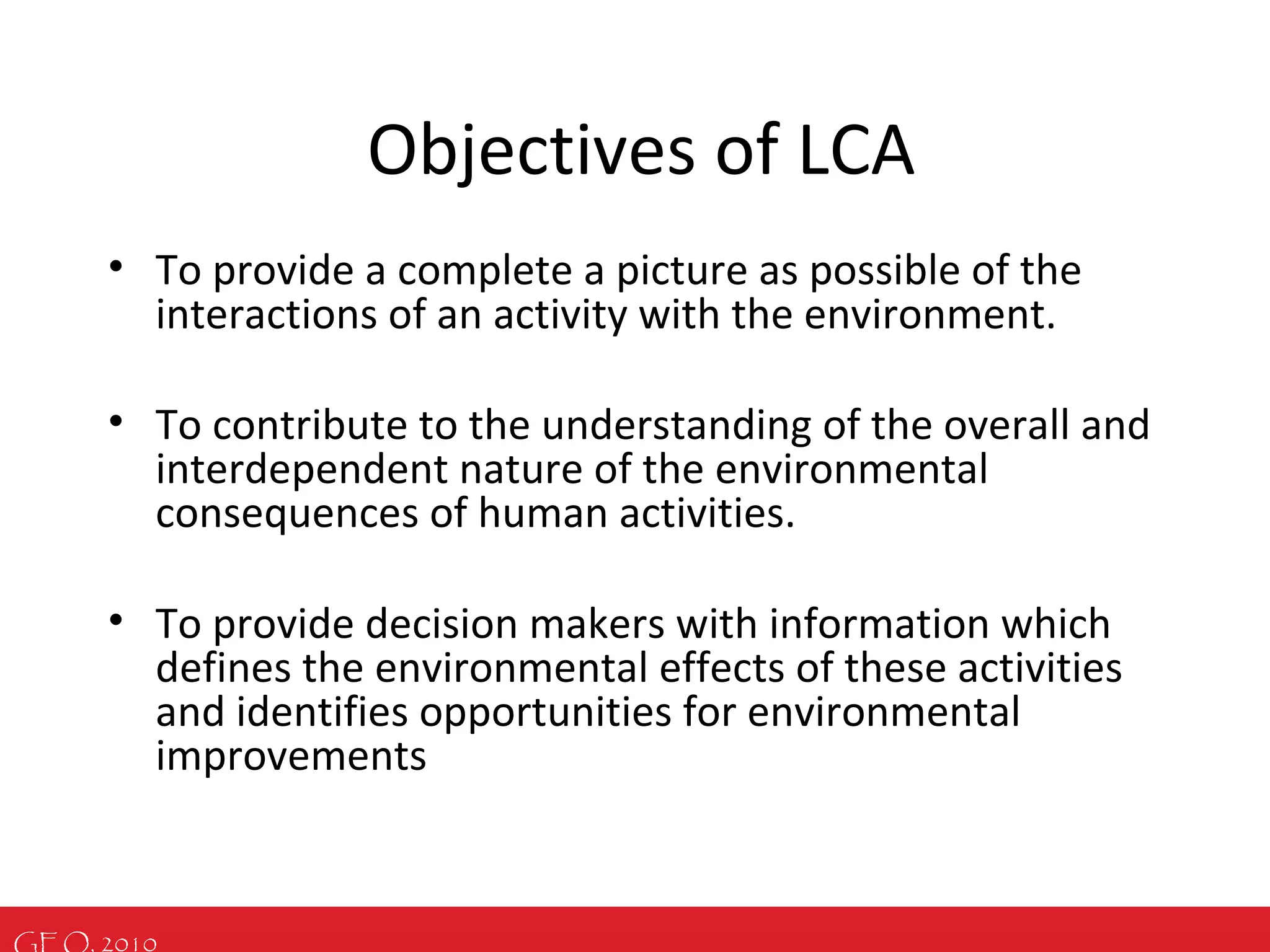
Objectives of LCA
• To provide a complete a picture as possible of the
interactions of an activity with the environment.
• To contribute to the understanding of the overall and
interdependent nature of the environmental
consequences of human activities.
• To provide decision makers with information which
defines the environmental effects of these activities
and identifies opportunities for environmental
improvements
GEO, 2010
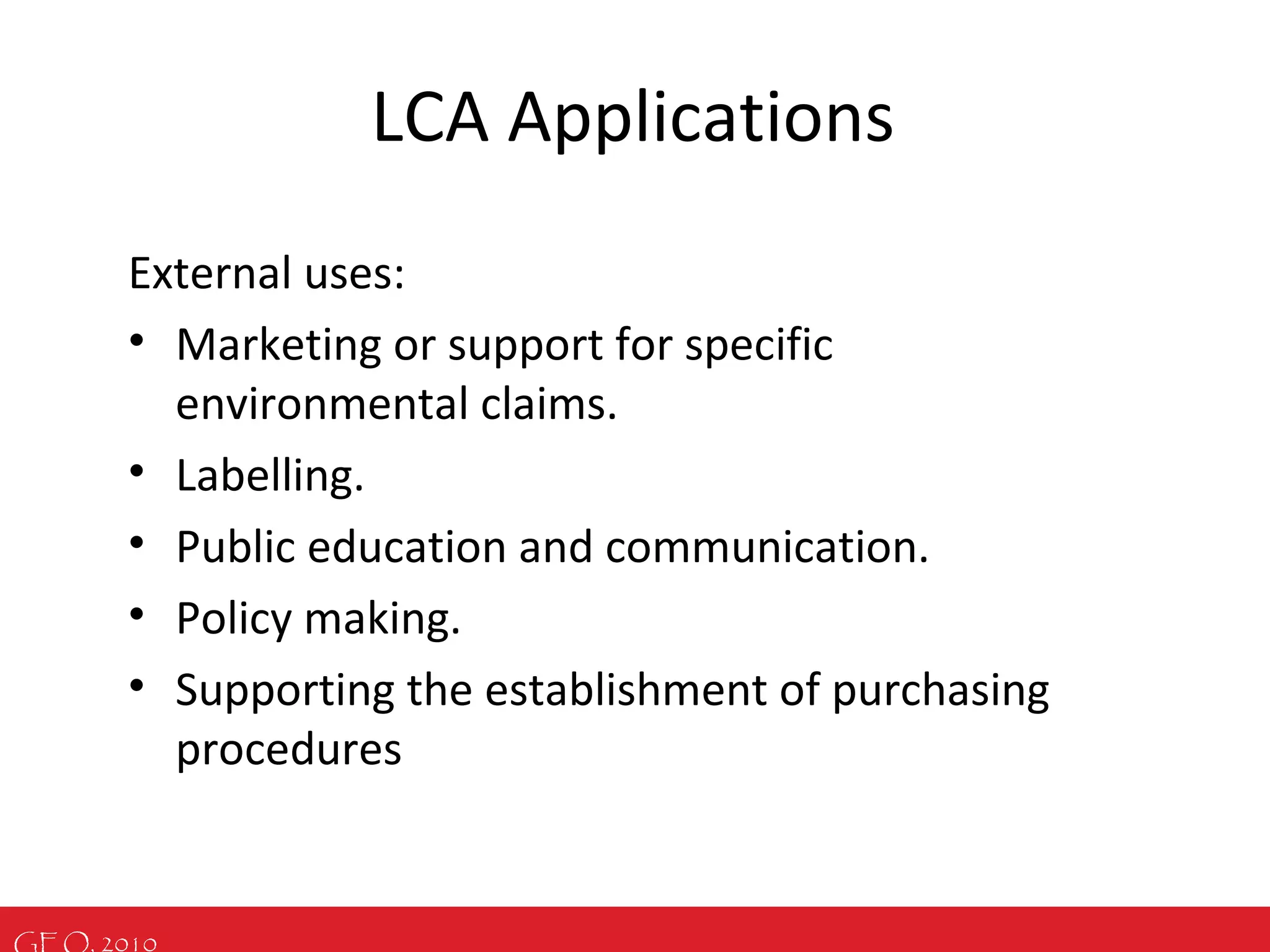
LCA Applications
External uses:
• Marketing or support for specific
environmental claims.
• Labelling.
• Public education and communication.
• Policy making.
• Supporting the establishment of purchasing
procedures
GEO, 2010
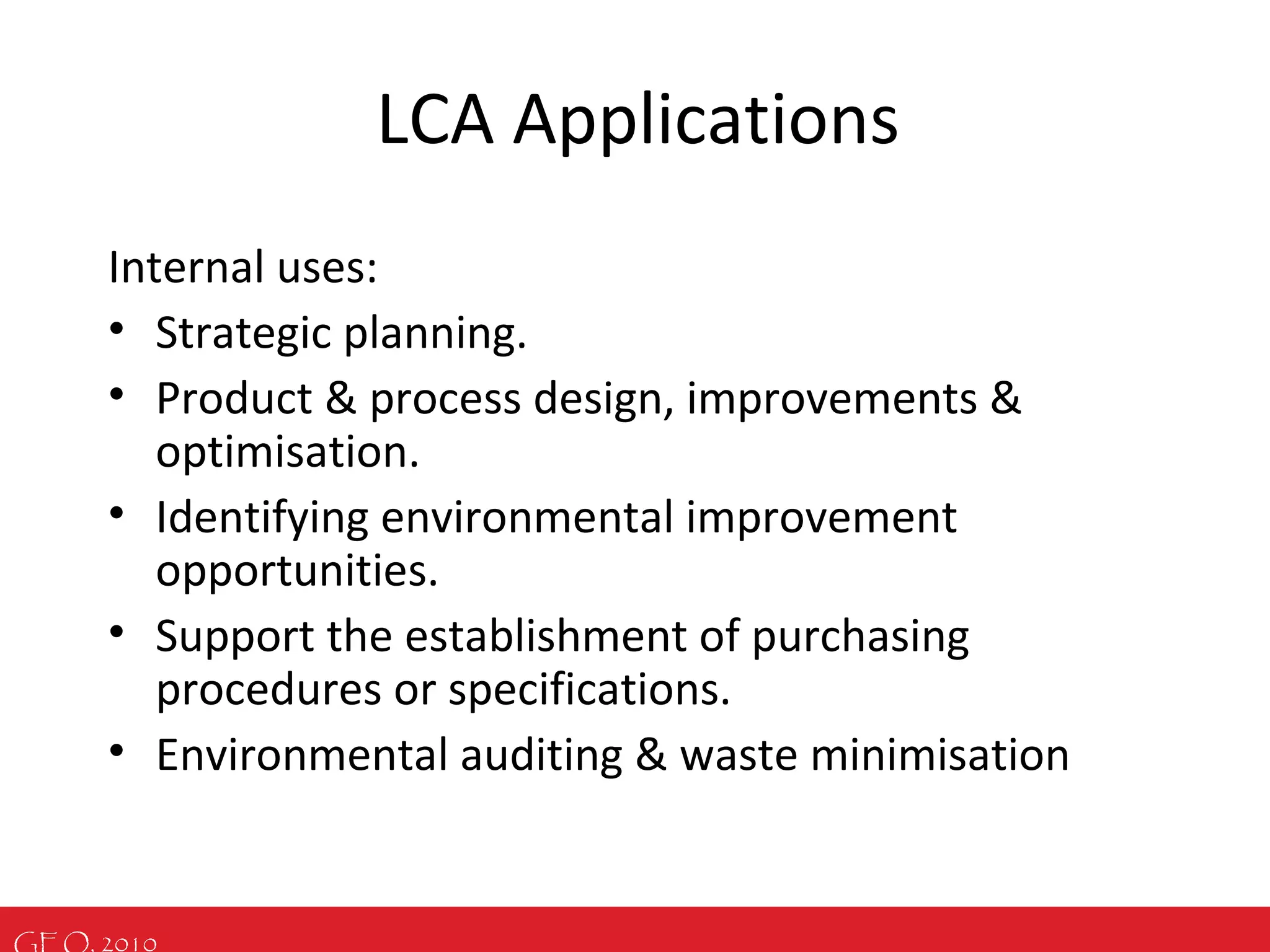
LCA Applications
Internal uses:
• Strategic planning.
• Product & process design, improvements &
optimisation.
• Identifying environmental improvement
opportunities.
• Support the establishment of purchasing
procedures or specifications.
• Environmental auditing & waste minimisation
GEO, 2010
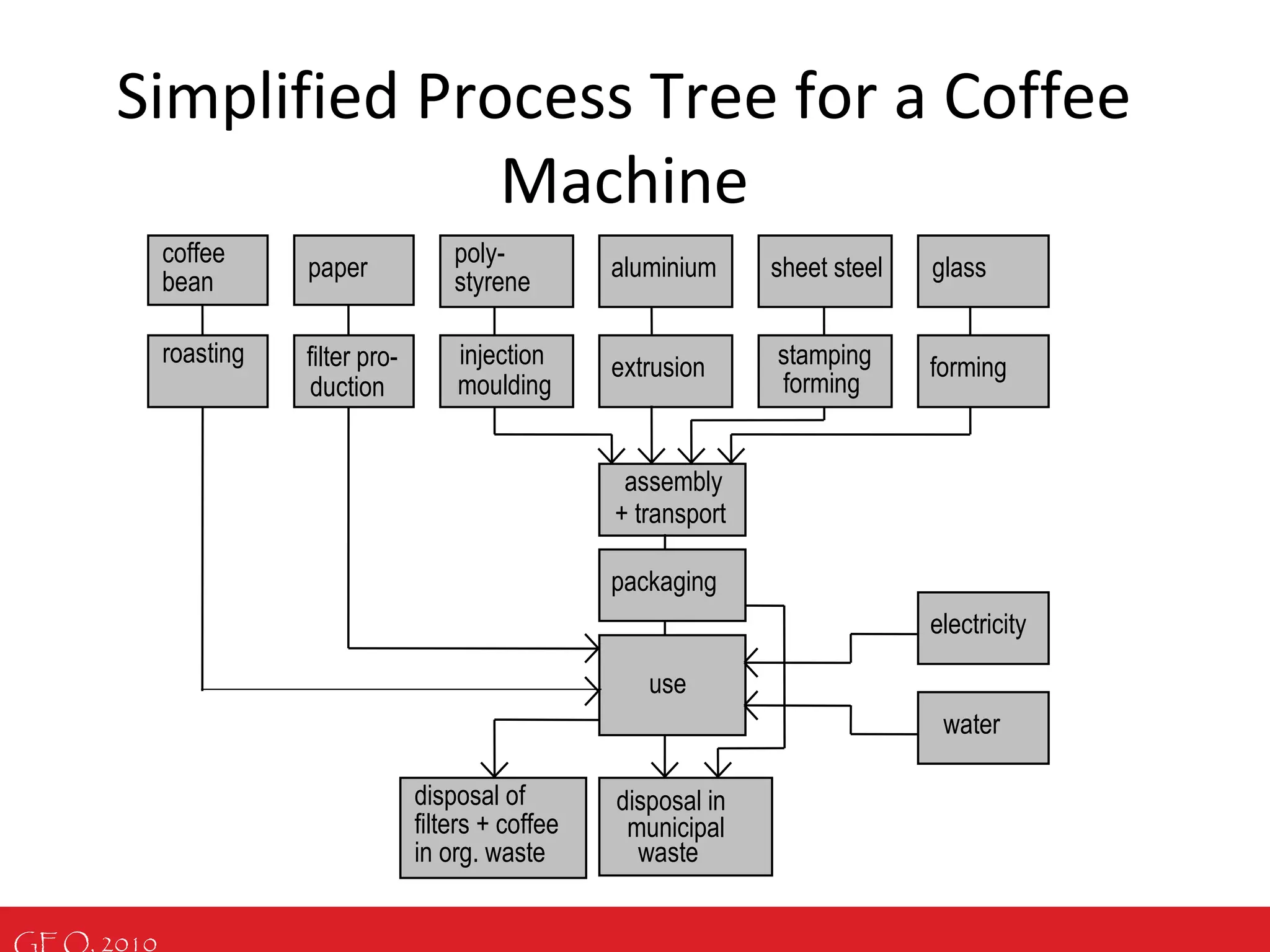
assembly
poly-
aluminium
extrusion
+ transport
disposal in
municipal
waste
disposal of
in org. waste
use
paper
duction
filter pro-
sheet steel
stamping
forming
glass
forming
filters + coffee
coffee
roasting
packaging
water
injection
moulding
bean styrene
electricity
Simplified Process Tree for a Coffee
Machine
GEO, 2010
assembly
poly-
aluminium
extrusion
+ transport
disposal in
municipal
waste
disposal of
in org. waste
use
paper
duction
filter pro-
sheet steel
stamping
forming
glass
forming
filters + coffee
coffee
roasting
packaging
water
injection
moulding
bean styrene
electricity
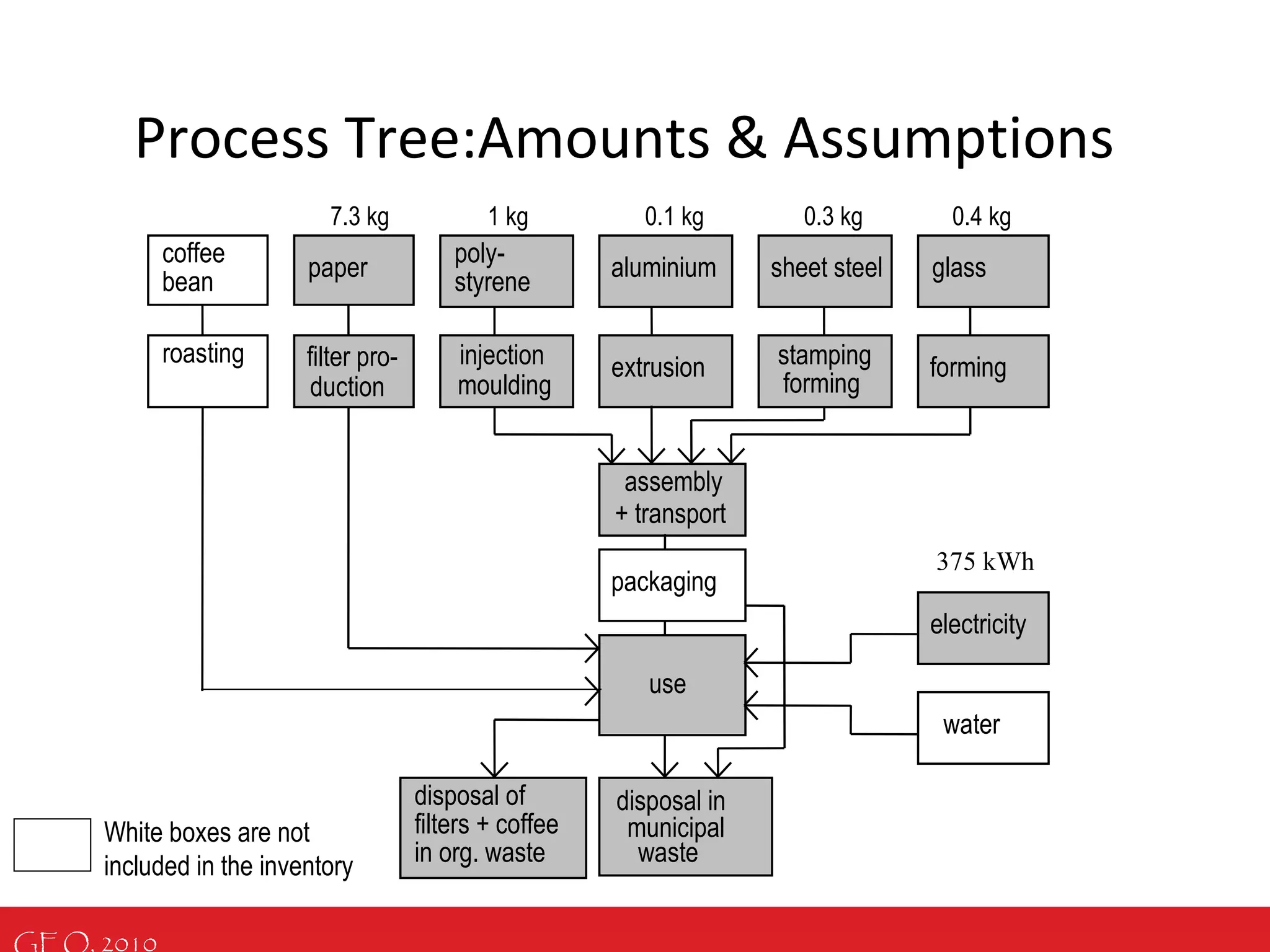
Process Tree:Amounts & Assumptions
7.3 kg 1 kg 0.1 kg 0.3 kg 0.4 kg
White boxes are not
included in the inventory
375 kWh
GEO, 2010
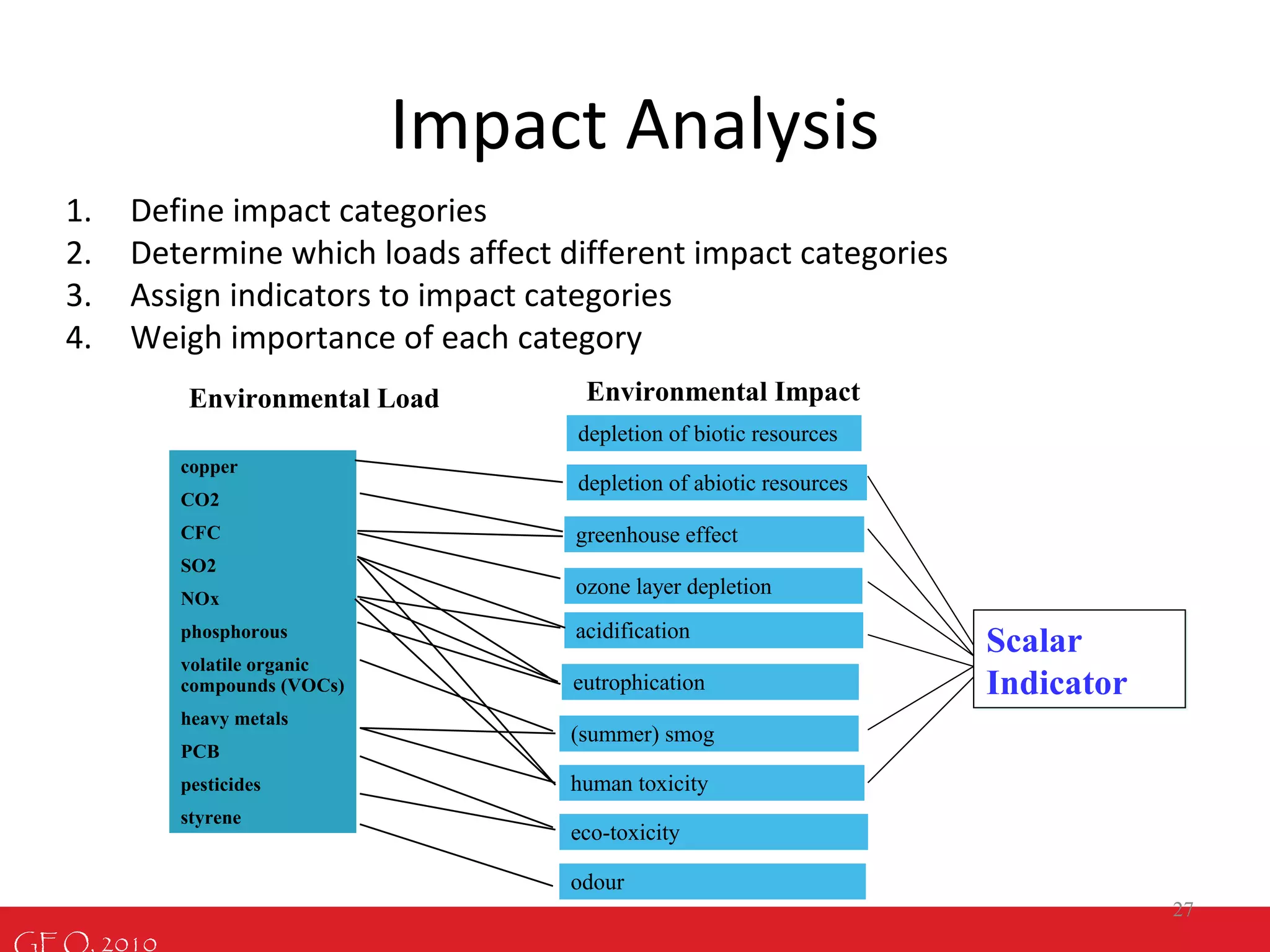
Impact Analysis
1. Define impact categories
2. Determine which loads affect different impact categories
3. Assign indicators to impact categories
4. Weigh importance of each category
27
Environmental ImpactEnvironmental Load
greenhouse effect
ozone layer depletion
eutrophication
depletion of abiotic resources
(summer) smog
acidification
copper
CO2
CFC
SO2
NOx
phosphorous
volatile organic
compounds (VOCs)
heavy metals
PCB
pesticides
styrene
eco-toxicity
depletion of biotic resources
human toxicity
odour
Scalar
Indicator
Scalar
Indicator
GEO, 2010
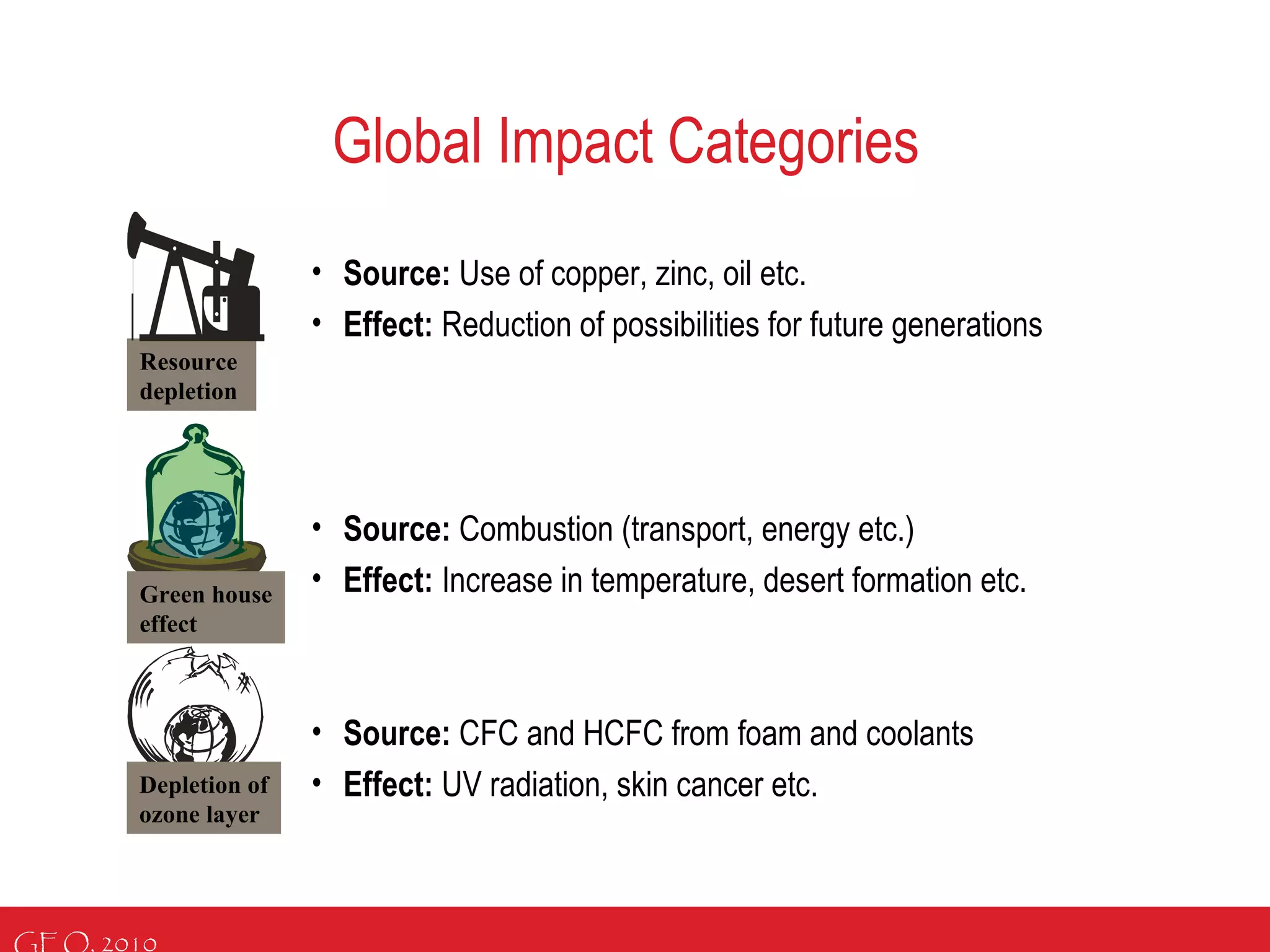
Resource
depletion
Green house
effect
Depletion of
ozone layer
• Source: Use of copper, zinc, oil etc.
• Effect: Reduction of possibilities for future generations
• Source: Combustion (transport, energy etc.)
• Effect: Increase in temperature, desert formation etc.
• Source: CFC and HCFC from foam and coolants
• Effect: UV radiation, skin cancer etc.
Global Impact Categories
GEO, 2010
Regional Impact Categories
Persistent
toxicity
Acidification
Ozone formation
Eutrofication
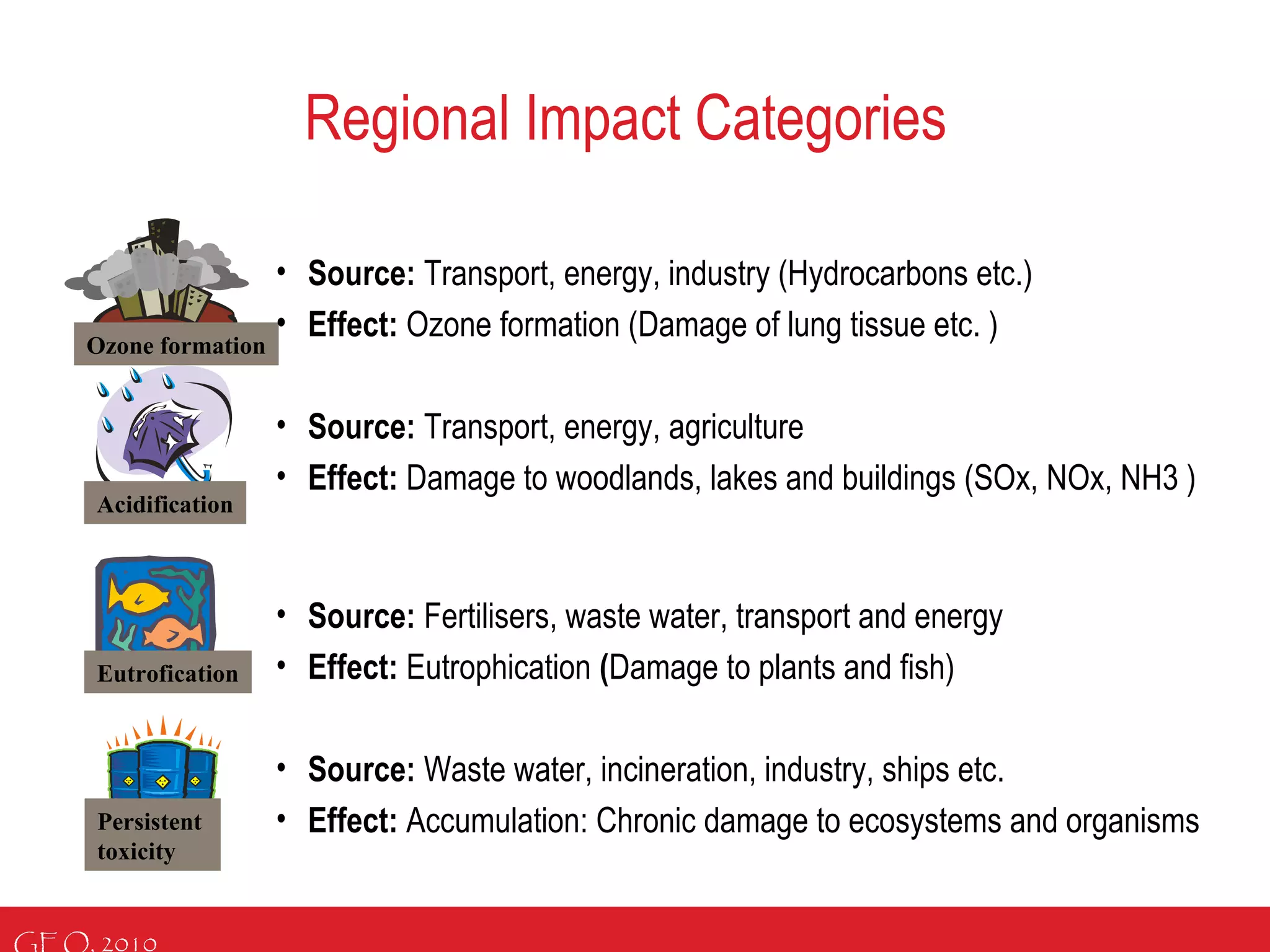
• Source: Transport, energy, industry (Hydrocarbons etc.)
• Effect: Ozone formation (Damage of lung tissue etc. )
• Source: Transport, energy, agriculture
• Effect: Damage to woodlands, lakes and buildings (SOx, NOx, NH3 )
• Source: Fertilisers, waste water, transport and energy
• Effect: Eutrophication (Damage to plants and fish)
• Source: Waste water, incineration, industry, ships etc.
• Effect: Accumulation: Chronic damage to ecosystems and organisms
GEO, 2010
Plastic versus Paper Bag
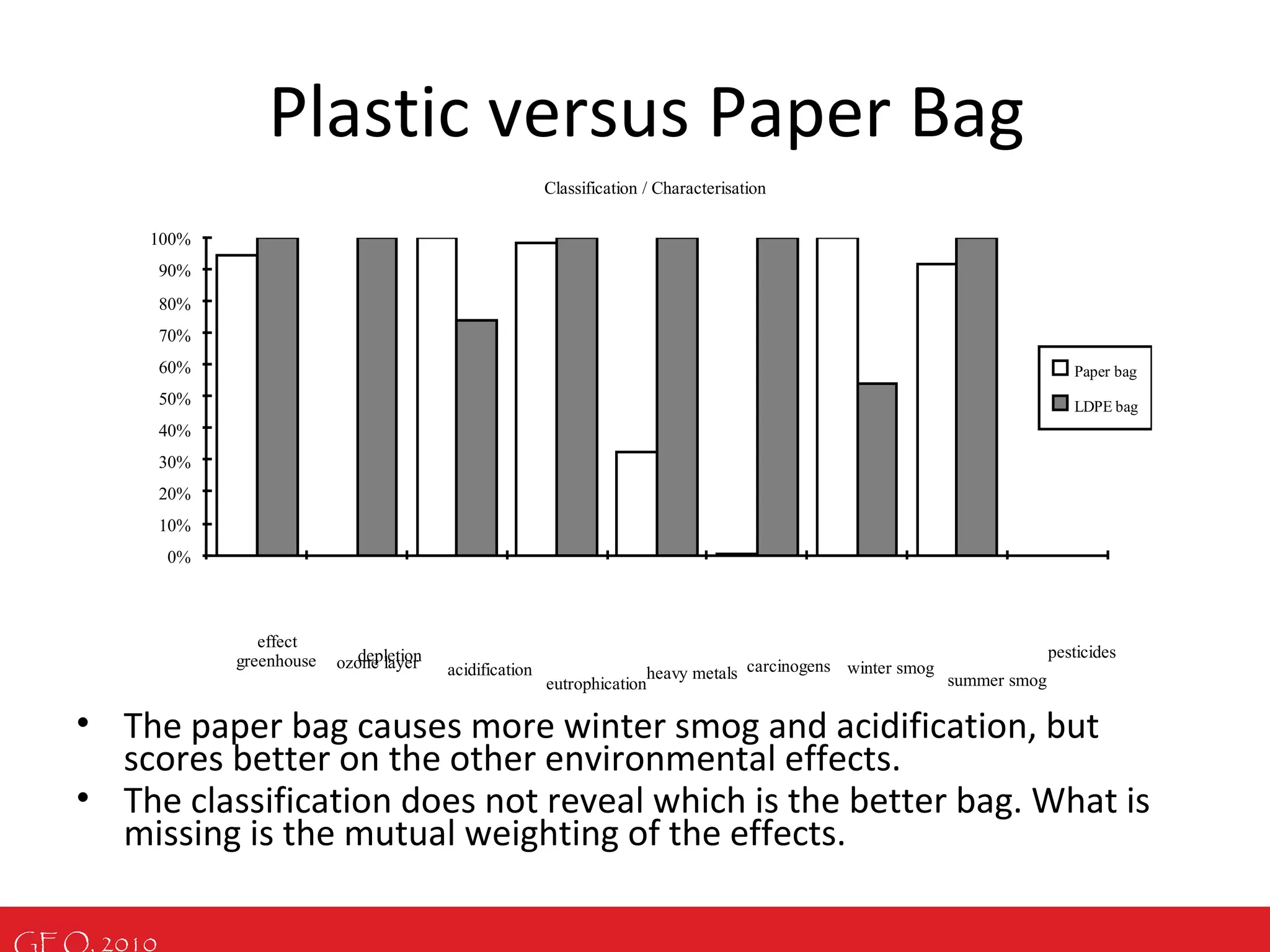
• The paper bag causes more winter smog and acidification, but
scores better on the other environmental effects.
• The classification does not reveal which is the better bag. What is
missing is the mutual weighting of the effects.
Classification / Characterisation
0%
10%
20%
30%
40%
50%
60%
70%
80%
90%
100%
greenhouse
effect
ozone layerdepletion
acidification
eutrophication
heavy metals carcinogens winter smog
summer smog
pesticides
Paper bag
LDPE bag
GEO, 2010
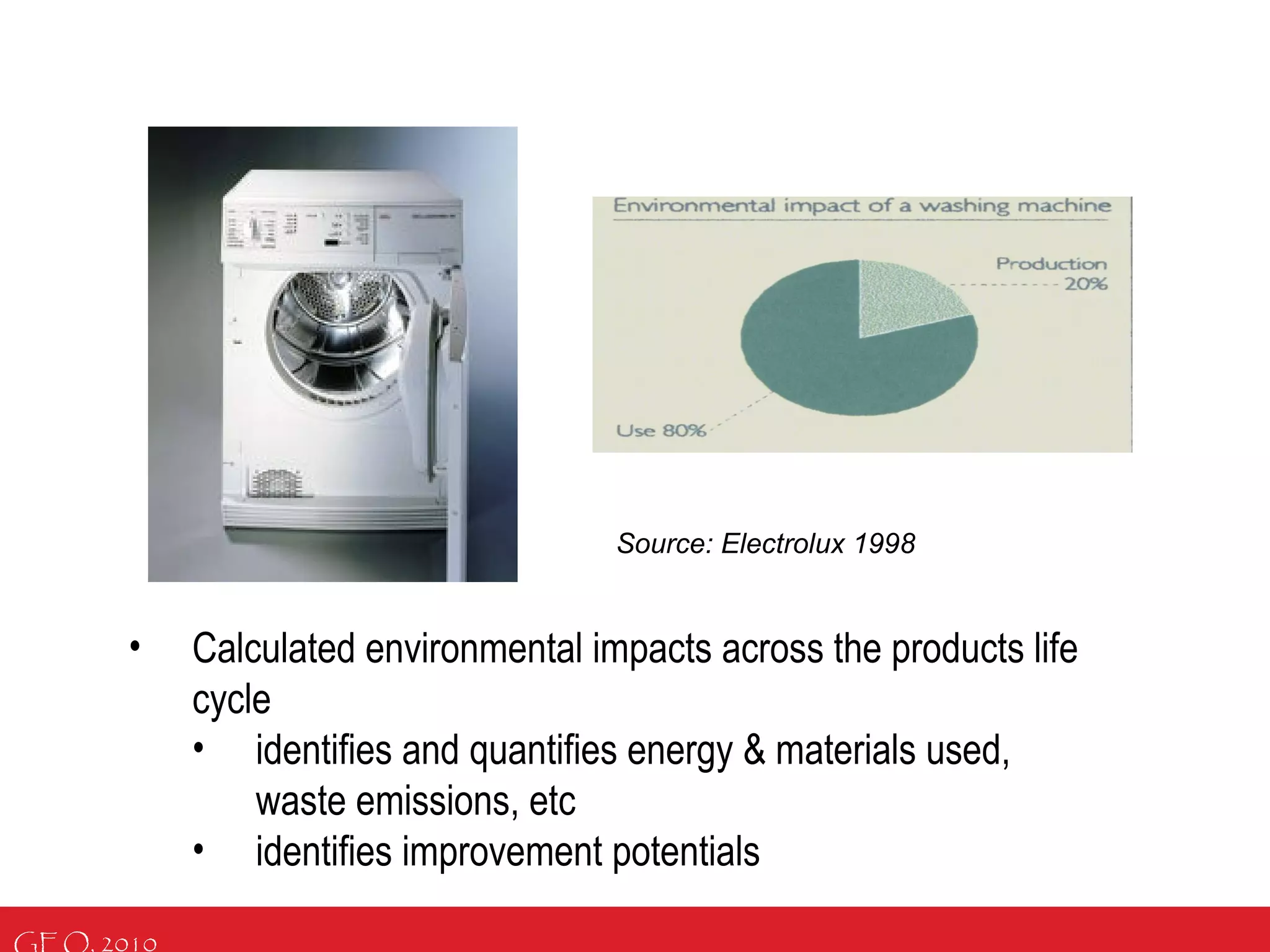
Source: Electrolux 1998
• Calculated environmental impacts across the products life
cycle
• identifies and quantifies energy & materials used,
waste emissions, etc
• identifies improvement potentials
GEO, 2010
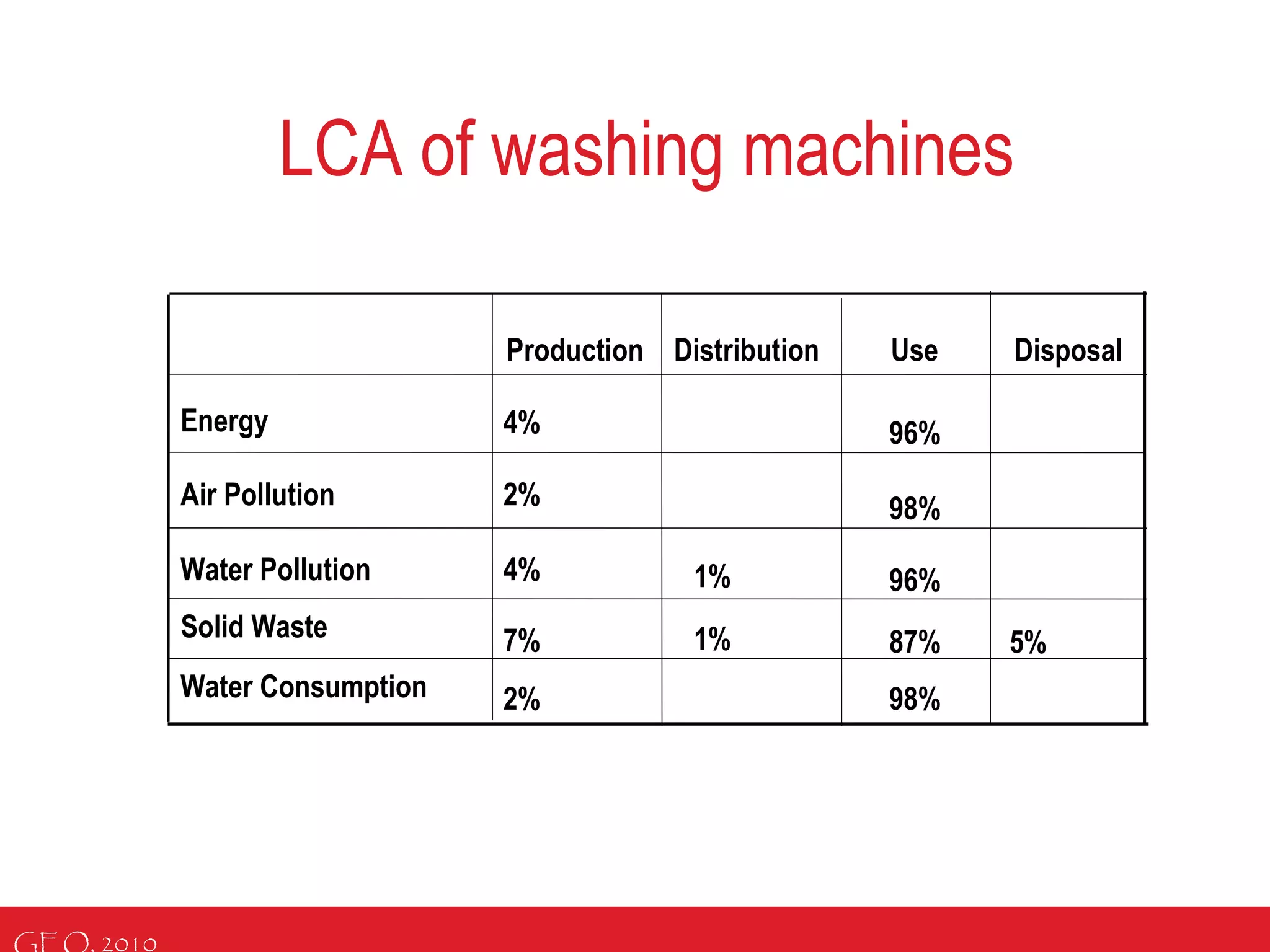
LCA of washing machines
98%2%Water Consumption
5%87%
1%
7%Solid Waste
96%
1%
4%Water Pollution
98%2%Air Pollution
96%4%Energy
DisposalUseDistributionProduction
GEO, 2010
Ref: http://....
Thank you

Life cycle assessment introduction

  • 1.
    GEO, 2010 SOLID WASTEMANAGEMENT 28TH May 2010 Dr. N. Sai Bhaskar Reddy, CEO, GEO http://e-geo.org Centre for Social Initiative and Management
  • 2.
    GEO, 2010 What doesit mean to be Green?? What is Sustainability?? What does it mean to be Green?? What is Sustainability?? What does it mean to be Green?? What is Sustainability?? What does it mean to be Green?? What is Sustainability?? What does it mean to be Green?? What is Sustainability??
  • 3.
    GEO, 2010 Sustainability United NationsWorld Commission on Environment and Development (1987) Sustainable Development definition: “… development that meets the needs of the present without compromising the ability of future generations to meet their own needs.” • Biodegradable • Recyclable • Ozone friendly • Eco-design • Greenwashing• Environmentally Friendly • Sustainable Products • Green product • Environmentally Preferable wwblog.miragestudio7.com
  • 4.
    GEO, 2010 What Canthe Earth Handle? Population (2007) Annual Growth Rate (00 – 07) World 6.7 Billion 1.24% LDC 5.4 Billion 1.44% MDC 1.2 Billion 0.36% US 301 Million 1.03% World Population Statistics UN Population Division• The estimate of Earth’s Maximum supportable population is 13.4 billion. • Looking at the population statistics, where are we headed? Renewable Energy Source Will Limit Our Growth! Average per capita energy consumption is 3 kW/person •US 12 kW/person •Industrialized 7.5 kW/person •Denmark 5.1 kW/person •Developing 1kW/person
  • 5.
    GEO, 2010 Being Greenis Trendy . . . . . . . . . . . What Does Science Say? • Industry is looking for ways to green their products and manufacturing processes. • Individuals and Families are looking to green their homes and lifestyles. • How can you tell if something really is green?? • What is currently happening to achieve this goal? • Scientists perform a Life Cycle Assessment (LCA) www.scienceinthebox.com
  • 6.
    GEO, 2010 Definition: “Compilation andevaluation of the inputs, outputs and the potential environmental impacts of a product system throughout its life cycle” This establishes an environmental profile of the system! ISO = International Organization for Standardization Ensures that an LCA is completed in a certain way. WHAT CAN BE DONE WITH LCA? 1.Product or project development and improvement 2.Strategic planning 3.Public policy making 4.Marketing and eco- declarations www.davidreport.com
  • 7.
    GEO, 2010 • Producingone ton of recycled steel saves the energy equivalent of 3.6 barrels of oil and 1.5 tons of iron ore, compared to the production of new steel? • Producing paper using a chlorine-free process uses between 20 and 25 percent less water than conventional chlorine-based paper production processes?
  • 8.
    GEO, 2010 Worldwatch Institute,Worldwatch Paper 166: Purchasing Power: Harnessing Institutional Procurement for People and the Planet, July 2003, www.worldwatch.org
  • 9.
    GEO, 2010 Life CycleAssessment A process to evaluate the environmental burdens associated with a product by identifying and quantifying energy and materials used and wastes released into the environment; to assess the impact of those energy and material uses and releases to the environment; and to identify and evaluate opportunities to affect environmental improvements. (SETAC, 1991)
  • 10.
    GEO, 2010 Product LifeCycle Raw Material Acquisition Material Processing Manufacture & Assembly Use & Service Retirement & Recovery Treatment Disposal open-loop recycle reuse remanufacture closed-loop recycle M, E W W W W W M, E M, E M, E M, EM, E W M, E = Material and Energy inputs to process and distribution W = Waste (gas, liquid, or solid) output from product, process, or distribution Material flow of product component
  • 11.
    GEO, 2010 What MakesUp LCA • Goal & Scope Definition What is the purpose of the LCA and who is the audience? • Inventory Analysis (LCI) 1. What is the function & functional unit? 2. Where are the boundaries? 3. What data do you need? 4. What assumptions are you making? 5. Are there any limitations? • Impact Assessment (LCIA) What are the environmental, social, and economic affects? • Interpretation Ways to reduce environmental impacts. What conclusions can you draw from the study? What recommendations can be made?
  • 12.
    GEO, 2010 Items ToConsider?? Inputs What is needed to make the substance! 1. Energy 2. Materials 3. Labor Outputs What comes out of the system! 1. Products (electricity, materials, goods, services) 2. Waste 3. Emissions 4. Co-products
  • 13.
    GEO, 2010 Data Collection LifeCycle Inventory Analysis 1. Time-sensitive = past 5 years 2. Geographical = does it match the location from the goal 3. Technology = best available technology for process 4. Representativeness = reflects population of interest 5. Consistency = matches the procedure 6. Reproducibility = another person could find it Never Forget . . . . . . . Precision: The consistent reproducibility of a measurement Completeness: Covers all the areas outlined in the scope
  • 14.
    GEO, 2010 LCA inAction: Think About It! Paper Plate vs. China (Plate You Wash & Reuse)  What is the function?  What is the functional unit?  What materials & resources are used?  What does it take to produce both?  What are the impacts to the environment?  Is there waste?  Does washing the China produce waste?  What types of data do you need?  How do you know which is better?
  • 15.
    GEO, 2010 Data Analysis EnvironmentalImpact Categories Global Warming Potential • Gases in the atmosphere that absorb and emit radiation • Trap heat from the sun • Water vapor, CO2 , CH4 , ozone, NO2 Abiotic Depletion • Consumption of non- living resources Human Toxicity Potential • Value that shows harms to humans from chemicals Land Use • How much land is needed
  • 16.
    GEO, 2010 Environmental ImpactCategories Continued . . . . . Eutrophication • Increase in chemical nutrients containing nitrogen or phosphorus • land or water • overgrowth of plants • killing organisms at bottom of water Water Use Mercury Acidification • caused by pollution from fuels & acid rain • low pH Smog (Winter or Summer) Energy Use Solid Waste Oil . . . . . . . AND MANY MORE!!
  • 17.
    GEO, 2010 Where DoWe Go From Here? • What is the purpose of all this data?? • Scientists can make recommendations of choices that are less impactful • Scientists can analyze a particular impact and focus on a solution • Industry & Individuals can take a closer look at how they can make a difference Class Project Evaluate 2 products using the LCA method and make change!
  • 18.
    GEO, 2010 Where DoesOur “Stuff” Come From? Let’s check it out with . . . . “The Story of Stuff” http://www.storyofstuff.com/
  • 19.
    GEO, 2010 What isLCA? • Enables estimation of cumulative environmental impacts results from all stages of the product life cycle • A “cradle-to-grave” approach “for assessing the environmental aspects and potential impacts associated with a product by; – compiling an inventory of relevant inputs and outputs of a system – evaluating the potential environmental impacts associated with these inputs and outputs – interpreting the results of the inventory and impact phases in relation to the objectives of the study.” (ISO 14040)
  • 20.
    GEO, 2010 Raw Materials MaterialsProcessing Product Manufacture Retail Outlets Product Use and Service Reuse - Recycling Disposal Materials Energy Transport Water Effluents Air Emissions Solid Wastes Other Releases Usable Products Areas covered by LCA
  • 21.
    T-shirt example (cotton) •Growing • Harvesting • Spinning • Weaving/knitting • Bleaching, dyeing, washing and treatment • Cutting and sewing • Use - reuse • Disposal - recycling Use and maintenance Disposal/end of life Processing of materials Production Extraction of materials
  • 22.
    GEO, 2010 Objectives ofLCA • To provide a complete a picture as possible of the interactions of an activity with the environment. • To contribute to the understanding of the overall and interdependent nature of the environmental consequences of human activities. • To provide decision makers with information which defines the environmental effects of these activities and identifies opportunities for environmental improvements
  • 23.
    GEO, 2010 LCA Applications Externaluses: • Marketing or support for specific environmental claims. • Labelling. • Public education and communication. • Policy making. • Supporting the establishment of purchasing procedures
  • 24.
    GEO, 2010 LCA Applications Internaluses: • Strategic planning. • Product & process design, improvements & optimisation. • Identifying environmental improvement opportunities. • Support the establishment of purchasing procedures or specifications. • Environmental auditing & waste minimisation
  • 25.
    GEO, 2010 assembly poly- aluminium extrusion + transport disposalin municipal waste disposal of in org. waste use paper duction filter pro- sheet steel stamping forming glass forming filters + coffee coffee roasting packaging water injection moulding bean styrene electricity Simplified Process Tree for a Coffee Machine
  • 26.
    GEO, 2010 assembly poly- aluminium extrusion + transport disposalin municipal waste disposal of in org. waste use paper duction filter pro- sheet steel stamping forming glass forming filters + coffee coffee roasting packaging water injection moulding bean styrene electricity Process Tree:Amounts & Assumptions 7.3 kg 1 kg 0.1 kg 0.3 kg 0.4 kg White boxes are not included in the inventory 375 kWh
  • 27.
    GEO, 2010 Impact Analysis 1.Define impact categories 2. Determine which loads affect different impact categories 3. Assign indicators to impact categories 4. Weigh importance of each category 27 Environmental ImpactEnvironmental Load greenhouse effect ozone layer depletion eutrophication depletion of abiotic resources (summer) smog acidification copper CO2 CFC SO2 NOx phosphorous volatile organic compounds (VOCs) heavy metals PCB pesticides styrene eco-toxicity depletion of biotic resources human toxicity odour Scalar Indicator Scalar Indicator
  • 28.
    GEO, 2010 Resource depletion Green house effect Depletionof ozone layer • Source: Use of copper, zinc, oil etc. • Effect: Reduction of possibilities for future generations • Source: Combustion (transport, energy etc.) • Effect: Increase in temperature, desert formation etc. • Source: CFC and HCFC from foam and coolants • Effect: UV radiation, skin cancer etc. Global Impact Categories
  • 29.
    GEO, 2010 Regional ImpactCategories Persistent toxicity Acidification Ozone formation Eutrofication • Source: Transport, energy, industry (Hydrocarbons etc.) • Effect: Ozone formation (Damage of lung tissue etc. ) • Source: Transport, energy, agriculture • Effect: Damage to woodlands, lakes and buildings (SOx, NOx, NH3 ) • Source: Fertilisers, waste water, transport and energy • Effect: Eutrophication (Damage to plants and fish) • Source: Waste water, incineration, industry, ships etc. • Effect: Accumulation: Chronic damage to ecosystems and organisms
  • 30.
    GEO, 2010 Plastic versusPaper Bag • The paper bag causes more winter smog and acidification, but scores better on the other environmental effects. • The classification does not reveal which is the better bag. What is missing is the mutual weighting of the effects. Classification / Characterisation 0% 10% 20% 30% 40% 50% 60% 70% 80% 90% 100% greenhouse effect ozone layerdepletion acidification eutrophication heavy metals carcinogens winter smog summer smog pesticides Paper bag LDPE bag
  • 31.
    GEO, 2010 Source: Electrolux1998 • Calculated environmental impacts across the products life cycle • identifies and quantifies energy & materials used, waste emissions, etc • identifies improvement potentials
  • 32.
    GEO, 2010 LCA ofwashing machines 98%2%Water Consumption 5%87% 1% 7%Solid Waste 96% 1% 4%Water Pollution 98%2%Air Pollution 96%4%Energy DisposalUseDistributionProduction
  • 33.

Editor's Notes

  • #3 Topics to discuss in class regards to sustainability: “Environmentally friendly Sustainable products, Green product, Environmentally preferable, Biodegradable, Recyclable, Ozone friendly, Eco-design, Greenwashing” United Nations World Commission on Environment and Development (1987) Sustainable Development definition : “… development that meets the needs of the present without compromising the ability of future generations to meet their own needs.”