WORLD OF LICHENS
introoDUCtion
CLASSiFiCAtion
rEProDUCtion
EConoMiC iMPortAnCEEConoMiC iMPortAnCE
PointS to notE
GEnErAL FEAtUrES
Lichens
A lichen is not a single organism. Rather, it is a symbiosis
between different organisms - a fungus and an alga or
cyanobacterium.
Cyanobacteria are sometimes still referred to as 'blue-greenCyanobacteria are sometimes still referred to as 'blue-green
algae', though they are quite distinct from the algae.
The non-fungal partner contains chlorophyll and is called the
photobiont.
#15,000-20,000 species.
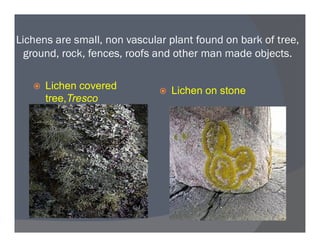
Lichens are small, non vascular plant found on bark of tree,
ground, rock, fences, roofs and other man made objects.
 Lichen on stone Lichen covered
tree,Tresco
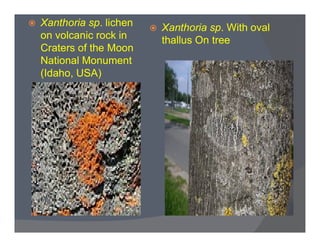
 Xanthoria sp. lichen
on volcanic rock in
Craters of the Moon
National Monument
(Idaho, USA)
 Xanthoria sp. With oval
thallus On tree
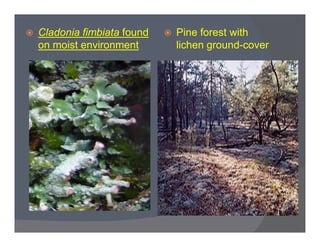
 Cladonia fimbiata found
on moist environment
 Pine forest with
lichen ground-cover
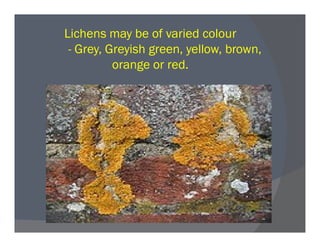
Lichens may be of varied colour
- Grey, Greyish green, yellow, brown,
orange or red.
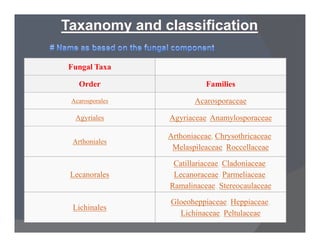
Fungal Taxa
Order Families
Acarosporales Acarosporaceae
Agyriales Agyriaceae, Anamylosporaceae
Arthoniales
Arthoniaceae, Chrysothricaceae,
Melaspileaceae, Roccellaceae
Lecanorales
Catillariaceae, Cladoniaceae,
Lecanoraceae, Parmeliaceae,
Ramalinaceae, Stereocaulaceae
Lichinales
Gloeoheppiaceae, Heppiaceae,
Lichinaceae, Peltulaceae
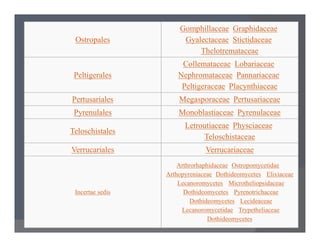
Ostropales
Gomphillaceae, Graphidaceae,
Gyalectaceae, Stictidaceae,
Thelotremataceae
Peltigerales
Collemataceae, Lobariaceae,
Nephromataceae, Pannariaceae,
Peltigeraceae, Placynthiaceae
Pertusariales Megasporaceae, Pertusariaceae
Pyrenulales Monoblastiaceae, Pyrenulaceae
Letroutiaceae, Physciaceae,
Teloschistales
Letroutiaceae, Physciaceae,
Teloschistaceae
Verrucariales Verrucariaceae
Incertae sedis
Arthrorhaphidaceae (Ostropomycetidae),
Arthopyreniaceae (Dothideomycetes), Elixiaceae
(Lecanoromycetes), Microtheliopsidaceae
(Dothideomycetes), Pyrenotrichaceae
(Dothideomycetes), Lecideaceae
(Lecanoromycetidae), Trypetheliaceae
(Dothideomycetes)
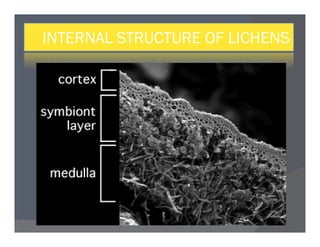
INTERNAL STRUCTURE OF LICHENS
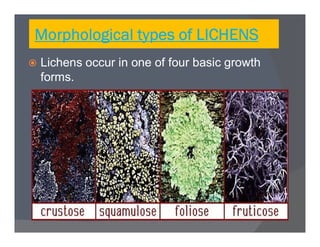
Morphological types of LICHENS
 Lichens occur in one of four basic growth
forms.
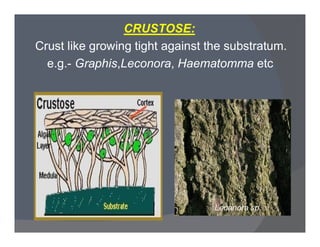
CRUSTOSE:
Crust like growing tight against the substratum.
e.g.- Graphis,Leconora, Haematomma etc
Lecanora sp.
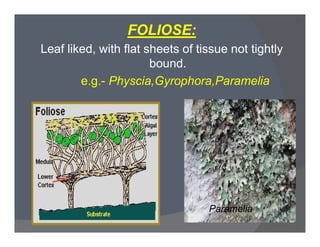
FOLIOSE:
Leaf liked, with flat sheets of tissue not tightly
bound.
e.g.- Physcia,Gyrophora,Paramelia
Paramelia
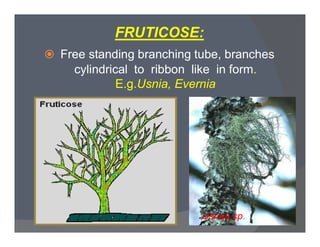
FRUTICOSE:
 Free standing branching tube, branches
cylindrical to ribbon like in form.
E.g.Usnia, Evernia
Usnea sp.
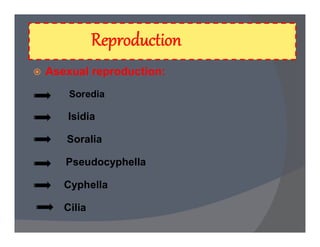
 Asexual reproduction:
Soredia
Isidia
Soralia
Pseudocyphella
Cyphella
Cilia
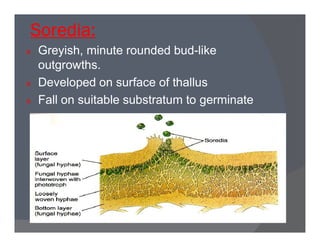
Soredia:
» Greyish, minute rounded bud-like
outgrowths.
» Developed on surface of thallus
» Fall on suitable substratum to germinate
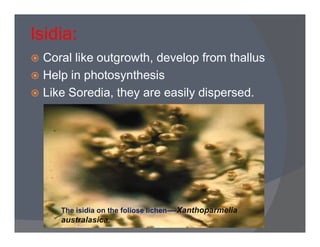
Isidia:
 Coral like outgrowth, develop from thallus
 Help in photosynthesis
 Like Soredia, they are easily dispersed.
The isidia on the foliose lichen----Xanthoparmelia
australasica.
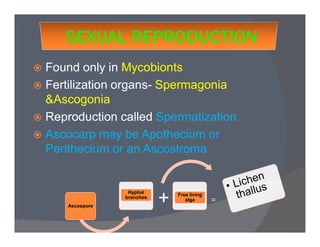
 Found only in Mycobionts
 Fertilization organs- Spermagonia
&Ascogonia
 Reproduction called Spermatization.
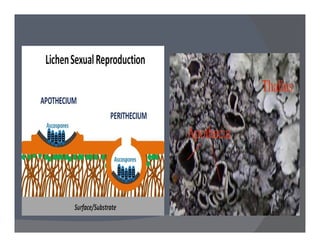
 Ascocarp may be Apothecium or
Perithecium or an Ascostroma
Ascospore
Hyphal
branches
Free living
alga
+ =
 Soil formation and growth of new
Vegetation – Enrich by forming humus
 Food – Contain Lichenin carbohydrate
compound.
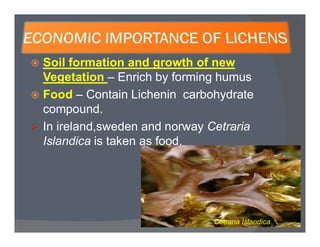
 In ireland,sweden and norway Cetraria In ireland,sweden and norway Cetraria
Islandica is taken as food.
Cetraria Islandica
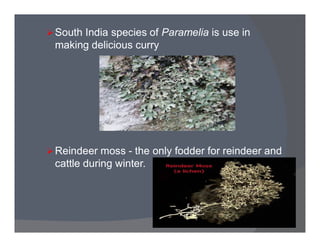
South India species of Paramelia is use in
making delicious curry
Reindeer moss - the only fodder for reindeer and
cattle during winter.
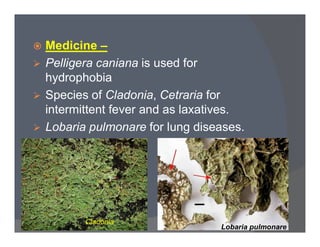
 Medicine –
 Pelligera caniana is used for
hydrophobia
 Species of Cladonia, Cetraria for
intermittent fever and as laxatives.
 Lobaria pulmonare for lung diseases. Lobaria pulmonare for lung diseases.
Cladonia
Lobaria pulmonare
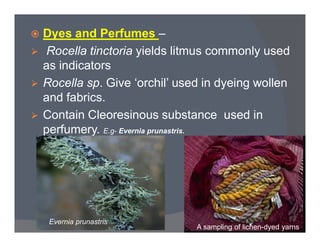
 Dyes and Perfumes –
 Rocella tinctoria yields litmus commonly used
as indicators
 Rocella sp. Give ‘orchil’ used in dyeing wollen
and fabrics.
 Contain Cleoresinous substance used in
perfumery.perfumery. E.g- Evernia prunastris.
A sampling of lichen-dyed yarns
Evernia prunastris
 As pollution indicators –
Lichens are killed by low level of Sulphur
dioxide.
Accumulate SO2 within their thalli.
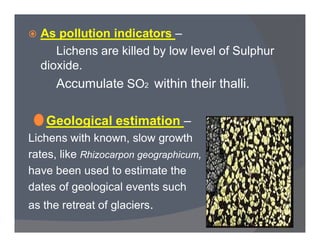
Geological estimation –Geological estimation –
Lichens with known, slow growth
rates, like Rhizocarpon geographicum,
have been used to estimate the
dates of geological events such
as the retreat of glaciers.
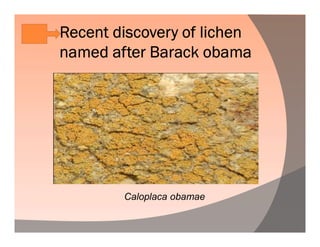
Recent discovery of lichen
named after Barack obama
Caloplaca obamae.
 THANK YOU THANK YOU

Lichen powerpoint presentation

  • 2.
    WORLD OF LICHENS introoDUCtion CLASSiFiCAtion rEProDUCtion EConoMiCiMPortAnCEEConoMiC iMPortAnCE PointS to notE GEnErAL FEAtUrES
  • 3.
    Lichens A lichen isnot a single organism. Rather, it is a symbiosis between different organisms - a fungus and an alga or cyanobacterium. Cyanobacteria are sometimes still referred to as 'blue-greenCyanobacteria are sometimes still referred to as 'blue-green algae', though they are quite distinct from the algae. The non-fungal partner contains chlorophyll and is called the photobiont. #15,000-20,000 species.
  • 4.
    Lichens are small,non vascular plant found on bark of tree, ground, rock, fences, roofs and other man made objects.  Lichen on stone Lichen covered tree,Tresco
  • 5.
     Xanthoria sp.lichen on volcanic rock in Craters of the Moon National Monument (Idaho, USA)  Xanthoria sp. With oval thallus On tree
  • 6.
     Cladonia fimbiatafound on moist environment  Pine forest with lichen ground-cover
  • 7.
    Lichens may beof varied colour - Grey, Greyish green, yellow, brown, orange or red.
  • 8.
    Fungal Taxa Order Families AcarosporalesAcarosporaceae Agyriales Agyriaceae, Anamylosporaceae Arthoniales Arthoniaceae, Chrysothricaceae, Melaspileaceae, Roccellaceae Lecanorales Catillariaceae, Cladoniaceae, Lecanoraceae, Parmeliaceae, Ramalinaceae, Stereocaulaceae Lichinales Gloeoheppiaceae, Heppiaceae, Lichinaceae, Peltulaceae
  • 9.
    Ostropales Gomphillaceae, Graphidaceae, Gyalectaceae, Stictidaceae, Thelotremataceae Peltigerales Collemataceae,Lobariaceae, Nephromataceae, Pannariaceae, Peltigeraceae, Placynthiaceae Pertusariales Megasporaceae, Pertusariaceae Pyrenulales Monoblastiaceae, Pyrenulaceae Letroutiaceae, Physciaceae, Teloschistales Letroutiaceae, Physciaceae, Teloschistaceae Verrucariales Verrucariaceae Incertae sedis Arthrorhaphidaceae (Ostropomycetidae), Arthopyreniaceae (Dothideomycetes), Elixiaceae (Lecanoromycetes), Microtheliopsidaceae (Dothideomycetes), Pyrenotrichaceae (Dothideomycetes), Lecideaceae (Lecanoromycetidae), Trypetheliaceae (Dothideomycetes)
  • 10.
  • 11.
    Morphological types ofLICHENS  Lichens occur in one of four basic growth forms.
  • 12.
    CRUSTOSE: Crust like growingtight against the substratum. e.g.- Graphis,Leconora, Haematomma etc Lecanora sp.
  • 13.
    FOLIOSE: Leaf liked, withflat sheets of tissue not tightly bound. e.g.- Physcia,Gyrophora,Paramelia Paramelia
  • 14.
    FRUTICOSE:  Free standingbranching tube, branches cylindrical to ribbon like in form. E.g.Usnia, Evernia Usnea sp.
  • 15.
  • 16.
    Soredia: » Greyish, minuterounded bud-like outgrowths. » Developed on surface of thallus » Fall on suitable substratum to germinate
  • 17.
    Isidia:  Coral likeoutgrowth, develop from thallus  Help in photosynthesis  Like Soredia, they are easily dispersed. The isidia on the foliose lichen----Xanthoparmelia australasica.
  • 18.
     Found onlyin Mycobionts  Fertilization organs- Spermagonia &Ascogonia  Reproduction called Spermatization.  Ascocarp may be Apothecium or Perithecium or an Ascostroma Ascospore Hyphal branches Free living alga + =
  • 20.
     Soil formationand growth of new Vegetation – Enrich by forming humus  Food – Contain Lichenin carbohydrate compound.  In ireland,sweden and norway Cetraria In ireland,sweden and norway Cetraria Islandica is taken as food. Cetraria Islandica
  • 21.
    South India speciesof Paramelia is use in making delicious curry Reindeer moss - the only fodder for reindeer and cattle during winter.
  • 22.
     Medicine – Pelligera caniana is used for hydrophobia  Species of Cladonia, Cetraria for intermittent fever and as laxatives.  Lobaria pulmonare for lung diseases. Lobaria pulmonare for lung diseases. Cladonia Lobaria pulmonare
  • 23.
     Dyes andPerfumes –  Rocella tinctoria yields litmus commonly used as indicators  Rocella sp. Give ‘orchil’ used in dyeing wollen and fabrics.  Contain Cleoresinous substance used in perfumery.perfumery. E.g- Evernia prunastris. A sampling of lichen-dyed yarns Evernia prunastris
  • 24.
     As pollutionindicators – Lichens are killed by low level of Sulphur dioxide. Accumulate SO2 within their thalli. Geological estimation –Geological estimation – Lichens with known, slow growth rates, like Rhizocarpon geographicum, have been used to estimate the dates of geological events such as the retreat of glaciers.
  • 25.
    Recent discovery oflichen named after Barack obama Caloplaca obamae.
  • 26.