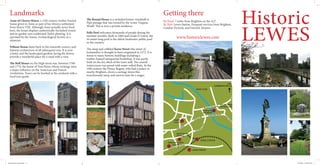
Historic
LEWES
Landmarks
Anne of Cleaves House, a 15th century timber framed
house given to Anne as part of her divorce settlement
from Henry VIII. Although Anne actually never lived
here, the house displays authentically furnished rooms
and its garden uses traditional Tudor planting. It is
operated by the Sussex Archaeological Society as a
museum.
Pelham House dates back to the sixteenth century and
features architecture of all subsequent eras. It is now
a hotel, and the landscaped gardens facing the downs
provide a wonderful place for a meal with a view.
The Bull House on the High street was, between 1768
and 1774, the home of Tom Paine, whose writings were
a major influence on the American and French
revolutions. Tours can be booked at the weekend with a
local tour guide.
The Round House is a secluded former windmill in
Pipe passage that was owned by the writer Virginia
Woolf. This is now a private residence.
Pells Pool welcomes thousands of people during the
summer months. Built in 1860 and Grade II Listed, the
44 meter long pool is the oldest freshwater public pool
in the country.
The steep and cobbled Keere Street (the street of
locksmiths) is thought to have originated in 1272. It is
home to many historic buildings including a
timber-framed antiquarian bookshop. It was partly
built on the dry ditch of the town wall. The central
watercourse was paved with water-rolled flints. In the
19th century the Prince Regent, who had a palace in
nearby Brighton, drove a carriage down this
treacherously steep and narrow lane for a wager.
Getting there
By Road: 7 miles from Brighton on the A27.
By Rail: Lewes Station. Frequent services from Brighton,
London Victoria, and Gatwick Airport.
www.historiclewes.com
LewesBrochure_final.indd 1-4 4/19/2016 10:18:02 AM
“You can see Lewes lying like a box
of toys under a great amphitheater
of chalk hills … on the whole it is set
down better than any town
I have seen in England.”
	 – William Morris (1834-1896)
Geography
Lewes is the county town of East Sussex and sits within
the South Downs National Park with the River Ouse
cutting through it. The towns of Newhaven and
Brighton are both approximately 7 miles away.
The West bank of the Ouse is dominated by the High
Street and on the East bank there is a large chalk cliff,
Cliffe Hill that can be seen for many miles. On 27th
December 1836, Britain’s worst recorded avalanche
occurred in Lewes after a large build up of snow on
this cliff slipped down onto a row of cottages killing 8
people.
Many countryside walks can be taken from the town,
starting from several points in Lewes. The South Downs
Way rises just below Lewes and hikers often stop off at
the town.
Lewes Bonfire
Lewes Bonfire is the UK’s largest and most famous
Bonfire Night or Guy Fawkes night festivities. It is also
the town’s most important annual event.
In Lewes this not only marks the date of the uncovering
of the Gunpowder Plot in 1605, but also commemorates
the memory of the 17 Protestant martyrs from the town
who were burnt at the stake during the reign of Mary
the 1st. Seventeen burning crosses are carried in their
memory.
Several bonfire societies march through the town
carrying burning torches, and effigies are drawn
through the streets which are then burnt on bonfires at
sites around the town. The effigies traditionally include
Pope Paul V who was Pope in 1605, and Guy Fawkes.
Other topical effigies often result in controversy.
Lewes Castle & Priory
When William the Conqueror returned to Normandy
in 1067, he made grants of land, including Lewes to one
of his Lords, William de Warenne. De Warenne built
Lewes castle in 1069, which became his main residence.
Although no longer complete it is open to visitors and
the highest point of Lewes, it gives magnificent views of
the town.
William and his wife Gundrada also founded Lewes
Priory in about 1081. It now lies in ruins following the
Dissolution of the Monasteries by Henry VIII in 1537.
The ruins stand within Priory park which are open to
the public.
Limestone from the Priory were used in many later
buildings in Lewes including Southover Grange. Built
in the 16th century, the house and magnificent gardens
offer a venue for weddings and exhibitions.
LewesBrochure_final.indd 5,8 4/19/2016 10:18:05 AM

LewesBrochure_final

  • 1.
    Historic LEWES Landmarks Anne of CleavesHouse, a 15th century timber framed house given to Anne as part of her divorce settlement from Henry VIII. Although Anne actually never lived here, the house displays authentically furnished rooms and its garden uses traditional Tudor planting. It is operated by the Sussex Archaeological Society as a museum. Pelham House dates back to the sixteenth century and features architecture of all subsequent eras. It is now a hotel, and the landscaped gardens facing the downs provide a wonderful place for a meal with a view. The Bull House on the High street was, between 1768 and 1774, the home of Tom Paine, whose writings were a major influence on the American and French revolutions. Tours can be booked at the weekend with a local tour guide. The Round House is a secluded former windmill in Pipe passage that was owned by the writer Virginia Woolf. This is now a private residence. Pells Pool welcomes thousands of people during the summer months. Built in 1860 and Grade II Listed, the 44 meter long pool is the oldest freshwater public pool in the country. The steep and cobbled Keere Street (the street of locksmiths) is thought to have originated in 1272. It is home to many historic buildings including a timber-framed antiquarian bookshop. It was partly built on the dry ditch of the town wall. The central watercourse was paved with water-rolled flints. In the 19th century the Prince Regent, who had a palace in nearby Brighton, drove a carriage down this treacherously steep and narrow lane for a wager. Getting there By Road: 7 miles from Brighton on the A27. By Rail: Lewes Station. Frequent services from Brighton, London Victoria, and Gatwick Airport. www.historiclewes.com LewesBrochure_final.indd 1-4 4/19/2016 10:18:02 AM
  • 2.
    “You can seeLewes lying like a box of toys under a great amphitheater of chalk hills … on the whole it is set down better than any town I have seen in England.” – William Morris (1834-1896) Geography Lewes is the county town of East Sussex and sits within the South Downs National Park with the River Ouse cutting through it. The towns of Newhaven and Brighton are both approximately 7 miles away. The West bank of the Ouse is dominated by the High Street and on the East bank there is a large chalk cliff, Cliffe Hill that can be seen for many miles. On 27th December 1836, Britain’s worst recorded avalanche occurred in Lewes after a large build up of snow on this cliff slipped down onto a row of cottages killing 8 people. Many countryside walks can be taken from the town, starting from several points in Lewes. The South Downs Way rises just below Lewes and hikers often stop off at the town. Lewes Bonfire Lewes Bonfire is the UK’s largest and most famous Bonfire Night or Guy Fawkes night festivities. It is also the town’s most important annual event. In Lewes this not only marks the date of the uncovering of the Gunpowder Plot in 1605, but also commemorates the memory of the 17 Protestant martyrs from the town who were burnt at the stake during the reign of Mary the 1st. Seventeen burning crosses are carried in their memory. Several bonfire societies march through the town carrying burning torches, and effigies are drawn through the streets which are then burnt on bonfires at sites around the town. The effigies traditionally include Pope Paul V who was Pope in 1605, and Guy Fawkes. Other topical effigies often result in controversy. Lewes Castle & Priory When William the Conqueror returned to Normandy in 1067, he made grants of land, including Lewes to one of his Lords, William de Warenne. De Warenne built Lewes castle in 1069, which became his main residence. Although no longer complete it is open to visitors and the highest point of Lewes, it gives magnificent views of the town. William and his wife Gundrada also founded Lewes Priory in about 1081. It now lies in ruins following the Dissolution of the Monasteries by Henry VIII in 1537. The ruins stand within Priory park which are open to the public. Limestone from the Priory were used in many later buildings in Lewes including Southover Grange. Built in the 16th century, the house and magnificent gardens offer a venue for weddings and exhibitions. LewesBrochure_final.indd 5,8 4/19/2016 10:18:05 AM