Principles of Information Security,
Fifth Edition
Chapter 6
Security Technology: Firewalls and
VPNs
If you think technology can solve your security problems,
then you don’t understand the problems and you don’t
understand the technology.
BRUCE SCHNEIER, AMERICAN CRYPTOGRAPHER,
COMPUTER SECURITY SPECIALIST, AND WRITER
Lesson 3 –
Remote Access
Learning Objectives
• Upon completion of this material, you should be
able to:
– Discuss the important role of access control in
computer-based information systems, and identify
and discuss widely used authentication factors
– Describe firewall technology and the various
approaches to firewall implementation
– Identify the various approaches to control remote
and dial-up access by authenticating and authorizing
users
Principles of Information Security, Fifth Edition 2
Learning Objectives (cont’d)
– Discuss content filtering technology
– Describe virtual private networks and discuss the
technology that enables them
Principles of Information Security, Fifth Edition 3
Remote Access
• Unsecured, dial-up connection points represent a
substantial exposure to attack.
• Attacker can use a device called a war dialer to
locate the connection points.
• War dialer: automatic phone-dialing program that
dials every number in a configured range and
records number if modem picks up
• Some technologies (RADIUS systems; TACACS;
CHAP password systems) have improved the
authentication process.
Principles of Information Security, Fifth Edition 4
Remote Access (cont’d)
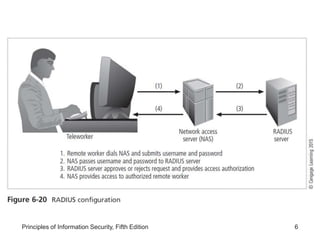
• RADIUS, Diameter, and TACACS
– Systems that authenticate user credentials for those
trying to access an organization’s network via dial-up
– Remote Authentication Dial-In User Service
(RADIUS): centralizes responsibility for user
authentication in a central RADIUS server
– Diameter: emerging alternative derived from
RADIUS
– Terminal Access Controller Access Control System
(TACACS): validates user’s credentials at
centralized server (like RADIUS); based on
client/server configuration
Principles of Information Security, Fifth Edition 5
Principles of Information Security, Fifth Edition 6
Remote Access (cont’d)
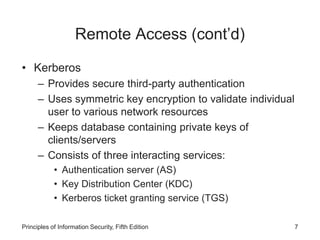
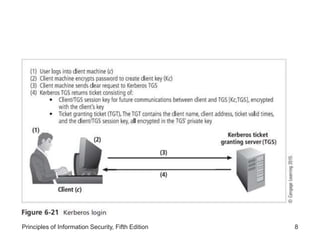
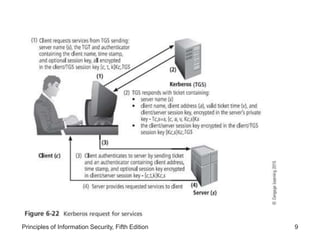
• Kerberos
– Provides secure third-party authentication
– Uses symmetric key encryption to validate individual
user to various network resources
– Keeps database containing private keys of
clients/servers
– Consists of three interacting services:
• Authentication server (AS)
• Key Distribution Center (KDC)
• Kerberos ticket granting service (TGS)
Principles of Information Security, Fifth Edition 7
Principles of Information Security, Fifth Edition 8
Principles of Information Security, Fifth Edition 9
Remote Access (cont’d)
• SESAME
– Secure European System for Applications in a
Multivendor Environment (SESAME) is similar to
Kerberos.
• User is first authenticated to authentication server and
receives token.
• Token is then presented to a privilege attribute server
as proof of identity to gain privilege attribute certificate.
• Uses public key encryption; adds sophisticated access
control features; more scalable encryption systems;
improved manageability; auditing features; and options
for delegation of responsibility for allowing access
Principles of Information Security, Fifth Edition 10
Virtual Private Networks (VPNs)
• Private and secure network connection between
systems; uses data communication capability of
unsecured and public network
• Securely extends organization’s internal network
connections to remote locations
• Three VPN technologies defined:
– Trusted VPN
– Secure VPN
– Hybrid VPN (combines trusted and secure)
Principles of Information Security, Fifth Edition 11
Virtual Private Networks (VPNs)
(cont’d)
• VPN must accomplish:
– Encapsulation of incoming and outgoing data
– Encryption of incoming and outgoing data
– Authentication of remote computer and perhaps
remote user as well
• In most common implementation, it allows the user
to turn Internet into a private network.
Principles of Information Security, Fifth Edition 12
Virtual Private Networks (VPNs)
(cont’d)
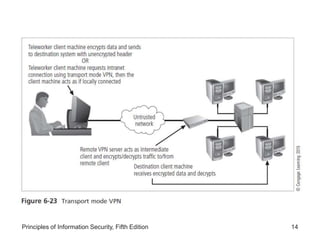
• Transport mode
– Data within IP packet is encrypted, but header
information is not.
– Allows user to establish secure link directly with
remote host, encrypting only data contents of packet
– Two popular uses:
• End-to-end transport of encrypted data
• Remote access worker connects to office network
over Internet by connecting to a VPN server on the
perimeter.
Principles of Information Security, Fifth Edition 13
Principles of Information Security, Fifth Edition 14
Virtual Private Networks (VPNs)
(cont’d)
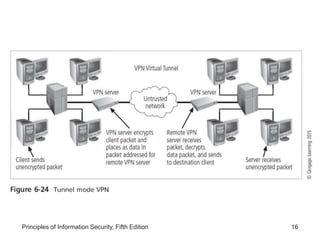
• Tunnel mode
– Establishes two perimeter tunnel servers to encrypt
all traffic that will traverse unsecured network
– Entire client package encrypted and added as data
portion of packet from one tunneling server to another
– Primary benefit to this model is that an intercepted
packet reveals nothing about the true destination
system.
– Example of tunnel mode VPN: Microsoft’s Internet
Security and Acceleration (ISA) Server
Principles of Information Security, Fifth Edition 15
Principles of Information Security, Fifth Edition 16
Summary
• Firewall technology
• Various approaches to remote and dial-up access
protection
• Content filtering technology
• Virtual private networks
Principles of Information Security, Fifth Edition 17

Lessson 3

  • 1.
    Principles of InformationSecurity, Fifth Edition Chapter 6 Security Technology: Firewalls and VPNs If you think technology can solve your security problems, then you don’t understand the problems and you don’t understand the technology. BRUCE SCHNEIER, AMERICAN CRYPTOGRAPHER, COMPUTER SECURITY SPECIALIST, AND WRITER Lesson 3 – Remote Access
  • 2.
    Learning Objectives • Uponcompletion of this material, you should be able to: – Discuss the important role of access control in computer-based information systems, and identify and discuss widely used authentication factors – Describe firewall technology and the various approaches to firewall implementation – Identify the various approaches to control remote and dial-up access by authenticating and authorizing users Principles of Information Security, Fifth Edition 2
  • 3.
    Learning Objectives (cont’d) –Discuss content filtering technology – Describe virtual private networks and discuss the technology that enables them Principles of Information Security, Fifth Edition 3
  • 4.
    Remote Access • Unsecured,dial-up connection points represent a substantial exposure to attack. • Attacker can use a device called a war dialer to locate the connection points. • War dialer: automatic phone-dialing program that dials every number in a configured range and records number if modem picks up • Some technologies (RADIUS systems; TACACS; CHAP password systems) have improved the authentication process. Principles of Information Security, Fifth Edition 4
  • 5.
    Remote Access (cont’d) •RADIUS, Diameter, and TACACS – Systems that authenticate user credentials for those trying to access an organization’s network via dial-up – Remote Authentication Dial-In User Service (RADIUS): centralizes responsibility for user authentication in a central RADIUS server – Diameter: emerging alternative derived from RADIUS – Terminal Access Controller Access Control System (TACACS): validates user’s credentials at centralized server (like RADIUS); based on client/server configuration Principles of Information Security, Fifth Edition 5
  • 6.
    Principles of InformationSecurity, Fifth Edition 6
  • 7.
    Remote Access (cont’d) •Kerberos – Provides secure third-party authentication – Uses symmetric key encryption to validate individual user to various network resources – Keeps database containing private keys of clients/servers – Consists of three interacting services: • Authentication server (AS) • Key Distribution Center (KDC) • Kerberos ticket granting service (TGS) Principles of Information Security, Fifth Edition 7
  • 8.
    Principles of InformationSecurity, Fifth Edition 8
  • 9.
    Principles of InformationSecurity, Fifth Edition 9
  • 10.
    Remote Access (cont’d) •SESAME – Secure European System for Applications in a Multivendor Environment (SESAME) is similar to Kerberos. • User is first authenticated to authentication server and receives token. • Token is then presented to a privilege attribute server as proof of identity to gain privilege attribute certificate. • Uses public key encryption; adds sophisticated access control features; more scalable encryption systems; improved manageability; auditing features; and options for delegation of responsibility for allowing access Principles of Information Security, Fifth Edition 10
  • 11.
    Virtual Private Networks(VPNs) • Private and secure network connection between systems; uses data communication capability of unsecured and public network • Securely extends organization’s internal network connections to remote locations • Three VPN technologies defined: – Trusted VPN – Secure VPN – Hybrid VPN (combines trusted and secure) Principles of Information Security, Fifth Edition 11
  • 12.
    Virtual Private Networks(VPNs) (cont’d) • VPN must accomplish: – Encapsulation of incoming and outgoing data – Encryption of incoming and outgoing data – Authentication of remote computer and perhaps remote user as well • In most common implementation, it allows the user to turn Internet into a private network. Principles of Information Security, Fifth Edition 12
  • 13.
    Virtual Private Networks(VPNs) (cont’d) • Transport mode – Data within IP packet is encrypted, but header information is not. – Allows user to establish secure link directly with remote host, encrypting only data contents of packet – Two popular uses: • End-to-end transport of encrypted data • Remote access worker connects to office network over Internet by connecting to a VPN server on the perimeter. Principles of Information Security, Fifth Edition 13
  • 14.
    Principles of InformationSecurity, Fifth Edition 14
  • 15.
    Virtual Private Networks(VPNs) (cont’d) • Tunnel mode – Establishes two perimeter tunnel servers to encrypt all traffic that will traverse unsecured network – Entire client package encrypted and added as data portion of packet from one tunneling server to another – Primary benefit to this model is that an intercepted packet reveals nothing about the true destination system. – Example of tunnel mode VPN: Microsoft’s Internet Security and Acceleration (ISA) Server Principles of Information Security, Fifth Edition 15
  • 16.
    Principles of InformationSecurity, Fifth Edition 16
  • 17.
    Summary • Firewall technology •Various approaches to remote and dial-up access protection • Content filtering technology • Virtual private networks Principles of Information Security, Fifth Edition 17