





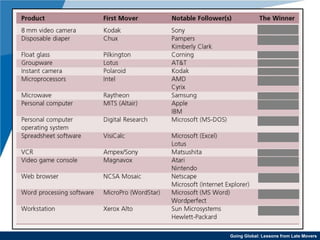
Going Global Presented by: Diana Lim April 21, 2011  Lessons from Late Movers
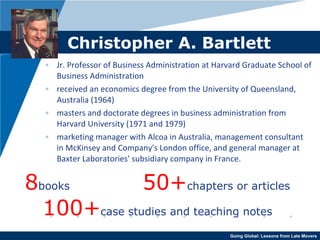
Christopher A. Bartlett Jr. Professor of Business Administration at Harvard Graduate School of Business Administration received an economics degree from the University of Queensland, Australia (1964) masters and doctorate degrees in business administration from Harvard University (1971 and 1979) marketing manager with Alcoa in Australia, management consultant in McKinsey and Company's London office, and general manager at Baxter Laboratories' subsidiary company in France. 8 books   50+ chapters or articles 100+ case studies and teaching notes
Sumantra Ghoshal Born in Calcutta; Died of brain haemorrhage (age 55) in 2004 in UK Studied physics at Delhi University then Worked for the Indian Oil Corporation (started as an intern and rose thru the ranks) Doctoral degrees at both MIT School of Management and Harvard Business School (He worked on these degrees at the same time, writing two distinct dissertations on two different topics) Joined London Business School in 1994 ‘ Managing across Borders: The Transnational Solution,’ co-authored with the Bartlett found a place in the Financial Times list of the 50 most influential management books of all time 12 books   70 chapters or articles Numerous  case studies
$25 Made in Indonesia $25 Made in Japan
$15 Made in Indonesia $25 Made in Japan
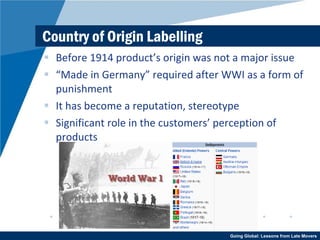
Country of Origin Labelling Before 1914 product’s origin was not a major issue “ Made in Germany” required after WWI as a form of punishment It has become a reputation, stereotype Significant role in the customers’ perception of products
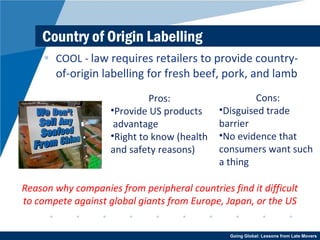
Country of Origin Labelling COOL -  law requires retailers to provide country-of-origin labelling for fresh beef, pork, and lamb Pros: Provide US products  advantage Right to know (health and safety reasons) Cons: Disguised trade barrier No evidence that consumers want such a thing Reason why companies from peripheral countries find it difficult to compete against global giants from Europe, Japan, or the US
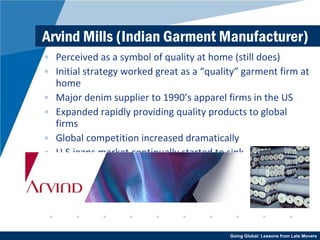
Arvind Mills (Indian Garment Manufacturer) Perceived as a symbol of quality at home (still does) Initial strategy worked great as a “quality” garment firm at home Major denim supplier to 1990’s apparel firms in the US Expanded rapidly providing quality products to global firms Global competition increased dramatically U.S jeans market continually started to sink
The Pharmaceutical Industry’s Value Curve All industries can be seen as a collection of product market segments The problem for most MNEs from peripheral countries is that they typically enter the global market at the bottom of the value curve, and they stay there
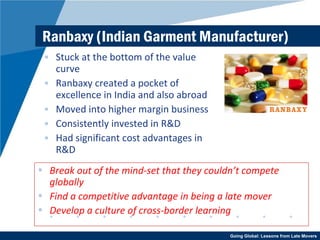
Ranbaxy (Indian Garment Manufacturer) Stuck at the bottom of the value curve Ranbaxy created a pocket of excellence in India and also abroad Moved into higher margin business Consistently invested in R&D Had significant cost advantages in R&D Break out of the mind-set that they couldn’t compete globally Find a competitive advantage in being a late mover Develop a culture of cross-border learning
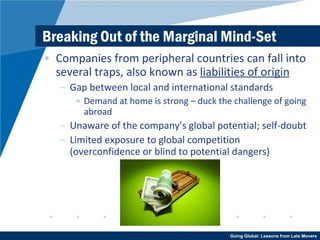
Breaking Out of the Marginal Mind-Set Companies from peripheral countries can fall into several traps, also known as  liabilities of origin Gap between local and international standards Demand at home is strong – duck the challenge of going abroad Unaware of the company’s global potential; self-doubt Limited exposure to global competition (overconfidence or blind to potential dangers)
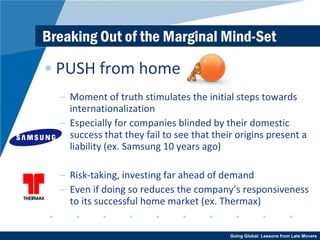
Breaking Out of the Marginal Mind-Set PUSH from home Moment of truth stimulates the initial steps towards internationalization Especially for companies blinded by their domestic success that they fail to see that their origins present a liability (ex. Samsung 10 years ago) Risk-taking, investing far ahead of demand Even if doing so reduces the company’s responsiveness to its successful home market (ex. Thermax)
Breaking Out of the Marginal Mind-Set PULL from abroad Need for offshore champions – senior executives from the target market This increases credibility and confidence to win top management’s attention Invest in management capabilities of your overseas units Ex. Natura defended its position in Brazil but failed abroad
 
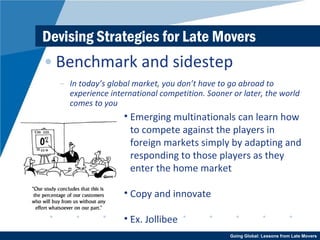
Devising Strategies for Late Movers Benchmark and sidestep In today’s global market, you don’t have to go abroad to experience international competition. Sooner or later, the world comes to you Emerging multinationals can learn how to compete against the players in foreign markets simply by adapting and responding to those players as they enter the home market Copy and innovate Ex. Jollibee
Devising Strategies for Late Movers Confront and challenge Introduce new business models that challenge the industry’s established rules of competition Can be effective in industries deeply embedded with tradition ex. BRL Hardy Wine, an Australian Wine Company
Learning How to Learn Protect the past Exploit the resources and capabilities that have provided competitive advantage to date Reinventing is not always the solution Cooperation between parent company and overseas subsidiary establishes a dynamic of mutual learning Build the future New capabilities cannot simply be installed, they must be developed and internalized Invest in new personnel, training, or reorienting internal culture
Success Factors Breaking Out of the Marginal Mind-set Push from home Pull from abroad Devising Strategies for Late Movers Benchmark and sidestep Confront and challenge Learning How to Learn Protect the past Build the future

Lessons From Late Movers

  • 1.
    Going Global Presentedby: Diana Lim April 21, 2011 Lessons from Late Movers
  • 2.
    Christopher A. BartlettJr. Professor of Business Administration at Harvard Graduate School of Business Administration received an economics degree from the University of Queensland, Australia (1964) masters and doctorate degrees in business administration from Harvard University (1971 and 1979) marketing manager with Alcoa in Australia, management consultant in McKinsey and Company's London office, and general manager at Baxter Laboratories' subsidiary company in France. 8 books 50+ chapters or articles 100+ case studies and teaching notes
  • 3.
    Sumantra Ghoshal Bornin Calcutta; Died of brain haemorrhage (age 55) in 2004 in UK Studied physics at Delhi University then Worked for the Indian Oil Corporation (started as an intern and rose thru the ranks) Doctoral degrees at both MIT School of Management and Harvard Business School (He worked on these degrees at the same time, writing two distinct dissertations on two different topics) Joined London Business School in 1994 ‘ Managing across Borders: The Transnational Solution,’ co-authored with the Bartlett found a place in the Financial Times list of the 50 most influential management books of all time 12 books 70 chapters or articles Numerous case studies
  • 4.
    $25 Made inIndonesia $25 Made in Japan
  • 5.
    $15 Made inIndonesia $25 Made in Japan
  • 6.
    Country of OriginLabelling Before 1914 product’s origin was not a major issue “ Made in Germany” required after WWI as a form of punishment It has become a reputation, stereotype Significant role in the customers’ perception of products
  • 7.
    Country of OriginLabelling COOL - law requires retailers to provide country-of-origin labelling for fresh beef, pork, and lamb Pros: Provide US products advantage Right to know (health and safety reasons) Cons: Disguised trade barrier No evidence that consumers want such a thing Reason why companies from peripheral countries find it difficult to compete against global giants from Europe, Japan, or the US
  • 8.
    Arvind Mills (IndianGarment Manufacturer) Perceived as a symbol of quality at home (still does) Initial strategy worked great as a “quality” garment firm at home Major denim supplier to 1990’s apparel firms in the US Expanded rapidly providing quality products to global firms Global competition increased dramatically U.S jeans market continually started to sink
  • 9.
    The Pharmaceutical Industry’sValue Curve All industries can be seen as a collection of product market segments The problem for most MNEs from peripheral countries is that they typically enter the global market at the bottom of the value curve, and they stay there
  • 10.
    Ranbaxy (Indian GarmentManufacturer) Stuck at the bottom of the value curve Ranbaxy created a pocket of excellence in India and also abroad Moved into higher margin business Consistently invested in R&D Had significant cost advantages in R&D Break out of the mind-set that they couldn’t compete globally Find a competitive advantage in being a late mover Develop a culture of cross-border learning
  • 11.
    Breaking Out ofthe Marginal Mind-Set Companies from peripheral countries can fall into several traps, also known as liabilities of origin Gap between local and international standards Demand at home is strong – duck the challenge of going abroad Unaware of the company’s global potential; self-doubt Limited exposure to global competition (overconfidence or blind to potential dangers)
  • 12.
    Breaking Out ofthe Marginal Mind-Set PUSH from home Moment of truth stimulates the initial steps towards internationalization Especially for companies blinded by their domestic success that they fail to see that their origins present a liability (ex. Samsung 10 years ago) Risk-taking, investing far ahead of demand Even if doing so reduces the company’s responsiveness to its successful home market (ex. Thermax)
  • 13.
    Breaking Out ofthe Marginal Mind-Set PULL from abroad Need for offshore champions – senior executives from the target market This increases credibility and confidence to win top management’s attention Invest in management capabilities of your overseas units Ex. Natura defended its position in Brazil but failed abroad
  • 14.
  • 15.
    Devising Strategies forLate Movers Benchmark and sidestep In today’s global market, you don’t have to go abroad to experience international competition. Sooner or later, the world comes to you Emerging multinationals can learn how to compete against the players in foreign markets simply by adapting and responding to those players as they enter the home market Copy and innovate Ex. Jollibee
  • 16.
    Devising Strategies forLate Movers Confront and challenge Introduce new business models that challenge the industry’s established rules of competition Can be effective in industries deeply embedded with tradition ex. BRL Hardy Wine, an Australian Wine Company
  • 17.
    Learning How toLearn Protect the past Exploit the resources and capabilities that have provided competitive advantage to date Reinventing is not always the solution Cooperation between parent company and overseas subsidiary establishes a dynamic of mutual learning Build the future New capabilities cannot simply be installed, they must be developed and internalized Invest in new personnel, training, or reorienting internal culture
  • 18.
    Success Factors BreakingOut of the Marginal Mind-set Push from home Pull from abroad Devising Strategies for Late Movers Benchmark and sidestep Confront and challenge Learning How to Learn Protect the past Build the future