LESSONS LEARNED (Pay no heed if your interest is not in thoroughgoing reform) Peter Gow NAIS 2001
Real curriculum development is forever. Realize this, develop a standing mechanism to direct how your programs will change, and nourish it.
If you are committed to meaningful curriculum reform and development, you can’t do a meaningful curriculum review in a year, package it as a scope-and-sequence, and consider yourselves done.
The “review” may be done, but your programs will continue to change. Make this happen strategically, not randomly.
MISSION AND STRATEGIC LESSONS •If it’s not connected to mission, forget it •Without Board support,  forget it
Beware the “tyranny of good ideas.” Maintain focus, and don’t jump into something that looks really hot without thinking through the mission and strategic implications.
Use self-studies, such as that for accreditation, as opportunities for real self-examination and growth.
Connect the pieces: mission to strategic plan to program to student life to professional evaluation to program evaluation.
 
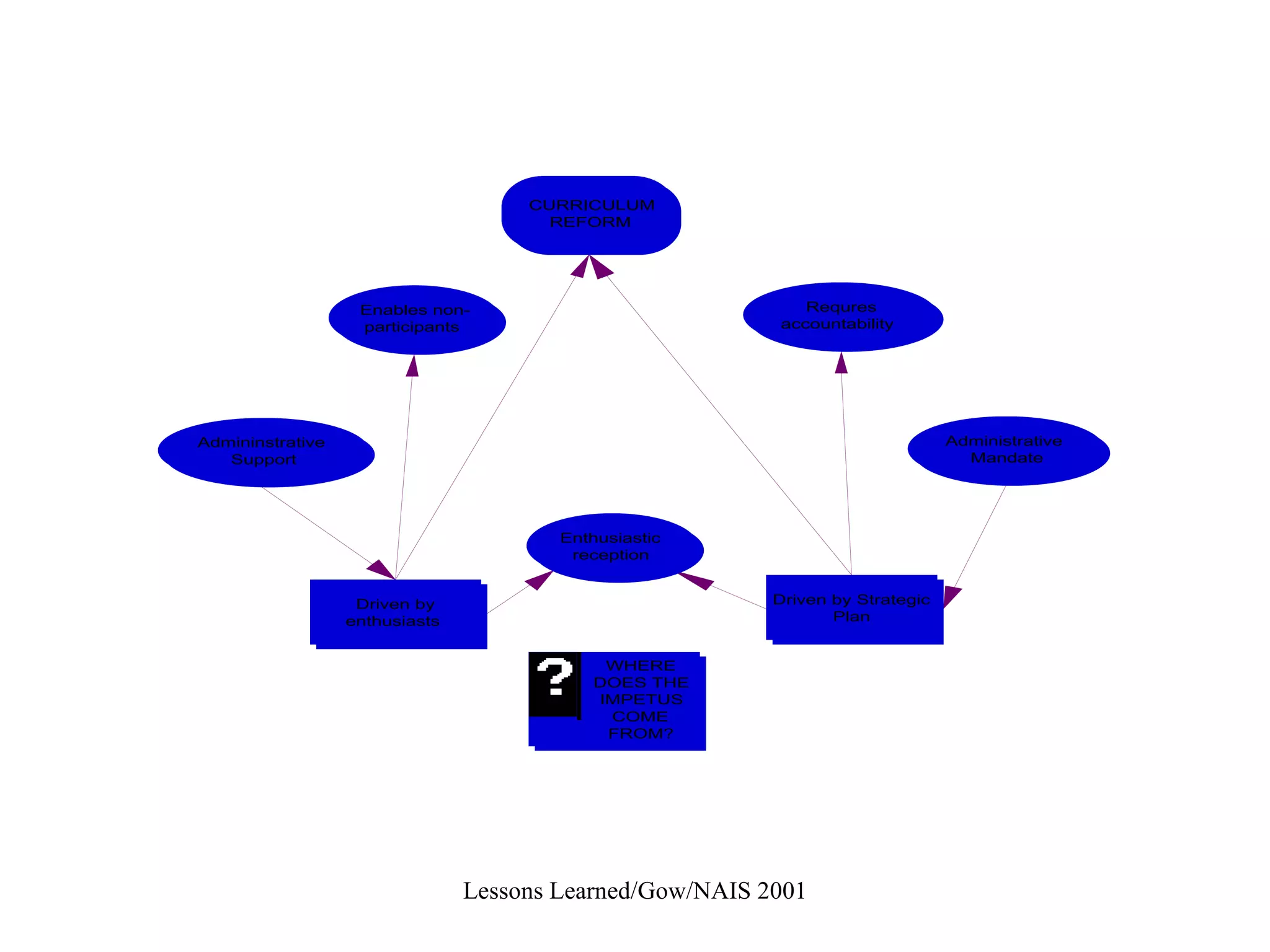
IT’S BIG
Curriculum reform is not about a few eager adopters in isolated classrooms, their odd ideas tolerated by colleagues and celebrated as examples of a school’s commitment to innovative curriculum.
Curriculum is everything you do. Initiatives in technology and diversity are completely intertwined in curriculum work.
The sooner you recognize the links between curriculum and pedagogy and your diversity work, the further ahead you’ll be in creating curriculum that is about
high expectations and high standards, thoughtful assessment, and more meaningful and engaging feedback for every student.
IT’S HARD FOR EVERYONE
A tightly focused and mission-driven approach to curriculum and pedagogy is in some conflict with the traditional autonomy afforded independent school teachers.
You need to be up front about this or risk a relatively high level of attrition—they won’t necessarily go away mad, but they may feel the “urge for going” a bit more strongly.
FIRST THINGS FIRST
Build in accountability for progress from the outset; don’t enable resisters or opters-out. Somebody may have to play the heavy.
Address the hardest issues first—go straight at ’em. Address the issue of depth versus breadth, of coverage, of standardized curricula and testing at the outset.
Beware of overload. Do a few things well, and contain strategic goal-mongering to a do-able level.
STRUCTURE AND RESOURCES
Creating an administrative structure that mirrors strategic goals related to curriculum reform is much harder than you might think but a very important idea.
You need buy in from your sales force: admission and college counseling. Make sure development “gets it.” The more experienced they are, the harder it may be for them to promote a “different” kind of school.
Look at your resources: people, space, time. In case you didn’t already know it, TIME is of the essence
PROFESSIONAL DEVELOPMENT
Start with broad-based and comprehensive discussion and training. Everyone must be equally engaged in the learning and in the process from the beginning.
Then develop structures that allow individuals to concentrate on specific ideas in small, focused, and ongoing professional development structures.
Protected time for discussion and development is great, but awfully hard to find. Make it possible for departments or other affinity groups to retreat for a day or an afternoon. Hire a permanent substitute.
Make sure that your ongoing professional development plan—and your system of professional evaluation—is based on the goals of your reform program, and on your mission.
AGENTS OF CHANGE   (The Good Guys)
Don’t let your agents of change get lonely, because inevitably they will.
Identify and reward your agents of change, but don’t celebrate them to the exclusion or perceived undervaluation of the established educational leadership.

Lesson Learned from a Curriculum Change Process

  • 1.
    LESSONS LEARNED (Payno heed if your interest is not in thoroughgoing reform) Peter Gow NAIS 2001
  • 2.
    Real curriculum developmentis forever. Realize this, develop a standing mechanism to direct how your programs will change, and nourish it.
  • 3.
    If you arecommitted to meaningful curriculum reform and development, you can’t do a meaningful curriculum review in a year, package it as a scope-and-sequence, and consider yourselves done.
  • 4.
    The “review” maybe done, but your programs will continue to change. Make this happen strategically, not randomly.
  • 5.
    MISSION AND STRATEGICLESSONS •If it’s not connected to mission, forget it •Without Board support, forget it
  • 6.
    Beware the “tyrannyof good ideas.” Maintain focus, and don’t jump into something that looks really hot without thinking through the mission and strategic implications.
  • 7.
    Use self-studies, suchas that for accreditation, as opportunities for real self-examination and growth.
  • 8.
    Connect the pieces:mission to strategic plan to program to student life to professional evaluation to program evaluation.
  • 9.
  • 10.
  • 11.
    Curriculum reform isnot about a few eager adopters in isolated classrooms, their odd ideas tolerated by colleagues and celebrated as examples of a school’s commitment to innovative curriculum.
  • 12.
    Curriculum is everythingyou do. Initiatives in technology and diversity are completely intertwined in curriculum work.
  • 13.
    The sooner yourecognize the links between curriculum and pedagogy and your diversity work, the further ahead you’ll be in creating curriculum that is about
  • 14.
    high expectations andhigh standards, thoughtful assessment, and more meaningful and engaging feedback for every student.
  • 15.
  • 16.
    A tightly focusedand mission-driven approach to curriculum and pedagogy is in some conflict with the traditional autonomy afforded independent school teachers.
  • 17.
    You need tobe up front about this or risk a relatively high level of attrition—they won’t necessarily go away mad, but they may feel the “urge for going” a bit more strongly.
  • 18.
  • 19.
    Build in accountabilityfor progress from the outset; don’t enable resisters or opters-out. Somebody may have to play the heavy.
  • 20.
    Address the hardestissues first—go straight at ’em. Address the issue of depth versus breadth, of coverage, of standardized curricula and testing at the outset.
  • 21.
    Beware of overload.Do a few things well, and contain strategic goal-mongering to a do-able level.
  • 22.
  • 23.
    Creating an administrativestructure that mirrors strategic goals related to curriculum reform is much harder than you might think but a very important idea.
  • 24.
    You need buyin from your sales force: admission and college counseling. Make sure development “gets it.” The more experienced they are, the harder it may be for them to promote a “different” kind of school.
  • 25.
    Look at yourresources: people, space, time. In case you didn’t already know it, TIME is of the essence
  • 26.
  • 27.
    Start with broad-basedand comprehensive discussion and training. Everyone must be equally engaged in the learning and in the process from the beginning.
  • 28.
    Then develop structuresthat allow individuals to concentrate on specific ideas in small, focused, and ongoing professional development structures.
  • 29.
    Protected time fordiscussion and development is great, but awfully hard to find. Make it possible for departments or other affinity groups to retreat for a day or an afternoon. Hire a permanent substitute.
  • 30.
    Make sure thatyour ongoing professional development plan—and your system of professional evaluation—is based on the goals of your reform program, and on your mission.
  • 31.
    AGENTS OF CHANGE (The Good Guys)
  • 32.
    Don’t let youragents of change get lonely, because inevitably they will.
  • 33.
    Identify and rewardyour agents of change, but don’t celebrate them to the exclusion or perceived undervaluation of the established educational leadership.