44 45
ERGONOMICSSTEVEN CASEY, ERGONOMIC SYSTEMS DESIGN
iVTInternational.com Sept/Oct 2015iVTInternational.com Sept/Oct 2015
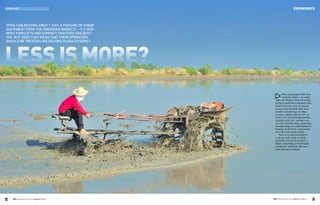
OPEN-CAB DESIGNS AREN’T JUST A FEATURE OF CHEAP
EQUIPMENT FROM THE EMERGING MARKETS – IT’S HOW
MOST FORKLIFTS AND COMPACT TRACTORS ARE BUILT
TOO. BUT DOES THAT MEAN THAT THEIR OPERATORS
SHOULD BE TREATED LIKE SECOND-CLASS CITIZENS?
When most people think of an
industrial vehicle, a so-called
‘with-cab’ design is what will usually
spring to mind. Be it a modern farm
tractor, harvester, mine excavator,
construction machine, haul truck,
forklift or aircraft tug, we often
envision a glamor shot (in iVT, of
course!) of a top-of-the-line machine
complete with cab – perhaps even
one with vault-like doors, suspension,
soundproofing, air-conditioning and
heating, air filtration, a suspension
and a first-class music system.
There is no question about it:
a cab can really make a vehicle –
especially one that is operated in
highly demanding environmental
conditions – infinitely safer and
more pleasant to operate.
ERGONOMICS
47iVTInternational.com Sept/Oct
But like most things in life, good
things invariably come at a price –
and sometimes the cost of a cab and
even the special requirements of the
operating environment and the work
to be done will necessitate that the
vehicle be a so-called ‘less-cab’
machine; an industrial vehicle
without a recognizable cab.
Considering worldwide markets
and the extensive array of industrial
vehicles of all kinds, it is likely that
there are far more of the less-cab
type than there are with-cab. This is
somewhat ironic in view of all the
attention given to vehicles with cabs
and related top-end, operator-centric
offerings by major manufacturers.
Reflect on, for example, the
millions upon millions of less-cab
tractors operating in the Indian
subcontinent and Africa, where
models with cabs are very rare
indeed. Even in North America,
only a small percentage of compact
tractors operated by homeowners,
small farms, landscape contractors
and the like, have cabs due to their
compact size, low frequency of use
(most of which is in milder weather),
required ease of ingress and egress,
cost, or a combination of all these
factors. Most material handling
vehicles operated within warehouses,
such as lift-trucks, tugs and pallet
trucks, do not need a full cab either,
because their operators are already
provided with protection from the
elements by the building in which
they are operating.
Does this have to mean that the
with-cab machine’s lowly less-cab
brethren, the ones that lack an
operator’s cab, must go without
common creature comforts, safety
and conveniences? The answer is
‘No, not necessarily’.
Accordingly, we must ask: ‘What
can be done to improve the comfort,
habitability and safety on a vehicle
without an enclosed cab where the
operator is exposed to the elements
and the natural environment?’
The advantages of doing without
But first, let’s consider some of the
advantages of not having a cab.
Surprisingly, there are quite a few!
A vehicle that does not have
doors, doorways and a roof to duck
under, can be – potentially – easier
and faster to board as well as exit.
This could be especially important
for an operator of a backhoe loader
at a construction site where it is
necessary to repeatedly get on and
off the machine. The same might be
true for a warehousing truck whose
operator works off the machine just
as much as on the machine. There
are many such examples of where
this type of ingress/egress flexibility
is beneficial.
An industrial vehicle without a
cab can make communication with
ABOVE LEFT: Freedom to
reach out from the cab, to
adjust implements or other
items, is a major point in
favour of less-cab designs
ABOVE: With no need to
open the door when you
need to discuss the day’s
tasks, less-cab designs
have the occasional
ergonomic advantage
LEFT: A sheltered working
environment and the need
to regularly jump on and off
the vehicle make forklifts
the ideal machine for the
less-cab approach
ERGONOMICS
iVTInternational.com Sept/Oct 2015 49
nearby co-workers easier and more
direct. They can talk to the operator,
and the operator can talk with co-
workers who are off the vehicle but
still within hearing distance. The
operator can also hear more within
the operating environment, including
the sounds of other vehicles and even
machine sounds, providing helpful
auditory feedback about the health
and operation of the machine.
A less-cab vehicle can also be
advantageous in terms of visibility.
Without an overhead structure or
roof there can be a direct line of
sight to a controlled implement
overhead such as a bucket or forks,
a visually important area such as a
high wall face, an overhead rack in
a warehouse, or an overhead power
line on a construction site. The lack
of pillars, dirty windows or reflections
on glass results in improved visibility
to the outside environment.
A mobile machine without a cab
also makes it easier for the operator
to physically reach out from the
immediate workspace of the vehicle
to adjust a mirror, to manipulate a
device or object behind the operator
compartment, such as when pulling
or inserting a latch pin when they
are connecting a trailer to a tractor
or a tug, or to hand something to a
co-worker on the ground or floor. The
vast majority of small rice planters
and harvesters in Japan do not have
a cab, partially due to the high level
of interaction the operator has with
numerous parts of the machine
during its operation in the field.
In some markets, less-cab vehicles
are often used to carry passengers,
sometimes in surprising numbers.
In these markets, tractors will often
have flat fenders with backrest bars
that can accommodate up to three
passengers on each fender. In other
markets, most notably Europe and
North America, passengers on less-
cab agricultural tractors are strongly
discouraged and even prohibited
due to safety concerns.
The disadvantages of wide,
open spaces
Most of the disadvantages of not
having a cab are associated with the
environmental protections provided
by a cab. Cabs can provide a barrier
to rain, snow, icy winds and noise.
When fitted with a heater, a cab can
protect against the cold; when fitted
with air-conditioning, fans, or even
windows that open, a cab can also
provide protection from the sun’s
heat. A cab can block the sun’s rays
and its glass can reduce the intensity
of sunlight and block UV rays.
A cab can protect the operator
from dust too, particularly if it has
an air filtration system. With positive
interior pressure and appropriate air
filtration, it can also fully protect the
operator from airborne toxins such
as pesticides. A sealed cab can isolate
the operator from stinging or biting
insects – a consideration of surprising
importance in some markets.
Most cabs also do double duty as
a roll-over protective system, thereby
greatly improving operator safety on
many types of machines.
TOP: Operators of backhoe
loaders will benefit from
the ease of access and
egress a less-cab design
offers, as well as the
enhanced view
ABOVE: There are canopies
and there are ‘canopies’
TOP RIGHT: The tractor as
transport – an enclosed cab
just wouldn’t be the same
ABOVE RIGHT: A better view
to the attachment doesn’t
always compensate for the
increased exposure to the
elements
ERGONOMICS
iVTInternational.com Sept/Oct 2015 51
Lastly, a cab can provide a high
degree of physical security for the
machine itself. A locking cab door
helps guard against vehicle theft
and vandalism, as well as protect
personal items or add-on items
inside the cab, particularly
expensive electronics.
Improving the quality of life on
a less-cab industrial vehicle
Having considered the pros and
cons of cabs, let us return to the
original question: ‘What can be done
to improve comfort, habitability and
safety on an industrial vehicle that
does not have a cab?’
In actuality, there is no shortage
of practical and design solutions for
enhancing these aspects. Firstly
consider the safety issue, as it is of
such importance. The effectiveness
of rollover protective structures,
especially in combination with a
seatbelt, has been extremely well
documented. Studies of rollover
injury and fatality rates, as well as
controlled testing by laboratories,
demonstrate the benefits of ROPS.
These structures work, and it is
troubling to see that such a large
percentage of less-cab machines in
the developing markets still do not
have them.
Neither does the absence of a
full cab automatically mean that the
operator can’t be shielded from the
sun and rain. Canopies can provide
very good protection from direct
sunlight and falling rain, and can
also contain useful integral storage
compartments for personal items
such as a jacket or water bottle.
Better still, a hard canopy roof
can be fitted to a ROPS to provide
rollover protection as well as sun
and rain protection.
The lack of a cab need not mean
that the operator has no means of
keeping cool on a hot day or staying
warm when it is cold. Most owners
of a convertible automobile have
experienced the pleasure of running
the heater with the top down on a
brisk night. Running the heater has
no impact on fuel efficiency because
the engine’s heat would be expelled
regardless. Should a less-cab vehicle
have a strategically placed heater vent
or two to warm up the operator on a
cold day or night? Perhaps.
Providing air-conditioning on a
less-cab machine may not constitute
a rational use of fuel and money,
however, but a carefully placed fan
can be surprisingly effective and
efficient at increasing the operator’s
comfort by increasing evaporative
cooling. Ventilated seating and cool
seating surfaces can also provide
much-needed added comfort in the
heat of the day.
Similarly, surface treatments of
touched machine parts can greatly
impact operator comfort. Potentially
hot surfaces such as handles and
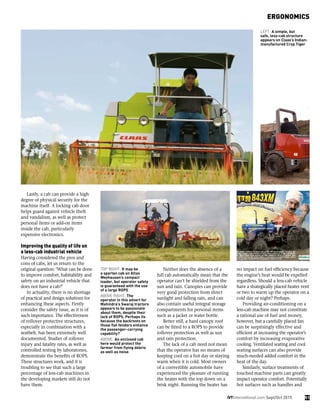
TOP RIGHT: It may be
a spartan cab on Atlas
Weyhausen’s compact
loader, but operator safety
is guaranteed with the use
of a large ROPS
ABOVE RIGHT: The
operator in this advert for
Mahindra’s Swaraj tractors
appears to be passionate
about them, despite their
lack of ROPS. Perhaps its
because the backrests on
those flat fenders enhance
the passenger-carrying
capability?
ABOVE: An enclosed cab
here would protect the
farmer from flying debris
as well as noise
LEFT: A simple, but
safe, less-cab structure
appears on Claas’s Indian-
manufactured Crop Tiger
ERGONOMICS
ubiquitous across most of the
planet, and providing a source of
reliable power for their operation
or charging has become a necessity.
Power outlets can be used for all
manner of common onboard devices
including lights, fans, phones, radios
and music systems.
In fact, most of what might be
expected from a with-cab machine
with regard to personal needs such
as food, water and clothing should
also be expected from a less-cab
machine. Many with-cab machines
have powered coolers for food and
drink, so why shouldn’t the same
apply to a less-cab machine? At the
very least, accommodation should
be provided for the clean and
protected storage of drinks, food,
clothing items and basic tools.
Unfortunately, the lack of a lockable
door on a less-cab vehicle means
that unprotected items are exposed
to theft. Locking compartments
such as tool boxes can therefore
meet this need, while engine and
machine access points can be easily
equipped with locking hardware.
These can be user-provided locks
or manufacturer-supplied locking
mechanisms. Locking fuel caps are
standard fare in many markets.
Finally, simply because a vehicle
does not have a protective and quiet
cab does not necessarily mean that
all operators are not interested in,
or should not have, the comforts of
musical entertainment to help pass
a long day’s or night’s work. “Music
on a less-cab machine?” you might
ask. This concept might appear at
first to be quite oxymoronic.
However, travel through the
Indian subcontinent and you will
see thousands of less-cab agricultural
tractors with large speakers mounted
to the fenders or suspended overhead
under a canopy. When the days are
simply too hot and farmers with
less-cab tractors resort to working
through the night in the field to
avoid the heat, ethnic melodies and
Bollywood dance tunes can be heard
blaring across the green and remote
cultivated farmland. The louder it is,
the better! iVT
52 iVTInternational.com Sept/Oct 2015
controls made of non-conductive
materials such as durable plastic will
be much cooler to the hand than
surfaces of heat-conducting material
such as aluminum or steel.
Also, exposed vehicle workspaces
invariably become dirty from dust
and grit and should therefore be
water- and dirt-resistant and easily
cleanable. Surfaces such as frames
around displays should be designed
to shed water and dust, as opposed
to having horizontal ledges that can
accumulate dirt and airborne debris.
It is safe to say that most less-cab
vehicles operated outside will be
exposed to dust in varying degrees.
Electronics, displays, switchgear and
other important and vulnerable
parts of the work platform must be
designed and selected accordingly.
Vehicle workspace designers
often fail to consider the potential
consequences of mud, snow and ice
on controls, particularly on, and
under, foot controls. One should
check whether the areas between
pedals can be easily cleaned of mud
and dirt, or even snow and ice. Seats
with built-in drain holes are much
appreciated in a rainy climate!
It should not be forgotten that
the operator of a less-cab vehicle has
the same requirement for information
connectivity as the operator who
gets to sit inside a cab. Cell phones
and mobile devices of all kinds are
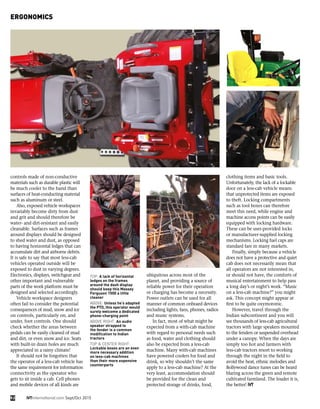
TOP: A lack of horizontal
ledges on the frames
around the dash display
should keep this Massey
Ferguson 1500 a little
cleaner
ABOVE: Unless he’s adapted
the PTO, this operator would
surely welcome a dedicated
phone-charging point
ABOVE RIGHT: An audio
speaker strapped to
the fender is a common
modification to Indian
tractors
TOP & CENTER RIGHT:
Lockable boxes are an even
more necessary addition
on less-cab machines
than their more expensive
counterparts

Less-Cab Tractor

  • 1.
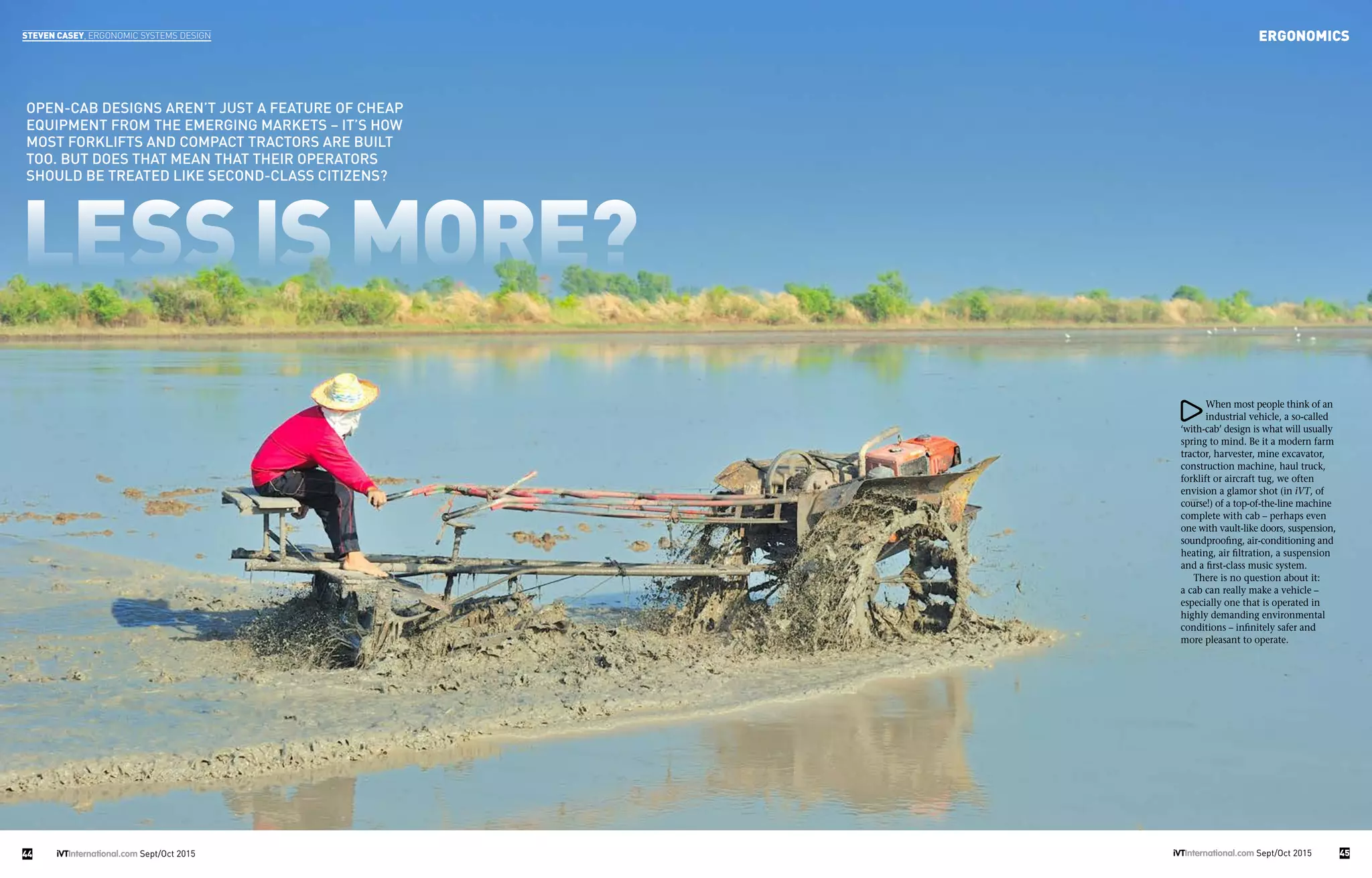
    44 45 ERGONOMICSSTEVEN CASEY,ERGONOMIC SYSTEMS DESIGN iVTInternational.com Sept/Oct 2015iVTInternational.com Sept/Oct 2015 OPEN-CAB DESIGNS AREN’T JUST A FEATURE OF CHEAP EQUIPMENT FROM THE EMERGING MARKETS – IT’S HOW MOST FORKLIFTS AND COMPACT TRACTORS ARE BUILT TOO. BUT DOES THAT MEAN THAT THEIR OPERATORS SHOULD BE TREATED LIKE SECOND-CLASS CITIZENS? When most people think of an industrial vehicle, a so-called ‘with-cab’ design is what will usually spring to mind. Be it a modern farm tractor, harvester, mine excavator, construction machine, haul truck, forklift or aircraft tug, we often envision a glamor shot (in iVT, of course!) of a top-of-the-line machine complete with cab – perhaps even one with vault-like doors, suspension, soundproofing, air-conditioning and heating, air filtration, a suspension and a first-class music system. There is no question about it: a cab can really make a vehicle – especially one that is operated in highly demanding environmental conditions – infinitely safer and more pleasant to operate.
  • 2.
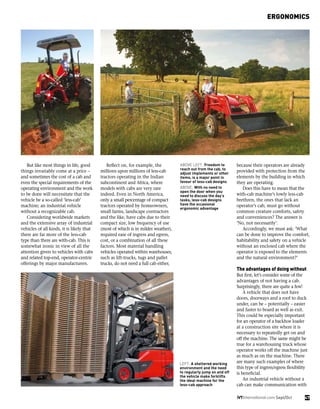
    ERGONOMICS 47iVTInternational.com Sept/Oct But likemost things in life, good things invariably come at a price – and sometimes the cost of a cab and even the special requirements of the operating environment and the work to be done will necessitate that the vehicle be a so-called ‘less-cab’ machine; an industrial vehicle without a recognizable cab. Considering worldwide markets and the extensive array of industrial vehicles of all kinds, it is likely that there are far more of the less-cab type than there are with-cab. This is somewhat ironic in view of all the attention given to vehicles with cabs and related top-end, operator-centric offerings by major manufacturers. Reflect on, for example, the millions upon millions of less-cab tractors operating in the Indian subcontinent and Africa, where models with cabs are very rare indeed. Even in North America, only a small percentage of compact tractors operated by homeowners, small farms, landscape contractors and the like, have cabs due to their compact size, low frequency of use (most of which is in milder weather), required ease of ingress and egress, cost, or a combination of all these factors. Most material handling vehicles operated within warehouses, such as lift-trucks, tugs and pallet trucks, do not need a full cab either, because their operators are already provided with protection from the elements by the building in which they are operating. Does this have to mean that the with-cab machine’s lowly less-cab brethren, the ones that lack an operator’s cab, must go without common creature comforts, safety and conveniences? The answer is ‘No, not necessarily’. Accordingly, we must ask: ‘What can be done to improve the comfort, habitability and safety on a vehicle without an enclosed cab where the operator is exposed to the elements and the natural environment?’ The advantages of doing without But first, let’s consider some of the advantages of not having a cab. Surprisingly, there are quite a few! A vehicle that does not have doors, doorways and a roof to duck under, can be – potentially – easier and faster to board as well as exit. This could be especially important for an operator of a backhoe loader at a construction site where it is necessary to repeatedly get on and off the machine. The same might be true for a warehousing truck whose operator works off the machine just as much as on the machine. There are many such examples of where this type of ingress/egress flexibility is beneficial. An industrial vehicle without a cab can make communication with ABOVE LEFT: Freedom to reach out from the cab, to adjust implements or other items, is a major point in favour of less-cab designs ABOVE: With no need to open the door when you need to discuss the day’s tasks, less-cab designs have the occasional ergonomic advantage LEFT: A sheltered working environment and the need to regularly jump on and off the vehicle make forklifts the ideal machine for the less-cab approach
  • 3.
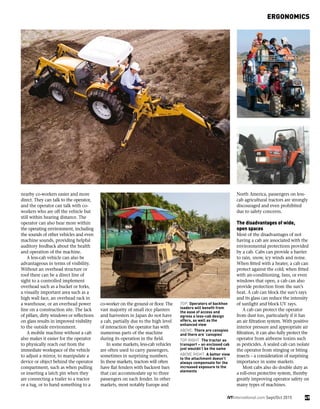
    ERGONOMICS iVTInternational.com Sept/Oct 201549 nearby co-workers easier and more direct. They can talk to the operator, and the operator can talk with co- workers who are off the vehicle but still within hearing distance. The operator can also hear more within the operating environment, including the sounds of other vehicles and even machine sounds, providing helpful auditory feedback about the health and operation of the machine. A less-cab vehicle can also be advantageous in terms of visibility. Without an overhead structure or roof there can be a direct line of sight to a controlled implement overhead such as a bucket or forks, a visually important area such as a high wall face, an overhead rack in a warehouse, or an overhead power line on a construction site. The lack of pillars, dirty windows or reflections on glass results in improved visibility to the outside environment. A mobile machine without a cab also makes it easier for the operator to physically reach out from the immediate workspace of the vehicle to adjust a mirror, to manipulate a device or object behind the operator compartment, such as when pulling or inserting a latch pin when they are connecting a trailer to a tractor or a tug, or to hand something to a co-worker on the ground or floor. The vast majority of small rice planters and harvesters in Japan do not have a cab, partially due to the high level of interaction the operator has with numerous parts of the machine during its operation in the field. In some markets, less-cab vehicles are often used to carry passengers, sometimes in surprising numbers. In these markets, tractors will often have flat fenders with backrest bars that can accommodate up to three passengers on each fender. In other markets, most notably Europe and North America, passengers on less- cab agricultural tractors are strongly discouraged and even prohibited due to safety concerns. The disadvantages of wide, open spaces Most of the disadvantages of not having a cab are associated with the environmental protections provided by a cab. Cabs can provide a barrier to rain, snow, icy winds and noise. When fitted with a heater, a cab can protect against the cold; when fitted with air-conditioning, fans, or even windows that open, a cab can also provide protection from the sun’s heat. A cab can block the sun’s rays and its glass can reduce the intensity of sunlight and block UV rays. A cab can protect the operator from dust too, particularly if it has an air filtration system. With positive interior pressure and appropriate air filtration, it can also fully protect the operator from airborne toxins such as pesticides. A sealed cab can isolate the operator from stinging or biting insects – a consideration of surprising importance in some markets. Most cabs also do double duty as a roll-over protective system, thereby greatly improving operator safety on many types of machines. TOP: Operators of backhoe loaders will benefit from the ease of access and egress a less-cab design offers, as well as the enhanced view ABOVE: There are canopies and there are ‘canopies’ TOP RIGHT: The tractor as transport – an enclosed cab just wouldn’t be the same ABOVE RIGHT: A better view to the attachment doesn’t always compensate for the increased exposure to the elements
  • 4.
    ERGONOMICS iVTInternational.com Sept/Oct 201551 Lastly, a cab can provide a high degree of physical security for the machine itself. A locking cab door helps guard against vehicle theft and vandalism, as well as protect personal items or add-on items inside the cab, particularly expensive electronics. Improving the quality of life on a less-cab industrial vehicle Having considered the pros and cons of cabs, let us return to the original question: ‘What can be done to improve comfort, habitability and safety on an industrial vehicle that does not have a cab?’ In actuality, there is no shortage of practical and design solutions for enhancing these aspects. Firstly consider the safety issue, as it is of such importance. The effectiveness of rollover protective structures, especially in combination with a seatbelt, has been extremely well documented. Studies of rollover injury and fatality rates, as well as controlled testing by laboratories, demonstrate the benefits of ROPS. These structures work, and it is troubling to see that such a large percentage of less-cab machines in the developing markets still do not have them. Neither does the absence of a full cab automatically mean that the operator can’t be shielded from the sun and rain. Canopies can provide very good protection from direct sunlight and falling rain, and can also contain useful integral storage compartments for personal items such as a jacket or water bottle. Better still, a hard canopy roof can be fitted to a ROPS to provide rollover protection as well as sun and rain protection. The lack of a cab need not mean that the operator has no means of keeping cool on a hot day or staying warm when it is cold. Most owners of a convertible automobile have experienced the pleasure of running the heater with the top down on a brisk night. Running the heater has no impact on fuel efficiency because the engine’s heat would be expelled regardless. Should a less-cab vehicle have a strategically placed heater vent or two to warm up the operator on a cold day or night? Perhaps. Providing air-conditioning on a less-cab machine may not constitute a rational use of fuel and money, however, but a carefully placed fan can be surprisingly effective and efficient at increasing the operator’s comfort by increasing evaporative cooling. Ventilated seating and cool seating surfaces can also provide much-needed added comfort in the heat of the day. Similarly, surface treatments of touched machine parts can greatly impact operator comfort. Potentially hot surfaces such as handles and TOP RIGHT: It may be a spartan cab on Atlas Weyhausen’s compact loader, but operator safety is guaranteed with the use of a large ROPS ABOVE RIGHT: The operator in this advert for Mahindra’s Swaraj tractors appears to be passionate about them, despite their lack of ROPS. Perhaps its because the backrests on those flat fenders enhance the passenger-carrying capability? ABOVE: An enclosed cab here would protect the farmer from flying debris as well as noise LEFT: A simple, but safe, less-cab structure appears on Claas’s Indian- manufactured Crop Tiger
  • 5.
    ERGONOMICS ubiquitous across mostof the planet, and providing a source of reliable power for their operation or charging has become a necessity. Power outlets can be used for all manner of common onboard devices including lights, fans, phones, radios and music systems. In fact, most of what might be expected from a with-cab machine with regard to personal needs such as food, water and clothing should also be expected from a less-cab machine. Many with-cab machines have powered coolers for food and drink, so why shouldn’t the same apply to a less-cab machine? At the very least, accommodation should be provided for the clean and protected storage of drinks, food, clothing items and basic tools. Unfortunately, the lack of a lockable door on a less-cab vehicle means that unprotected items are exposed to theft. Locking compartments such as tool boxes can therefore meet this need, while engine and machine access points can be easily equipped with locking hardware. These can be user-provided locks or manufacturer-supplied locking mechanisms. Locking fuel caps are standard fare in many markets. Finally, simply because a vehicle does not have a protective and quiet cab does not necessarily mean that all operators are not interested in, or should not have, the comforts of musical entertainment to help pass a long day’s or night’s work. “Music on a less-cab machine?” you might ask. This concept might appear at first to be quite oxymoronic. However, travel through the Indian subcontinent and you will see thousands of less-cab agricultural tractors with large speakers mounted to the fenders or suspended overhead under a canopy. When the days are simply too hot and farmers with less-cab tractors resort to working through the night in the field to avoid the heat, ethnic melodies and Bollywood dance tunes can be heard blaring across the green and remote cultivated farmland. The louder it is, the better! iVT 52 iVTInternational.com Sept/Oct 2015 controls made of non-conductive materials such as durable plastic will be much cooler to the hand than surfaces of heat-conducting material such as aluminum or steel. Also, exposed vehicle workspaces invariably become dirty from dust and grit and should therefore be water- and dirt-resistant and easily cleanable. Surfaces such as frames around displays should be designed to shed water and dust, as opposed to having horizontal ledges that can accumulate dirt and airborne debris. It is safe to say that most less-cab vehicles operated outside will be exposed to dust in varying degrees. Electronics, displays, switchgear and other important and vulnerable parts of the work platform must be designed and selected accordingly. Vehicle workspace designers often fail to consider the potential consequences of mud, snow and ice on controls, particularly on, and under, foot controls. One should check whether the areas between pedals can be easily cleaned of mud and dirt, or even snow and ice. Seats with built-in drain holes are much appreciated in a rainy climate! It should not be forgotten that the operator of a less-cab vehicle has the same requirement for information connectivity as the operator who gets to sit inside a cab. Cell phones and mobile devices of all kinds are TOP: A lack of horizontal ledges on the frames around the dash display should keep this Massey Ferguson 1500 a little cleaner ABOVE: Unless he’s adapted the PTO, this operator would surely welcome a dedicated phone-charging point ABOVE RIGHT: An audio speaker strapped to the fender is a common modification to Indian tractors TOP & CENTER RIGHT: Lockable boxes are an even more necessary addition on less-cab machines than their more expensive counterparts