Leishmania
Phylum Sarcomastigophora
Order Kinetoplastida
Family Trypanosomatidae
Genus Leishmania
• Transmitted to the mammalian hosts by the bite of
infected sandflies, Phlebotomus and Lutzomyja
• Currently, leishmaniasis occurs in 4 continents and is
considered to be endemic in 88 countries, 72 of which
are developing countries:
• 90% of all : Bangladesh, Brazil, India, Nepal and
Sudan
• Annual incidence: 1- 1.5 million cases of CL
• 500,000 cases ofVL
SITUATION IN INDIA
• 40-50% of global burden
(Bora 1999, Nat/ Med J India) Survillance
being done by NVDBCP
• Endemic states in Eastern
India: Bihar, Jharkhand, West
Bengal, Uttar Pradesh
• Estimated 165.4 million population
at risk in 4 states
Endemic states in Eastern
India: Bihar, Jharkhand, West
Bengal, Uttar Pradesh
Estimated 165.4 million population at risk in 4 states
(NVBDCP, 2010)
•On the basis of development, divided in two genera:
Subgenus Leishmania: in the anterior part of alimentary tract
of sandfly
Subgenus Viannia: midqut and hindqut of sandfly
Leishmania tropica
Leishmania major
Leishmania aethiopica
Leishmania mexjcana
Cutaneous
leishmaniasis
Leishmania braziliensis Mucocutaneous
leishmaniasis (MCL)
Leishmania donovani
Leishmania infantum
Leishmania chagasi
Visceral leishmaniasis
Leishmania Parasites and Diseases
SPECIES Disease
proboscis.
into
Digenetic Life Cycle
Promastigote Amastigote
— Mammalian stage
Non-motile
— Intracellular
— Insect
Motile
—Midgut
INFECTION
Sub-clinical or inapparent infection
Recovery
Immune to reinfection
Death
Concurrent
infection
PKDL
LEISHMANIASIS
• Vector borne
disease
• A wide clinical
spectrum
VISCERAL
• pKDL
• DIFFUSE
CUTANEOUS
• CUTANEOUS
• MUCOCUTANE
OUS
VL - Clinical Manifestation
• Variable - Incubation 3-100+ weeks
• Lowgrade fever
• Hepato-splenomegaly
• Bone marrow hyperplasia
• Anemia, Leucopenia & Cachexia
• Hypergammaglobulinnemia
• Epistaxis , Proteinuna, Hematuria
• Most severe form of the disease, may be fatal if
left untreated
• Usually associated with fever, weight loss, and an
enlarged spleen and liver
• Anemia (low RBC), leukopenia (low WBC), and
thrombocytopenia (low platelets) are common
• Lymphadenopathy may be present
• Visceral disease from the Middle East is usually
milder with less specific findings than visceral
leishmaniasis from other areas of the world
Post Kala Azar Dermal
Leishmaniasis
• Normally develops Q years after recovery
• Recrudescence
• Restricted to skin
• Rare but varies geographically
Cutaneous Leishmaniasis
•Most common form
•Characterized by one or more sores, papules or
nodules on the skin
•Sores can change in size and appearance over
time
•Often described as looking somewhat like a
volcano with a raised edge and central crater
•Sores are usually painless but can become painful
if secondarily infected
•Swollen lymph nodes may be present near
the sores (under the arm if the sores are on the
arm or hand...)
Cutaneous Leishmaniasis
• Most sores develop within a few weeks of the
sandfly bite, however they can appear up to months
later
• Skin sores of cutaneous leishmaniasis can heal on
their own, but this can take months or even years
• Sores can leave significant scars and be disfiguring if
they occur on the face
• If infection is from L. tropica it can spread to
contiguous mucous membranes (upper lip to nose)
Mucocutaneous Leishmaniasis
• Occurs with Leishmania species from Central and South
America
• Very rarely associated with L, tropica which is found in the
Middle East
• This type occurs if a cutaneous lesion on the face spreads
to involve the nose or mouth
• This rare mucosal involvement may occur if a skin lesion
near the mouth or nose is not treated
• May occur months to years after original skin lesion
• Hard to confirm diagnosis as few parasites are in the lesion
Lesions can be very disfiguring
DIAGNOSIS
Direct evidence:
Demonstration of Leishmania
Specimens that may be collected
•Splenic aspirate and biopsy
•Liver biopsy
•Bone marrow (Sternum or iliac crest)
•FNAC and biopsy
•Blood buffy coat
•Tegumantary leishmaniasis- dermal scrapings, sections
from skin biopsy
Animal inoculation
• Golden hamsters inoculated intraperitoneally
CULTURE
Culture media for axenic culture
•SOLID MEDIUM
•NNN medium
•Evan's modified Tobie i
s medium
•LIQUID MEDIA
•Schneider's Drosophila medium
•Grace's insect tissue culture medium
DEMONSTRATION OF Leishmania
PROMASTIGOTES
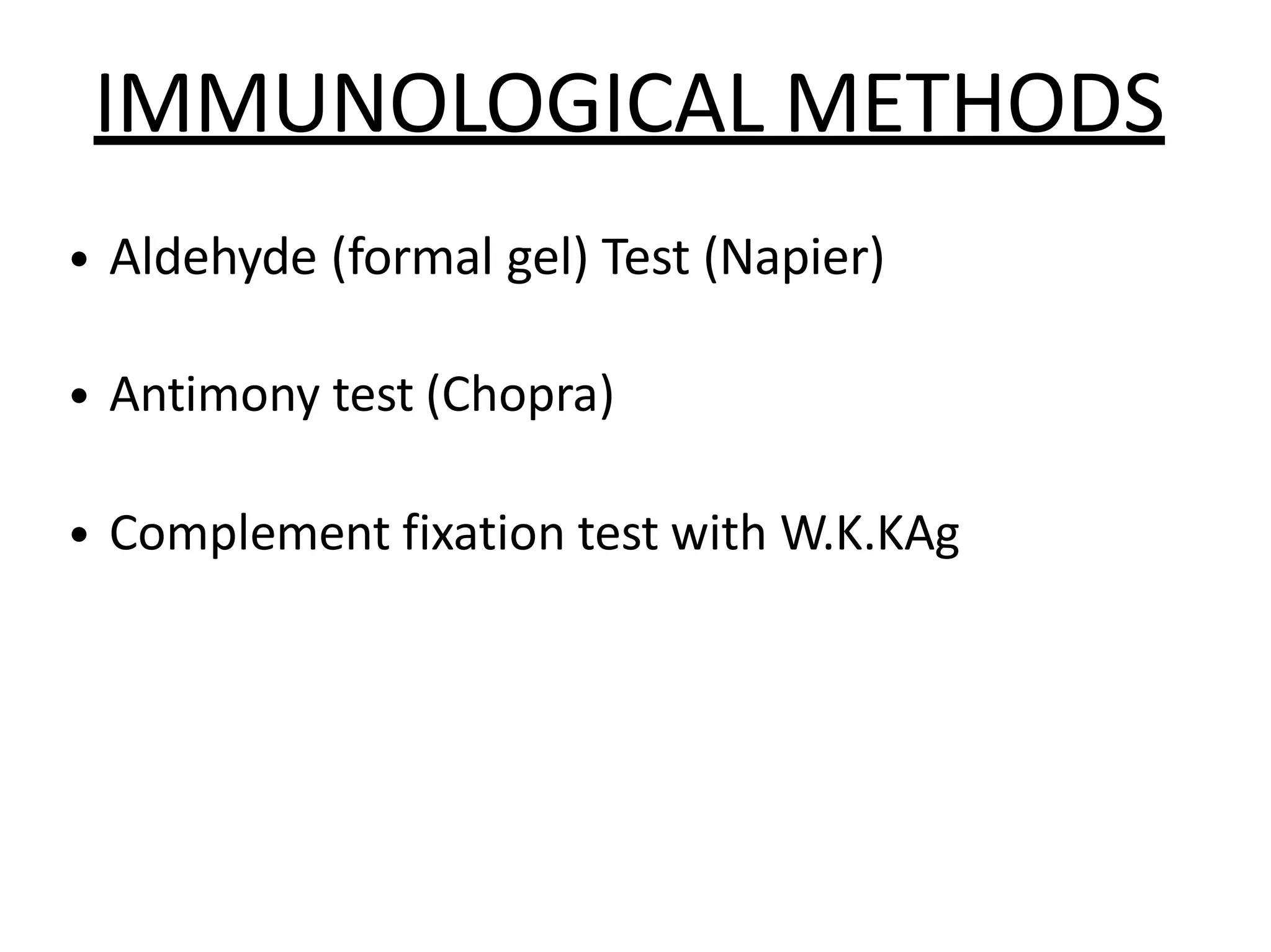
IMMUNOLOGICAL METHODS
• Aldehyde (formal gel) Test (Napier)
• Antimony test (Chopra)
• Complement fixation test with W.K.KAg
Prevention
Suppress the reservoir: dogs, rats, gerbils, other
small mammals and rodents
Suppress the vector: Sandfly
Critical to preventing disease in stationary troop populations
Prevent sandfly bites: Personal Protective Measures
Most important at night Sleeves down
Insect repellent w/ DEET Permethrin treated uniforms
Permethrin treated bed nets
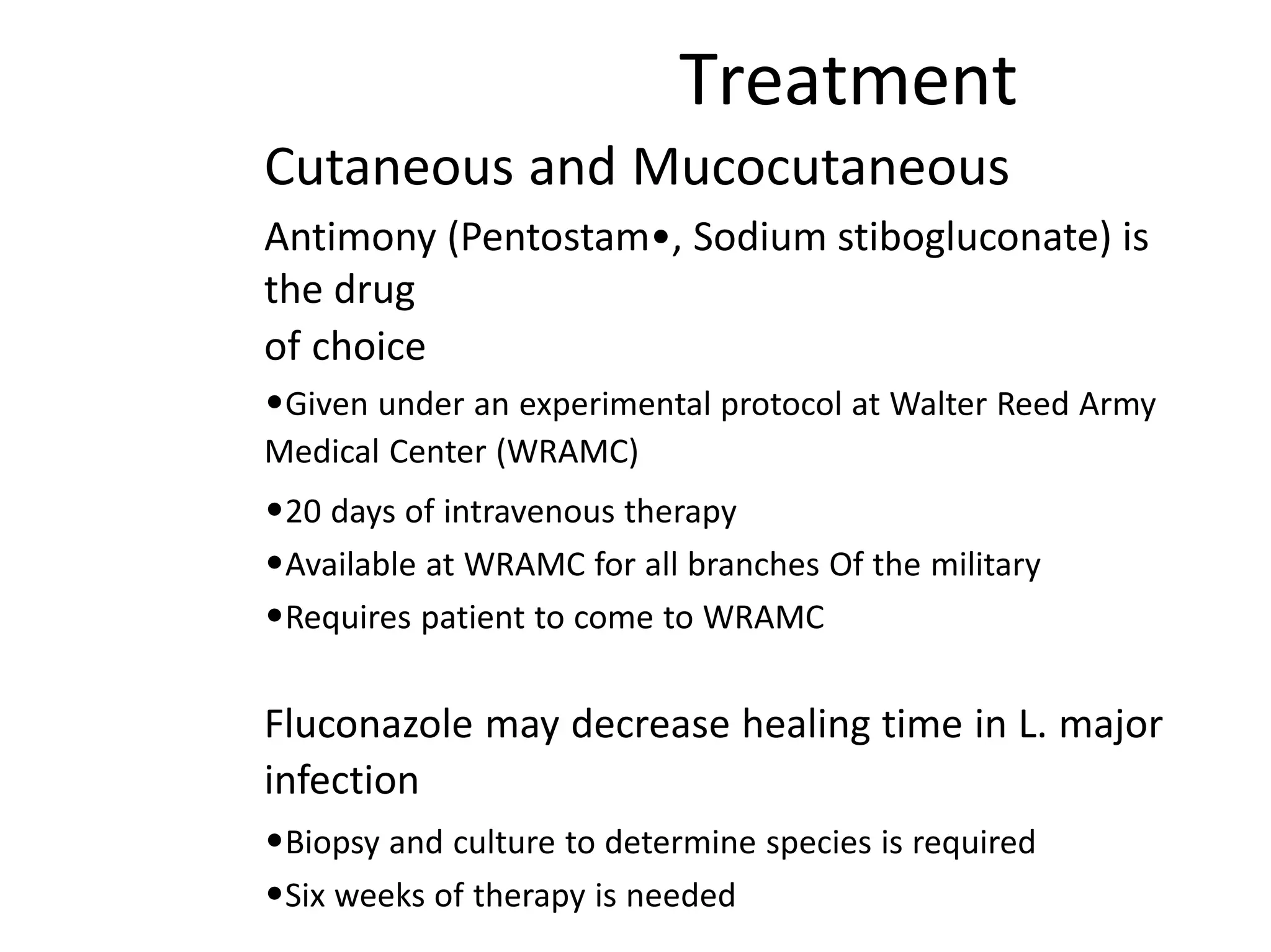
Treatment
Cutaneous and Mucocutaneous
Antimony (Pentostam•, Sodium stibogluconate) is
the drug
of choice
•Given under an experimental protocol at Walter Reed Army
Medical Center (WRAMC)
•20 days of intravenous therapy
•Available at WRAMC for all branches Of the military
•Requires patient to come to WRAMC
Fluconazole may decrease healing time in L. major
infection
•Biopsy and culture to determine species is required
•Six weeks of therapy is needed
Visceral Leishmaniasis
• Although AmBisome• is widely available, the
difficulty of accurate diagnosis and the potential
severity of visceral infection suggest possible patients
be referred to the Leishmania Treatment Center at
WRAMC for maximal diagnostic efficiency
• Liposomal amphotericin-B (AmBisome@)
choice
is the drug of
• 3 mg/kg per day on days 1-5, day 14 and day 21
• Pentostame
is an alternative therapy
• 28 days Of therapy is required
Vaccine
• There is as yet no effective vaccine for
prevention of any form of leishmaniasis.
•first generation vaccine was prepared
using whole killed parasites combined or
not with BCG.
• Live: including new genetically modified
constructs
•1st generation vaccines: whole killed
parasite with/without adjuvants or
fractions of the parasite
• 2nd generation vaccines: recombinant
proteins, DNA vaccines & combinations

leishmania ppt mine.ppt

  • 1.
  • 2.
    • Transmitted tothe mammalian hosts by the bite of infected sandflies, Phlebotomus and Lutzomyja • Currently, leishmaniasis occurs in 4 continents and is considered to be endemic in 88 countries, 72 of which are developing countries: • 90% of all : Bangladesh, Brazil, India, Nepal and Sudan • Annual incidence: 1- 1.5 million cases of CL • 500,000 cases ofVL
  • 3.
    SITUATION IN INDIA •40-50% of global burden (Bora 1999, Nat/ Med J India) Survillance being done by NVDBCP • Endemic states in Eastern India: Bihar, Jharkhand, West Bengal, Uttar Pradesh • Estimated 165.4 million population at risk in 4 states
  • 4.
    Endemic states inEastern India: Bihar, Jharkhand, West Bengal, Uttar Pradesh Estimated 165.4 million population at risk in 4 states (NVBDCP, 2010) •On the basis of development, divided in two genera: Subgenus Leishmania: in the anterior part of alimentary tract of sandfly Subgenus Viannia: midqut and hindqut of sandfly
  • 5.
    Leishmania tropica Leishmania major Leishmaniaaethiopica Leishmania mexjcana Cutaneous leishmaniasis Leishmania braziliensis Mucocutaneous leishmaniasis (MCL) Leishmania donovani Leishmania infantum Leishmania chagasi Visceral leishmaniasis Leishmania Parasites and Diseases SPECIES Disease
  • 6.
  • 7.
    Digenetic Life Cycle PromastigoteAmastigote — Mammalian stage Non-motile — Intracellular — Insect Motile —Midgut
  • 8.
    INFECTION Sub-clinical or inapparentinfection Recovery Immune to reinfection Death Concurrent infection PKDL LEISHMANIASIS
  • 9.
    • Vector borne disease •A wide clinical spectrum VISCERAL • pKDL • DIFFUSE CUTANEOUS • CUTANEOUS • MUCOCUTANE OUS
  • 10.
    VL - ClinicalManifestation • Variable - Incubation 3-100+ weeks • Lowgrade fever • Hepato-splenomegaly • Bone marrow hyperplasia • Anemia, Leucopenia & Cachexia • Hypergammaglobulinnemia • Epistaxis , Proteinuna, Hematuria
  • 12.
    • Most severeform of the disease, may be fatal if left untreated • Usually associated with fever, weight loss, and an enlarged spleen and liver • Anemia (low RBC), leukopenia (low WBC), and thrombocytopenia (low platelets) are common • Lymphadenopathy may be present • Visceral disease from the Middle East is usually milder with less specific findings than visceral leishmaniasis from other areas of the world
  • 13.
    Post Kala AzarDermal Leishmaniasis • Normally develops Q years after recovery • Recrudescence • Restricted to skin • Rare but varies geographically
  • 14.
    Cutaneous Leishmaniasis •Most commonform •Characterized by one or more sores, papules or nodules on the skin •Sores can change in size and appearance over time •Often described as looking somewhat like a volcano with a raised edge and central crater •Sores are usually painless but can become painful if secondarily infected •Swollen lymph nodes may be present near the sores (under the arm if the sores are on the arm or hand...)
  • 15.
    Cutaneous Leishmaniasis • Mostsores develop within a few weeks of the sandfly bite, however they can appear up to months later • Skin sores of cutaneous leishmaniasis can heal on their own, but this can take months or even years • Sores can leave significant scars and be disfiguring if they occur on the face • If infection is from L. tropica it can spread to contiguous mucous membranes (upper lip to nose)
  • 16.
    Mucocutaneous Leishmaniasis • Occurswith Leishmania species from Central and South America • Very rarely associated with L, tropica which is found in the Middle East • This type occurs if a cutaneous lesion on the face spreads to involve the nose or mouth • This rare mucosal involvement may occur if a skin lesion near the mouth or nose is not treated • May occur months to years after original skin lesion • Hard to confirm diagnosis as few parasites are in the lesion Lesions can be very disfiguring
  • 17.
  • 18.
    Direct evidence: Demonstration ofLeishmania Specimens that may be collected •Splenic aspirate and biopsy •Liver biopsy •Bone marrow (Sternum or iliac crest) •FNAC and biopsy •Blood buffy coat •Tegumantary leishmaniasis- dermal scrapings, sections from skin biopsy
  • 20.
    Animal inoculation • Goldenhamsters inoculated intraperitoneally
  • 21.
    CULTURE Culture media foraxenic culture •SOLID MEDIUM •NNN medium •Evan's modified Tobie i s medium •LIQUID MEDIA •Schneider's Drosophila medium •Grace's insect tissue culture medium DEMONSTRATION OF Leishmania PROMASTIGOTES
  • 22.
    IMMUNOLOGICAL METHODS • Aldehyde(formal gel) Test (Napier) • Antimony test (Chopra) • Complement fixation test with W.K.KAg
  • 23.
    Prevention Suppress the reservoir:dogs, rats, gerbils, other small mammals and rodents Suppress the vector: Sandfly Critical to preventing disease in stationary troop populations Prevent sandfly bites: Personal Protective Measures Most important at night Sleeves down Insect repellent w/ DEET Permethrin treated uniforms Permethrin treated bed nets
  • 24.
    Treatment Cutaneous and Mucocutaneous Antimony(Pentostam•, Sodium stibogluconate) is the drug of choice •Given under an experimental protocol at Walter Reed Army Medical Center (WRAMC) •20 days of intravenous therapy •Available at WRAMC for all branches Of the military •Requires patient to come to WRAMC Fluconazole may decrease healing time in L. major infection •Biopsy and culture to determine species is required •Six weeks of therapy is needed
  • 25.
    Visceral Leishmaniasis • AlthoughAmBisome• is widely available, the difficulty of accurate diagnosis and the potential severity of visceral infection suggest possible patients be referred to the Leishmania Treatment Center at WRAMC for maximal diagnostic efficiency • Liposomal amphotericin-B (AmBisome@) choice is the drug of • 3 mg/kg per day on days 1-5, day 14 and day 21 • Pentostame is an alternative therapy • 28 days Of therapy is required
  • 26.
    Vaccine • There isas yet no effective vaccine for prevention of any form of leishmaniasis. •first generation vaccine was prepared using whole killed parasites combined or not with BCG. • Live: including new genetically modified constructs •1st generation vaccines: whole killed parasite with/without adjuvants or fractions of the parasite • 2nd generation vaccines: recombinant proteins, DNA vaccines & combinations