Khie Johnson
1
Khie Johnson
Professor Lilley
Legal Research
9 May 2016
Khie Johnson
2
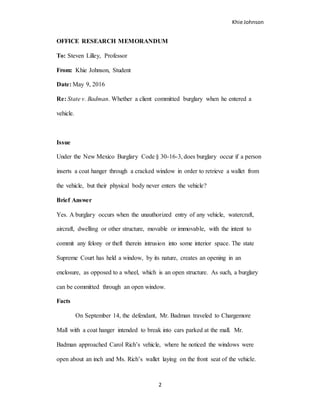
OFFICE RESEARCH MEMORANDUM
To: Steven Lilley, Professor
From: Khie Johnson, Student
Date: May 9, 2016
Re: State v. Badman. Whether a client committed burglary when he entered a
vehicle.
Issue
Under the New Mexico Burglary Code § 30-16-3, does burglary occur if a person
inserts a coat hanger through a cracked window in order to retrieve a wallet from
the vehicle, but their physical body never enters the vehicle?
Brief Answer
Yes. A burglary occurs when the unauthorized entry of any vehicle, watercraft,
aircraft, dwelling or other structure, movable or immovable, with the intent to
commit any felony or theft therein intrusion into some interior space. The state
Supreme Court has held a window, by its nature, creates an opening in an
enclosure, as opposed to a wheel, which is an open structure. As such, a burglary
can be committed through an open window.
Facts
On September 14, the defendant, Mr. Badman traveled to Chargemore
Mall with a coat hanger intended to break into cars parked at the mall. Mr.
Badman approached Carol Rich’s vehicle, where he noticed the windows were
open about an inch and Ms. Rich’s wallet laying on the front seat of the vehicle.
Khie Johnson
3
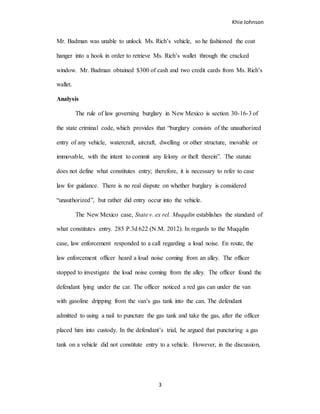
Mr. Badman was unable to unlock Ms. Rich’s vehicle, so he fashioned the coat
hanger into a hook in order to retrieve Ms. Rich’s wallet through the cracked
window. Mr. Badman obtained $300 of cash and two credit cards from Ms. Rich’s
wallet.
Analysis
The rule of law governing burglary in New Mexico is section 30-16-3 of
the state criminal code, which provides that “burglary consists of the unauthorized
entry of any vehicle, watercraft, aircraft, dwelling or other structure, movable or
immovable, with the intent to commit any felony or theft therein”. The statute
does not define what constitutes entry; therefore, it is necessary to refer to case
law for guidance. There is no real dispute on whether burglary is considered
“unauthorized”, but rather did entry occur into the vehicle.
The New Mexico case, State v. ex rel. Muqqdin establishes the standard of
what constitutes entry. 285 P.3d 622 (N.M. 2012). In regards to the Muqqdin
case, law enforcement responded to a call regarding a loud noise. En route, the
law enforcement officer heard a loud noise coming from an alley. The officer
stopped to investigate the loud noise coming from the alley. The officer found the
defendant lying under the car. The officer noticed a red gas can under the van
with gasoline dripping from the van’s gas tank into the can. The defendant
admitted to using a nail to puncture the gas tank and take the gas, after the officer
placed him into custody. In the defendant’s trial, he argued that puncturing a gas
tank on a vehicle did not constitute entry to a vehicle. However, in the discussion,
Khie Johnson
4
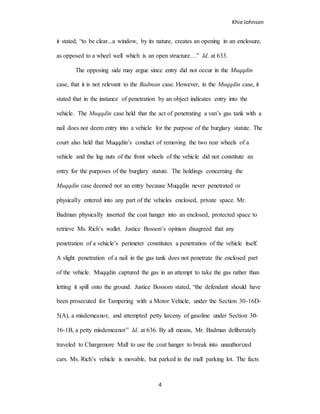
it stated, “to be clear...a window, by its nature, creates an opening in an enclosure,
as opposed to a wheel well which is an open structure…” Id. at 633.
The opposing side may argue since entry did not occur in the Muqqdin
case, that it is not relevant to the Badman case. However, in the Muqqdin case, it
stated that in the instance of penetration by an object indicates entry into the
vehicle. The Muqqdin case held that the act of penetrating a van’s gas tank with a
nail does not deem entry into a vehicle for the purpose of the burglary statute. The
court also held that Muqqdin’s conduct of removing the two rear wheels of a
vehicle and the lug nuts of the front wheels of the vehicle did not constitute an
entry for the purposes of the burglary statute. The holdings concerning the
Muqqdin case deemed not an entry because Muqqdin never penetrated or
physically entered into any part of the vehicles enclosed, private space. Mr.
Badman physically inserted the coat hanger into an enclosed, protected space to
retrieve Ms. Rich’s wallet. Justice Bosson’s opinion disagreed that any
penetration of a vehicle’s perimeter constitutes a penetration of the vehicle itself.
A slight penetration of a nail in the gas tank does not penetrate the enclosed part
of the vehicle. Muqqdin captured the gas in an attempt to take the gas rather than
letting it spill onto the ground. Justice Bossom stated, “the defendant should have
been prosecuted for Tampering with a Motor Vehicle, under the Section 30-16D-
5(A), a misdemeanor, and attempted petty larceny of gasoline under Section 30-
16-1B, a petty misdemeanor” Id. at 636. By all means, Mr. Badman deliberately
traveled to Chargemore Mall to use the coat hanger to break into unauthorized
cars. Ms. Rich’s vehicle is movable, but parked in the mall parking lot. The facts
Khie Johnson
5
of the Muqqdin case are not on point facts, but the facts are relevant to the
Badman case.
The New Mexico case, State v. Holt, conveyed that Anthony Holt partially
removed a window screen from a residential dwelling, but fled after the
homeowner noticed him. 368 P.3d 409 (N.M. 2016). While Holt attempted to
move the screen, he placed his fingers behind the screen and inside the outer
boundary of the home. Holt contends “that only penetration of an interior
space…constitutes entry”. Id. at 412. Moreover, Mr. Badman used the hanger to
insert into the interior of the car in order to obtain Ms. Rich’s wallet. Holt was
charged with breaking and entering. The opposing side might argue that this case
is irrelevant due to the fact that Mr. Holt’s case argues whether he enter the
dwelling or not. However, the court held based off of the reasoning stated in the
Muqqdin case, Mr. Holt indeed entered the structure.
Conclusion
Section 30-16-3 of the Burglary Code prohibits the entry of unauthorized entry of
any vehicle, watercraft, aircraft, dwelling, or other structure, movable or
immovable, with the intent to commit any felony or theft therein. The Badman
case provides that when an individual enters an unauthorized, movable, but
parked vehicle with the intent to commit a crime with a coat hanger, they will be
charged with burglary. Given these points, there is sufficient evidence to prove
that Mr. Badman indeed entered Ms. Rich’s vehicle with a coat hanger in order to
obtain her wallet.

Legal Memo

  • 1.
    Khie Johnson 1 Khie Johnson ProfessorLilley Legal Research 9 May 2016
  • 2.
    Khie Johnson 2 OFFICE RESEARCHMEMORANDUM To: Steven Lilley, Professor From: Khie Johnson, Student Date: May 9, 2016 Re: State v. Badman. Whether a client committed burglary when he entered a vehicle. Issue Under the New Mexico Burglary Code § 30-16-3, does burglary occur if a person inserts a coat hanger through a cracked window in order to retrieve a wallet from the vehicle, but their physical body never enters the vehicle? Brief Answer Yes. A burglary occurs when the unauthorized entry of any vehicle, watercraft, aircraft, dwelling or other structure, movable or immovable, with the intent to commit any felony or theft therein intrusion into some interior space. The state Supreme Court has held a window, by its nature, creates an opening in an enclosure, as opposed to a wheel, which is an open structure. As such, a burglary can be committed through an open window. Facts On September 14, the defendant, Mr. Badman traveled to Chargemore Mall with a coat hanger intended to break into cars parked at the mall. Mr. Badman approached Carol Rich’s vehicle, where he noticed the windows were open about an inch and Ms. Rich’s wallet laying on the front seat of the vehicle.
  • 3.
    Khie Johnson 3 Mr. Badmanwas unable to unlock Ms. Rich’s vehicle, so he fashioned the coat hanger into a hook in order to retrieve Ms. Rich’s wallet through the cracked window. Mr. Badman obtained $300 of cash and two credit cards from Ms. Rich’s wallet. Analysis The rule of law governing burglary in New Mexico is section 30-16-3 of the state criminal code, which provides that “burglary consists of the unauthorized entry of any vehicle, watercraft, aircraft, dwelling or other structure, movable or immovable, with the intent to commit any felony or theft therein”. The statute does not define what constitutes entry; therefore, it is necessary to refer to case law for guidance. There is no real dispute on whether burglary is considered “unauthorized”, but rather did entry occur into the vehicle. The New Mexico case, State v. ex rel. Muqqdin establishes the standard of what constitutes entry. 285 P.3d 622 (N.M. 2012). In regards to the Muqqdin case, law enforcement responded to a call regarding a loud noise. En route, the law enforcement officer heard a loud noise coming from an alley. The officer stopped to investigate the loud noise coming from the alley. The officer found the defendant lying under the car. The officer noticed a red gas can under the van with gasoline dripping from the van’s gas tank into the can. The defendant admitted to using a nail to puncture the gas tank and take the gas, after the officer placed him into custody. In the defendant’s trial, he argued that puncturing a gas tank on a vehicle did not constitute entry to a vehicle. However, in the discussion,
  • 4.
    Khie Johnson 4 it stated,“to be clear...a window, by its nature, creates an opening in an enclosure, as opposed to a wheel well which is an open structure…” Id. at 633. The opposing side may argue since entry did not occur in the Muqqdin case, that it is not relevant to the Badman case. However, in the Muqqdin case, it stated that in the instance of penetration by an object indicates entry into the vehicle. The Muqqdin case held that the act of penetrating a van’s gas tank with a nail does not deem entry into a vehicle for the purpose of the burglary statute. The court also held that Muqqdin’s conduct of removing the two rear wheels of a vehicle and the lug nuts of the front wheels of the vehicle did not constitute an entry for the purposes of the burglary statute. The holdings concerning the Muqqdin case deemed not an entry because Muqqdin never penetrated or physically entered into any part of the vehicles enclosed, private space. Mr. Badman physically inserted the coat hanger into an enclosed, protected space to retrieve Ms. Rich’s wallet. Justice Bosson’s opinion disagreed that any penetration of a vehicle’s perimeter constitutes a penetration of the vehicle itself. A slight penetration of a nail in the gas tank does not penetrate the enclosed part of the vehicle. Muqqdin captured the gas in an attempt to take the gas rather than letting it spill onto the ground. Justice Bossom stated, “the defendant should have been prosecuted for Tampering with a Motor Vehicle, under the Section 30-16D- 5(A), a misdemeanor, and attempted petty larceny of gasoline under Section 30- 16-1B, a petty misdemeanor” Id. at 636. By all means, Mr. Badman deliberately traveled to Chargemore Mall to use the coat hanger to break into unauthorized cars. Ms. Rich’s vehicle is movable, but parked in the mall parking lot. The facts
  • 5.
    Khie Johnson 5 of theMuqqdin case are not on point facts, but the facts are relevant to the Badman case. The New Mexico case, State v. Holt, conveyed that Anthony Holt partially removed a window screen from a residential dwelling, but fled after the homeowner noticed him. 368 P.3d 409 (N.M. 2016). While Holt attempted to move the screen, he placed his fingers behind the screen and inside the outer boundary of the home. Holt contends “that only penetration of an interior space…constitutes entry”. Id. at 412. Moreover, Mr. Badman used the hanger to insert into the interior of the car in order to obtain Ms. Rich’s wallet. Holt was charged with breaking and entering. The opposing side might argue that this case is irrelevant due to the fact that Mr. Holt’s case argues whether he enter the dwelling or not. However, the court held based off of the reasoning stated in the Muqqdin case, Mr. Holt indeed entered the structure. Conclusion Section 30-16-3 of the Burglary Code prohibits the entry of unauthorized entry of any vehicle, watercraft, aircraft, dwelling, or other structure, movable or immovable, with the intent to commit any felony or theft therein. The Badman case provides that when an individual enters an unauthorized, movable, but parked vehicle with the intent to commit a crime with a coat hanger, they will be charged with burglary. Given these points, there is sufficient evidence to prove that Mr. Badman indeed entered Ms. Rich’s vehicle with a coat hanger in order to obtain her wallet.