Left Atrial Appendage Closure
Dr. Yogesh Shilimkar
Why Do We Have LAA?
• The LAA is a vestigial structure in the human body
similar to the appendix.
• It is the remnant of the primordial left atrium, which
develops during the third to sixth week of fetal cardiac
development, whereas the smooth left atrial cavity
develops later from the pulmonary venous bud.
• The function and activity of the LAA can be broadly
divided into 2 categories:
– neurohormonal,
– reservoir
Neurohormonal role of LAA
• Both the left atrium and the LAA have specialized
endothelial cells that are involved in the production
and release of natriuretic peptides, both ANP and B-
type natriuretic peptide (BNP).
• The LAA appears to be the primary production site of
ANP in the human heart and stores about 30% of
cardiac ANP in the granulocytes, which are secreted in
response to atrial stretch receptors.
• The concentration of ANP in the left atrial wall is about
40 times higher than in the rest of the atrium and
ventricles.
Reservoir function
• The LAA also has a reservoir function and is the most
distensible structure within the left atrium, acting as a
decompression chamber in patients with increased LA
pressure and volume.
• In patients with sinus rhythm, LAA amputation
diminishes the reservoir and conduit function of the left
atrium.
• In patients with AF, LAA remodeling occurs, which results
in the LAA functioning as a static pouch with decreased
Doppler flow velocities and reduced distensibility,
increasing the predisposition to thrombus formation.
AF, LAA and Stroke
• Prior studies have demonstrated that LAA is the most
common source of thrombus formation in AF.
• AF can lead to impairment in the conduit function of the
LAA with a decrease in LAA flow velocity, which is a
major predictor for thrombus in the LAA.
• AF can cause a prothrombotic state manifested by
endothelial dysfunction, activation of coagulation factors
including platelet aggregation, prothrombin fragments,
interleukin-6, thrombin–antithrombin complexes, and D-
dimer.
• Longstanding AF also leads to atrial remodeling,
fibrosis, and inflammation of the endothelium of
the left atrium, especially the LAA, leading to
focal triggers and re-entry arrhythmias,
contributing to a vicious cycle.
• Studies have reported that the LAA is the source
of thrombus in about 90% of nonvalvular AF and
57% of valvular AF
– Blackshear JL, Odell JA. Appendage obliteration to reduce stroke
in cardiac surgical patients with atrial fibrillation. Ann Thorac Surg
1996;61:755–9.
– Manning WJ, Silverman DI, Keighley CS, Oettgen P, Douglas PS.
Transesophageal echocardiographically facilitated early
cardioversion from atrial fibrillation using short-term
anticoagulation: final results of a prospective 4.5-year study. J Am
Coll Cardiol 1995;25:1354–61.
Why LAA occlusion?
• LAA is frequent source of systemic emboli.
• Occlusion or removal of LAA may decrease the
risk of systemic embolization.
• It may be an alternative to OAC in patients
with high bleeding risk.
• It may be an additional treatment on top of
OAC to reduce the risk of stroke.
Types of LAA
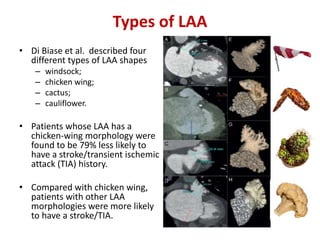
• Di Biase et al. described four
different types of LAA shapes
– windsock;
– chicken wing;
– cactus;
– cauliflower.
• Patients whose LAA has a
chicken-wing morphology were
found to be 79% less likely to
have a stroke/transient ischemic
attack (TIA) history.
• Compared with chicken wing,
patients with other LAA
morphologies were more likely
to have a stroke/TIA.
Imaging of the LAA
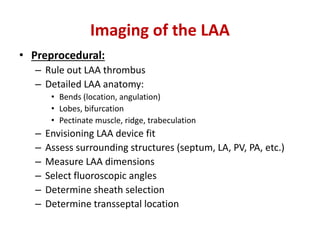
• Preprocedural:
– Rule out LAA thrombus
– Detailed LAA anatomy:
• Bends (location, angulation)
• Lobes, bifurcation
• Pectinate muscle, ridge, trabeculation
– Envisioning LAA device fit
– Assess surrounding structures (septum, LA, PV, PA, etc.)
– Measure LAA dimensions
– Select fluoroscopic angles
– Determine sheath selection
– Determine transseptal location
• Periprocedural: for guiding delivery and
deployment of the device and for assessing
procedural complications
• Postprocedural:
– Assess residual leak (LAA patency)
– Assess device position (migration, embolisation)
– Assess device-associated thrombus
– Assess pericardial effusion
– Assess surrounding structures
Preprocedural imaging
• TEE and/or cardiac computed tomography
angiography (CCTA) are both well suited for
preprocedural imaging.
• Although TOE has been the traditional gold-
standard preprocedural imaging for LAAO, there
are several advantages with CCTA including
– superior spatial resolution,
– detailed three-dimensional (3D) characterisation of
the LAA anatomy,
– accurate sizing, and
– non-invasive acquisition.
LAA measurements
• Measurements of the LAA for device sizing can be different
for devices, and manufacturer instructions for use should
be adhered to.
• For example, with the WATCHMAN device, the ostium of
the LAA is measured from the circumflex coronary artery to
a superior point 1-2 cm within the pulmonary vein ridge,
and the deepest feasible LAA depth is then measured from
that point.
• For Amulet device, the most proximal aspect of the LAA
(from the inferior edge of LAA origin to the LUPV ridge
superiorly) and the landing zone (12 mm inside the most
proximal point) should be measured.
• For TEE measurements, both the LAA orifice and
depth should be measured in at least four angles
(0, 45, 90 and 135), at the cardiac phase with
largest dimension (end-systole).
• 3D-TEE facilitates assessment of the shape of the
LAA orifice, and measurement of the maximum
and minimum diameters, as well as mean
diameters
CCTA vs TEE
• CCTA produces the largest LAA measurements
and more accurately predicts device sizes, due to
the superior multiplanar 3D imaging with CCTA,
allowing visualisation of maximal dimensions.
• CCTA maximal LAA diameter measurements were
on average 1-3 mm larger than 2D-TEE, and 2-4
mm larger than fluoroscopy measurements
Surgical approaches
• In 1949, Madden suggested that surgical resection of
the LAA in patients with AF could prevent recurrent
arterial emboli.
– MADDEN JL. RESECTION OF THE LEFT AURICULAR APPENDIX: A
Prophylaxis for Recurrent Arterial Emboli. JAMA. 1949;140(9):769–772.
• The high complication rate of the procedure prevented
its widespread adoption until the 1990s, when interest
in the procedure was rekindled by the development of
the Cox-Maze III procedure, which included removal of
the LAA.
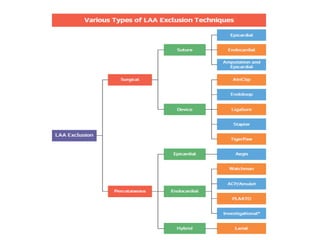
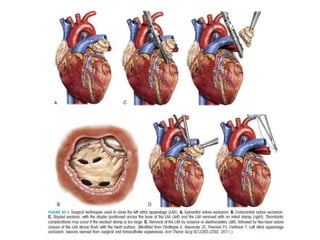
• The two general approaches to surgical LAA closure are
– exclusion and
– excision.
• Exclusion can be performed with running or mattress
sutures, with or without felt pledgets, from the
endocardial or epicardial surface or with a stapler.
• Excision can be performed by stapled excision or
removal and oversewing.
• However, postoperative residual leaks and insufficient
resection occur frequently and can be associated with
thrombus and neurologic events.
• Incomplete or insufficient closure is more common
with suture or staple exclusion than with excision.
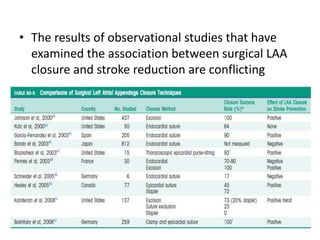
• The results of observational studies that have
examined the association between surgical LAA
closure and stroke reduction are conflicting
• The prospective randomized LAAOS III (Left Atrial
Appendage Occlusion Study III) evaluating
prophylactic LAA occlusion in surgical patients
with known pre-operative AF is currently
underway.
• The primary end point is the first occurrence of
stroke or systemic arterial embolism over a mean
follow-up period of 4 years.
• The results of this trial will help to define the
efficacy of surgical approaches to stroke
prevention.
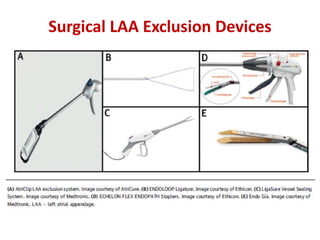
Surgical LAA Exclusion Devices
• Only the AtriClip LAA exclusion system is
currently available.
• A longterm follow-up of implanted clips showed
that at 36 months, all clips were stable with no
displacement, intracardiac thrombi, perfused LAA,
residual neck >1 cm, strokes, TIAs, or neurological
events.
• The advantages of this approach are:
– minimal risk of bleeding;
– immediate electrical isolation of the LAA;
– no need for anticoagulation during or after the
procedure; and
– no foreign body in the blood stream.
• A multicenter evaluation of the AtriCure clip reported a
>98% closure rate at 3-month follow-up with TEE/
computed tomography angiography.
• The LAA exclusion system is currently CE marked and
has received U.S. Food and Drug Administration (FDA)
510K approval for LAA ligation.
• ATLAS (AtriClip Left Atrial Appendage Exclusion
Concomitant to Structural Heart Procedures)
randomized trial currently underway to evaluate the
efficacy of LAA occlusion in surgical patients without
pre-operative AF, but with a high CHA2DS2-VASc score
in combination with a high HASBLED score.
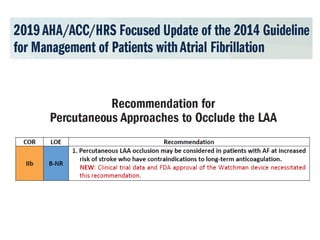
• The current 2016 European Society of Cardiology and the 2019
AHA/ACC/HRS Focused Update of the 2014 Guideline both
appropriately have a Class IIb recommendation regarding routine
surgical LAA excision in patients undergoing cardiac surgery due to
lack of randomized controlled trials (RCTs).
• However, the 2017 Society of Thoracic Surgeons guideline
statement gives a Class IIa recommendation for LAA closure.
• Despite these recommendations, several patients undergoing mitral
valve surgery or patients with AF and a high risk of stroke routinely
undergo LAA amputation, either during surgery or thoracoscopically
under general anesthesia by stapling or a loop snare.
• A meta-analysis reported a LAA exclusion rate of 55% to 68% with
various surgical methods .
– Bajaj NS, Parashar A, Agarwal S, et al. Percutaneous left atrial appendage occlusion for
stroke prophylaxis in nonvalvular atrial fibrillation: a systematic review and analysis of
observational studies. J Am Coll Cardiol Intv 2014;7:296–304
Percutaneous LAA Exclusion Devices
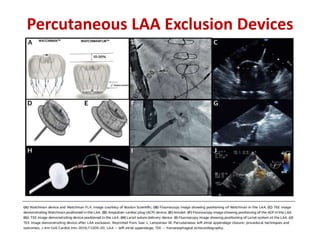
• Current catheter-based devices for LAAO are based on three
different principles:
– Plug: endovascular delivery of a device lobe or umbrella
obstructing the neck of the LAA, thereby preventing blood flow
into the body of the LAA. LAA exclusion relies on
sealing/endocardialisation of the device lobe/umbrella.
• e.g. WATCHMANTM, WaveCrestVR
– Pacifier principle: endovascular delivery of a device with a lobe
or umbrella and an additional disc to seal the ostium of the LAA
from the left atrial side. LAA exclusion relies on
sealing/endocardialisation of the device lobe/umbrella
• e.g. AMPLATZERTM Cardiac Plug [ACP], AmuletTM and/or the sealing
disc (ACP, Amulet, Ultraseal, LAmbreTM.
– Ligation: LARIAT to snare and ligate the body of the LAA using an
endocardial and epicardial approach. LAA exclusion relies on
complete ligation of the neck of the LAA
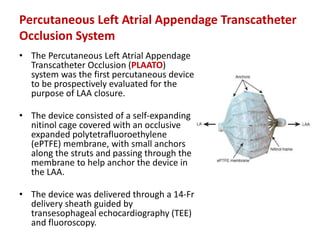
Percutaneous Left Atrial Appendage Transcatheter
Occlusion System
• The Percutaneous Left Atrial Appendage
Transcatheter Occlusion (PLAATO)
system was the first percutaneous device
to be prospectively evaluated for the
purpose of LAA closure.
• The device consisted of a self-expanding
nitinol cage covered with an occlusive
expanded polytetrafluoroethylene
(ePTFE) membrane, with small anchors
along the struts and passing through the
membrane to help anchor the device in
the LAA.
• The device was delivered through a 14-Fr
delivery sheath guided by
transesophageal echocardiography (TEE)
and fluoroscopy.
• Device feasibility and long-term outcomes were evaluated in a
prospective, nonrandomized, multicenter study of 64 AF
patients in North America who were at high risk for
thromboembolism (CHADS2 score ≥2) but who were not
candidates for warfarin.
• Patients were treated after the procedure with indefinite
aspirin and 4 to 6 weeks of clopidogrel.
• Anatomic closure at the time of the procedure (i.e., residual
flow area ≤3 mm wide) was achieved in 98% of cases, and
safety outcomes were excellent (i.e., only one major device-
related adverse event within 1 month of the procedure).
• At the 5-year follow-up, the observed rate of stroke or
transient ischemic attack was 3.8% per year, compared with
an expected rate of 6.6% based on the CHADS2 score of the
study population.
• The European prospective, multicenter, observational registry,
a total of 180high-risk AF patients were treated with the
PLAATO device.
• LAA occlusion was successful in 90%.
• The major periprocedural complication was cardiac
tamponade, which occurred in 3.3% of cases.
• At 129 patient-years of follow-up, the observed incidence of
stroke was 2.3% per year, compared with the expected 6.6%.
• The device was not evaluated beyond these studies due to
financial considerations.
• However, the PLAATO experience serves as proof of principle
for transcatheter occlusion of the LAA for stroke prevention.
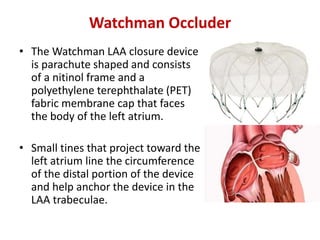
Watchman Occluder
• The Watchman LAA closure device
is parachute shaped and consists
of a nitinol frame and a
polyethylene terephthalate (PET)
fabric membrane cap that faces
the body of the left atrium.
• Small tines that project toward the
left atrium line the circumference
of the distal portion of the device
and help anchor the device in the
LAA trabeculae.
• Device size corresponds to the diameter of the device measured at
the proximal shoulders, which is its widest portion.
• The manufacturer recommends oversizing the device by 8% to 20%.
• The Watchman device is used to occlude LAAs between
approximately 17 and 33 mm in diameter, as long as there is
sufficient depth to accommodate the device, whose length is
approximately equal to its diameter.
• The device can be partially recaptured and redeployed before
release from the delivery cable if the implant location is too deep,
or it can be fully recaptured and removed if it is deployed too
proximally or a different device size is required.
• This device is CE marked for sale within the European Economic
Area and is approved by FDA in US.
Preprocedural TEE guided assessment of the LAA
before Watchman occluder implantation
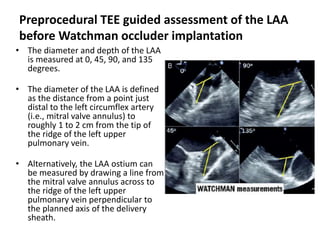
• The diameter and depth of the LAA
is measured at 0, 45, 90, and 135
degrees.
• The diameter of the LAA is defined
as the distance from a point just
distal to the left circumflex artery
(i.e., mitral valve annulus) to
roughly 1 to 2 cm from the tip of
the ridge of the left upper
pulmonary vein.
• Alternatively, the LAA ostium can
be measured by drawing a line from
the mitral valve annulus across to
the ridge of the left upper
pulmonary vein perpendicular to
the planned axis of the delivery
sheath.
Implantation Procedure
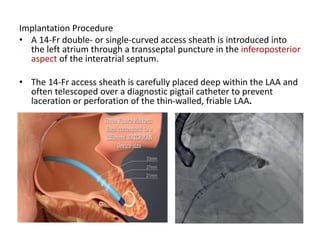
• A 14-Fr double- or single-curved access sheath is introduced into
the left atrium through a transseptal puncture in the inferoposterior
aspect of the interatrial septum.
• The 14-Fr access sheath is carefully placed deep within the LAA and
often telescoped over a diagnostic pigtail catheter to prevent
laceration or perforation of the thin-walled, friable LAA.
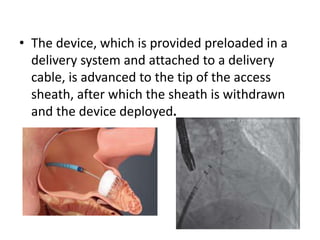
• The device, which is provided preloaded in a
delivery system and attached to a delivery
cable, is advanced to the tip of the access
sheath, after which the sheath is withdrawn
and the device deployed.
• Once the device has been deployed, use fluoroscopy
and TEE to confirm the device release criteria have
been met. These are: Position, Anchor, Size and Seal
(PASS.)
• POSITION: To confirm that the device was properly
positioned, ensure that the plane of maximum
diameter of the device is at or just distal to the orifice
of the LAA, and that it spans the entire LAA ostium.
• ANCHOR: To confirm the device is anchored in place,
withdraw the access sheath/delivery catheter assembly
1 - 2 cm from the face of the device. Gently retract and
release the deployment knob. The device and LAA
should move in unison.
• SIZE: To confirm the device size, measure the plane of
the maximum diameter of the device using TEE in the
standard 4 views 0, 45, 90, and 135 degrees, ensuring
the threaded insert is visible. The device should be 80-
92% of the original size.
• SEAL: Using color Doppler, ensure that all of the lobes
distal to device are sealed. Ideally, no color flow should
be detected near the device. If a very small gap is
visible between the wall of the left atrial appendage
and the device, no adjustment is needed.
• If there is a gap or jet around the device that is larger
than 5 mm, the device should be repositioned or fully
recaptured and replaced.
• If all release criteria are met, move the access
sheath/delivery catheter up to the face of the device
and rotate the deployment knob 3-5 turns
counterclockwise to release.
• After release, perform angiography with contrast dye
to document that the device is still in place. Then,
using TEE, recheck the size and seal. Remove the
sheath assembly from the left atrium.
PROTECT AF trial
• PROTECT AF was a worldwide prospective RCT,
including 707 patients with nonvalvular AF with a
CHADS2 score ≥1, comparing the WATCHMAN device
and warfarin with 2:1 randomization.
• The post-procedural antithrombotic strategy included
45 days of warfarin, which was discontinued if a TEE
showed a ≤5 mm peridevice leak, followed by aspirin
and clopidogrel for 6 months and then aspirin
indefinitely.
• Successful device implantation was documented in
91% of subjects, whereas TEE criteria for warfarin
discontinuation were met in 86% and 92% at 45 days
and 6 months, respectively.
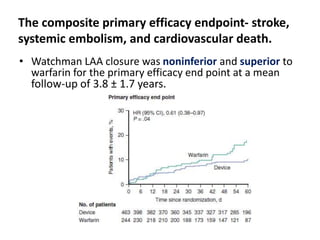
The composite primary efficacy endpoint- stroke,
systemic embolism, and cardiovascular death.
• Watchman LAA closure was noninferior and superior to
warfarin for the primary efficacy end point at a mean
follow-up of 3.8 ± 1.7 years.
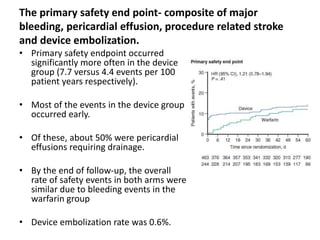
The primary safety end point- composite of major
bleeding, pericardial effusion, procedure related stroke
and device embolization.
• Primary safety endpoint occurred
significantly more often in the device
group (7.7 versus 4.4 events per 100
patient years respectively).
• Most of the events in the device group
occurred early.
• Of these, about 50% were pericardial
effusions requiring drainage.
• By the end of follow-up, the overall
rate of safety events in both arms were
similar due to bleeding events in the
warfarin group
• Device embolization rate was 0.6%.
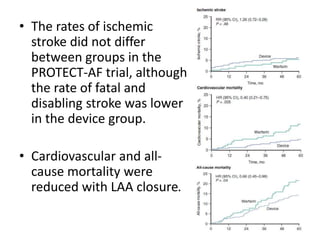
• The rates of ischemic
stroke did not differ
between groups in the
PROTECT-AF trial, although
the rate of fatal and
disabling stroke was lower
in the device group.
• Cardiovascular and all-
cause mortality were
reduced with LAA closure.
PREVAIL trial
• The PREVAIL trial was conducted to answer some of the
safety concerns raised by the FDA from the PROTECT AF
study.
• Study included 407 patients with a similar 2:1
randomization between the WATCHMAN device and
warfarin.
• The study required at least 25% of patients to be treated by
new operators with no previous experience with the
WATCHMAN device.
• The post-procedural antithrombotic strategy was similar to
that in the PROTECT AF trial.
• The results demonstrated that, when
compared with warfarin, WATCHMAN device
did not achieve the first pre-specified criterion
for noninferiority for the composite rate of
stroke, systemic thromboembolism, or
cardiovascular or unexplained death.
• However, WATCHMAN device met both the
second noninferiority criterion and safety
endpoint of rate of stroke or systemic
thromboembolism >7 days post-implantation.
• The WATCHMAN device was non-inferior to warfarin
for the composite of stroke, systemic embolism, and
cardiovascular/unexplained death.
• Differences in mortality, haemorrhagic stroke and
major bleeding favoured the WATCHMAN.
• There was a numerically higher rate of ischaemic stroke
and systemic embolism in the WATCHMAN group, but
this did not reach statistical significance.
• The CAP registry followed the 502 patients
enrolled in the device arm of PROTECT AF and
an additional 460 non-randomised patients.
• There was a significant decline in procedure-
or device-related adverse events, emphasising
the role of operator experience in improving
safety.
• The long-term incidence of severe bleeding was examined
in the 1,114 patients enrolled in PROTECT AF and PREVAIL.
• After a mean follow-up of 3.1 years, the overall bleeding
rate between the device and the warfarin groups was
similar; however, once the device group discontinued
adjunctive OAC and antiplatelet therapy, there was a
significant reduction in severe bleeding events.
• The overall similarity between groups was driven mainly by
perioperative bleeding complications.
WATCHMAN device in patients unable to take OAC
• The ASAP registry enrolled 150 patients with a CHADS2
score of 1 or more ineligible for vitamin K antagonist
(VKA) OAC.
• The WATCHMAN device was inserted together with a
dual antiplatelet regimen of acetylsalicylic acid (ASA)
and clopidogrel for six months followed by
acetylsalicylic acid alone.
• A history of haemorrhage or bleeding tendencies was
present in 93%.
• 8.7% had procedure- or device-related safety events.
• The incidence of stroke or systemic embolism was 2.6
per year, significantly lower than the CHADS2
estimated event rate of 7.3%.
EWOLUTION registry
• The international multicentre EWOLUTION prospective registry
reported on 1,021 patients receiving a WATCHMAN device.
• Oral anticoagulation was contraindicated in 62% and 45% had
suffered a prior stroke.
• Implantation was successful in 98.5%.
• Device- or procedure-related adverse events were seen in 2.8%
up to seven days, a significant reduction compared to PROTECT
AF, PREVAIL and the CAP registries.
• One-year follow-up revealed a mortality rate of 9.8%, and an
ischaemic stroke rate of 1.1% (84% RRR).
• Antiplatelet therapy was used in 83% and VKA in only 8%
• The WATCHMAN LAA occluder has been approved by
the FDA for use within the United States.
• It is indicated to reduce the risk of thromboembolism
from the LAA in patients with AF who are
– at increased risk for stroke or systemic embolism based on
CHADS2 or CHA2DS2VASc and are
– recommended for anticoagulation;
– deemed by their physicians to be suitable for warfarin; and
– have an appropriate rationale to seek a nonpharmacologic
alternative to warfarin, taking into account the safety and
effectiveness of the device compared with warfarin.
Amplatzer Cardiac Plug and Amulet
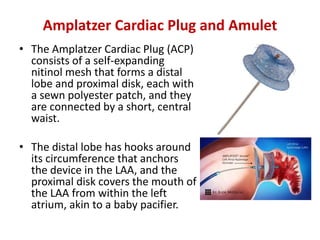
• The Amplatzer Cardiac Plug (ACP)
consists of a self-expanding
nitinol mesh that forms a distal
lobe and proximal disk, each with
a sewn polyester patch, and they
are connected by a short, central
waist.
• The distal lobe has hooks around
its circumference that anchors
the device in the LAA, and the
proximal disk covers the mouth of
the LAA from within the left
atrium, akin to a baby pacifier.
• Device sizing is based on the maximal diameter of
the distal lobe’s landing zone, which is measured
approximately 10 mm distal to the LAA orifice.
• The second-generation ACP, the Amulet, has a
slightly longer distal lobe, more stabilizing hooks,
a longer central waist, and a larger-diameter
proximal disk with a recessed threaded insert.
• These modifications improve device stability,
position, residual leak, and the incidence of
device-associated thrombi
• For the ACP or Amulet, the landing zone is
measured approximately 12 to 15 mm from
the LAA orifice.
• The device is delivered through a 12- to 14-Fr
double-curved sheath that is introduced into
the LAA from the right femoral vein through a
transseptal puncture.
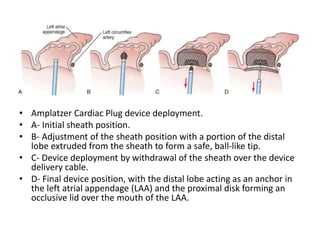
• Amplatzer Cardiac Plug device deployment.
• A- Initial sheath position.
• B- Adjustment of the sheath position with a portion of the distal
lobe extruded from the sheath to form a safe, ball-like tip.
• C- Device deployment by withdrawal of the sheath over the device
delivery cable.
• D- Final device position, with the distal lobe acting as an anchor in
the left atrial appendage (LAA) and the proximal disk forming an
occlusive lid over the mouth of the LAA.
ACP and amulet evidence
• Safety and efficacy data for the ACP device were examined in a
1,047-patient registry.
• The procedure success rate was 97.3% with a procedure-related
adverse event rate of 5%.
• Although the majority of implants were performed on single or dual
antiplatelet therapy, nearly 40% used OAC at some point.
• After a mean follow-up of 13 months, the annual stroke or transient
ischaemic attack (TIA) rate was 2.3%, against an estimated rate of
5.6% based on the CHA2DS2-VASc scores.
• The subgroup on long-term acetylsalicylic acid monotherapy or no
therapy had an annual stroke or TIA rate of 1.3% against an
estimated 5.6%.
» Tzikas A, Shakir S, Gafoor S, Omran H, Berti S, Santoro G, Kefer J, Landmesser U,
Nielsen-Kudsk JE, Cruz-Gonzalez I, Sievert H, Tichelbacker T, Kanagaratnam P,
Nietlispach F, Aminian A, Kasch F, Freixa X, Danna P, Rezzaghi M, Vermeersch P,
Stock F, Stolcova M, Costa M, Ibrahim R, Schillinger W, Meier B, Park JW. Left atrial
appendage occlusion for stroke prevention in atrial fibrillation multicentre
experience with the AMPLATZER Cardiac Plug. EuroIntervention. 2016;11:1170–9
• The Amulet registry enrolled 1,088 patients, 83% with
contraindications to OAC.
• The device was successfully implanted in 99% with a
3.2% major adverse event rate; 77% of patients were
discharged on a single antiplatelet agent or DAPT.
• At 12-month follow-up in this population with a mean
CHA2DS2-VASc score of 4.2 there was a 2.9% ischaemic
stroke rate.
– Landmesser U, Tondo C, Camm J, Diener HC, Paul V, Schmidt B, Settergren
M, Teiger E, Nielsen-Kudsk JE, Hildick-Smith D. Left atrial appendage
occlusionwith the AMPLATZER Amulet device: one-year follow-up from
the prospective global Amulet observational registry. EuroIntervention.
2018;14:e590–7
• Both generations of the transcatheter self-
expanding nitinol plug are currently not FDA-
approved in the United States but are available in
Europe.
• In the United States, the second-generation
transcatheter self-expanding nitinol plug is
currently being randomized to WATCHMAN
device in the ongoing Amulet–IDE (AMPLATZER
Amulet LAA Occluder Trial) clinical trial to
evaluate its safety and efficacy for stroke
prevention in AF.
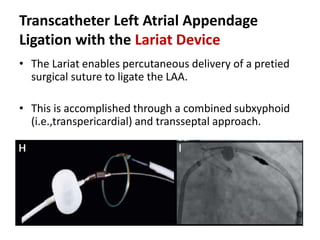
Transcatheter Left Atrial Appendage
Ligation with the Lariat Device
• The Lariat enables percutaneous delivery of a pretied
surgical suture to ligate the LAA.
• This is accomplished through a combined subxyphoid
(i.e.,transpericardial) and transseptal approach.
• Anatomic eligibility for the procedure is determined by
cardiac computed tomography (CT).
• Appendages with a diameter greater than 40 mm, lobes
behind the pulmonary artery, or a posterior orientation
should be avoided.
• A larger, second-generation device will allow closure of
appendages as large as 45 mm in diameter.
• The procedure cannot be performed in patients with prior
cardiac surgery because it requires an intact pericardium.
• The procedure should also be avoided in patients with prior
pericarditis because pericardial adhesions can prevent
manipulation in the pericardial space and hinder
procedural success.
• The Lariat system is a percutaneous endo-
epicardial suture delivery system.
• An epicardial delivery snare with a preformed
suture is delivered over a magnet tipped wire
placed epicardially at the LAA that aligns with
another magnet-tipped wire delivered
endocardially via a transseptal approach and
positioned at the LAA apex
Evidence for LARIAT
• The dataset for the safety and efficacy of LAA
closure with the Lariat has been limited to a few
small, observational studies.
• The studies suggest that the major complications
associated with the procedure are significant
pericardial effusions and postprocedural
pericarditis.
• Results are insufficient to determine the clinical
efficacy of the device for stroke prevention.
• The largest LARIAT registry collected data retrospectively on
712 patients from 18 US hospitals.
• Procedure success rate was 95.5%.
• Periprocedural complications occurred in 5.3% and were
influenced by the pericardial puncture technique.
• A further 4.5% had delayed complications, predominantly
pericarditis.
• Currently, the percutaneous endo-epicardial suture delivery
system has received a CE mark and 510K FDA approval for
soft tissue apposition, but not for stroke prevention in AF.
• LAA ligation can have an antiarrhythmic effect in
selected patients because the LAA can be a source of
AF.
• The Lariat procedure appears to isolate LAA electrical
activity.
• In an observational study, the AF burden in patients
with known AF triggers in the LAA was significantly
reduced at 12 months after the Lariat procedure
compared with baseline AF activity.
– Afzal MR, Kanmanthareddy A, Earnest M, et al: Impact of left atrial
appendage exclusion using an epicardial ligation system (LARIAT) on atrial
fibrillation burden in patients with cardiac implantable electronic devices.
Heart Rhythm 12:52–59, 2015.
• It has been proposed that LAA ligation with the suture
causes transmural necrosis of the epicardial structures,
including the autonomic ganglia that lay between the
LAA and left superior pulmonary veins (PVs) and the
vein of Marshall, which might be the reason it may
improve clinical outcomes.
• aMAZE (LAA Ligation Adjunctive to PVI for Persistent or
Longstanding Persistent Atrial Fibrillation), a
multicenter RCT for the treatment of persistent or
longstanding persistent AF, will determine the safety
and efficacy of using adjunctive percutaneous
endoepicardial suture delivery in persistent AF.
Investigational devices
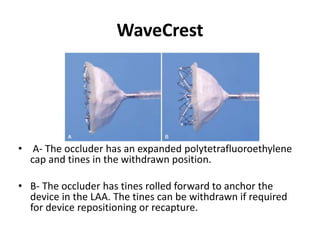
WaveCrest
• A- The occluder has an expanded polytetrafluoroethylene
cap and tines in the withdrawn position.
• B- The occluder has tines rolled forward to anchor the
device in the LAA. The tines can be withdrawn if required
for device repositioning or recapture.
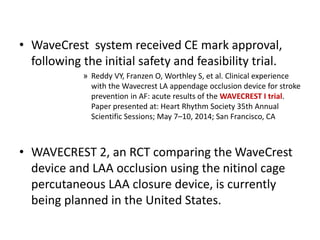
• WaveCrest system received CE mark approval,
following the initial safety and feasibility trial.
» Reddy VY, Franzen O, Worthley S, et al. Clinical experience
with the Wavecrest LA appendage occlusion device for stroke
prevention in AF: acute results of the WAVECREST I trial.
Paper presented at: Heart Rhythm Society 35th Annual
Scientific Sessions; May 7–10, 2014; San Francisco, CA
• WAVECREST 2, an RCT comparing the WaveCrest
device and LAA occlusion using the nitinol cage
percutaneous LAA closure device, is currently
being planned in the United States.
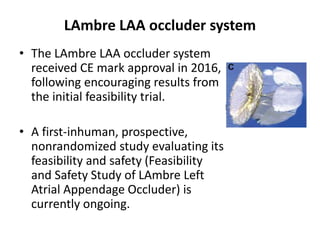
LAmbre LAA occluder system
• The LAmbre LAA occluder system
received CE mark approval in 2016,
following encouraging results from
the initial feasibility trial.
• A first-inhuman, prospective,
nonrandomized study evaluating its
feasibility and safety (Feasibility
and Safety Study of LAmbre Left
Atrial Appendage Occluder) is
currently ongoing.
• Several other devices are in the clinical
investigation pipeline, such as the:
1) Occlutech device,
2) Ultraseal LAA closure device,
3) Transcatheter Patch and
4) Sierra Ligation System
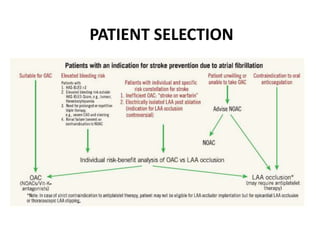
PATIENT SELECTION
Medical conditions which represent
contraindications to long-term oral anticoagulation
• Risk for major bleeding, especially life-
threatening or disabling bleeding due to an
“untreatable” source of
– Intracranial/intraspinal bleeding (e.g., diffuse amyloid
angiopathy, untreatable vascular malformation)
– Severe gastrointestinal (e.g., diffuse angiodysplasia)
pulmonary or urogenital source of bleeding that
cannot be corrected
• Severe side effects under vitamin K antagonists
and/or contraindicationfor NOAC
PATIENTS AT HIGH RISK OF STROKE WITH
CONTRAINDICATIONS TO ANTICOAGULATION
• The ASAP trial and EWOLUTION registry support the benefit of
the percutaneous LAA closure device in patients who are
deemed ineligible for OAC, as a significant proportion of
patients were treated with DAPT in both registries, with
substantial reductions in stroke and major bleeding.
• It currently remains unclear if endocardial LAA closure is
noninferior to DOAC therapy; this subject needs further
investigation.
• The ongoing randomized trial, ASAP-TOO (Assessment of the
WATCHMAN Device in Patients Unsuitable for Oral
Anticoagulation) will further elucidate the benefit of the
nitinol cage percutaneous LAA closure device in patients who
are ineligible for OAC.
PATIENTS ON DIALYSIS
• There are substantial data on the lack of net benefit
and excessive bleeding with OAC in patients with AF on
dialysis.
• There are limited data regarding the benefit of DOACs
in this group of patients.
• In theory, LAA closure may be a logical strategy in these
high-risk patients.
• Currently, most LAA studies have excluded patients on
dialysis.
• A recent observational study in patients with
chronic kidney disease (including dialysis)
receiving the transcatheter self-expanding nitinol
plug device reported excellent procedural success
with an acceptable rate of complications.
» Kefer J, Tzikas A, Freixa X, et al. Impact of chronic kidney
disease on left atrial appendage occlusion for stroke
prevention in patients with atrial fibrillation. Int J Cardiol
2016;207:335–40.
• Further studies are needed to support the safety
and efficacy of LAA closure devices in patients
with end-stage renal disease.
PATIENTS WITH HIGH HAS-BLED OR HIGH
CHA2DS2-VASC SCORES
• In theory, patients with high HAS-BLED scores can benefit from LAA
closure, as studies have consistently shown a significant reduction
in risk of major bleeding that can translate into a survival benefit.
• Similarly, patients with a very high risk of stroke with high
CHA2DS2-VASc scores can continue to have events despite OAC, as
demonstrated in the ROCKET AF trial, where a subset of patients
with CHA2DS2-VASc score ≥5 had 5 events/100 patient-years over a
2-year period.
• These patients did not have any bleeding contraindications to OACs,
but could potentially benefit from combination therapy with LAA
closure and OAC.
• Currently, there are no data to support such a strategy in these
high-risk patients.
PATIENTS WITH PERSISTENT AF
• As yet, there are no data showing that
endocardial LAA exclusion devices reduce the
arrhythmia burden in patients with AF.
• There are several observational studies
demonstrating a reduction in AF burden after
epicardial LAA ligation with the percutaneous
endo-epicardial suture deliverysystem or LAA
exclusion system.
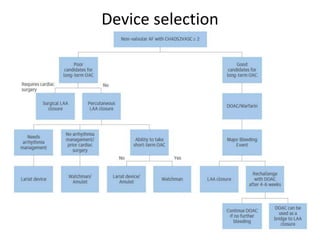
Device selection
COMPLICATIONS OF LAA CLOSURE
1) Post-procedural thrombosis/bleeding
2) Post-procedural leaks
3) Device embolization
4) Cardiac perforation
5) Pericardial effusion with tamponade
6) Stroke/TIA
7) Vascular complications
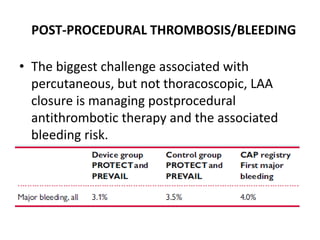
POST-PROCEDURAL THROMBOSIS/BLEEDING
• The biggest challenge associated with
percutaneous, but not thoracoscopic, LAA
closure is managing postprocedural
antithrombotic therapy and the associated
bleeding risk.
• Recent studies have demonstrated that the incidence of
device-related thrombus with endocardial devices ranges
from 3% to 7.2%.
• Epicardial LAA exclusion (LAA exclusion system or
percutaneous endo-epicardial suture delivery system) has
the advantages of not having a foreign body in the
endovascular system and, theoretically, lower risk of
thrombus formation.
• But real-world data for the percutaneous endo-epicardial
suture delivery system suggest similar risk compared with
the nitinol cage percutaneous LAA closure device.
» Lakkireddy D, Afzal MR, Lee RJ, et al. Short and long-term outcomes of
percutaneous left atrial appendage suture ligation: results from a US
multicenter evaluation. Heart Rhythm 2016;13:1030–6.
POST-PROCEDURAL LEAKS
• Post-procedural leaks are common after percutaneous
LAA closure and have been reported with both
endocardial and percutaneous endo-epicardial closure,
but not LAA exclusion system closure.
• The incidence of reported leaks- 62% for PLAATO, 32%
for WATCHMAN, 10% for ACP.
• The consequences of such peridevice leaks remain
unclear at this point, with studies reporting conflicting
results regarding risk of stroke.
• In the PROTECT AF trial with a WATCHMAN device Leaks
were present in 32% patients and were graded as
– minor (<1 mm),
– moderate (1-3 mm), or
– major (>3 mm) and
• There was no significant statistical relationship
between the presence or severity of peri-device
flow and the incidence of stroke or systemic
embolism during follow-up.
DEVICE EMBOLIZATION
• Device embolization is a rare, but a potential challenge
associated with endocardial LAA devices, such as the
WATCHMAN device and ACP/Amulet device, with a
reported incidence of <4% .
• It appears that most of the device embolizations reported
were acute and occurred during the hospital stay (65%)
after the procedure, whereas about 30% were late
embolizations picked up on routine TEE follow-up.
• Although most device embolizations in published reports
were retrieved percutaneously, a surgical approach may be
required in some complex cases.
• It is recommended that inexperienced
operators obtain adequate imaging of the LAA
anatomy by both TEE and CT scan to facilitate
adequate device sizing to minimize this
complication.
• Furthermore, follow-up TEEs are
recommended at 45 days, 6 months, and 12
months.
CATHETER ABLATION WITH LAA CLOSURE
• Patients who undergo LAA closure are usually
elderly, highrisk patients with AF who may need
additional radiofrequency catheter ablation
procedures targeting both PV and other, non-PV
sites for symptomatic AF.
• Performing ablation, especially around the LAA,
in the presence of an endocardial device can be
challenging, due to remodeling of the ostium of
the LAA, potentially increasing the risk of new
peridevice leaks.
Left atrial appendage occlusion (LAAO) vs oral
anticoagulants
• Whilst the non-vitamin K dependent oral
anticoagulants (NOAC) vs warfarin trials recruited
tens of thousands of patients, the pivotal trials
underpinning LAAO, PROTECT AF and PREVAIL,
enrolled only 730 and 382 patients, respectively.
• The smaller sample sizes of the LAAO trials
diminish confidence in detecting differences in
rates of infrequently occurring events.
• Besides sample size, other aspects that diminish
confidence in the WATCHMAN trials relative to NOAC
trials include laxer noninferiority margins and the
addition of cardiovascular (CV)/unexplained death.
• Whilst the RELY and ARISTOTLE trials used a non-
inferiority risk ratio of 1.46 and 1.44, respectively, the
PROTECT AF and PREVAIL trials employed a laxer
margin of 2.0 and 1.75, respectively.
• The choice to include CV/unexplained death, an event
unlikely to be affected by either treatment arm, biases
towards non-inferiority.
Future and ongoing studies for LAAO
• ANDES (Short-Term Anticoagulation Versus Antiplatelet Therapy for
Preventing Device Thrombosis Following Left Atrial Appendage Closure)
• ASAP-TOO trial
• STROKECLOSE trial is currently recruiting patients with previous
intracerebral haemorrhage, randomised to LAAO with AMPLATZER Amulet
or medical therapy.
• PRAGUE-17 trial195 is presently recruiting patients (400 planned)
randomised to NOAC or LAAO with AMPLATZER Amulet or WATCHMAN
• SAFE-LAAC trial is currently recruiting patients (target 160) randomised to
LAAO followed by 30 days of DAPT versus LAAO followed by six months of
DAPT
• CLOSURE-AF (Left Atrial Appendage CLOSURE in Patients With Atrial
Fibrillation Compared to Medical Therapy)
• OCCLUSION-AF (Left Atrial Appendage Occlusion Versus Novel Oral
Anticoagulation for Stroke Prevention in Atrial Fibrillation)
• AMPLATZER Amulet LAA Occluder trial
Left atrial appendage closure

Left atrial appendage closure

  • 1.
    Left Atrial AppendageClosure Dr. Yogesh Shilimkar
  • 2.
    Why Do WeHave LAA? • The LAA is a vestigial structure in the human body similar to the appendix. • It is the remnant of the primordial left atrium, which develops during the third to sixth week of fetal cardiac development, whereas the smooth left atrial cavity develops later from the pulmonary venous bud. • The function and activity of the LAA can be broadly divided into 2 categories: – neurohormonal, – reservoir
  • 3.
    Neurohormonal role ofLAA • Both the left atrium and the LAA have specialized endothelial cells that are involved in the production and release of natriuretic peptides, both ANP and B- type natriuretic peptide (BNP). • The LAA appears to be the primary production site of ANP in the human heart and stores about 30% of cardiac ANP in the granulocytes, which are secreted in response to atrial stretch receptors. • The concentration of ANP in the left atrial wall is about 40 times higher than in the rest of the atrium and ventricles.
  • 4.
    Reservoir function • TheLAA also has a reservoir function and is the most distensible structure within the left atrium, acting as a decompression chamber in patients with increased LA pressure and volume. • In patients with sinus rhythm, LAA amputation diminishes the reservoir and conduit function of the left atrium. • In patients with AF, LAA remodeling occurs, which results in the LAA functioning as a static pouch with decreased Doppler flow velocities and reduced distensibility, increasing the predisposition to thrombus formation.
  • 5.
    AF, LAA andStroke • Prior studies have demonstrated that LAA is the most common source of thrombus formation in AF. • AF can lead to impairment in the conduit function of the LAA with a decrease in LAA flow velocity, which is a major predictor for thrombus in the LAA. • AF can cause a prothrombotic state manifested by endothelial dysfunction, activation of coagulation factors including platelet aggregation, prothrombin fragments, interleukin-6, thrombin–antithrombin complexes, and D- dimer.
  • 6.
    • Longstanding AFalso leads to atrial remodeling, fibrosis, and inflammation of the endothelium of the left atrium, especially the LAA, leading to focal triggers and re-entry arrhythmias, contributing to a vicious cycle. • Studies have reported that the LAA is the source of thrombus in about 90% of nonvalvular AF and 57% of valvular AF – Blackshear JL, Odell JA. Appendage obliteration to reduce stroke in cardiac surgical patients with atrial fibrillation. Ann Thorac Surg 1996;61:755–9. – Manning WJ, Silverman DI, Keighley CS, Oettgen P, Douglas PS. Transesophageal echocardiographically facilitated early cardioversion from atrial fibrillation using short-term anticoagulation: final results of a prospective 4.5-year study. J Am Coll Cardiol 1995;25:1354–61.
  • 7.
    Why LAA occlusion? •LAA is frequent source of systemic emboli. • Occlusion or removal of LAA may decrease the risk of systemic embolization. • It may be an alternative to OAC in patients with high bleeding risk. • It may be an additional treatment on top of OAC to reduce the risk of stroke.
  • 8.
    Types of LAA •Di Biase et al. described four different types of LAA shapes – windsock; – chicken wing; – cactus; – cauliflower. • Patients whose LAA has a chicken-wing morphology were found to be 79% less likely to have a stroke/transient ischemic attack (TIA) history. • Compared with chicken wing, patients with other LAA morphologies were more likely to have a stroke/TIA.
  • 9.
    Imaging of theLAA • Preprocedural: – Rule out LAA thrombus – Detailed LAA anatomy: • Bends (location, angulation) • Lobes, bifurcation • Pectinate muscle, ridge, trabeculation – Envisioning LAA device fit – Assess surrounding structures (septum, LA, PV, PA, etc.) – Measure LAA dimensions – Select fluoroscopic angles – Determine sheath selection – Determine transseptal location
  • 10.
    • Periprocedural: forguiding delivery and deployment of the device and for assessing procedural complications • Postprocedural: – Assess residual leak (LAA patency) – Assess device position (migration, embolisation) – Assess device-associated thrombus – Assess pericardial effusion – Assess surrounding structures
  • 11.
    Preprocedural imaging • TEEand/or cardiac computed tomography angiography (CCTA) are both well suited for preprocedural imaging. • Although TOE has been the traditional gold- standard preprocedural imaging for LAAO, there are several advantages with CCTA including – superior spatial resolution, – detailed three-dimensional (3D) characterisation of the LAA anatomy, – accurate sizing, and – non-invasive acquisition.
  • 12.
    LAA measurements • Measurementsof the LAA for device sizing can be different for devices, and manufacturer instructions for use should be adhered to. • For example, with the WATCHMAN device, the ostium of the LAA is measured from the circumflex coronary artery to a superior point 1-2 cm within the pulmonary vein ridge, and the deepest feasible LAA depth is then measured from that point. • For Amulet device, the most proximal aspect of the LAA (from the inferior edge of LAA origin to the LUPV ridge superiorly) and the landing zone (12 mm inside the most proximal point) should be measured.
  • 13.
    • For TEEmeasurements, both the LAA orifice and depth should be measured in at least four angles (0, 45, 90 and 135), at the cardiac phase with largest dimension (end-systole). • 3D-TEE facilitates assessment of the shape of the LAA orifice, and measurement of the maximum and minimum diameters, as well as mean diameters
  • 14.
    CCTA vs TEE •CCTA produces the largest LAA measurements and more accurately predicts device sizes, due to the superior multiplanar 3D imaging with CCTA, allowing visualisation of maximal dimensions. • CCTA maximal LAA diameter measurements were on average 1-3 mm larger than 2D-TEE, and 2-4 mm larger than fluoroscopy measurements
  • 16.
    Surgical approaches • In1949, Madden suggested that surgical resection of the LAA in patients with AF could prevent recurrent arterial emboli. – MADDEN JL. RESECTION OF THE LEFT AURICULAR APPENDIX: A Prophylaxis for Recurrent Arterial Emboli. JAMA. 1949;140(9):769–772. • The high complication rate of the procedure prevented its widespread adoption until the 1990s, when interest in the procedure was rekindled by the development of the Cox-Maze III procedure, which included removal of the LAA. • The two general approaches to surgical LAA closure are – exclusion and – excision.
  • 17.
    • Exclusion canbe performed with running or mattress sutures, with or without felt pledgets, from the endocardial or epicardial surface or with a stapler. • Excision can be performed by stapled excision or removal and oversewing. • However, postoperative residual leaks and insufficient resection occur frequently and can be associated with thrombus and neurologic events. • Incomplete or insufficient closure is more common with suture or staple exclusion than with excision.
  • 19.
    • The resultsof observational studies that have examined the association between surgical LAA closure and stroke reduction are conflicting
  • 20.
    • The prospectiverandomized LAAOS III (Left Atrial Appendage Occlusion Study III) evaluating prophylactic LAA occlusion in surgical patients with known pre-operative AF is currently underway. • The primary end point is the first occurrence of stroke or systemic arterial embolism over a mean follow-up period of 4 years. • The results of this trial will help to define the efficacy of surgical approaches to stroke prevention.
  • 21.
  • 22.
    • Only theAtriClip LAA exclusion system is currently available. • A longterm follow-up of implanted clips showed that at 36 months, all clips were stable with no displacement, intracardiac thrombi, perfused LAA, residual neck >1 cm, strokes, TIAs, or neurological events. • The advantages of this approach are: – minimal risk of bleeding; – immediate electrical isolation of the LAA; – no need for anticoagulation during or after the procedure; and – no foreign body in the blood stream.
  • 23.
    • A multicenterevaluation of the AtriCure clip reported a >98% closure rate at 3-month follow-up with TEE/ computed tomography angiography. • The LAA exclusion system is currently CE marked and has received U.S. Food and Drug Administration (FDA) 510K approval for LAA ligation. • ATLAS (AtriClip Left Atrial Appendage Exclusion Concomitant to Structural Heart Procedures) randomized trial currently underway to evaluate the efficacy of LAA occlusion in surgical patients without pre-operative AF, but with a high CHA2DS2-VASc score in combination with a high HASBLED score.
  • 24.
    • The current2016 European Society of Cardiology and the 2019 AHA/ACC/HRS Focused Update of the 2014 Guideline both appropriately have a Class IIb recommendation regarding routine surgical LAA excision in patients undergoing cardiac surgery due to lack of randomized controlled trials (RCTs). • However, the 2017 Society of Thoracic Surgeons guideline statement gives a Class IIa recommendation for LAA closure. • Despite these recommendations, several patients undergoing mitral valve surgery or patients with AF and a high risk of stroke routinely undergo LAA amputation, either during surgery or thoracoscopically under general anesthesia by stapling or a loop snare. • A meta-analysis reported a LAA exclusion rate of 55% to 68% with various surgical methods . – Bajaj NS, Parashar A, Agarwal S, et al. Percutaneous left atrial appendage occlusion for stroke prophylaxis in nonvalvular atrial fibrillation: a systematic review and analysis of observational studies. J Am Coll Cardiol Intv 2014;7:296–304
  • 25.
  • 26.
    • Current catheter-baseddevices for LAAO are based on three different principles: – Plug: endovascular delivery of a device lobe or umbrella obstructing the neck of the LAA, thereby preventing blood flow into the body of the LAA. LAA exclusion relies on sealing/endocardialisation of the device lobe/umbrella. • e.g. WATCHMANTM, WaveCrestVR – Pacifier principle: endovascular delivery of a device with a lobe or umbrella and an additional disc to seal the ostium of the LAA from the left atrial side. LAA exclusion relies on sealing/endocardialisation of the device lobe/umbrella • e.g. AMPLATZERTM Cardiac Plug [ACP], AmuletTM and/or the sealing disc (ACP, Amulet, Ultraseal, LAmbreTM. – Ligation: LARIAT to snare and ligate the body of the LAA using an endocardial and epicardial approach. LAA exclusion relies on complete ligation of the neck of the LAA
  • 27.
    Percutaneous Left AtrialAppendage Transcatheter Occlusion System • The Percutaneous Left Atrial Appendage Transcatheter Occlusion (PLAATO) system was the first percutaneous device to be prospectively evaluated for the purpose of LAA closure. • The device consisted of a self-expanding nitinol cage covered with an occlusive expanded polytetrafluoroethylene (ePTFE) membrane, with small anchors along the struts and passing through the membrane to help anchor the device in the LAA. • The device was delivered through a 14-Fr delivery sheath guided by transesophageal echocardiography (TEE) and fluoroscopy.
  • 28.
    • Device feasibilityand long-term outcomes were evaluated in a prospective, nonrandomized, multicenter study of 64 AF patients in North America who were at high risk for thromboembolism (CHADS2 score ≥2) but who were not candidates for warfarin. • Patients were treated after the procedure with indefinite aspirin and 4 to 6 weeks of clopidogrel. • Anatomic closure at the time of the procedure (i.e., residual flow area ≤3 mm wide) was achieved in 98% of cases, and safety outcomes were excellent (i.e., only one major device- related adverse event within 1 month of the procedure). • At the 5-year follow-up, the observed rate of stroke or transient ischemic attack was 3.8% per year, compared with an expected rate of 6.6% based on the CHADS2 score of the study population.
  • 29.
    • The Europeanprospective, multicenter, observational registry, a total of 180high-risk AF patients were treated with the PLAATO device. • LAA occlusion was successful in 90%. • The major periprocedural complication was cardiac tamponade, which occurred in 3.3% of cases. • At 129 patient-years of follow-up, the observed incidence of stroke was 2.3% per year, compared with the expected 6.6%. • The device was not evaluated beyond these studies due to financial considerations. • However, the PLAATO experience serves as proof of principle for transcatheter occlusion of the LAA for stroke prevention.
  • 30.
    Watchman Occluder • TheWatchman LAA closure device is parachute shaped and consists of a nitinol frame and a polyethylene terephthalate (PET) fabric membrane cap that faces the body of the left atrium. • Small tines that project toward the left atrium line the circumference of the distal portion of the device and help anchor the device in the LAA trabeculae.
  • 31.
    • Device sizecorresponds to the diameter of the device measured at the proximal shoulders, which is its widest portion. • The manufacturer recommends oversizing the device by 8% to 20%. • The Watchman device is used to occlude LAAs between approximately 17 and 33 mm in diameter, as long as there is sufficient depth to accommodate the device, whose length is approximately equal to its diameter. • The device can be partially recaptured and redeployed before release from the delivery cable if the implant location is too deep, or it can be fully recaptured and removed if it is deployed too proximally or a different device size is required. • This device is CE marked for sale within the European Economic Area and is approved by FDA in US.
  • 32.
    Preprocedural TEE guidedassessment of the LAA before Watchman occluder implantation • The diameter and depth of the LAA is measured at 0, 45, 90, and 135 degrees. • The diameter of the LAA is defined as the distance from a point just distal to the left circumflex artery (i.e., mitral valve annulus) to roughly 1 to 2 cm from the tip of the ridge of the left upper pulmonary vein. • Alternatively, the LAA ostium can be measured by drawing a line from the mitral valve annulus across to the ridge of the left upper pulmonary vein perpendicular to the planned axis of the delivery sheath.
  • 33.
    Implantation Procedure • A14-Fr double- or single-curved access sheath is introduced into the left atrium through a transseptal puncture in the inferoposterior aspect of the interatrial septum. • The 14-Fr access sheath is carefully placed deep within the LAA and often telescoped over a diagnostic pigtail catheter to prevent laceration or perforation of the thin-walled, friable LAA.
  • 34.
    • The device,which is provided preloaded in a delivery system and attached to a delivery cable, is advanced to the tip of the access sheath, after which the sheath is withdrawn and the device deployed.
  • 35.
    • Once thedevice has been deployed, use fluoroscopy and TEE to confirm the device release criteria have been met. These are: Position, Anchor, Size and Seal (PASS.) • POSITION: To confirm that the device was properly positioned, ensure that the plane of maximum diameter of the device is at or just distal to the orifice of the LAA, and that it spans the entire LAA ostium. • ANCHOR: To confirm the device is anchored in place, withdraw the access sheath/delivery catheter assembly 1 - 2 cm from the face of the device. Gently retract and release the deployment knob. The device and LAA should move in unison.
  • 36.
    • SIZE: Toconfirm the device size, measure the plane of the maximum diameter of the device using TEE in the standard 4 views 0, 45, 90, and 135 degrees, ensuring the threaded insert is visible. The device should be 80- 92% of the original size. • SEAL: Using color Doppler, ensure that all of the lobes distal to device are sealed. Ideally, no color flow should be detected near the device. If a very small gap is visible between the wall of the left atrial appendage and the device, no adjustment is needed.
  • 37.
    • If thereis a gap or jet around the device that is larger than 5 mm, the device should be repositioned or fully recaptured and replaced. • If all release criteria are met, move the access sheath/delivery catheter up to the face of the device and rotate the deployment knob 3-5 turns counterclockwise to release. • After release, perform angiography with contrast dye to document that the device is still in place. Then, using TEE, recheck the size and seal. Remove the sheath assembly from the left atrium.
  • 38.
    PROTECT AF trial •PROTECT AF was a worldwide prospective RCT, including 707 patients with nonvalvular AF with a CHADS2 score ≥1, comparing the WATCHMAN device and warfarin with 2:1 randomization. • The post-procedural antithrombotic strategy included 45 days of warfarin, which was discontinued if a TEE showed a ≤5 mm peridevice leak, followed by aspirin and clopidogrel for 6 months and then aspirin indefinitely. • Successful device implantation was documented in 91% of subjects, whereas TEE criteria for warfarin discontinuation were met in 86% and 92% at 45 days and 6 months, respectively.
  • 39.
    The composite primaryefficacy endpoint- stroke, systemic embolism, and cardiovascular death. • Watchman LAA closure was noninferior and superior to warfarin for the primary efficacy end point at a mean follow-up of 3.8 ± 1.7 years.
  • 40.
    The primary safetyend point- composite of major bleeding, pericardial effusion, procedure related stroke and device embolization. • Primary safety endpoint occurred significantly more often in the device group (7.7 versus 4.4 events per 100 patient years respectively). • Most of the events in the device group occurred early. • Of these, about 50% were pericardial effusions requiring drainage. • By the end of follow-up, the overall rate of safety events in both arms were similar due to bleeding events in the warfarin group • Device embolization rate was 0.6%.
  • 41.
    • The ratesof ischemic stroke did not differ between groups in the PROTECT-AF trial, although the rate of fatal and disabling stroke was lower in the device group. • Cardiovascular and all- cause mortality were reduced with LAA closure.
  • 42.
    PREVAIL trial • ThePREVAIL trial was conducted to answer some of the safety concerns raised by the FDA from the PROTECT AF study. • Study included 407 patients with a similar 2:1 randomization between the WATCHMAN device and warfarin. • The study required at least 25% of patients to be treated by new operators with no previous experience with the WATCHMAN device. • The post-procedural antithrombotic strategy was similar to that in the PROTECT AF trial.
  • 43.
    • The resultsdemonstrated that, when compared with warfarin, WATCHMAN device did not achieve the first pre-specified criterion for noninferiority for the composite rate of stroke, systemic thromboembolism, or cardiovascular or unexplained death. • However, WATCHMAN device met both the second noninferiority criterion and safety endpoint of rate of stroke or systemic thromboembolism >7 days post-implantation.
  • 44.
    • The WATCHMANdevice was non-inferior to warfarin for the composite of stroke, systemic embolism, and cardiovascular/unexplained death. • Differences in mortality, haemorrhagic stroke and major bleeding favoured the WATCHMAN. • There was a numerically higher rate of ischaemic stroke and systemic embolism in the WATCHMAN group, but this did not reach statistical significance.
  • 45.
    • The CAPregistry followed the 502 patients enrolled in the device arm of PROTECT AF and an additional 460 non-randomised patients. • There was a significant decline in procedure- or device-related adverse events, emphasising the role of operator experience in improving safety.
  • 46.
    • The long-termincidence of severe bleeding was examined in the 1,114 patients enrolled in PROTECT AF and PREVAIL. • After a mean follow-up of 3.1 years, the overall bleeding rate between the device and the warfarin groups was similar; however, once the device group discontinued adjunctive OAC and antiplatelet therapy, there was a significant reduction in severe bleeding events. • The overall similarity between groups was driven mainly by perioperative bleeding complications.
  • 47.
    WATCHMAN device inpatients unable to take OAC • The ASAP registry enrolled 150 patients with a CHADS2 score of 1 or more ineligible for vitamin K antagonist (VKA) OAC. • The WATCHMAN device was inserted together with a dual antiplatelet regimen of acetylsalicylic acid (ASA) and clopidogrel for six months followed by acetylsalicylic acid alone. • A history of haemorrhage or bleeding tendencies was present in 93%. • 8.7% had procedure- or device-related safety events. • The incidence of stroke or systemic embolism was 2.6 per year, significantly lower than the CHADS2 estimated event rate of 7.3%.
  • 48.
    EWOLUTION registry • Theinternational multicentre EWOLUTION prospective registry reported on 1,021 patients receiving a WATCHMAN device. • Oral anticoagulation was contraindicated in 62% and 45% had suffered a prior stroke. • Implantation was successful in 98.5%. • Device- or procedure-related adverse events were seen in 2.8% up to seven days, a significant reduction compared to PROTECT AF, PREVAIL and the CAP registries. • One-year follow-up revealed a mortality rate of 9.8%, and an ischaemic stroke rate of 1.1% (84% RRR). • Antiplatelet therapy was used in 83% and VKA in only 8%
  • 49.
    • The WATCHMANLAA occluder has been approved by the FDA for use within the United States. • It is indicated to reduce the risk of thromboembolism from the LAA in patients with AF who are – at increased risk for stroke or systemic embolism based on CHADS2 or CHA2DS2VASc and are – recommended for anticoagulation; – deemed by their physicians to be suitable for warfarin; and – have an appropriate rationale to seek a nonpharmacologic alternative to warfarin, taking into account the safety and effectiveness of the device compared with warfarin.
  • 50.
    Amplatzer Cardiac Plugand Amulet • The Amplatzer Cardiac Plug (ACP) consists of a self-expanding nitinol mesh that forms a distal lobe and proximal disk, each with a sewn polyester patch, and they are connected by a short, central waist. • The distal lobe has hooks around its circumference that anchors the device in the LAA, and the proximal disk covers the mouth of the LAA from within the left atrium, akin to a baby pacifier.
  • 51.
    • Device sizingis based on the maximal diameter of the distal lobe’s landing zone, which is measured approximately 10 mm distal to the LAA orifice. • The second-generation ACP, the Amulet, has a slightly longer distal lobe, more stabilizing hooks, a longer central waist, and a larger-diameter proximal disk with a recessed threaded insert. • These modifications improve device stability, position, residual leak, and the incidence of device-associated thrombi
  • 52.
    • For theACP or Amulet, the landing zone is measured approximately 12 to 15 mm from the LAA orifice. • The device is delivered through a 12- to 14-Fr double-curved sheath that is introduced into the LAA from the right femoral vein through a transseptal puncture.
  • 53.
    • Amplatzer CardiacPlug device deployment. • A- Initial sheath position. • B- Adjustment of the sheath position with a portion of the distal lobe extruded from the sheath to form a safe, ball-like tip. • C- Device deployment by withdrawal of the sheath over the device delivery cable. • D- Final device position, with the distal lobe acting as an anchor in the left atrial appendage (LAA) and the proximal disk forming an occlusive lid over the mouth of the LAA.
  • 54.
    ACP and amuletevidence • Safety and efficacy data for the ACP device were examined in a 1,047-patient registry. • The procedure success rate was 97.3% with a procedure-related adverse event rate of 5%. • Although the majority of implants were performed on single or dual antiplatelet therapy, nearly 40% used OAC at some point. • After a mean follow-up of 13 months, the annual stroke or transient ischaemic attack (TIA) rate was 2.3%, against an estimated rate of 5.6% based on the CHA2DS2-VASc scores. • The subgroup on long-term acetylsalicylic acid monotherapy or no therapy had an annual stroke or TIA rate of 1.3% against an estimated 5.6%. » Tzikas A, Shakir S, Gafoor S, Omran H, Berti S, Santoro G, Kefer J, Landmesser U, Nielsen-Kudsk JE, Cruz-Gonzalez I, Sievert H, Tichelbacker T, Kanagaratnam P, Nietlispach F, Aminian A, Kasch F, Freixa X, Danna P, Rezzaghi M, Vermeersch P, Stock F, Stolcova M, Costa M, Ibrahim R, Schillinger W, Meier B, Park JW. Left atrial appendage occlusion for stroke prevention in atrial fibrillation multicentre experience with the AMPLATZER Cardiac Plug. EuroIntervention. 2016;11:1170–9
  • 55.
    • The Amuletregistry enrolled 1,088 patients, 83% with contraindications to OAC. • The device was successfully implanted in 99% with a 3.2% major adverse event rate; 77% of patients were discharged on a single antiplatelet agent or DAPT. • At 12-month follow-up in this population with a mean CHA2DS2-VASc score of 4.2 there was a 2.9% ischaemic stroke rate. – Landmesser U, Tondo C, Camm J, Diener HC, Paul V, Schmidt B, Settergren M, Teiger E, Nielsen-Kudsk JE, Hildick-Smith D. Left atrial appendage occlusionwith the AMPLATZER Amulet device: one-year follow-up from the prospective global Amulet observational registry. EuroIntervention. 2018;14:e590–7
  • 56.
    • Both generationsof the transcatheter self- expanding nitinol plug are currently not FDA- approved in the United States but are available in Europe. • In the United States, the second-generation transcatheter self-expanding nitinol plug is currently being randomized to WATCHMAN device in the ongoing Amulet–IDE (AMPLATZER Amulet LAA Occluder Trial) clinical trial to evaluate its safety and efficacy for stroke prevention in AF.
  • 57.
    Transcatheter Left AtrialAppendage Ligation with the Lariat Device • The Lariat enables percutaneous delivery of a pretied surgical suture to ligate the LAA. • This is accomplished through a combined subxyphoid (i.e.,transpericardial) and transseptal approach.
  • 58.
    • Anatomic eligibilityfor the procedure is determined by cardiac computed tomography (CT). • Appendages with a diameter greater than 40 mm, lobes behind the pulmonary artery, or a posterior orientation should be avoided. • A larger, second-generation device will allow closure of appendages as large as 45 mm in diameter. • The procedure cannot be performed in patients with prior cardiac surgery because it requires an intact pericardium. • The procedure should also be avoided in patients with prior pericarditis because pericardial adhesions can prevent manipulation in the pericardial space and hinder procedural success.
  • 59.
    • The Lariatsystem is a percutaneous endo- epicardial suture delivery system. • An epicardial delivery snare with a preformed suture is delivered over a magnet tipped wire placed epicardially at the LAA that aligns with another magnet-tipped wire delivered endocardially via a transseptal approach and positioned at the LAA apex
  • 61.
    Evidence for LARIAT •The dataset for the safety and efficacy of LAA closure with the Lariat has been limited to a few small, observational studies. • The studies suggest that the major complications associated with the procedure are significant pericardial effusions and postprocedural pericarditis. • Results are insufficient to determine the clinical efficacy of the device for stroke prevention.
  • 62.
    • The largestLARIAT registry collected data retrospectively on 712 patients from 18 US hospitals. • Procedure success rate was 95.5%. • Periprocedural complications occurred in 5.3% and were influenced by the pericardial puncture technique. • A further 4.5% had delayed complications, predominantly pericarditis. • Currently, the percutaneous endo-epicardial suture delivery system has received a CE mark and 510K FDA approval for soft tissue apposition, but not for stroke prevention in AF.
  • 63.
    • LAA ligationcan have an antiarrhythmic effect in selected patients because the LAA can be a source of AF. • The Lariat procedure appears to isolate LAA electrical activity. • In an observational study, the AF burden in patients with known AF triggers in the LAA was significantly reduced at 12 months after the Lariat procedure compared with baseline AF activity. – Afzal MR, Kanmanthareddy A, Earnest M, et al: Impact of left atrial appendage exclusion using an epicardial ligation system (LARIAT) on atrial fibrillation burden in patients with cardiac implantable electronic devices. Heart Rhythm 12:52–59, 2015.
  • 64.
    • It hasbeen proposed that LAA ligation with the suture causes transmural necrosis of the epicardial structures, including the autonomic ganglia that lay between the LAA and left superior pulmonary veins (PVs) and the vein of Marshall, which might be the reason it may improve clinical outcomes. • aMAZE (LAA Ligation Adjunctive to PVI for Persistent or Longstanding Persistent Atrial Fibrillation), a multicenter RCT for the treatment of persistent or longstanding persistent AF, will determine the safety and efficacy of using adjunctive percutaneous endoepicardial suture delivery in persistent AF.
  • 65.
  • 66.
    WaveCrest • A- Theoccluder has an expanded polytetrafluoroethylene cap and tines in the withdrawn position. • B- The occluder has tines rolled forward to anchor the device in the LAA. The tines can be withdrawn if required for device repositioning or recapture.
  • 67.
    • WaveCrest systemreceived CE mark approval, following the initial safety and feasibility trial. » Reddy VY, Franzen O, Worthley S, et al. Clinical experience with the Wavecrest LA appendage occlusion device for stroke prevention in AF: acute results of the WAVECREST I trial. Paper presented at: Heart Rhythm Society 35th Annual Scientific Sessions; May 7–10, 2014; San Francisco, CA • WAVECREST 2, an RCT comparing the WaveCrest device and LAA occlusion using the nitinol cage percutaneous LAA closure device, is currently being planned in the United States.
  • 68.
    LAmbre LAA occludersystem • The LAmbre LAA occluder system received CE mark approval in 2016, following encouraging results from the initial feasibility trial. • A first-inhuman, prospective, nonrandomized study evaluating its feasibility and safety (Feasibility and Safety Study of LAmbre Left Atrial Appendage Occluder) is currently ongoing.
  • 69.
    • Several otherdevices are in the clinical investigation pipeline, such as the: 1) Occlutech device, 2) Ultraseal LAA closure device, 3) Transcatheter Patch and 4) Sierra Ligation System
  • 70.
  • 71.
    Medical conditions whichrepresent contraindications to long-term oral anticoagulation • Risk for major bleeding, especially life- threatening or disabling bleeding due to an “untreatable” source of – Intracranial/intraspinal bleeding (e.g., diffuse amyloid angiopathy, untreatable vascular malformation) – Severe gastrointestinal (e.g., diffuse angiodysplasia) pulmonary or urogenital source of bleeding that cannot be corrected • Severe side effects under vitamin K antagonists and/or contraindicationfor NOAC
  • 72.
    PATIENTS AT HIGHRISK OF STROKE WITH CONTRAINDICATIONS TO ANTICOAGULATION • The ASAP trial and EWOLUTION registry support the benefit of the percutaneous LAA closure device in patients who are deemed ineligible for OAC, as a significant proportion of patients were treated with DAPT in both registries, with substantial reductions in stroke and major bleeding. • It currently remains unclear if endocardial LAA closure is noninferior to DOAC therapy; this subject needs further investigation. • The ongoing randomized trial, ASAP-TOO (Assessment of the WATCHMAN Device in Patients Unsuitable for Oral Anticoagulation) will further elucidate the benefit of the nitinol cage percutaneous LAA closure device in patients who are ineligible for OAC.
  • 73.
    PATIENTS ON DIALYSIS •There are substantial data on the lack of net benefit and excessive bleeding with OAC in patients with AF on dialysis. • There are limited data regarding the benefit of DOACs in this group of patients. • In theory, LAA closure may be a logical strategy in these high-risk patients. • Currently, most LAA studies have excluded patients on dialysis.
  • 74.
    • A recentobservational study in patients with chronic kidney disease (including dialysis) receiving the transcatheter self-expanding nitinol plug device reported excellent procedural success with an acceptable rate of complications. » Kefer J, Tzikas A, Freixa X, et al. Impact of chronic kidney disease on left atrial appendage occlusion for stroke prevention in patients with atrial fibrillation. Int J Cardiol 2016;207:335–40. • Further studies are needed to support the safety and efficacy of LAA closure devices in patients with end-stage renal disease.
  • 75.
    PATIENTS WITH HIGHHAS-BLED OR HIGH CHA2DS2-VASC SCORES • In theory, patients with high HAS-BLED scores can benefit from LAA closure, as studies have consistently shown a significant reduction in risk of major bleeding that can translate into a survival benefit. • Similarly, patients with a very high risk of stroke with high CHA2DS2-VASc scores can continue to have events despite OAC, as demonstrated in the ROCKET AF trial, where a subset of patients with CHA2DS2-VASc score ≥5 had 5 events/100 patient-years over a 2-year period. • These patients did not have any bleeding contraindications to OACs, but could potentially benefit from combination therapy with LAA closure and OAC. • Currently, there are no data to support such a strategy in these high-risk patients.
  • 76.
    PATIENTS WITH PERSISTENTAF • As yet, there are no data showing that endocardial LAA exclusion devices reduce the arrhythmia burden in patients with AF. • There are several observational studies demonstrating a reduction in AF burden after epicardial LAA ligation with the percutaneous endo-epicardial suture deliverysystem or LAA exclusion system.
  • 77.
  • 78.
    COMPLICATIONS OF LAACLOSURE 1) Post-procedural thrombosis/bleeding 2) Post-procedural leaks 3) Device embolization 4) Cardiac perforation 5) Pericardial effusion with tamponade 6) Stroke/TIA 7) Vascular complications
  • 79.
    POST-PROCEDURAL THROMBOSIS/BLEEDING • Thebiggest challenge associated with percutaneous, but not thoracoscopic, LAA closure is managing postprocedural antithrombotic therapy and the associated bleeding risk.
  • 80.
    • Recent studieshave demonstrated that the incidence of device-related thrombus with endocardial devices ranges from 3% to 7.2%. • Epicardial LAA exclusion (LAA exclusion system or percutaneous endo-epicardial suture delivery system) has the advantages of not having a foreign body in the endovascular system and, theoretically, lower risk of thrombus formation. • But real-world data for the percutaneous endo-epicardial suture delivery system suggest similar risk compared with the nitinol cage percutaneous LAA closure device. » Lakkireddy D, Afzal MR, Lee RJ, et al. Short and long-term outcomes of percutaneous left atrial appendage suture ligation: results from a US multicenter evaluation. Heart Rhythm 2016;13:1030–6.
  • 81.
    POST-PROCEDURAL LEAKS • Post-proceduralleaks are common after percutaneous LAA closure and have been reported with both endocardial and percutaneous endo-epicardial closure, but not LAA exclusion system closure. • The incidence of reported leaks- 62% for PLAATO, 32% for WATCHMAN, 10% for ACP. • The consequences of such peridevice leaks remain unclear at this point, with studies reporting conflicting results regarding risk of stroke.
  • 82.
    • In thePROTECT AF trial with a WATCHMAN device Leaks were present in 32% patients and were graded as – minor (<1 mm), – moderate (1-3 mm), or – major (>3 mm) and • There was no significant statistical relationship between the presence or severity of peri-device flow and the incidence of stroke or systemic embolism during follow-up.
  • 83.
    DEVICE EMBOLIZATION • Deviceembolization is a rare, but a potential challenge associated with endocardial LAA devices, such as the WATCHMAN device and ACP/Amulet device, with a reported incidence of <4% . • It appears that most of the device embolizations reported were acute and occurred during the hospital stay (65%) after the procedure, whereas about 30% were late embolizations picked up on routine TEE follow-up. • Although most device embolizations in published reports were retrieved percutaneously, a surgical approach may be required in some complex cases.
  • 84.
    • It isrecommended that inexperienced operators obtain adequate imaging of the LAA anatomy by both TEE and CT scan to facilitate adequate device sizing to minimize this complication. • Furthermore, follow-up TEEs are recommended at 45 days, 6 months, and 12 months.
  • 85.
    CATHETER ABLATION WITHLAA CLOSURE • Patients who undergo LAA closure are usually elderly, highrisk patients with AF who may need additional radiofrequency catheter ablation procedures targeting both PV and other, non-PV sites for symptomatic AF. • Performing ablation, especially around the LAA, in the presence of an endocardial device can be challenging, due to remodeling of the ostium of the LAA, potentially increasing the risk of new peridevice leaks.
  • 86.
    Left atrial appendageocclusion (LAAO) vs oral anticoagulants • Whilst the non-vitamin K dependent oral anticoagulants (NOAC) vs warfarin trials recruited tens of thousands of patients, the pivotal trials underpinning LAAO, PROTECT AF and PREVAIL, enrolled only 730 and 382 patients, respectively. • The smaller sample sizes of the LAAO trials diminish confidence in detecting differences in rates of infrequently occurring events.
  • 87.
    • Besides samplesize, other aspects that diminish confidence in the WATCHMAN trials relative to NOAC trials include laxer noninferiority margins and the addition of cardiovascular (CV)/unexplained death. • Whilst the RELY and ARISTOTLE trials used a non- inferiority risk ratio of 1.46 and 1.44, respectively, the PROTECT AF and PREVAIL trials employed a laxer margin of 2.0 and 1.75, respectively. • The choice to include CV/unexplained death, an event unlikely to be affected by either treatment arm, biases towards non-inferiority.
  • 88.
    Future and ongoingstudies for LAAO • ANDES (Short-Term Anticoagulation Versus Antiplatelet Therapy for Preventing Device Thrombosis Following Left Atrial Appendage Closure) • ASAP-TOO trial • STROKECLOSE trial is currently recruiting patients with previous intracerebral haemorrhage, randomised to LAAO with AMPLATZER Amulet or medical therapy. • PRAGUE-17 trial195 is presently recruiting patients (400 planned) randomised to NOAC or LAAO with AMPLATZER Amulet or WATCHMAN • SAFE-LAAC trial is currently recruiting patients (target 160) randomised to LAAO followed by 30 days of DAPT versus LAAO followed by six months of DAPT • CLOSURE-AF (Left Atrial Appendage CLOSURE in Patients With Atrial Fibrillation Compared to Medical Therapy) • OCCLUSION-AF (Left Atrial Appendage Occlusion Versus Novel Oral Anticoagulation for Stroke Prevention in Atrial Fibrillation) • AMPLATZER Amulet LAA Occluder trial