Introduction & Classification
of
Arthropods
Features of All Arthropods
 All have exoskeletons for support and protection
 All have jointed appendages
 Body regions include: a head, thorax, and an
abdomen.
 Some have a cephalothorax (head and thorax
are fused together)
 All arthropods molt (shed exoskeleton)
General Characteristics Cont’d
 Arthropods use either gills, tracheal tubes, or book lungs
for gas exchange.
 Acute senses include simple and compound eyes,
brains, and many ganglia.
 Arthropods use pheromones to communicate.
 They have open circulatory systems, complete digestive
system, and efficient means of wastes excretion.
 Arthropods reproduce sexually, but some exhibit
parthenogenesis.
Phylum Arthropoda is classified
into four subphylla
 1- Trilobita Extinct (Fossilised )
 2- Crustacia (All aquatic forms )
 3- Chelicerata
 Class Arachnida
 ( includes three important orders)
 (A) Acarina (Ticks and mites)
 (B) Scorpionida (All forms of scorpions)
 (C) Areinida (all spiders)
 4- Uniramia – Three classes-Hexapoda;
Chilopoda; and Diplopoda
Class Arachnida
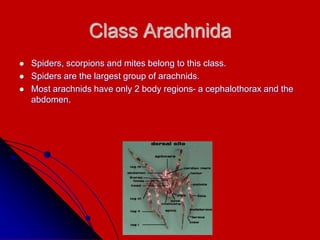
 Spiders, scorpions and mites belong to this class.
 Spiders are the largest group of arachnids.
 Most arachnids have only 2 body regions- a cephalothorax and the
abdomen.
Arachnids Cont’d
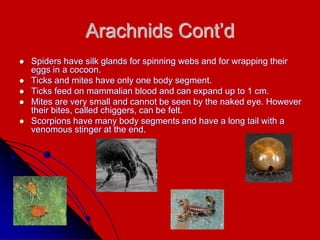
 Spiders have silk glands for spinning webs and for wrapping their
eggs in a cocoon.
 Ticks and mites have only one body segment.
 Ticks feed on mammalian blood and can expand up to 1 cm.
 Mites are very small and cannot be seen by the naked eye. However
their bites, called chiggers, can be felt.
 Scorpions have many body segments and have a long tail with a
venomous stinger at the end.
Class Crustacea
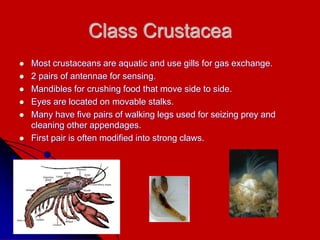
 Most crustaceans are aquatic and use gills for gas exchange.
 2 pairs of antennae for sensing.
 Mandibles for crushing food that move side to side.
 Eyes are located on movable stalks.
 Many have five pairs of walking legs used for seizing prey and
cleaning other appendages.
 First pair is often modified into strong claws.
Crustaceans Cont’d
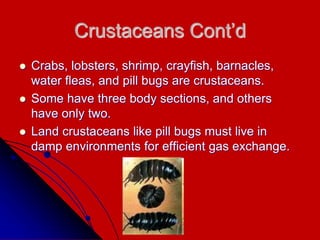
 Crabs, lobsters, shrimp, crayfish, barnacles,
water fleas, and pill bugs are crustaceans.
 Some have three body sections, and others
have only two.
 Land crustaceans like pill bugs must live in
damp environments for efficient gas exchange.
Class Chilopoda and Diplopoda
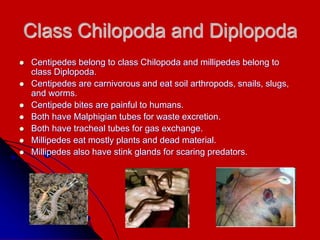
 Centipedes belong to class Chilopoda and millipedes belong to
class Diplopoda.
 Centipedes are carnivorous and eat soil arthropods, snails, slugs,
and worms.
 Centipede bites are painful to humans.
 Both have Malphigian tubes for waste excretion.
 Both have tracheal tubes for gas exchange.
 Millipedes eat mostly plants and dead material.
 Millipedes also have stink glands for scaring predators.
Class Merostomata
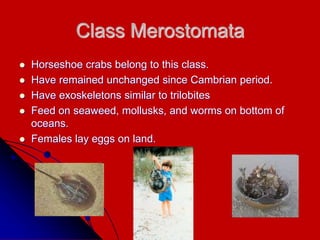
 Horseshoe crabs belong to this class.
 Have remained unchanged since Cambrian period.
 Have exoskeletons similar to trilobites
 Feed on seaweed, mollusks, and worms on bottom of
oceans.
 Females lay eggs on land.
Class Insecta
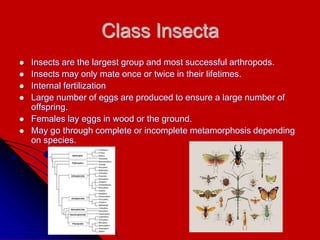
 Insects are the largest group and most successful arthropods.
 Insects may only mate once or twice in their lifetimes.
 Internal fertilization
 Large number of eggs are produced to ensure a large number of
offspring.
 Females lay eggs in wood or the ground.
 May go through complete or incomplete metamorphosis depending
on species.
Insects Cont’d
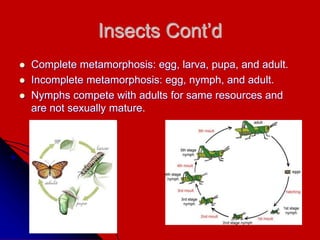
 Complete metamorphosis: egg, larva, pupa, and adult.
 Incomplete metamorphosis: egg, nymph, and adult.
 Nymphs compete with adults for same resources and
are not sexually mature.

lecture_1_15.ppt

  • 1.
  • 2.
    Features of AllArthropods  All have exoskeletons for support and protection  All have jointed appendages  Body regions include: a head, thorax, and an abdomen.  Some have a cephalothorax (head and thorax are fused together)  All arthropods molt (shed exoskeleton)
  • 3.
    General Characteristics Cont’d Arthropods use either gills, tracheal tubes, or book lungs for gas exchange.  Acute senses include simple and compound eyes, brains, and many ganglia.  Arthropods use pheromones to communicate.  They have open circulatory systems, complete digestive system, and efficient means of wastes excretion.  Arthropods reproduce sexually, but some exhibit parthenogenesis.
  • 4.
    Phylum Arthropoda isclassified into four subphylla  1- Trilobita Extinct (Fossilised )  2- Crustacia (All aquatic forms )  3- Chelicerata  Class Arachnida  ( includes three important orders)  (A) Acarina (Ticks and mites)  (B) Scorpionida (All forms of scorpions)  (C) Areinida (all spiders)  4- Uniramia – Three classes-Hexapoda; Chilopoda; and Diplopoda
  • 5.
    Class Arachnida  Spiders,scorpions and mites belong to this class.  Spiders are the largest group of arachnids.  Most arachnids have only 2 body regions- a cephalothorax and the abdomen.
  • 6.
    Arachnids Cont’d  Spidershave silk glands for spinning webs and for wrapping their eggs in a cocoon.  Ticks and mites have only one body segment.  Ticks feed on mammalian blood and can expand up to 1 cm.  Mites are very small and cannot be seen by the naked eye. However their bites, called chiggers, can be felt.  Scorpions have many body segments and have a long tail with a venomous stinger at the end.
  • 7.
    Class Crustacea  Mostcrustaceans are aquatic and use gills for gas exchange.  2 pairs of antennae for sensing.  Mandibles for crushing food that move side to side.  Eyes are located on movable stalks.  Many have five pairs of walking legs used for seizing prey and cleaning other appendages.  First pair is often modified into strong claws.
  • 8.
    Crustaceans Cont’d  Crabs,lobsters, shrimp, crayfish, barnacles, water fleas, and pill bugs are crustaceans.  Some have three body sections, and others have only two.  Land crustaceans like pill bugs must live in damp environments for efficient gas exchange.
  • 9.
    Class Chilopoda andDiplopoda  Centipedes belong to class Chilopoda and millipedes belong to class Diplopoda.  Centipedes are carnivorous and eat soil arthropods, snails, slugs, and worms.  Centipede bites are painful to humans.  Both have Malphigian tubes for waste excretion.  Both have tracheal tubes for gas exchange.  Millipedes eat mostly plants and dead material.  Millipedes also have stink glands for scaring predators.
  • 10.
    Class Merostomata  Horseshoecrabs belong to this class.  Have remained unchanged since Cambrian period.  Have exoskeletons similar to trilobites  Feed on seaweed, mollusks, and worms on bottom of oceans.  Females lay eggs on land.
  • 11.
    Class Insecta  Insectsare the largest group and most successful arthropods.  Insects may only mate once or twice in their lifetimes.  Internal fertilization  Large number of eggs are produced to ensure a large number of offspring.  Females lay eggs in wood or the ground.  May go through complete or incomplete metamorphosis depending on species.
  • 12.
    Insects Cont’d  Completemetamorphosis: egg, larva, pupa, and adult.  Incomplete metamorphosis: egg, nymph, and adult.  Nymphs compete with adults for same resources and are not sexually mature.