2.3
2-1 PROTOCOL LAYERING
Aword we hear all the time when we talk
about the Internet is protocol. A protocol
defines the rules that both the sender and
receiver and all intermediate devices need
to follow to be able to communicate
effectively. When communication is simple,
we may need only one simple protocol; when
the communication is complex, we need a
protocol at each layer, or protocol layering.
4.
2.4
2.1.1 Scenarios
Let usdevelop two simple scenarios to better
understand the need for protocol layering.
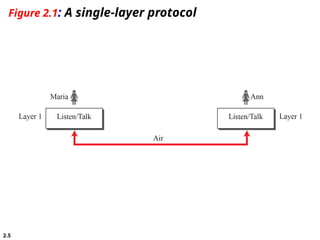
In the first scenario, communication is so simple
that it can occur in only one layer.
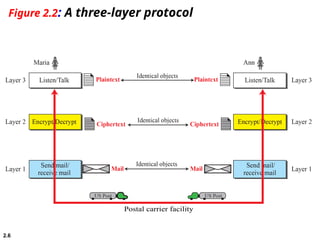
In the second, the communication between Maria
and Ann takes place in three layers.
2.7
2.1.2 Principles ofProtocol Layering
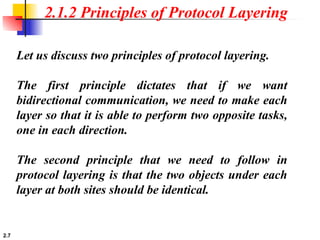
Let us discuss two principles of protocol layering.
The first principle dictates that if we want
bidirectional communication, we need to make each
layer so that it is able to perform two opposite tasks,
one in each direction.
The second principle that we need to follow in
protocol layering is that the two objects under each
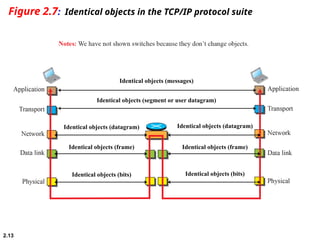
layer at both sites should be identical.
8.
2.8
2-2 TCP/IP PROTOCOLSUITE
A word we hear all the time when we talk
about the Internet is protocol. A protocol
defines the rules that both the sender and
receiver and all intermediate devices need
to follow to be able to communicate
effectively. When communication is simple,
we may need only one simple protocol; when
the communication is complex, we need a
protocol at each layer, or protocol layering.
9.
2.9
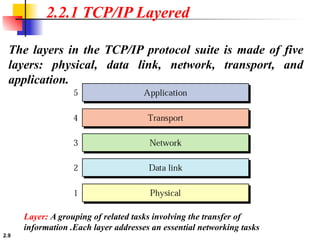
The layers inthe TCP/IP protocol suite is made of five
layers: physical, data link, network, transport, and
application.
Layer: A grouping of related tasks involving the transfer of
information .Each layer addresses an essential networking tasks
2.2.1 TCP/IP Layered
10.
2.10
2.2.1 Layered Architecture
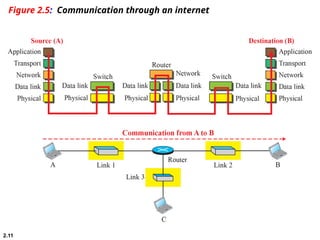
Toshow how the layers in the TCP/IP protocol suite
are involved in communication between two hosts,
we assume that we want to use the suite in a small
internet made up of three LANs (links), each with a
link-layer switch. We also assume that the links are
connected by one router, as shown in Figure 2.5.
2.12
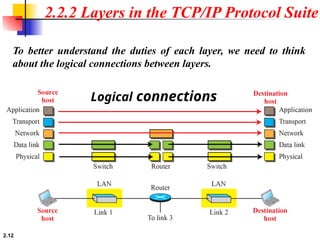
Logical connections
To betterunderstand the duties of each layer, we need to think
about the logical connections between layers.
2.2.2 Layers in the TCP/IP Protocol Suite
13.
2.13
Figure 2.7: Identicalobjects in the TCP/IP protocol suite
Identical objects (messages)
Identical objects (segment or user datagram)
Identical objects (datagram)
Identical objects (frame)
Identical objects (bits)
Identical objects (datagram)
Identical objects (frame)
Identical objects (bits)
14.
2.14
2.2.3 Description ofEach Leyer
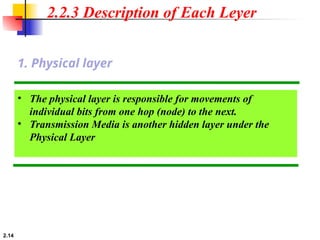
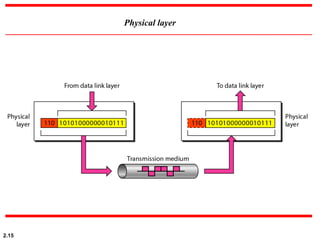
• The physical layer is responsible for movements of
individual bits from one hop (node) to the next.
• Transmission Media is another hidden layer under the
Physical Layer
1. Physical layer
2.16
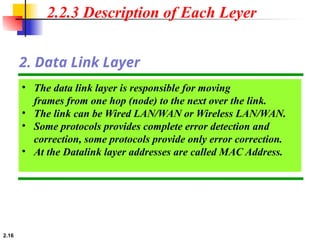
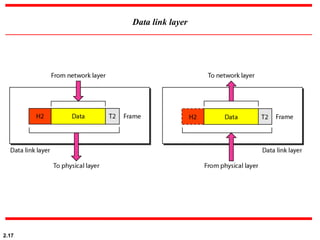
• The datalink layer is responsible for moving
frames from one hop (node) to the next over the link.
• The link can be Wired LAN/WAN or Wireless LAN/WAN.
• Some protocols provides complete error detection and
correction, some protocols provide only error correction.
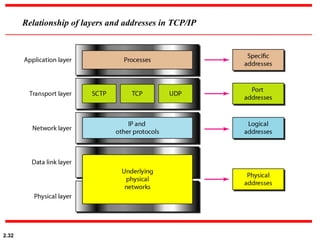
• At the Datalink layer addresses are called MAC Address.
2. Data Link Layer
2.2.3 Description of Each Leyer
2.18
• known alsoas the MAC or link address
• Is the address of a node as defined by its LAN or WAN
• It is included in the frame used by data link layer (Header)
• The MAC addresses are locally defined address
Physical address (MAC)
Datalink Layer
19.
2.19
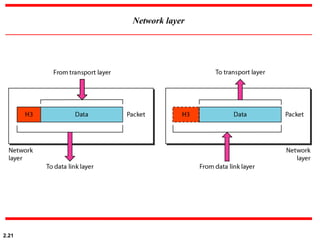
• The networklayer is responsible for the delivery of
individual packets from the source host to the destination
host across multiple network.
• If two system are connected to the same link (network), no
need for this layer.
• The network layer also response for routing the packet.
• IP is the main protocol of the network layer.
• At the Network layer addresses are called IP Address.
3. Network Layer
2.2.3 Description of Each Leyer
20.
2.20
Logical addressing (IP)
•Network layer adds unique identifier ( IP or logical
address) to the packet.
• These unique identifier( as tel. no, each tel. has unique
number) enable special devices called router to make sure
the packet get to correct system.
• IP addresses are necessary for universal communications
that are independent of physical network.
Routing:
provide the routing mechanism for the router which route
the packet to their final destination.
Routers : devices used when independent networks are
connected to create an internetworking ( network of
networks)
Network Layer
2.22
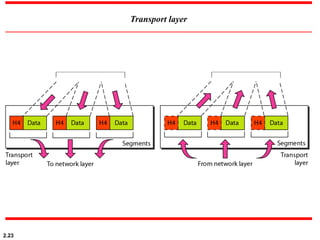
• The transportlayer is responsible for the delivery
of a message from one process to another.
• At the Transport layer addresses are called Port Address.
• TCO/IP model defines 3 protocols :
• TCP (Transmission Control Protocol )
• UDP (User Datagram Protocol)
• SCTP( Stream Control Transmission Protocol)
4. Transport Layer (process to process delivery)
2.2.3 Description of Each Leyer
2.24
Port addressing (Service-pointaddressing)
• Computer often run several process ( running programs) at the
same time, so the process to process delivery means delivery from
a specific process on a computer to specific process to the other.
• The transport layer header must include Port address
• Port address: 16-bit addresses represented by decimal number
range from 0-65535 to choose among multiple processes on the
destination host
• Destination port No is needed for delivery
• Source port No is needed for replay.
Transport Layer
25.
2.25
The transport layercan be either connection less or connection
oriented
1. Connection oriented protocol (TCP)
• Makes a connection with the transport layer at the destination
machine first before delivering the packers.
• When the connection established a sequence of packets from
source to the destination can be sent one after another on the
same path and in sequential order.
• When all packets of message have been delivered, the connection
is terminated
This makes the sending transport layer ensure that the message
arrives at the receiving transport layer without error ( damage, loss
or duplication
Transport Layer
26.
2.26
Transport Layer
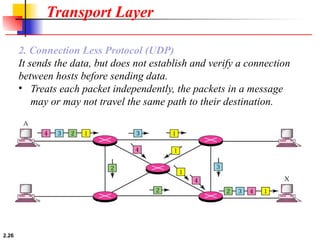
2. ConnectionLess Protocol (UDP)
It sends the data, but does not establish and verify a connection
between hosts before sending data.
• Treats each packet independently, the packets in a message
may or may not travel the same path to their destination.
27.
2.27
• The applicationlayer exchange messages between each other.
• TCP/IP model defines the following protocols:
• FTP:File transfer protocol is used for transferring files
from one host to another .
• Telnet: A service that enables users on the internet to log
onto remote systems from their own host system.
• HTTP: Hyper text transfer protocol used for network file
transfers in WWW environment
• SMTP: Simple mail transfer protocol used to send
electronic mail on the internet.
5 . Application Layer
2.2.3 Description of Each Leyer
28.
2.28
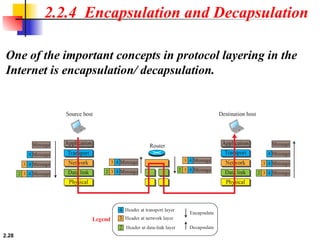
One of theimportant concepts in protocol layering in the
Internet is encapsulation/ decapsulation.
2.2.4 Encapsulation and Decapsulation
29.
2.29
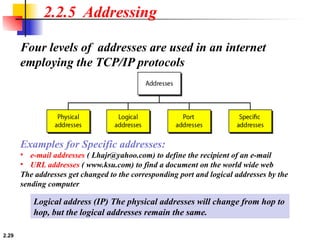
Four levels ofaddresses are used in an internet
employing the TCP/IP protocols
Examples for Specific addresses:
• e-mail addresses ( Lhajr@yahoo.com) to define the recipient of an e-mail
• URL addresses ( www.ksu.com) to find a document on the world wide web
The addresses get changed to the corresponding port and logical addresses by the
sending computer
2.2.5 Addressing
Logical address (IP) The physical addresses will change from hop to
hop, but the logical addresses remain the same.
30.
2.30
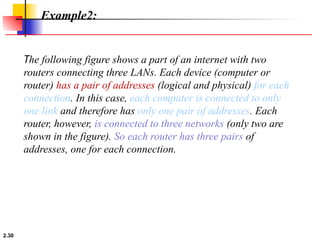
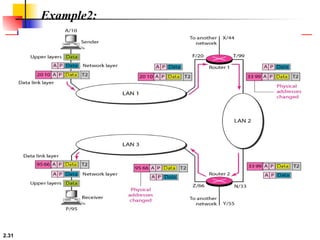
Example2:
The following figureshows a part of an internet with two
routers connecting three LANs. Each device (computer or
router) has a pair of addresses (logical and physical) for each
connection. In this case, each computer is connected to only
one link and therefore has only one pair of addresses. Each
router, however, is connected to three networks (only two are
shown in the figure). So each router has three pairs of
addresses, one for each connection.
2.33
2-3 OSI MODEL
Aword we hear all the time when we talk
about the Internet is protocol. A protocol
defines the rules that both the sender and
receiver and all intermediate devices need
to follow to be able to communicate
effectively. When communication is simple,
we may need only one simple protocol; when
the communication is complex, we need a
protocol at each layer, or protocol layering.
2.35
2.3.1 OSI versusTCP/IP
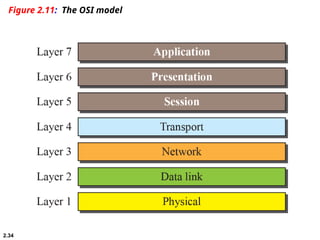
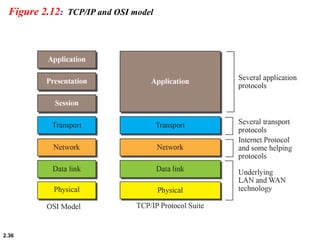
When we compare the two models, we find that two
layers, session and presentation, are missing from
the TCP/IP protocol suite. These two layers were not
added to the TCP/IP protocol suite after the
publication of the OSI model. The application layer
in the suite is usually considered to be the
combination of three layers in the OSI model, as
shown in Figure 2.12.