• An ArrayListclass is a resizable array implementation in Java
provided by the java.util package. Unlike arrays, which have a
fixed size, an ArrayList can grow and shrink dynamically as
elements are added or removed.
• Key Characteristics:
- Dynamic sizing: Automatically resizes when capacity is exceeded.
- Indexed access: Elements can be accessed using an index, just
like arrays.
- Allows duplicates: Elements can be repeated.
- Preserves insertion order.
ArrayList
3.
• When toUse ArrayList?
- when you need fast access by index.
- when you don't know the number of elements in advance.
- when you want to frequently add/remove elements at the end.
• How does ArrayList work internally?
ArrayList uses an internal array of type Object[] to store data.
When elements are added and the capacity is exceeded, it
automatically creates a larger array and copies the old data into it.
ArrayList
4.
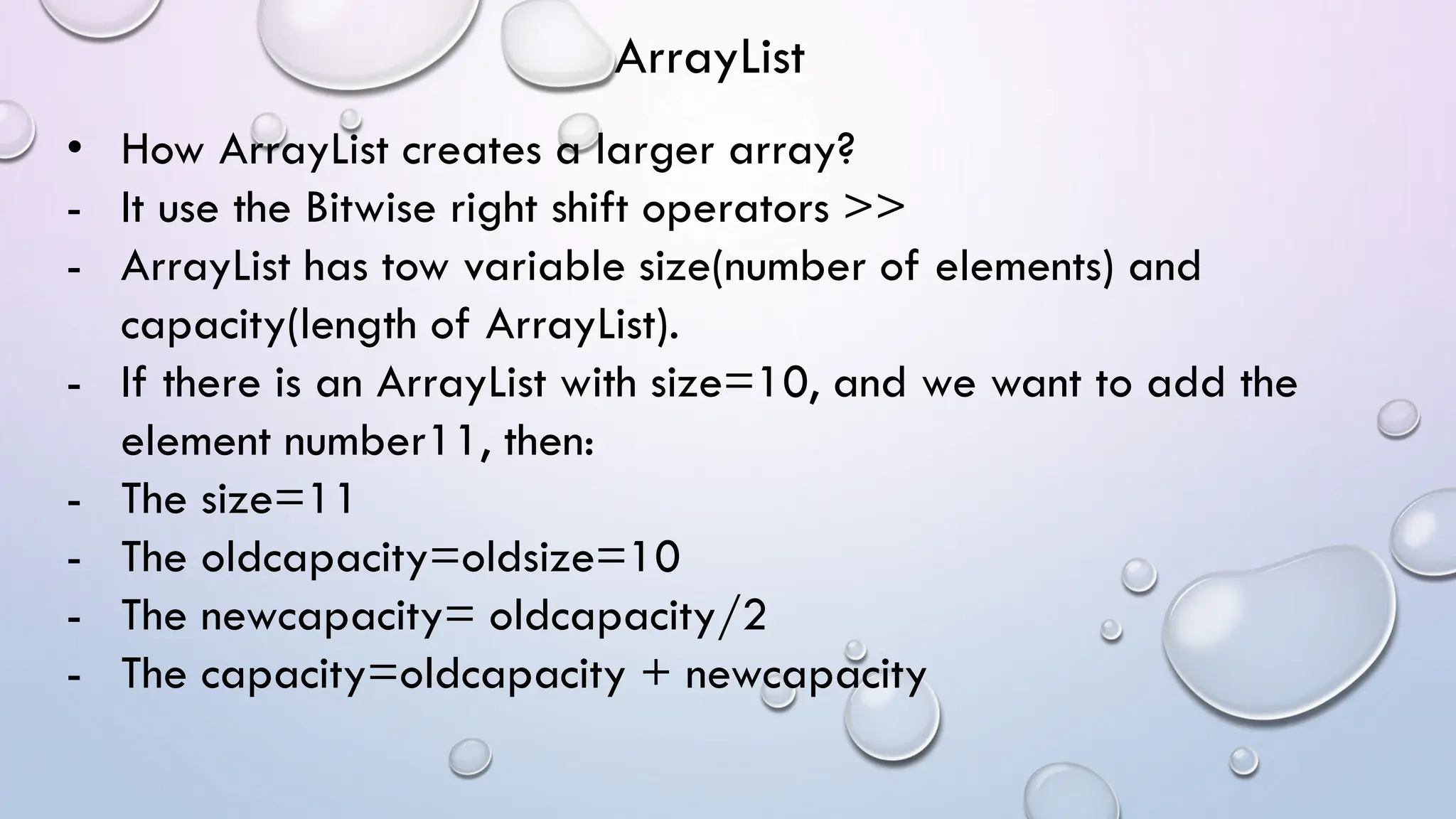
• How ArrayListcreates a larger array?
- It use the Bitwise right shift operators >>
- ArrayList has tow variable size(number of elements) and
capacity(length of ArrayList).
- If there is an ArrayList with size=10, and we want to add the
element number11, then:
- The size=11
- The oldcapacity=oldsize=10
- The newcapacity= oldcapacity/2
- The capacity=oldcapacity + newcapacity
ArrayList
5.
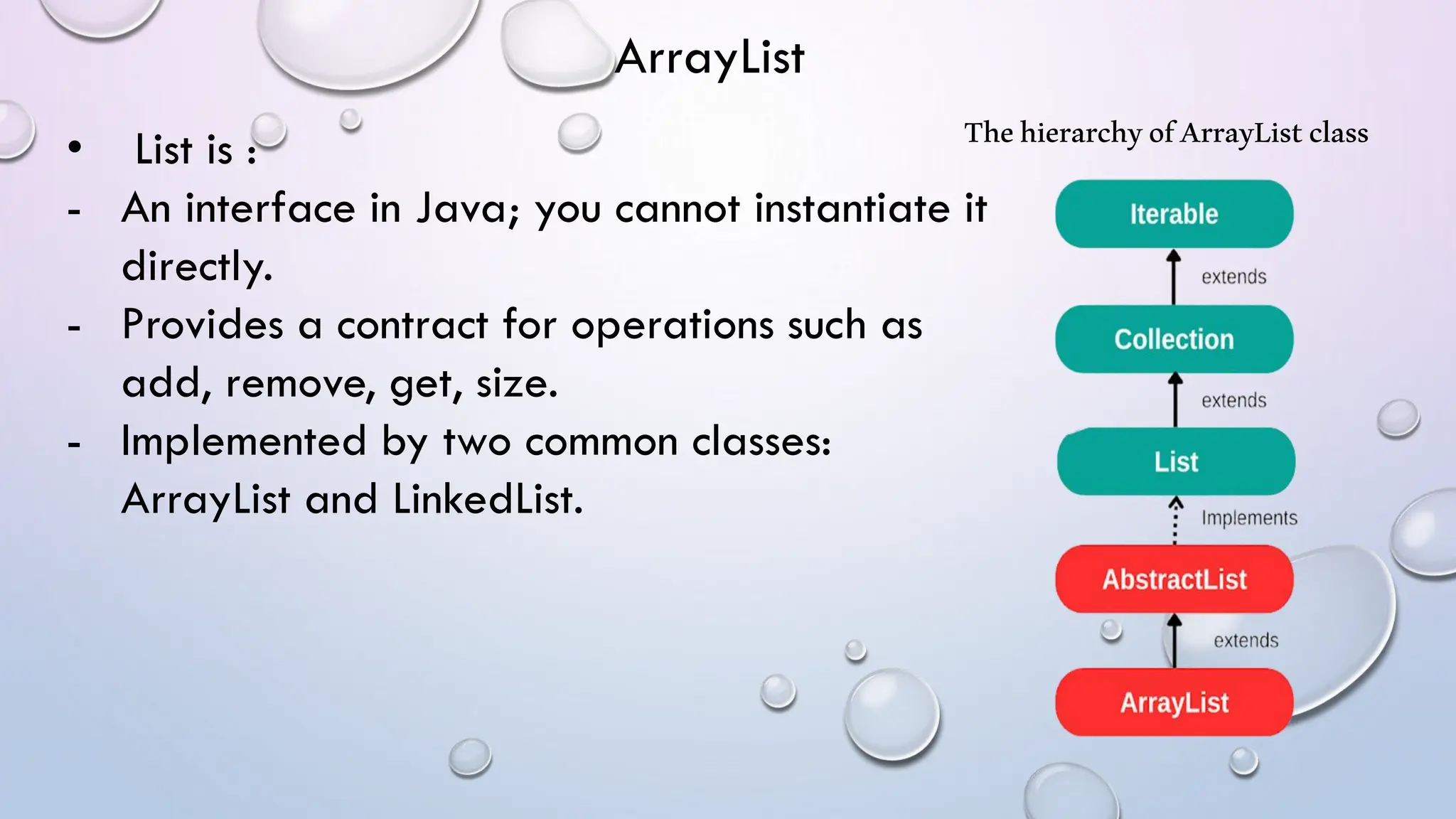
• List is:
- An interface in Java; you cannot instantiate it
directly.
- Provides a contract for operations such as
add, remove, get, size.
- Implemented by two common classes:
ArrayList and LinkedList.
ArrayList
ThehierarchyofArrayListclass
6.
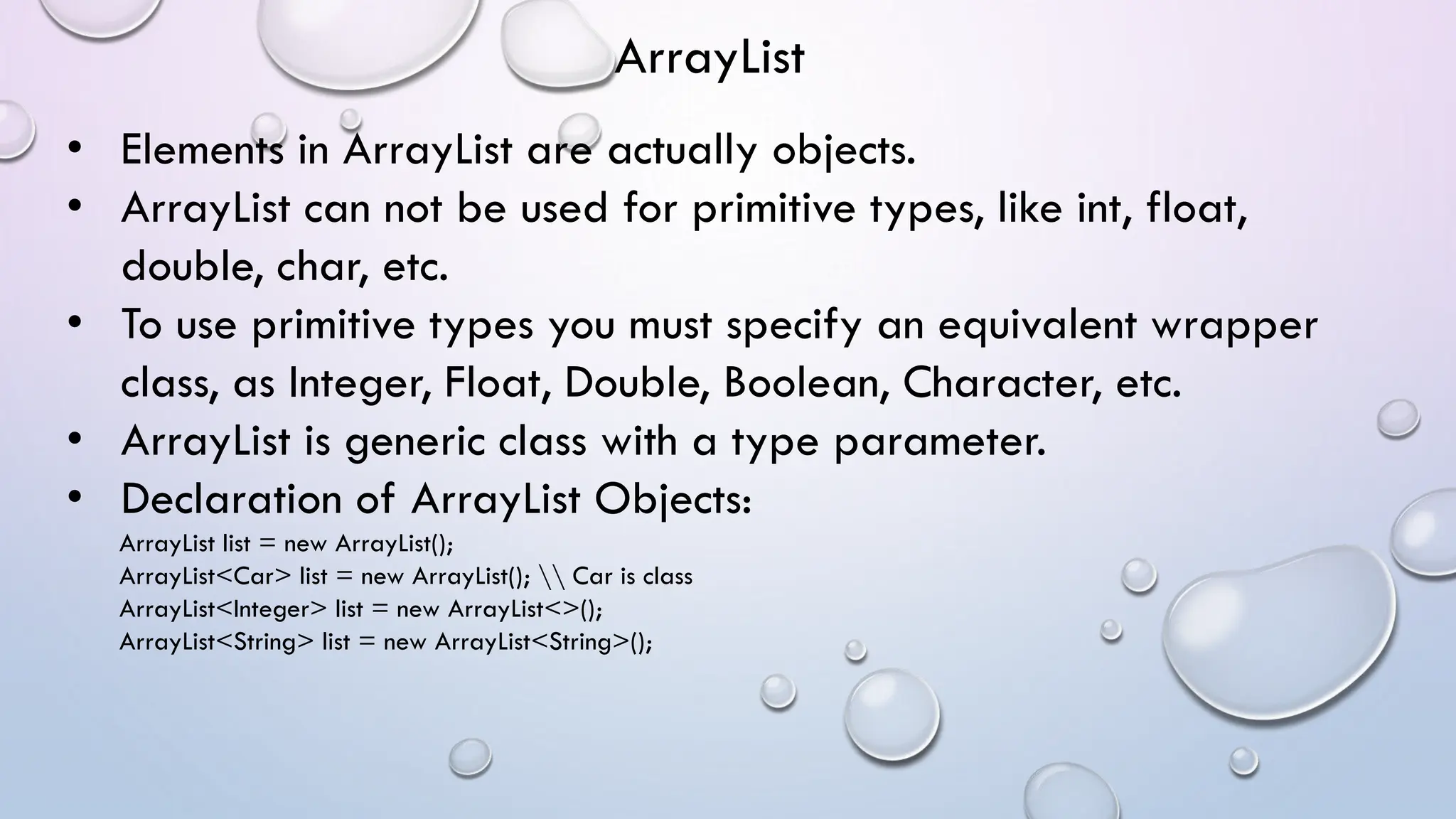
• Elements inArrayList are actually objects.
• ArrayList can not be used for primitive types, like int, float,
double, char, etc.
• To use primitive types you must specify an equivalent wrapper
class, as Integer, Float, Double, Boolean, Character, etc.
• ArrayList is generic class with a type parameter.
• Declaration of ArrayList Objects:
ArrayList list = new ArrayList();
ArrayList<Car> list = new ArrayList(); Car is class
ArrayList<Integer> list = new ArrayList<>();
ArrayList<String> list = new ArrayList<String>();
ArrayList
7.
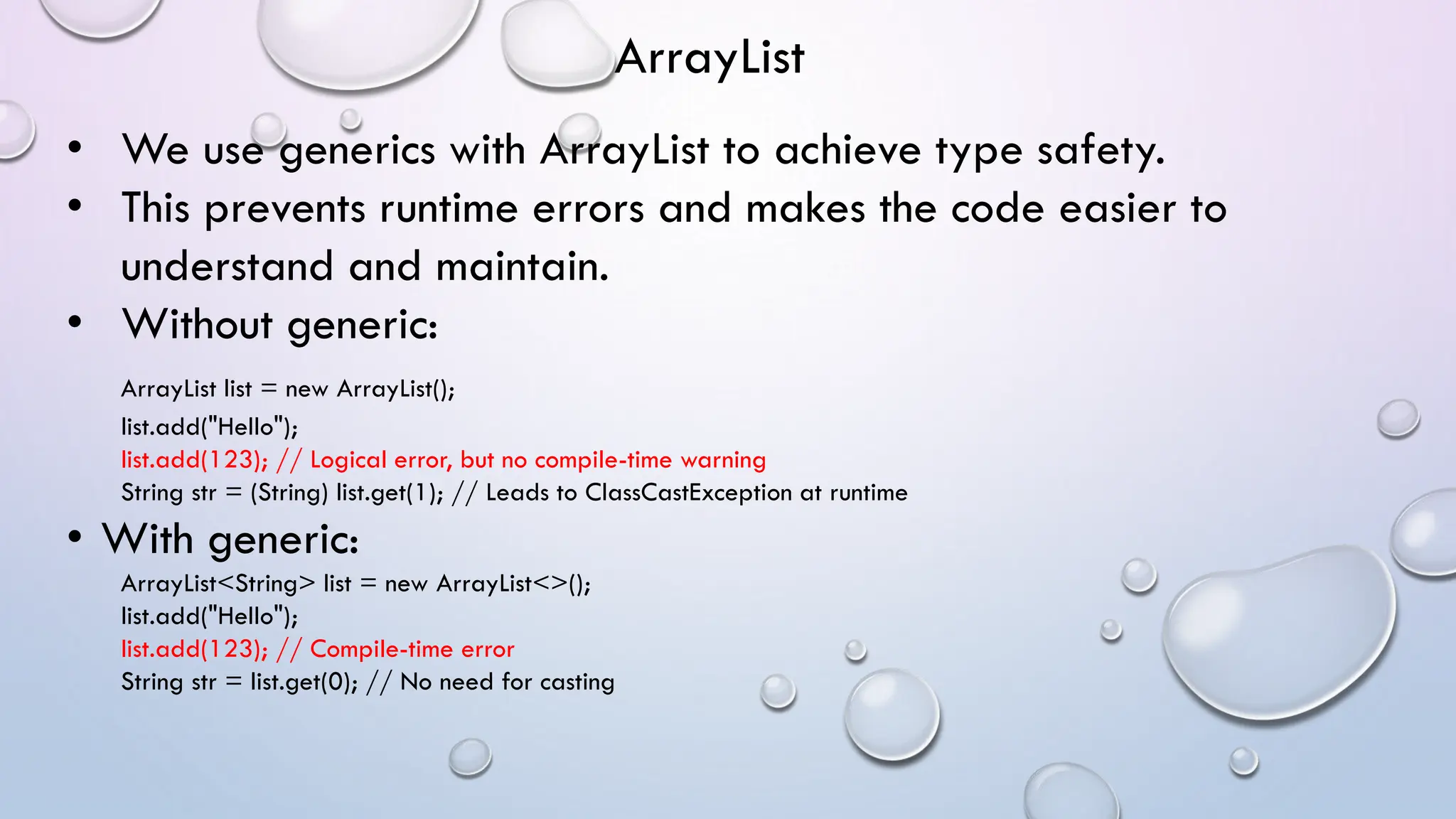
• We usegenerics with ArrayList to achieve type safety.
• This prevents runtime errors and makes the code easier to
understand and maintain.
• Without generic:
ArrayList list = new ArrayList();
list.add("Hello");
list.add(123); // Logical error, but no compile-time warning
String str = (String) list.get(1); // Leads to ClassCastException at runtime
• With generic:
ArrayList<String> list = new ArrayList<>();
list.add("Hello");
list.add(123); // Compile-time error
String str = list.get(0); // No need for casting
ArrayList
8.
• Benefit ofgenerics in ArrayList:
- Prevents inserting incompatible types.
- No need for casting when retrieving elements.
- Errors are caught at compile time instead of runtime, making the
program more stable.
• Note:
Main drawback of ArrayList: Inserting or deleting from the
beginning or middle is slower because elements need to be shifted.
ArrayList

![• When to Use ArrayList?
- when you need fast access by index.
- when you don't know the number of elements in advance.
- when you want to frequently add/remove elements at the end.
• How does ArrayList work internally?
ArrayList uses an internal array of type Object[] to store data.
When elements are added and the capacity is exceeded, it
automatically creates a larger array and copies the old data into it.
ArrayList](https://image.slidesharecdn.com/lecture8-250604184454-499dd9e5/75/Lecture-8_-taiz-unvercity-object-oreinted-programming-pdf-3-2048.jpg)