Introduction to Software Engineering 
Muhammad Nasir 
Agile Software Development 
m.nasir@iiu.edu.pk
Agenda 
 Agile Software Development 
 The Manifesto for Agile Software Development 
 What is “Agility”? 
 Agility and the Cost of Change 
 An Agile Process 
 Agility Principles
Agile Software Development 
 In the modern economy, it is often difficult or impossible to predict 
how a software system will evolve as time passes. 
 Market conditions change rapidly, end-user needs evolve, and new 
competitive threats emerge without warning. 
 In many situations, you won’t be able to define requirements fully 
before the project begins. 
 You must be agile enough to respond to a changing business 
environment. 
 And change is expensive. 
 Particularly if it is uncontrolled or poorly managed. 
 One of the most compelling characteristics of the agile approach is 
its ability to reduce the costs of change throughout the software 
process.
The Manifesto for 
Agile Software Development 
 ““We are uncovering bbeetttteerr wwaayyss ooff ddeevveellooppiinngg 
ssooffttwwaarree bbyy ddooiinngg iitt aanndd hheellppiinngg ootthheerrss ddoo iitt.. 
TThhrroouugghh tthhiiss wwoorrkk wwee hhaavvee ccoommee ttoo vvaalluuee:: 
• Individuals and interactions over processes and 
tools 
• Working software over comprehensive 
documentation 
• Customer collaboration over contract negotiation 
• Responding to change over following a plan 
 TThhaatt iiss,, wwhhiillee tthheerree iiss vvaalluuee iinn tthhee iitteemmss oonn tthhee rriigghhtt,, 
wwee vvaalluuee tthhee iitteemmss oonn tthhee lleefftt mmoorree..”” 
Kent Beck et al, 2001
What is “Agility”? 
 Effective (rapid and adaptive) response to 
change! 
 Effective communication among all stakeholders! 
 Drawing the customer onto the team! Eliminate 
“us and them” attitude 
 Organizing a team so that it is in control of the 
work performed! 
Yielding …! 
 Rapid, incremental delivery of software!
Agility and the Cost of Change 
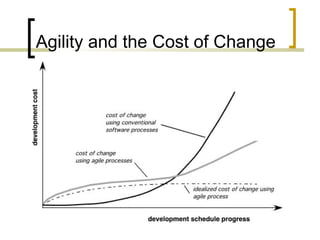
 A well-designed agile process “flattens” the cost of 
change curve 
 Allowing a software team to accommodate changes 
late in a software project without dramatic cost and 
time impact. 
 You’ve already learned that the agile process 
encompasses incremental delivery. 
 When incremental delivery is coupled with other agile 
practices 
 such as continuous unit testing and pair 
programming the cost of making a change is 
attenuated.
Agility and the Cost of Change
An Agile Process 
 Is driven by customer descriptions of what is 
required (scenarios)! 
 Recognizes that plans are short-lived! (some 
requirements will persist, some will change. Customer priorities will change) 
 Develops software iteratively with a heavy 
emphasis on construction activities! (Design and 
Construction activities are interleaved) 
 Delivers multiple ‘software increments’! 
 Adapts as changes occur!
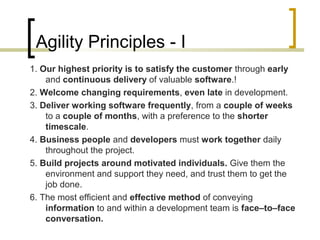
Agility Principles - I 
1. Our highest priority is to satisfy the customer through early 
and continuous delivery of valuable software.! 
2. Welcome changing requirements, even late in development. 
3. Deliver working software frequently, from a couple of weeks 
to a couple of months, with a preference to the shorter 
timescale. 
4. Business people and developers must work together daily 
throughout the project. 
5. Build projects around motivated individuals. Give them the 
environment and support they need, and trust them to get the 
job done. 
6. The most efficient and effective method of conveying 
information to and within a development team is face–to–face 
conversation.
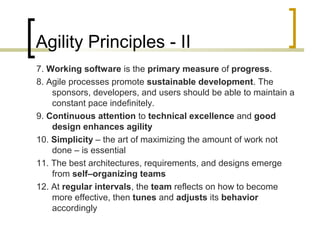
Agility Principles - II 
7. Working software is the primary measure of progress. 
8. Agile processes promote sustainable development. The 
sponsors, developers, and users should be able to maintain a 
constant pace indefinitely. 
9. Continuous attention to technical excellence and good 
design enhances agility 
10. Simplicity – the art of maximizing the amount of work not 
done – is essential 
11. The best architectures, requirements, and designs emerge 
from self–organizing teams 
12. At regular intervals, the team reflects on how to become 
more effective, then tunes and adjusts its behavior 
accordingly
The End 
 Thanks for listening 
 Questions would be appreciated.

Lecture 6 agile software development

  • 1.
    Introduction to SoftwareEngineering Muhammad Nasir Agile Software Development m.nasir@iiu.edu.pk
  • 2.
    Agenda  AgileSoftware Development  The Manifesto for Agile Software Development  What is “Agility”?  Agility and the Cost of Change  An Agile Process  Agility Principles
  • 3.
    Agile Software Development  In the modern economy, it is often difficult or impossible to predict how a software system will evolve as time passes.  Market conditions change rapidly, end-user needs evolve, and new competitive threats emerge without warning.  In many situations, you won’t be able to define requirements fully before the project begins.  You must be agile enough to respond to a changing business environment.  And change is expensive.  Particularly if it is uncontrolled or poorly managed.  One of the most compelling characteristics of the agile approach is its ability to reduce the costs of change throughout the software process.
  • 4.
    The Manifesto for Agile Software Development  ““We are uncovering bbeetttteerr wwaayyss ooff ddeevveellooppiinngg ssooffttwwaarree bbyy ddooiinngg iitt aanndd hheellppiinngg ootthheerrss ddoo iitt.. TThhrroouugghh tthhiiss wwoorrkk wwee hhaavvee ccoommee ttoo vvaalluuee:: • Individuals and interactions over processes and tools • Working software over comprehensive documentation • Customer collaboration over contract negotiation • Responding to change over following a plan  TThhaatt iiss,, wwhhiillee tthheerree iiss vvaalluuee iinn tthhee iitteemmss oonn tthhee rriigghhtt,, wwee vvaalluuee tthhee iitteemmss oonn tthhee lleefftt mmoorree..”” Kent Beck et al, 2001
  • 5.
    What is “Agility”?  Effective (rapid and adaptive) response to change!  Effective communication among all stakeholders!  Drawing the customer onto the team! Eliminate “us and them” attitude  Organizing a team so that it is in control of the work performed! Yielding …!  Rapid, incremental delivery of software!
  • 6.
    Agility and theCost of Change  A well-designed agile process “flattens” the cost of change curve  Allowing a software team to accommodate changes late in a software project without dramatic cost and time impact.  You’ve already learned that the agile process encompasses incremental delivery.  When incremental delivery is coupled with other agile practices  such as continuous unit testing and pair programming the cost of making a change is attenuated.
  • 7.
    Agility and theCost of Change
  • 8.
    An Agile Process  Is driven by customer descriptions of what is required (scenarios)!  Recognizes that plans are short-lived! (some requirements will persist, some will change. Customer priorities will change)  Develops software iteratively with a heavy emphasis on construction activities! (Design and Construction activities are interleaved)  Delivers multiple ‘software increments’!  Adapts as changes occur!
  • 9.
    Agility Principles -I 1. Our highest priority is to satisfy the customer through early and continuous delivery of valuable software.! 2. Welcome changing requirements, even late in development. 3. Deliver working software frequently, from a couple of weeks to a couple of months, with a preference to the shorter timescale. 4. Business people and developers must work together daily throughout the project. 5. Build projects around motivated individuals. Give them the environment and support they need, and trust them to get the job done. 6. The most efficient and effective method of conveying information to and within a development team is face–to–face conversation.
  • 10.
    Agility Principles -II 7. Working software is the primary measure of progress. 8. Agile processes promote sustainable development. The sponsors, developers, and users should be able to maintain a constant pace indefinitely. 9. Continuous attention to technical excellence and good design enhances agility 10. Simplicity – the art of maximizing the amount of work not done – is essential 11. The best architectures, requirements, and designs emerge from self–organizing teams 12. At regular intervals, the team reflects on how to become more effective, then tunes and adjusts its behavior accordingly
  • 11.
    The End Thanks for listening  Questions would be appreciated.

Editor's Notes

  • #5 Manifesto: A public declaration of principles, Public statement