T S PRADEEP KUMAR
   Process Introduction
   Process States
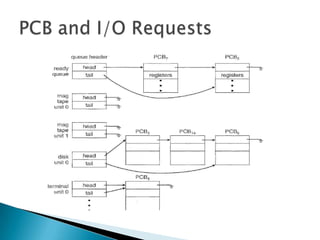
   Process Control Block (PCB or TCB)
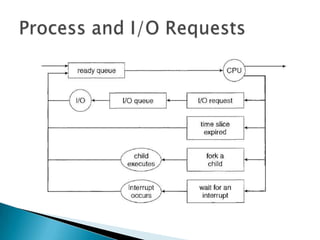
   Process creation and I/O Requests
   Schedulers
   A program in execution
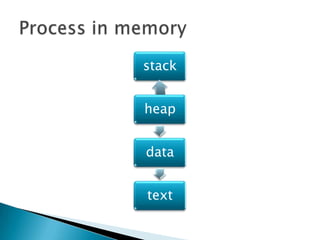
   Process in memory has
    ◦ Text section (includes program code)
    ◦ Data section (global variables)
    ◦ Stack (contains the return address, local address,
      function parameters)
    ◦ Heap (dynamic runtime memory during the
      execution of process and this may vary)
stack


heap


data


text
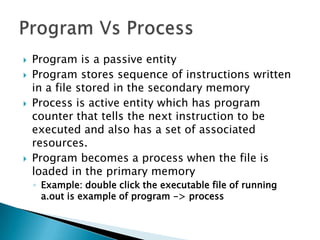
   Program is a passive entity
   Program stores sequence of instructions written
    in a file stored in the secondary memory
   Process is active entity which has program
    counter that tells the next instruction to be
    executed and also has a set of associated
    resources.
   Program becomes a process when the file is
    loaded in the primary memory
    ◦ Example: double click the executable file of running
      a.out is example of program -> process
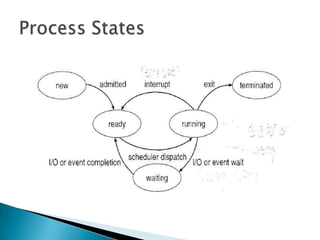
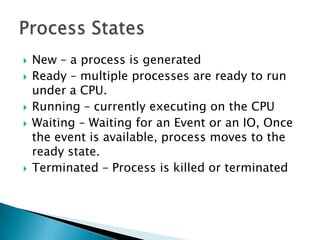
   New – a process is generated
   Ready – multiple processes are ready to run
    under a CPU.
   Running – currently executing on the CPU
   Waiting – Waiting for an Event or an IO, Once
    the event is available, process moves to the
    ready state.
   Terminated – Process is killed or terminated
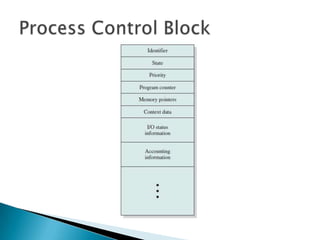
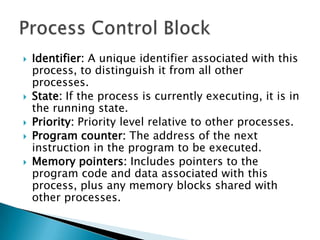
   Identifier: A unique identifier associated with this
    process, to distinguish it from all other
    processes.
   State: If the process is currently executing, it is in
    the running state.
   Priority: Priority level relative to other processes.
   Program counter: The address of the next
    instruction in the program to be executed.
   Memory pointers: Includes pointers to the
    program code and data associated with this
    process, plus any memory blocks shared with
    other processes.
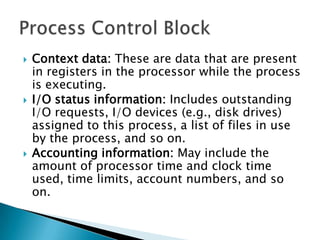
   Context data: These are data that are present
    in registers in the processor while the process
    is executing.
   I/O status information: Includes outstanding
    I/O requests, I/O devices (e.g., disk drives)
    assigned to this process, a list of files in use
    by the process, and so on.
   Accounting information: May include the
    amount of processor time and clock time
    used, time limits, account numbers, and so
    on.
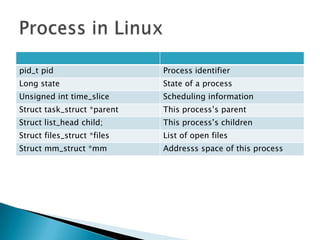
pid_t pid                    Process identifier
Long state                   State of a process
Unsigned int time_slice      Scheduling information
Struct task_struct *parent   This process’s parent
Struct list_head child;      This process’s children
Struct files_struct *files   List of open files
Struct mm_struct *mm         Addresss space of this process
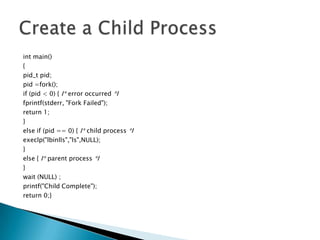
int main()
{
pid_t pid;
pid =fork();
if (pid < 0) { I* error occurred *I
fprintf(stderr, "Fork Failed");
return 1;
}
else if (pid == 0) { I* child process *I
execlp("lbinlls","ls",NULL);
}
else { I* parent process *I
}
wait (NULL) ;
printf("Child Complete");
return 0;}
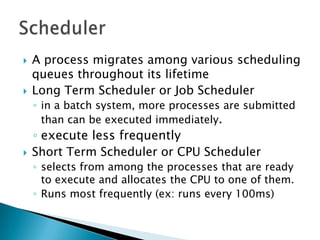
   A process migrates among various scheduling
    queues throughout its lifetime
   Long Term Scheduler or Job Scheduler
    ◦ in a batch system, more processes are submitted
      than can be executed immediately.
    ◦ execute less frequently
   Short Term Scheduler or CPU Scheduler
    ◦ selects from among the processes that are ready
      to execute and allocates the CPU to one of them.
    ◦ Runs most frequently (ex: runs every 100ms)
   Processes are either I/O Bound or CPU Bound
   Long Term schedulers should have the
    correct mix of I/O Process and CPU Bound
    processes
   Short Term Scheduler schedules the
    Processes that are ready to run under the CPU
   So Unix and Microsoft does not have Long
    Term Schedulers as it more time to get
    executed
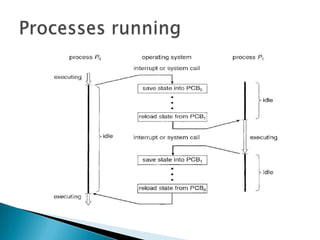
   When an interrupt occurs, the state of the
    process to be saved which called as context
    switching
   It depends highly on the hardware support
   Hardware architecture should have more
    number of registers as compared to more
    number of context switches.
   Reasons for IPC
    ◦ Information Sharing
      Sharing file between processes
    ◦ Computational Speedup
      Processes are break down in to sub-process
    ◦ Modularity
    ◦ Convenience
      Individual user can work on many tasks at the same
       time
   Independent Processes
    ◦ No interference with other processes in the system
   Cooperative processes
    ◦ Shared Memory
    ◦ Message Passing
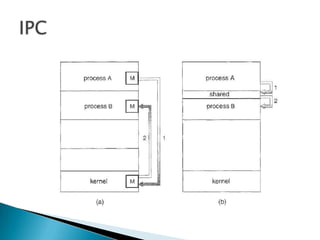
   Message Passing
    ◦ Suitable for smaller amount of data
    ◦ Easier to implement
    ◦ Usually implemented using System calls, so kernel
      is bothered every-time during message
      communication
   Shared Memory
    ◦ Faster to implement
    ◦ system calls are required only to establish shared-
      memory regions.
    ◦ Once shared memory is established, all accesses are
      treated as routine memory accesses, and no
      assistance from the kernel is required.
   Use of Producer – Consumer relations
   Producer will produce and consumer will
    consume the items produced by the producer
   P-C problem achieved through
    ◦ Unbounded buffer
      No limit on the size of queue
       The consumer may have to wait for new items
        but the producer can always produce new items.
    ◦ Bounded buffer
      Implement like a circular Queue
      Producer will wait if the queue is full
      Consume will waif if the queue is empty
#define BUFFER_SIZE 10
typedef struct {
…
}item;
item buffer[BUFFER_SIZE];
int in = 0;
int out = 0;
/*
Buffer is empty when in==out
Buffer is full when ((in+1)%BUFFER_SIZE)==out
*/
while (true) {
/* produce an item in nextProduced *I
while ( ((in + 1) % BUFFER_SIZE) == out)
I* do nothing *I
buffer[in] = nextProduced;
in = (in + 1) % BUFFER_SIZE;
}
item nextConsumed;
while (true) {
while (in == out)
; II do nothing
nextConsumed = buffer[out];
out = (out + 1) % BUFFER_SIZE;
I* consume the item in nextConsumed *I
}

Lecture 5 process concept

  • 1.
  • 2.
    Process Introduction  Process States  Process Control Block (PCB or TCB)  Process creation and I/O Requests  Schedulers
  • 3.
    A program in execution  Process in memory has ◦ Text section (includes program code) ◦ Data section (global variables) ◦ Stack (contains the return address, local address, function parameters) ◦ Heap (dynamic runtime memory during the execution of process and this may vary)
  • 4.
  • 6.
    Program is a passive entity  Program stores sequence of instructions written in a file stored in the secondary memory  Process is active entity which has program counter that tells the next instruction to be executed and also has a set of associated resources.  Program becomes a process when the file is loaded in the primary memory ◦ Example: double click the executable file of running a.out is example of program -> process
  • 8.
    New – a process is generated  Ready – multiple processes are ready to run under a CPU.  Running – currently executing on the CPU  Waiting – Waiting for an Event or an IO, Once the event is available, process moves to the ready state.  Terminated – Process is killed or terminated
  • 10.
    Identifier: A unique identifier associated with this process, to distinguish it from all other processes.  State: If the process is currently executing, it is in the running state.  Priority: Priority level relative to other processes.  Program counter: The address of the next instruction in the program to be executed.  Memory pointers: Includes pointers to the program code and data associated with this process, plus any memory blocks shared with other processes.
  • 11.
    Context data: These are data that are present in registers in the processor while the process is executing.  I/O status information: Includes outstanding I/O requests, I/O devices (e.g., disk drives) assigned to this process, a list of files in use by the process, and so on.  Accounting information: May include the amount of processor time and clock time used, time limits, account numbers, and so on.
  • 12.
    pid_t pid Process identifier Long state State of a process Unsigned int time_slice Scheduling information Struct task_struct *parent This process’s parent Struct list_head child; This process’s children Struct files_struct *files List of open files Struct mm_struct *mm Addresss space of this process
  • 16.
    int main() { pid_t pid; pid=fork(); if (pid < 0) { I* error occurred *I fprintf(stderr, "Fork Failed"); return 1; } else if (pid == 0) { I* child process *I execlp("lbinlls","ls",NULL); } else { I* parent process *I } wait (NULL) ; printf("Child Complete"); return 0;}
  • 17.
    A process migrates among various scheduling queues throughout its lifetime  Long Term Scheduler or Job Scheduler ◦ in a batch system, more processes are submitted than can be executed immediately. ◦ execute less frequently  Short Term Scheduler or CPU Scheduler ◦ selects from among the processes that are ready to execute and allocates the CPU to one of them. ◦ Runs most frequently (ex: runs every 100ms)
  • 18.
    Processes are either I/O Bound or CPU Bound  Long Term schedulers should have the correct mix of I/O Process and CPU Bound processes  Short Term Scheduler schedules the Processes that are ready to run under the CPU  So Unix and Microsoft does not have Long Term Schedulers as it more time to get executed
  • 19.
    When an interrupt occurs, the state of the process to be saved which called as context switching  It depends highly on the hardware support  Hardware architecture should have more number of registers as compared to more number of context switches.
  • 20.
    Reasons for IPC ◦ Information Sharing  Sharing file between processes ◦ Computational Speedup  Processes are break down in to sub-process ◦ Modularity ◦ Convenience  Individual user can work on many tasks at the same time
  • 21.
    Independent Processes ◦ No interference with other processes in the system  Cooperative processes ◦ Shared Memory ◦ Message Passing
  • 23.
    Message Passing ◦ Suitable for smaller amount of data ◦ Easier to implement ◦ Usually implemented using System calls, so kernel is bothered every-time during message communication  Shared Memory ◦ Faster to implement ◦ system calls are required only to establish shared- memory regions. ◦ Once shared memory is established, all accesses are treated as routine memory accesses, and no assistance from the kernel is required.
  • 24.
    Use of Producer – Consumer relations  Producer will produce and consumer will consume the items produced by the producer  P-C problem achieved through ◦ Unbounded buffer  No limit on the size of queue  The consumer may have to wait for new items but the producer can always produce new items. ◦ Bounded buffer  Implement like a circular Queue  Producer will wait if the queue is full  Consume will waif if the queue is empty
  • 25.
    #define BUFFER_SIZE 10 typedefstruct { … }item; item buffer[BUFFER_SIZE]; int in = 0; int out = 0; /* Buffer is empty when in==out Buffer is full when ((in+1)%BUFFER_SIZE)==out */
  • 26.
    while (true) { /*produce an item in nextProduced *I while ( ((in + 1) % BUFFER_SIZE) == out) I* do nothing *I buffer[in] = nextProduced; in = (in + 1) % BUFFER_SIZE; }
  • 27.
    item nextConsumed; while (true){ while (in == out) ; II do nothing nextConsumed = buffer[out]; out = (out + 1) % BUFFER_SIZE; I* consume the item in nextConsumed *I }