Overview
• Structure of Muscle and Muscle Fiber
• Components of a Muscle Fiber, Myofibril,
and Sarcomere
• Structure of Myosin and Actin
• Muscle Contraction
• Muscle Fiber Types
• Fiber Type and Athletic Performance
• Muscle Fatigue during Exercise
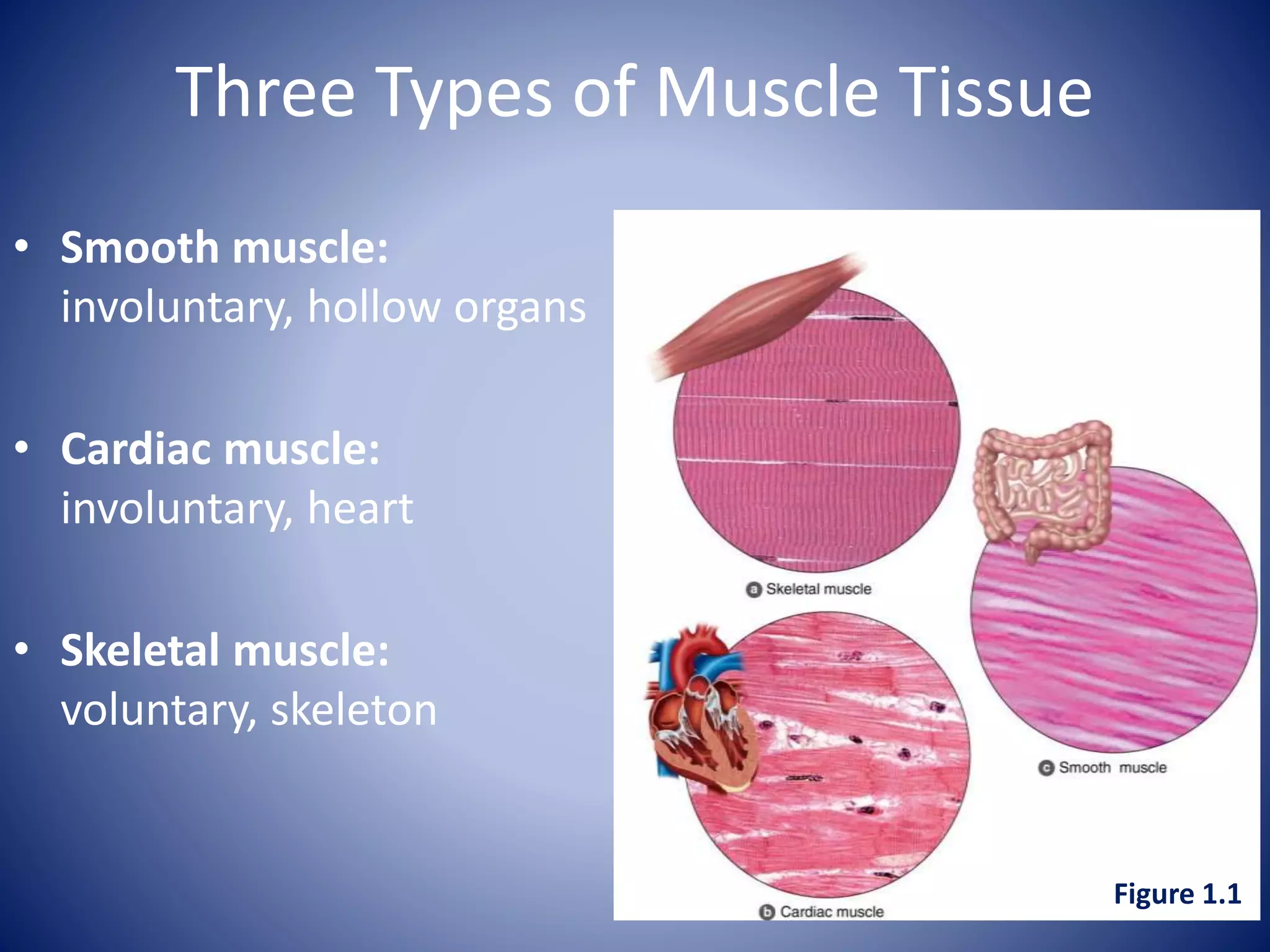
Three Types of Muscle Tissue
• Smooth muscle:
involuntary, hollow organs
• Cardiac muscle:
involuntary, heart
• Skeletal muscle:
voluntary, skeleton
Figure 1.1
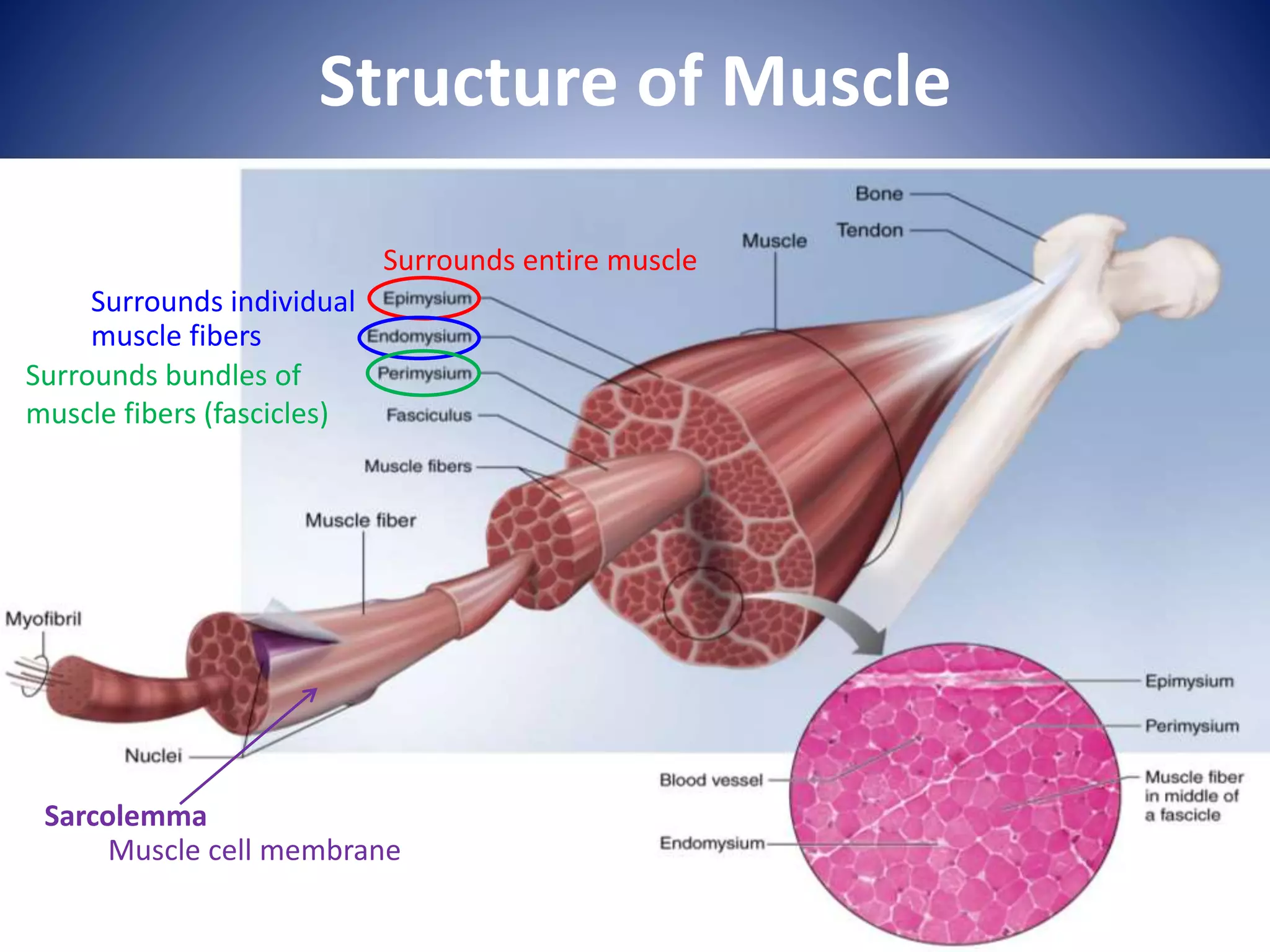
Structure of Muscle
Surrounds entire muscle
Surrounds bundles of
muscle fibers (fascicles)
Surrounds individual
muscle fibers
Sarcolemma
Muscle cell membrane
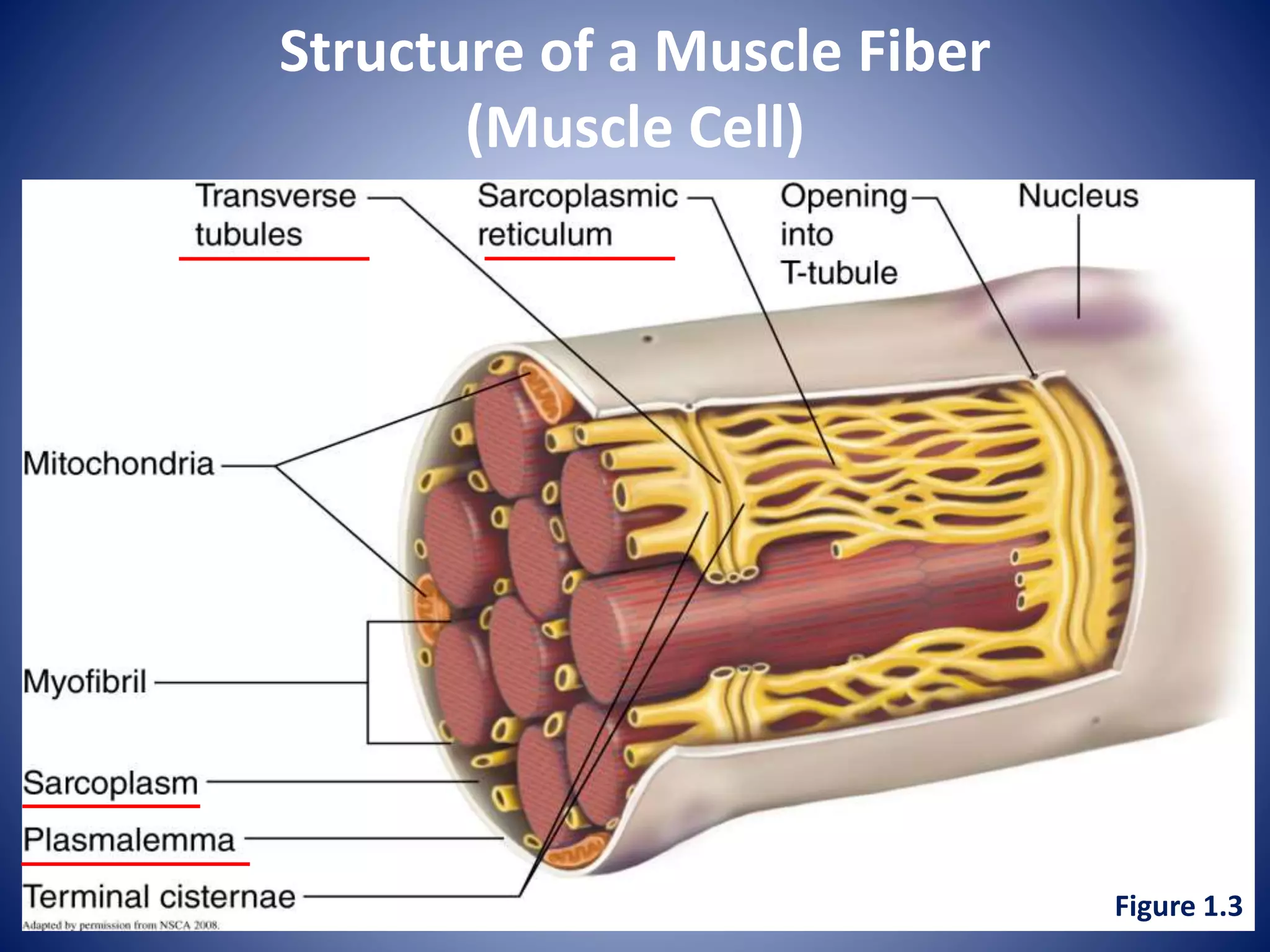
Structure of a Muscle Fiber
(Muscle Cell)
Figure 1.3
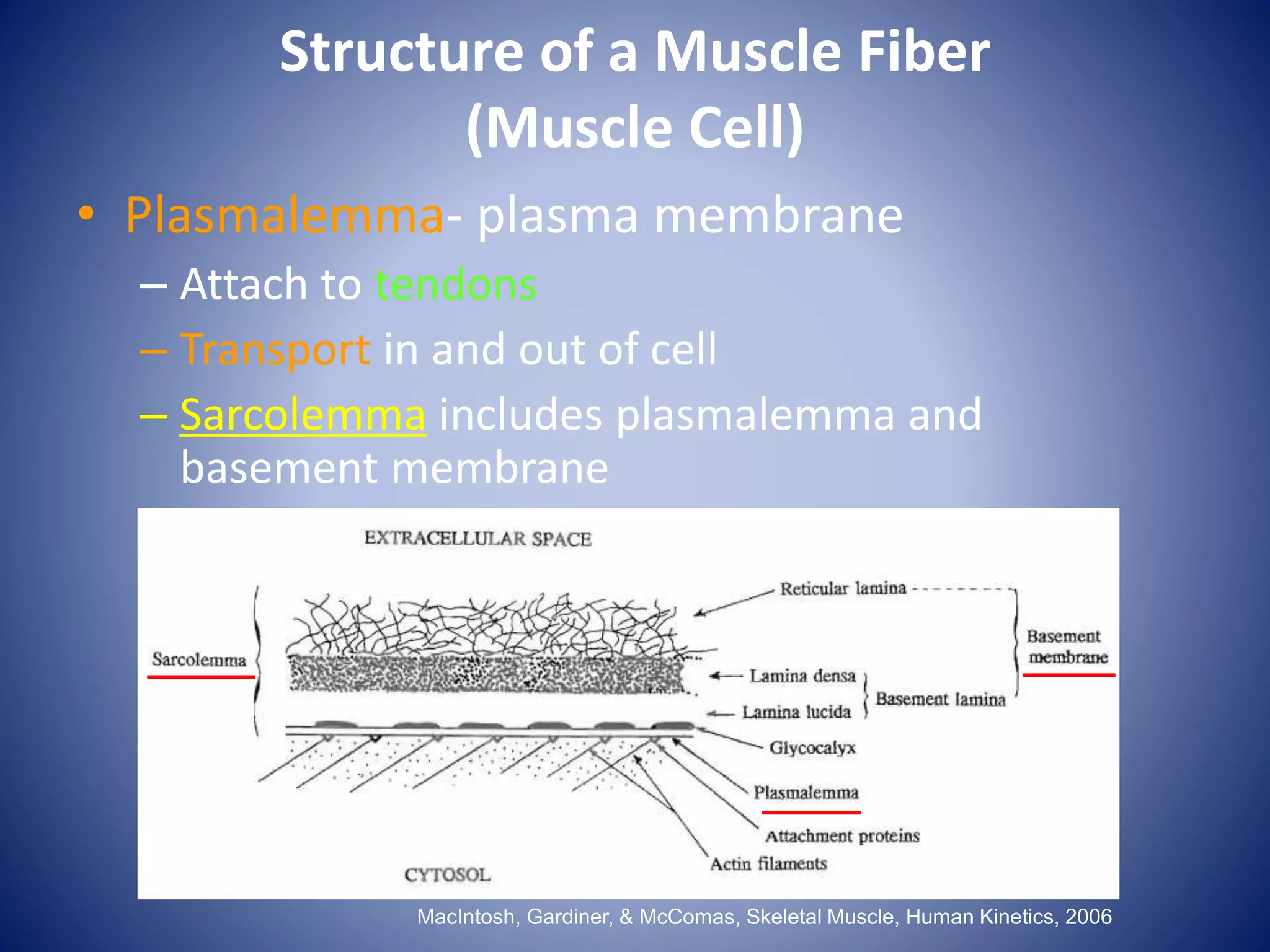
• Plasmalemma- plasma membrane
– Attach to tendons
– Transport in and out of cell
– Sarcolemma includes plasmalemma and
basement membrane
MacIntosh, Gardiner, & McComas, Skeletal Muscle, Human Kinetics, 2006
Structure of a Muscle Fiber
(Muscle Cell)
Components of a Muscle Fiber
(Muscle Cell)
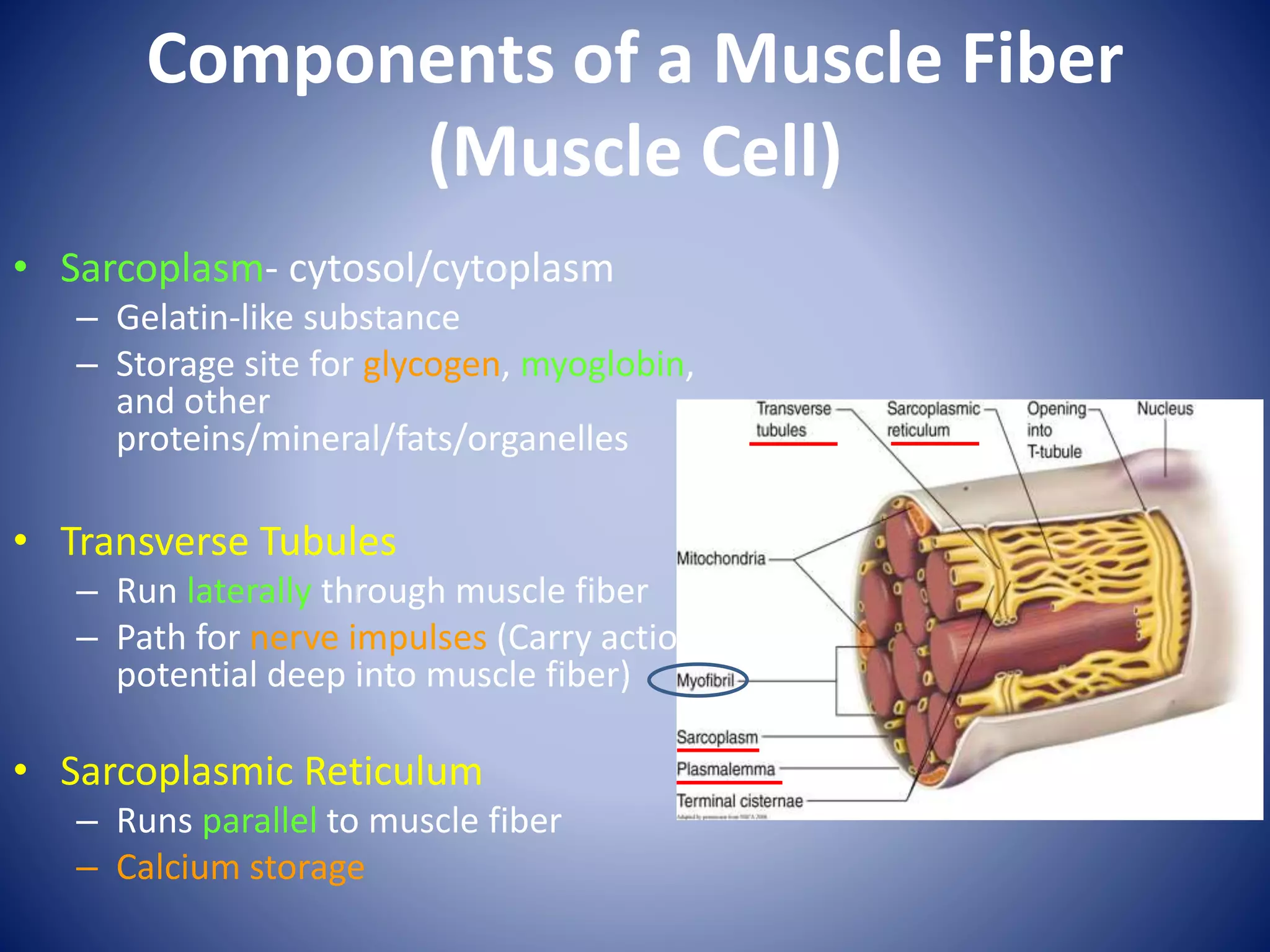
• Sarcoplasm- cytosol/cytoplasm
– Gelatin-like substance
– Storage site for glycogen, myoglobin,
and other
proteins/mineral/fats/organelles
• Transverse Tubules
– Run laterally through muscle fiber
– Path for nerve impulses (Carry action
potential deep into muscle fiber)
• Sarcoplasmic Reticulum
– Runs parallel to muscle fiber
– Calcium storage
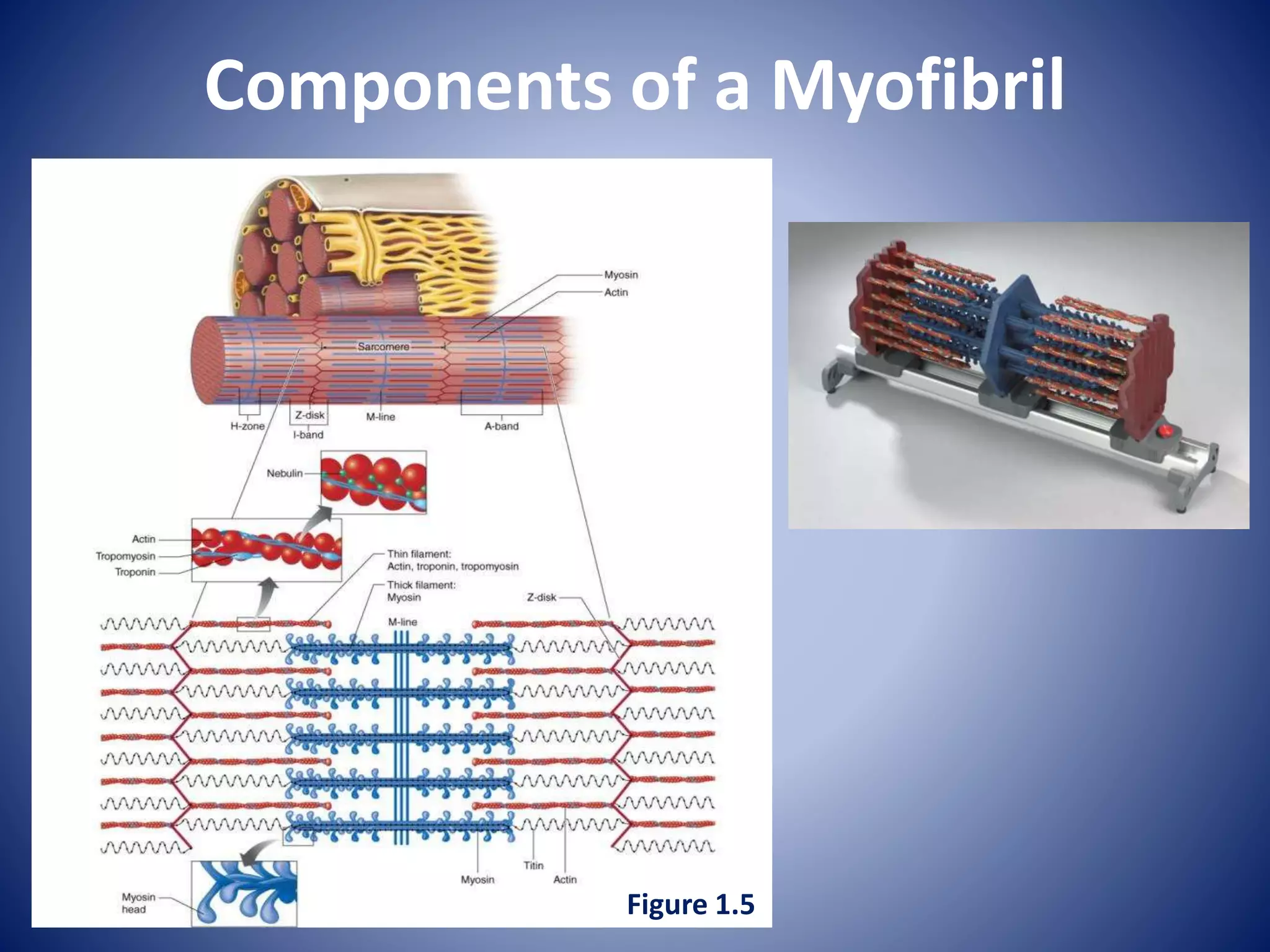
Components of a Myofibril
Figure 1.5
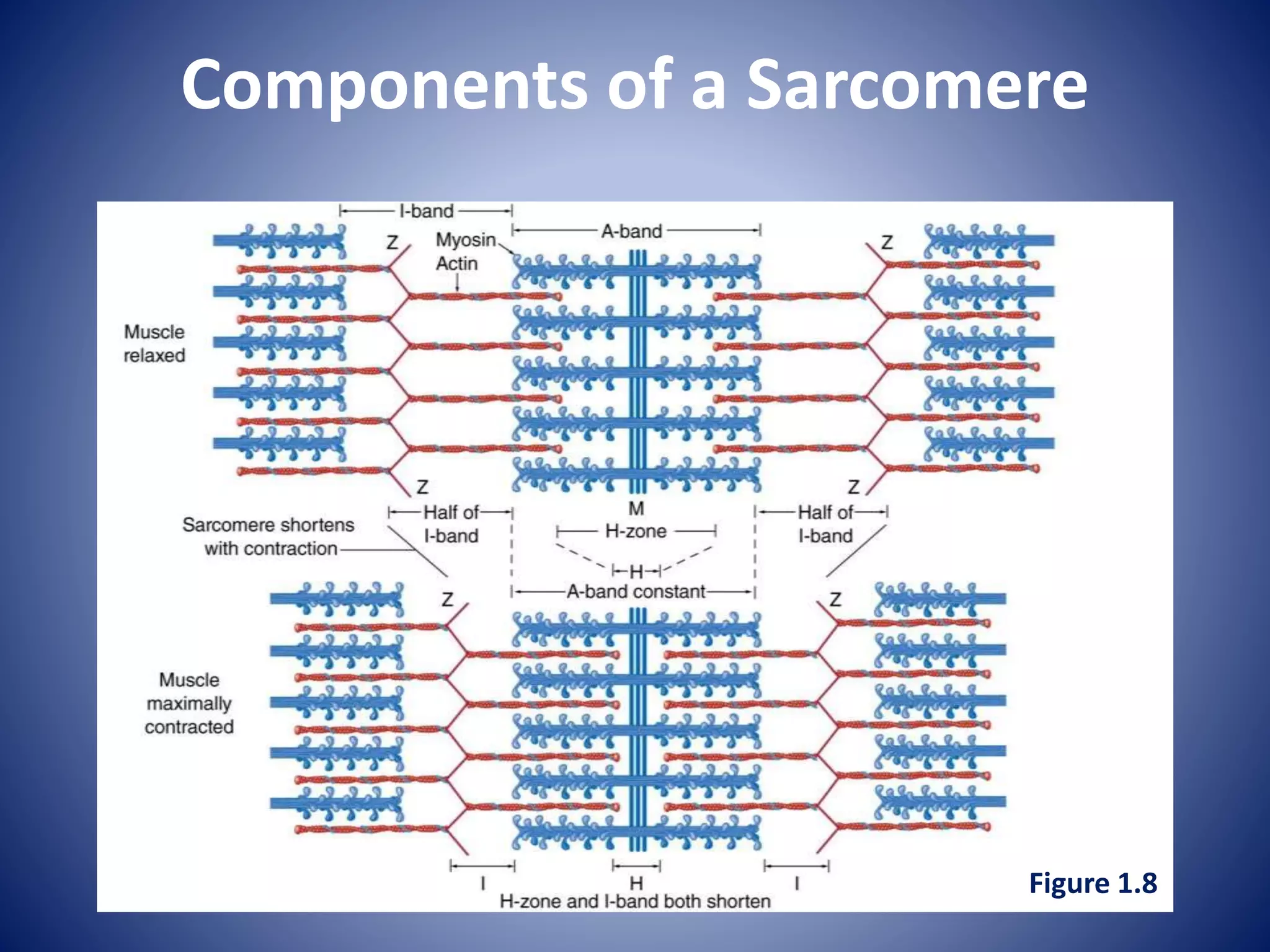
Components of a Sarcomere
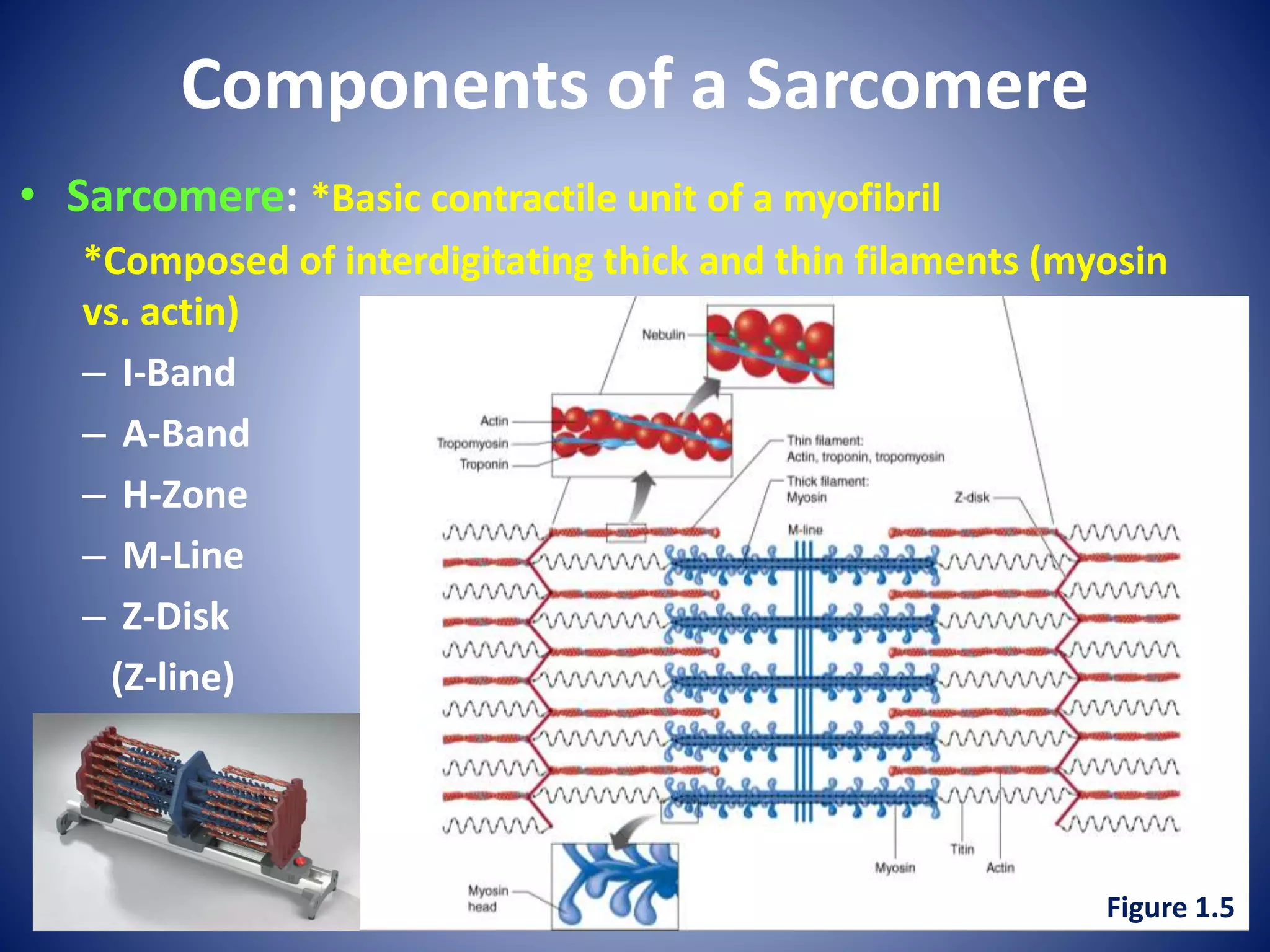
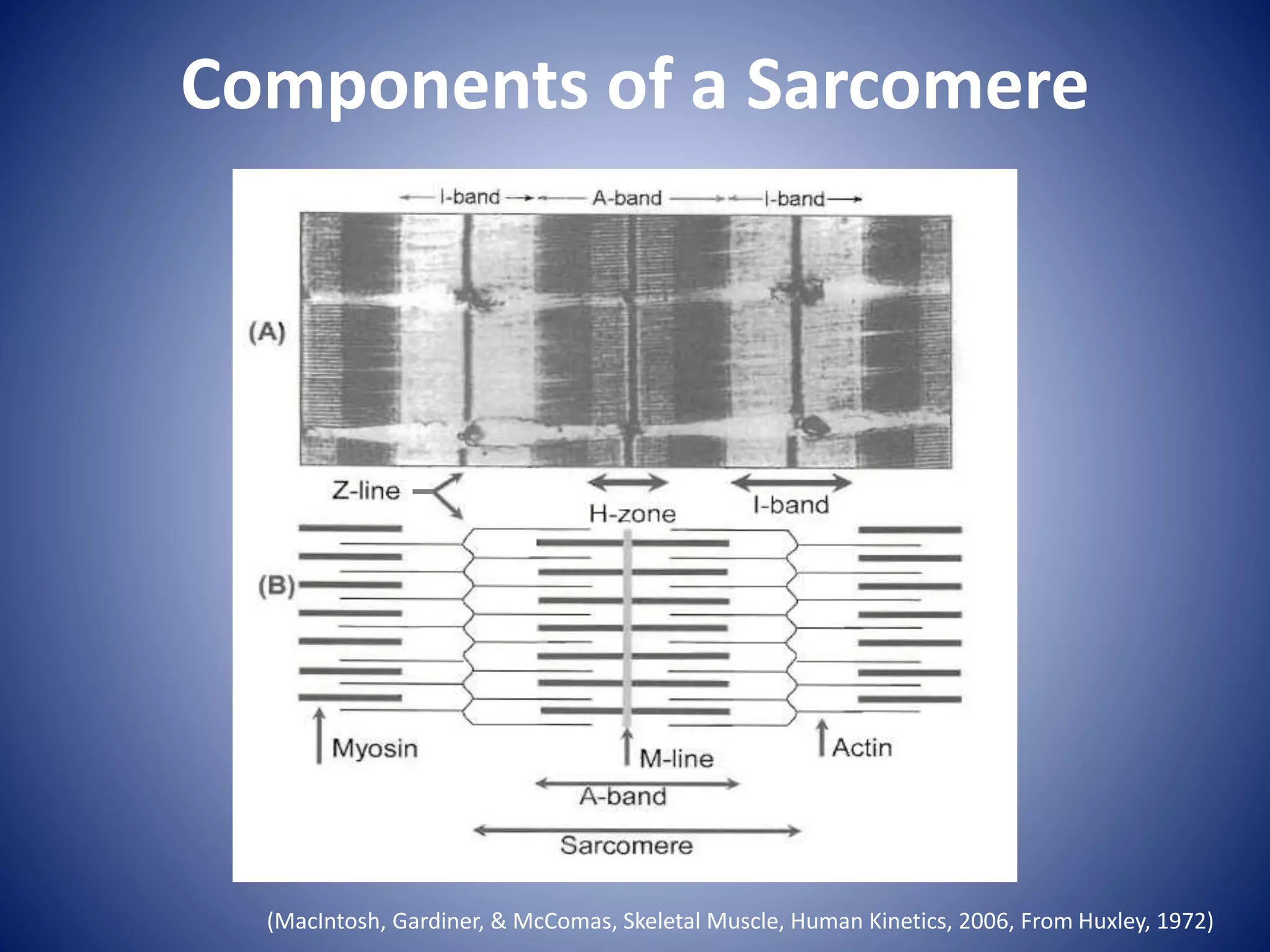
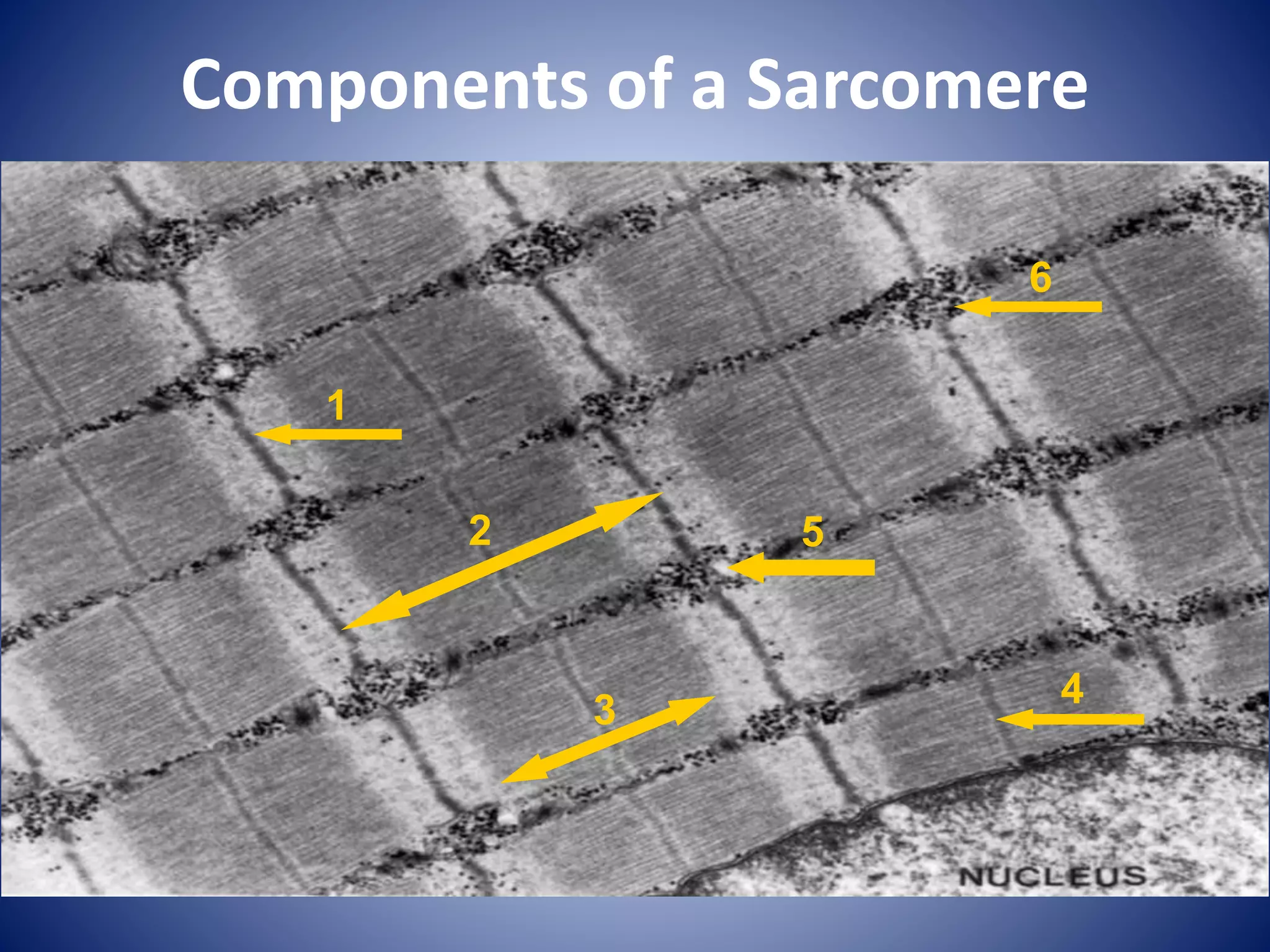
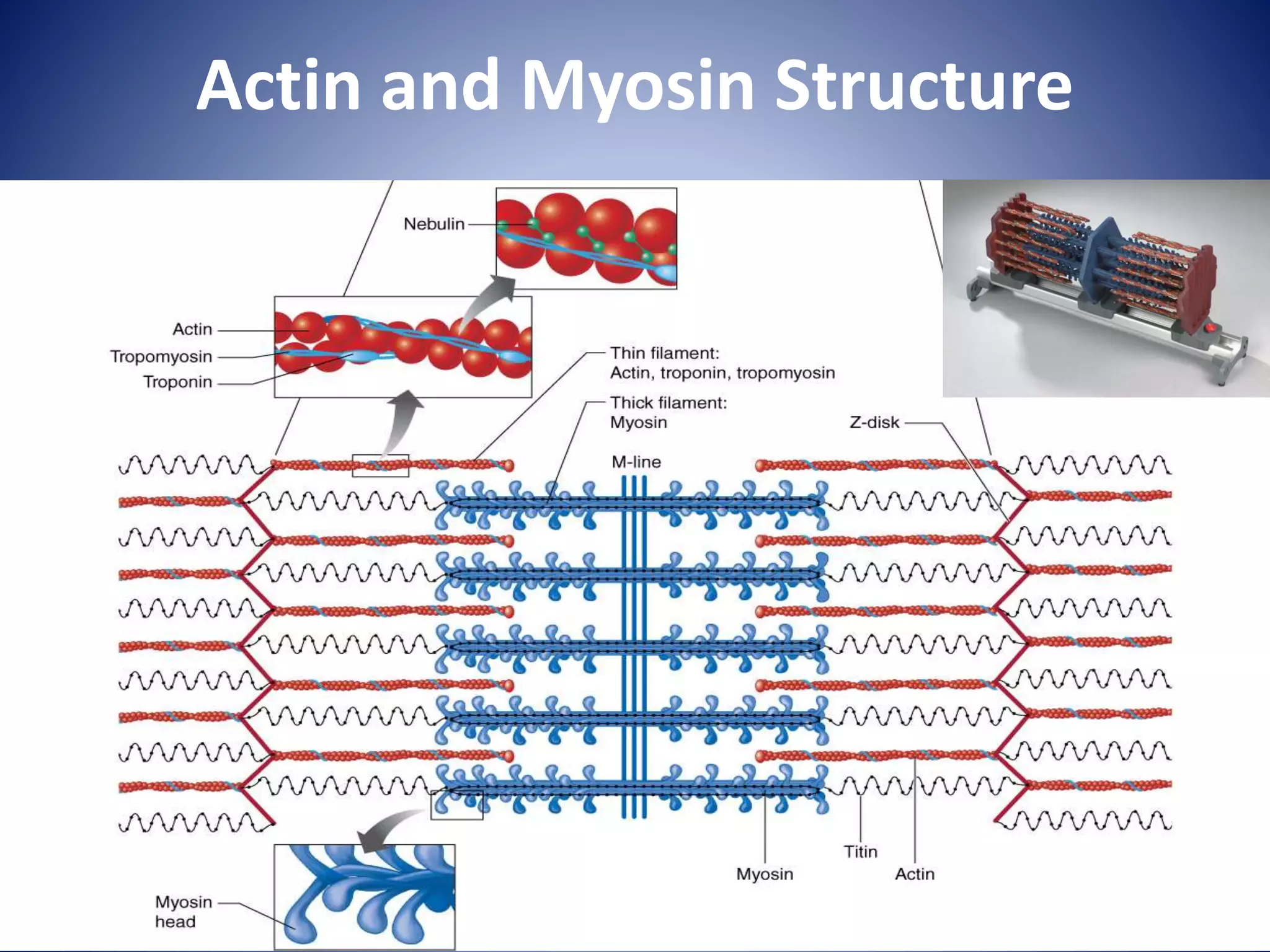
• Sarcomere: *Basic contractile unit of a myofibril
*Composed of interdigitating thick and thin filaments (myosin
vs. actin)
– I-Band
– A-Band
– H-Zone
– M-Line
– Z-Disk
(Z-line)
Figure 1.5
Components of a Sarcomere
Figure 1.8
Components of a Sarcomere
(MacIntosh, Gardiner, & McComas, Skeletal Muscle, Human Kinetics, 2006, From Huxley, 1972)
Components of a Sarcomere
4
1
2
3
5
6
Components of a Sarcomere
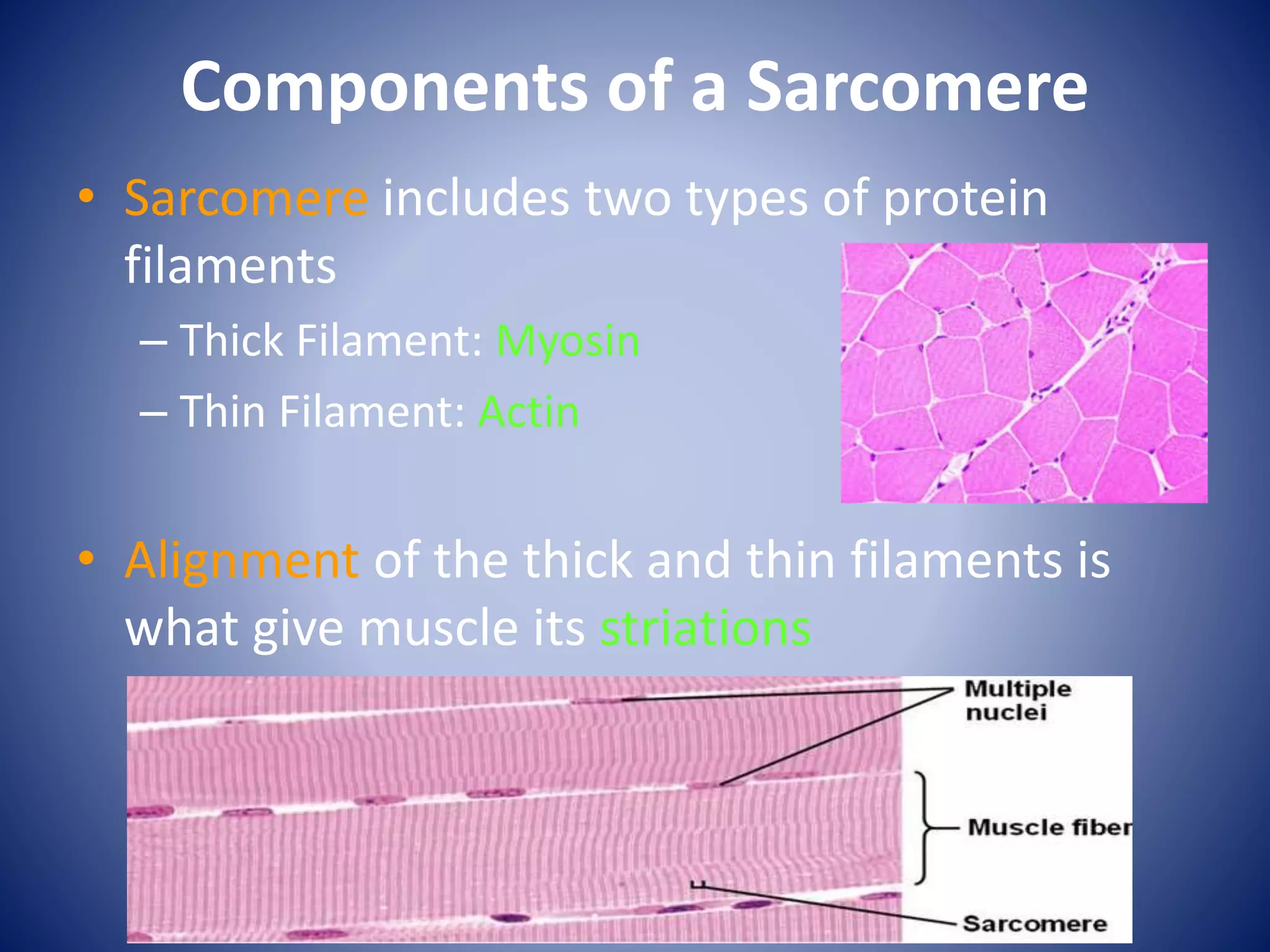
• Sarcomere includes two types of protein
filaments
– Thick Filament: Myosin
– Thin Filament: Actin
• Alignment of the thick and thin filaments is
what give muscle its striations
Myosin
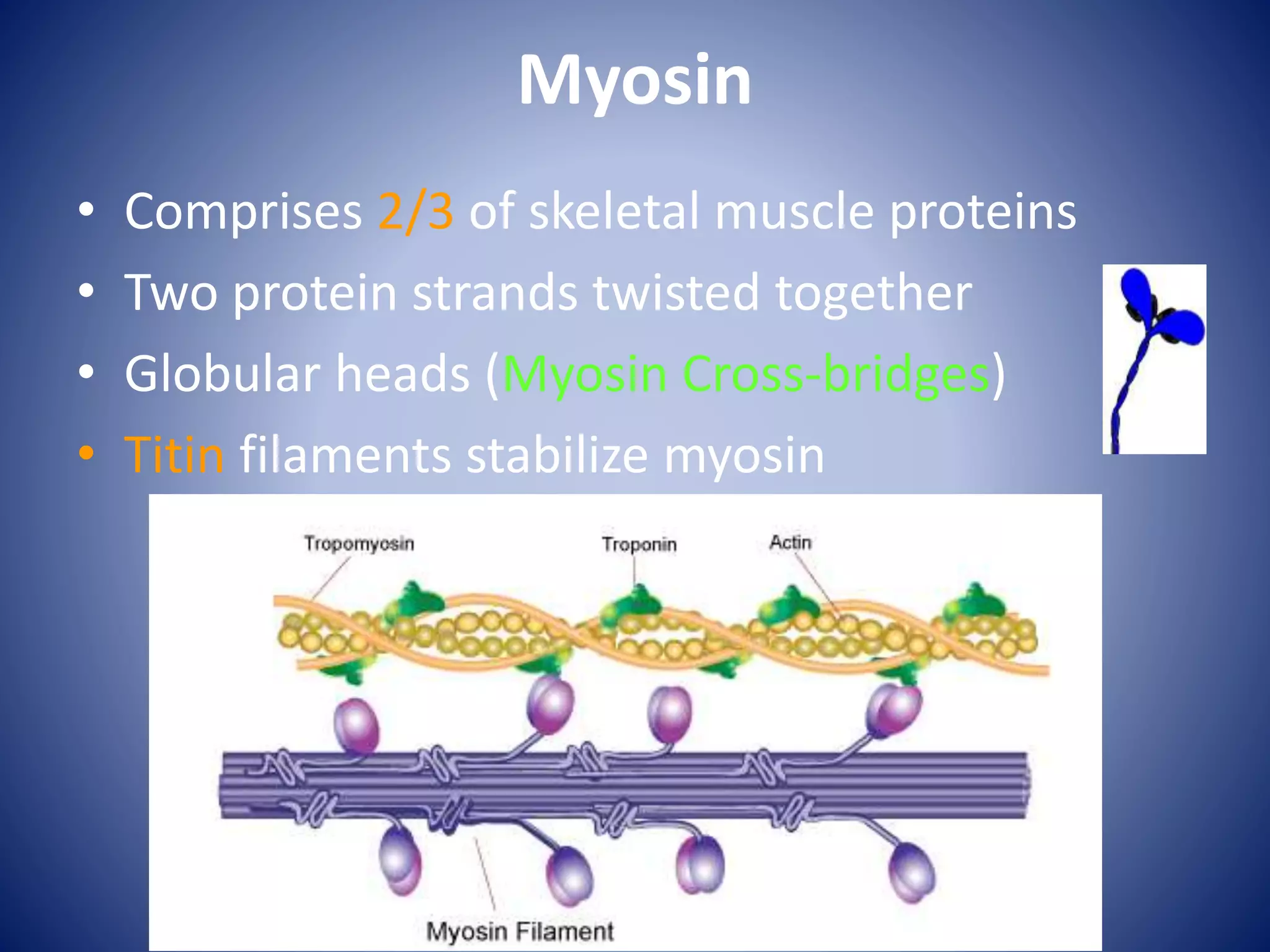
• Comprises 2/3 of skeletal muscle proteins
• Two protein strands twisted together
• Globular heads (Myosin Cross-bridges)
• Titin filaments stabilize myosin
Actin
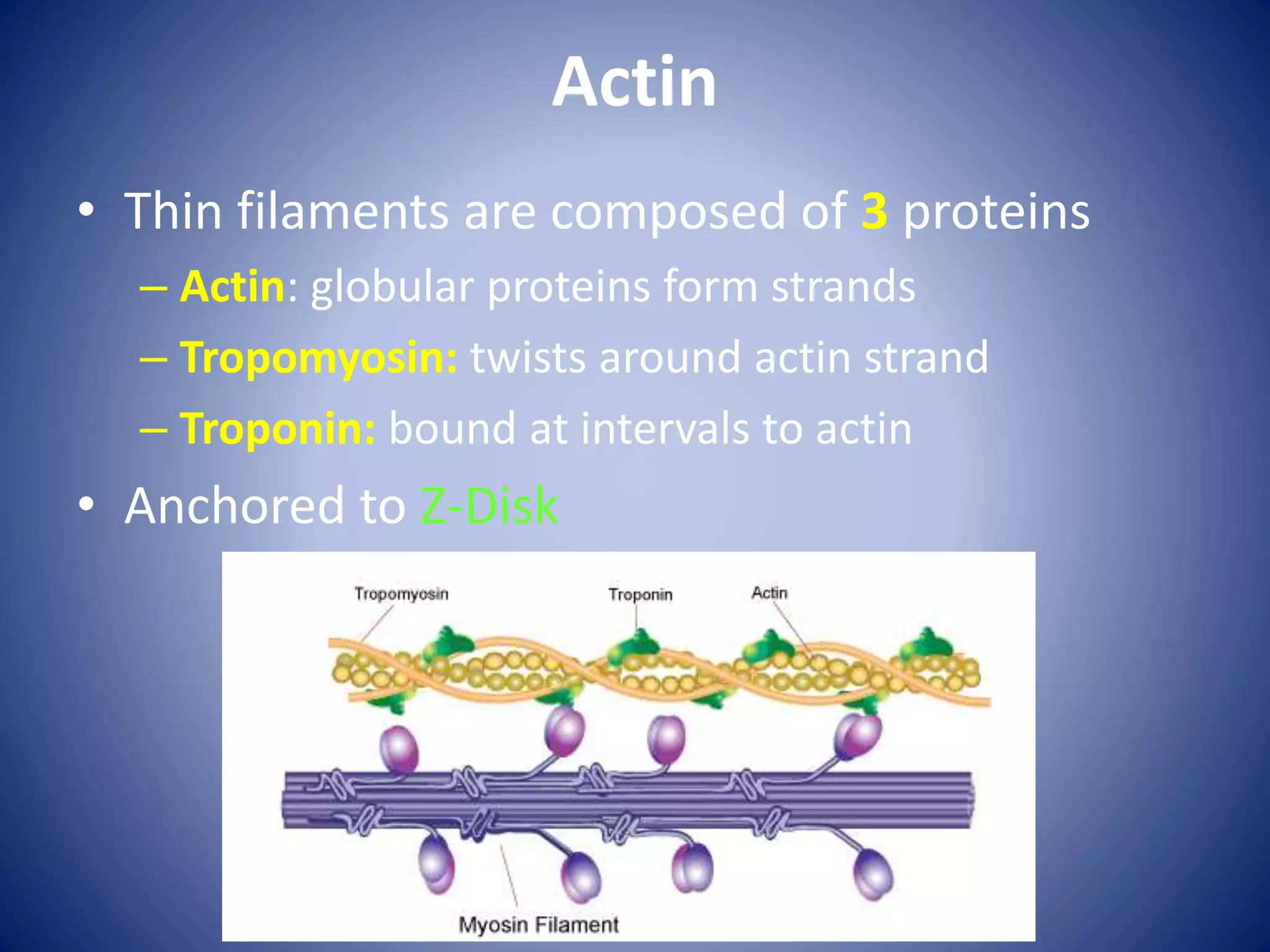
• Thin filaments are composed of 3 proteins
– Actin: globular proteins form strands
– Tropomyosin: twists around actin strand
– Troponin: bound at intervals to actin
• Anchored to Z-Disk
Actin and Myosin Structure
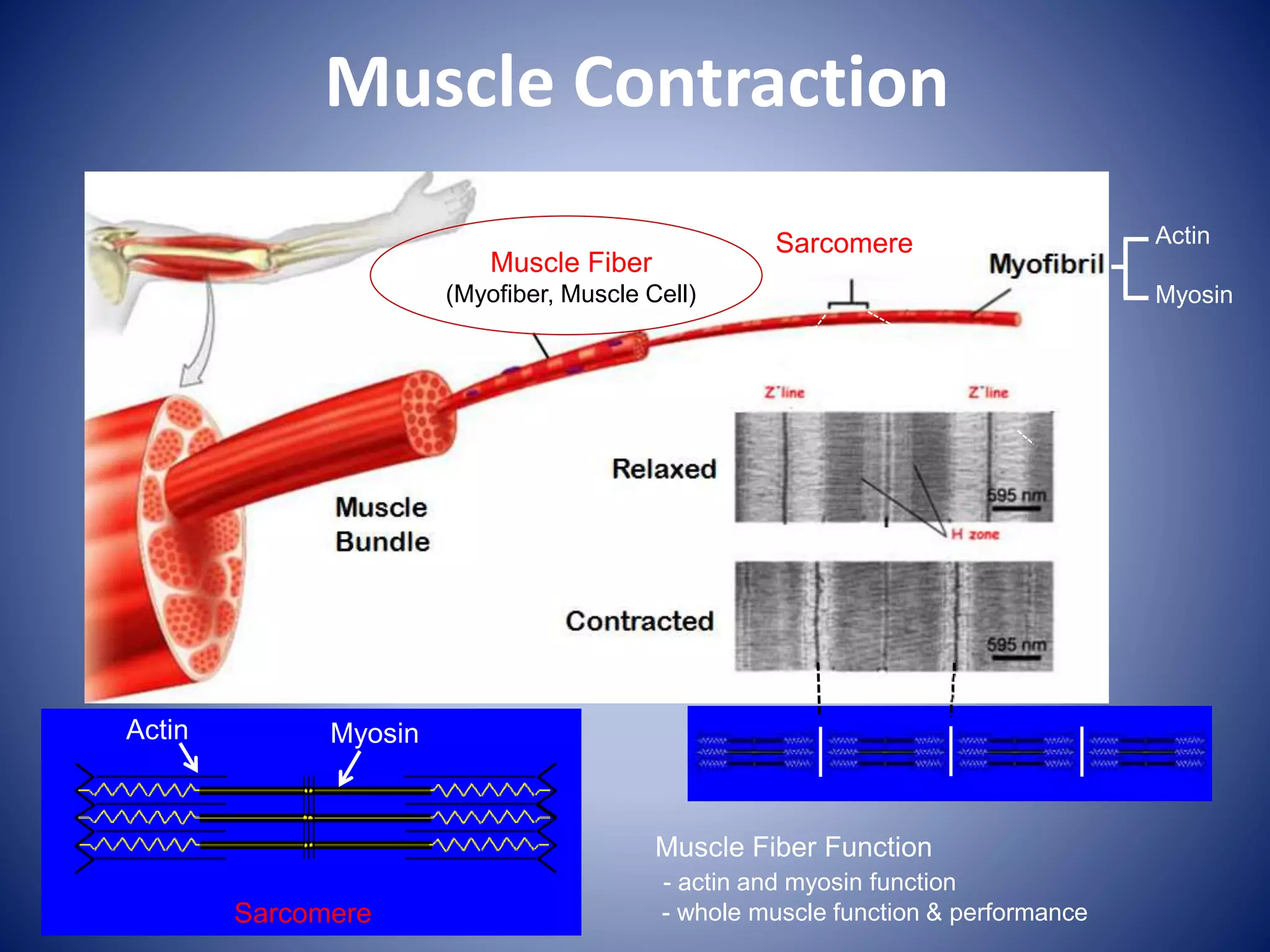
Muscle Contraction
Sarcomere Actin
Myosin
Sarcomere
Actin Myosin
Muscle Fiber Function
- actin and myosin function
- whole muscle function & performance
Skeletal Muscle
Muscle Fiber
(Myofiber, Muscle Cell)
Muscle
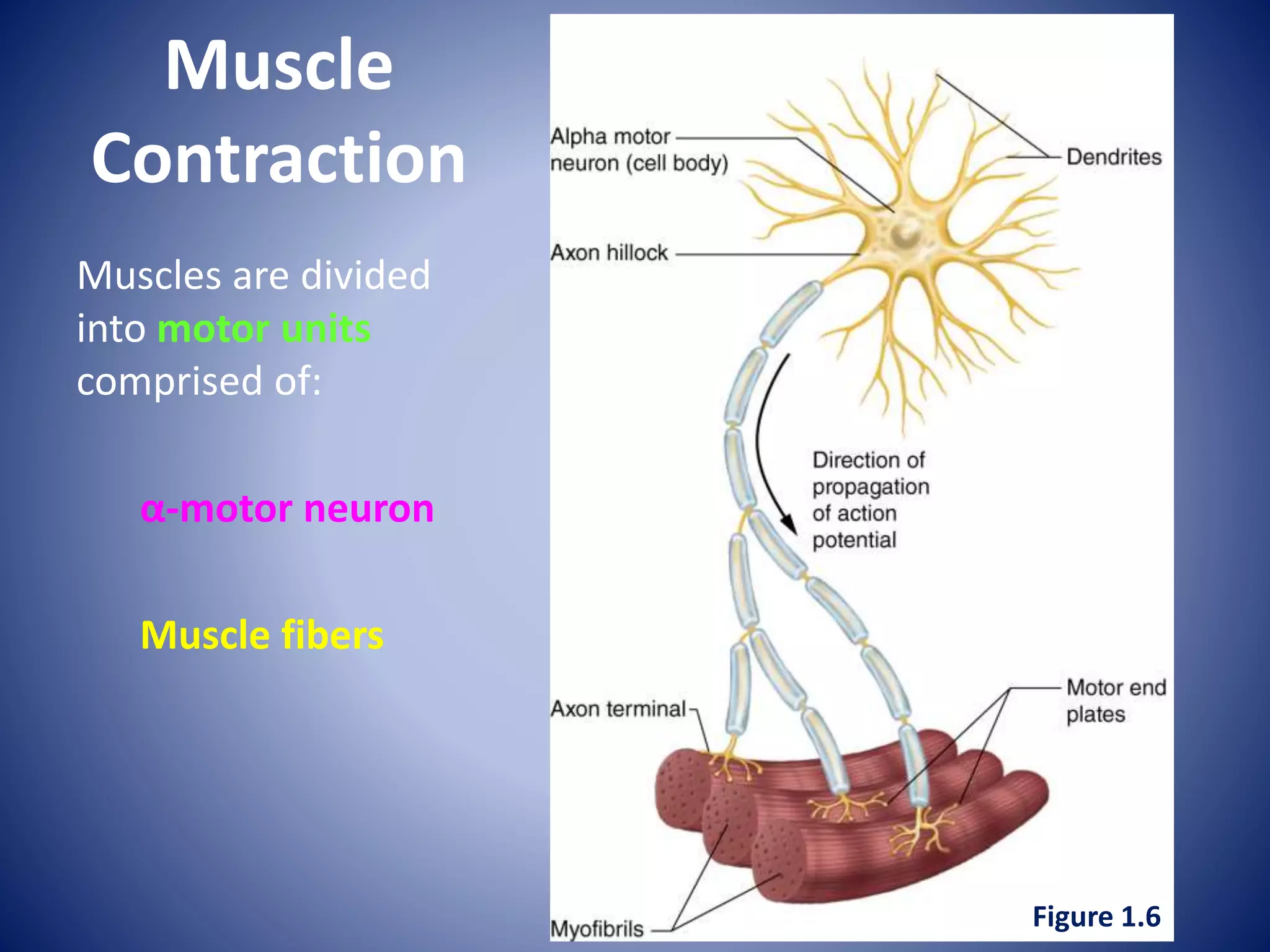
Contraction
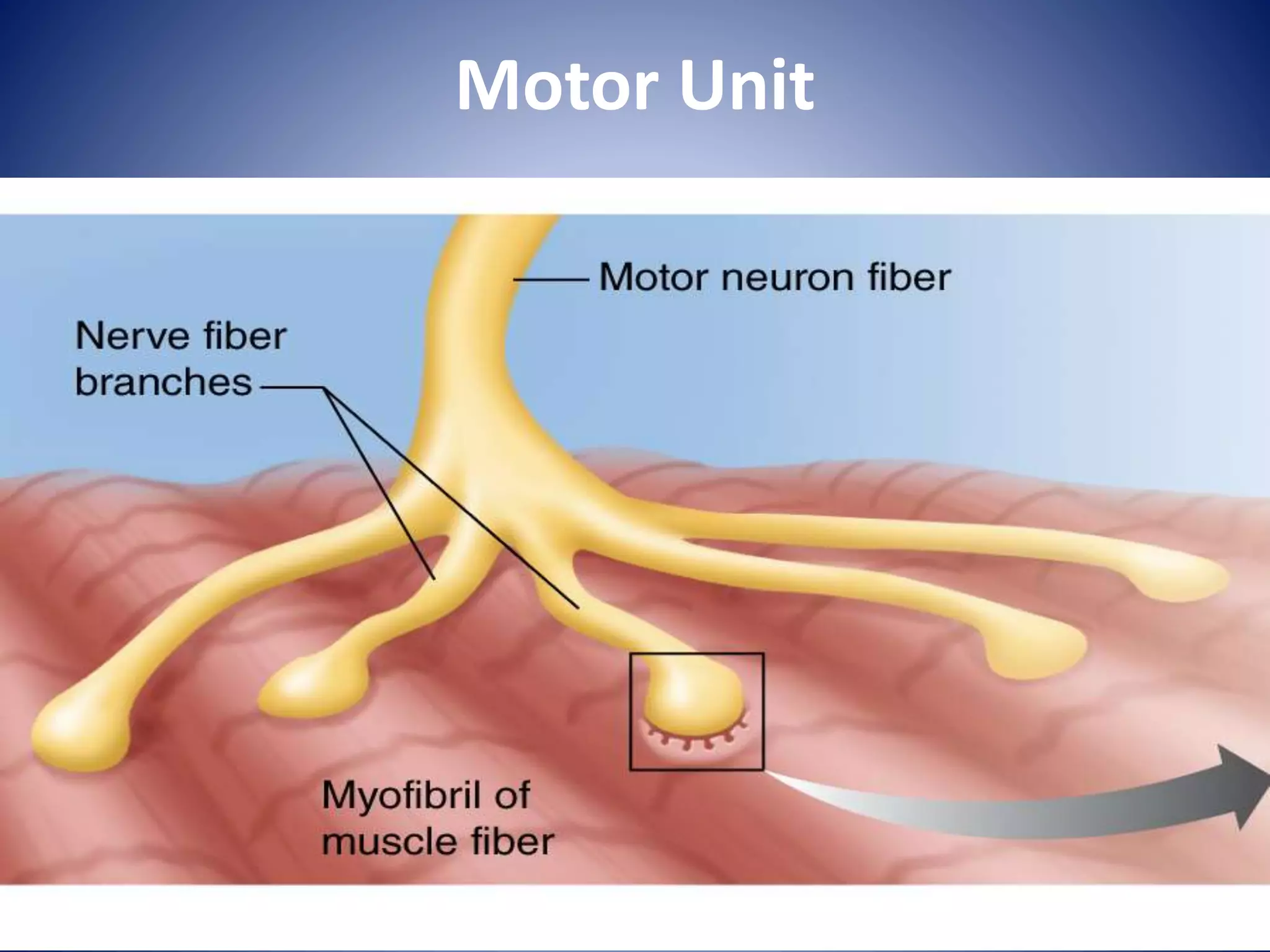
Muscles are divided
into motor units
comprised of:
α-motor neuron
Muscle fibers
Figure 1.6
Phases of Muscle Contraction
• Action Potential/Calcium Release
• Calcium-Troponin Binding; Tropomyosin Shift
• Actin-Myosin Binding
• Myosin Power Stroke/ ATP Binding
Resting Membrane Potential
(RMP)
• RMP= -70mV
• Caused by uneven separation of charged ions
inside (K+) and outside (Na+) the cell
• More ions outside the cell than inside
• Membrane more permeable to K+
• Sodium-Potassium Pumps maintain imbalance
– 3 Na+ out
– 2 K+ in
Ions Channels
• At rest, almost all the
Na+ channels are
closed.
• At rest, few K+
channels are open.
– Leaking due to [ ]
gradient
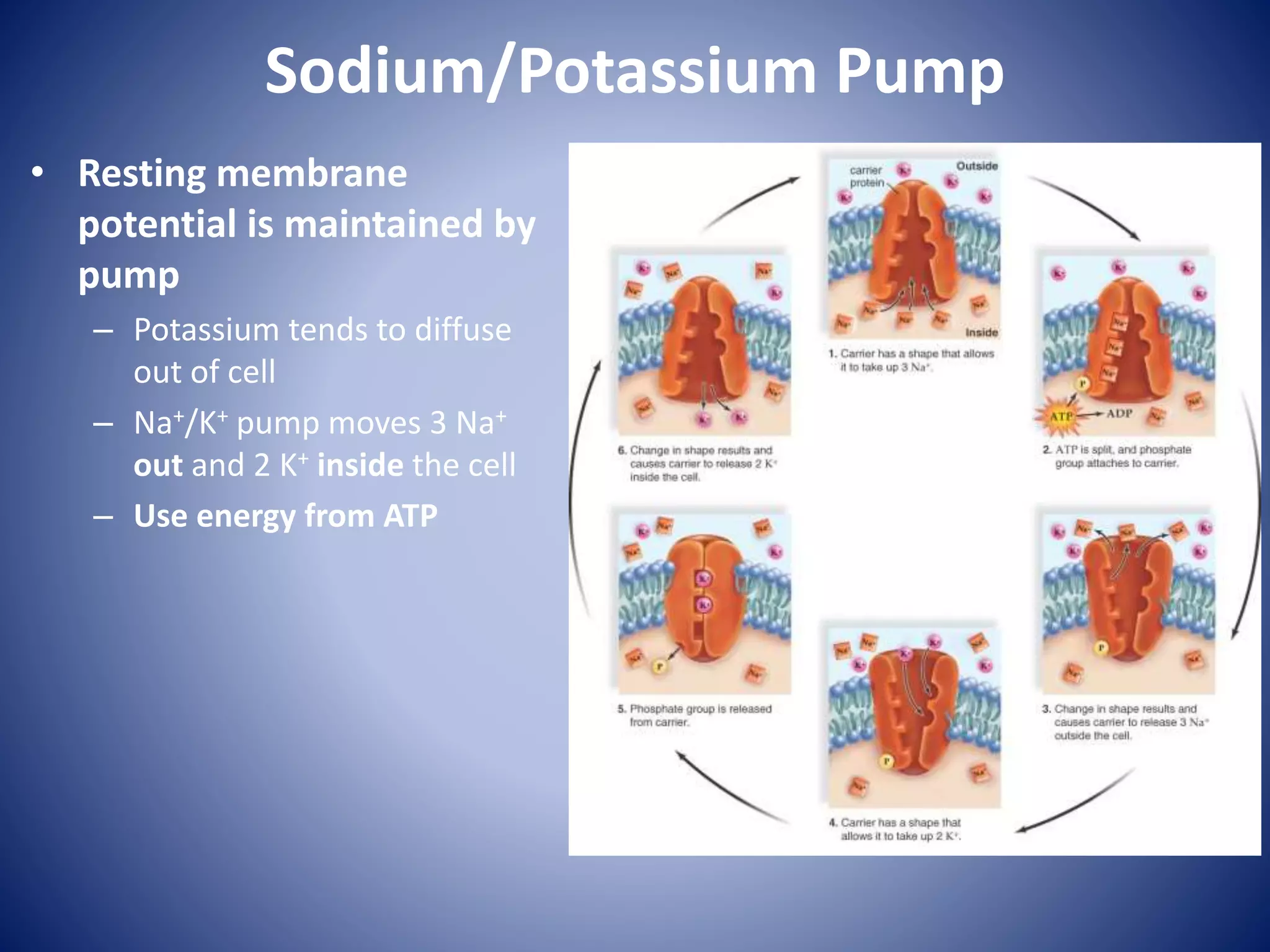
Sodium/Potassium Pump
• Resting membrane
potential is maintained by
pump
– Potassium tends to diffuse
out of cell
– Na+/K+ pump moves 3 Na+
out and 2 K+ inside the cell
– Use energy from ATP
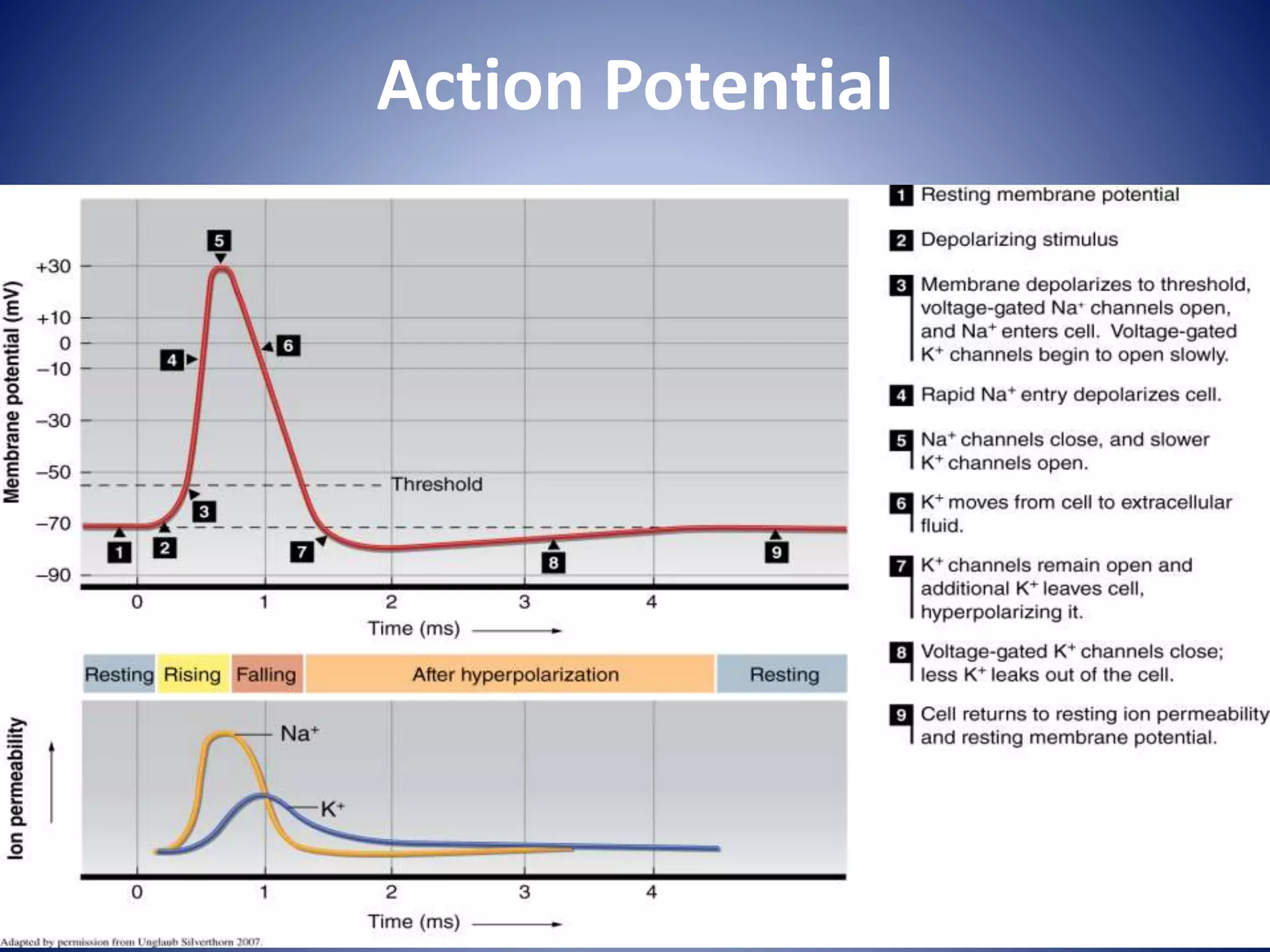
Action Potential
Action Potential
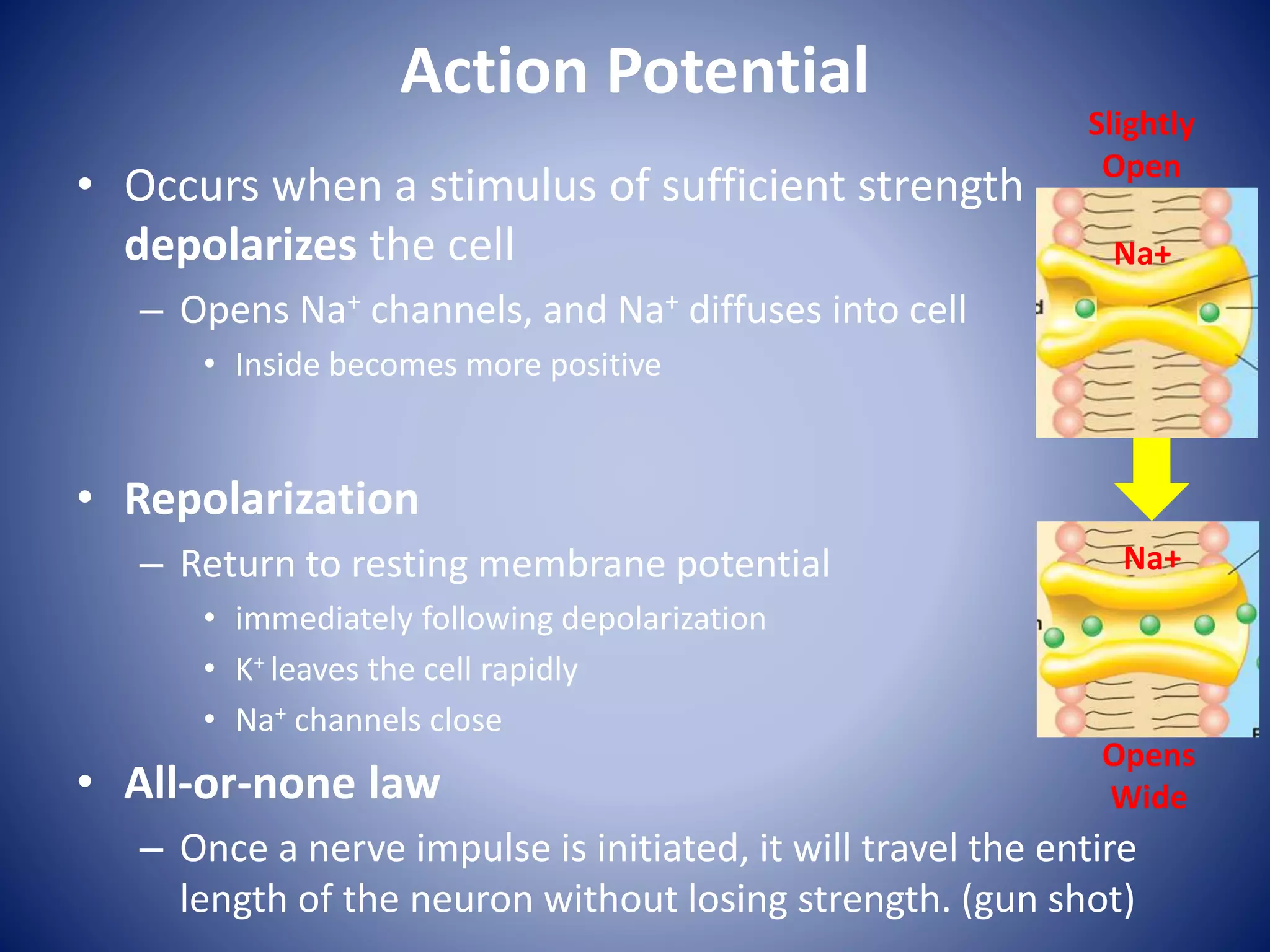
• Occurs when a stimulus of sufficient strength
depolarizes the cell
– Opens Na+ channels, and Na+ diffuses into cell
• Inside becomes more positive
• Repolarization
– Return to resting membrane potential
• immediately following depolarization
• K+ leaves the cell rapidly
• Na+ channels close
• All-or-none law
– Once a nerve impulse is initiated, it will travel the entire
length of the neuron without losing strength. (gun shot)
Slightly
Open
Na+
Opens
Wide
Na+
Motor Unit
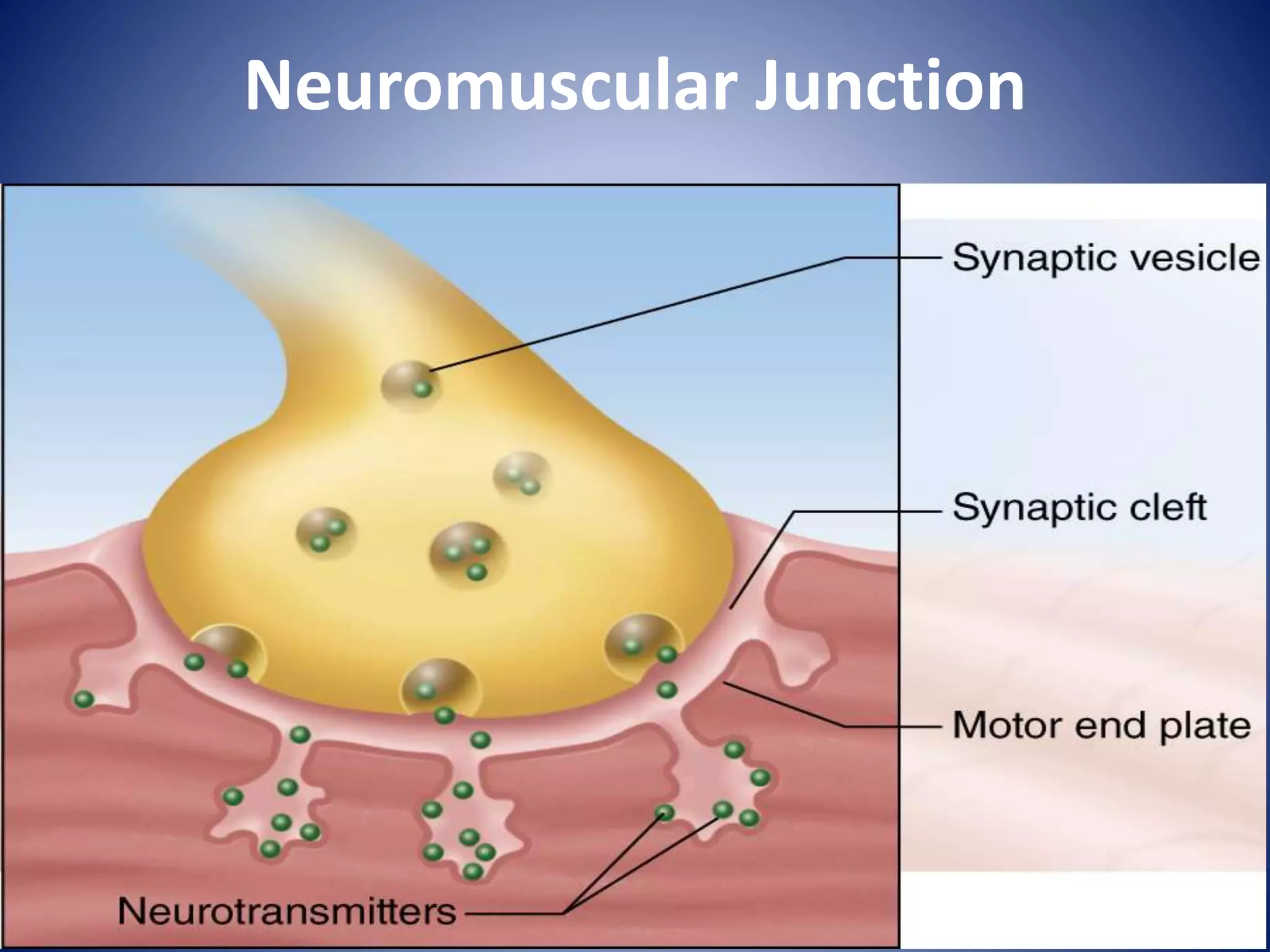
Neuromuscular Junction
Excitation-Contraction Coupling
(EC Coupling)
• Action potential travels to Sarcoplasmic
Reticulum, causes release of calcium into
sarcoplasm
• Calcium binds to troponin on thin filament
• Troponin moves tropomyosin, revealing
myosin binding sites on actin
• Myosin cross-bridges bind to actin
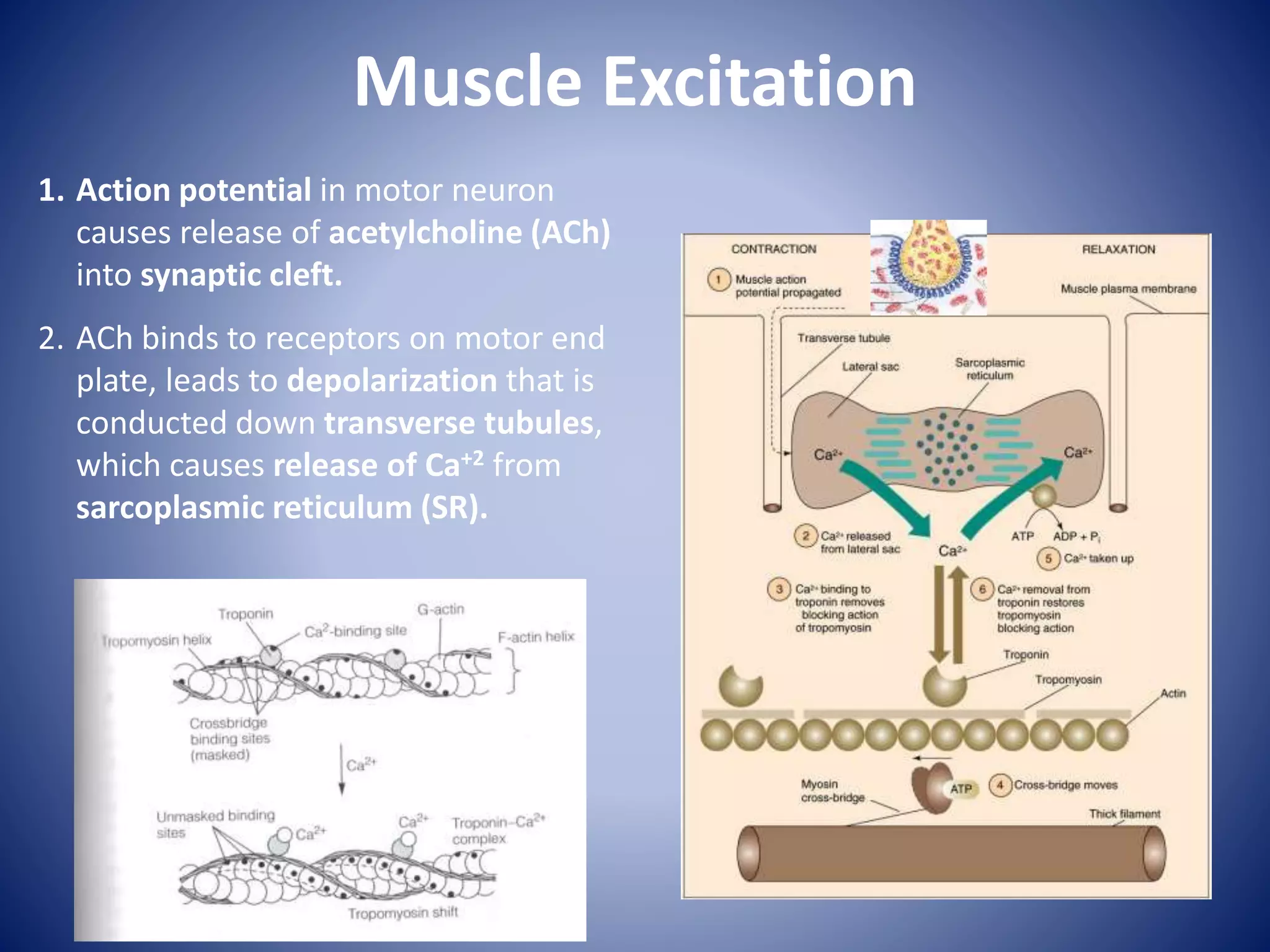
Muscle Excitation
1. Action potential in motor neuron
causes release of acetylcholine (ACh)
into synaptic cleft.
2. ACh binds to receptors on motor end
plate, leads to depolarization that is
conducted down transverse tubules,
which causes release of Ca+2 from
sarcoplasmic reticulum (SR).
Sliding Filament Theory
• Muscle contraction = muscle fiber shortening
• Myosin power stroke
– Myosin bound to actin tilts its head, pulling thin
filament towards the center of the sarcomere
– Process is repeated until Z-disk reaches myosin
filaments or until calcium is no longer available
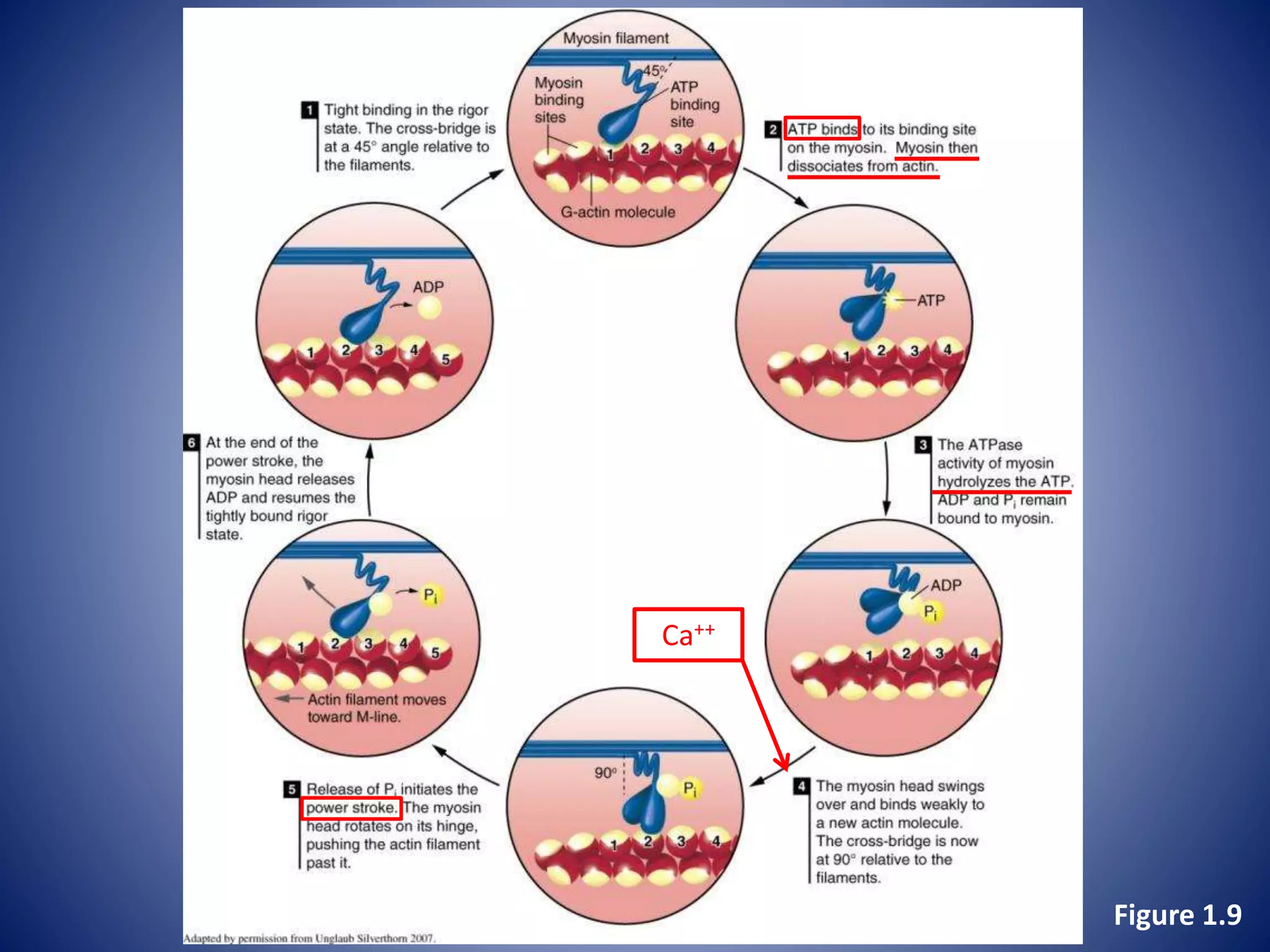
Figure 1.9
Ca++
Energy for Contraction
• ATP binding sites on myosin head
• ATPase (on myosin head) splits ATP into ADP
and Pi
• Energy released fuels the tilting of the myosin
head (power stroke)
• Additional ATP is required to keep contraction
going
Muscle Relaxation
• Calcium pumps return calcium to the SR,
stored for future use
• ATP required for calcium pumps
• Troponin and Tropomyosin return to original
position
• Thick and thin filaments return to original
positions
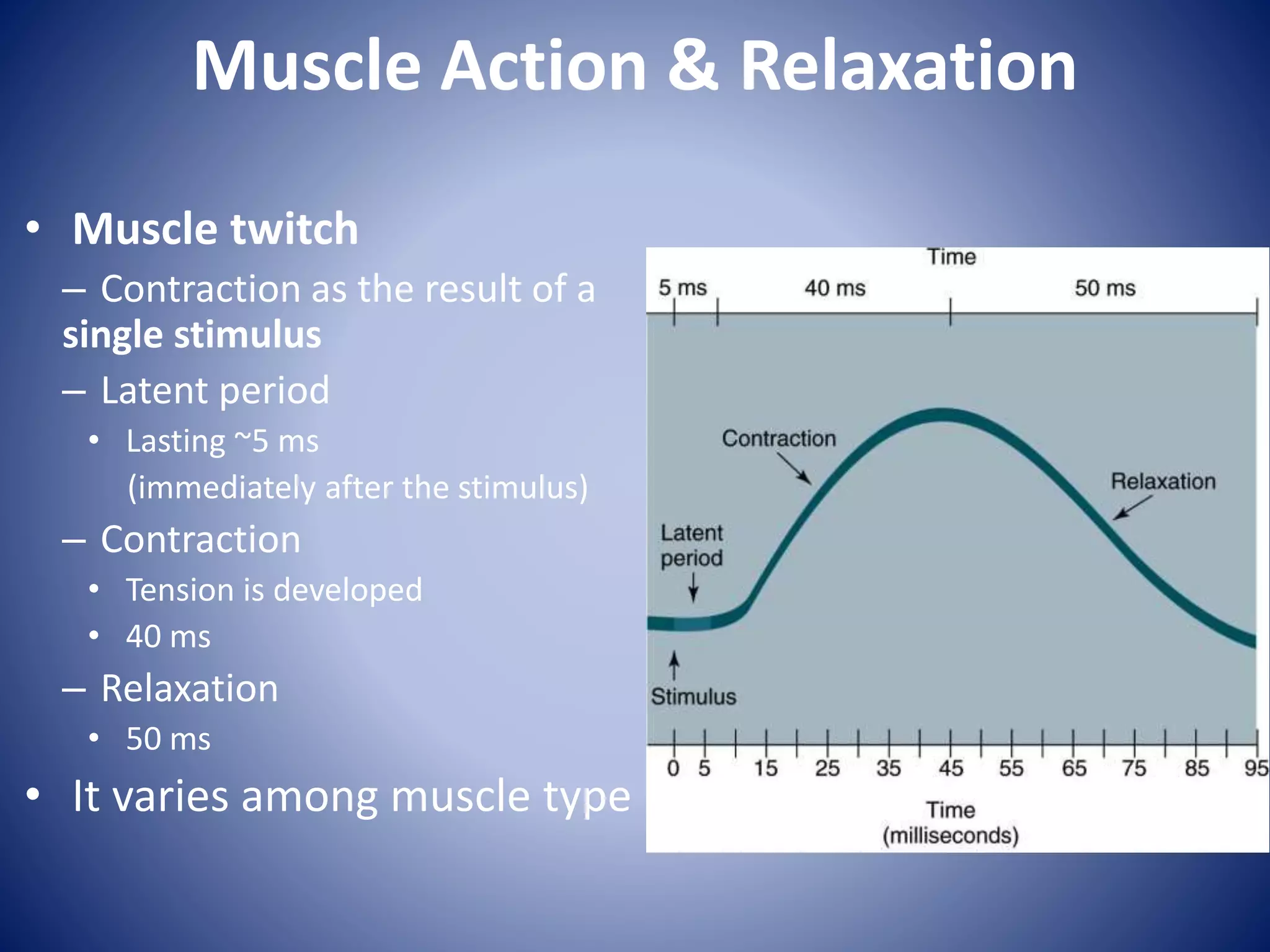
Muscle Action & Relaxation
• Muscle twitch
– Contraction as the result of a
single stimulus
– Latent period
• Lasting ~5 ms
(immediately after the stimulus)
– Contraction
• Tension is developed
• 40 ms
– Relaxation
• 50 ms
• It varies among muscle type
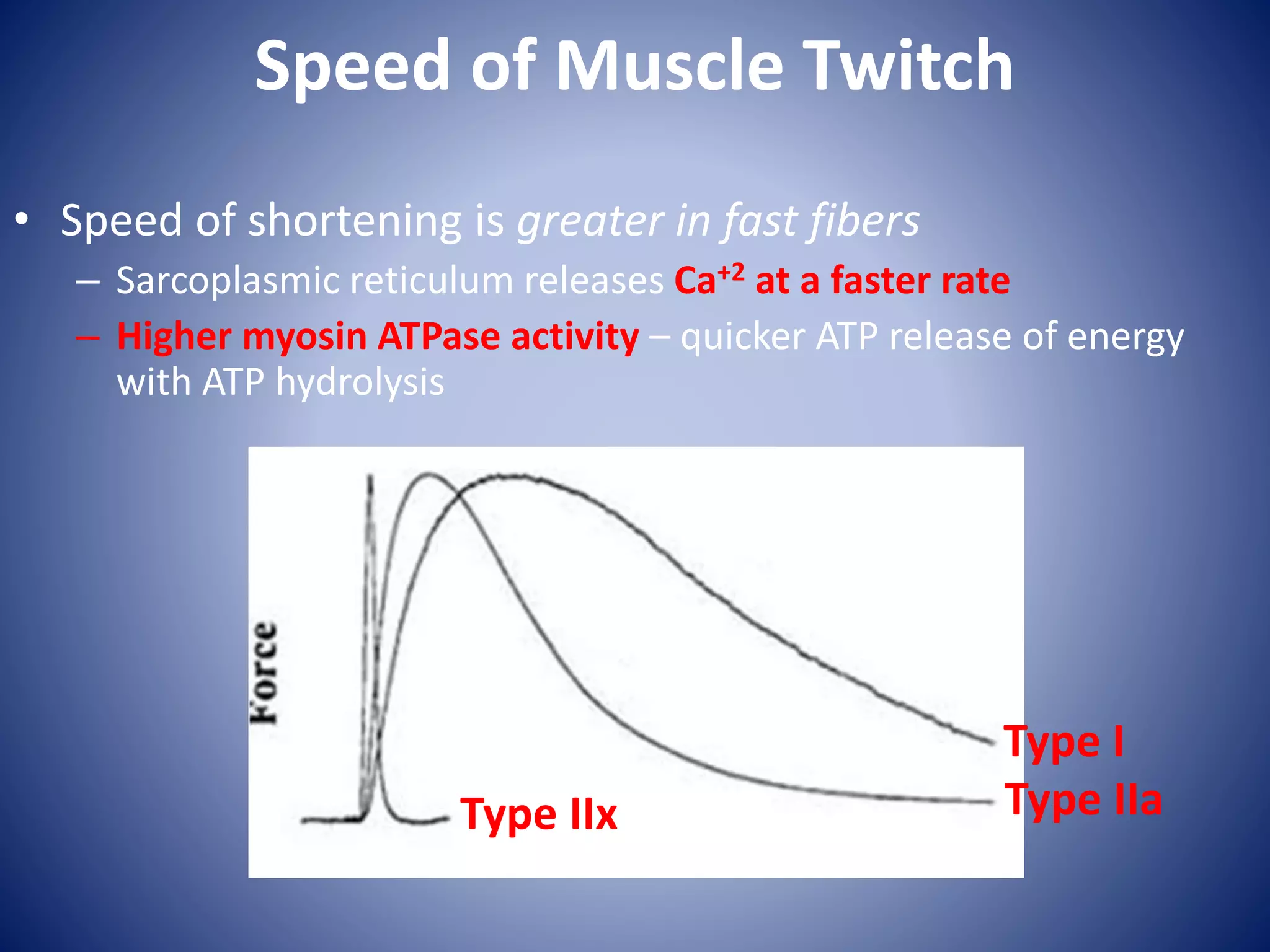
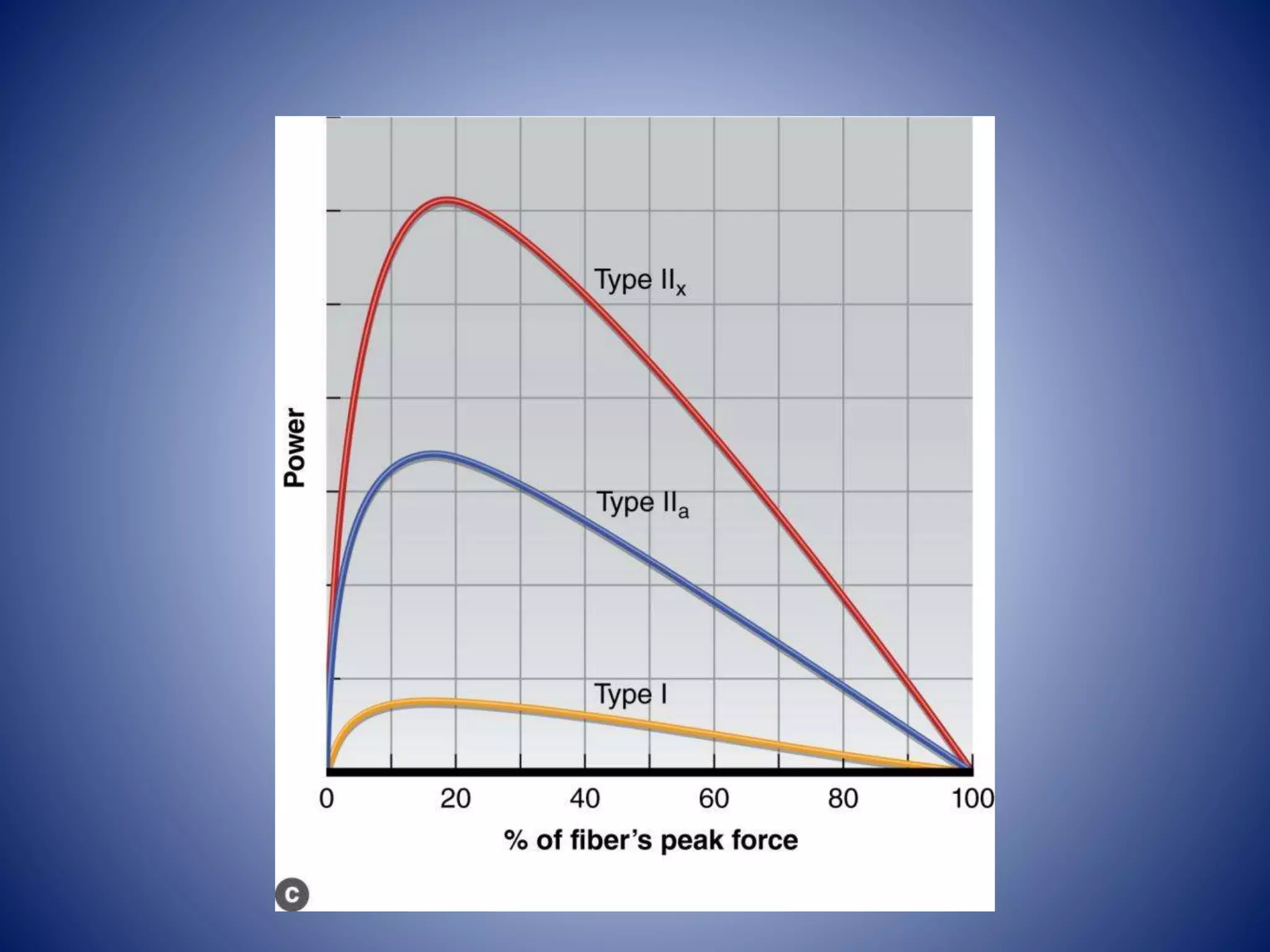
Speed of Muscle Twitch
• Speed of shortening is greater in fast fibers
– Sarcoplasmic reticulum releases Ca+2 at a faster rate
– Higher myosin ATPase activity – quicker ATP release of energy
with ATP hydrolysis
Type I
Type IIaType IIx
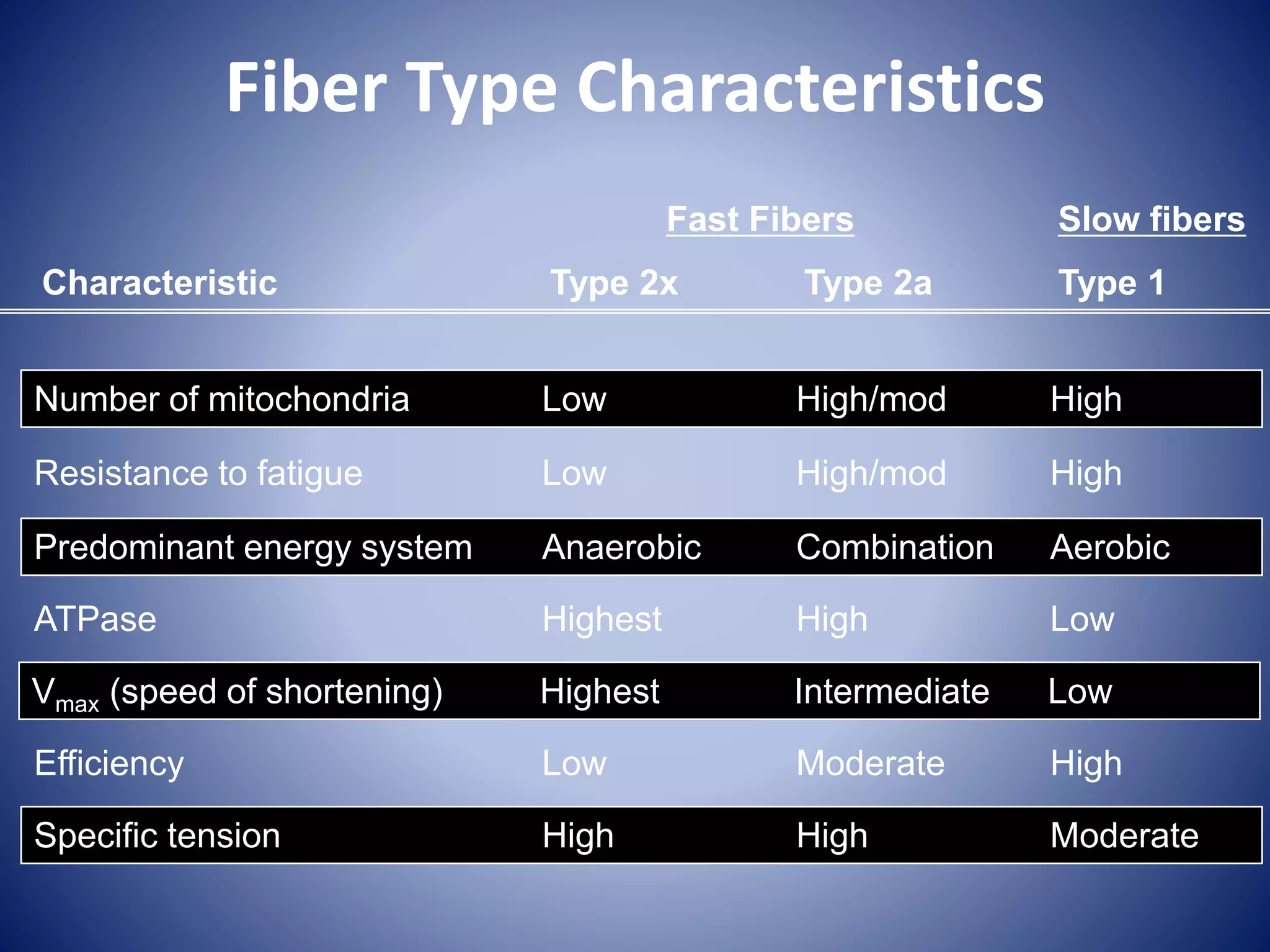
Fiber Type Characteristics
Fast Fibers Slow fibers
Characteristic Type 2x Type 2a Type 1
Number of mitochondria Low High/mod High
Resistance to fatigue Low High/mod High
Predominant energy system Anaerobic Combination Aerobic
ATPase Highest High Low
Vmax (speed of shortening) Highest Intermediate Low
Efficiency Low Moderate High
Specific tension High High Moderate
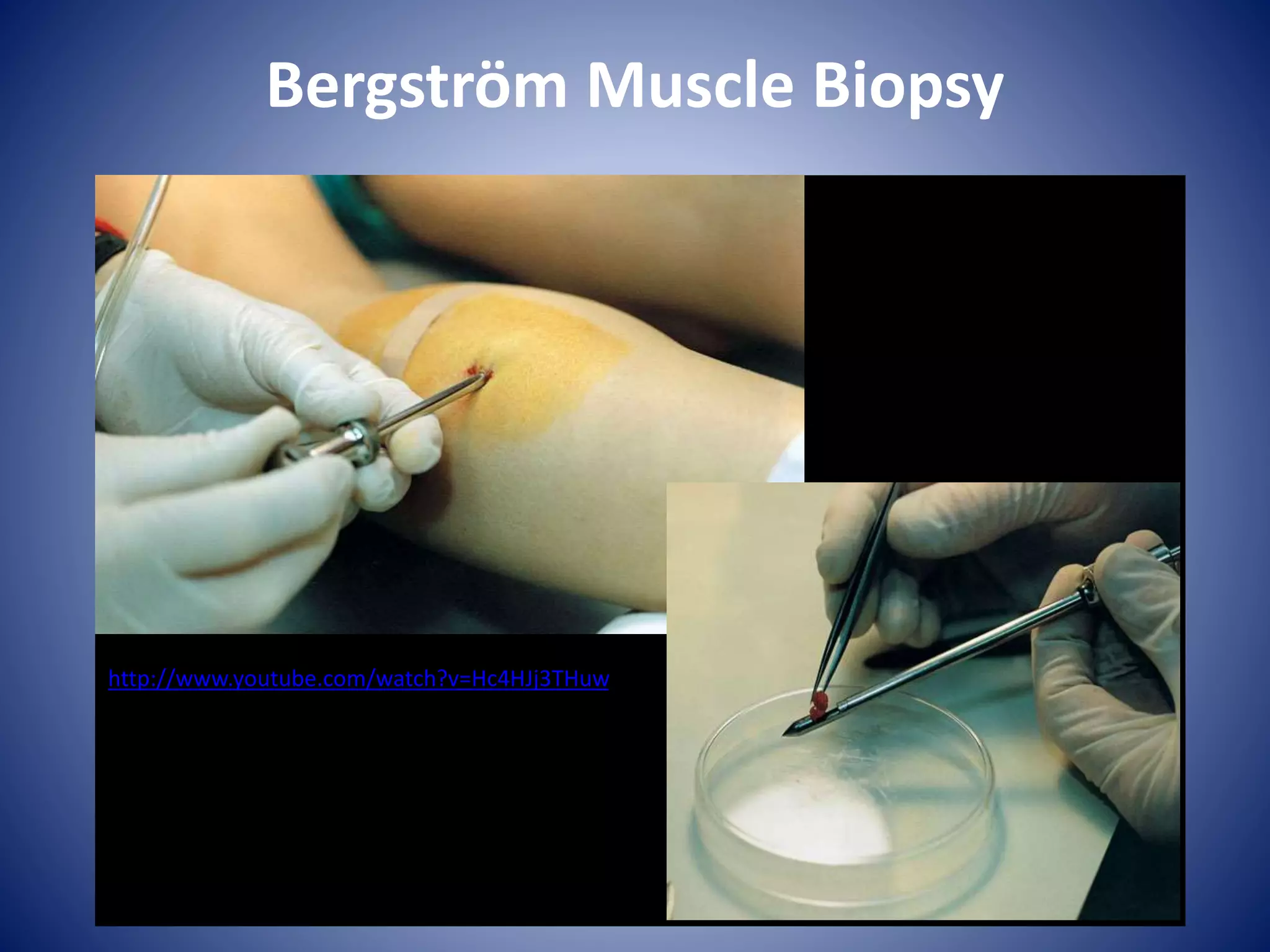
Bergström Muscle Biopsy
http://www.youtube.com/watch?v=Hc4HJj3THuw
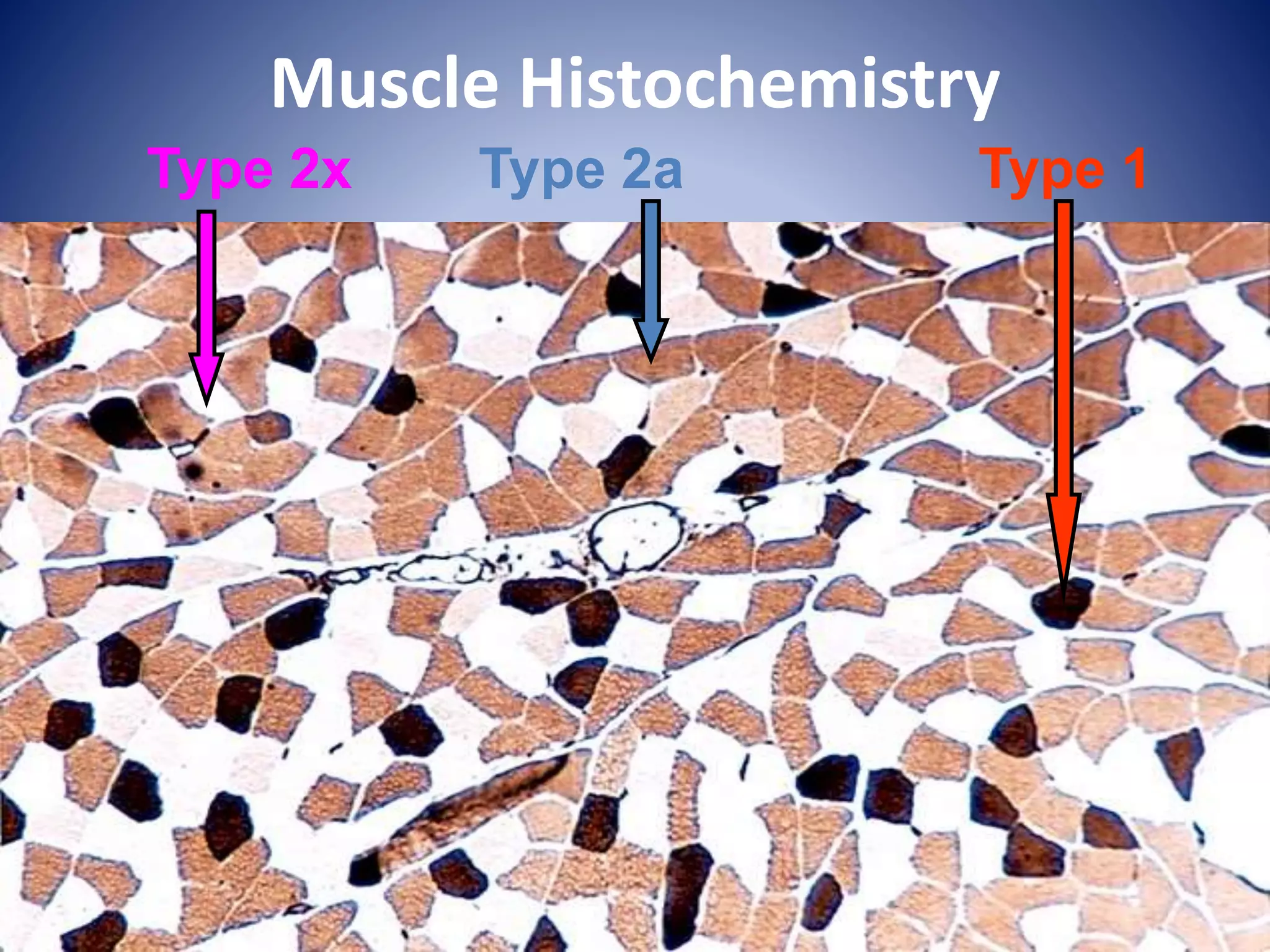
Muscle Histochemistry
Type 2a Type 1Type 2x
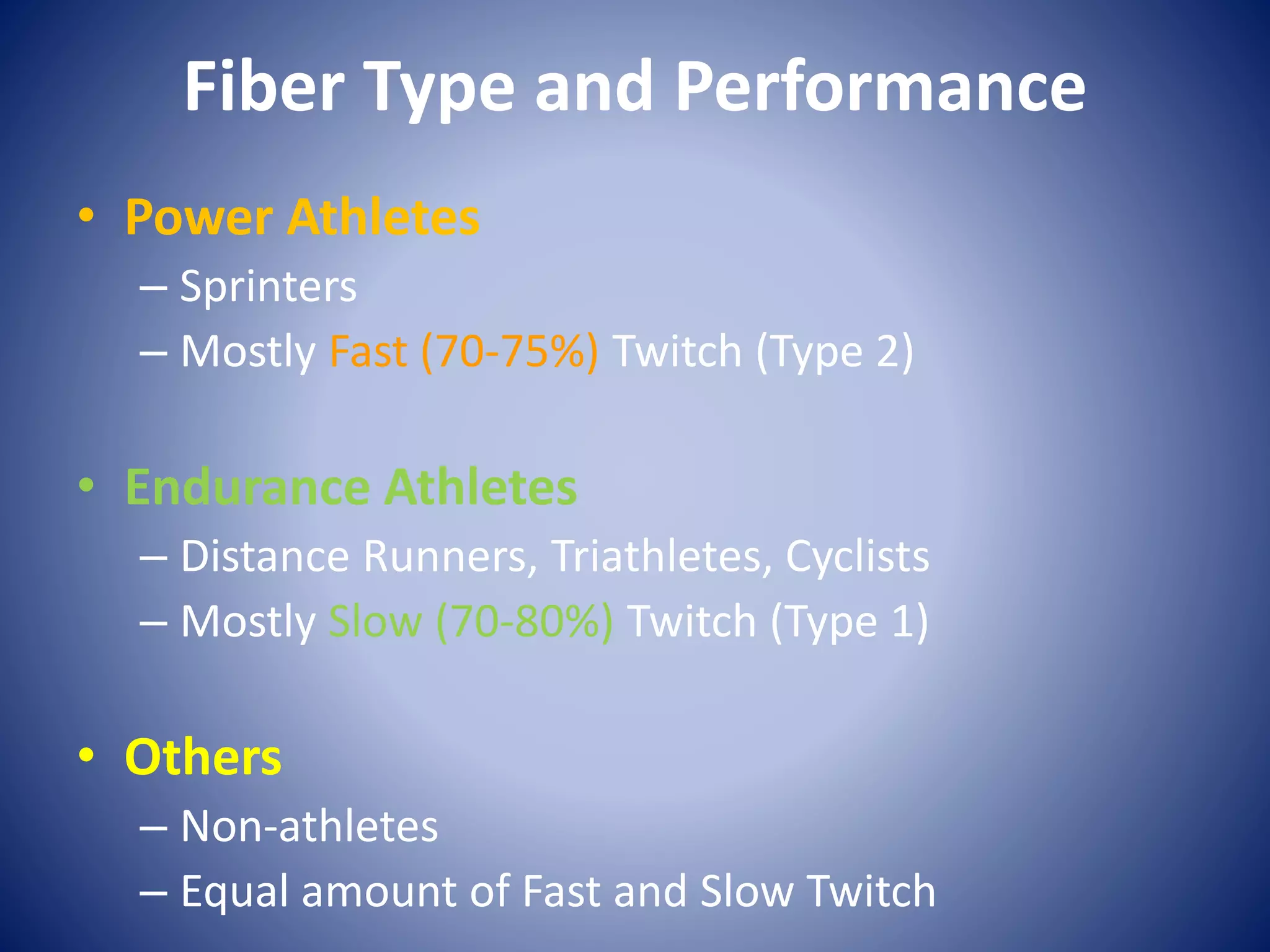
Fiber Type and Performance
• Power Athletes
– Sprinters
– Mostly Fast (70-75%) Twitch (Type 2)
• Endurance Athletes
– Distance Runners, Triathletes, Cyclists
– Mostly Slow (70-80%) Twitch (Type 1)
• Others
– Non-athletes
– Equal amount of Fast and Slow Twitch
Other Factors which Influence
Muscle Force
• Number of motor units activated
• Type of motor units activated (FT or ST)
• Muscle size
• Initial muscle length
• Joint angle
• Speed of muscle action (shortening or
lengthening)
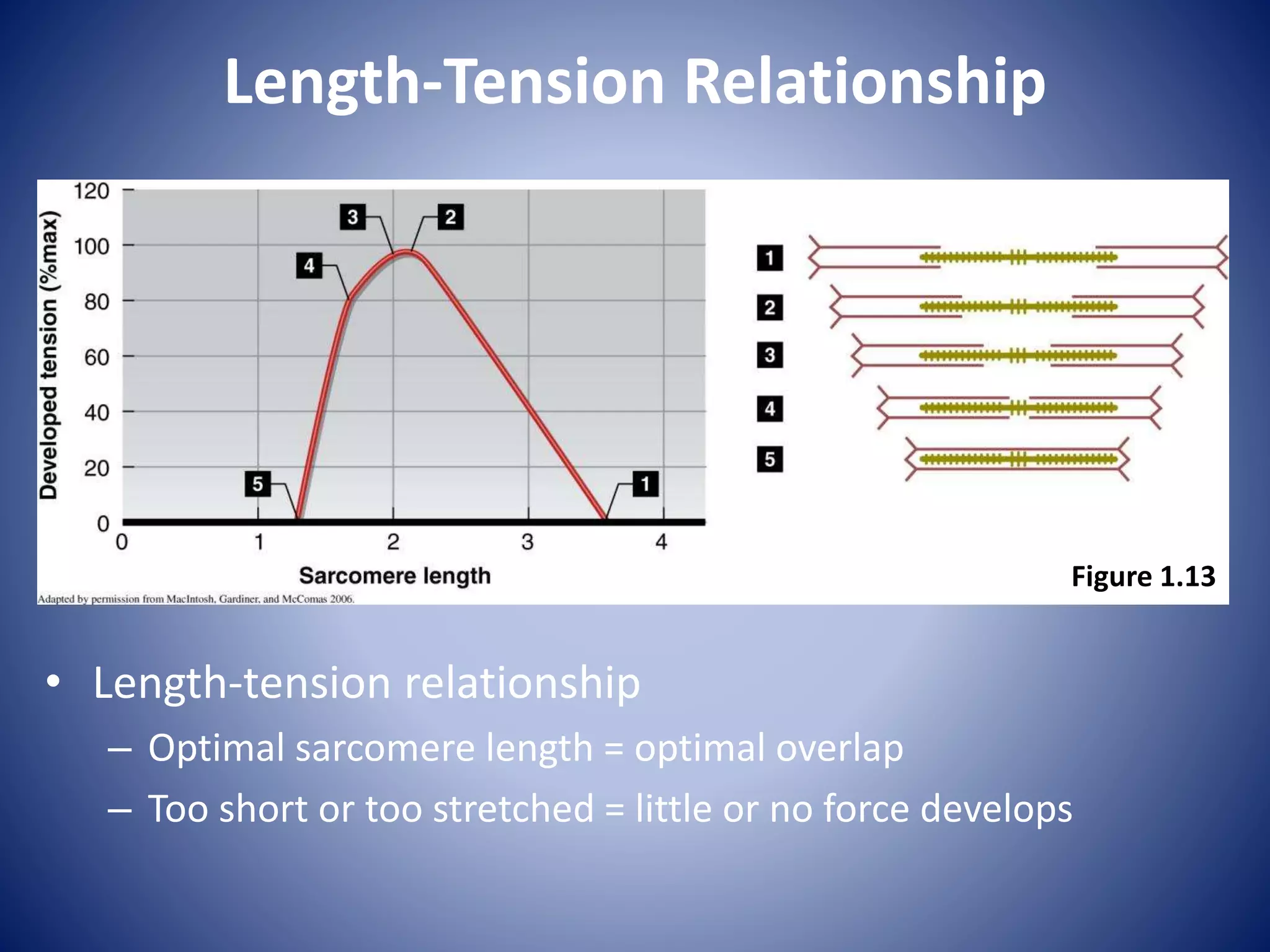
Length-Tension Relationship
Figure 1.13
• Length-tension relationship
– Optimal sarcomere length = optimal overlap
– Too short or too stretched = little or no force develops
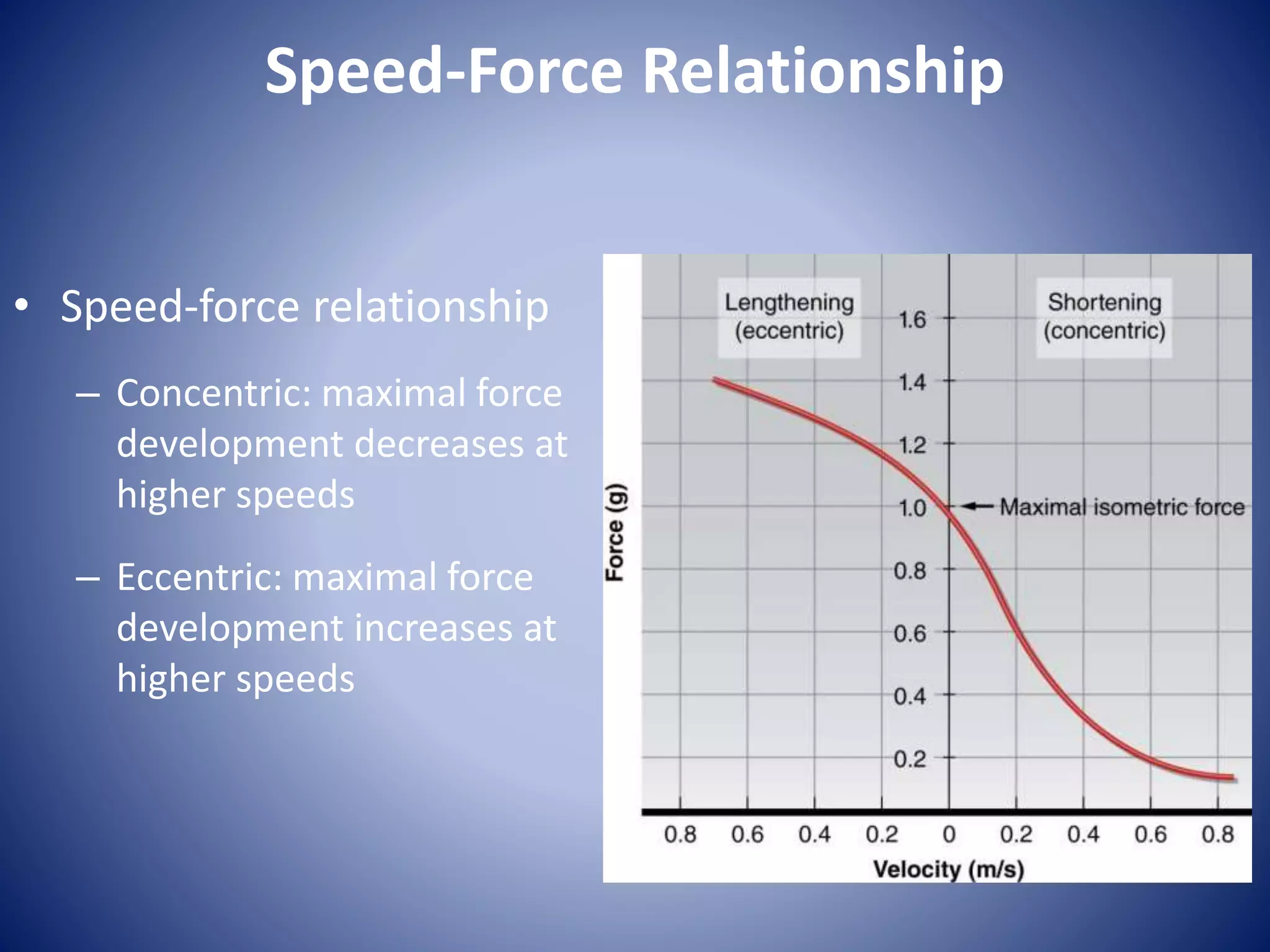
Speed-Force Relationship
• Speed-force relationship
– Concentric: maximal force
development decreases at
higher speeds
– Eccentric: maximal force
development increases at
higher speeds
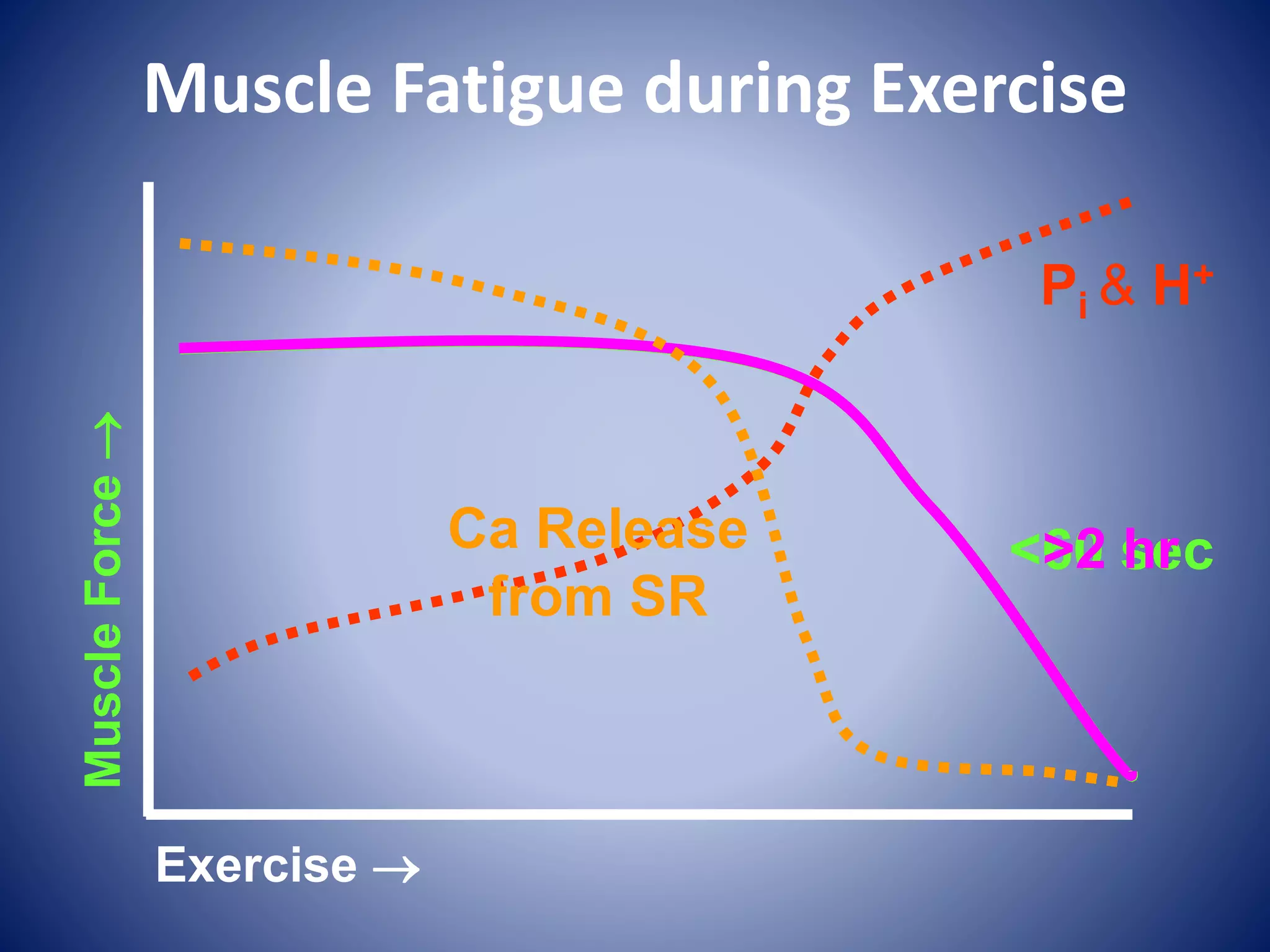
Muscle Fatigue during ExerciseMuscleForce
Exercise 
<60 sec
Pi & H+
>2 hrCa Release
from SR

Lecture 4 muscle physiology(1)

  • 2.
    Overview • Structure ofMuscle and Muscle Fiber • Components of a Muscle Fiber, Myofibril, and Sarcomere • Structure of Myosin and Actin • Muscle Contraction • Muscle Fiber Types • Fiber Type and Athletic Performance • Muscle Fatigue during Exercise
  • 3.
    Three Types ofMuscle Tissue • Smooth muscle: involuntary, hollow organs • Cardiac muscle: involuntary, heart • Skeletal muscle: voluntary, skeleton Figure 1.1
  • 4.
    Structure of Muscle Surroundsentire muscle Surrounds bundles of muscle fibers (fascicles) Surrounds individual muscle fibers Sarcolemma Muscle cell membrane
  • 5.
    Structure of aMuscle Fiber (Muscle Cell) Figure 1.3
  • 6.
    • Plasmalemma- plasmamembrane – Attach to tendons – Transport in and out of cell – Sarcolemma includes plasmalemma and basement membrane MacIntosh, Gardiner, & McComas, Skeletal Muscle, Human Kinetics, 2006 Structure of a Muscle Fiber (Muscle Cell)
  • 7.
    Components of aMuscle Fiber (Muscle Cell) • Sarcoplasm- cytosol/cytoplasm – Gelatin-like substance – Storage site for glycogen, myoglobin, and other proteins/mineral/fats/organelles • Transverse Tubules – Run laterally through muscle fiber – Path for nerve impulses (Carry action potential deep into muscle fiber) • Sarcoplasmic Reticulum – Runs parallel to muscle fiber – Calcium storage
  • 8.
    Components of aMyofibril Figure 1.5
  • 9.
    Components of aSarcomere • Sarcomere: *Basic contractile unit of a myofibril *Composed of interdigitating thick and thin filaments (myosin vs. actin) – I-Band – A-Band – H-Zone – M-Line – Z-Disk (Z-line) Figure 1.5
  • 10.
    Components of aSarcomere Figure 1.8
  • 11.
    Components of aSarcomere (MacIntosh, Gardiner, & McComas, Skeletal Muscle, Human Kinetics, 2006, From Huxley, 1972)
  • 12.
    Components of aSarcomere 4 1 2 3 5 6
  • 13.
    Components of aSarcomere • Sarcomere includes two types of protein filaments – Thick Filament: Myosin – Thin Filament: Actin • Alignment of the thick and thin filaments is what give muscle its striations
  • 14.
    Myosin • Comprises 2/3of skeletal muscle proteins • Two protein strands twisted together • Globular heads (Myosin Cross-bridges) • Titin filaments stabilize myosin
  • 15.
    Actin • Thin filamentsare composed of 3 proteins – Actin: globular proteins form strands – Tropomyosin: twists around actin strand – Troponin: bound at intervals to actin • Anchored to Z-Disk
  • 16.
  • 17.
    Muscle Contraction Sarcomere Actin Myosin Sarcomere ActinMyosin Muscle Fiber Function - actin and myosin function - whole muscle function & performance Skeletal Muscle Muscle Fiber (Myofiber, Muscle Cell)
  • 18.
    Muscle Contraction Muscles are divided intomotor units comprised of: α-motor neuron Muscle fibers Figure 1.6
  • 19.
    Phases of MuscleContraction • Action Potential/Calcium Release • Calcium-Troponin Binding; Tropomyosin Shift • Actin-Myosin Binding • Myosin Power Stroke/ ATP Binding
  • 20.
    Resting Membrane Potential (RMP) •RMP= -70mV • Caused by uneven separation of charged ions inside (K+) and outside (Na+) the cell • More ions outside the cell than inside • Membrane more permeable to K+ • Sodium-Potassium Pumps maintain imbalance – 3 Na+ out – 2 K+ in
  • 21.
    Ions Channels • Atrest, almost all the Na+ channels are closed. • At rest, few K+ channels are open. – Leaking due to [ ] gradient
  • 22.
    Sodium/Potassium Pump • Restingmembrane potential is maintained by pump – Potassium tends to diffuse out of cell – Na+/K+ pump moves 3 Na+ out and 2 K+ inside the cell – Use energy from ATP
  • 23.
  • 24.
    Action Potential • Occurswhen a stimulus of sufficient strength depolarizes the cell – Opens Na+ channels, and Na+ diffuses into cell • Inside becomes more positive • Repolarization – Return to resting membrane potential • immediately following depolarization • K+ leaves the cell rapidly • Na+ channels close • All-or-none law – Once a nerve impulse is initiated, it will travel the entire length of the neuron without losing strength. (gun shot) Slightly Open Na+ Opens Wide Na+
  • 25.
  • 26.
  • 27.
    Excitation-Contraction Coupling (EC Coupling) •Action potential travels to Sarcoplasmic Reticulum, causes release of calcium into sarcoplasm • Calcium binds to troponin on thin filament • Troponin moves tropomyosin, revealing myosin binding sites on actin • Myosin cross-bridges bind to actin
  • 28.
    Muscle Excitation 1. Actionpotential in motor neuron causes release of acetylcholine (ACh) into synaptic cleft. 2. ACh binds to receptors on motor end plate, leads to depolarization that is conducted down transverse tubules, which causes release of Ca+2 from sarcoplasmic reticulum (SR).
  • 29.
    Sliding Filament Theory •Muscle contraction = muscle fiber shortening • Myosin power stroke – Myosin bound to actin tilts its head, pulling thin filament towards the center of the sarcomere – Process is repeated until Z-disk reaches myosin filaments or until calcium is no longer available
  • 30.
  • 31.
    Energy for Contraction •ATP binding sites on myosin head • ATPase (on myosin head) splits ATP into ADP and Pi • Energy released fuels the tilting of the myosin head (power stroke) • Additional ATP is required to keep contraction going
  • 32.
    Muscle Relaxation • Calciumpumps return calcium to the SR, stored for future use • ATP required for calcium pumps • Troponin and Tropomyosin return to original position • Thick and thin filaments return to original positions
  • 33.
    Muscle Action &Relaxation • Muscle twitch – Contraction as the result of a single stimulus – Latent period • Lasting ~5 ms (immediately after the stimulus) – Contraction • Tension is developed • 40 ms – Relaxation • 50 ms • It varies among muscle type
  • 34.
    Speed of MuscleTwitch • Speed of shortening is greater in fast fibers – Sarcoplasmic reticulum releases Ca+2 at a faster rate – Higher myosin ATPase activity – quicker ATP release of energy with ATP hydrolysis Type I Type IIaType IIx
  • 35.
    Fiber Type Characteristics FastFibers Slow fibers Characteristic Type 2x Type 2a Type 1 Number of mitochondria Low High/mod High Resistance to fatigue Low High/mod High Predominant energy system Anaerobic Combination Aerobic ATPase Highest High Low Vmax (speed of shortening) Highest Intermediate Low Efficiency Low Moderate High Specific tension High High Moderate
  • 37.
  • 38.
  • 39.
    Fiber Type andPerformance • Power Athletes – Sprinters – Mostly Fast (70-75%) Twitch (Type 2) • Endurance Athletes – Distance Runners, Triathletes, Cyclists – Mostly Slow (70-80%) Twitch (Type 1) • Others – Non-athletes – Equal amount of Fast and Slow Twitch
  • 40.
    Other Factors whichInfluence Muscle Force • Number of motor units activated • Type of motor units activated (FT or ST) • Muscle size • Initial muscle length • Joint angle • Speed of muscle action (shortening or lengthening)
  • 41.
    Length-Tension Relationship Figure 1.13 •Length-tension relationship – Optimal sarcomere length = optimal overlap – Too short or too stretched = little or no force develops
  • 42.
    Speed-Force Relationship • Speed-forcerelationship – Concentric: maximal force development decreases at higher speeds – Eccentric: maximal force development increases at higher speeds
  • 43.
    Muscle Fatigue duringExerciseMuscleForce Exercise  <60 sec Pi & H+ >2 hrCa Release from SR