CONSUMER DECISION MAKING
Lecture 3: Principles of Marketing
LEARNING OBJECTIVES:

• Explain why we should understand consumer behavior.
• Analyze the components of the consumer decision-making
process.
• Examine the consumer’s postpurchase evaluation process.
• Identify the types of consumer buying decisions and discuss
the significance of consumer environment.
• Identify and understand the cultural factors that affect
consumer buying decisions.
• Identify and understand the social factors that affect
consumer buying decisions.
• Identify and understand the individual and psychological
factors affecting consumer buying decisions.
LO#1: The Importance of Understanding Consumer
Behavior

CONSUMER BEHAVIOR are processes a
consumer uses to make purchase decisions,
as well as the use and dispose of purchased
goods and services. It also includes factors
that influence purchase decisions and
product use.
 Consumers’ product and service
preferences are constantly changing;
 Marketing managers must understand
these desires in order to create a proper
marketing mix for a well-defined market.

Thus, it is important to know how
consumers make purchase decisions.
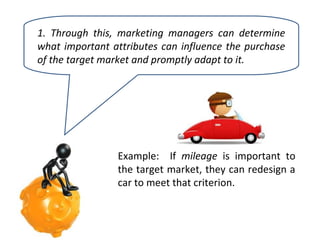
1. Through this, marketing managers can determine
what important attributes can influence the purchase
of the target market and promptly adapt to it.

Example: If mileage is important to
the target market, they can redesign a
car to meet that criterion.
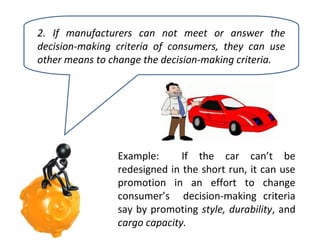
2. If manufacturers can not meet or answer the
decision-making criteria of consumers, they can use
other means to change the decision-making criteria.

Example:
If the car can’t be
redesigned in the short run, it can use
promotion in an effort to change
consumer’s decision-making criteria
say by promoting style, durability, and
cargo capacity.
3. It helps the government make better public decisions
and aid in educating consumers against buying and
using goods and services that may injure their health
or hurt society.

Example: Hurtful whitening products
from China.
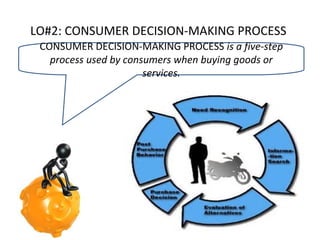
LO#2: CONSUMER DECISION-MAKING PROCESS
CONSUMER DECISION-MAKING PROCESS is a five-step
process used by consumers when buying goods or
services.
1. NEED RECOGNITION – is the result of an imbalance
between actual and desired states that arouses and
activates the consumers decision-making process.

WANT is the recognition
of unfulfilled need and a
product that will satisfy
it.
NEED RECOGNITION is triggered when a consumer is exposed
to an internal or external stimulus.
STIMULUS is any unit of
input affecting one or
more of the five senses:
sight, smell, taste, touch,
hearing.

INTERNAL STIMULI are
occurrences you experience
–hunger, thirst, boredom,
etc.

EXTERNAL STIMULI are influences from an
outside source such as someone’s
recommendation, color , design of a
package, a brand name mentioned by a
friend, or an advertisement on TV or radio.
The imbalance between actual and desired states is sometimes
referred to as the WANT-GOT Gap.
This gap does not always trigger consumer action. The gap
must be large enough to drive the consumer to do something.
Example:
Just because your
stomach growls once
does not mean that
you will stop what you
are doing and eat.
The marketer’s objective is to get consumers to recognize
this WANT-GOT Gap.

Additional Concepts:
•NEED – can be viewed as ‘JOB
Statements’ or outcome statements.
•JOB – is a fundamental goal that
consumers are trying to accomplish or
a problem they are trying to resolve.
•DESIRED OUTCOME STATEMENTS –
what consumers are seeking from a
job.
2. INFORMATION SEARCH – after recognizing a need or
want, consumers search for information about the
various alternatives available to satisfy it.

Information search can
occur internally,
externally, or both.
Internal Information Search is the process of recalling a past
information stored in the memory.
External Information Search is the process of seeking
information in the outside environment and there are two (2)
types of external information sources:
a) Nonmarketing-controlled Information Source – is not
associated with marketers promoting a product. This
includes:
• Trying or observing a new product;
• Personal sources (family, friends,
acquaintances, co-workers);
• Public sources (consumer reports, rating
organizations that comment on products
and services.
b) Marketing-controlled Information Source – it is a product
information source that originates with marketers promoting
the product. This include:
• Mass media advertising (radio, TV,
magazines, newspapers)
• Sales promotion (contests, displays)
• Salespeople
• Product labels and packaging; and
• The Internet.
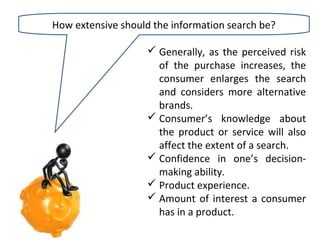
How extensive should the information search be?
 Generally, as the perceived risk
of the purchase increases, the
consumer enlarges the search
and considers more alternative
brands.
 Consumer’s knowledge about
the product or service will also
affect the extent of a search.
 Confidence in one’s decisionmaking ability.
 Product experience.
 Amount of interest a consumer
has in a product.
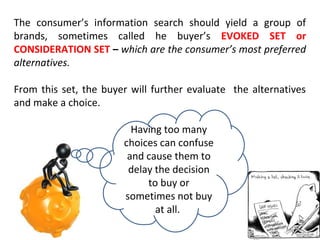
The consumer’s information search should yield a group of
brands, sometimes called he buyer’s EVOKED SET or
CONSIDERATION SET – which are the consumer’s most preferred
alternatives.
From this set, the buyer will further evaluate the alternatives
and make a choice.
Having too many
choices can confuse
and cause them to
delay the decision
to buy or
sometimes not buy
at all.
3. EVALUATION OF ALTERNATIVES – the environmental,
internal info., and external info. help consumers evaluate
and compare alternatives.

There are two general
groups of evaluation
processes are: Piecemeal
Processes and
Categorization Process.
A. PIECEMEAL PROCESS OPTIONS – evaluation using
advantages and disadvantages along with attributes.
1. Using the ‘evoked set’, pick a product attribute and then
exclude all products in the set that do not have that
attribute.
2. Use ‘cut-offs’ to narrow the number of choices. Cut-offs
are either minimum or maximum levels of an attribute
that an alternative must pass to be considered.
3. Rank the attributes under consideration in order of
importance and evaluate the products based on how well
each performs on the most important attributes.
A. CATEGORIZATION PROCESS – evaluation of an
alternative depends upon the particular category to
which it is assigned. Categories can be:
•
•

General – Ex. Motorized form of transportation.
Specific – Ex. Harley-Davidson motorcycle.
These categories used are associated with some degree of
liking or disliking.
So, when consumers rely on a
categorization process, a product’s evaluation depends on
the particular category to which it is perceived as
belonging.
How a product is categorized can strongly influence
consumer’s demand.
BRAND EXTENSIONS in
which a well-known and
respected brand name from
one product category is
extended into other product
categories.
This is the answer to
categorization!
4. PURCHASE – ultimately, the consumer has to decide
whether to buy or not to buy.

Specifically, consumers
must decide:
Whether to buy
When to buy
What to buy (product
type and brand)
Where to buy (retailer,
online or in store)
How to pay.
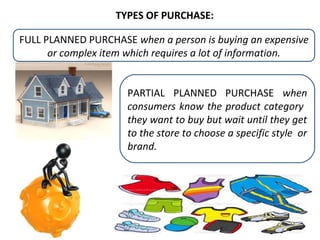
TYPES OF PURCHASE:
FULL PLANNED PURCHASE when a person is buying an expensive
or complex item which requires a lot of information.
PARTIAL PLANNED PURCHASE when
consumers know the product category
they want to buy but wait until they get
to the store to choose a specific style or
brand.
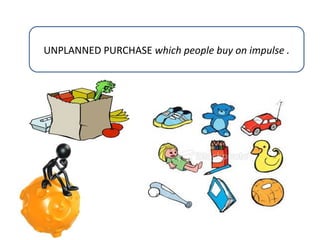
UNPLANNED PURCHASE which people buy on impulse .
5. POSTPURHASE BEHAVIOR – when buying products,
consumers expect certain outcomes from the purchase.
{LO#3}

For Marketers, an
important element of any
postpurchase evaluation
is reducing any lingering
doubts that the decision
was sound.
When people recognize inconsistency between their
values or opinions and their behavior, they tend to feel
an inner tension called COGNITIVE DISSONANCE.

Consumers
try
to
reduce
dissonance by justifying their
decision. They may seek new
information
that
reinforces
positive ideas
about the
purchase, avoid information that
contradicts
their decision, or
revoke the original decision by
returning the product .
Marketing Managers can help reduce
dissonance
through
effective
communication with purchasers.
Example:
Slip a note inside the package
congratulating the buyer on making a
sound decision.
Postpurchase letters
Dissonance-reducing statements in
instruction booklets
Indicating superiority of the
product compared to competing
brands
Guarantees.
LO#4: TYPES OF CONSUMER BUYING DECISIONS and
CONSUMER INVOLVEMENT:
All consumer buying decisions generally fall
along a continuum of three (3) categories:
1.Routine Response Behavior
2.Limited Decision Making
3.Extensive Decision Making
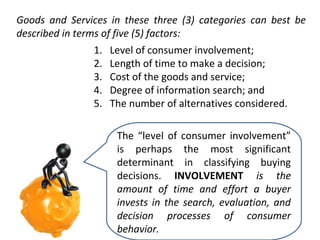
Goods and Services in these three (3) categories can best be
described in terms of five (5) factors:
1.
2.
3.
4.
5.

Level of consumer involvement;
Length of time to make a decision;
Cost of the goods and service;
Degree of information search; and
The number of alternatives considered.
The “level of consumer involvement”
is perhaps the most significant
determinant in classifying buying
decisions. INVOLVEMENT is the
amount of time and effort a buyer
invests in the search, evaluation, and
decision processes of consumer
behavior.
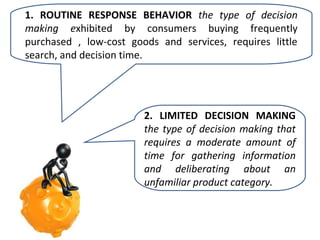
1. ROUTINE RESPONSE BEHAVIOR the type of decision
making exhibited by consumers buying frequently
purchased , low-cost goods and services, requires little
search, and decision time.

2. LIMITED DECISION MAKING
the type of decision making that
requires a moderate amount of
time for gathering information
and deliberating about an
unfamiliar product category.
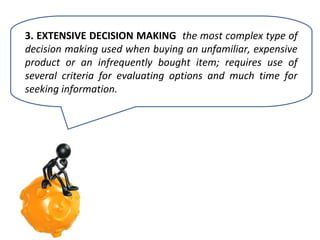
3. EXTENSIVE DECISION MAKING the most complex type of
decision making used when buying an unfamiliar, expensive
product or an infrequently bought item; requires use of
several criteria for evaluating options and much time for
seeking information.
Factors Determining the Level of Consumer Involvement:
• Previous experience.
• Interest.
• Perceived risk of negative consequences:
– Financial risk
– Social risk
– Psychological risk

• Social visibility.
‘High Involvement’ can take a number
of different forms. The most important
ones are the following:
• Product involvement – means that a product
category has high personal relevance.
• Situational Involvement – means that the
circumstances of a purchase may temporarily
transform a low-involvement decision into a
high-involvement one.
• Shopping Involvement – represents the
personal relevance of the process of shopping.
• Enduring Involvement – represents an ongoing
interest in some product or activity.
• Emotional Involvement – represents how
emotional a consumer gets during some specific
consumption activity.
ASSIGNMENT:
1. What are the Cultural Influences on consumer buying
decisions? Explain/define briefly each one.
2. What are the Social Influences on consumer buying
decisions? Explain/define briefly each one.
3. What are the Individual Influences on consumer buying
decisions? Explain/define briefly each one.
4. What are the Psychological Influences on consumer
buying decisions? Explain/define briefly each one.
You may print your assignment in short
bond paper. This is due next meeting.

Lecture 3 consumer decision making

  • 1.
    CONSUMER DECISION MAKING Lecture3: Principles of Marketing
  • 2.
    LEARNING OBJECTIVES: • Explainwhy we should understand consumer behavior. • Analyze the components of the consumer decision-making process. • Examine the consumer’s postpurchase evaluation process. • Identify the types of consumer buying decisions and discuss the significance of consumer environment. • Identify and understand the cultural factors that affect consumer buying decisions. • Identify and understand the social factors that affect consumer buying decisions. • Identify and understand the individual and psychological factors affecting consumer buying decisions.
  • 3.
    LO#1: The Importanceof Understanding Consumer Behavior CONSUMER BEHAVIOR are processes a consumer uses to make purchase decisions, as well as the use and dispose of purchased goods and services. It also includes factors that influence purchase decisions and product use.
  • 4.
     Consumers’ productand service preferences are constantly changing;  Marketing managers must understand these desires in order to create a proper marketing mix for a well-defined market. Thus, it is important to know how consumers make purchase decisions.
  • 5.
    1. Through this,marketing managers can determine what important attributes can influence the purchase of the target market and promptly adapt to it. Example: If mileage is important to the target market, they can redesign a car to meet that criterion.
  • 6.
    2. If manufacturerscan not meet or answer the decision-making criteria of consumers, they can use other means to change the decision-making criteria. Example: If the car can’t be redesigned in the short run, it can use promotion in an effort to change consumer’s decision-making criteria say by promoting style, durability, and cargo capacity.
  • 7.
    3. It helpsthe government make better public decisions and aid in educating consumers against buying and using goods and services that may injure their health or hurt society. Example: Hurtful whitening products from China.
  • 8.
    LO#2: CONSUMER DECISION-MAKINGPROCESS CONSUMER DECISION-MAKING PROCESS is a five-step process used by consumers when buying goods or services.
  • 9.
    1. NEED RECOGNITION– is the result of an imbalance between actual and desired states that arouses and activates the consumers decision-making process. WANT is the recognition of unfulfilled need and a product that will satisfy it.
  • 10.
    NEED RECOGNITION istriggered when a consumer is exposed to an internal or external stimulus. STIMULUS is any unit of input affecting one or more of the five senses: sight, smell, taste, touch, hearing. INTERNAL STIMULI are occurrences you experience –hunger, thirst, boredom, etc. EXTERNAL STIMULI are influences from an outside source such as someone’s recommendation, color , design of a package, a brand name mentioned by a friend, or an advertisement on TV or radio.
  • 11.
    The imbalance betweenactual and desired states is sometimes referred to as the WANT-GOT Gap. This gap does not always trigger consumer action. The gap must be large enough to drive the consumer to do something. Example: Just because your stomach growls once does not mean that you will stop what you are doing and eat.
  • 12.
    The marketer’s objectiveis to get consumers to recognize this WANT-GOT Gap. Additional Concepts: •NEED – can be viewed as ‘JOB Statements’ or outcome statements. •JOB – is a fundamental goal that consumers are trying to accomplish or a problem they are trying to resolve. •DESIRED OUTCOME STATEMENTS – what consumers are seeking from a job.
  • 13.
    2. INFORMATION SEARCH– after recognizing a need or want, consumers search for information about the various alternatives available to satisfy it. Information search can occur internally, externally, or both.
  • 14.
    Internal Information Searchis the process of recalling a past information stored in the memory. External Information Search is the process of seeking information in the outside environment and there are two (2) types of external information sources: a) Nonmarketing-controlled Information Source – is not associated with marketers promoting a product. This includes: • Trying or observing a new product; • Personal sources (family, friends, acquaintances, co-workers); • Public sources (consumer reports, rating organizations that comment on products and services.
  • 15.
    b) Marketing-controlled InformationSource – it is a product information source that originates with marketers promoting the product. This include: • Mass media advertising (radio, TV, magazines, newspapers) • Sales promotion (contests, displays) • Salespeople • Product labels and packaging; and • The Internet.
  • 16.
    How extensive shouldthe information search be?  Generally, as the perceived risk of the purchase increases, the consumer enlarges the search and considers more alternative brands.  Consumer’s knowledge about the product or service will also affect the extent of a search.  Confidence in one’s decisionmaking ability.  Product experience.  Amount of interest a consumer has in a product.
  • 17.
    The consumer’s informationsearch should yield a group of brands, sometimes called he buyer’s EVOKED SET or CONSIDERATION SET – which are the consumer’s most preferred alternatives. From this set, the buyer will further evaluate the alternatives and make a choice. Having too many choices can confuse and cause them to delay the decision to buy or sometimes not buy at all.
  • 18.
    3. EVALUATION OFALTERNATIVES – the environmental, internal info., and external info. help consumers evaluate and compare alternatives. There are two general groups of evaluation processes are: Piecemeal Processes and Categorization Process.
  • 19.
    A. PIECEMEAL PROCESSOPTIONS – evaluation using advantages and disadvantages along with attributes. 1. Using the ‘evoked set’, pick a product attribute and then exclude all products in the set that do not have that attribute. 2. Use ‘cut-offs’ to narrow the number of choices. Cut-offs are either minimum or maximum levels of an attribute that an alternative must pass to be considered. 3. Rank the attributes under consideration in order of importance and evaluate the products based on how well each performs on the most important attributes.
  • 20.
    A. CATEGORIZATION PROCESS– evaluation of an alternative depends upon the particular category to which it is assigned. Categories can be: • • General – Ex. Motorized form of transportation. Specific – Ex. Harley-Davidson motorcycle. These categories used are associated with some degree of liking or disliking. So, when consumers rely on a categorization process, a product’s evaluation depends on the particular category to which it is perceived as belonging. How a product is categorized can strongly influence consumer’s demand.
  • 21.
    BRAND EXTENSIONS in whicha well-known and respected brand name from one product category is extended into other product categories. This is the answer to categorization!
  • 22.
    4. PURCHASE –ultimately, the consumer has to decide whether to buy or not to buy. Specifically, consumers must decide: Whether to buy When to buy What to buy (product type and brand) Where to buy (retailer, online or in store) How to pay.
  • 23.
    TYPES OF PURCHASE: FULLPLANNED PURCHASE when a person is buying an expensive or complex item which requires a lot of information. PARTIAL PLANNED PURCHASE when consumers know the product category they want to buy but wait until they get to the store to choose a specific style or brand.
  • 24.
    UNPLANNED PURCHASE whichpeople buy on impulse .
  • 25.
    5. POSTPURHASE BEHAVIOR– when buying products, consumers expect certain outcomes from the purchase. {LO#3} For Marketers, an important element of any postpurchase evaluation is reducing any lingering doubts that the decision was sound.
  • 26.
    When people recognizeinconsistency between their values or opinions and their behavior, they tend to feel an inner tension called COGNITIVE DISSONANCE. Consumers try to reduce dissonance by justifying their decision. They may seek new information that reinforces positive ideas about the purchase, avoid information that contradicts their decision, or revoke the original decision by returning the product .
  • 27.
    Marketing Managers canhelp reduce dissonance through effective communication with purchasers. Example: Slip a note inside the package congratulating the buyer on making a sound decision. Postpurchase letters Dissonance-reducing statements in instruction booklets Indicating superiority of the product compared to competing brands Guarantees.
  • 28.
    LO#4: TYPES OFCONSUMER BUYING DECISIONS and CONSUMER INVOLVEMENT: All consumer buying decisions generally fall along a continuum of three (3) categories: 1.Routine Response Behavior 2.Limited Decision Making 3.Extensive Decision Making
  • 29.
    Goods and Servicesin these three (3) categories can best be described in terms of five (5) factors: 1. 2. 3. 4. 5. Level of consumer involvement; Length of time to make a decision; Cost of the goods and service; Degree of information search; and The number of alternatives considered. The “level of consumer involvement” is perhaps the most significant determinant in classifying buying decisions. INVOLVEMENT is the amount of time and effort a buyer invests in the search, evaluation, and decision processes of consumer behavior.
  • 30.
    1. ROUTINE RESPONSEBEHAVIOR the type of decision making exhibited by consumers buying frequently purchased , low-cost goods and services, requires little search, and decision time. 2. LIMITED DECISION MAKING the type of decision making that requires a moderate amount of time for gathering information and deliberating about an unfamiliar product category.
  • 31.
    3. EXTENSIVE DECISIONMAKING the most complex type of decision making used when buying an unfamiliar, expensive product or an infrequently bought item; requires use of several criteria for evaluating options and much time for seeking information.
  • 32.
    Factors Determining theLevel of Consumer Involvement: • Previous experience. • Interest. • Perceived risk of negative consequences: – Financial risk – Social risk – Psychological risk • Social visibility. ‘High Involvement’ can take a number of different forms. The most important ones are the following:
  • 33.
    • Product involvement– means that a product category has high personal relevance. • Situational Involvement – means that the circumstances of a purchase may temporarily transform a low-involvement decision into a high-involvement one. • Shopping Involvement – represents the personal relevance of the process of shopping. • Enduring Involvement – represents an ongoing interest in some product or activity. • Emotional Involvement – represents how emotional a consumer gets during some specific consumption activity.
  • 34.
    ASSIGNMENT: 1. What arethe Cultural Influences on consumer buying decisions? Explain/define briefly each one. 2. What are the Social Influences on consumer buying decisions? Explain/define briefly each one. 3. What are the Individual Influences on consumer buying decisions? Explain/define briefly each one. 4. What are the Psychological Influences on consumer buying decisions? Explain/define briefly each one. You may print your assignment in short bond paper. This is due next meeting.