Data Structure and
Algorithm (CS 102)
Ashok K Turuk

1
Sorting
Sorting refers to the operation of
arranging data in some order such as
increasing or decreasing with numerical
data or alphabetically with character
data

2
Complexity of Sorting Algorithm
The complexity of a sorting algorithm
measures the running time as a function
of the number on n of items to be
sorted

3
Complexity of Sorting Algorithm
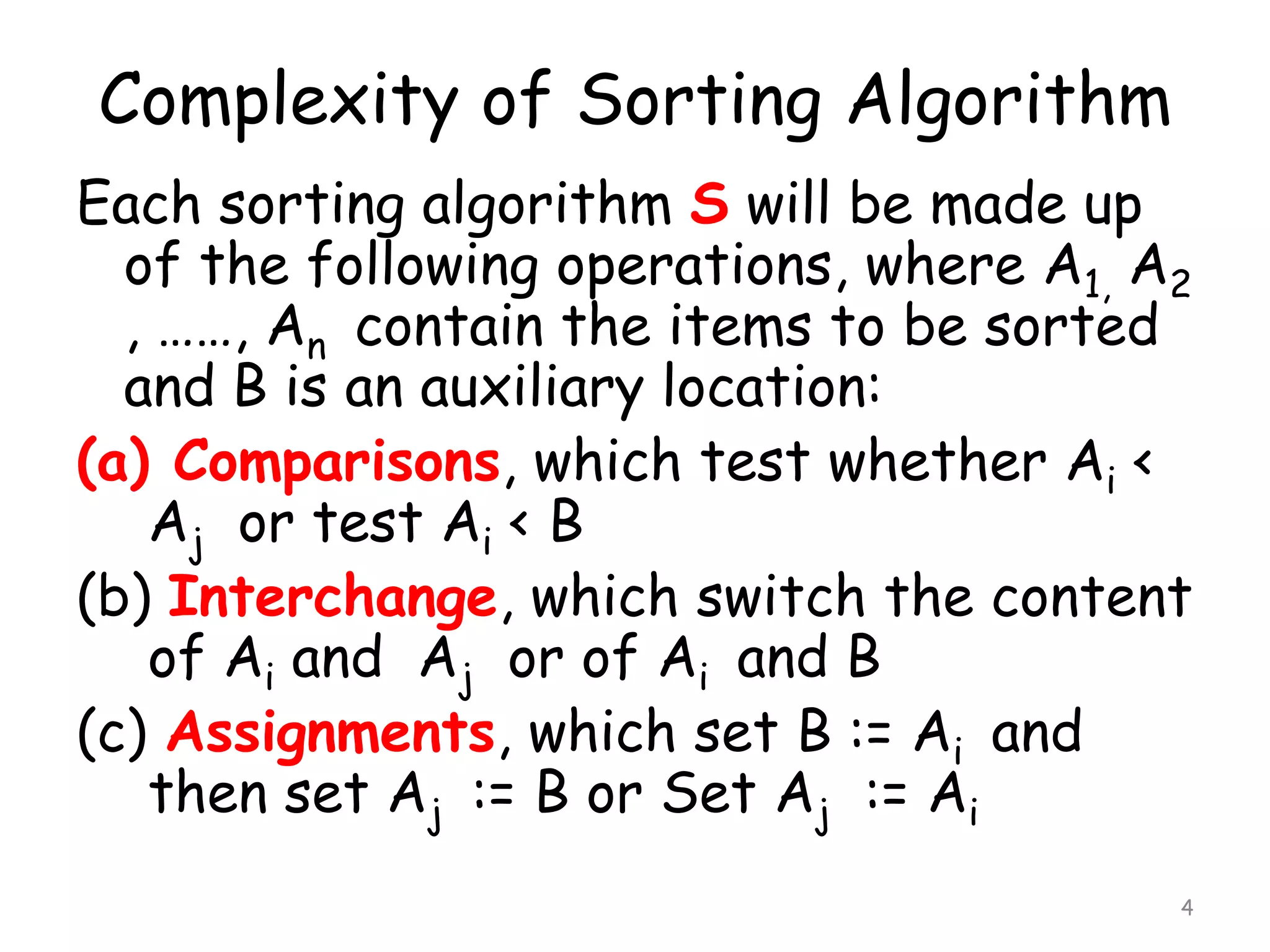
Each sorting algorithm S will be made up
of the following operations, where A1, A2
, ……, An contain the items to be sorted
and B is an auxiliary location:
(a) Comparisons, which test whether Ai <
Aj or test Ai < B
(b) Interchange, which switch the content
of Ai and Aj or of Ai and B
(c) Assignments, which set B := Ai and
then set Aj := B or Set Aj := Ai
4
Sorting
Algorithms are divided into two categories:
Internal Sorts

and
External sorts.

5
Sorting
Internal Sort:
Any sort algorithm which uses main
memory exclusively during the sort.
This assumes high-speed random access to
all memory.

6
Sorting
External Sort:
Any sort algorithm which uses external
memory, such as tape or disk, during
the sort.

7
Sorting
Note:
Algorithms may read the initial values from
magnetic tape or write sorted values to
disk, but this is not using external
memory during the sort. Note that even
though virtual memory may mask the
use of disk, sorting sets of data much
larger than main memory may be much
faster using an explicit external sort.
8
Sorting
Sort Stable
A sort algorithm is said to be “stable” if
multiple items which compare as equal
will stay in the same order they were in
after a sort.

9
Internal Sorting
Bubble Sort

The oldest and simplest sort in use.
Unfortunately, also the slowest.

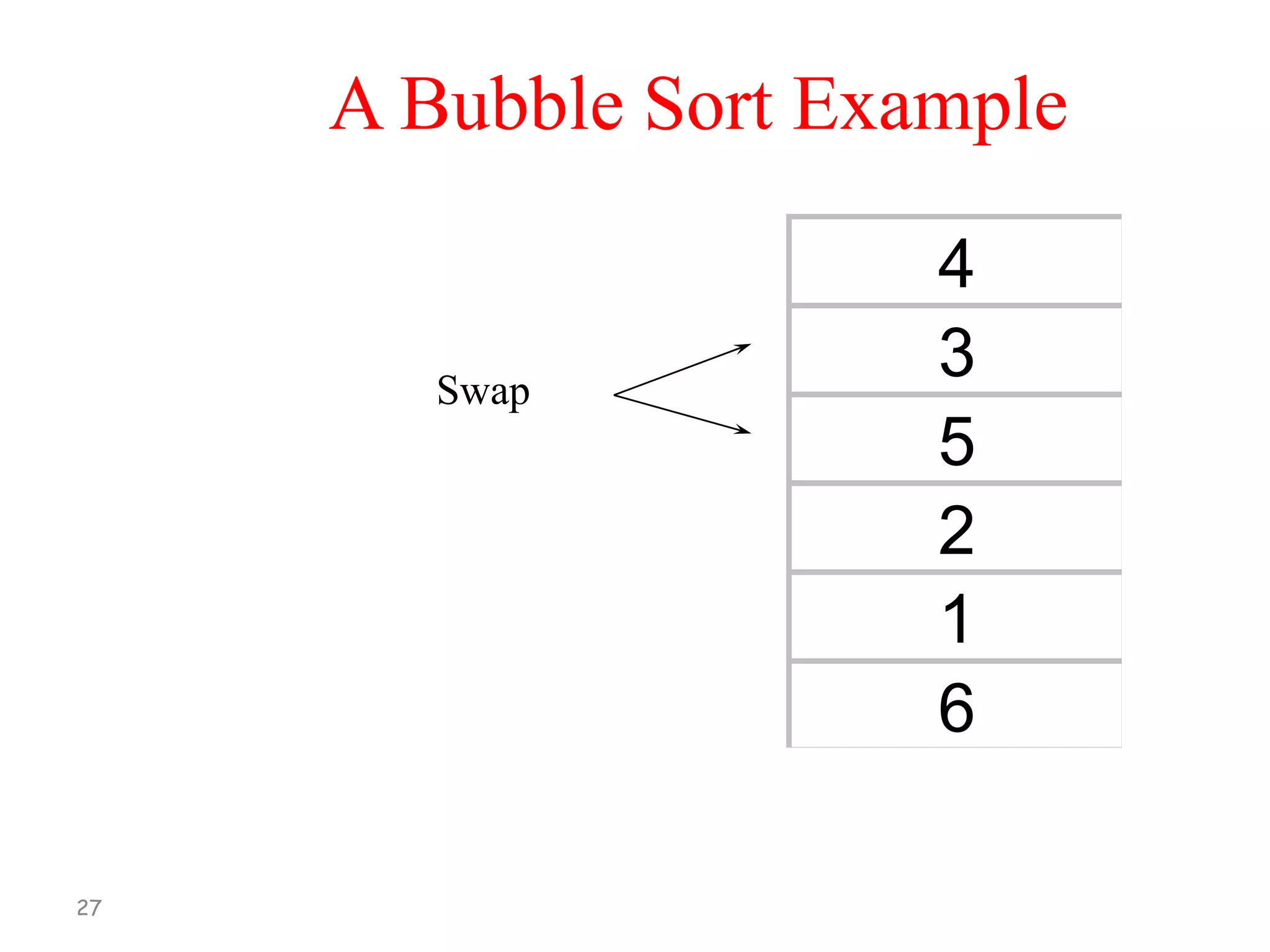
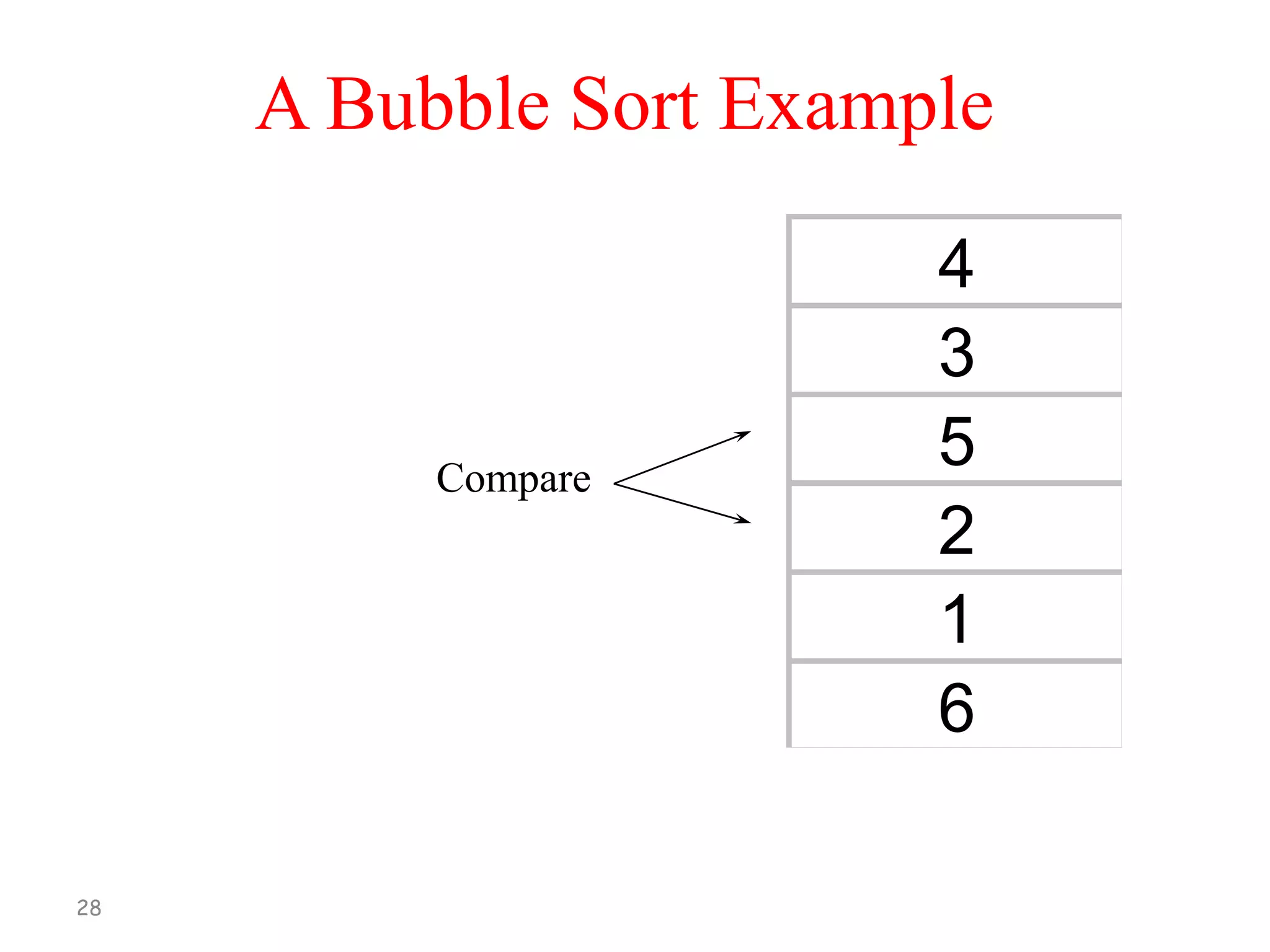
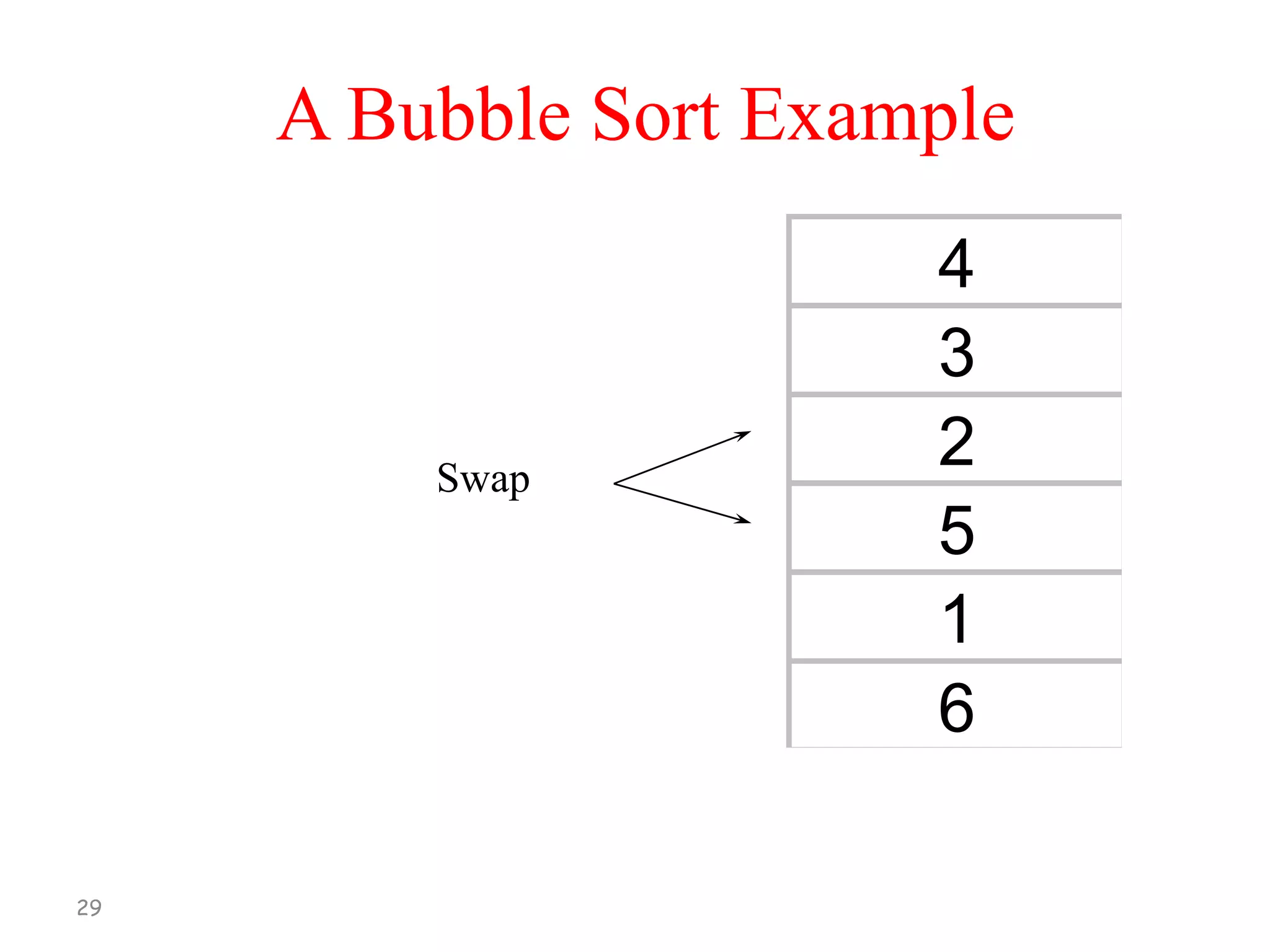
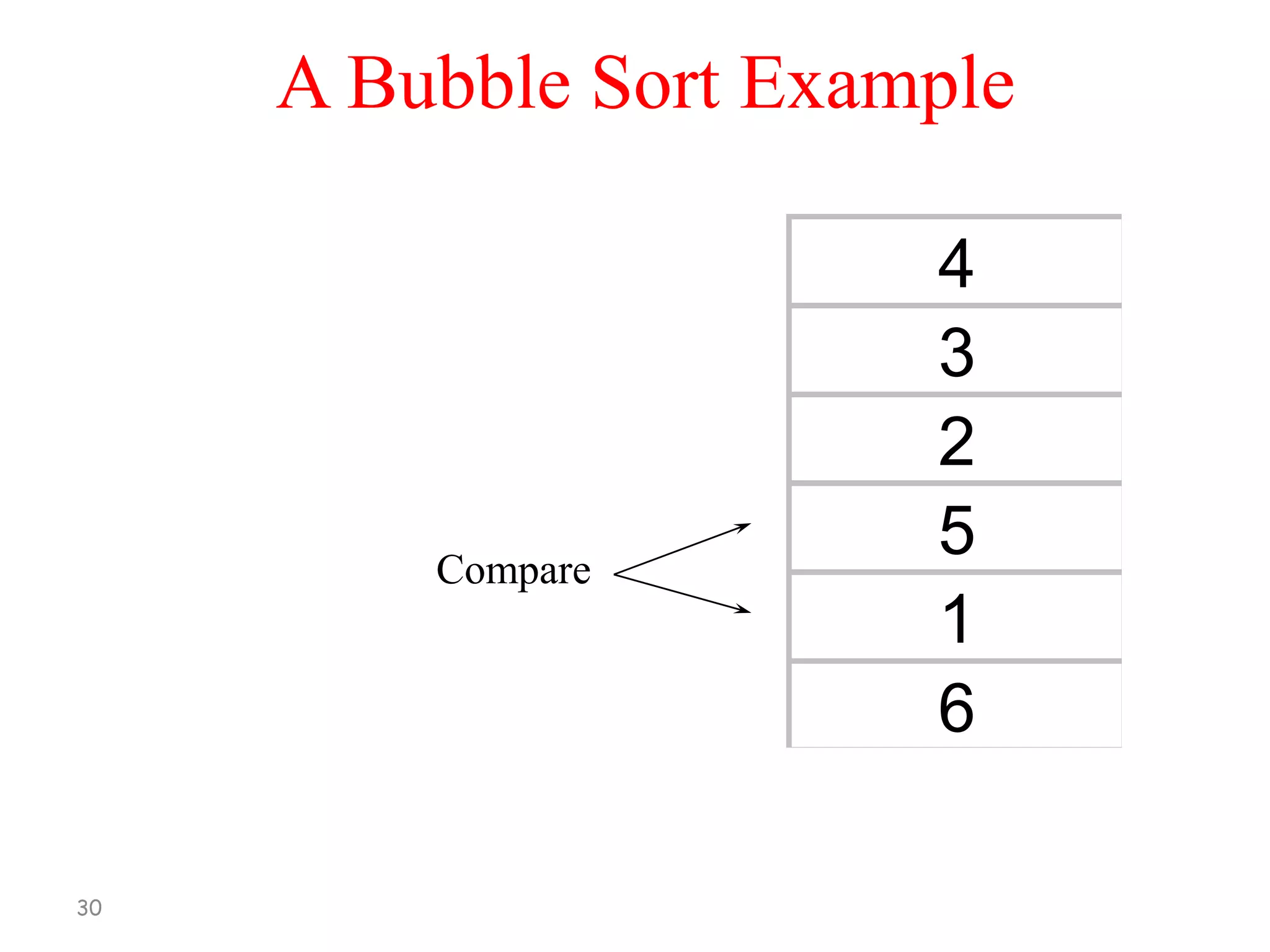
Works by comparing each item in the list
with the item next to it, and
swapping them if required.

10
Bubble Sort
The algorithm repeats this process until
it makes a pass all the way through
the list without swapping any items.

This causes larger values to "bubble" to
the end of the list while smaller
values "sink" towards the beginning of
the list.
11
Bubble Sort
Suppose the list of number A[1], [2], A[3], …,
A[N] is in memory. Algorithm works as
follows.
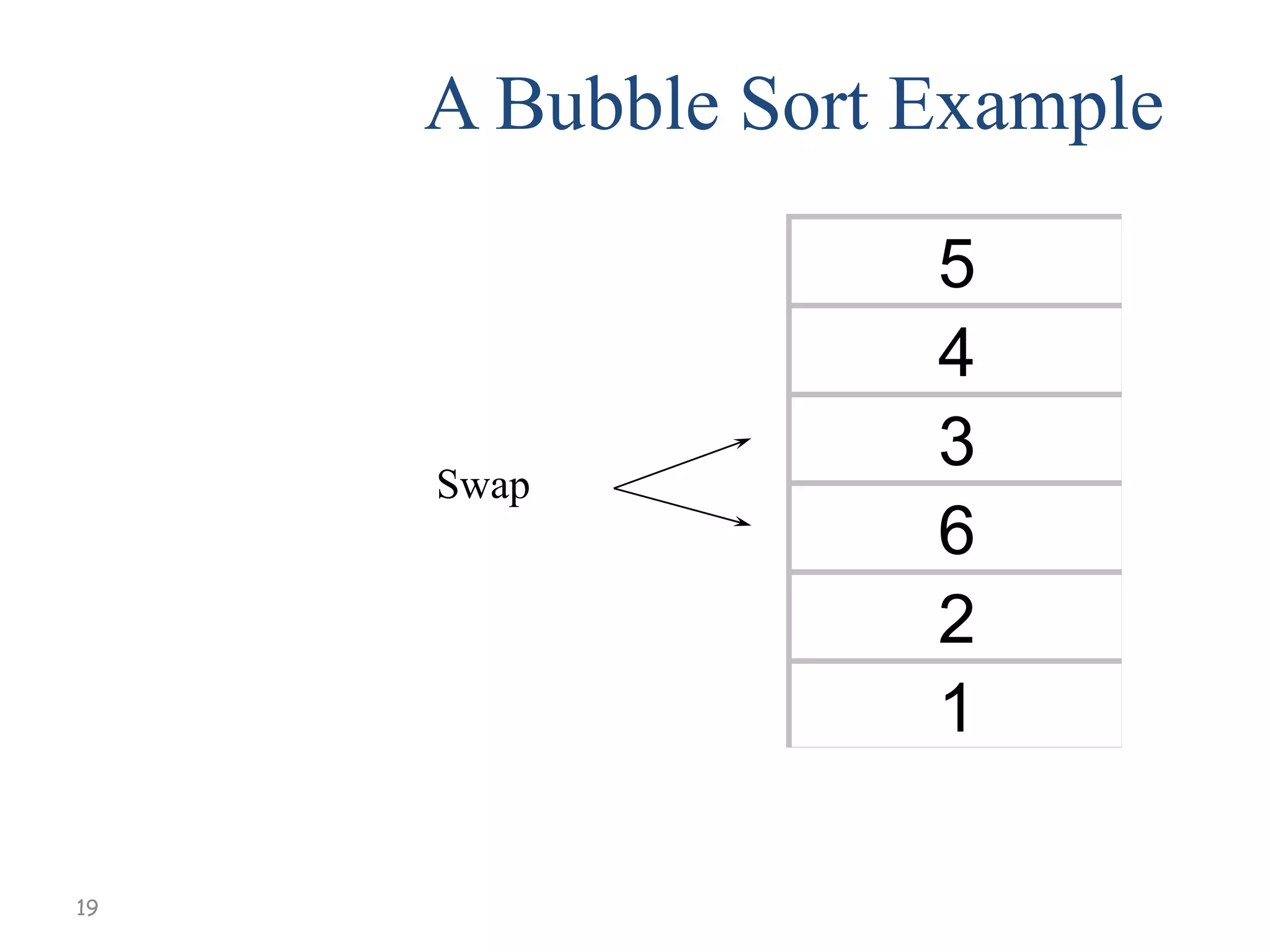
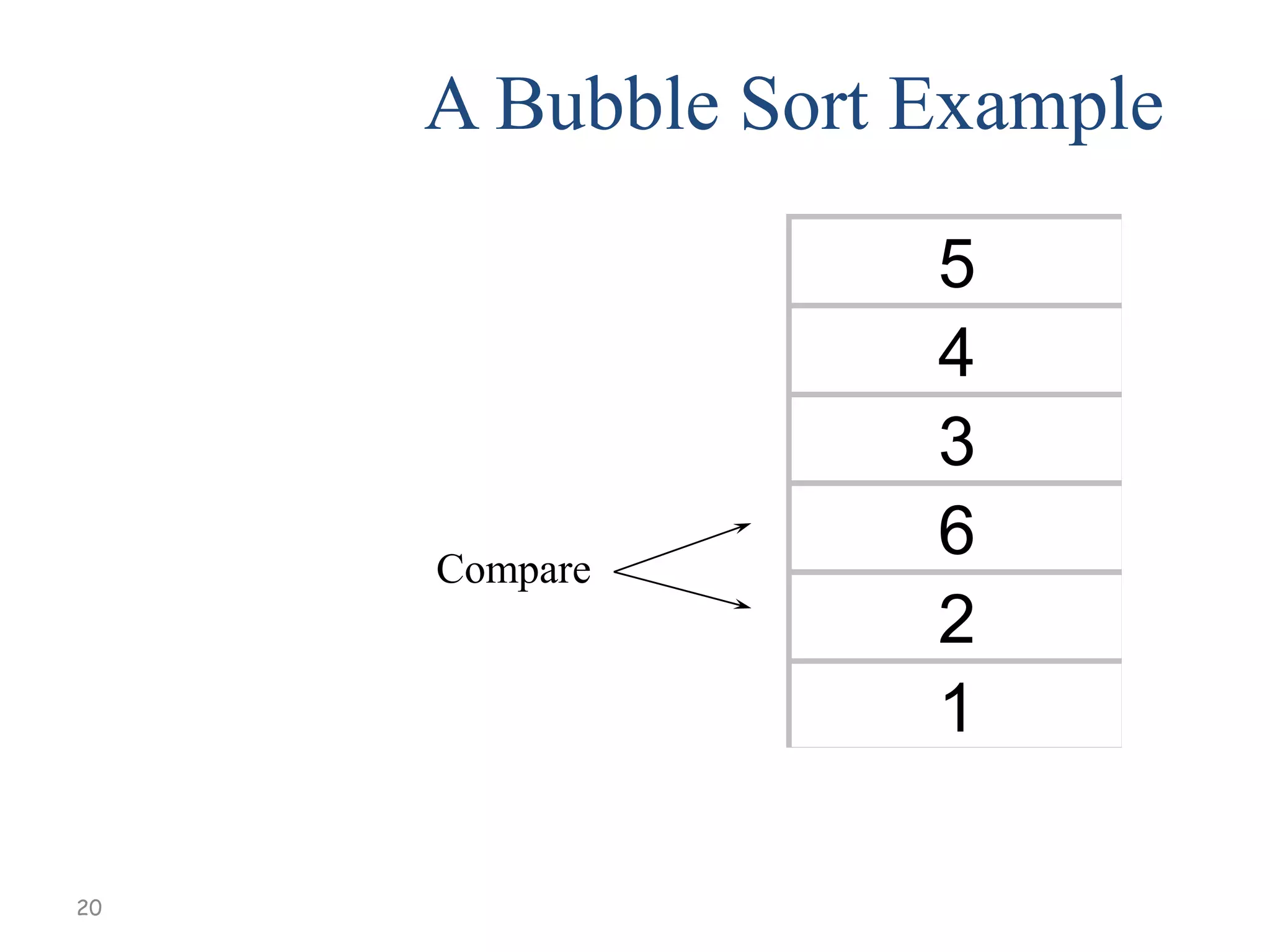
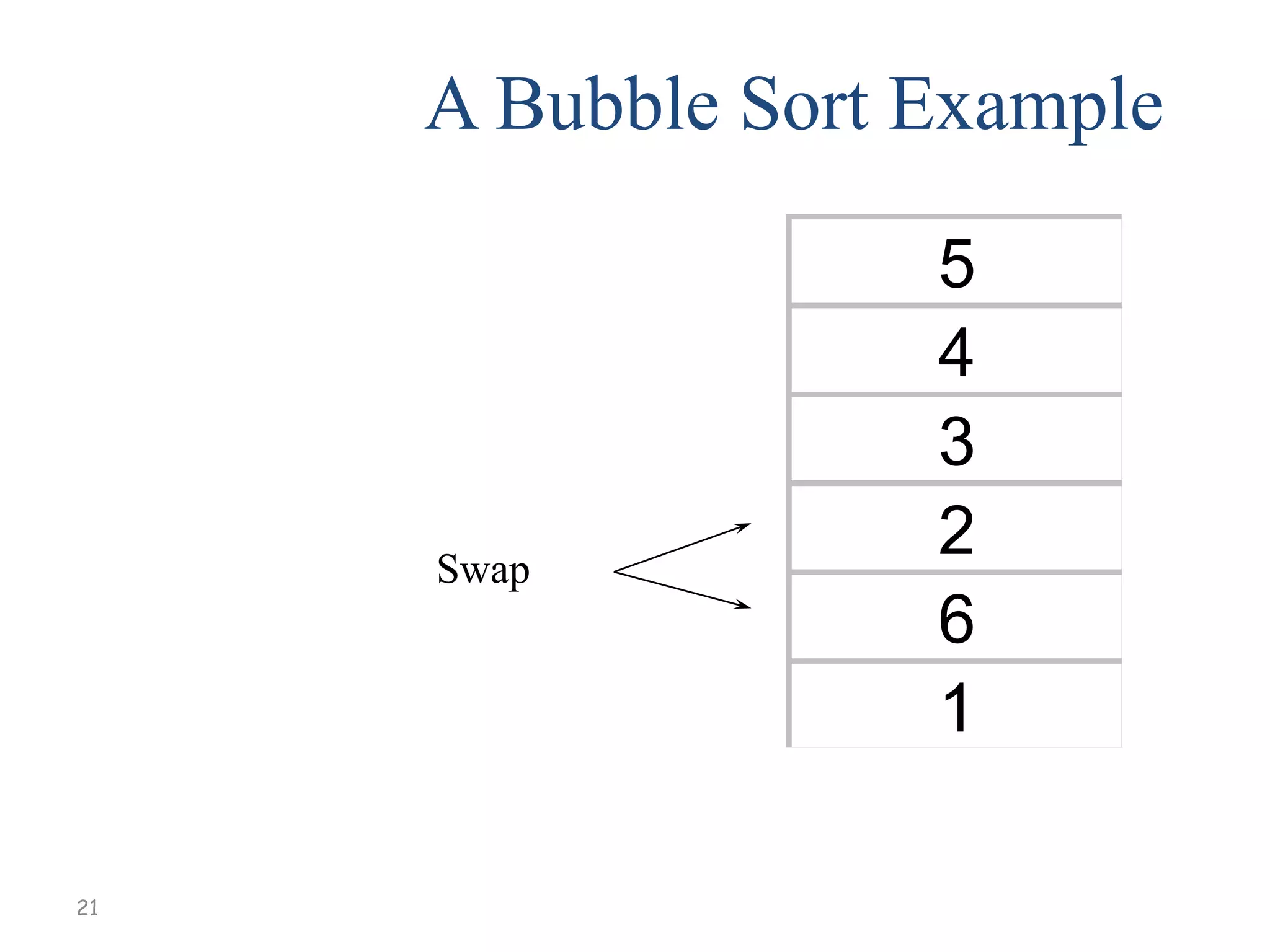
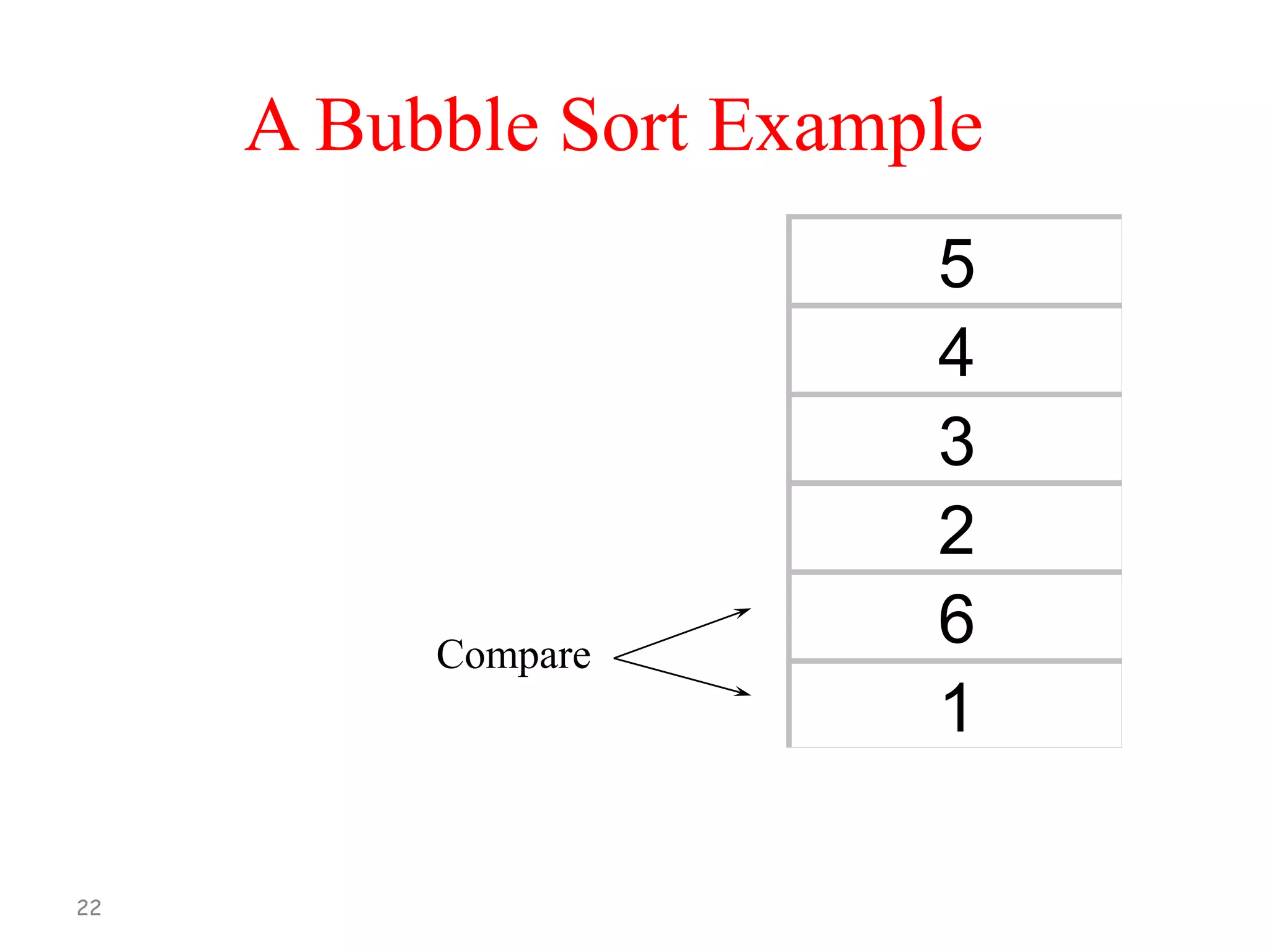
[1] Compare A[1] and A[2], arrange them in
the desired order so that A[1] < A[2]. Then
Compare A[2] and A[3], arrange them in
the desired order so that A[2] < A[3].
Continue until A[N-1] is compared with
A[N], arrange them so that A[N-1] < A[N].
12
Bubble Sort
[2] Repeat Step 1, Now stop after comparing and
re-arranging A[N-2] and A[N-1].
[3] Repeat Step 3, Now stop after comparing and
re-arranging A[N-3] and A[N-2].
.
.
[N-1] Compare A[1] and A[2] and arrange them in
sorted order so that A[1] < A[2].
After N-1 steps the list will be sorted in
increasing order.
13
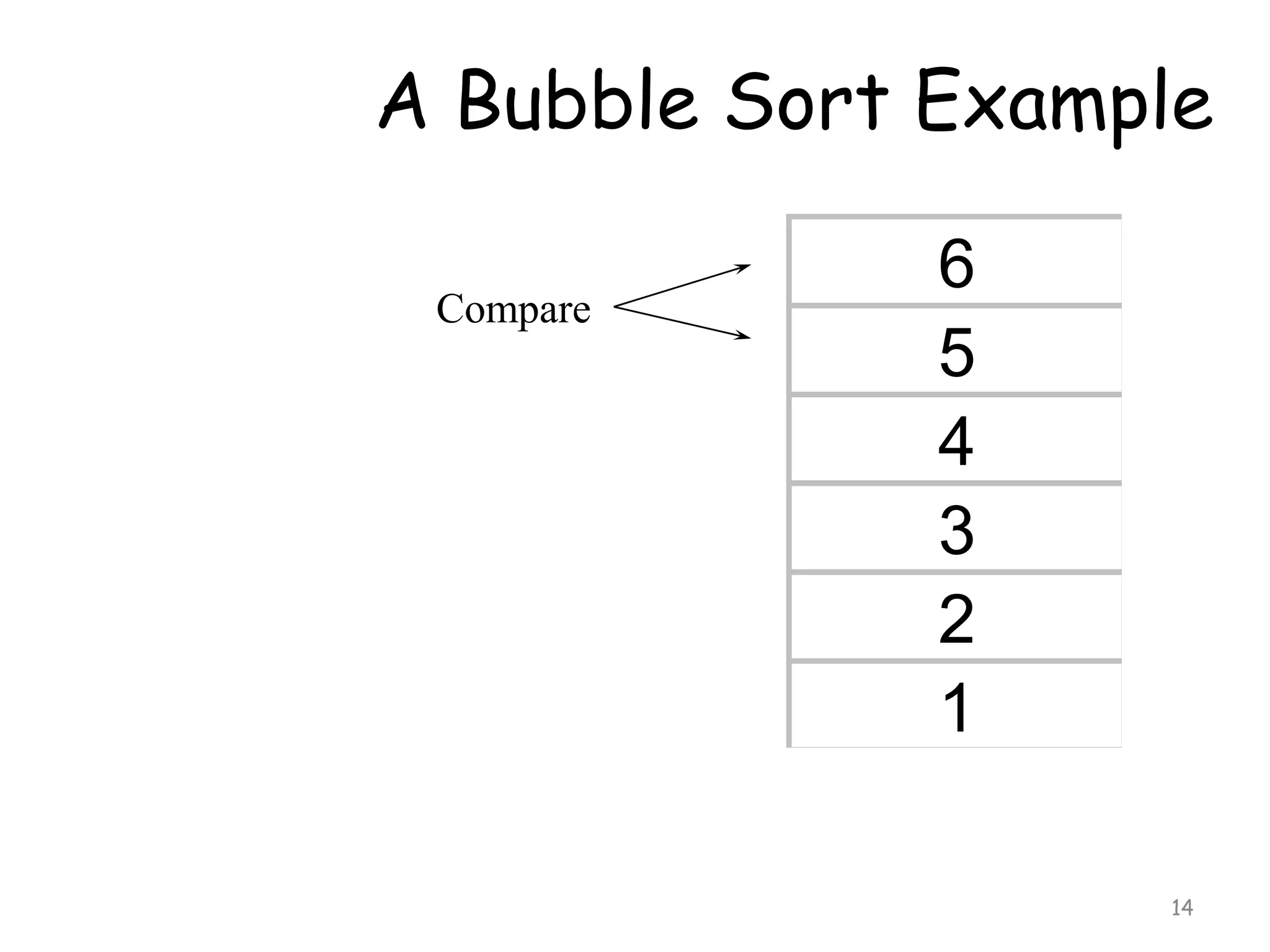
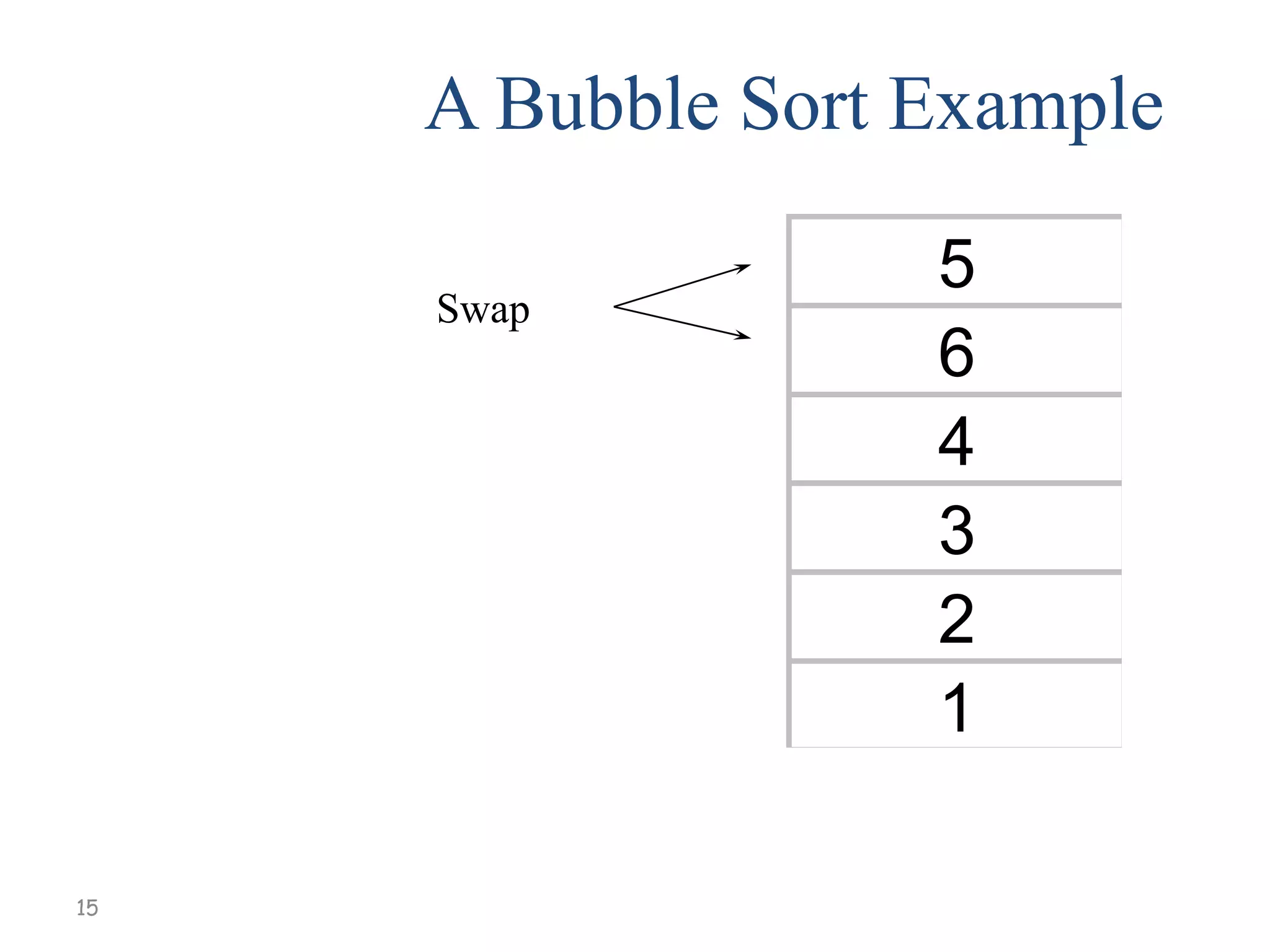
A Bubble Sort Example
Compare

6
5
4
3
2
1
14
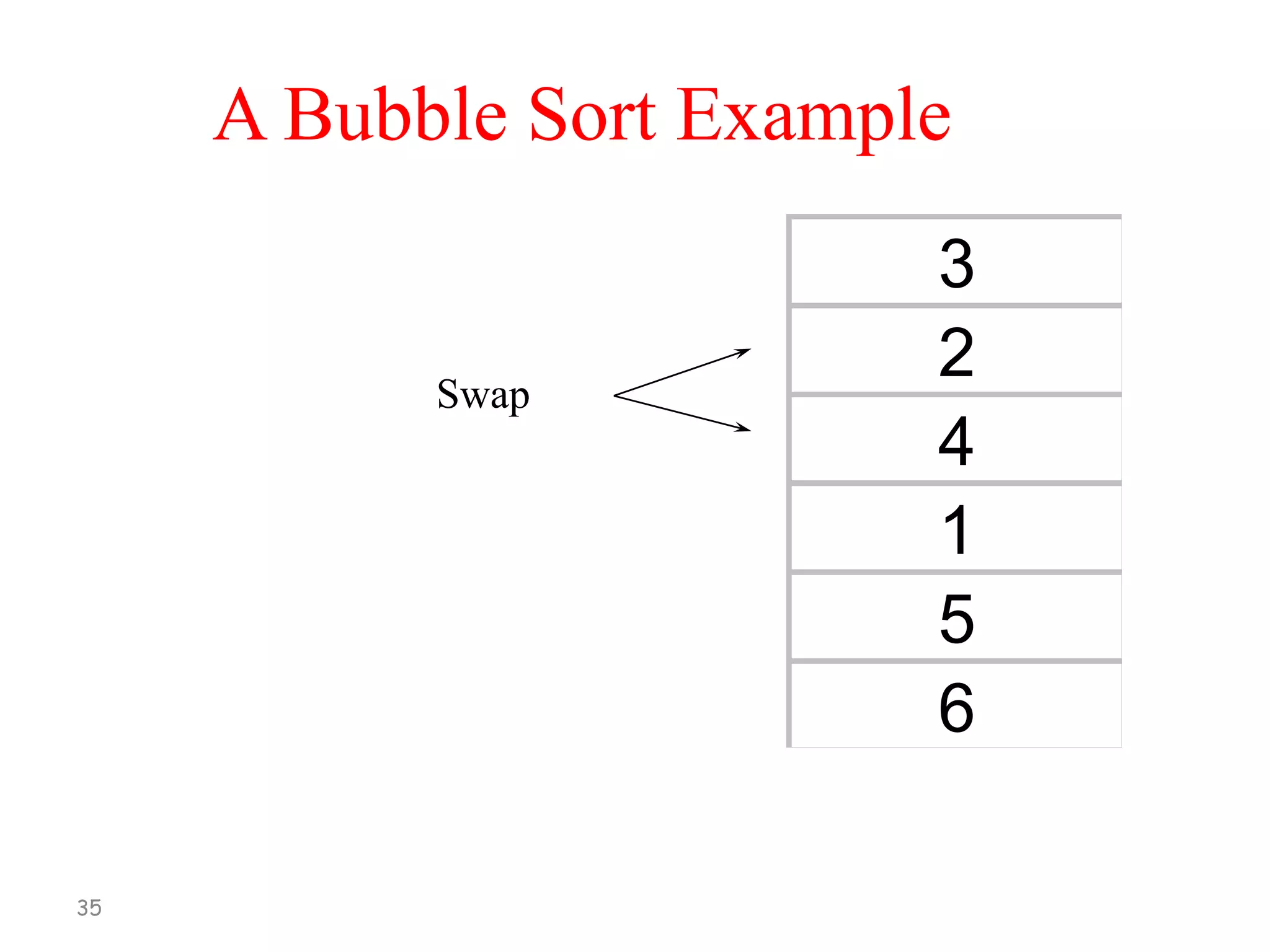
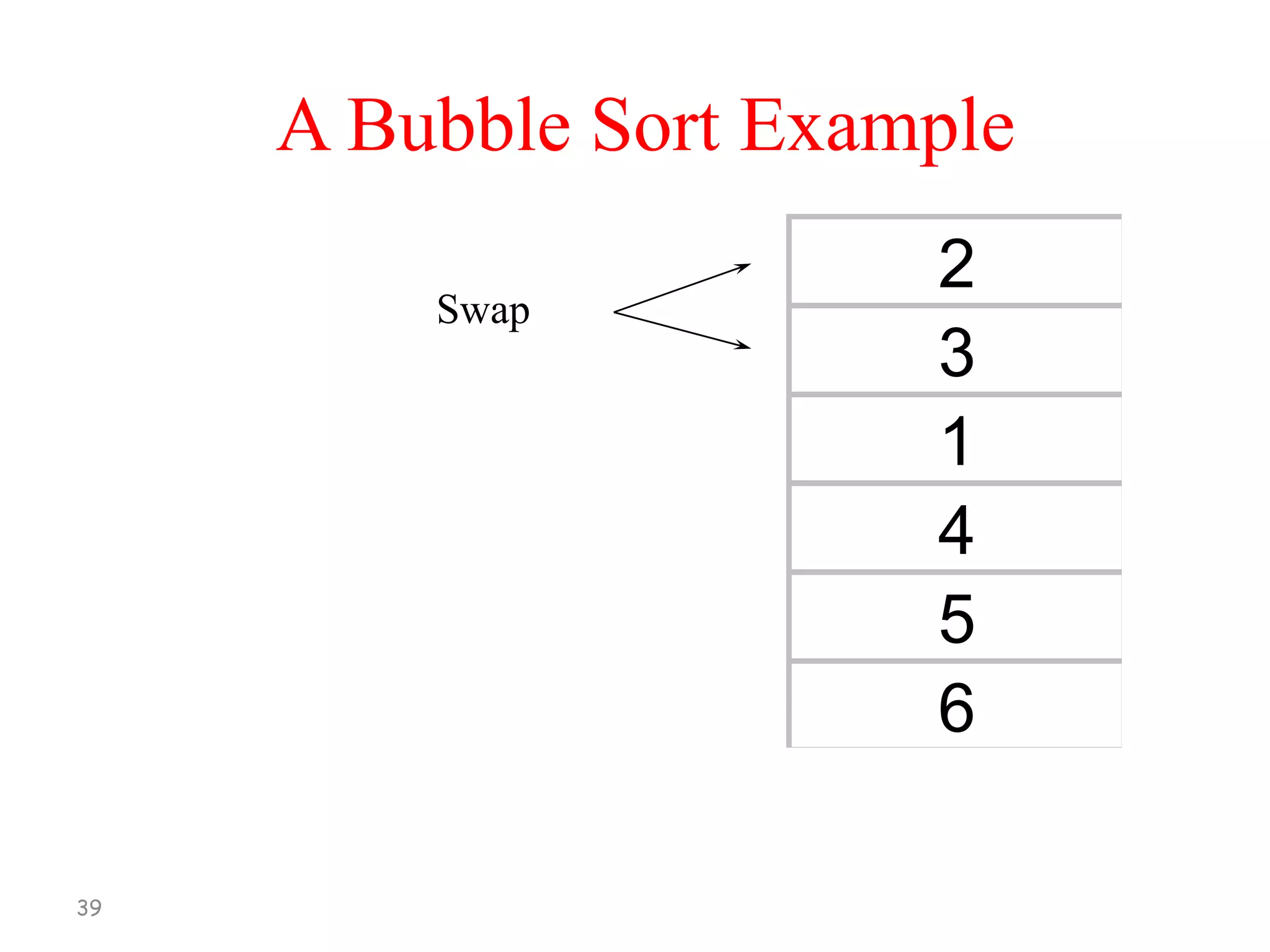
A Bubble Sort Example
Swap

15

5
6
4
3
2
1
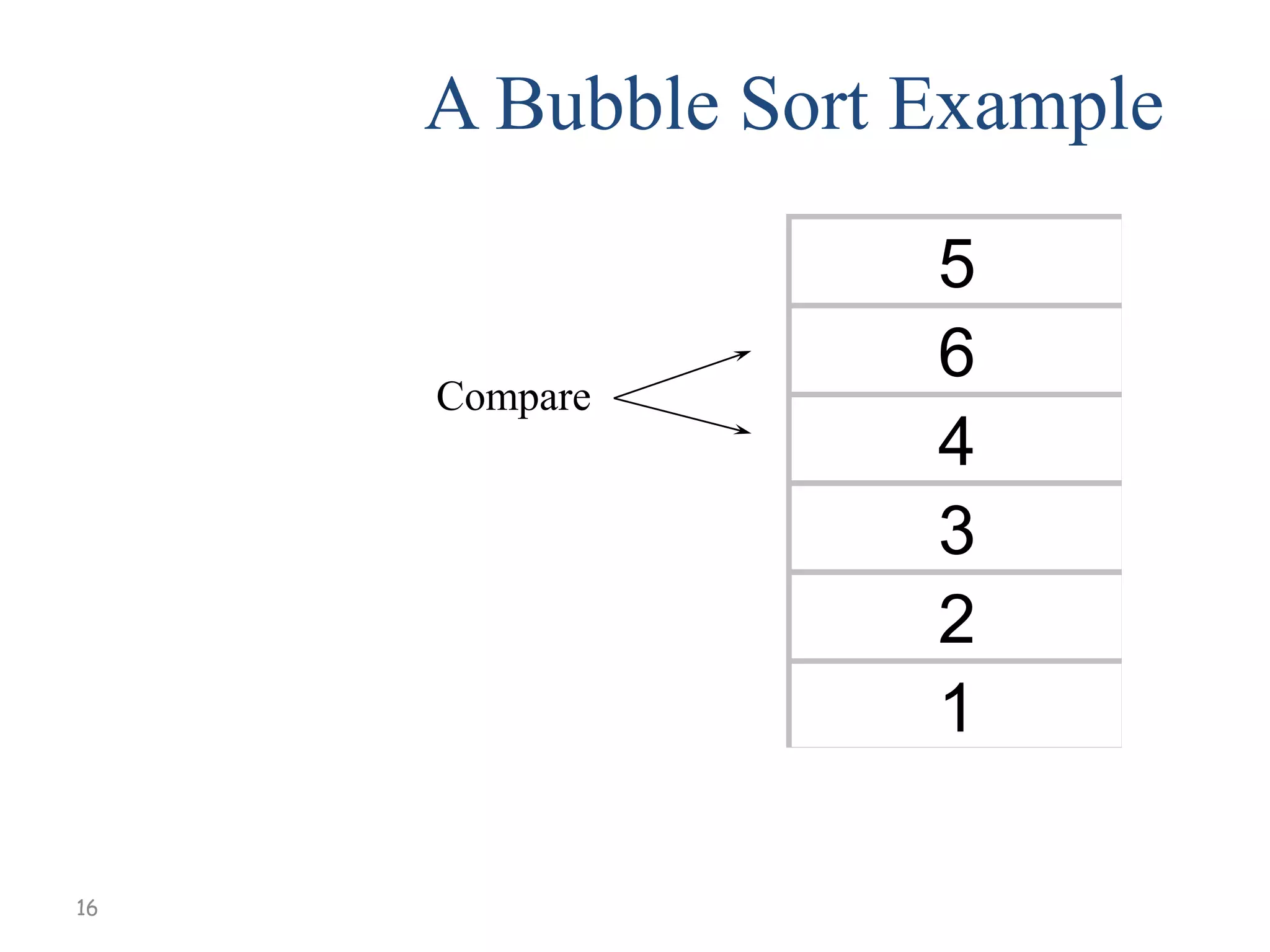
A Bubble Sort Example

Compare

16

5
6
4
3
2
1
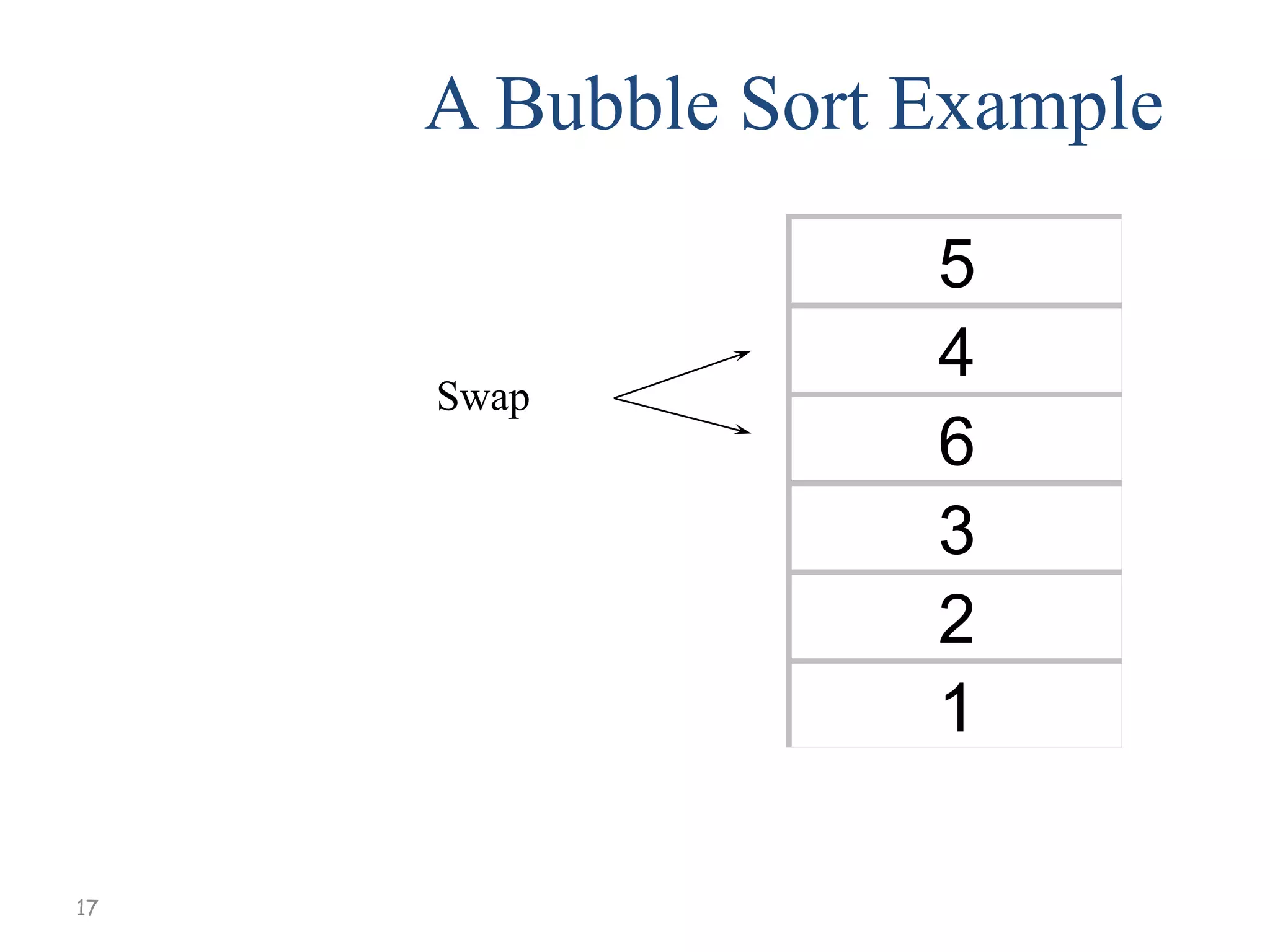
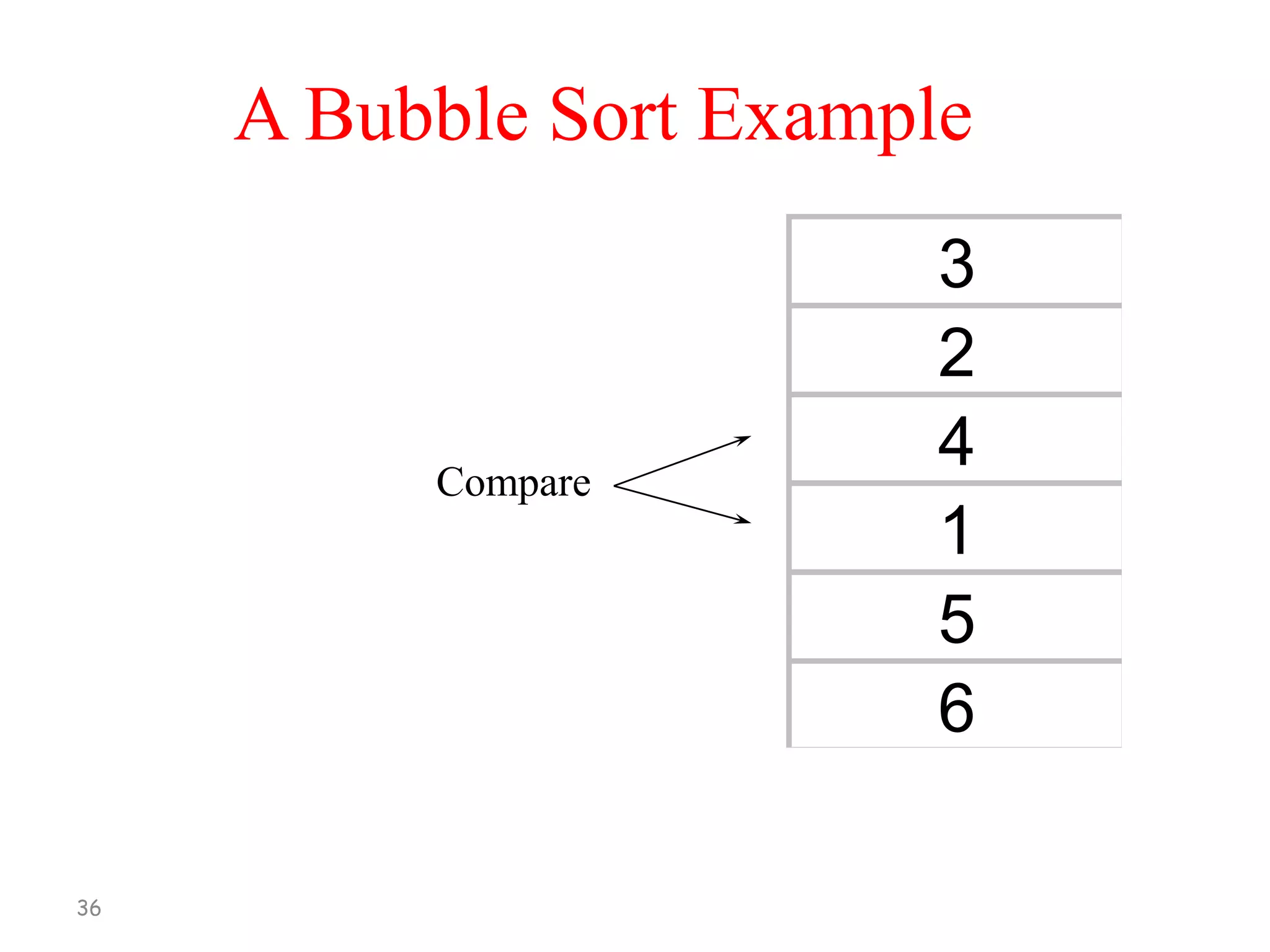
A Bubble Sort Example

Swap

17

5
4
6
3
2
1
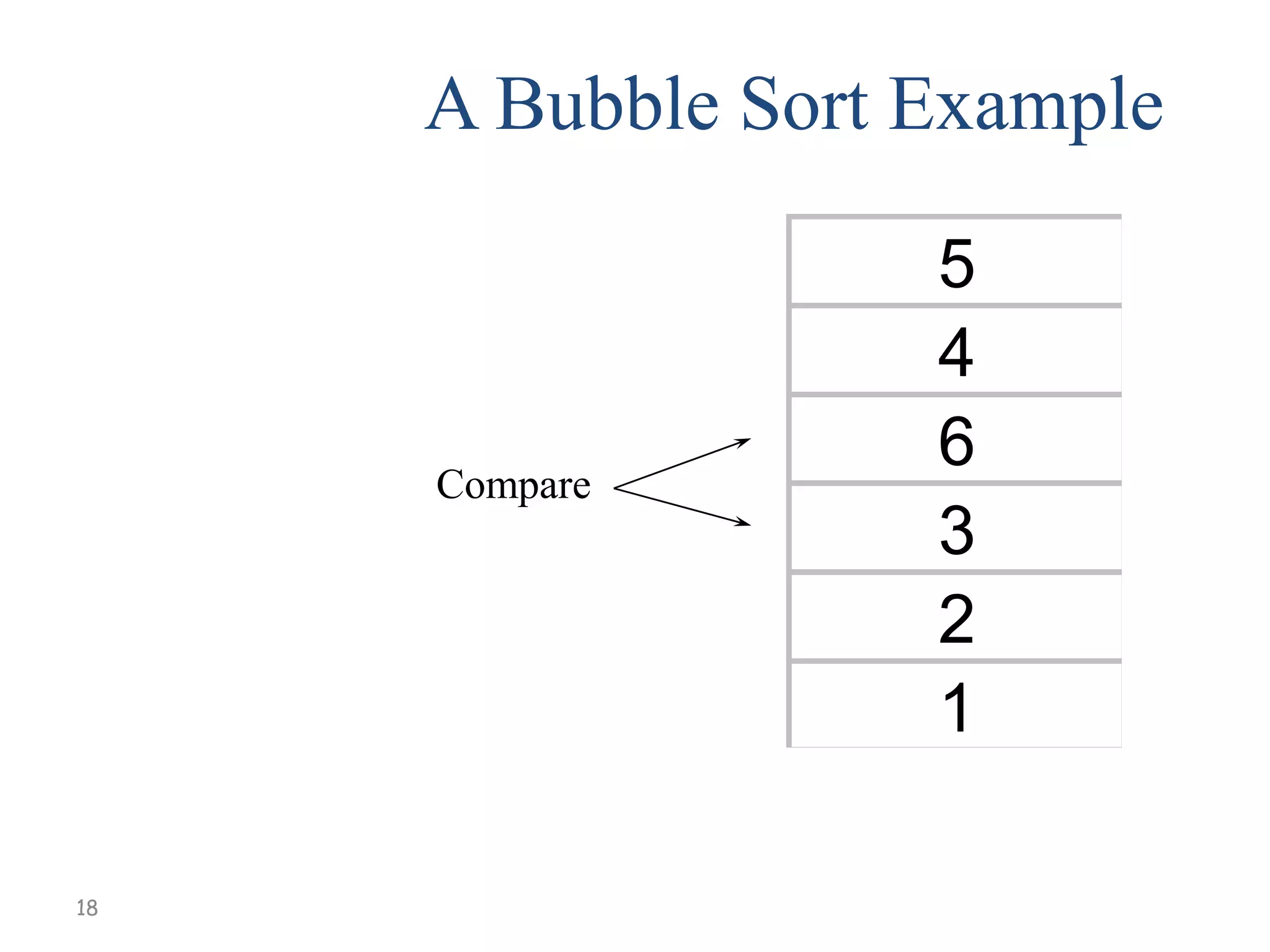
A Bubble Sort Example

Compare

18

5
4
6
3
2
1
A Bubble Sort Example

Swap

19

5
4
3
6
2
1
A Bubble Sort Example

Compare

20

5
4
3
6
2
1
A Bubble Sort Example

Swap

21

5
4
3
2
6
1
A Bubble Sort Example

Compare

22

5
4
3
2
6
1
A Bubble Sort Example
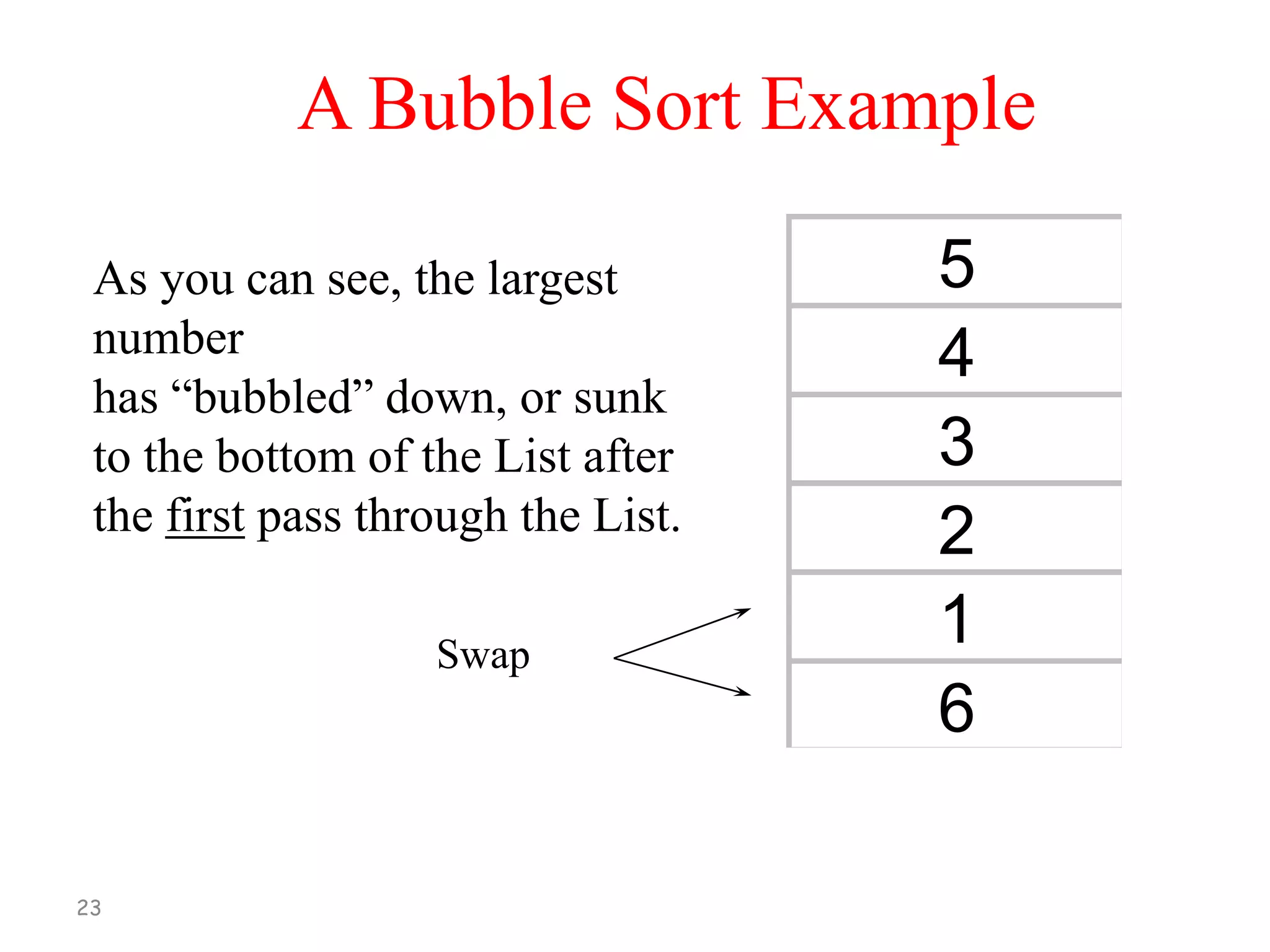
As you can see, the largest
number
has “bubbled” down, or sunk
to the bottom of the List after
the first pass through the List.
Swap

23

5
4
3
2
1
6
A Bubble Sort Example
Compare
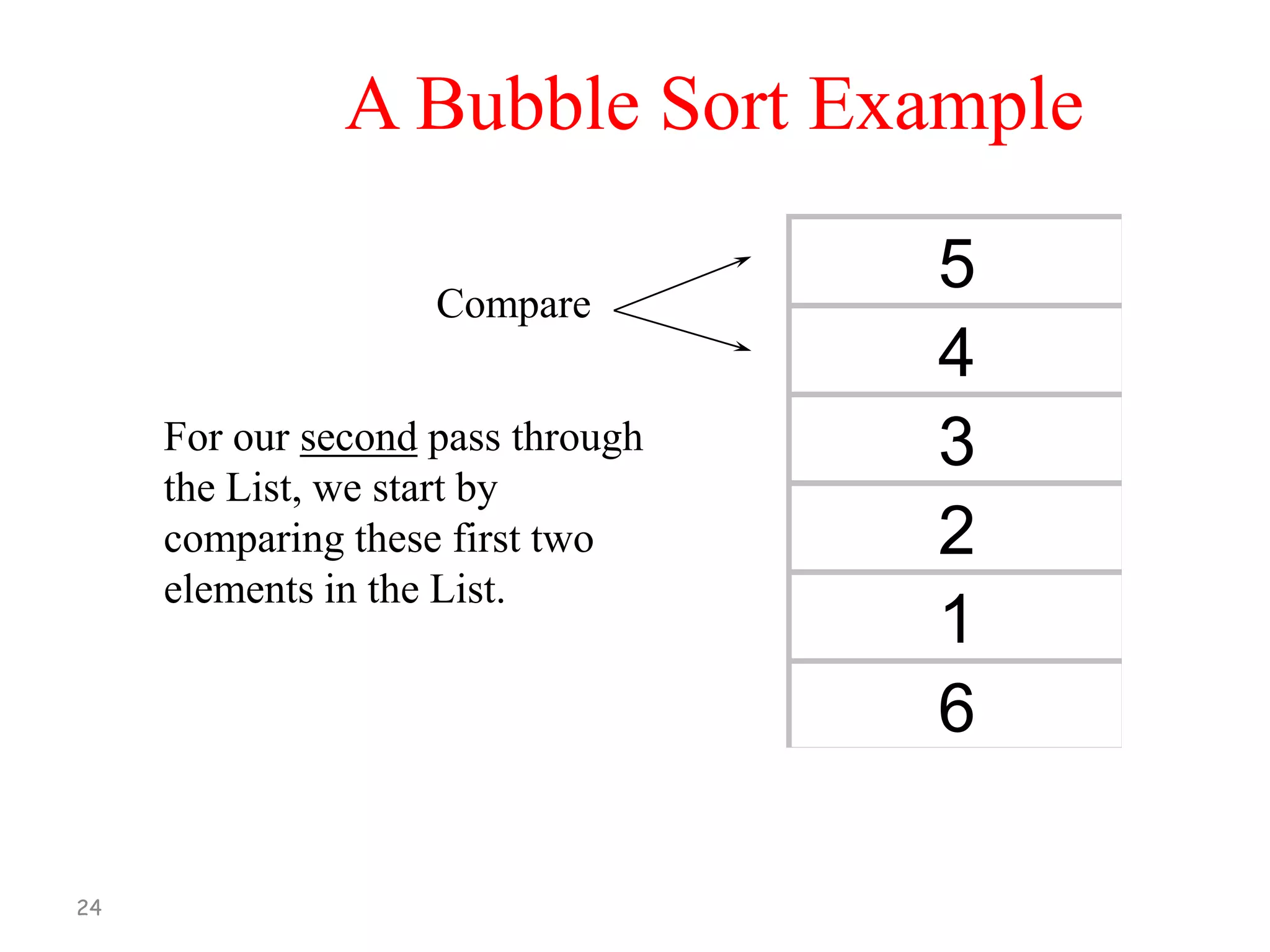
For our second pass through
the List, we start by
comparing these first two
elements in the List.

24

5
4
3
2
1
6
A Bubble Sort Example
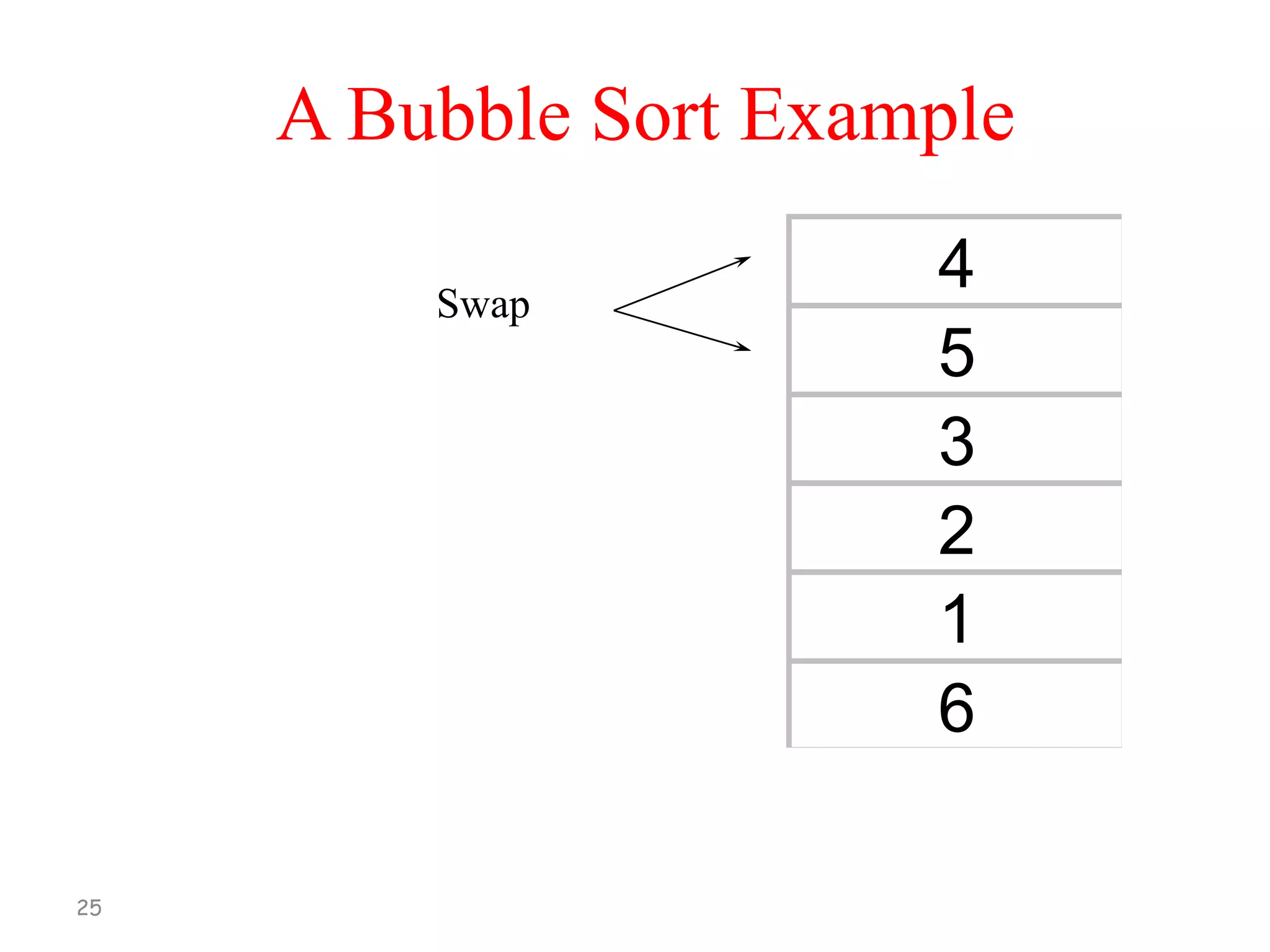
Swap

25

4
5
3
2
1
6
A Bubble Sort Example

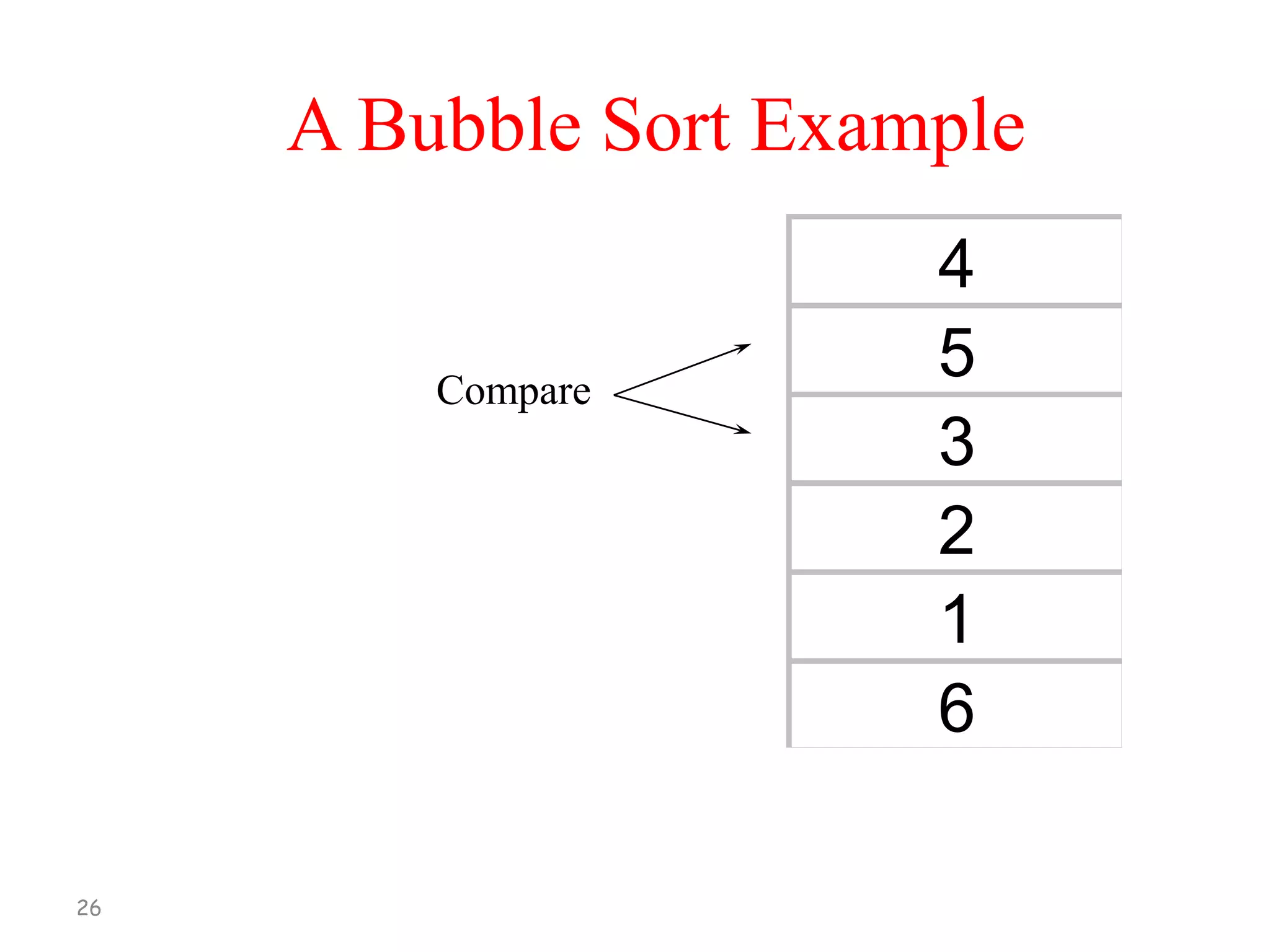
Compare

26

4
5
3
2
1
6
A Bubble Sort Example

Swap

27

4
3
5
2
1
6
A Bubble Sort Example

Compare

28

4
3
5
2
1
6
A Bubble Sort Example

Swap

29

4
3
2
5
1
6
A Bubble Sort Example

Compare

30

4
3
2
5
1
6
A Bubble Sort Example
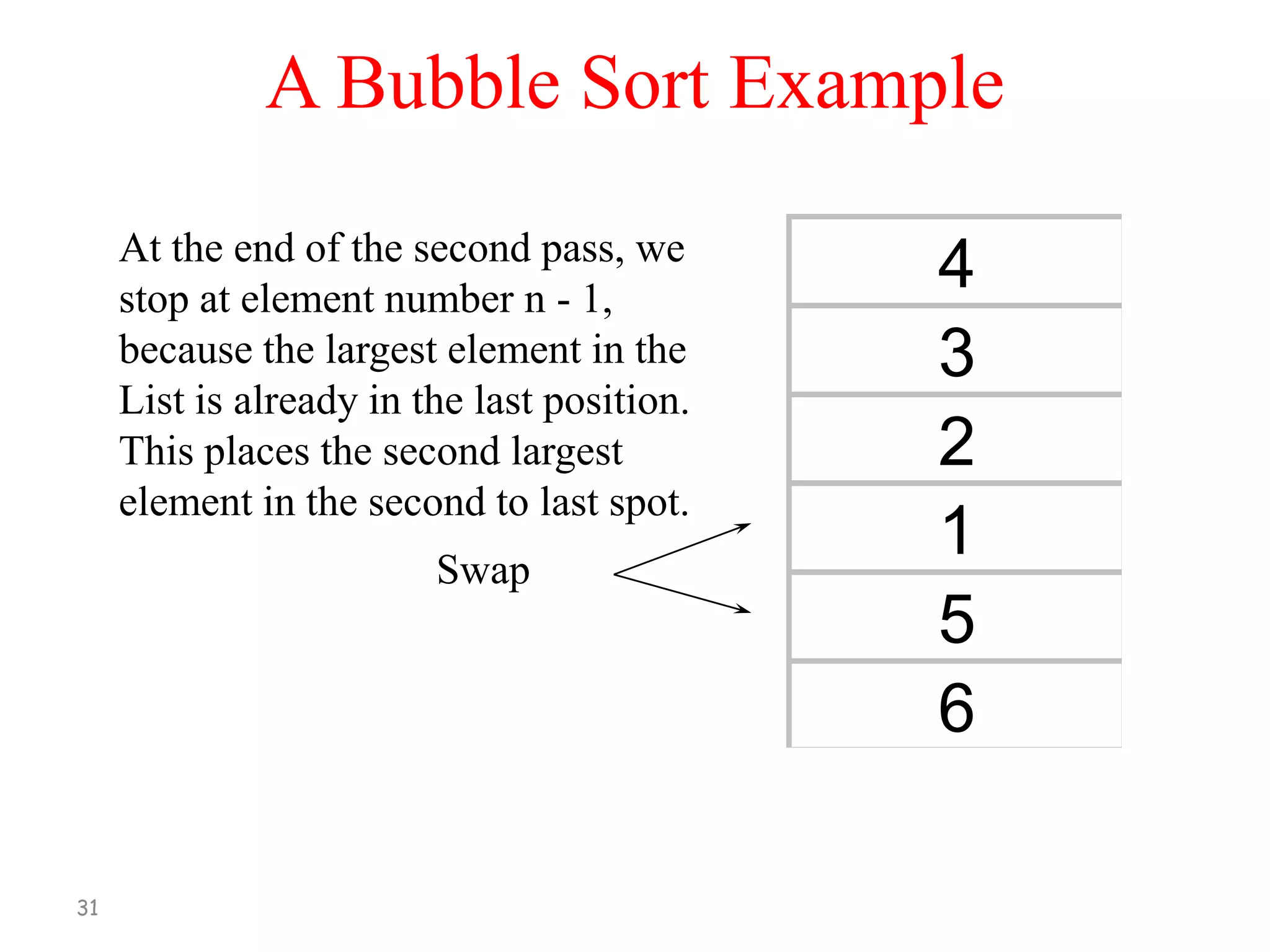
At the end of the second pass, we
stop at element number n - 1,
because the largest element in the
List is already in the last position.
This places the second largest
element in the second to last spot.
Swap

31

4
3
2
1
5
6
A Bubble Sort Example
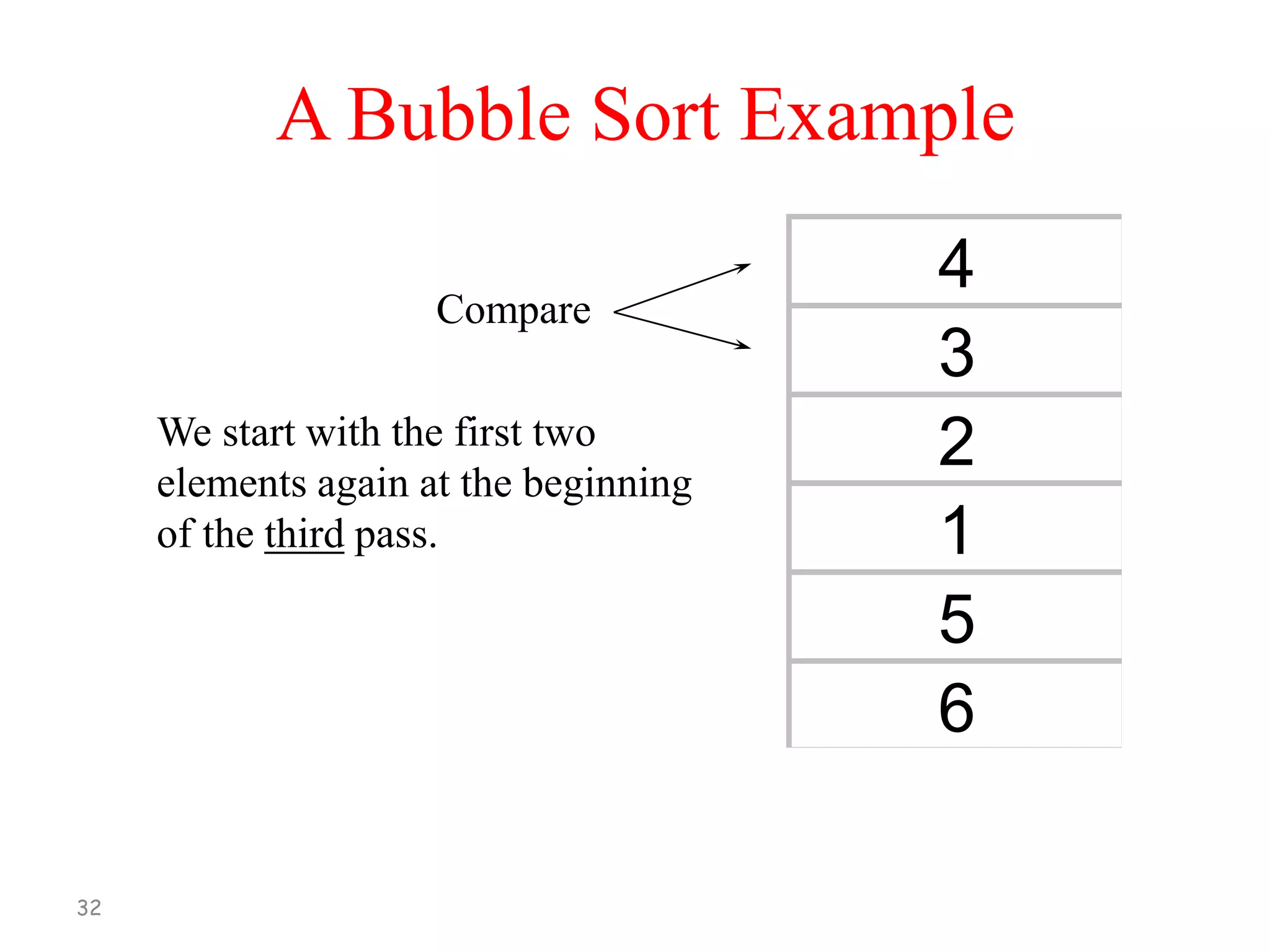
Compare

We start with the first two
elements again at the beginning
of the third pass.

32

4
3
2
1
5
6
A Bubble Sort Example
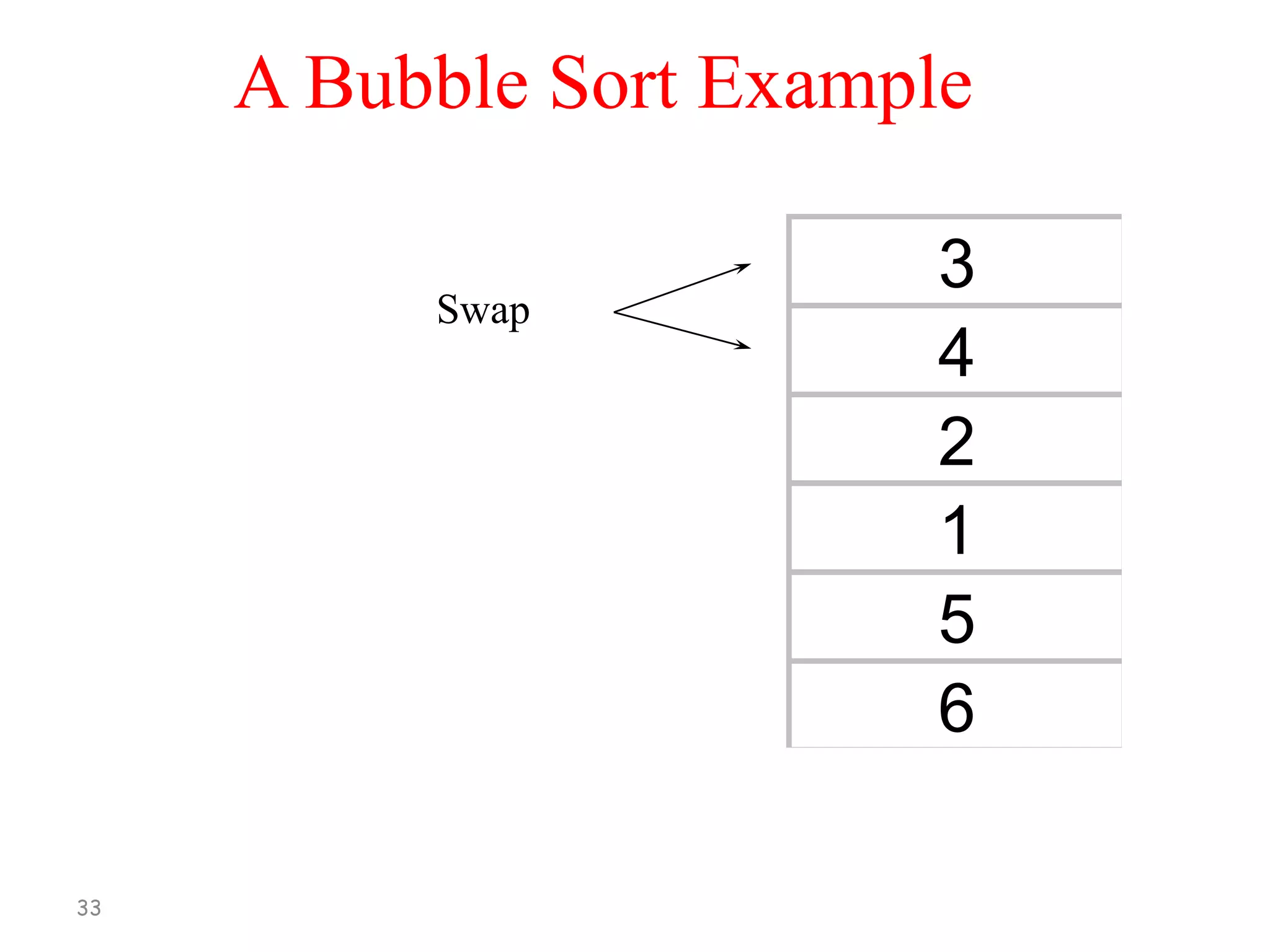
Swap

33

3
4
2
1
5
6
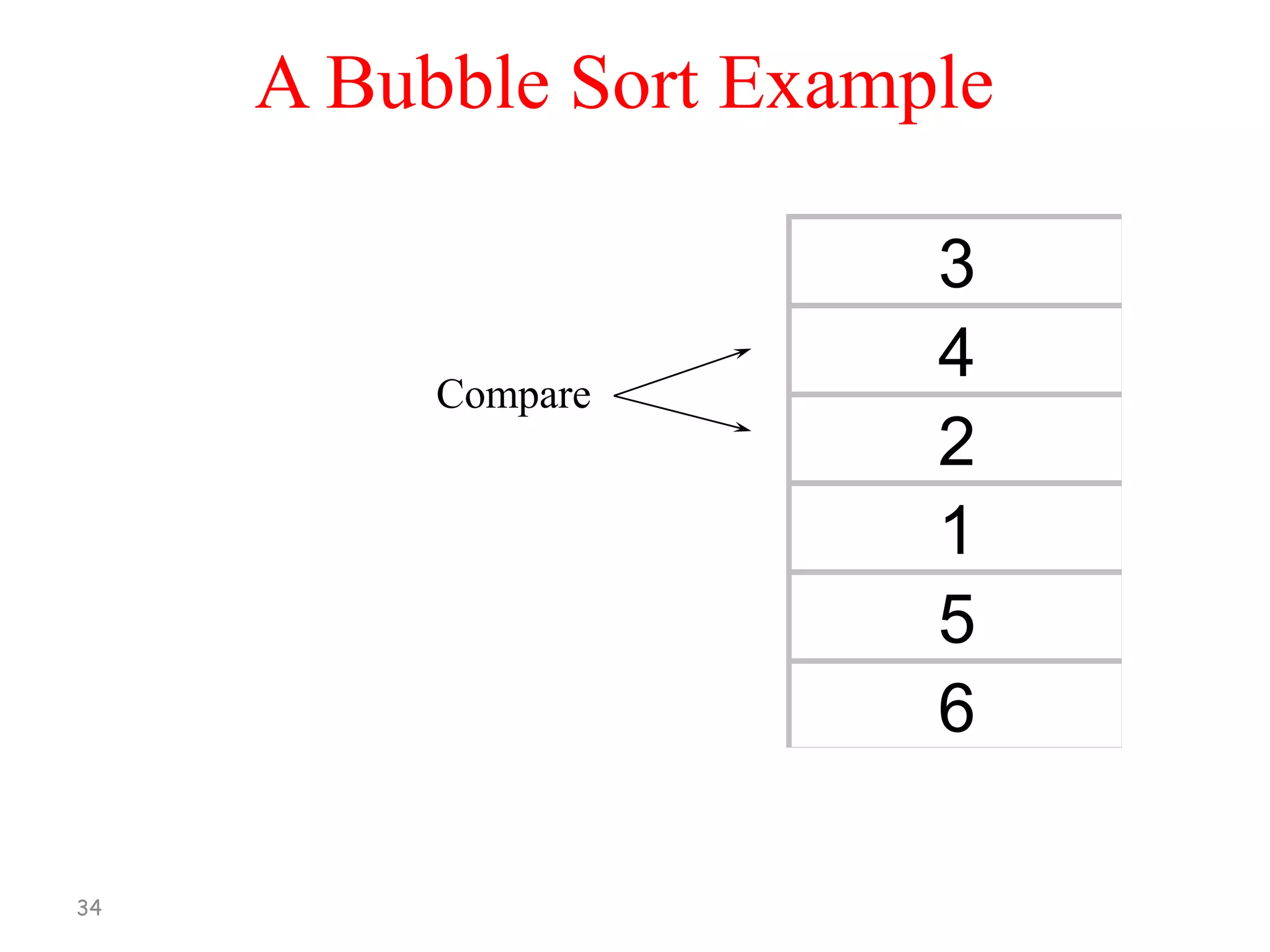
A Bubble Sort Example

Compare

34

3
4
2
1
5
6
A Bubble Sort Example

Swap

35

3
2
4
1
5
6
A Bubble Sort Example

Compare

36

3
2
4
1
5
6
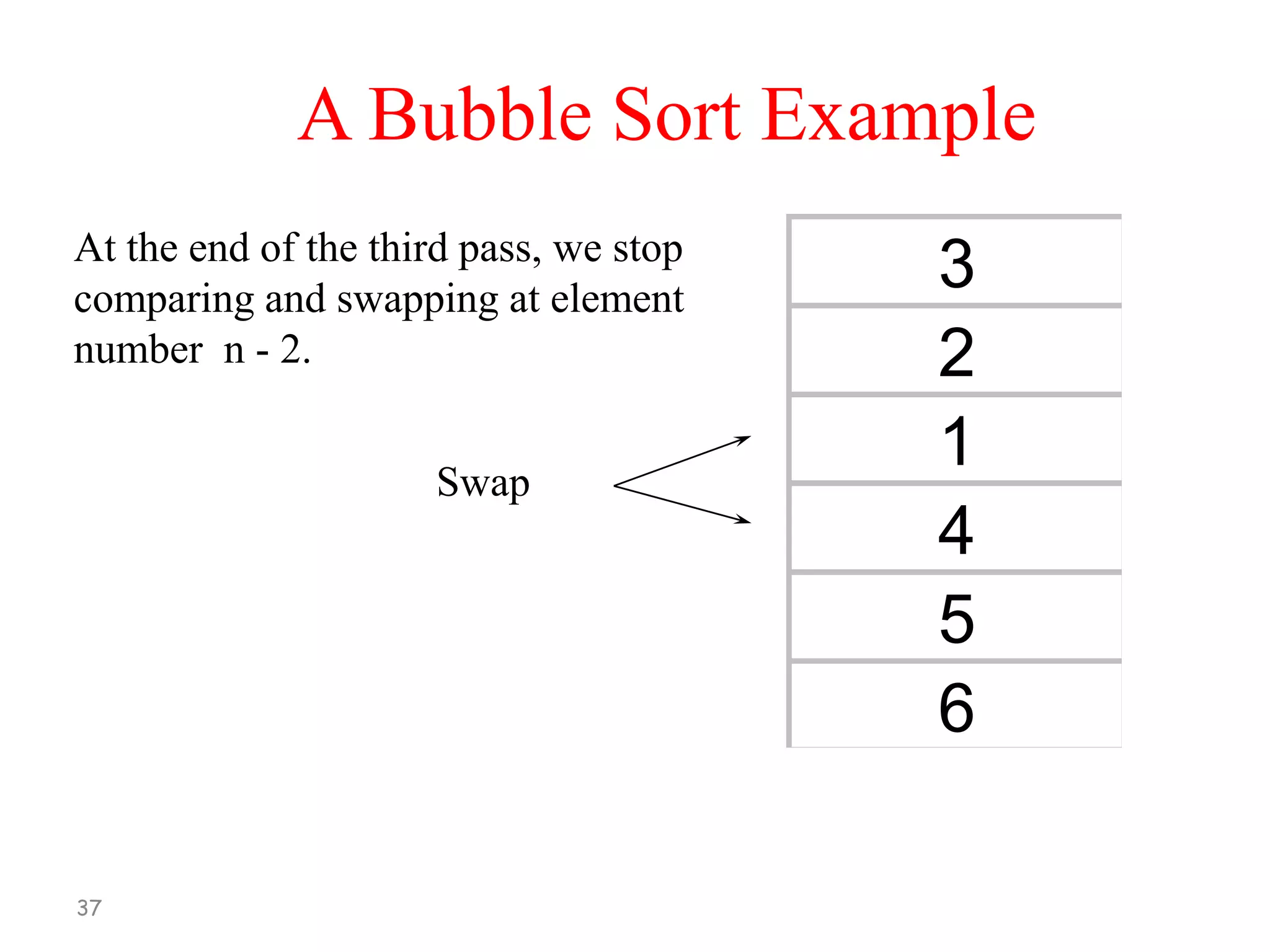
A Bubble Sort Example
At the end of the third pass, we stop
comparing and swapping at element
number n - 2.
Swap

37

3
2
1
4
5
6
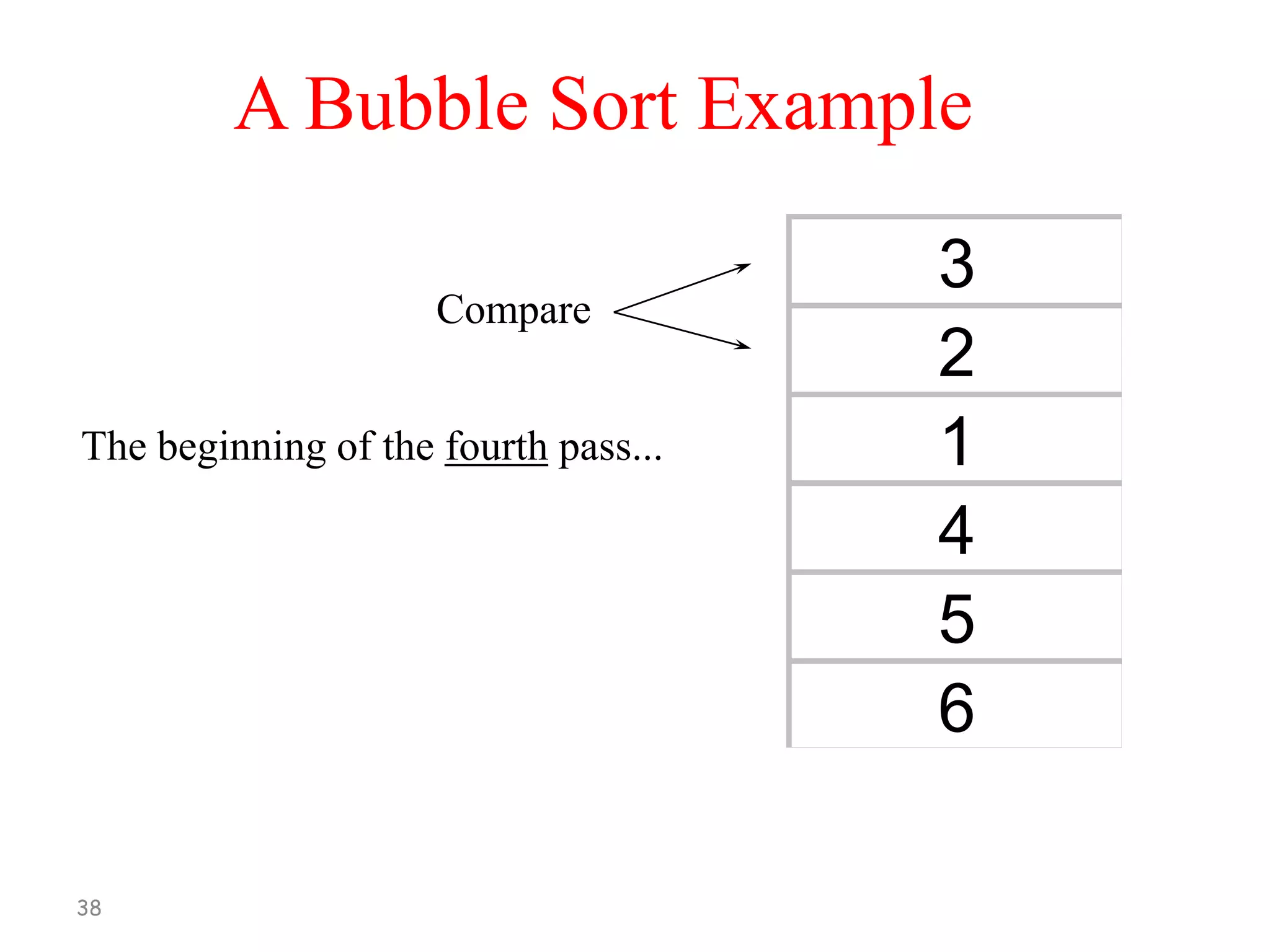
A Bubble Sort Example
Compare
The beginning of the fourth pass...

38

3
2
1
4
5
6
A Bubble Sort Example
Swap

39

2
3
1
4
5
6
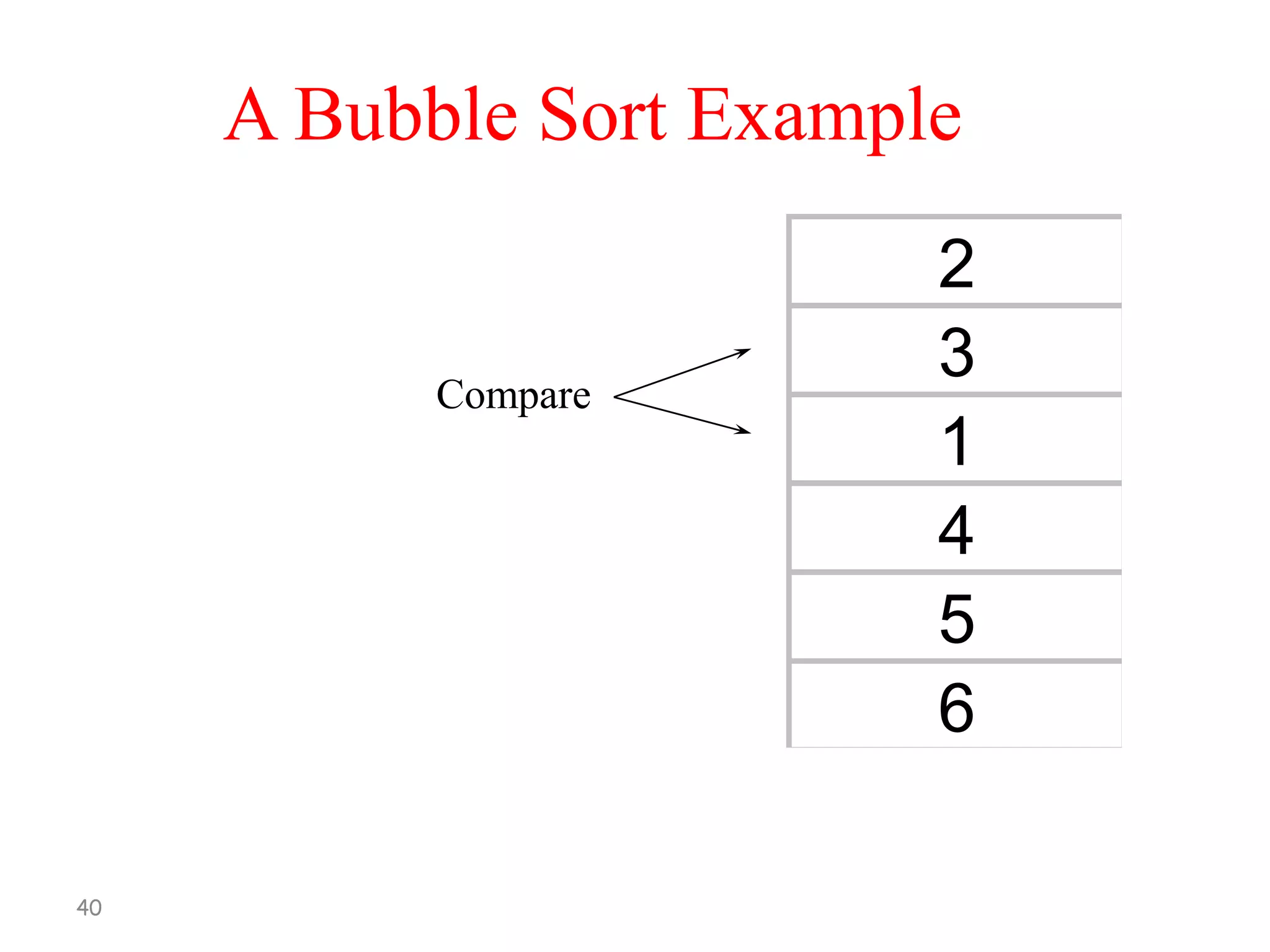
A Bubble Sort Example

Compare

40

2
3
1
4
5
6
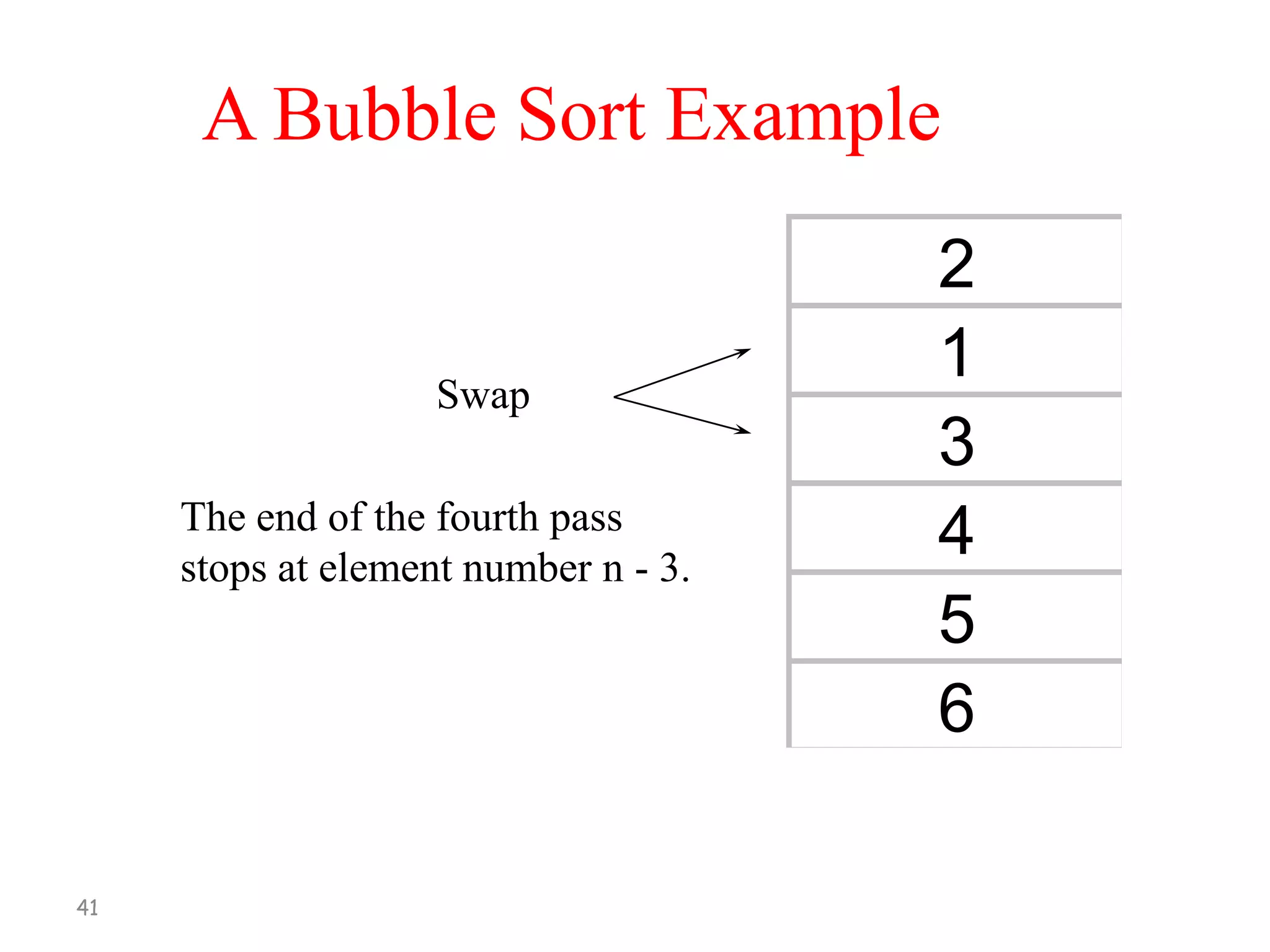
A Bubble Sort Example

Swap
The end of the fourth pass
stops at element number n - 3.

41

2
1
3
4
5
6
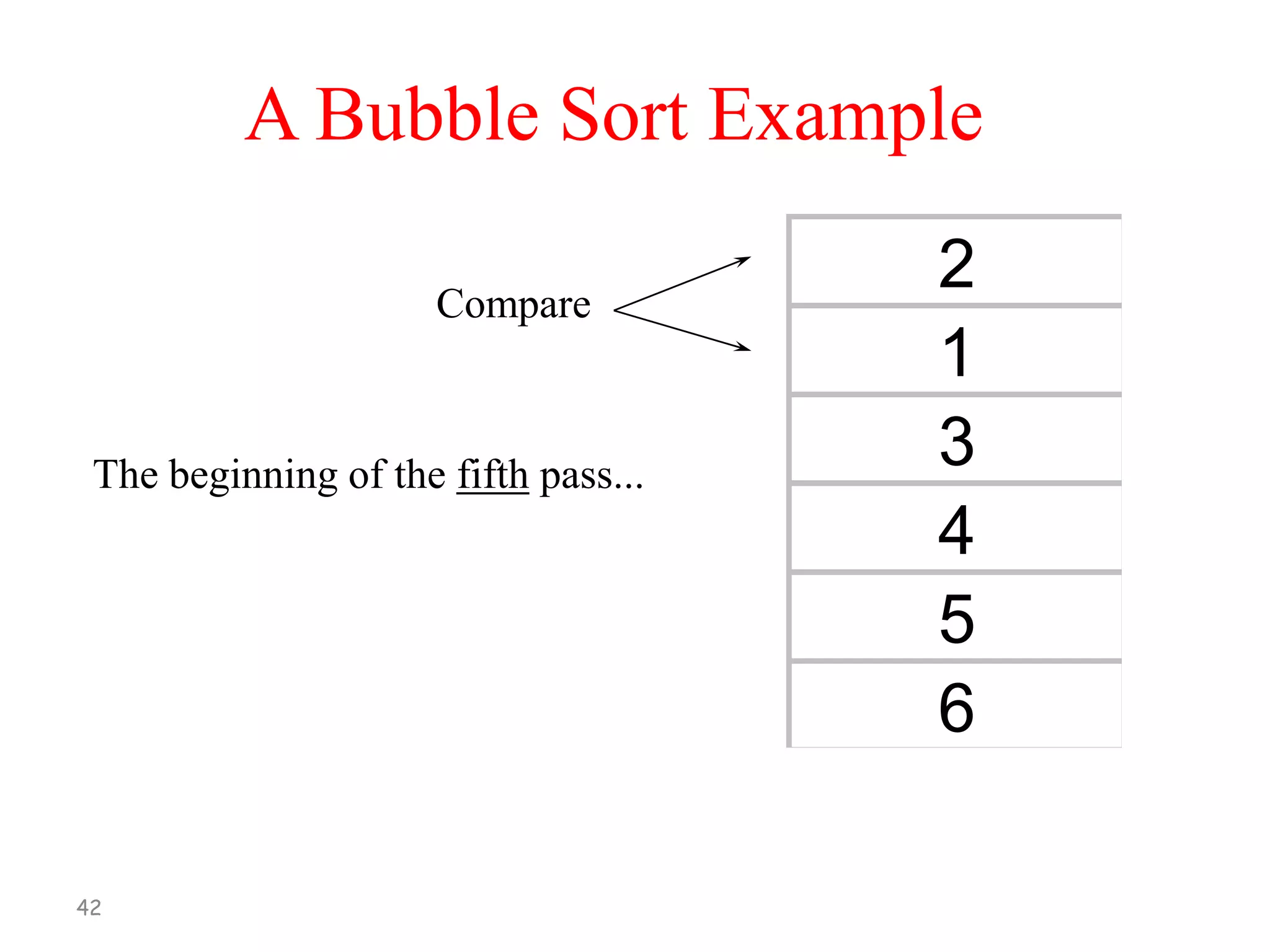
A Bubble Sort Example
Compare

The beginning of the fifth pass...

42

2
1
3
4
5
6
A Bubble Sort Example
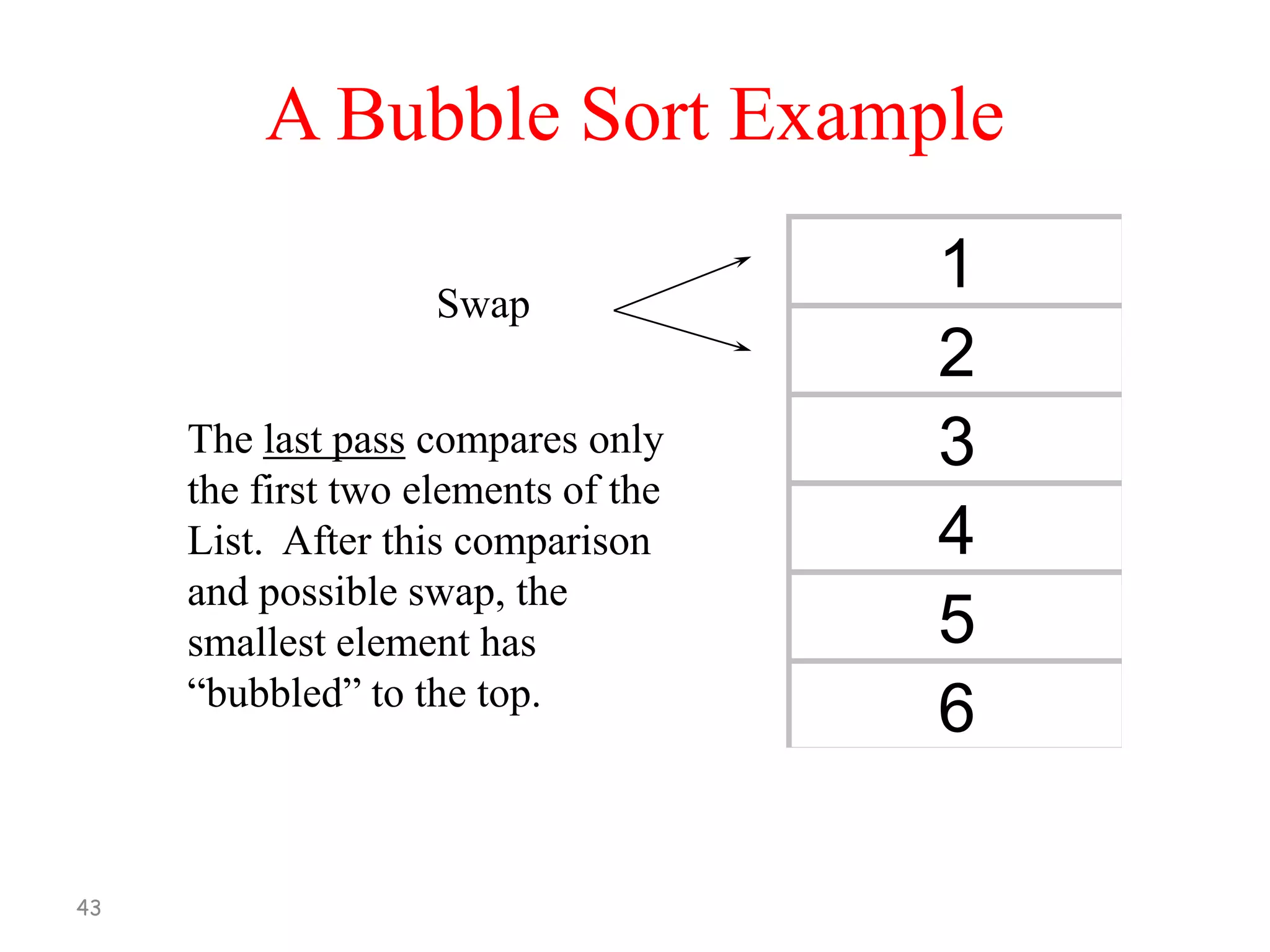
Swap
The last pass compares only
the first two elements of the
List. After this comparison
and possible swap, the
smallest element has
“bubbled” to the top.

43

1
2
3
4
5
6
What “Swapping” Means
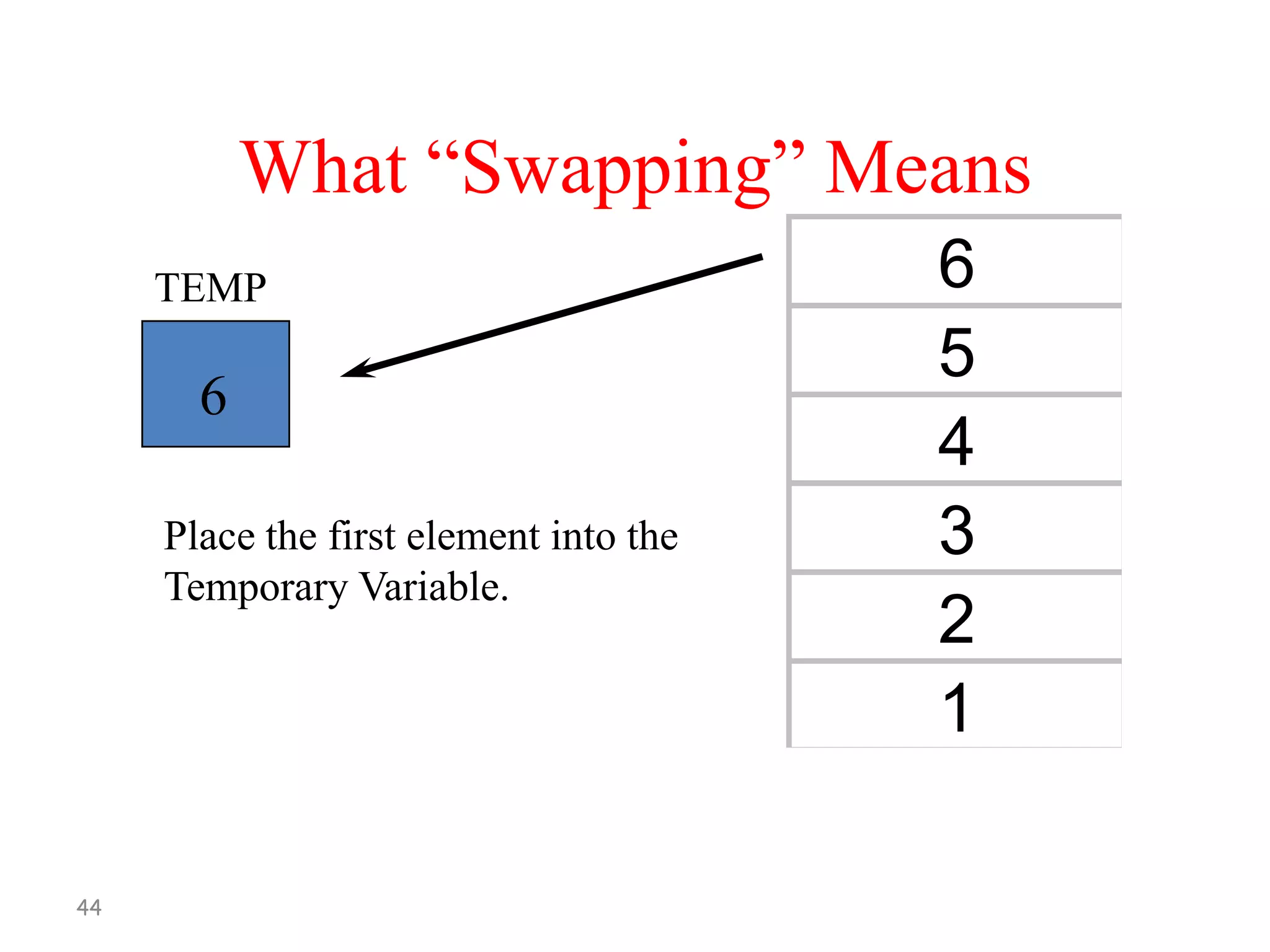
TEMP

6
Place the first element into the
Temporary Variable.

44

6
5
4
3
2
1
What “Swapping” Means
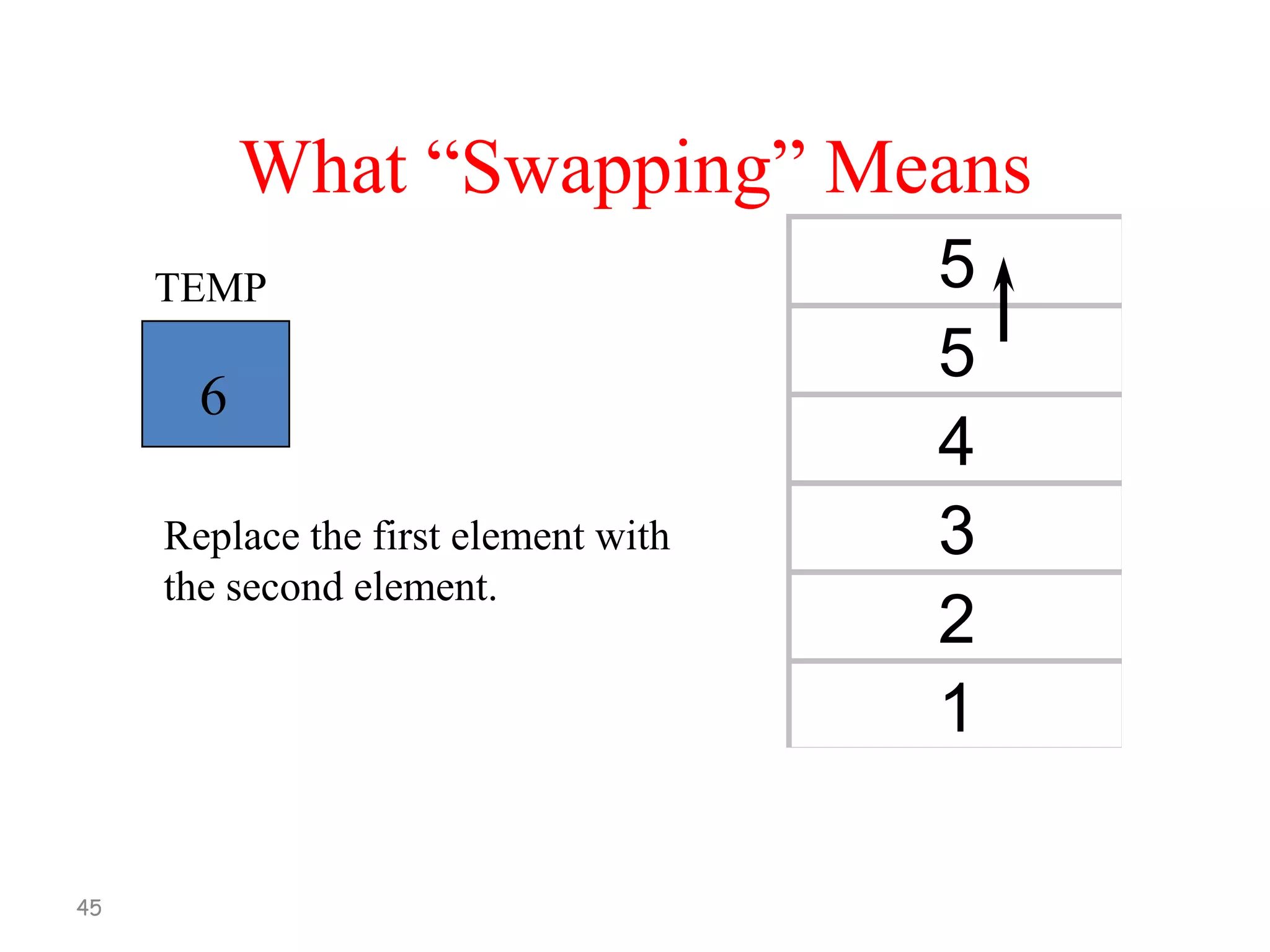
TEMP

6
Replace the first element with
the second element.

45

5
5
4
3
2
1
What “Swapping” Means
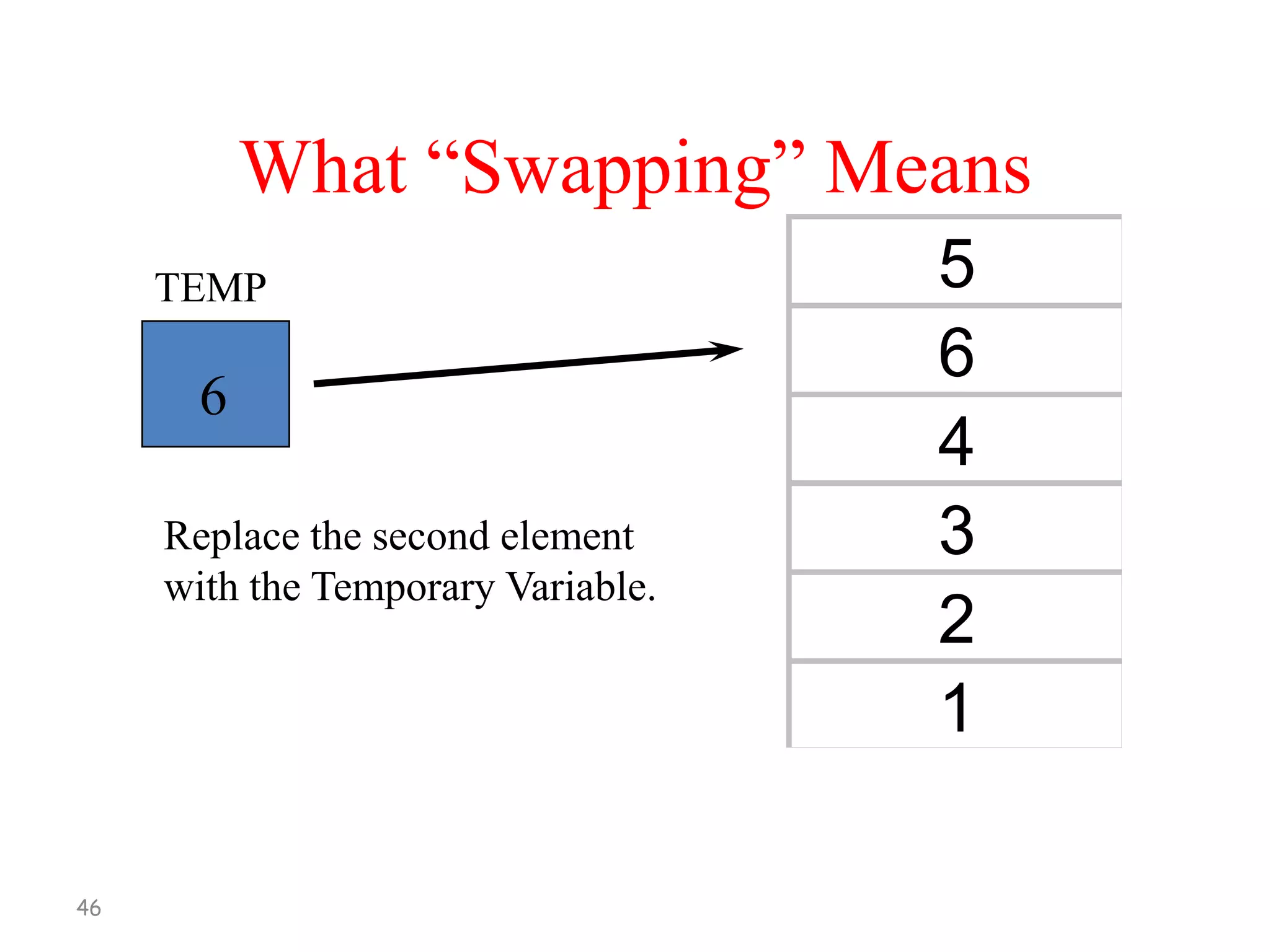
TEMP

6
Replace the second element
with the Temporary Variable.

46

5
6
4
3
2
1
Bubble Sort
DATA is an array with N elements
[1] Repeat Step 2 and 3 for K =1 to N-1
[2] Set PTR :=1
[3] Repeat While PTR <= N –K
(a) If DATA[PTR] > DATA[PTR+1]
Interchange DATA[PTR] and
DATA[PTR + 1]
(b) Set PTR = PTR + 1
[4] Exit
47
Analysis of Bubble Sort
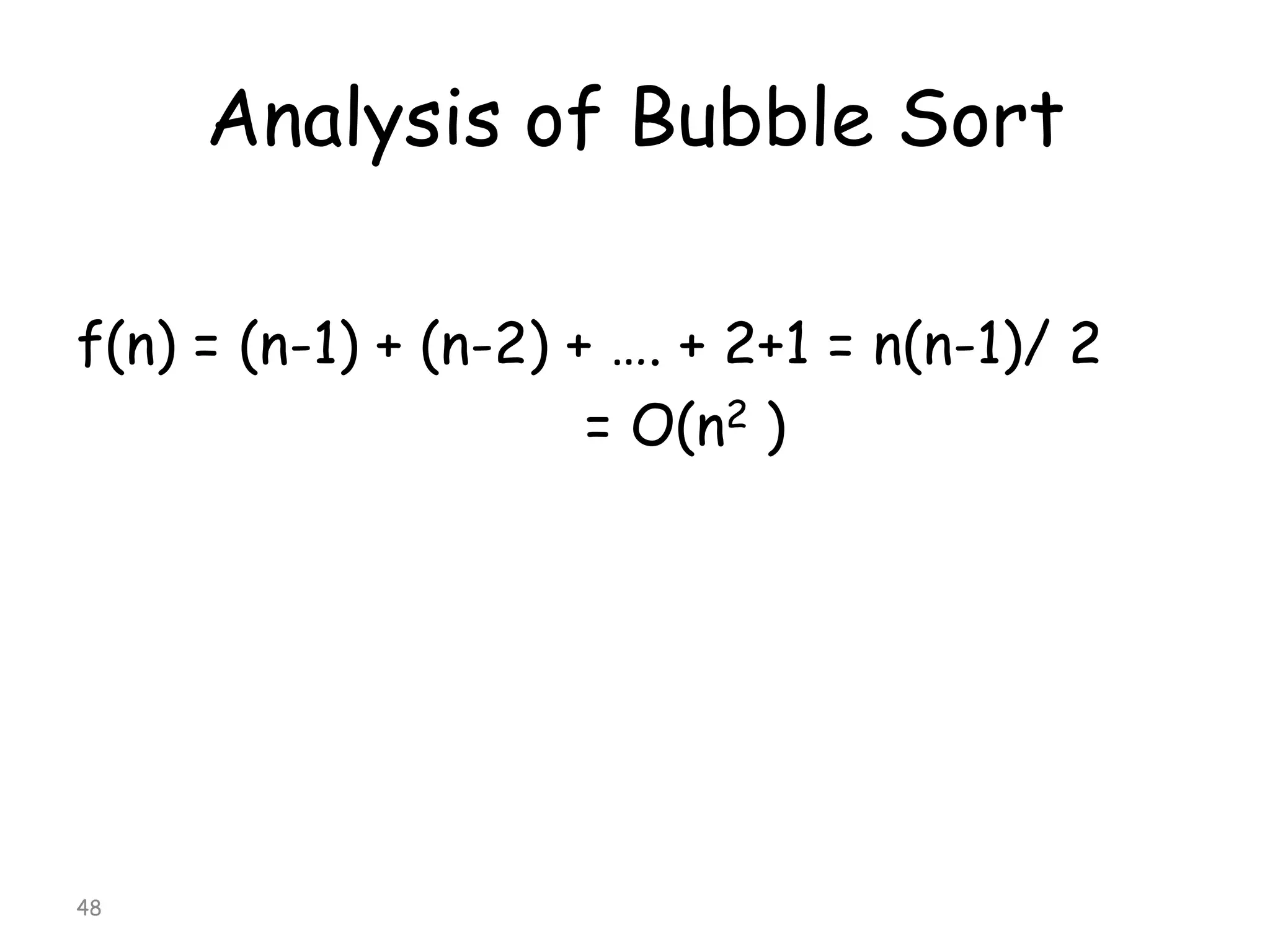
f(n) = (n-1) + (n-2) + …. + 2+1 = n(n-1)/ 2
= O(n2 )

48
Quick Sort

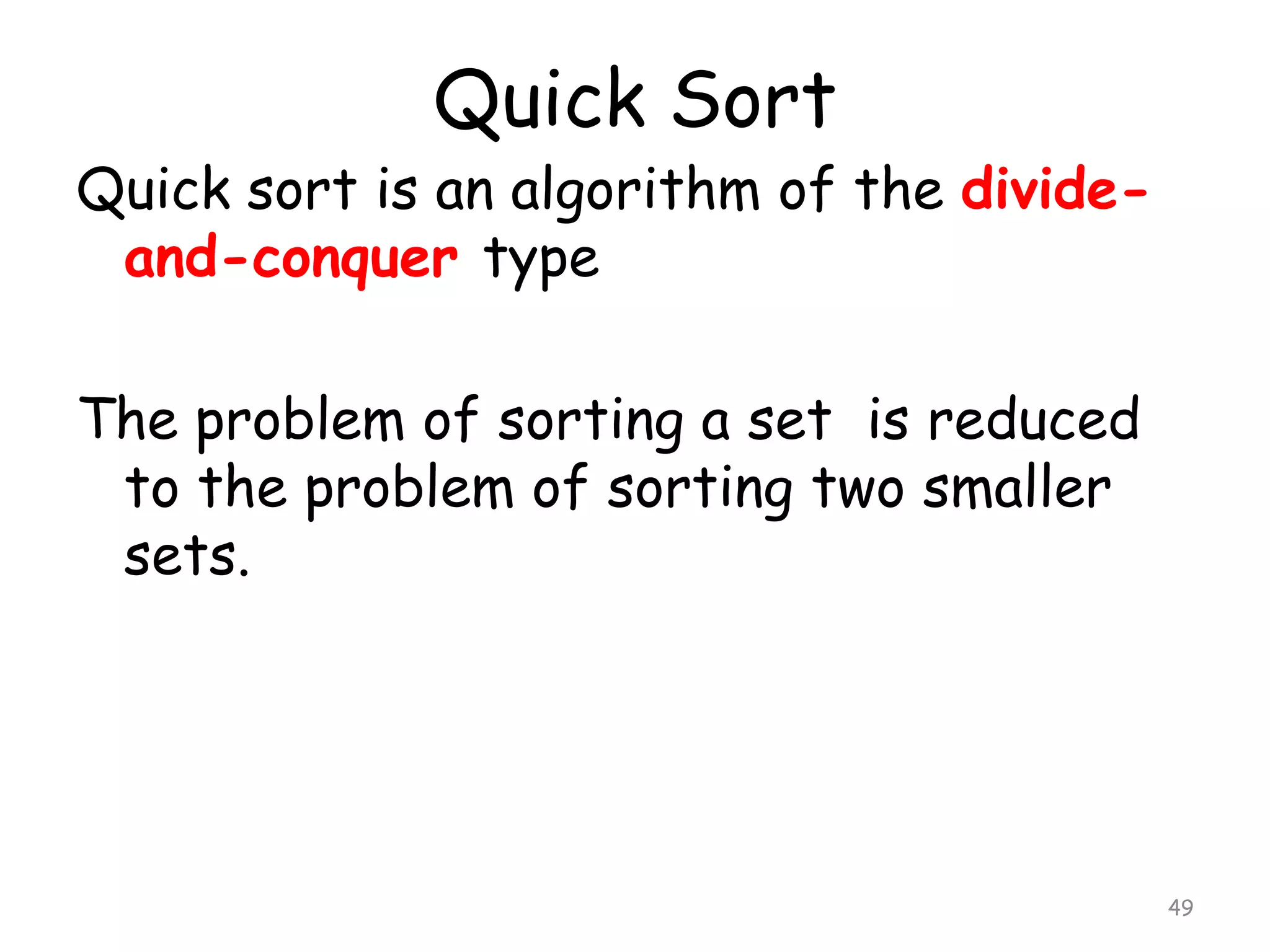
Quick sort is an algorithm of the divideand-conquer type
The problem of sorting a set is reduced
to the problem of sorting two smaller
sets.

49
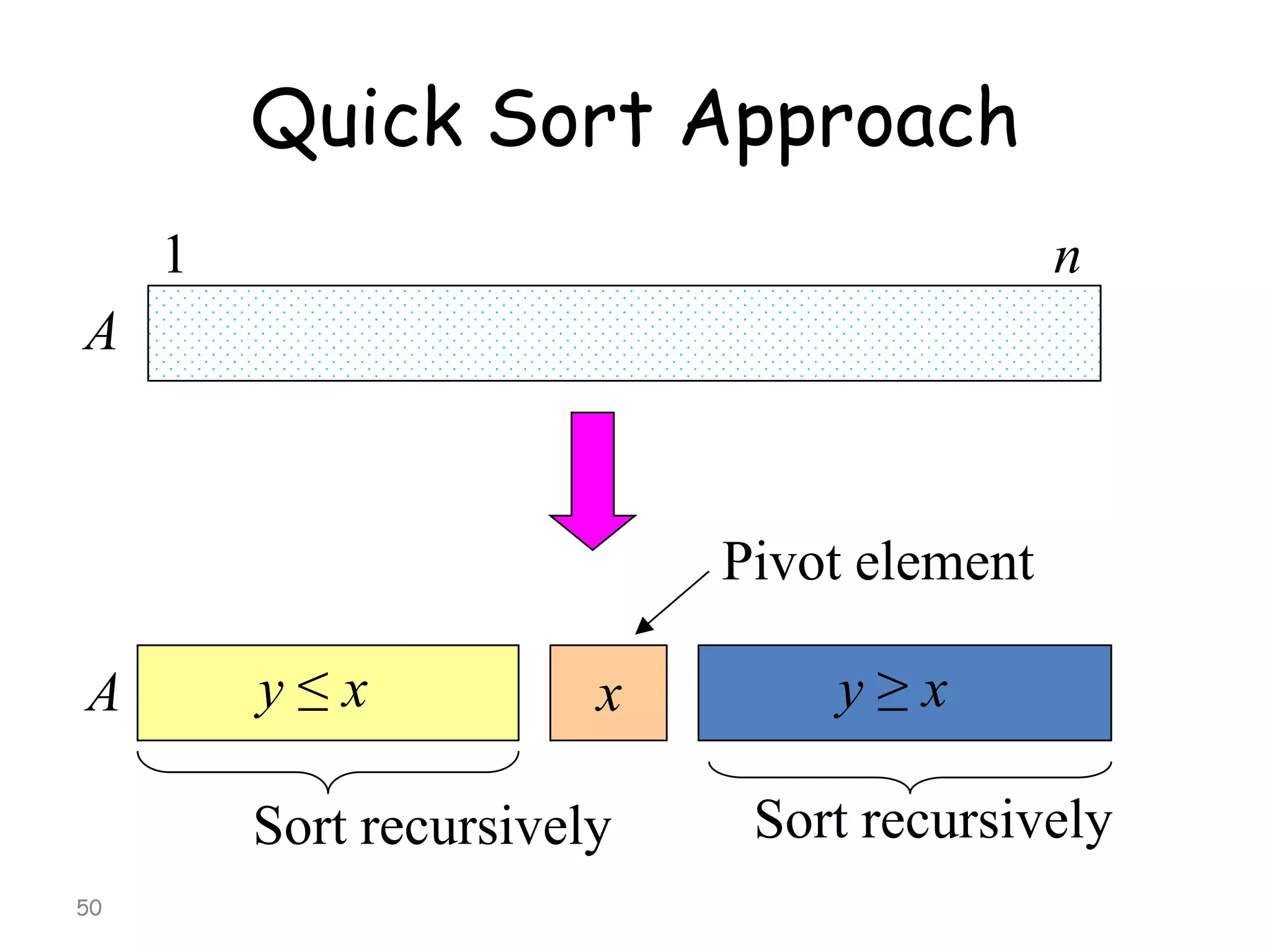
Quick Sort Approach
1

n

A

Pivot element
A

y≤x

x

Sort recursively
50

y≥x
Sort recursively
Quick Sort
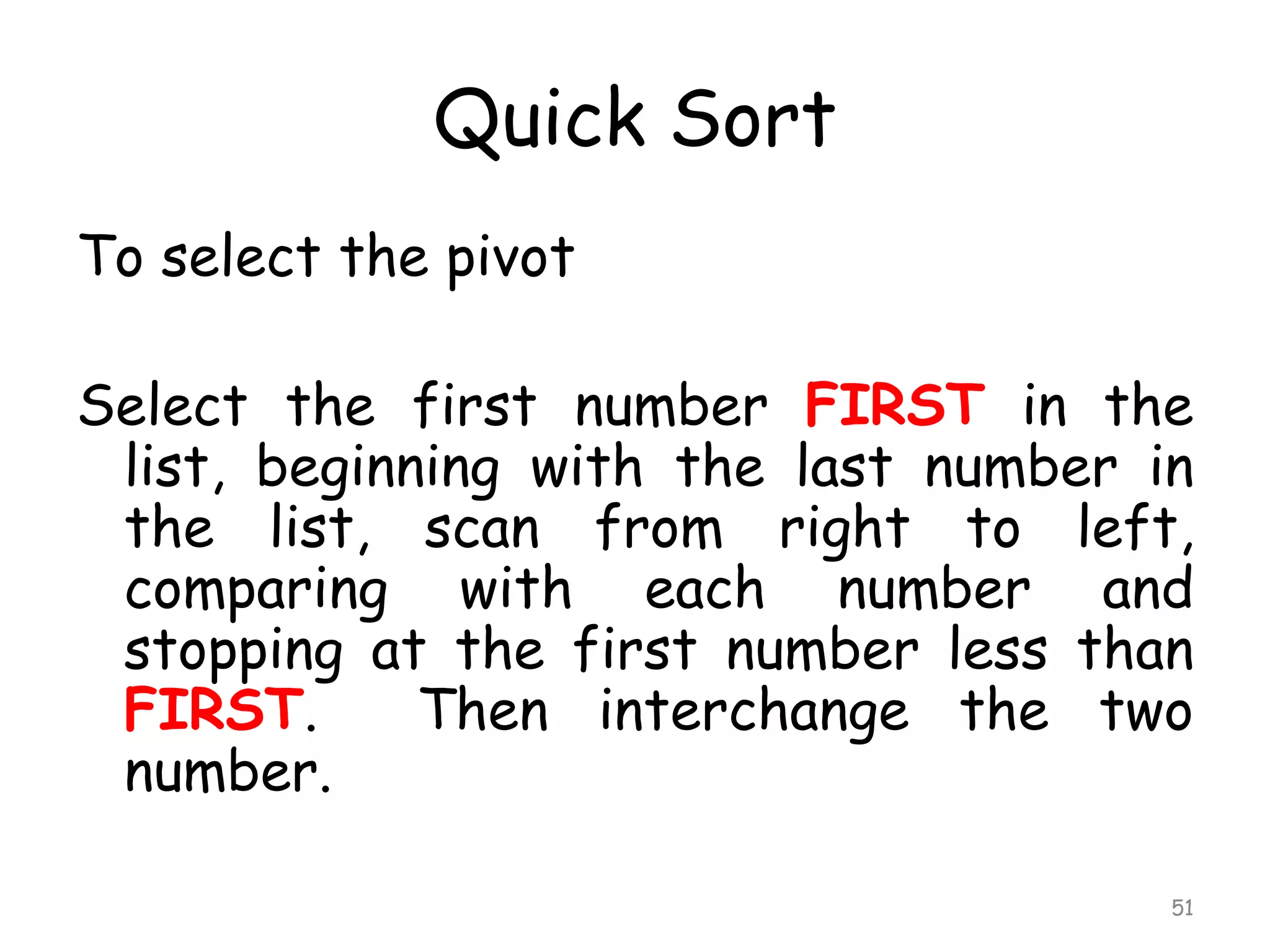
To select the pivot
Select the first number FIRST in the
list, beginning with the last number in
the list, scan from right to left,
comparing with each number and
stopping at the first number less than
FIRST.
Then interchange the two
number.
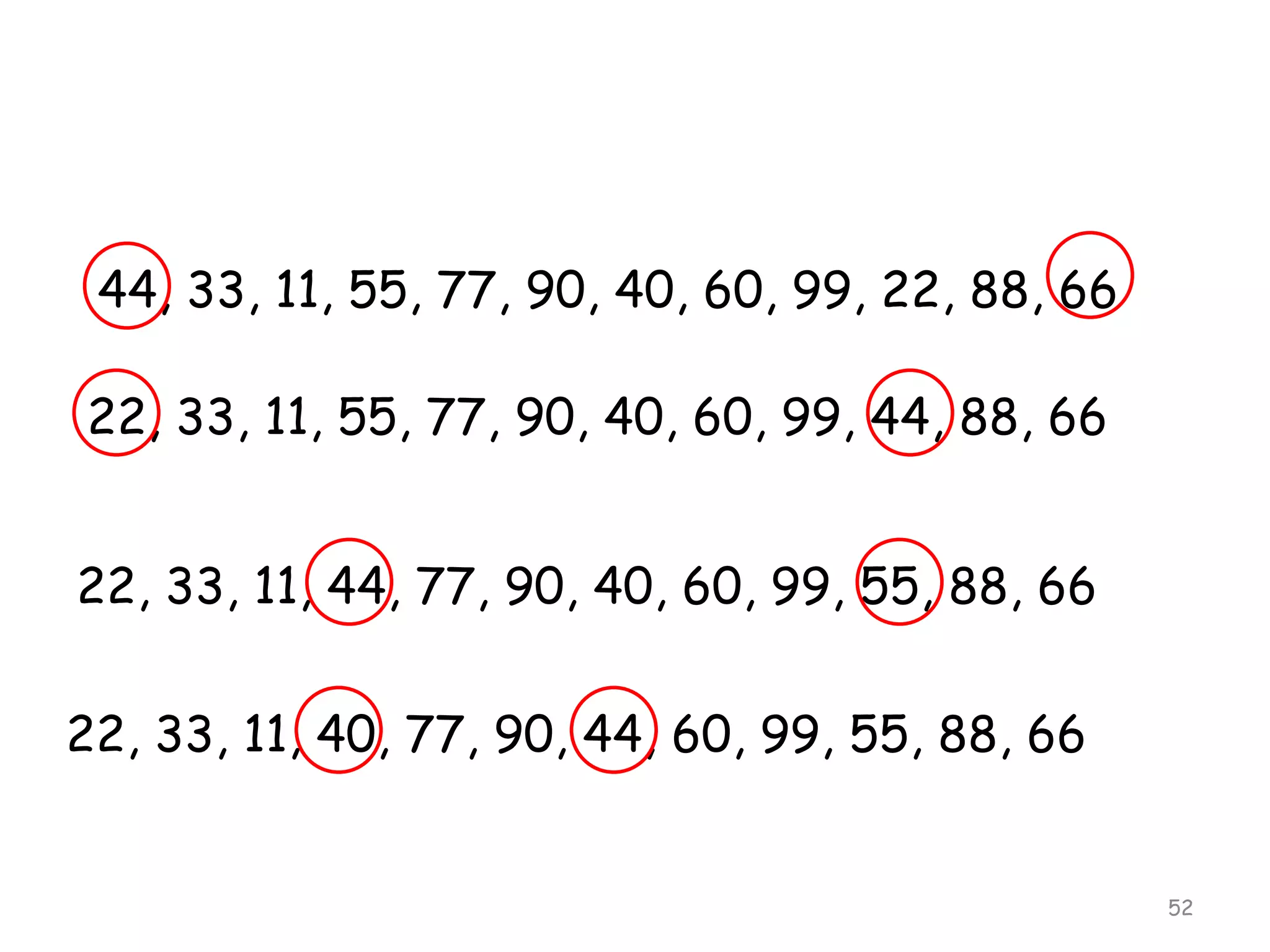
51
44, 33, 11, 55, 77, 90, 40, 60, 99, 22, 88, 66
22, 33, 11, 55, 77, 90, 40, 60, 99, 44, 88, 66
22, 33, 11, 44, 77, 90, 40, 60, 99, 55, 88, 66
22, 33, 11, 40, 77, 90, 44, 60, 99, 55, 88, 66

52
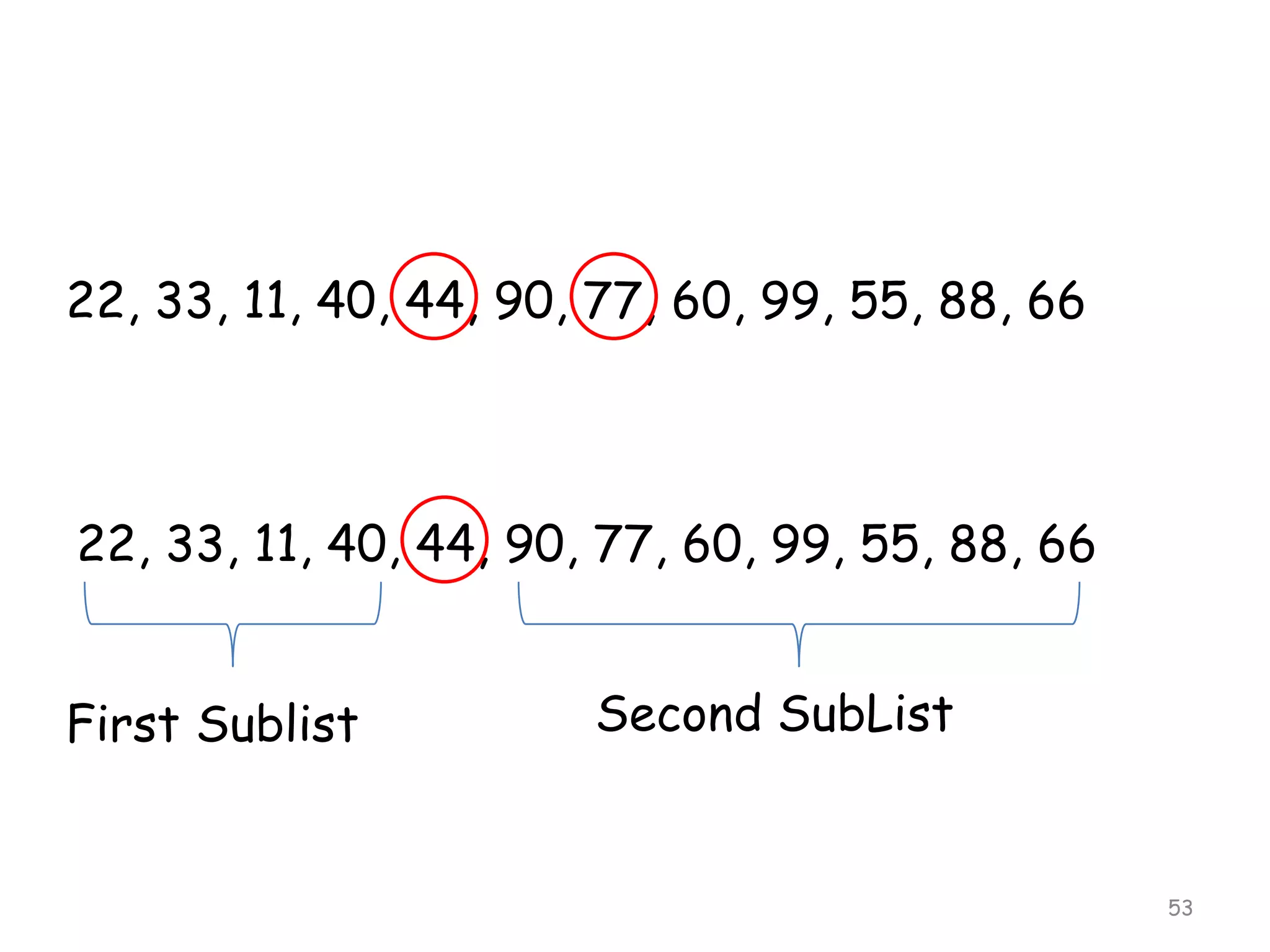
22, 33, 11, 40, 44, 90, 77, 60, 99, 55, 88, 66

22, 33, 11, 40, 44, 90, 77, 60, 99, 55, 88, 66
First Sublist

Second SubList

53
Quick Sort Algorithm
Input: Unsorted sub-array A[first..last]
Output: Sorted sub-array A[first..last]
QUICKSORT (A, first, Last)
if first < last
then loc← PARTITION(A, first, last)
QUICKSORT (A, first, loc-1)
QUICKSORT (A, loc+1, last)
54
Partition Algorithm
Input: Sub-array A[first..last]
Output: Sub-array A[first..loc] where each element of
A[first..loc-1] is ≤ to each element of A[(q+1)..r]; returns the
index loc
PARTITION (A, first, last)

1
2
3
4
5
6
7
8
9
10
11
55

x ← A[first]
i ← first -1
j ← last +1
while TRUE
repeat j ← j - 1
until A[j] ≤ x
repeat i ← i + 1
until A[i] ≥ x
if i < j
then exchange A[i] ↔A[j]
else return j
Insertion Sort
An array A with N elements A[1], A[2] …
A[N] is in memory
Insertion Sort scan A from A[1] to A[N]
inserting each elements A[k] into its
proper position in the previously sorted
subarray A[1], A[2], …. A[K-1]

56
Pass 1: A[1] by itself is trivially sorted
Pass 2: A[2] is inserted either before or
after A[1] so that A[1], A[2] is sorted
Pass 3: A[3] is inserted in its proper place
in A[1], A[2], that is before A[1],
between A[1] and A[2] or after A[2] so
that A[1], A[2], A[3] is sorted.

57
Pass 4: A[4] is inserted in its proper place in
A[1], A[2], A[3] so that A[1], A[2], A[3],
A[4] is sorted.
.
.
Pass N: A[N] is inserted in its proper place in
A[1], A[2], A[3], .. A[N-1] so that A[1],
A[2], A[3], A[4] , A[N] is sorted.
58
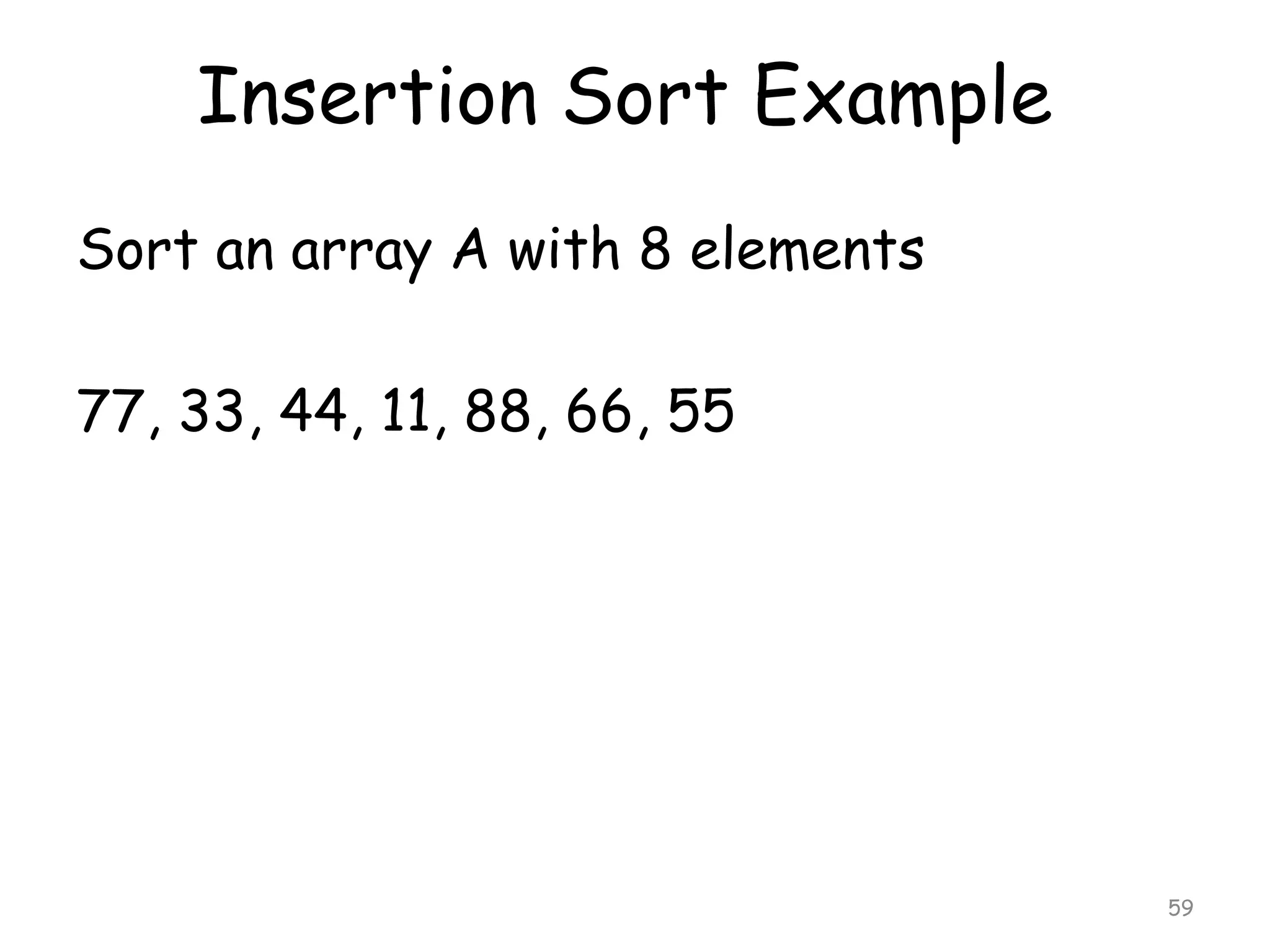
Insertion Sort Example
Sort an array A with 8 elements
77, 33, 44, 11, 88, 66, 55

59
Insertion Sort
Pass A[0] A[1] A[2] A[3] A[4] A[5] A[6] A[7] A[8]
K=1 -∞

77

33

44

11

88

22

66

55

K=2 -∞

77

33

44

11

88

22

66

55

K=3 -∞

33

77

44

11

88

22

66

55

K=4 -∞

33

44

77

11

88

22

66

55

K=5 -∞

11

33

44

77

88

22

66

55

K=6 -∞

11

33

44

77

88

22

66

55

K=7 -∞

11

22

33

44

77

88

66

55

K=8 -∞

11

22

33

44

66

77

88

55

-∞

11

22

33

44

55

66

77

88 60

Sorted
Insertion Algorithm

This algorithm sort an array with N elements
[1] Set A[0] = -∞ [Initialize a delimiter]
[2] Repeat Steps 3 to 5 for K = 2, 3, …, N
[3] Set TEMP = A[K] and PTR = K-1
[4] Repeat while TEMP < A[PTR]
(a) Set A[PTR+1] = A[PTR]
(b) Set PTR = PTR -1
[5] Set A[PTR+1] = TEMP
[6] Exit
61
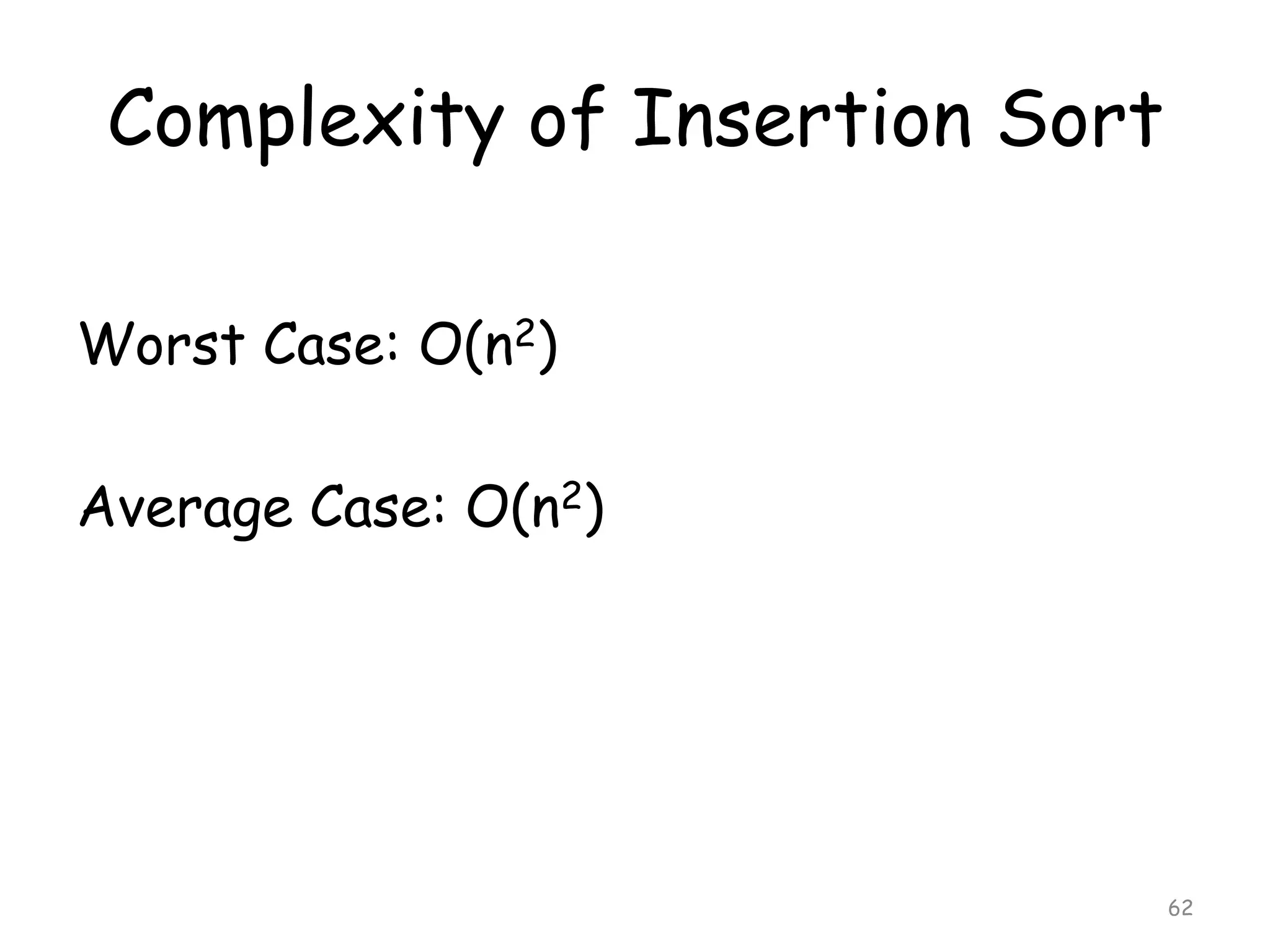
Complexity of Insertion Sort
Worst Case: O(n2)
Average Case: O(n2)

62
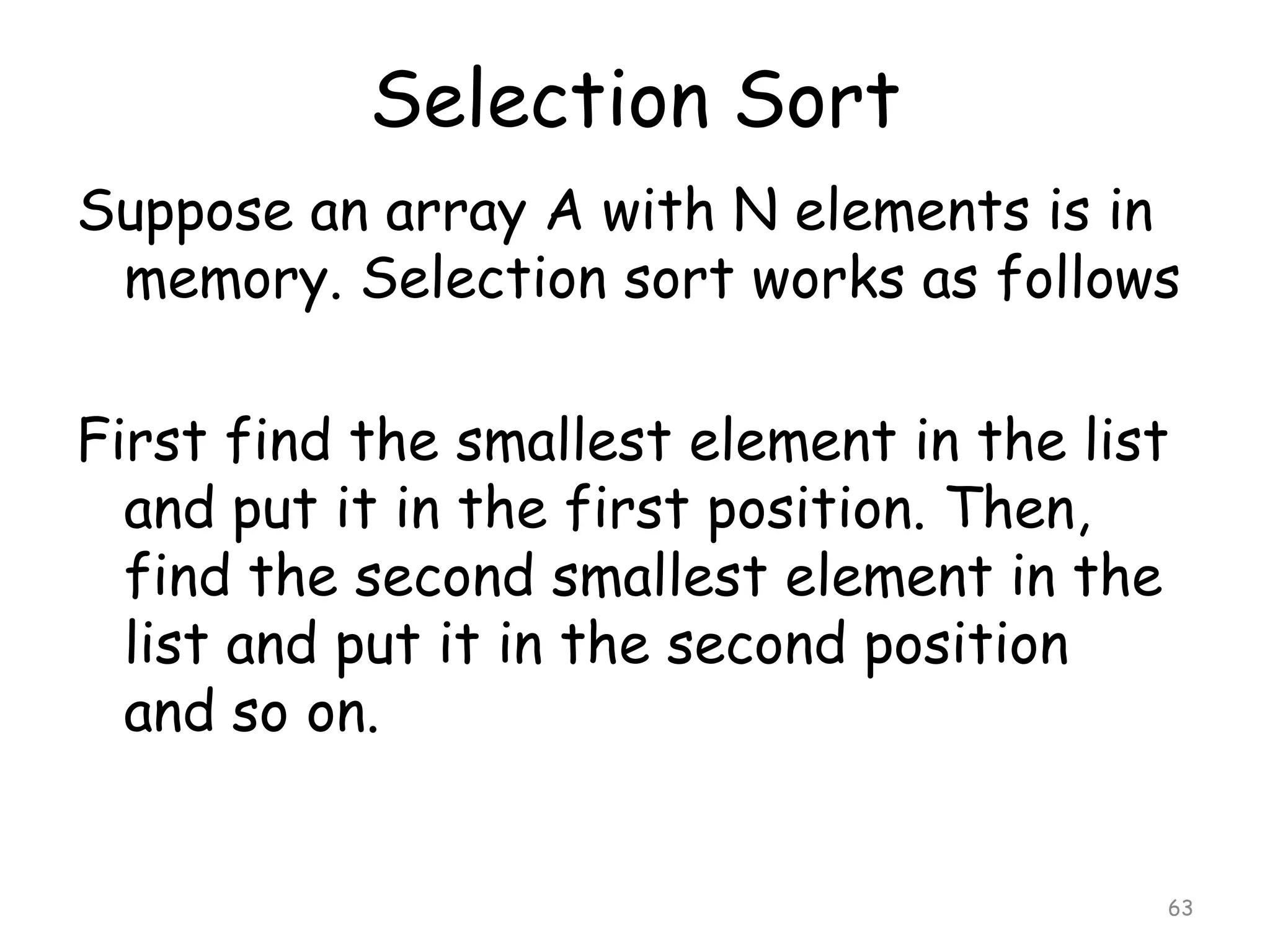
Selection Sort
Suppose an array A with N elements is in
memory. Selection sort works as follows
First find the smallest element in the list
and put it in the first position. Then,
find the second smallest element in the
list and put it in the second position
and so on.

63
Pass 1: Find the location LOC of the smallest
element in the list A[1], A[2], … A[N]. Then
interchange A[LOC] and A[1]. Then: A[1] is
sorted
Pass 2: Find the location LOC
of the
smallest element in the sublist A[2], A[3],
… A[N]. Then interchange A[LOC] and
A[2]. Then: A[1],A[2] is sorted since A[1]
<= A[2].
Pass 3: Find the location LOC
of the
smallest element in the sublist A[3], A[4],
… A[N]. Then interchange A[LOC] and
A[3]. Then: A[1], A[2],A[3] is sorted,
since A[2] <= A[3].
64
Pass N-1: Find the location LOC of the
smallest element in the sublist A[N-1],
A[N]. Then interchange A[LOC] and
A[N-1]. Then: A[1], A[2], ….. , A[N] is
sorted, since A[N-1] <= A[N].
A is sorted after N-1 pass.

65
Selection Sort
Pass

A[1] A[2] A[3] A[4] A[5] A[6] A[7] A[8]

K=1 LOC=4

77

33

44

11

88

22

66

55

K=2 LOC=6

11

33

44

77

88

22

66

55

K=3 LOC=6

11

22

44

77

88

33

66

55

K=4 LOC=6

11

22

33

77

88

44

66

55

K=5 LOC=8

11

22

33

44

88

77

66

55

K=6 LOC=7

11

22

33

44

55

77

66

88

K=7 LOC=4

11

22

33

44

55

66

77

88

11

22

33

44

55

66

77

88 66

Sorted
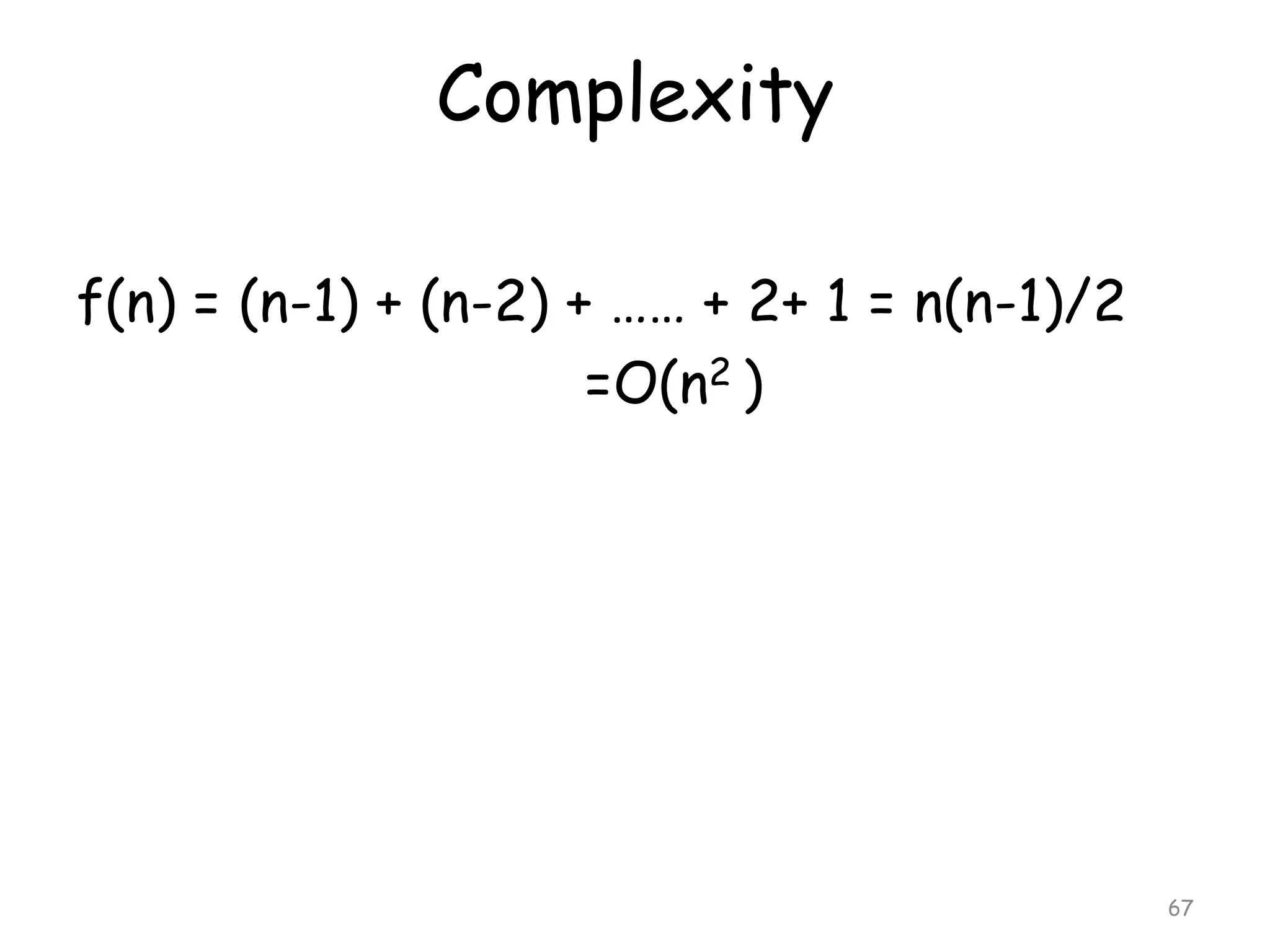
Complexity
f(n) = (n-1) + (n-2) + …… + 2+ 1 = n(n-1)/2
=O(n2 )

67
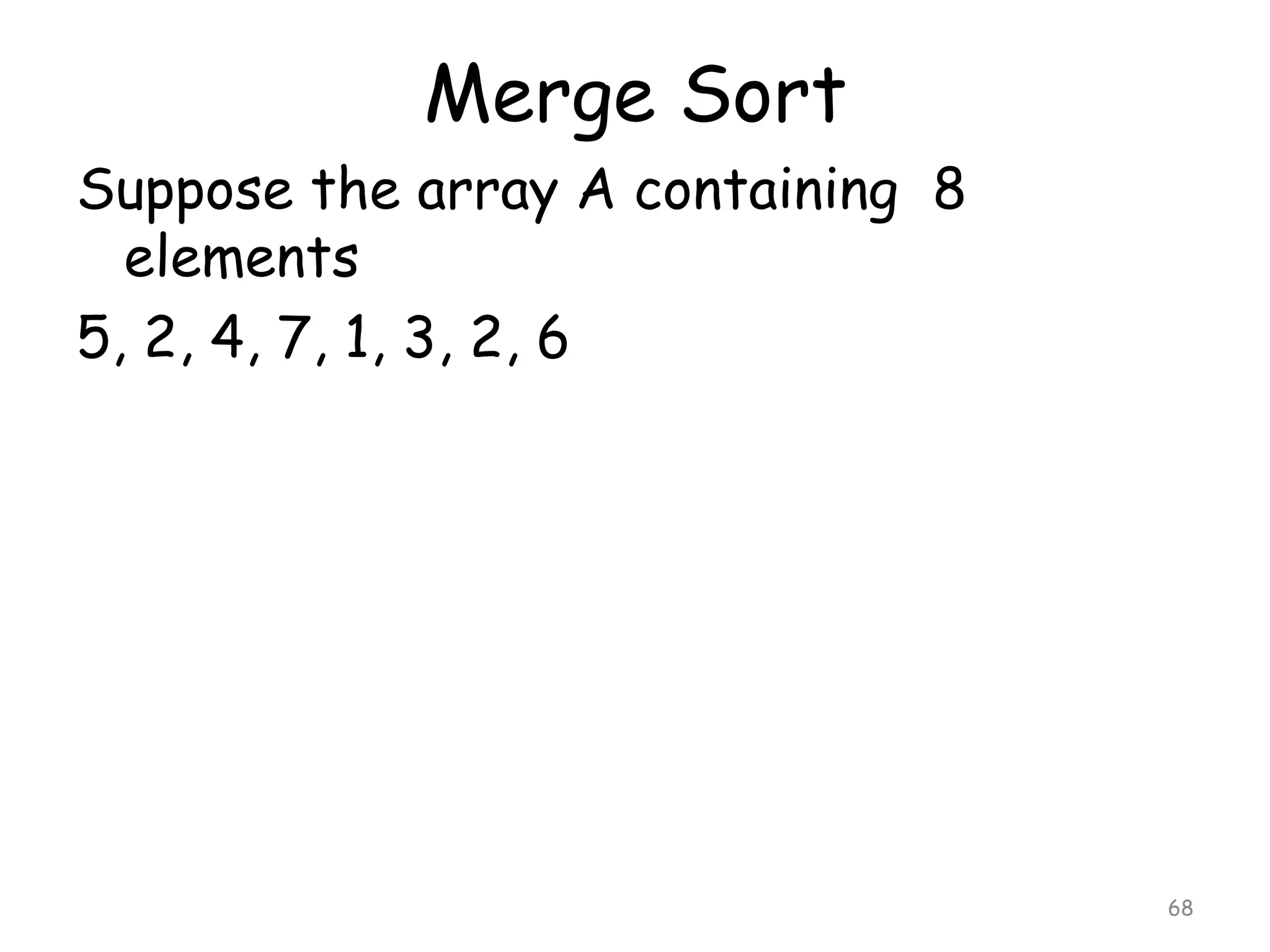
Merge Sort
Suppose the array A containing 8
elements
5, 2, 4, 7, 1, 3, 2, 6

68
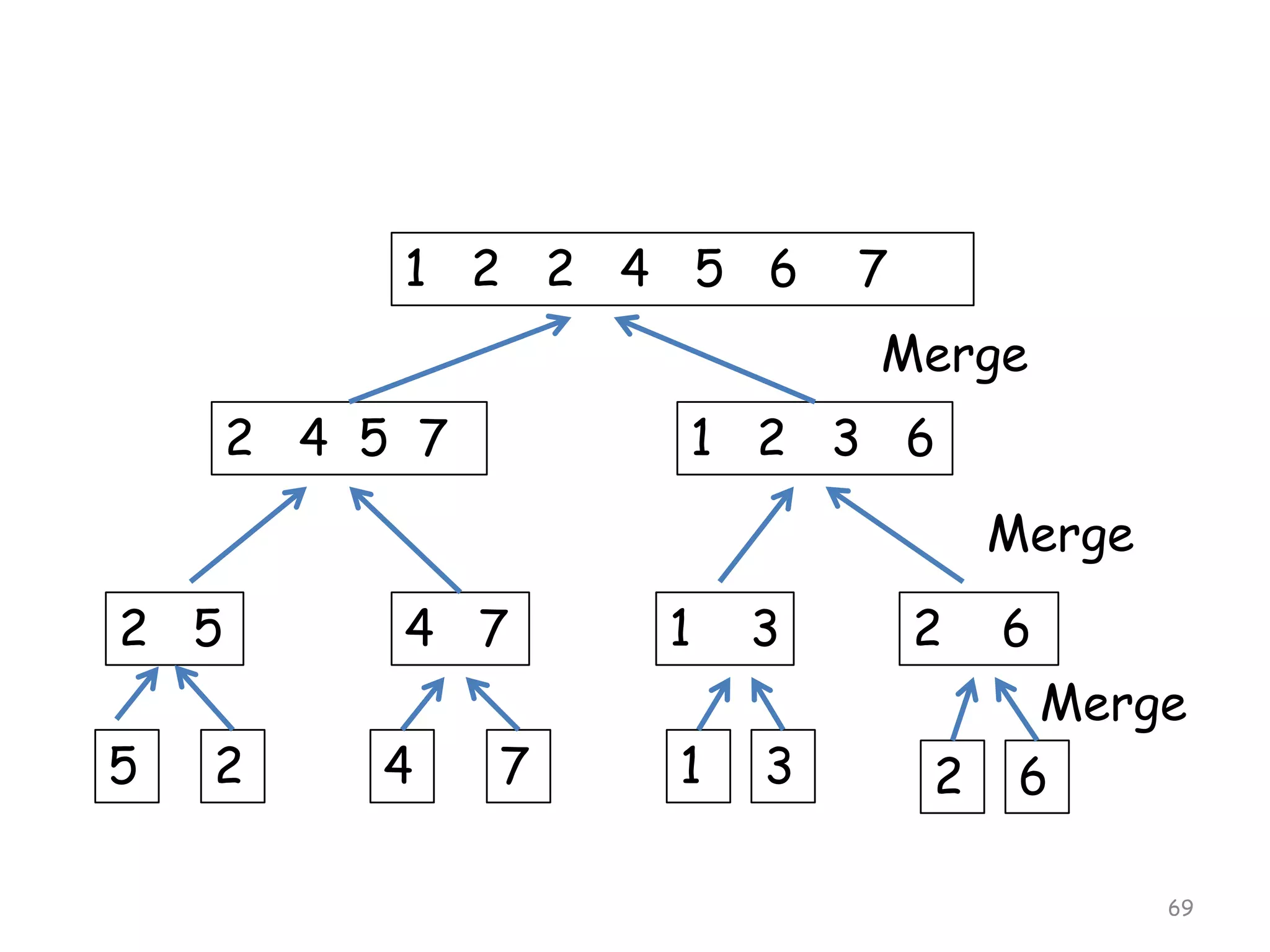
1 2 2 4 5 6

7
Merge

2 4 5 7

1 2 3 6

Merge
2 5

5

2

4 7

4

7

1

1

3

3

2

6
Merge

2

6
69
Time complexity =

(n log n)

70
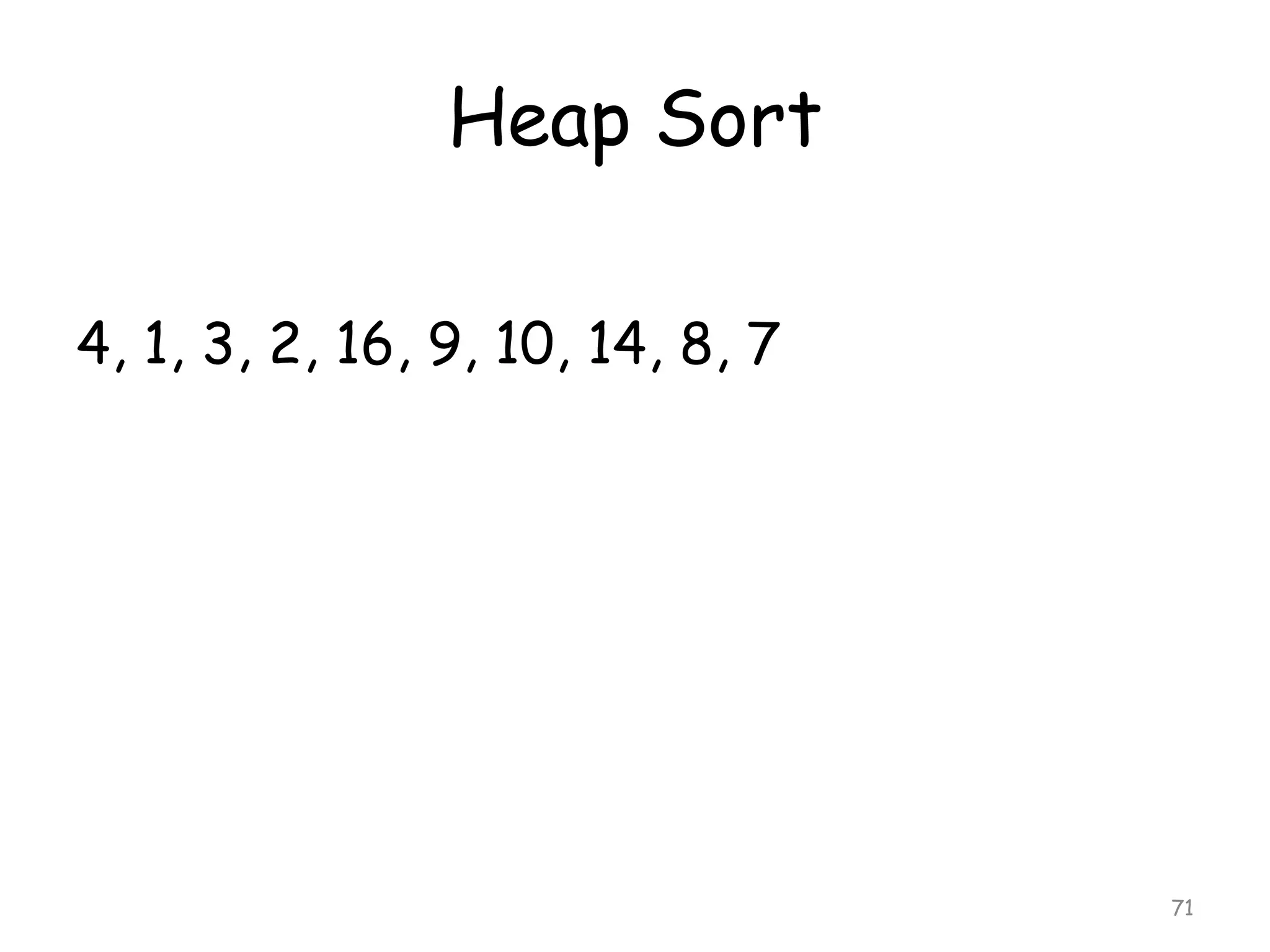
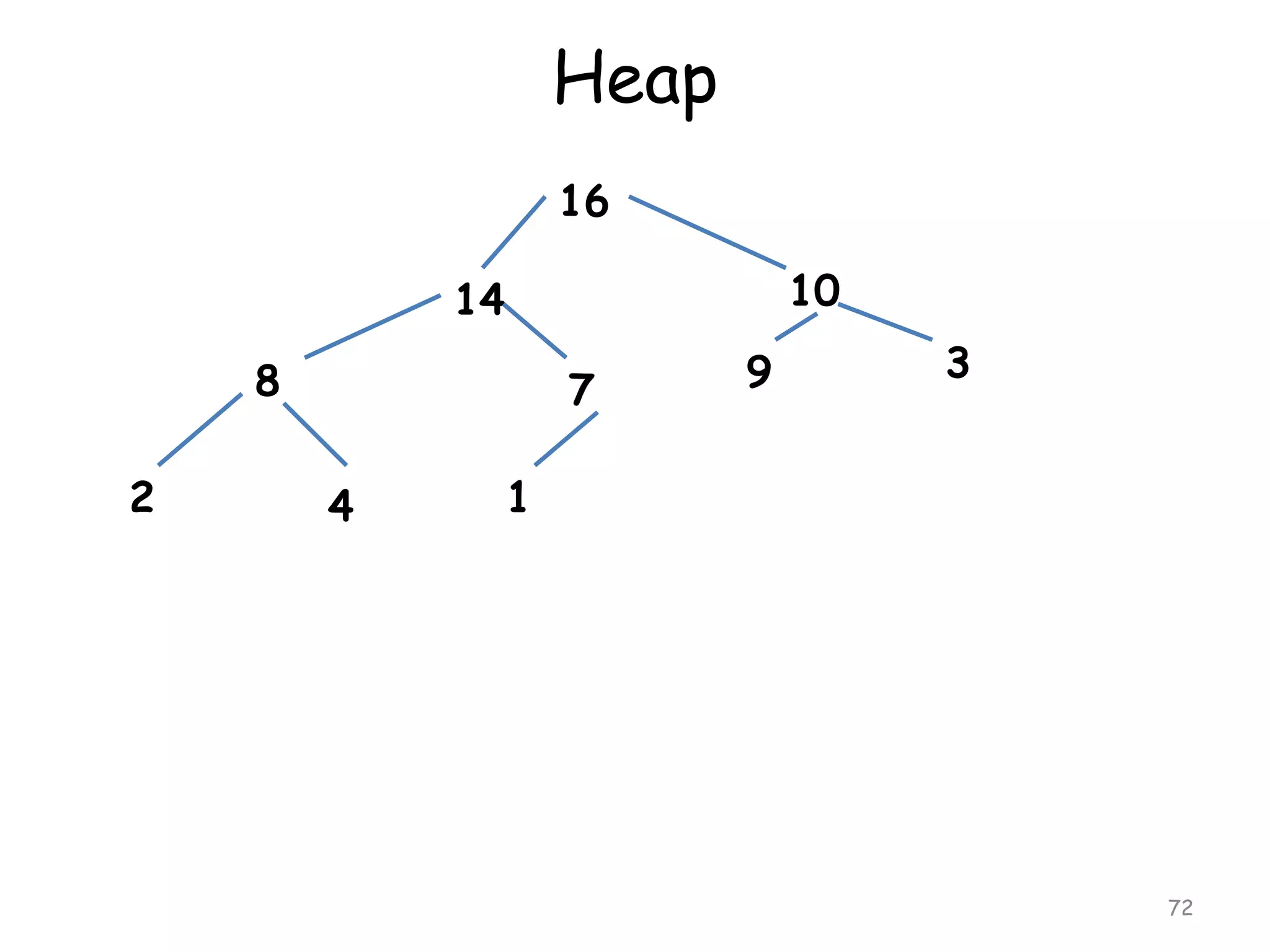
Heap Sort
4, 1, 3, 2, 16, 9, 10, 14, 8, 7

71
Heap
16
10

14
8
2

7
4

9

3

1

72
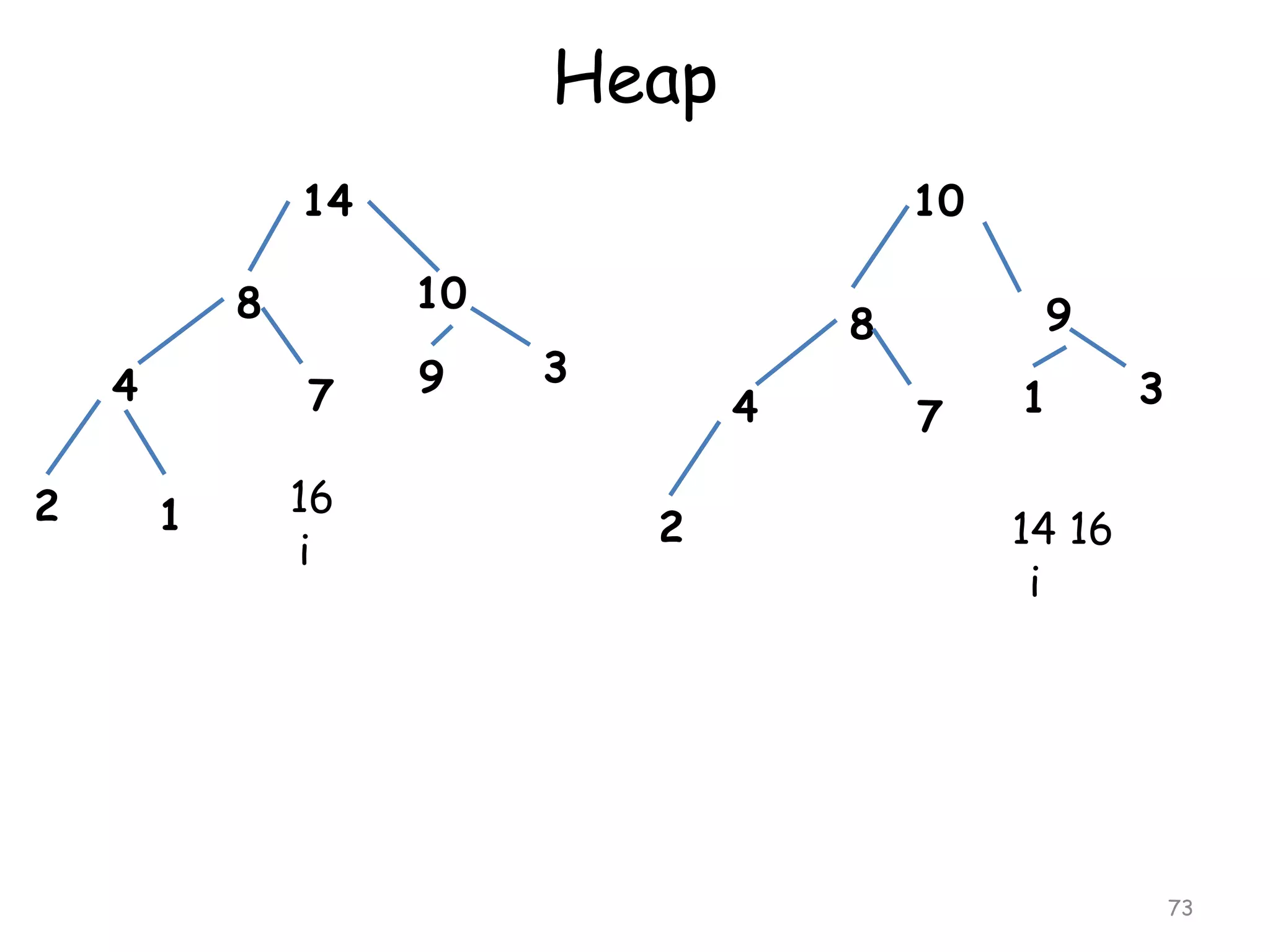
Heap
14
10

8
4

2

7
1

10

16
i

9

9

8

3

4
2

7

1

3

14 16
i

73

Lecture 13 data structures and algorithms

  • 1.
    Data Structure and Algorithm(CS 102) Ashok K Turuk 1
  • 2.
    Sorting Sorting refers tothe operation of arranging data in some order such as increasing or decreasing with numerical data or alphabetically with character data 2
  • 3.
    Complexity of SortingAlgorithm The complexity of a sorting algorithm measures the running time as a function of the number on n of items to be sorted 3
  • 4.
    Complexity of SortingAlgorithm Each sorting algorithm S will be made up of the following operations, where A1, A2 , ……, An contain the items to be sorted and B is an auxiliary location: (a) Comparisons, which test whether Ai < Aj or test Ai < B (b) Interchange, which switch the content of Ai and Aj or of Ai and B (c) Assignments, which set B := Ai and then set Aj := B or Set Aj := Ai 4
  • 5.
    Sorting Algorithms are dividedinto two categories: Internal Sorts and External sorts. 5
  • 6.
    Sorting Internal Sort: Any sortalgorithm which uses main memory exclusively during the sort. This assumes high-speed random access to all memory. 6
  • 7.
    Sorting External Sort: Any sortalgorithm which uses external memory, such as tape or disk, during the sort. 7
  • 8.
    Sorting Note: Algorithms may readthe initial values from magnetic tape or write sorted values to disk, but this is not using external memory during the sort. Note that even though virtual memory may mask the use of disk, sorting sets of data much larger than main memory may be much faster using an explicit external sort. 8
  • 9.
    Sorting Sort Stable A sortalgorithm is said to be “stable” if multiple items which compare as equal will stay in the same order they were in after a sort. 9
  • 10.
    Internal Sorting Bubble Sort Theoldest and simplest sort in use. Unfortunately, also the slowest. Works by comparing each item in the list with the item next to it, and swapping them if required. 10
  • 11.
    Bubble Sort The algorithmrepeats this process until it makes a pass all the way through the list without swapping any items. This causes larger values to "bubble" to the end of the list while smaller values "sink" towards the beginning of the list. 11
  • 12.
    Bubble Sort Suppose thelist of number A[1], [2], A[3], …, A[N] is in memory. Algorithm works as follows. [1] Compare A[1] and A[2], arrange them in the desired order so that A[1] < A[2]. Then Compare A[2] and A[3], arrange them in the desired order so that A[2] < A[3]. Continue until A[N-1] is compared with A[N], arrange them so that A[N-1] < A[N]. 12
  • 13.
    Bubble Sort [2] RepeatStep 1, Now stop after comparing and re-arranging A[N-2] and A[N-1]. [3] Repeat Step 3, Now stop after comparing and re-arranging A[N-3] and A[N-2]. . . [N-1] Compare A[1] and A[2] and arrange them in sorted order so that A[1] < A[2]. After N-1 steps the list will be sorted in increasing order. 13
  • 14.
    A Bubble SortExample Compare 6 5 4 3 2 1 14
  • 15.
    A Bubble SortExample Swap 15 5 6 4 3 2 1
  • 16.
    A Bubble SortExample Compare 16 5 6 4 3 2 1
  • 17.
    A Bubble SortExample Swap 17 5 4 6 3 2 1
  • 18.
    A Bubble SortExample Compare 18 5 4 6 3 2 1
  • 19.
    A Bubble SortExample Swap 19 5 4 3 6 2 1
  • 20.
    A Bubble SortExample Compare 20 5 4 3 6 2 1
  • 21.
    A Bubble SortExample Swap 21 5 4 3 2 6 1
  • 22.
    A Bubble SortExample Compare 22 5 4 3 2 6 1
  • 23.
    A Bubble SortExample As you can see, the largest number has “bubbled” down, or sunk to the bottom of the List after the first pass through the List. Swap 23 5 4 3 2 1 6
  • 24.
    A Bubble SortExample Compare For our second pass through the List, we start by comparing these first two elements in the List. 24 5 4 3 2 1 6
  • 25.
    A Bubble SortExample Swap 25 4 5 3 2 1 6
  • 26.
    A Bubble SortExample Compare 26 4 5 3 2 1 6
  • 27.
    A Bubble SortExample Swap 27 4 3 5 2 1 6
  • 28.
    A Bubble SortExample Compare 28 4 3 5 2 1 6
  • 29.
    A Bubble SortExample Swap 29 4 3 2 5 1 6
  • 30.
    A Bubble SortExample Compare 30 4 3 2 5 1 6
  • 31.
    A Bubble SortExample At the end of the second pass, we stop at element number n - 1, because the largest element in the List is already in the last position. This places the second largest element in the second to last spot. Swap 31 4 3 2 1 5 6
  • 32.
    A Bubble SortExample Compare We start with the first two elements again at the beginning of the third pass. 32 4 3 2 1 5 6
  • 33.
    A Bubble SortExample Swap 33 3 4 2 1 5 6
  • 34.
    A Bubble SortExample Compare 34 3 4 2 1 5 6
  • 35.
    A Bubble SortExample Swap 35 3 2 4 1 5 6
  • 36.
    A Bubble SortExample Compare 36 3 2 4 1 5 6
  • 37.
    A Bubble SortExample At the end of the third pass, we stop comparing and swapping at element number n - 2. Swap 37 3 2 1 4 5 6
  • 38.
    A Bubble SortExample Compare The beginning of the fourth pass... 38 3 2 1 4 5 6
  • 39.
    A Bubble SortExample Swap 39 2 3 1 4 5 6
  • 40.
    A Bubble SortExample Compare 40 2 3 1 4 5 6
  • 41.
    A Bubble SortExample Swap The end of the fourth pass stops at element number n - 3. 41 2 1 3 4 5 6
  • 42.
    A Bubble SortExample Compare The beginning of the fifth pass... 42 2 1 3 4 5 6
  • 43.
    A Bubble SortExample Swap The last pass compares only the first two elements of the List. After this comparison and possible swap, the smallest element has “bubbled” to the top. 43 1 2 3 4 5 6
  • 44.
    What “Swapping” Means TEMP 6 Placethe first element into the Temporary Variable. 44 6 5 4 3 2 1
  • 45.
    What “Swapping” Means TEMP 6 Replacethe first element with the second element. 45 5 5 4 3 2 1
  • 46.
    What “Swapping” Means TEMP 6 Replacethe second element with the Temporary Variable. 46 5 6 4 3 2 1
  • 47.
    Bubble Sort DATA isan array with N elements [1] Repeat Step 2 and 3 for K =1 to N-1 [2] Set PTR :=1 [3] Repeat While PTR <= N –K (a) If DATA[PTR] > DATA[PTR+1] Interchange DATA[PTR] and DATA[PTR + 1] (b) Set PTR = PTR + 1 [4] Exit 47
  • 48.
    Analysis of BubbleSort f(n) = (n-1) + (n-2) + …. + 2+1 = n(n-1)/ 2 = O(n2 ) 48
  • 49.
    Quick Sort Quick sortis an algorithm of the divideand-conquer type The problem of sorting a set is reduced to the problem of sorting two smaller sets. 49
  • 50.
    Quick Sort Approach 1 n A Pivotelement A y≤x x Sort recursively 50 y≥x Sort recursively
  • 51.
    Quick Sort To selectthe pivot Select the first number FIRST in the list, beginning with the last number in the list, scan from right to left, comparing with each number and stopping at the first number less than FIRST. Then interchange the two number. 51
  • 52.
    44, 33, 11,55, 77, 90, 40, 60, 99, 22, 88, 66 22, 33, 11, 55, 77, 90, 40, 60, 99, 44, 88, 66 22, 33, 11, 44, 77, 90, 40, 60, 99, 55, 88, 66 22, 33, 11, 40, 77, 90, 44, 60, 99, 55, 88, 66 52
  • 53.
    22, 33, 11,40, 44, 90, 77, 60, 99, 55, 88, 66 22, 33, 11, 40, 44, 90, 77, 60, 99, 55, 88, 66 First Sublist Second SubList 53
  • 54.
    Quick Sort Algorithm Input:Unsorted sub-array A[first..last] Output: Sorted sub-array A[first..last] QUICKSORT (A, first, Last) if first < last then loc← PARTITION(A, first, last) QUICKSORT (A, first, loc-1) QUICKSORT (A, loc+1, last) 54
  • 55.
    Partition Algorithm Input: Sub-arrayA[first..last] Output: Sub-array A[first..loc] where each element of A[first..loc-1] is ≤ to each element of A[(q+1)..r]; returns the index loc PARTITION (A, first, last) 1 2 3 4 5 6 7 8 9 10 11 55 x ← A[first] i ← first -1 j ← last +1 while TRUE repeat j ← j - 1 until A[j] ≤ x repeat i ← i + 1 until A[i] ≥ x if i < j then exchange A[i] ↔A[j] else return j
  • 56.
    Insertion Sort An arrayA with N elements A[1], A[2] … A[N] is in memory Insertion Sort scan A from A[1] to A[N] inserting each elements A[k] into its proper position in the previously sorted subarray A[1], A[2], …. A[K-1] 56
  • 57.
    Pass 1: A[1]by itself is trivially sorted Pass 2: A[2] is inserted either before or after A[1] so that A[1], A[2] is sorted Pass 3: A[3] is inserted in its proper place in A[1], A[2], that is before A[1], between A[1] and A[2] or after A[2] so that A[1], A[2], A[3] is sorted. 57
  • 58.
    Pass 4: A[4]is inserted in its proper place in A[1], A[2], A[3] so that A[1], A[2], A[3], A[4] is sorted. . . Pass N: A[N] is inserted in its proper place in A[1], A[2], A[3], .. A[N-1] so that A[1], A[2], A[3], A[4] , A[N] is sorted. 58
  • 59.
    Insertion Sort Example Sortan array A with 8 elements 77, 33, 44, 11, 88, 66, 55 59
  • 60.
    Insertion Sort Pass A[0]A[1] A[2] A[3] A[4] A[5] A[6] A[7] A[8] K=1 -∞ 77 33 44 11 88 22 66 55 K=2 -∞ 77 33 44 11 88 22 66 55 K=3 -∞ 33 77 44 11 88 22 66 55 K=4 -∞ 33 44 77 11 88 22 66 55 K=5 -∞ 11 33 44 77 88 22 66 55 K=6 -∞ 11 33 44 77 88 22 66 55 K=7 -∞ 11 22 33 44 77 88 66 55 K=8 -∞ 11 22 33 44 66 77 88 55 -∞ 11 22 33 44 55 66 77 88 60 Sorted
  • 61.
    Insertion Algorithm This algorithmsort an array with N elements [1] Set A[0] = -∞ [Initialize a delimiter] [2] Repeat Steps 3 to 5 for K = 2, 3, …, N [3] Set TEMP = A[K] and PTR = K-1 [4] Repeat while TEMP < A[PTR] (a) Set A[PTR+1] = A[PTR] (b) Set PTR = PTR -1 [5] Set A[PTR+1] = TEMP [6] Exit 61
  • 62.
    Complexity of InsertionSort Worst Case: O(n2) Average Case: O(n2) 62
  • 63.
    Selection Sort Suppose anarray A with N elements is in memory. Selection sort works as follows First find the smallest element in the list and put it in the first position. Then, find the second smallest element in the list and put it in the second position and so on. 63
  • 64.
    Pass 1: Findthe location LOC of the smallest element in the list A[1], A[2], … A[N]. Then interchange A[LOC] and A[1]. Then: A[1] is sorted Pass 2: Find the location LOC of the smallest element in the sublist A[2], A[3], … A[N]. Then interchange A[LOC] and A[2]. Then: A[1],A[2] is sorted since A[1] <= A[2]. Pass 3: Find the location LOC of the smallest element in the sublist A[3], A[4], … A[N]. Then interchange A[LOC] and A[3]. Then: A[1], A[2],A[3] is sorted, since A[2] <= A[3]. 64
  • 65.
    Pass N-1: Findthe location LOC of the smallest element in the sublist A[N-1], A[N]. Then interchange A[LOC] and A[N-1]. Then: A[1], A[2], ….. , A[N] is sorted, since A[N-1] <= A[N]. A is sorted after N-1 pass. 65
  • 66.
    Selection Sort Pass A[1] A[2]A[3] A[4] A[5] A[6] A[7] A[8] K=1 LOC=4 77 33 44 11 88 22 66 55 K=2 LOC=6 11 33 44 77 88 22 66 55 K=3 LOC=6 11 22 44 77 88 33 66 55 K=4 LOC=6 11 22 33 77 88 44 66 55 K=5 LOC=8 11 22 33 44 88 77 66 55 K=6 LOC=7 11 22 33 44 55 77 66 88 K=7 LOC=4 11 22 33 44 55 66 77 88 11 22 33 44 55 66 77 88 66 Sorted
  • 67.
    Complexity f(n) = (n-1)+ (n-2) + …… + 2+ 1 = n(n-1)/2 =O(n2 ) 67
  • 68.
    Merge Sort Suppose thearray A containing 8 elements 5, 2, 4, 7, 1, 3, 2, 6 68
  • 69.
    1 2 24 5 6 7 Merge 2 4 5 7 1 2 3 6 Merge 2 5 5 2 4 7 4 7 1 1 3 3 2 6 Merge 2 6 69
  • 70.
  • 71.
    Heap Sort 4, 1,3, 2, 16, 9, 10, 14, 8, 7 71
  • 72.
  • 73.