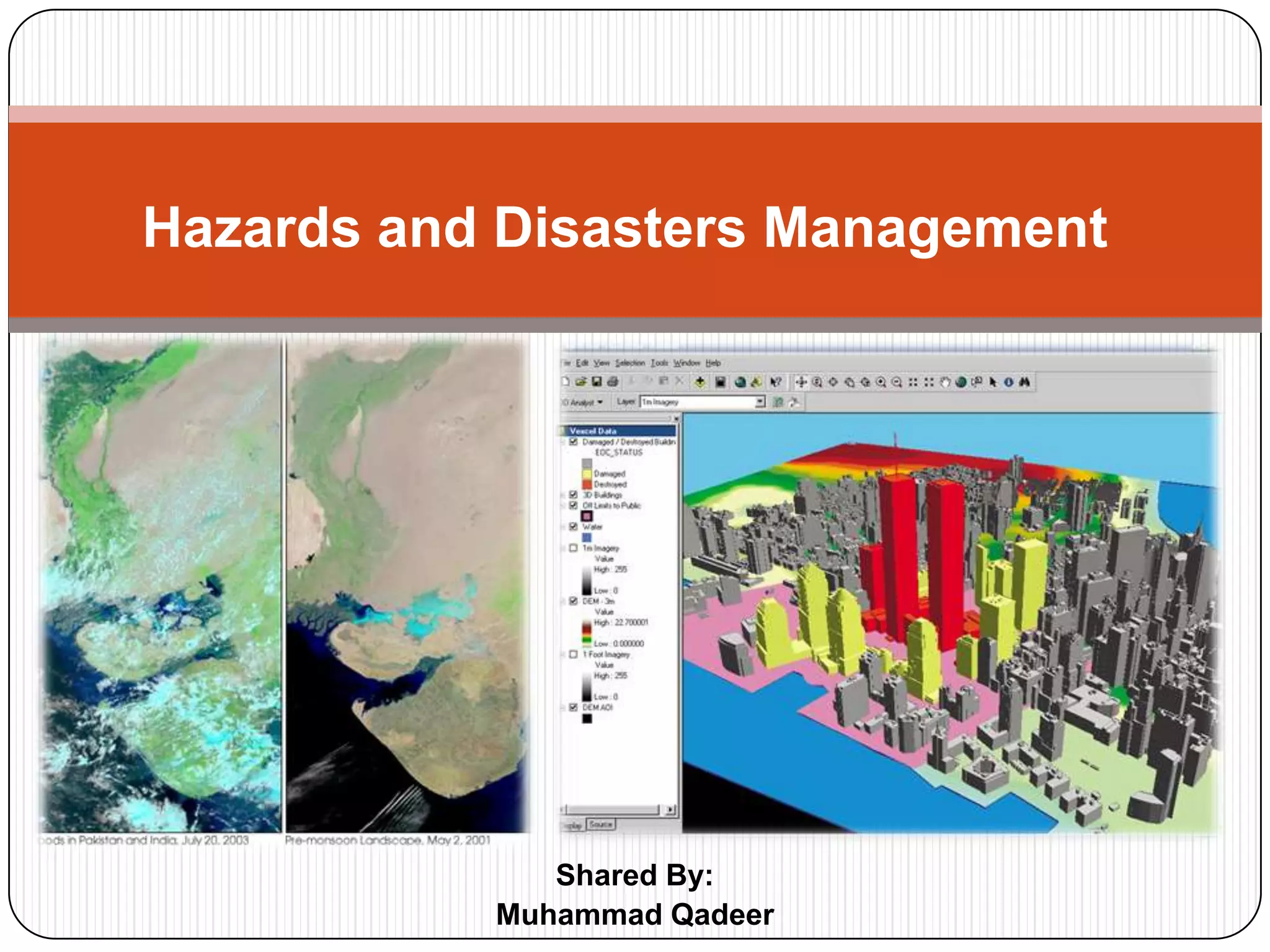
Shared By:Muhammad QadeerHazards and Disasters Management
"O my Lord! Open for me my chest (grant me self-confidence, contentment, and boldness)."And ease my task for me;"And make loose the knot (the defect) from my tongue, (i.e. remove the incorrectness from my speech)That they may understand my speech.
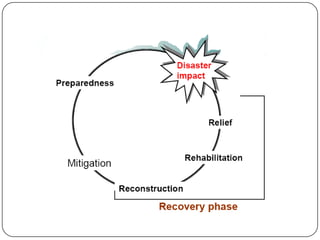
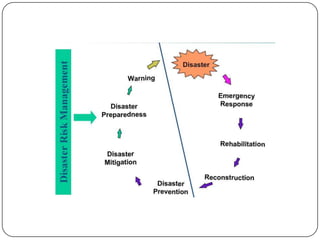
DiscussionLecture		 StructureOur world and our challengesDisasters in PakistanDisaster Management; basic terms and conceptsHazard, Risk, Disaster, Elements at Risk, Vulnerability, Capacity, Response, Relief, Rehabilitation, Reconstruction, Development, Mitigation, Preparedness and Prevention etcDisaster Management Cycle
Our world - our ChallengesDisasters are as old as human historyFrom 1994 to 1998, reported disasters average 428 per yearFrom 1999 to 2003, average raised to 707 events per year, it’s a 60% increaseThe worse is that the biggest rise was in countries of low human development which suffered an increase of 142 percent
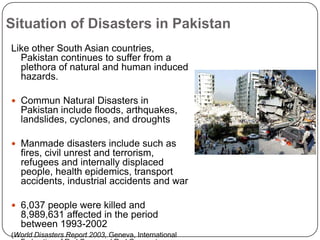
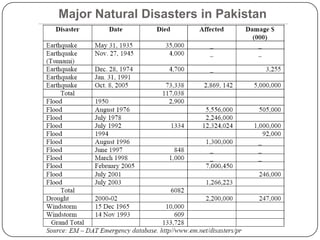
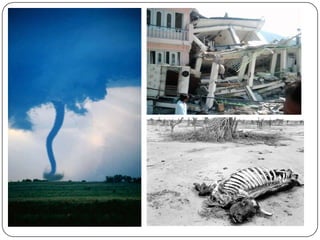
Situation of Disasters in PakistanLike other South Asian countries, Pakistan continues to suffer from a plethora of natural and human induced hazards.Commun Natural Disasters in Pakistan include floods, arthquakes, landslides, cyclones, and droughtsManmade disasters include such as fires, civil unrest and terrorism, refugees and internally displaced people, health epidemics, transport accidents, industrial accidents and war6,037 people were killed and 8,989,631 affected in the period between 1993-2002 (World Disasters Report 2003, Geneva, International Federation of Red Cross and Red Crescent Societies).
Situation of Disasters in PakistanFloods:Pakistan is one of the five South Asian countries with the highest annual average number of people physically exposed to floods. During 1991 to 2001 floods caused an estimated damage of over Pak Rs 78,000 million to propertyDroughts: Severe drought periods in 2000 and 2002 led to 120 deaths and affected 2,200,000 people.Earthquakes: From 1974 to 1990, approximately 5669 people were killed due to earthquakes in the Northern Areas (NA), NWFP and Balochistan. The most recent significant earthquake of February 2004, and Oct 05 in NWFP has resulted in the life loss of millions of peopleCyclons: The cyclone of 1999 in Thatta and Badin districts wiped out 73 settlements, and resulted in 168 lives lost, nearly 0.6 million people affected and killing of 11,000 cattle. It destroyed 1,800 small and big boats and partially damaged 642 boats, causing a loss of Rs 380 million.
Major Natural Disasters in Pakistan
Basic Terms and Concepts
Is FLOOD a disaster????And an earthquake???
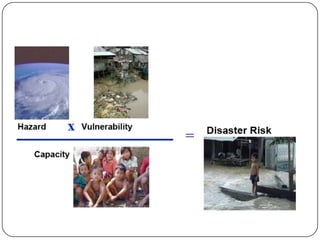
HazardIts physical phenomenon or situation which has the potential to cause disruption or damage to people, their properties, their services or their environmentHazards are the result of an interaction between human activities and the natural and technological processes that can generate extreme events. For example, earthquake faults, active volcanoes, flood zones, and highly flammable brush fields are all hazards.
DisasterThe serious disruption of the functioning of society, causing widespread human, material or environmental losses, which exceed the ability of the affected people to cope using their own resources.An event, either man-made or natural, sudden or progressive, causing widespread human, material or environmental lossesEmergency vs DisasterEmergency—An emergency is a deviation from planned or expected behavior or a course of events that endangers or adversely affects people, property, or the environment.Disaster—Disasters are characterized by the scope of an emergency. An emergency becomes a disaster when it exceeds the capability of the local resources to manage it.Disasters often result in great damage, loss, or destruction
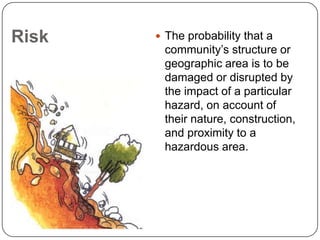
RiskThe probability that a community’s structure or geographic area is to be damaged or disrupted by the impact of a particular hazard, on account of their nature, construction, and proximity to a hazardous area.
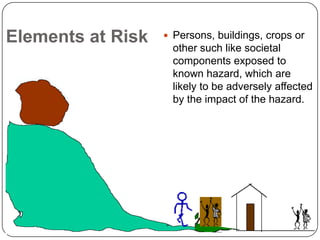
Elements at RiskPersons, buildings, crops or other such like societal components exposed to known hazard, which are likely to be adversely affected by the impact of the hazard.
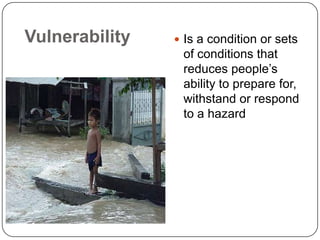
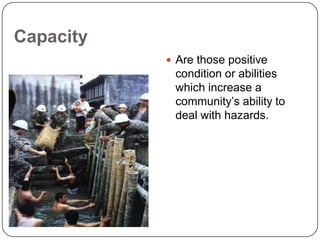
VulnerabilityIs a condition or sets of conditions that reduces people’s ability to prepare for, withstand or respond to a hazardCapacityAre those positive condition or abilities which increase a community’s ability to deal with hazards.
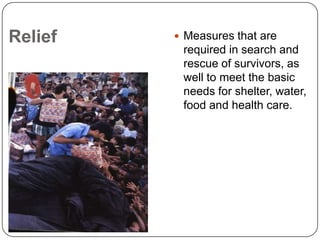
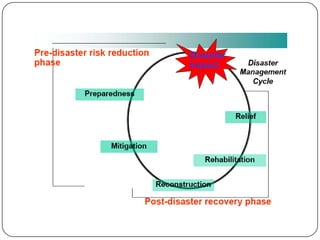
ReliefMeasures that are required in search and rescue of survivors, as well to meet the basic needs for shelter, water, food and health care.
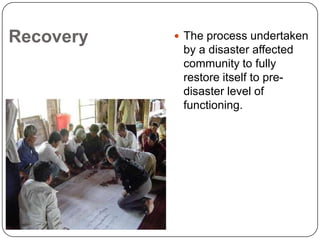
RecoveryThe process undertaken by a disaster affected community to fully restore itself to pre-disaster level of functioning.
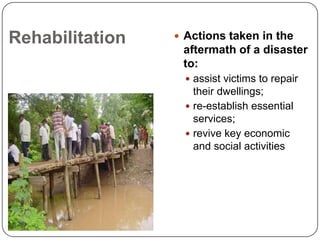
RehabilitationActions taken in the aftermath of a disaster to:assist victims to repair their dwellings;re-establish essential services; revive key economic and social activities
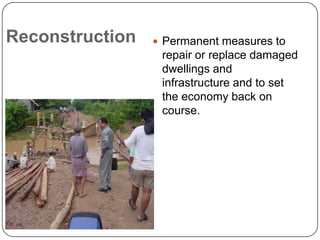
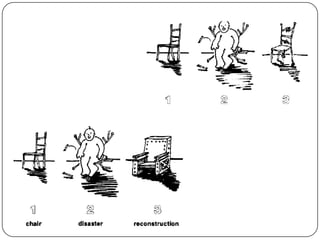
ReconstructionPermanent measures to repair or replace damaged dwellings and infrastructure and to set the economy back on course.
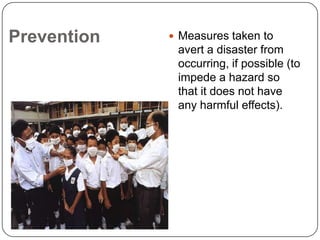
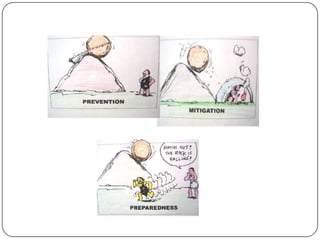
PreventionMeasures taken to avert a disaster from occurring, if possible (to impede a hazard so that it does not have any harmful effects).
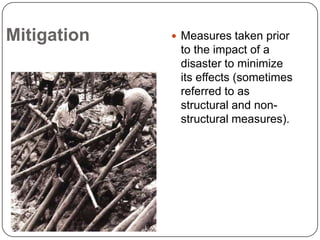
MitigationMeasures taken prior to the impact of a disaster to minimize its effects (sometimes referred to as structural and non-structural measures).
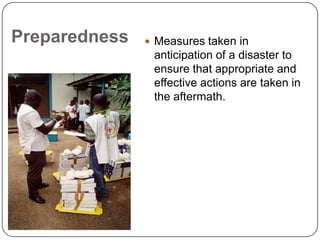
PreparednessMeasures taken in anticipation of a disaster to ensure that appropriate and effective actions are taken in the aftermath.
Any Question???Good Question!!!Next Question??
Lect 1
Lect 1

Lect 1

  • 1.
    Shared By:Muhammad QadeerHazardsand Disasters Management
  • 2.
    "O my Lord!Open for me my chest (grant me self-confidence, contentment, and boldness)."And ease my task for me;"And make loose the knot (the defect) from my tongue, (i.e. remove the incorrectness from my speech)That they may understand my speech.
  • 4.
    DiscussionLecture StructureOur worldand our challengesDisasters in PakistanDisaster Management; basic terms and conceptsHazard, Risk, Disaster, Elements at Risk, Vulnerability, Capacity, Response, Relief, Rehabilitation, Reconstruction, Development, Mitigation, Preparedness and Prevention etcDisaster Management Cycle
  • 5.
    Our world -our ChallengesDisasters are as old as human historyFrom 1994 to 1998, reported disasters average 428 per yearFrom 1999 to 2003, average raised to 707 events per year, it’s a 60% increaseThe worse is that the biggest rise was in countries of low human development which suffered an increase of 142 percent
  • 6.
    Situation of Disastersin PakistanLike other South Asian countries, Pakistan continues to suffer from a plethora of natural and human induced hazards.Commun Natural Disasters in Pakistan include floods, arthquakes, landslides, cyclones, and droughtsManmade disasters include such as fires, civil unrest and terrorism, refugees and internally displaced people, health epidemics, transport accidents, industrial accidents and war6,037 people were killed and 8,989,631 affected in the period between 1993-2002 (World Disasters Report 2003, Geneva, International Federation of Red Cross and Red Crescent Societies).
  • 7.
    Situation of Disastersin PakistanFloods:Pakistan is one of the five South Asian countries with the highest annual average number of people physically exposed to floods. During 1991 to 2001 floods caused an estimated damage of over Pak Rs 78,000 million to propertyDroughts: Severe drought periods in 2000 and 2002 led to 120 deaths and affected 2,200,000 people.Earthquakes: From 1974 to 1990, approximately 5669 people were killed due to earthquakes in the Northern Areas (NA), NWFP and Balochistan. The most recent significant earthquake of February 2004, and Oct 05 in NWFP has resulted in the life loss of millions of peopleCyclons: The cyclone of 1999 in Thatta and Badin districts wiped out 73 settlements, and resulted in 168 lives lost, nearly 0.6 million people affected and killing of 11,000 cattle. It destroyed 1,800 small and big boats and partially damaged 642 boats, causing a loss of Rs 380 million.
  • 8.
  • 11.
  • 12.
    Is FLOOD adisaster????And an earthquake???
  • 13.
    HazardIts physical phenomenonor situation which has the potential to cause disruption or damage to people, their properties, their services or their environmentHazards are the result of an interaction between human activities and the natural and technological processes that can generate extreme events. For example, earthquake faults, active volcanoes, flood zones, and highly flammable brush fields are all hazards.
  • 14.
    DisasterThe serious disruptionof the functioning of society, causing widespread human, material or environmental losses, which exceed the ability of the affected people to cope using their own resources.An event, either man-made or natural, sudden or progressive, causing widespread human, material or environmental lossesEmergency vs DisasterEmergency—An emergency is a deviation from planned or expected behavior or a course of events that endangers or adversely affects people, property, or the environment.Disaster—Disasters are characterized by the scope of an emergency. An emergency becomes a disaster when it exceeds the capability of the local resources to manage it.Disasters often result in great damage, loss, or destruction
  • 15.
    RiskThe probability thata community’s structure or geographic area is to be damaged or disrupted by the impact of a particular hazard, on account of their nature, construction, and proximity to a hazardous area.
  • 16.
    Elements at RiskPersons,buildings, crops or other such like societal components exposed to known hazard, which are likely to be adversely affected by the impact of the hazard.
  • 17.
    VulnerabilityIs a conditionor sets of conditions that reduces people’s ability to prepare for, withstand or respond to a hazardCapacityAre those positive condition or abilities which increase a community’s ability to deal with hazards.
  • 19.
    ReliefMeasures that arerequired in search and rescue of survivors, as well to meet the basic needs for shelter, water, food and health care.
  • 20.
    RecoveryThe process undertakenby a disaster affected community to fully restore itself to pre-disaster level of functioning.
  • 21.
    RehabilitationActions taken inthe aftermath of a disaster to:assist victims to repair their dwellings;re-establish essential services; revive key economic and social activities
  • 22.
    ReconstructionPermanent measures torepair or replace damaged dwellings and infrastructure and to set the economy back on course.
  • 25.
    PreventionMeasures taken toavert a disaster from occurring, if possible (to impede a hazard so that it does not have any harmful effects).
  • 26.
    MitigationMeasures taken priorto the impact of a disaster to minimize its effects (sometimes referred to as structural and non-structural measures).
  • 27.
    PreparednessMeasures taken inanticipation of a disaster to ensure that appropriate and effective actions are taken in the aftermath.
  • 31.

Editor's Notes

  • #6 Disasters are as old as human history
  • #8 The main arid rangelands are Thar, Cholistan, Dera Ghazi Khan,Tharparkar, Kohistan, and western Balochistan. Severe drought periods in 2000 and 2002 affected livelihoods, resulted in human deaths, pushed tens of thousands people to migrate, and killed large numbers of cattle. This drought led to 120 deaths and affected 2,200,000 people.