Outline
 Programming language
 Types of programming languages
 Procedural oriented programming language (POP)
 Object oriented programming language (OOP)
 Difference between POP and OOP
Programming Language
 Artificial language
 Designed to communicate instructions to a machine
 Used to create programs that control the behavior of a machine
Types of Programming Language
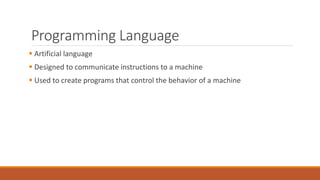
 Low Level programming language
◦ Machine language
◦ Assembly language
 High level programming language
◦ Procedural oriented programming language (POP)
◦ Object oriented programming language (OOP)
Types of Programming Language Cont..
 Machine language :
◦ Directly run on CPU
◦ Series of bits like 0’s and 1’s
◦ Tedious and error prone to write code manually
◦ Not portable
 Assembly language :
◦ Less error prone
◦ Coding easier than machine language
◦ Replaces 0’s and 1’s with english instructions
◦ Mnemonic codes for corresponding machine language
◦ Example :
◦ MOV A1, AA
Procedural oriented programming
language (POP)
 In POP programs are divided into smaller modules.
 In POP a program is written as a sequence of procedures or functions.
 Each procedure contains a series of instructions for performing a specific task.
 During the program execution each procedure can be called by the other procedures.
 The major emphasis of these languages is on the procedures and not on the data.
 POP language allow the data to move freely around the program.
 Top down program design approach is used by POP.
 Example :
 C,COBOL, FORTAN, ALGOL, BASIC etc.
Drawbacks of POP
 It emphasis on doing things. Data is given a second class status even through data is the reason
for the existence of the program.
 Since every function has complete access to the global variables, the new programmer can
corrupt the data accidentally by creating function.
 Similarly, if new data is to be added, all the function needed to be modified to access the data.
 It is often difficult to design because the components function and data structure do not model
the real world.
Object Oriented Programming Language (OOP)
 OOP divides a problem into a number of entities called objects and then build data and
functions around these objects.
 It is designed to remove some drawbacks of POP.
 OOP treats data as important element in the program development and does not allow it to
flow freely around the program.
 OOP ties data and functions together and protects it from accidental modification from outside
functions.
 In OOP data is hidden and can not be accessed by external functions.
 In OOP objects communicates with each other through functions.
 OOP emphasis is on data rather than procedure.
 OOP follows bottom up programming approach.
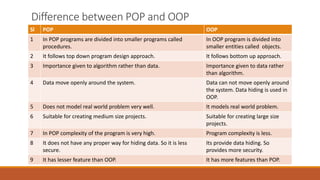
Difference between POP and OOP
Sl POP OOP
1 In POP programs are divided into smaller programs called
procedures.
In OOP program is divided into
smaller entities called objects.
2 It follows top down program design approach. It follows bottom up approach.
3 Importance given to algorithm rather than data. Importance given to data rather
than algorithm.
4 Data move openly around the system. Data can not move openly around
the system. Data hiding is used in
OOP.
5 Does not model real world problem very well. It models real world problem.
6 Suitable for creating medium size projects. Suitable for creating large size
projects.
7 In POP complexity of the program is very high. Program complexity is less.
8 It does not have any proper way for hiding data. So it is less
secure.
Its provide data hiding. So
provides more security.
9 It has lesser feature than OOP. It has more features than POP.
Thank You

Lec-01.pptx

  • 1.
    Outline  Programming language Types of programming languages  Procedural oriented programming language (POP)  Object oriented programming language (OOP)  Difference between POP and OOP
  • 2.
    Programming Language  Artificiallanguage  Designed to communicate instructions to a machine  Used to create programs that control the behavior of a machine
  • 3.
    Types of ProgrammingLanguage  Low Level programming language ◦ Machine language ◦ Assembly language  High level programming language ◦ Procedural oriented programming language (POP) ◦ Object oriented programming language (OOP)
  • 4.
    Types of ProgrammingLanguage Cont..  Machine language : ◦ Directly run on CPU ◦ Series of bits like 0’s and 1’s ◦ Tedious and error prone to write code manually ◦ Not portable  Assembly language : ◦ Less error prone ◦ Coding easier than machine language ◦ Replaces 0’s and 1’s with english instructions ◦ Mnemonic codes for corresponding machine language ◦ Example : ◦ MOV A1, AA
  • 5.
    Procedural oriented programming language(POP)  In POP programs are divided into smaller modules.  In POP a program is written as a sequence of procedures or functions.  Each procedure contains a series of instructions for performing a specific task.  During the program execution each procedure can be called by the other procedures.  The major emphasis of these languages is on the procedures and not on the data.  POP language allow the data to move freely around the program.  Top down program design approach is used by POP.  Example :  C,COBOL, FORTAN, ALGOL, BASIC etc.
  • 6.
    Drawbacks of POP It emphasis on doing things. Data is given a second class status even through data is the reason for the existence of the program.  Since every function has complete access to the global variables, the new programmer can corrupt the data accidentally by creating function.  Similarly, if new data is to be added, all the function needed to be modified to access the data.  It is often difficult to design because the components function and data structure do not model the real world.
  • 7.
    Object Oriented ProgrammingLanguage (OOP)  OOP divides a problem into a number of entities called objects and then build data and functions around these objects.  It is designed to remove some drawbacks of POP.  OOP treats data as important element in the program development and does not allow it to flow freely around the program.  OOP ties data and functions together and protects it from accidental modification from outside functions.  In OOP data is hidden and can not be accessed by external functions.  In OOP objects communicates with each other through functions.  OOP emphasis is on data rather than procedure.  OOP follows bottom up programming approach.
  • 8.
    Difference between POPand OOP Sl POP OOP 1 In POP programs are divided into smaller programs called procedures. In OOP program is divided into smaller entities called objects. 2 It follows top down program design approach. It follows bottom up approach. 3 Importance given to algorithm rather than data. Importance given to data rather than algorithm. 4 Data move openly around the system. Data can not move openly around the system. Data hiding is used in OOP. 5 Does not model real world problem very well. It models real world problem. 6 Suitable for creating medium size projects. Suitable for creating large size projects. 7 In POP complexity of the program is very high. Program complexity is less. 8 It does not have any proper way for hiding data. So it is less secure. Its provide data hiding. So provides more security. 9 It has lesser feature than OOP. It has more features than POP.
  • 9.