Ontologies, dialogue and knowledge maturing: Towards a mashup and design study A. Ravenscroft1, S. Braun2, J. Cook1, A. Schmidt2, J.Bimrose3, A. Brown3  & C. Bradley1 1. Learning Technology Research Institute,  London Metropolitan University, UK 2  FZI Research Center for Information Technologies, Germany 3  The Institute for Employment Research, University of Warwick, UK http://mature-ip.eu
Overview of talk Learning as knowledge maturing Why this design study?  SOBOLEO and ontology maturing Ontology maturing and dialogue Dialogue games and InterLoc Dialogue games for knowledge maturing (KM-DG) A proof of concept scenario: Careers guidance Discussion/key issues/way forward
Learning as knowledge maturing MATURE: Large-scale European research project (FP 7, started April 2008) “ Continuous social learning in knowledge networks” Aim: Investigate and realise learning as knowledge maturing in the workplace
Learning as knowledge maturing Key aims: Develop: Personal Learning and Maturing Environment (PLME) Organisational Learning and Maturing Environment (OLME) Investigate and develop: The knowledge maturing model Technological approaches to the continuous development of social software and knowledge networks.
Why this design study?   federated set of studies that are examining different aspects of the (large-scale) knowledge maturing enterprise This Ontology-Dialogue Design Study aims to: Explore and develop the relationship between knowledge maturing (SOBOLEO) and social learning (Dialogue Games/InterLoc)  … esp. Ontology maturing and collaborative learning dialogue … both approaches established through papers etc.  Test technical integration issues related to the creation of suitable mashups (also ‘conceptual mashup’) Explore the role of collaborative dialogue (generally) in the continuous development of knowledge networks  Validate against a concrete scenario demonstrating knowledge maturing … so very much wip! Also try out some evaluation methods -  Scenario based evaluation - Other empirical methods (modelling, comparative studies etc.)
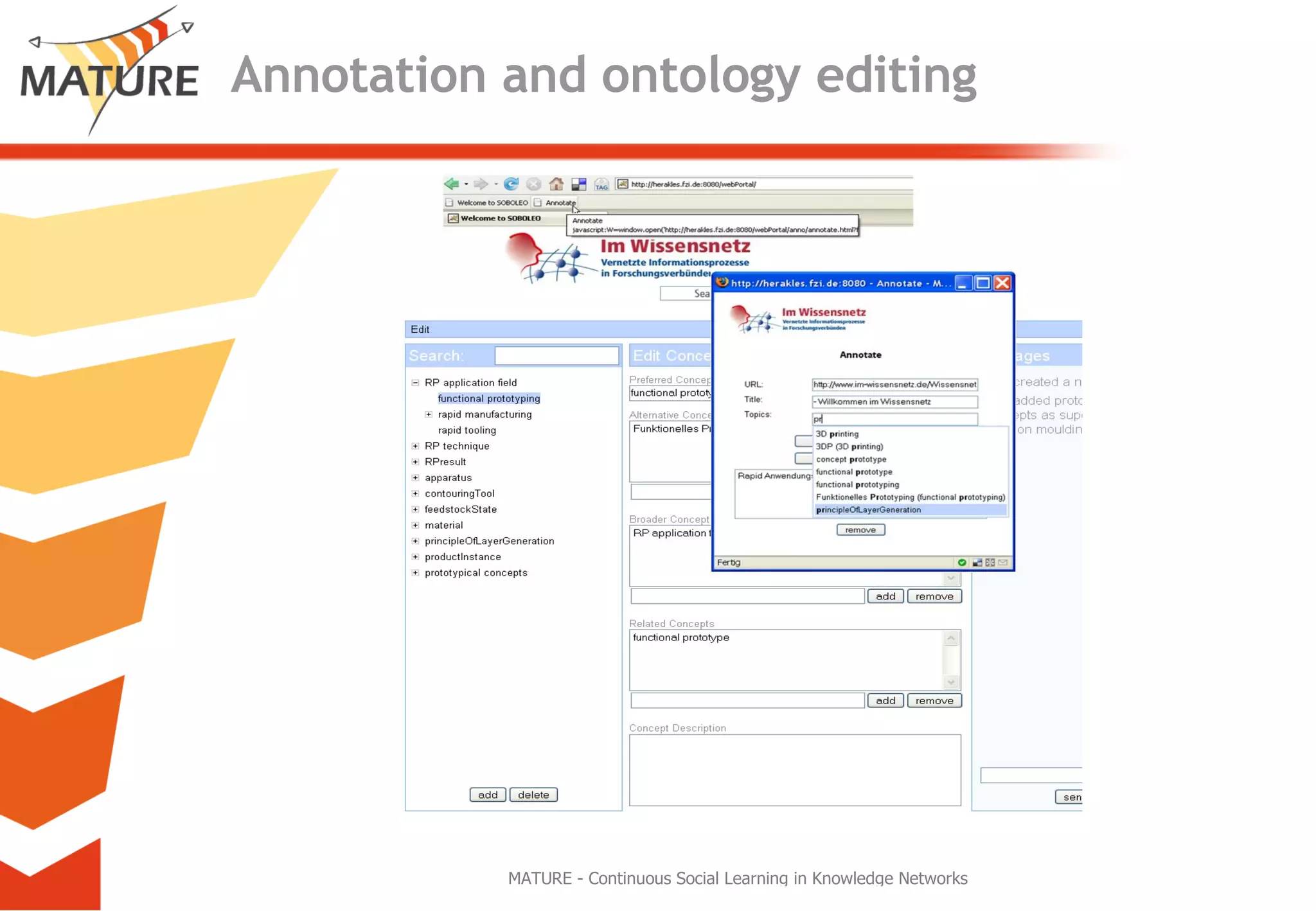
Ontology maturing and SOBOLEO <add Simone’s / Andreas’s slides here>
Annotation and ontology editing
Ontology development and dialogue Can the introduction of a specially designed dialogue: Improve the way Ontologies are developed, refined, used and generally understood? Support the phases of knowledge maturing?  Support collaborative and social learning around Ontology development and use?  … With this in mind we considered incorporating work into digital dialogue games and the InterLoc tool that realises them
Dialogue games (DGs) and InterLoc Address pressing need to reconcile learners developing digital literacies and practices with the well-established requirements for reasoned and purposeful learning dialogues (critical and creative thinking) InterLoc is an attractive, inclusive and pedagogically derived web-technology that is easily deployed and used to address relatively generic learning problems and opportunities.  DGs are serious social games: realise engaging and structured rule-based interactions that are performed using pre-defined dialogue features (such as dialogue moves and a model of turn-taking) specifically designed to foster thinking and learning in ways that are popular with users
Key features of Dialogue games (DGs)c Structured and engaging rule-based interaction to scaffold thinking  and collaborative argumentation (Currently) synchronous multimodal dialogues (4-6 players) Roles: player, facilitator, learning manager Pre-defined dialogue features that promote thinking Moves:  Inform, Question, Challenge , etc. Sets of Openers to perform each move:  “I think…”, “I disagree because…”, “My evidence is…”  etc. Content generated as an Active Document (or knowledge asset) Dialogue Games can be edited – so can produce a Knowledge Maturing Dialogue Game (KM-DG)
Playing a dialogue game
Towards a mashup for knowledge maturing, SOBOLEO-InterLoc Why?...means to populate, clarify and refine the Ontologies that are produced.  E.g. dimensions such as Appropriateness, Social Agreement and Formality could be negotiated, and therefore  better understood through suitably designed dialogue games.  How? be achieved through replacing or supplementing the Chat component of SOBOLEO with a specially designed dialogue game, or number of games, for Ontology maturing  To stimulate users to have a dialogue with and about the developing Ontologies to specify, clarify and refine the semantic features or degrees of certainty about their classification.  Achieved  through specifying the pre-defined Moves and Openers of the dialogue game in terms of the semantic relations and classifications that are implicit in SOBOLEO or provided through the dialogue of a user community.
Towards a mashup for knowledge maturing, SOBOLEO-InterLoc Why? …essentially – both individual users and the community could have a dialogue with and about the ontology, to construct more understandable and meaningful representations.  Should catalyse knowledge maturing and social learning in relation to the domain and the users who are continuously developing their understanding of it.  Or, having a structured dialogue about the development and use of the ontology should actually help to ‘bring it to life’ and make it more useful
A proof of concept scenario: Careers guidance How such a mashup would work in a hypothetical yet authentic user scenario A Personal Advisor (P.A) working with a young female interested in becoming a plumber In this situation the P.A. would need to perform a number of knowledge maturing processes to research and mediate Labour Market Information (LMI) in a meaningful way  How could they use this ‘engine’ of a (continuously developing) knowledge representation plus various dialogue facilities to support a range of activities associated with the development and application of  knowledge for advising and problem solving in this situation?
A proof of concept scenario: Careers guidance To summarise, through combining a flexible ontology development and learning dialogue technology, a range of knowledge maturing services could be provided that include:  1. knowledge acquisition 2. personal knowledge refinement  3. collaborative knowledge refinement and negotiation of meaning 4. informal learning 5. collaborative learning 6. support for advising and problem solving;  7. reflection and meta-cognition about the domain and its application;  8. re-representing domain knowledge for different audiences and purposes.  Or summarising all this, arguably, as hypothesise: having the potential continuously to develop a personal and community Ontology about LMI combined with the means to have a specialised and scaffolded dialogue about it, will potentially make the domain more understandable and the application of the ontology more powerful.
Discussion/key issues/way forward … a prototype validation and evaluation of the knowledge maturing model, an orchestration of tools that realise it and how this might work in practice Conceptual validation, of ‘conceptual mashup’ (this article) Test the current mashup against other user scenarios and findings from the ethnographic studies … Exemplary  (what we can do) and  Critical  (what we can’t do) Conduct technical integration (+ semantic wiki wrapper?) Involve users Harmonise with other design studies of knowledge maturing … evaluation matrix e.g. harmonise conceptual and technical emphasis from Ontology-Dialogue study with usability and acceptability emphasis in other design studies (e.g. semantic wiki) … Front end mock-ups and back-end mashups: towards integrated methodologies for MATURE
Why would anyone use this mashup? Why take time and commit to collective improvement in knowledge and understanding   Participate in organisational understanding Re-use developed knowledge structures Better personal understanding through active participation and dialogue, and participate in and understand process of abstraction (cornerstone of much understanding and learning) What if we don’t do this sort of thing? Less empowered workers Constant misunderstandings and miscommunications because no shared understanding of basic concepts Would the credit crunch have happened if more key members of financial institutions had a better shared and negotiated understanding of core economic principles and the relations between them!?
Ethnographic reality!? Innsbruck's work: How accommodate different worker/user styles? (Sally, Igor and Aisha) - Optional participation vs. instructed … being instructed to do something valuable to the organisation or community? Do we accommodate different learning styles or aim to transform them into ‘better’ ones? Accommodation more doable so more personalised tools or personalised interfaces to organisational tools Individuation Interaction   In-form-ation

Leb08talksept17

  • 1.
    Ontologies, dialogue andknowledge maturing: Towards a mashup and design study A. Ravenscroft1, S. Braun2, J. Cook1, A. Schmidt2, J.Bimrose3, A. Brown3 & C. Bradley1 1. Learning Technology Research Institute, London Metropolitan University, UK 2 FZI Research Center for Information Technologies, Germany 3 The Institute for Employment Research, University of Warwick, UK http://mature-ip.eu
  • 2.
    Overview of talkLearning as knowledge maturing Why this design study? SOBOLEO and ontology maturing Ontology maturing and dialogue Dialogue games and InterLoc Dialogue games for knowledge maturing (KM-DG) A proof of concept scenario: Careers guidance Discussion/key issues/way forward
  • 3.
    Learning as knowledgematuring MATURE: Large-scale European research project (FP 7, started April 2008) “ Continuous social learning in knowledge networks” Aim: Investigate and realise learning as knowledge maturing in the workplace
  • 4.
    Learning as knowledgematuring Key aims: Develop: Personal Learning and Maturing Environment (PLME) Organisational Learning and Maturing Environment (OLME) Investigate and develop: The knowledge maturing model Technological approaches to the continuous development of social software and knowledge networks.
  • 5.
    Why this designstudy? federated set of studies that are examining different aspects of the (large-scale) knowledge maturing enterprise This Ontology-Dialogue Design Study aims to: Explore and develop the relationship between knowledge maturing (SOBOLEO) and social learning (Dialogue Games/InterLoc) … esp. Ontology maturing and collaborative learning dialogue … both approaches established through papers etc. Test technical integration issues related to the creation of suitable mashups (also ‘conceptual mashup’) Explore the role of collaborative dialogue (generally) in the continuous development of knowledge networks Validate against a concrete scenario demonstrating knowledge maturing … so very much wip! Also try out some evaluation methods - Scenario based evaluation - Other empirical methods (modelling, comparative studies etc.)
  • 6.
    Ontology maturing andSOBOLEO <add Simone’s / Andreas’s slides here>
  • 7.
  • 8.
    Ontology development anddialogue Can the introduction of a specially designed dialogue: Improve the way Ontologies are developed, refined, used and generally understood? Support the phases of knowledge maturing? Support collaborative and social learning around Ontology development and use? … With this in mind we considered incorporating work into digital dialogue games and the InterLoc tool that realises them
  • 9.
    Dialogue games (DGs)and InterLoc Address pressing need to reconcile learners developing digital literacies and practices with the well-established requirements for reasoned and purposeful learning dialogues (critical and creative thinking) InterLoc is an attractive, inclusive and pedagogically derived web-technology that is easily deployed and used to address relatively generic learning problems and opportunities. DGs are serious social games: realise engaging and structured rule-based interactions that are performed using pre-defined dialogue features (such as dialogue moves and a model of turn-taking) specifically designed to foster thinking and learning in ways that are popular with users
  • 10.
    Key features ofDialogue games (DGs)c Structured and engaging rule-based interaction to scaffold thinking and collaborative argumentation (Currently) synchronous multimodal dialogues (4-6 players) Roles: player, facilitator, learning manager Pre-defined dialogue features that promote thinking Moves: Inform, Question, Challenge , etc. Sets of Openers to perform each move: “I think…”, “I disagree because…”, “My evidence is…” etc. Content generated as an Active Document (or knowledge asset) Dialogue Games can be edited – so can produce a Knowledge Maturing Dialogue Game (KM-DG)
  • 11.
  • 12.
    Towards a mashupfor knowledge maturing, SOBOLEO-InterLoc Why?...means to populate, clarify and refine the Ontologies that are produced. E.g. dimensions such as Appropriateness, Social Agreement and Formality could be negotiated, and therefore better understood through suitably designed dialogue games. How? be achieved through replacing or supplementing the Chat component of SOBOLEO with a specially designed dialogue game, or number of games, for Ontology maturing To stimulate users to have a dialogue with and about the developing Ontologies to specify, clarify and refine the semantic features or degrees of certainty about their classification. Achieved through specifying the pre-defined Moves and Openers of the dialogue game in terms of the semantic relations and classifications that are implicit in SOBOLEO or provided through the dialogue of a user community.
  • 13.
    Towards a mashupfor knowledge maturing, SOBOLEO-InterLoc Why? …essentially – both individual users and the community could have a dialogue with and about the ontology, to construct more understandable and meaningful representations. Should catalyse knowledge maturing and social learning in relation to the domain and the users who are continuously developing their understanding of it. Or, having a structured dialogue about the development and use of the ontology should actually help to ‘bring it to life’ and make it more useful
  • 14.
    A proof ofconcept scenario: Careers guidance How such a mashup would work in a hypothetical yet authentic user scenario A Personal Advisor (P.A) working with a young female interested in becoming a plumber In this situation the P.A. would need to perform a number of knowledge maturing processes to research and mediate Labour Market Information (LMI) in a meaningful way How could they use this ‘engine’ of a (continuously developing) knowledge representation plus various dialogue facilities to support a range of activities associated with the development and application of knowledge for advising and problem solving in this situation?
  • 15.
    A proof ofconcept scenario: Careers guidance To summarise, through combining a flexible ontology development and learning dialogue technology, a range of knowledge maturing services could be provided that include: 1. knowledge acquisition 2. personal knowledge refinement 3. collaborative knowledge refinement and negotiation of meaning 4. informal learning 5. collaborative learning 6. support for advising and problem solving; 7. reflection and meta-cognition about the domain and its application; 8. re-representing domain knowledge for different audiences and purposes. Or summarising all this, arguably, as hypothesise: having the potential continuously to develop a personal and community Ontology about LMI combined with the means to have a specialised and scaffolded dialogue about it, will potentially make the domain more understandable and the application of the ontology more powerful.
  • 16.
    Discussion/key issues/way forward… a prototype validation and evaluation of the knowledge maturing model, an orchestration of tools that realise it and how this might work in practice Conceptual validation, of ‘conceptual mashup’ (this article) Test the current mashup against other user scenarios and findings from the ethnographic studies … Exemplary (what we can do) and Critical (what we can’t do) Conduct technical integration (+ semantic wiki wrapper?) Involve users Harmonise with other design studies of knowledge maturing … evaluation matrix e.g. harmonise conceptual and technical emphasis from Ontology-Dialogue study with usability and acceptability emphasis in other design studies (e.g. semantic wiki) … Front end mock-ups and back-end mashups: towards integrated methodologies for MATURE
  • 17.
    Why would anyoneuse this mashup? Why take time and commit to collective improvement in knowledge and understanding  Participate in organisational understanding Re-use developed knowledge structures Better personal understanding through active participation and dialogue, and participate in and understand process of abstraction (cornerstone of much understanding and learning) What if we don’t do this sort of thing? Less empowered workers Constant misunderstandings and miscommunications because no shared understanding of basic concepts Would the credit crunch have happened if more key members of financial institutions had a better shared and negotiated understanding of core economic principles and the relations between them!?
  • 18.
    Ethnographic reality!? Innsbruck'swork: How accommodate different worker/user styles? (Sally, Igor and Aisha) - Optional participation vs. instructed … being instructed to do something valuable to the organisation or community? Do we accommodate different learning styles or aim to transform them into ‘better’ ones? Accommodation more doable so more personalised tools or personalised interfaces to organisational tools Individuation Interaction In-form-ation