Leather TanningSpencer Black
What is tanning?Leather is made from animal skins or hides which have been chemically treated to preserve quality and natural beauty. The chemical procedure used to ready raw animal hides for use is called "tanning." A piece of hide or skin which has been tanned produces a strong, flexible leather which is able to resist decay and spoilage.	(http://www.essortment.com/all/leathertanning_rdcu.htm)
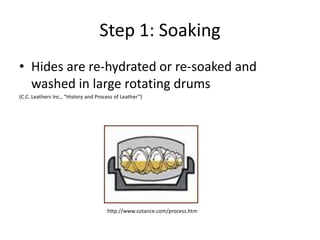
Step 1: SoakingHides are re-hydrated or re-soaked and washed in large rotating drums(C.C. Leathers Inc., “History and Process of Leather”) http://www.cotance.com/process.htm
Step 2: Hair RemovalHair is removed by chemical digestion Lime and sodium sulphide solution Hairless hides are then neutralized with acids and treated with enzymesRemoves depositsIncreases softness(C.C. Leathers Inc., “History and Process of Leather”)
Step 3: DelimingHairless hides are then neutralized with acids and treated with enzymesRemoves depositsIncreases softness(C.C. Leathers Inc., “History and Process of Leather”)
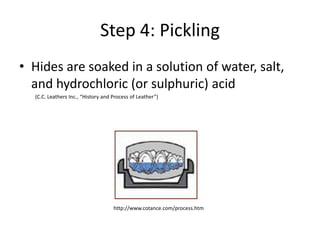
Step 4: PicklingHides are soaked in a solution of water, salt, and hydrochloric (or sulphuric) acid(C.C. Leathers Inc., “History and Process of Leather”) http://www.cotance.com/process.htm
Step 5: TanningTanningTwo main methods: Chrome and VegetableChrome is more commonVegetable tanning produces stiffer leathers; chrome tanning produces softer leather(C.C. Leathers Inc., “History and Process of Leather”)
Step 5: Chrome TanningMost upholstery, shoes, garments, bagsHides placed in rotating drums and washed in a chemical containing trivalent chromeAfter 8 hours, the chrome is “fixed” with an alkaline chemical (sodium carbonate)	(C.C. Leathers Inc., “History and Process of Leather”)
Step 5: Vegetable TanningUsed on shoe soles, luggage, belts, and some upholsterySlower, 2-4 daysUses tannic acid, which is extracted from tree bark	(C.C. Leathers Inc., “History and Process of Leather”)
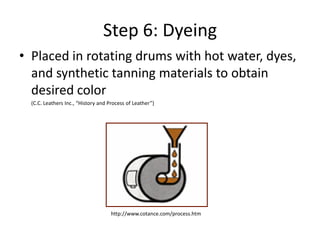
Step 6: DyeingPlaced in rotating drums with hot water, dyes, and synthetic tanning materials to obtain desired color	(C.C. Leathers Inc., “History and Process of Leather”) http://www.cotance.com/process.htm
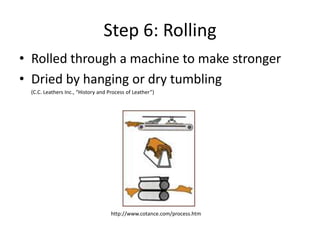
Step 6: RollingRolled through a machine to make strongerDried by hanging or dry tumbling         (C.C. Leathers Inc., “History and Process of Leather”) http://www.cotance.com/process.htm
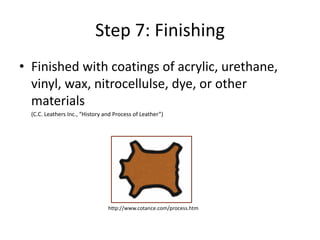
Step 7: FinishingFinished with coatings of acrylic, urethane, vinyl, wax, nitrocellulse, dye, or other materials	(C.C. Leathers Inc., “History and Process of Leather”) http://www.cotance.com/process.htm
Environmental ImpactAir pollutionammonia gas, hydrosulphuric gas and volatile organic compoundsWater contaminationresidual baths for hide treatment and washings containing chemical productsContamination of the soilflesh, hairs, hide chippings and scrapingsLarge amount of water consumptionChrome has high level of contamination (Siddharth Singh, “Project Report on Environmental Impact Assessment (in Leather Industry)”)
Ways to ReduceReuse waterRecover and reuse chrome*New process- improved chrome syntan with more than 90% uptake of chromeUse ammonia-free delimingUse less salt (although will decrease “shelf-life”)(Siddharth Singh, “Project Report on Environmental Impact Assessment (in Leather Industry)”)
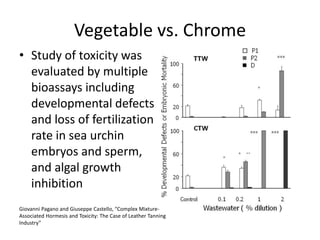
Vegetable vs. ChromeStudy of toxicity was evaluated by multiple bioassays including developmental defects and loss of fertilization rate in sea urchin embryos and sperm, and algal growth inhibitionGiovanni Pagano and Giuseppe Castello, “Complex Mixture-Associated Hormesis and Toxicity: The Case of Leather Tanning Industry”

Leather Tanning

  • 1.
  • 2.
    What is tanning?Leatheris made from animal skins or hides which have been chemically treated to preserve quality and natural beauty. The chemical procedure used to ready raw animal hides for use is called "tanning." A piece of hide or skin which has been tanned produces a strong, flexible leather which is able to resist decay and spoilage. (http://www.essortment.com/all/leathertanning_rdcu.htm)
  • 3.
    Step 1: SoakingHidesare re-hydrated or re-soaked and washed in large rotating drums(C.C. Leathers Inc., “History and Process of Leather”) http://www.cotance.com/process.htm
  • 4.
    Step 2: HairRemovalHair is removed by chemical digestion Lime and sodium sulphide solution Hairless hides are then neutralized with acids and treated with enzymesRemoves depositsIncreases softness(C.C. Leathers Inc., “History and Process of Leather”)
  • 5.
    Step 3: DelimingHairlesshides are then neutralized with acids and treated with enzymesRemoves depositsIncreases softness(C.C. Leathers Inc., “History and Process of Leather”)
  • 6.
    Step 4: PicklingHidesare soaked in a solution of water, salt, and hydrochloric (or sulphuric) acid(C.C. Leathers Inc., “History and Process of Leather”) http://www.cotance.com/process.htm
  • 7.
    Step 5: TanningTanningTwomain methods: Chrome and VegetableChrome is more commonVegetable tanning produces stiffer leathers; chrome tanning produces softer leather(C.C. Leathers Inc., “History and Process of Leather”)
  • 8.
    Step 5: ChromeTanningMost upholstery, shoes, garments, bagsHides placed in rotating drums and washed in a chemical containing trivalent chromeAfter 8 hours, the chrome is “fixed” with an alkaline chemical (sodium carbonate) (C.C. Leathers Inc., “History and Process of Leather”)
  • 9.
    Step 5: VegetableTanningUsed on shoe soles, luggage, belts, and some upholsterySlower, 2-4 daysUses tannic acid, which is extracted from tree bark (C.C. Leathers Inc., “History and Process of Leather”)
  • 10.
    Step 6: DyeingPlacedin rotating drums with hot water, dyes, and synthetic tanning materials to obtain desired color (C.C. Leathers Inc., “History and Process of Leather”) http://www.cotance.com/process.htm
  • 11.
    Step 6: RollingRolledthrough a machine to make strongerDried by hanging or dry tumbling (C.C. Leathers Inc., “History and Process of Leather”) http://www.cotance.com/process.htm
  • 12.
    Step 7: FinishingFinishedwith coatings of acrylic, urethane, vinyl, wax, nitrocellulse, dye, or other materials (C.C. Leathers Inc., “History and Process of Leather”) http://www.cotance.com/process.htm
  • 13.
    Environmental ImpactAir pollutionammoniagas, hydrosulphuric gas and volatile organic compoundsWater contaminationresidual baths for hide treatment and washings containing chemical productsContamination of the soilflesh, hairs, hide chippings and scrapingsLarge amount of water consumptionChrome has high level of contamination (Siddharth Singh, “Project Report on Environmental Impact Assessment (in Leather Industry)”)
  • 14.
    Ways to ReduceReusewaterRecover and reuse chrome*New process- improved chrome syntan with more than 90% uptake of chromeUse ammonia-free delimingUse less salt (although will decrease “shelf-life”)(Siddharth Singh, “Project Report on Environmental Impact Assessment (in Leather Industry)”)
  • 15.
    Vegetable vs. ChromeStudyof toxicity was evaluated by multiple bioassays including developmental defects and loss of fertilization rate in sea urchin embryos and sperm, and algal growth inhibitionGiovanni Pagano and Giuseppe Castello, “Complex Mixture-Associated Hormesis and Toxicity: The Case of Leather Tanning Industry”