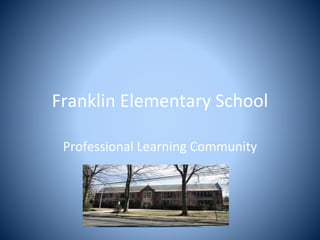
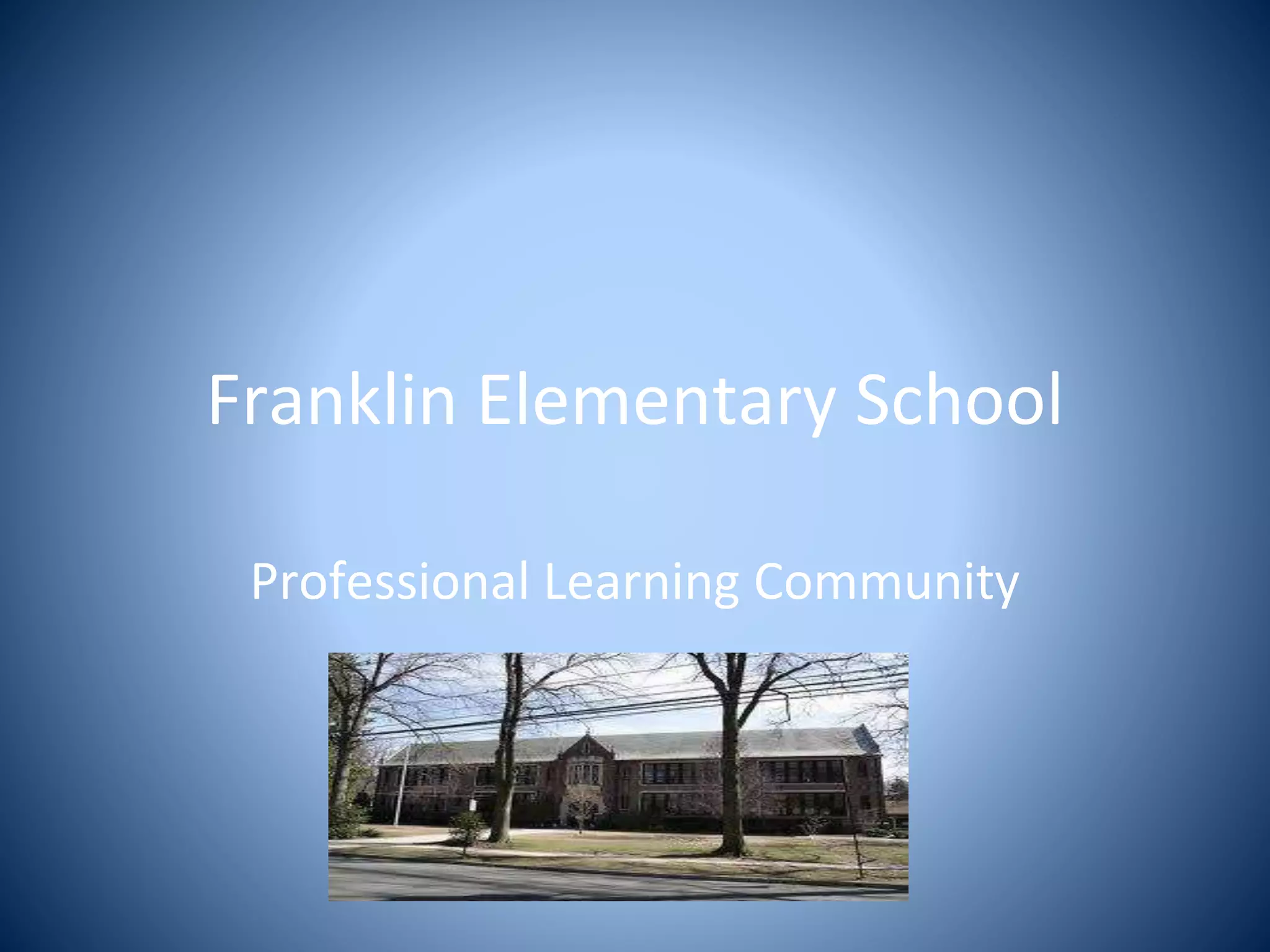
Franklin Elementary School
Professional Learning Community
How did we get started?
• District Support
• Board of Education
• Professional Learning Committee (School and
District Based)
We are Summit
• DFG-I
• Two Primary Centers,
Five Elementary
Schools, One Middle
School and One High
School
• 4,134 Students
• 13% on Free and
Reduced Lunch
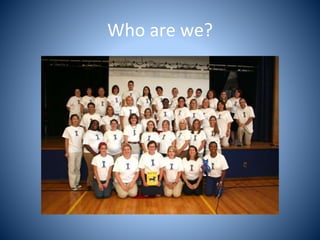
Who are we?
We are Franklin School…
Demographics
• 383 students
• 262 families
• 87% White
• 8.46% Asian
• 5.8% Multi-racial Non-
Hispanic
• 4.2% Hispanic
• 2.6% African American
• 7.67% Special Education
• …Where it’s all good!
How have we demonstrated
commitment to our PLCs?By…
• Meeting continually throughout the year
• Attending meetings
• Utilizing time on half-days
• Being provided with release time
• Having common preps
• Having team meetings as a grade with principal
and PLC meetings across grade
• Having respect for group mates, staying on task,
and having equal and positive participation
• Teachers having a voice in planning meetings
The Different Types of PLCs at Franklin
include…
• Grade Level
• Cross Grade
• Content area for World Language, Media
Specialists, Special Education, etc.
What is a Grade Level PLC?
• A grade level PLC is a team of teachers on the
same grade level working together.
• We…
Plan curriculum calendars
Analyze student work
Analyze data
Share strategies for instruction
Differentiate lessons and student work
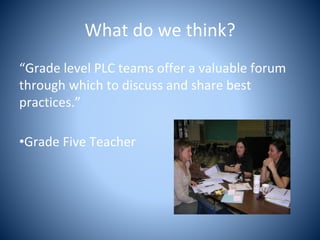
What do we think?
“Grade level PLC teams offer a valuable forum
through which to discuss and share best
practices.”
•Grade Five Teacher
The Benefits of Grade Level PLC
• Collaborating with others on grade level
• Develop TC curriculum calendar
• Evaluate student work
• Get others perspective
• Time to differentiate units
• Cross grade strategy groups
• Decisions on how to present material
• Discussing students of concern
• Discussing enrichment strategies that work and are effective
• Increase insight to individual students
• Evaluate and plan units of studies
• Discuss student achievement
• Divide and conquer
• Collaboration/planning time with general education teacher (resource
teacher)
What is a Cross Grade Level PLC?
• A cross grade level PLC is composed of faculty
members including general education
teachers, special education teachers,
specialists-physical education teachers, world
language instructor, media specialist, etc.
• We…
Analyze student work
Provide strategies for instruction
Celebrate strengths
What does it look like?
• http://www.youtube.com/watch?v=n1V6m9P30zE
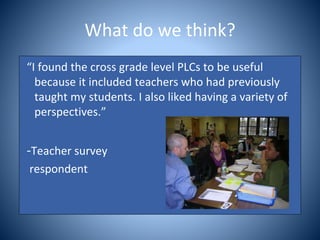
What do we think?
“I found the cross grade level PLCs to be useful
because it included teachers who had previously
taught my students. I also liked having a variety of
perspectives.”
-Teacher survey
respondent
Benefits of Cross Grade Level PLC
• Getting input from various grade levels
• Input from other teachers
• Ability to see child’s progress over time who had child
• Collaborate with specialists
• A fresh perspective
• Learning about productive strategies to target specific concerns
• Increase insight into individual students
• Meeting with lower and upper grade teachers to discuss where kids are coming
from and where they are going
• Analyzing student progress
• Input from other teachers we don’t have time to collaborate with
• Celebrating students strengths
• Strategies to help students achieve academic success
• Able to hear about children in the school
Turn and Talk
•Any questions so far about what a PLC is?
•What resonates with you regarding
structures for organizing your teams?
How do you get everyone on board?
• Develop norms
• Engage in team building activities
• Set clear expectations and desired outcomes
• Instill trust
• Take risks
• PLC Leaders provided with strategies
• Time not looked at as something extra, but built
into routines, meetings, etc.
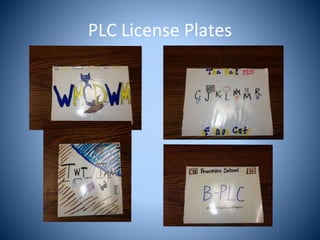
PLC License Plates
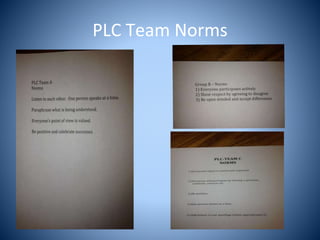
PLC Team Norms
Take a 5 minute break
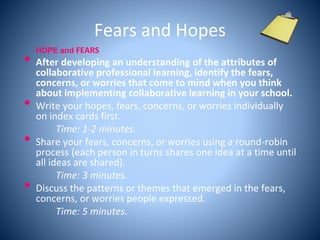
Fears and Hopes
HOPE and FEARS
• After developing an understanding of the attributes of
collaborative professional learning, identify the fears,
concerns, or worries that come to mind when you think
about implementing collaborative learning in your school.
• Write your hopes, fears, concerns, or worries individually
on index cards first.
Time: 1-2 minutes.
• Share your fears, concerns, or worries using a round-robin
process (each person in turns shares one idea at a time until
all ideas are shared).
Time: 3 minutes.
• Discuss the patterns or themes that emerged in the fears,
concerns, or worries people expressed.
Time: 5 minutes.
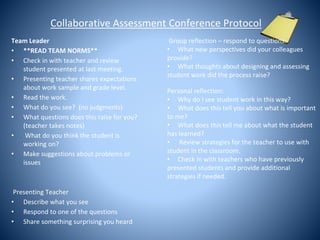
Collaborative Assessment Conference Protocol
Team Leader
• **READ TEAM NORMS**
• Check in with teacher and review
student presented at last meeting.
• Presenting teacher shares expectations
about work sample and grade level.
• Read the work.
• What do you see? (no judgments)
• What questions does this raise for you?
(teacher takes notes)
• What do you think the student is
working on?
• Make suggestions about problems or
issues
Presenting Teacher
• Describe what you see
• Respond to one of the questions
• Share something surprising you heard
Group reflection – respond to questions:
• What new perspectives did your colleagues
provide?
• What thoughts about designing and assessing
student work did the process raise?
Personal reflection:
• Why do I see student work in this way?
• What does this tell you about what is important
to me?
• What does this tell me about what the student
has learned?
• Review strategies for the teacher to use with
student in the classroom.
• Check in with teachers who have previously
presented students and provide additional
strategies if needed.
Trying Out the Protocol
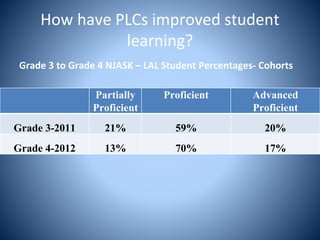
How have PLCs improved student
learning?
Partially
Proficient
Proficient Advanced
Proficient
Grade 3-2011 21% 59% 20%
Grade 4-2012 13% 70% 17%
Grade 3 to Grade 4 NJASK – LAL Student Percentages- Cohorts
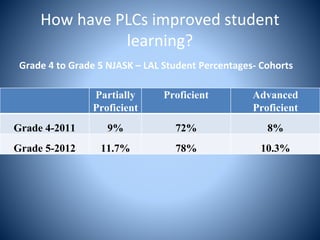
How have PLCs improved student
learning?
Partially
Proficient
Proficient Advanced
Proficient
Grade 4-2011 9% 72% 8%
Grade 5-2012 11.7% 78% 10.3%
Grade 4 to Grade 5 NJASK – LAL Student Percentages- Cohorts
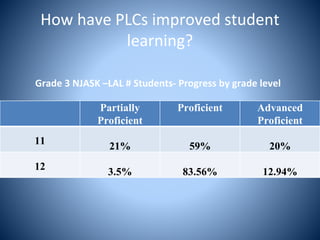
How have PLCs improved student
learning?
Partially
Proficient
Proficient Advanced
Proficient
11
21% 59% 20%
12
3.5% 83.56% 12.94%
Grade 3 NJASK –LAL # Students- Progress by grade level
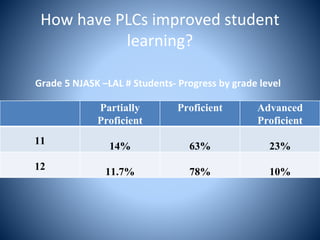
How have PLCs improved student
learning?
Partially
Proficient
Proficient Advanced
Proficient
11
14% 63% 23%
12
11.7% 78% 10%
Grade 5 NJASK –LAL # Students- Progress by grade level
Resources
Books:
Jolly, Anne. Team to Teach A Facilitator’s Guide to Professional
Learning Team National Staff Development Council 2008
Killion, Joelle and Patricia Roy. Become a Learning School
National Staff Development Council 2009
Articles:
Harrison, Cindy and Chris Bryan. “Data Dialogue” National Staff
Development Council Fall 2008
DuFour, Rick. “The Best Staff Development is in the Work Place,
Not in a Workshop” National Staff Development Council Spring
2004
Lasting Advice….
• “Alone we can do so little; together we can do
so much.” –Helen Keller
Thank you!

LearningForwardJuly2013r

  • 1.
  • 2.
    How did weget started? • District Support • Board of Education • Professional Learning Committee (School and District Based)
  • 3.
    We are Summit •DFG-I • Two Primary Centers, Five Elementary Schools, One Middle School and One High School • 4,134 Students • 13% on Free and Reduced Lunch
  • 4.
  • 5.
    We are FranklinSchool… Demographics • 383 students • 262 families • 87% White • 8.46% Asian • 5.8% Multi-racial Non- Hispanic • 4.2% Hispanic • 2.6% African American • 7.67% Special Education • …Where it’s all good!
  • 6.
    How have wedemonstrated commitment to our PLCs?By… • Meeting continually throughout the year • Attending meetings • Utilizing time on half-days • Being provided with release time • Having common preps • Having team meetings as a grade with principal and PLC meetings across grade • Having respect for group mates, staying on task, and having equal and positive participation • Teachers having a voice in planning meetings
  • 7.
    The Different Typesof PLCs at Franklin include… • Grade Level • Cross Grade • Content area for World Language, Media Specialists, Special Education, etc.
  • 8.
    What is aGrade Level PLC? • A grade level PLC is a team of teachers on the same grade level working together. • We… Plan curriculum calendars Analyze student work Analyze data Share strategies for instruction Differentiate lessons and student work
  • 10.
    What do wethink? “Grade level PLC teams offer a valuable forum through which to discuss and share best practices.” •Grade Five Teacher
  • 11.
    The Benefits ofGrade Level PLC • Collaborating with others on grade level • Develop TC curriculum calendar • Evaluate student work • Get others perspective • Time to differentiate units • Cross grade strategy groups • Decisions on how to present material • Discussing students of concern • Discussing enrichment strategies that work and are effective • Increase insight to individual students • Evaluate and plan units of studies • Discuss student achievement • Divide and conquer • Collaboration/planning time with general education teacher (resource teacher)
  • 12.
    What is aCross Grade Level PLC? • A cross grade level PLC is composed of faculty members including general education teachers, special education teachers, specialists-physical education teachers, world language instructor, media specialist, etc. • We… Analyze student work Provide strategies for instruction Celebrate strengths
  • 13.
    What does itlook like? • http://www.youtube.com/watch?v=n1V6m9P30zE
  • 14.
    What do wethink? “I found the cross grade level PLCs to be useful because it included teachers who had previously taught my students. I also liked having a variety of perspectives.” -Teacher survey respondent
  • 15.
    Benefits of CrossGrade Level PLC • Getting input from various grade levels • Input from other teachers • Ability to see child’s progress over time who had child • Collaborate with specialists • A fresh perspective • Learning about productive strategies to target specific concerns • Increase insight into individual students • Meeting with lower and upper grade teachers to discuss where kids are coming from and where they are going • Analyzing student progress • Input from other teachers we don’t have time to collaborate with • Celebrating students strengths • Strategies to help students achieve academic success • Able to hear about children in the school
  • 16.
    Turn and Talk •Anyquestions so far about what a PLC is? •What resonates with you regarding structures for organizing your teams?
  • 17.
    How do youget everyone on board? • Develop norms • Engage in team building activities • Set clear expectations and desired outcomes • Instill trust • Take risks • PLC Leaders provided with strategies • Time not looked at as something extra, but built into routines, meetings, etc.
  • 18.
  • 19.
  • 20.
    Take a 5minute break
  • 21.
    Fears and Hopes HOPEand FEARS • After developing an understanding of the attributes of collaborative professional learning, identify the fears, concerns, or worries that come to mind when you think about implementing collaborative learning in your school. • Write your hopes, fears, concerns, or worries individually on index cards first. Time: 1-2 minutes. • Share your fears, concerns, or worries using a round-robin process (each person in turns shares one idea at a time until all ideas are shared). Time: 3 minutes. • Discuss the patterns or themes that emerged in the fears, concerns, or worries people expressed. Time: 5 minutes.
  • 22.
    Collaborative Assessment ConferenceProtocol Team Leader • **READ TEAM NORMS** • Check in with teacher and review student presented at last meeting. • Presenting teacher shares expectations about work sample and grade level. • Read the work. • What do you see? (no judgments) • What questions does this raise for you? (teacher takes notes) • What do you think the student is working on? • Make suggestions about problems or issues Presenting Teacher • Describe what you see • Respond to one of the questions • Share something surprising you heard Group reflection – respond to questions: • What new perspectives did your colleagues provide? • What thoughts about designing and assessing student work did the process raise? Personal reflection: • Why do I see student work in this way? • What does this tell you about what is important to me? • What does this tell me about what the student has learned? • Review strategies for the teacher to use with student in the classroom. • Check in with teachers who have previously presented students and provide additional strategies if needed.
  • 23.
  • 24.
    How have PLCsimproved student learning? Partially Proficient Proficient Advanced Proficient Grade 3-2011 21% 59% 20% Grade 4-2012 13% 70% 17% Grade 3 to Grade 4 NJASK – LAL Student Percentages- Cohorts
  • 25.
    How have PLCsimproved student learning? Partially Proficient Proficient Advanced Proficient Grade 4-2011 9% 72% 8% Grade 5-2012 11.7% 78% 10.3% Grade 4 to Grade 5 NJASK – LAL Student Percentages- Cohorts
  • 26.
    How have PLCsimproved student learning? Partially Proficient Proficient Advanced Proficient 11 21% 59% 20% 12 3.5% 83.56% 12.94% Grade 3 NJASK –LAL # Students- Progress by grade level
  • 27.
    How have PLCsimproved student learning? Partially Proficient Proficient Advanced Proficient 11 14% 63% 23% 12 11.7% 78% 10% Grade 5 NJASK –LAL # Students- Progress by grade level
  • 28.
    Resources Books: Jolly, Anne. Teamto Teach A Facilitator’s Guide to Professional Learning Team National Staff Development Council 2008 Killion, Joelle and Patricia Roy. Become a Learning School National Staff Development Council 2009 Articles: Harrison, Cindy and Chris Bryan. “Data Dialogue” National Staff Development Council Fall 2008 DuFour, Rick. “The Best Staff Development is in the Work Place, Not in a Workshop” National Staff Development Council Spring 2004
  • 29.
    Lasting Advice…. • “Alonewe can do so little; together we can do so much.” –Helen Keller Thank you!