LEARNING TO LEARN
TRAINING PROGRAM

           LEVEL 7
            Writing
OBJECTIVES

To  help you realize the place of
 Writing in the process of learning a
 language and the skills involved in it.
To  make you aware of the different
 strategies that may be used to
 practice Writing.
Activity

 They  say that good listeners become
  good speakers, and good readers
  become good writers.
 Explain how this works, how is this
  possible and/or logical?
 Think about a few specific things that you
  could probably improve in your writing by
  working on your reading. Ask around: your
  classmates, teachers, tutors, other people.
Discuss the following:
 Writing  is a complex skill.
 It involves many different aspects.
 When you write in your own language you
  are not always aware of all the things your
  mind considers in order to produce a
  piece of writing.
 When you write in a different language
  you have to make a conscious effort to
  prepare, oversee and evaluate what you
  are writing.
Activity
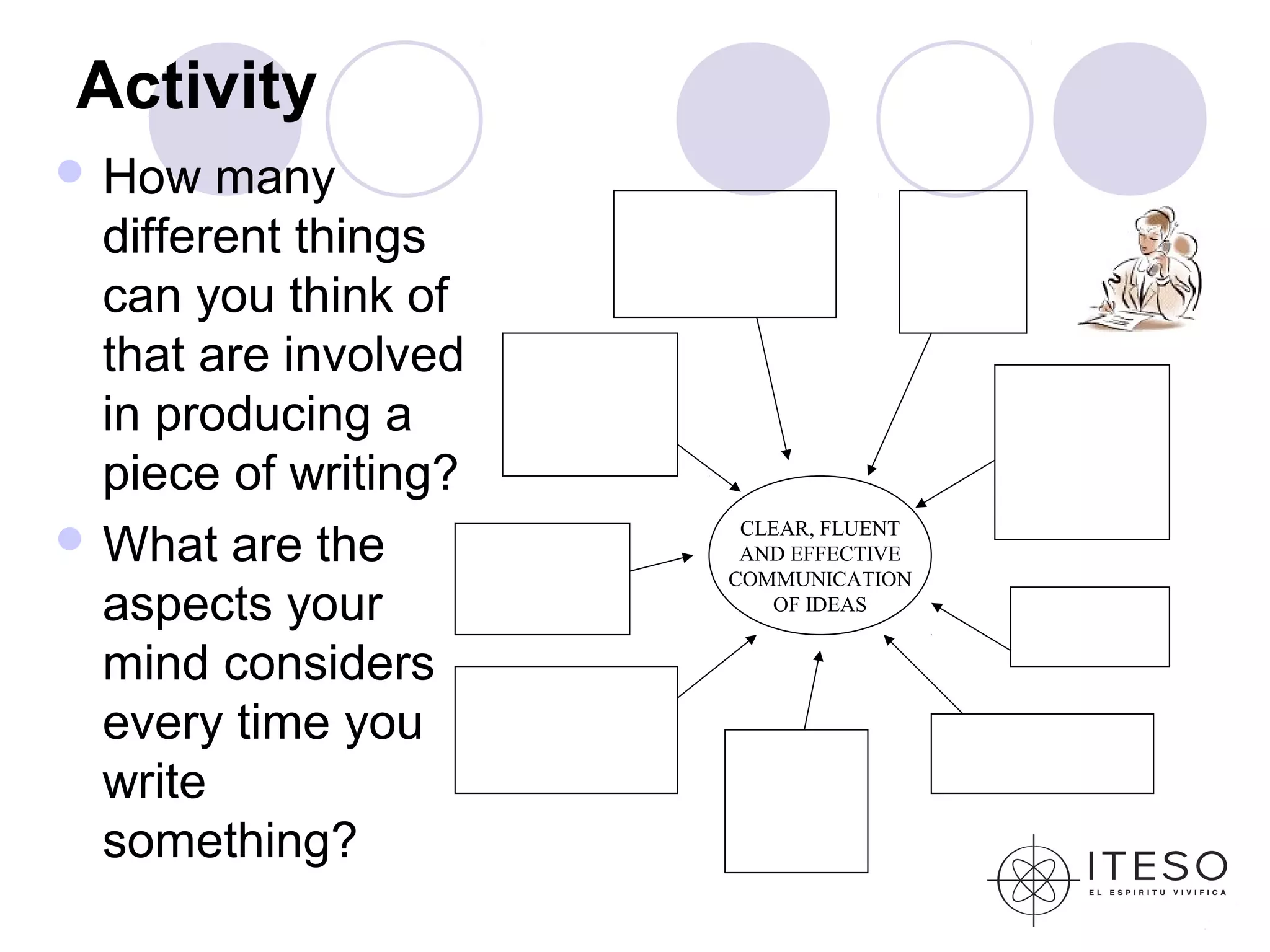
 How   many
  different things
  can you think of
  that are involved
  in producing a
  piece of writing?
 What are the         CLEAR, FLUENT
                       AND EFFECTIVE
                      COMMUNICATION
  aspects your           OF IDEAS


  mind considers
  every time you
  write
  something?
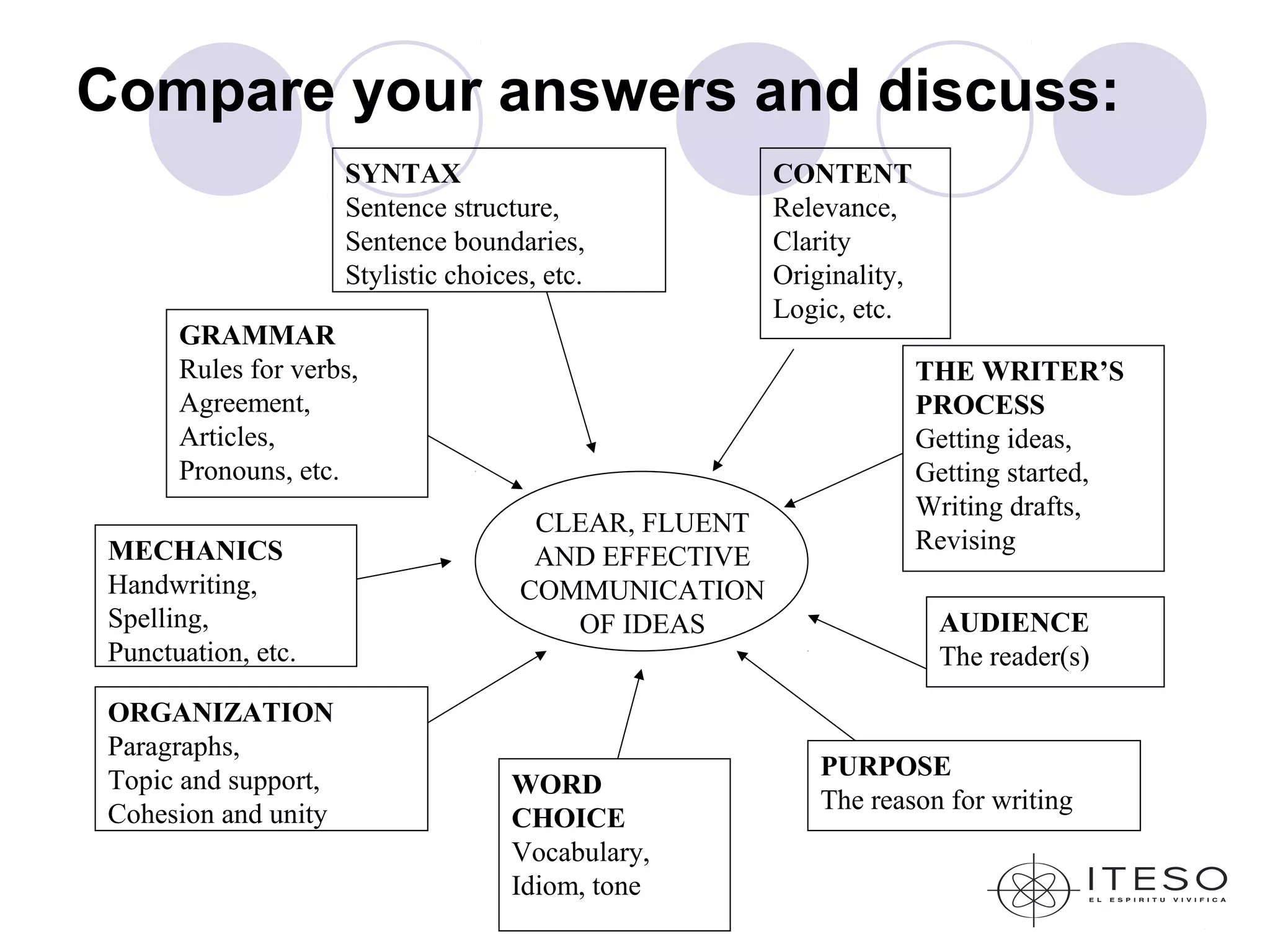
Compare your answers and discuss:
                      SYNTAX                           CONTENT
                      Sentence structure,              Relevance,
                      Sentence boundaries,             Clarity
                      Stylistic choices, etc.          Originality,
                                                       Logic, etc.
       GRAMMAR
       Rules for verbs,                                               THE WRITER’S
       Agreement,                                                     PROCESS
       Articles,                                                      Getting ideas,
       Pronouns, etc.                                                 Getting started,
                                                                      Writing drafts,
                                       CLEAR, FLUENT
 MECHANICS                                                            Revising
                                       AND EFFECTIVE
 Handwriting,                         COMMUNICATION
 Spelling,                               OF IDEAS                      AUDIENCE
 Punctuation, etc.                                                     The reader(s)
 ORGANIZATION
 Paragraphs,
 Topic and support,                                        PURPOSE
                                     WORD
 Cohesion and unity                                        The reason for writing
                                     CHOICE
                                     Vocabulary,
                                     Idiom, tone
Think about this:
 Ifthere are so many aspects to consider
  how do we ever write anything?
 We can write because we follow steps in a
  process and we do it in stages.
 Good writing is basically done following
  three easy steps:
    Pre-writing

    Writing

    Post-writing
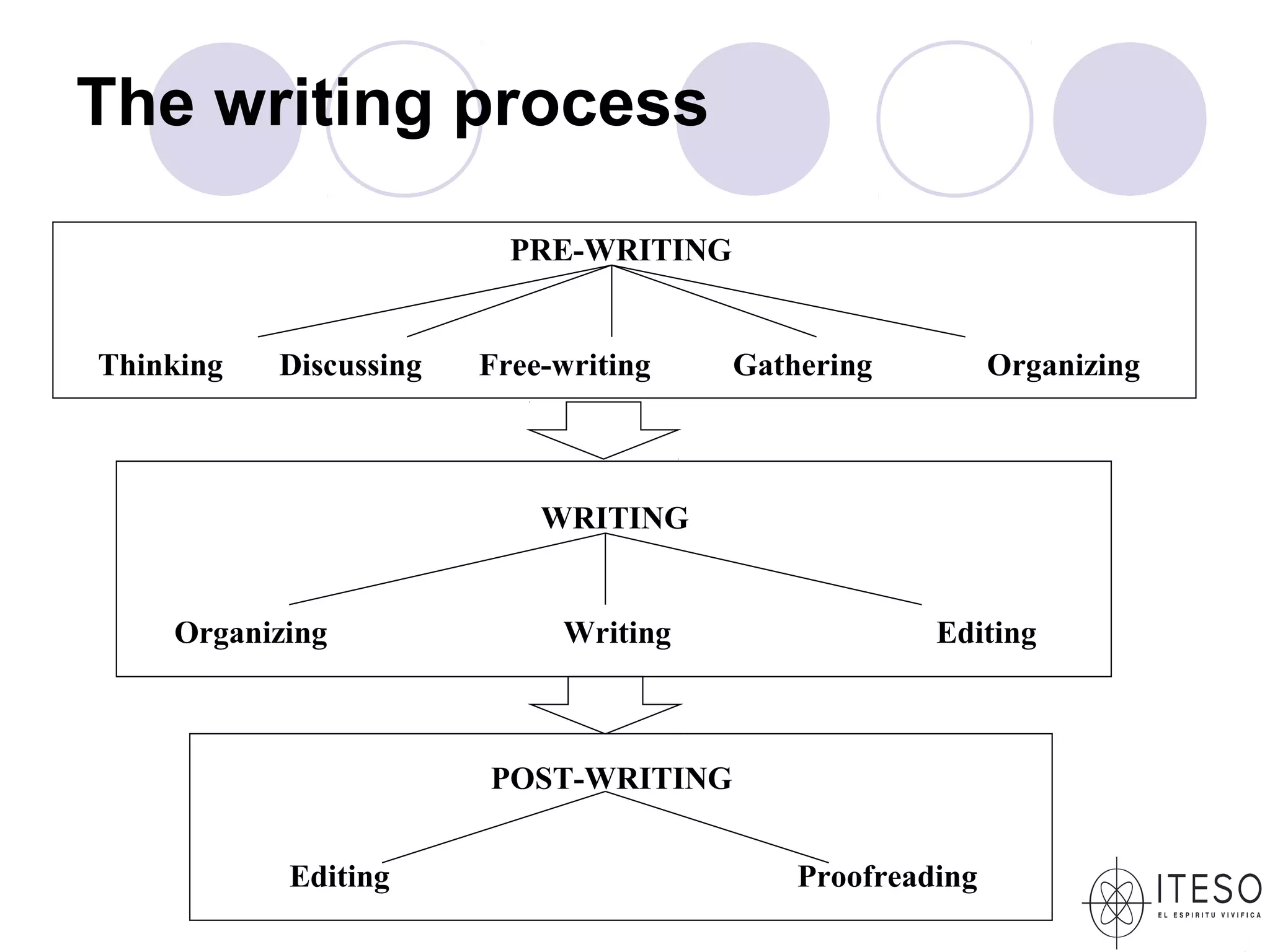
The writing process

                          PRE-WRITING


Thinking   Discussing   Free-writing    Gathering          Organizing


                            WRITING


    Organizing               Writing                 Editing


                        POST-WRITING


           Editing                          Proofreading
Activity
 How   many of these aspects in the three
  basic steps do you already follow?
 Which ones do you think you could
  incorporate to your writing process next
  time you write something?
 Re-write something you had already
  written, this time follow all the steps in the
  process. Compare it to the previous text.
  How are they different?
Think about this:
 Nobody   was born knowing how to write.
 You have probably been writing in your
  own language for a long time, and that still
  does not guarantee that you are good at
  writing.
 People need practice to become good at
  something: including writing.
 One way to practice writing is to do writing
  practice in stages.
Stages in writing practice
 Think   about they way you started
  producing pieces of writing in your own
  language, what were the first things that
  you did? Then what? And now?
 The stages go from:
   Copying,

   Controlled writing,
   Guided writing, to

   Free writing.
Activity:
 To    improve your writing skills practice
  activities for each one of the four different
  stages.
 Little by little upgrade the level of difficulty
  of the activities you use and practice,
  practice, practice.
 Next you will find some suggestions for
  activities you can do for each stage.
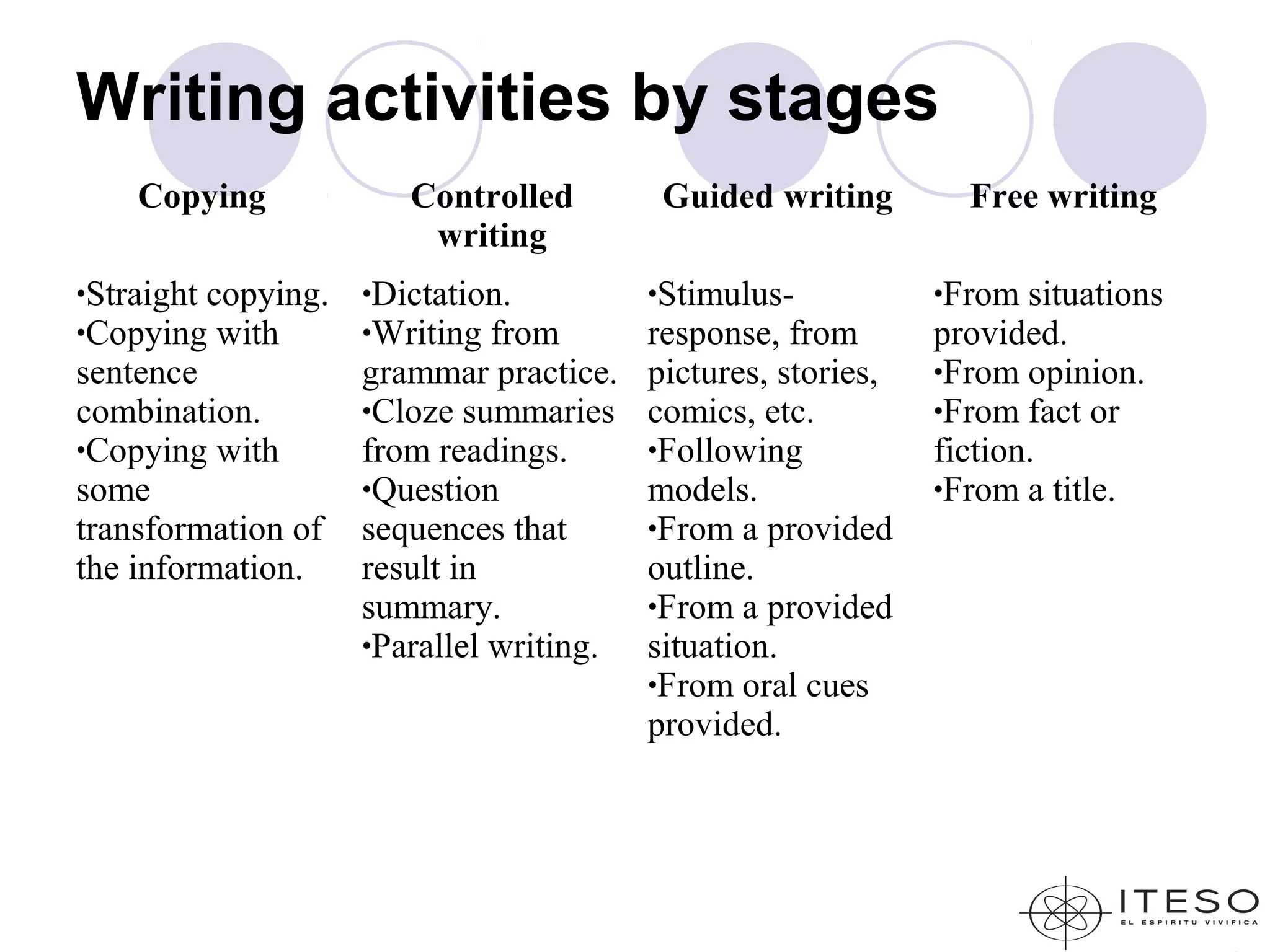
Writing activities by stages
    Copying             Controlled       Guided writing       Free writing
                         writing
•Straight copying.   •Dictation.        •Stimulus-          •From  situations
•Copying with        •Writing from      response, from      provided.
sentence             grammar practice. pictures, stories,   •From opinion.
combination.         •Cloze summaries comics, etc.          •From fact or
•Copying with        from readings.     •Following          fiction.
some                 •Question          models.             •From a title.
transformation of    sequences that     •From a provided
the information.     result in          outline.
                     summary.           •From a provided
                     •Parallel writing. situation.
                                        •From oral cues
                                        provided.

Learning to Learn Nivel 7

  • 1.
    LEARNING TO LEARN TRAININGPROGRAM LEVEL 7 Writing
  • 2.
    OBJECTIVES To helpyou realize the place of Writing in the process of learning a language and the skills involved in it. To make you aware of the different strategies that may be used to practice Writing.
  • 3.
    Activity  They say that good listeners become good speakers, and good readers become good writers.  Explain how this works, how is this possible and/or logical?  Think about a few specific things that you could probably improve in your writing by working on your reading. Ask around: your classmates, teachers, tutors, other people.
  • 4.
    Discuss the following: Writing is a complex skill.  It involves many different aspects.  When you write in your own language you are not always aware of all the things your mind considers in order to produce a piece of writing.  When you write in a different language you have to make a conscious effort to prepare, oversee and evaluate what you are writing.
  • 5.
    Activity  How many different things can you think of that are involved in producing a piece of writing?  What are the CLEAR, FLUENT AND EFFECTIVE COMMUNICATION aspects your OF IDEAS mind considers every time you write something?
  • 6.
    Compare your answersand discuss: SYNTAX CONTENT Sentence structure, Relevance, Sentence boundaries, Clarity Stylistic choices, etc. Originality, Logic, etc. GRAMMAR Rules for verbs, THE WRITER’S Agreement, PROCESS Articles, Getting ideas, Pronouns, etc. Getting started, Writing drafts, CLEAR, FLUENT MECHANICS Revising AND EFFECTIVE Handwriting, COMMUNICATION Spelling, OF IDEAS AUDIENCE Punctuation, etc. The reader(s) ORGANIZATION Paragraphs, Topic and support, PURPOSE WORD Cohesion and unity The reason for writing CHOICE Vocabulary, Idiom, tone
  • 7.
    Think about this: Ifthere are so many aspects to consider how do we ever write anything?  We can write because we follow steps in a process and we do it in stages.  Good writing is basically done following three easy steps:  Pre-writing  Writing  Post-writing
  • 8.
    The writing process PRE-WRITING Thinking Discussing Free-writing Gathering Organizing WRITING Organizing Writing Editing POST-WRITING Editing Proofreading
  • 9.
    Activity  How many of these aspects in the three basic steps do you already follow?  Which ones do you think you could incorporate to your writing process next time you write something?  Re-write something you had already written, this time follow all the steps in the process. Compare it to the previous text. How are they different?
  • 10.
    Think about this: Nobody was born knowing how to write.  You have probably been writing in your own language for a long time, and that still does not guarantee that you are good at writing.  People need practice to become good at something: including writing.  One way to practice writing is to do writing practice in stages.
  • 11.
    Stages in writingpractice  Think about they way you started producing pieces of writing in your own language, what were the first things that you did? Then what? And now?  The stages go from:  Copying,  Controlled writing,  Guided writing, to  Free writing.
  • 12.
    Activity:  To improve your writing skills practice activities for each one of the four different stages.  Little by little upgrade the level of difficulty of the activities you use and practice, practice, practice.  Next you will find some suggestions for activities you can do for each stage.
  • 13.
    Writing activities bystages Copying Controlled Guided writing Free writing writing •Straight copying. •Dictation. •Stimulus- •From situations •Copying with •Writing from response, from provided. sentence grammar practice. pictures, stories, •From opinion. combination. •Cloze summaries comics, etc. •From fact or •Copying with from readings. •Following fiction. some •Question models. •From a title. transformation of sequences that •From a provided the information. result in outline. summary. •From a provided •Parallel writing. situation. •From oral cues provided.