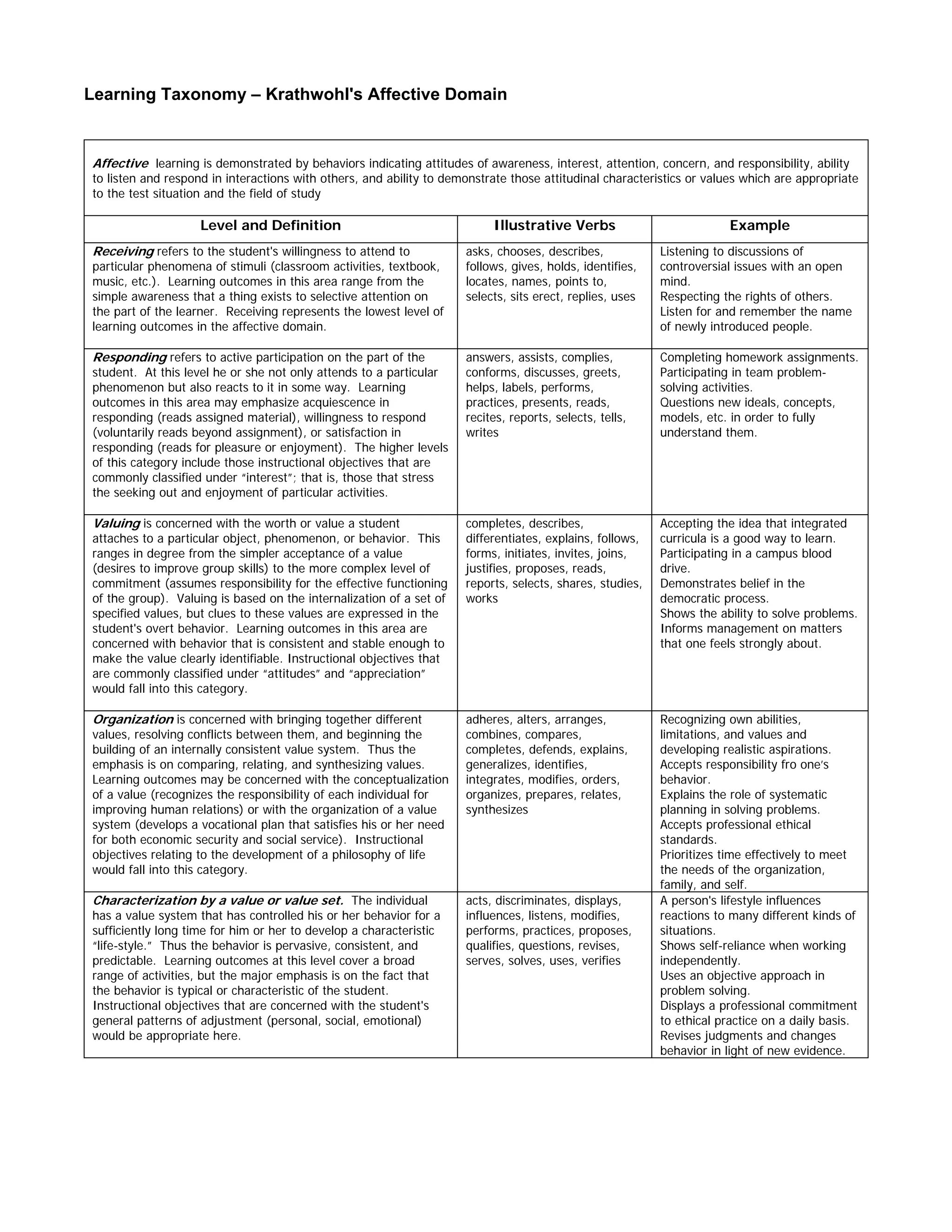
Learning Taxonomy – Krathwohl's Affective Domain


Affective learning is demonstrated by behaviors indicating attitudes of awareness, interest, attention, concern, and responsibility, ability
to listen and respond in interactions with others, and ability to demonstrate those attitudinal characteristics or values which are appropriate
to the test situation and the field of study

                    Level and Definition                                  Illustrative Verbs                           Example
Receiving refers to the student's willingness to attend to           asks, chooses, describes,            Listening to discussions of
particular phenomena of stimuli (classroom activities, textbook,     follows, gives, holds, identifies,   controversial issues with an open
music, etc.). Learning outcomes in this area range from the          locates, names, points to,           mind.
simple awareness that a thing exists to selective attention on       selects, sits erect, replies, uses   Respecting the rights of others.
the part of the learner. Receiving represents the lowest level of                                         Listen for and remember the name
learning outcomes in the affective domain.                                                                of newly introduced people.

Responding refers to active participation on the part of the         answers, assists, complies,          Completing homework assignments.
student. At this level he or she not only attends to a particular    conforms, discusses, greets,         Participating in team problem-
phenomenon but also reacts to it in some way. Learning               helps, labels, performs,             solving activities.
outcomes in this area may emphasize acquiescence in                  practices, presents, reads,          Questions new ideals, concepts,
responding (reads assigned material), willingness to respond         recites, reports, selects, tells,    models, etc. in order to fully
(voluntarily reads beyond assignment), or satisfaction in            writes                               understand them.
responding (reads for pleasure or enjoyment). The higher levels
of this category include those instructional objectives that are
commonly classified under “interest”; that is, those that stress
the seeking out and enjoyment of particular activities.

Valuing is concerned with the worth or value a student               completes, describes,                Accepting the idea that integrated
attaches to a particular object, phenomenon, or behavior. This       differentiates, explains, follows,   curricula is a good way to learn.
ranges in degree from the simpler acceptance of a value              forms, initiates, invites, joins,    Participating in a campus blood
(desires to improve group skills) to the more complex level of       justifies, proposes, reads,          drive.
commitment (assumes responsibility for the effective functioning     reports, selects, shares, studies,   Demonstrates belief in the
of the group). Valuing is based on the internalization of a set of   works                                democratic process.
specified values, but clues to these values are expressed in the                                          Shows the ability to solve problems.
student's overt behavior. Learning outcomes in this area are                                              Informs management on matters
concerned with behavior that is consistent and stable enough to                                           that one feels strongly about.
make the value clearly identifiable. Instructional objectives that
are commonly classified under “attitudes” and “appreciation”
would fall into this category.

Organization is concerned with bringing together different           adheres, alters, arranges,           Recognizing own abilities,
values, resolving conflicts between them, and beginning the          combines, compares,                  limitations, and values and
building of an internally consistent value system. Thus the          completes, defends, explains,        developing realistic aspirations.
emphasis is on comparing, relating, and synthesizing values.         generalizes, identifies,             Accepts responsibility fro one’s
Learning outcomes may be concerned with the conceptualization        integrates, modifies, orders,        behavior.
of a value (recognizes the responsibility of each individual for     organizes, prepares, relates,        Explains the role of systematic
improving human relations) or with the organization of a value       synthesizes                          planning in solving problems.
system (develops a vocational plan that satisfies his or her need                                         Accepts professional ethical
for both economic security and social service). Instructional                                             standards.
objectives relating to the development of a philosophy of life                                            Prioritizes time effectively to meet
would fall into this category.                                                                            the needs of the organization,
                                                                                                          family, and self.
Characterization by a value or value set. The individual             acts, discriminates, displays,       A person's lifestyle influences
has a value system that has controlled his or her behavior for a     influences, listens, modifies,       reactions to many different kinds of
sufficiently long time for him or her to develop a characteristic    performs, practices, proposes,       situations.
“life-style.” Thus the behavior is pervasive, consistent, and        qualifies, questions, revises,       Shows self-reliance when working
predictable. Learning outcomes at this level cover a broad           serves, solves, uses, verifies       independently.
range of activities, but the major emphasis is on the fact that                                           Uses an objective approach in
the behavior is typical or characteristic of the student.                                                 problem solving.
Instructional objectives that are concerned with the student's                                            Displays a professional commitment
general patterns of adjustment (personal, social, emotional)                                              to ethical practice on a daily basis.
would be appropriate here.                                                                                Revises judgments and changes
                                                                                                          behavior in light of new evidence.

Learning taxonomy affective

  • 1.
    Learning Taxonomy –Krathwohl's Affective Domain Affective learning is demonstrated by behaviors indicating attitudes of awareness, interest, attention, concern, and responsibility, ability to listen and respond in interactions with others, and ability to demonstrate those attitudinal characteristics or values which are appropriate to the test situation and the field of study Level and Definition Illustrative Verbs Example Receiving refers to the student's willingness to attend to asks, chooses, describes, Listening to discussions of particular phenomena of stimuli (classroom activities, textbook, follows, gives, holds, identifies, controversial issues with an open music, etc.). Learning outcomes in this area range from the locates, names, points to, mind. simple awareness that a thing exists to selective attention on selects, sits erect, replies, uses Respecting the rights of others. the part of the learner. Receiving represents the lowest level of Listen for and remember the name learning outcomes in the affective domain. of newly introduced people. Responding refers to active participation on the part of the answers, assists, complies, Completing homework assignments. student. At this level he or she not only attends to a particular conforms, discusses, greets, Participating in team problem- phenomenon but also reacts to it in some way. Learning helps, labels, performs, solving activities. outcomes in this area may emphasize acquiescence in practices, presents, reads, Questions new ideals, concepts, responding (reads assigned material), willingness to respond recites, reports, selects, tells, models, etc. in order to fully (voluntarily reads beyond assignment), or satisfaction in writes understand them. responding (reads for pleasure or enjoyment). The higher levels of this category include those instructional objectives that are commonly classified under “interest”; that is, those that stress the seeking out and enjoyment of particular activities. Valuing is concerned with the worth or value a student completes, describes, Accepting the idea that integrated attaches to a particular object, phenomenon, or behavior. This differentiates, explains, follows, curricula is a good way to learn. ranges in degree from the simpler acceptance of a value forms, initiates, invites, joins, Participating in a campus blood (desires to improve group skills) to the more complex level of justifies, proposes, reads, drive. commitment (assumes responsibility for the effective functioning reports, selects, shares, studies, Demonstrates belief in the of the group). Valuing is based on the internalization of a set of works democratic process. specified values, but clues to these values are expressed in the Shows the ability to solve problems. student's overt behavior. Learning outcomes in this area are Informs management on matters concerned with behavior that is consistent and stable enough to that one feels strongly about. make the value clearly identifiable. Instructional objectives that are commonly classified under “attitudes” and “appreciation” would fall into this category. Organization is concerned with bringing together different adheres, alters, arranges, Recognizing own abilities, values, resolving conflicts between them, and beginning the combines, compares, limitations, and values and building of an internally consistent value system. Thus the completes, defends, explains, developing realistic aspirations. emphasis is on comparing, relating, and synthesizing values. generalizes, identifies, Accepts responsibility fro one’s Learning outcomes may be concerned with the conceptualization integrates, modifies, orders, behavior. of a value (recognizes the responsibility of each individual for organizes, prepares, relates, Explains the role of systematic improving human relations) or with the organization of a value synthesizes planning in solving problems. system (develops a vocational plan that satisfies his or her need Accepts professional ethical for both economic security and social service). Instructional standards. objectives relating to the development of a philosophy of life Prioritizes time effectively to meet would fall into this category. the needs of the organization, family, and self. Characterization by a value or value set. The individual acts, discriminates, displays, A person's lifestyle influences has a value system that has controlled his or her behavior for a influences, listens, modifies, reactions to many different kinds of sufficiently long time for him or her to develop a characteristic performs, practices, proposes, situations. “life-style.” Thus the behavior is pervasive, consistent, and qualifies, questions, revises, Shows self-reliance when working predictable. Learning outcomes at this level cover a broad serves, solves, uses, verifies independently. range of activities, but the major emphasis is on the fact that Uses an objective approach in the behavior is typical or characteristic of the student. problem solving. Instructional objectives that are concerned with the student's Displays a professional commitment general patterns of adjustment (personal, social, emotional) to ethical practice on a daily basis. would be appropriate here. Revises judgments and changes behavior in light of new evidence.