Q-LEARNING
CO-3
AIM
To familiarize students with the concepts of unsupervised machine learning, hierarchical clustering, distance
functions, and data standardization
INSTRUCTIONAL OBJECTIVES
This session is designed to:
1. Two formulations for learning: Inductive and Analytical
2. Perfect domain theories
LEARNING OUTCOMES
At the end of this session, you should be able to:
1. Hierarchical clustering and its types
2. Agglomerative clustering
3. Measuring the distance of two clusters
4. Data standardization techniques
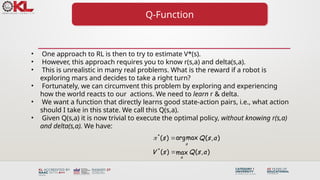
Q-Function
• One approach to RL is then to try to estimate V*(s).
• However, this approach requires you to know r(s,a) and delta(s,a).
• This is unrealistic in many real problems. What is the reward if a robot is
exploring mars and decides to take a right turn?
• Fortunately, we can circumvent this problem by exploring and experiencing
how the world reacts to our actions. We need to learn r & delta.
• We want a function that directly learns good state-action pairs, i.e., what action
should I take in this state. We call this Q(s,a).
• Given Q(s,a) it is now trivial to execute the optimal policy, without knowing r(s,a)
and delta(s,a). We have:
*
*
argmax
( ) ( , )
( ) ( , )
max
a
a
s Q s a
V s Q s a
 

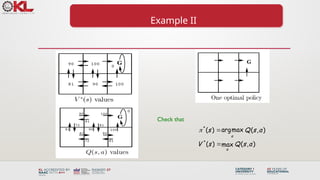
Example II
*
*
argmax
( ) ( , )
( ) ( , )
max
a
a
s Q s a
V s Q s a
 

Check that
Q-Learning
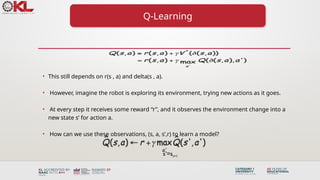
• This still depends on r(s , a) and delta(s , a).
• However, imagine the robot is exploring its environment, trying new actions as it goes.
• At every step it receives some reward “r”, and it observes the environment change into a
new state s’ for action a.
• How can we use these observations, (s, a, s’,r) to learn a model?
s’=st+1
Q-Learning
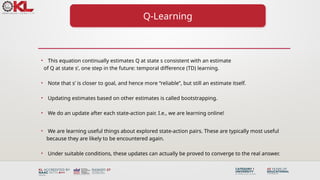
• This equation continually estimates Q at state s consistent with an estimate
of Q at state s’, one step in the future: temporal difference (TD) learning.
• Note that s’ is closer to goal, and hence more “reliable”, but still an estimate itself.
• Updating estimates based on other estimates is called bootstrapping.
• We do an update after each state-action pair. I.e., we are learning online!
• We are learning useful things about explored state-action pairs. These are typically most useful
because they are likely to be encountered again.
• Under suitable conditions, these updates can actually be proved to converge to the real answer.
Example Q-Learning
1 2
'
ˆ ˆ
( , ) ( , ')
max
0 0.9 max{66,81,100}
90
right
a
Q s a r Q s a

 
 

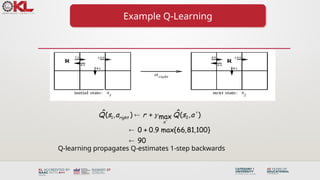
Q-learning propagates Q-estimates 1-step backwards
Exploration / Exploitation
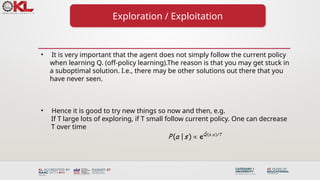
• It is very important that the agent does not simply follow the current policy
when learning Q. (off-policy learning).The reason is that you may get stuck in
a suboptimal solution. I.e., there may be other solutions out there that you
have never seen.
• Hence it is good to try new things so now and then, e.g.
If T large lots of exploring, if T small follow current policy. One can decrease
T over time
ˆ( , )/
( | ) eQ s a T
P a s 
Improvements
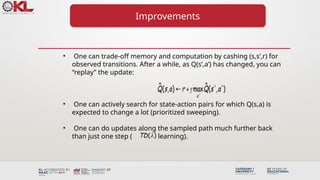
• One can trade-off memory and computation by cashing (s,s’,r) for
observed transitions. After a while, as Q(s’,a’) has changed, you can
“replay” the update:
• One can actively search for state-action pairs for which Q(s,a) is
expected to change a lot (prioritized sweeping).
• One can do updates along the sampled path much further back
than just one step ( learning).
( )
TD 
Extensions
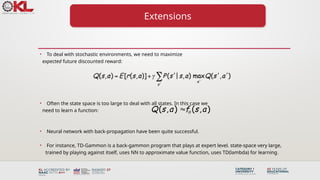
• To deal with stochastic environments, we need to maximize
expected future discounted reward:
• Often the state space is too large to deal with all states. In this case we
need to learn a function:
• Neural network with back-propagation have been quite successful.
• For instance, TD-Gammon is a back-gammon program that plays at expert level. state-space very large,
trained by playing against itself, uses NN to approximate value function, uses TD(lambda) for learning.
( , ) ( , )
Q s a f s a


More on Function Approximation
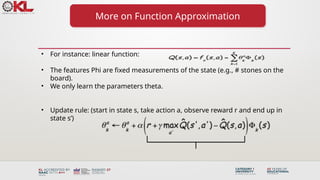
• For instance: linear function:
• The features Phi are fixed measurements of the state (e.g., # stones on the
board).
• We only learn the parameters theta.
• Update rule: (start in state s, take action a, observe reward r and end up in
state s’)
Conclusion
• Reinforcement learning addresses a very broad and relevant question:
• How can we learn to survive in our environment?
• We have looked at Q-learning, which simply learn s from experience.
• No model of the world is needed.
• We made simplifying assumptions: e.g., state of the world only depends on
last state and action. This is the Markov assumption. The model is called a
Markov Decision Process (MDP).
• We assumed deterministic dynamics, reward function, but the world really
is stochastic.
• There are many extensions to speed up learning.
• There have been many successful real-world applications.
Applications of
Reinforcement Learning
• Robotics for industrial automation.
• Business strategy planning
• Machine learning and data processing
• It helps you to create training systems that provide custom
instruction and materials according to the requirement of
students.
• Aircraft control and robot motion control
• Traffic Light Control
• A robot cleaning room and recharging its battery
• Robot-soccer
• How to invest in shares
• Modeling the economy through rational agents
• Learning how to fly a helicopter
• Scheduling planes to their destinations
THANK YOU
TEAM ML

Learning Task in machine learning

  • 1.
  • 2.
    AIM To familiarize studentswith the concepts of unsupervised machine learning, hierarchical clustering, distance functions, and data standardization INSTRUCTIONAL OBJECTIVES This session is designed to: 1. Two formulations for learning: Inductive and Analytical 2. Perfect domain theories LEARNING OUTCOMES At the end of this session, you should be able to: 1. Hierarchical clustering and its types 2. Agglomerative clustering 3. Measuring the distance of two clusters 4. Data standardization techniques
  • 3.
    Q-Function • One approachto RL is then to try to estimate V*(s). • However, this approach requires you to know r(s,a) and delta(s,a). • This is unrealistic in many real problems. What is the reward if a robot is exploring mars and decides to take a right turn? • Fortunately, we can circumvent this problem by exploring and experiencing how the world reacts to our actions. We need to learn r & delta. • We want a function that directly learns good state-action pairs, i.e., what action should I take in this state. We call this Q(s,a). • Given Q(s,a) it is now trivial to execute the optimal policy, without knowing r(s,a) and delta(s,a). We have: * * argmax ( ) ( , ) ( ) ( , ) max a a s Q s a V s Q s a   
  • 4.
    Example II * * argmax ( )( , ) ( ) ( , ) max a a s Q s a V s Q s a    Check that
  • 5.
    Q-Learning • This stilldepends on r(s , a) and delta(s , a). • However, imagine the robot is exploring its environment, trying new actions as it goes. • At every step it receives some reward “r”, and it observes the environment change into a new state s’ for action a. • How can we use these observations, (s, a, s’,r) to learn a model? s’=st+1
  • 6.
    Q-Learning • This equationcontinually estimates Q at state s consistent with an estimate of Q at state s’, one step in the future: temporal difference (TD) learning. • Note that s’ is closer to goal, and hence more “reliable”, but still an estimate itself. • Updating estimates based on other estimates is called bootstrapping. • We do an update after each state-action pair. I.e., we are learning online! • We are learning useful things about explored state-action pairs. These are typically most useful because they are likely to be encountered again. • Under suitable conditions, these updates can actually be proved to converge to the real answer.
  • 7.
    Example Q-Learning 1 2 ' ˆˆ ( , ) ( , ') max 0 0.9 max{66,81,100} 90 right a Q s a r Q s a       Q-learning propagates Q-estimates 1-step backwards
  • 8.
    Exploration / Exploitation •It is very important that the agent does not simply follow the current policy when learning Q. (off-policy learning).The reason is that you may get stuck in a suboptimal solution. I.e., there may be other solutions out there that you have never seen. • Hence it is good to try new things so now and then, e.g. If T large lots of exploring, if T small follow current policy. One can decrease T over time ˆ( , )/ ( | ) eQ s a T P a s 
  • 9.
    Improvements • One cantrade-off memory and computation by cashing (s,s’,r) for observed transitions. After a while, as Q(s’,a’) has changed, you can “replay” the update: • One can actively search for state-action pairs for which Q(s,a) is expected to change a lot (prioritized sweeping). • One can do updates along the sampled path much further back than just one step ( learning). ( ) TD 
  • 10.
    Extensions • To dealwith stochastic environments, we need to maximize expected future discounted reward: • Often the state space is too large to deal with all states. In this case we need to learn a function: • Neural network with back-propagation have been quite successful. • For instance, TD-Gammon is a back-gammon program that plays at expert level. state-space very large, trained by playing against itself, uses NN to approximate value function, uses TD(lambda) for learning. ( , ) ( , ) Q s a f s a  
  • 11.
    More on FunctionApproximation • For instance: linear function: • The features Phi are fixed measurements of the state (e.g., # stones on the board). • We only learn the parameters theta. • Update rule: (start in state s, take action a, observe reward r and end up in state s’)
  • 12.
    Conclusion • Reinforcement learningaddresses a very broad and relevant question: • How can we learn to survive in our environment? • We have looked at Q-learning, which simply learn s from experience. • No model of the world is needed. • We made simplifying assumptions: e.g., state of the world only depends on last state and action. This is the Markov assumption. The model is called a Markov Decision Process (MDP). • We assumed deterministic dynamics, reward function, but the world really is stochastic. • There are many extensions to speed up learning. • There have been many successful real-world applications.
  • 13.
    Applications of Reinforcement Learning •Robotics for industrial automation. • Business strategy planning • Machine learning and data processing • It helps you to create training systems that provide custom instruction and materials according to the requirement of students. • Aircraft control and robot motion control • Traffic Light Control • A robot cleaning room and recharging its battery • Robot-soccer • How to invest in shares • Modeling the economy through rational agents • Learning how to fly a helicopter • Scheduling planes to their destinations
  • 14.