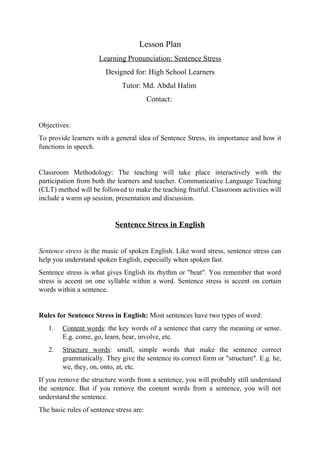
Lesson Plan 
Learning Pronunciation: Sentence Stress 
Designed for: High School Learners 
Tutor: Md. Abdul Halim 
Contact: 
Objectives: 
To provide learners with a general idea of Sentence Stress, its importance and how it 
functions in speech. 
Classroom Methodology: The teaching will take place interactively with the 
participation from both the learners and teacher. Communicative Language Teaching 
(CLT) method will be followed to make the teaching fruitful. Classroom activities will 
include a warm up session, presentation and discussion. 
Sentence Stress in English 
Sentence stress is the music of spoken English. Like word stress, sentence stress can 
help you understand spoken English, especially when spoken fast. 
Sentence stress is what gives English its rhythm or "beat". You remember that word 
stress is accent on one syllable within a word. Sentence stress is accent on certain 
words within a sentence. 
Rules for Sentence Stress in English: Most sentences have two types of word: 
1. Content words : the key words of a sentence that carry the meaning or sense. 
E.g. come, go, learn, hear, involve, etc. 
2. Structure words : small, simple words that make the sentence correct 
grammatically. They give the sentence its correct form or "structure". E.g. he, 
we, they, on, onto, at, etc. 
If you remove the structure words from a sentence, you will probably still understand 
the sentence. But if you remove the content words from a sentence, you will not 
understand the sentence. 
The basic rules of sentence stress are:
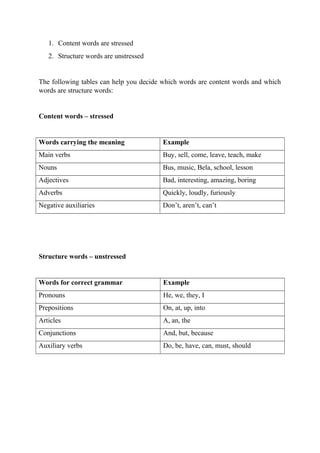
1. Content words are stressed 
2. Structure words are unstressed 
The following tables can help you decide which words are content words and which 
words are structure words: 
Content words – stressed 
Words carrying the meaning Example 
Main verbs Buy, sell, come, leave, teach, make 
Nouns Bus, music, Bela, school, lesson 
Adjectives Bad, interesting, amazing, boring 
Adverbs Quickly, loudly, furiously 
Negative auxiliaries Don’t, aren’t, can’t 
Structure words – unstressed 
Words for correct grammar Example 
Pronouns He, we, they, I 
Prepositions On, at, up, into 
Articles A, an, the 
Conjunctions And, but, because 
Auxiliary verbs Do, be, have, can, must, should
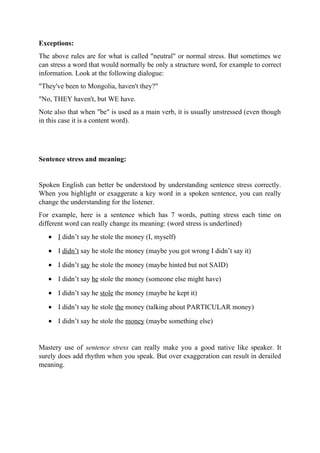
Exceptions: 
The above rules are for what is called "neutral" or normal stress. But sometimes we 
can stress a word that would normally be only a structure word, for example to correct 
information. Look at the following dialogue: 
"They've been to Mongolia, haven't they?" 
"No, THEY haven't, but WE have. 
Note also that when "be" is used as a main verb, it is usually unstressed (even though 
in this case it is a content word). 
Sentence stress and meaning: 
Spoken English can better be understood by understanding sentence stress correctly. 
When you highlight or exaggerate a key word in a spoken sentence, you can really 
change the understanding for the listener. 
For example, here is a sentence which has 7 words, putting stress each time on 
different word can really change its meaning: (word stress is underlined) 
· I didn’t say he stole the money (I, myself) 
· I didn’t say he stole the money (maybe you got wrong I didn’t say it) 
· I didn’t say he stole the money (maybe hinted but not SAID) 
· I didn’t say he stole the money (someone else might have) 
· I didn’t say he stole the money (maybe he kept it) 
· I didn’t say he stole the money (talking about PARTICULAR money) 
· I didn’t say he stole the money (maybe something else) 
Mastery use of sentence stress can really make you a good native like speaker. It 
surely does add rhythm when you speak. But over exaggeration can result in derailed 
meaning.

Learning Pronunciation: Sentence Stress

  • 1.
    Lesson Plan LearningPronunciation: Sentence Stress Designed for: High School Learners Tutor: Md. Abdul Halim Contact: Objectives: To provide learners with a general idea of Sentence Stress, its importance and how it functions in speech. Classroom Methodology: The teaching will take place interactively with the participation from both the learners and teacher. Communicative Language Teaching (CLT) method will be followed to make the teaching fruitful. Classroom activities will include a warm up session, presentation and discussion. Sentence Stress in English Sentence stress is the music of spoken English. Like word stress, sentence stress can help you understand spoken English, especially when spoken fast. Sentence stress is what gives English its rhythm or "beat". You remember that word stress is accent on one syllable within a word. Sentence stress is accent on certain words within a sentence. Rules for Sentence Stress in English: Most sentences have two types of word: 1. Content words : the key words of a sentence that carry the meaning or sense. E.g. come, go, learn, hear, involve, etc. 2. Structure words : small, simple words that make the sentence correct grammatically. They give the sentence its correct form or "structure". E.g. he, we, they, on, onto, at, etc. If you remove the structure words from a sentence, you will probably still understand the sentence. But if you remove the content words from a sentence, you will not understand the sentence. The basic rules of sentence stress are:
  • 2.
    1. Content wordsare stressed 2. Structure words are unstressed The following tables can help you decide which words are content words and which words are structure words: Content words – stressed Words carrying the meaning Example Main verbs Buy, sell, come, leave, teach, make Nouns Bus, music, Bela, school, lesson Adjectives Bad, interesting, amazing, boring Adverbs Quickly, loudly, furiously Negative auxiliaries Don’t, aren’t, can’t Structure words – unstressed Words for correct grammar Example Pronouns He, we, they, I Prepositions On, at, up, into Articles A, an, the Conjunctions And, but, because Auxiliary verbs Do, be, have, can, must, should
  • 3.
    Exceptions: The aboverules are for what is called "neutral" or normal stress. But sometimes we can stress a word that would normally be only a structure word, for example to correct information. Look at the following dialogue: "They've been to Mongolia, haven't they?" "No, THEY haven't, but WE have. Note also that when "be" is used as a main verb, it is usually unstressed (even though in this case it is a content word). Sentence stress and meaning: Spoken English can better be understood by understanding sentence stress correctly. When you highlight or exaggerate a key word in a spoken sentence, you can really change the understanding for the listener. For example, here is a sentence which has 7 words, putting stress each time on different word can really change its meaning: (word stress is underlined) · I didn’t say he stole the money (I, myself) · I didn’t say he stole the money (maybe you got wrong I didn’t say it) · I didn’t say he stole the money (maybe hinted but not SAID) · I didn’t say he stole the money (someone else might have) · I didn’t say he stole the money (maybe he kept it) · I didn’t say he stole the money (talking about PARTICULAR money) · I didn’t say he stole the money (maybe something else) Mastery use of sentence stress can really make you a good native like speaker. It surely does add rhythm when you speak. But over exaggeration can result in derailed meaning.