




PRESENTATION
Members :
SAMIKSHA MAINALI KRISHNA GUPTA
RANJANA YADAV Rupesh Niraula
Vhawana parajuli Yadav Adikari
Shakuntala Rauniyar
LEARNING
DATE :2071/03/19
Contents:
o Concept
o Theories of learning:
• Behavioral perspective
 Classical conditioning
 Operant conditioning
• Cognitive perspective
 Observational learning
 Insight learning
o Application of learning theories:
• Shaping behavior
 Positive reinforcement
 Negative reinforcement
 Punishment
 Extinction
• Schedule of reinforcement
• Behavior modification
Concept
Learning is a relatively permanent change in behavioral tendency
and is the result of reinforced practice.
Characteristics of learning
 Learning is a continuous process.
 Learning is a key process in human behavior.
 Without learning, life becomes meaningless and
colorless.
 Learning shapes our thoughts, language, motivations,
emotions, personalities and attitudes.
 It ranges from simple to complex.
 It is influenced by the learning, stimulus, and
environmental factors.
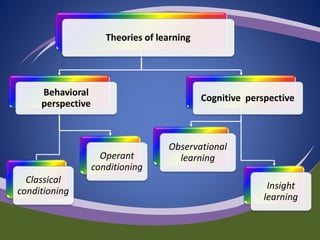
Theories of learning
Behavioral
perspective
Classical
conditioning
Operant
conditioning
Cognitive perspective
Observational
learning
Insight
learning
A. Classical conditioning:
 Russian physiologist and scientist Ivan P. Pavlov developed
the conditioning technique known as ‘Pavlovian’
conditioning’.
 He conducted much of his research on dogs, and example
of classical conditioning can be found in many human
behaviors.
 Classical conditioning is a type of learning in which a
neutral stimulus comes to bring about a response after it is
paired with a stimulus that naturally brings about that
response.
1. Behavioral perspective
BASIC ELEMENTS OF CLASSICAL
CONDITIONING
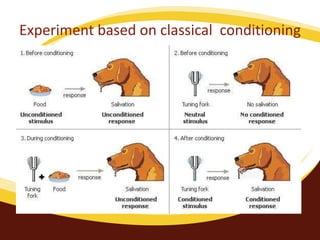
1. Neutral stimulus: A stimulus that before conditioning, does
not naturally bring about the response of interest.
2. Unconditioned stimulus: A stimulus that naturally brings
about a particular response without having been learned.
3. Unconditioned response: A response that is natural and needs
no training.
4. Conditioned stimulus: A neutral stimulus that have been
paired with an unconditioned stimulus to bring about a
response formally caused only by the unconditioned stimulus.
5. Conditioned response: A response that, after conditioning,
follows a previously neutral stimulus.
Experiment based on classical conditioning
BASIC PRINCIPLES OF CLASSICAL
CONDITIONING
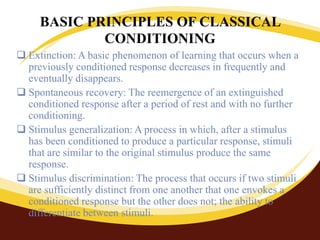
 Extinction: A basic phenomenon of learning that occurs when a
previously conditioned response decreases in frequently and
eventually disappears.
 Spontaneous recovery: The reemergence of an extinguished
conditioned response after a period of rest and with no further
conditioning.
 Stimulus generalization: A process in which, after a stimulus
has been conditioned to produce a particular response, stimuli
that are similar to the original stimulus produce the same
response.
 Stimulus discrimination: The process that occurs if two stimuli
are sufficiently distinct from one another that one envokes a
conditioned response but the other does not; the ability to
differentiate between stimuli.
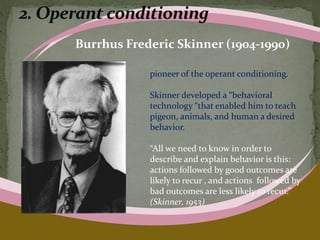
Burrhus Frederic Skinner (1904-1990)
pioneer of the operant conditioning.
Skinner developed a “behavioral
technology “that enabled him to teach
pigeon, animals, and human a desired
behavior.
“All we need to know in order to
describe and explain behavior is this:
actions followed by good outcomes are
likely to recur , and actions followed by
bad outcomes are less likely to recur.”
(Skinner, 1953)
B. Operant conditioning :
It is derived from the word ‘operate’.
Skinner used the term operant to refer to any "active behavior
that operates upon the environment to generate
consequences" (1953).
Operant conditioning is a method of learning that occurs through
rewards and punishments for behavior through operant
conditioning, an association is made between a behavior and
a consequence for that behavior.
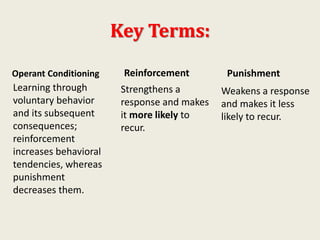
Key Terms:
Operant Conditioning
Learning through
voluntary behavior
and its subsequent
consequences;
reinforcement
increases behavioral
tendencies, whereas
punishment
decreases them.
Reinforcement
Strengthens a
response and makes
it more likely to
recur.
Punishment
Weakens a response
and makes it less
likely to recur.
Experiment based on classical conditioning
Let’s have a look on experiment conducted by B.F
Skinner..learninghyperlink folderAn example of a Skinner Box.mp4
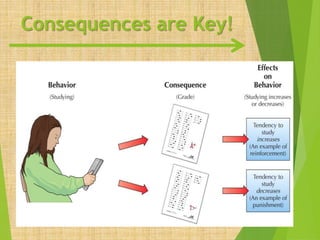
Consequences are Key!
2. Cognitive perspective
A. Observational learning
1. Shaping Behavior
Shaping is an experimental process used in operant conditioning
by which successive approximations of a target behavior are
reinforced.
This method relies on the :
 Use of behavioral reinforcement
 Use of behavioral punishment
Application of learning theories:
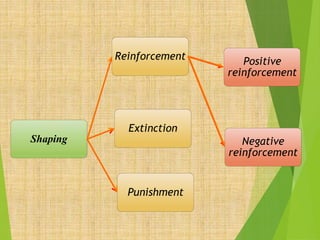
Shaping
Reinforcement Positive
reinforcement
Negative
reinforcement
Extinction
Punishment
Reinforcement
Procedure that:
 increases the likelihood that the response will occur &
 strengthen behavior
It is the application or removal of a stimulus to increase the
strength of a specific behavior.
There are two types of reinforcement:
 Positive reinforcement
 Negative reinforcement
Positive reinforcement
 It strengthens responses that precede occurrence of stimulus.
 It involves the impact of positive reinforces.
 Positive reinforces - event or stimuli that increases the probability that
the responses will occur again in the future.
Factors influencing Positive reinforcement
 Timing
 Consistency in providing reinforcement
 The reinforcer must be reinforcing
Negative Reinforcement
 It strengthens responses that permit the escape or avoidance of
stimulus.
 It involves the impact of negative reinforcers.
 Negative reinforcers- event or stimuli that strengthens responses
that lead to their termination or avoidance.
Types of Negative reinforcement
Escape conditioning:
Behavior is reinforced by the elimination of expected event from happening.
Avoidance conditioning:
Behavior is reinforced by preventing an expected event from happening.
Punishment
 A punishment has the opposite affect, decreasing the
likelihood, or rate of responding to a target response.
 Punishment, when appropriately used, can be a valuable
tool for discouraging inappropriate behavior.
 Punishment is also positive and negative.
Factors influencing Punishment
 The punishment should be applied immediately after the undesired
responses that is to be eliminated.
 The punishment should be strong enough to make a real difference.
 Punishment should be applied uniformly.
 Provide alternative desired reinforcer for the person.
Extinction
 Extinction refers to the systematic withholding of the
reinforcers which had previously maintained a behavior.
 Ignoring a behavior is an example of extinction if that
behavior has been maintained by the attention of the
person doing the ignoring.
Extinction is likely to work effectively under
these conditions:
 If the person has previously received continuous reinforcement for the
behavior.
 If reinforcement has occurred only a few times.
 If the person is not excessively deprived of the reinforcer.
 If the behavior requires a great deal of effort.
 If it is possible to withdraw all the reinforcers.
 If extinction can be combined with punishment, reinforcement of an
alternative behavior, or modeling.
2. Schedule of reinforcement
Reinforcement is anything that increases the likelihood that a
response will occur. A schedule of reinforcement is basically a
rule stating which instance of a behaviour will be reinforced.
In operant conditioning ,schedules of reinforcement are an
important component of the learning process when and how
often we reinforce a behaviour can have a dramatic impact on
the strength and rate of the response.
Certain types of reinforcement may be more
effective in specific situations
A. Continuous reinforcement:-
It is a conditioning principle where the subject is rewarded
every time it does the appropriate action.
A. Partial reinforcement:-
Partial reinforcement is when an individual is rewarded on
some but not all, trials. There are four kinds of partial
reinforcement:-
 Fixed –ratio schedule
 Variable ratio schedule
 fixed interval schedule
 variable interval schedule
3. Behavior modification
 A formalized technique for promoting the frequency of
desirable behaviors & decreasing the incidence of unwanted
ones
 It is a great way to address a variety of behavior problem,
 The techniques are often applied in every life
 tries to stimulate & maintain desired & extinguish undesired
behavior
 targets specific behaviors that require change
 Also know as Applied behavior analysis (ABA)
It cosisits of four components ie
 Positive reinforcement
 Negetive reinforcement
 Positive punishment
 Negetive punishment
Steps of Behavior Modification
Identifying goals & target behaviors.
Designing a data recording system & recording
preliminary data.
Selecting a behavior change strategy.
Implementing the program.
Keeping careful records after the program is
implemented.
Evaluating & altering the ongoing program.
 Mr Arjun Rai
 All the Viewes
 And all the Group members

learning

  • 1.
    PRESENTATION Members : SAMIKSHA MAINALIKRISHNA GUPTA RANJANA YADAV Rupesh Niraula Vhawana parajuli Yadav Adikari Shakuntala Rauniyar
  • 2.
  • 3.
    Contents: o Concept o Theoriesof learning: • Behavioral perspective  Classical conditioning  Operant conditioning • Cognitive perspective  Observational learning  Insight learning o Application of learning theories: • Shaping behavior  Positive reinforcement  Negative reinforcement  Punishment  Extinction • Schedule of reinforcement • Behavior modification
  • 4.
    Concept Learning is arelatively permanent change in behavioral tendency and is the result of reinforced practice.
  • 5.
    Characteristics of learning Learning is a continuous process.  Learning is a key process in human behavior.  Without learning, life becomes meaningless and colorless.  Learning shapes our thoughts, language, motivations, emotions, personalities and attitudes.  It ranges from simple to complex.  It is influenced by the learning, stimulus, and environmental factors.
  • 6.
  • 7.
    A. Classical conditioning: Russian physiologist and scientist Ivan P. Pavlov developed the conditioning technique known as ‘Pavlovian’ conditioning’.  He conducted much of his research on dogs, and example of classical conditioning can be found in many human behaviors.  Classical conditioning is a type of learning in which a neutral stimulus comes to bring about a response after it is paired with a stimulus that naturally brings about that response. 1. Behavioral perspective
  • 8.
    BASIC ELEMENTS OFCLASSICAL CONDITIONING 1. Neutral stimulus: A stimulus that before conditioning, does not naturally bring about the response of interest. 2. Unconditioned stimulus: A stimulus that naturally brings about a particular response without having been learned. 3. Unconditioned response: A response that is natural and needs no training. 4. Conditioned stimulus: A neutral stimulus that have been paired with an unconditioned stimulus to bring about a response formally caused only by the unconditioned stimulus. 5. Conditioned response: A response that, after conditioning, follows a previously neutral stimulus.
  • 9.
    Experiment based onclassical conditioning
  • 10.
    BASIC PRINCIPLES OFCLASSICAL CONDITIONING  Extinction: A basic phenomenon of learning that occurs when a previously conditioned response decreases in frequently and eventually disappears.  Spontaneous recovery: The reemergence of an extinguished conditioned response after a period of rest and with no further conditioning.  Stimulus generalization: A process in which, after a stimulus has been conditioned to produce a particular response, stimuli that are similar to the original stimulus produce the same response.  Stimulus discrimination: The process that occurs if two stimuli are sufficiently distinct from one another that one envokes a conditioned response but the other does not; the ability to differentiate between stimuli.
  • 11.
    Burrhus Frederic Skinner(1904-1990) pioneer of the operant conditioning. Skinner developed a “behavioral technology “that enabled him to teach pigeon, animals, and human a desired behavior. “All we need to know in order to describe and explain behavior is this: actions followed by good outcomes are likely to recur , and actions followed by bad outcomes are less likely to recur.” (Skinner, 1953)
  • 12.
    B. Operant conditioning: It is derived from the word ‘operate’. Skinner used the term operant to refer to any "active behavior that operates upon the environment to generate consequences" (1953). Operant conditioning is a method of learning that occurs through rewards and punishments for behavior through operant conditioning, an association is made between a behavior and a consequence for that behavior.
  • 13.
    Key Terms: Operant Conditioning Learningthrough voluntary behavior and its subsequent consequences; reinforcement increases behavioral tendencies, whereas punishment decreases them. Reinforcement Strengthens a response and makes it more likely to recur. Punishment Weakens a response and makes it less likely to recur.
  • 14.
    Experiment based onclassical conditioning Let’s have a look on experiment conducted by B.F Skinner..learninghyperlink folderAn example of a Skinner Box.mp4
  • 15.
  • 16.
    2. Cognitive perspective A.Observational learning
  • 17.
    1. Shaping Behavior Shapingis an experimental process used in operant conditioning by which successive approximations of a target behavior are reinforced. This method relies on the :  Use of behavioral reinforcement  Use of behavioral punishment Application of learning theories:
  • 18.
  • 19.
    Reinforcement Procedure that:  increasesthe likelihood that the response will occur &  strengthen behavior It is the application or removal of a stimulus to increase the strength of a specific behavior. There are two types of reinforcement:  Positive reinforcement  Negative reinforcement
  • 20.
    Positive reinforcement  Itstrengthens responses that precede occurrence of stimulus.  It involves the impact of positive reinforces.  Positive reinforces - event or stimuli that increases the probability that the responses will occur again in the future.
  • 22.
    Factors influencing Positivereinforcement  Timing  Consistency in providing reinforcement  The reinforcer must be reinforcing
  • 23.
    Negative Reinforcement  Itstrengthens responses that permit the escape or avoidance of stimulus.  It involves the impact of negative reinforcers.  Negative reinforcers- event or stimuli that strengthens responses that lead to their termination or avoidance.
  • 25.
    Types of Negativereinforcement Escape conditioning: Behavior is reinforced by the elimination of expected event from happening. Avoidance conditioning: Behavior is reinforced by preventing an expected event from happening.
  • 26.
    Punishment  A punishmenthas the opposite affect, decreasing the likelihood, or rate of responding to a target response.  Punishment, when appropriately used, can be a valuable tool for discouraging inappropriate behavior.  Punishment is also positive and negative.
  • 27.
    Factors influencing Punishment The punishment should be applied immediately after the undesired responses that is to be eliminated.  The punishment should be strong enough to make a real difference.  Punishment should be applied uniformly.  Provide alternative desired reinforcer for the person.
  • 28.
    Extinction  Extinction refersto the systematic withholding of the reinforcers which had previously maintained a behavior.  Ignoring a behavior is an example of extinction if that behavior has been maintained by the attention of the person doing the ignoring.
  • 29.
    Extinction is likelyto work effectively under these conditions:  If the person has previously received continuous reinforcement for the behavior.  If reinforcement has occurred only a few times.  If the person is not excessively deprived of the reinforcer.  If the behavior requires a great deal of effort.  If it is possible to withdraw all the reinforcers.  If extinction can be combined with punishment, reinforcement of an alternative behavior, or modeling.
  • 30.
    2. Schedule ofreinforcement Reinforcement is anything that increases the likelihood that a response will occur. A schedule of reinforcement is basically a rule stating which instance of a behaviour will be reinforced. In operant conditioning ,schedules of reinforcement are an important component of the learning process when and how often we reinforce a behaviour can have a dramatic impact on the strength and rate of the response.
  • 31.
    Certain types ofreinforcement may be more effective in specific situations A. Continuous reinforcement:- It is a conditioning principle where the subject is rewarded every time it does the appropriate action. A. Partial reinforcement:- Partial reinforcement is when an individual is rewarded on some but not all, trials. There are four kinds of partial reinforcement:-  Fixed –ratio schedule  Variable ratio schedule  fixed interval schedule  variable interval schedule
  • 32.
    3. Behavior modification A formalized technique for promoting the frequency of desirable behaviors & decreasing the incidence of unwanted ones  It is a great way to address a variety of behavior problem,  The techniques are often applied in every life  tries to stimulate & maintain desired & extinguish undesired behavior  targets specific behaviors that require change  Also know as Applied behavior analysis (ABA) It cosisits of four components ie  Positive reinforcement  Negetive reinforcement  Positive punishment  Negetive punishment
  • 33.
    Steps of BehaviorModification Identifying goals & target behaviors. Designing a data recording system & recording preliminary data. Selecting a behavior change strategy. Implementing the program. Keeping careful records after the program is implemented. Evaluating & altering the ongoing program.
  • 34.
     Mr ArjunRai  All the Viewes  And all the Group members

Editor's Notes