Leadership Theories
Jani Saheb Shaik, B.Tech, MBA
Leadership quotes and definition
Leadership is a process whereby an individual influences a group of
individuals to achieve a common goal.
“A manager takes people where they want to go.
A great leader takes people where they don’t
necessarily want to go but ought to.” — Rosalyn Carter
“As for the best leaders, the people do not notice their
existence. The next best, the people honor and praise.
The next, the people fear; the next, the people hate.” — Lao
Tse, 604-531 B. C., Chinese philosopher and founder of Taoism, Tao Te Ching
“Leadership is a two-way street, loyalty up and loyalty
down. Respect for one’s superiors; care for one’s
crew.” — Grace Hopper, Admiral, U. S. Navy (retired), Speech, Washington, D. C., February 1987
“If your actions inspire others to dream more, learn
more, do more and become more, you are a
leader.” — John Quincy Adams
“Managers have subordinates — leaders have
followers.” — Murray Johannsen
“Leadership is the art to of influencing and
directing people in such a way that will win their
obedience, confidence, respect and loyal
cooperation in achieving common objectives.” — U.
S. Air Force
Various Leadership Theories
1. Great Man Theory
2. Trait Theory
3. Skills Theory
4. Behavioural Theory
5. Situational Theory
6. Contingency Theory
7. Servant Leadership Theory
The Early Development of Leadership Theories
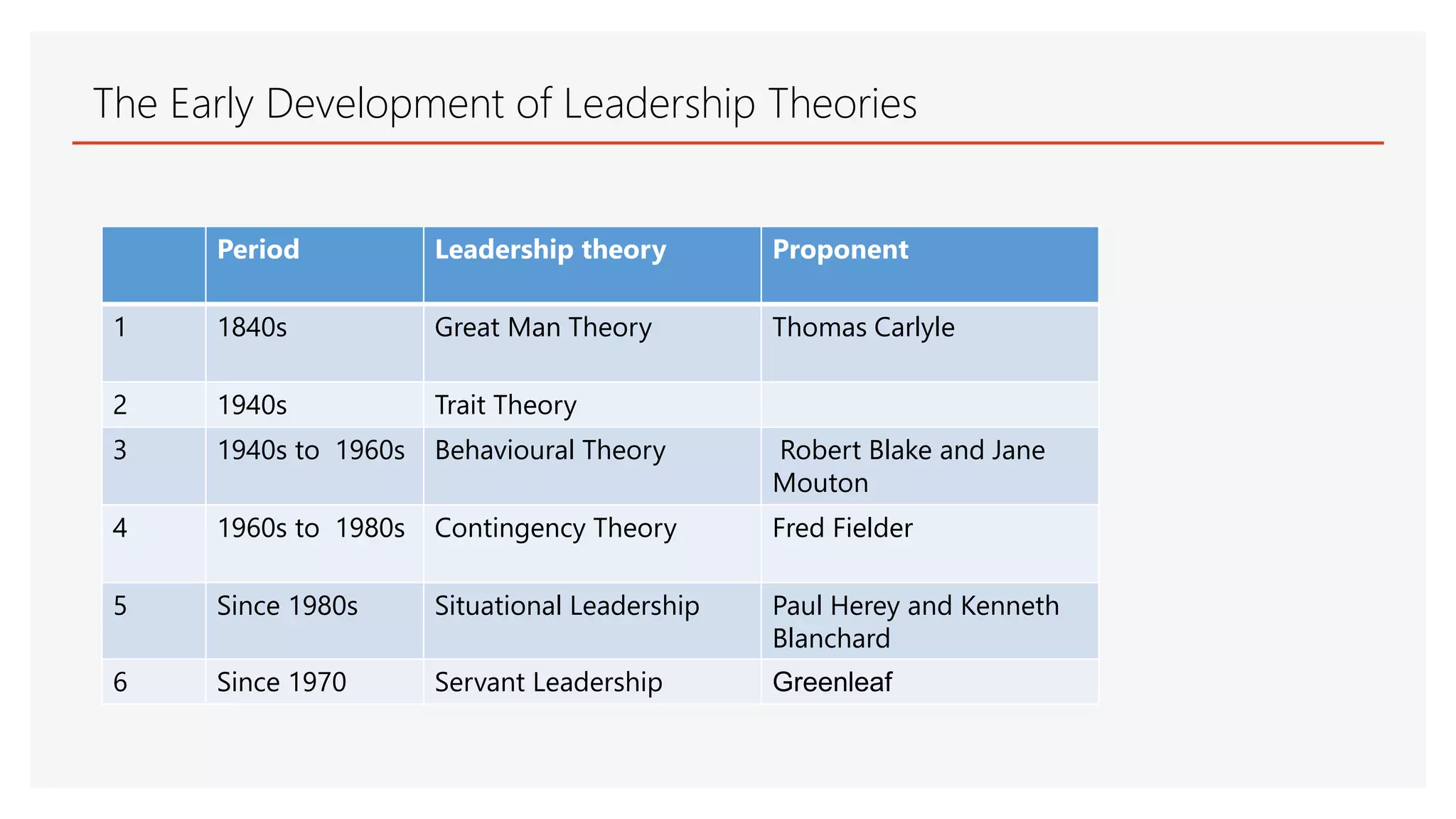
Period Leadership theory Proponent
1 1840s Great Man Theory Thomas Carlyle
2 1940s Trait Theory
3 1940s to 1960s Behavioural Theory Robert Blake and Jane
Mouton
4 1960s to 1980s Contingency Theory Fred Fielder
5 Since 1980s Situational Leadership Paul Herey and Kenneth
Blanchard
6 Since 1970 Servant Leadership Greenleaf
Great Man Theory : Leaders are born, not made
According to great man theory
- A person is either a natural-born leader or not.
- Some people are born with the necessary leadership attributes that help them create a great impact on
society, politics, or the military.
- The theory focuses on identifying the innate qualities and characteristics possessed by great men.
- A leader is a hero who accomplishes goals against all odds for his followers.
- The Great Man Theory centers on two main assumptions:
•Great leaders are born possessing certain traits that enable them to rise and lead.
•Great leaders can arise when the need for them is great.
Great Man Theory : Leaders are born, not made
- Leaders are either aristocratic ruler, who achieved the position through birthright or individuals with
personal charisma that they emerged great against all odds.
- Great men are actually the products of their societies, and that their actions would be impossible without
the social conditions built before their lifetimes. Leaders were the products of the society in which they lived
- These leaders could attract followers through the magnetism of their personalities and had the ability to
direct the group in ways that produced significant changes to society
Criticism of Theory
Trait Theory : Leaders are born, not made
This is extension of Great man theory
- Considers personality, social, physical, or intellectual traits to differentiate leaders from nonleaders
- It is possible to predict leaders from non-leaders with a set of characteristics
- Trait theory identifies specific personality traits of great leaders, eg.
Leadership Traits
• Extraversion
• Conscientiousness
• Openness
• Emotional Intelligence
Key Trait Research Studies and Findings
Stogdill
(1948)
Mann (1959) Stogdill (1974) Lord, deVader and
Alliger (1986)
Kirkpatrick and Locke
(1991)
Intelligence
Alertness
Insight
Responsibility
Initiative
Persistence
Self-confidence
Sociability
Intelligence
Masculinity
Adjustment
Dominance
Extroversion
Conservatism
Achievement
Persistence
Insight
Self-confidence
Responsibility
Cooperativeness
Tolerance
Influence
Sociability
Intelligence
Masculinity
Dominance
Drive
Motivation
Integrity
Confidence
Cognitive ability
Task knowledge
Trait Theory : Leaders are born, not made
- List of traits is too long, more than 100 traits
- Situational factors such as social, economic equality etc not taken into account
- No universal traits found that predict leadership in all situations
- Unclear evidence of the cause and effect of relationship of leadership and traits
- Better predictor of the appearance of leadership than distinguishing effective and ineffective leaders
Criticism of Theory
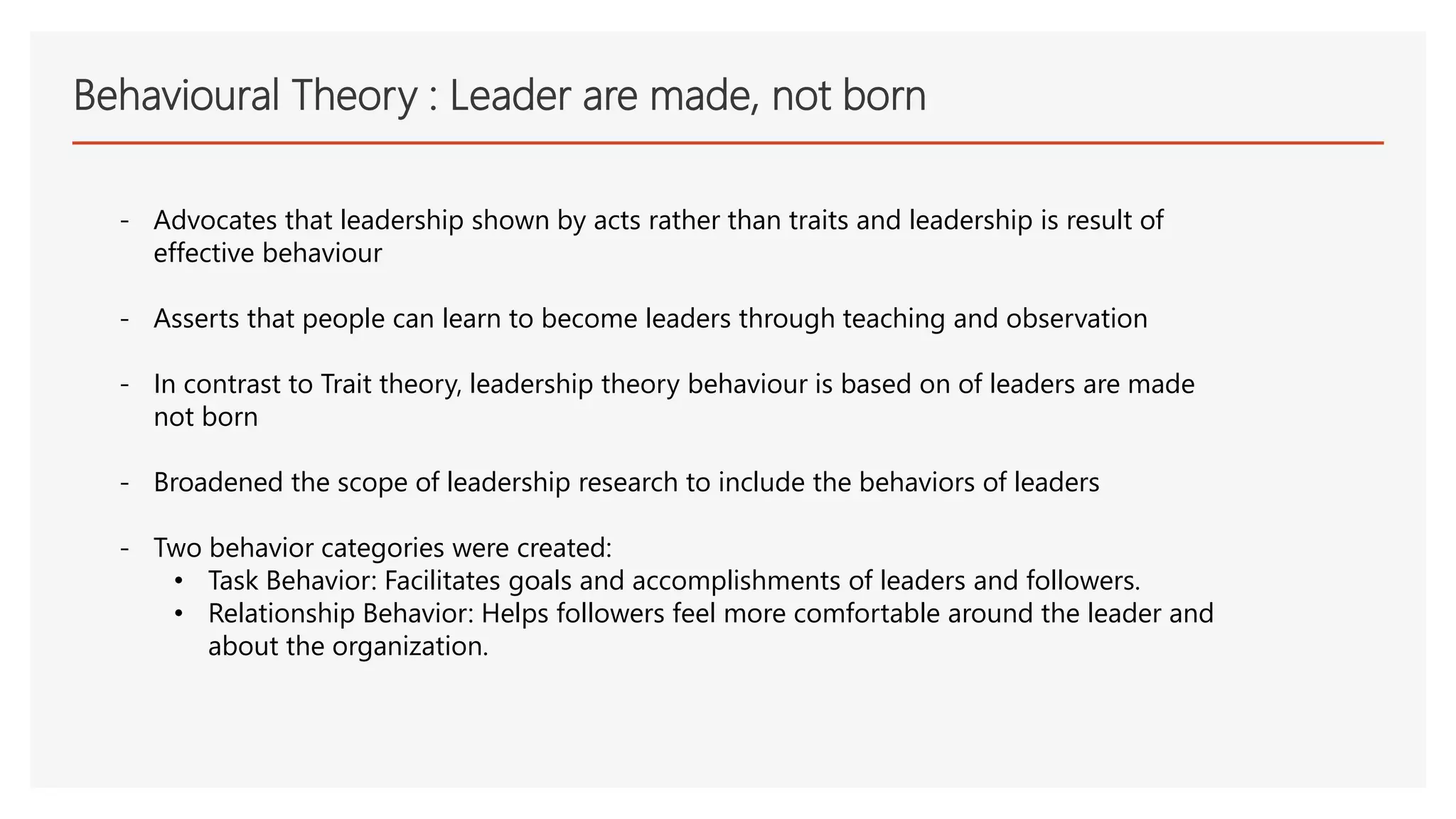
Behavioural Theory : Leader are made, not born
- Advocates that leadership shown by acts rather than traits and leadership is result of
effective behaviour
- Asserts that people can learn to become leaders through teaching and observation
- In contrast to Trait theory, leadership theory behaviour is based on of leaders are made
not born
- Broadened the scope of leadership research to include the behaviors of leaders
- Two behavior categories were created:
• Task Behavior: Facilitates goals and accomplishments of leaders and followers.
• Relationship Behavior: Helps followers feel more comfortable around the leader and
about the organization.
Behavioural Theory : Leader are made, not born
Leadership
Behaviours
Autocratic
Democratic
Supportive
Laissez-Faire
Achievement
Types of Behaviours
Behavioural Theory : Leader are made, not born
- Failed to find a universal style of leadership that could be effective in almost every situation
- Not been able to establish a consistent link between task and relationship behaviors and
outcomes such as morale, job satisfaction, and productivity.
Behavioiur Theory vs Trait Theory
Behaviour Theory
• Leadership behaviour
can be taught
Trait Theory
• Leaders are born, not
made
Skills Theory
- The skills approach is a leader-centered perspective, emphasizes the competencies of leaders
- Leadership skills is defined as ‘The ability to use one’s knowledge and competencies to accomplish a set of
goals and objectives’
- Skills and abilities can be learned and developed.
- Two versions of Skill approach
• Three-Skill Approach (Katz, 1955)
• Skills Model (Mumford et al., 2000)
- Three-skill approach model stresses, leaders to possess technical, human, and conceptual skills
- Skills makes leadership available to everyone
- Considers role of experience and environment in success of leadership
- Provides a consistent approach and structure for leadership education
Skills Theory
Leaders need all three skills ( Technical, Human, Conceptual) – but,
relative importance changes based on level of management
Skills Theory
- Breadth of the skills approach appears to extend beyond the boundaries of leadership, making it more
general, less precise
- It does not explain how a person’s competencies lead to effective leadership
performance.
- Skills model claims not to be a trait approach; nevertheless, individual traits such as cognitive abilities,
motivation, and personality play a large role in the model.
- The skills model was constructed by using a large sample of military personnel and observing
their performance in the armed services. In such case, can the results be generalized to other
populations or organizational settings?
Northouse - Leadership Theory and Practice, Sixth Edition © 2012 SAGE Publications, Inc.
Criticism of Theory
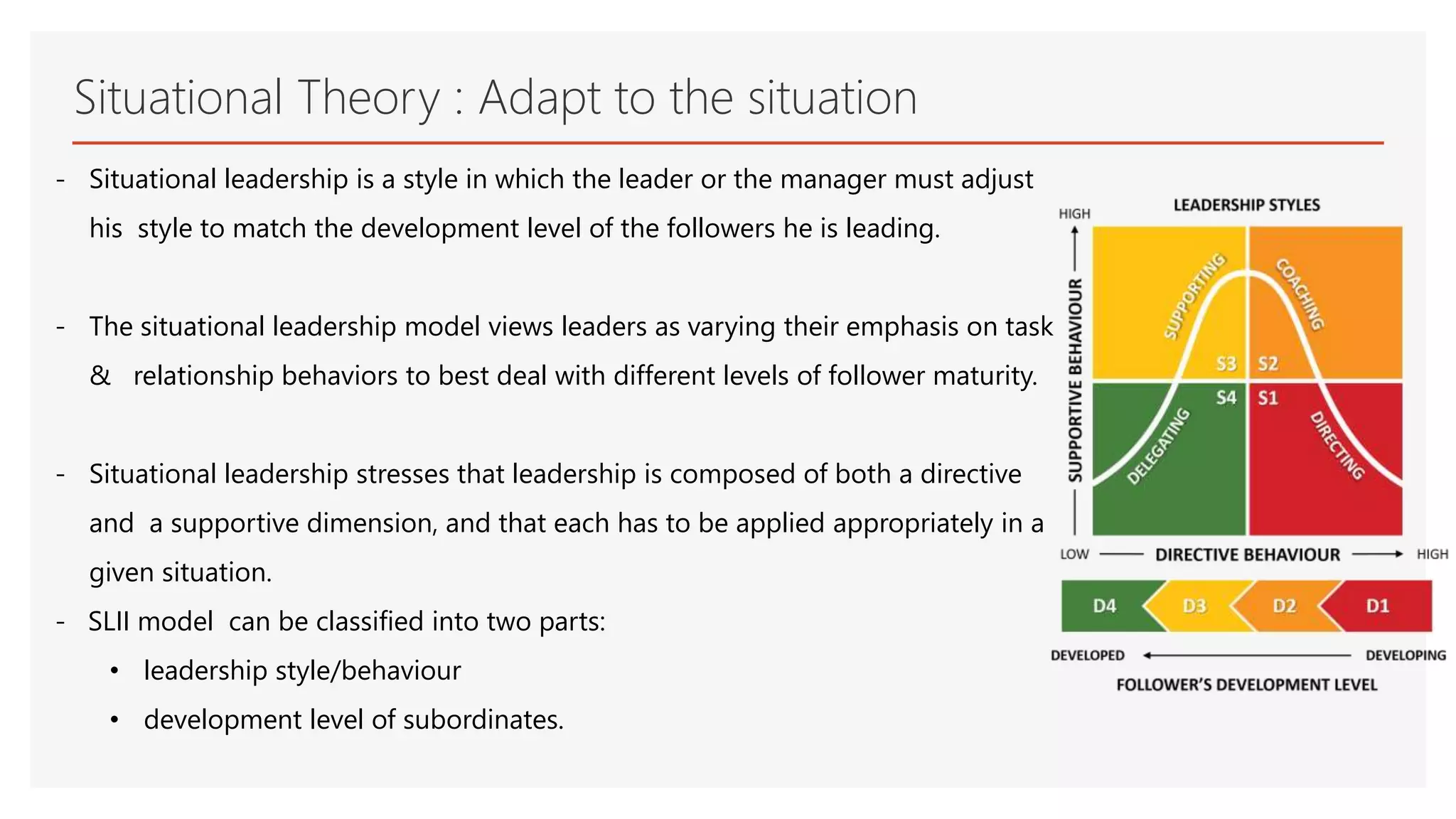
Situational Theory : Adapt to the situation
- Situational leadership is a style in which the leader or the manager must adjust
his style to match the development level of the followers he is leading.
- The situational leadership model views leaders as varying their emphasis on task
& relationship behaviors to best deal with different levels of follower maturity.
- Situational leadership stresses that leadership is composed of both a directive
and a supportive dimension, and that each has to be applied appropriately in a
given situation.
- SLII model can be classified into two parts:
• leadership style/behaviour
• development level of subordinates.
Situational Theory : Adapt to the situation
- Insufficient research on situational leadership to validate the theory
- There is an ambiguous conceptualization in the model of subordinates i.e
commitment is combined with competence to form four distinct levels of development
- It does not explain the theoretical basis for the changes in the composition of each of the development
levels.
- Does not explain how competence and commitment are weighted across different development levels.
- It fails to account for how certain demographic characteristics (e.g., education, experience, age, and
gender) influence the leader–subordinate
- Does not fully address the issue of one-to-one versus group leadership in an organizational setting
Criticism of Theory
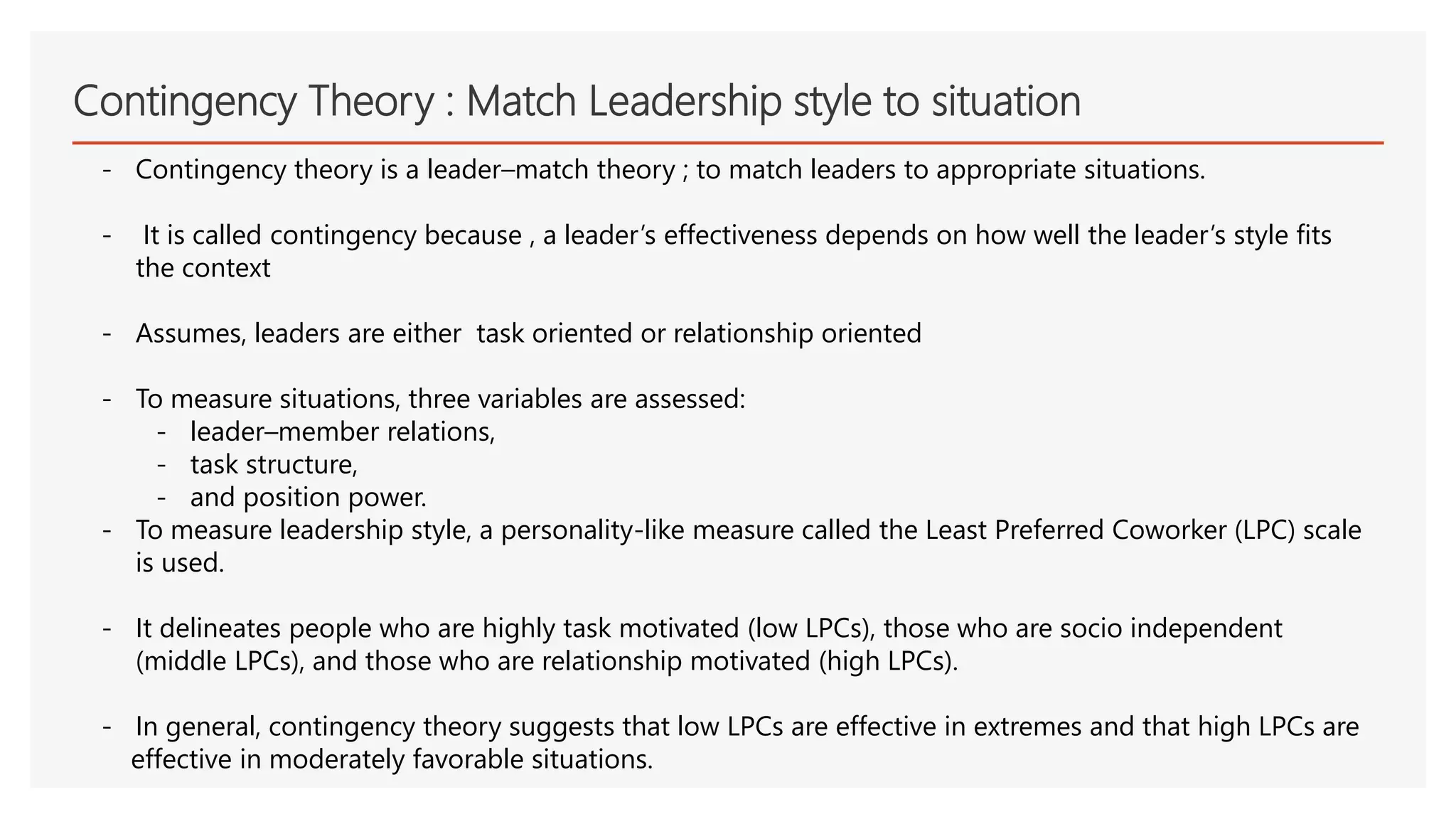
Contingency Theory : Match Leadership style to situation
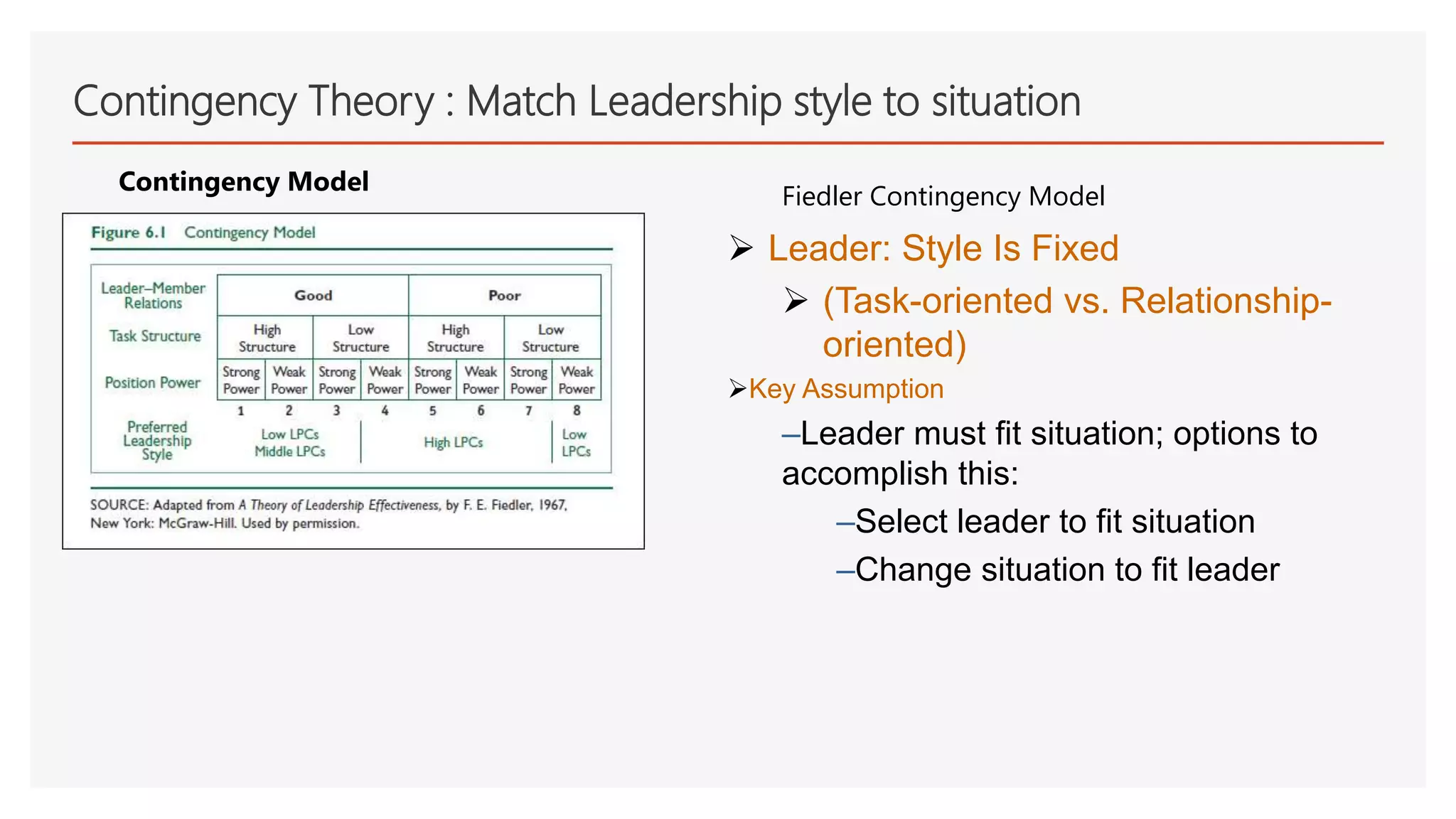
- Contingency theory is a leader–match theory ; to match leaders to appropriate situations.
- It is called contingency because , a leader’s effectiveness depends on how well the leader’s style fits
the context
- Assumes, leaders are either task oriented or relationship oriented
- To measure situations, three variables are assessed:
- leader–member relations,
- task structure,
- and position power.
- To measure leadership style, a personality-like measure called the Least Preferred Coworker (LPC) scale
is used.
- It delineates people who are highly task motivated (low LPCs), those who are socio independent
(middle LPCs), and those who are relationship motivated (high LPCs).
- In general, contingency theory suggests that low LPCs are effective in extremes and that high LPCs are
effective in moderately favorable situations.
Contingency Theory : Match Leadership style to situation
Contingency Model
Fiedler Contingency Model
 Leader: Style Is Fixed
 (Task-oriented vs. Relationship-
oriented)
Key Assumption
–Leader must fit situation; options to
accomplish this:
–Select leader to fit situation
–Change situation to fit leader
Fiedler’s Model Summary
Fiedlers contingency model summarizes
1. Task oriented leadership is better in most favourable and
most unfavourable situations
2. For moderately favaourable situations, relationship oriented
leadership is more suitable.
Contingency Theory : Match Leadership style to situation
- It has not adequately explained the link between styles and situations, and it relies heavily on the LPC scale
- Contingency theory is not easily used in ongoing organizations.
- It does not fully explain how organizations can use the results of this theory in situational engineering.
Criticism of Theory
Servant Leadership Theory : Sever the followers
- Servant leadership focuses on the behaviors leaders should exhibit to put followers first and to support
followers’ personal development.
- Servant leadership emphasizes that leaders be attentive to the concerns of their followers, empathize with
them, and nurture them.
- Servant leaders put followers first, empower them, and help them develop their full personal capacities
- Servant demonstrate strong moral behavior toward followers
- Servant leadership provides a counterintuitive and provocative approach to the use of influence, or power,
in leadership
Servant Leadership Theory
Servant leaders possess below characteristics
1. Listening
2. Empathy
3. Awareness.
4. Healing
5. Persuasion
6. Conceptualization
7. Foresight
8. Stewardship
9. Commitment to the growth of people.
10. Building Community.
Model of Servant Leadership
Servant Leadership Theory
- The title “servant leadership” creates undermines the definition of leadership
- Servant leadership is hypothesized to include a multitude of abilities, traits, and
behaviors. However, there is no theoretical frame work
- It advocates an altruistic approach to leadership by putting followers first, this
contradicts with key leadership qualities i.e directing, goal setting, creating vision
Criticism of Theory
Summary and Conclusion
• Leadership is critical to any organization’s success
• Good leadership can be groomed and developed
• Good leaders transform the organizations and improve business performance
• Organizations shall adopt proven leadership theories
• Absence of leadership can lead to downfall of organizations
• Leadership theories discussed here offer a guidance to the success of organization
Other Theories
Leader-Member Exchange (LMX) Theory
Path-Goal Theory
Transactional and Transformational Leadership
Thank You

Leadership Theories.pptx

  • 1.
  • 2.
    Leadership quotes anddefinition Leadership is a process whereby an individual influences a group of individuals to achieve a common goal. “A manager takes people where they want to go. A great leader takes people where they don’t necessarily want to go but ought to.” — Rosalyn Carter “As for the best leaders, the people do not notice their existence. The next best, the people honor and praise. The next, the people fear; the next, the people hate.” — Lao Tse, 604-531 B. C., Chinese philosopher and founder of Taoism, Tao Te Ching “Leadership is a two-way street, loyalty up and loyalty down. Respect for one’s superiors; care for one’s crew.” — Grace Hopper, Admiral, U. S. Navy (retired), Speech, Washington, D. C., February 1987 “If your actions inspire others to dream more, learn more, do more and become more, you are a leader.” — John Quincy Adams “Managers have subordinates — leaders have followers.” — Murray Johannsen “Leadership is the art to of influencing and directing people in such a way that will win their obedience, confidence, respect and loyal cooperation in achieving common objectives.” — U. S. Air Force
  • 3.
    Various Leadership Theories 1.Great Man Theory 2. Trait Theory 3. Skills Theory 4. Behavioural Theory 5. Situational Theory 6. Contingency Theory 7. Servant Leadership Theory
  • 4.
    The Early Developmentof Leadership Theories Period Leadership theory Proponent 1 1840s Great Man Theory Thomas Carlyle 2 1940s Trait Theory 3 1940s to 1960s Behavioural Theory Robert Blake and Jane Mouton 4 1960s to 1980s Contingency Theory Fred Fielder 5 Since 1980s Situational Leadership Paul Herey and Kenneth Blanchard 6 Since 1970 Servant Leadership Greenleaf
  • 5.
    Great Man Theory: Leaders are born, not made According to great man theory - A person is either a natural-born leader or not. - Some people are born with the necessary leadership attributes that help them create a great impact on society, politics, or the military. - The theory focuses on identifying the innate qualities and characteristics possessed by great men. - A leader is a hero who accomplishes goals against all odds for his followers. - The Great Man Theory centers on two main assumptions: •Great leaders are born possessing certain traits that enable them to rise and lead. •Great leaders can arise when the need for them is great.
  • 6.
    Great Man Theory: Leaders are born, not made - Leaders are either aristocratic ruler, who achieved the position through birthright or individuals with personal charisma that they emerged great against all odds. - Great men are actually the products of their societies, and that their actions would be impossible without the social conditions built before their lifetimes. Leaders were the products of the society in which they lived - These leaders could attract followers through the magnetism of their personalities and had the ability to direct the group in ways that produced significant changes to society Criticism of Theory
  • 7.
    Trait Theory :Leaders are born, not made This is extension of Great man theory - Considers personality, social, physical, or intellectual traits to differentiate leaders from nonleaders - It is possible to predict leaders from non-leaders with a set of characteristics - Trait theory identifies specific personality traits of great leaders, eg. Leadership Traits • Extraversion • Conscientiousness • Openness • Emotional Intelligence
  • 8.
    Key Trait ResearchStudies and Findings Stogdill (1948) Mann (1959) Stogdill (1974) Lord, deVader and Alliger (1986) Kirkpatrick and Locke (1991) Intelligence Alertness Insight Responsibility Initiative Persistence Self-confidence Sociability Intelligence Masculinity Adjustment Dominance Extroversion Conservatism Achievement Persistence Insight Self-confidence Responsibility Cooperativeness Tolerance Influence Sociability Intelligence Masculinity Dominance Drive Motivation Integrity Confidence Cognitive ability Task knowledge
  • 9.
    Trait Theory :Leaders are born, not made - List of traits is too long, more than 100 traits - Situational factors such as social, economic equality etc not taken into account - No universal traits found that predict leadership in all situations - Unclear evidence of the cause and effect of relationship of leadership and traits - Better predictor of the appearance of leadership than distinguishing effective and ineffective leaders Criticism of Theory
  • 10.
    Behavioural Theory :Leader are made, not born - Advocates that leadership shown by acts rather than traits and leadership is result of effective behaviour - Asserts that people can learn to become leaders through teaching and observation - In contrast to Trait theory, leadership theory behaviour is based on of leaders are made not born - Broadened the scope of leadership research to include the behaviors of leaders - Two behavior categories were created: • Task Behavior: Facilitates goals and accomplishments of leaders and followers. • Relationship Behavior: Helps followers feel more comfortable around the leader and about the organization.
  • 11.
    Behavioural Theory :Leader are made, not born Leadership Behaviours Autocratic Democratic Supportive Laissez-Faire Achievement Types of Behaviours
  • 12.
    Behavioural Theory :Leader are made, not born - Failed to find a universal style of leadership that could be effective in almost every situation - Not been able to establish a consistent link between task and relationship behaviors and outcomes such as morale, job satisfaction, and productivity.
  • 13.
    Behavioiur Theory vsTrait Theory Behaviour Theory • Leadership behaviour can be taught Trait Theory • Leaders are born, not made
  • 14.
    Skills Theory - Theskills approach is a leader-centered perspective, emphasizes the competencies of leaders - Leadership skills is defined as ‘The ability to use one’s knowledge and competencies to accomplish a set of goals and objectives’ - Skills and abilities can be learned and developed. - Two versions of Skill approach • Three-Skill Approach (Katz, 1955) • Skills Model (Mumford et al., 2000) - Three-skill approach model stresses, leaders to possess technical, human, and conceptual skills - Skills makes leadership available to everyone - Considers role of experience and environment in success of leadership - Provides a consistent approach and structure for leadership education
  • 15.
    Skills Theory Leaders needall three skills ( Technical, Human, Conceptual) – but, relative importance changes based on level of management
  • 16.
    Skills Theory - Breadthof the skills approach appears to extend beyond the boundaries of leadership, making it more general, less precise - It does not explain how a person’s competencies lead to effective leadership performance. - Skills model claims not to be a trait approach; nevertheless, individual traits such as cognitive abilities, motivation, and personality play a large role in the model. - The skills model was constructed by using a large sample of military personnel and observing their performance in the armed services. In such case, can the results be generalized to other populations or organizational settings? Northouse - Leadership Theory and Practice, Sixth Edition © 2012 SAGE Publications, Inc. Criticism of Theory
  • 17.
    Situational Theory :Adapt to the situation - Situational leadership is a style in which the leader or the manager must adjust his style to match the development level of the followers he is leading. - The situational leadership model views leaders as varying their emphasis on task & relationship behaviors to best deal with different levels of follower maturity. - Situational leadership stresses that leadership is composed of both a directive and a supportive dimension, and that each has to be applied appropriately in a given situation. - SLII model can be classified into two parts: • leadership style/behaviour • development level of subordinates.
  • 18.
    Situational Theory :Adapt to the situation - Insufficient research on situational leadership to validate the theory - There is an ambiguous conceptualization in the model of subordinates i.e commitment is combined with competence to form four distinct levels of development - It does not explain the theoretical basis for the changes in the composition of each of the development levels. - Does not explain how competence and commitment are weighted across different development levels. - It fails to account for how certain demographic characteristics (e.g., education, experience, age, and gender) influence the leader–subordinate - Does not fully address the issue of one-to-one versus group leadership in an organizational setting Criticism of Theory
  • 19.
    Contingency Theory :Match Leadership style to situation - Contingency theory is a leader–match theory ; to match leaders to appropriate situations. - It is called contingency because , a leader’s effectiveness depends on how well the leader’s style fits the context - Assumes, leaders are either task oriented or relationship oriented - To measure situations, three variables are assessed: - leader–member relations, - task structure, - and position power. - To measure leadership style, a personality-like measure called the Least Preferred Coworker (LPC) scale is used. - It delineates people who are highly task motivated (low LPCs), those who are socio independent (middle LPCs), and those who are relationship motivated (high LPCs). - In general, contingency theory suggests that low LPCs are effective in extremes and that high LPCs are effective in moderately favorable situations.
  • 20.
    Contingency Theory :Match Leadership style to situation Contingency Model Fiedler Contingency Model  Leader: Style Is Fixed  (Task-oriented vs. Relationship- oriented) Key Assumption –Leader must fit situation; options to accomplish this: –Select leader to fit situation –Change situation to fit leader
  • 21.
    Fiedler’s Model Summary Fiedlerscontingency model summarizes 1. Task oriented leadership is better in most favourable and most unfavourable situations 2. For moderately favaourable situations, relationship oriented leadership is more suitable.
  • 22.
    Contingency Theory :Match Leadership style to situation - It has not adequately explained the link between styles and situations, and it relies heavily on the LPC scale - Contingency theory is not easily used in ongoing organizations. - It does not fully explain how organizations can use the results of this theory in situational engineering. Criticism of Theory
  • 23.
    Servant Leadership Theory: Sever the followers - Servant leadership focuses on the behaviors leaders should exhibit to put followers first and to support followers’ personal development. - Servant leadership emphasizes that leaders be attentive to the concerns of their followers, empathize with them, and nurture them. - Servant leaders put followers first, empower them, and help them develop their full personal capacities - Servant demonstrate strong moral behavior toward followers - Servant leadership provides a counterintuitive and provocative approach to the use of influence, or power, in leadership
  • 24.
    Servant Leadership Theory Servantleaders possess below characteristics 1. Listening 2. Empathy 3. Awareness. 4. Healing 5. Persuasion 6. Conceptualization 7. Foresight 8. Stewardship 9. Commitment to the growth of people. 10. Building Community. Model of Servant Leadership
  • 25.
    Servant Leadership Theory -The title “servant leadership” creates undermines the definition of leadership - Servant leadership is hypothesized to include a multitude of abilities, traits, and behaviors. However, there is no theoretical frame work - It advocates an altruistic approach to leadership by putting followers first, this contradicts with key leadership qualities i.e directing, goal setting, creating vision Criticism of Theory
  • 26.
    Summary and Conclusion •Leadership is critical to any organization’s success • Good leadership can be groomed and developed • Good leaders transform the organizations and improve business performance • Organizations shall adopt proven leadership theories • Absence of leadership can lead to downfall of organizations • Leadership theories discussed here offer a guidance to the success of organization
  • 27.
    Other Theories Leader-Member Exchange(LMX) Theory Path-Goal Theory Transactional and Transformational Leadership
  • 28.

Editor's Notes

  • #3  Leadership has been researched over the last century with many classifications developed to define leadership.
  • #18 Directive Behavior helps group members accomplish goals by giving directions, defining roles, setting time lines, evaluating and showing how goals will be met. Explains what is to be done, how it is to be done, and who is responsible for doing it One way communication Supportive Behavior helps coworkers feel comfortable about themselves, their coworkers and the situation. Asking for input, praising, listening, sharing information about oneself Two way communication Constructed around the idea that employees move forward and backward along the developmental continuum In any situation the leader must first determine the nature of the situation Leader asks him/herself questions like: What is the task I need to ask the subordinates complete? How complex is the task? Are the subordinates sufficiently skilled to complete the task?
  • #20 Hersey and Blanchard’s Situational Leadership Th A contingency theory that focuses on followers’ readiness; the more “ready” the followers (the more willing and able) the less the need for leader support and supervision. eory