LEADERSHIP AND LEADERS
Great Leaders Live with integrity, lead by example develop a winning strategy or “big idea” build a great management team inspire employees to greatness create a flexible, responsive organization use reinforcing management systems In Search of Leadership (article by Reingold)
Great Leaders passionate  about what they do love to talk about it high energy clarity of thinking communicate  to diverse audience work through people ( empowering ) In Search of Leadership (article by Reingold)
LEADERSHIP The Trust Factor in Leadership Question:   How does a trust-oriented leader differ from a Machiavellian-oriented leader? Question:   Which is more important, our actions or our words? Question:   How concerned  should we be about others? Recommendation:   Being trustworthy is good!!! Leadership
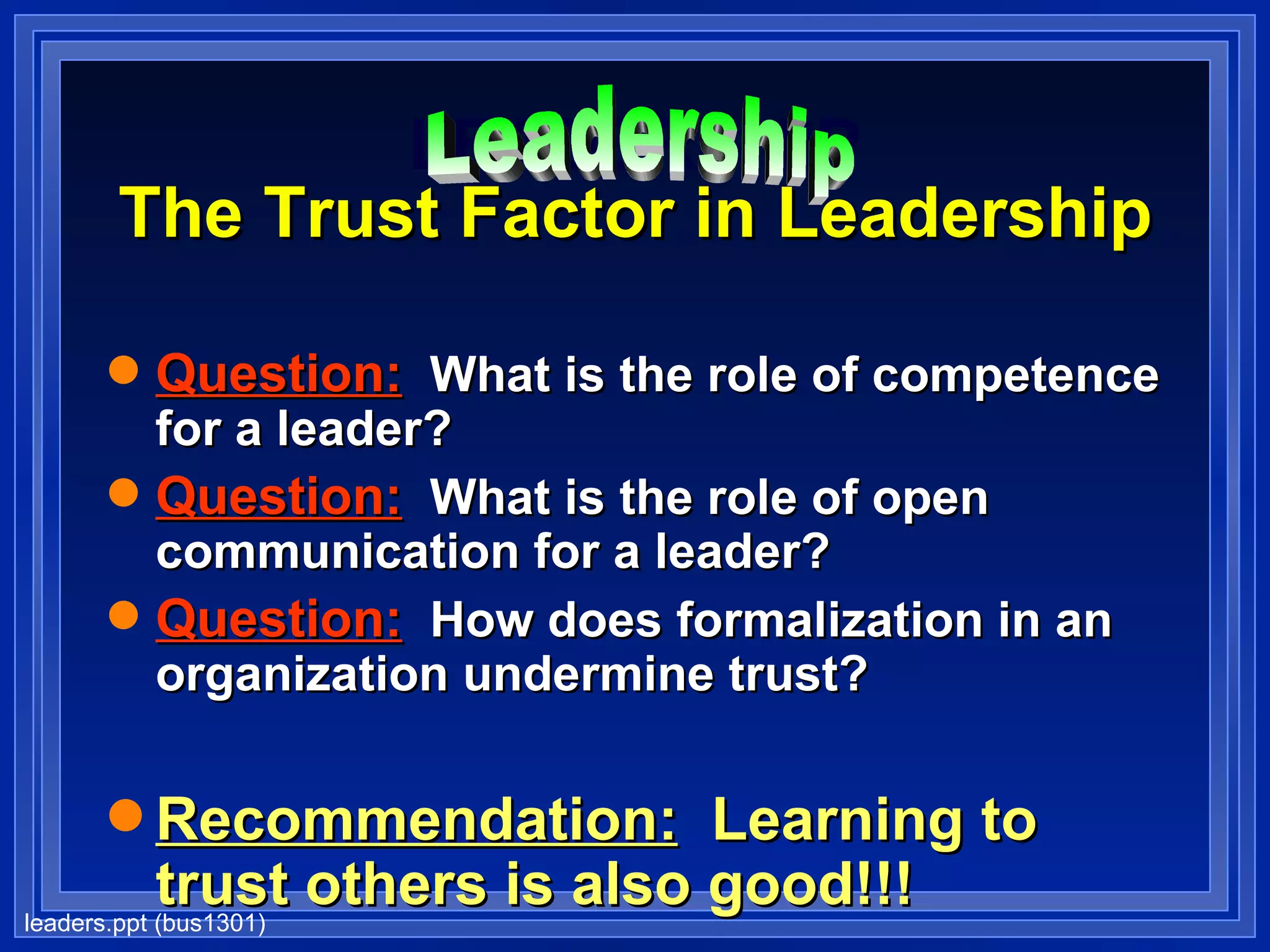
LEADERSHIP The Trust Factor in Leadership Question:   What is the role of competence for a leader? Question:   What is the role of open communication for a leader? Question:   How does formalization in an organization undermine trust? Recommendation:   Learning to trust others is also good!!! Leadership
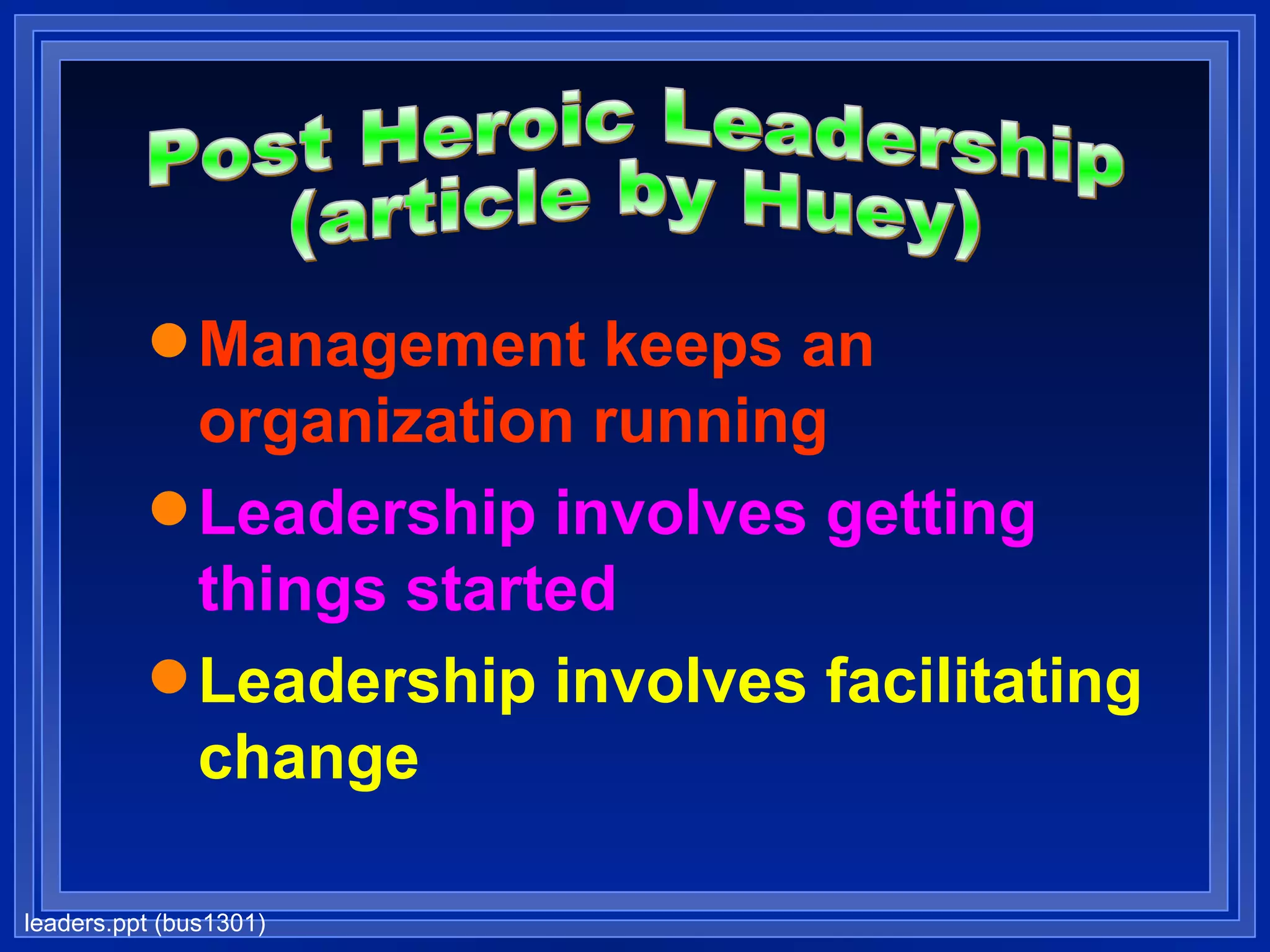
Management keeps an organization running Leadership involves getting things started Leadership involves facilitating change Post Heroic Leadership (article by Huey)
Future Leaders…. Develop/communicate what company is trying to accomplish Create environment where employees can figure out what needs to be done  AND  then do it well. Post Heroic Leadership 95% of American managers say the right thing. 5% of American managers  do  the right thing. When companies derive their advantage from intellectual capital, old management styles (carrots and sticks) are not sufficient.
CORE VALUES Fairness Commitment Freedom Water Line Post Heroic Leadership (article by Huey)
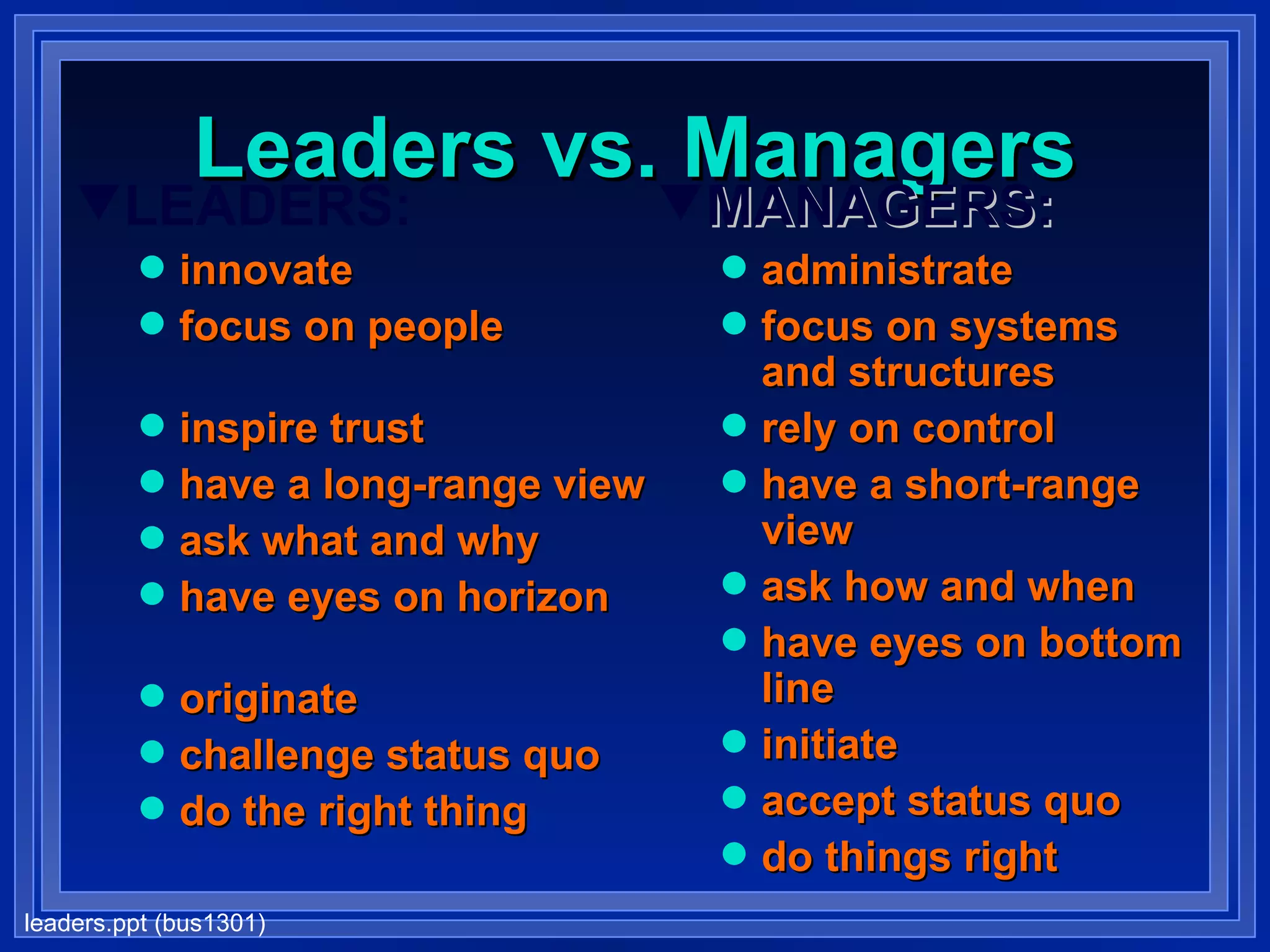
Leaders vs. Managers LEADERS: innovate focus on people  inspire trust have a long-range view ask what and why have eyes on horizon originate challenge status quo do the right thing MANAGERS: administrate focus on systems and structures rely on control have a short-range view ask how and when have eyes on bottom line initiate accept status quo do things right
LEADERSHIP - Marks of a Great Leader QUESTION:   WHY ARE THE FOLLOWING TRAITS CONSIDERED CHARACTERISTICS OF GREAT LEADERS? servicing and sacrificing initiating and risk taking needing no credit empowering others clarifying values LEADERSHIP
There Are Only Five Ways to Lead (Article by Farkas and De Becker) Strategic Approach Human Assets Approach Expertise Approach Box Approach Change Approach
LEADERSHIP   Resistance to Empowerment (Article by Williams) QUESTION:   Why do managers resist change? QUESTION:   Why do managers resist suggestions? QUESTION:   Why are managers afraid to empower their subordinates? Recommendation:   Don’t leave this class thinking that you have cornered the market for good ideas Recommendation:   Learn to recognize your strengths and weaknesses and those of others Recommendation:   Learn that teams always do better than individuals, if there is a trust relationship among the team members
LEADERSHIP  -  Empowerment Empowerment Strategies Avoid  competition for power, status, recognition Delegate Create  and  communicate  a vision Insist  that others diligently work to achieve meaningful goals Help  others believe in their own worth and potential Create  a culture in which fear and intimidation are replaced by trust Demonstrate  a willingness to be supportive of others
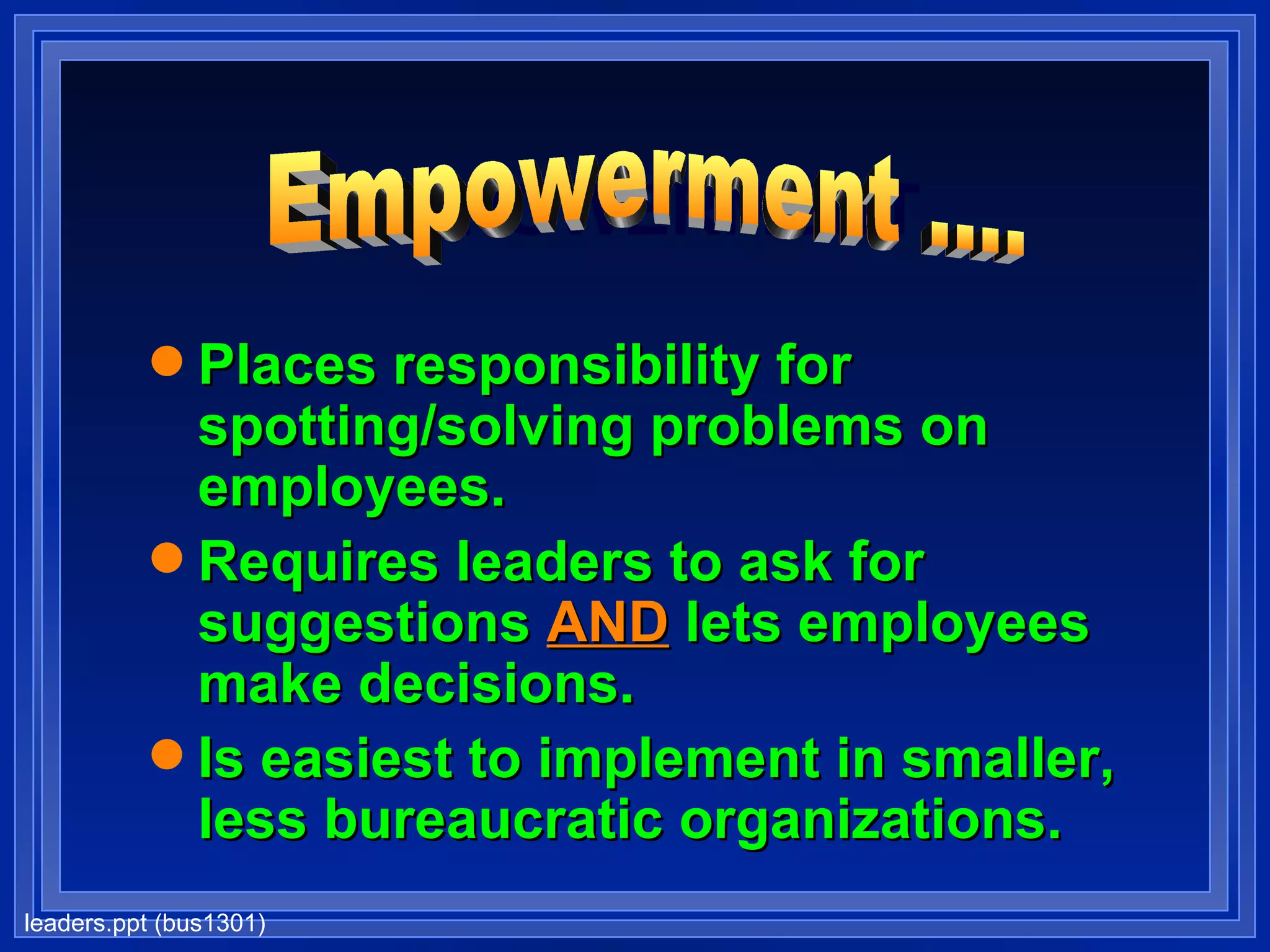
EMPOWERMENT Places responsibility for spotting/solving problems on employees. Requires leaders to ask for suggestions  AND   lets employees make decisions. Is easiest to implement in smaller, less bureaucratic organizations. Empowerment ....
LEADERSHIP Develop Ownership There are always at least two owners of responsibility. Empowerers ask questions, organize data to confront people with reality, bring customers and performers together. Empowerers insist on tough standards. Empowerers support and coach. Conversations are the grist for the leader’s mill.
LEADERSHIP Develop Ownership   continued… You can lead a horse to water, but you can’t make him drink. If you want the horse to drink, make sure the horse is thirsty. Head buffalo lock the barn door after the horse is stolen. Lead geese make certain nothing is ever stolen.
LEADERSHIP  -  Empowerment  Continued…. Recommendation:   Learn to encourage and make full use of your talents and the talents of others.
LEADERSHIP -  The Magic of Vision Vision sees   what must be tomorrow ,  beyond what is today Customers  help you see the vision Vision  inspires Vision is  clarity Vision is a  worthy commitment Vision generates  supportive actions
LEADERSHIP  -  How Vision Works The right vision attracts  commitment  and  energizes  people. The right vision creates  meaning  in workers’ lives. The right vision establishes a standard of  excellence . The right vision  bridges  the present and the future.
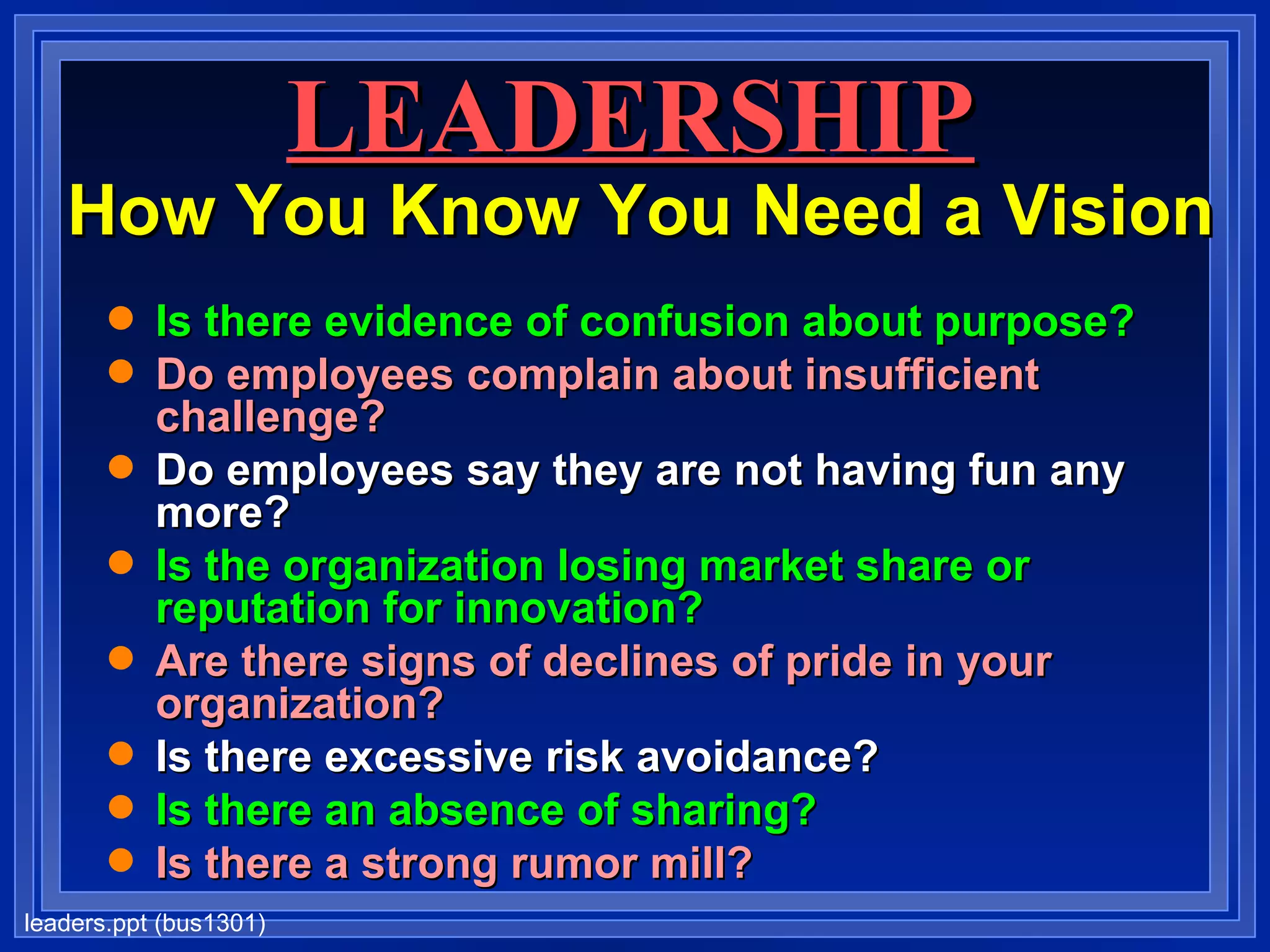
LEADERSHIP   How You Know You Need a Vision Is there evidence of confusion about purpose? Do employees complain about insufficient challenge? Do employees say they are not having fun any more? Is the organization losing market share or reputation for innovation? Are there signs of declines of pride in your organization? Is there excessive risk avoidance? Is there an absence of sharing? Is there a strong rumor mill?
LEADERSHIP Customer Focus What do customers  really buy ? Leaders focus on  customers  - and so does everyone else. Leaders focus on  partnering , not selling. Leaders begin with the customer’s  needs and wants . Solving problems   spurs partnerships.
LEADERSHIP Great Performance Is this the  best you can do ? Remember, its leadership,  not  status quo-ship. Thinking  incrementally  moves you forward from today. Thinking  strategically  leads backward from the future. How many bugs  is one too many? Begin with the end in mind.
LEADERSHIP   Create Value-Added Strategies Stay close to the customer. The tough strategic question: “What do I do?” Value is solving the customers’ problems. Value is doing better than anyone else. Value-added strategies solve the problems that drive purchasing decisions. Leaders learn how to focus themselves and everyone else on solving the customers’ problems.
Some Managers are More Than Bosses - They’re Leaders, Too (Horowitz) There is no one leader personality they do inspire others to take risks they do inspire others to do more than they    thought possible they set steep goals they instill in others that both failure and    success are allowed
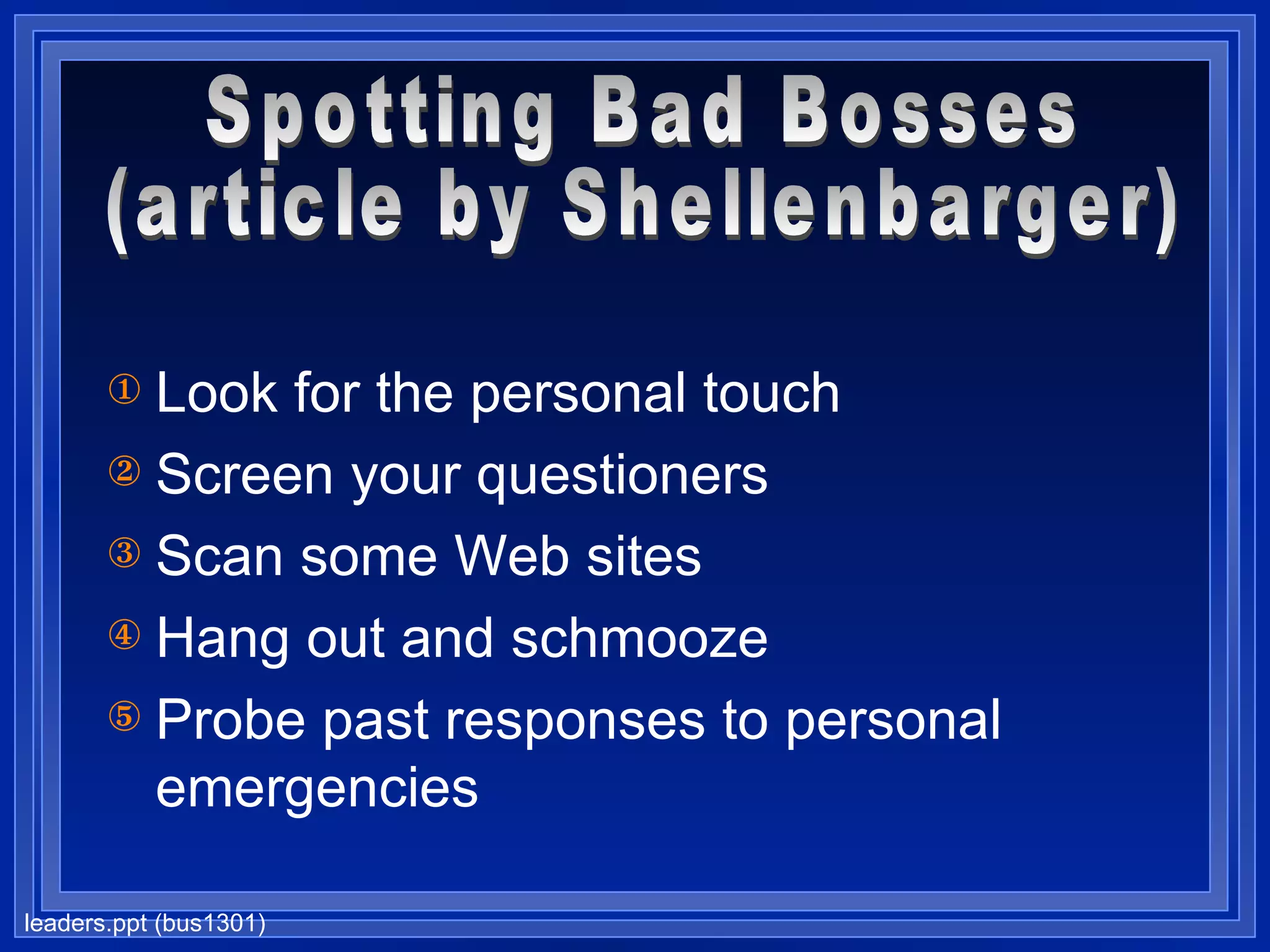
Look for the personal touch Screen your questioners Scan some Web sites Hang out and schmooze Probe past responses to personal emergencies Spotting Bad Bosses (article by Shellenbarger)
LEADERSHIP: Remove  Obstacles Systems send powerful messages. Performance management systems Reward systems Information systems Structures send powerful messages. Decentralize decision making to the point of customer contact Cross-functional teams Simplified processes and procedures Focus on one customer, one product, one product/market combination
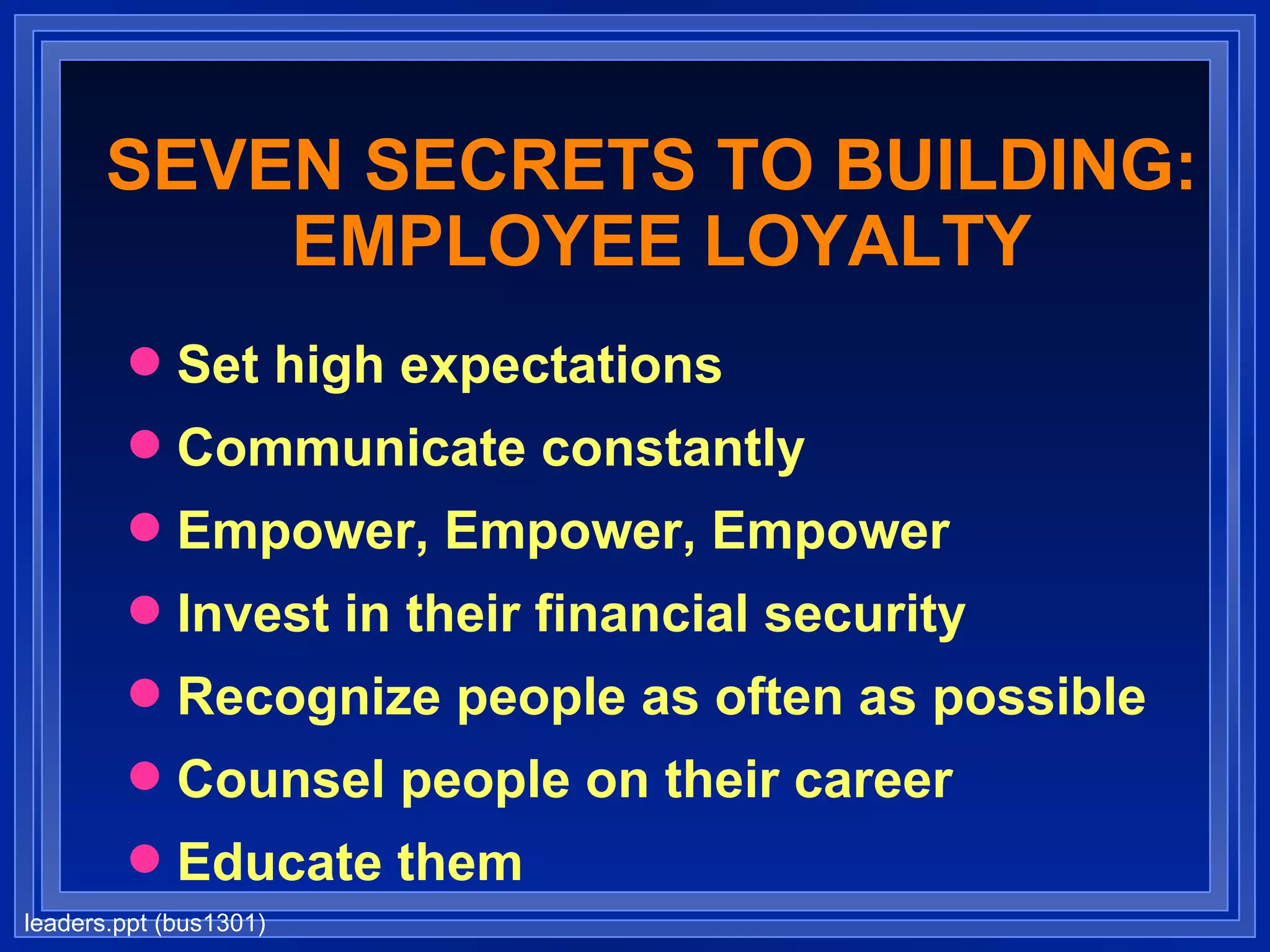
SEVEN SECRETS TO BUILDING:  EMPLOYEE LOYALTY Set high expectations Communicate constantly Empower, Empower, Empower Invest in their financial security Recognize people as often as possible Counsel people on their career Educate them
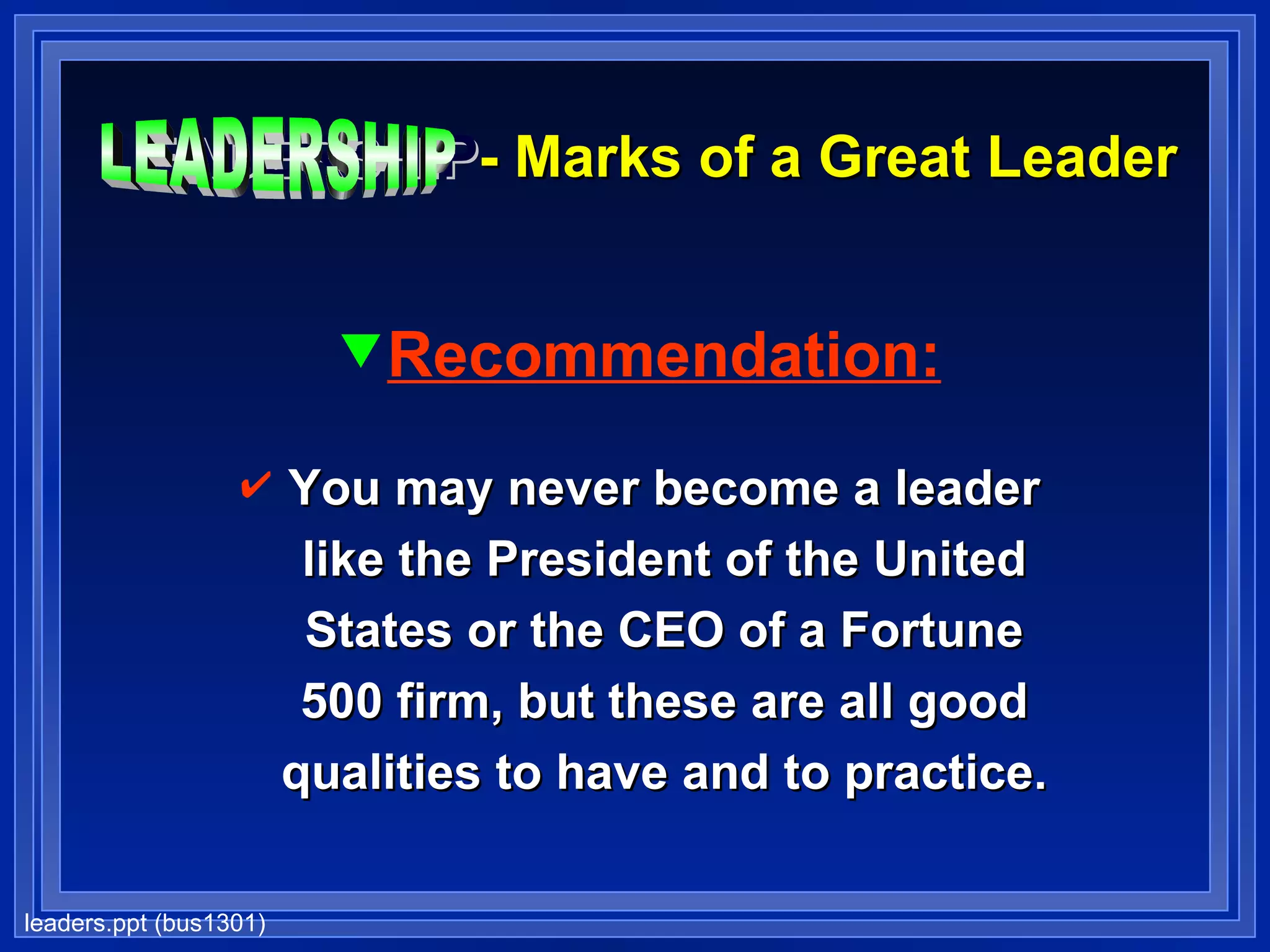
LEADERSHIP - Marks of a Great Leader Recommendation: You may never become a leader like the President of the United States or the CEO of a Fortune 500 firm, but these are all good qualities to have and to practice. LEADERSHIP
A leader is only as effective as the team Outperform peers Make excellence a habit Be willing to try new approaches Focus on what  you  need to do Spotting Gold Talent (article by Hymowitz)
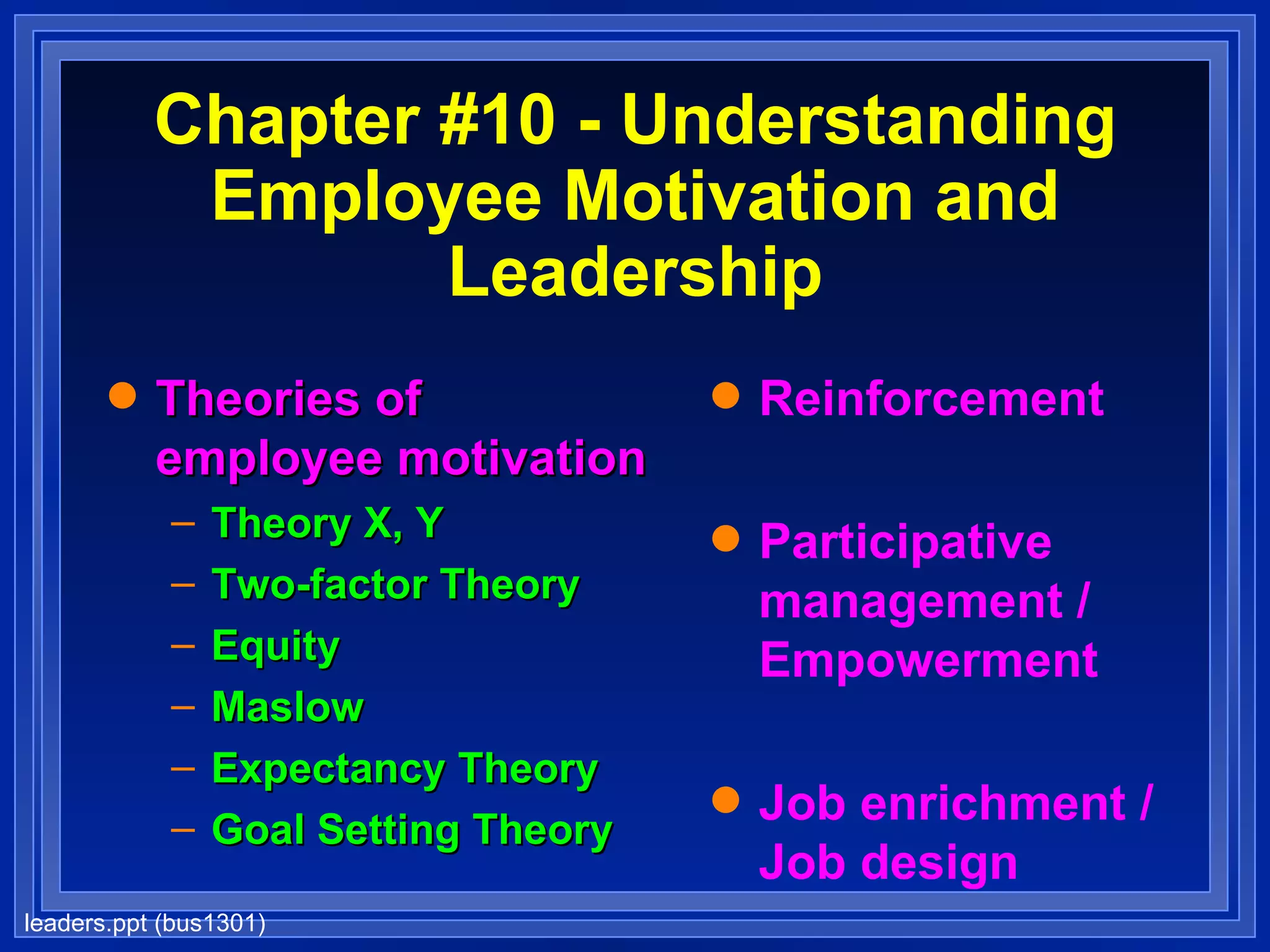
Chapter #10 - Understanding Employee Motivation and Leadership Theories of employee motivation Theory X, Y Two-factor Theory Equity Maslow Expectancy Theory Goal Setting Theory Reinforcement Participative management / Empowerment Job enrichment / Job design Leadership

Leaders

  • 1.
  • 2.
    Great Leaders Livewith integrity, lead by example develop a winning strategy or “big idea” build a great management team inspire employees to greatness create a flexible, responsive organization use reinforcing management systems In Search of Leadership (article by Reingold)
  • 3.
    Great Leaders passionate about what they do love to talk about it high energy clarity of thinking communicate to diverse audience work through people ( empowering ) In Search of Leadership (article by Reingold)
  • 4.
    LEADERSHIP The TrustFactor in Leadership Question: How does a trust-oriented leader differ from a Machiavellian-oriented leader? Question: Which is more important, our actions or our words? Question: How concerned should we be about others? Recommendation: Being trustworthy is good!!! Leadership
  • 5.
    LEADERSHIP The TrustFactor in Leadership Question: What is the role of competence for a leader? Question: What is the role of open communication for a leader? Question: How does formalization in an organization undermine trust? Recommendation: Learning to trust others is also good!!! Leadership
  • 6.
    Management keeps anorganization running Leadership involves getting things started Leadership involves facilitating change Post Heroic Leadership (article by Huey)
  • 7.
    Future Leaders…. Develop/communicatewhat company is trying to accomplish Create environment where employees can figure out what needs to be done AND then do it well. Post Heroic Leadership 95% of American managers say the right thing. 5% of American managers do the right thing. When companies derive their advantage from intellectual capital, old management styles (carrots and sticks) are not sufficient.
  • 8.
    CORE VALUES FairnessCommitment Freedom Water Line Post Heroic Leadership (article by Huey)
  • 9.
    Leaders vs. ManagersLEADERS: innovate focus on people inspire trust have a long-range view ask what and why have eyes on horizon originate challenge status quo do the right thing MANAGERS: administrate focus on systems and structures rely on control have a short-range view ask how and when have eyes on bottom line initiate accept status quo do things right
  • 10.
    LEADERSHIP - Marksof a Great Leader QUESTION: WHY ARE THE FOLLOWING TRAITS CONSIDERED CHARACTERISTICS OF GREAT LEADERS? servicing and sacrificing initiating and risk taking needing no credit empowering others clarifying values LEADERSHIP
  • 11.
    There Are OnlyFive Ways to Lead (Article by Farkas and De Becker) Strategic Approach Human Assets Approach Expertise Approach Box Approach Change Approach
  • 12.
    LEADERSHIP Resistance to Empowerment (Article by Williams) QUESTION: Why do managers resist change? QUESTION: Why do managers resist suggestions? QUESTION: Why are managers afraid to empower their subordinates? Recommendation: Don’t leave this class thinking that you have cornered the market for good ideas Recommendation: Learn to recognize your strengths and weaknesses and those of others Recommendation: Learn that teams always do better than individuals, if there is a trust relationship among the team members
  • 13.
    LEADERSHIP - Empowerment Empowerment Strategies Avoid competition for power, status, recognition Delegate Create and communicate a vision Insist that others diligently work to achieve meaningful goals Help others believe in their own worth and potential Create a culture in which fear and intimidation are replaced by trust Demonstrate a willingness to be supportive of others
  • 14.
    EMPOWERMENT Places responsibilityfor spotting/solving problems on employees. Requires leaders to ask for suggestions AND lets employees make decisions. Is easiest to implement in smaller, less bureaucratic organizations. Empowerment ....
  • 15.
    LEADERSHIP Develop OwnershipThere are always at least two owners of responsibility. Empowerers ask questions, organize data to confront people with reality, bring customers and performers together. Empowerers insist on tough standards. Empowerers support and coach. Conversations are the grist for the leader’s mill.
  • 16.
    LEADERSHIP Develop Ownership continued… You can lead a horse to water, but you can’t make him drink. If you want the horse to drink, make sure the horse is thirsty. Head buffalo lock the barn door after the horse is stolen. Lead geese make certain nothing is ever stolen.
  • 17.
    LEADERSHIP - Empowerment Continued…. Recommendation: Learn to encourage and make full use of your talents and the talents of others.
  • 18.
    LEADERSHIP - The Magic of Vision Vision sees what must be tomorrow , beyond what is today Customers help you see the vision Vision inspires Vision is clarity Vision is a worthy commitment Vision generates supportive actions
  • 19.
    LEADERSHIP - How Vision Works The right vision attracts commitment and energizes people. The right vision creates meaning in workers’ lives. The right vision establishes a standard of excellence . The right vision bridges the present and the future.
  • 20.
    LEADERSHIP How You Know You Need a Vision Is there evidence of confusion about purpose? Do employees complain about insufficient challenge? Do employees say they are not having fun any more? Is the organization losing market share or reputation for innovation? Are there signs of declines of pride in your organization? Is there excessive risk avoidance? Is there an absence of sharing? Is there a strong rumor mill?
  • 21.
    LEADERSHIP Customer FocusWhat do customers really buy ? Leaders focus on customers - and so does everyone else. Leaders focus on partnering , not selling. Leaders begin with the customer’s needs and wants . Solving problems spurs partnerships.
  • 22.
    LEADERSHIP Great PerformanceIs this the best you can do ? Remember, its leadership, not status quo-ship. Thinking incrementally moves you forward from today. Thinking strategically leads backward from the future. How many bugs is one too many? Begin with the end in mind.
  • 23.
    LEADERSHIP Create Value-Added Strategies Stay close to the customer. The tough strategic question: “What do I do?” Value is solving the customers’ problems. Value is doing better than anyone else. Value-added strategies solve the problems that drive purchasing decisions. Leaders learn how to focus themselves and everyone else on solving the customers’ problems.
  • 24.
    Some Managers areMore Than Bosses - They’re Leaders, Too (Horowitz) There is no one leader personality they do inspire others to take risks they do inspire others to do more than they thought possible they set steep goals they instill in others that both failure and success are allowed
  • 25.
    Look for thepersonal touch Screen your questioners Scan some Web sites Hang out and schmooze Probe past responses to personal emergencies Spotting Bad Bosses (article by Shellenbarger)
  • 26.
    LEADERSHIP: Remove Obstacles Systems send powerful messages. Performance management systems Reward systems Information systems Structures send powerful messages. Decentralize decision making to the point of customer contact Cross-functional teams Simplified processes and procedures Focus on one customer, one product, one product/market combination
  • 27.
    SEVEN SECRETS TOBUILDING: EMPLOYEE LOYALTY Set high expectations Communicate constantly Empower, Empower, Empower Invest in their financial security Recognize people as often as possible Counsel people on their career Educate them
  • 28.
    LEADERSHIP - Marksof a Great Leader Recommendation: You may never become a leader like the President of the United States or the CEO of a Fortune 500 firm, but these are all good qualities to have and to practice. LEADERSHIP
  • 29.
    A leader isonly as effective as the team Outperform peers Make excellence a habit Be willing to try new approaches Focus on what you need to do Spotting Gold Talent (article by Hymowitz)
  • 30.
    Chapter #10 -Understanding Employee Motivation and Leadership Theories of employee motivation Theory X, Y Two-factor Theory Equity Maslow Expectancy Theory Goal Setting Theory Reinforcement Participative management / Empowerment Job enrichment / Job design Leadership