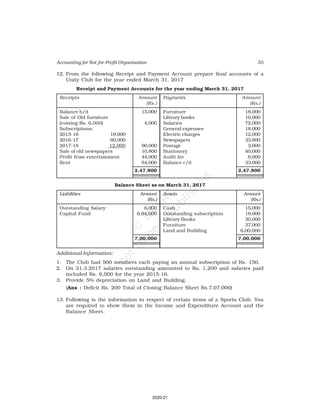
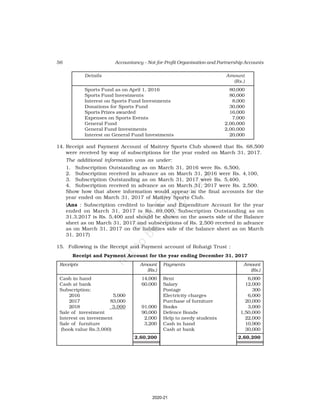
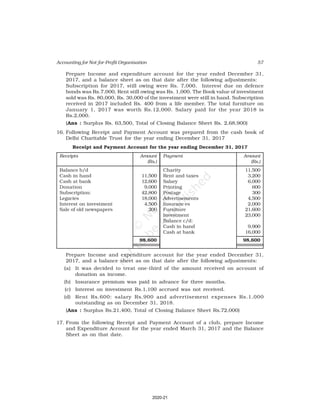
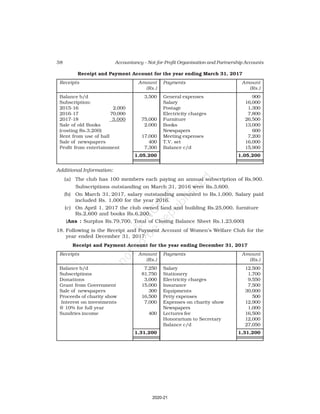
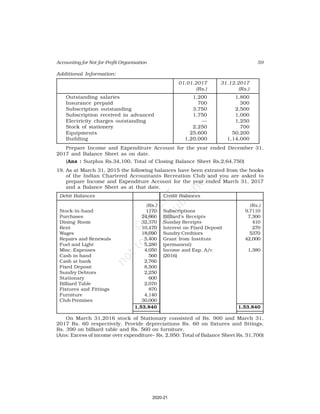
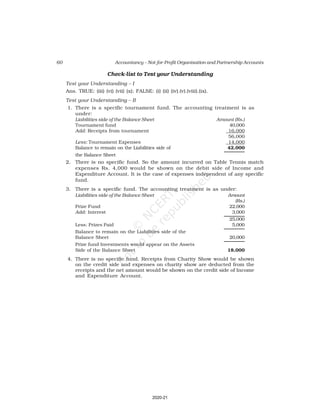
There are certain organisations which are set up
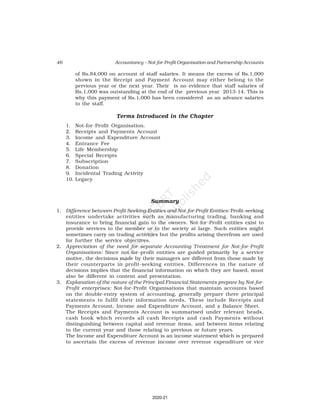
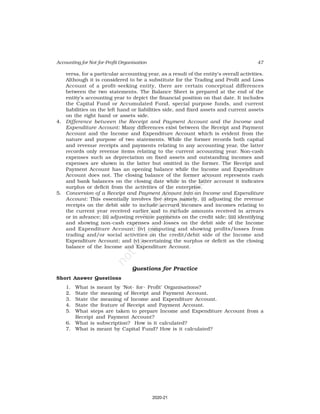
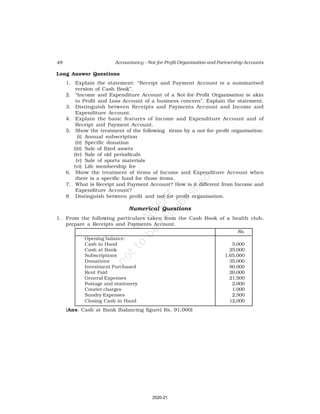
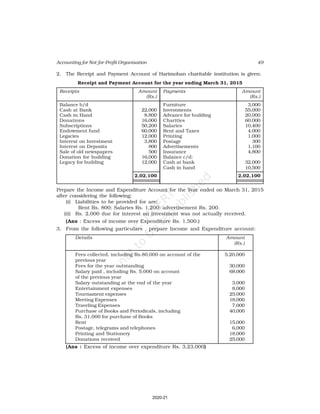
for providing service to its members and the
public in general. Such organisations include clubs,
charitable institutions, schools, religious
organisations, trade unions, welfare societies and
societies for the promotion of art and culture. These
organisations have service as the main objective and
not the profit as is the case of organisations in
business. Normally, these organisations do not
undertake any business activity, and are managed
by trustees who are fully accountable to their
members and the society for the utilization of the
funds raised for meeting the objectives of the
organisation. Hence, they also have to maintain
proper accounts and prepare the financial statement
which take the form of Receipt and Payment
Account; Income and Expenditure Account; and
Balance Sheet. at the end of for every accounting
period (normally a financial year).
This is also a legal requirement and helps them
to keep track of their income and expenditure, the
nature of which is different from those of the business
organisations. In this chapter we shall learn about
the accounting aspects relating to not-for-profit
organisation.
1.1 Meaning and Characteristics of Not-for-
Profit Organisation
Not-for -Profit Organisations refer to the
organisations that are for used for the welfare of the
society and are set up as charitable institutions
Accounting for Not-for-Profit Organisation 1
LEARNING OBJECTIVES
After studying this chapter,
you will be able to;
• Identiy the need for, and
nature of accounting records
relating to not-for-profit
organisations;
• List the principal financial
statements prepared by not-
for-profit organisations;
• Prepare the Receipt, and
Payment Account and Income
and Expenditure Account;
• Prepare Income and
Expenditure Account and
Balance Sheet from a given
Receipt and Payment
Account;
• Explain treatment of certain
peculiar items of Receipts
and Payments such as
subscriptions from members,
special funds, legacies, sale
of old fixed assets, etc.
2020-21
2 Accountancy – Not-for-Profit Organisation and Partnership Accounts
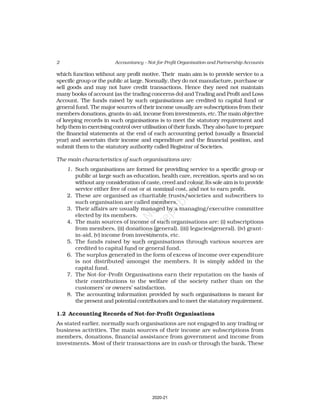
which function without any profit motive. Their main aim is to provide service to a
specific group or the public at large. Normally, they do not manufacture, purchase or
sell goods and may not have credit transactions. Hence they need not maintain
many books of account (as the trading concerns do) and Trading and Profit and Loss
Account. The funds raised by such organisations are credited to capital fund or
general fund. The major sources of their income usually are subscriptions from their
members donations, grants-in-aid, income from investments, etc. The main objective
of keeping records in such organisations is to meet the statutory requirement and
helptheminexercisingcontroloverutilisationoftheirfunds.Theyalsohavetoprepare
the financial statements at the end of each accounting period (usually a financial
year) and ascertain their income and expenditure and the financial position, and
submit them to the statutory authority called Registrar of Societies.
The main characteristics of such organisations are:
1. Such organisations are formed for providing service to a specific group or
public at large such as education, health care, recreation, sports and so on
without any consideration of caste, creed and colour. Its sole aim is to provide
service either free of cost or at nominal cost, and not to earn profit.
2. These are organised as charitable trusts/societies and subscribers to
such organisation are called members.
3. Their affairs are usually managed by a managing/executive committee
elected by its members.
4. The main sources of income of such organisations are: (i) subscriptions
from members, (ii) donations (general). (iii) legacies(general). (iv) grant-
in-aid, (v) income from investments, etc.
5. The funds raised by such organisations through various sources are
credited to capital fund or general fund.
6. The surplus generated in the form of excess of income over expenditure
is not distributed amongst the members. It is simply added in the
capital fund.
7. The Not-for-Profit Organisations earn their reputation on the basis of
their contributions to the welfare of the society rather than on the
customers’ or owners’ satisfaction.
8. The accounting information provided by such organisations is meant for
the present and potential contributors and to meet the statutory requirement.
1.2 Accounting Records of Not-for-Profit Organisations
As stated earlier, normally such organisations are not engaged in any trading or
business activities. The main sources of their income are subscriptions from
members, donations, financial assistance from government and income from
investments. Most of their transactions are in cash or through the bank. These
2020-21
3
Accounting for Not-for-Profit Organisation
institutions are required by law to keep proper accounting records and keep
proper control over the utilization of their funds. This is why they usually keep
a cash book in which all receipts and payments are duly recorded. They also
maintain a ledger containing the accounts of all incomes, expenses, assets
and liabilities which facilitates the preparation of financial statements at the
end of the accounting period. In addition, they are required to maintain a stock
register to keep complete record of all fixed assets and the consumables.
They do not maintain any capital account. Instead they maintain capital
fund which is also called general fund that goes on accumulating due to
surpluses generated, life membership fee, etc., received from year to year. In
fact, a proper system of accounting is desirable to avoid or minimise the chances
of misappropriations or embezzlement of the funds contributed by the members
and other donors.
Final Accounts or Financial Statements: The Not-for-Profit Organisations are also
required to prepare financial statements at the end of the each accounting period.
Although these organisations are non-profit making entities and they are not required
to make Trading and Profit & Loss Account but it is necessary to know whether the
income during the year was sufficient to meet the expenses or not. Not only that
they have to provide the necessary financial information to members, donors, and
contributors and also to the Registrar of Societies. For this purpose, they have to
prepare their final accounts at the end of the accounting period and the general
principles of accounting are fully applicable in their preparation as stated earlier,
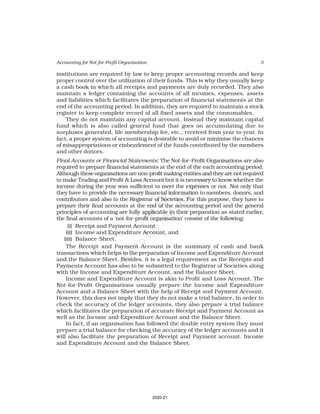
the final accounts of a ‘not-for-profit organisation’ consist of the following:
(i) Receipt and Payment Account
(ii) Income and Expenditure Account, and
(iii) Balance Sheet.
The Receipt and Payment Account is the summary of cash and bank
transactions which helps in the preparation of Income and Expenditure Account
and the Balance Sheet. Besides, it is a legal requirement as the Receipts and
Payments Account has also to be submitted to the Registrar of Societies along
with the Income and Expenditure Account, and the Balance Sheet.
Income and Expenditure Account is akin to Profit and Loss Account. The
Not-for-Profit Organisations usually prepare the Income and Expenditure
Account and a Balance Sheet with the help of Receipt and Payment Account.
However, this does not imply that they do not make a trial balance. In order to
check the accuracy of the ledger accounts, they also prepare a trial balance
which facilitates the preparation of accurate Receipt and Payment Account as
well as the Income and Expenditure Account and the Balance Sheet.
In fact, if an organisation has followed the double entry system they must
prepare a trial balance for checking the accuracy of the ledger accounts and it
will also facilitate the preparation of Receipt and Payment account. Income
and Expenditure Account and the Balance Sheet.
2020-21
4 Accountancy – Not-for-Profit Organisation and Partnership Accounts
1.3 Receipt and Payment Account
It is prepared at the end of the accounting year on the basis of cash receipts and
cash payments recorded in the cash book. It is a summary of cash and bank
transactions under various heads. For example, subscriptions received from the
members on different dates which appear on the debit side of the cash book, shall
be shown on the receipts side of the Receipt and Payment Account as one item
with its total amount. Similarly, salary, rent, electricity charges paid from time to
time as recorded on the credit side of the cash book but the total salary paid, total
rent paid, total electricity charges paid during the year appear on the payment
side of the Receipt and Payment Account. Thus, Receipt and Payment Account
gives summarised picture of various receipts and payments, irrespective of whether
they pertain to the current period, previous period or succeeding period or whether
they are of capital or revenue nature. It may be noted that this account does not
show any non cash item like depreciation. The opening balance in Receipt and
Payment Account represents cash in hand/cash at bank which is shown on its
receipts side and the closing balance of this account represents cash in hand and
bank balance as at the end of the year, which appear on the credit side of the
Receipt and Payment Account. However, if it is bank overdraft at the end it shall
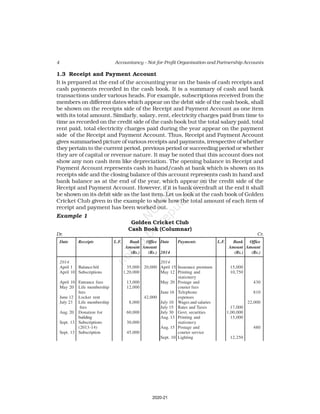
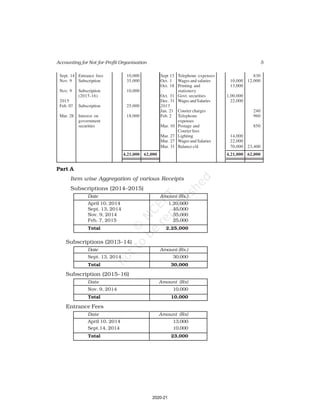
be shown on its debit side as the last item. Let us look at the cash book of Golden
Cricket Club given in the example to show how the total amount of each item of
receipt and payment has been worked out.
Example 1
Golden Cricket Club
Cash Book (Columnar)
Dr. Cr.
Date Receipts L.F. Bank Office Date Payments L.F. Bank Office
Amount Amount Amount Amount
(Rs.) (Rs.) 2014 (Rs.) (Rs.)
2014 2014
April 1 Balance b/d 35,000 20,000 April 15 Insurance premium 15,000
April 10 Subscriptions 1,20,000 May 12 Printing and 10,750
stationery
April 10 Entrance fees 13,000 May 20 Postage and 430
May 20 Life membership 12,000 courier fees
fees June 16 Telephone 810
June 12 Locker rent 42,000 expenses
July 23 Life membership 8,000 July 10 Wages and salaries 22,000
fees July 15 Rates and Taxes 17,000
Aug. 20 Donation for 60,000 July 30 Govt. securities 1,00,000
building Aug. 13 Printing and 15,000
Sept. 13 Subscriptions 30,000 stationery
(2013-14) Aug. 15 Postage and 480
Sept. 13 Subscription 45,000 courier service
Sept. 10 Lighting 12,250
2020-21
5
Accounting for Not-for-Profit Organisation
Sept. 14 Entrance fees 10,000 Sept 13 Telephone expenses 830
Nov. 9 Subscription 35,000 Oct. 1 Wages and salaries 10,000 12,000
Oct. 18 Printing and 13,000
Nov. 9 Subscription 10,000 stationery
(2015-16) Oct. 31 Govt. securities 1,00,000
2015 Dec. 31 Wages andSalaries 22,000
Feb. 07 Subscription 25,000 2015
Jan. 21 Courier charges 240
Mar. 28 Interest on 18,000 Feb. 2 Telephone 960
government expenses
securities Mar. 10 Postage and 850
Courier fees
Mar. 27 Lighting 14,000
Mar. 27 Wages and Salaries 22,000
Mar. 31 Balance c/d 70,000 23,400
4,21,000 62,000 4,21,000 62,000
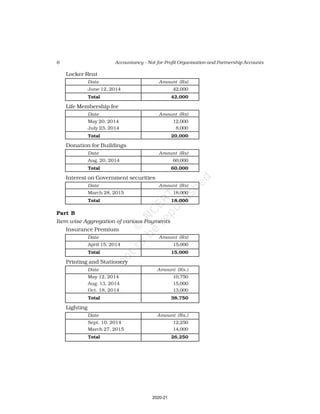
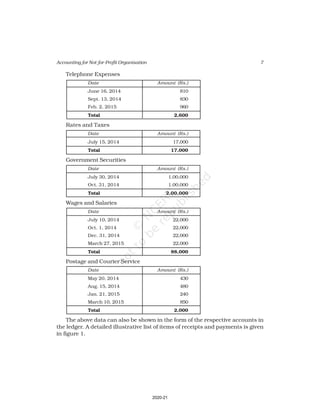
Part A
Item wise Aggregation of various Receipts
Subscriptions (2014–2015)
Date Amount (Rs.)
April 10, 2014 1,20,000
Sept. 13, 2014 45,000
Nov. 9, 2014 35,000
Feb. 7, 2015 25,000
Total 2,25,000
Subscriptions (2013–14)
Date Amount (Rs.)
Sept. 13, 2014 30,000
Total 30,000
Subscription (2015–16)
Date Amount (Rs)
Nov. 9, 2014 10,000
Total 10,000
Entrance Fees
Date Amount (Rs)
April 10, 2014 13,000
Sept.14, 2014 10,000
Total 23,000
2020-21
6 Accountancy – Not-for-Profit Organisation and Partnership Accounts
Locker Rent
Date Amount (Rs)
June 12, 2014 42,000
Total 42,000
Life Membership fee
Date Amount (Rs)
May 20, 2014 12,000
July 23, 2014 8,000
Total 20,000
Donation for Buildings
Date Amount (Rs)
Aug. 20, 2014 60,000
Total 60,000
Interest on Government securities
Date Amount (Rs)
March 28, 2015 18,000
Total 18,000
Part B
Item wise Aggregation of various Payments
Insurance Premium
Date Amount (Rs)
April 15, 2014 15,000
Total 15,000
Printing and Stationery
Date Amount (Rs.)
May 12, 2014 10,750
Aug. 13, 2014 15,000
Oct. 18, 2014 13,000
Total 38,750
Lighting
Date Amount (Rs.)
Sept. 10, 2014 12,250
March 27, 2015 14,000
Total 26,250
2020-21
7
Accounting for Not-for-Profit Organisation
Telephone Expenses
Date Amount (Rs.)
June 16, 2014 810
Sept. 13, 2014 830
Feb. 2, 2015 960
Total 2,600
Rates and Taxes
Date Amount (Rs.)
July 15, 2014 17,000
Total 17,000
Government Securities
Date Amount (Rs.)
July 30, 2014 1,00,000
Oct. 31, 2014 1,00,000
Total 2,00,000
Wages and Salaries
Date Amount (Rs.)
July 10, 2014 22,000
Oct. 1, 2014 22,000
Dec. 31, 2014 22,000
March 27, 2015 22,000
Total 88,000
Postage and Courier Service
Date Amount (Rs.)
May 20, 2014 430
Aug. 15, 2014 480
Jan. 21, 2015 240
March 10, 2015 850
Total 2,000
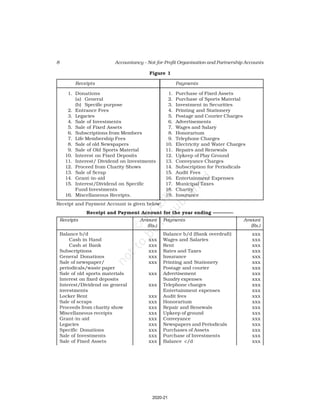
The above data can also be shown in the form of the respective accounts in
the ledger. A detailed illustrative list of items of receipts and payments is given
in figure 1.
2020-21
8 Accountancy – Not-for-Profit Organisation and Partnership Accounts
Figure 1
Receipts Payments
1. Donations 1. Purchase of Fixed Assets
(a) General 2. Purchase of Sports Material
(b) Specific purpose 3. Investment in Securities
2. Entrance Fees 4. Printing and Stationery
3. Legacies 5. Postage and Courier Charges
4. Sale of Investments 6. Advertisements
5. Sale of Fixed Assets 7. Wages and Salary
6. Subscriptions from Members 8. Honorarium
7. Life Membership Fees 9. Telephone Charges
8. Sale of old Newspapers 10. Electricity and Water Charges
9. Sale of Old Sports Material 11. Repairs and Renewals
10. Interest on Fixed Deposits 12. Upkeep of Play Ground
11. Interest/ Dividend on Investments 13. Conveyance Charges
12. Proceed from Charity Shows 14. Subscription for Periodicals
13. Sale of Scrap 15. Audit Fees
14. Grant-in-aid 16. Entertainment Expenses
15. Interest/Dividend on Specific 17. Municipal Taxes
Fund Investments 18. Charity
16. Miscellaneous Receipts. 19. Insurance
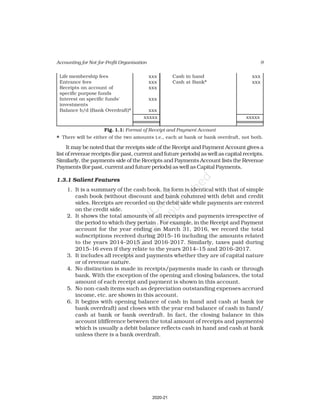
Receipt and Payment Account is given below:
Receipt and Payment Account for the year ending ————-
Receipts Amount Payments Amount
(Rs.) (Rs.)
Balance b/d Balance b/d (Bank overdraft) xxx
Cash in Hand xxx Wages and Salaries xxx
Cash at Bank xxx Rent xxx
Subscriptions xxx Rates and Taxes xxx
General Donations xxx Insurance xxx
Sale of newspaper/ xxx Printing and Stationery xxx
periodicals/waste paper Postage and courier xxx
Sale of old sports materials xxx Advertisement xxx
Interest on fixed deposits Sundry expenses xxx
Interest/Dividend on general xxx Telephone charges xxx
investments Entertainment expenses xxx
Locker Rent xxx Audit fees xxx
Sale of scraps xxx Honorarium xxx
Proceeds from charity show xxx Repair and Renewals xxx
Miscellaneous receipts xxx Upkeep of ground xxx
Grant-in-aid xxx Conveyance xxx
Legacies xxx Newspapers and Periodicals xxx
Specific Donations xxx Purchases of Assets xxx
Sale of Investments xxx Purchase of Investments xxx
Sale of Fixed Assets xxx Balance c/d xxx
2020-21
9
Accounting for Not-for-Profit Organisation
Life membership fees xxx Cash in hand xxx
Entrance fees xxx Cash at Bank* xxx
Receipts on account of xxx
specific purpose funds
Interest on specific funds' xxx
investments
Balance b/d (Bank Overdraft)* xxx
xxxxx xxxxx
Fig. 1.1: Format of Receipt and Payment Account
* There will be either of the two amounts i.e., each at bank or bank overdraft, not both.
It may be noted that the receipts side of the Receipt and Payment Account gives a
list of revenue receipts (for past, current and future periods) as well as capital receipts.
Similarly, the payments side of the Receipts and Payments Account lists the Revenue
Payments (for past, current and future periods) as well as Capital Payments.
1.3.1 Salient Features
1. It is a summary of the cash book. Its form is identical with that of simple
cash book (without discount and bank columns) with debit and credit
sides. Receipts are recorded on the debit side while payments are entered
on the credit side.
2. It shows the total amounts of all receipts and payments irrespective of
the period to which they pertain . For example, in the Receipt and Payment
account for the year ending on March 31, 2016, we record the total
subscriptions received during 2015–16 including the amounts related
to the years 2014–2015 and 2016-2017. Similarly, taxes paid during
2015–16 even if they relate to the years 2014–15 and 2016–2017.
3. It includes all receipts and payments whether they are of capital nature
or of revenue nature.
4. No distinction is made in receipts/payments made in cash or through
bank. With the exception of the opening and closing balances, the total
amount of each receipt and payment is shown in this account.
5. No non-cash items such as depreciation outstanding expenses accrued
income, etc. are shown in this account.
6. It begins with opening balance of cash in hand and cash at bank (or
bank overdraft) and closes with the year end balance of cash in hand/
cash at bank or bank overdraft. In fact, the closing balance in this
account (difference between the total amount of receipts and payments)
which is usually a debit balance reflects cash in hand and cash at bank
unless there is a bank overdraft.
2020-21
10 Accountancy – Not-for-Profit Organisation and Partnership Accounts
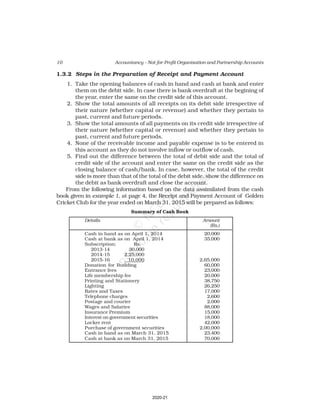
1.3.2 Steps in the Preparation of Receipt and Payment Account
1. Take the opening balances of cash in hand and cash at bank and enter
them on the debit side. In case there is bank overdraft at the begining of
the year, enter the same on the credit side of this account.
2. Show the total amounts of all receipts on its debit side irrespective of
their nature (whether capital or revenue) and whether they pertain to
past, current and future periods.
3. Show the total amounts of all payments on its credit side irrespective of
their nature (whether capital or revenue) and whether they pertain to
past, current and future periods.
4. None of the receivable income and payable expense is to be entered in
this account as they do not involve inflow or outflow of cash.
5. Find out the difference between the total of debit side and the total of
credit side of the account and enter the same on the credit side as the
closing balance of cash/bank. In case, however, the total of the credit
side is more than that of the total of the debit side, show the difference on
the debit as bank overdraft and close the account.
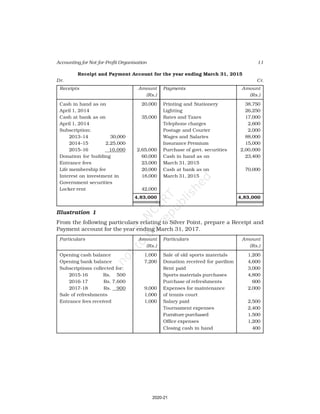
From the following information based on the data assimilated from the cash
book given in example 1, at page 4, the Receipt and Payment Account of Golden
Cricket Club for the year ended on March 31, 2015 will be prepared as follows:
Summary of Cash Book
Details Amount
(Rs.)
Cash in hand as on April 1, 2014 20,000
Cash at bank as on April 1, 2014 35,000
Subscription: Rs.
2013-14 30,000
2014-15 2,25,000
2015-16 10,000 2,65,000
Donation for Building 60,000
Entrance fees 23,000
Life membership fee 20,000
Printing and Stationery 38,750
Lighting 26,250
Rates and Taxes 17,000
Telephone charges 2,600
Postage and courier 2,000
Wages and Salaries 88,000
Insurance Premium 15,000
Interest on government securities 18,000
Locker rent 42,000
Purchase of government securities 2,00,000
Cash in hand as on March 31, 2015 23,400
Cash at bank as on March 31, 2015 70,000
2020-21
11
Accounting for Not-for-Profit Organisation
Receipt and Payment Account for the year ending March 31, 2015
Dr. Cr.
Receipts Amount Payments Amount
(Rs.) (Rs.)
Cash in hand as on 20,000 Printing and Stationery 38,750
April 1, 2014 Lighting 26,250
Cash at bank as on 35,000 Rates and Taxes 17,000
April 1, 2014 Telephone charges 2,600
Subscription: Postage and Courier 2,000
2013–14 30,000 Wages and Salaries 88,000
2014–15 2,25,000 Insurance Premium 15,000
2015–16 10,000 2,65,000 Purchase of govt. securities 2,00,000
Donation for building 60,000 Cash in hand as on 23,400
Entrance fees 23,000 March 31, 2015
Life membership fee 20,000 Cash at bank as on 70,000
Interest on investment in 18,000 March 31, 2015
Government securities
Locker rent 42,000
4,83,000 4,83,000
Illustration 1
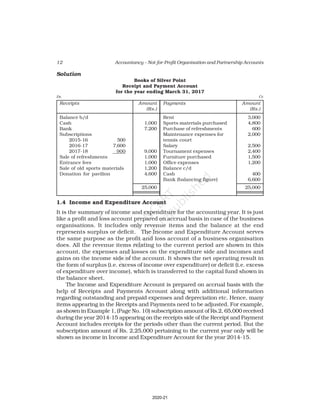
From the following particulars relating to Silver Point, prepare a Receipt and
Payment account for the year ending March 31, 2017.
Particulars Amount Particulars Amount
(Rs.) (Rs.)
Opening cash balance 1,000 Sale of old sports materials 1,200
Opening bank balance 7,200 Donation received for pavilion 4,600
Subscriptions collected for: Rent paid 3,000
2015-16 Rs. 500 Sports materials purchases 4,800
2016-17 Rs. 7,600 Purchase of refreshments 600
2017-18 Rs. 900 9,000 Expenses for maintenance 2,000
Sale of refreshments 1,000 of tennis court
Entrance fees received 1,000 Salary paid 2,500
Tournament expenses 2,400
Furniture purchased 1,500
Office expenses 1,200
Closing cash in hand 400
2020-21
12 Accountancy – Not-for-Profit Organisation and Partnership Accounts
Solution
Books of Silver Point
Receipt and Payment Account
for the year ending March 31, 2017
Dr. Cr.
Receipts Amount Payments Amount
(Rs.) (Rs.)
Balance b/d Rent 3,000
Cash 1,000 Sports materials purchased 4,800
Bank 7,200 Purchase of refreshments 600
Subscriptions Maintenance expenses for 2,000
2015-16 500 tennis court
2016-17 7,600 Salary 2,500
2017-18 900 9,000 Tournament expenses 2,400
Sale of refreshments 1,000 Furniture purchased 1,500
Entrance fees 1,000 Office expenses 1,200
Sale of old sports materials 1,200 Balance c/d
Donation for pavilion 4,600 Cash 400
Bank (balancing figure) 6,600
25,000 25,000
1.4 Income and Expenditure Account
It is the summary of income and expenditure for the accounting year. It is just
like a profit and loss account prepared on accrual basis in case of the business
organisations. It includes only revenue items and the balance at the end
represents surplus or deficit. The Income and Expenditure Account serves
the same purpose as the profit and loss account of a business organisation
does. All the revenue items relating to the current period are shown in this
account, the expenses and losses on the expenditure side and incomes and
gains on the income side of the account. It shows the net operating result in
the form of surplus (i.e. excess of income over expenditure) or deficit (i.e. excess
of expenditure over income), which is transferred to the capital fund shown in
the balance sheet.
The Income and Expenditure Account is prepared on accrual basis with the
help of Receipts and Payments Account along with additional information
regarding outstanding and prepaid expenses and depreciation etc. Hence, many
items appearing in the Receipts and Payments need to be adjusted. For example,
as shown in Example 1, (Page No. 10) subscription amount of Rs.2, 65,000 received
during the year 2014-15 appearing on the receipts side of the Receipt and Payment
Account includes receipts for the periods other than the current period. But the
subscription amount of Rs. 2,25,000 pertaining to the current year only will be
shown as income in Income and Expenditure Account for the year 2014-15.
2020-21
13
Accounting for Not-for-Profit Organisation
1.4.1 Steps in the Preparation of Income and Expenditure Account
Following steps may be helpful in preparing an Income and Expenditure Account
from a given Receipt and Payment Account:
1. Persue the Receipt and Payment Account thoroughly.
2. Exclude the opening and closing balances of cash and bank as they
are not an income.
3. Exclude the capital receipts and capital payments as these are to be
shown in the Balance Sheet.
4. Consider only the revenue receipts to be shown on the income side of
Income and Expenditure Account. Some of these need to be adjusted by
excluding the amounts relating to the preceding and the succeeding
periods and including the amounts relating to the current year not yet
received.
5. Take the revenue expenses to the expenditure side of the Income and
Expenditure Account with due adjustments as per the additional
information provided relating to the amounts received in advance and
those not yet received.
6. Consider the following items not appearing in the Receipt and Payment
Account that need to be taken into account for determining the surplus/
deficit for the current year :
(a) Depreciation of fixed assets.
(b) Provision for doubtful debts, if required.
(c) Profit or loss on sale of fixed assets.
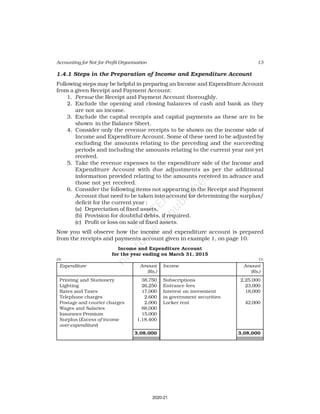
Now you will observe how the income and expenditure account is prepared
from the receipts and payments account given in example 1, on page 10.
Income and Expenditure Account
for the year ending on March 31, 2015
Dr. Cr.
Expenditure Amount Income Amount
(Rs.) (Rs.)
Printing and Stationery 38,750 Subscriptions 2,25,000
Lighting 26,250 Entrance fees 23,000
Rates and Taxes 17,000 Interest on investment 18,000
Telephone charges 2,600 in government securities
Postage and courier charges 2,000 Locker rent 42,000
Wages and Salaries 88,000
Insurance Premium 15,000
Surplus (Excess of income 1,18,400
over expenditure)
3,08,000 3,08,000
2020-21
14 Accountancy – Not-for-Profit Organisation and Partnership Accounts
Note that-
1. Opening and closing cash/bank balances have been excluded.
2. Payment for purchase of Government securities being capital expenditure has
been excluded.
3. Amount of subscriptions received for the year 2013-14 and 2015-16 have been excluded.
4. Life membership fee is an item of capital receipt and so excluded.
5. Donation for building is a receipt for a specific purpose and so excluded.
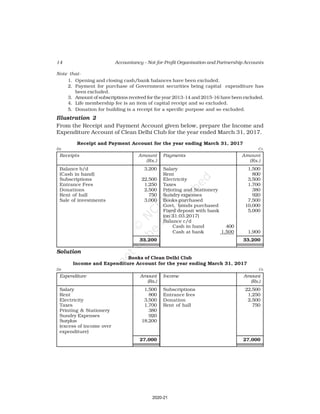
Illustration 2
From the Receipt and Payment Account given below, prepare the Income and
Expenditure Account of Clean Delhi Club for the year ended March 31, 2017.
Receipt and Payment Account for the year ending March 31, 2017
Dr. Cr.
Receipts Amount Payments Amount
(Rs.) (Rs.)
Balance b/d 3,200 Salary 1,500
(Cash in hand) Rent 800
Subscriptions 22,500 Electricity 3,500
Entrance Fees 1,250 Taxes 1,700
Donations 2,500 Printing and Stationery 380
Rent of hall 750 Sundry expenses 920
Sale of investments 3,000 Books purchased 7,500
Govt. bonds purchased 10,000
Fixed deposit with bank 5,000
(on 31.03.2017)
Balance c/d
Cash in hand 400
Cash at bank 1,500 1,900
33,200 33,200
Solution
Books of Clean Delhi Club
Income and Expenditure Account for the year ending March 31, 2017
Dr. Cr.
Expenditure Amount Income Amount
(Rs.) (Rs.)
Salary 1,500 Subscriptions 22,500
Rent 800 Entrance fees 1,250
Electricity 3,500 Donation 2,500
Taxes 1,700 Rent of hall 750
Printing & Stationery 380
Sundry Expenses 920
Surplus 18,200
(excess of income over
expenditure)
27,000 27,000
2020-21
15
Accounting for Not-for-Profit Organisation
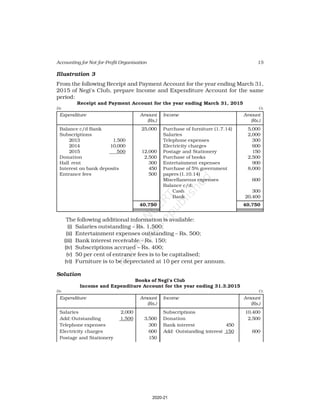
Illustration 3
From the following Receipt and Payment Account for the year ending March 31,
2015 of Negi's Club, prepare Income and Expenditure Account for the same
period:
Receipt and Payment Account for the year ending March 31, 2015
Dr. Cr.
Expenditure Amount Income Amount
(Rs.) (Rs.)
Balance c/d Bank 25,000 Purchase of furniture (1.7.14) 5,000
Subscriptions Salaries 2,000
2013 1,500 Telephone expenses 300
2014 10,000 Electricity charges 600
2015 500 12,000 Postage and Stationery 150
Donation 2,500 Purchase of books 2,500
Hall rent 300 Entertainment expenses 900
Interest on bank deposits 450 Purchase of 5% government 8,000
Entrance fees 500 papers (1.10.14)
Miscellaneous expenses 600
Balance c/d:
Cash 300
Bank 20,400
40,750 40,750
The following additional information is available:
(i) Salaries outstanding – Rs. 1,500;
(ii) Entertainment expenses outstanding – Rs. 500;
(iii) Bank interest receivable – Rs. 150;
(iv) Subscriptions accrued – Rs. 400;
(v) 50 per cent of entrance fees is to be capitalised;
(vi) Furniture is to be depreciated at 10 per cent per annum.
Solution
Books of Negi's Club
Income and Expenditure Account for the year ending 31.3.2015
Dr. Cr.
Expenditure Amount Income Amount
(Rs.) (Rs.)
Salaries 2,000 Subscriptions 10,400
Add: Outstanding 1,500 3,500 Donation 2,500
Telephone expenses 300 Bank interest 450
Electricity charges 600 Add: Outstanding interest 150 600
Postage and Stationery 150
2020-21
16 Accountancy – Not-for-Profit Organisation and Partnership Accounts
Entertainment expenses 900 Interest on investment 200
Add: Outstanding 500 1,400 Hall rent 300
expenses
Miscellaneous expenses 600
Depreciation on furniture 375
Surplus 7,075
(Excess of Income over
Expenditure)
14,000 14,000
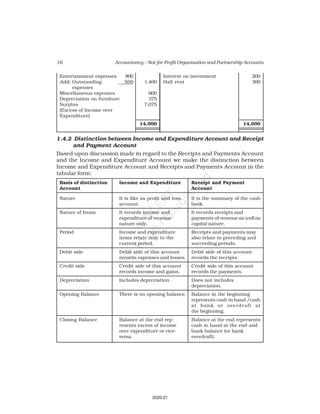
1.4.2 Distinction between Income and Expenditure Account and Receipt
and Payment Account
Based upon discussion made in regard to the Receipts and Payments Account
and the Income and Expenditure Account we make the distinction between
Income and Expenditure Account and Receipts and Payments Account in the
tabular form:
Basis of distinction Income and Expenditure Receipt and Payment
Account Account
Nature It is like as profit and loss It is the summary of the cash
account. book.
Nature of Items It records income and It records receipts and
expenditure of revenue payments of revenue as well as
nature only. capital nature.
Period Income and expenditure Receipts and payments may
items relate only to the also relate to preceding and
current period. succeeding periods.
Debit side Debit side of this account Debit side of this account
records expenses and losses. records the receipts.
Credit side Credit side of this account Credit side of this account
records income and gains. records the payments.
Depreciation Includes depreciation. Does not includes
depreciation.
Opening Balance There is no opening balance. Balance in the beginning
represents cash in hand /cash
at bank or overdraft at
the beginning.
Closing Balance Balance at the end rep- Balance at the end represents
resents excess of income cash in hand at the end and
over expenditure or vice- bank balance (or bank
versa. overdraft).
2020-21
17
Accounting for Not-for-Profit Organisation
1.5 Balance Sheet
‘Not-for-Profit’ Organisations prepare Balance Sheet for ascertaining the financial
position of the organisation. The preparation of their Balance Sheet is on the same
pattern as that of the business entities. It shows assets and liabilities as at the end
of the year. Assets are shown on the right hand side and the liabilities on the left
hand side. However, there will be a Capital Fund or General Fund in place of the
Capital and the surplus or deficit as per Income and Expenditure Account which
is either added to/deducted from the capital fund, as the case may be. It is also
a common practice to add some of the capitalised items like legacies, entrance
fees and life membership fees directly in the capital fund.
Besides the Capital or General Fund, there may be other funds created for
specific purposes or to meet the requirements of the contributors/donors such
as building fund, sports fund, etc. Such funds are shown separately in the
liabilities side of the balance sheet.
Some times it becomes necessary to prepare Balance Sheet as at the beginning
of the year in order to find out the opening balance of the capital/general fund.
1.5.1 Preparation of Balance Sheet
The following procedure is adopted to prepare the Balance Sheet:
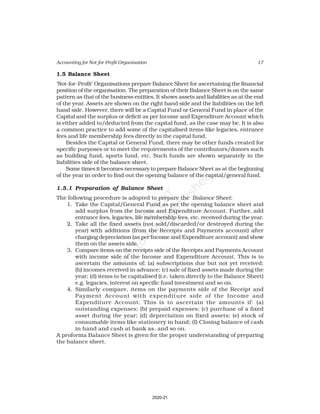
1. Take the Capital/General Fund as per the opening balance sheet and
add surplus from the Income and Expenditure Account. Further, add
entrance fees, legacies, life membership fees, etc. received during the year.
2. Take all the fixed assets (not sold/discarded/or destroyed during the
year) with additions (from the Receipts and Payments account) after
charging depreciation (as per Income and Expenditure account) and show
them on the assets side.
3. Compare items on the receipts side of the Receipts and Payments Account
with income side of the Income and Expenditure Account. This is to
ascertain the amounts of: (a) subscriptions due but not yet received:
(b) incomes received in advance; (c) sale of fixed assets made during the
year; (d) items to be capitalised (i.e. taken directly to the Balance Sheet)
e.g. legacies, interest on specific fund investment and so on.
4. Similarly compare, items on the payments side of the Receipt and
Payment Account with expenditure side of the Income and
Expenditure Account. This is to ascertain the amounts if: (a)
outstanding expenses; (b) prepaid expenses; (c) purchase of a fixed
asset during the year; (d) depreciation on fixed assets; (e) stock of
consumable items like stationery in hand; (f) Closing balance of cash
in hand and cash at bank as, and so on.
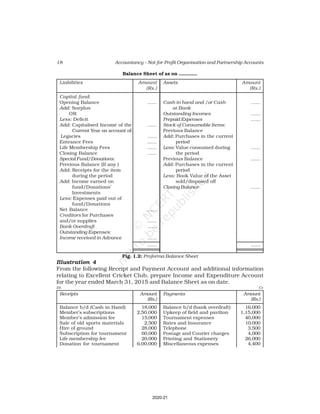
A proforma Balance Sheet is given for the proper understanding of preparing
the balance sheet.
2020-21
18 Accountancy – Not-for-Profit Organisation and Partnership Accounts
Balance Sheet of as on ...............
Liabilities Amount Assets Amount
(Rs.) (Rs.)
Capital fund:
Opening Balance ...... Cash in hand and /or Cash ......
Add: Surplus at Bank
OR Outstanding Incomes ......
Less: Deficit Prepaid Expenses ......
Add: Capitalised Income of the ...... Stock of Consumable Items:
Current Year on account of: Previous Balance
Legacies ...... Add: Purchases in the current
Entrance Fees ...... period
Life Membership Fees ...... Less: Value consumed during ......
Closing Balance ...... the period
Special Fund/Donations: Previous Balance ......
Previous Balance (If any ) Add: Purchases in the current
Add: Receipts for the item period
during the period Less: Book Value of the Asset
Add: Income earned on sold/disposed off
fund/Donations’ Closing Balance ......
Investments
Less: Expenses paid out of
fund/Donations
Net Balance ......
Creditors for Purchases
and/or supplies ......
Bank Overdraft ......
Outstanding Expenses:
Income received in Advance ......
...... ......
Fig. 1.2: Proforma Balance Sheet
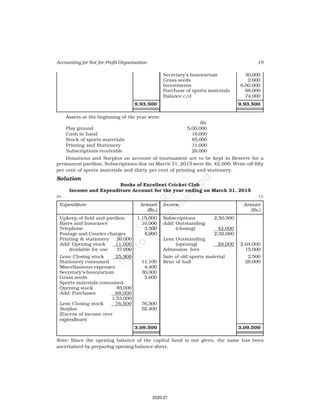
Illustration 4
From the following Receipt and Payment Account and additional information
relating to Excellent Cricket Club, prepare Income and Expenditure Account
for the year ended March 31, 2015 and Balance Sheet as on date.
Dr. Cr.
Receipts Amount Payments Amount
(Rs.) (Rs.)
Balance b/d (Cash in Hand) 18,000 Balance b/d (bank overdraft) 16,000
Member’s subscriptions 2,50,000 Upkeep of field and pavilion 1,15,000
Member’s admission fee 15,000 Tournament expenses 40,000
Sale of old sports materials 2,500 Rates and Insurance 10,000
Hire of ground 28,000 Telephone 3,500
Subscription for tournament 60,000 Postage and Courier charges 4,000
Life membership fee 20,000 Printing and Stationery 26,000
Donation for tournament 6,00,000 Miscellaneous expenses 4,400
2020-21
19
Accounting for Not-for-Profit Organisation
Secretary’s honorarium 30,000
Grass seeds 2,600
Investments 6,00,000
Purchase of sports materials 68,000
Balance c/d 74,000
9,93,500 9,93,500
Assets at the beginning of the year were:
Rs.
Play ground 5,00,000
Cash in hand 18,000
Stock of sports materials 85,000
Printing and Stationery 11,000
Subscriptions receivable 28,000
Donations and Surplus on account of tournament are to be kept in Reserve for a
permanent pavilion. Subscriptions due on March 31, 2015 were Rs. 42,000. Write-off fifty
per cent of sports materials and thirty per cent of printing and stationery.
Solution
Books of Excellent Cricket Club
Income and Expenditure Account for the year ending on March 31, 2015
Dr. Cr.
Expenditure Amount Income Amount
(Rs.) (Rs.)
Upkeep of field and pavilion 1,15,000 Subscriptions 2,50,000
Rates and Insurance 10,000 Add: Outstanding
Telephone 3,500 (closing) 42,000
Postage and Courier charges 4,000 2,92,000
Printing & stationery 26,000 Less: Outstanding
Add: Opening stock 11,000 (opening) 28,000 2,64,000
Available for use 37,000 Admission fees 15,000
Less: Closing stock 25,900 Sale of old sports material 2,500
Stationery consumed 11,100 Rent of hall 28,000
Miscellaneous expenses 4,400
Secretary’s honorarium 30,000
Grass seeds 2,600
Sports materials consumed:
Opening stock 85,000
Add: Purchases 68,000
1,53,000
Less: Closing stock 76,500 76,500
Surplus 52,400
(Excess of income over
expenditure)
3,09,500 3,09,500
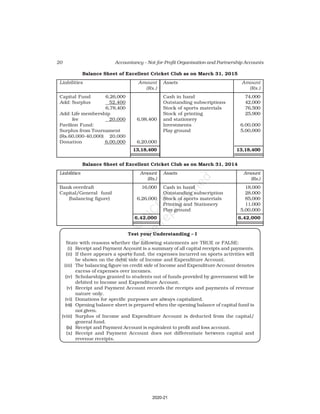
Note: Since the opening balance of the capital fund is not given, the same has been
ascertained by preparing opening balance sheet.
2020-21
20 Accountancy – Not-for-Profit Organisation and Partnership Accounts
Balance Sheet of Excellent Cricket Club as on March 31, 2015
Liabilities Amount Assets Amount
(Rs.) (Rs.)
Capital Fund 6,26,000 Cash in hand 74,000
Add: Surplus 52,400 Outstanding subscriptions 42,000
6,78,400 Stock of sports materials 76,500
Add: Life membership Stock of printing 25,900
fee 20,000 6,98,400 and stationery
Pavilion Fund: Investments 6,00,000
Surplus from Tournament Play ground 5,00,000
(Rs.60,000-40,000) 20,000
Donation 6,00,000 6,20,000
13,18,400 13,18,400
Balance Sheet of Excellent Cricket Club as on March 31, 2014
Liabilities Amount Assets Amount
(Rs.) (Rs.)
Bank overdraft 16,000 Cash in hand 18,000
Capital/General fund Outstanding subscription 28,000
(balancing figure) 6,26,000 Stock of sports materials 85,000
Printing and Stationery 11,000
Play ground 5,00,000
6,42,000 6,42,000
Test your Understanding – I
State with reasons whether the following statements are TRUE or FALSE:
(i) Receipt and Payment Account is a summary of all capital receipts and payments.
(ii) If there appears a sports fund, the expenses incurred on sports activities will
be shown on the debit side of Income and Expenditure Account.
(iii) The balancing figure on credit side of Income and Expenditure Account denotes
excess of expenses over incomes.
(iv) Scholarships granted to students out of funds provided by government will be
debited to Income and Expenditure Account.
(v) Receipt and Payment Account records the receipts and payments of revenue
nature only.
(vi) Donations for specific purposes are always capitalized.
(vii) Opening balance sheet is prepared when the opening balance of capital fund is
not given.
(viii) Surplus of Income and Expenditure Account is deducted from the capital/
general fund.
(ix) Receipt and Payment Account is equivalent to profit and loss account.
(x) Receipt and Payment Account does not differentiate between capital and
revenue receipts.
2020-21
21
Accounting for Not-for-Profit Organisation
1.6 Some Peculiar Items
Final accounts of the Not-for-Profit organisations are prepared on the similar
pattern as that of a business orgnisation. However, a few items of income and
expenses of such orgnisations are somewhat different in nature and need special
attention in their treatment in final accounts. They are peculiar to these
orgnisations. Some of the common peculiar items are explained as under:
Subscriptions: Subscription is a membership fee paid by the member on annual
basis. This is the main source of income of such orgnisations. Subscription paid
by the members is shown as receipt in the Receipt and Payment Account and as
income in the Income and Expenditure Account. It may be noted that Receipt
and Payment Account shows the total amount of subscription actually received
during the year while the amount shown in Income and Expenditure Account is
confined to the figure related to the current period only irrespective of the fact
whether it has been received or not. For example, a club received Rs. 20,000 as
subscriptions during the year 2016-17 of which Rs.3,000 relate to year
2015-16 and Rs.2,000 to 2017-18, and at the end of the year 2016-17 Rs.6,000
are still receivable. In this case, the Receipt and Payment Account will show
Rs.20,000 as receipt from subscriptions. But the Income and Expenditure
Account will show Rs. 21,000 as income from subscriptions for the year
2016-17, the calculation of which is given as below:
Rs.
Subscriptions received in 2016-17 20,000
Less: Subscriptions for the year 2015-16 3,000
17,000
Less: Subscription for the year 2017-18 2,000
15,000
Add: Subscriptions outstanding for the year 2016-17 6,000
Income from subscriptions for the year 2016-17 21,000
The above amount of subscriptions to be shown as income can also be
ascertained by preparing the subscription account as follows:
Subscription Account
Dr. Cr.
Date Particulars J.F. Amount Date Particulars J.F. A m o u n t
(Rs.) (Rs.)
Balance b/d 3,000 Balance b/d Nil
(outstanding at the (received in advance
beginning) during previous year)
Income and Expenditure 21,000 Cash (subscription 20,000
Account (balancing figure) received)
Balance c/d 2,000 Balance c/d 6,000
(received in advance) (outstanding at the end)
26,000 26,000
2020-21
22 Accountancy – Not-for-Profit Organisation and Partnership Accounts
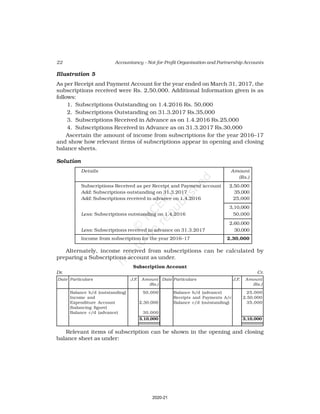
Illustration 5
As per Receipt and Payment Account for the year ended on March 31, 2017, the
subscriptions received were Rs. 2,50,000. Additional Information given is as
follows:
1. Subscriptions Outstanding on 1.4.2016 Rs. 50,000
2. Subscriptions Outstanding on 31.3.2017 Rs.35,000
3. Subscriptions Received in Advance as on 1.4.2016 Rs.25,000
4. Subscriptions Received in Advance as on 31.3.2017 Rs.30,000
Ascertain the amount of income from subscriptions for the year 2016–17
and show how relevant items of subscriptions appear in opening and closing
balance sheets.
Solution
Details Amount
(Rs.)
Subscriptions Received as per Receipt and Payment account 2,50,000
Add: Subscriptions outstanding on 31.3.2017 35,000
Add: Subscriptions received in advance on 1.4.2016 25,000
3,10,000
Less: Subscriptions outstanding on 1.4.2016 50,000
2,60,000
Less: Subscriptions received in advance on 31.3.2017 30,000
Income from subscription for the year 2016–17 2,30,000
Alternately, income received from subscriptions can be calculated by
preparing a Subscriptions account as under.
Subscription Account
Dr. Cr.
Date Particulars J.F. Amount Date Particulars J.F. Amount
(Rs.) (Rs.)
Balance b/d (outstanding) 50,000 Balance b/d (advance) 25,000
Income and Receipts and Payments A/c 2,50,000
Expenditure Account 2,30,000 Balance c/d (outstanding) 35,000
(balancing figure)
Balance c/d (advance) 30,000
3,10,000 3,10,000
Relevant items of subscription can be shown in the opening and closing
balance sheet as under:
2020-21
23
Accounting for Not-for-Profit Organisation
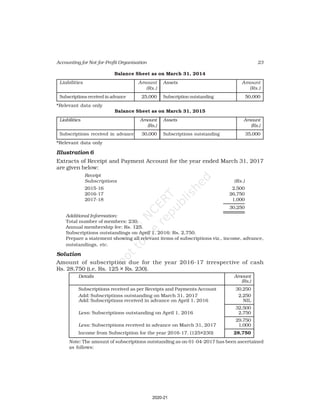
Balance Sheet as on March 31, 2014
Liabilities Amount Assets Amount
(Rs.) (Rs.)
Subscriptions received in advance 25,000 Subscription outstanding 50,000
*Relevant data only
Balance Sheet as on March 31, 2015
Liabilities Amount Assets Amount
(Rs.) (Rs.)
Subscriptions received in advance 30,000 Subscriptions outstanding 35,000
*Relevant data only
Illustration 6
Extracts of Receipt and Payment Account for the year ended March 31, 2017
are given below:
Receipt
Subscriptions (Rs.)
2015-16 2,500
2016-17 26,750
2017-18 1,000
30,250
Additional Information:
Total number of members: 230.
Annual membership fee: Rs. 125.
Subscriptions outstandings on April 1, 2016: Rs. 2,750.
Prepare a statement showing all relevant items of subscriptions viz., income, advance,
outstandings, etc.
Solution
Amount of subscription due for the year 2016-17 irrespective of cash
Rs. 28,750 (i.e. Rs. 125 × Rs. 230).
Details Amount
(Rs.)
Subscriptions received as per Receipts and Payments Account 30,250
Add: Subscriptions outstanding on March 31, 2017 2,250
Add: Subscriptions received in advance on April 1, 2016 NIL
32,500
Less: Subscriptions outstanding on April 1, 2016 2,750
29,750
Less: Subscriptions received in advance on March 31, 2017 1,000
Income from Subscription for the year 2016-17. (125×230) 28,750
Note: The amount of subscriptions outstanding as on 01-04-2017 has been ascertained
as follows:
2020-21
24 Accountancy – Not-for-Profit Organisation and Partnership Accounts
Details (Rs.) (Rs.)
(i) Outstanding as on 01.04.2016 2,750
Received for 2015–16 2,500 250
(ii) Due for 2016–17 (125×230) 28,750
Received for 2016–17 26,750 2,000
Outstanding as on 31-3-2017 2,250
Illustration 7
From the following extract of Receipt and Payment Account and the additional
information, compute the amount of income from subscriptions and show as
how they would appear in the Income and Expenditure Account for the year
ending March 31, 2015 and the Balance Sheet.
Receipt and Payment Account for the year ending March 31, 2015
Receipts Amount Payments Amount
(Rs.) (Rs.)
Subscriptions:
2013-14 7,000
2014-15 30,000
2015-16 5,000 42,000
Additional Information: Rs.
1. Subscriptions outstanding March 31, 2014 8,500
2. Total Subscriptions outstanding March 31, 2015 18,500
3. Subscriptions received in advance 4,000
as on March 31, 2014
Solution
Income and Expenditure Account
for the year ending on March 31, 2015
Expenditure Amount Income Amount
(Rs.) (Rs.)
Subscriptions 30,000
Received for 2014-15
Add: Outstanding for 2014-15 17,000
Add: Received in advance for 4,000
2014-15
51,000
Note: Total amount of subscriptions outstanding as on 31-3-2015 are Rs. 18,500. This,
includes Rs. 1,500 (Rs. 8,500 – Rs. 7,000) for subscriptions still outstanding for
2013–14. Hence, the subscriptions outstanding for 2014–15 are Rs. 17,000
(Rs. 18,500 – Rs. 1,500).
2020-21
25
Accounting for Not-for-Profit Organisation
Balance Sheet (Relevant Data) as on March 31, 2015
Liabilities Amount Assets Amount
(Rs.) (Rs.)
Subscription Received in Subscription Outstanding:
Advance for 2014-15 2013-14 1,500
5,000 2014-15 1,7000 18,500
*Relevant data only
Do it Yourself
1. Subscriptions received by the health club during the year 2015 were as under:
Rs.
2014 3,000
2015 96,000
2016 2,000
1,01,000
Rs.
Subscriptions Outstanding as on 31.12.14 5,000
Subscriptions Outstanding as on 31.12.15 12,000
Subscriptions received in advance in 2014 for 2015 5,000
Calculate the amount of subscriptions to be shown on the income side of Income
and Expenditure A/c.
2. During the year 2015, subscriptions received by a sports club were Rs. 80,000.
These included Rs. 3,000 for the year 2014 and Rs.6,000 for the year 2016.
On March 31, 2016 the amount of subscriptions due but not received was
Rs.12,000. Calculate the amount of subscriptions to be shown in Income
and Expenditure Account as income from subscription.
3. Subscriptions received during the year ended December 31, 2015 by Royal
Club were as under:
Rs.
2014 3,000
2015 93,000
2016 2,000
98,000
The club has 500 members each paying @ Rs.200 as annual subscription.
Subscriptions outstanding as on March 31, 2016 are Rs. 6,000. Calculate
the amount of subscriptions to be shown as income in the Income and
Expenditure Account for the year ended March 31, 2016 and show the
relevant data in the Balance Sheet as on date.
Donations: It is a sort of gift in cash or property received from some person or
organisation. It appears on the receipts side of the Receipts and Payments
Account. Donation can be for specific purposes or for general purposes.
(i) Specific Donations: If donation received is to be utilised to achieve specified
purpose, it is called Specific Donation. The specific purpose can be an
2020-21
26 Accountancy – Not-for-Profit Organisation and Partnership Accounts
extension of the existing building, construction of new computer
laboratory, creation of a book bank, etc. Such donation is to be capitalised
and shown on the liabilities side of the Balance Sheet irrespective of the
fact whether the amount is big or small. The intention is to utilise the
amount for the specified purpose only.
(ii) General Donations: Such donations are to be utilised to promote the
general purpose of the organisation. These are treated as revenue receipts
as it is a regular source of income hence, it is taken to the income side of
the Income and Expenditure Account of the current year.
Legacies: It is the amount received as per the will of a deceased person who may
or may not specify the use of the amount. Legacies, use of which is specified are
specific legacy and is shown in the balance sheet as liability. If the use is not
specified it is considered as revenue nature and credited to income and
expenditure account.
Life Membership Fees: Some members prefer to pay lump sum amount as life
membership fee instead of paying periodic subscription. Such amount is treated
as capital receipt and credited directly to the capital/general fund.
Entrance Fees: Entrance fee also known as admission fee is paid only once by
the member at the time of becoming a member. In case of organisations like clubs
and some charitable institutions, is limited and the amount of entrance fees is
quite high. Hence, it is treated as non-recurring item and credited directly to
capital/general fund.
Sale of old asset: Receipts from the sale of an old asset appear in the Receipts
and Payments Account of the year in which it is sold. But any gain or loss on the
sale of asset is taken to the Income and Expenditure Account of the year. For
example, if an item furniture with a book value of Rs. 800 is sold for Rs. 700,
this amount of Rs. 700 will be shown as receipt in Receipts and Payments
Account and Rs. 100 on the expenditure side of the Income and Expenditure
Account as a loss on sale of old asset and while showing furniture in the balance
sheet Rs. 800 will be deducted from its total book value.
Sale of Periodicals: It is an item of recurring nature and shown as the income
side of the Income and Expenditure Account.
Sale of Sports Materials: Sale of sports materials (used materials like old balls,
bats, nets, etc) is the regular feature with any Sports Club. It is usually shown
as an income in the Income and Expenditure Account.
Payments of Honorarium: It is the amount paid to the person who is not the
regular employee of the institution. Payment to an artist for giving performance
2020-21
27
Accounting for Not-for-Profit Organisation
at the club is an example of honorarium. This payment of honorarium is shown
on the expenditure side of the Income and Expenditure Account.
Endowment Fund: It is a fund arising from a bequest or gift, the income of
which is devoted for a specific purpose. Hence, it is a capital receipt and shown
on the Liabilities side of the Balance Sheet as an item of a specific purpose fund.
Government Grant: Schools, colleges, public hospitals, etc. depend upon
government grant for their activities. The recurring grants in the form of
maintenance grant is treated as revenue receipt (i.e. income of the current year)
and credited to Income and Expenditure account. However, grants such as
building grant are treated as capital receipt and transferred to the building fund
account. It may be noted that some Not-for-Profit organisations receive cash
subsidy from the government or government agencies. This subsidy is also
treated as revenue income for the year in which it is received.
Special Funds
The Not-for-Profit Organisations office create special funds for certain
purposes/activities such as 'prize funds', 'match fund' and 'sports fund', etc.
Such funds are invested in securities and the income earned on such
investments is added to the respective fund, not credited to Income and
Expenditure Account. Similarly, the expenses incurred on such specific
purposes are also deducted from the special fund. For example, a club may
maintain a special fund for sports activities. In such a situation, the interest
income on sports fund investments is added to the sports fund and all expenses
on sports deducted therefrom. The special funds are shown in balance sheet.
However, if, after adjustment of income and expenses the balance in specific or
special fund is negative, it is transferred to the debit side of the Income and
Expenditure Account or adjusted as per prescribed directions. (see Illustrations
8 and 9.)
Illustration 8
Show how you would deal with the following items in the financial statements of
a Club:
Details Debit Credit
Amount Amount
(Rs.) (Rs.)
Prize Fund 80,000
Prize Fund Investments 80,000
Income from Prize Fund Investments 8,000
Prizes awarded 6,000
2020-21
28 Accountancy – Not-for-Profit Organisation and Partnership Accounts
Solution
Balance Sheet as on………..
Liabilities Amount Assets Amount
(Rs.) (Rs.)
Prize fund 80,000 Prize Fund Investments 80,000
Add: Income from 8,000
Investments 88,000
Less: Prizes Awarded 6,000 82,000
Illustration 9
(a) Show the following information in financial statements of a ‘ Not-for-Profit’
Organisation:
Details Amount
(Rs.)
Match Expenses 16,000
Match Fund 8,000
Donation for Match Fund 5,000
Sale of Match tickets 7,000
(b) What will be the effect, if match expenses go up by Rs. 6,000 other things
remaining the same?
Solution
(a)
Balance Sheet as on………..*
Liabilities Amount Assets Amount
(Rs.) (Rs.)
Match fund 8,000
Add: Donation 5,000
(Specific)
Add: Sale of Match 7,000
Tickets 20,000
Less: Match Expenses 16,000 4,000
4,000
* Only relevant data.
(b)
If match expenses go up by Rs. 6,000, the net balance of the match fund
becomes negative i.e. Debit exceeds the Credit, and the resultant debit balance
of Rs. 2,000 shall be charged to the Income and Expenditure Account of that
year.
2020-21
29
Accounting for Not-for-Profit Organisation
Test your Understanding – II
How would you treat the following items in the case of a ‘not-for-profit’ organisation?
1. Tournament Fund Rs. 40,000. Tournament Expenses Rs. 14,000. Receipts
from Tournament Rs. 16,000.
2. Table Tennis match expenses Rs. 4,000.
3. Prize Fund Rs. 22,000. Interest on Prize fund Investments Rs. 3,000. Prizes
given Rs. 5,000. Prize fund Investments Rs. 18,000.
4. Receipts from Charity Show Rs. 7,000. Expenses on Charity Show Rs. 3,000.
Illustration 10
Extract of a Receipt and Payment Account for the year ended on March 31,
2015:
Payments:
Stationery Rs. 23,000
Additional Information:
Details April 1, 2014 March 31, 2015
Stock of stationery 4,000 3,000
Creditors for stationery 9,000 2,500
Solution
Details Amount
(Rs.)
Payment made for the purchase of stationery as per
Receipts and Payments account 23,000
Less: Creditors in the beginning 9,000
Payment made for the year 2014-15 14,000
Add: Payment not yet made (i.e. creditors at the end) 2,500
Stationery Purchased for the year 2014-15 16,500
Add: Stock in the beginning 4,000
Stationery Available for consumption during 2014-15 20,500
Less: Stock at the end 3,000
Stationery Consumed during 2014-15 to be taken to the
Expenditure side of the Income and Expenditure account 17,500
Stationery: Normally expenses incurred on stationary, a consumable items are
charged to Income and Expenditure Account. But in case stock of stationery
(opening and/or closing) is given, the approach would be make necessary
adjustments in purchases of stationery and work out cost of stationery consumed
and show that amount in Income and Expenditure Account and its stock in the
2020-21
30 Accountancy – Not-for-Profit Organisation and Partnership Accounts
balance sheet. For example, the Receipt and Payment Account shows a payment
for stationery amounting to Rs. 40,000 and there is an opening and closing
stationery amounting to Rs. 12,000 and Rs. 15,000. The amount of expense on
stationery will be worked out as follows:
Stationery
Purchases 40,000
Add: Opening stock 12,000
52,000
Less: Closing stock 15,000
37,000
In case stationery is also purchased on credit, the amount of its consumption
will be worked out as given in Illustration 12.
Do it Yourself
1. Find out the cost of medicines consumed during 2014-15 from the following
information:
Details Amount
(Rs.)
Payment for purchase of medicines 3,70,000
Creditors for medicines purchased:
On 1.4.2014 25,000
On 31.3.2015 17,000
Stock of Medicines:
On 1.4.2014 62,000
On 31.3.2015 54,000
Advance to suppliers of medicines:
On 1.4.2014 11,500
On 31.3.2015 18,200
2. What amount of sports material will be posted to Income and Expenditure
Account for the year ended March 31, 2016 as expenditure? :
Amount
(Rs.)
Stock of sports materials as on April 1, 2014 7,500
Creditors for sports material as on April 1, 2014 2,000
Stock of sports material as on March 31, 2016 6,200
Amount paid for sports material during the year 2015-16 17,000
Advance paid for sports material as on March 31, 2016 3,500
Creditors for sports material as on March 31, 2016 1,200
2020-21
31
Accounting for Not-for-Profit Organisation
Illustration 11
Following is the Receipt and Payment Account of an Entertainment Club for the
period April 1, 2016 to March 31, 2017.
Receipt and Payment Account for the year ending March 31, 2017
Receipts Amount Payments Amount
(Rs.) (Rs.)
Balance b/d Salaries 24,000
Cash 27,500 Entertainment expenses 81,000
Bank 60,000 87,500 Telephone bill 35,000
Member’s subscriptions: Subscription for periodicals 14,500
2015-2016 12,500 Printing and stationery 13,000
2016-2017 1,00,000 Sports expenses 50,000
2017-2018 10,000 1,22,500 Secretary’s honorarium 30,000
Sale of furniture 8% Investments (31.3.2017) 1,00,000
(book value: Rs. 8,000) 10,000 Balance c/d:
Legacies (general) 1,00,000 Cash 21,500
Sale of old periodicals 3,200 Bank 45,000 66,500
and newspapers
Hire of ground used 48,750
for marriage
Donation for sports fund 25,000
Locker Rent 17,050
4,14,000 4,14,000
Additional Information
1. The club had 225 members, each paying an annual subscription of Rs. 500.
Subscription outstanding as on 31 March 2016 Rs. 15,000.
2. Telephone bill outstanding for the year 2016-2017 is Rs. 2,000.
3. Locker Rent Rs. 3,050 outstanding for the year 2015-16 and Rs. 1,500 for
2016-17.
4. Salary outstanding for the year 2016-17 Rs. 4,000.
5. Opening Stock of Printing and stationery Rs. 2,000 and closing stock of printing
and stationery is Rs. 3,000 for the year 2016-17.
6. On 1st
April 2016 other balances were as under:
Rs.
Furniture 1,00,000
Building 6,50,000
Sports fund 15,000
7. Depreciation Furniture and Building @ 12.5% and 5% respectively assuming that
it is on reducing balance for the year ending March 31,2017
Prepare Income and Expenditure account and Balance Sheet as on
that date.
2020-21
32 Accountancy – Not-for-Profit Organisation and Partnership Accounts
Solution
Book of Entertainment Club
Income and Expenditure Account
for the year ending on March 31, 2017
Expenditure Amount Income Amount
(Rs.) (Rs.)
Salary 24,000 Subscriptions 1,00,000
Add: Outstanding 4,000 28,000 Add: Outstanding 12,500 1,12,500
Entertainment expenses 81,000 Sale of old periodicals 3,200
Telephone Bill 35,000 Profit on sale of furniture 2,000
Add: Outstanding 2,000 37,000 Hire of ground for marriage 48,750
Subscription for periodicals 14,500 Locker rent 17,050
Printing and Stationery 13,000 Less: Opening o/s 3,050
Add: Opening Stock 2,000 14,000
15,000 Add: Closing o/s 1,500 15,500
Less: Closing stock 3,000 12,000 Donations 1,00,000
Secretary's honorarium 30,000
Sports Expenses 50,000
Less: Opening Balance
of sports fund 15,000
35,000
Less: Donation for
Sports 25,000 10,000
Depreciation On:
Furniture 11,500
Building 32,500 44,000
Surplus (Excess of Income over 25,450
Expenditure)
2,81,950 2,81,950
2020-21
33
Accounting for Not-for-Profit Organisation
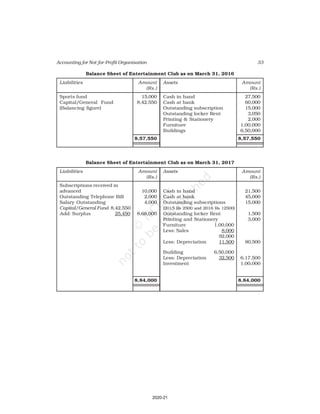
Balance Sheet of Entertainment Club as on March 31, 2016
Liabilities Amount Assets Amount
(Rs.) (Rs.)
Sports fund 15,000 Cash in hand 27,500
Capital/General Fund 8,42,550 Cash at bank 60,000
(Balancing figure) Outstanding subscription 15,000
Outstanding locker Rent 3,050
Printing & Stationery 2,000
Furniture 1,00,000
Buildings 6,50,000
8,57,550 8,57,550
Balance Sheet of Entertainment Club as on March 31, 2017
Liabilities Amount Assets Amount
(Rs.) (Rs.)
Subscriptions received in
advanced 10,000 Cash in hand 21,500
Outstanding Telephone Bill 2,000 Cash at bank 45,000
Salary Outstanding 4,000 Outstanding subscriptions 15,000
Capital/General Fund 8,42,550 (2015 Rs 2500 and 2016 Rs 12500)
Add: Surplus 25,450 8,68,000 Outstanding locker Rent 1,500
Printing and Stationery 3,000
Furniture 1,00,000
Less: Sales 8,000
92,000
Less: Depreciation 11,500 80,500
Building 6,50,000
Less: Depreciation 32,500 6,17,500
Investment 1,00,000
8,84,000 8,84,000
2020-21
34 Accountancy – Not-for-Profit Organisation and Partnership Accounts
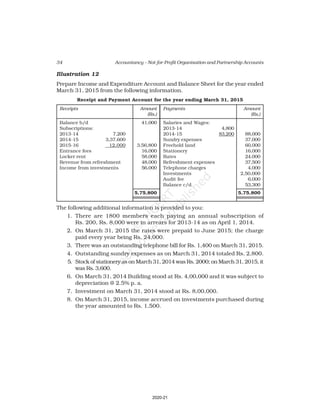
Illustration 12
Prepare Income and Expenditure Account and Balance Sheet for the year ended
March 31, 2015 from the following information.
Receipt and Payment Account for the year ending March 31, 2015
Receipts Amount Payments Amount
(Rs.) (Rs.)
Balance b/d 41,000 Salaries and Wages:
Subscriptions: 2013-14 4,800
2013-14 7,200 2014-15 83,200 88,000
2014-15 3,37,600 Sundry expenses 37,000
2015-16 12,000 3,56,800 Freehold land 60,000
Entrance fees 16,000 Stationery 16,000
Locker rent 58,000 Rates 24,000
Revenue from refreshment 48,000 Refreshment expenses 37,500
Income from investments 56,000 Telephone charges 4,000
Investments 2,50,000
Audit fee 6,000
Balance c/d 53,300
5,75,800 5,75,800
The following additional information is provided to you:
1. There are 1800 members each paying an annual subscription of
Rs. 200, Rs. 8,000 were in arrears for 2013-14 as on April 1, 2014.
2. On March 31, 2015 the rates were prepaid to June 2015; the charge
paid every year being Rs. 24,000.
3. There was an outstanding telephone bill for Rs. 1,400 on March 31, 2015.
4. Outstanding sundry expenses as on March 31, 2014 totaled Rs. 2,800.
5. Stock of stationery as on March 31, 2014 was Rs. 2000; on March 31, 2015, it
was Rs. 3,600.
6. On March 31, 2014 Building stood at Rs. 4,00,000 and it was subject to
depreciation @ 2.5% p. a.
7. Investment on March 31, 2014 stood at Rs. 8,00,000.
8. On March 31, 2015, income accrued on investments purchased during
the year amounted to Rs. 1,500.
2020-21
35
Accounting for Not-for-Profit Organisation
Solution
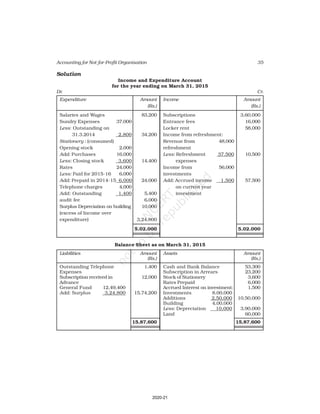
Income and Expenditure Account
for the year ending on March 31, 2015
Dr. Cr.
Expenditure Amount Income Amount
(Rs.) (Rs.)
Salaries and Wages 83,200 Subscriptions 3,60,000
Sundry Expenses 37,000 Entrance fees 16,000
Less: Outstanding on Locker rent 58,000
31.3.2014 2,800 34,200 Income from refreshment:
Stationery : (consumed) Revenue from 48,000
Opening stock 2,000 refreshment
Add: Purchases 16,000 Less: Refreshment 37,500 10,500
Less: Closing stock 3,600 14,400 expenses
Rates 24,000 Income from 56,000
Less: Paid for 2015-16 6,000 investments
Add: Prepaid in 2014-15 6,000 24,000 Add: Accrued income 1,500 57,500
Telephone charges 4,000 on current year
Add: Outstanding 1,400 5,400 investment
audit fee 6,000
Surplus Depreciation on building 10,000
(excess of Income over
expenditure) 3,24,800
5,02,000 5,02,000
Balance Sheet as on March 31, 2015
Liabilities Amount Assets Amount
(Rs.) (Rs.)
Outstanding Telephone 1,400 Cash and Bank Balance 53,300
Expenses Subscription in Arrears 23,200
Subscription received in 12,000 Stock of Stationery 3,600
Advance Rates Prepaid 6,000
General Fund 12,49,400 Accrued Interest on investment: 1,500
Add: Surplus 3,24,800 15,74,200 Investments 8,00,000
Additions 2,50,000 10,50,000
Building 4,00,000
Less: Depreciation 10,000 3,90,000
Land 60,000
15,87,600 15,87,600
2020-21
36 Accountancy – Not-for-Profit Organisation and Partnership Accounts
Balance Sheet as on March 31, 2014
Liabilities Amount Assets Amount
(Rs.) (Rs.)
Outstanding Sundry Expenses 2,800 Cash and Bank balance 41,000
Outstanding Salary and Wages 4,800 Subscription in arrears 8,000
General Fund 12,49,400 Stock of stationery 2,000
(Balancing figure) Rates prepaid 6,000
Investments 8,00,000
Building 4,00,000
12,57,000 12,57,000
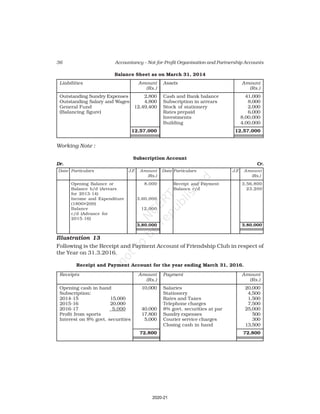
Working Note :
Subscription Account
Dr. Cr.
Date Particulars J.F. Amount Date Particulars J.F. Amount
(Rs.) (Rs.)
Opening Balance or 8,000 Receipt and Payment 3,56,800
Balance b/d (Arrears Balance c/d 23,200
for 2013-14)
Income and Expenditure 3,60,000
(1800×200)
Balance 12,000
c/d (Advance for
2015-16)
3,80,000 3,80,000
Illustration 13
Following is the Receipt and Payment Account of Friendship Club in respect of
the Year on 31.3.2016.
Receipt and Payment Account for the year ending March 31, 2016.
Receipts Amount Payment Amount
(Rs.) (Rs.)
Opening cash in hand 10,000 Salaries 20,000
Subscription: Stationery 4,500
2014-15 15,000 Rates and Taxes 1,500
2015-16 20,000 Telephone charges 7,500
2016-17 5,000 40,000 8% govt. securities at par 25,000
Profit from sports 17,800 Sundry expenses 500
Interest on 8% govt. securities 5,000 Courier service charges 300
Closing cash in hand 13,500
72,800 72,800
2020-21
37
Accounting for Not-for-Profit Organisation
Additional Information :
1. There are 500 members, each paying an annual subscription of Rs. 50, Rs. 17,500
being in arrears for 2014-15 at the beginning of 2015-16. During 2014-15,
subscriptions were paid in advance by 40 members for 2015-16.
2. Stock of stationery on March 31, 2015, was Rs. 1,500 and on March 31, 2016, Rs. 2,000.
3. On March 31, 2016, the rates and taxes were prepaid to the following January 31,
the annual charge being Rs. 1,500.
4. Telephone bill unpaid as on March 31, 2015 Rs. 3,000 and on March 31, 2016
Rs. 1,500.
5. Sundry expenses accruing at 31.3.2015 were Rs. 250 and at March 31, 2016 Rs. 300.
6. On March 31, 2015 Building stood in the books at Rs. 2,00,000 and it is required
to write off depreciation @ 10% p.a.
7. Value of 8% Government Securities on March 31, 2015 was Rs. 75,000 which were
purchased at that date at Par. Additional Government Securities worth Rs. 25,000
are purchased on March 31, 2016.
You are required to prepare:
(a) An Income and Expenditure Account for the year ended on 31.3.2016
(b) A Balance Sheet on that date.
Solution
Books of Friendship Club
Balance Sheet as on March 31, 2015
Liabilities Amount Assets Amount
(Rs.) (Rs.)
Outstanding Expenses: Building 2,00,000
Telephone charges 3,000 Investment in 8% Govt. 75,000
Sundry Expenses 250 3,250 Securities
Subscription received in 2,000 Stock of stationery 1,500
Advance Prepaid Rates and Taxes 1,250
General Fund 3,00,000 Subscription outstanding 17,500
(balancing figure) Cash in hand 10,000
3,05,250 3,05,250
Income and Expenditure Account
for the year ending on March 31, 2015
Expenditure Amount Income Amount
(Rs.) (Rs.)
Salaries 20,000 Profit on Sports 17,800
Stationery (paid) 4,500 Interest on 8% Govt. 5,000
Add: Opening stock 1,500 Securities Received
6,000 Add: Receivable 1,000 6,000
Less: Closing stock 2,000 Total Subscription 40,000
Stationery consumed 4,000 Received during
Rates and Taxes 1,500 the current year
2020-21
38 Accountancy – Not-for-Profit Organisation and Partnership Accounts
Less: Closing Prepaid 1,250 Add: Opening 2,000
250 Subscription in advance
Add: Opening Prepaid 1,250 1,500 Add: Outstanding at 5,500
Telephone charges paid 7,500 the end of the
Add: Outstanding 1,500 Current Year
(Current Year) 9,000 (2,500+3,000)= 47,500
Less: Outstanding 3,000 6,000 Less: Subscription 5,000
(Previous year) received in 42,500
Sundry expenses paid 500 Advance(Closing)
Add: Outstanding 300 Less: Outstanding 17,500 25,000*
(Current Year) 800 at the start of
Less: Outstanding 250 550 the Current Year
(Previous year) Deficit: (Excess of Expenditure 3,550
Depreciation on building 20,000 over to Income)
Courier charges 300
52,350 52,350
• Verification: 500 × 50 = 25000.
Balance Sheet of Friendship Club as on March 31, 2016
Liabilities Amount Assets Amount
(Rs.) (Rs.)
Outstanding Expenses: Building : 2,00000
Telephone charges 1,500 Less: depreciation 20,000 1,80,000
Sundry Expenses 300 1,800 Investment in 8% 75,000
Subscription received in 5,000 Govt. Securities:
Advance Add: Purchases 25,000 1,00,000
General Fund 3,00,000 Stock of stationery 2,000
Less: Deficit 3,550 2,96,450 Interest on 8% 1,000
Govt. securities Receivable
Prepaid Rates and Taxes 1,250
Subscription outstanding 5,500
(Rs.17,500-Rs. 5,000)
+Rs. 3,000= Rs.5,500
Cash in hand 13,500
3,03,250 3,03,250
1.7 Income and Expenditure Account based on Trial Balance
In case of not-for-profit organisations, normally the Income and Expenditure
Account and Balance Sheet is prepared based on the Receipts and Payments
Account and the additional information given. But, sometimes, the trial
balance along with some additional information is given for this purpose.
See Illustration 14.
2020-21
39
Accounting for Not-for-Profit Organisation
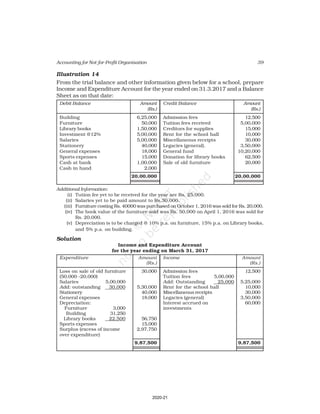
Illustration 14
From the trial balance and other information given below for a school, prepare
Income and Expenditure Account for the year ended on 31.3.2017 and a Balance
Sheet as on that date:
Debit Balance Amount Credit Balance Amount
(Rs.) (Rs.)
Building 6,25,000 Admission fees 12,500
Furniture 50,000 Tuition fees received 5,00,000
Library books 1,50,000 Creditors for supplies 15,000
Investment @12% 5,00,000 Rent for the school hall 10,000
Salaries 5,00,000 Miscellaneous receipts 30,000
Stationery 40,000 Legacies (general). 3,50,000
General expenses 18,000 General fund 10,20,000
Sports expenses 15,000 Donation for library books 62,500
Cash at bank 1,00,000 Sale of old furniture 20,000
Cash in hand 2,000
20,00,000 20,00,000
Additional Information:
(i) Tution fee yet to be received for the year are Rs. 25,000.
(ii) Salaries yet to be paid amount to Rs.30,000.
(iii) Furniture costing Rs. 40000 was purchased on October 1, 2016 was sold for Rs. 20,000.
(iv) The book value of the furniture sold was Rs. 50,000 on April 1, 2016 was sold for
Rs. 20,000.
(v) Depreciation is to be charged @ 10% p.a. on furniture, 15% p.a. on Library books,
and 5% p.a. on building.
Solution
Income and Expenditure Account
for the year ending on March 31, 2017
Expenditure Amount Income Amount
(Rs.) (Rs.)
Loss on sale of old furniture 30,000 Admission fees 12,500
(50,000 –20,000) Tuition fees 5,00,000
Salaries 5,00,000 Add: Outstanding 25,000 5,25,000
Add: outstanding 30,000 5,30,000 Rent for the school hall 10,000
Stationery 40,000 Miscellaneous receipts 30,000
General expenses 18,000 Legacies (general) 3,50,000
Depreciation: Interest accrued on 60,000
Furniture 3,000 investments
Building 31,250
Library books 22,500 56,750
Sports expenses 15,000
Surplus (excess of income 2,97,750
over expenditure)
9,87,500 9,87,500
2020-21
40 Accountancy – Not-for-Profit Organisation and Partnership Accounts
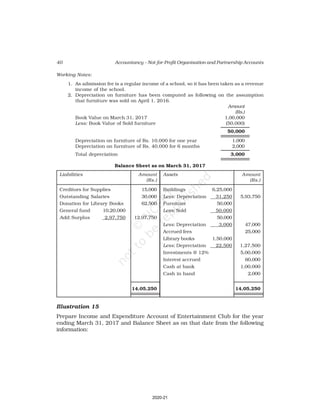
Working Notes:
1. As admission fee is a regular income of a school, so it has been taken as a revenue
income of the school.
2. Depreciation on furniture has been computed as following on the assumption
that furniture was sold on April 1, 2016.
Amount
(Rs.)
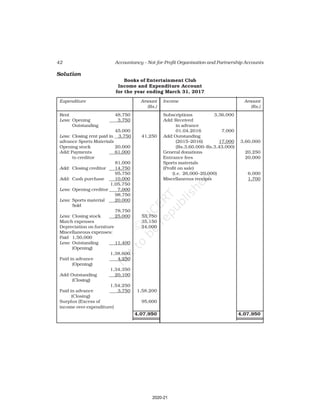
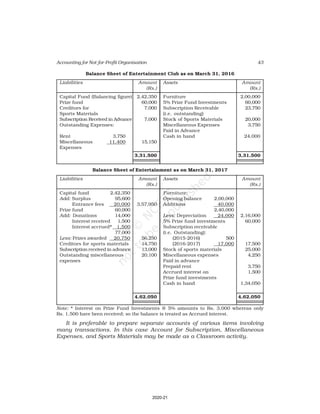
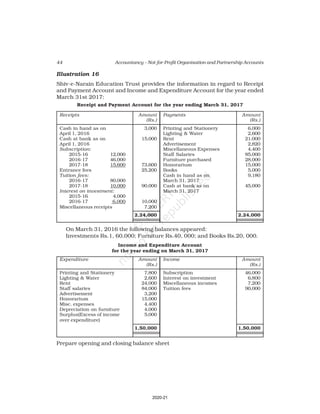
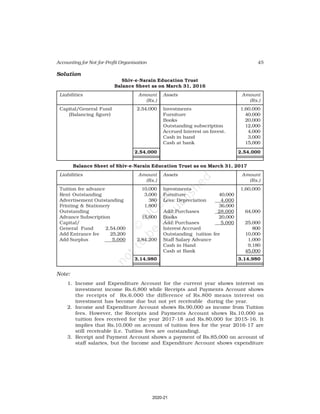
Book Value on March 31, 2017 1,00,000
Less: Book Value of Sold furniture (50,000)
50,000
Depreciation on furniture of Rs. 10,000 for one year 1,000
Depreciation on furniture of Rs. 40,000 for 6 months 2,000
Total depreciation 3,000
Balance Sheet as on March 31, 2017
Liabilities Amount Assets Amount
(Rs.) (Rs.)
Creditors for Supplies 15,000 Buildings 6,25,000
Outstanding Salaries 30,000 Less: Depreciation 31,250 5,93,750
Donation for Library Books 62,500 Furniture 50,000
General fund 10,20,000 Less: Sold 50,000
Add: Surplus 2,97,750 12,97,750 50,000
Less: Depreciation 3,000 47,000
Accrued fees 25,000
Library books 1,50,000
Less: Depreciation 22,500 1,27,500
Investments @ 12% 5,00,000
Interest accrued 60,000
Cash at bank 1,00,000
Cash in hand 2,000
14,05,250 14,05,250
Illustration 15
Prepare Income and Expenditure Account of Entertainment Club for the year
ending March 31, 2017 and Balance Sheet as on that date from the following
information:
2020-21
41
Accounting for Not-for-Profit Organisation
Receipt and Payment Account
For the year ending on March 31, 2017
Receipts Amount Payments Amount
(Rs.) (Rs.)
Balance b/d 24,000 Rent and Rates 48,750
Subscriptions Furniture purchased 40,000
2015-16 23,250 Creditors for sports materials 61,000
2016-17 3,36,000 Purchases for sports materials 10,000
2017-18 13,000 3,72,250 Cost of prizes awarded 20,750
Sale of sports materials 26,000 Match expenses 35,150
Entrance fees 40,000 Miscellaneous expenses 1,50,000
General donation 20,250 Balance c/d 1,34,050
Donation for prize fund 14,000
Interest on prize fund
Investments 1,500
Miscellaneous receipts 1,700
4,99,700 4,99,700
Additional Information:
Details Apr. 01, 2016 Mar. 31, 2017
Sports materials 20,000 25,000
Furniture 2,00,000 ?
5% Prize fund investments 60,000 ?
Creditors for sports materials 7,000 14,750
Subscription in arrears 23,750 ?
Prize fund 60,000 ?
Rent paid in advance ---- 3,750
Outstanding rent 3,750
Outstanding miscellaneous expenses 11,400 20,100
Miscellaneous expenses paid in advance 3,750 4,250
Book value of sports materials sold was Rs. 20000
Depreciation on furniture is to be provided @ 10%.
Half of the entrance fee is to be capitalised.
There are 1440 members, each paying an annual
subscription @ Rs. 250.
Subscription received in advance on 1.4.2016
were Rs. 7,000.
2020-21
42 Accountancy – Not-for-Profit Organisation and Partnership Accounts
Solution
Books of Entertainment Club
Income and Expenditure Account
for the year ending March 31, 2017
Expenditure Amount Income Amount
(Rs.) (Rs.)
Rent 48,750 Subscriptions 3,36,000
Less: Opening 3,750 Add: Received
Outstanding in advance
45,000 01.04.2016 7,000
Less: Closing rent paid in 3,750 41,250 Add: Outstanding
advance Sports Materials (2015–2016) 17,000 3,60,000
Opening stock 20,000 (Rs.3,60,000–Rs.3,43,000)
Add: Payments 61,000 General donations 20,250
to creditor Entrance fees 20,000
81,000 Sports materials
Add: Closing creditor 14,750 (Profit on sale)
95,750 (i.e. 26,000–20,000) 6,000
Add: Cash purchase 10,000 Miscellaneous receipts 1,700
1,05,750
Less: Opening creditor 7,000
98,750
Less: Sports material 20,000
Sold
78,750
Less: Closing stock 25,000 53,750
Match expenses 35,150
Depreciation on furniture 24,000
Miscellaneous expenses:
Paid 1,50,000
Less: Outstanding 11,400
(Opening)
1,38,600
Paid in advance 4,250
(Opening)
1,34,350
Add: Outstanding 20,100
(Closing)
1,54,250
Paid in advance 3,750 1,58,200
(Closing)
Surplus (Excess of 95,600
income over expenditure)
4,07,950 4,07,950
2020-21
43
Accounting for Not-for-Profit Organisation
Balance Sheet of Entertainment Club as on March 31, 2016
Liabilities Amount Assets Amount
(Rs,) (Rs,)
Capital Fund (Balancing figure) 2,42,350 Furniture 2,00,000
Prize fund 60,000 5% Prize Fund Investments 60,000
Creditors for 7,000 Subscription Receivable 23,750
Sports Materials (i.e. outstanding)
Subscription Received in Advance 7,000 Stock of Sports Materials 20,000
Outstanding Expenses: Miscellaneous Expenses 3,750
Paid in Advance
Rent 3,750 Cash in hand 24,000
Miscellaneous 11,400 15,150
Expenses
3,31,500 3,31,500
Balance Sheet of Entertainment as on March 31, 2017
Liabilities Amount Assets Amount
(Rs.) (Rs.)
Capital fund 2,42,350 Furniture:
Add: Surplus 95,600 Opening balance 2,00,000
Entrance fees 20,000 3,57,950 Additions 40,000
Prize fund 60,000 2,40,000
Add: Donations 14,000 Less: Depreciation 24,000 2,16,000
Interest received 1,500 5% Prize fund investments 60,000
Interest accrued* 1,500 Subscription receivable
77,000 (i.e. Outstanding):
Less: Prizes awarded 20,750 56,250 (2015-2016) 500
Creditors for sports materials 14,750 (2016-2017) 17,000 17,500
Subscription received in advance 13,000 Stock of sports materials 25,000
Outstanding miscellaneous 20,100 Miscellaneous expenses 4,250
expenses Paid in advance
Prepaid rent 3,750
Accrued interest on 1,500
Prize fund investments
Cash in hand 1,34,050
4,62,050 4,62,050
Note: * Interest on Prize Fund Investments @ 5% amounts to Rs. 3,000 whereas only
Rs. 1,500 have been received; so the balance is treated as Accrued interest.
It is preferable to prepare separate accounts of various items involving
many transactions. In this case Account for Subscription, Miscellaneous
Expenses, and Sports Materials may be made as a Classroom activity.
2020-21
44 Accountancy – Not-for-Profit Organisation and Partnership Accounts
Illustration 16
Shiv-e-Narain Education Trust provides the information in regard to Receipt
and Payment Account and Income and Expenditure Account for the year ended
March 31st 2017:
Receipt and Payment Account for the year ending March 31, 2017
Receipts Amount Payments Amount
(Rs.) (Rs.)
Cash in hand as on 3,000 Printing and Stationery 6,000
April 1, 2016 Lighting & Water 2,600
Cash at bank as on 15,000 Rent 21,000
April 1, 2016 Advertisement 2,820
Subscription: Miscellaneous Expenses 4,400
2015-16 12,000 Staff Salaries 85,000
2016-17 46,000 Furniture purchased 28,000
2017-18 15,600 73,600 Honorarium 15,000
Entrance fees 25,200 Books 5,000
Tuition fees: Cash in hand as on 9,180
2016-17 80,000 March 31, 2017
2017-18 10,000 90,000 Cash at bank as on 45,000
Interest on investment: March 31, 2017
2015-16 4,000
2016-17 6,000 10,000
Miscellaneous receipts 7,200
2,24,000 2,24,000
On March 31, 2016 the following balances appeared:
Investments Rs.1, 60,000; Furniture Rs.40, 000; and Books Rs.20, 000.
Income and Expenditure Account
for the year ending on March 31, 2017
Expenditure Amount Income Amount
(Rs.) (Rs.)
Printing and Stationery 7,800 Subscription 46,000
Lighting & Water 2,600 Interest on investment 6,800
Rent 24,000 Miscellaneous incomes 7,200
Staff salaries 84,000 Tuition fees 90,000
Advertisement 3,200
Honorarium 15,000
Misc. expenses 4,400
Depreciation on furniture 4,000
Surplus(Excess of income 5,000
over expenditure)
1,50,000 1,50,000
Prepare opening and closing balance sheet
2020-21
45
Accounting for Not-for-Profit Organisation
Solution
Shiv-e-Narain Education Trust
Balance Sheet as on March 31, 2016
Liabilities Amount Assets Amount
(Rs.) (Rs.)
Capital/General Fund 2,54,000 Investments 1,60,000
(Balancing figure) Furniture 40,000
Books 20,000
Outstanding subscription 12,000
Accrued Interest on Invest. 4,000
Cash in hand 3,000
Cash at bank 15,000
2,54,000 2,54,000
Balance Sheet of Shiv-e-Narain Education Trust as on March 31, 2017
Liabilities Amount Assets Amount
(Rs.) (Rs.)
Tuition fee advance 10,000 Investments 1,60,000
Rent Outstanding 3,000 Furniture 40,000
Advertisement Outstanding 380 Less: Depreciation 4,000
Printing & Stationery 1,800 36,000
Outstanding Add: Purchases 28,000 64,000
Advance Subscription 15,600 Books 20,000
Capital/ Add: Purchases 5,000 25,000
General Fund 2,54,000 Interest Accrued 800
Add Entrance fee 25,200 Outstanding tuition fee 10,000
Add Surplus 5,000 2,84,200 Staff Salary Advance 1,000
Cash in Hand 9,180
Cash at Bank 45,000
3,14,980 3,14,980
Note:
1. Income and Expenditure Account for the current year shows interest on
investment income Rs.6,800 while Receipts and Payments Account shows
the receipts of Rs.6,000 the difference of Rs.800 means interest on
investment has become due but not yet receivable during the year.
2. Income and Expenditure Account shows Rs.90,000 as income from Tuition
fees. However, the Receipts and Payments Account shows Rs.10,000 as
tuition fees received for the year 2017-18 and Rs.80,000 for 2015-16. It
implies that Rs.10,000 on account of tuition fees for the year 2016-17 are
still receivable (i.e. Tuition fees are outstanding).
3. Receipt and Payment Account shows a payment of Rs.85,000 on account of
staff salaries, but the Income and Expenditure Account shows expenditure
2020-21
46 Accountancy – Not-for-Profit Organisation and Partnership Accounts
of Rs.84,000 on account of staff salaries. It means the excess of Rs.1,000
shown in the Receipt and Payment Account may either belong to the
pervious year or the next year. Their is no evidence that staff salaries of
Rs.1,000 was outstanding at the end of the previous year 2013-14. This is
why this payment of Rs.1,000 has been considered as an advance salaries
to the staff.
Terms Introduced in the Chapter
1. Not-for-Profit Organisation.
2. Receipts and Payments Account
3. Income and Expenditure Account
4. Entrance Fee
5. Life Membership
6. Special Receipts
7. Subscription
8. Donation
9. Incidental Trading Activity
10. Legacy
Summary
1. Difference between Profit Seeking Entities and Not-for-Profit Entities: Profit-seeking
entities undertake activities such as manufacturing trading, banking and
insurance to bring financial gain to the owners. Not-for-Profit entities exist to
provide services to the member or to the society at large. Such entities might
sometimes carry on trading activities but the profits arising therefrom are used
for further the service objectives.
2. Appreciation of the need for separate Accounting Treatment for Not-for-Profit
Organisations: Since not-for-profit entities are guided primarily by a service
motive, the decisions made by their managers are different from those made by
their counterparts in profit-seeking entities. Differences in the nature of
decisions implies that the financial information on which they are based, must
also be different in content and presentation.
3. Explanation of the nature of the Principal Financial Statements prepare by Not-for-
Profit enterprises: Not-for-Profit Organisations that maintain accounts based
on the double-entry system of accounting, generally prepare three principal
statements to fulfil their information needs. These include Receipts and
Payments Account, Income and Expenditure Account, and a Balance Sheet.
The Receipts and Payments Account is summarised under relevant heads,
cash book which records all cash Receipts and cash Payments without
distinguishing between capital and revenue items, and between items relating
to the current year and those relating to previous or future years.
The Income and Expenditure Account is an income statement which is prepared
to ascertain the excess of revenue income over revenue expenditure or vice
2020-21
47
Accounting for Not-for-Profit Organisation
versa, for a particular accounting year, as a result of the entity’s overall activities.
Although it is considered to be a substitute for the Trading and Profit and Loss
Account of a profit-seeking entity, there are certain conceptual differences
between the two statements. The Balance Sheet is prepared at the end of the
entity’s accounting year to depict the financial position on that date. It includes
the Capital Fund or Accumulated Fund, special purpose funds, and current
liabilities on the left hand or liabilities side, and fixed assets and current assets
on the right hand or assets side.
4. Difference between the Receipt and Payment Account and the Income and
Expenditure Account: Many differences exist between the Receipt and Payment
Account and the Income and Expenditure Account which is evident from the
nature and purpose of two statements. While the former records both capital
and revenue receipts and payments relating to any accounting year, the latter
records only revenue items relating to the current accounting year. Non-cash
expenses such as depreciation on fixed assets and outstanding incomes and
expenses are shown in the latter but omitted in the former. The Receipt and
Payment Account has an opening balance while the Income and Expenditure
Account does not. The closing balance of the former account represents cash
and bank balances on the closing date while in the latter account it indicates
surplus or deficit from the activities of the enterprise.
5. Conversion of a Receipt and Payment Account into an Income and Expenditure
Account: This essentially involves five steps namely, (i) adjusting the revenue
receipts on the debit side to include accrued incomes and incomes relating to
the current year received earlier and to exclude amounts received in arrears
or in advance; (ii) adjusting revenue payments on the credit side; (iii) identifying
and showing non-cash expenses and losses on the debit side of the Income
and Expenditure Account; (iv) computing and showing profits/losses from
trading and/or social activities on the credit/debit side of the Income and
Expenditure Account; and (v) ascertaining the surplus or deficit as the closing
balance of the Income and Expenditure Account.
Questions for Practice
Short Answer Questions
1. What is meant by ‘Not- for- Profit’ Organisations?
2. State the meaning of Receipt and Payment Account.
3. State the meaning of Income and Expenditure Account.
4. State the feature of Receipt and Payment Account.
5. What steps are taken to prepare Income and Expenditure Account from a
Receipt and Payment Account?
6. What is subscription? How is it calculated?
7. What is meant by Capital Fund? How is it calculated?
2020-21
48 Accountancy – Not-for-Profit Organisation and Partnership Accounts
Long Answer Questions
1. Explain the statement: “Receipt and Payment Account is a summarised
version of Cash Book”.
2. “Income and Expenditure Account of a Not-for-Profit Organisation is akin
to Profit and Loss Account of a business concern”. Explain the statement.
3. Distinguish between Receipts and Payments Account and Income and
Expenditure Account.
4. Explain the basic features of Income and Expenditure Account and of
Receipt and Payment Account.
5. Show the treatment of the following items by a not-for-profit organisation:
(i) Annual subscription
(ii) Specific donation
(iii) Sale of fixed assets
(iv) Sale of old periodicals
(v) Sale of sports materials
(vi) Life membership fee
6. Show the treatment of items of Income and Expenditure Account when
there is a specific fund for those items.
7. What is Receipt and Payment Account? How is it different from Income and
Expenditure Account?
8. Distinguish between profit and not-for-profit organisation.
Numerical Questions
1. From the following particulars taken from the Cash Book of a health club,
prepare a Receipts and Payments Account.
Rs.
Opening balance:
Cash in Hand 5,000
Cash at Bank 25,000
Subscriptions 1,65,000
Donations 35,000
Investment Purchased 80,000
Rent Paid 20,000
General Expenses 21,500
Postage and stationery 2,000
Courier charges 1,000
Sundry Expenses 2,500
Closing Cash in Hand 12,000
(Ans: Cash at Bank (balancing figure) Rs. 91,000)
2020-21
49
Accounting for Not-for-Profit Organisation
2. The Receipt and Payment Account of Harimohan charitable institution is given:
Receipt and Payment Account for the year ending March 31, 2015
Receipts Amount Payments Amount
(Rs.) (Rs.)
Balance b/d Furniture 3,000
Cash at Bank 22,000 Investments 55,000
Cash in Hand 8,800 Advance for building 20,000
Donations 16,000 Charities 60,000
Subscriptions 50,200 Salaries 10,400
Endowment fund 60,000 Rent and Taxes 4,000
Legacies 12,000 Printing 1,000
Interest on Investment 3,800 Postage 300
Interest on Deposits 800 Advertisements 1,100
Sale of old newspapers 500 Insurance 4,800
Donation for building 16,000 Balance c/d:
Legacy for building 12,000 Cash at bank 32,000
Cash in hand 10,500
2,02,100 2,02,100
Prepare the Income and Expenditure Account for the Year ended on March 31, 2015
after considering the following:
(i) Liabilities to be provided for are:
Rent Rs. 800; Salaries Rs. 1,200; advertisement Rs. 200.
(ii) Rs. 2,000 due for interest on investment was not actually received.
(Ans : Excess of income over Expenditure Rs. 1,500.)
3. From the following particulars , prepare Income and Expenditure account:
Details Amount
(Rs.)
Fees collected, including Rs.80,000 on account of the 5,20,000
previous year
Fees for the year outstanding 30,000
Salary paid , including Rs. 5,000 on account 68,000
of the previous year
Salary outstanding at the end of the year 3,000
Entertainment expenses 8,000
Tournament expenses 25,000
Meeting Expenses 18,000
Traveling Expenses 7,000
Purchase of Books and Periodicals, including 40,000
Rs. 31,000 for purchase of Books
Rent 15,000
Postage, telegrams and telephones 6,000
Printing and Stationery 18,000
Donations received 25,000
(Ans : Excess of income over expenditure Rs. 3,23,000)
2020-21
50 Accountancy – Not-for-Profit Organisation and Partnership Accounts
4. Following is the information given in respect of certain items of a Sports Club.
Show these items in the Income and Expenditure Account and the Balance
Sheet of the Club:
Rs.
Sports Fund as on 1.4.2015 35,000
Sports Fund Investments 35,000
Interest on Sports Fund 4,000
Donations for Sports Fund Investment 15,000
Sports Prizes awarded 10,000
Expenses on Sports Events 4,000
General Fund 80,000
General Fund Investments 80,000
Interest on General Fund Investments 8,000
(Ans : Balance of Sports Fund Rs. 40,000.)
5. How will you deal with the following items while preparing for the Bombay
Women Cricket Club its income and expenditure account for the year ending
31.3.2017 and its Balance Sheet as on 31.3.2017:
Rs.
(a) Donation received during the year for the 12,25,000
construction of a permanent Pavilion
Expenditure incurred up to 31.3.2017 on its construction 10,80,000
The total estimated expenditure on construction 25,00,000
of Pavilion being
(b) Tournament Fund:
Balance as on 1.4.2016 10,700
Subscriptions for tournament received during the year 65,800
Expenditure incurred during the year on conducting 72,400
tournaments
(c) Life Membership fee received during the year 28,000
Give reasons for your answers.
(Ans : (a) Balance of Pavilion Fund Rs. 1,45,000; (b) Balance of Tournment
Fund Rs. 4,100; (c) Life Membership fee to the Capitalised).
6. From the following receipts and payments and information given below, Prepare
Income and Expenditure Account and opening Balance Sheet of Adult Literacy
Orgnisation as on December 31, 2017.
2020-21
51
Accounting for Not-for-Profit Organisation
Receipt and Payment Account for the year ending as on December 31, 2017
Receipts Amount Payments Amount
(Rs.) (Rs.)
Balance b/d General Expenses 3,200
Cash in hand 4,000 Newspaper 1,850
Cash at Bank 15,550 Electricity 3,000
Subscriptions Fixed deposit with bank 18,000
2016 1,200 (on 31.06.2017) @ 10% p.a.
2017 26,500 Books 7,000
2018 500 28,200 Salary 3,600
Sale of old newspapers 1,250 Rent 6,500
Govt. grant 12,000 Postage charges 300
Sale of old furniture Furniture (purchased) 10,500
(book value Rs.5000) 3,700 Balance c/d
Interest received on FD 450 Cash in hand 3,000
Cash at bank 8,200
65,150 65,150
Information:
(i) Subscription outstanding as on 31.12.2016 were Rs.2,000 and on December
31, 2017 were Rs.1,500.
(ii) On December 31, 2017 Salary outstanding was Rs.600, and one month
Rent paid in advance.
(iii) On Jan. 01, 2016 orgnisation owned Furniture Rs.12,000, Books Rs.5,000.
(Ans : Surplus Rs. 22,300, Opening Capital Fund Rs.38,550, Total Balance
Sheet Rs. 61,950).
7. The following is the Receipt and Payment Account of the Nari Kalayan Samittee
for the year ended December 31, 2017:
Receipts Amount Payments Amount
(Rs.) (Rs.)
Balance from last year b/d 2,270 Rent 6,600
Subscriptions 32,500 Electric charges 3,200
Life membership fee 3,250 Lecturer’s fee 730
Donation 2,500 Office expenses 1,480
Profit from entertainment 7,250 Printing and Stationery 1,050
Sale of old Books 750 Legal fee 1,870
(books value Rs.1,000) Books 6,500
Interest 350 Furniture purchased 8,600
Expenses on nukar drama 1,300
Balance c/d:
Cash in hand 8,040
Cash at bank 9,500
48,870 48,870
2020-21
52 Accountancy – Not-for-Profit Organisation and Partnership Accounts
You are required to prepare an Income and Expenditure Account after the
following adjustments:
(a) Subscription still to be received are Rs.750 , but subscription include Rs.500
for the year 2018.
(b) In the beginning of the year the Samiti owned building Rs.20,000 and
furniture Rs.3,000 and Books Rs.2,000.
(c) Provide depreciation on furniture @5% (including purchase ), books @
10% and building @ 5%.
(Ans : Surplus Rs. 24,040)
8. Following is the Receipt and Payment Account of Indian Sports Club, prepared
Income and Expenditure Account, Balance Sheet as on December 31, 2015:
Receipt and Payment Account for the year ending December 31, 2017
Receipts Amount Payments Amount
(Rs.) (Rs.)
Balance b/d 7,890 Salary 11,000
Subscriptions 52,000 Electric charges 5,500
Life membership fee 2,200 Billiard Table 17,500
Entrance fee 3,200 Office expenses 4,100
Tournament fund 26,000 Printing & Stationery 2,300
Locker Rent 1,250 Tournament expenses 18,500
Sale of old sports equipment Repair of ground 2,000
(Costing Rs.2,200) 2,500 Furniture purchased 7,700
Sale of old newspaper 750 Sports equipment 12,000
Legacy 37,500 Cash in hand 12,690
Cash at bank 10,000
Fixed deposit
(on 1.10.2017 for 10% p.a) 30,000
1,33,290 1,33,290
Other Information:
Subscription outstanding was on December 31, 2016 Rs.1,200 and Rs.3,200
on December 31, 2017. Locker rent outstanding on December 31, 2017 Rs.250.
Salary outstanding on December 31, 2017 Rs.1,000.
On January 1, 2017, club has Building Rs.36,000, furniture Rs.12,000,
Sports equipments Rs.17,500. Depreciation charged on these items @ 10%
(including Purchase).
(Ans : Surplus Rs.26,300, Opening Capital fund Rs.74,590, Total of Closing
Balance Sheet Rs.1,49,090)
9. From the following Receipt and Payment Account of Jan Kalyan Club, prepare
Income and Expenditure Account and Balance Sheet for the year ending
March 31, 2017.
2020-21
53
Accounting for Not-for-Profit Organisation
Receipt and Payment Account
for the year ending March 31, 2017
Receipts Amount Payments Amount
(Rs.) (Rs.)
Cash in hand as on 1.4.16 6,800 Salaries 24,000
Subscription 60,200 Traveling Expenses 6,000
Donation 3,000 Stationery 2,300
Sale of furniture 4,000 Rent 16,000
(Book value Rs.6000) Repair 700
Entrance fee 800 Books purchased 6,000
Life membership fee 7,000 Building purchased 30,000
Interest on investment 5,000 Cash in hand as 31.03.2017 1,800
(@ 5% for full year)
86,800 86,800
Additional Information:
As on As on
01.04.2016 31.03.2017
(i) Subscription received in advance 1,000 3,200
(ii) Outstanding subscription 2,000 3,700
(iii) Stock of stationery 1,200 800
(iv) Books 13,500 16,500
(v) Furniture 16,000 8,000
(vi) Outstanding rent 1,000 2,000
(Ans : Surplus Rs.11,100 ,Opening Capital fund Rs.1,37,500, Total of Closing
Balance Sheet Rs.1,60,800]
10. Receipt and Payment Account of Shankar Sports club is given below, for the
year ended March 31, 2017
Receipt and Payment Account
for the year ending March 31, 2017
Receipts Amount Payments Amount
(Rs.) (Rs.)
Opening Cash in hand 2,600 Rent 18,000
Entrance fees 3,200 Wages 7,000
Donation for building 23,000 Billiard table 14,000
Locker rent 1,200 Furniture 10,000
Life membership fee 7,000 Interest 2,000
Profit from entertainment 3,000 Postage 1,000
Subscription 40,000 Salary 24,000
Cash in hand 4,000
80,000 80,000
2020-21
54 Accountancy – Not-for-Profit Organisation and Partnership Accounts
Prepare Income and Expenditure Account and Balance Sheet with help of
following Information:
Subscription outstanding on March 31, 2016 is Rs.1, 200 and Rs.2, 300 on
March 31, 2017, opening stock of postage stamps is Rs.300 and closing stock
is Rs. 200, Rent Rs.1, 500 related to 2015 and Rs.1, 500 is still unpaid.
On April 1, 2016 the club owned furniture Rs.15, 000, Furniture valued at
Rs. 22,500 on March 31, 2016.
On March 31, 2017, the club had a loan of Rs.20,000 (@ 10% p.a) in 2017.
(Ans : Deficit Rs.6,100, Opening Capital fund Deficit Rs.2,400, Total of Closing
Balance Sheet Rs. 44,500)
11. Prepare Income and Expenditure Account and Balance Sheet for the year ended
March 31, 2016 from the following Receipt and Payment Account and Balance
Sheet of culture club:
Receipt and Payment Account
for the year ending March 31, 2016
Receipts Amount Payments Amount
(Rs.) (Rs.)
Opening cash balance 12,000 Furniture 4,000
Subscription Telephone expenses 800
2014-15 2,000 Salary
2015-16 22,000 24,000 2014-15 1,000
Entrance fees 2,800 2015-16 4,000
Locker rent 1,000 Newspapers 700
Life membership fee 1,200 Sundry expenses 1,000
Government grant 11,000 Defence bonds 18,000
Land 20,000
Closing cash balance 2,500
52,000 52,000
Balance Sheet for the year ending March 31, 2015
Liabilities Amount Assets Amount
(Rs.) (Rs.)
Advance locker rent 200 Cash in hand 12,000
Subscription received in 1,000 Outstanding subscription 3,000
Advance Building 35,000
Outstanding salary 2,000
Loan 10,000
Capital fund 36,800
50,000 50,000
(Ans : Surplus Rs. 31,500; Total of Closing Balance Sheet Rs. 80,500)
2020-21
55
Accounting for Not-for-Profit Organisation
12. From the following Receipt and Payment Account prepare final accounts of a
Unity Club for the year ended March 31, 2017
Receipt and Payment Accounts for the year ending March 31, 2017
Receipts Amount Payments Amount
(Rs.) (Rs.)
Balance b/d 15,000 Furniture 18,000
Sale of Old furniture Library books 10,000
(costing Rs. 6,000) 4,000 Salaries 72,000
Subscriptions: General expenses 18,000
2015-16 18,000 Electric charges 12,000
2016-17 60,000 Newspapers 33,800
2017-18 12,000 90,000 Postage 3,000
Sale of old newspapers 10,800 Stationery 40,000
Profit from entertainment 44,000 Audit fee 8,000
Rent 84,000 Balance c/d 33,000
2,47,800 2,47,800
Balance Sheet as on March 31, 2017
Liabilities Amount Assets Amount
(Rs.) (Rs.)
Outstanding Salary 6,000 Cash 15,000
Capital Fund 6,94,000 Outstanding subscription 18,000
Library Books 30,000
Furniture 37,000
Land and Building 6,00,000
7,00,000 7,00,000
Additional Information:
1. The Club had 500 members each paying an annual subscription of Rs. 150.
2. On 31.3.2017 salaries outstanding amounted to Rs. 1,200 and salaries paid
included Rs. 6,000 for the year 2015-16.
3. Provide 5% depreciation on Land and Building.
(Ans : Deficit Rs. 200 Total of Closing Balance Sheet Rs.7,07,000)
13. Following is the information in respect of certain items of a Sports Club. You
are required to show them in the Income and Expenditure Account and the
Balance Sheet.
2020-21
56 Accountancy – Not-for-Profit Organisation and Partnership Accounts
Details Amount
(Rs.)
Sports Fund as on April 1, 2016 80,000
Sports Fund Investments 80,000
Interest on Sports Fund Investments 8,000
Donations for Sports Fund 30,000
Sports Prizes awarded 16,000
Expenses on Sports Events 7,000
General Fund 2,00,000
General Fund Investments 2,00,000
Interest on General Fund Investments 20,000
14. Receipt and Payment Account of Maitrey Sports Club showed that Rs. 68,500
were received by way of subscriptions for the year ended on March 31, 2017.
The additional information was as under:
1. Subscription Outstanding as on March 31, 2016 were Rs. 6,500,
2. Subscription received in advance as on March 31, 2016 were Rs. 4,100,
3. Subscription Outstanding as on March 31, 2017 were Rs. 5,400,
4. Subscription received in advance as on March 31, 2017 were Rs. 2,500.
Show how that above information would appear in the final accounts for the
year ended on March 31, 2017 of Maitrey Sports Club.
(Ans : Subscription credited to Income and Expenditure Account for the year
ended on March 31, 2017 is Rs. 69,000. Subscription Outstanding as on
31.3.2017 is Rs. 5,400 and should be shown on the assets side of the Balance
sheet as on March 31, 2017 and subscriptions of Rs. 2,500 received in advance
as on March 31, 2017 on the liabilities side of the balance sheet as on March
31, 2017)
15. Following is the Receipt and Payment account of Rohatgi Trust :
Receipt and Payment Account for the year ending December 31, 2017
Receipts Amount Payments Amount
(Rs.) (Rs.)
Cash in hand 14,000 Rent 6,000
Cash at bank 60,000 Salary 12,000
Subscription: Postage 300
2016 5,000 Electricity charges 6,000
2017 83,000 Purchase of furniture 20,000
2018 3,000 91,000 Books 3,000
Sale of investment 90,000 Defence Bonds 1,50,000
Interest on investment 2,000 Help to needy students 22,000
Sale of furniture 3,200 Cash in hand 10,900
(book value Rs.3,000) Cash at bank 30,000
2,60,200 2,60,200
2020-21
57
Accounting for Not-for-Profit Organisation
Prepare Income and expenditure account for the year ended December 31,
2017, and a balance sheet as on that date after the following adjustments:
Subscription for 2017, still owing were Rs. 7,000. Interest due on defence
bonds was Rs.7,000, Rent still owing was Rs. 1,000. The Book value of investment
sold was Rs. 80,000, Rs. 30,000 of the investment were still in hand. Subscription
received in 2017 included Rs. 400 from a life member. The total furniture on
January 1, 2017 was worth Rs.12,000. Salary paid for the year 2018 is
Rs.2,000.
(Ans : Surplus Rs. 63,500, Total of Closing Balance Sheet Rs. 2,68,900)
16. Following Receipt and Payment Account was prepared from the cash book of
Delhi Charitable Trust for the year ending December 31, 2017
Receipt and Payment Account for the year ending December 31, 2017
Receipts Amount Payment Amount
(Rs.) (Rs.)
Balance b/d Charity 11,500
Cash in hand 11,500 Rent and taxes 3,200
Cash at bank 12,600 Salary 6,000
Donation 9,000 Printing 600
Subscription: 42,800 Postage 300
Legacies 18,000 Advertisements 4,500
Interest on investment 4,500 Insuranc es 2,000
Sale of old newspapers 200 Furniture 21,600
Investment 23,000
Balance c/d:
Cash in hand 9,900
Cash at bank 16,000
98,600 98,600
Prepare Income and expenditure account for the year ended December 31,
2017, and a balance sheet as on that date after the following adjustments:
(a) It was decided to treat one-third of the amount received on account of
donation as income.
(b) Insurance premium was paid in advance for three months.
(c) Interest on investment Rs.1,100 accrued was not received.
(d) Rent Rs.600: salary Rs.900 and advertisement expenses Rs.1,000
outstanding as on December 31, 2018.
(Ans : Surplus Rs.21,400, Total of Closing Balance Sheet Rs.72,000)
17. From the following Receipt and Payment Account of a club, prepare Income
and Expenditure Account for the year ended March 31, 2017 and the Balance
Sheet as on that date.
2020-21
58 Accountancy – Not-for-Profit Organisation and Partnership Accounts
Receipt and Payment Account for the year ending March 31, 2017
Receipts Amount Payments Amount
(Rs.) (Rs.)
Balance b/d 3,500 General expenses 900
Subscription: Salary 16,000
2015-16 2,000 Postage 1,300
2016-17 70,000 Electricity charges 7,800
2017-18 3,000 75,000 Furniture 26,500
Sale of old Books 2,000 Books 13,000
(costing Rs.3,200) Newspapers 600
Rent from use of hall 17,000 Meeting expenses 7,200
Sale of newspapers 400 T.V. set 16,000
Profit from entertainment 7,300 Balance c/d 15,900
1,05,200 1,05,200
Additional Information:
(a) The club has 100 members each paying an annual subscription of Rs.900.
Subscriptions outstanding on March 31, 2016 were Rs.3,600.
(b) On March 31, 2017, salary outstanding amounted to Rs.1,000, Salary paid
included Rs. 1,000 for the year 2016.
(c) On April 1, 2017 the club owned land and building Rs.25,000, furniture
Rs.2,600 and books Rs.6,200.
(Ans : Surplus Rs.79,700, Total of Closing Balance Sheet Rs.1,23,600)
18. Following is the Receipt and Payment Account of Women’s Welfare Club for the
year ended December 31, 2017:
Receipt and Payment Account for the year ending December 31, 2017
Receipts Amount Payments Amount
(Rs.) (Rs.)
Balance b/d 7,250 Salary 12,500
Subscriptions 81,750 Stationery 1,700
Donations 3,000 Electricity charges 9,550
Grant from Government 15,000 Insurance 7,500
Sale of newspapers 300 Equipments 30,000
Proceeds of charity show 16,500 Petty expenses 500
Interest on investments 7,000 Expenses on charity show 12,900
@ 10% for full year Newspapers 1,000
Sundries income 400 Lectures fee 16,500
Honorarium to Secretary 12,000
Balance c/d 27,050
1,31,200 1,31,200
2020-21
59
Accounting for Not-for-Profit Organisation
Additional Information:
01.01.2017 31.12.2017
(Rs.) (Rs.)
Outstanding salaries 1,200 1,800
Insurance prepaid 700 300
Subscription outstanding 3,750 2,500
Subscription received in advanced 1,750 1,000
Electricity charges outstanding — 1,250
Stock of stationery 2,250 700
Equipments 25,600 50,200
Building 1,20,000 1,14,000
Prepare Income and Expenditure Account for the year ended December 31,
2017 and Balance Sheet as on date.
(Ans : Surplus Rs.34,100, Total of Closing Balance Sheet Rs.2,64,750)
19. As at March 31, 2015 the following balances have been extrated from the books
of the Indian Chartered Accountants Recreation Club and you are asked to
prepare Income and Expenditure Account for the year ended March 31, 2017
and a Balance Sheet as at that date.
Debit Balances Credit Balances
(Rs.) (Rs.)
Stock-in-hand 1170 Subscriptions 9,7110
Purchases 24,660 Billiard's Receipts 7,300
Dining Room 32,370 Sunday Receipts 410
Rent 10,470 Interest on Fixed Deposit 270
Wages 18,690 Sundry Credtiors 5370
Repairs and Renewals 5,400 Grant from Institute 42,000
Fuel and Light 5,280 (permanent)
Misc. Expenses 4,050 Income and Exp. A/c 1,380
Cash in hand 560 (2016)
Cash at bank 2,760
Fixed Deposit 8,500
Sundry Debtors 2,250
Stationary 600
Billiard Table 2,070
Fixtures and Fittings 870
Furniture 4,140
Club Premises 30,000
1,53,840 1,53,840
On March 31,2016 stock of Stationary consisted of Rs. 900 and March 31,
2017 Rs. 60 respectively. Provide depreciations Rs. 60 on fixtures and fittings,
Rs. 390 on billiard table and Rs. 560 on furniture.
(Ans: Excess of income over expenditure– Rs. 2,950: Total of Balance Sheet Rs. 51,700)
2020-21
60 Accountancy – Not-for-Profit Organisation and Partnership Accounts
Check-list to Test your Understanding
Test your Understanding – I
Ans. TRUE: (iii) (vi) (vii) (x); FALSE: (i) (ii) (iv).(v).(viii).(ix).
Test your Understanding – II
1. There is a specific tournament fund. The accounting treatment is as
under:
Liabilities side of the Balance Sheet Amount (Rs.)
Tournament fund 40,000
Add: Receipts from tournament 16,000
56,000
Less: Tournament Expenses 14,000
Balance to remain on the Liabilities side of 42,000
the Balance Sheet
2. There is no specific fund. So the amount incurred on Table Tennis match
expenses Rs. 4,000 would be shown on the debit side of Income and
Expenditure Account. It is the case of expenses independent of any specific
fund.
3. There is a specific fund. The accounting treatment is as under:
Liabilities side of the Balance Sheet Amount
(Rs.)
Prize Fund 22,000
Add: Interest 3,000
25,000
Less: Prizes Paid 5,000
Balance to remain on the Liabilities side of the
Balance Sheet 20,000
Prize fund Investments would appear on the Assets
Side of the Balance Sheet 18,000
4. There is no specific fund. Receipts from Charity Show would be shown
on the credit side and expenses on charity show are deducted from the
receipts and the net amount would be shown on the credit side of Income
and Expenditure Account.
2020-21
CBSE Class 12 Study Materials
Maths Formulas for Class 12
CBSE Class 12 Notes
Printable Worksheets for Class 12
CBSE Sample Papers for Class 12
Why you Need to Read NCERT Books for Board Exams
NCERT Extra Questions
JEE Main
Trigonometry Formulas
Integration Formulas
CBSE Previous Year Question Papers Class 12
NCERT Books for Class
12
NCERT Solutions for
Class 12
 Class 12 Maths
NCERT Books
 Maths MCQ
Questions for Class
12 Chapterwise with
Answers
 Important Questions
for Class 12 Maths
 CBSE Sample
Papers for Class 12
Maths
 NCERT Solutions for
class 12 Maths
 Notes for Class 12
Maths
 NCERT Exemplar
Class 12 Maths
 RD Sharma Class 12
Solutions
 CBSE Class 11 and
12 Revised Syllabus
 Class 12 Physics
NCERT Books
 Physics MCQ
Questions for Class
12 Chapterwise with
Answers
 NCERT Solutions for
class 12 Biology
 Notes for Class 12
Biology
 NCERT Exemplar
Class 12 Biology
 Class 12 Chemistry
NCERT Books
 Chemistry MCQ
Questions for Class
12 Chapterwise with
Answers
 NCERT Solutions for
class 12 Physics
 Notes for Class 12
Physics
 NCERT Exemplar
Class 12 Physics
 HC Verma Solutions
 Class 12 Biology
NCERT Books
 Biology MCQ
Questions for Class
12 Chapterwise with
Answers
 NCERT Solutions for
class 12 Chemistry
 Notes for Class 12
Chemistry
 NCERT Exemplar
Class 12 Chemistry
NCERT Geography
Book Class 12
NCERT Solutions for
class 12 English
 Class 12 NCERT
Accountancy Books
 Accountancy MCQ
Questions for Class
12 Chapterwise with
Answers
 NCERT Solutions for
class 12
Accountancy
 TS Grewal
Accountancy Class
12 Solutions
Class 12 NCERT
Business Studies Books
 NCERT Solutions for
class 12 Business
Studies
 Notes for Class 12
Business Studies
Class 12 Introductory
Microeconomics
 NCERT Solutions for
class 12 Economics
 Notes for Class 12
Economics
Class 12 Introductory
Macroeconomics
NCERT Solutions for
class 12
Entrepreneurship
Class 12 NCERT
Kaleidoscope
NCERT Solutions for
class 12 Sociology
Class 12 NCERT
English Books
NCERT Solutions for
class 12 Psychology
NCERT Sanksrit Books
Class 12
NCERT Solutions for
class 12 Political
Science
Class 12 Khayaban-e-
Urdu
NCERT Solutions for
class 12 Computer
Science – C++
NCERT Class 12 History
Book
NCERT Solutions for
class 12 Computer
Science – Python
Class 12 Psychology
NCERT Books
Class 12 Social Change
and Development in
India NCERT Books
Class 12 Indian Society
NCERT Books
Class 12 Contemporary
World Politics NCERT
Books
Class 12 Craft Tradition
in India NCERT Books
Class 12 Human
Ecology and Family
Sciences NCERT
Books
Class 12 Towards A
New Age Graphic
Design NCERT Books
Class 12 Political
Science Part-II NCERT
Books
Students can easily download the PDF file of these questions and solve them offline as well. For
any doubts existing while solving the questions, students are free enough to ask their queries in
the comment section given at the end of this page.
 Important Questions for Class 12 Maths Chapter
Wise
 Important Questions for Class 12 Physics with
Answers
 Important Questions for Class 12 Chemistry
Chapter Wise
 Important Questions for Class 12 Biology Chapter
Wise
 Important Questions for Class 12 English Chapter
Wise
 Important Questions for Class 12 Accountancy
Chapter Wise
 Important Questions for Class 12 Economics
Chapter Wise
 Business Studies Class 12 Important Questions
Chapter Wise
 Important Questions for Class 12 Computer
Science Chapter Wise
 Political Science Class 12 Important Questions
 Physical Education Class 12 Important Questions
 Geography Class 12 Important Questions
 Informatics Practices Class 12 Important
Questions
 Important Questions for Class 12 History Chapter
Wise
NCERT Solutions for Class 12
NCERT Solutions for all the subjects in Class 12 can be found from the following table. Working
on Class 12 NCERT solutions is really important as the class 12 syllabus is more or less the same
as the competitive exam syllabus such as JEE, NEET etc., So students who have strong
command over class 12 NCERT Solutions can easily crack the competitive exams without any
difficulty. Just click on the link in following NCERT Class 12 Solutions table and practice away the
questions which you want to.
 Class 12 Maths
 Physics Class 12
 Chemistry Class 12
 Class 12 Biology
 Class 12 English
 Class 12 English Vistas
 Class 12 English Flamingo
 Class 12 Hindi
 Class 12 Hindi Aroh (आरोह भाग 2)
 Class 12 Hindi Vitan (वितान भाग 2)
 Class 12 Sanskrit
 Class 12 History
 Class 12 Geography
 Class 12 Economics
 Class 12 Macro Economics
 Class 12 Micro Economics
 Class 12 Political Science
 Class 12 Business Studies
 Class 12 Accountancy
 Class 12 Sociology
 Class 12 Psychology
 Class 12 Entrepreneurship
 Class 12 Computer Science (C++)
 Class 12 Computer Science (Python)

leac101.pdf

  • 1.
    There are certainorganisations which are set up for providing service to its members and the public in general. Such organisations include clubs, charitable institutions, schools, religious organisations, trade unions, welfare societies and societies for the promotion of art and culture. These organisations have service as the main objective and not the profit as is the case of organisations in business. Normally, these organisations do not undertake any business activity, and are managed by trustees who are fully accountable to their members and the society for the utilization of the funds raised for meeting the objectives of the organisation. Hence, they also have to maintain proper accounts and prepare the financial statement which take the form of Receipt and Payment Account; Income and Expenditure Account; and Balance Sheet. at the end of for every accounting period (normally a financial year). This is also a legal requirement and helps them to keep track of their income and expenditure, the nature of which is different from those of the business organisations. In this chapter we shall learn about the accounting aspects relating to not-for-profit organisation. 1.1 Meaning and Characteristics of Not-for- Profit Organisation Not-for -Profit Organisations refer to the organisations that are for used for the welfare of the society and are set up as charitable institutions Accounting for Not-for-Profit Organisation 1 LEARNING OBJECTIVES After studying this chapter, you will be able to; • Identiy the need for, and nature of accounting records relating to not-for-profit organisations; • List the principal financial statements prepared by not- for-profit organisations; • Prepare the Receipt, and Payment Account and Income and Expenditure Account; • Prepare Income and Expenditure Account and Balance Sheet from a given Receipt and Payment Account; • Explain treatment of certain peculiar items of Receipts and Payments such as subscriptions from members, special funds, legacies, sale of old fixed assets, etc. 2020-21
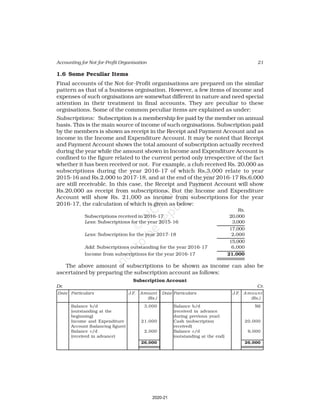
  • 2.
    2 Accountancy –Not-for-Profit Organisation and Partnership Accounts which function without any profit motive. Their main aim is to provide service to a specific group or the public at large. Normally, they do not manufacture, purchase or sell goods and may not have credit transactions. Hence they need not maintain many books of account (as the trading concerns do) and Trading and Profit and Loss Account. The funds raised by such organisations are credited to capital fund or general fund. The major sources of their income usually are subscriptions from their members donations, grants-in-aid, income from investments, etc. The main objective of keeping records in such organisations is to meet the statutory requirement and helptheminexercisingcontroloverutilisationoftheirfunds.Theyalsohavetoprepare the financial statements at the end of each accounting period (usually a financial year) and ascertain their income and expenditure and the financial position, and submit them to the statutory authority called Registrar of Societies. The main characteristics of such organisations are: 1. Such organisations are formed for providing service to a specific group or public at large such as education, health care, recreation, sports and so on without any consideration of caste, creed and colour. Its sole aim is to provide service either free of cost or at nominal cost, and not to earn profit. 2. These are organised as charitable trusts/societies and subscribers to such organisation are called members. 3. Their affairs are usually managed by a managing/executive committee elected by its members. 4. The main sources of income of such organisations are: (i) subscriptions from members, (ii) donations (general). (iii) legacies(general). (iv) grant- in-aid, (v) income from investments, etc. 5. The funds raised by such organisations through various sources are credited to capital fund or general fund. 6. The surplus generated in the form of excess of income over expenditure is not distributed amongst the members. It is simply added in the capital fund. 7. The Not-for-Profit Organisations earn their reputation on the basis of their contributions to the welfare of the society rather than on the customers’ or owners’ satisfaction. 8. The accounting information provided by such organisations is meant for the present and potential contributors and to meet the statutory requirement. 1.2 Accounting Records of Not-for-Profit Organisations As stated earlier, normally such organisations are not engaged in any trading or business activities. The main sources of their income are subscriptions from members, donations, financial assistance from government and income from investments. Most of their transactions are in cash or through the bank. These 2020-21
  • 3.
    3 Accounting for Not-for-ProfitOrganisation institutions are required by law to keep proper accounting records and keep proper control over the utilization of their funds. This is why they usually keep a cash book in which all receipts and payments are duly recorded. They also maintain a ledger containing the accounts of all incomes, expenses, assets and liabilities which facilitates the preparation of financial statements at the end of the accounting period. In addition, they are required to maintain a stock register to keep complete record of all fixed assets and the consumables. They do not maintain any capital account. Instead they maintain capital fund which is also called general fund that goes on accumulating due to surpluses generated, life membership fee, etc., received from year to year. In fact, a proper system of accounting is desirable to avoid or minimise the chances of misappropriations or embezzlement of the funds contributed by the members and other donors. Final Accounts or Financial Statements: The Not-for-Profit Organisations are also required to prepare financial statements at the end of the each accounting period. Although these organisations are non-profit making entities and they are not required to make Trading and Profit & Loss Account but it is necessary to know whether the income during the year was sufficient to meet the expenses or not. Not only that they have to provide the necessary financial information to members, donors, and contributors and also to the Registrar of Societies. For this purpose, they have to prepare their final accounts at the end of the accounting period and the general principles of accounting are fully applicable in their preparation as stated earlier, the final accounts of a ‘not-for-profit organisation’ consist of the following: (i) Receipt and Payment Account (ii) Income and Expenditure Account, and (iii) Balance Sheet. The Receipt and Payment Account is the summary of cash and bank transactions which helps in the preparation of Income and Expenditure Account and the Balance Sheet. Besides, it is a legal requirement as the Receipts and Payments Account has also to be submitted to the Registrar of Societies along with the Income and Expenditure Account, and the Balance Sheet. Income and Expenditure Account is akin to Profit and Loss Account. The Not-for-Profit Organisations usually prepare the Income and Expenditure Account and a Balance Sheet with the help of Receipt and Payment Account. However, this does not imply that they do not make a trial balance. In order to check the accuracy of the ledger accounts, they also prepare a trial balance which facilitates the preparation of accurate Receipt and Payment Account as well as the Income and Expenditure Account and the Balance Sheet. In fact, if an organisation has followed the double entry system they must prepare a trial balance for checking the accuracy of the ledger accounts and it will also facilitate the preparation of Receipt and Payment account. Income and Expenditure Account and the Balance Sheet. 2020-21
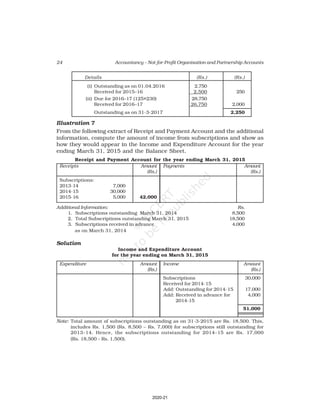
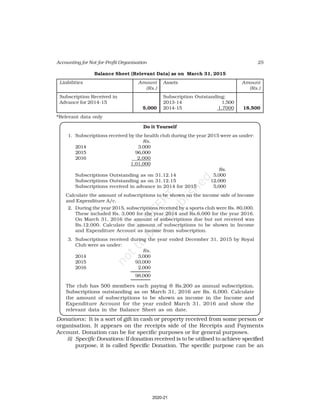
  • 4.
    4 Accountancy –Not-for-Profit Organisation and Partnership Accounts 1.3 Receipt and Payment Account It is prepared at the end of the accounting year on the basis of cash receipts and cash payments recorded in the cash book. It is a summary of cash and bank transactions under various heads. For example, subscriptions received from the members on different dates which appear on the debit side of the cash book, shall be shown on the receipts side of the Receipt and Payment Account as one item with its total amount. Similarly, salary, rent, electricity charges paid from time to time as recorded on the credit side of the cash book but the total salary paid, total rent paid, total electricity charges paid during the year appear on the payment side of the Receipt and Payment Account. Thus, Receipt and Payment Account gives summarised picture of various receipts and payments, irrespective of whether they pertain to the current period, previous period or succeeding period or whether they are of capital or revenue nature. It may be noted that this account does not show any non cash item like depreciation. The opening balance in Receipt and Payment Account represents cash in hand/cash at bank which is shown on its receipts side and the closing balance of this account represents cash in hand and bank balance as at the end of the year, which appear on the credit side of the Receipt and Payment Account. However, if it is bank overdraft at the end it shall be shown on its debit side as the last item. Let us look at the cash book of Golden Cricket Club given in the example to show how the total amount of each item of receipt and payment has been worked out. Example 1 Golden Cricket Club Cash Book (Columnar) Dr. Cr. Date Receipts L.F. Bank Office Date Payments L.F. Bank Office Amount Amount Amount Amount (Rs.) (Rs.) 2014 (Rs.) (Rs.) 2014 2014 April 1 Balance b/d 35,000 20,000 April 15 Insurance premium 15,000 April 10 Subscriptions 1,20,000 May 12 Printing and 10,750 stationery April 10 Entrance fees 13,000 May 20 Postage and 430 May 20 Life membership 12,000 courier fees fees June 16 Telephone 810 June 12 Locker rent 42,000 expenses July 23 Life membership 8,000 July 10 Wages and salaries 22,000 fees July 15 Rates and Taxes 17,000 Aug. 20 Donation for 60,000 July 30 Govt. securities 1,00,000 building Aug. 13 Printing and 15,000 Sept. 13 Subscriptions 30,000 stationery (2013-14) Aug. 15 Postage and 480 Sept. 13 Subscription 45,000 courier service Sept. 10 Lighting 12,250 2020-21
  • 5.
    5 Accounting for Not-for-ProfitOrganisation Sept. 14 Entrance fees 10,000 Sept 13 Telephone expenses 830 Nov. 9 Subscription 35,000 Oct. 1 Wages and salaries 10,000 12,000 Oct. 18 Printing and 13,000 Nov. 9 Subscription 10,000 stationery (2015-16) Oct. 31 Govt. securities 1,00,000 2015 Dec. 31 Wages andSalaries 22,000 Feb. 07 Subscription 25,000 2015 Jan. 21 Courier charges 240 Mar. 28 Interest on 18,000 Feb. 2 Telephone 960 government expenses securities Mar. 10 Postage and 850 Courier fees Mar. 27 Lighting 14,000 Mar. 27 Wages and Salaries 22,000 Mar. 31 Balance c/d 70,000 23,400 4,21,000 62,000 4,21,000 62,000 Part A Item wise Aggregation of various Receipts Subscriptions (2014–2015) Date Amount (Rs.) April 10, 2014 1,20,000 Sept. 13, 2014 45,000 Nov. 9, 2014 35,000 Feb. 7, 2015 25,000 Total 2,25,000 Subscriptions (2013–14) Date Amount (Rs.) Sept. 13, 2014 30,000 Total 30,000 Subscription (2015–16) Date Amount (Rs) Nov. 9, 2014 10,000 Total 10,000 Entrance Fees Date Amount (Rs) April 10, 2014 13,000 Sept.14, 2014 10,000 Total 23,000 2020-21
  • 6.
    6 Accountancy –Not-for-Profit Organisation and Partnership Accounts Locker Rent Date Amount (Rs) June 12, 2014 42,000 Total 42,000 Life Membership fee Date Amount (Rs) May 20, 2014 12,000 July 23, 2014 8,000 Total 20,000 Donation for Buildings Date Amount (Rs) Aug. 20, 2014 60,000 Total 60,000 Interest on Government securities Date Amount (Rs) March 28, 2015 18,000 Total 18,000 Part B Item wise Aggregation of various Payments Insurance Premium Date Amount (Rs) April 15, 2014 15,000 Total 15,000 Printing and Stationery Date Amount (Rs.) May 12, 2014 10,750 Aug. 13, 2014 15,000 Oct. 18, 2014 13,000 Total 38,750 Lighting Date Amount (Rs.) Sept. 10, 2014 12,250 March 27, 2015 14,000 Total 26,250 2020-21
  • 7.
    7 Accounting for Not-for-ProfitOrganisation Telephone Expenses Date Amount (Rs.) June 16, 2014 810 Sept. 13, 2014 830 Feb. 2, 2015 960 Total 2,600 Rates and Taxes Date Amount (Rs.) July 15, 2014 17,000 Total 17,000 Government Securities Date Amount (Rs.) July 30, 2014 1,00,000 Oct. 31, 2014 1,00,000 Total 2,00,000 Wages and Salaries Date Amount (Rs.) July 10, 2014 22,000 Oct. 1, 2014 22,000 Dec. 31, 2014 22,000 March 27, 2015 22,000 Total 88,000 Postage and Courier Service Date Amount (Rs.) May 20, 2014 430 Aug. 15, 2014 480 Jan. 21, 2015 240 March 10, 2015 850 Total 2,000 The above data can also be shown in the form of the respective accounts in the ledger. A detailed illustrative list of items of receipts and payments is given in figure 1. 2020-21
  • 8.
    8 Accountancy –Not-for-Profit Organisation and Partnership Accounts Figure 1 Receipts Payments 1. Donations 1. Purchase of Fixed Assets (a) General 2. Purchase of Sports Material (b) Specific purpose 3. Investment in Securities 2. Entrance Fees 4. Printing and Stationery 3. Legacies 5. Postage and Courier Charges 4. Sale of Investments 6. Advertisements 5. Sale of Fixed Assets 7. Wages and Salary 6. Subscriptions from Members 8. Honorarium 7. Life Membership Fees 9. Telephone Charges 8. Sale of old Newspapers 10. Electricity and Water Charges 9. Sale of Old Sports Material 11. Repairs and Renewals 10. Interest on Fixed Deposits 12. Upkeep of Play Ground 11. Interest/ Dividend on Investments 13. Conveyance Charges 12. Proceed from Charity Shows 14. Subscription for Periodicals 13. Sale of Scrap 15. Audit Fees 14. Grant-in-aid 16. Entertainment Expenses 15. Interest/Dividend on Specific 17. Municipal Taxes Fund Investments 18. Charity 16. Miscellaneous Receipts. 19. Insurance Receipt and Payment Account is given below: Receipt and Payment Account for the year ending ————- Receipts Amount Payments Amount (Rs.) (Rs.) Balance b/d Balance b/d (Bank overdraft) xxx Cash in Hand xxx Wages and Salaries xxx Cash at Bank xxx Rent xxx Subscriptions xxx Rates and Taxes xxx General Donations xxx Insurance xxx Sale of newspaper/ xxx Printing and Stationery xxx periodicals/waste paper Postage and courier xxx Sale of old sports materials xxx Advertisement xxx Interest on fixed deposits Sundry expenses xxx Interest/Dividend on general xxx Telephone charges xxx investments Entertainment expenses xxx Locker Rent xxx Audit fees xxx Sale of scraps xxx Honorarium xxx Proceeds from charity show xxx Repair and Renewals xxx Miscellaneous receipts xxx Upkeep of ground xxx Grant-in-aid xxx Conveyance xxx Legacies xxx Newspapers and Periodicals xxx Specific Donations xxx Purchases of Assets xxx Sale of Investments xxx Purchase of Investments xxx Sale of Fixed Assets xxx Balance c/d xxx 2020-21
  • 9.
    9 Accounting for Not-for-ProfitOrganisation Life membership fees xxx Cash in hand xxx Entrance fees xxx Cash at Bank* xxx Receipts on account of xxx specific purpose funds Interest on specific funds' xxx investments Balance b/d (Bank Overdraft)* xxx xxxxx xxxxx Fig. 1.1: Format of Receipt and Payment Account * There will be either of the two amounts i.e., each at bank or bank overdraft, not both. It may be noted that the receipts side of the Receipt and Payment Account gives a list of revenue receipts (for past, current and future periods) as well as capital receipts. Similarly, the payments side of the Receipts and Payments Account lists the Revenue Payments (for past, current and future periods) as well as Capital Payments. 1.3.1 Salient Features 1. It is a summary of the cash book. Its form is identical with that of simple cash book (without discount and bank columns) with debit and credit sides. Receipts are recorded on the debit side while payments are entered on the credit side. 2. It shows the total amounts of all receipts and payments irrespective of the period to which they pertain . For example, in the Receipt and Payment account for the year ending on March 31, 2016, we record the total subscriptions received during 2015–16 including the amounts related to the years 2014–2015 and 2016-2017. Similarly, taxes paid during 2015–16 even if they relate to the years 2014–15 and 2016–2017. 3. It includes all receipts and payments whether they are of capital nature or of revenue nature. 4. No distinction is made in receipts/payments made in cash or through bank. With the exception of the opening and closing balances, the total amount of each receipt and payment is shown in this account. 5. No non-cash items such as depreciation outstanding expenses accrued income, etc. are shown in this account. 6. It begins with opening balance of cash in hand and cash at bank (or bank overdraft) and closes with the year end balance of cash in hand/ cash at bank or bank overdraft. In fact, the closing balance in this account (difference between the total amount of receipts and payments) which is usually a debit balance reflects cash in hand and cash at bank unless there is a bank overdraft. 2020-21
  • 10.
    10 Accountancy –Not-for-Profit Organisation and Partnership Accounts 1.3.2 Steps in the Preparation of Receipt and Payment Account 1. Take the opening balances of cash in hand and cash at bank and enter them on the debit side. In case there is bank overdraft at the begining of the year, enter the same on the credit side of this account. 2. Show the total amounts of all receipts on its debit side irrespective of their nature (whether capital or revenue) and whether they pertain to past, current and future periods. 3. Show the total amounts of all payments on its credit side irrespective of their nature (whether capital or revenue) and whether they pertain to past, current and future periods. 4. None of the receivable income and payable expense is to be entered in this account as they do not involve inflow or outflow of cash. 5. Find out the difference between the total of debit side and the total of credit side of the account and enter the same on the credit side as the closing balance of cash/bank. In case, however, the total of the credit side is more than that of the total of the debit side, show the difference on the debit as bank overdraft and close the account. From the following information based on the data assimilated from the cash book given in example 1, at page 4, the Receipt and Payment Account of Golden Cricket Club for the year ended on March 31, 2015 will be prepared as follows: Summary of Cash Book Details Amount (Rs.) Cash in hand as on April 1, 2014 20,000 Cash at bank as on April 1, 2014 35,000 Subscription: Rs. 2013-14 30,000 2014-15 2,25,000 2015-16 10,000 2,65,000 Donation for Building 60,000 Entrance fees 23,000 Life membership fee 20,000 Printing and Stationery 38,750 Lighting 26,250 Rates and Taxes 17,000 Telephone charges 2,600 Postage and courier 2,000 Wages and Salaries 88,000 Insurance Premium 15,000 Interest on government securities 18,000 Locker rent 42,000 Purchase of government securities 2,00,000 Cash in hand as on March 31, 2015 23,400 Cash at bank as on March 31, 2015 70,000 2020-21
  • 11.
    11 Accounting for Not-for-ProfitOrganisation Receipt and Payment Account for the year ending March 31, 2015 Dr. Cr. Receipts Amount Payments Amount (Rs.) (Rs.) Cash in hand as on 20,000 Printing and Stationery 38,750 April 1, 2014 Lighting 26,250 Cash at bank as on 35,000 Rates and Taxes 17,000 April 1, 2014 Telephone charges 2,600 Subscription: Postage and Courier 2,000 2013–14 30,000 Wages and Salaries 88,000 2014–15 2,25,000 Insurance Premium 15,000 2015–16 10,000 2,65,000 Purchase of govt. securities 2,00,000 Donation for building 60,000 Cash in hand as on 23,400 Entrance fees 23,000 March 31, 2015 Life membership fee 20,000 Cash at bank as on 70,000 Interest on investment in 18,000 March 31, 2015 Government securities Locker rent 42,000 4,83,000 4,83,000 Illustration 1 From the following particulars relating to Silver Point, prepare a Receipt and Payment account for the year ending March 31, 2017. Particulars Amount Particulars Amount (Rs.) (Rs.) Opening cash balance 1,000 Sale of old sports materials 1,200 Opening bank balance 7,200 Donation received for pavilion 4,600 Subscriptions collected for: Rent paid 3,000 2015-16 Rs. 500 Sports materials purchases 4,800 2016-17 Rs. 7,600 Purchase of refreshments 600 2017-18 Rs. 900 9,000 Expenses for maintenance 2,000 Sale of refreshments 1,000 of tennis court Entrance fees received 1,000 Salary paid 2,500 Tournament expenses 2,400 Furniture purchased 1,500 Office expenses 1,200 Closing cash in hand 400 2020-21
  • 12.
    12 Accountancy –Not-for-Profit Organisation and Partnership Accounts Solution Books of Silver Point Receipt and Payment Account for the year ending March 31, 2017 Dr. Cr. Receipts Amount Payments Amount (Rs.) (Rs.) Balance b/d Rent 3,000 Cash 1,000 Sports materials purchased 4,800 Bank 7,200 Purchase of refreshments 600 Subscriptions Maintenance expenses for 2,000 2015-16 500 tennis court 2016-17 7,600 Salary 2,500 2017-18 900 9,000 Tournament expenses 2,400 Sale of refreshments 1,000 Furniture purchased 1,500 Entrance fees 1,000 Office expenses 1,200 Sale of old sports materials 1,200 Balance c/d Donation for pavilion 4,600 Cash 400 Bank (balancing figure) 6,600 25,000 25,000 1.4 Income and Expenditure Account It is the summary of income and expenditure for the accounting year. It is just like a profit and loss account prepared on accrual basis in case of the business organisations. It includes only revenue items and the balance at the end represents surplus or deficit. The Income and Expenditure Account serves the same purpose as the profit and loss account of a business organisation does. All the revenue items relating to the current period are shown in this account, the expenses and losses on the expenditure side and incomes and gains on the income side of the account. It shows the net operating result in the form of surplus (i.e. excess of income over expenditure) or deficit (i.e. excess of expenditure over income), which is transferred to the capital fund shown in the balance sheet. The Income and Expenditure Account is prepared on accrual basis with the help of Receipts and Payments Account along with additional information regarding outstanding and prepaid expenses and depreciation etc. Hence, many items appearing in the Receipts and Payments need to be adjusted. For example, as shown in Example 1, (Page No. 10) subscription amount of Rs.2, 65,000 received during the year 2014-15 appearing on the receipts side of the Receipt and Payment Account includes receipts for the periods other than the current period. But the subscription amount of Rs. 2,25,000 pertaining to the current year only will be shown as income in Income and Expenditure Account for the year 2014-15. 2020-21
  • 13.
    13 Accounting for Not-for-ProfitOrganisation 1.4.1 Steps in the Preparation of Income and Expenditure Account Following steps may be helpful in preparing an Income and Expenditure Account from a given Receipt and Payment Account: 1. Persue the Receipt and Payment Account thoroughly. 2. Exclude the opening and closing balances of cash and bank as they are not an income. 3. Exclude the capital receipts and capital payments as these are to be shown in the Balance Sheet. 4. Consider only the revenue receipts to be shown on the income side of Income and Expenditure Account. Some of these need to be adjusted by excluding the amounts relating to the preceding and the succeeding periods and including the amounts relating to the current year not yet received. 5. Take the revenue expenses to the expenditure side of the Income and Expenditure Account with due adjustments as per the additional information provided relating to the amounts received in advance and those not yet received. 6. Consider the following items not appearing in the Receipt and Payment Account that need to be taken into account for determining the surplus/ deficit for the current year : (a) Depreciation of fixed assets. (b) Provision for doubtful debts, if required. (c) Profit or loss on sale of fixed assets. Now you will observe how the income and expenditure account is prepared from the receipts and payments account given in example 1, on page 10. Income and Expenditure Account for the year ending on March 31, 2015 Dr. Cr. Expenditure Amount Income Amount (Rs.) (Rs.) Printing and Stationery 38,750 Subscriptions 2,25,000 Lighting 26,250 Entrance fees 23,000 Rates and Taxes 17,000 Interest on investment 18,000 Telephone charges 2,600 in government securities Postage and courier charges 2,000 Locker rent 42,000 Wages and Salaries 88,000 Insurance Premium 15,000 Surplus (Excess of income 1,18,400 over expenditure) 3,08,000 3,08,000 2020-21
  • 14.
    14 Accountancy –Not-for-Profit Organisation and Partnership Accounts Note that- 1. Opening and closing cash/bank balances have been excluded. 2. Payment for purchase of Government securities being capital expenditure has been excluded. 3. Amount of subscriptions received for the year 2013-14 and 2015-16 have been excluded. 4. Life membership fee is an item of capital receipt and so excluded. 5. Donation for building is a receipt for a specific purpose and so excluded. Illustration 2 From the Receipt and Payment Account given below, prepare the Income and Expenditure Account of Clean Delhi Club for the year ended March 31, 2017. Receipt and Payment Account for the year ending March 31, 2017 Dr. Cr. Receipts Amount Payments Amount (Rs.) (Rs.) Balance b/d 3,200 Salary 1,500 (Cash in hand) Rent 800 Subscriptions 22,500 Electricity 3,500 Entrance Fees 1,250 Taxes 1,700 Donations 2,500 Printing and Stationery 380 Rent of hall 750 Sundry expenses 920 Sale of investments 3,000 Books purchased 7,500 Govt. bonds purchased 10,000 Fixed deposit with bank 5,000 (on 31.03.2017) Balance c/d Cash in hand 400 Cash at bank 1,500 1,900 33,200 33,200 Solution Books of Clean Delhi Club Income and Expenditure Account for the year ending March 31, 2017 Dr. Cr. Expenditure Amount Income Amount (Rs.) (Rs.) Salary 1,500 Subscriptions 22,500 Rent 800 Entrance fees 1,250 Electricity 3,500 Donation 2,500 Taxes 1,700 Rent of hall 750 Printing & Stationery 380 Sundry Expenses 920 Surplus 18,200 (excess of income over expenditure) 27,000 27,000 2020-21
  • 15.
    15 Accounting for Not-for-ProfitOrganisation Illustration 3 From the following Receipt and Payment Account for the year ending March 31, 2015 of Negi's Club, prepare Income and Expenditure Account for the same period: Receipt and Payment Account for the year ending March 31, 2015 Dr. Cr. Expenditure Amount Income Amount (Rs.) (Rs.) Balance c/d Bank 25,000 Purchase of furniture (1.7.14) 5,000 Subscriptions Salaries 2,000 2013 1,500 Telephone expenses 300 2014 10,000 Electricity charges 600 2015 500 12,000 Postage and Stationery 150 Donation 2,500 Purchase of books 2,500 Hall rent 300 Entertainment expenses 900 Interest on bank deposits 450 Purchase of 5% government 8,000 Entrance fees 500 papers (1.10.14) Miscellaneous expenses 600 Balance c/d: Cash 300 Bank 20,400 40,750 40,750 The following additional information is available: (i) Salaries outstanding – Rs. 1,500; (ii) Entertainment expenses outstanding – Rs. 500; (iii) Bank interest receivable – Rs. 150; (iv) Subscriptions accrued – Rs. 400; (v) 50 per cent of entrance fees is to be capitalised; (vi) Furniture is to be depreciated at 10 per cent per annum. Solution Books of Negi's Club Income and Expenditure Account for the year ending 31.3.2015 Dr. Cr. Expenditure Amount Income Amount (Rs.) (Rs.) Salaries 2,000 Subscriptions 10,400 Add: Outstanding 1,500 3,500 Donation 2,500 Telephone expenses 300 Bank interest 450 Electricity charges 600 Add: Outstanding interest 150 600 Postage and Stationery 150 2020-21
  • 16.
    16 Accountancy –Not-for-Profit Organisation and Partnership Accounts Entertainment expenses 900 Interest on investment 200 Add: Outstanding 500 1,400 Hall rent 300 expenses Miscellaneous expenses 600 Depreciation on furniture 375 Surplus 7,075 (Excess of Income over Expenditure) 14,000 14,000 1.4.2 Distinction between Income and Expenditure Account and Receipt and Payment Account Based upon discussion made in regard to the Receipts and Payments Account and the Income and Expenditure Account we make the distinction between Income and Expenditure Account and Receipts and Payments Account in the tabular form: Basis of distinction Income and Expenditure Receipt and Payment Account Account Nature It is like as profit and loss It is the summary of the cash account. book. Nature of Items It records income and It records receipts and expenditure of revenue payments of revenue as well as nature only. capital nature. Period Income and expenditure Receipts and payments may items relate only to the also relate to preceding and current period. succeeding periods. Debit side Debit side of this account Debit side of this account records expenses and losses. records the receipts. Credit side Credit side of this account Credit side of this account records income and gains. records the payments. Depreciation Includes depreciation. Does not includes depreciation. Opening Balance There is no opening balance. Balance in the beginning represents cash in hand /cash at bank or overdraft at the beginning. Closing Balance Balance at the end rep- Balance at the end represents resents excess of income cash in hand at the end and over expenditure or vice- bank balance (or bank versa. overdraft). 2020-21
  • 17.
    17 Accounting for Not-for-ProfitOrganisation 1.5 Balance Sheet ‘Not-for-Profit’ Organisations prepare Balance Sheet for ascertaining the financial position of the organisation. The preparation of their Balance Sheet is on the same pattern as that of the business entities. It shows assets and liabilities as at the end of the year. Assets are shown on the right hand side and the liabilities on the left hand side. However, there will be a Capital Fund or General Fund in place of the Capital and the surplus or deficit as per Income and Expenditure Account which is either added to/deducted from the capital fund, as the case may be. It is also a common practice to add some of the capitalised items like legacies, entrance fees and life membership fees directly in the capital fund. Besides the Capital or General Fund, there may be other funds created for specific purposes or to meet the requirements of the contributors/donors such as building fund, sports fund, etc. Such funds are shown separately in the liabilities side of the balance sheet. Some times it becomes necessary to prepare Balance Sheet as at the beginning of the year in order to find out the opening balance of the capital/general fund. 1.5.1 Preparation of Balance Sheet The following procedure is adopted to prepare the Balance Sheet: 1. Take the Capital/General Fund as per the opening balance sheet and add surplus from the Income and Expenditure Account. Further, add entrance fees, legacies, life membership fees, etc. received during the year. 2. Take all the fixed assets (not sold/discarded/or destroyed during the year) with additions (from the Receipts and Payments account) after charging depreciation (as per Income and Expenditure account) and show them on the assets side. 3. Compare items on the receipts side of the Receipts and Payments Account with income side of the Income and Expenditure Account. This is to ascertain the amounts of: (a) subscriptions due but not yet received: (b) incomes received in advance; (c) sale of fixed assets made during the year; (d) items to be capitalised (i.e. taken directly to the Balance Sheet) e.g. legacies, interest on specific fund investment and so on. 4. Similarly compare, items on the payments side of the Receipt and Payment Account with expenditure side of the Income and Expenditure Account. This is to ascertain the amounts if: (a) outstanding expenses; (b) prepaid expenses; (c) purchase of a fixed asset during the year; (d) depreciation on fixed assets; (e) stock of consumable items like stationery in hand; (f) Closing balance of cash in hand and cash at bank as, and so on. A proforma Balance Sheet is given for the proper understanding of preparing the balance sheet. 2020-21
  • 18.
    18 Accountancy –Not-for-Profit Organisation and Partnership Accounts Balance Sheet of as on ............... Liabilities Amount Assets Amount (Rs.) (Rs.) Capital fund: Opening Balance ...... Cash in hand and /or Cash ...... Add: Surplus at Bank OR Outstanding Incomes ...... Less: Deficit Prepaid Expenses ...... Add: Capitalised Income of the ...... Stock of Consumable Items: Current Year on account of: Previous Balance Legacies ...... Add: Purchases in the current Entrance Fees ...... period Life Membership Fees ...... Less: Value consumed during ...... Closing Balance ...... the period Special Fund/Donations: Previous Balance ...... Previous Balance (If any ) Add: Purchases in the current Add: Receipts for the item period during the period Less: Book Value of the Asset Add: Income earned on sold/disposed off fund/Donations’ Closing Balance ...... Investments Less: Expenses paid out of fund/Donations Net Balance ...... Creditors for Purchases and/or supplies ...... Bank Overdraft ...... Outstanding Expenses: Income received in Advance ...... ...... ...... Fig. 1.2: Proforma Balance Sheet Illustration 4 From the following Receipt and Payment Account and additional information relating to Excellent Cricket Club, prepare Income and Expenditure Account for the year ended March 31, 2015 and Balance Sheet as on date. Dr. Cr. Receipts Amount Payments Amount (Rs.) (Rs.) Balance b/d (Cash in Hand) 18,000 Balance b/d (bank overdraft) 16,000 Member’s subscriptions 2,50,000 Upkeep of field and pavilion 1,15,000 Member’s admission fee 15,000 Tournament expenses 40,000 Sale of old sports materials 2,500 Rates and Insurance 10,000 Hire of ground 28,000 Telephone 3,500 Subscription for tournament 60,000 Postage and Courier charges 4,000 Life membership fee 20,000 Printing and Stationery 26,000 Donation for tournament 6,00,000 Miscellaneous expenses 4,400 2020-21
  • 19.
    19 Accounting for Not-for-ProfitOrganisation Secretary’s honorarium 30,000 Grass seeds 2,600 Investments 6,00,000 Purchase of sports materials 68,000 Balance c/d 74,000 9,93,500 9,93,500 Assets at the beginning of the year were: Rs. Play ground 5,00,000 Cash in hand 18,000 Stock of sports materials 85,000 Printing and Stationery 11,000 Subscriptions receivable 28,000 Donations and Surplus on account of tournament are to be kept in Reserve for a permanent pavilion. Subscriptions due on March 31, 2015 were Rs. 42,000. Write-off fifty per cent of sports materials and thirty per cent of printing and stationery. Solution Books of Excellent Cricket Club Income and Expenditure Account for the year ending on March 31, 2015 Dr. Cr. Expenditure Amount Income Amount (Rs.) (Rs.) Upkeep of field and pavilion 1,15,000 Subscriptions 2,50,000 Rates and Insurance 10,000 Add: Outstanding Telephone 3,500 (closing) 42,000 Postage and Courier charges 4,000 2,92,000 Printing & stationery 26,000 Less: Outstanding Add: Opening stock 11,000 (opening) 28,000 2,64,000 Available for use 37,000 Admission fees 15,000 Less: Closing stock 25,900 Sale of old sports material 2,500 Stationery consumed 11,100 Rent of hall 28,000 Miscellaneous expenses 4,400 Secretary’s honorarium 30,000 Grass seeds 2,600 Sports materials consumed: Opening stock 85,000 Add: Purchases 68,000 1,53,000 Less: Closing stock 76,500 76,500 Surplus 52,400 (Excess of income over expenditure) 3,09,500 3,09,500 Note: Since the opening balance of the capital fund is not given, the same has been ascertained by preparing opening balance sheet. 2020-21
  • 20.
    20 Accountancy –Not-for-Profit Organisation and Partnership Accounts Balance Sheet of Excellent Cricket Club as on March 31, 2015 Liabilities Amount Assets Amount (Rs.) (Rs.) Capital Fund 6,26,000 Cash in hand 74,000 Add: Surplus 52,400 Outstanding subscriptions 42,000 6,78,400 Stock of sports materials 76,500 Add: Life membership Stock of printing 25,900 fee 20,000 6,98,400 and stationery Pavilion Fund: Investments 6,00,000 Surplus from Tournament Play ground 5,00,000 (Rs.60,000-40,000) 20,000 Donation 6,00,000 6,20,000 13,18,400 13,18,400 Balance Sheet of Excellent Cricket Club as on March 31, 2014 Liabilities Amount Assets Amount (Rs.) (Rs.) Bank overdraft 16,000 Cash in hand 18,000 Capital/General fund Outstanding subscription 28,000 (balancing figure) 6,26,000 Stock of sports materials 85,000 Printing and Stationery 11,000 Play ground 5,00,000 6,42,000 6,42,000 Test your Understanding – I State with reasons whether the following statements are TRUE or FALSE: (i) Receipt and Payment Account is a summary of all capital receipts and payments. (ii) If there appears a sports fund, the expenses incurred on sports activities will be shown on the debit side of Income and Expenditure Account. (iii) The balancing figure on credit side of Income and Expenditure Account denotes excess of expenses over incomes. (iv) Scholarships granted to students out of funds provided by government will be debited to Income and Expenditure Account. (v) Receipt and Payment Account records the receipts and payments of revenue nature only. (vi) Donations for specific purposes are always capitalized. (vii) Opening balance sheet is prepared when the opening balance of capital fund is not given. (viii) Surplus of Income and Expenditure Account is deducted from the capital/ general fund. (ix) Receipt and Payment Account is equivalent to profit and loss account. (x) Receipt and Payment Account does not differentiate between capital and revenue receipts. 2020-21
  • 21.
    21 Accounting for Not-for-ProfitOrganisation 1.6 Some Peculiar Items Final accounts of the Not-for-Profit organisations are prepared on the similar pattern as that of a business orgnisation. However, a few items of income and expenses of such orgnisations are somewhat different in nature and need special attention in their treatment in final accounts. They are peculiar to these orgnisations. Some of the common peculiar items are explained as under: Subscriptions: Subscription is a membership fee paid by the member on annual basis. This is the main source of income of such orgnisations. Subscription paid by the members is shown as receipt in the Receipt and Payment Account and as income in the Income and Expenditure Account. It may be noted that Receipt and Payment Account shows the total amount of subscription actually received during the year while the amount shown in Income and Expenditure Account is confined to the figure related to the current period only irrespective of the fact whether it has been received or not. For example, a club received Rs. 20,000 as subscriptions during the year 2016-17 of which Rs.3,000 relate to year 2015-16 and Rs.2,000 to 2017-18, and at the end of the year 2016-17 Rs.6,000 are still receivable. In this case, the Receipt and Payment Account will show Rs.20,000 as receipt from subscriptions. But the Income and Expenditure Account will show Rs. 21,000 as income from subscriptions for the year 2016-17, the calculation of which is given as below: Rs. Subscriptions received in 2016-17 20,000 Less: Subscriptions for the year 2015-16 3,000 17,000 Less: Subscription for the year 2017-18 2,000 15,000 Add: Subscriptions outstanding for the year 2016-17 6,000 Income from subscriptions for the year 2016-17 21,000 The above amount of subscriptions to be shown as income can also be ascertained by preparing the subscription account as follows: Subscription Account Dr. Cr. Date Particulars J.F. Amount Date Particulars J.F. A m o u n t (Rs.) (Rs.) Balance b/d 3,000 Balance b/d Nil (outstanding at the (received in advance beginning) during previous year) Income and Expenditure 21,000 Cash (subscription 20,000 Account (balancing figure) received) Balance c/d 2,000 Balance c/d 6,000 (received in advance) (outstanding at the end) 26,000 26,000 2020-21
  • 22.
    22 Accountancy –Not-for-Profit Organisation and Partnership Accounts Illustration 5 As per Receipt and Payment Account for the year ended on March 31, 2017, the subscriptions received were Rs. 2,50,000. Additional Information given is as follows: 1. Subscriptions Outstanding on 1.4.2016 Rs. 50,000 2. Subscriptions Outstanding on 31.3.2017 Rs.35,000 3. Subscriptions Received in Advance as on 1.4.2016 Rs.25,000 4. Subscriptions Received in Advance as on 31.3.2017 Rs.30,000 Ascertain the amount of income from subscriptions for the year 2016–17 and show how relevant items of subscriptions appear in opening and closing balance sheets. Solution Details Amount (Rs.) Subscriptions Received as per Receipt and Payment account 2,50,000 Add: Subscriptions outstanding on 31.3.2017 35,000 Add: Subscriptions received in advance on 1.4.2016 25,000 3,10,000 Less: Subscriptions outstanding on 1.4.2016 50,000 2,60,000 Less: Subscriptions received in advance on 31.3.2017 30,000 Income from subscription for the year 2016–17 2,30,000 Alternately, income received from subscriptions can be calculated by preparing a Subscriptions account as under. Subscription Account Dr. Cr. Date Particulars J.F. Amount Date Particulars J.F. Amount (Rs.) (Rs.) Balance b/d (outstanding) 50,000 Balance b/d (advance) 25,000 Income and Receipts and Payments A/c 2,50,000 Expenditure Account 2,30,000 Balance c/d (outstanding) 35,000 (balancing figure) Balance c/d (advance) 30,000 3,10,000 3,10,000 Relevant items of subscription can be shown in the opening and closing balance sheet as under: 2020-21
  • 23.
    23 Accounting for Not-for-ProfitOrganisation Balance Sheet as on March 31, 2014 Liabilities Amount Assets Amount (Rs.) (Rs.) Subscriptions received in advance 25,000 Subscription outstanding 50,000 *Relevant data only Balance Sheet as on March 31, 2015 Liabilities Amount Assets Amount (Rs.) (Rs.) Subscriptions received in advance 30,000 Subscriptions outstanding 35,000 *Relevant data only Illustration 6 Extracts of Receipt and Payment Account for the year ended March 31, 2017 are given below: Receipt Subscriptions (Rs.) 2015-16 2,500 2016-17 26,750 2017-18 1,000 30,250 Additional Information: Total number of members: 230. Annual membership fee: Rs. 125. Subscriptions outstandings on April 1, 2016: Rs. 2,750. Prepare a statement showing all relevant items of subscriptions viz., income, advance, outstandings, etc. Solution Amount of subscription due for the year 2016-17 irrespective of cash Rs. 28,750 (i.e. Rs. 125 × Rs. 230). Details Amount (Rs.) Subscriptions received as per Receipts and Payments Account 30,250 Add: Subscriptions outstanding on March 31, 2017 2,250 Add: Subscriptions received in advance on April 1, 2016 NIL 32,500 Less: Subscriptions outstanding on April 1, 2016 2,750 29,750 Less: Subscriptions received in advance on March 31, 2017 1,000 Income from Subscription for the year 2016-17. (125×230) 28,750 Note: The amount of subscriptions outstanding as on 01-04-2017 has been ascertained as follows: 2020-21
  • 24.
    24 Accountancy –Not-for-Profit Organisation and Partnership Accounts Details (Rs.) (Rs.) (i) Outstanding as on 01.04.2016 2,750 Received for 2015–16 2,500 250 (ii) Due for 2016–17 (125×230) 28,750 Received for 2016–17 26,750 2,000 Outstanding as on 31-3-2017 2,250 Illustration 7 From the following extract of Receipt and Payment Account and the additional information, compute the amount of income from subscriptions and show as how they would appear in the Income and Expenditure Account for the year ending March 31, 2015 and the Balance Sheet. Receipt and Payment Account for the year ending March 31, 2015 Receipts Amount Payments Amount (Rs.) (Rs.) Subscriptions: 2013-14 7,000 2014-15 30,000 2015-16 5,000 42,000 Additional Information: Rs. 1. Subscriptions outstanding March 31, 2014 8,500 2. Total Subscriptions outstanding March 31, 2015 18,500 3. Subscriptions received in advance 4,000 as on March 31, 2014 Solution Income and Expenditure Account for the year ending on March 31, 2015 Expenditure Amount Income Amount (Rs.) (Rs.) Subscriptions 30,000 Received for 2014-15 Add: Outstanding for 2014-15 17,000 Add: Received in advance for 4,000 2014-15 51,000 Note: Total amount of subscriptions outstanding as on 31-3-2015 are Rs. 18,500. This, includes Rs. 1,500 (Rs. 8,500 – Rs. 7,000) for subscriptions still outstanding for 2013–14. Hence, the subscriptions outstanding for 2014–15 are Rs. 17,000 (Rs. 18,500 – Rs. 1,500). 2020-21
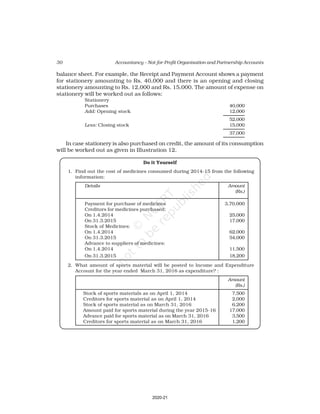
  • 25.
    25 Accounting for Not-for-ProfitOrganisation Balance Sheet (Relevant Data) as on March 31, 2015 Liabilities Amount Assets Amount (Rs.) (Rs.) Subscription Received in Subscription Outstanding: Advance for 2014-15 2013-14 1,500 5,000 2014-15 1,7000 18,500 *Relevant data only Do it Yourself 1. Subscriptions received by the health club during the year 2015 were as under: Rs. 2014 3,000 2015 96,000 2016 2,000 1,01,000 Rs. Subscriptions Outstanding as on 31.12.14 5,000 Subscriptions Outstanding as on 31.12.15 12,000 Subscriptions received in advance in 2014 for 2015 5,000 Calculate the amount of subscriptions to be shown on the income side of Income and Expenditure A/c. 2. During the year 2015, subscriptions received by a sports club were Rs. 80,000. These included Rs. 3,000 for the year 2014 and Rs.6,000 for the year 2016. On March 31, 2016 the amount of subscriptions due but not received was Rs.12,000. Calculate the amount of subscriptions to be shown in Income and Expenditure Account as income from subscription. 3. Subscriptions received during the year ended December 31, 2015 by Royal Club were as under: Rs. 2014 3,000 2015 93,000 2016 2,000 98,000 The club has 500 members each paying @ Rs.200 as annual subscription. Subscriptions outstanding as on March 31, 2016 are Rs. 6,000. Calculate the amount of subscriptions to be shown as income in the Income and Expenditure Account for the year ended March 31, 2016 and show the relevant data in the Balance Sheet as on date. Donations: It is a sort of gift in cash or property received from some person or organisation. It appears on the receipts side of the Receipts and Payments Account. Donation can be for specific purposes or for general purposes. (i) Specific Donations: If donation received is to be utilised to achieve specified purpose, it is called Specific Donation. The specific purpose can be an 2020-21
  • 26.
    26 Accountancy –Not-for-Profit Organisation and Partnership Accounts extension of the existing building, construction of new computer laboratory, creation of a book bank, etc. Such donation is to be capitalised and shown on the liabilities side of the Balance Sheet irrespective of the fact whether the amount is big or small. The intention is to utilise the amount for the specified purpose only. (ii) General Donations: Such donations are to be utilised to promote the general purpose of the organisation. These are treated as revenue receipts as it is a regular source of income hence, it is taken to the income side of the Income and Expenditure Account of the current year. Legacies: It is the amount received as per the will of a deceased person who may or may not specify the use of the amount. Legacies, use of which is specified are specific legacy and is shown in the balance sheet as liability. If the use is not specified it is considered as revenue nature and credited to income and expenditure account. Life Membership Fees: Some members prefer to pay lump sum amount as life membership fee instead of paying periodic subscription. Such amount is treated as capital receipt and credited directly to the capital/general fund. Entrance Fees: Entrance fee also known as admission fee is paid only once by the member at the time of becoming a member. In case of organisations like clubs and some charitable institutions, is limited and the amount of entrance fees is quite high. Hence, it is treated as non-recurring item and credited directly to capital/general fund. Sale of old asset: Receipts from the sale of an old asset appear in the Receipts and Payments Account of the year in which it is sold. But any gain or loss on the sale of asset is taken to the Income and Expenditure Account of the year. For example, if an item furniture with a book value of Rs. 800 is sold for Rs. 700, this amount of Rs. 700 will be shown as receipt in Receipts and Payments Account and Rs. 100 on the expenditure side of the Income and Expenditure Account as a loss on sale of old asset and while showing furniture in the balance sheet Rs. 800 will be deducted from its total book value. Sale of Periodicals: It is an item of recurring nature and shown as the income side of the Income and Expenditure Account. Sale of Sports Materials: Sale of sports materials (used materials like old balls, bats, nets, etc) is the regular feature with any Sports Club. It is usually shown as an income in the Income and Expenditure Account. Payments of Honorarium: It is the amount paid to the person who is not the regular employee of the institution. Payment to an artist for giving performance 2020-21
  • 27.
    27 Accounting for Not-for-ProfitOrganisation at the club is an example of honorarium. This payment of honorarium is shown on the expenditure side of the Income and Expenditure Account. Endowment Fund: It is a fund arising from a bequest or gift, the income of which is devoted for a specific purpose. Hence, it is a capital receipt and shown on the Liabilities side of the Balance Sheet as an item of a specific purpose fund. Government Grant: Schools, colleges, public hospitals, etc. depend upon government grant for their activities. The recurring grants in the form of maintenance grant is treated as revenue receipt (i.e. income of the current year) and credited to Income and Expenditure account. However, grants such as building grant are treated as capital receipt and transferred to the building fund account. It may be noted that some Not-for-Profit organisations receive cash subsidy from the government or government agencies. This subsidy is also treated as revenue income for the year in which it is received. Special Funds The Not-for-Profit Organisations office create special funds for certain purposes/activities such as 'prize funds', 'match fund' and 'sports fund', etc. Such funds are invested in securities and the income earned on such investments is added to the respective fund, not credited to Income and Expenditure Account. Similarly, the expenses incurred on such specific purposes are also deducted from the special fund. For example, a club may maintain a special fund for sports activities. In such a situation, the interest income on sports fund investments is added to the sports fund and all expenses on sports deducted therefrom. The special funds are shown in balance sheet. However, if, after adjustment of income and expenses the balance in specific or special fund is negative, it is transferred to the debit side of the Income and Expenditure Account or adjusted as per prescribed directions. (see Illustrations 8 and 9.) Illustration 8 Show how you would deal with the following items in the financial statements of a Club: Details Debit Credit Amount Amount (Rs.) (Rs.) Prize Fund 80,000 Prize Fund Investments 80,000 Income from Prize Fund Investments 8,000 Prizes awarded 6,000 2020-21
  • 28.
    28 Accountancy –Not-for-Profit Organisation and Partnership Accounts Solution Balance Sheet as on……….. Liabilities Amount Assets Amount (Rs.) (Rs.) Prize fund 80,000 Prize Fund Investments 80,000 Add: Income from 8,000 Investments 88,000 Less: Prizes Awarded 6,000 82,000 Illustration 9 (a) Show the following information in financial statements of a ‘ Not-for-Profit’ Organisation: Details Amount (Rs.) Match Expenses 16,000 Match Fund 8,000 Donation for Match Fund 5,000 Sale of Match tickets 7,000 (b) What will be the effect, if match expenses go up by Rs. 6,000 other things remaining the same? Solution (a) Balance Sheet as on………..* Liabilities Amount Assets Amount (Rs.) (Rs.) Match fund 8,000 Add: Donation 5,000 (Specific) Add: Sale of Match 7,000 Tickets 20,000 Less: Match Expenses 16,000 4,000 4,000 * Only relevant data. (b) If match expenses go up by Rs. 6,000, the net balance of the match fund becomes negative i.e. Debit exceeds the Credit, and the resultant debit balance of Rs. 2,000 shall be charged to the Income and Expenditure Account of that year. 2020-21
  • 29.
    29 Accounting for Not-for-ProfitOrganisation Test your Understanding – II How would you treat the following items in the case of a ‘not-for-profit’ organisation? 1. Tournament Fund Rs. 40,000. Tournament Expenses Rs. 14,000. Receipts from Tournament Rs. 16,000. 2. Table Tennis match expenses Rs. 4,000. 3. Prize Fund Rs. 22,000. Interest on Prize fund Investments Rs. 3,000. Prizes given Rs. 5,000. Prize fund Investments Rs. 18,000. 4. Receipts from Charity Show Rs. 7,000. Expenses on Charity Show Rs. 3,000. Illustration 10 Extract of a Receipt and Payment Account for the year ended on March 31, 2015: Payments: Stationery Rs. 23,000 Additional Information: Details April 1, 2014 March 31, 2015 Stock of stationery 4,000 3,000 Creditors for stationery 9,000 2,500 Solution Details Amount (Rs.) Payment made for the purchase of stationery as per Receipts and Payments account 23,000 Less: Creditors in the beginning 9,000 Payment made for the year 2014-15 14,000 Add: Payment not yet made (i.e. creditors at the end) 2,500 Stationery Purchased for the year 2014-15 16,500 Add: Stock in the beginning 4,000 Stationery Available for consumption during 2014-15 20,500 Less: Stock at the end 3,000 Stationery Consumed during 2014-15 to be taken to the Expenditure side of the Income and Expenditure account 17,500 Stationery: Normally expenses incurred on stationary, a consumable items are charged to Income and Expenditure Account. But in case stock of stationery (opening and/or closing) is given, the approach would be make necessary adjustments in purchases of stationery and work out cost of stationery consumed and show that amount in Income and Expenditure Account and its stock in the 2020-21
  • 30.
    30 Accountancy –Not-for-Profit Organisation and Partnership Accounts balance sheet. For example, the Receipt and Payment Account shows a payment for stationery amounting to Rs. 40,000 and there is an opening and closing stationery amounting to Rs. 12,000 and Rs. 15,000. The amount of expense on stationery will be worked out as follows: Stationery Purchases 40,000 Add: Opening stock 12,000 52,000 Less: Closing stock 15,000 37,000 In case stationery is also purchased on credit, the amount of its consumption will be worked out as given in Illustration 12. Do it Yourself 1. Find out the cost of medicines consumed during 2014-15 from the following information: Details Amount (Rs.) Payment for purchase of medicines 3,70,000 Creditors for medicines purchased: On 1.4.2014 25,000 On 31.3.2015 17,000 Stock of Medicines: On 1.4.2014 62,000 On 31.3.2015 54,000 Advance to suppliers of medicines: On 1.4.2014 11,500 On 31.3.2015 18,200 2. What amount of sports material will be posted to Income and Expenditure Account for the year ended March 31, 2016 as expenditure? : Amount (Rs.) Stock of sports materials as on April 1, 2014 7,500 Creditors for sports material as on April 1, 2014 2,000 Stock of sports material as on March 31, 2016 6,200 Amount paid for sports material during the year 2015-16 17,000 Advance paid for sports material as on March 31, 2016 3,500 Creditors for sports material as on March 31, 2016 1,200 2020-21
  • 31.
    31 Accounting for Not-for-ProfitOrganisation Illustration 11 Following is the Receipt and Payment Account of an Entertainment Club for the period April 1, 2016 to March 31, 2017. Receipt and Payment Account for the year ending March 31, 2017 Receipts Amount Payments Amount (Rs.) (Rs.) Balance b/d Salaries 24,000 Cash 27,500 Entertainment expenses 81,000 Bank 60,000 87,500 Telephone bill 35,000 Member’s subscriptions: Subscription for periodicals 14,500 2015-2016 12,500 Printing and stationery 13,000 2016-2017 1,00,000 Sports expenses 50,000 2017-2018 10,000 1,22,500 Secretary’s honorarium 30,000 Sale of furniture 8% Investments (31.3.2017) 1,00,000 (book value: Rs. 8,000) 10,000 Balance c/d: Legacies (general) 1,00,000 Cash 21,500 Sale of old periodicals 3,200 Bank 45,000 66,500 and newspapers Hire of ground used 48,750 for marriage Donation for sports fund 25,000 Locker Rent 17,050 4,14,000 4,14,000 Additional Information 1. The club had 225 members, each paying an annual subscription of Rs. 500. Subscription outstanding as on 31 March 2016 Rs. 15,000. 2. Telephone bill outstanding for the year 2016-2017 is Rs. 2,000. 3. Locker Rent Rs. 3,050 outstanding for the year 2015-16 and Rs. 1,500 for 2016-17. 4. Salary outstanding for the year 2016-17 Rs. 4,000. 5. Opening Stock of Printing and stationery Rs. 2,000 and closing stock of printing and stationery is Rs. 3,000 for the year 2016-17. 6. On 1st April 2016 other balances were as under: Rs. Furniture 1,00,000 Building 6,50,000 Sports fund 15,000 7. Depreciation Furniture and Building @ 12.5% and 5% respectively assuming that it is on reducing balance for the year ending March 31,2017 Prepare Income and Expenditure account and Balance Sheet as on that date. 2020-21
  • 32.
    32 Accountancy –Not-for-Profit Organisation and Partnership Accounts Solution Book of Entertainment Club Income and Expenditure Account for the year ending on March 31, 2017 Expenditure Amount Income Amount (Rs.) (Rs.) Salary 24,000 Subscriptions 1,00,000 Add: Outstanding 4,000 28,000 Add: Outstanding 12,500 1,12,500 Entertainment expenses 81,000 Sale of old periodicals 3,200 Telephone Bill 35,000 Profit on sale of furniture 2,000 Add: Outstanding 2,000 37,000 Hire of ground for marriage 48,750 Subscription for periodicals 14,500 Locker rent 17,050 Printing and Stationery 13,000 Less: Opening o/s 3,050 Add: Opening Stock 2,000 14,000 15,000 Add: Closing o/s 1,500 15,500 Less: Closing stock 3,000 12,000 Donations 1,00,000 Secretary's honorarium 30,000 Sports Expenses 50,000 Less: Opening Balance of sports fund 15,000 35,000 Less: Donation for Sports 25,000 10,000 Depreciation On: Furniture 11,500 Building 32,500 44,000 Surplus (Excess of Income over 25,450 Expenditure) 2,81,950 2,81,950 2020-21
  • 33.
    33 Accounting for Not-for-ProfitOrganisation Balance Sheet of Entertainment Club as on March 31, 2016 Liabilities Amount Assets Amount (Rs.) (Rs.) Sports fund 15,000 Cash in hand 27,500 Capital/General Fund 8,42,550 Cash at bank 60,000 (Balancing figure) Outstanding subscription 15,000 Outstanding locker Rent 3,050 Printing & Stationery 2,000 Furniture 1,00,000 Buildings 6,50,000 8,57,550 8,57,550 Balance Sheet of Entertainment Club as on March 31, 2017 Liabilities Amount Assets Amount (Rs.) (Rs.) Subscriptions received in advanced 10,000 Cash in hand 21,500 Outstanding Telephone Bill 2,000 Cash at bank 45,000 Salary Outstanding 4,000 Outstanding subscriptions 15,000 Capital/General Fund 8,42,550 (2015 Rs 2500 and 2016 Rs 12500) Add: Surplus 25,450 8,68,000 Outstanding locker Rent 1,500 Printing and Stationery 3,000 Furniture 1,00,000 Less: Sales 8,000 92,000 Less: Depreciation 11,500 80,500 Building 6,50,000 Less: Depreciation 32,500 6,17,500 Investment 1,00,000 8,84,000 8,84,000 2020-21
  • 34.
    34 Accountancy –Not-for-Profit Organisation and Partnership Accounts Illustration 12 Prepare Income and Expenditure Account and Balance Sheet for the year ended March 31, 2015 from the following information. Receipt and Payment Account for the year ending March 31, 2015 Receipts Amount Payments Amount (Rs.) (Rs.) Balance b/d 41,000 Salaries and Wages: Subscriptions: 2013-14 4,800 2013-14 7,200 2014-15 83,200 88,000 2014-15 3,37,600 Sundry expenses 37,000 2015-16 12,000 3,56,800 Freehold land 60,000 Entrance fees 16,000 Stationery 16,000 Locker rent 58,000 Rates 24,000 Revenue from refreshment 48,000 Refreshment expenses 37,500 Income from investments 56,000 Telephone charges 4,000 Investments 2,50,000 Audit fee 6,000 Balance c/d 53,300 5,75,800 5,75,800 The following additional information is provided to you: 1. There are 1800 members each paying an annual subscription of Rs. 200, Rs. 8,000 were in arrears for 2013-14 as on April 1, 2014. 2. On March 31, 2015 the rates were prepaid to June 2015; the charge paid every year being Rs. 24,000. 3. There was an outstanding telephone bill for Rs. 1,400 on March 31, 2015. 4. Outstanding sundry expenses as on March 31, 2014 totaled Rs. 2,800. 5. Stock of stationery as on March 31, 2014 was Rs. 2000; on March 31, 2015, it was Rs. 3,600. 6. On March 31, 2014 Building stood at Rs. 4,00,000 and it was subject to depreciation @ 2.5% p. a. 7. Investment on March 31, 2014 stood at Rs. 8,00,000. 8. On March 31, 2015, income accrued on investments purchased during the year amounted to Rs. 1,500. 2020-21
  • 35.
    35 Accounting for Not-for-ProfitOrganisation Solution Income and Expenditure Account for the year ending on March 31, 2015 Dr. Cr. Expenditure Amount Income Amount (Rs.) (Rs.) Salaries and Wages 83,200 Subscriptions 3,60,000 Sundry Expenses 37,000 Entrance fees 16,000 Less: Outstanding on Locker rent 58,000 31.3.2014 2,800 34,200 Income from refreshment: Stationery : (consumed) Revenue from 48,000 Opening stock 2,000 refreshment Add: Purchases 16,000 Less: Refreshment 37,500 10,500 Less: Closing stock 3,600 14,400 expenses Rates 24,000 Income from 56,000 Less: Paid for 2015-16 6,000 investments Add: Prepaid in 2014-15 6,000 24,000 Add: Accrued income 1,500 57,500 Telephone charges 4,000 on current year Add: Outstanding 1,400 5,400 investment audit fee 6,000 Surplus Depreciation on building 10,000 (excess of Income over expenditure) 3,24,800 5,02,000 5,02,000 Balance Sheet as on March 31, 2015 Liabilities Amount Assets Amount (Rs.) (Rs.) Outstanding Telephone 1,400 Cash and Bank Balance 53,300 Expenses Subscription in Arrears 23,200 Subscription received in 12,000 Stock of Stationery 3,600 Advance Rates Prepaid 6,000 General Fund 12,49,400 Accrued Interest on investment: 1,500 Add: Surplus 3,24,800 15,74,200 Investments 8,00,000 Additions 2,50,000 10,50,000 Building 4,00,000 Less: Depreciation 10,000 3,90,000 Land 60,000 15,87,600 15,87,600 2020-21
  • 36.
    36 Accountancy –Not-for-Profit Organisation and Partnership Accounts Balance Sheet as on March 31, 2014 Liabilities Amount Assets Amount (Rs.) (Rs.) Outstanding Sundry Expenses 2,800 Cash and Bank balance 41,000 Outstanding Salary and Wages 4,800 Subscription in arrears 8,000 General Fund 12,49,400 Stock of stationery 2,000 (Balancing figure) Rates prepaid 6,000 Investments 8,00,000 Building 4,00,000 12,57,000 12,57,000 Working Note : Subscription Account Dr. Cr. Date Particulars J.F. Amount Date Particulars J.F. Amount (Rs.) (Rs.) Opening Balance or 8,000 Receipt and Payment 3,56,800 Balance b/d (Arrears Balance c/d 23,200 for 2013-14) Income and Expenditure 3,60,000 (1800×200) Balance 12,000 c/d (Advance for 2015-16) 3,80,000 3,80,000 Illustration 13 Following is the Receipt and Payment Account of Friendship Club in respect of the Year on 31.3.2016. Receipt and Payment Account for the year ending March 31, 2016. Receipts Amount Payment Amount (Rs.) (Rs.) Opening cash in hand 10,000 Salaries 20,000 Subscription: Stationery 4,500 2014-15 15,000 Rates and Taxes 1,500 2015-16 20,000 Telephone charges 7,500 2016-17 5,000 40,000 8% govt. securities at par 25,000 Profit from sports 17,800 Sundry expenses 500 Interest on 8% govt. securities 5,000 Courier service charges 300 Closing cash in hand 13,500 72,800 72,800 2020-21
  • 37.
    37 Accounting for Not-for-ProfitOrganisation Additional Information : 1. There are 500 members, each paying an annual subscription of Rs. 50, Rs. 17,500 being in arrears for 2014-15 at the beginning of 2015-16. During 2014-15, subscriptions were paid in advance by 40 members for 2015-16. 2. Stock of stationery on March 31, 2015, was Rs. 1,500 and on March 31, 2016, Rs. 2,000. 3. On March 31, 2016, the rates and taxes were prepaid to the following January 31, the annual charge being Rs. 1,500. 4. Telephone bill unpaid as on March 31, 2015 Rs. 3,000 and on March 31, 2016 Rs. 1,500. 5. Sundry expenses accruing at 31.3.2015 were Rs. 250 and at March 31, 2016 Rs. 300. 6. On March 31, 2015 Building stood in the books at Rs. 2,00,000 and it is required to write off depreciation @ 10% p.a. 7. Value of 8% Government Securities on March 31, 2015 was Rs. 75,000 which were purchased at that date at Par. Additional Government Securities worth Rs. 25,000 are purchased on March 31, 2016. You are required to prepare: (a) An Income and Expenditure Account for the year ended on 31.3.2016 (b) A Balance Sheet on that date. Solution Books of Friendship Club Balance Sheet as on March 31, 2015 Liabilities Amount Assets Amount (Rs.) (Rs.) Outstanding Expenses: Building 2,00,000 Telephone charges 3,000 Investment in 8% Govt. 75,000 Sundry Expenses 250 3,250 Securities Subscription received in 2,000 Stock of stationery 1,500 Advance Prepaid Rates and Taxes 1,250 General Fund 3,00,000 Subscription outstanding 17,500 (balancing figure) Cash in hand 10,000 3,05,250 3,05,250 Income and Expenditure Account for the year ending on March 31, 2015 Expenditure Amount Income Amount (Rs.) (Rs.) Salaries 20,000 Profit on Sports 17,800 Stationery (paid) 4,500 Interest on 8% Govt. 5,000 Add: Opening stock 1,500 Securities Received 6,000 Add: Receivable 1,000 6,000 Less: Closing stock 2,000 Total Subscription 40,000 Stationery consumed 4,000 Received during Rates and Taxes 1,500 the current year 2020-21
  • 38.
    38 Accountancy –Not-for-Profit Organisation and Partnership Accounts Less: Closing Prepaid 1,250 Add: Opening 2,000 250 Subscription in advance Add: Opening Prepaid 1,250 1,500 Add: Outstanding at 5,500 Telephone charges paid 7,500 the end of the Add: Outstanding 1,500 Current Year (Current Year) 9,000 (2,500+3,000)= 47,500 Less: Outstanding 3,000 6,000 Less: Subscription 5,000 (Previous year) received in 42,500 Sundry expenses paid 500 Advance(Closing) Add: Outstanding 300 Less: Outstanding 17,500 25,000* (Current Year) 800 at the start of Less: Outstanding 250 550 the Current Year (Previous year) Deficit: (Excess of Expenditure 3,550 Depreciation on building 20,000 over to Income) Courier charges 300 52,350 52,350 • Verification: 500 × 50 = 25000. Balance Sheet of Friendship Club as on March 31, 2016 Liabilities Amount Assets Amount (Rs.) (Rs.) Outstanding Expenses: Building : 2,00000 Telephone charges 1,500 Less: depreciation 20,000 1,80,000 Sundry Expenses 300 1,800 Investment in 8% 75,000 Subscription received in 5,000 Govt. Securities: Advance Add: Purchases 25,000 1,00,000 General Fund 3,00,000 Stock of stationery 2,000 Less: Deficit 3,550 2,96,450 Interest on 8% 1,000 Govt. securities Receivable Prepaid Rates and Taxes 1,250 Subscription outstanding 5,500 (Rs.17,500-Rs. 5,000) +Rs. 3,000= Rs.5,500 Cash in hand 13,500 3,03,250 3,03,250 1.7 Income and Expenditure Account based on Trial Balance In case of not-for-profit organisations, normally the Income and Expenditure Account and Balance Sheet is prepared based on the Receipts and Payments Account and the additional information given. But, sometimes, the trial balance along with some additional information is given for this purpose. See Illustration 14. 2020-21
  • 39.
    39 Accounting for Not-for-ProfitOrganisation Illustration 14 From the trial balance and other information given below for a school, prepare Income and Expenditure Account for the year ended on 31.3.2017 and a Balance Sheet as on that date: Debit Balance Amount Credit Balance Amount (Rs.) (Rs.) Building 6,25,000 Admission fees 12,500 Furniture 50,000 Tuition fees received 5,00,000 Library books 1,50,000 Creditors for supplies 15,000 Investment @12% 5,00,000 Rent for the school hall 10,000 Salaries 5,00,000 Miscellaneous receipts 30,000 Stationery 40,000 Legacies (general). 3,50,000 General expenses 18,000 General fund 10,20,000 Sports expenses 15,000 Donation for library books 62,500 Cash at bank 1,00,000 Sale of old furniture 20,000 Cash in hand 2,000 20,00,000 20,00,000 Additional Information: (i) Tution fee yet to be received for the year are Rs. 25,000. (ii) Salaries yet to be paid amount to Rs.30,000. (iii) Furniture costing Rs. 40000 was purchased on October 1, 2016 was sold for Rs. 20,000. (iv) The book value of the furniture sold was Rs. 50,000 on April 1, 2016 was sold for Rs. 20,000. (v) Depreciation is to be charged @ 10% p.a. on furniture, 15% p.a. on Library books, and 5% p.a. on building. Solution Income and Expenditure Account for the year ending on March 31, 2017 Expenditure Amount Income Amount (Rs.) (Rs.) Loss on sale of old furniture 30,000 Admission fees 12,500 (50,000 –20,000) Tuition fees 5,00,000 Salaries 5,00,000 Add: Outstanding 25,000 5,25,000 Add: outstanding 30,000 5,30,000 Rent for the school hall 10,000 Stationery 40,000 Miscellaneous receipts 30,000 General expenses 18,000 Legacies (general) 3,50,000 Depreciation: Interest accrued on 60,000 Furniture 3,000 investments Building 31,250 Library books 22,500 56,750 Sports expenses 15,000 Surplus (excess of income 2,97,750 over expenditure) 9,87,500 9,87,500 2020-21
  • 40.
    40 Accountancy –Not-for-Profit Organisation and Partnership Accounts Working Notes: 1. As admission fee is a regular income of a school, so it has been taken as a revenue income of the school. 2. Depreciation on furniture has been computed as following on the assumption that furniture was sold on April 1, 2016. Amount (Rs.) Book Value on March 31, 2017 1,00,000 Less: Book Value of Sold furniture (50,000) 50,000 Depreciation on furniture of Rs. 10,000 for one year 1,000 Depreciation on furniture of Rs. 40,000 for 6 months 2,000 Total depreciation 3,000 Balance Sheet as on March 31, 2017 Liabilities Amount Assets Amount (Rs.) (Rs.) Creditors for Supplies 15,000 Buildings 6,25,000 Outstanding Salaries 30,000 Less: Depreciation 31,250 5,93,750 Donation for Library Books 62,500 Furniture 50,000 General fund 10,20,000 Less: Sold 50,000 Add: Surplus 2,97,750 12,97,750 50,000 Less: Depreciation 3,000 47,000 Accrued fees 25,000 Library books 1,50,000 Less: Depreciation 22,500 1,27,500 Investments @ 12% 5,00,000 Interest accrued 60,000 Cash at bank 1,00,000 Cash in hand 2,000 14,05,250 14,05,250 Illustration 15 Prepare Income and Expenditure Account of Entertainment Club for the year ending March 31, 2017 and Balance Sheet as on that date from the following information: 2020-21
  • 41.
    41 Accounting for Not-for-ProfitOrganisation Receipt and Payment Account For the year ending on March 31, 2017 Receipts Amount Payments Amount (Rs.) (Rs.) Balance b/d 24,000 Rent and Rates 48,750 Subscriptions Furniture purchased 40,000 2015-16 23,250 Creditors for sports materials 61,000 2016-17 3,36,000 Purchases for sports materials 10,000 2017-18 13,000 3,72,250 Cost of prizes awarded 20,750 Sale of sports materials 26,000 Match expenses 35,150 Entrance fees 40,000 Miscellaneous expenses 1,50,000 General donation 20,250 Balance c/d 1,34,050 Donation for prize fund 14,000 Interest on prize fund Investments 1,500 Miscellaneous receipts 1,700 4,99,700 4,99,700 Additional Information: Details Apr. 01, 2016 Mar. 31, 2017 Sports materials 20,000 25,000 Furniture 2,00,000 ? 5% Prize fund investments 60,000 ? Creditors for sports materials 7,000 14,750 Subscription in arrears 23,750 ? Prize fund 60,000 ? Rent paid in advance ---- 3,750 Outstanding rent 3,750 Outstanding miscellaneous expenses 11,400 20,100 Miscellaneous expenses paid in advance 3,750 4,250 Book value of sports materials sold was Rs. 20000 Depreciation on furniture is to be provided @ 10%. Half of the entrance fee is to be capitalised. There are 1440 members, each paying an annual subscription @ Rs. 250. Subscription received in advance on 1.4.2016 were Rs. 7,000. 2020-21
  • 42.
    42 Accountancy –Not-for-Profit Organisation and Partnership Accounts Solution Books of Entertainment Club Income and Expenditure Account for the year ending March 31, 2017 Expenditure Amount Income Amount (Rs.) (Rs.) Rent 48,750 Subscriptions 3,36,000 Less: Opening 3,750 Add: Received Outstanding in advance 45,000 01.04.2016 7,000 Less: Closing rent paid in 3,750 41,250 Add: Outstanding advance Sports Materials (2015–2016) 17,000 3,60,000 Opening stock 20,000 (Rs.3,60,000–Rs.3,43,000) Add: Payments 61,000 General donations 20,250 to creditor Entrance fees 20,000 81,000 Sports materials Add: Closing creditor 14,750 (Profit on sale) 95,750 (i.e. 26,000–20,000) 6,000 Add: Cash purchase 10,000 Miscellaneous receipts 1,700 1,05,750 Less: Opening creditor 7,000 98,750 Less: Sports material 20,000 Sold 78,750 Less: Closing stock 25,000 53,750 Match expenses 35,150 Depreciation on furniture 24,000 Miscellaneous expenses: Paid 1,50,000 Less: Outstanding 11,400 (Opening) 1,38,600 Paid in advance 4,250 (Opening) 1,34,350 Add: Outstanding 20,100 (Closing) 1,54,250 Paid in advance 3,750 1,58,200 (Closing) Surplus (Excess of 95,600 income over expenditure) 4,07,950 4,07,950 2020-21
  • 43.
    43 Accounting for Not-for-ProfitOrganisation Balance Sheet of Entertainment Club as on March 31, 2016 Liabilities Amount Assets Amount (Rs,) (Rs,) Capital Fund (Balancing figure) 2,42,350 Furniture 2,00,000 Prize fund 60,000 5% Prize Fund Investments 60,000 Creditors for 7,000 Subscription Receivable 23,750 Sports Materials (i.e. outstanding) Subscription Received in Advance 7,000 Stock of Sports Materials 20,000 Outstanding Expenses: Miscellaneous Expenses 3,750 Paid in Advance Rent 3,750 Cash in hand 24,000 Miscellaneous 11,400 15,150 Expenses 3,31,500 3,31,500 Balance Sheet of Entertainment as on March 31, 2017 Liabilities Amount Assets Amount (Rs.) (Rs.) Capital fund 2,42,350 Furniture: Add: Surplus 95,600 Opening balance 2,00,000 Entrance fees 20,000 3,57,950 Additions 40,000 Prize fund 60,000 2,40,000 Add: Donations 14,000 Less: Depreciation 24,000 2,16,000 Interest received 1,500 5% Prize fund investments 60,000 Interest accrued* 1,500 Subscription receivable 77,000 (i.e. Outstanding): Less: Prizes awarded 20,750 56,250 (2015-2016) 500 Creditors for sports materials 14,750 (2016-2017) 17,000 17,500 Subscription received in advance 13,000 Stock of sports materials 25,000 Outstanding miscellaneous 20,100 Miscellaneous expenses 4,250 expenses Paid in advance Prepaid rent 3,750 Accrued interest on 1,500 Prize fund investments Cash in hand 1,34,050 4,62,050 4,62,050 Note: * Interest on Prize Fund Investments @ 5% amounts to Rs. 3,000 whereas only Rs. 1,500 have been received; so the balance is treated as Accrued interest. It is preferable to prepare separate accounts of various items involving many transactions. In this case Account for Subscription, Miscellaneous Expenses, and Sports Materials may be made as a Classroom activity. 2020-21
  • 44.
    44 Accountancy –Not-for-Profit Organisation and Partnership Accounts Illustration 16 Shiv-e-Narain Education Trust provides the information in regard to Receipt and Payment Account and Income and Expenditure Account for the year ended March 31st 2017: Receipt and Payment Account for the year ending March 31, 2017 Receipts Amount Payments Amount (Rs.) (Rs.) Cash in hand as on 3,000 Printing and Stationery 6,000 April 1, 2016 Lighting & Water 2,600 Cash at bank as on 15,000 Rent 21,000 April 1, 2016 Advertisement 2,820 Subscription: Miscellaneous Expenses 4,400 2015-16 12,000 Staff Salaries 85,000 2016-17 46,000 Furniture purchased 28,000 2017-18 15,600 73,600 Honorarium 15,000 Entrance fees 25,200 Books 5,000 Tuition fees: Cash in hand as on 9,180 2016-17 80,000 March 31, 2017 2017-18 10,000 90,000 Cash at bank as on 45,000 Interest on investment: March 31, 2017 2015-16 4,000 2016-17 6,000 10,000 Miscellaneous receipts 7,200 2,24,000 2,24,000 On March 31, 2016 the following balances appeared: Investments Rs.1, 60,000; Furniture Rs.40, 000; and Books Rs.20, 000. Income and Expenditure Account for the year ending on March 31, 2017 Expenditure Amount Income Amount (Rs.) (Rs.) Printing and Stationery 7,800 Subscription 46,000 Lighting & Water 2,600 Interest on investment 6,800 Rent 24,000 Miscellaneous incomes 7,200 Staff salaries 84,000 Tuition fees 90,000 Advertisement 3,200 Honorarium 15,000 Misc. expenses 4,400 Depreciation on furniture 4,000 Surplus(Excess of income 5,000 over expenditure) 1,50,000 1,50,000 Prepare opening and closing balance sheet 2020-21
  • 45.
    45 Accounting for Not-for-ProfitOrganisation Solution Shiv-e-Narain Education Trust Balance Sheet as on March 31, 2016 Liabilities Amount Assets Amount (Rs.) (Rs.) Capital/General Fund 2,54,000 Investments 1,60,000 (Balancing figure) Furniture 40,000 Books 20,000 Outstanding subscription 12,000 Accrued Interest on Invest. 4,000 Cash in hand 3,000 Cash at bank 15,000 2,54,000 2,54,000 Balance Sheet of Shiv-e-Narain Education Trust as on March 31, 2017 Liabilities Amount Assets Amount (Rs.) (Rs.) Tuition fee advance 10,000 Investments 1,60,000 Rent Outstanding 3,000 Furniture 40,000 Advertisement Outstanding 380 Less: Depreciation 4,000 Printing & Stationery 1,800 36,000 Outstanding Add: Purchases 28,000 64,000 Advance Subscription 15,600 Books 20,000 Capital/ Add: Purchases 5,000 25,000 General Fund 2,54,000 Interest Accrued 800 Add Entrance fee 25,200 Outstanding tuition fee 10,000 Add Surplus 5,000 2,84,200 Staff Salary Advance 1,000 Cash in Hand 9,180 Cash at Bank 45,000 3,14,980 3,14,980 Note: 1. Income and Expenditure Account for the current year shows interest on investment income Rs.6,800 while Receipts and Payments Account shows the receipts of Rs.6,000 the difference of Rs.800 means interest on investment has become due but not yet receivable during the year. 2. Income and Expenditure Account shows Rs.90,000 as income from Tuition fees. However, the Receipts and Payments Account shows Rs.10,000 as tuition fees received for the year 2017-18 and Rs.80,000 for 2015-16. It implies that Rs.10,000 on account of tuition fees for the year 2016-17 are still receivable (i.e. Tuition fees are outstanding). 3. Receipt and Payment Account shows a payment of Rs.85,000 on account of staff salaries, but the Income and Expenditure Account shows expenditure 2020-21
  • 46.
    46 Accountancy –Not-for-Profit Organisation and Partnership Accounts of Rs.84,000 on account of staff salaries. It means the excess of Rs.1,000 shown in the Receipt and Payment Account may either belong to the pervious year or the next year. Their is no evidence that staff salaries of Rs.1,000 was outstanding at the end of the previous year 2013-14. This is why this payment of Rs.1,000 has been considered as an advance salaries to the staff. Terms Introduced in the Chapter 1. Not-for-Profit Organisation. 2. Receipts and Payments Account 3. Income and Expenditure Account 4. Entrance Fee 5. Life Membership 6. Special Receipts 7. Subscription 8. Donation 9. Incidental Trading Activity 10. Legacy Summary 1. Difference between Profit Seeking Entities and Not-for-Profit Entities: Profit-seeking entities undertake activities such as manufacturing trading, banking and insurance to bring financial gain to the owners. Not-for-Profit entities exist to provide services to the member or to the society at large. Such entities might sometimes carry on trading activities but the profits arising therefrom are used for further the service objectives. 2. Appreciation of the need for separate Accounting Treatment for Not-for-Profit Organisations: Since not-for-profit entities are guided primarily by a service motive, the decisions made by their managers are different from those made by their counterparts in profit-seeking entities. Differences in the nature of decisions implies that the financial information on which they are based, must also be different in content and presentation. 3. Explanation of the nature of the Principal Financial Statements prepare by Not-for- Profit enterprises: Not-for-Profit Organisations that maintain accounts based on the double-entry system of accounting, generally prepare three principal statements to fulfil their information needs. These include Receipts and Payments Account, Income and Expenditure Account, and a Balance Sheet. The Receipts and Payments Account is summarised under relevant heads, cash book which records all cash Receipts and cash Payments without distinguishing between capital and revenue items, and between items relating to the current year and those relating to previous or future years. The Income and Expenditure Account is an income statement which is prepared to ascertain the excess of revenue income over revenue expenditure or vice 2020-21
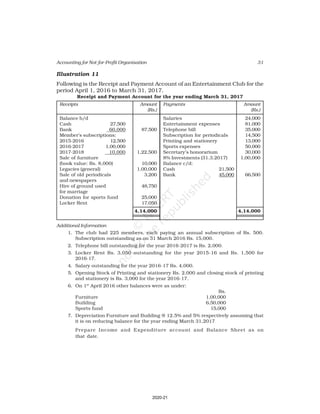
  • 47.
    47 Accounting for Not-for-ProfitOrganisation versa, for a particular accounting year, as a result of the entity’s overall activities. Although it is considered to be a substitute for the Trading and Profit and Loss Account of a profit-seeking entity, there are certain conceptual differences between the two statements. The Balance Sheet is prepared at the end of the entity’s accounting year to depict the financial position on that date. It includes the Capital Fund or Accumulated Fund, special purpose funds, and current liabilities on the left hand or liabilities side, and fixed assets and current assets on the right hand or assets side. 4. Difference between the Receipt and Payment Account and the Income and Expenditure Account: Many differences exist between the Receipt and Payment Account and the Income and Expenditure Account which is evident from the nature and purpose of two statements. While the former records both capital and revenue receipts and payments relating to any accounting year, the latter records only revenue items relating to the current accounting year. Non-cash expenses such as depreciation on fixed assets and outstanding incomes and expenses are shown in the latter but omitted in the former. The Receipt and Payment Account has an opening balance while the Income and Expenditure Account does not. The closing balance of the former account represents cash and bank balances on the closing date while in the latter account it indicates surplus or deficit from the activities of the enterprise. 5. Conversion of a Receipt and Payment Account into an Income and Expenditure Account: This essentially involves five steps namely, (i) adjusting the revenue receipts on the debit side to include accrued incomes and incomes relating to the current year received earlier and to exclude amounts received in arrears or in advance; (ii) adjusting revenue payments on the credit side; (iii) identifying and showing non-cash expenses and losses on the debit side of the Income and Expenditure Account; (iv) computing and showing profits/losses from trading and/or social activities on the credit/debit side of the Income and Expenditure Account; and (v) ascertaining the surplus or deficit as the closing balance of the Income and Expenditure Account. Questions for Practice Short Answer Questions 1. What is meant by ‘Not- for- Profit’ Organisations? 2. State the meaning of Receipt and Payment Account. 3. State the meaning of Income and Expenditure Account. 4. State the feature of Receipt and Payment Account. 5. What steps are taken to prepare Income and Expenditure Account from a Receipt and Payment Account? 6. What is subscription? How is it calculated? 7. What is meant by Capital Fund? How is it calculated? 2020-21
  • 48.
    48 Accountancy –Not-for-Profit Organisation and Partnership Accounts Long Answer Questions 1. Explain the statement: “Receipt and Payment Account is a summarised version of Cash Book”. 2. “Income and Expenditure Account of a Not-for-Profit Organisation is akin to Profit and Loss Account of a business concern”. Explain the statement. 3. Distinguish between Receipts and Payments Account and Income and Expenditure Account. 4. Explain the basic features of Income and Expenditure Account and of Receipt and Payment Account. 5. Show the treatment of the following items by a not-for-profit organisation: (i) Annual subscription (ii) Specific donation (iii) Sale of fixed assets (iv) Sale of old periodicals (v) Sale of sports materials (vi) Life membership fee 6. Show the treatment of items of Income and Expenditure Account when there is a specific fund for those items. 7. What is Receipt and Payment Account? How is it different from Income and Expenditure Account? 8. Distinguish between profit and not-for-profit organisation. Numerical Questions 1. From the following particulars taken from the Cash Book of a health club, prepare a Receipts and Payments Account. Rs. Opening balance: Cash in Hand 5,000 Cash at Bank 25,000 Subscriptions 1,65,000 Donations 35,000 Investment Purchased 80,000 Rent Paid 20,000 General Expenses 21,500 Postage and stationery 2,000 Courier charges 1,000 Sundry Expenses 2,500 Closing Cash in Hand 12,000 (Ans: Cash at Bank (balancing figure) Rs. 91,000) 2020-21
  • 49.
    49 Accounting for Not-for-ProfitOrganisation 2. The Receipt and Payment Account of Harimohan charitable institution is given: Receipt and Payment Account for the year ending March 31, 2015 Receipts Amount Payments Amount (Rs.) (Rs.) Balance b/d Furniture 3,000 Cash at Bank 22,000 Investments 55,000 Cash in Hand 8,800 Advance for building 20,000 Donations 16,000 Charities 60,000 Subscriptions 50,200 Salaries 10,400 Endowment fund 60,000 Rent and Taxes 4,000 Legacies 12,000 Printing 1,000 Interest on Investment 3,800 Postage 300 Interest on Deposits 800 Advertisements 1,100 Sale of old newspapers 500 Insurance 4,800 Donation for building 16,000 Balance c/d: Legacy for building 12,000 Cash at bank 32,000 Cash in hand 10,500 2,02,100 2,02,100 Prepare the Income and Expenditure Account for the Year ended on March 31, 2015 after considering the following: (i) Liabilities to be provided for are: Rent Rs. 800; Salaries Rs. 1,200; advertisement Rs. 200. (ii) Rs. 2,000 due for interest on investment was not actually received. (Ans : Excess of income over Expenditure Rs. 1,500.) 3. From the following particulars , prepare Income and Expenditure account: Details Amount (Rs.) Fees collected, including Rs.80,000 on account of the 5,20,000 previous year Fees for the year outstanding 30,000 Salary paid , including Rs. 5,000 on account 68,000 of the previous year Salary outstanding at the end of the year 3,000 Entertainment expenses 8,000 Tournament expenses 25,000 Meeting Expenses 18,000 Traveling Expenses 7,000 Purchase of Books and Periodicals, including 40,000 Rs. 31,000 for purchase of Books Rent 15,000 Postage, telegrams and telephones 6,000 Printing and Stationery 18,000 Donations received 25,000 (Ans : Excess of income over expenditure Rs. 3,23,000) 2020-21
  • 50.
    50 Accountancy –Not-for-Profit Organisation and Partnership Accounts 4. Following is the information given in respect of certain items of a Sports Club. Show these items in the Income and Expenditure Account and the Balance Sheet of the Club: Rs. Sports Fund as on 1.4.2015 35,000 Sports Fund Investments 35,000 Interest on Sports Fund 4,000 Donations for Sports Fund Investment 15,000 Sports Prizes awarded 10,000 Expenses on Sports Events 4,000 General Fund 80,000 General Fund Investments 80,000 Interest on General Fund Investments 8,000 (Ans : Balance of Sports Fund Rs. 40,000.) 5. How will you deal with the following items while preparing for the Bombay Women Cricket Club its income and expenditure account for the year ending 31.3.2017 and its Balance Sheet as on 31.3.2017: Rs. (a) Donation received during the year for the 12,25,000 construction of a permanent Pavilion Expenditure incurred up to 31.3.2017 on its construction 10,80,000 The total estimated expenditure on construction 25,00,000 of Pavilion being (b) Tournament Fund: Balance as on 1.4.2016 10,700 Subscriptions for tournament received during the year 65,800 Expenditure incurred during the year on conducting 72,400 tournaments (c) Life Membership fee received during the year 28,000 Give reasons for your answers. (Ans : (a) Balance of Pavilion Fund Rs. 1,45,000; (b) Balance of Tournment Fund Rs. 4,100; (c) Life Membership fee to the Capitalised). 6. From the following receipts and payments and information given below, Prepare Income and Expenditure Account and opening Balance Sheet of Adult Literacy Orgnisation as on December 31, 2017. 2020-21
  • 51.
    51 Accounting for Not-for-ProfitOrganisation Receipt and Payment Account for the year ending as on December 31, 2017 Receipts Amount Payments Amount (Rs.) (Rs.) Balance b/d General Expenses 3,200 Cash in hand 4,000 Newspaper 1,850 Cash at Bank 15,550 Electricity 3,000 Subscriptions Fixed deposit with bank 18,000 2016 1,200 (on 31.06.2017) @ 10% p.a. 2017 26,500 Books 7,000 2018 500 28,200 Salary 3,600 Sale of old newspapers 1,250 Rent 6,500 Govt. grant 12,000 Postage charges 300 Sale of old furniture Furniture (purchased) 10,500 (book value Rs.5000) 3,700 Balance c/d Interest received on FD 450 Cash in hand 3,000 Cash at bank 8,200 65,150 65,150 Information: (i) Subscription outstanding as on 31.12.2016 were Rs.2,000 and on December 31, 2017 were Rs.1,500. (ii) On December 31, 2017 Salary outstanding was Rs.600, and one month Rent paid in advance. (iii) On Jan. 01, 2016 orgnisation owned Furniture Rs.12,000, Books Rs.5,000. (Ans : Surplus Rs. 22,300, Opening Capital Fund Rs.38,550, Total Balance Sheet Rs. 61,950). 7. The following is the Receipt and Payment Account of the Nari Kalayan Samittee for the year ended December 31, 2017: Receipts Amount Payments Amount (Rs.) (Rs.) Balance from last year b/d 2,270 Rent 6,600 Subscriptions 32,500 Electric charges 3,200 Life membership fee 3,250 Lecturer’s fee 730 Donation 2,500 Office expenses 1,480 Profit from entertainment 7,250 Printing and Stationery 1,050 Sale of old Books 750 Legal fee 1,870 (books value Rs.1,000) Books 6,500 Interest 350 Furniture purchased 8,600 Expenses on nukar drama 1,300 Balance c/d: Cash in hand 8,040 Cash at bank 9,500 48,870 48,870 2020-21
  • 52.
    52 Accountancy –Not-for-Profit Organisation and Partnership Accounts You are required to prepare an Income and Expenditure Account after the following adjustments: (a) Subscription still to be received are Rs.750 , but subscription include Rs.500 for the year 2018. (b) In the beginning of the year the Samiti owned building Rs.20,000 and furniture Rs.3,000 and Books Rs.2,000. (c) Provide depreciation on furniture @5% (including purchase ), books @ 10% and building @ 5%. (Ans : Surplus Rs. 24,040) 8. Following is the Receipt and Payment Account of Indian Sports Club, prepared Income and Expenditure Account, Balance Sheet as on December 31, 2015: Receipt and Payment Account for the year ending December 31, 2017 Receipts Amount Payments Amount (Rs.) (Rs.) Balance b/d 7,890 Salary 11,000 Subscriptions 52,000 Electric charges 5,500 Life membership fee 2,200 Billiard Table 17,500 Entrance fee 3,200 Office expenses 4,100 Tournament fund 26,000 Printing & Stationery 2,300 Locker Rent 1,250 Tournament expenses 18,500 Sale of old sports equipment Repair of ground 2,000 (Costing Rs.2,200) 2,500 Furniture purchased 7,700 Sale of old newspaper 750 Sports equipment 12,000 Legacy 37,500 Cash in hand 12,690 Cash at bank 10,000 Fixed deposit (on 1.10.2017 for 10% p.a) 30,000 1,33,290 1,33,290 Other Information: Subscription outstanding was on December 31, 2016 Rs.1,200 and Rs.3,200 on December 31, 2017. Locker rent outstanding on December 31, 2017 Rs.250. Salary outstanding on December 31, 2017 Rs.1,000. On January 1, 2017, club has Building Rs.36,000, furniture Rs.12,000, Sports equipments Rs.17,500. Depreciation charged on these items @ 10% (including Purchase). (Ans : Surplus Rs.26,300, Opening Capital fund Rs.74,590, Total of Closing Balance Sheet Rs.1,49,090) 9. From the following Receipt and Payment Account of Jan Kalyan Club, prepare Income and Expenditure Account and Balance Sheet for the year ending March 31, 2017. 2020-21
  • 53.
    53 Accounting for Not-for-ProfitOrganisation Receipt and Payment Account for the year ending March 31, 2017 Receipts Amount Payments Amount (Rs.) (Rs.) Cash in hand as on 1.4.16 6,800 Salaries 24,000 Subscription 60,200 Traveling Expenses 6,000 Donation 3,000 Stationery 2,300 Sale of furniture 4,000 Rent 16,000 (Book value Rs.6000) Repair 700 Entrance fee 800 Books purchased 6,000 Life membership fee 7,000 Building purchased 30,000 Interest on investment 5,000 Cash in hand as 31.03.2017 1,800 (@ 5% for full year) 86,800 86,800 Additional Information: As on As on 01.04.2016 31.03.2017 (i) Subscription received in advance 1,000 3,200 (ii) Outstanding subscription 2,000 3,700 (iii) Stock of stationery 1,200 800 (iv) Books 13,500 16,500 (v) Furniture 16,000 8,000 (vi) Outstanding rent 1,000 2,000 (Ans : Surplus Rs.11,100 ,Opening Capital fund Rs.1,37,500, Total of Closing Balance Sheet Rs.1,60,800] 10. Receipt and Payment Account of Shankar Sports club is given below, for the year ended March 31, 2017 Receipt and Payment Account for the year ending March 31, 2017 Receipts Amount Payments Amount (Rs.) (Rs.) Opening Cash in hand 2,600 Rent 18,000 Entrance fees 3,200 Wages 7,000 Donation for building 23,000 Billiard table 14,000 Locker rent 1,200 Furniture 10,000 Life membership fee 7,000 Interest 2,000 Profit from entertainment 3,000 Postage 1,000 Subscription 40,000 Salary 24,000 Cash in hand 4,000 80,000 80,000 2020-21
  • 54.
    54 Accountancy –Not-for-Profit Organisation and Partnership Accounts Prepare Income and Expenditure Account and Balance Sheet with help of following Information: Subscription outstanding on March 31, 2016 is Rs.1, 200 and Rs.2, 300 on March 31, 2017, opening stock of postage stamps is Rs.300 and closing stock is Rs. 200, Rent Rs.1, 500 related to 2015 and Rs.1, 500 is still unpaid. On April 1, 2016 the club owned furniture Rs.15, 000, Furniture valued at Rs. 22,500 on March 31, 2016. On March 31, 2017, the club had a loan of Rs.20,000 (@ 10% p.a) in 2017. (Ans : Deficit Rs.6,100, Opening Capital fund Deficit Rs.2,400, Total of Closing Balance Sheet Rs. 44,500) 11. Prepare Income and Expenditure Account and Balance Sheet for the year ended March 31, 2016 from the following Receipt and Payment Account and Balance Sheet of culture club: Receipt and Payment Account for the year ending March 31, 2016 Receipts Amount Payments Amount (Rs.) (Rs.) Opening cash balance 12,000 Furniture 4,000 Subscription Telephone expenses 800 2014-15 2,000 Salary 2015-16 22,000 24,000 2014-15 1,000 Entrance fees 2,800 2015-16 4,000 Locker rent 1,000 Newspapers 700 Life membership fee 1,200 Sundry expenses 1,000 Government grant 11,000 Defence bonds 18,000 Land 20,000 Closing cash balance 2,500 52,000 52,000 Balance Sheet for the year ending March 31, 2015 Liabilities Amount Assets Amount (Rs.) (Rs.) Advance locker rent 200 Cash in hand 12,000 Subscription received in 1,000 Outstanding subscription 3,000 Advance Building 35,000 Outstanding salary 2,000 Loan 10,000 Capital fund 36,800 50,000 50,000 (Ans : Surplus Rs. 31,500; Total of Closing Balance Sheet Rs. 80,500) 2020-21
  • 55.
    55 Accounting for Not-for-ProfitOrganisation 12. From the following Receipt and Payment Account prepare final accounts of a Unity Club for the year ended March 31, 2017 Receipt and Payment Accounts for the year ending March 31, 2017 Receipts Amount Payments Amount (Rs.) (Rs.) Balance b/d 15,000 Furniture 18,000 Sale of Old furniture Library books 10,000 (costing Rs. 6,000) 4,000 Salaries 72,000 Subscriptions: General expenses 18,000 2015-16 18,000 Electric charges 12,000 2016-17 60,000 Newspapers 33,800 2017-18 12,000 90,000 Postage 3,000 Sale of old newspapers 10,800 Stationery 40,000 Profit from entertainment 44,000 Audit fee 8,000 Rent 84,000 Balance c/d 33,000 2,47,800 2,47,800 Balance Sheet as on March 31, 2017 Liabilities Amount Assets Amount (Rs.) (Rs.) Outstanding Salary 6,000 Cash 15,000 Capital Fund 6,94,000 Outstanding subscription 18,000 Library Books 30,000 Furniture 37,000 Land and Building 6,00,000 7,00,000 7,00,000 Additional Information: 1. The Club had 500 members each paying an annual subscription of Rs. 150. 2. On 31.3.2017 salaries outstanding amounted to Rs. 1,200 and salaries paid included Rs. 6,000 for the year 2015-16. 3. Provide 5% depreciation on Land and Building. (Ans : Deficit Rs. 200 Total of Closing Balance Sheet Rs.7,07,000) 13. Following is the information in respect of certain items of a Sports Club. You are required to show them in the Income and Expenditure Account and the Balance Sheet. 2020-21
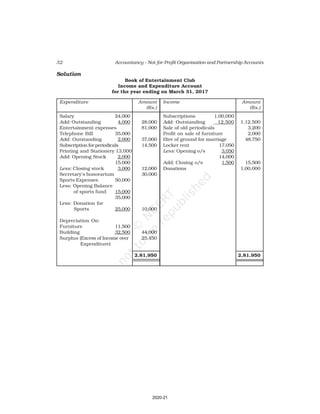
  • 56.
    56 Accountancy –Not-for-Profit Organisation and Partnership Accounts Details Amount (Rs.) Sports Fund as on April 1, 2016 80,000 Sports Fund Investments 80,000 Interest on Sports Fund Investments 8,000 Donations for Sports Fund 30,000 Sports Prizes awarded 16,000 Expenses on Sports Events 7,000 General Fund 2,00,000 General Fund Investments 2,00,000 Interest on General Fund Investments 20,000 14. Receipt and Payment Account of Maitrey Sports Club showed that Rs. 68,500 were received by way of subscriptions for the year ended on March 31, 2017. The additional information was as under: 1. Subscription Outstanding as on March 31, 2016 were Rs. 6,500, 2. Subscription received in advance as on March 31, 2016 were Rs. 4,100, 3. Subscription Outstanding as on March 31, 2017 were Rs. 5,400, 4. Subscription received in advance as on March 31, 2017 were Rs. 2,500. Show how that above information would appear in the final accounts for the year ended on March 31, 2017 of Maitrey Sports Club. (Ans : Subscription credited to Income and Expenditure Account for the year ended on March 31, 2017 is Rs. 69,000. Subscription Outstanding as on 31.3.2017 is Rs. 5,400 and should be shown on the assets side of the Balance sheet as on March 31, 2017 and subscriptions of Rs. 2,500 received in advance as on March 31, 2017 on the liabilities side of the balance sheet as on March 31, 2017) 15. Following is the Receipt and Payment account of Rohatgi Trust : Receipt and Payment Account for the year ending December 31, 2017 Receipts Amount Payments Amount (Rs.) (Rs.) Cash in hand 14,000 Rent 6,000 Cash at bank 60,000 Salary 12,000 Subscription: Postage 300 2016 5,000 Electricity charges 6,000 2017 83,000 Purchase of furniture 20,000 2018 3,000 91,000 Books 3,000 Sale of investment 90,000 Defence Bonds 1,50,000 Interest on investment 2,000 Help to needy students 22,000 Sale of furniture 3,200 Cash in hand 10,900 (book value Rs.3,000) Cash at bank 30,000 2,60,200 2,60,200 2020-21
  • 57.
    57 Accounting for Not-for-ProfitOrganisation Prepare Income and expenditure account for the year ended December 31, 2017, and a balance sheet as on that date after the following adjustments: Subscription for 2017, still owing were Rs. 7,000. Interest due on defence bonds was Rs.7,000, Rent still owing was Rs. 1,000. The Book value of investment sold was Rs. 80,000, Rs. 30,000 of the investment were still in hand. Subscription received in 2017 included Rs. 400 from a life member. The total furniture on January 1, 2017 was worth Rs.12,000. Salary paid for the year 2018 is Rs.2,000. (Ans : Surplus Rs. 63,500, Total of Closing Balance Sheet Rs. 2,68,900) 16. Following Receipt and Payment Account was prepared from the cash book of Delhi Charitable Trust for the year ending December 31, 2017 Receipt and Payment Account for the year ending December 31, 2017 Receipts Amount Payment Amount (Rs.) (Rs.) Balance b/d Charity 11,500 Cash in hand 11,500 Rent and taxes 3,200 Cash at bank 12,600 Salary 6,000 Donation 9,000 Printing 600 Subscription: 42,800 Postage 300 Legacies 18,000 Advertisements 4,500 Interest on investment 4,500 Insuranc es 2,000 Sale of old newspapers 200 Furniture 21,600 Investment 23,000 Balance c/d: Cash in hand 9,900 Cash at bank 16,000 98,600 98,600 Prepare Income and expenditure account for the year ended December 31, 2017, and a balance sheet as on that date after the following adjustments: (a) It was decided to treat one-third of the amount received on account of donation as income. (b) Insurance premium was paid in advance for three months. (c) Interest on investment Rs.1,100 accrued was not received. (d) Rent Rs.600: salary Rs.900 and advertisement expenses Rs.1,000 outstanding as on December 31, 2018. (Ans : Surplus Rs.21,400, Total of Closing Balance Sheet Rs.72,000) 17. From the following Receipt and Payment Account of a club, prepare Income and Expenditure Account for the year ended March 31, 2017 and the Balance Sheet as on that date. 2020-21
  • 58.
    58 Accountancy –Not-for-Profit Organisation and Partnership Accounts Receipt and Payment Account for the year ending March 31, 2017 Receipts Amount Payments Amount (Rs.) (Rs.) Balance b/d 3,500 General expenses 900 Subscription: Salary 16,000 2015-16 2,000 Postage 1,300 2016-17 70,000 Electricity charges 7,800 2017-18 3,000 75,000 Furniture 26,500 Sale of old Books 2,000 Books 13,000 (costing Rs.3,200) Newspapers 600 Rent from use of hall 17,000 Meeting expenses 7,200 Sale of newspapers 400 T.V. set 16,000 Profit from entertainment 7,300 Balance c/d 15,900 1,05,200 1,05,200 Additional Information: (a) The club has 100 members each paying an annual subscription of Rs.900. Subscriptions outstanding on March 31, 2016 were Rs.3,600. (b) On March 31, 2017, salary outstanding amounted to Rs.1,000, Salary paid included Rs. 1,000 for the year 2016. (c) On April 1, 2017 the club owned land and building Rs.25,000, furniture Rs.2,600 and books Rs.6,200. (Ans : Surplus Rs.79,700, Total of Closing Balance Sheet Rs.1,23,600) 18. Following is the Receipt and Payment Account of Women’s Welfare Club for the year ended December 31, 2017: Receipt and Payment Account for the year ending December 31, 2017 Receipts Amount Payments Amount (Rs.) (Rs.) Balance b/d 7,250 Salary 12,500 Subscriptions 81,750 Stationery 1,700 Donations 3,000 Electricity charges 9,550 Grant from Government 15,000 Insurance 7,500 Sale of newspapers 300 Equipments 30,000 Proceeds of charity show 16,500 Petty expenses 500 Interest on investments 7,000 Expenses on charity show 12,900 @ 10% for full year Newspapers 1,000 Sundries income 400 Lectures fee 16,500 Honorarium to Secretary 12,000 Balance c/d 27,050 1,31,200 1,31,200 2020-21
  • 59.
    59 Accounting for Not-for-ProfitOrganisation Additional Information: 01.01.2017 31.12.2017 (Rs.) (Rs.) Outstanding salaries 1,200 1,800 Insurance prepaid 700 300 Subscription outstanding 3,750 2,500 Subscription received in advanced 1,750 1,000 Electricity charges outstanding — 1,250 Stock of stationery 2,250 700 Equipments 25,600 50,200 Building 1,20,000 1,14,000 Prepare Income and Expenditure Account for the year ended December 31, 2017 and Balance Sheet as on date. (Ans : Surplus Rs.34,100, Total of Closing Balance Sheet Rs.2,64,750) 19. As at March 31, 2015 the following balances have been extrated from the books of the Indian Chartered Accountants Recreation Club and you are asked to prepare Income and Expenditure Account for the year ended March 31, 2017 and a Balance Sheet as at that date. Debit Balances Credit Balances (Rs.) (Rs.) Stock-in-hand 1170 Subscriptions 9,7110 Purchases 24,660 Billiard's Receipts 7,300 Dining Room 32,370 Sunday Receipts 410 Rent 10,470 Interest on Fixed Deposit 270 Wages 18,690 Sundry Credtiors 5370 Repairs and Renewals 5,400 Grant from Institute 42,000 Fuel and Light 5,280 (permanent) Misc. Expenses 4,050 Income and Exp. A/c 1,380 Cash in hand 560 (2016) Cash at bank 2,760 Fixed Deposit 8,500 Sundry Debtors 2,250 Stationary 600 Billiard Table 2,070 Fixtures and Fittings 870 Furniture 4,140 Club Premises 30,000 1,53,840 1,53,840 On March 31,2016 stock of Stationary consisted of Rs. 900 and March 31, 2017 Rs. 60 respectively. Provide depreciations Rs. 60 on fixtures and fittings, Rs. 390 on billiard table and Rs. 560 on furniture. (Ans: Excess of income over expenditure– Rs. 2,950: Total of Balance Sheet Rs. 51,700) 2020-21
  • 60.
    60 Accountancy –Not-for-Profit Organisation and Partnership Accounts Check-list to Test your Understanding Test your Understanding – I Ans. TRUE: (iii) (vi) (vii) (x); FALSE: (i) (ii) (iv).(v).(viii).(ix). Test your Understanding – II 1. There is a specific tournament fund. The accounting treatment is as under: Liabilities side of the Balance Sheet Amount (Rs.) Tournament fund 40,000 Add: Receipts from tournament 16,000 56,000 Less: Tournament Expenses 14,000 Balance to remain on the Liabilities side of 42,000 the Balance Sheet 2. There is no specific fund. So the amount incurred on Table Tennis match expenses Rs. 4,000 would be shown on the debit side of Income and Expenditure Account. It is the case of expenses independent of any specific fund. 3. There is a specific fund. The accounting treatment is as under: Liabilities side of the Balance Sheet Amount (Rs.) Prize Fund 22,000 Add: Interest 3,000 25,000 Less: Prizes Paid 5,000 Balance to remain on the Liabilities side of the Balance Sheet 20,000 Prize fund Investments would appear on the Assets Side of the Balance Sheet 18,000 4. There is no specific fund. Receipts from Charity Show would be shown on the credit side and expenses on charity show are deducted from the receipts and the net amount would be shown on the credit side of Income and Expenditure Account. 2020-21
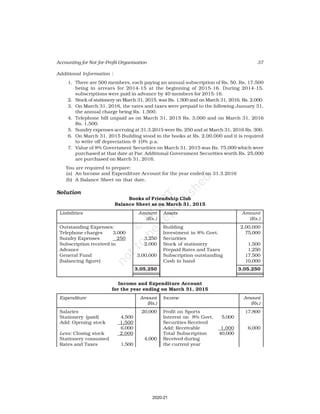
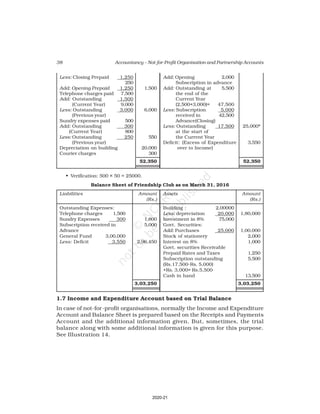
  • 61.
    CBSE Class 12Study Materials Maths Formulas for Class 12 CBSE Class 12 Notes Printable Worksheets for Class 12 CBSE Sample Papers for Class 12 Why you Need to Read NCERT Books for Board Exams NCERT Extra Questions JEE Main Trigonometry Formulas Integration Formulas CBSE Previous Year Question Papers Class 12 NCERT Books for Class 12 NCERT Solutions for Class 12  Class 12 Maths NCERT Books  Maths MCQ Questions for Class 12 Chapterwise with Answers  Important Questions for Class 12 Maths  CBSE Sample Papers for Class 12 Maths  NCERT Solutions for class 12 Maths  Notes for Class 12 Maths  NCERT Exemplar Class 12 Maths  RD Sharma Class 12 Solutions
  • 62.
     CBSE Class11 and 12 Revised Syllabus  Class 12 Physics NCERT Books  Physics MCQ Questions for Class 12 Chapterwise with Answers  NCERT Solutions for class 12 Biology  Notes for Class 12 Biology  NCERT Exemplar Class 12 Biology  Class 12 Chemistry NCERT Books  Chemistry MCQ Questions for Class 12 Chapterwise with Answers  NCERT Solutions for class 12 Physics  Notes for Class 12 Physics  NCERT Exemplar Class 12 Physics  HC Verma Solutions  Class 12 Biology NCERT Books  Biology MCQ Questions for Class 12 Chapterwise with Answers  NCERT Solutions for class 12 Chemistry  Notes for Class 12 Chemistry  NCERT Exemplar Class 12 Chemistry NCERT Geography Book Class 12 NCERT Solutions for class 12 English
  • 63.
     Class 12NCERT Accountancy Books  Accountancy MCQ Questions for Class 12 Chapterwise with Answers  NCERT Solutions for class 12 Accountancy  TS Grewal Accountancy Class 12 Solutions Class 12 NCERT Business Studies Books  NCERT Solutions for class 12 Business Studies  Notes for Class 12 Business Studies Class 12 Introductory Microeconomics  NCERT Solutions for class 12 Economics  Notes for Class 12 Economics Class 12 Introductory Macroeconomics NCERT Solutions for class 12 Entrepreneurship Class 12 NCERT Kaleidoscope NCERT Solutions for class 12 Sociology Class 12 NCERT English Books NCERT Solutions for class 12 Psychology NCERT Sanksrit Books Class 12 NCERT Solutions for class 12 Political Science
  • 64.
    Class 12 Khayaban-e- Urdu NCERTSolutions for class 12 Computer Science – C++ NCERT Class 12 History Book NCERT Solutions for class 12 Computer Science – Python Class 12 Psychology NCERT Books Class 12 Social Change and Development in India NCERT Books Class 12 Indian Society NCERT Books Class 12 Contemporary World Politics NCERT Books Class 12 Craft Tradition in India NCERT Books Class 12 Human Ecology and Family Sciences NCERT Books Class 12 Towards A New Age Graphic Design NCERT Books Class 12 Political Science Part-II NCERT Books Students can easily download the PDF file of these questions and solve them offline as well. For any doubts existing while solving the questions, students are free enough to ask their queries in the comment section given at the end of this page.  Important Questions for Class 12 Maths Chapter Wise  Important Questions for Class 12 Physics with Answers
  • 65.
     Important Questionsfor Class 12 Chemistry Chapter Wise  Important Questions for Class 12 Biology Chapter Wise  Important Questions for Class 12 English Chapter Wise  Important Questions for Class 12 Accountancy Chapter Wise  Important Questions for Class 12 Economics Chapter Wise  Business Studies Class 12 Important Questions Chapter Wise  Important Questions for Class 12 Computer Science Chapter Wise  Political Science Class 12 Important Questions  Physical Education Class 12 Important Questions  Geography Class 12 Important Questions  Informatics Practices Class 12 Important Questions  Important Questions for Class 12 History Chapter Wise NCERT Solutions for Class 12 NCERT Solutions for all the subjects in Class 12 can be found from the following table. Working on Class 12 NCERT solutions is really important as the class 12 syllabus is more or less the same as the competitive exam syllabus such as JEE, NEET etc., So students who have strong command over class 12 NCERT Solutions can easily crack the competitive exams without any difficulty. Just click on the link in following NCERT Class 12 Solutions table and practice away the questions which you want to.  Class 12 Maths  Physics Class 12  Chemistry Class 12
  • 66.
     Class 12Biology  Class 12 English  Class 12 English Vistas  Class 12 English Flamingo  Class 12 Hindi  Class 12 Hindi Aroh (आरोह भाग 2)  Class 12 Hindi Vitan (वितान भाग 2)  Class 12 Sanskrit  Class 12 History  Class 12 Geography  Class 12 Economics  Class 12 Macro Economics  Class 12 Micro Economics  Class 12 Political Science  Class 12 Business Studies  Class 12 Accountancy  Class 12 Sociology  Class 12 Psychology  Class 12 Entrepreneurship  Class 12 Computer Science (C++)  Class 12 Computer Science (Python)