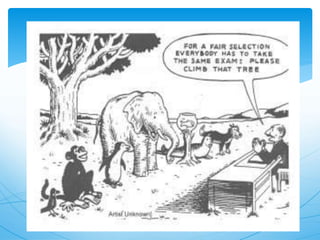
Differentiating instruction is doing what’s fair for
students. It means creating multiple paths so that
students of different abilities, interests, or learning
needs experience equally appropriate ways to learn.
Let’s Define Differentiated Instruction
Definitions of Differentiated
Instruction (DI)
refers to a systematic approach to
planning curriculum and instruction for
academically diverse learners.
It is a way of thinking about the classroom
with the dual goals of honoring each
student’s learning needs and maximizing
each student’s learning capacity
(Carol Ann Tomlinson)
In a DI class...
a teacher proactively plans varied
approaches to what students need to
learn, how they will learn it, and/or how
they will express what they have learned
in order to increase the likelihood that
each student will learn as much as he or
she can.
The Goals of Differentiation
 Every student will make continuous progress
no matter how old she is or at what level her
knowledge and skills are as she begins the
unit of study.
 Every student will become a lifelong learner,
the long-term goal for all children and young
people.
-Julia A. Roberts and Tracy F. Inman
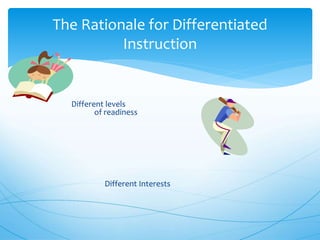
Different levels
of readiness
Different Interests
The Rationale for Differentiated
Instruction
Different Ability Levels
Different Cognitive Needs
The Rationale for Differentiated
Instruction
do a formative assessment
create an individual profile of each of
his/her student in each class he/she is
handling.
BUT assessment should be on-going and
diagnostic for these assessments
provides teachers a day-to-day data on
their students.
How to start?
Assessment is today’s means of
understanding how to modify
tomorrow’s instructions.
 Using the results of the assessment, teachers can
modify/differentiate content, process or product along with
the learning area.
 The differentiation should be based on the students’
Readiness, Interest and Learning Profile.
Remember that
Interest refers to a child’s
affinity, curiosity or passion
for a particular topic or skill.
Interest
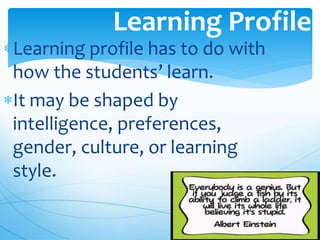
Learning profile has to do with
how the students’ learn.
It may be shaped by
intelligence, preferences,
gender, culture, or learning
style.
Learning Profile

Laying the Foundation for
Differentiated Instruction

Differentiated instruction does not happen
by accident. It requires planning,
commitment, and acknowledgment of the
fact that diverse abilities, experiences, and
interests have a tremendous impact on
student learning.
If you are considering using differentiated
instruction in your classroom, the three steps below
provide a place to start.
1. Get to know your students.
 Identify the level at which individual students are working in
your subject area. Standardized test scores and other
information found in student records can help determine
this information.
 Administer a learning style inventory to determine how your
students best learn. An instrument can be obtained through
the guidance department at your school.
 Determine student interests. On a regular basis, ask students
to identify topics that interest them and activities that
occupy their non-school time.
 2. Identify areas of your curriculum that could
be adapted to differentiated instruction.
 Study the instructional goals and objectives for your
subject established by the department of education.
Identify the major concepts, principles, and skills students
should learn.
 Choose one or two broad concepts or skills that lend
themselves to being taught at different degrees of
complexity.
 Brainstorm ideas for activities, tasks, and assessments
that address a specific concept or skill. Ideas should cover
a range of learning preferences, abilities, and interests.
3. Examine your role as teacher in the
differentiated classroom.
 Develop a general plan for facilitating time, space,
and materials in your classroom. On any given day,
not all students will be working on the same
assignment at the same time. You must have a plan
for student access to necessary materials, where
individuals or groups will work, and how much time
can be allotted to specific tasks.
 Identify alternative methods of assessing student
performance and understanding. Assessment results
should increase teacher understanding of students'
abilities, interests, and needs, and should be
incorporated into future planning.
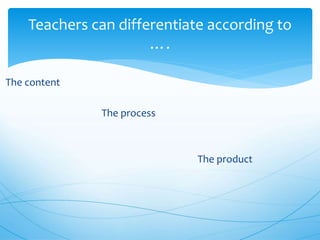
The content
The process
The product
Teachers can differentiate according to
….
Content is input.
It is what a student should come to
know (facts), understand (concepts
and principles), and able to do
(skills).
Content
Differentiating Content
 Determine the
Ability Level of Your
Students
 Survey Past
Records, Look at
Their Chums
 Align Tasks and
Objectives to
Learning Goals
 Survey Student
Interests
 Interest
Inventories,
Interview/
Conference,
Respond to Open-
Ended
Questionnaire
with Questions
Differentiating Content
What are Your
Students Multiple
Intelligences &
Learning Styles?
What are Your
Student’s
Preferences and
Motivators?
 Instruction is
Concept-Focused
and Principle-Driven
 What do Brain-
Based Research say?
Ultimately,
teachers need
to Know THEIR
Students.
Differentiating Content
Sample Activities
 Use Reading
Materials at Varying
Readability Levels
 Put Text Materials
on ppt, mp4 or mp3
format
 Use Spelling/Vocab.
Tests at Readiness
Levels of Students
 Use Reading
Buddies
 Meet with Small
Groups to Re-Teach
an Idea or Skill for
Struggling Learners,
or Extend the
Learning
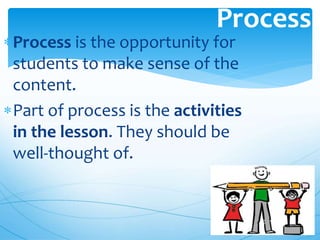
Process is the opportunity for
students to make sense of the
content.
Part of process is the activities
in the lesson. They should be
well-thought of.
Process
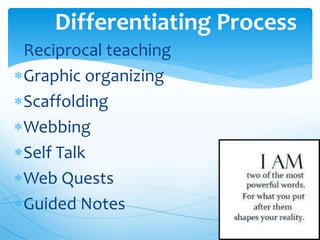
Reciprocal teaching
Graphic organizing
Scaffolding
Webbing
Self Talk
Web Quests
Guided Notes
Differentiating Process
have a clearly defined instructional
purpose
focus students squarely on one key
understanding
cause students to use a key skill to work
with key ideas
ensure that students will have to
understand (not just repeat) the idea
help students relate new understandings
and skills to previous ones, and
match the student’s level of readiness.
Effective ONLY if they ...
Product is a vehicle through which a
student show (and extends what he or
she has come to understand and can do
as a result of a considerable segment of
learning.
It is something students produce to
exhibit major portions of learning.
Product
These are culminating projects
that ask the student to
rehearse, apply, and extend
what he/she has learned in a
unit.
Product
 Initial and on-going assessment of student readiness and
growth are Essential
 Authentic Assessment is a must.
 Students should be trained to be active and responsible
explorers.
 Teachers should vary expectations and requirements for
student responses
 For outcomes, teachers should consider each student’s
multiple intelligences and learning styles
Remember...
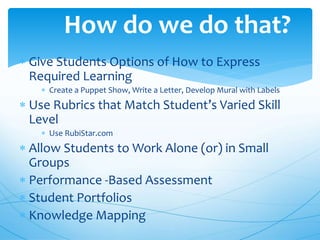
 Give Students Options of How to Express
Required Learning
 Create a Puppet Show, Write a Letter, Develop Mural with Labels
 Use Rubrics that Match Student’s Varied Skill
Level
 Use RubiStar.com
 Allow Students to Work Alone (or) in Small
Groups
 Performance -Based Assessment
 Student Portfolios
 Knowledge Mapping
How do we do that?
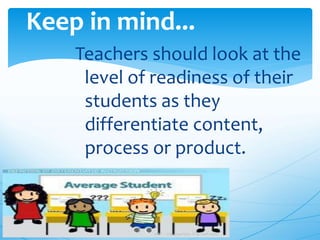
Teachers should look at the
level of readiness of their
students as they
differentiate content,
process or product.
Keep in mind...
 someone to help them identify and make-up
gaps in their learning so they can move ahead;
 more opportunities for direct instruction or
practice;
 activities or products that are more structured
or more concrete, with fewer steps, closer to
their own experiences and calling on simpler
reading skills; or
 a more deliberate pace of learning.
Students with less–developed
readiness may need:
a student needs it and
modification increases the
likelihood that the learner will
understand important ideas and use
the important skills more
thoroughly as a result.
Modify a curricular element
only when
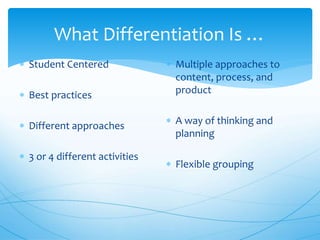
What Differentiation Is …
 Student Centered
 Best practices
 Different approaches
 3 or 4 different activities
 Multiple approaches to
content, process, and
product
 A way of thinking and
planning
 Flexible grouping
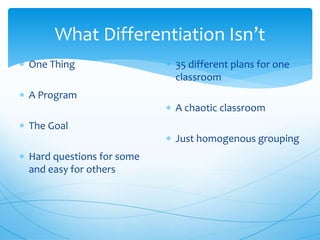
What Differentiation Isn’t
 One Thing
 A Program
 The Goal
 Hard questions for some
and easy for others
 35 different plans for one
classroom
 A chaotic classroom
 Just homogenous grouping
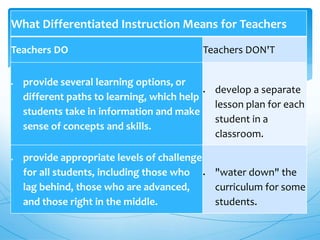
What Differentiated Instruction Means for Teachers
Teachers DO Teachers DON'T
 provide several learning options, or
different paths to learning, which help
students take in information and make
sense of concepts and skills.
 develop a separate
lesson plan for each
student in a
classroom.
 provide appropriate levels of challenge
for all students, including those who
lag behind, those who are advanced,
and those right in the middle.
 "water down" the
curriculum for some
students.
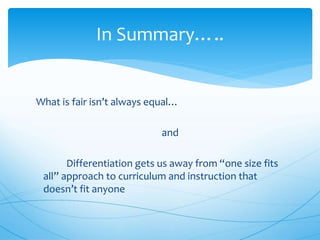
What is fair isn’t always equal…
and
Differentiation gets us away from “one size fits
all” approach to curriculum and instruction that
doesn’t fit anyone
In Summary…..
EVERY MAN is in certain respects
a. like all other men,
b. like some other men,
c. like no other man.
-Murray, H. A. & C. Kluckhohn, 1953

LAYOUT

  • 2.
    Differentiating instruction isdoing what’s fair for students. It means creating multiple paths so that students of different abilities, interests, or learning needs experience equally appropriate ways to learn. Let’s Define Differentiated Instruction
  • 3.
    Definitions of Differentiated Instruction(DI) refers to a systematic approach to planning curriculum and instruction for academically diverse learners. It is a way of thinking about the classroom with the dual goals of honoring each student’s learning needs and maximizing each student’s learning capacity (Carol Ann Tomlinson)
  • 4.
    In a DIclass... a teacher proactively plans varied approaches to what students need to learn, how they will learn it, and/or how they will express what they have learned in order to increase the likelihood that each student will learn as much as he or she can.
  • 5.
    The Goals ofDifferentiation  Every student will make continuous progress no matter how old she is or at what level her knowledge and skills are as she begins the unit of study.  Every student will become a lifelong learner, the long-term goal for all children and young people. -Julia A. Roberts and Tracy F. Inman
  • 6.
    Different levels of readiness DifferentInterests The Rationale for Differentiated Instruction
  • 7.
    Different Ability Levels DifferentCognitive Needs The Rationale for Differentiated Instruction
  • 8.
    do a formativeassessment create an individual profile of each of his/her student in each class he/she is handling. BUT assessment should be on-going and diagnostic for these assessments provides teachers a day-to-day data on their students. How to start?
  • 9.
    Assessment is today’smeans of understanding how to modify tomorrow’s instructions.  Using the results of the assessment, teachers can modify/differentiate content, process or product along with the learning area.  The differentiation should be based on the students’ Readiness, Interest and Learning Profile. Remember that
  • 10.
    Interest refers toa child’s affinity, curiosity or passion for a particular topic or skill. Interest
  • 11.
    Learning profile hasto do with how the students’ learn. It may be shaped by intelligence, preferences, gender, culture, or learning style. Learning Profile
  • 13.
     Laying the Foundationfor Differentiated Instruction  Differentiated instruction does not happen by accident. It requires planning, commitment, and acknowledgment of the fact that diverse abilities, experiences, and interests have a tremendous impact on student learning.
  • 14.
    If you areconsidering using differentiated instruction in your classroom, the three steps below provide a place to start. 1. Get to know your students.  Identify the level at which individual students are working in your subject area. Standardized test scores and other information found in student records can help determine this information.  Administer a learning style inventory to determine how your students best learn. An instrument can be obtained through the guidance department at your school.  Determine student interests. On a regular basis, ask students to identify topics that interest them and activities that occupy their non-school time.
  • 15.
     2. Identifyareas of your curriculum that could be adapted to differentiated instruction.  Study the instructional goals and objectives for your subject established by the department of education. Identify the major concepts, principles, and skills students should learn.  Choose one or two broad concepts or skills that lend themselves to being taught at different degrees of complexity.  Brainstorm ideas for activities, tasks, and assessments that address a specific concept or skill. Ideas should cover a range of learning preferences, abilities, and interests.
  • 16.
    3. Examine yourrole as teacher in the differentiated classroom.  Develop a general plan for facilitating time, space, and materials in your classroom. On any given day, not all students will be working on the same assignment at the same time. You must have a plan for student access to necessary materials, where individuals or groups will work, and how much time can be allotted to specific tasks.  Identify alternative methods of assessing student performance and understanding. Assessment results should increase teacher understanding of students' abilities, interests, and needs, and should be incorporated into future planning.
  • 17.
    The content The process Theproduct Teachers can differentiate according to ….
  • 18.
    Content is input. Itis what a student should come to know (facts), understand (concepts and principles), and able to do (skills). Content
  • 19.
    Differentiating Content  Determinethe Ability Level of Your Students  Survey Past Records, Look at Their Chums  Align Tasks and Objectives to Learning Goals  Survey Student Interests  Interest Inventories, Interview/ Conference, Respond to Open- Ended Questionnaire with Questions
  • 20.
    Differentiating Content What areYour Students Multiple Intelligences & Learning Styles? What are Your Student’s Preferences and Motivators?  Instruction is Concept-Focused and Principle-Driven  What do Brain- Based Research say? Ultimately, teachers need to Know THEIR Students.
  • 21.
    Differentiating Content Sample Activities Use Reading Materials at Varying Readability Levels  Put Text Materials on ppt, mp4 or mp3 format  Use Spelling/Vocab. Tests at Readiness Levels of Students  Use Reading Buddies  Meet with Small Groups to Re-Teach an Idea or Skill for Struggling Learners, or Extend the Learning
  • 22.
    Process is theopportunity for students to make sense of the content. Part of process is the activities in the lesson. They should be well-thought of. Process
  • 23.
    Reciprocal teaching Graphic organizing Scaffolding Webbing SelfTalk Web Quests Guided Notes Differentiating Process
  • 24.
    have a clearlydefined instructional purpose focus students squarely on one key understanding cause students to use a key skill to work with key ideas ensure that students will have to understand (not just repeat) the idea help students relate new understandings and skills to previous ones, and match the student’s level of readiness. Effective ONLY if they ...
  • 25.
    Product is avehicle through which a student show (and extends what he or she has come to understand and can do as a result of a considerable segment of learning. It is something students produce to exhibit major portions of learning. Product
  • 26.
    These are culminatingprojects that ask the student to rehearse, apply, and extend what he/she has learned in a unit. Product
  • 27.
     Initial andon-going assessment of student readiness and growth are Essential  Authentic Assessment is a must.  Students should be trained to be active and responsible explorers.  Teachers should vary expectations and requirements for student responses  For outcomes, teachers should consider each student’s multiple intelligences and learning styles Remember...
  • 28.
     Give StudentsOptions of How to Express Required Learning  Create a Puppet Show, Write a Letter, Develop Mural with Labels  Use Rubrics that Match Student’s Varied Skill Level  Use RubiStar.com  Allow Students to Work Alone (or) in Small Groups  Performance -Based Assessment  Student Portfolios  Knowledge Mapping How do we do that?
  • 29.
    Teachers should lookat the level of readiness of their students as they differentiate content, process or product. Keep in mind...
  • 30.
     someone tohelp them identify and make-up gaps in their learning so they can move ahead;  more opportunities for direct instruction or practice;  activities or products that are more structured or more concrete, with fewer steps, closer to their own experiences and calling on simpler reading skills; or  a more deliberate pace of learning. Students with less–developed readiness may need:
  • 31.
    a student needsit and modification increases the likelihood that the learner will understand important ideas and use the important skills more thoroughly as a result. Modify a curricular element only when
  • 32.
    What Differentiation Is…  Student Centered  Best practices  Different approaches  3 or 4 different activities  Multiple approaches to content, process, and product  A way of thinking and planning  Flexible grouping
  • 33.
    What Differentiation Isn’t One Thing  A Program  The Goal  Hard questions for some and easy for others  35 different plans for one classroom  A chaotic classroom  Just homogenous grouping
  • 34.
    What Differentiated InstructionMeans for Teachers Teachers DO Teachers DON'T  provide several learning options, or different paths to learning, which help students take in information and make sense of concepts and skills.  develop a separate lesson plan for each student in a classroom.  provide appropriate levels of challenge for all students, including those who lag behind, those who are advanced, and those right in the middle.  "water down" the curriculum for some students.
  • 35.
    What is fairisn’t always equal… and Differentiation gets us away from “one size fits all” approach to curriculum and instruction that doesn’t fit anyone In Summary…..
  • 36.
    EVERY MAN isin certain respects a. like all other men, b. like some other men, c. like no other man. -Murray, H. A. & C. Kluckhohn, 1953

Editor's Notes

  • #20 How will do you know your students? Family background.. Their interest.. Reasons for dropping out
  • #21 What are they good at? Fast/slow learners…?
  • #24 Reciprocal – mutual understanding Scaffolding – a supporting framework Webbing – interrelated
  • #25 Are the emotional, physical, and intellectual needs of students met? Does the instructor prompt awareness of students’ prior learning and experiences? Does the instructor offer “real world” application? Does the instructor relate class to course goals, students’ personal goals, or societal concerns?
  • #28 Does instructor involve students in deciding what issues to discuss? Does the instructor introduce topic, state goals, present material or activity effectively, summarize, and give assignment or suggest an idea to consider before the next class?
  • #31 Does a student need assistance for a temporary or permanent disability? Are one or more students not motivated or unable to follow the class? Does the instructor show favoritism? Are students able to see visual aids? Does one group dominate discussion and hinder others’ participation?
  • #33 Instructional methods: List instructor activities. Did the opening gain the class’s attention? Did it establish rapport? Did the opening outline the topic and purpose of the lecture? Is the delivery paced to students’ needs? Does the instructor introduce topic, state goals, present material or activity effectively, summarize, and give assignment or suggest an idea to consider before the next class? Could the instructor be seen and heard? Were key points emphasized? Were explanations clear to students? Were examples, metaphors, and analogies appropriate? Was the lecture stimulating and thought provoking?