Download the full version and explore a variety of ebooks
or textbooks at https://ebookmass.com
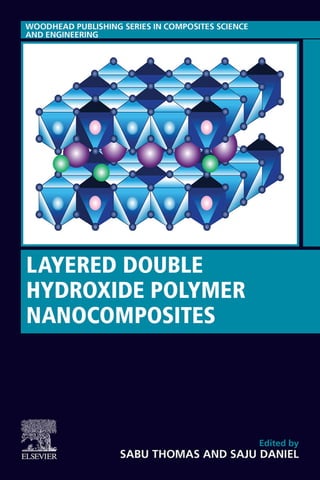
Layered double hydroxide polymer nanocomposites
Daniel
_____ Follow the link below to get your download now _____
https://ebookmass.com/product/layered-double-hydroxide-
polymer-nanocomposites-daniel/
Access ebookmass.com now to download high-quality
ebooks or textbooks
Here are some recommended products for you. Click the link to
download, or explore more at ebookmass.com
Graphene to Polymer/ Graphene Nanocomposites. Emerging
Research and Opportunities Ayesha Kausar
https://ebookmass.com/product/graphene-to-polymer-graphene-
nanocomposites-emerging-research-and-opportunities-ayesha-kausar/
New Polymer Nanocomposites for Environmental Remediation
1st Edition Chaudhery Mustansar Hussain (Editor)
https://ebookmass.com/product/new-polymer-nanocomposites-for-
environmental-remediation-1st-edition-chaudhery-mustansar-hussain-
editor/
Silica and Clay Dispersed Polymer Nanocomposites :
Preparation, Properties and Applications. Rahman Rezaur.
https://ebookmass.com/product/silica-and-clay-dispersed-polymer-
nanocomposites-preparation-properties-and-applications-rahman-rezaur/
Enhanced adsorption of bromate from aqueous solutions on
ordered mesoporous Mg-Al layered double hydroxides (LDHs)
Huashun Ji & Wenhao Wu & Feihu Li & Xiaoxue Yu & Jingjing
Fu & Luyao Jia
https://ebookmass.com/product/enhanced-adsorption-of-bromate-from-
aqueous-solutions-on-ordered-mesoporous-mg-al-layered-double-
hydroxides-ldhs-huashun-ji-wenhao-wu-feihu-li-xiaoxue-yu-jingjing-fu-
luyao-jia/
Nanocomposites N B Singh
https://ebookmass.com/product/nanocomposites-n-b-singh/
Layered 2D Materials And Their Allied Application
Inamuddin
https://ebookmass.com/product/layered-2d-materials-and-their-allied-
application-inamuddin/
Metal oxide glass nanocomposites Sanjib Bhattacharya
https://ebookmass.com/product/metal-oxide-glass-nanocomposites-sanjib-
bhattacharya/
Green Micro and Nanocomposites Thomas S.
https://ebookmass.com/product/green-micro-and-nanocomposites-thomas-s/
Applications of Polymer Nanofibers Anthony L. Andrady
https://ebookmass.com/product/applications-of-polymer-nanofibers-
anthony-l-andrady/
Layered Double Hydroxide Polymer
Nanocomposites
Related Titles
Lightweight Composite Materials in Transport Structures (ISBN 978-1-78242-325-6)
Recent Advances in Smart Self-Healing Polymers and Nanocomposites
(ISBN 978-1-78242-280-8)
Manufacturing Nanocomposites With Engineering Plastics (ISBN 978-1-78242-308-9)
Biofiber Reinforcements in Composite Materials (ISBN 978-1-78242-122-1)
Physical Properties and Applications of Polymer Nanocomposites
(ISBN 978-1-84569-672-6)
Environmentally-Friendly Polymer Nanocomposites (ISBN 978-0-85709-777-4)
Ceramic Nanocomposites (ISBN 978-0-85709-338-7)
Polymer-Carbon Nanotube Composites (ISBN 978-1-84569-761-7)
Advances in Polymer Nanocomposites (ISBN 978-1-84569-940-6)
Advances in Shape Memory Polymers (ISBN 978-0-85709-852-8)
Polymer Nanocomposites (ISBN 978-1-85573-969-7)
Clay-Containing Polymer Nanocomposites (ISBN 978-0-444-59437-2)
Polymer-Layered Silicate and Silica Nanocomposites (ISBN 978-0-444-51570-4)
Tribology of Polymeric Nanocomposites (ISBN 978-0-444-53155-1)
Tribology of Polymeric Nanocomposites (2nd edn) (ISBN 9780444594556)
Nanocomposite Structures and Dispersions (ISBN 978-0-444-52716-5)
Modern Biopolymer Science (ISBN 978-0-12-374195-0)
Natural and Synthetic Biomedical Polymers (ISBN 978-0-12-396983-5)
Layered Double
Hydroxide Polymer
Nanocomposites
Edited by
Sabu Thomas
International and Inter University Centre for
Nanoscience and Nanotechnology,
Mahatma Gandhi University,
Kottayam, Kerala, India
School of Chemical Sciences,
Mahatma Gandhi University,
Kottayam, Kerala, India
Saju Daniel
International and Inter University Centre for
Nanoscience and Nanotechnology,
Mahatma Gandhi University,
Kottayam, Kerala, India
St. Xavier’s College Vaikom, Kottayam,
Kerala, India
Woodhead Publishing Series in Composites
Science and Engineering
Woodhead Publishing is an imprint of Elsevier
The Officers’ Mess Business Centre, Royston Road, Duxford, CB22 4QH, United Kingdom
50 Hampshire Street, 5th Floor, Cambridge, MA 02139, United States
The Boulevard, Langford Lane, Kidlington, OX5 1GB, United Kingdom
Copyright © 2020 Elsevier Ltd. All rights reserved.
No part of this publication may be reproduced or transmitted in any form or by any means, electronic or
mechanical, including photocopying, recording, or any information storage and retrieval system, without
permission in writing from the publisher. Details on how to seek permission, further information about the
Publisher’s permissions policies and our arrangements with organizations such as the Copyright Clearance
Center and the Copyright Licensing Agency, can be found at our website: www.elsevier.com/permissions.
This book and the individual contributions contained in it are protected under copyright by the Publisher
(other than as may be noted herein).
Notices
Knowledge and best practice in this field are constantly changing. As new research and experience broaden our
understanding, changes in research methods, professional practices, or medical treatment may become
necessary.
Practitioners and researchers must always rely on their own experience and knowledge in evaluating and using
any information, methods, compounds, or experiments described herein. In using such information or
methods they should be mindful of their own safety and the safety of others, including parties for whom they
have a professional responsibility.
To the fullest extent of the law, neither the Publisher nor the authors, contributors, or editors, assume any
liability for any injury and/or damage to persons or property as a matter of products liability, negligence or
otherwise, or from any use or operation of any methods, products, instructions, or ideas contained in the
material herein.
British Library Cataloguing-in-Publication Data
A catalogue record for this book is available from the British Library
Library of Congress Cataloging-in-Publication Data
A catalog record for this book is available from the Library of Congress
ISBN: 978-0-08-102261-0 (print)
ISBN: 978-0-08-101904-7 (online)
For information on all Woodhead Publishing publications
visit our website at https://www.elsevier.com/books-and-journals
Publisher: Matthew Deans
Acquisition Editor: Gwen Jones
Editorial Project Manager: Andrea Gallego Ortiz
Production Project Manager: Debasish Ghosh
Cover Designer: Greg Harris
Typeset by MPS Limited, Chennai, India
Contents
List of contributors xvii
Preface xxi
Acknowledgement xxv
1. Layered double hydroxides: fundamentals to applications 1
Saju Daniel and Sabu Thomas
1.1 Introduction 1
1.2 Layered double hydroxides 2
1.2.1 Structure of layered double hydroxides 2
1.2.2 Differences between Ordinary Clays and Layered Double
Hydroxides 4
1.2.3 Synthesis Routes of Layered Double Hydroxides 4
1.3 Organic Modification of Layered Double Hydroxides 7
1.3.1 One step Co-precipitation 11
1.3.2 Anion exchange reaction 12
1.3.3 Memory Effect or Regeneration Method 12
1.3.4 The delamination/restacking method 13
1.4 Characterization of layered double hydroxides and modified
layered double hydroxides 14
1.5 Potential applications of layered double hydroxides, organically
modified layered double hydroxides and layered double hydroxide
nanocomposites 21
1.5.1 Flame retardant applications 23
1.5.2 Catalysis 25
1.5.3 Water splitting 26
1.5.4 Environmental remediation 27
1.5.5 Electrode for super capacitor 30
1.5.6 Biomedical applications 32
1.6 Introduction to Layered Double Hydroxide Polymer
Nanocomposites 35
1.7 Different Fabrication Techniques of Layered Double Hydroxide
polymer Nanocomposites 35
1.7.1 Melt Compounding 35
1.7.2 Solution Blending 37
1.7.3 In Situ Methods 38
1.7.4 Layer By Layer Assembly 39
1.7.5 Two roll mill mixing 41
1.7.6 Sonication 42
1.7.7 High energy ball milling 42
1.8 Applications of Layered Double Hydroxide Polymer
Nanocomposites 43
1.8.1 Flame Retardant Application 43
1.8.2 Biomedical Application 44
1.8.3 Gas sensing Applications 49
1.8.4 Energy Applications 50
1.8.5 Food Packaging Applications 51
1.8.6 Water Purification 52
1.8.7 Gas Barrier Materials 53
1.8.8 Agricultural Applications 54
1.8.9 Anti Corrosion Materials 55
1.9 LDH based polymer hybrid nanocomposites 56
1.10 Conclusion and perspectives 63
1.11 Abbreviations 66
References 68
2. FTIR characterization of layered double hydroxides and modified
layered double hydroxides 77
Meisam Shabanian, Mohsen Hajibeygi and Ahmad Raeisi
2.1 Introduction 77
2.2 Fourier transform infrared spectra of layered double hydroxides 79
2.2.1 Fourier transform infrared characteristic absorption bands
of layered double hydroxides with different anions 79
2.2.2 Fourier transform infrared characteristic absorption bands
of layered double hydroxides with different metals 83
2.2.3 FTIR spectra of layered double hydroxides containing three
metals 85
2.3 FTIR spectra of organo-modified layered double hydroxides 87
2.4 Conclusion 95
References 96
3. Fabrication technologies of layered double hydroxide polymer
nanocomposites 103
Shadpour Mallakpour and Farbod Tabesh
3.1 Introduction 103
3.1.1 Layered double hydroxides 103
3.1.2 Modification of layered double hydroxides 104
3.2 Preparation of polymer/layered double hydroxide nanocomposites 106
3.2.1 Introduction 106
3.3 Preparation of Natural polymer/layered double hydroxide
nanocomposites 115
3.3.1 Preparation of carboxymethylcellulose/layered double
hydroxide nanocomposites 115
vi Contents
3.3.2 Preparation of pectin/layered double hydroxide
nanocomposites 116
3.3.3 Preparation of chitosan/layered double hydroxide
nanocomposites 117
3.3.4 Preparation of natural rubber/layered double hydroxide
nanocomposites 118
3.3.5 Other natural polymer/layered double hydroxide
nanocomposites 120
3.4 Preparation of synthetic polymer/layered double hydroxide
nanocomposites 120
3.4.1 Preparation of polyimide/layered double hydroxide
nanocomposites 122
3.4.2 Preparation of poly(methyl methacrylate)/layered double
hydroxide nanocomposites 123
3.4.3 Preparation of polyvinyl acetate/layered double hydroxide
nanocomposites 124
3.4.4 Preparation of P(MMA-co-BA)/layered double hydroxide
nanocomposites 124
3.4.5 Preparation of wood flour/polypropylene/layered double
hydroxide nanocomposites 127
3.4.6 Preparation of poly(amide-imide)/layered double
hydroxide nanocomposites 127
3.4.7 Preparation of low-density polyethylene/layered double
hydroxide nanocomposites 131
3.4.8 Preparation of polyvinyl alcohol/layered double hydroxide
nanocomposites 134
3.4.9 Preparation of polyester/layered double hydroxide
nanocomposites 136
3.4.10 Preparation of polyvinyl chloride/layered double hydroxide
nanocomposites 137
3.4.11 Preparation of polypropylene-ethylene vinyl acetate/layered
double hydroxide nanocomposites 139
3.4.12 Preparation of silicone rubber/layered double hydroxide
nanocomposites 140
3.4.13 Preparation of epoxy resin/MoS2/layered double hydroxide
nanocomposites 141
3.4.14 Preparation of polyurethane/nitrile butadiene rubber
Blend/layered double hydroxide nanocomposites 143
3.4.15 Preparation of polyethyleneimine/poly(sodium 4-styrene
sulfonate) hybrid/layered double hydroxide
nanocomposites 144
3.4.16 Preparation of isotactic polypropylene/layered double
hydroxide nanocomposites 145
3.5 Conclusions and future perspectives 148
vii
Contents
Acknowledgments 152
References 152
4. Microscopic characterization techniques for layered double
hydroxide polymer nanocomposites 157
Shadpour Mallakpour and Shima Rashidimoghadam
4.1 Introduction 157
4.2 Microscopic characterization techniques for PNCs 158
4.2.1 Optical microscope 159
4.2.2 Scanning electron microscope 159
4.2.3 Transmission electron microscope 160
4.2.4 Field ion microscope 162
4.2.5 Scanning probe microscope 162
4.2.6 Scanning tunneling microscope 163
4.2.7 Atomic force microscope 164
4.2.8 X-Ray diffraction topography 165
4.3 Microscopic characterization of polymer/LDH NCs 165
4.3.1 Microscopic characterization of elastomer/LDH NCs 166
4.3.2 Microscopic characterization of thermoplastic
polymer/LDH NCs 170
4.3.3 Microscopic characterization of thermosetting
polymer/LDH NCs 183
4.3.4 Microscopic characterization of polymer blend/LDH NCs 192
4.4 Conclusions 197
Acknowledgments 197
References 197
Further reading 203
5. X-ray diffraction analysis of layered double hydroxide polymer
nanocomposites 205
Rodrigo Botan and Sabrina de Bona Sartor
5.1 Introduction 205
5.2 X-ray diffraction analysis 206
5.3 X-ray diffraction analysis of layered double hydroxides and
Modified Layered Double Hydroxides 210
5.4 X-ray diffraction analysis of layered double hydroxide polymer
nanocomposites 216
5.5 Conclusion 225
References 226
6. Spectroscopic characterization techniques for layered double
hydroxide polymer nanocomposites 231
Shadpour Mallakpour and Faezeh Azimi
6.1 Introduction 231
viii Contents
6.2 Spectroscopy of polymer nanocomposites 232
6.2.1 Fourier transform infrared spectroscopy 233
6.2.2 Raman spectroscopy 233
6.2.3 Energy-dispersive X-ray spectroscopy 233
6.2.4 Fluorescence spectroscopy 234
6.2.5 Dielectric spectroscopy 234
6.2.6 Nuclear magnetic resonance spectroscopy 234
6.2.7 UVvis spectrophotometry 235
6.2.8 X-ray photoelectron spectroscopy 235
6.3 Spectroscopic characterization of layered double hydroxide
polymer nanocomposites 236
6.3.1 Fourier transform infrared spectroscopy of layered double
hydroxide polymer nanocomposites 236
6.3.2 Raman spectroscopy of layered double hydroxide polymer
nanocomposites 239
6.3.3 Energy-dispersive X-ray spectroscopy of layered double
hydroxide polymer nanocomposites 243
6.3.4 Fluorescence spectroscopy of layered double hydroxide
polymer nanocomposites 247
6.3.5 Dielectric spectroscopy of layered double hydroxide
polymer nanocomposites 251
6.3.6 Nuclear magnetic resonance spectroscopy of layered
double hydroxide polymer nanocomposites 258
6.3.7 UVvis spectroscopy of layered double hydroxide
polymer nanocomposites 262
6.3.8 X-ray photoelectron spectroscopy of layered double
hydroxide polymer nanocomposites 265
6.4 Spectroscopic characterization for the aging process 270
6.5 Conclusions 273
Acknowledgments 274
References 274
Further reading 279
7. Melt rheological properties of layered double hydroxide polymer
nanocomposites 281
Appukuttan Saritha and Kuruvilla Joseph
7.1 Introduction 281
7.1.1 The importance of rheological studies of polymer
nanocomposites 281
7.1.2 Rheology of polymer layered double hydroxide
nanocomposites 282
7.2 Rheology of thermoplastic polymer layered double hydroxide
nanocomposites 284
7.3 Rheology of thermosetting polymer layered double hydroxide
nanocomposites 297
ix
Contents
7.4 Modeling of rheological properties 301
7.5 Conclusions and future scope 305
References 305
Further reading 310
8. Thermal properties and flame-retardant characteristics of layered
double hydroxide polymer nanocomposites 311
Yanshan Gao, Lei Qiu, Dermot O’Hare and Qiang Wang
8.1 Introduction 311
8.2 The techniques for determining thermal stability properties and
flame retardancy performance 313
8.2.1 The techniques for determining thermal stability properties
of polymers 313
8.2.2 The techniques for determining the flame-retardant
performance of polymers 314
8.3 LDH-based thermal stabilizer materials and their applications 317
8.3.1 Thermal stabilizer introduction 317
8.3.2 Thermal stability properties of LDH-based nanocomposites 318
8.3.3 The mechanism of thermostability using LDHs 322
8.4 LDH-based flame-retardant materials and their applications 323
8.4.1 Flame retardant introduction 323
8.4.2 Flame-retardant performance of LDH-based nanocomposites 324
8.4.3 Posttreatment of LDHs as flame retardants 337
8.4.4 The mechanism of flame retardancy using LDH 338
8.5 Conclusions and future development 340
References 340
9. Mechancial and dynamical mechanical properties of layered double
hydroxide-filled elastomer and elastomeric blend nanocomposites 347
Suneel Kumar Srivastava
9.1 Introduction 347
9.2 Preparative methods of LDH-elastomer and LDH-elastomeric
blend nanocomposites 349
9.3 Different types of layered double hydroxide fillers used in the
fabrication of elastomer and elastomeric blend nanocomposites 350
9.4 Morphology of elastomer-LDH and elastomeric blend-LDH
nanocomposites 350
9.4.1 Morphology of elastomeric-LDH nanocomposites 350
9.4.2 Morphology of elastomeric blend-LDH nanocomposites 367
9.5 Mechanical properties of elastomer-LDH and elastomeric
blend-LDH nanocomposites 372
9.5.1 Mechanical properties of elastomer-LDH nanocomposites 372
9.5.2 Mechanical properties of elastomeric blend-LDH
nanocomposites 383
x Contents
9.6 Dynamical mechanical properties of LDH-filled elastomer and
elastomeric blend nanocomposites 388
9.6.1 Dynamical mechanical properties of elastomer-LDH
nanocomposites 388
9.6.2 Dynamical mechanical properties of elastomer blend-LDH
nanocomposites 398
9.7 Conclusion 402
References 403
10. Layered double hydroxide nanocomposites based on carbon
nanoforms 411
Gonzalo Abellán, Jose A. Carrasco and Eugenio Coronado
10.1 A general introduction to LDH-carbon nanoform nanocomposites 411
10.2 Graphene and graphene oxide/LDH nanocomposites 415
10.2.1 Synthesis 417
10.3 Carbon nanotubes/LDH nanocomposites 425
10.3.1 Synthesis 427
10.4 Other CNF/LDH nanocomposites 431
10.4.1 Fullerene/LDH nanocomposites 431
10.4.2 Carbon quantum dot/LDH nanocomposites 431
10.4.3 Carbon spheres/LDH nanocomposites 431
10.4.4 Carbon (nano)fibers/LDH nanocomposites 432
10.4.5 Graphene/single-walled CNT/LDH nanocomposites 436
10.5 Applications of CNF/LDH nanocomposites 436
10.5.1 Energy storage and conversion 436
10.5.2 Catalysis 443
10.5.3 Miscellanea 445
10.6 Conclusions 448
10.7 Perspectives 449
Acknowledgments 450
References 450
Further reading 460
11. Recent advances in layered double hydroxide/polymer latex
nanocomposites: from assembly to in situ formation 461
V. Prevot and E. Bourgeat-Lami
11.1 Introduction 461
11.2 Use of latex technology for the production of LDH-based
composite materials and macroporous structures 464
11.2.1 Assembly of preformed LDH and latex particles 464
11.2.2 LDH-based nanocomposites by in situ emulsion and
suspension polymerizations 468
11.2.3 Latex-templating approaches 475
11.3 Properties of LDH-based nanocomposites and LDH macroporous
structures 481
xi
Contents
11.3.1 LDH-based nanocomposites 481
11.3.2 LDH-based macroporous structures 485
11.4 Concluding remarks and general trends 489
References 489
12. Fabrication, assembly, and optoelectric properties of layered double
hydroxide/conjugated polymer nanocomposites 497
Yaping Huang, Harrone Muhammad Sohail and Jun Lu
12.1 Fabrication and assembly of LDHs/conjugated polymer
nanocomposites 497
12.1.1 Introduction 497
12.1.2 Fabrication and assembly of LDH/CP nanocomposites 499
12.2 Optical and optoelectric properties of LDH/CP nanocomposites 515
12.2.1 Optical properties 515
12.2.2 Optoelectric properties 522
12.3 Conclusions and outlook 525
References 526
13. Polymer layered double hydroxide hybrid nanocomposites 531
Shadpour Mallakpour and Elham Khadem
13.1 Introduction 531
13.2 Modification of LDHs with organic compounds 532
13.3 Layered double hydroxide/Carbonaceous nanofiller hybrids 535
13.4 Synthesis of LDH/Carbonaceous nanofiller hybrids 536
13.5 Applications of LDH/Carbonaceous nanofiller hybrids 538
13.5.1 Removal of pollution 538
13.5.2 Supercapacitor 543
13.5.3 Catalyst 546
13.6 Polymer/LDH/Carbonaceous nanofiller hybrid nanocomposites 548
13.6.1 Polymer/LDH/CNT hybrid nanocomposites 550
13.6.2 Polymer/LDH/graphene hybrid nanocomposites 554
13.6.3 Polymer/LDH/Other nanofiller hybrids 556
13.7 Conclusions 558
Acknowledgments 559
References 559
14. Electrical and electronic applications of layered double-hydroxide
polymer nanocomposites 565
Shadpour Mallakpour and Forough Motirasoul
14.1 Introduction 565
14.2 Supercapacitors 568
14.2.1 Application of Layered Double Hydroxide
Nanocomposites in Supercapacitors 568
14.2.2 Application of Layered Double Hydroxide/Polymer
Nanocomposites in Supercapacitors 571
xii Contents
14.3 Batteries 574
14.3.1 Application of Layered Double Hydroxide
Nanocomposites in Batteries 575
14.3.2 Application of Layered Double Hydroxide/Polymer
Nanocomposites in Batteries 577
14.4 Fuel Cells 579
14.4.1 Application of Layered Double Hydroxide/Polymer
Nanocomposites in Fuel Cells 580
14.5 Other Electrical and Electronic Applications of Layered Double
Hydroxide/Polymer Nanocomposites 587
14.6 Conclusions 591
Acknowledgments 591
References 592
15. Applications of layered double hydroxide biopolymer
nanocomposites 599
Shadpour Mallakpour and Leila khodadadzadeh
15.1 Introduction 599
15.2 Biopolymer/layered double hydroxide nanocomposites 604
15.2.1 Polysaccharide/layered double hydroxide nanocomposites 604
15.2.2 Protein/layered double hydroxide nanocomposites 632
15.2.3 PHA/layered double hydroxide nanocomposites 633
15.2.4 PLA/layered double hydroxide nanocomposites 643
15.2.5 PVA/layered double hydroxide nanocomposites 653
15.3 Conclusions 665
Acknowledgments 665
References 665
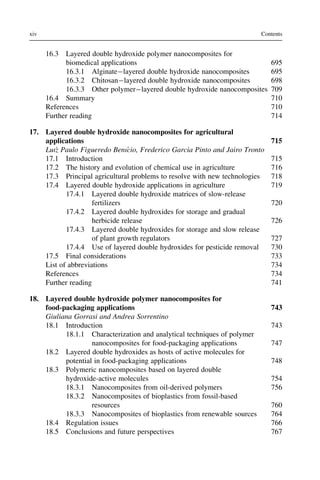
16. Layered double hydroxide based nanocomposites for biomedical
applications 677
Raji Vijayamma, Nandakumar Kalarikkal and Sabu Thomas
16.1 Introduction 677
16.1.1 Layered double hydroxide nanocomposites 678
16.1.2 Layered double hydroxide nanocomposites
in the medical field 680
16.2 Biomedical applications of layered double hydroxide
nanocomposites 685
16.2.1 Layered double hydroxide nanocomposites
in drug-delivery applications 685
16.2.2 Layered double hydroxide nanocomposites
in gene-delivery applications 688
16.2.3 Bioimaging applications 693
16.2.4 Biosensor 694
16.2.5 Layered double hydroxide nanocomposites for tissue
engineering applications 694
xiii
Contents
16.3 Layered double hydroxide polymer nanocomposites for
biomedical applications 695
16.3.1 Alginatelayered double hydroxide nanocomposites 695
16.3.2 Chitosanlayered double hydroxide nanocomposites 698
16.3.3 Other polymerlayered double hydroxide nanocomposites 709
16.4 Summary 710
References 710
Further reading 714
17. Layered double hydroxide nanocomposites for agricultural
applications 715
Luı´z Paulo Figueredo Benı´cio, Frederico Garcia Pinto and Jairo Tronto
17.1 Introduction 715
17.2 The history and evolution of chemical use in agriculture 716
17.3 Principal agricultural problems to resolve with new technologies 718
17.4 Layered double hydroxide applications in agriculture 719
17.4.1 Layered double hydroxide matrices of slow-release
fertilizers 720
17.4.2 Layered double hydroxides for storage and gradual
herbicide release 726
17.4.3 Layered double hydroxides for storage and slow release
of plant growth regulators 727
17.4.4 Use of layered double hydroxides for pesticide removal 730
17.5 Final considerations 733
List of abbreviations 734
References 734
Further reading 741
18. Layered double hydroxide polymer nanocomposites for
food-packaging applications 743
Giuliana Gorrasi and Andrea Sorrentino
18.1 Introduction 743
18.1.1 Characterization and analytical techniques of polymer
nanocomposites for food-packaging applications 747
18.2 Layered double hydroxides as hosts of active molecules for
potential in food-packaging applications 748
18.3 Polymeric nanocomposites based on layered double
hydroxide-active molecules 754
18.3.1 Nanocomposites from oil-derived polymers 756
18.3.2 Nanocomposites of bioplastics from fossil-based
resources 760
18.3.3 Nanocomposites of bioplastics from renewable sources 764
18.4 Regulation issues 766
18.5 Conclusions and future perspectives 767
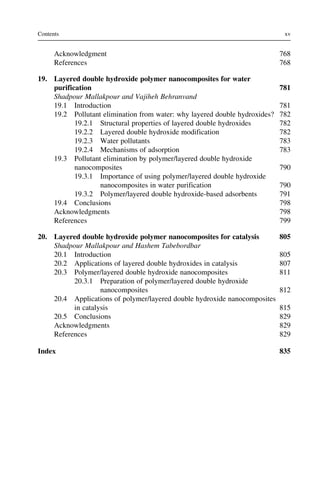
xiv Contents
Acknowledgment 768
References 768
19. Layered double hydroxide polymer nanocomposites for water
purification 781
Shadpour Mallakpour and Vajiheh Behranvand
19.1 Introduction 781
19.2 Pollutant elimination from water: why layered double hydroxides? 782
19.2.1 Structural properties of layered double hydroxides 782
19.2.2 Layered double hydroxide modification 782
19.2.3 Water pollutants 783
19.2.4 Mechanisms of adsorption 783
19.3 Pollutant elimination by polymer/layered double hydroxide
nanocomposites 790
19.3.1 Importance of using polymer/layered double hydroxide
nanocomposites in water purification 790
19.3.2 Polymer/layered double hydroxide-based adsorbents 791
19.4 Conclusions 798
Acknowledgments 798
References 799
20. Layered double hydroxide polymer nanocomposites for catalysis 805
Shadpour Mallakpour and Hashem Tabebordbar
20.1 Introduction 805
20.2 Applications of layered double hydroxides in catalysis 807
20.3 Polymer/layered double hydroxide nanocomposites 811
20.3.1 Preparation of polymer/layered double hydroxide
nanocomposites 812
20.4 Applications of polymer/layered double hydroxide nanocomposites
in catalysis 815
20.5 Conclusions 829
Acknowledgments 829
References 829
Index 835
xv
Contents
This page intentionally left blank
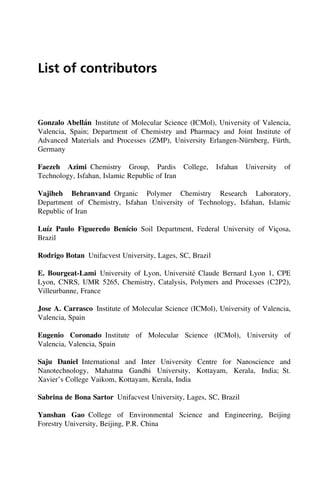
List of contributors
Gonzalo Abellán Institute of Molecular Science (ICMol), University of Valencia,
Valencia, Spain; Department of Chemistry and Pharmacy and Joint Institute of
Advanced Materials and Processes (ZMP), University Erlangen-Nürnberg, Fürth,
Germany
Faezeh Azimi Chemistry Group, Pardis College, Isfahan University of
Technology, Isfahan, Islamic Republic of Iran
Vajiheh Behranvand Organic Polymer Chemistry Research Laboratory,
Department of Chemistry, Isfahan University of Technology, Isfahan, Islamic
Republic of Iran
Luı́z Paulo Figueredo Benı́cio Soil Department, Federal University of Viçosa,
Brazil
Rodrigo Botan Unifacvest University, Lages, SC, Brazil
E. Bourgeat-Lami University of Lyon, Université Claude Bernard Lyon 1, CPE
Lyon, CNRS, UMR 5265, Chemistry, Catalysis, Polymers and Processes (C2P2),
Villeurbanne, France
Jose A. Carrasco Institute of Molecular Science (ICMol), University of Valencia,
Valencia, Spain
Eugenio Coronado Institute of Molecular Science (ICMol), University of
Valencia, Valencia, Spain
Saju Daniel International and Inter University Centre for Nanoscience and
Nanotechnology, Mahatma Gandhi University, Kottayam, Kerala, India; St.
Xavier’s College Vaikom, Kottayam, Kerala, India
Sabrina de Bona Sartor Unifacvest University, Lages, SC, Brazil
Yanshan Gao College of Environmental Science and Engineering, Beijing
Forestry University, Beijing, P.R. China
Giuliana Gorrasi Department of Industrial Engineering, University of Salerno-via
Giovanni Paolo II 132, Fisciano, Italy
Mohsen Hajibeygi Faculty of Chemistry, Kharazmi University, Tehran, Iran
Yaping Huang Beijing University of Chemical Technology, Beijing, P.R. China
Kuruvilla Joseph Department of Chemistry, Indian Institute of Space Science and
Technology, Valiamala, Thiruvananthapuram, Kerala, India
Nandakumar Kalarikkal International and Inter University Centre for
Nanoscience and Nanotechnology, Mahatma Gandhi University, Kottayam,
India; School of Pure and Applied Physics, Mahatma Gandhi University,
Kottayam, India
Elham Khadem Organic Polymer Chemistry Research Laboratory, Department of
Chemistry, Isfahan University of Technology, Isfahan, Islamic Republic of Iran
Leila Khodadadzadeh Chemistry Group, Pardis College, Isfahan University of
Technology, Isfahan, Islamic Republic of Iran
Jun Lu Beijing University of Chemical Technology, Beijing, P.R. China
Shadpour Mallakpour Organic Polymer Chemistry Research Laboratory,
Department of Chemistry, Isfahan University of Technology, Isfahan, Islamic
Republic of Iran; Research Institute for Nanotechnology and Advanced Materials,
Isfahan University of Technology, Isfahan, Islamic Republic of Iran; Chemistry
Group, Pardis College, Isfahan University of Technology, Isfahan, Islamic Republic
of Iran
Forough Motirasoul Organic Polymer Chemistry Research Laboratory,
Department of Chemistry, Isfahan University of Technology, Isfahan, Islamic
Republic of Iran
Dermot O’Hare University of Oxford, Oxford, United Kingdom
Frederico Garcia Pinto Institute of Exact and Technological Sciences, Federal
University of Viçosa - Rio Paranaı́ba Campus, Brazil
V. Prevot CNRS, ICCF - Institut de Chimie de Clermont-Ferrand, Université
Clermont Auvergne, Clermont-Ferrand, France
Lei Qiu College of Environmental Science and Engineering, Beijing Forestry
University, Beijing, P.R. China
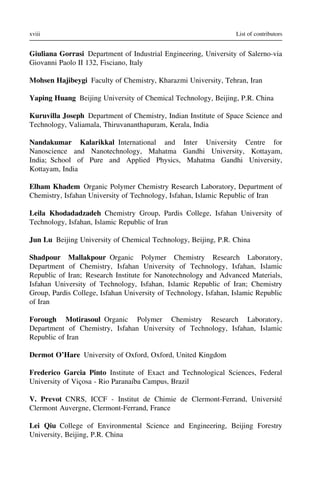
xviii List of contributors
Ahmad Raeisi Organic Polymer Chemistry Research Laboratory, Department of
Chemistry, Faculty of Science, Arak University, Arak, Iran
Shima Rashidimoghadam Department of Chemistry, Organic Polymer Chemistry
Research Laboratory, Isfahan University of Technology, Isfahan, Islamic Republic
of Iran
Appukuttan Saritha Department of Chemistry, School of Arts and Sciences,
Amrita Vishwa Vidyapeetham, Amritapuri, Kollam, Kerala, India
Meisam Shabanian Faculty of Chemistry and Petrochemical Engineering,
Standard Research Institute (SRI), Karaj, Iran
Harrone Muhammad Sohail Beijing University of Chemical Technology,
Beijing, P.R. China
Andrea Sorrentino Institute for Polymers, Composites and Biomaterials (IPCB),
National Research Council (CNR), Lecco, Italy
Suneel Kumar Srivastava Department of Chemistry, Indian Institute of
Technology, Khragpur, India
Hashem Tabebordbar Organic Polymer Chemistry Research Laboratory,
Department of Chemistry, Isfahan University of Technology, Isfahan, Islamic
Republic of Iran
Farbod Tabesh Chemistry Group, Pardis College, Isfahan University of
Technology, Isfahan, Islamic Republic of Iran
Sabu Thomas International and Inter University Centre for Nanoscience and
Nanotechnology, Mahatma Gandhi University, Kottayam, Kerala, India; School of
Chemical Sciences, Mahatma Gandhi University, Kottayam, Kerala, India
Jairo Tronto Institute of Exact and Technological Sciences, Federal University of
Viçosa - Rio Paranaı́ba Campus, Brazil
Raji Vijayamma International and Inter University Centre for Nanoscience and
Nanotechnology, Mahatma Gandhi University, Kottayam, Kerala, India
Qiang Wang College of Environmental Science and Engineering, Beijing Forestry
University, Beijing, P.R. China
xix
List of contributors
This page intentionally left blank
Preface
Recently the researchers have turned their attention toward layered double hydroxide
(LDH) polymer nanocomposites because of the distinctive properties of LDHs such as
wide range of chemical compositions, structural homogeneity, unique and excellent
anion exchanging ability, easy synthesis, high bound water content, memory effect,
nontoxicity and biocompatibility, and their wide range of applications. This book
really showcases the researches of many famous scientists who have been working in
the field of LDHs. The aspire of introducing this compendium is to replenish a solid
understanding of the recent innovative advances in the fabrication, characterization, and
applications of polymer LDH nanocomposites in various fields such as biomedical,
aerospace, electrical and electronics, automotive industry, agricultural, water treatment,
and catalysis.
This book consists of 20 chapters and all the chapters cover various relevant topics
and state of the art, new challenges, and opportunities in each field. Chapter 1 is actu-
ally a voyage from LDHs to LDH polymer nanocomposites so that one can acquire
the knowledge of different strategies required to convert LDHs to exfoliated LDH
polymer nanocomposites. Chapter 2 provides Fourier transform infrared spectroscopic
characterization of various LDHs and organically modified LDHs with the help of
which success of organic modification can be easily identified. Chapter 3 illustrates
recent advances in the fabrication technologies of LDH polymer nanocomposites
with suitable examples and it helps to find the novel and green procedure for the fab-
rication of LDHbased nanocomposites of each type of polymer.
Chapters 46 highlight advanced morphological characterization techniques
such as X-ray diffraction analysis, wide range of spectroscopic and microscopic
characterization techniques for LDH, organically modified LDHs, and LDH poly-
mer nanocomposites. In chapter 4 basal spacing of various organically modified
LDHs are provided so that suitable organic modifiers required for the preparation
of exfoliated polymer nanocomposites can be easily detected and the diffraction
pattern of the polymer nanocomposite helps to predict the morphology of the com-
posite—intercalated or exfoliated. Chapters 5 and 6 focus on spectroscopic charac-
terization techniques such as nuclear magnetic resonance spectroscopy, electron
spin resonance spectroscopy, ultraviolet visible spectroscopy, Fourier transform
infrared spectroscopy, dielectric spectroscopy, fluorescence spectroscopy, Raman
spectroscopy, X-ray photoelectron spectroscopy, and microscopic characterization
techniques such as optical microscopy, scanning electron microscopy, transmission
electron microscopy, and atomic force microscopy to help in characterizing the
nanoscale dispersions, phase segregation, and interface/interphases of polymer
nanocomposites.
Chapters 79 discuss specific properties of LDH polymer nanocomposites such
as melt rheological properties, thermal and flame retardancy, and mechanical and
dynamic mechanical properties. Chapter 7 reviews the rheology of nanocomposites
of thermoplastics and thermosetting polymers filled with LDH and modified LDH
with special emphasis on the modeling of rheological properties to understand the
LDH particle dispersion and its influence on the melt flow behavior of the nano-
composites. Chapter 8 summarizes the thermal stability and flame retardancy of
LDH polymer nanocomposites, their characterization techniques such as thermogra-
vimetric analysis, cone calorimetry, limiting oxygen index and UL94 investigations,
and the synergistic effect of LDH with other thermal stabilizers and fire retardants.
Chapter 9 reviews recent advances on the mechanical and dynamical mechanical
properties of LDH filled elastomer and elastomeric blend nanocomposites.
Chapters 1013 discuss fabrication and applications of carbon nanoform/LDH
nanocomposites, LDH/polymer latexes nanocomposites, LDH/conjugated polymer
nanocomposites, and LDHbased polymer hybrid nanocomposites. Chapter 10
deals with the fabrication of carbon nanoform/LDH nanocomposites and their appli-
cations in super capacitor, water splitting, catalysis, drug delivery, and environment
protection. In Chapter 11 three main routes for the fabrication of LDH/polymer
latexes nanocomposites such as electrostatic assembly, in situ polymerization, and
latex-templating and their flame retardant applications are reviewed. Chapter 12
introduces various LDH/conjugated polymer nanocomposites fabricated by layer-
by-layer assembly through electrostatic interaction, hydrogen bonds, van der Waals
force of attraction, and miscellaneous interactions for optoelectronic applications.
Chapter 13 focuses on the state of the art in the preparation of polymer/LDH/carbo-
naceous nanomaterial hybrids and the influence of hybrid fillers on the properties
such as thermal, mechanical, permeability, and drug delivery properties of
polymers.
Chapters 1420 discuss wide range applications of LDH polymer nanocompo-
sites, such as electrical and electronic applications such as super capacitors, batter-
ies, and fuel cells, biomedical applications, such as controlled drug delivery, gene
delivery, tissue engineering, and photodynamic therapy, and agricultural applica-
tions, such as controlled fertilizer, herbicide and plant growth regulators release and
pesticide removal, food packaging, water purification, and catalysis. The main focus
of Chapter 15 is on the fabrication of LDHbased polymer nanocomposites con-
taining biopolymer matrix for the environmental protection and their important
applications in the fields of water treatment, drug delivery, tissue engineering, pack-
aging, and catalysis.
This book is really an one stop reference book emphasizing recent advances in
the technologies for the fabrication and characterization of LDHs, organically modi-
fied LDHs, LDH nanocomposites, LDHbased polymer nanocomposites, and
LDH-based polymer hybrid nanocomposites and their wide range of applications
thereby covering almost all the points of LDH chemistry. Therefore this book will
xxii Preface
lend a hand to academics, researchers, scientists, engineers, industrialists, and stu-
dents in the field of polymer nanocomposites especially polymer LDH nanocompo-
sites to discern solutions to their unreciprocated posers.
Sabu Thomas and Saju Daniel
xxiii
Preface
This page intentionally left blank
Acknowledgement
We express our sincere thanks to all the authors who have taken so much effort and
spent their valuable time for contributing chapters to this book. We are very much
grateful to the peer reviewers for the valuable guidance. We would like to appreci-
ate and acknowledge all the Elsevier team members of this project for their continu-
ous and unforgettable support throughout the editing of this book.
This page intentionally left blank
1
Layered double hydroxides:
fundamentals to applications
Saju Daniel1,2
and Sabu Thomas1,3
1
International and Inter University Centre for Nanoscience and Nanotechnology,
Mahatma Gandhi University, Kottayam, Kerala, India, 2
St. Xavier’s College Vaikom,
Kottayam, Kerala, India, 3
School of Chemical Sciences, Mahatma Gandhi University,
Kottayam, Kerala, India
1.1 Introduction
In recent years, Layered double hydroxides have achieved a lot of attention both
from academia and industries due to their easy and ecofriendly synthesis, low cost,
non toxicity, structural and compositional tunability, high chemical and thermal
stability, high biocompatibility and broad spectrum applications. By exploiting the
three outstanding properties of layered double hydroxides, compositional flexibility
in cations and anions, excellent anion exchange ability, memory effect, it is very
easy to tailor layered double hydroxides into functional hybrid materials and nano-
composites for vast field applications. LDHs can be synthesized by simple methods
which enable control over structure, composition and shape by properly varying the
conditions. Recent developments in the synthesis methods have offered various
morphologies such as microspheres, fibrous structures, nano sized belt, LDH films
on substrates etc leads to tremendous range of possibilities for the fabrication of
smart high-performance multifunctional materials. So the fabrication of layered dou-
ble hydroxide based functional hybrid materials and nanocomposites have become
one of the most fascinating topics of today’s research. One way of producing the
LDH hybrid is the intercalation of smart inorganic or organic functional materials
into the nanospace in the intergallery space by anion exchange to form inorganic/
inorganic or inorganic/organic hybrid system for controlled drug delivery, pesticide
delivery, gene delivery, biosensor applications, bioimaging etc. Second way is to
mix LDH with smart nanomaterials like graphene, carbon nanotube etc to form
nanocomposites for energy storage and conversion like electrode for super capaci-
tors, batteries, fuel cell, solar cell, photo catalysts and electro catalysts for water
splitting, environmental remediation such as water treatment, removal of toxic gases
from atmosphere. Third way is to introduce organically modified LDH or exfoliated
LDH sheets or LDH/other nanofillers hybrid into the polymer matrix to develop
polymer nanocomposites or LDH based polymer hybrid nanocomposites for energy,
food packaging, agricultural, biomedical, flame retardant, gas barrier, anticorrosion,
waste water treatment etc. Thin films and core-shell hierarchical hybrid nanostruc-
tures formed from LDH sheets and any other nanofillers or polymers attracted much
Layered Double Hydroxide Polymer Nanocomposites. DOI: https://doi.org/10.1016/B978-0-08-101903-0.00001-X
© 2020 Elsevier Ltd. All rights reserved.
attention because of their high performance in photoluminescence, drug delivery,
electrode for super capacitors etc. The aim of this chapter is to make aware of the
readers the importance of layered double hydroxides, layered double hydroxide
nanocomposites and layered double hydroxide based polymer nanocomposites so as
to motivate them to develop hierarchical hybrid nanostructures for the benefit of the
society. For this purpose, from fundamentals to applications of layered double
hydroxides, LDH hybrids and polymer nanocomposites are reviewed.
1.2 Layered double hydroxides
Layered double hydroxides are versatile and emergent class of two dimensional
inorganic layered nanomaterials, natural or synthetic anionic clay minerals, of
which the general formula is [M21
1-x Mx
31
(OH) 2] x1
(An2
) x/n. yH2O where MII
is a divalent ion, MIII
is a trivalent ion, An2
is an anion and charge density of LDH
layers, x 5 MIII
/MII
1 MIII
whose value lies between 0.2 and 0.33 for pure LDH
phase (Taviot-Guého et al., 2018; Basu et al., 2014). This formula gives rise to a
generic layer sequence [AcBZAcB]n for layered double hydroxides in which A and
B represents layers of hydroxide anions, c represents layers of metal cations and
Z represents layers of other anions such as carbonate ion, chloride ion, nitrate ion
etc and neutral molecules like water molecules (https://en.wikipedia.org/wiki/
Layered_double_hydroxides). Hydrotalcite is one of the naturally occurring LDH
clays and the parent member of the family layered double hydroxides with the
chemical formula Mg6 Al2 (OH) 16CO3.4H2O and its name attributable to high
water content (hydro) and talc like appearance (Selvam et al., 2014; Maheskumar
et al., 2014; Mishra et al., 2018). Its existence was first declared by Hochstetter in
1842 and synthesized 100 years later by Feitknecht (Basu et al., 2014; Grosu et al.,
2018). It is most common and its structure and properties were studied extensively
and is considered as the representative of LDHs. So LDHs are also known as
hydrotalcite-like compounds (Evans and Duan, 2006).
1.2.1 Structure of layered double hydroxides
The structure of layered double hydroxides can be easily reviewed by analogizing
its structure with that of brucite which has the formula Mg (OH) 2. Brucite has
hexagonal close packing of hydroxide ions in which alternate octahedral sites are
occupied by Mg21
ions so that hydroxide layers are neutral. The neutral hydrox-
ide layers are stacked one upon the other and are held together by Vanderwaal’s
force of attraction which results in a basal spacing of about 0.48 nm. Schematic
representation of brucite structure is shown in Fig. 1.1 (Arizaga et al., 2007). It
can be imagined that the substitution of some divalent ions in brucite structure by
some trivalent ions isomorphously results in the formation of a positively charged
mixed metal hydroxide layers [M1-x
II
M x
III
(OH) 2] x1
and the intercalation of
anions in the inter layer regions counterbalance the residual positive charge on the
2 Layered Double Hydroxide Polymer Nanocomposites
metal hydroxide layers resembles layered double hydroxide structures. Water
molecules in the interlayer region bind to the metal hydroxide layers and anions
via extensive hydrogen bonding and help to stabilize the crystal structure of
layered double hydroxides. Due to the intercalation of water molecules and anions
in the inter lamellar region, the basal spacing has been increased from 0.48 nm
in brucite to about 0.77 nm in hydrotalcite (Basu et al., 2014). Schematic
representation of structure of layered double hydroxide is shown in Fig. 1.2
(Arizaga et al., 2007).
Figure 1.1 Schematic representation of the brucite structure. (a) Side and (b) top view of
the layer.
Source: Adapted from Arizaga, G.G.C., Satyanarayana, K.G. and Wypych, F., 2007. Layered
hydroxide salts: synthesis, properties and potential applications. Solid State Ionics, 178
(1518), pp. 11431162. with kind permission of elsevier
Figure 1.2 Schematic representation of the structure of a generic LDH. (a) Side and (b) top
view of the layer.
Source: Adapted from Arizaga, G.G.C., Satyanarayana, K.G. and Wypych, F., 2007. Layered
hydroxide salts: synthesis, properties and potential applications. Solid State Ionics, 178
(1518), pp. 11431162. with kind permission of elsevier
3
Layered double hydroxides: fundamentals to applications
1.2.1.1 Metal cations in the layers
The metal cations both divalent and trivalent ions in the layers of LDHs are mainly
from third and fourth periods of the periodic table. The divalent metal ions that are
found commonly in the layers are Mg21
, Ni21
, Zn21
, Co21
, Fe21
, Mn21
, Cu21
,
Ti21
, Cd21
, Ca21
etc and the common trivalent metal ions that are found in the
layers are Al31
, Cr31
, Fe31
, Mn31
, Ga31
, V31
, In31
, Y31
, La31
, Ru31
etc.
1.2.1.2 Interlamellar anions
The generally found interlamellar anions in LDHs are halides e.g. fluoride, chloride
etc oxoanions such as carbonate, nitrate, sulphate, bromate etc, oxo and polyoxo-
metallates like chromate, dichromate, (Mo7O24) 62
, (V10O28) 62
etc, anionic complexes
such as ferro and ferricyanide, (PbCl4) 22
etc and organic anions like carboxylates,
phosphonates, alkyl sulphates etc.
1.2.2 Differences between Ordinary Clays and Layered Double
Hydroxides
Even though LDHs have layered crystalline structures with substitutable ions in the
interlamellar region similar to layered silicates such as montmorillonite, their chem-
ical and structural features such as composition, geometries, and layer thickness are
not identical. As already mentioned LDHs are anionic clays because of the presence
of anions in the interlamellar gallery of positively charged layers whereas reversed
structure can be observed in the case of layered silicates so the name cationic clays.
Each crystal layer in LDHs consists of single octahedral metal hydroxide sheet
whereas in layered silicates two or more sheets of metal oxides in the sandwiched
structure are observed. In montmorillonite, single crystal layer is a sandwiched sys-
tem of one octahedral sheet containing Fe, Al, and Mg between two silica tetrahe-
dral sheets. Hence crystal layer thickness and rigidity of LDHs are lower than that
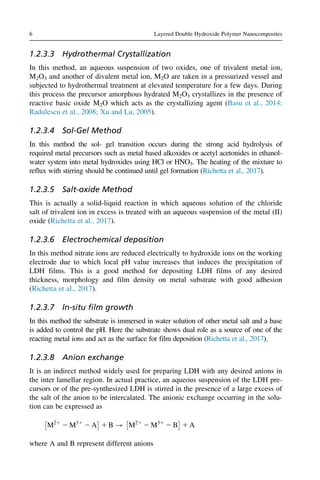
of layered silicates (Basu et al., 2014; Das et al., 2008). Schematic diagram show-
ing structural and chemical difference between LDH and MMT is given in Fig. 1.3
(Das et al., 2008).
1.2.3 Synthesis Routes of Layered Double Hydroxides
A number of techniques can be applied for the synthesis of LDHs and the selection
of the method highly depends on the type of cations in the hydroxide layers, the
intercalated anions and the desired physicochemical properties such as phase purity,
crystallinity, porosity, morphology, and electronic and optical characteristics of the
final materials. The direct methods used for the synthesis of LDHs are co precipita-
tion, urea hydrolysis, salt- oxide method, sol-gel synthesis, electrochemical synthe-
sis, and in-situ film growth and the indirect method used for the synthesis of LDHs
are anion exchange, reconstruction by memory effect, and delamination followed
by restacking (Richetta et al., 2017).
4 Layered Double Hydroxide Polymer Nanocomposites
1.2.3.1 Co-Precipitation
It is the most common and useful method for the preparation of large amount of
layered double hydroxides and this method is also known as salt-base method. This
method involves the slow addition of mixed aqueous solution of salts of both diva-
lent and trivalent ions in proper proportion into water taken in a reactor and the
co-precipitation of both the metal ions from the aqueous solution by the simulta-
neous addition of dilute solutions of sodium hydroxide and/or sodium bicarbonate,
sodium carbonate, or ammonium hydroxide solution at controlled temperature and
under vigorous shaking. Generally the pH of the reaction medium is kept constant
in the range of 710, on the basis of nature of metal ions. Finally the suspension
is subjected to hydrothermal treatment to obtain well crystallized sample
(Basu et al., 2014; Richetta et al., 2017; Radulescu et al., 2008; Yan et al., 2016;
Rives et al., 2013).
1.2.3.2 Urea Hydrolysis
In this sophisticated method, an aqueous solution of the selected metal ions that
required to be present in the LDH and urea in the stoichiometric molar ratio is
heated in the temperature range from 100
C to reflux temperature for two to three
days. At the end of the process, urea hydrolyses to ammonium carbonate that leads
to the precipitation of LDH with carbonate ion as interlayer anion. This homoge-
neous precipitation method via urea hydrolysis offers LDH with high crystalline
and narrow particle size distribution (Basu et al., 2014; Radulescu et al., 2008).
Figure 1.3 Schematic diagram showing structural and chemical difference between LDH
and MMT.
Source: Adapted from Das, A., Costa, F.R., Wagenknecht, U. and Heinrich, G., 2008.
Nanocomposites based on chloroprene rubber: effect of chemical nature and organic
modification of nanoclay on the vulcanizate properties. European Polymer Journal, 44 (11),
pp. 34563465 with kind permission of elsevier
5
Layered double hydroxides: fundamentals to applications
1.2.3.3 Hydrothermal Crystallization
In this method, an aqueous suspension of two oxides, one of trivalent metal ion,
M2O3 and another of divalent metal ion, M2O are taken in a pressurized vessel and
subjected to hydrothermal treatment at elevated temperature for a few days. During
this process the precursor amorphous hydrated M2O3 crystallizes in the presence of
reactive basic oxide M2O which acts as the crystallizing agent (Basu et al., 2014;
Radulescu et al., 2008; Xu and Lu, 2005).
1.2.3.4 Sol-Gel Method
In this method the sol- gel transition occurs during the strong acid hydrolysis of
required metal precursors such as metal based alkoxides or acetyl acetonides in ethanol-
water system into metal hydroxides using HCl or HNO3. The heating of the mixture to
reflux with stirring should be continued until gel formation (Richetta et al., 2017).
1.2.3.5 Salt-oxide Method
This is actually a solid-liquid reaction in which aqueous solution of the chloride
salt of trivalent ion in excess is treated with an aqueous suspension of the metal (II)
oxide (Richetta et al., 2017).
1.2.3.6 Electrochemical deposition
In this method nitrate ions are reduced electrically to hydroxide ions on the working
electrode due to which local pH value increases that induces the precipitation of
LDH films. This is a good method for depositing LDH films of any desired
thickness, morphology and film density on metal substrate with good adhesion
(Richetta et al., 2017).
1.2.3.7 In-situ film growth
In this method the substrate is immersed in water solution of other metal salt and a base
is added to control the pH. Here the substrate shows dual role as a source of one of the
reacting metal ions and act as the surface for film deposition (Richetta et al., 2017).
1.2.3.8 Anion exchange
It is an indirect method widely used for preparing LDH with any desired anions in
the inter lamellar region. In actual practice, an aqueous suspension of the LDH pre-
cursors or of the pre-synthesized LDH is stirred in the presence of a large excess of
the salt of the anion to be intercalated. The anionic exchange occurring in the solu-
tion can be expressed as
M21
2 M31
2 A
 
1 B ! M21
2 M31
2 B
 
1 A
where A and B represent different anions
6 Layered Double Hydroxide Polymer Nanocomposites
The exchange of the anion depends on the electrostatic forces between positively
charged LDH layers and the exchanging anions. The main criterion for anionic
exchange is that the force of attraction between the host ion and the LDH sheet
must be lower than that of guest ion and the sheet. The affinity between various
anions and the positively charged LDH sheets is in the order NO3
2
, Br2
, Cl2
, F2
, OH2
, MoO4
22
, SO4
22
, CrO4
22
, HPO4
22
, CO3
22
. This method
can be used for the preparation of layered double hydroxides with any inorganic
anions or organic anions. The entire process of anion-exchange must be carried out
in an inert atmosphere (Basu et al., 2014; Selvam et al., 2014; Mishra et al., 2018;
Richetta et al., 2017; Bullo Saifullah, 2015).
1.2.3.9 Reconstruction / rehydration method
The noticeable property of LDHs is the regaining of original structure back after
subjecting it to calcination between 400500
C followed by rehydration. When
LDH is heated between 400500
C, it changes to mixed metal oxides. It is
immersed in water or any other solution of anions to be intercalated. The overall
process of rehydration must be carried out in an inert nitrogen atmosphere. This
method can also be used for the synthesis of LDH with any inorganic or organic
anions (Basu et al., 2014; Mishra et al., 2018; Richetta et al., 2017; Bullo Saifullah,
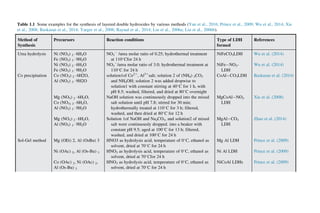
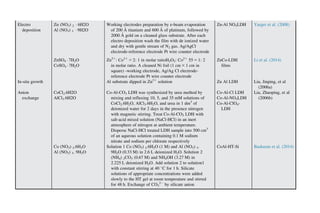
2015). Some examples for the synthesis of layered double hydroxides by various
methods are given in Table 1.1.
1.3 Organic Modification of Layered Double Hydroxides
The prime objective of organic modification of layered double hydroxides is to
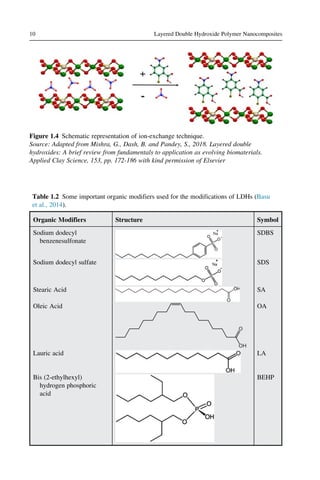
enhance the interlayer spacing of LDH materials (Fig. 1.4) so as to make it eas-
ily accessible for the intercalation of large hydrophobic polymer chains. Some
important organic modifiers used for the modifications of LDHs are given in
Table 1.2 The fine tuning of the inter lamellar galleries of layered double hydro-
xides with suitable organic anions offer exfoliated layered double hydroxide
polymer nanocomposites with multifaceted applications such as biomedical,
energy, food packaging, flame retardant, gas barrier, agricultural, water purifica-
tion etc. This is also an efficient way to tailor the nano space in the intergallery
region with functional materials like pesticides, drugs, nucleic acids, enzymes
etc for vast applications such as controlled pesticides release, drug delivery,
gene delivery, biosensors etc. Organic modification can be carried out success-
fully by following any one of the important strategies such as anion exchange
reaction, reconstruction, direct synthesis and restacking (Leroux and Taviot-
Guého, 2005).
Sometimes bilayers, instead of mono layers of organic anions are formed in the
inter gallery space as a result of which basal spacing becomes double that is a
boon for producing polymer nanocomposites. This happens when the process is
carried out in the presence of excess of organic anions for a long time with
7
Layered double hydroxides: fundamentals to applications
Table 1.1 Some examples for the synthesis of layered double hydroxides by various methods (Yan et al., 2016; Prince et al., 2009; Wu et al., 2014; Xie
et al., 2008; Baskaran et al., 2014; Yarger et al., 2008; Raynal et al., 2014; Liu et al., 2006a; Liu et al., 2006b).
Method of
Synthesis
Precursors Reaction conditions Type of LDH
formed
References
Urea hydrolysis Ni (NO3) 2  6H2O
Fe (NO3) 3  9H2O
NO3
2
/urea molar ratio of 0.25; hydrothermal treatment
at 110
Cfor 24 h
NiFeCO3LDH Wu et al. (2014)
Ni (NO3) 2  6H2O
Fe (NO3) 3  9H2O
NO3
2
/urea molar ratio of 3.0; hydrothermal treatment at
110
C for 24 h
NiFeNO3-
LDH
Wu et al. (2014)
Co precipitation Co (NO3) 2  6H2O,
Al (NO3) 3  9H2O
solution1of Co21
, Al31
salt; solution 2 of (NH4) 2CO3
and NH4OH; solution 2 was added dropwise to
solution1 with constant stirring at 40
C for 1 h, with
pH 8.5; washed, filtered, and dried at 80
C overnight
CoAlCO3LDH Baskaran et al. (2014)
Mg (NO3) 2  6H2O,
Co (NO3) 2  6H2O,
Al (NO3) 3  9H2O
NaOH solution was continuously dropped into the mixed
salt solution until pH 7.8; stirred for 30 min;
hydrothermally treated at 110
C for 3 h; filtered,
washed, and then dried at 80
C for 12 h
MgCoAlNO3
LDH
Xie et al. (2008)
Mg (NO3) 2  6H2O,
Al (NO3) 3  9H2O
Solution 1of NaOH and Na2CO3, and solution2 of mixed
salt were continuously dropped. into a beaker with
constant pH 9.5; aged at 100
C for 13 h; filtered,
washed, and dried at 100
C for 24 h
MgAlCO3
LDH
Zhao et al. (2014)
Sol-Gel method Mg (OEt) 2, Al (OsBu) 3 HNO3 as hydrolysis acid, temperature of 0
C, ethanol as
solvent, dried at 70
C for 24 h
Mg Al LDH Prince et al. (2009)
Ni (OAc) 2, Al (Os-Bu) 3 HNO3 as hydrolysis acid, temperature of 0
C, ethanol as
solvent, dried at 70
Cfor 24 h
Ni Al LDH Prince et al. (2009)
Co (OAc) 2, Ni (OAc) 2,
Al (Os-Bu) 3
HNO3 as hydrolysis acid, temperature of 0
C, ethanol as
solvent, dried at 70
C for 24 h
NiCoAl LDHs Prince et al. (2009)
Electro
deposition
Zn (NO3) 2  6H2O
Al (NO3) 3  9H2O
Working electrodes preparation by e-beam evaporation
of 200 Å titanium and 600 Å of platinum, followed by
2000 Å gold on a cleaned glass substrate. After each
electro deposition wash the film with de ionized water
and dry with gentle stream of N2 gas. Ag/AgCl
electrode-reference electrode Pt wire counter electrode
Zn-Al NO3LDH Yarger et al. (2008)
ZnSO4  7H2O
CoSO4  7H2O
Zn21
: Co21
5 2: 1 in molar ratioH2O2: Co21
55 5 1: 2
in molar ratio. A cleaned Ni foil (1 cm 3 1 cm in
square) -working electrode, Ag/Ag Cl electrode-
reference electrode Pt wire counter electrode
ZnCo-LDH
films
Li et al. (2014)
In-situ growth Al substrate dipped in Zn21
solution Zn Al LDH Liu, Jinping, et al
(2006a)
Anion
exchange
CoCl2.6H2O
AlCl3.6H2O
Co-Al-CO3 LDH was synthesized by urea method by
mixing and refluxing 10, 5, and 35 mM solutions of
CoCl2.6H2O, AlCl3.6H2O, and urea in 1 dm3
of
deionized water for 2 days in the presence nitrogen
with magnetic stirring. Treat Co-Al-CO3 LDH with
salt-acid mixed solution (NaCl-HCl) in an inert
atmosphere of nitrogen at ambient temperature.
Disperse NaCl-HCl treated LDH sample into 500 cm3
of an aqueous solution containing 0.1 M sodium
nitrate and sodium per chlorate respectively
Co-Al-Cl LDH
Co-Al-NO3LDH
Co-Al-ClO4-
LDH
Liu, Zhaoping, et al
(2006b)
Co (NO3) 2.6H2O
Al (NO3) 3. 9H2O
Solution 1 Co (NO3) 2.6H2O (1 M) and Al (NO3) 3.
9H2O (0.33 M) in 2.6 L deionized H2O. Solution 2
(NH4) 2CO3 (0.67 M) and NH4OH (3.27 M) in
2.225 L deionized H2O. Add solution 2 to solution1
with constant stirring at 40 
C for 1 h. Silicate
solutions of appropriate concentrations were added
slowly to the HT gel at room temperature and stirred
for 48 h. Exchange of CO3
22
by silicate anion
CoAl-HT-Si Baskaran et al. (2014)
Figure 1.4 Schematic representation of ion-exchange technique.
Source: Adapted from Mishra, G., Dash, B. and Pandey, S., 2018. Layered double
hydroxides: A brief review from fundamentals to application as evolving biomaterials.
Applied Clay Science, 153, pp. 172-186 with kind permission of Elsevier
Table 1.2 Some important organic modifiers used for the modifications of LDHs (Basu
et al., 2014).
Organic Modifiers Structure Symbol
Sodium dodecyl
benzenesulfonate
SDBS
Sodium dodecyl sulfate SDS
Stearic Acid SA
Oleic Acid
OH
O
OA
Lauric acid LA
Bis (2-ethylhexyl)
hydrogen phosphoric
acid
BEHP
10 Layered Double Hydroxide Polymer Nanocomposites
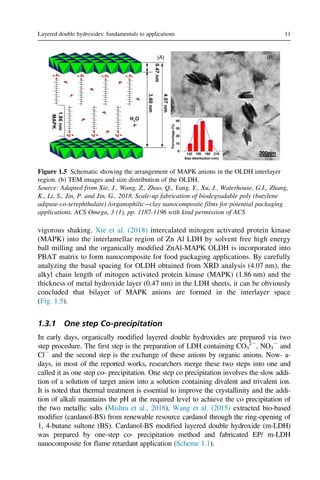
vigorous shaking. Xie et al. (2018) intercalated mitogen activated protein kinase
(MAPK) into the interlamellar region of Zn Al LDH by solvent free high energy
ball milling and the organically modified ZnAl-MAPK OLDH is incorporated into
PBAT matrix to form nanocomposite for food packaging applications. By carefully
analyzing the basal spacing for OLDH obtained from XRD analysis (4.07 nm), the
alkyl chain length of mitogen activated protein kinase (MAPK) (1.86 nm) and the
thickness of metal hydroxide layer (0.47 nm) in the LDH sheets, it can be obviously
concluded that bilayer of MAPK anions are formed in the interlayer space
(Fig. 1.5).
1.3.1 One step Co-precipitation
In early days, organically modified layered double hydroxides are prepared via two
step procedure. The first step is the preparation of LDH containing CO3
22
, NO3
2
and
Cl2
and the second step is the exchange of these anions by organic anions. Now- a-
days, in most of the reported works, researchers merge these two steps into one and
called it as one step co- precipitation. One step co precipitation involves the slow addi-
tion of a solution of target anion into a solution containing divalent and trivalent ion.
It is noted that thermal treatment is essential to improve the crystallinity and the addi-
tion of alkali maintains the pH at the required level to achieve the co precipitation of
the two metallic salts (Mishra et al., 2018). Wang et al. (2015) extracted bio-based
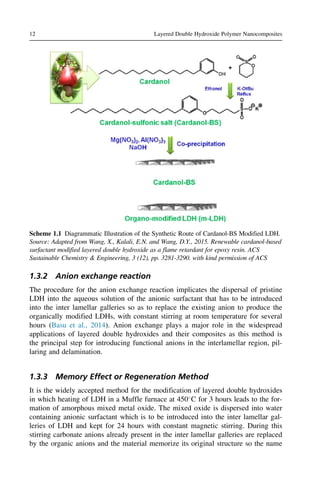
modifier (cardanol-BS) from renewable resource cardanol through the ring-opening of
1, 4-butane sultone (BS). Cardanol-BS modified layered double hydroxide (m-LDH)
was prepared by one-step co- precipitation method and fabricated EP/ m-LDH
nanocomposite for flame retardant application (Scheme 1.1).
Figure 1.5 Schematic showing the arrangement of MAPK anions in the OLDH interlayer
region. (b) TEM images and size distribution of the OLDH.
Source: Adapted from Xie, J., Wang, Z., Zhao, Q., Yang, Y., Xu, J., Waterhouse, G.I., Zhang,
K., Li, S., Jin, P. and Jin, G., 2018. Scale-up fabrication of biodegradable poly (butylene
adipate-co-terephthalate) /organophilicclay nanocomposite films for potential packaging
applications. ACS Omega, 3 (1), pp. 1187-1196 with kind permission of ACS
11
Layered double hydroxides: fundamentals to applications
1.3.2 Anion exchange reaction
The procedure for the anion exchange reaction implicates the dispersal of pristine
LDH into the aqueous solution of the anionic surfactant that has to be introduced
into the inter lamellar galleries so as to replace the existing anion to produce the
organically modified LDHs, with constant stirring at room temperature for several
hours (Basu et al., 2014). Anion exchange plays a major role in the widespread
applications of layered double hydroxides and their composites as this method is
the principal step for introducing functional anions in the interlamellar region, pil-
laring and delamination.
1.3.3 Memory Effect or Regeneration Method
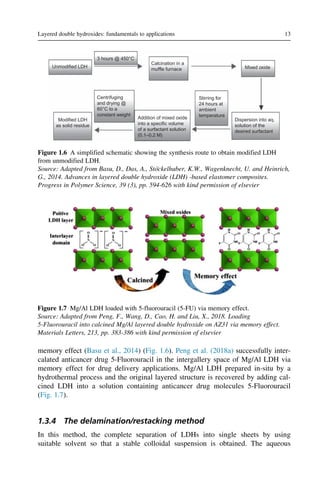
It is the widely accepted method for the modification of layered double hydroxides
in which heating of LDH in a Muffle furnace at 450
C for 3 hours leads to the for-
mation of amorphous mixed metal oxide. The mixed oxide is dispersed into water
containing anionic surfactant which is to be introduced into the inter lamellar gal-
leries of LDH and kept for 24 hours with constant magnetic stirring. During this
stirring carbonate anions already present in the inter lamellar galleries are replaced
by the organic anions and the material memorize its original structure so the name
Scheme 1.1 Diagrammatic Illustration of the Synthetic Route of Cardanol-BS Modified LDH.
Source: Adapted from Wang, X., Kalali, E.N. and Wang, D.Y., 2015. Renewable cardanol-based
surfactant modified layered double hydroxide as a flame retardant for epoxy resin. ACS
Sustainable Chemistry  Engineering, 3 (12), pp. 3281-3290. with kind permission of ACS
12 Layered Double Hydroxide Polymer Nanocomposites
memory effect (Basu et al., 2014) (Fig. 1.6). Peng et al. (2018a) successfully inter-
calated anticancer drug 5-Fluorouracil in the intergallery space of Mg/Al LDH via
memory effect for drug delivery applications. Mg/Al LDH prepared in-situ by a
hydrothermal process and the original layered structure is recovered by adding cal-
cined LDH into a solution containing anticancer drug molecules 5-Fluorouracil
(Fig. 1.7).
1.3.4 The delamination/restacking method
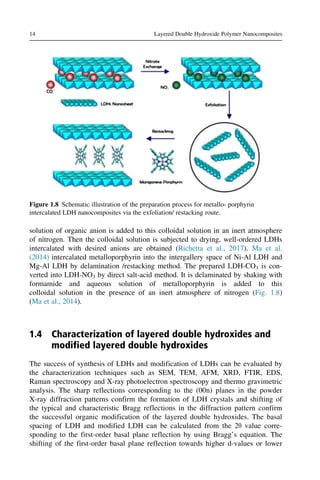
In this method, the complete separation of LDHs into single sheets by using
suitable solvent so that a stable colloidal suspension is obtained. The aqueous
3 hours @ 450°C
Unmodified LDH
Modified LDH
as solid residue
Centrifuging
and drying @
60°C to a
constant weight
Calcination in a
muffle furnace
Addition of mixed oxide
into a specific volume
of a surfactant solution
(0.1–0.2 M)
Stirring for
24 hours at
ambient
temperature
Mixed oxide
Dispersion into aq.
solution of the
desired surfactant
Figure 1.6 A simplified schematic showing the synthesis route to obtain modified LDH
from unmodified LDH.
Source: Adapted from Basu, D., Das, A., Stöckelhuber, K.W., Wagenknecht, U. and Heinrich,
G., 2014. Advances in layered double hydroxide (LDH) -based elastomer composites.
Progress in Polymer Science, 39 (3), pp. 594-626 with kind permission of elsevier
Figure 1.7 Mg/Al LDH loaded with 5-fluorouracil (5-FU) via memory effect.
Source: Adapted from Peng, F., Wang, D., Cao, H. and Liu, X., 2018. Loading
5-Fluorouracil into calcined Mg/Al layered double hydroxide on AZ31 via memory effect.
Materials Letters, 213, pp. 383-386 with kind permission of elsevier
13
Layered double hydroxides: fundamentals to applications
solution of organic anion is added to this colloidal solution in an inert atmosphere
of nitrogen. Then the colloidal solution is subjected to drying, well-ordered LDHs
intercalated with desired anions are obtained (Richetta et al., 2017). Ma et al.
(2014) intercalated metalloporphyrin into the intergallery space of Ni-Al LDH and
Mg-Al LDH by delamination /restacking method. The prepared LDH-CO3 is con-
verted into LDH-NO3 by direct salt-acid method. It is delaminated by shaking with
formamide and aqueous solution of metalloporphyrin is added to this
colloidal solution in the presence of an inert atmosphere of nitrogen (Fig. 1.8)
(Ma et al., 2014).
1.4 Characterization of layered double hydroxides and
modified layered double hydroxides
The success of synthesis of LDHs and modification of LDHs can be evaluated by
the characterization techniques such as SEM, TEM, AFM, XRD, FTIR, EDS,
Raman spectroscopy and X-ray photoelectron spectroscopy and thermo gravimetric
analysis. The sharp reflections corresponding to the (00n) planes in the powder
X-ray diffraction patterns confirm the formation of LDH crystals and shifting of
the typical and characteristic Bragg reflections in the diffraction pattern confirm
the successful organic modification of the layered double hydroxides. The basal
spacing of LDH and modified LDH can be calculated from the 2θ value corre-
sponding to the first-order basal plane reflection by using Bragg’s equation. The
shifting of the first-order basal plane reflection towards higher d-values or lower
Figure 1.8 Schematic illustration of the preparation process for metallo- porphyrin
intercalated LDH nanocomposites via the exfoliation/ restacking route.
14 Layered Double Hydroxide Polymer Nanocomposites
2θ values indicates the successful intercalation of organic anions into the inter
lamellar gallery of layered double hydroxides. XRD analysis goes into the in-depth
study of the crystal by providing the unit cell parameters, miller indices crystallite
size or particle size (calculated with the help of Scherrer equation) etc. SEM and
TEM give valuable information regarding the size and shape of the LDHs and
modified LDHs. The chemical compositions of the LDHs and modified LDHs are
determined by energy-dispersive X-ray spectra (EDS). The thickness of LDHs and
modified LDHs can be detected from the AFM height images and the correspond-
ing height profiles. The FTIR spectrum confirms the formation of LDH by provid-
ing peaks corresponding to interlayer anion, interlayer water molecules, O-H of
metal hydroxide layer, M-O lattice etc (Nagendra et al., 2017a; Nagendra et al.,
2015; Nagendra et al., 2017b). The increase in basal spacing obtained from XRD
and the characteristic peak corresponding to the organic modifier from the FTIR
spectrum and visualization of increase in basal spacing by taking the image by
high resolution TEM etc indicates the successful modification of layered double
hydroxides with the organic modifiers. Some of the characterization techniques are
illustrated here with suitable examples, which are taken from some previously
reported research work, for the better understanding of this topic.
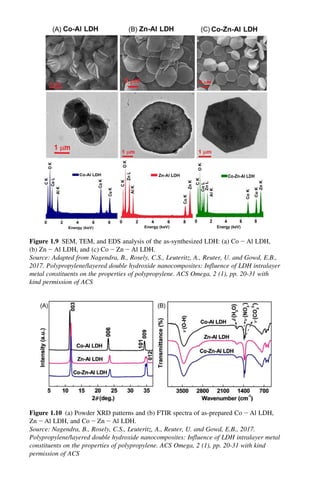
Nagendra et al (2017b) synthesized Co 2 Al, Zn 2 Al LDH and Co 2 Zn 2 Al
LDH by co precipitation method. The size and shape of these LDHs were character-
ized by SEM and TEM analysis and visualized as circular platelets, hexagonal
platelets with rounded edges, and hexagonal platelets with sharp edges morpholo-
gies respectively for Co 2 Al LDH, Zn 2 Al LDH, and Co 2 Zn 2 Al LDH
(Fig. 1.9). This difference in shape is attributed to the difference in nucleation and
growth mechanism of LDH in the presence of different metal salts. The crystallinity
was confirmed by XRD and the prepared LDH crystals are found to be highly pure
as there were no peaks other than typical LDH (Fig. 1.10a). Because of water mole-
cules in the interlamellar region and hydroxyl groups in the LDH layers, a dominant
oxygen peak was observed in EDS of different LDH. (Fig. 1.9) The FTIR bands at
1356 and1382 cm21
indicated the presence of carbonate and nitrate respectively,
the bands at 3440 cm21
(ν (O-H) ) and 1632 cm21
(δ (H2O) ) indicated the pres-
ence of water molecules in the inter lamellar region (Fig. 1.10b).
Xu et al. (2013b) synthesized LDH-CO3 by urea method and converted it to
LDH-NO3 by an acidsalt direct exchange method. The reason for the conversion
is that it is difficult to substitute interlayer CO3
22
anions by organic anions directly,
because of high electrostatic attraction between CO3
22
and LDH platelets. After the
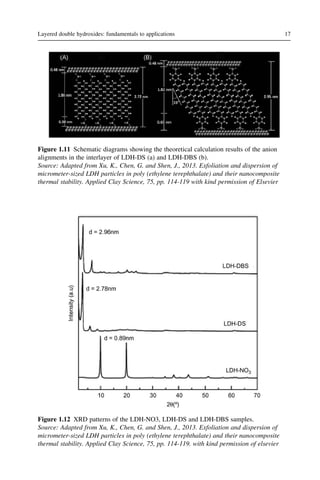
first conversion, LDH NO3 was again converted to LDH-DS and LDH -DBS by
anion exchange reaction. From the XRD data, it is clear that the basal space of
LDH-NO3, LDH-DS, and LDH-DBS are 0.88 nm, 2.78 and 2.96 nm respectively
which are found to be well agreement with the theoretical values (Fig. 1.11 and
Fig. 1.12). The characteristic reflection peak of LDH-CO3 corresponding to
2θ 5 11.8
is absent in XRD graphs of all the other LDHs mentioned above which
indicates complete conversion of CO3
22
. XRD data of unmodified and some organ-
ically modified LDHs are given in Table 1.3. In addition to that, the characteristic
absorption band of the carbonate at around 1352 cm21
was not observed in the
15
Layered double hydroxides: fundamentals to applications
Figure 1.10 (a) Powder XRD patterns and (b) FTIR spectra of as-prepared Co 2 Al LDH,
Zn 2 Al LDH, and Co 2 Zn 2 Al LDH.
Source: Nagendra, B., Rosely, C.S., Leuteritz, A., Reuter, U. and Gowd, E.B., 2017.
Polypropylene/layered double hydroxide nanocomposites: Influence of LDH intralayer metal
constituents on the properties of polypropylene. ACS Omega, 2 (1), pp. 20-31 with kind
permission of ACS
Figure 1.9 SEM, TEM, and EDS analysis of the as-synthesized LDH: (a) Co 2 Al LDH,
(b) Zn 2 Al LDH, and (c) Co 2 Zn 2 Al LDH.
Source: Adapted from Nagendra, B., Rosely, C.S., Leuteritz, A., Reuter, U. and Gowd, E.B.,
2017. Polypropylene/layered double hydroxide nanocomposites: Influence of LDH intralayer
metal constituents on the properties of polypropylene. ACS Omega, 2 (1), pp. 20-31 with
kind permission of ACS
Figure 1.11 Schematic diagrams showing the theoretical calculation results of the anion
alignments in the interlayer of LDH-DS (a) and LDH-DBS (b).
Source: Adapted from Xu, K., Chen, G. and Shen, J., 2013. Exfoliation and dispersion of
micrometer-sized LDH particles in poly (ethylene terephthalate) and their nanocomposite
thermal stability. Applied Clay Science, 75, pp. 114-119 with kind permission of Elsevier
Figure 1.12 XRD patterns of the LDH-NO3, LDH-DS and LDH-DBS samples.
Source: Adapted from Xu, K., Chen, G. and Shen, J., 2013. Exfoliation and dispersion of
micrometer-sized LDH particles in poly (ethylene terephthalate) and their nanocomposite
thermal stability. Applied Clay Science, 75, pp. 114-119. with kind permission of elsevier
17
Layered double hydroxides: fundamentals to applications
FTIR spectrum of LDH-NO3, LDH-DS, and LDH-DBS. At the same time, some
new peaks were observed at 1384 cm21
, 2957, 2920 and 2845 cm21
. The first peak
arises due to the stretching mode of NO3
2
and the three other peaks arises as a
result of asymmetric and symmetric stretching vibrations of CH3/CH2 group of long
alkyl chains of the DS and DBS anions. Some additional bands were observed at
1220 cm21
, 1200 and 1042 cm21
, 1133 and 1011 cm21
, first band results from the
DS anions, a couple of bands (second and third) characteristic of the DBS absorption
and the next pair of bands (fourth and fifth) characteristic of the C-H aromatic in-plane
bendings of the LDH-DBS. In addition to all these bands, a broad absorption band
appeared between 3700 and 3000 cm21
can be assigned to the O-H group stretching
(Fig. 1.13). FTIR bands of some organically modified LDHs are given in Table 1.4.
The information obtained from thermo gravimetric analysis of various types of
LDHs reported in literature is that thermal stability of layered double hydroxides is
only up to 200
C and above that temperature it decomposes to amorphous mixed
metal oxides. Yang et al. (2002) conducted several in situ techniques such as
DRIFTS, TG/DTA, MS, and HTXRD to detect the thermal evolution of the struc-
ture of an MgAlCO3 layered double hydroxide (LDH) under an inert atmo-
sphere (Fig. 1.14). The diffuse reflectance infrared Fourier transform spectroscopy
(DRIFTS) helped to determine the changes in the functional groups. TG/DTA
investigate the changes in mass and energy changes (Fig. 1.15), MS identifies the
products liberated during each stage of heating and HTXRD monitors the structure
evolution. A model has been proposed on the basis of the study to describe the
structural evolution of the MgAlCO3 LDH. In this model, the conversion of lay-
ered double hydroxides into mixed metal oxides is divided into four stages. In the
first stage, between 70190
C, removal of interlayer water takes place and a
change from Phase I with a basal spacing ranging from 7.5 to 7.3 A
to Phase II
with basal spacing of 6.6 A
which indicates that no change in the LDH tactoid
structure. In stage 2, between 190280
C, the OH2
group bonded to Al31
disap-
pears, in the third stage, between190280
C, the OH 2 group linked to
Mg21
disappears and in the final stage, between 405580
C, loss of CO3
22
takes
Table 1.3 XRD data of unmodified and some organically modified LDHs
(Basu et al., 2014; Xu et al., 2013b; Costa et al., 2008; Liu et al., 2008;
Manzi-Nshuti et al., 2009).
Type of LDH Basal spacing (nm)
LDH NO3 0.89
LDH-DS 2.78
LDH- DBS 2.96
LDH-laurate 2.45
LDH-oleate 3.4
LDH-stearate 3.37
LDH-BEHP (Bis (2-ethylhexyl) hydrogen
3phosphate-modified LDH)
1.52
18 Layered Double Hydroxide Polymer Nanocomposites
Other documents randomly have
different content
Señor Miramonte will rejoice, I know, when he learns that Señor Jones
and his friend—the name—I did not hear it——
My friend's name is Smith.
Ah!—Smith. Señor Miramonte will rejoice that his house could give
hospitality to the Señors Jones and Smith—unusual names. No? She
looked him full in the eyes, her smile inscrutable.
California's hospitality is proverbial the world over, was his evasive
reply.
Ah! yes. Ah! yes. The world over, you say. I too have been much about.
May it not be, Señor—ah!—Jones, that we have met before? Was it,
perhaps, in London three years ago, or, even in your capital, Washington,
two years past?
Señora Valentino, let me say, once having seen you no man could forget
you. It was in Washington, also in London; and, before that, in Vienna, that
I had the pleasure of knowing you.
And the Señor Smith, your companion? smilingly.
Madam, I cry a truce of this. I am Commodore Billings, of the
American navy. The man with me is Captain Hamilton, of my flagship. For
the present neither of us cares to be thus known.
The woman arched her eyebrows. That is entirely the affair of the Señor
Commodore and the Señor Capitan. Still, why so far from the flagship?
We were riding incognito through a peaceful and friendly land, señora.
Rumors float about, Señor Officer.
The man looked into the fire for a moment. Señora Valentino, I have
told you who I am. I will tell you also that I am in command of the Pacific
squadron of the American navy. Will you be as candid with me, and tell me
why you are in this country?
She laughed. You haven't yet told me why you are traveling under an
assumed name; neither, why you are on the mainland of California.
Undoubtedly for diversion, señora.
Come, Señor Commodore, it is as our hostess said, is it not so? that the
Lion and the Eagle are straining to the contest over spoils vast as the
territory of all Europe. Come, let us be fair with each other. You are here in
the interest of the United States. Some special errand leads you on a secret
journey. An accident brings you and me under the same roof; and fate,
perhaps, leaves us here alone together in conversation. It may be that you
and I could come to some understanding about affairs of mighty interest.
Indeed, it may be, save two nations from grave misunderstanding.
His smile was as genial as ever, as he said: The señora favors Great
Britain in the dispute she alleges may some time arise. Am I not correct?
She bowed. You met the Señor O'Donnell a week ago, and again four
days ago. Was it at your last meeting he told you of my preferences, or at
the first? She laughed, and playfully tapped the Commodore's hand with
her fan.
Madam, may I say to you that I have letters in my possession from our
State Department, in Washington, which relate not only to your presence
here but which also tell something of your work as England's secret agent in
Alta California.
Again the woman laughed. Child's play, Commodore! Child's play! The
man who sent this information to your State Department, in Washington, is
here, and in touch with you. Certainly, he told you as much as he wrote to
Washington.
The officer made no reply.
Commodore Billings, I deal with you, and with you only. I take not
account of the frontiersman, O'Donnell. The United States, though still
young, is a great nation; and should be represented by men such as you.
Señora, O'Donnell has the confidence of Mr. Tyler, President of the
United States.
Has your Mr. Tyler the confidence of the republic which made him its
President?
There was no reply.
The señora arose. The jewels in her hair flamed and glittered in the
firelight. A hundred questions seemed to burn in the depths of her eyes. She
extended her hand, as if in gesture. The warrior-diplomat was impelled to
arise also, and to take the hand in his.
Señor the Commodore, you go to conference with Mendoza, of Mission
San José. Is it not so?
He started to reply, but checked himself.
Think on what you do. We of this province—Mendoza and a handful of
others excepted—desire not to be ruled by your nation.
Señora Valentino, I am but a student of conditions here.
She moved closer toward him. He still held her hand.
You do not come with prejudged verdict? In her earnestness she placed
her disengaged hand on his shoulder.
Assuredly not. Of course I know the general desire of my government.
Further than that I do what seems wisest.
Then consult the people of California. See Padre Osuna, that saintly
Chrysostom of this Western world. Meet Colonel Barcelo, the acting-
governor. Interview Pio Pico, and his brother Andreas. See the Peraltas, the
Carillos. Señor Mendoza represents but few besides himself.
She moved away from him. As to this O'Donnell—O'Donnell! He is a
man with a price on his head, placed there by the English government.
What wonder he intrigues against England!
Some political offense, of course.
For attempted murder! He struck down his captain on the parade
ground in Dublin, following an admonition.
Zounds, madam!
This would-be assassin carries word to you from Señor Mendoza—why
does he forget he is Colonel Mendoza?—carries word that Mendoza has
wishes for the department of California which differ from the wishes of the
people themselves who comprise this department. Indeed! And who is this
Mendoza? Is he not of a make-up so unrestrained that once, in a burst of
temper, he even burned to the ground his magnificent home? Ask the people
of California if this is not true. Bethink you, my Commodore.
Señora, I ask you, what is in the wind?
Let us be seated, Señor Commodore.
She looked at him intently. Texas is free from Mexico. Some of your
States wish to accept the republic of Texas as one of themselves. The States
north of the Mason and Dixon line object. They oppose extension of Negro
slavery. Your President Tyler is on the fence, dangling his long legs in the
air, prepared to jump to either side, as it seems expedient for him.
The Commodore covered his mouth with his hand, to conceal an
involuntary smile.
Oregon is now jointly held by the United States and England. Some of
your States wish for a part of Oregon. Others make opposition; and the
opposition this time comes from those south of the Mason and Dixon line.
The reason? No possibility of slavery in Oregon. Your President, from his
perch, dangles his long legs yet more alertly.
Billings now laughed outright.
Señora, you are droll.
Is what I say not true, my Commodore?
Oregon is ours, my lady, by occupation. Doctor Whitman and his
missionaries live in that country; are Christianizing the Indians, and
drawing settlers from beyond the Mississippi. Oregon is ours, I say, by right
of occupation.
A hundred years before your Whitman saw light missionaries from
French Canada lived among those same tribes. England succeeded to the
rights of France. Oregon, then, is England's by this right of occupation of
which you speak.
But, the rifles of the American settlers in Oregon! They will speak, and
speak strongly, my lady.
But the rifles of the Spanish hacenderos in California, my Commodore!
Can they not speak? Commodore Billings, a shot in California will echo
around the world!
She leaned toward him and placed her hand on the arm of his chair. A
few months ago I saw Doctor McLoughlin, head of the Hudson Bay
Company, at Vancouver. He knows of the work of your missionary
Whitman. My Commodore, twenty British ships-of-war are in the Pacific
waters. I saw them, one and all, on my journey to the North. They are not
far from here.
So many, Señora Valentino?
That many.
I did not think Admiral Fairbanks——
She waited for him to continue. As he did not she went on:
That enthusiast, Mendoza, thinks he can persuade you to seize our
capital, Monterey. Suppose you do? The province will seethe in rebellion,
and call to Admiral Fairbanks for aid. He will give it. That means war. Your
United States is unprepared for war at sea. Mexico then goes under an
English protectorate. Texas goes back to Mexico, and England will then
control the Pacific Coast from the tropics to the Russian line in the far
north.
Both were standing now.
Señora Valentino, neither Mendoza, nor anyone, can lead me into an
unconsidered move in this matter.
To-night you had an appointment with Mendoza. Fate intervened. To-
morrow sees not the danger removed. He will ask you to seize this province
for the United States. Commodore Billings, ruin comes if you do.
Señora, I have never seen Mendoza.
You know of his wishes. Others do.
But I shall judge for myself.
Again her inscrutable smile. Commodore, I thank you. I mean—that is
to say—I thank you for listening to me to-night. I pray good will come of
it. Her hand was on his arm. He took it in fervent grasp.
Señora, Europe knows you for a brilliant woman. I say you are that, and
more. I am glad to have met you again. He looked at his watch. It is late. I
fear I have kept you too long. I ask your pardon.
My Commodore, have a care, only, that you do not ask pardon of the
world one day for what your decision to-morrow may bring about.
Your words do you honor, señora. May I ask leave now to retire?
The leave is yours, Commodore.
After good night had been said Señora Valentino returned to her chair by
the fire. Into the flames she looked for a long time.
The Commodore talks in his silence, she finally said to herself, smiling
grimly. The pages of this drama fast turn themselves—very fast—to the
issue. 'But I shall judge for myself.' Ah! Commodore, your silence is indeed
golden. So, Mendoza wishes you to seize Monterey—evidently—but, 'you
will judge for yourself.' Discreet Commodore! But we shall see—we shall
see!
The thick oaken log in the fireplace was ashes before the señora went to
her room.
CHAPTER XXII
ALMOST——
Señora Valentino rode slowly along the way leading from Santa Clara to
Pueblo San José. Willow trees lined the edge of the road, lifting their
featherly foliage in greeting to the morning sun. Yellow light filtered
through and marked the interlacing plumes with myriad fairy figures in
golden tints. The branches nodded and undulated in low-toned rhythm.
Tempered breezes from the bay, sweet with the breath of virgin meadow,
hung light-winged over this shaded alameda. Peons, men and women,
worked in the vegetable gardens by the wayside, singing as they labored.
Betimes they used the guttural words of their aborigine tongue, the age-old
longing of savage man flowing in heavy note and shrill refrain. Again, some
neophyte rested for the moment on hoe or mattock and intoned a hymn.
Then knoll and hollow resounded as the children of the wilderness sang the
words of their new-found faith.
The long white line marking the fort at San José had come plainly into
view when the señora halted.
My message requested the Captain to meet me here at this hour, she
said to no one in particular. Her mounted Indian guard was a score of paces
behind. Just then Captain Farquharson, coming at swift gallop, turned the
bend just ahead.
Good morning! she called to him.
Good morning! he called back. Well, the great question, as he drew
up at her side. Your word reached me after midnight. Our signal-fire was
lighted within two hours, on the high mountains east of San José. This
morning at daylight the signal-smoke told me that Admiral Fairbanks's
anchors are under weigh for Monterey harbor. Now, your note told me
nothing of the particulars of your interview with Billings last night. You
managed to gain his attention, I'm sure.
I did. But our English admiral? Tell me, is he of two minds, as he was
the other day; or have they crystallized into one?
He has agreed to keep his fleet hidden until our signal-fire or smoke
informs him it is the hour to enter Monterey harbor and take possession.
Ah! that is his mind now.
Señora, I await with great interest some news of your interview last
night with the American. He must have said something of deep import that
you sent word to signal at once our admiral's fleet. Fairbanks reaches
Monterey easily to-morrow. What I signal him to do there, and how soon,
will be greatly determined by what you learned last night from this
Billings.
Well, Captain, since nothing is to be done until to-morrow, you have
time to answer me a question or two. The lady laughed, then went on:
How did you manage to get our gringo naval heroes lost at the right time
yesterday?
Simple, very simple, indeed. They lost themselves. One hero's saddle
seat was uncertain. He gripped his horse with his calves, to make himself
more secure, forgetting the sharp spurs on his heels. The indignant broncho
jumped over the nearest bank, his rider just naturally following. I declare,
the gallant officer actually spun head over heels twice before he landed in
the water. The peon with the two gentlemen was held by our men under
pretended suspicion of being a runaway, when he went in search of another
horse. This left our heroes without a guide; and Valeriano, the Miramonte
major-domo, did his part when the stars began to shine. Now, señora, of
course Commodore Billings——
She interrupted him. If the gringo hero's horse had not obligingly
jumped over that bank, how would you have got the Commodore to Señor
Miramonte's hacienda house at the right time?
Depend on it, I would have found a way. Bringing them to the
Miramonte's place as suspicious characters would have been the last resort.
You would have identified the Commodore, in that case, and would have
made all possible amends for unwarranted detention.
Of course. The two joined their laughter.
Mendoza's peons were scouring the woods last night for the officers.
Our fellows furnished them plenty of information. It didn't lead them to
Miramonte's house, you may be sure. Again the forest echoed the sound of
their laughter.
Well, from the señora, our two worthies set out comfortably enough
this morning, after early breakfast with us. Alberto, the Miramonte's peon,
guides them to Señor Mendoza. Alberto, lifting her eyebrows,
understands English. When a lad, a religious-minded gringo tallow-trader
captain took him to Boston, and had him educated, hoping he would
become a missionary here of the tallow-trader's faith. Instead he reverted to
the ordinary peon, and an ardent Americano hater, into the bargain.
Fortunately for us. It was simply invaluable that he was present the
other day at that Billings-O'Donnell talk at Half Moon bay, and thus found
out about the appointment to meet at Mendoza's last night. But, laughing a
little, yet serious, I'm anxious as to what happened last night at
Miramonte's.
Just one more question, Captain. In what frame of mind was Padre
Osuna when you last saw him?
You have swung him to our side, señora, for the second time. But he
forced from Fairbanks and me papers giving these natives extraordinary
rights when the country is ours.
The padre is where now, do you judge?
Somewhere near San Luis Obispo. He travels like the whirlwind.
Yesterday he swept the crowd off its feet when he spoke from the church
steps at Monterey. They cheered and stormed for English rule. His
discourse over, he set off for the south with the impetuosity of a crusader.
Very well, my Captain, we have done our part. It remains for Fairbanks
to do his.
Now, señora, why was it you sent the hurried messenger last night?
What did Billings say that you thought such haste necessary?
Practically nothing.
I beg pardon, señora. You must have misunderstood me. I——
I understood you perfectly.
Well, then, señora, think of your reply.
My reply was that Commodore Billings said practically nothing from
which I thought haste necessary. It was from what he palpably refrained
from saying that I made my inference.
Farquharson drew his bridle-rein. His horse curveted over the turf, under
pressure of the curb-bit. He drew the animal back to the woman's side.
Señora Valentino, what does Billings intend to do?
To seize Monterey for the United States if——
If what?
If he can find reasonable excuse, in the attitude of the hacenderos here,
for such a move.
But can he?
He can, if Colonel Mendoza is minded to supply it.
But, señora, at the Mendoza baile the entire countryside cried out for an
English protectorate.
Yes, but we made the minds of these men for them. The structure may
not be the most lasting.
But, perdition! they——
Admiral Fairbanks must seize Monterey as soon as he reaches there,
she went on.
He must! By heaven he must! I'll ruin him before all England if he
flinches.
Remember, Captain, Commodore Billings will fight.
My word, señora! Fight us! Why, bless my soul! our fleet outnumbers
him at least three to one. Fairbanks could sink him in an hour.
The woman leaned in her saddle toward the officer. I shall be in
Monterey all day to-morrow. So must you, Captain.
They shook hands over the manes of their horses and parted company,
the Captain riding swiftly across the fields, the lady walking her mount
toward San José.
The adobe walls of the fort were a dozen feet or so in height, with eaves
projecting outward, the better to prevent scaling by a possible enemy.
Within these walls was a row of buildings in which were the officers of the
alcalde, the subprefect, the jefe-politico and other civil officers of the
pueblo. Here also were the quarters of Morando's men. The Captain himself
had a reception room in one corner of an edifice facing the street. A motley
gathering was in this room, also clustered around the door as the Señora
Valentino drew rein. Her mounted escort had drawn up on either side of her
in orderly lines, each peon so tightening his bridle that the horses walked in
perfect step.
Captain Morando, the comandante, pushed his way through the crowd to
the lady's side. Thrice glad am I to see you, amiga mia. Will you not alight
and rest awhile?
Thank you, Captain.
He released her foot from the stirrup and assisted her to the ground.
My poor place shines like the morning in answer to your presence,
señora.
She smiled on him and looked about over the waiting crowd. Why so
many sad faces here, Captain?
These friends mourn relatives who fell in the recent contest with
Yoscolo. To-day the Department, through me, considers the demands for
pensions.
Then I interrupt.
Indeed not, my friend. This reception room meets never a guest more
welcome than Señora Valentino.
But these sad ones? You must not neglect them for my sake.
I shall not forget you, nor neglect them. Besides, my work with the
pensioners has about concluded.
The peonas had nearly all dried their tears, had gathered their restless
pocos niños together and were preparing to depart, with many blessings
murmured on the very good and very handsome comandante.
The señora seated near the Captain was greatly interested in the scene.
Their praises for you, señor, are fervent, if not loud, she remarked.
Soon the man and woman were alone in the reception room. She
regarded him gravely. He started from a revery and caught her look. He
flushed. She laughed a little.
Well, Captain, I have done as you requested.
What?
I have seen the Señorita Mendoza and have told her for you that——
She paused.
He waited for her to continue.
I must say I do not quite understand the girl, charming, indeed, as she
is.
How so, señora?
O, friend of my heart, I would spare you pain.
Tell me everything, señora.
O, Don Alfredo, everything? My heart fails me. How can I wound
you?
Do not fear for me, gentle one. Let me know the truth. Please go on.
Well—if I must. I made occasion to do your bidding by visiting the
Mendoza house, ostensibly to express to the host of the great baile at
Mission San José my appreciation of that event. The señor was away, but
his daughter received me. This was just the opportunity I would have
wished for. Nothing could have been better for our purpose, Don Alfredo.
He bowed in recognition of the fact.
We passed bits of conversation from one to the other on chance topics.
The young lady was delightful. As we sat in the cool drawing room sipping
tea and nibbling dulces I thought continually of you, my friend. Small
wonder, truly, that you wished to wed this beautiful and talented young
woman. Small wonder, again, that the swains of the valley lay their hearts
before her, as she beckons.
The soldier's face grew gloomy.
When our time had in a measure sped I introduced the subject on which
you wished me to speak with her.
How did she receive it?
I am puzzled to know how to explain. It is but a step, often, from joy to
sorrow; at times, discourtesy seems waiting on the threshold of courtesy.
Well, enough to say that our pleasant relations underwent a change most
unaccountable. The Doña Carmelita grew cold and drew within herself. Try
as I might I could not bring back the former cordiality. In the course of the
conversation I said: 'Señorita, Captain Morando loves you and you only.'
She replied: 'Señora Valentino, I cannot listen to you; even though you are a
guest in this house I cannot.'
We parleyed further. She was obdurate. She tried to cut me short with
the words: 'I request that this conversation cease and that you do not again
mention to me the name of Captain Morando.'
Yet still did I refuse to accept her dismissal of the subject. You see, my
one-time knight, I was determined to fulfill your wishes, no matter what
came.
She lowered her eyes with a tender little sigh, but went on hastily. I
continued to speak of you and of your love for her. She almost flung at me:
'Captain Morando is nothing to me, nor can he ever be. I would not wish it
otherwise.'
Then I concluded: 'At least accept his word that he meant no harm by
his attentions to you.' To this she gave no response.
We were now at the hacienda gate. She summoned the peon who had
my horse in charge. As I mounted she said: 'Remember, if you call again, I
shall give word to my maid to tell you I am not at home.'
The young man came to her side and took her hand in both his. Forgive
me, señora. Forgive me, my dear friend, the stupid selfishness in asking you
to do such an errand. When I think of your goodness to me and of my placid
acceptance of it I curse myself for a brute.
You are harsh with yourself, Alfredo, putting her disengaged hand on
his.
No, señora, a thousand times, no. How can I ever atone for my
thoughtlessness!
The lustrous brown eyes were looking gently at him. He gazed into their
beautiful depths. She leaned a trifle nearer.
He continued: I have been a cur! You have suffered your life long. You
generously gave me the confidences of your heart. I saw how empty your
years have been of the things that, after all, really count in this world; yet I,
selfish fool! could only whine about my own loss.
Don't, don't, Alfredo. You must not say such words.
Dear amiga, you are too forgetful of yourself, always thinking of the
good you may do others. You have a claim on me, a strong claim, which I
shall always remember; for, no matter how unwitting on my part,
unhappiness came to you years ago, and that unhappiness still persists.
Added to this, I have been the direct cause of your losing your friend, the
Doña Carmelita. I wish I could make compensation.
The woman's eyes drooped. Her hands fell to her side.
The past is gone—gone the way of all past things, she said, very
slowly.
But the hurt continues, he returned.
You certainly cannot blame yourself for that.
He dropped on his knees beside her. My dear señora, my true friend,
ask what you will of me, and if I can accomplish it, it shall be yours. I
would do anything to be of service to you.
She raised her eyes and put her hand on his shoulder. Alfredo, how
could you retrieve a broken life? Why, I envy the love of the peonas for
their husbands who fell by your side at La Cuesta de los Gatos. Though
bereft their love lives on. Their heart is not empty, as is mine—as is mine.
Ah, me!
Doña Silvia, the way of love should not be difficult to one of your
gentle spirit. Surely, you will find it, with all the joys bordering thereon.
Her eyebrows lifted almost imperceptibly. She moved a little away.
Forgive me, he said anxiously, noting the movement. I have entered
forbidden ground.
No, no, dear Alfredo. For you it is not forbidden ground. There is not a
recess within my heart where you might not enter.
You are more than kind, my good friend.
Friend! Captain, showing some impatience, friend! Good friend! She
tried to hide the sarcasm in her tone by an unusually alluring smile. I am
but one of your many, many good friends. Is it not so? her voice sounding
hard in spite of herself. O, well, I must be content with whatever the gods
see fit to bestow.
Señora, you are not merely one of many. You are my most loyal, my
warmest, my ever-remaining, ever-to-be-cherished, never-to-be-forgotten
—— He paused, overcome by his own vehemence.
You would scale barbed walls to carry away the señorita of the window
pane, leaning wearily on her arm.
Yes, dear Silvia, I would scale those walls, he went on, passionately. I
would scale them and bear you away, taking both her hands. Her warm
breath was against his cheek. I would—I would—— His voice choked.
—Even sing love songs outside the window, to the accompaniment of
the guitar. O, Alfredo!
In space of time hardly more than an instant he saw the Señorita
Carmelita's eyes flash behind the barred window; heard her gay banter at
the house party; felt her soft hand in his as he had spoken love to her at the
baile.
Very gently he moved away from the señora. Slowly he arose to his feet.
The woman quickly realized the effect of her ill-chosen words. She arose
also and stood leaning on the back of her chair. For a moment they looked
at each other. She was the first to speak, a queer little smile stealing over
her face.
Well, Captain Morando, I have made report to you, the smile
vanishing. I must now—journey homeward.
He escorted the señora to her horse. Assisting her to mount he kissed her
hand in parting salute.
She rode leisurely out of the pueblo, pleasantly exchanging greetings
with acquaintances along the way. Once on the plains, however, she lashed
her horse until the beast plunged and kicked in fury. She quelled him with
bit and word, then rode at break-neck speed until he was winded.
The peon guard followed in wonderment.
CHAPTER XXIII
PEDRO ZELAYA BRINGS IMPORTANT NEWS
On with the green boughs, Anselmo. Now, you, Francisco, the
turpentine in plenty. Pronto! hombre. Pronto! Hasten! Diablo!
The wind from the Yerba Buena side blew more and more strongly, and
finally stiffened to a quarter gale.
It is useless, Señor Zelaya, said the peon Anselmo. The breeze from
the bay so fans the blaze that there is no smoke at all, but all flame.
Don Pedro Zelaya and his peons were on a pinnacle of one of the high
hills which skirt the eastern side of San Francisco harbor. Away at the south
somewhere was the hacienda of Mendoza. On the roof of Mendoza's
hacienda house by night and by day watchers scanned the north horizon for
fire or smoke signals telling that the British fleet had sailed, and
announcing, in the devious ways known to such signal-makers, the
direction the ships had taken, together with other apt information.
Caramba! Caramba! stormed little Zelaya. Bring more green leaves.
Give over using that turpentine now. Perhaps we'll get some smoke after
all.
The keen air breathed through the heaping leaves with a bellowslike
sound. The fierce heat exuded the oil from the fiber and the flames roared
with added vigor.
Bring water! commanded Zelaya. We must have a signal-smoke here,
or it means a wild dash on horseback to Mission San José. Bring water, I
say.
There is no water within a league, Señor Zelaya. Besides, the high wind
would blow the smoke along the mountain top, not letting it form a column
that would reach upward.
The excitable Zelaya ran to his horse tied to some brush near by. Taking
his canteen from the saddle he poured the contents, a quart or so of water,
on the blazing fire. There was a splutter, a sizzle, and the leaves burned as
furiously as before.
The sun was just peeping over the eastern horizon. Zelaya looked
intently, listening expectantly. When the wind lulled for a moment there
came swelling over the hills the reenforced bellowings from tens of
thousands of cattle throats.
Ah! the herds are at last coming in from the San Joaquin bottoms. Well,
we have other fish to fry besides thinking of that. Say! you, Anselmo, and
you, Francisco, are you sure you caught all the signals right? No danger of
mistake? Are you sure?
The small black eyes of the peons glittered. We wish we were as sure of
heaven, Señor Zelaya. Our men saw the signal fire on the high mountains
east of San José last night; saw the answer on Tamalpais. This morning at
daybreak they saw the great white birds swim out in the direction of the
south wind. Our young master, Roberto Morago, said that only cannon and
heaps of cannon balls were on the decks. He saw it through his field glass
from his station on the flank of Mount Diablo. We have brought you his
word, Señor Zelaya, and our telling is true. It's no use; we cannot send a
smoke signal in this wind.
Zelaya was already astride his mount. It means a couple of hours'
delay, he muttered, a couple of hours which we can in no way afford.
He rode his horse furiously. The wind sang in his ears as he swept along.
His face was set and hard, his eyes narrowing to burning sparks.
So, the English ships have sailed southward, with decks cleared for
action! he thought. Word must be given to Mendoza and the American
commodore at once. Then with an oath: What misfortune this strong wind
was blowing on this of all mornings! Well, I'll get to Mission San José with
the news if my horse holds out! or, he half laughed, if he fails, I'll lasso a
bull and press him into service.
The horseman slipped down the steep grades, passed the rancho of his
neighbor, Señor Peralta; rode through the foothills comprising part of the
grant of Don Luis Castro, and into the confines of his own property, the
Rancho Arroyo San Lorenzo. Here he reined in for a moment, and allowed
the animal to lope, an easy canter much affected in early-California days.
Now, for Arroyo Seco, Mendoza's outpost! I'll find a fresh horse there
in his corrals.
He spurred his horse which dashed along the foothills toward Mission
San José. The bellowing of the returning cattle became plainer and plainer.
The vanguard of the herds was already dotting the higher levels above him.
Caramba! I'm none too far away, if I wish to avoid being caught in the
press.
With word and quirt and spur he urged his horse forward. Mile after mile
sped past.
You, poor fellow, are pretty well done, to his animal as it labored
along. Well, I see Mendoza's corrals ahead. I'll leave you there in good
hands, and get my saddle on another racer.
Many cattle and horses in the marshes adjacent on the bay had not been
rounded up in the spring when the droves had been formed for the San
Joaquin. They had swum across the intervening sloughs to the salt-grass
pastures where fodder was more plentiful. After the rains had come these
animals had returned to the valley lands and had grown fat.
Each stallion is a general having under him his lieutenants who, with
him, form a guard for the protection of the mothers and foals of the family.
As it is with the horse so is it with the cattle. The cows and calves follow
the mighty leaders that afford them safety.
Thus, from the valley came hundreds of horses and cattle to meet the
homecomers. They had scented their fellows from afar, and flew madly to
the foothills, to do them battle. The vaqueros were miles away, in the rear of
the swarming, home-coming herds. In time they would make peace by
clubbing the fighting leaders over nose or horn with their heavy whip-
stocks.
Zelaya was within half a mile of the Mendoza corral when a drove of
fifty or more horses, led by a splendid dapple-gray stallion, came
thundering from a deep hollow directly in front of him. The leader
disdained battle with a single stranger and rushed by like the wind. Don
Pedro turned rein and ran with the drove for safety. Little by little he
lessened speed; then, as the way opened, he left the company forced on him
and again turned toward the Mendoza corrals.
A hundred paces to the side a herd of cattle, led by an immense bull, was
charging in the foothills. The leader saw the horseman and made for him
viciously. The Spaniard waved his reata and shouted, Hoop-la! Hoop-la!
after the manner of the vaquero. The herd paused, snorted; then, with head
and tail up, looked on while their protector fought the enemy.
The bull lowered its head and rushed at him, roaring a tremendous bass
defiance. The Spaniard swung his horse to one side, and the beast stumbled
past him. Again and again was this repeated. Finally, the horse stepped into
a hole and fell. The rider came to the ground on his feet, moved quickly
aside, in time to avoid a furious rush from the tormentor. As the bull
stopped in preparation for another attack Don Pedro sprang on its back.
I have for myself a merienda, he thought, grimly, remembering the day
when he had ridden the bull at the Calaveras picnic ground.
Come, come, run to the corral, my lordly beast!
The animal ran around and around in a circle, roaring terrifically.
Carrajo! Carrajo! 'twill not do, called the rider. I must make the
corral. Go, now, you son of an imp! Run as I direct!
Climbing out well on the shoulders he managed to reach the beast's nose
with his spur. First kicking it on one side of the muzzle, then on the other,
he succeeded in getting it started toward the corral.
Grande! Grande! he shouted. You make not badly the mount. Hoop-
la! Hoop-la! Pronto! Pronto!
The bull ran under some trees, endeavoring to free itself from the
incumbrance. Zelaya drew himself up into the branches.
It is again the merienda, as I have said. Now, farewell, toro mio, I go to
the corral and stables for a mount superior even to you.
The bull hurried back to his bellowing herd, and soon together they were
tearing onward to the hills, to fight the myriad homecomers.
A thousand and one devils! A thousand and one devils! exclaimed
Zelaya a few moments later. The corrals and stables were empty. The peon
cots were vacant. Evidently, Mendoza had sent all available horses and men
to the San Joaquin to bring home his grazing stock.
The little man did not hesitate. Off came his embroidered jacket, his
outer, as well as his inner, shirt, then his long riding boots. He tossed his
sombrero, heavy with gold, to one side.
Behold! 'twould not be so bad, if I only had my running shoes.
The morning sun fell on his muscular torso, the runner's flat abdomen
and well-sinewed limbs discernible through the knee-pants and leggings.
For an instant he pulled his short mustachios savagely. I may meet more
bulls and their families, and I have now no spurs, glancing at his discarded
boots. Well, if a bull chases me toward Mission San José I shall reach my
goal all the quicker.
It was three leagues good, as the bird flies, to the Mendoza hacienda
house, at the Mission. Don Pedro set off across country at a long, swinging
gait which ate the miles like fire. For nearly a league he ran along cattle
paths in the tall oats and drying mustard. Then he struck the main-traveled
road. Here he rested for a moment.
Diablo! standing first on one foot, then on the other. That dried grass
has the edge of a knife!
The roaring of cattle and the raucous threatening of a stallion sent him
flying along instantly.
A pest on it! I prefer the sharp grass edge to these infernal stones, the
ragged pebbles in the road bruising and tearing his feet, while the dry grass
had cut cleanly. Still he did not waver. Bright red spots showed on his
cheeks; his breath came in quick gasps, but he did not slacken the
wonderful pace he had set for himself.
Once a bull compelled him to climb a tree, and once he hid under a bank
while a stallion led his squadron past. I take the rest whether or no I need
it, was his laconic thought at these times.
Finally he came in sight of the towers of Mendoza's house. It was yet a
league away, and more. Don Pedro tightened his belt, looked at his bleeding
feet, then at the mansion gleaming white in the sun. He surveyed the
landscape in search of a horseman, but in vain.
He bathed his feet in a streamlet, then darted along the rough road at a
speed that might, indeed, be fitly described as only less than that of a fast-
galloping horse.
* * * * * *
*
Commodore Billings, float the stars and stripes over Monterey before
another sun goes out!
In the Administrator's sitting room were gathered Billings, Hamilton,
O'Donnell, and a score of land barons of the valley.
The American's mouth shut in a straight line. You Spaniards, save a
handful, are clamoring for English rule. Still, Señor Mendoza, you ask me
to invest the capital of this province with my ships. To what end?
To afford our California opportunity to appeal from her inconsiderate
self to her wiser self.
Mendoza, I represent the United States. My office is to conserve, or
advance, her interests.
Señor Commodore, California is the key to the vast region north and
east. With this province goes mastery of the Pacific from the Isthmus to the
ice. No small addition to the United States of America.
California, in her wiser thought, you intimate, would elect to become a
province under my government. I so understand you, señor.
The Administrator nodded affirmatively.
I am, then, to hold your capital pending this expected change of
attitude?
Again the affirmation from Mendoza.
Very well, our Señor Hacendado, suppose the inevitable finds resting
place on the other horn of this dilemma, and your province elects to become
British?
Several of the men were on their feet, speaking excitedly.
Señor Billings, not one chance in ten of such an outcome, exclaimed
Fulgencio Higuera. Geographically we belong to the United States. In
politics we are one with you. Give us time to think and all of us will say aye
to this.
Diego Valencia and others seconded him.
I voted in haste for English rule, said Luis Castro. My preference is
for your country, Señor Commodore.
And I! And I! from a dozen others.
Billings shrugged. Your California Baja is solid for England.
I have letters here from Señor Carillo, the Picos, and others prominent
there, stating that these men will accept what is wisest for the province,
replied Mendoza.
Well said! Well said! broke in the heavy voice of O'Donnell.
Billings looked around the room from one face to another. Finally, his
eyes rested on Mendoza. But there is a possibility if I take your capital that
I may be asked to give it over to the English admiral. Is that not true? Your
people, after all, may vote to become a British dependency, giving the
table beside him a resounding blow with his clenched hand.
A bare possibility—nothing more, said Mendoza, quietly.
In which case I should have my trouble for my pains, asserted the
American.
You would, then, have aided a sovereign people to exercise their right
of franchise. Surely, your government would uphold you in that. Besides,
the chance is ten to one—yes, a hundred to one—that your flag will
continue flying over the province, argued the Administrator.
Billings's heavy mustachios raised along his face in a peculiar smile. His
bushy eyebrows were elevated. In a moment his features fell into their usual
mold.
If I do not take Monterey, what then?
Then comes England, replied Mendoza, his voice low and even, and
at the present—the present, mind you, I say—an apparent majority of our
people would welcome her coming. If she comes, she will stay. He looked
steadily at the other. Señor the Commodore, it may be now or never for the
Americans.
There was a rush of feet in the corridor, a clatter of excited native voices,
angry expostulations, and then there burst into the room a figure which
startled the grave assemblage nearly out of its senses. A man naked to the
waist, his feet cut and bleeding, his face streaked with dust and perspiration.
He was scarcely able to stand.
Dios! exclaimed Mendoza. It's Señor Zelaya. What has happened?
The perspiring, fainting man partially steadied himself. The English
fleet sailed—this morning—at daybreak—toward the south—decks cleared
for action—— He collapsed and would have fallen had not Mendoza
caught him.
Zelaya soon recovered. Quickly he told his story.
By thunder! The English fleet stripped for battle! Hurrying to
Monterey! I'll shoot their infernal rudders off! cried the Commodore.
Hamilton, unsheathing his sword, bounded to the side of his superior.
Billings's blade gave answering flash.
Excited voices hushed under the swish of steel.
The officers and Mendoza strode from the room.
O'Donnell was already at his horse's side.
On, for Half Moon Bay! You, O'Donnell, lead the way! shouted
Billings.
Faith! Commodore, I'm in for the race, and it's bad luck catch the
hindmost! as O'Donnell swung to the saddle.
Tomaso and his peons, signaled by Mendoza, came hurrying with horses.
I too will ride with the Commodore Americano, called Zelaya,
forgetful of his fatigue.
Not so, Pedro, from Mendoza. A bed and a surgeon for thee.
The Administrator mounted his prized racer, Mercurio. He waved his
hand. Instantly, Tomaso and his fighting peons reined their horses behind
him in double file. Captain Hamilton stood with toe in stirrup, looking
ruefully enough at the prospect of a jolting ride back to Half Moon Bay.
Fall in, Captain! called Billings.
In a moment the Captain was racing along the road, not second to many
in the run.
CHAPTER XXIV
THE NEXT DAY
It's ingratitude, I say, ingratitude worthy of a—Catalonian, puffed
Colonel Barcelo, striding up and down the veranda on the second story of
his house.
But, dear husband, Captain Morando is not a Catalonian. He is
Castilian, native of Madrid, just the same as we are.
The Colonel paused in his walk and glared at his wife. All the worse for
him! All the worse for him! he roared. He has birth and training of a lion
and the instincts of a—a—— Breath failed him.
O, dear husband! in expostulation.
Dear husband! Dear husband! mockingly. This is no time——
Sufficient breath had not returned to him to complete his thought.
O, Crisostimo! Crisostimo!
Crisostimo! Crisostimo! again mocking her. I've always said, Señora
Barcelo, that you have no pride, and that you talk too much.
O, my husband, you don't love me any more. How I wish I had never
come to California!
So do I, growled the husband.
How dare you! How dare you! bridled the little woman. I believe,
now, those stories about your drinking absinthe and gambling in Paris.
Clarinda, love, I mean I wish we had never come to California, but that
we had remained in Europe.
Well, that sounds different.
As for this Morando, why, confound those Catalonian instincts in him!
But he isn't a Catalonian.
I nearly shot a villainous Catalan major once for less than what
Morando has done, he blustered, ignoring his wife's remark.
What has Captain Morando done? I'm sure he is a very good man, and
everyone thinks him handsome.
Handsome! straightening his shoulders and looking down at his ample
proportions. Handsome! Why, once at a court ball where I was present half
a dozen princesses——
Were present also, I presume, snappingly interrupted his wife. Well,
tell me about Morando.
Clarinda, my dear, sententiously, I've labored for position and power,
not for my own sake, but that you should receive what is worthy of you.
That has been my great ambition, pompously.
How exceedingly nice of you! half sarcastically from the señora, not
yet quite mollified after her husband's reference to the princesses.
I had climbed to a place where high honor was almost mine. Mexico
goes out of California and England comes in. I had aimed to gain for myself
governorship of the province, as well as the commandership-in-chief of all
the land forces. Under England such a position should satisfy anyone. It
would have satisfied me—at least, for the present; that is, my love, when
you would be at my side sharing the honors.
Where else would I be? her wide-open eyes darkening a little.
Nowhere else; nowhere else, my love—not with my consent.
Nor mine either, firmly.
The Colonel floundered a moment. Where was I when interrupted? O
yes. At last I had attained a place proper and fitting for me—and for you,
too, Clarinda. When I say 'I' I mean you also.
Crisostimo, why didn't you say that at first?
First! Say it first! Well, I meant it first. Now, comes this Morando, this
villainous Morando——
Crisostimo, he is no such thing, defended the señora with indignation.
A man whom I have often fed at my own table——
You never did but once, again interrupting. Other than that he has
never eaten a bite in this house, except the coffee and cake sister Silvia gave
him early one morning when he happened to be here.
Well, he didn't deserve even that.
Señora Valentino came on the veranda. Why, my dear brother, what has
happened? Your face is red and perspiring, and you seem excited.
O, Silvia, sweetheart. Crisostimo has been saying mean things about
your friend Captain Morando.
And with reason, interjected Barcelo, gruffly.
How so? queried the sister.
My confidence in this Morando has been shattered to pieces.
And how?
Just what I've asked him, from the Colonel's wife.
I've just come from an interview with the English consul here. Found
him closeted with that Farquharson. Well, they told me the English admiral
is to take possession of Monterey to-morrow, from Barcelo.
Why should that make you say mean things about the Captain? asked
his wife.
He puffed his cheeks and rested his palms upon his hips, in characteristic
pose. This Morando has been laying plans to capture for himself the
combined office of governor and commander-in-chief of this province.
O, Crisostimo, faintly from Señora Barcelo, this cannot be true. You
must be mistaken.
Mistaken, wife! Mistaken! Why, that Farquharson told me himself, in
cold blood, that Morando is to be given the office, and the English consul
seconded the fellow.
We all thought so much of the Captain, from his wife, nearly
overcome.
You'll see I'm right about the man, a triumphant note in the Colonel's
voice.
I know you are always right, Crisostimo, love.
Well, poor little Clarinda, you are not to be governor's wife, nor yet
wife of the commander-in-chief, he commiserated.
We've always made the Captain so welcome when he came here, and he
was such an intimate friend of you, Silvia. How could he have meditated
such treason against us all?
Treason is just the name for it. But—England isn't here yet, and I've got
something to say about her coming. I am comandante of this presidio.
Why, of course! his wife cheering up.
Yes, of course! Of course, exulted the Colonel.
Silvia, asked her sister, haven't you something to suggest? People say
you are so bright.
Señora Valentino turned away to hide her smile. The English consul and
Señor Farquharson told you that Captain Morando is to receive the honor of
which you speak? addressing Barcelo.
Well, it was this way. You see, I forced their hand. Just pinned them
down; so, yes, or no, was all they could say, with a knowing nod.
A servant entered. A message from the porter, she announced.
Speak! commanded her master.
An orderly is at the door and requests to see Colonel Barcelo.
Show him up here.
The soldier entered, saluted his commander and bowed to the women. I
have the honor to say the lookout at the castle reports ships entering the
outer harbor.
Coming, are they? Well, I shall let them see I am a soldier and a
caballero; and, perhaps, moving his head from side to side, that I am in
command of the castle here. Clarinda, where is my new uniform? I shall
appear in that, as befits the occasion.
The Colonel's wife, all a-flutter, took his arm and walked with him down
the veranda stairs, Señora Valentino following.
The atmosphere of Monterey was tense with feeling that morning. By
some telepathy news of the expected event had spread out from the capital.
Hamlet, hacienda, and Indian rancheria were alike agog.
Benito, the horses, called Barcelo, coming to the porte-cochere.
The acting governor made an imposing figure in his full colonel's
regimentals. He mounted his horse with heavy dignity. Wife, and sister
Silvia, you ride with me.
They rode along the street to the public square. Already it bore
resemblance to a fiesta day. Sidewalks were lined with men talking with
lightninglike rapidity between puffs of their cigaritos. Peon and ranchero
joined in the talk. Windows, verandas, roofs, even, were splendid in the
vari-colored dress and headgear of the señora, señorita and peona. The
whole world of Monterey became akin under stress of the greatest day it
had ever known.
The Colonel endeavored to push rapidly through the square on his way
to the castle. He was one of very many bent on the same errand. Carretas
strained and squeaked in the press; horses snorted, reared, plunged;
pedestrians risked life and limb by darting hither and thither, as opening
presented.
Out of the way! Out of the way! Barcelo shouted after a little. Here I
am, only half way to the castle. Out of the way, I say! The Governor and his
party are coming.
Two carretas going in opposite directions had locked wheels. The
postilions were hurling curses and threats at each other; the occupants of the
vehicles were screaming, while numerous fellow travelers were lavishly
advising the best manner of breaking up the obstruction.
Peste! again from the Colonel. Give way! Give way! Such drivers
should be knocked senseless!
Peons now seized the teams by the bridles; others pulled and tugged at
the carretas until each was backed into freedom.
The stream of life once more toiled onward toward the castle. The
Barcelos were carried on its bosom.
The old castle was built on a bluff overlooking Monterey harbor. Its
black-mouthed guns had long gaped over the quiet of the land-locked
waters, and its buttressed walls meant safety to padre, Indian neophyte, and
Spanish hacendado.
The fort had been called castle by its builders when the flag of Spain
waved over the Californias. Its appointments were mediæval. The moss-
grown walls betokened decay; while the crumbling cement in the rock-
ribbed abutments told the same story. Its ordnance was ranged to protect
harbor and approaches. Moreover, it had protected them. Within the
memory of the present generation two robber vessels had attempted to force
entrance. The cannon thundered and one buccaneer boat laid her bones at
the bottom of the bay; while the other, white flag at masthead, sued for
mercy.
A long line of soldiers held the crowd at proper distance from the castle.
The Colonel, with his wife and sister-in-law, made his way to the entrance,
then along wide corridor and winding stair to the upper battlement.
Silently they looked out over the unheeding water. The surf murmured
beneath them. The ocean nestled lazily against the horizon. Seabirds floated
Welcome to our website – the perfect destination for book lovers and
knowledge seekers. We believe that every book holds a new world,
offering opportunities for learning, discovery, and personal growth.
That’s why we are dedicated to bringing you a diverse collection of
books, ranging from classic literature and specialized publications to
self-development guides and children's books.
More than just a book-buying platform, we strive to be a bridge
connecting you with timeless cultural and intellectual values. With an
elegant, user-friendly interface and a smart search system, you can
quickly find the books that best suit your interests. Additionally,
our special promotions and home delivery services help you save time
and fully enjoy the joy of reading.
Join us on a journey of knowledge exploration, passion nurturing, and
personal growth every day!
ebookmasss.com


Layered double hydroxide polymer nanocomposites Daniel

  • 1.
    Download the fullversion and explore a variety of ebooks or textbooks at https://ebookmass.com Layered double hydroxide polymer nanocomposites Daniel _____ Follow the link below to get your download now _____ https://ebookmass.com/product/layered-double-hydroxide- polymer-nanocomposites-daniel/ Access ebookmass.com now to download high-quality ebooks or textbooks
  • 2.
    Here are somerecommended products for you. Click the link to download, or explore more at ebookmass.com Graphene to Polymer/ Graphene Nanocomposites. Emerging Research and Opportunities Ayesha Kausar https://ebookmass.com/product/graphene-to-polymer-graphene- nanocomposites-emerging-research-and-opportunities-ayesha-kausar/ New Polymer Nanocomposites for Environmental Remediation 1st Edition Chaudhery Mustansar Hussain (Editor) https://ebookmass.com/product/new-polymer-nanocomposites-for- environmental-remediation-1st-edition-chaudhery-mustansar-hussain- editor/ Silica and Clay Dispersed Polymer Nanocomposites : Preparation, Properties and Applications. Rahman Rezaur. https://ebookmass.com/product/silica-and-clay-dispersed-polymer- nanocomposites-preparation-properties-and-applications-rahman-rezaur/ Enhanced adsorption of bromate from aqueous solutions on ordered mesoporous Mg-Al layered double hydroxides (LDHs) Huashun Ji & Wenhao Wu & Feihu Li & Xiaoxue Yu & Jingjing Fu & Luyao Jia https://ebookmass.com/product/enhanced-adsorption-of-bromate-from- aqueous-solutions-on-ordered-mesoporous-mg-al-layered-double- hydroxides-ldhs-huashun-ji-wenhao-wu-feihu-li-xiaoxue-yu-jingjing-fu- luyao-jia/
  • 3.
    Nanocomposites N BSingh https://ebookmass.com/product/nanocomposites-n-b-singh/ Layered 2D Materials And Their Allied Application Inamuddin https://ebookmass.com/product/layered-2d-materials-and-their-allied- application-inamuddin/ Metal oxide glass nanocomposites Sanjib Bhattacharya https://ebookmass.com/product/metal-oxide-glass-nanocomposites-sanjib- bhattacharya/ Green Micro and Nanocomposites Thomas S. https://ebookmass.com/product/green-micro-and-nanocomposites-thomas-s/ Applications of Polymer Nanofibers Anthony L. Andrady https://ebookmass.com/product/applications-of-polymer-nanofibers- anthony-l-andrady/
  • 6.
    Layered Double HydroxidePolymer Nanocomposites
  • 7.
    Related Titles Lightweight CompositeMaterials in Transport Structures (ISBN 978-1-78242-325-6) Recent Advances in Smart Self-Healing Polymers and Nanocomposites (ISBN 978-1-78242-280-8) Manufacturing Nanocomposites With Engineering Plastics (ISBN 978-1-78242-308-9) Biofiber Reinforcements in Composite Materials (ISBN 978-1-78242-122-1) Physical Properties and Applications of Polymer Nanocomposites (ISBN 978-1-84569-672-6) Environmentally-Friendly Polymer Nanocomposites (ISBN 978-0-85709-777-4) Ceramic Nanocomposites (ISBN 978-0-85709-338-7) Polymer-Carbon Nanotube Composites (ISBN 978-1-84569-761-7) Advances in Polymer Nanocomposites (ISBN 978-1-84569-940-6) Advances in Shape Memory Polymers (ISBN 978-0-85709-852-8) Polymer Nanocomposites (ISBN 978-1-85573-969-7) Clay-Containing Polymer Nanocomposites (ISBN 978-0-444-59437-2) Polymer-Layered Silicate and Silica Nanocomposites (ISBN 978-0-444-51570-4) Tribology of Polymeric Nanocomposites (ISBN 978-0-444-53155-1) Tribology of Polymeric Nanocomposites (2nd edn) (ISBN 9780444594556) Nanocomposite Structures and Dispersions (ISBN 978-0-444-52716-5) Modern Biopolymer Science (ISBN 978-0-12-374195-0) Natural and Synthetic Biomedical Polymers (ISBN 978-0-12-396983-5)
  • 8.
    Layered Double Hydroxide Polymer Nanocomposites Editedby Sabu Thomas International and Inter University Centre for Nanoscience and Nanotechnology, Mahatma Gandhi University, Kottayam, Kerala, India School of Chemical Sciences, Mahatma Gandhi University, Kottayam, Kerala, India Saju Daniel International and Inter University Centre for Nanoscience and Nanotechnology, Mahatma Gandhi University, Kottayam, Kerala, India St. Xavier’s College Vaikom, Kottayam, Kerala, India Woodhead Publishing Series in Composites Science and Engineering
  • 9.
    Woodhead Publishing isan imprint of Elsevier The Officers’ Mess Business Centre, Royston Road, Duxford, CB22 4QH, United Kingdom 50 Hampshire Street, 5th Floor, Cambridge, MA 02139, United States The Boulevard, Langford Lane, Kidlington, OX5 1GB, United Kingdom Copyright © 2020 Elsevier Ltd. All rights reserved. No part of this publication may be reproduced or transmitted in any form or by any means, electronic or mechanical, including photocopying, recording, or any information storage and retrieval system, without permission in writing from the publisher. Details on how to seek permission, further information about the Publisher’s permissions policies and our arrangements with organizations such as the Copyright Clearance Center and the Copyright Licensing Agency, can be found at our website: www.elsevier.com/permissions. This book and the individual contributions contained in it are protected under copyright by the Publisher (other than as may be noted herein). Notices Knowledge and best practice in this field are constantly changing. As new research and experience broaden our understanding, changes in research methods, professional practices, or medical treatment may become necessary. Practitioners and researchers must always rely on their own experience and knowledge in evaluating and using any information, methods, compounds, or experiments described herein. In using such information or methods they should be mindful of their own safety and the safety of others, including parties for whom they have a professional responsibility. To the fullest extent of the law, neither the Publisher nor the authors, contributors, or editors, assume any liability for any injury and/or damage to persons or property as a matter of products liability, negligence or otherwise, or from any use or operation of any methods, products, instructions, or ideas contained in the material herein. British Library Cataloguing-in-Publication Data A catalogue record for this book is available from the British Library Library of Congress Cataloging-in-Publication Data A catalog record for this book is available from the Library of Congress ISBN: 978-0-08-102261-0 (print) ISBN: 978-0-08-101904-7 (online) For information on all Woodhead Publishing publications visit our website at https://www.elsevier.com/books-and-journals Publisher: Matthew Deans Acquisition Editor: Gwen Jones Editorial Project Manager: Andrea Gallego Ortiz Production Project Manager: Debasish Ghosh Cover Designer: Greg Harris Typeset by MPS Limited, Chennai, India
  • 10.
    Contents List of contributorsxvii Preface xxi Acknowledgement xxv 1. Layered double hydroxides: fundamentals to applications 1 Saju Daniel and Sabu Thomas 1.1 Introduction 1 1.2 Layered double hydroxides 2 1.2.1 Structure of layered double hydroxides 2 1.2.2 Differences between Ordinary Clays and Layered Double Hydroxides 4 1.2.3 Synthesis Routes of Layered Double Hydroxides 4 1.3 Organic Modification of Layered Double Hydroxides 7 1.3.1 One step Co-precipitation 11 1.3.2 Anion exchange reaction 12 1.3.3 Memory Effect or Regeneration Method 12 1.3.4 The delamination/restacking method 13 1.4 Characterization of layered double hydroxides and modified layered double hydroxides 14 1.5 Potential applications of layered double hydroxides, organically modified layered double hydroxides and layered double hydroxide nanocomposites 21 1.5.1 Flame retardant applications 23 1.5.2 Catalysis 25 1.5.3 Water splitting 26 1.5.4 Environmental remediation 27 1.5.5 Electrode for super capacitor 30 1.5.6 Biomedical applications 32 1.6 Introduction to Layered Double Hydroxide Polymer Nanocomposites 35 1.7 Different Fabrication Techniques of Layered Double Hydroxide polymer Nanocomposites 35 1.7.1 Melt Compounding 35 1.7.2 Solution Blending 37 1.7.3 In Situ Methods 38 1.7.4 Layer By Layer Assembly 39 1.7.5 Two roll mill mixing 41
  • 11.
    1.7.6 Sonication 42 1.7.7High energy ball milling 42 1.8 Applications of Layered Double Hydroxide Polymer Nanocomposites 43 1.8.1 Flame Retardant Application 43 1.8.2 Biomedical Application 44 1.8.3 Gas sensing Applications 49 1.8.4 Energy Applications 50 1.8.5 Food Packaging Applications 51 1.8.6 Water Purification 52 1.8.7 Gas Barrier Materials 53 1.8.8 Agricultural Applications 54 1.8.9 Anti Corrosion Materials 55 1.9 LDH based polymer hybrid nanocomposites 56 1.10 Conclusion and perspectives 63 1.11 Abbreviations 66 References 68 2. FTIR characterization of layered double hydroxides and modified layered double hydroxides 77 Meisam Shabanian, Mohsen Hajibeygi and Ahmad Raeisi 2.1 Introduction 77 2.2 Fourier transform infrared spectra of layered double hydroxides 79 2.2.1 Fourier transform infrared characteristic absorption bands of layered double hydroxides with different anions 79 2.2.2 Fourier transform infrared characteristic absorption bands of layered double hydroxides with different metals 83 2.2.3 FTIR spectra of layered double hydroxides containing three metals 85 2.3 FTIR spectra of organo-modified layered double hydroxides 87 2.4 Conclusion 95 References 96 3. Fabrication technologies of layered double hydroxide polymer nanocomposites 103 Shadpour Mallakpour and Farbod Tabesh 3.1 Introduction 103 3.1.1 Layered double hydroxides 103 3.1.2 Modification of layered double hydroxides 104 3.2 Preparation of polymer/layered double hydroxide nanocomposites 106 3.2.1 Introduction 106 3.3 Preparation of Natural polymer/layered double hydroxide nanocomposites 115 3.3.1 Preparation of carboxymethylcellulose/layered double hydroxide nanocomposites 115 vi Contents
  • 12.
    3.3.2 Preparation ofpectin/layered double hydroxide nanocomposites 116 3.3.3 Preparation of chitosan/layered double hydroxide nanocomposites 117 3.3.4 Preparation of natural rubber/layered double hydroxide nanocomposites 118 3.3.5 Other natural polymer/layered double hydroxide nanocomposites 120 3.4 Preparation of synthetic polymer/layered double hydroxide nanocomposites 120 3.4.1 Preparation of polyimide/layered double hydroxide nanocomposites 122 3.4.2 Preparation of poly(methyl methacrylate)/layered double hydroxide nanocomposites 123 3.4.3 Preparation of polyvinyl acetate/layered double hydroxide nanocomposites 124 3.4.4 Preparation of P(MMA-co-BA)/layered double hydroxide nanocomposites 124 3.4.5 Preparation of wood flour/polypropylene/layered double hydroxide nanocomposites 127 3.4.6 Preparation of poly(amide-imide)/layered double hydroxide nanocomposites 127 3.4.7 Preparation of low-density polyethylene/layered double hydroxide nanocomposites 131 3.4.8 Preparation of polyvinyl alcohol/layered double hydroxide nanocomposites 134 3.4.9 Preparation of polyester/layered double hydroxide nanocomposites 136 3.4.10 Preparation of polyvinyl chloride/layered double hydroxide nanocomposites 137 3.4.11 Preparation of polypropylene-ethylene vinyl acetate/layered double hydroxide nanocomposites 139 3.4.12 Preparation of silicone rubber/layered double hydroxide nanocomposites 140 3.4.13 Preparation of epoxy resin/MoS2/layered double hydroxide nanocomposites 141 3.4.14 Preparation of polyurethane/nitrile butadiene rubber Blend/layered double hydroxide nanocomposites 143 3.4.15 Preparation of polyethyleneimine/poly(sodium 4-styrene sulfonate) hybrid/layered double hydroxide nanocomposites 144 3.4.16 Preparation of isotactic polypropylene/layered double hydroxide nanocomposites 145 3.5 Conclusions and future perspectives 148 vii Contents
  • 13.
    Acknowledgments 152 References 152 4.Microscopic characterization techniques for layered double hydroxide polymer nanocomposites 157 Shadpour Mallakpour and Shima Rashidimoghadam 4.1 Introduction 157 4.2 Microscopic characterization techniques for PNCs 158 4.2.1 Optical microscope 159 4.2.2 Scanning electron microscope 159 4.2.3 Transmission electron microscope 160 4.2.4 Field ion microscope 162 4.2.5 Scanning probe microscope 162 4.2.6 Scanning tunneling microscope 163 4.2.7 Atomic force microscope 164 4.2.8 X-Ray diffraction topography 165 4.3 Microscopic characterization of polymer/LDH NCs 165 4.3.1 Microscopic characterization of elastomer/LDH NCs 166 4.3.2 Microscopic characterization of thermoplastic polymer/LDH NCs 170 4.3.3 Microscopic characterization of thermosetting polymer/LDH NCs 183 4.3.4 Microscopic characterization of polymer blend/LDH NCs 192 4.4 Conclusions 197 Acknowledgments 197 References 197 Further reading 203 5. X-ray diffraction analysis of layered double hydroxide polymer nanocomposites 205 Rodrigo Botan and Sabrina de Bona Sartor 5.1 Introduction 205 5.2 X-ray diffraction analysis 206 5.3 X-ray diffraction analysis of layered double hydroxides and Modified Layered Double Hydroxides 210 5.4 X-ray diffraction analysis of layered double hydroxide polymer nanocomposites 216 5.5 Conclusion 225 References 226 6. Spectroscopic characterization techniques for layered double hydroxide polymer nanocomposites 231 Shadpour Mallakpour and Faezeh Azimi 6.1 Introduction 231 viii Contents
  • 14.
    6.2 Spectroscopy ofpolymer nanocomposites 232 6.2.1 Fourier transform infrared spectroscopy 233 6.2.2 Raman spectroscopy 233 6.2.3 Energy-dispersive X-ray spectroscopy 233 6.2.4 Fluorescence spectroscopy 234 6.2.5 Dielectric spectroscopy 234 6.2.6 Nuclear magnetic resonance spectroscopy 234 6.2.7 UVvis spectrophotometry 235 6.2.8 X-ray photoelectron spectroscopy 235 6.3 Spectroscopic characterization of layered double hydroxide polymer nanocomposites 236 6.3.1 Fourier transform infrared spectroscopy of layered double hydroxide polymer nanocomposites 236 6.3.2 Raman spectroscopy of layered double hydroxide polymer nanocomposites 239 6.3.3 Energy-dispersive X-ray spectroscopy of layered double hydroxide polymer nanocomposites 243 6.3.4 Fluorescence spectroscopy of layered double hydroxide polymer nanocomposites 247 6.3.5 Dielectric spectroscopy of layered double hydroxide polymer nanocomposites 251 6.3.6 Nuclear magnetic resonance spectroscopy of layered double hydroxide polymer nanocomposites 258 6.3.7 UVvis spectroscopy of layered double hydroxide polymer nanocomposites 262 6.3.8 X-ray photoelectron spectroscopy of layered double hydroxide polymer nanocomposites 265 6.4 Spectroscopic characterization for the aging process 270 6.5 Conclusions 273 Acknowledgments 274 References 274 Further reading 279 7. Melt rheological properties of layered double hydroxide polymer nanocomposites 281 Appukuttan Saritha and Kuruvilla Joseph 7.1 Introduction 281 7.1.1 The importance of rheological studies of polymer nanocomposites 281 7.1.2 Rheology of polymer layered double hydroxide nanocomposites 282 7.2 Rheology of thermoplastic polymer layered double hydroxide nanocomposites 284 7.3 Rheology of thermosetting polymer layered double hydroxide nanocomposites 297 ix Contents
  • 15.
    7.4 Modeling ofrheological properties 301 7.5 Conclusions and future scope 305 References 305 Further reading 310 8. Thermal properties and flame-retardant characteristics of layered double hydroxide polymer nanocomposites 311 Yanshan Gao, Lei Qiu, Dermot O’Hare and Qiang Wang 8.1 Introduction 311 8.2 The techniques for determining thermal stability properties and flame retardancy performance 313 8.2.1 The techniques for determining thermal stability properties of polymers 313 8.2.2 The techniques for determining the flame-retardant performance of polymers 314 8.3 LDH-based thermal stabilizer materials and their applications 317 8.3.1 Thermal stabilizer introduction 317 8.3.2 Thermal stability properties of LDH-based nanocomposites 318 8.3.3 The mechanism of thermostability using LDHs 322 8.4 LDH-based flame-retardant materials and their applications 323 8.4.1 Flame retardant introduction 323 8.4.2 Flame-retardant performance of LDH-based nanocomposites 324 8.4.3 Posttreatment of LDHs as flame retardants 337 8.4.4 The mechanism of flame retardancy using LDH 338 8.5 Conclusions and future development 340 References 340 9. Mechancial and dynamical mechanical properties of layered double hydroxide-filled elastomer and elastomeric blend nanocomposites 347 Suneel Kumar Srivastava 9.1 Introduction 347 9.2 Preparative methods of LDH-elastomer and LDH-elastomeric blend nanocomposites 349 9.3 Different types of layered double hydroxide fillers used in the fabrication of elastomer and elastomeric blend nanocomposites 350 9.4 Morphology of elastomer-LDH and elastomeric blend-LDH nanocomposites 350 9.4.1 Morphology of elastomeric-LDH nanocomposites 350 9.4.2 Morphology of elastomeric blend-LDH nanocomposites 367 9.5 Mechanical properties of elastomer-LDH and elastomeric blend-LDH nanocomposites 372 9.5.1 Mechanical properties of elastomer-LDH nanocomposites 372 9.5.2 Mechanical properties of elastomeric blend-LDH nanocomposites 383 x Contents
  • 16.
    9.6 Dynamical mechanicalproperties of LDH-filled elastomer and elastomeric blend nanocomposites 388 9.6.1 Dynamical mechanical properties of elastomer-LDH nanocomposites 388 9.6.2 Dynamical mechanical properties of elastomer blend-LDH nanocomposites 398 9.7 Conclusion 402 References 403 10. Layered double hydroxide nanocomposites based on carbon nanoforms 411 Gonzalo Abellán, Jose A. Carrasco and Eugenio Coronado 10.1 A general introduction to LDH-carbon nanoform nanocomposites 411 10.2 Graphene and graphene oxide/LDH nanocomposites 415 10.2.1 Synthesis 417 10.3 Carbon nanotubes/LDH nanocomposites 425 10.3.1 Synthesis 427 10.4 Other CNF/LDH nanocomposites 431 10.4.1 Fullerene/LDH nanocomposites 431 10.4.2 Carbon quantum dot/LDH nanocomposites 431 10.4.3 Carbon spheres/LDH nanocomposites 431 10.4.4 Carbon (nano)fibers/LDH nanocomposites 432 10.4.5 Graphene/single-walled CNT/LDH nanocomposites 436 10.5 Applications of CNF/LDH nanocomposites 436 10.5.1 Energy storage and conversion 436 10.5.2 Catalysis 443 10.5.3 Miscellanea 445 10.6 Conclusions 448 10.7 Perspectives 449 Acknowledgments 450 References 450 Further reading 460 11. Recent advances in layered double hydroxide/polymer latex nanocomposites: from assembly to in situ formation 461 V. Prevot and E. Bourgeat-Lami 11.1 Introduction 461 11.2 Use of latex technology for the production of LDH-based composite materials and macroporous structures 464 11.2.1 Assembly of preformed LDH and latex particles 464 11.2.2 LDH-based nanocomposites by in situ emulsion and suspension polymerizations 468 11.2.3 Latex-templating approaches 475 11.3 Properties of LDH-based nanocomposites and LDH macroporous structures 481 xi Contents
  • 17.
    11.3.1 LDH-based nanocomposites481 11.3.2 LDH-based macroporous structures 485 11.4 Concluding remarks and general trends 489 References 489 12. Fabrication, assembly, and optoelectric properties of layered double hydroxide/conjugated polymer nanocomposites 497 Yaping Huang, Harrone Muhammad Sohail and Jun Lu 12.1 Fabrication and assembly of LDHs/conjugated polymer nanocomposites 497 12.1.1 Introduction 497 12.1.2 Fabrication and assembly of LDH/CP nanocomposites 499 12.2 Optical and optoelectric properties of LDH/CP nanocomposites 515 12.2.1 Optical properties 515 12.2.2 Optoelectric properties 522 12.3 Conclusions and outlook 525 References 526 13. Polymer layered double hydroxide hybrid nanocomposites 531 Shadpour Mallakpour and Elham Khadem 13.1 Introduction 531 13.2 Modification of LDHs with organic compounds 532 13.3 Layered double hydroxide/Carbonaceous nanofiller hybrids 535 13.4 Synthesis of LDH/Carbonaceous nanofiller hybrids 536 13.5 Applications of LDH/Carbonaceous nanofiller hybrids 538 13.5.1 Removal of pollution 538 13.5.2 Supercapacitor 543 13.5.3 Catalyst 546 13.6 Polymer/LDH/Carbonaceous nanofiller hybrid nanocomposites 548 13.6.1 Polymer/LDH/CNT hybrid nanocomposites 550 13.6.2 Polymer/LDH/graphene hybrid nanocomposites 554 13.6.3 Polymer/LDH/Other nanofiller hybrids 556 13.7 Conclusions 558 Acknowledgments 559 References 559 14. Electrical and electronic applications of layered double-hydroxide polymer nanocomposites 565 Shadpour Mallakpour and Forough Motirasoul 14.1 Introduction 565 14.2 Supercapacitors 568 14.2.1 Application of Layered Double Hydroxide Nanocomposites in Supercapacitors 568 14.2.2 Application of Layered Double Hydroxide/Polymer Nanocomposites in Supercapacitors 571 xii Contents
  • 18.
    14.3 Batteries 574 14.3.1Application of Layered Double Hydroxide Nanocomposites in Batteries 575 14.3.2 Application of Layered Double Hydroxide/Polymer Nanocomposites in Batteries 577 14.4 Fuel Cells 579 14.4.1 Application of Layered Double Hydroxide/Polymer Nanocomposites in Fuel Cells 580 14.5 Other Electrical and Electronic Applications of Layered Double Hydroxide/Polymer Nanocomposites 587 14.6 Conclusions 591 Acknowledgments 591 References 592 15. Applications of layered double hydroxide biopolymer nanocomposites 599 Shadpour Mallakpour and Leila khodadadzadeh 15.1 Introduction 599 15.2 Biopolymer/layered double hydroxide nanocomposites 604 15.2.1 Polysaccharide/layered double hydroxide nanocomposites 604 15.2.2 Protein/layered double hydroxide nanocomposites 632 15.2.3 PHA/layered double hydroxide nanocomposites 633 15.2.4 PLA/layered double hydroxide nanocomposites 643 15.2.5 PVA/layered double hydroxide nanocomposites 653 15.3 Conclusions 665 Acknowledgments 665 References 665 16. Layered double hydroxide based nanocomposites for biomedical applications 677 Raji Vijayamma, Nandakumar Kalarikkal and Sabu Thomas 16.1 Introduction 677 16.1.1 Layered double hydroxide nanocomposites 678 16.1.2 Layered double hydroxide nanocomposites in the medical field 680 16.2 Biomedical applications of layered double hydroxide nanocomposites 685 16.2.1 Layered double hydroxide nanocomposites in drug-delivery applications 685 16.2.2 Layered double hydroxide nanocomposites in gene-delivery applications 688 16.2.3 Bioimaging applications 693 16.2.4 Biosensor 694 16.2.5 Layered double hydroxide nanocomposites for tissue engineering applications 694 xiii Contents
  • 19.
    16.3 Layered doublehydroxide polymer nanocomposites for biomedical applications 695 16.3.1 Alginatelayered double hydroxide nanocomposites 695 16.3.2 Chitosanlayered double hydroxide nanocomposites 698 16.3.3 Other polymerlayered double hydroxide nanocomposites 709 16.4 Summary 710 References 710 Further reading 714 17. Layered double hydroxide nanocomposites for agricultural applications 715 Luı´z Paulo Figueredo Benı´cio, Frederico Garcia Pinto and Jairo Tronto 17.1 Introduction 715 17.2 The history and evolution of chemical use in agriculture 716 17.3 Principal agricultural problems to resolve with new technologies 718 17.4 Layered double hydroxide applications in agriculture 719 17.4.1 Layered double hydroxide matrices of slow-release fertilizers 720 17.4.2 Layered double hydroxides for storage and gradual herbicide release 726 17.4.3 Layered double hydroxides for storage and slow release of plant growth regulators 727 17.4.4 Use of layered double hydroxides for pesticide removal 730 17.5 Final considerations 733 List of abbreviations 734 References 734 Further reading 741 18. Layered double hydroxide polymer nanocomposites for food-packaging applications 743 Giuliana Gorrasi and Andrea Sorrentino 18.1 Introduction 743 18.1.1 Characterization and analytical techniques of polymer nanocomposites for food-packaging applications 747 18.2 Layered double hydroxides as hosts of active molecules for potential in food-packaging applications 748 18.3 Polymeric nanocomposites based on layered double hydroxide-active molecules 754 18.3.1 Nanocomposites from oil-derived polymers 756 18.3.2 Nanocomposites of bioplastics from fossil-based resources 760 18.3.3 Nanocomposites of bioplastics from renewable sources 764 18.4 Regulation issues 766 18.5 Conclusions and future perspectives 767 xiv Contents
  • 20.
    Acknowledgment 768 References 768 19.Layered double hydroxide polymer nanocomposites for water purification 781 Shadpour Mallakpour and Vajiheh Behranvand 19.1 Introduction 781 19.2 Pollutant elimination from water: why layered double hydroxides? 782 19.2.1 Structural properties of layered double hydroxides 782 19.2.2 Layered double hydroxide modification 782 19.2.3 Water pollutants 783 19.2.4 Mechanisms of adsorption 783 19.3 Pollutant elimination by polymer/layered double hydroxide nanocomposites 790 19.3.1 Importance of using polymer/layered double hydroxide nanocomposites in water purification 790 19.3.2 Polymer/layered double hydroxide-based adsorbents 791 19.4 Conclusions 798 Acknowledgments 798 References 799 20. Layered double hydroxide polymer nanocomposites for catalysis 805 Shadpour Mallakpour and Hashem Tabebordbar 20.1 Introduction 805 20.2 Applications of layered double hydroxides in catalysis 807 20.3 Polymer/layered double hydroxide nanocomposites 811 20.3.1 Preparation of polymer/layered double hydroxide nanocomposites 812 20.4 Applications of polymer/layered double hydroxide nanocomposites in catalysis 815 20.5 Conclusions 829 Acknowledgments 829 References 829 Index 835 xv Contents
  • 21.
  • 22.
    List of contributors GonzaloAbellán Institute of Molecular Science (ICMol), University of Valencia, Valencia, Spain; Department of Chemistry and Pharmacy and Joint Institute of Advanced Materials and Processes (ZMP), University Erlangen-Nürnberg, Fürth, Germany Faezeh Azimi Chemistry Group, Pardis College, Isfahan University of Technology, Isfahan, Islamic Republic of Iran Vajiheh Behranvand Organic Polymer Chemistry Research Laboratory, Department of Chemistry, Isfahan University of Technology, Isfahan, Islamic Republic of Iran Luı́z Paulo Figueredo Benı́cio Soil Department, Federal University of Viçosa, Brazil Rodrigo Botan Unifacvest University, Lages, SC, Brazil E. Bourgeat-Lami University of Lyon, Université Claude Bernard Lyon 1, CPE Lyon, CNRS, UMR 5265, Chemistry, Catalysis, Polymers and Processes (C2P2), Villeurbanne, France Jose A. Carrasco Institute of Molecular Science (ICMol), University of Valencia, Valencia, Spain Eugenio Coronado Institute of Molecular Science (ICMol), University of Valencia, Valencia, Spain Saju Daniel International and Inter University Centre for Nanoscience and Nanotechnology, Mahatma Gandhi University, Kottayam, Kerala, India; St. Xavier’s College Vaikom, Kottayam, Kerala, India Sabrina de Bona Sartor Unifacvest University, Lages, SC, Brazil Yanshan Gao College of Environmental Science and Engineering, Beijing Forestry University, Beijing, P.R. China
  • 23.
    Giuliana Gorrasi Departmentof Industrial Engineering, University of Salerno-via Giovanni Paolo II 132, Fisciano, Italy Mohsen Hajibeygi Faculty of Chemistry, Kharazmi University, Tehran, Iran Yaping Huang Beijing University of Chemical Technology, Beijing, P.R. China Kuruvilla Joseph Department of Chemistry, Indian Institute of Space Science and Technology, Valiamala, Thiruvananthapuram, Kerala, India Nandakumar Kalarikkal International and Inter University Centre for Nanoscience and Nanotechnology, Mahatma Gandhi University, Kottayam, India; School of Pure and Applied Physics, Mahatma Gandhi University, Kottayam, India Elham Khadem Organic Polymer Chemistry Research Laboratory, Department of Chemistry, Isfahan University of Technology, Isfahan, Islamic Republic of Iran Leila Khodadadzadeh Chemistry Group, Pardis College, Isfahan University of Technology, Isfahan, Islamic Republic of Iran Jun Lu Beijing University of Chemical Technology, Beijing, P.R. China Shadpour Mallakpour Organic Polymer Chemistry Research Laboratory, Department of Chemistry, Isfahan University of Technology, Isfahan, Islamic Republic of Iran; Research Institute for Nanotechnology and Advanced Materials, Isfahan University of Technology, Isfahan, Islamic Republic of Iran; Chemistry Group, Pardis College, Isfahan University of Technology, Isfahan, Islamic Republic of Iran Forough Motirasoul Organic Polymer Chemistry Research Laboratory, Department of Chemistry, Isfahan University of Technology, Isfahan, Islamic Republic of Iran Dermot O’Hare University of Oxford, Oxford, United Kingdom Frederico Garcia Pinto Institute of Exact and Technological Sciences, Federal University of Viçosa - Rio Paranaı́ba Campus, Brazil V. Prevot CNRS, ICCF - Institut de Chimie de Clermont-Ferrand, Université Clermont Auvergne, Clermont-Ferrand, France Lei Qiu College of Environmental Science and Engineering, Beijing Forestry University, Beijing, P.R. China xviii List of contributors
  • 24.
    Ahmad Raeisi OrganicPolymer Chemistry Research Laboratory, Department of Chemistry, Faculty of Science, Arak University, Arak, Iran Shima Rashidimoghadam Department of Chemistry, Organic Polymer Chemistry Research Laboratory, Isfahan University of Technology, Isfahan, Islamic Republic of Iran Appukuttan Saritha Department of Chemistry, School of Arts and Sciences, Amrita Vishwa Vidyapeetham, Amritapuri, Kollam, Kerala, India Meisam Shabanian Faculty of Chemistry and Petrochemical Engineering, Standard Research Institute (SRI), Karaj, Iran Harrone Muhammad Sohail Beijing University of Chemical Technology, Beijing, P.R. China Andrea Sorrentino Institute for Polymers, Composites and Biomaterials (IPCB), National Research Council (CNR), Lecco, Italy Suneel Kumar Srivastava Department of Chemistry, Indian Institute of Technology, Khragpur, India Hashem Tabebordbar Organic Polymer Chemistry Research Laboratory, Department of Chemistry, Isfahan University of Technology, Isfahan, Islamic Republic of Iran Farbod Tabesh Chemistry Group, Pardis College, Isfahan University of Technology, Isfahan, Islamic Republic of Iran Sabu Thomas International and Inter University Centre for Nanoscience and Nanotechnology, Mahatma Gandhi University, Kottayam, Kerala, India; School of Chemical Sciences, Mahatma Gandhi University, Kottayam, Kerala, India Jairo Tronto Institute of Exact and Technological Sciences, Federal University of Viçosa - Rio Paranaı́ba Campus, Brazil Raji Vijayamma International and Inter University Centre for Nanoscience and Nanotechnology, Mahatma Gandhi University, Kottayam, Kerala, India Qiang Wang College of Environmental Science and Engineering, Beijing Forestry University, Beijing, P.R. China xix List of contributors
  • 25.
  • 26.
    Preface Recently the researchershave turned their attention toward layered double hydroxide (LDH) polymer nanocomposites because of the distinctive properties of LDHs such as wide range of chemical compositions, structural homogeneity, unique and excellent anion exchanging ability, easy synthesis, high bound water content, memory effect, nontoxicity and biocompatibility, and their wide range of applications. This book really showcases the researches of many famous scientists who have been working in the field of LDHs. The aspire of introducing this compendium is to replenish a solid understanding of the recent innovative advances in the fabrication, characterization, and applications of polymer LDH nanocomposites in various fields such as biomedical, aerospace, electrical and electronics, automotive industry, agricultural, water treatment, and catalysis. This book consists of 20 chapters and all the chapters cover various relevant topics and state of the art, new challenges, and opportunities in each field. Chapter 1 is actu- ally a voyage from LDHs to LDH polymer nanocomposites so that one can acquire the knowledge of different strategies required to convert LDHs to exfoliated LDH polymer nanocomposites. Chapter 2 provides Fourier transform infrared spectroscopic characterization of various LDHs and organically modified LDHs with the help of which success of organic modification can be easily identified. Chapter 3 illustrates recent advances in the fabrication technologies of LDH polymer nanocomposites with suitable examples and it helps to find the novel and green procedure for the fab- rication of LDHbased nanocomposites of each type of polymer. Chapters 46 highlight advanced morphological characterization techniques such as X-ray diffraction analysis, wide range of spectroscopic and microscopic characterization techniques for LDH, organically modified LDHs, and LDH poly- mer nanocomposites. In chapter 4 basal spacing of various organically modified LDHs are provided so that suitable organic modifiers required for the preparation of exfoliated polymer nanocomposites can be easily detected and the diffraction pattern of the polymer nanocomposite helps to predict the morphology of the com- posite—intercalated or exfoliated. Chapters 5 and 6 focus on spectroscopic charac- terization techniques such as nuclear magnetic resonance spectroscopy, electron spin resonance spectroscopy, ultraviolet visible spectroscopy, Fourier transform infrared spectroscopy, dielectric spectroscopy, fluorescence spectroscopy, Raman spectroscopy, X-ray photoelectron spectroscopy, and microscopic characterization techniques such as optical microscopy, scanning electron microscopy, transmission electron microscopy, and atomic force microscopy to help in characterizing the
  • 27.
    nanoscale dispersions, phasesegregation, and interface/interphases of polymer nanocomposites. Chapters 79 discuss specific properties of LDH polymer nanocomposites such as melt rheological properties, thermal and flame retardancy, and mechanical and dynamic mechanical properties. Chapter 7 reviews the rheology of nanocomposites of thermoplastics and thermosetting polymers filled with LDH and modified LDH with special emphasis on the modeling of rheological properties to understand the LDH particle dispersion and its influence on the melt flow behavior of the nano- composites. Chapter 8 summarizes the thermal stability and flame retardancy of LDH polymer nanocomposites, their characterization techniques such as thermogra- vimetric analysis, cone calorimetry, limiting oxygen index and UL94 investigations, and the synergistic effect of LDH with other thermal stabilizers and fire retardants. Chapter 9 reviews recent advances on the mechanical and dynamical mechanical properties of LDH filled elastomer and elastomeric blend nanocomposites. Chapters 1013 discuss fabrication and applications of carbon nanoform/LDH nanocomposites, LDH/polymer latexes nanocomposites, LDH/conjugated polymer nanocomposites, and LDHbased polymer hybrid nanocomposites. Chapter 10 deals with the fabrication of carbon nanoform/LDH nanocomposites and their appli- cations in super capacitor, water splitting, catalysis, drug delivery, and environment protection. In Chapter 11 three main routes for the fabrication of LDH/polymer latexes nanocomposites such as electrostatic assembly, in situ polymerization, and latex-templating and their flame retardant applications are reviewed. Chapter 12 introduces various LDH/conjugated polymer nanocomposites fabricated by layer- by-layer assembly through electrostatic interaction, hydrogen bonds, van der Waals force of attraction, and miscellaneous interactions for optoelectronic applications. Chapter 13 focuses on the state of the art in the preparation of polymer/LDH/carbo- naceous nanomaterial hybrids and the influence of hybrid fillers on the properties such as thermal, mechanical, permeability, and drug delivery properties of polymers. Chapters 1420 discuss wide range applications of LDH polymer nanocompo- sites, such as electrical and electronic applications such as super capacitors, batter- ies, and fuel cells, biomedical applications, such as controlled drug delivery, gene delivery, tissue engineering, and photodynamic therapy, and agricultural applica- tions, such as controlled fertilizer, herbicide and plant growth regulators release and pesticide removal, food packaging, water purification, and catalysis. The main focus of Chapter 15 is on the fabrication of LDHbased polymer nanocomposites con- taining biopolymer matrix for the environmental protection and their important applications in the fields of water treatment, drug delivery, tissue engineering, pack- aging, and catalysis. This book is really an one stop reference book emphasizing recent advances in the technologies for the fabrication and characterization of LDHs, organically modi- fied LDHs, LDH nanocomposites, LDHbased polymer nanocomposites, and LDH-based polymer hybrid nanocomposites and their wide range of applications thereby covering almost all the points of LDH chemistry. Therefore this book will xxii Preface
  • 28.
    lend a handto academics, researchers, scientists, engineers, industrialists, and stu- dents in the field of polymer nanocomposites especially polymer LDH nanocompo- sites to discern solutions to their unreciprocated posers. Sabu Thomas and Saju Daniel xxiii Preface
  • 29.
  • 30.
    Acknowledgement We express oursincere thanks to all the authors who have taken so much effort and spent their valuable time for contributing chapters to this book. We are very much grateful to the peer reviewers for the valuable guidance. We would like to appreci- ate and acknowledge all the Elsevier team members of this project for their continu- ous and unforgettable support throughout the editing of this book.
  • 31.
  • 32.
    1 Layered double hydroxides: fundamentalsto applications Saju Daniel1,2 and Sabu Thomas1,3 1 International and Inter University Centre for Nanoscience and Nanotechnology, Mahatma Gandhi University, Kottayam, Kerala, India, 2 St. Xavier’s College Vaikom, Kottayam, Kerala, India, 3 School of Chemical Sciences, Mahatma Gandhi University, Kottayam, Kerala, India 1.1 Introduction In recent years, Layered double hydroxides have achieved a lot of attention both from academia and industries due to their easy and ecofriendly synthesis, low cost, non toxicity, structural and compositional tunability, high chemical and thermal stability, high biocompatibility and broad spectrum applications. By exploiting the three outstanding properties of layered double hydroxides, compositional flexibility in cations and anions, excellent anion exchange ability, memory effect, it is very easy to tailor layered double hydroxides into functional hybrid materials and nano- composites for vast field applications. LDHs can be synthesized by simple methods which enable control over structure, composition and shape by properly varying the conditions. Recent developments in the synthesis methods have offered various morphologies such as microspheres, fibrous structures, nano sized belt, LDH films on substrates etc leads to tremendous range of possibilities for the fabrication of smart high-performance multifunctional materials. So the fabrication of layered dou- ble hydroxide based functional hybrid materials and nanocomposites have become one of the most fascinating topics of today’s research. One way of producing the LDH hybrid is the intercalation of smart inorganic or organic functional materials into the nanospace in the intergallery space by anion exchange to form inorganic/ inorganic or inorganic/organic hybrid system for controlled drug delivery, pesticide delivery, gene delivery, biosensor applications, bioimaging etc. Second way is to mix LDH with smart nanomaterials like graphene, carbon nanotube etc to form nanocomposites for energy storage and conversion like electrode for super capaci- tors, batteries, fuel cell, solar cell, photo catalysts and electro catalysts for water splitting, environmental remediation such as water treatment, removal of toxic gases from atmosphere. Third way is to introduce organically modified LDH or exfoliated LDH sheets or LDH/other nanofillers hybrid into the polymer matrix to develop polymer nanocomposites or LDH based polymer hybrid nanocomposites for energy, food packaging, agricultural, biomedical, flame retardant, gas barrier, anticorrosion, waste water treatment etc. Thin films and core-shell hierarchical hybrid nanostruc- tures formed from LDH sheets and any other nanofillers or polymers attracted much Layered Double Hydroxide Polymer Nanocomposites. DOI: https://doi.org/10.1016/B978-0-08-101903-0.00001-X © 2020 Elsevier Ltd. All rights reserved.
  • 33.
    attention because oftheir high performance in photoluminescence, drug delivery, electrode for super capacitors etc. The aim of this chapter is to make aware of the readers the importance of layered double hydroxides, layered double hydroxide nanocomposites and layered double hydroxide based polymer nanocomposites so as to motivate them to develop hierarchical hybrid nanostructures for the benefit of the society. For this purpose, from fundamentals to applications of layered double hydroxides, LDH hybrids and polymer nanocomposites are reviewed. 1.2 Layered double hydroxides Layered double hydroxides are versatile and emergent class of two dimensional inorganic layered nanomaterials, natural or synthetic anionic clay minerals, of which the general formula is [M21 1-x Mx 31 (OH) 2] x1 (An2 ) x/n. yH2O where MII is a divalent ion, MIII is a trivalent ion, An2 is an anion and charge density of LDH layers, x 5 MIII /MII 1 MIII whose value lies between 0.2 and 0.33 for pure LDH phase (Taviot-Guého et al., 2018; Basu et al., 2014). This formula gives rise to a generic layer sequence [AcBZAcB]n for layered double hydroxides in which A and B represents layers of hydroxide anions, c represents layers of metal cations and Z represents layers of other anions such as carbonate ion, chloride ion, nitrate ion etc and neutral molecules like water molecules (https://en.wikipedia.org/wiki/ Layered_double_hydroxides). Hydrotalcite is one of the naturally occurring LDH clays and the parent member of the family layered double hydroxides with the chemical formula Mg6 Al2 (OH) 16CO3.4H2O and its name attributable to high water content (hydro) and talc like appearance (Selvam et al., 2014; Maheskumar et al., 2014; Mishra et al., 2018). Its existence was first declared by Hochstetter in 1842 and synthesized 100 years later by Feitknecht (Basu et al., 2014; Grosu et al., 2018). It is most common and its structure and properties were studied extensively and is considered as the representative of LDHs. So LDHs are also known as hydrotalcite-like compounds (Evans and Duan, 2006). 1.2.1 Structure of layered double hydroxides The structure of layered double hydroxides can be easily reviewed by analogizing its structure with that of brucite which has the formula Mg (OH) 2. Brucite has hexagonal close packing of hydroxide ions in which alternate octahedral sites are occupied by Mg21 ions so that hydroxide layers are neutral. The neutral hydrox- ide layers are stacked one upon the other and are held together by Vanderwaal’s force of attraction which results in a basal spacing of about 0.48 nm. Schematic representation of brucite structure is shown in Fig. 1.1 (Arizaga et al., 2007). It can be imagined that the substitution of some divalent ions in brucite structure by some trivalent ions isomorphously results in the formation of a positively charged mixed metal hydroxide layers [M1-x II M x III (OH) 2] x1 and the intercalation of anions in the inter layer regions counterbalance the residual positive charge on the 2 Layered Double Hydroxide Polymer Nanocomposites
  • 34.
    metal hydroxide layersresembles layered double hydroxide structures. Water molecules in the interlayer region bind to the metal hydroxide layers and anions via extensive hydrogen bonding and help to stabilize the crystal structure of layered double hydroxides. Due to the intercalation of water molecules and anions in the inter lamellar region, the basal spacing has been increased from 0.48 nm in brucite to about 0.77 nm in hydrotalcite (Basu et al., 2014). Schematic representation of structure of layered double hydroxide is shown in Fig. 1.2 (Arizaga et al., 2007). Figure 1.1 Schematic representation of the brucite structure. (a) Side and (b) top view of the layer. Source: Adapted from Arizaga, G.G.C., Satyanarayana, K.G. and Wypych, F., 2007. Layered hydroxide salts: synthesis, properties and potential applications. Solid State Ionics, 178 (1518), pp. 11431162. with kind permission of elsevier Figure 1.2 Schematic representation of the structure of a generic LDH. (a) Side and (b) top view of the layer. Source: Adapted from Arizaga, G.G.C., Satyanarayana, K.G. and Wypych, F., 2007. Layered hydroxide salts: synthesis, properties and potential applications. Solid State Ionics, 178 (1518), pp. 11431162. with kind permission of elsevier 3 Layered double hydroxides: fundamentals to applications
  • 35.
    1.2.1.1 Metal cationsin the layers The metal cations both divalent and trivalent ions in the layers of LDHs are mainly from third and fourth periods of the periodic table. The divalent metal ions that are found commonly in the layers are Mg21 , Ni21 , Zn21 , Co21 , Fe21 , Mn21 , Cu21 , Ti21 , Cd21 , Ca21 etc and the common trivalent metal ions that are found in the layers are Al31 , Cr31 , Fe31 , Mn31 , Ga31 , V31 , In31 , Y31 , La31 , Ru31 etc. 1.2.1.2 Interlamellar anions The generally found interlamellar anions in LDHs are halides e.g. fluoride, chloride etc oxoanions such as carbonate, nitrate, sulphate, bromate etc, oxo and polyoxo- metallates like chromate, dichromate, (Mo7O24) 62 , (V10O28) 62 etc, anionic complexes such as ferro and ferricyanide, (PbCl4) 22 etc and organic anions like carboxylates, phosphonates, alkyl sulphates etc. 1.2.2 Differences between Ordinary Clays and Layered Double Hydroxides Even though LDHs have layered crystalline structures with substitutable ions in the interlamellar region similar to layered silicates such as montmorillonite, their chem- ical and structural features such as composition, geometries, and layer thickness are not identical. As already mentioned LDHs are anionic clays because of the presence of anions in the interlamellar gallery of positively charged layers whereas reversed structure can be observed in the case of layered silicates so the name cationic clays. Each crystal layer in LDHs consists of single octahedral metal hydroxide sheet whereas in layered silicates two or more sheets of metal oxides in the sandwiched structure are observed. In montmorillonite, single crystal layer is a sandwiched sys- tem of one octahedral sheet containing Fe, Al, and Mg between two silica tetrahe- dral sheets. Hence crystal layer thickness and rigidity of LDHs are lower than that of layered silicates (Basu et al., 2014; Das et al., 2008). Schematic diagram show- ing structural and chemical difference between LDH and MMT is given in Fig. 1.3 (Das et al., 2008). 1.2.3 Synthesis Routes of Layered Double Hydroxides A number of techniques can be applied for the synthesis of LDHs and the selection of the method highly depends on the type of cations in the hydroxide layers, the intercalated anions and the desired physicochemical properties such as phase purity, crystallinity, porosity, morphology, and electronic and optical characteristics of the final materials. The direct methods used for the synthesis of LDHs are co precipita- tion, urea hydrolysis, salt- oxide method, sol-gel synthesis, electrochemical synthe- sis, and in-situ film growth and the indirect method used for the synthesis of LDHs are anion exchange, reconstruction by memory effect, and delamination followed by restacking (Richetta et al., 2017). 4 Layered Double Hydroxide Polymer Nanocomposites
  • 36.
    1.2.3.1 Co-Precipitation It isthe most common and useful method for the preparation of large amount of layered double hydroxides and this method is also known as salt-base method. This method involves the slow addition of mixed aqueous solution of salts of both diva- lent and trivalent ions in proper proportion into water taken in a reactor and the co-precipitation of both the metal ions from the aqueous solution by the simulta- neous addition of dilute solutions of sodium hydroxide and/or sodium bicarbonate, sodium carbonate, or ammonium hydroxide solution at controlled temperature and under vigorous shaking. Generally the pH of the reaction medium is kept constant in the range of 710, on the basis of nature of metal ions. Finally the suspension is subjected to hydrothermal treatment to obtain well crystallized sample (Basu et al., 2014; Richetta et al., 2017; Radulescu et al., 2008; Yan et al., 2016; Rives et al., 2013). 1.2.3.2 Urea Hydrolysis In this sophisticated method, an aqueous solution of the selected metal ions that required to be present in the LDH and urea in the stoichiometric molar ratio is heated in the temperature range from 100 C to reflux temperature for two to three days. At the end of the process, urea hydrolyses to ammonium carbonate that leads to the precipitation of LDH with carbonate ion as interlayer anion. This homoge- neous precipitation method via urea hydrolysis offers LDH with high crystalline and narrow particle size distribution (Basu et al., 2014; Radulescu et al., 2008). Figure 1.3 Schematic diagram showing structural and chemical difference between LDH and MMT. Source: Adapted from Das, A., Costa, F.R., Wagenknecht, U. and Heinrich, G., 2008. Nanocomposites based on chloroprene rubber: effect of chemical nature and organic modification of nanoclay on the vulcanizate properties. European Polymer Journal, 44 (11), pp. 34563465 with kind permission of elsevier 5 Layered double hydroxides: fundamentals to applications
  • 37.
    1.2.3.3 Hydrothermal Crystallization Inthis method, an aqueous suspension of two oxides, one of trivalent metal ion, M2O3 and another of divalent metal ion, M2O are taken in a pressurized vessel and subjected to hydrothermal treatment at elevated temperature for a few days. During this process the precursor amorphous hydrated M2O3 crystallizes in the presence of reactive basic oxide M2O which acts as the crystallizing agent (Basu et al., 2014; Radulescu et al., 2008; Xu and Lu, 2005). 1.2.3.4 Sol-Gel Method In this method the sol- gel transition occurs during the strong acid hydrolysis of required metal precursors such as metal based alkoxides or acetyl acetonides in ethanol- water system into metal hydroxides using HCl or HNO3. The heating of the mixture to reflux with stirring should be continued until gel formation (Richetta et al., 2017). 1.2.3.5 Salt-oxide Method This is actually a solid-liquid reaction in which aqueous solution of the chloride salt of trivalent ion in excess is treated with an aqueous suspension of the metal (II) oxide (Richetta et al., 2017). 1.2.3.6 Electrochemical deposition In this method nitrate ions are reduced electrically to hydroxide ions on the working electrode due to which local pH value increases that induces the precipitation of LDH films. This is a good method for depositing LDH films of any desired thickness, morphology and film density on metal substrate with good adhesion (Richetta et al., 2017). 1.2.3.7 In-situ film growth In this method the substrate is immersed in water solution of other metal salt and a base is added to control the pH. Here the substrate shows dual role as a source of one of the reacting metal ions and act as the surface for film deposition (Richetta et al., 2017). 1.2.3.8 Anion exchange It is an indirect method widely used for preparing LDH with any desired anions in the inter lamellar region. In actual practice, an aqueous suspension of the LDH pre- cursors or of the pre-synthesized LDH is stirred in the presence of a large excess of the salt of the anion to be intercalated. The anionic exchange occurring in the solu- tion can be expressed as M21 2 M31 2 A 1 B ! M21 2 M31 2 B 1 A where A and B represent different anions 6 Layered Double Hydroxide Polymer Nanocomposites
  • 38.
    The exchange ofthe anion depends on the electrostatic forces between positively charged LDH layers and the exchanging anions. The main criterion for anionic exchange is that the force of attraction between the host ion and the LDH sheet must be lower than that of guest ion and the sheet. The affinity between various anions and the positively charged LDH sheets is in the order NO3 2 , Br2 , Cl2 , F2 , OH2 , MoO4 22 , SO4 22 , CrO4 22 , HPO4 22 , CO3 22 . This method can be used for the preparation of layered double hydroxides with any inorganic anions or organic anions. The entire process of anion-exchange must be carried out in an inert atmosphere (Basu et al., 2014; Selvam et al., 2014; Mishra et al., 2018; Richetta et al., 2017; Bullo Saifullah, 2015). 1.2.3.9 Reconstruction / rehydration method The noticeable property of LDHs is the regaining of original structure back after subjecting it to calcination between 400500 C followed by rehydration. When LDH is heated between 400500 C, it changes to mixed metal oxides. It is immersed in water or any other solution of anions to be intercalated. The overall process of rehydration must be carried out in an inert nitrogen atmosphere. This method can also be used for the synthesis of LDH with any inorganic or organic anions (Basu et al., 2014; Mishra et al., 2018; Richetta et al., 2017; Bullo Saifullah, 2015). Some examples for the synthesis of layered double hydroxides by various methods are given in Table 1.1. 1.3 Organic Modification of Layered Double Hydroxides The prime objective of organic modification of layered double hydroxides is to enhance the interlayer spacing of LDH materials (Fig. 1.4) so as to make it eas- ily accessible for the intercalation of large hydrophobic polymer chains. Some important organic modifiers used for the modifications of LDHs are given in Table 1.2 The fine tuning of the inter lamellar galleries of layered double hydro- xides with suitable organic anions offer exfoliated layered double hydroxide polymer nanocomposites with multifaceted applications such as biomedical, energy, food packaging, flame retardant, gas barrier, agricultural, water purifica- tion etc. This is also an efficient way to tailor the nano space in the intergallery region with functional materials like pesticides, drugs, nucleic acids, enzymes etc for vast applications such as controlled pesticides release, drug delivery, gene delivery, biosensors etc. Organic modification can be carried out success- fully by following any one of the important strategies such as anion exchange reaction, reconstruction, direct synthesis and restacking (Leroux and Taviot- Guého, 2005). Sometimes bilayers, instead of mono layers of organic anions are formed in the inter gallery space as a result of which basal spacing becomes double that is a boon for producing polymer nanocomposites. This happens when the process is carried out in the presence of excess of organic anions for a long time with 7 Layered double hydroxides: fundamentals to applications
  • 39.
    Table 1.1 Someexamples for the synthesis of layered double hydroxides by various methods (Yan et al., 2016; Prince et al., 2009; Wu et al., 2014; Xie et al., 2008; Baskaran et al., 2014; Yarger et al., 2008; Raynal et al., 2014; Liu et al., 2006a; Liu et al., 2006b). Method of Synthesis Precursors Reaction conditions Type of LDH formed References Urea hydrolysis Ni (NO3) 2 6H2O Fe (NO3) 3 9H2O NO3 2 /urea molar ratio of 0.25; hydrothermal treatment at 110 Cfor 24 h NiFeCO3LDH Wu et al. (2014) Ni (NO3) 2 6H2O Fe (NO3) 3 9H2O NO3 2 /urea molar ratio of 3.0; hydrothermal treatment at 110 C for 24 h NiFeNO3- LDH Wu et al. (2014) Co precipitation Co (NO3) 2 6H2O, Al (NO3) 3 9H2O solution1of Co21 , Al31 salt; solution 2 of (NH4) 2CO3 and NH4OH; solution 2 was added dropwise to solution1 with constant stirring at 40 C for 1 h, with pH 8.5; washed, filtered, and dried at 80 C overnight CoAlCO3LDH Baskaran et al. (2014) Mg (NO3) 2 6H2O, Co (NO3) 2 6H2O, Al (NO3) 3 9H2O NaOH solution was continuously dropped into the mixed salt solution until pH 7.8; stirred for 30 min; hydrothermally treated at 110 C for 3 h; filtered, washed, and then dried at 80 C for 12 h MgCoAlNO3 LDH Xie et al. (2008) Mg (NO3) 2 6H2O, Al (NO3) 3 9H2O Solution 1of NaOH and Na2CO3, and solution2 of mixed salt were continuously dropped. into a beaker with constant pH 9.5; aged at 100 C for 13 h; filtered, washed, and dried at 100 C for 24 h MgAlCO3 LDH Zhao et al. (2014) Sol-Gel method Mg (OEt) 2, Al (OsBu) 3 HNO3 as hydrolysis acid, temperature of 0 C, ethanol as solvent, dried at 70 C for 24 h Mg Al LDH Prince et al. (2009) Ni (OAc) 2, Al (Os-Bu) 3 HNO3 as hydrolysis acid, temperature of 0 C, ethanol as solvent, dried at 70 Cfor 24 h Ni Al LDH Prince et al. (2009) Co (OAc) 2, Ni (OAc) 2, Al (Os-Bu) 3 HNO3 as hydrolysis acid, temperature of 0 C, ethanol as solvent, dried at 70 C for 24 h NiCoAl LDHs Prince et al. (2009)
  • 40.
    Electro deposition Zn (NO3) 2 6H2O Al (NO3) 3 9H2O Working electrodes preparation by e-beam evaporation of 200 Å titanium and 600 Å of platinum, followed by 2000 Å gold on a cleaned glass substrate. After each electro deposition wash the film with de ionized water and dry with gentle stream of N2 gas. Ag/AgCl electrode-reference electrode Pt wire counter electrode Zn-Al NO3LDH Yarger et al. (2008) ZnSO4 7H2O CoSO4 7H2O Zn21 : Co21 5 2: 1 in molar ratioH2O2: Co21 55 5 1: 2 in molar ratio. A cleaned Ni foil (1 cm 3 1 cm in square) -working electrode, Ag/Ag Cl electrode- reference electrode Pt wire counter electrode ZnCo-LDH films Li et al. (2014) In-situ growth Al substrate dipped in Zn21 solution Zn Al LDH Liu, Jinping, et al (2006a) Anion exchange CoCl2.6H2O AlCl3.6H2O Co-Al-CO3 LDH was synthesized by urea method by mixing and refluxing 10, 5, and 35 mM solutions of CoCl2.6H2O, AlCl3.6H2O, and urea in 1 dm3 of deionized water for 2 days in the presence nitrogen with magnetic stirring. Treat Co-Al-CO3 LDH with salt-acid mixed solution (NaCl-HCl) in an inert atmosphere of nitrogen at ambient temperature. Disperse NaCl-HCl treated LDH sample into 500 cm3 of an aqueous solution containing 0.1 M sodium nitrate and sodium per chlorate respectively Co-Al-Cl LDH Co-Al-NO3LDH Co-Al-ClO4- LDH Liu, Zhaoping, et al (2006b) Co (NO3) 2.6H2O Al (NO3) 3. 9H2O Solution 1 Co (NO3) 2.6H2O (1 M) and Al (NO3) 3. 9H2O (0.33 M) in 2.6 L deionized H2O. Solution 2 (NH4) 2CO3 (0.67 M) and NH4OH (3.27 M) in 2.225 L deionized H2O. Add solution 2 to solution1 with constant stirring at 40 C for 1 h. Silicate solutions of appropriate concentrations were added slowly to the HT gel at room temperature and stirred for 48 h. Exchange of CO3 22 by silicate anion CoAl-HT-Si Baskaran et al. (2014)
  • 41.
    Figure 1.4 Schematicrepresentation of ion-exchange technique. Source: Adapted from Mishra, G., Dash, B. and Pandey, S., 2018. Layered double hydroxides: A brief review from fundamentals to application as evolving biomaterials. Applied Clay Science, 153, pp. 172-186 with kind permission of Elsevier Table 1.2 Some important organic modifiers used for the modifications of LDHs (Basu et al., 2014). Organic Modifiers Structure Symbol Sodium dodecyl benzenesulfonate SDBS Sodium dodecyl sulfate SDS Stearic Acid SA Oleic Acid OH O OA Lauric acid LA Bis (2-ethylhexyl) hydrogen phosphoric acid BEHP 10 Layered Double Hydroxide Polymer Nanocomposites
  • 42.
    vigorous shaking. Xieet al. (2018) intercalated mitogen activated protein kinase (MAPK) into the interlamellar region of Zn Al LDH by solvent free high energy ball milling and the organically modified ZnAl-MAPK OLDH is incorporated into PBAT matrix to form nanocomposite for food packaging applications. By carefully analyzing the basal spacing for OLDH obtained from XRD analysis (4.07 nm), the alkyl chain length of mitogen activated protein kinase (MAPK) (1.86 nm) and the thickness of metal hydroxide layer (0.47 nm) in the LDH sheets, it can be obviously concluded that bilayer of MAPK anions are formed in the interlayer space (Fig. 1.5). 1.3.1 One step Co-precipitation In early days, organically modified layered double hydroxides are prepared via two step procedure. The first step is the preparation of LDH containing CO3 22 , NO3 2 and Cl2 and the second step is the exchange of these anions by organic anions. Now- a- days, in most of the reported works, researchers merge these two steps into one and called it as one step co- precipitation. One step co precipitation involves the slow addi- tion of a solution of target anion into a solution containing divalent and trivalent ion. It is noted that thermal treatment is essential to improve the crystallinity and the addi- tion of alkali maintains the pH at the required level to achieve the co precipitation of the two metallic salts (Mishra et al., 2018). Wang et al. (2015) extracted bio-based modifier (cardanol-BS) from renewable resource cardanol through the ring-opening of 1, 4-butane sultone (BS). Cardanol-BS modified layered double hydroxide (m-LDH) was prepared by one-step co- precipitation method and fabricated EP/ m-LDH nanocomposite for flame retardant application (Scheme 1.1). Figure 1.5 Schematic showing the arrangement of MAPK anions in the OLDH interlayer region. (b) TEM images and size distribution of the OLDH. Source: Adapted from Xie, J., Wang, Z., Zhao, Q., Yang, Y., Xu, J., Waterhouse, G.I., Zhang, K., Li, S., Jin, P. and Jin, G., 2018. Scale-up fabrication of biodegradable poly (butylene adipate-co-terephthalate) /organophilicclay nanocomposite films for potential packaging applications. ACS Omega, 3 (1), pp. 1187-1196 with kind permission of ACS 11 Layered double hydroxides: fundamentals to applications
  • 43.
    1.3.2 Anion exchangereaction The procedure for the anion exchange reaction implicates the dispersal of pristine LDH into the aqueous solution of the anionic surfactant that has to be introduced into the inter lamellar galleries so as to replace the existing anion to produce the organically modified LDHs, with constant stirring at room temperature for several hours (Basu et al., 2014). Anion exchange plays a major role in the widespread applications of layered double hydroxides and their composites as this method is the principal step for introducing functional anions in the interlamellar region, pil- laring and delamination. 1.3.3 Memory Effect or Regeneration Method It is the widely accepted method for the modification of layered double hydroxides in which heating of LDH in a Muffle furnace at 450 C for 3 hours leads to the for- mation of amorphous mixed metal oxide. The mixed oxide is dispersed into water containing anionic surfactant which is to be introduced into the inter lamellar gal- leries of LDH and kept for 24 hours with constant magnetic stirring. During this stirring carbonate anions already present in the inter lamellar galleries are replaced by the organic anions and the material memorize its original structure so the name Scheme 1.1 Diagrammatic Illustration of the Synthetic Route of Cardanol-BS Modified LDH. Source: Adapted from Wang, X., Kalali, E.N. and Wang, D.Y., 2015. Renewable cardanol-based surfactant modified layered double hydroxide as a flame retardant for epoxy resin. ACS Sustainable Chemistry Engineering, 3 (12), pp. 3281-3290. with kind permission of ACS 12 Layered Double Hydroxide Polymer Nanocomposites
  • 44.
    memory effect (Basuet al., 2014) (Fig. 1.6). Peng et al. (2018a) successfully inter- calated anticancer drug 5-Fluorouracil in the intergallery space of Mg/Al LDH via memory effect for drug delivery applications. Mg/Al LDH prepared in-situ by a hydrothermal process and the original layered structure is recovered by adding cal- cined LDH into a solution containing anticancer drug molecules 5-Fluorouracil (Fig. 1.7). 1.3.4 The delamination/restacking method In this method, the complete separation of LDHs into single sheets by using suitable solvent so that a stable colloidal suspension is obtained. The aqueous 3 hours @ 450°C Unmodified LDH Modified LDH as solid residue Centrifuging and drying @ 60°C to a constant weight Calcination in a muffle furnace Addition of mixed oxide into a specific volume of a surfactant solution (0.1–0.2 M) Stirring for 24 hours at ambient temperature Mixed oxide Dispersion into aq. solution of the desired surfactant Figure 1.6 A simplified schematic showing the synthesis route to obtain modified LDH from unmodified LDH. Source: Adapted from Basu, D., Das, A., Stöckelhuber, K.W., Wagenknecht, U. and Heinrich, G., 2014. Advances in layered double hydroxide (LDH) -based elastomer composites. Progress in Polymer Science, 39 (3), pp. 594-626 with kind permission of elsevier Figure 1.7 Mg/Al LDH loaded with 5-fluorouracil (5-FU) via memory effect. Source: Adapted from Peng, F., Wang, D., Cao, H. and Liu, X., 2018. Loading 5-Fluorouracil into calcined Mg/Al layered double hydroxide on AZ31 via memory effect. Materials Letters, 213, pp. 383-386 with kind permission of elsevier 13 Layered double hydroxides: fundamentals to applications
  • 45.
    solution of organicanion is added to this colloidal solution in an inert atmosphere of nitrogen. Then the colloidal solution is subjected to drying, well-ordered LDHs intercalated with desired anions are obtained (Richetta et al., 2017). Ma et al. (2014) intercalated metalloporphyrin into the intergallery space of Ni-Al LDH and Mg-Al LDH by delamination /restacking method. The prepared LDH-CO3 is con- verted into LDH-NO3 by direct salt-acid method. It is delaminated by shaking with formamide and aqueous solution of metalloporphyrin is added to this colloidal solution in the presence of an inert atmosphere of nitrogen (Fig. 1.8) (Ma et al., 2014). 1.4 Characterization of layered double hydroxides and modified layered double hydroxides The success of synthesis of LDHs and modification of LDHs can be evaluated by the characterization techniques such as SEM, TEM, AFM, XRD, FTIR, EDS, Raman spectroscopy and X-ray photoelectron spectroscopy and thermo gravimetric analysis. The sharp reflections corresponding to the (00n) planes in the powder X-ray diffraction patterns confirm the formation of LDH crystals and shifting of the typical and characteristic Bragg reflections in the diffraction pattern confirm the successful organic modification of the layered double hydroxides. The basal spacing of LDH and modified LDH can be calculated from the 2θ value corre- sponding to the first-order basal plane reflection by using Bragg’s equation. The shifting of the first-order basal plane reflection towards higher d-values or lower Figure 1.8 Schematic illustration of the preparation process for metallo- porphyrin intercalated LDH nanocomposites via the exfoliation/ restacking route. 14 Layered Double Hydroxide Polymer Nanocomposites
  • 46.
    2θ values indicatesthe successful intercalation of organic anions into the inter lamellar gallery of layered double hydroxides. XRD analysis goes into the in-depth study of the crystal by providing the unit cell parameters, miller indices crystallite size or particle size (calculated with the help of Scherrer equation) etc. SEM and TEM give valuable information regarding the size and shape of the LDHs and modified LDHs. The chemical compositions of the LDHs and modified LDHs are determined by energy-dispersive X-ray spectra (EDS). The thickness of LDHs and modified LDHs can be detected from the AFM height images and the correspond- ing height profiles. The FTIR spectrum confirms the formation of LDH by provid- ing peaks corresponding to interlayer anion, interlayer water molecules, O-H of metal hydroxide layer, M-O lattice etc (Nagendra et al., 2017a; Nagendra et al., 2015; Nagendra et al., 2017b). The increase in basal spacing obtained from XRD and the characteristic peak corresponding to the organic modifier from the FTIR spectrum and visualization of increase in basal spacing by taking the image by high resolution TEM etc indicates the successful modification of layered double hydroxides with the organic modifiers. Some of the characterization techniques are illustrated here with suitable examples, which are taken from some previously reported research work, for the better understanding of this topic. Nagendra et al (2017b) synthesized Co 2 Al, Zn 2 Al LDH and Co 2 Zn 2 Al LDH by co precipitation method. The size and shape of these LDHs were character- ized by SEM and TEM analysis and visualized as circular platelets, hexagonal platelets with rounded edges, and hexagonal platelets with sharp edges morpholo- gies respectively for Co 2 Al LDH, Zn 2 Al LDH, and Co 2 Zn 2 Al LDH (Fig. 1.9). This difference in shape is attributed to the difference in nucleation and growth mechanism of LDH in the presence of different metal salts. The crystallinity was confirmed by XRD and the prepared LDH crystals are found to be highly pure as there were no peaks other than typical LDH (Fig. 1.10a). Because of water mole- cules in the interlamellar region and hydroxyl groups in the LDH layers, a dominant oxygen peak was observed in EDS of different LDH. (Fig. 1.9) The FTIR bands at 1356 and1382 cm21 indicated the presence of carbonate and nitrate respectively, the bands at 3440 cm21 (ν (O-H) ) and 1632 cm21 (δ (H2O) ) indicated the pres- ence of water molecules in the inter lamellar region (Fig. 1.10b). Xu et al. (2013b) synthesized LDH-CO3 by urea method and converted it to LDH-NO3 by an acidsalt direct exchange method. The reason for the conversion is that it is difficult to substitute interlayer CO3 22 anions by organic anions directly, because of high electrostatic attraction between CO3 22 and LDH platelets. After the first conversion, LDH NO3 was again converted to LDH-DS and LDH -DBS by anion exchange reaction. From the XRD data, it is clear that the basal space of LDH-NO3, LDH-DS, and LDH-DBS are 0.88 nm, 2.78 and 2.96 nm respectively which are found to be well agreement with the theoretical values (Fig. 1.11 and Fig. 1.12). The characteristic reflection peak of LDH-CO3 corresponding to 2θ 5 11.8 is absent in XRD graphs of all the other LDHs mentioned above which indicates complete conversion of CO3 22 . XRD data of unmodified and some organ- ically modified LDHs are given in Table 1.3. In addition to that, the characteristic absorption band of the carbonate at around 1352 cm21 was not observed in the 15 Layered double hydroxides: fundamentals to applications
  • 47.
    Figure 1.10 (a)Powder XRD patterns and (b) FTIR spectra of as-prepared Co 2 Al LDH, Zn 2 Al LDH, and Co 2 Zn 2 Al LDH. Source: Nagendra, B., Rosely, C.S., Leuteritz, A., Reuter, U. and Gowd, E.B., 2017. Polypropylene/layered double hydroxide nanocomposites: Influence of LDH intralayer metal constituents on the properties of polypropylene. ACS Omega, 2 (1), pp. 20-31 with kind permission of ACS Figure 1.9 SEM, TEM, and EDS analysis of the as-synthesized LDH: (a) Co 2 Al LDH, (b) Zn 2 Al LDH, and (c) Co 2 Zn 2 Al LDH. Source: Adapted from Nagendra, B., Rosely, C.S., Leuteritz, A., Reuter, U. and Gowd, E.B., 2017. Polypropylene/layered double hydroxide nanocomposites: Influence of LDH intralayer metal constituents on the properties of polypropylene. ACS Omega, 2 (1), pp. 20-31 with kind permission of ACS
  • 48.
    Figure 1.11 Schematicdiagrams showing the theoretical calculation results of the anion alignments in the interlayer of LDH-DS (a) and LDH-DBS (b). Source: Adapted from Xu, K., Chen, G. and Shen, J., 2013. Exfoliation and dispersion of micrometer-sized LDH particles in poly (ethylene terephthalate) and their nanocomposite thermal stability. Applied Clay Science, 75, pp. 114-119 with kind permission of Elsevier Figure 1.12 XRD patterns of the LDH-NO3, LDH-DS and LDH-DBS samples. Source: Adapted from Xu, K., Chen, G. and Shen, J., 2013. Exfoliation and dispersion of micrometer-sized LDH particles in poly (ethylene terephthalate) and their nanocomposite thermal stability. Applied Clay Science, 75, pp. 114-119. with kind permission of elsevier 17 Layered double hydroxides: fundamentals to applications
  • 49.
    FTIR spectrum ofLDH-NO3, LDH-DS, and LDH-DBS. At the same time, some new peaks were observed at 1384 cm21 , 2957, 2920 and 2845 cm21 . The first peak arises due to the stretching mode of NO3 2 and the three other peaks arises as a result of asymmetric and symmetric stretching vibrations of CH3/CH2 group of long alkyl chains of the DS and DBS anions. Some additional bands were observed at 1220 cm21 , 1200 and 1042 cm21 , 1133 and 1011 cm21 , first band results from the DS anions, a couple of bands (second and third) characteristic of the DBS absorption and the next pair of bands (fourth and fifth) characteristic of the C-H aromatic in-plane bendings of the LDH-DBS. In addition to all these bands, a broad absorption band appeared between 3700 and 3000 cm21 can be assigned to the O-H group stretching (Fig. 1.13). FTIR bands of some organically modified LDHs are given in Table 1.4. The information obtained from thermo gravimetric analysis of various types of LDHs reported in literature is that thermal stability of layered double hydroxides is only up to 200 C and above that temperature it decomposes to amorphous mixed metal oxides. Yang et al. (2002) conducted several in situ techniques such as DRIFTS, TG/DTA, MS, and HTXRD to detect the thermal evolution of the struc- ture of an MgAlCO3 layered double hydroxide (LDH) under an inert atmo- sphere (Fig. 1.14). The diffuse reflectance infrared Fourier transform spectroscopy (DRIFTS) helped to determine the changes in the functional groups. TG/DTA investigate the changes in mass and energy changes (Fig. 1.15), MS identifies the products liberated during each stage of heating and HTXRD monitors the structure evolution. A model has been proposed on the basis of the study to describe the structural evolution of the MgAlCO3 LDH. In this model, the conversion of lay- ered double hydroxides into mixed metal oxides is divided into four stages. In the first stage, between 70190 C, removal of interlayer water takes place and a change from Phase I with a basal spacing ranging from 7.5 to 7.3 A to Phase II with basal spacing of 6.6 A which indicates that no change in the LDH tactoid structure. In stage 2, between 190280 C, the OH2 group bonded to Al31 disap- pears, in the third stage, between190280 C, the OH 2 group linked to Mg21 disappears and in the final stage, between 405580 C, loss of CO3 22 takes Table 1.3 XRD data of unmodified and some organically modified LDHs (Basu et al., 2014; Xu et al., 2013b; Costa et al., 2008; Liu et al., 2008; Manzi-Nshuti et al., 2009). Type of LDH Basal spacing (nm) LDH NO3 0.89 LDH-DS 2.78 LDH- DBS 2.96 LDH-laurate 2.45 LDH-oleate 3.4 LDH-stearate 3.37 LDH-BEHP (Bis (2-ethylhexyl) hydrogen 3phosphate-modified LDH) 1.52 18 Layered Double Hydroxide Polymer Nanocomposites
  • 50.
    Other documents randomlyhave different content
  • 51.
    Señor Miramonte willrejoice, I know, when he learns that Señor Jones and his friend—the name—I did not hear it—— My friend's name is Smith. Ah!—Smith. Señor Miramonte will rejoice that his house could give hospitality to the Señors Jones and Smith—unusual names. No? She looked him full in the eyes, her smile inscrutable. California's hospitality is proverbial the world over, was his evasive reply. Ah! yes. Ah! yes. The world over, you say. I too have been much about. May it not be, Señor—ah!—Jones, that we have met before? Was it, perhaps, in London three years ago, or, even in your capital, Washington, two years past? Señora Valentino, let me say, once having seen you no man could forget you. It was in Washington, also in London; and, before that, in Vienna, that I had the pleasure of knowing you. And the Señor Smith, your companion? smilingly. Madam, I cry a truce of this. I am Commodore Billings, of the American navy. The man with me is Captain Hamilton, of my flagship. For the present neither of us cares to be thus known. The woman arched her eyebrows. That is entirely the affair of the Señor Commodore and the Señor Capitan. Still, why so far from the flagship? We were riding incognito through a peaceful and friendly land, señora. Rumors float about, Señor Officer. The man looked into the fire for a moment. Señora Valentino, I have told you who I am. I will tell you also that I am in command of the Pacific squadron of the American navy. Will you be as candid with me, and tell me why you are in this country?
  • 52.
    She laughed. Youhaven't yet told me why you are traveling under an assumed name; neither, why you are on the mainland of California. Undoubtedly for diversion, señora. Come, Señor Commodore, it is as our hostess said, is it not so? that the Lion and the Eagle are straining to the contest over spoils vast as the territory of all Europe. Come, let us be fair with each other. You are here in the interest of the United States. Some special errand leads you on a secret journey. An accident brings you and me under the same roof; and fate, perhaps, leaves us here alone together in conversation. It may be that you and I could come to some understanding about affairs of mighty interest. Indeed, it may be, save two nations from grave misunderstanding. His smile was as genial as ever, as he said: The señora favors Great Britain in the dispute she alleges may some time arise. Am I not correct? She bowed. You met the Señor O'Donnell a week ago, and again four days ago. Was it at your last meeting he told you of my preferences, or at the first? She laughed, and playfully tapped the Commodore's hand with her fan. Madam, may I say to you that I have letters in my possession from our State Department, in Washington, which relate not only to your presence here but which also tell something of your work as England's secret agent in Alta California. Again the woman laughed. Child's play, Commodore! Child's play! The man who sent this information to your State Department, in Washington, is here, and in touch with you. Certainly, he told you as much as he wrote to Washington. The officer made no reply. Commodore Billings, I deal with you, and with you only. I take not account of the frontiersman, O'Donnell. The United States, though still young, is a great nation; and should be represented by men such as you.
  • 53.
    Señora, O'Donnell hasthe confidence of Mr. Tyler, President of the United States. Has your Mr. Tyler the confidence of the republic which made him its President? There was no reply. The señora arose. The jewels in her hair flamed and glittered in the firelight. A hundred questions seemed to burn in the depths of her eyes. She extended her hand, as if in gesture. The warrior-diplomat was impelled to arise also, and to take the hand in his. Señor the Commodore, you go to conference with Mendoza, of Mission San José. Is it not so? He started to reply, but checked himself. Think on what you do. We of this province—Mendoza and a handful of others excepted—desire not to be ruled by your nation. Señora Valentino, I am but a student of conditions here. She moved closer toward him. He still held her hand. You do not come with prejudged verdict? In her earnestness she placed her disengaged hand on his shoulder. Assuredly not. Of course I know the general desire of my government. Further than that I do what seems wisest. Then consult the people of California. See Padre Osuna, that saintly Chrysostom of this Western world. Meet Colonel Barcelo, the acting- governor. Interview Pio Pico, and his brother Andreas. See the Peraltas, the Carillos. Señor Mendoza represents but few besides himself. She moved away from him. As to this O'Donnell—O'Donnell! He is a man with a price on his head, placed there by the English government. What wonder he intrigues against England!
  • 54.
    Some political offense,of course. For attempted murder! He struck down his captain on the parade ground in Dublin, following an admonition. Zounds, madam! This would-be assassin carries word to you from Señor Mendoza—why does he forget he is Colonel Mendoza?—carries word that Mendoza has wishes for the department of California which differ from the wishes of the people themselves who comprise this department. Indeed! And who is this Mendoza? Is he not of a make-up so unrestrained that once, in a burst of temper, he even burned to the ground his magnificent home? Ask the people of California if this is not true. Bethink you, my Commodore. Señora, I ask you, what is in the wind? Let us be seated, Señor Commodore. She looked at him intently. Texas is free from Mexico. Some of your States wish to accept the republic of Texas as one of themselves. The States north of the Mason and Dixon line object. They oppose extension of Negro slavery. Your President Tyler is on the fence, dangling his long legs in the air, prepared to jump to either side, as it seems expedient for him. The Commodore covered his mouth with his hand, to conceal an involuntary smile. Oregon is now jointly held by the United States and England. Some of your States wish for a part of Oregon. Others make opposition; and the opposition this time comes from those south of the Mason and Dixon line. The reason? No possibility of slavery in Oregon. Your President, from his perch, dangles his long legs yet more alertly. Billings now laughed outright. Señora, you are droll. Is what I say not true, my Commodore?
  • 55.
    Oregon is ours,my lady, by occupation. Doctor Whitman and his missionaries live in that country; are Christianizing the Indians, and drawing settlers from beyond the Mississippi. Oregon is ours, I say, by right of occupation. A hundred years before your Whitman saw light missionaries from French Canada lived among those same tribes. England succeeded to the rights of France. Oregon, then, is England's by this right of occupation of which you speak. But, the rifles of the American settlers in Oregon! They will speak, and speak strongly, my lady. But the rifles of the Spanish hacenderos in California, my Commodore! Can they not speak? Commodore Billings, a shot in California will echo around the world! She leaned toward him and placed her hand on the arm of his chair. A few months ago I saw Doctor McLoughlin, head of the Hudson Bay Company, at Vancouver. He knows of the work of your missionary Whitman. My Commodore, twenty British ships-of-war are in the Pacific waters. I saw them, one and all, on my journey to the North. They are not far from here. So many, Señora Valentino? That many. I did not think Admiral Fairbanks—— She waited for him to continue. As he did not she went on: That enthusiast, Mendoza, thinks he can persuade you to seize our capital, Monterey. Suppose you do? The province will seethe in rebellion, and call to Admiral Fairbanks for aid. He will give it. That means war. Your United States is unprepared for war at sea. Mexico then goes under an English protectorate. Texas goes back to Mexico, and England will then
  • 56.
    control the PacificCoast from the tropics to the Russian line in the far north. Both were standing now. Señora Valentino, neither Mendoza, nor anyone, can lead me into an unconsidered move in this matter. To-night you had an appointment with Mendoza. Fate intervened. To- morrow sees not the danger removed. He will ask you to seize this province for the United States. Commodore Billings, ruin comes if you do. Señora, I have never seen Mendoza. You know of his wishes. Others do. But I shall judge for myself. Again her inscrutable smile. Commodore, I thank you. I mean—that is to say—I thank you for listening to me to-night. I pray good will come of it. Her hand was on his arm. He took it in fervent grasp. Señora, Europe knows you for a brilliant woman. I say you are that, and more. I am glad to have met you again. He looked at his watch. It is late. I fear I have kept you too long. I ask your pardon. My Commodore, have a care, only, that you do not ask pardon of the world one day for what your decision to-morrow may bring about. Your words do you honor, señora. May I ask leave now to retire? The leave is yours, Commodore. After good night had been said Señora Valentino returned to her chair by the fire. Into the flames she looked for a long time. The Commodore talks in his silence, she finally said to herself, smiling grimly. The pages of this drama fast turn themselves—very fast—to the issue. 'But I shall judge for myself.' Ah! Commodore, your silence is indeed
  • 57.
    golden. So, Mendozawishes you to seize Monterey—evidently—but, 'you will judge for yourself.' Discreet Commodore! But we shall see—we shall see! The thick oaken log in the fireplace was ashes before the señora went to her room. CHAPTER XXII ALMOST—— Señora Valentino rode slowly along the way leading from Santa Clara to Pueblo San José. Willow trees lined the edge of the road, lifting their featherly foliage in greeting to the morning sun. Yellow light filtered through and marked the interlacing plumes with myriad fairy figures in golden tints. The branches nodded and undulated in low-toned rhythm. Tempered breezes from the bay, sweet with the breath of virgin meadow, hung light-winged over this shaded alameda. Peons, men and women, worked in the vegetable gardens by the wayside, singing as they labored. Betimes they used the guttural words of their aborigine tongue, the age-old longing of savage man flowing in heavy note and shrill refrain. Again, some neophyte rested for the moment on hoe or mattock and intoned a hymn. Then knoll and hollow resounded as the children of the wilderness sang the words of their new-found faith. The long white line marking the fort at San José had come plainly into view when the señora halted. My message requested the Captain to meet me here at this hour, she said to no one in particular. Her mounted Indian guard was a score of paces behind. Just then Captain Farquharson, coming at swift gallop, turned the bend just ahead. Good morning! she called to him.
  • 58.
    Good morning! hecalled back. Well, the great question, as he drew up at her side. Your word reached me after midnight. Our signal-fire was lighted within two hours, on the high mountains east of San José. This morning at daylight the signal-smoke told me that Admiral Fairbanks's anchors are under weigh for Monterey harbor. Now, your note told me nothing of the particulars of your interview with Billings last night. You managed to gain his attention, I'm sure. I did. But our English admiral? Tell me, is he of two minds, as he was the other day; or have they crystallized into one? He has agreed to keep his fleet hidden until our signal-fire or smoke informs him it is the hour to enter Monterey harbor and take possession. Ah! that is his mind now. Señora, I await with great interest some news of your interview last night with the American. He must have said something of deep import that you sent word to signal at once our admiral's fleet. Fairbanks reaches Monterey easily to-morrow. What I signal him to do there, and how soon, will be greatly determined by what you learned last night from this Billings. Well, Captain, since nothing is to be done until to-morrow, you have time to answer me a question or two. The lady laughed, then went on: How did you manage to get our gringo naval heroes lost at the right time yesterday? Simple, very simple, indeed. They lost themselves. One hero's saddle seat was uncertain. He gripped his horse with his calves, to make himself more secure, forgetting the sharp spurs on his heels. The indignant broncho jumped over the nearest bank, his rider just naturally following. I declare, the gallant officer actually spun head over heels twice before he landed in the water. The peon with the two gentlemen was held by our men under pretended suspicion of being a runaway, when he went in search of another horse. This left our heroes without a guide; and Valeriano, the Miramonte major-domo, did his part when the stars began to shine. Now, señora, of course Commodore Billings——
  • 59.
    She interrupted him.If the gringo hero's horse had not obligingly jumped over that bank, how would you have got the Commodore to Señor Miramonte's hacienda house at the right time? Depend on it, I would have found a way. Bringing them to the Miramonte's place as suspicious characters would have been the last resort. You would have identified the Commodore, in that case, and would have made all possible amends for unwarranted detention. Of course. The two joined their laughter. Mendoza's peons were scouring the woods last night for the officers. Our fellows furnished them plenty of information. It didn't lead them to Miramonte's house, you may be sure. Again the forest echoed the sound of their laughter. Well, from the señora, our two worthies set out comfortably enough this morning, after early breakfast with us. Alberto, the Miramonte's peon, guides them to Señor Mendoza. Alberto, lifting her eyebrows, understands English. When a lad, a religious-minded gringo tallow-trader captain took him to Boston, and had him educated, hoping he would become a missionary here of the tallow-trader's faith. Instead he reverted to the ordinary peon, and an ardent Americano hater, into the bargain. Fortunately for us. It was simply invaluable that he was present the other day at that Billings-O'Donnell talk at Half Moon bay, and thus found out about the appointment to meet at Mendoza's last night. But, laughing a little, yet serious, I'm anxious as to what happened last night at Miramonte's. Just one more question, Captain. In what frame of mind was Padre Osuna when you last saw him? You have swung him to our side, señora, for the second time. But he forced from Fairbanks and me papers giving these natives extraordinary rights when the country is ours. The padre is where now, do you judge?
  • 60.
    Somewhere near SanLuis Obispo. He travels like the whirlwind. Yesterday he swept the crowd off its feet when he spoke from the church steps at Monterey. They cheered and stormed for English rule. His discourse over, he set off for the south with the impetuosity of a crusader. Very well, my Captain, we have done our part. It remains for Fairbanks to do his. Now, señora, why was it you sent the hurried messenger last night? What did Billings say that you thought such haste necessary? Practically nothing. I beg pardon, señora. You must have misunderstood me. I—— I understood you perfectly. Well, then, señora, think of your reply. My reply was that Commodore Billings said practically nothing from which I thought haste necessary. It was from what he palpably refrained from saying that I made my inference. Farquharson drew his bridle-rein. His horse curveted over the turf, under pressure of the curb-bit. He drew the animal back to the woman's side. Señora Valentino, what does Billings intend to do? To seize Monterey for the United States if—— If what? If he can find reasonable excuse, in the attitude of the hacenderos here, for such a move. But can he? He can, if Colonel Mendoza is minded to supply it.
  • 61.
    But, señora, atthe Mendoza baile the entire countryside cried out for an English protectorate. Yes, but we made the minds of these men for them. The structure may not be the most lasting. But, perdition! they—— Admiral Fairbanks must seize Monterey as soon as he reaches there, she went on. He must! By heaven he must! I'll ruin him before all England if he flinches. Remember, Captain, Commodore Billings will fight. My word, señora! Fight us! Why, bless my soul! our fleet outnumbers him at least three to one. Fairbanks could sink him in an hour. The woman leaned in her saddle toward the officer. I shall be in Monterey all day to-morrow. So must you, Captain. They shook hands over the manes of their horses and parted company, the Captain riding swiftly across the fields, the lady walking her mount toward San José. The adobe walls of the fort were a dozen feet or so in height, with eaves projecting outward, the better to prevent scaling by a possible enemy. Within these walls was a row of buildings in which were the officers of the alcalde, the subprefect, the jefe-politico and other civil officers of the pueblo. Here also were the quarters of Morando's men. The Captain himself had a reception room in one corner of an edifice facing the street. A motley gathering was in this room, also clustered around the door as the Señora Valentino drew rein. Her mounted escort had drawn up on either side of her in orderly lines, each peon so tightening his bridle that the horses walked in perfect step.
  • 62.
    Captain Morando, thecomandante, pushed his way through the crowd to the lady's side. Thrice glad am I to see you, amiga mia. Will you not alight and rest awhile? Thank you, Captain. He released her foot from the stirrup and assisted her to the ground. My poor place shines like the morning in answer to your presence, señora. She smiled on him and looked about over the waiting crowd. Why so many sad faces here, Captain? These friends mourn relatives who fell in the recent contest with Yoscolo. To-day the Department, through me, considers the demands for pensions. Then I interrupt. Indeed not, my friend. This reception room meets never a guest more welcome than Señora Valentino. But these sad ones? You must not neglect them for my sake. I shall not forget you, nor neglect them. Besides, my work with the pensioners has about concluded. The peonas had nearly all dried their tears, had gathered their restless pocos niños together and were preparing to depart, with many blessings murmured on the very good and very handsome comandante. The señora seated near the Captain was greatly interested in the scene. Their praises for you, señor, are fervent, if not loud, she remarked. Soon the man and woman were alone in the reception room. She regarded him gravely. He started from a revery and caught her look. He flushed. She laughed a little.
  • 63.
    Well, Captain, Ihave done as you requested. What? I have seen the Señorita Mendoza and have told her for you that—— She paused. He waited for her to continue. I must say I do not quite understand the girl, charming, indeed, as she is. How so, señora? O, friend of my heart, I would spare you pain. Tell me everything, señora. O, Don Alfredo, everything? My heart fails me. How can I wound you? Do not fear for me, gentle one. Let me know the truth. Please go on. Well—if I must. I made occasion to do your bidding by visiting the Mendoza house, ostensibly to express to the host of the great baile at Mission San José my appreciation of that event. The señor was away, but his daughter received me. This was just the opportunity I would have wished for. Nothing could have been better for our purpose, Don Alfredo. He bowed in recognition of the fact. We passed bits of conversation from one to the other on chance topics. The young lady was delightful. As we sat in the cool drawing room sipping tea and nibbling dulces I thought continually of you, my friend. Small wonder, truly, that you wished to wed this beautiful and talented young woman. Small wonder, again, that the swains of the valley lay their hearts before her, as she beckons. The soldier's face grew gloomy.
  • 64.
    When our timehad in a measure sped I introduced the subject on which you wished me to speak with her. How did she receive it? I am puzzled to know how to explain. It is but a step, often, from joy to sorrow; at times, discourtesy seems waiting on the threshold of courtesy. Well, enough to say that our pleasant relations underwent a change most unaccountable. The Doña Carmelita grew cold and drew within herself. Try as I might I could not bring back the former cordiality. In the course of the conversation I said: 'Señorita, Captain Morando loves you and you only.' She replied: 'Señora Valentino, I cannot listen to you; even though you are a guest in this house I cannot.' We parleyed further. She was obdurate. She tried to cut me short with the words: 'I request that this conversation cease and that you do not again mention to me the name of Captain Morando.' Yet still did I refuse to accept her dismissal of the subject. You see, my one-time knight, I was determined to fulfill your wishes, no matter what came. She lowered her eyes with a tender little sigh, but went on hastily. I continued to speak of you and of your love for her. She almost flung at me: 'Captain Morando is nothing to me, nor can he ever be. I would not wish it otherwise.' Then I concluded: 'At least accept his word that he meant no harm by his attentions to you.' To this she gave no response. We were now at the hacienda gate. She summoned the peon who had my horse in charge. As I mounted she said: 'Remember, if you call again, I shall give word to my maid to tell you I am not at home.' The young man came to her side and took her hand in both his. Forgive me, señora. Forgive me, my dear friend, the stupid selfishness in asking you to do such an errand. When I think of your goodness to me and of my placid acceptance of it I curse myself for a brute.
  • 65.
    You are harshwith yourself, Alfredo, putting her disengaged hand on his. No, señora, a thousand times, no. How can I ever atone for my thoughtlessness! The lustrous brown eyes were looking gently at him. He gazed into their beautiful depths. She leaned a trifle nearer. He continued: I have been a cur! You have suffered your life long. You generously gave me the confidences of your heart. I saw how empty your years have been of the things that, after all, really count in this world; yet I, selfish fool! could only whine about my own loss. Don't, don't, Alfredo. You must not say such words. Dear amiga, you are too forgetful of yourself, always thinking of the good you may do others. You have a claim on me, a strong claim, which I shall always remember; for, no matter how unwitting on my part, unhappiness came to you years ago, and that unhappiness still persists. Added to this, I have been the direct cause of your losing your friend, the Doña Carmelita. I wish I could make compensation. The woman's eyes drooped. Her hands fell to her side. The past is gone—gone the way of all past things, she said, very slowly. But the hurt continues, he returned. You certainly cannot blame yourself for that. He dropped on his knees beside her. My dear señora, my true friend, ask what you will of me, and if I can accomplish it, it shall be yours. I would do anything to be of service to you. She raised her eyes and put her hand on his shoulder. Alfredo, how could you retrieve a broken life? Why, I envy the love of the peonas for their husbands who fell by your side at La Cuesta de los Gatos. Though
  • 66.
    bereft their lovelives on. Their heart is not empty, as is mine—as is mine. Ah, me! Doña Silvia, the way of love should not be difficult to one of your gentle spirit. Surely, you will find it, with all the joys bordering thereon. Her eyebrows lifted almost imperceptibly. She moved a little away. Forgive me, he said anxiously, noting the movement. I have entered forbidden ground. No, no, dear Alfredo. For you it is not forbidden ground. There is not a recess within my heart where you might not enter. You are more than kind, my good friend. Friend! Captain, showing some impatience, friend! Good friend! She tried to hide the sarcasm in her tone by an unusually alluring smile. I am but one of your many, many good friends. Is it not so? her voice sounding hard in spite of herself. O, well, I must be content with whatever the gods see fit to bestow. Señora, you are not merely one of many. You are my most loyal, my warmest, my ever-remaining, ever-to-be-cherished, never-to-be-forgotten —— He paused, overcome by his own vehemence. You would scale barbed walls to carry away the señorita of the window pane, leaning wearily on her arm. Yes, dear Silvia, I would scale those walls, he went on, passionately. I would scale them and bear you away, taking both her hands. Her warm breath was against his cheek. I would—I would—— His voice choked. —Even sing love songs outside the window, to the accompaniment of the guitar. O, Alfredo! In space of time hardly more than an instant he saw the Señorita Carmelita's eyes flash behind the barred window; heard her gay banter at
  • 67.
    the house party;felt her soft hand in his as he had spoken love to her at the baile. Very gently he moved away from the señora. Slowly he arose to his feet. The woman quickly realized the effect of her ill-chosen words. She arose also and stood leaning on the back of her chair. For a moment they looked at each other. She was the first to speak, a queer little smile stealing over her face. Well, Captain Morando, I have made report to you, the smile vanishing. I must now—journey homeward. He escorted the señora to her horse. Assisting her to mount he kissed her hand in parting salute. She rode leisurely out of the pueblo, pleasantly exchanging greetings with acquaintances along the way. Once on the plains, however, she lashed her horse until the beast plunged and kicked in fury. She quelled him with bit and word, then rode at break-neck speed until he was winded. The peon guard followed in wonderment. CHAPTER XXIII PEDRO ZELAYA BRINGS IMPORTANT NEWS On with the green boughs, Anselmo. Now, you, Francisco, the turpentine in plenty. Pronto! hombre. Pronto! Hasten! Diablo! The wind from the Yerba Buena side blew more and more strongly, and finally stiffened to a quarter gale. It is useless, Señor Zelaya, said the peon Anselmo. The breeze from the bay so fans the blaze that there is no smoke at all, but all flame.
  • 68.
    Don Pedro Zelayaand his peons were on a pinnacle of one of the high hills which skirt the eastern side of San Francisco harbor. Away at the south somewhere was the hacienda of Mendoza. On the roof of Mendoza's hacienda house by night and by day watchers scanned the north horizon for fire or smoke signals telling that the British fleet had sailed, and announcing, in the devious ways known to such signal-makers, the direction the ships had taken, together with other apt information. Caramba! Caramba! stormed little Zelaya. Bring more green leaves. Give over using that turpentine now. Perhaps we'll get some smoke after all. The keen air breathed through the heaping leaves with a bellowslike sound. The fierce heat exuded the oil from the fiber and the flames roared with added vigor. Bring water! commanded Zelaya. We must have a signal-smoke here, or it means a wild dash on horseback to Mission San José. Bring water, I say. There is no water within a league, Señor Zelaya. Besides, the high wind would blow the smoke along the mountain top, not letting it form a column that would reach upward. The excitable Zelaya ran to his horse tied to some brush near by. Taking his canteen from the saddle he poured the contents, a quart or so of water, on the blazing fire. There was a splutter, a sizzle, and the leaves burned as furiously as before. The sun was just peeping over the eastern horizon. Zelaya looked intently, listening expectantly. When the wind lulled for a moment there came swelling over the hills the reenforced bellowings from tens of thousands of cattle throats. Ah! the herds are at last coming in from the San Joaquin bottoms. Well, we have other fish to fry besides thinking of that. Say! you, Anselmo, and you, Francisco, are you sure you caught all the signals right? No danger of mistake? Are you sure?
  • 69.
    The small blackeyes of the peons glittered. We wish we were as sure of heaven, Señor Zelaya. Our men saw the signal fire on the high mountains east of San José last night; saw the answer on Tamalpais. This morning at daybreak they saw the great white birds swim out in the direction of the south wind. Our young master, Roberto Morago, said that only cannon and heaps of cannon balls were on the decks. He saw it through his field glass from his station on the flank of Mount Diablo. We have brought you his word, Señor Zelaya, and our telling is true. It's no use; we cannot send a smoke signal in this wind. Zelaya was already astride his mount. It means a couple of hours' delay, he muttered, a couple of hours which we can in no way afford. He rode his horse furiously. The wind sang in his ears as he swept along. His face was set and hard, his eyes narrowing to burning sparks. So, the English ships have sailed southward, with decks cleared for action! he thought. Word must be given to Mendoza and the American commodore at once. Then with an oath: What misfortune this strong wind was blowing on this of all mornings! Well, I'll get to Mission San José with the news if my horse holds out! or, he half laughed, if he fails, I'll lasso a bull and press him into service. The horseman slipped down the steep grades, passed the rancho of his neighbor, Señor Peralta; rode through the foothills comprising part of the grant of Don Luis Castro, and into the confines of his own property, the Rancho Arroyo San Lorenzo. Here he reined in for a moment, and allowed the animal to lope, an easy canter much affected in early-California days. Now, for Arroyo Seco, Mendoza's outpost! I'll find a fresh horse there in his corrals. He spurred his horse which dashed along the foothills toward Mission San José. The bellowing of the returning cattle became plainer and plainer. The vanguard of the herds was already dotting the higher levels above him. Caramba! I'm none too far away, if I wish to avoid being caught in the press.
  • 70.
    With word andquirt and spur he urged his horse forward. Mile after mile sped past. You, poor fellow, are pretty well done, to his animal as it labored along. Well, I see Mendoza's corrals ahead. I'll leave you there in good hands, and get my saddle on another racer. Many cattle and horses in the marshes adjacent on the bay had not been rounded up in the spring when the droves had been formed for the San Joaquin. They had swum across the intervening sloughs to the salt-grass pastures where fodder was more plentiful. After the rains had come these animals had returned to the valley lands and had grown fat. Each stallion is a general having under him his lieutenants who, with him, form a guard for the protection of the mothers and foals of the family. As it is with the horse so is it with the cattle. The cows and calves follow the mighty leaders that afford them safety. Thus, from the valley came hundreds of horses and cattle to meet the homecomers. They had scented their fellows from afar, and flew madly to the foothills, to do them battle. The vaqueros were miles away, in the rear of the swarming, home-coming herds. In time they would make peace by clubbing the fighting leaders over nose or horn with their heavy whip- stocks. Zelaya was within half a mile of the Mendoza corral when a drove of fifty or more horses, led by a splendid dapple-gray stallion, came thundering from a deep hollow directly in front of him. The leader disdained battle with a single stranger and rushed by like the wind. Don Pedro turned rein and ran with the drove for safety. Little by little he lessened speed; then, as the way opened, he left the company forced on him and again turned toward the Mendoza corrals. A hundred paces to the side a herd of cattle, led by an immense bull, was charging in the foothills. The leader saw the horseman and made for him viciously. The Spaniard waved his reata and shouted, Hoop-la! Hoop-la! after the manner of the vaquero. The herd paused, snorted; then, with head and tail up, looked on while their protector fought the enemy.
  • 71.
    The bull loweredits head and rushed at him, roaring a tremendous bass defiance. The Spaniard swung his horse to one side, and the beast stumbled past him. Again and again was this repeated. Finally, the horse stepped into a hole and fell. The rider came to the ground on his feet, moved quickly aside, in time to avoid a furious rush from the tormentor. As the bull stopped in preparation for another attack Don Pedro sprang on its back. I have for myself a merienda, he thought, grimly, remembering the day when he had ridden the bull at the Calaveras picnic ground. Come, come, run to the corral, my lordly beast! The animal ran around and around in a circle, roaring terrifically. Carrajo! Carrajo! 'twill not do, called the rider. I must make the corral. Go, now, you son of an imp! Run as I direct! Climbing out well on the shoulders he managed to reach the beast's nose with his spur. First kicking it on one side of the muzzle, then on the other, he succeeded in getting it started toward the corral. Grande! Grande! he shouted. You make not badly the mount. Hoop- la! Hoop-la! Pronto! Pronto! The bull ran under some trees, endeavoring to free itself from the incumbrance. Zelaya drew himself up into the branches. It is again the merienda, as I have said. Now, farewell, toro mio, I go to the corral and stables for a mount superior even to you. The bull hurried back to his bellowing herd, and soon together they were tearing onward to the hills, to fight the myriad homecomers. A thousand and one devils! A thousand and one devils! exclaimed Zelaya a few moments later. The corrals and stables were empty. The peon cots were vacant. Evidently, Mendoza had sent all available horses and men to the San Joaquin to bring home his grazing stock.
  • 72.
    The little mandid not hesitate. Off came his embroidered jacket, his outer, as well as his inner, shirt, then his long riding boots. He tossed his sombrero, heavy with gold, to one side. Behold! 'twould not be so bad, if I only had my running shoes. The morning sun fell on his muscular torso, the runner's flat abdomen and well-sinewed limbs discernible through the knee-pants and leggings. For an instant he pulled his short mustachios savagely. I may meet more bulls and their families, and I have now no spurs, glancing at his discarded boots. Well, if a bull chases me toward Mission San José I shall reach my goal all the quicker. It was three leagues good, as the bird flies, to the Mendoza hacienda house, at the Mission. Don Pedro set off across country at a long, swinging gait which ate the miles like fire. For nearly a league he ran along cattle paths in the tall oats and drying mustard. Then he struck the main-traveled road. Here he rested for a moment. Diablo! standing first on one foot, then on the other. That dried grass has the edge of a knife! The roaring of cattle and the raucous threatening of a stallion sent him flying along instantly. A pest on it! I prefer the sharp grass edge to these infernal stones, the ragged pebbles in the road bruising and tearing his feet, while the dry grass had cut cleanly. Still he did not waver. Bright red spots showed on his cheeks; his breath came in quick gasps, but he did not slacken the wonderful pace he had set for himself. Once a bull compelled him to climb a tree, and once he hid under a bank while a stallion led his squadron past. I take the rest whether or no I need it, was his laconic thought at these times. Finally he came in sight of the towers of Mendoza's house. It was yet a league away, and more. Don Pedro tightened his belt, looked at his bleeding
  • 73.
    feet, then atthe mansion gleaming white in the sun. He surveyed the landscape in search of a horseman, but in vain. He bathed his feet in a streamlet, then darted along the rough road at a speed that might, indeed, be fitly described as only less than that of a fast- galloping horse. * * * * * * * Commodore Billings, float the stars and stripes over Monterey before another sun goes out! In the Administrator's sitting room were gathered Billings, Hamilton, O'Donnell, and a score of land barons of the valley. The American's mouth shut in a straight line. You Spaniards, save a handful, are clamoring for English rule. Still, Señor Mendoza, you ask me to invest the capital of this province with my ships. To what end? To afford our California opportunity to appeal from her inconsiderate self to her wiser self. Mendoza, I represent the United States. My office is to conserve, or advance, her interests. Señor Commodore, California is the key to the vast region north and east. With this province goes mastery of the Pacific from the Isthmus to the ice. No small addition to the United States of America. California, in her wiser thought, you intimate, would elect to become a province under my government. I so understand you, señor. The Administrator nodded affirmatively. I am, then, to hold your capital pending this expected change of attitude? Again the affirmation from Mendoza.
  • 74.
    Very well, ourSeñor Hacendado, suppose the inevitable finds resting place on the other horn of this dilemma, and your province elects to become British? Several of the men were on their feet, speaking excitedly. Señor Billings, not one chance in ten of such an outcome, exclaimed Fulgencio Higuera. Geographically we belong to the United States. In politics we are one with you. Give us time to think and all of us will say aye to this. Diego Valencia and others seconded him. I voted in haste for English rule, said Luis Castro. My preference is for your country, Señor Commodore. And I! And I! from a dozen others. Billings shrugged. Your California Baja is solid for England. I have letters here from Señor Carillo, the Picos, and others prominent there, stating that these men will accept what is wisest for the province, replied Mendoza. Well said! Well said! broke in the heavy voice of O'Donnell. Billings looked around the room from one face to another. Finally, his eyes rested on Mendoza. But there is a possibility if I take your capital that I may be asked to give it over to the English admiral. Is that not true? Your people, after all, may vote to become a British dependency, giving the table beside him a resounding blow with his clenched hand. A bare possibility—nothing more, said Mendoza, quietly. In which case I should have my trouble for my pains, asserted the American. You would, then, have aided a sovereign people to exercise their right of franchise. Surely, your government would uphold you in that. Besides,
  • 75.
    the chance isten to one—yes, a hundred to one—that your flag will continue flying over the province, argued the Administrator. Billings's heavy mustachios raised along his face in a peculiar smile. His bushy eyebrows were elevated. In a moment his features fell into their usual mold. If I do not take Monterey, what then? Then comes England, replied Mendoza, his voice low and even, and at the present—the present, mind you, I say—an apparent majority of our people would welcome her coming. If she comes, she will stay. He looked steadily at the other. Señor the Commodore, it may be now or never for the Americans. There was a rush of feet in the corridor, a clatter of excited native voices, angry expostulations, and then there burst into the room a figure which startled the grave assemblage nearly out of its senses. A man naked to the waist, his feet cut and bleeding, his face streaked with dust and perspiration. He was scarcely able to stand. Dios! exclaimed Mendoza. It's Señor Zelaya. What has happened? The perspiring, fainting man partially steadied himself. The English fleet sailed—this morning—at daybreak—toward the south—decks cleared for action—— He collapsed and would have fallen had not Mendoza caught him. Zelaya soon recovered. Quickly he told his story. By thunder! The English fleet stripped for battle! Hurrying to Monterey! I'll shoot their infernal rudders off! cried the Commodore. Hamilton, unsheathing his sword, bounded to the side of his superior. Billings's blade gave answering flash. Excited voices hushed under the swish of steel.
  • 76.
    The officers andMendoza strode from the room. O'Donnell was already at his horse's side. On, for Half Moon Bay! You, O'Donnell, lead the way! shouted Billings. Faith! Commodore, I'm in for the race, and it's bad luck catch the hindmost! as O'Donnell swung to the saddle. Tomaso and his peons, signaled by Mendoza, came hurrying with horses. I too will ride with the Commodore Americano, called Zelaya, forgetful of his fatigue. Not so, Pedro, from Mendoza. A bed and a surgeon for thee. The Administrator mounted his prized racer, Mercurio. He waved his hand. Instantly, Tomaso and his fighting peons reined their horses behind him in double file. Captain Hamilton stood with toe in stirrup, looking ruefully enough at the prospect of a jolting ride back to Half Moon Bay. Fall in, Captain! called Billings. In a moment the Captain was racing along the road, not second to many in the run. CHAPTER XXIV THE NEXT DAY It's ingratitude, I say, ingratitude worthy of a—Catalonian, puffed Colonel Barcelo, striding up and down the veranda on the second story of his house.
  • 77.
    But, dear husband,Captain Morando is not a Catalonian. He is Castilian, native of Madrid, just the same as we are. The Colonel paused in his walk and glared at his wife. All the worse for him! All the worse for him! he roared. He has birth and training of a lion and the instincts of a—a—— Breath failed him. O, dear husband! in expostulation. Dear husband! Dear husband! mockingly. This is no time—— Sufficient breath had not returned to him to complete his thought. O, Crisostimo! Crisostimo! Crisostimo! Crisostimo! again mocking her. I've always said, Señora Barcelo, that you have no pride, and that you talk too much. O, my husband, you don't love me any more. How I wish I had never come to California! So do I, growled the husband. How dare you! How dare you! bridled the little woman. I believe, now, those stories about your drinking absinthe and gambling in Paris. Clarinda, love, I mean I wish we had never come to California, but that we had remained in Europe. Well, that sounds different. As for this Morando, why, confound those Catalonian instincts in him! But he isn't a Catalonian. I nearly shot a villainous Catalan major once for less than what Morando has done, he blustered, ignoring his wife's remark. What has Captain Morando done? I'm sure he is a very good man, and everyone thinks him handsome.
  • 78.
    Handsome! straightening hisshoulders and looking down at his ample proportions. Handsome! Why, once at a court ball where I was present half a dozen princesses—— Were present also, I presume, snappingly interrupted his wife. Well, tell me about Morando. Clarinda, my dear, sententiously, I've labored for position and power, not for my own sake, but that you should receive what is worthy of you. That has been my great ambition, pompously. How exceedingly nice of you! half sarcastically from the señora, not yet quite mollified after her husband's reference to the princesses. I had climbed to a place where high honor was almost mine. Mexico goes out of California and England comes in. I had aimed to gain for myself governorship of the province, as well as the commandership-in-chief of all the land forces. Under England such a position should satisfy anyone. It would have satisfied me—at least, for the present; that is, my love, when you would be at my side sharing the honors. Where else would I be? her wide-open eyes darkening a little. Nowhere else; nowhere else, my love—not with my consent. Nor mine either, firmly. The Colonel floundered a moment. Where was I when interrupted? O yes. At last I had attained a place proper and fitting for me—and for you, too, Clarinda. When I say 'I' I mean you also. Crisostimo, why didn't you say that at first? First! Say it first! Well, I meant it first. Now, comes this Morando, this villainous Morando—— Crisostimo, he is no such thing, defended the señora with indignation. A man whom I have often fed at my own table——
  • 79.
    You never didbut once, again interrupting. Other than that he has never eaten a bite in this house, except the coffee and cake sister Silvia gave him early one morning when he happened to be here. Well, he didn't deserve even that. Señora Valentino came on the veranda. Why, my dear brother, what has happened? Your face is red and perspiring, and you seem excited. O, Silvia, sweetheart. Crisostimo has been saying mean things about your friend Captain Morando. And with reason, interjected Barcelo, gruffly. How so? queried the sister. My confidence in this Morando has been shattered to pieces. And how? Just what I've asked him, from the Colonel's wife. I've just come from an interview with the English consul here. Found him closeted with that Farquharson. Well, they told me the English admiral is to take possession of Monterey to-morrow, from Barcelo. Why should that make you say mean things about the Captain? asked his wife. He puffed his cheeks and rested his palms upon his hips, in characteristic pose. This Morando has been laying plans to capture for himself the combined office of governor and commander-in-chief of this province. O, Crisostimo, faintly from Señora Barcelo, this cannot be true. You must be mistaken. Mistaken, wife! Mistaken! Why, that Farquharson told me himself, in cold blood, that Morando is to be given the office, and the English consul seconded the fellow.
  • 80.
    We all thoughtso much of the Captain, from his wife, nearly overcome. You'll see I'm right about the man, a triumphant note in the Colonel's voice. I know you are always right, Crisostimo, love. Well, poor little Clarinda, you are not to be governor's wife, nor yet wife of the commander-in-chief, he commiserated. We've always made the Captain so welcome when he came here, and he was such an intimate friend of you, Silvia. How could he have meditated such treason against us all? Treason is just the name for it. But—England isn't here yet, and I've got something to say about her coming. I am comandante of this presidio. Why, of course! his wife cheering up. Yes, of course! Of course, exulted the Colonel. Silvia, asked her sister, haven't you something to suggest? People say you are so bright. Señora Valentino turned away to hide her smile. The English consul and Señor Farquharson told you that Captain Morando is to receive the honor of which you speak? addressing Barcelo. Well, it was this way. You see, I forced their hand. Just pinned them down; so, yes, or no, was all they could say, with a knowing nod. A servant entered. A message from the porter, she announced. Speak! commanded her master. An orderly is at the door and requests to see Colonel Barcelo. Show him up here.
  • 81.
    The soldier entered,saluted his commander and bowed to the women. I have the honor to say the lookout at the castle reports ships entering the outer harbor. Coming, are they? Well, I shall let them see I am a soldier and a caballero; and, perhaps, moving his head from side to side, that I am in command of the castle here. Clarinda, where is my new uniform? I shall appear in that, as befits the occasion. The Colonel's wife, all a-flutter, took his arm and walked with him down the veranda stairs, Señora Valentino following. The atmosphere of Monterey was tense with feeling that morning. By some telepathy news of the expected event had spread out from the capital. Hamlet, hacienda, and Indian rancheria were alike agog. Benito, the horses, called Barcelo, coming to the porte-cochere. The acting governor made an imposing figure in his full colonel's regimentals. He mounted his horse with heavy dignity. Wife, and sister Silvia, you ride with me. They rode along the street to the public square. Already it bore resemblance to a fiesta day. Sidewalks were lined with men talking with lightninglike rapidity between puffs of their cigaritos. Peon and ranchero joined in the talk. Windows, verandas, roofs, even, were splendid in the vari-colored dress and headgear of the señora, señorita and peona. The whole world of Monterey became akin under stress of the greatest day it had ever known. The Colonel endeavored to push rapidly through the square on his way to the castle. He was one of very many bent on the same errand. Carretas strained and squeaked in the press; horses snorted, reared, plunged; pedestrians risked life and limb by darting hither and thither, as opening presented. Out of the way! Out of the way! Barcelo shouted after a little. Here I am, only half way to the castle. Out of the way, I say! The Governor and his
  • 82.
    party are coming. Twocarretas going in opposite directions had locked wheels. The postilions were hurling curses and threats at each other; the occupants of the vehicles were screaming, while numerous fellow travelers were lavishly advising the best manner of breaking up the obstruction. Peste! again from the Colonel. Give way! Give way! Such drivers should be knocked senseless! Peons now seized the teams by the bridles; others pulled and tugged at the carretas until each was backed into freedom. The stream of life once more toiled onward toward the castle. The Barcelos were carried on its bosom. The old castle was built on a bluff overlooking Monterey harbor. Its black-mouthed guns had long gaped over the quiet of the land-locked waters, and its buttressed walls meant safety to padre, Indian neophyte, and Spanish hacendado. The fort had been called castle by its builders when the flag of Spain waved over the Californias. Its appointments were mediæval. The moss- grown walls betokened decay; while the crumbling cement in the rock- ribbed abutments told the same story. Its ordnance was ranged to protect harbor and approaches. Moreover, it had protected them. Within the memory of the present generation two robber vessels had attempted to force entrance. The cannon thundered and one buccaneer boat laid her bones at the bottom of the bay; while the other, white flag at masthead, sued for mercy. A long line of soldiers held the crowd at proper distance from the castle. The Colonel, with his wife and sister-in-law, made his way to the entrance, then along wide corridor and winding stair to the upper battlement. Silently they looked out over the unheeding water. The surf murmured beneath them. The ocean nestled lazily against the horizon. Seabirds floated
  • 83.
    Welcome to ourwebsite – the perfect destination for book lovers and knowledge seekers. We believe that every book holds a new world, offering opportunities for learning, discovery, and personal growth. That’s why we are dedicated to bringing you a diverse collection of books, ranging from classic literature and specialized publications to self-development guides and children's books. More than just a book-buying platform, we strive to be a bridge connecting you with timeless cultural and intellectual values. With an elegant, user-friendly interface and a smart search system, you can quickly find the books that best suit your interests. Additionally, our special promotions and home delivery services help you save time and fully enjoy the joy of reading. Join us on a journey of knowledge exploration, passion nurturing, and personal growth every day! ebookmasss.com