Understanding - The Protection Of Children
from Sexual Offences (POCSO) Act 2012 and
Child Sexual Abuse (CSA)
CHILDLINE India Foundation
Supported by Ministry of Women & Child
Development Government of India
Who is a
child ?
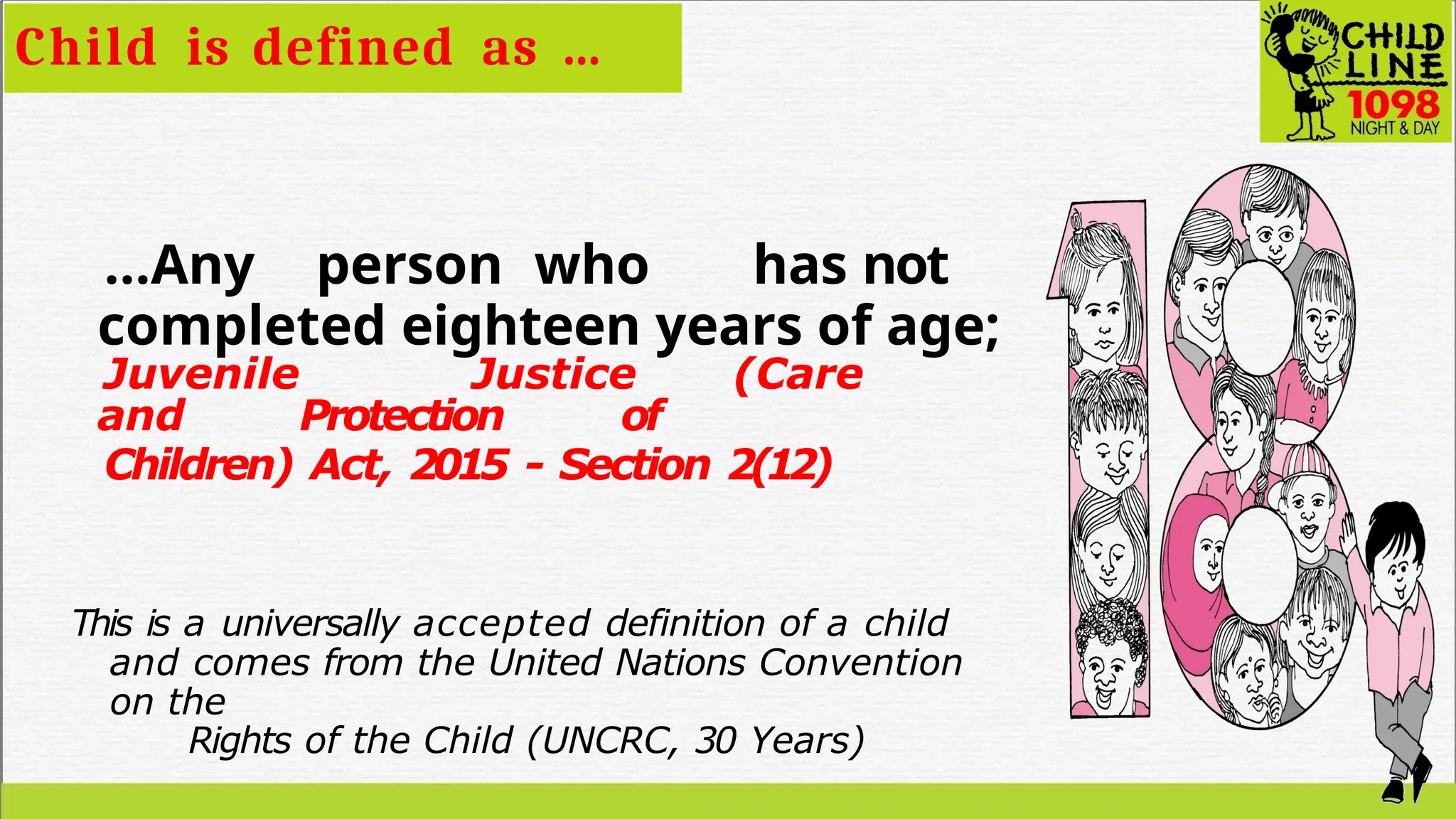
…Any person who has not
completed eighteen years of age;
Juvenile Justice (Care
and Protection of
Children) Act, 2015 - Section 2(12)
This is a universally accepted definition of a child
and comes from the United Nations Convention
on the
Rights of the Child (UNCRC, 30 Years)
Child is defined as …
Rights Vs Needs/Wants
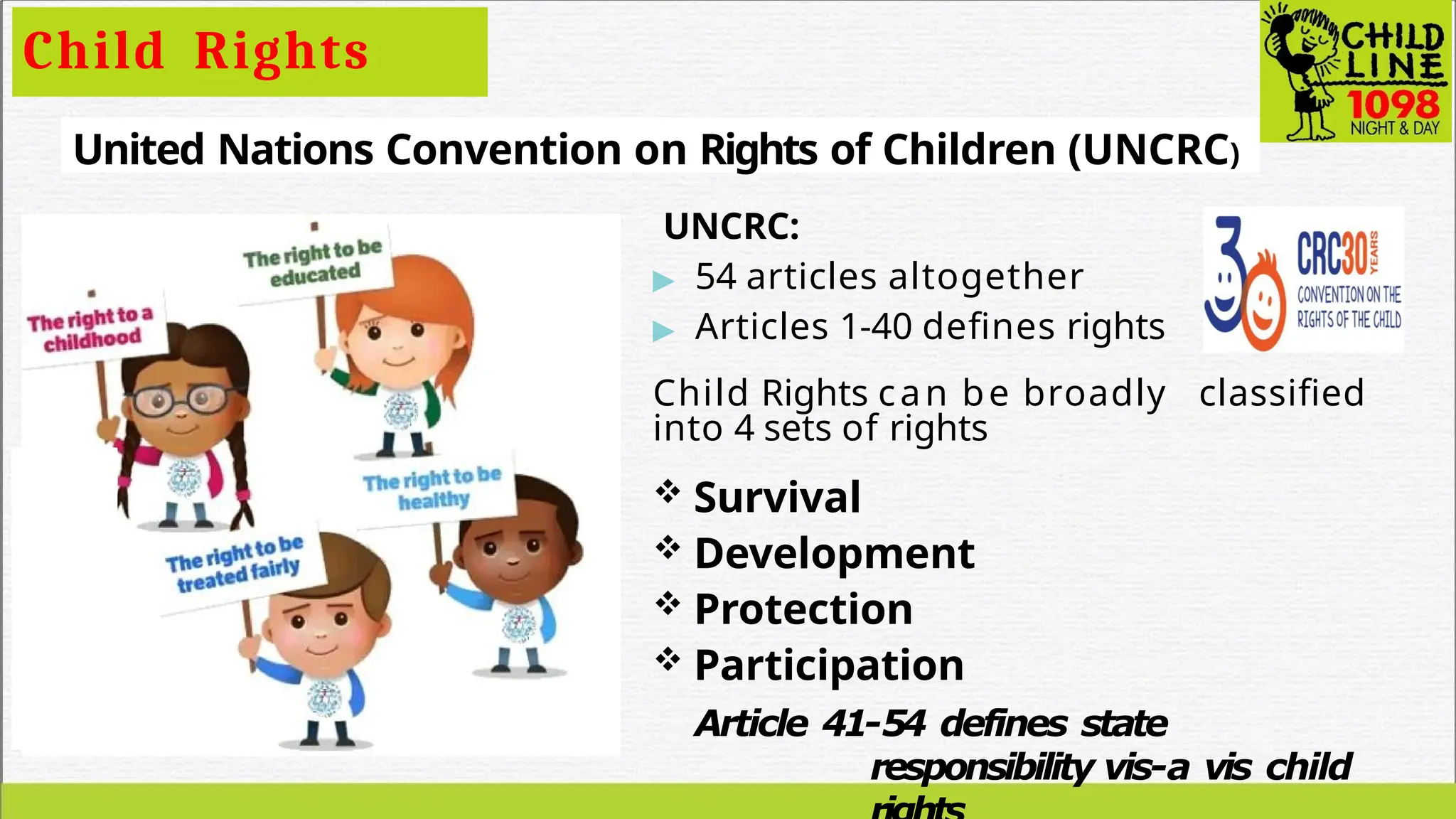
Child Rights
United Nations Convention on Rights of Children (UNCRC)
UNCRC:
▶ 54 articles altogether
▶ Articles 1-40 defines rights
Child Rights can be broadly classified
into 4 sets of rights
 Survival
 Development
 Protection
 Participation
Article 41-54 defines state
responsibility vis-a vis child
What is
Child
Abuse?
Child Abuse
Child abuse constitutes different forms….
Emotional
Sexual
Physical
Neglect
Resulting in actual or potential harm to the child’s
health,
survival, development or dignity
What is Child Sexual Abuse (CSA)?
Any act, using a child for sexual
Gratification of / by the more powerful
person
Acts of abuse may or may not include
touch
CSA takes place in the context of
a relationship where responsibility,
trust or power are abused by the
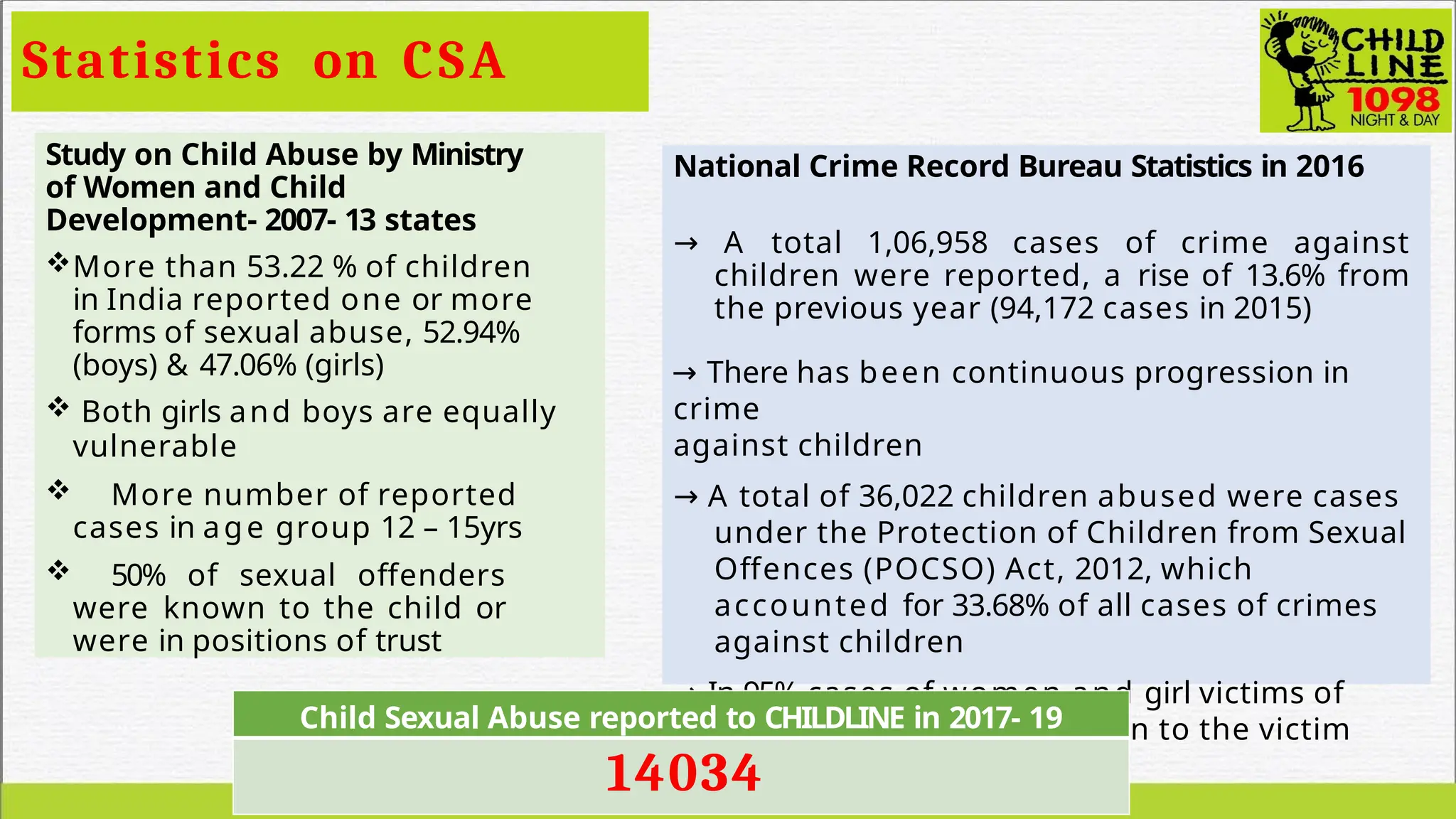
Statistics on CSA
Study on Child Abuse by Ministry
of Women and Child
Development- 2007- 13 states
More than 53.22 % of children
in India reported one or more
forms of sexual abuse, 52.94%
(boys) & 47.06% (girls)
 Both girls and boys are equally
vulnerable
 More number of reported
cases in age group 12 – 15yrs
 50% of sexual offenders
were known to the child or
were in positions of trust
National Crime Record Bureau Statistics in 2016
→ A total 1,06,958 cases of crime against
children were reported, a rise of 13.6% from
the previous year (94,172 cases in 2015)
→ There has been continuous progression in
crime
against children
→ A total of 36,022 children abused were cases
under the Protection of Children from Sexual
Offences (POCSO) Act, 2012, which
accounted for 33.68% of all cases of crimes
against children
→ In 95% cases of women and girl victims of
rape, offenders were known to the victim
Child Sexual Abuse reported to CHILDLINE in 2017- 19
14034
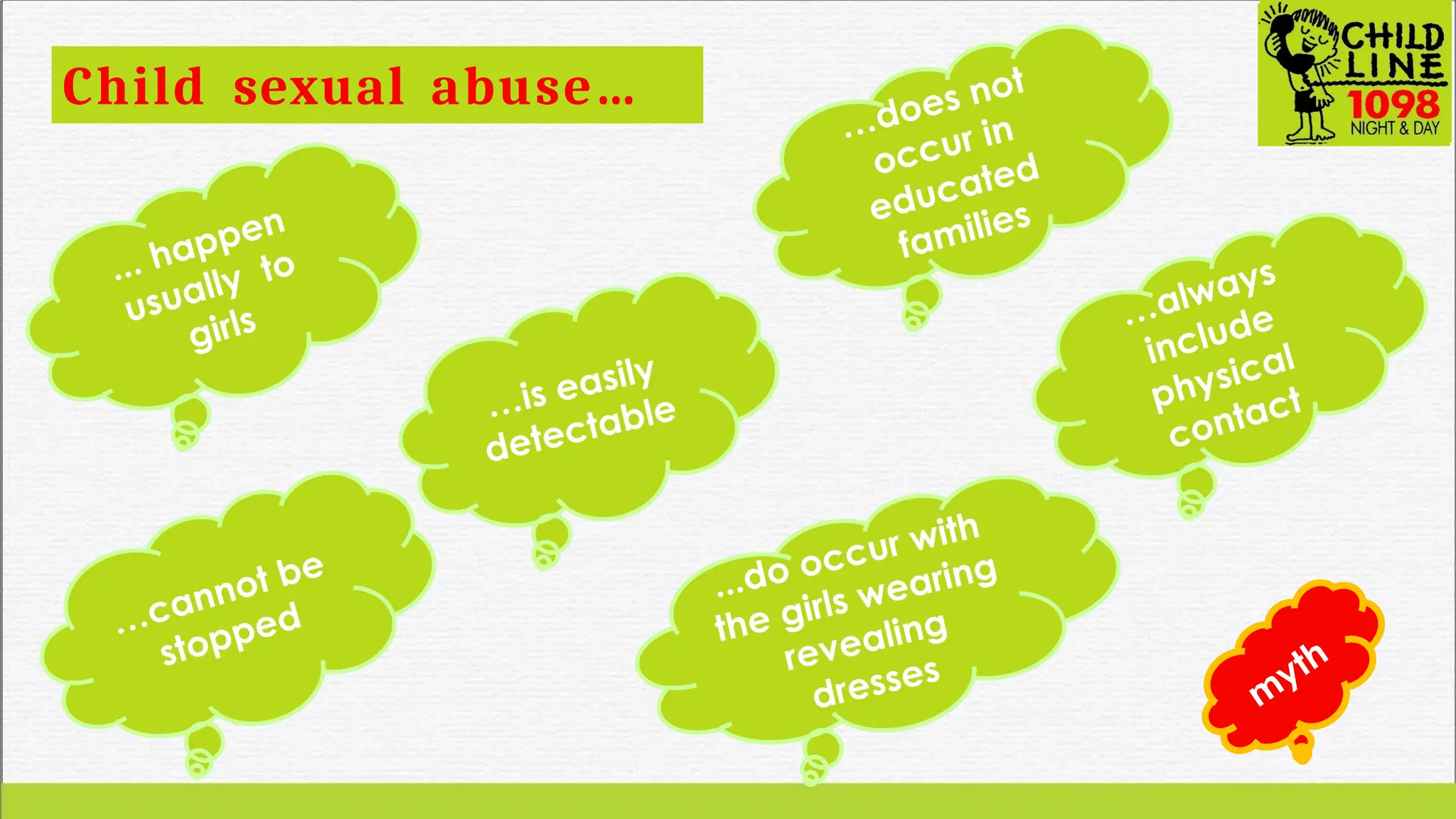
Child sexual abuse…
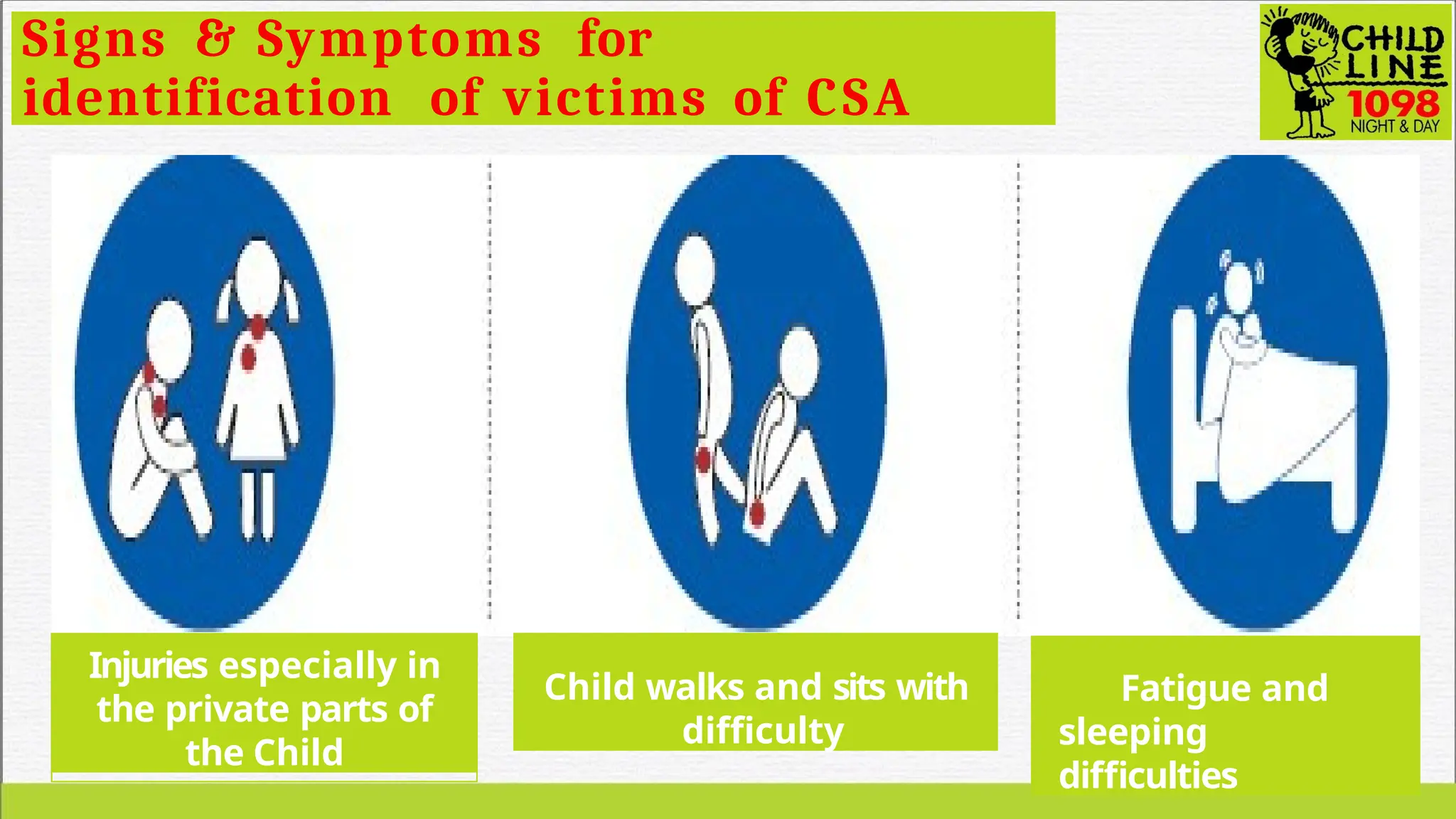
Injuries especially in
the private parts of
the Child
Child walks and sits with
difficulty
Fatigue and
sleeping
difficulties
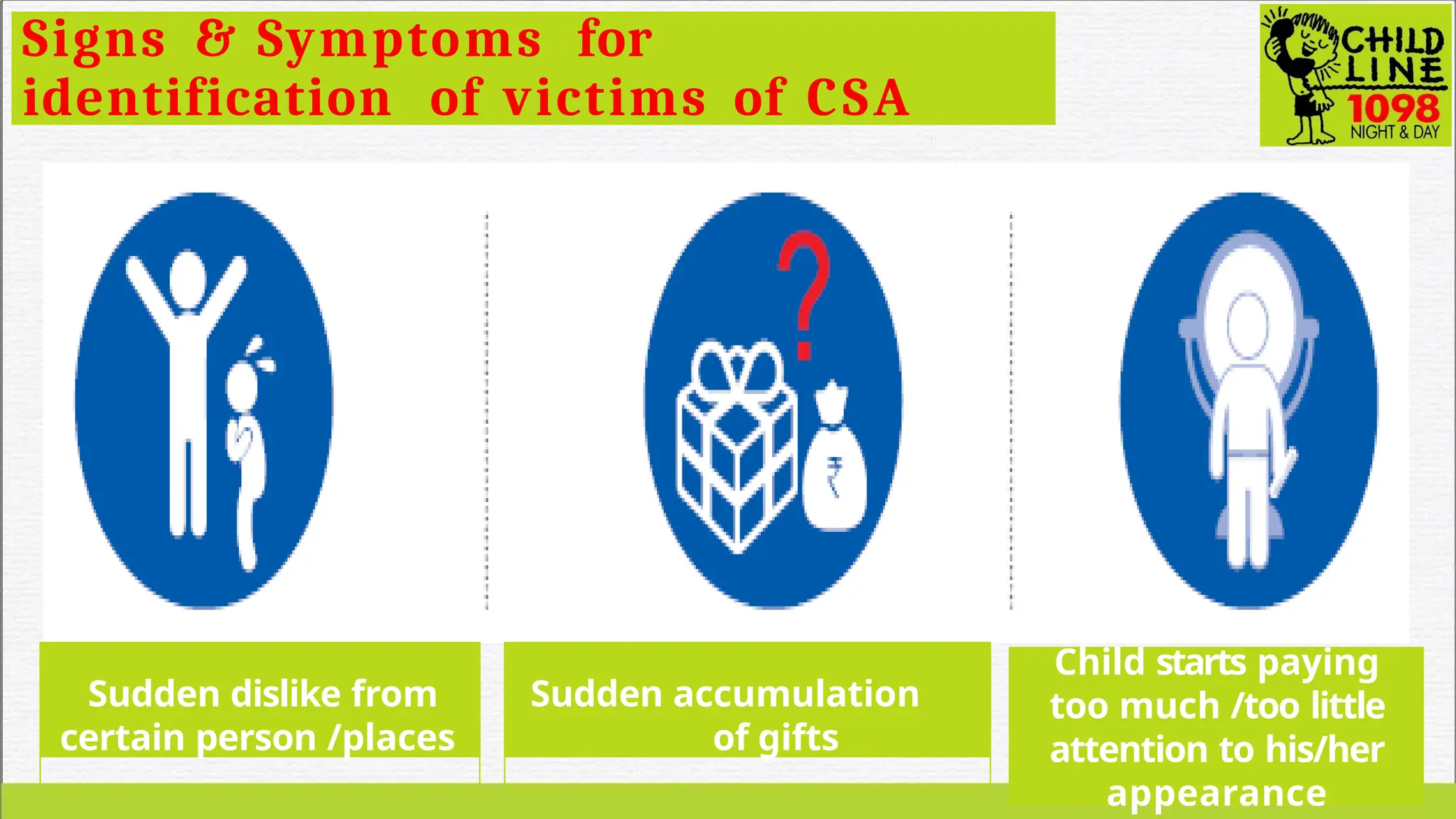
Signs & Symptoms for
identification of victims of CSA
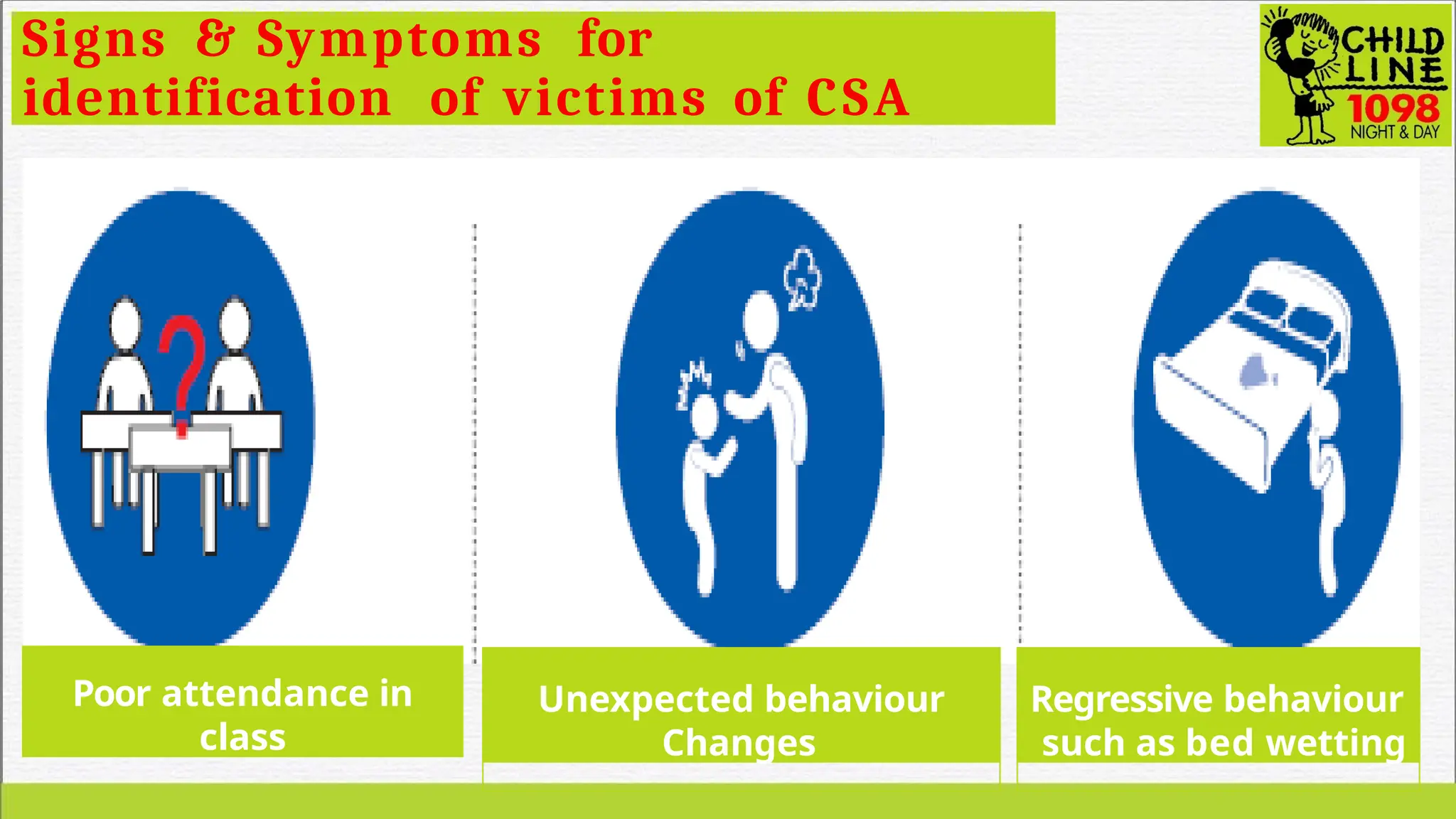
Signs & Symptoms for
identification of victims of CSA
Poor attendance in
class
Unexpected behaviour
Changes
Regressive behaviour
such as bed wetting
Signs & Symptoms for
identification of victims of CSA
Sudden dislike from
certain person /places
Sudden accumulation
of gifts
Child starts paying
too much /too little
attention to his/her
appearance
Protection Of Children from Sexual Offences
(POCSO)Act, 2012 , Amendment (2019)
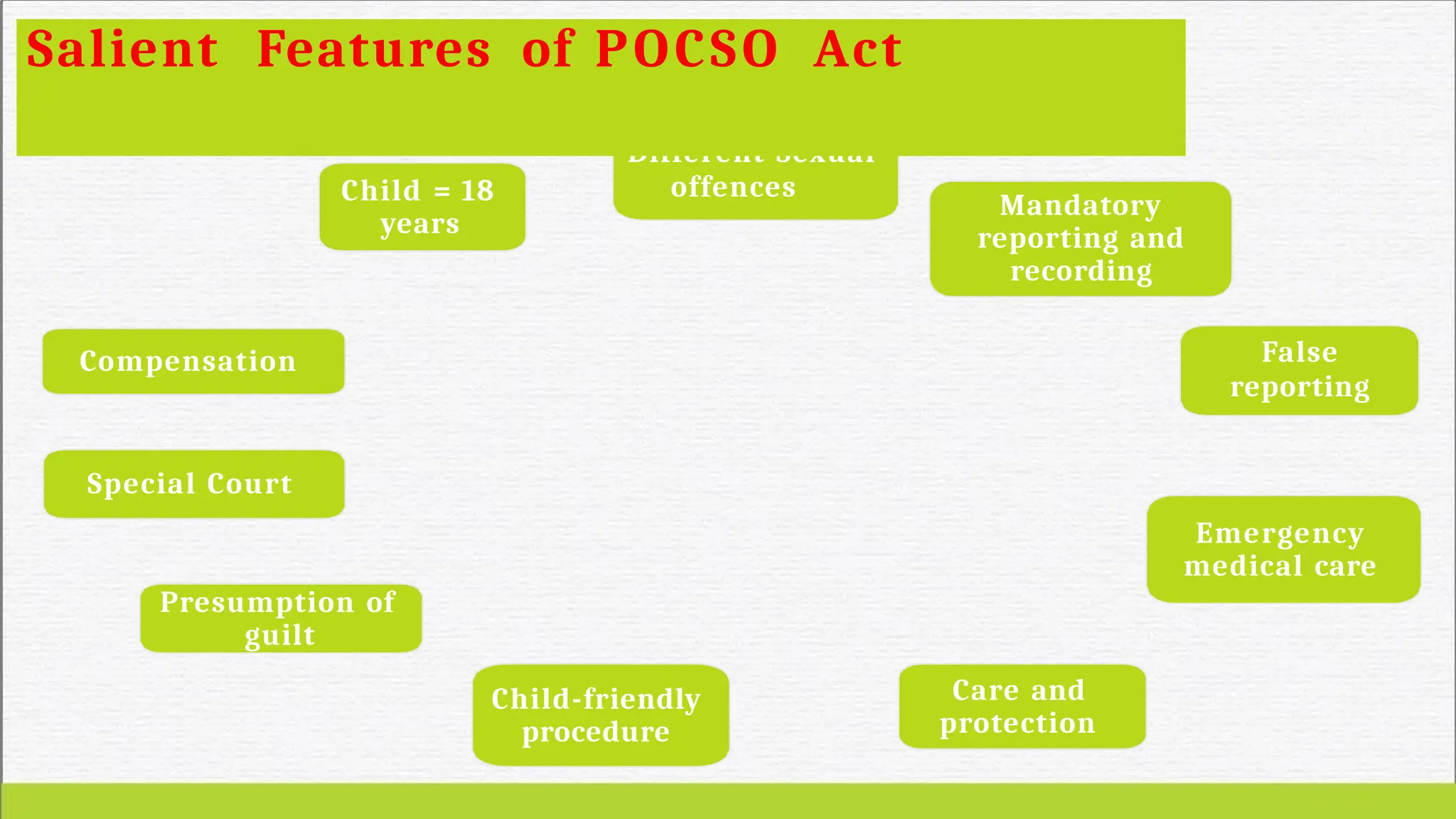
Different Sexual
offences
Mandatory
reporting and
recording
False
reporting
Emergency
medical care
Care and
protection
Child-friendly
procedure
Presumption of
guilt
Special Court
Compensation
Child = 18
years
Salient Features of POCSO Act
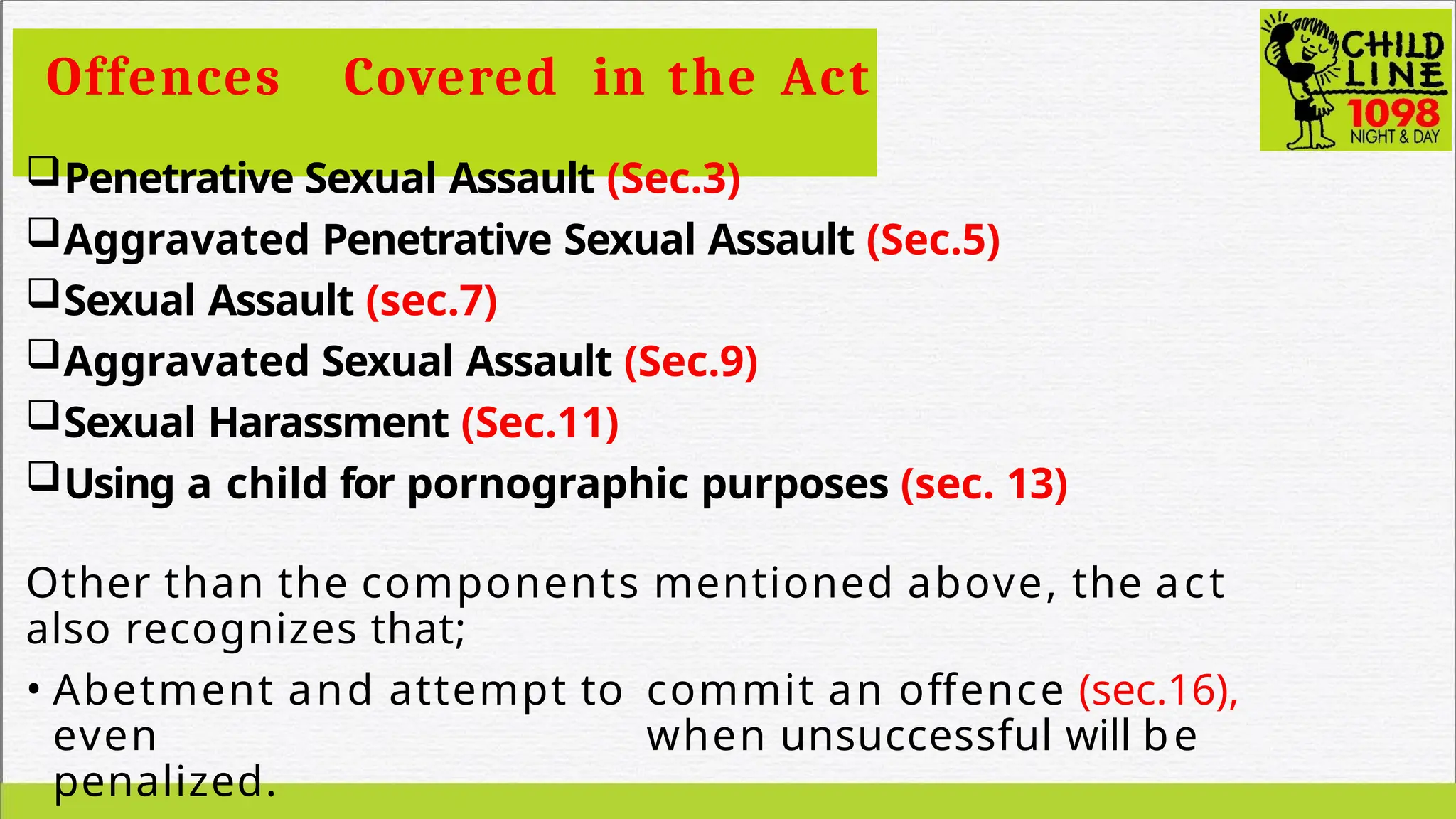
Offences Covered in the Act
Penetrative Sexual Assault (Sec.3)
Aggravated Penetrative Sexual Assault (Sec.5)
Sexual Assault (sec.7)
Aggravated Sexual Assault (Sec.9)
Sexual Harassment (Sec.11)
Using a child for pornographic purposes (sec. 13)
Other than the components mentioned above, the act
also recognizes that;
• Abetment and attempt to commit an offence (sec.16),
even when unsuccessful will be
penalized.
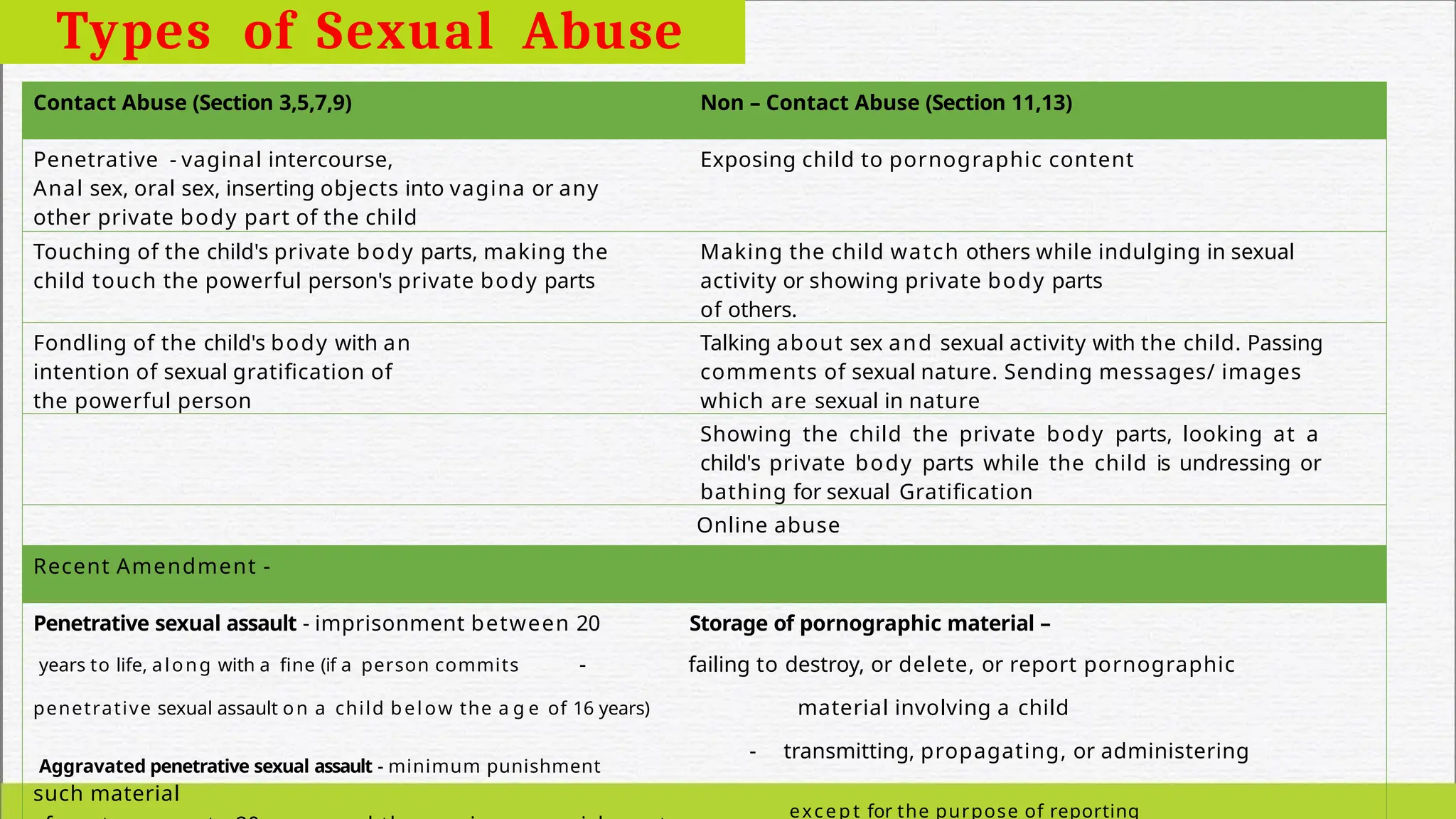
Types of Sexual Abuse
Contact Abuse (Section 3,5,7,9) Non – Contact Abuse (Section 11,13)
Penetrative - vaginal intercourse,
Anal sex, oral sex, inserting objects into vagina or any
other private body part of the child
Exposing child to pornographic content
Touching of the child's private body parts, making the
child touch the powerful person's private body parts
Making the child watch others while indulging in sexual
activity or showing private body parts
of others.
Fondling of the child's body with an
intention of sexual gratification of
the powerful person
Talking about sex and sexual activity with the child. Passing
comments of sexual nature. Sending messages/ images
which are sexual in nature
Showing the child the private body parts, looking at a
child's private body parts while the child is undressing or
bathing for sexual Gratification
Online abuse
Recent Amendment -
Penetrative sexual assault - imprisonment between 20 Storage of pornographic material –
years to life, along with a fine (if a person commits - failing to destroy, or delete, or report pornographic
penetrative sexual assault on a child below the a g e of 16 years) material involving a child
Aggravated penetrative sexual assault - minimum punishment
- transmitting, propagating, or administering
such material
excep t for the purpose of reporting
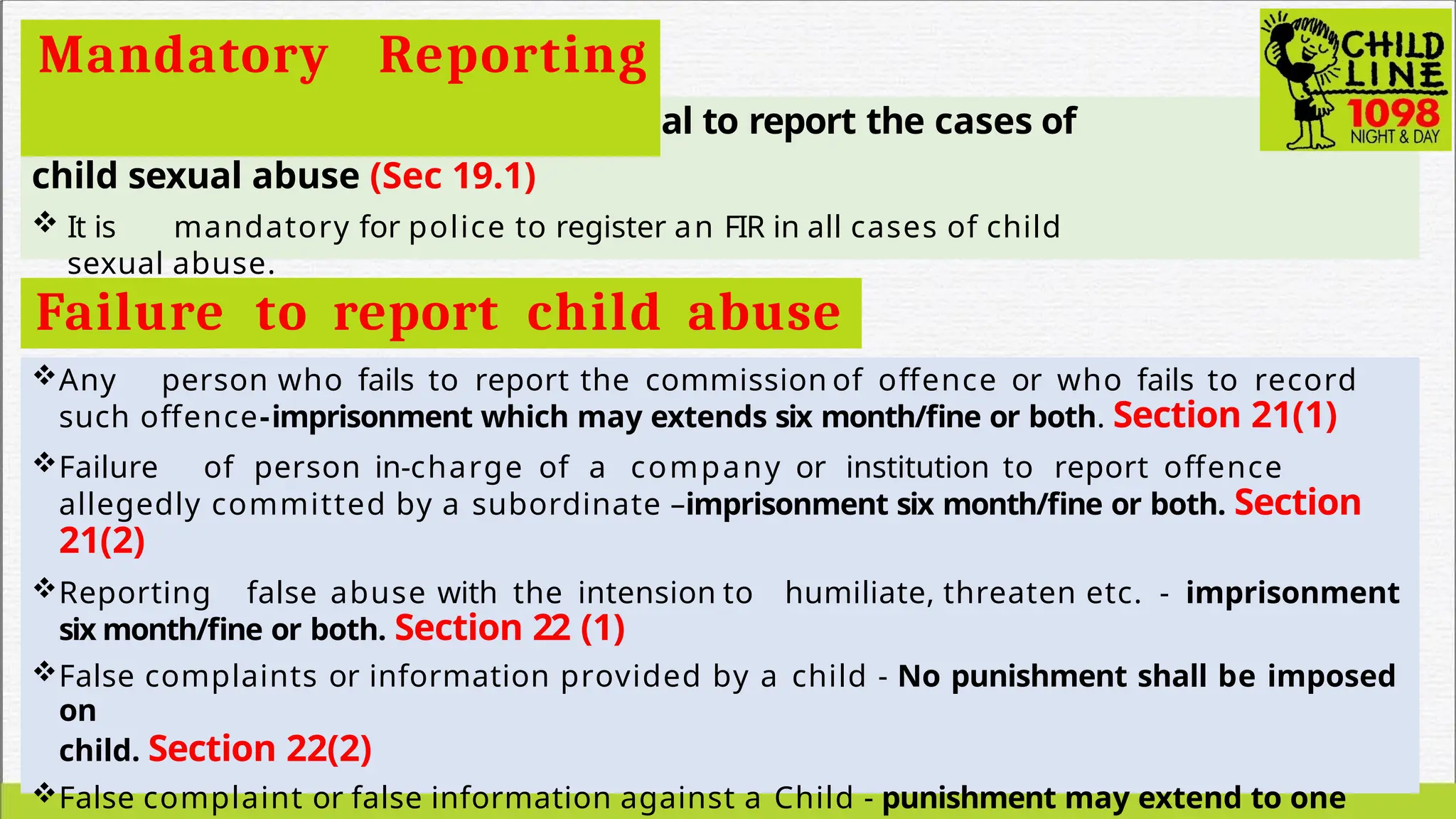
 It is mandatory for every individual to report the cases of
child sexual abuse (Sec 19.1)
 It is mandatory for police to register an FIR in all cases of child
sexual abuse.
Mandatory Reporting
Failure to report child abuse
Any person who fails to report the commission of offence or who fails to record
such offence-imprisonment which may extends six month/fine or both. Section 21(1)
Failure of person in-charge of a company or institution to report offence
allegedly committed by a subordinate –imprisonment six month/fine or both. Section
21(2)
Reporting false abuse with the intension to humiliate, threaten etc. - imprisonment
six month/fine or both. Section 22 (1)
False complaints or information provided by a child - No punishment shall be imposed
on
child. Section 22(2)
False complaint or false information against a Child - punishment may extend to one
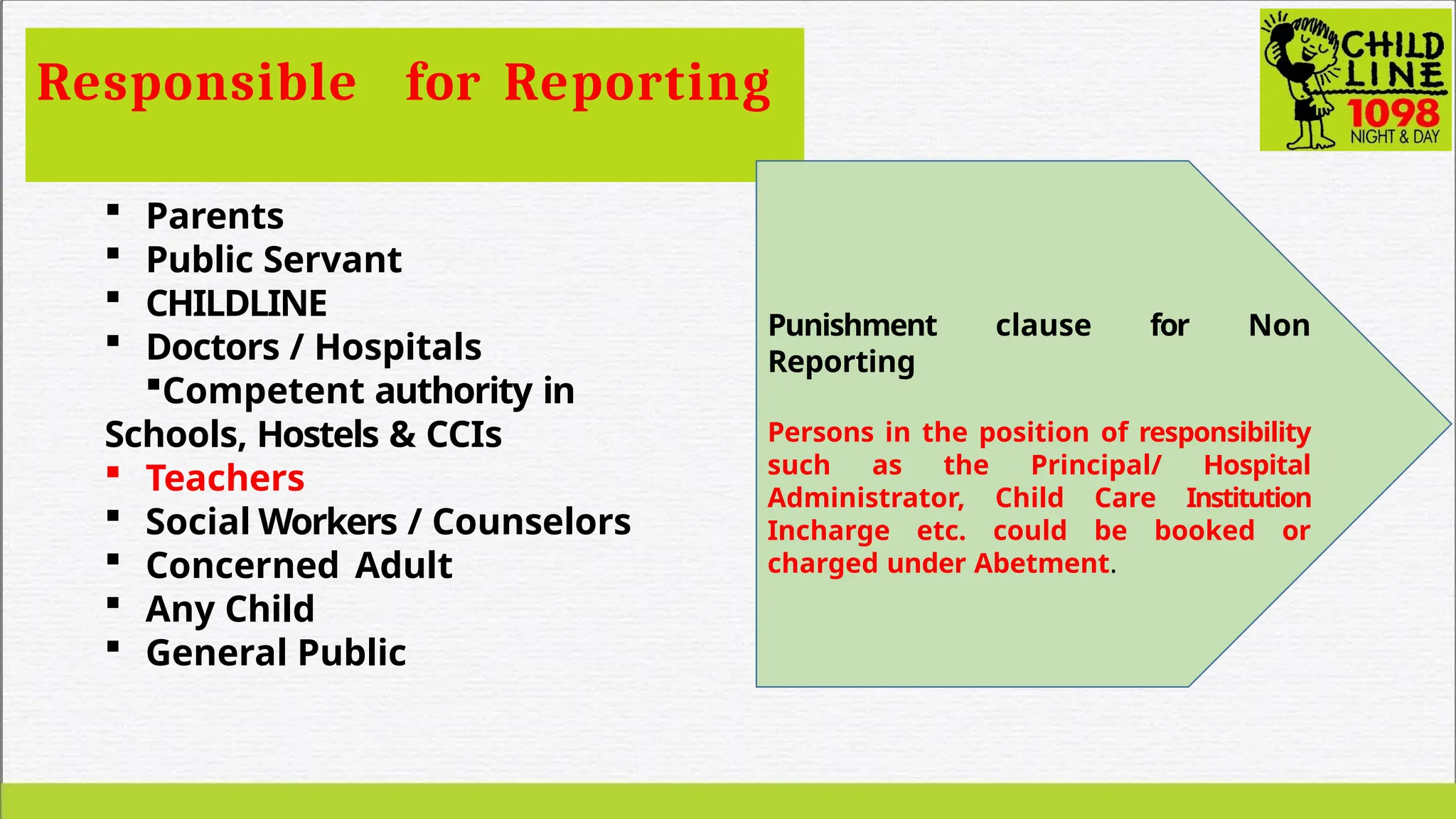
Responsible for Reporting
 Parents
 Public Servant
 CHILDLINE
 Doctors / Hospitals
Competent authority in
Schools, Hostels & CCIs
 Teachers
 Social Workers / Counselors
 Concerned Adult
 Any Child
 General Public
Punishment clause for Non
Reporting
Persons in the position of responsibility
such as the Principal/ Hospital
Administrator, Child Care Institution
Incharge etc. could be booked or
charged under Abetment.
Whom to Report?
Local Police/ Special Juvenile Police Unit
Child Welfare Committee
CHILDLINE 1098
State Commission for Protection of Child Rights (SCPCR)
National Commission for Protection of Child Rights (NCPCR)
- (e-box)- http://ncpcronline.info/OnlineForm/onlineform.aspx
Role of Schools in
Preventing Child
Sexual Abuse
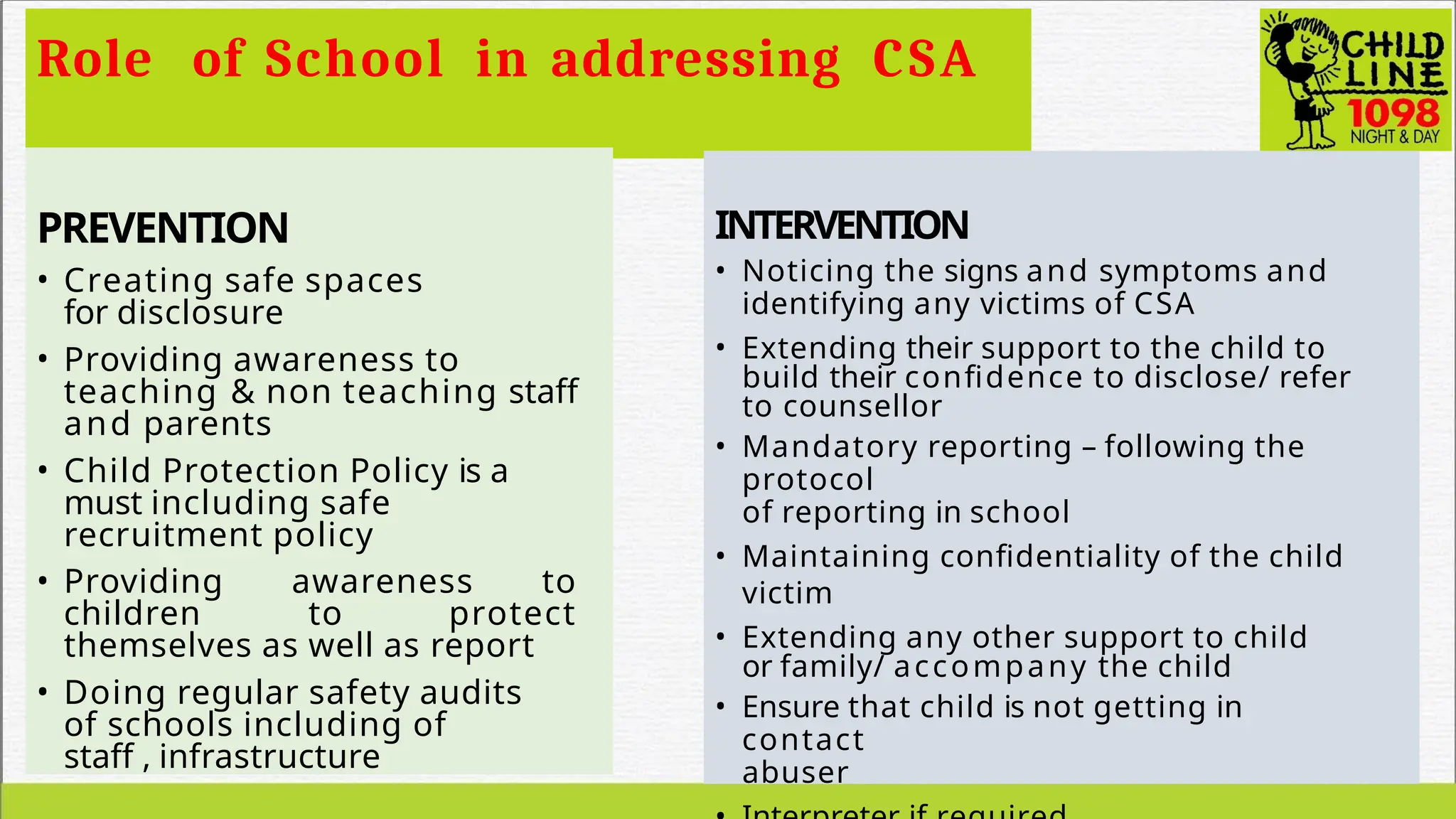
Role of School in addressing CSA
PREVENTION
• Creating safe spaces
for disclosure
• Providing awareness to
teaching & non teaching staff
and parents
• Child Protection Policy is a
must including safe
recruitment policy
• Providing awareness to
children to protect
themselves as well as report
• Doing regular safety audits
of schools including of
staff , infrastructure
INTERVENTION
• Noticing the signs and symptoms and
identifying any victims of CSA
• Extending their support to the child to
build their confidence to disclose/ refer
to counsellor
• Mandatory reporting – following the
protocol
of reporting in school
• Maintaining confidentiality of the child
victim
• Extending any other support to child
or family/ accompany the child
• Ensure that child is not getting in
contact
abuser
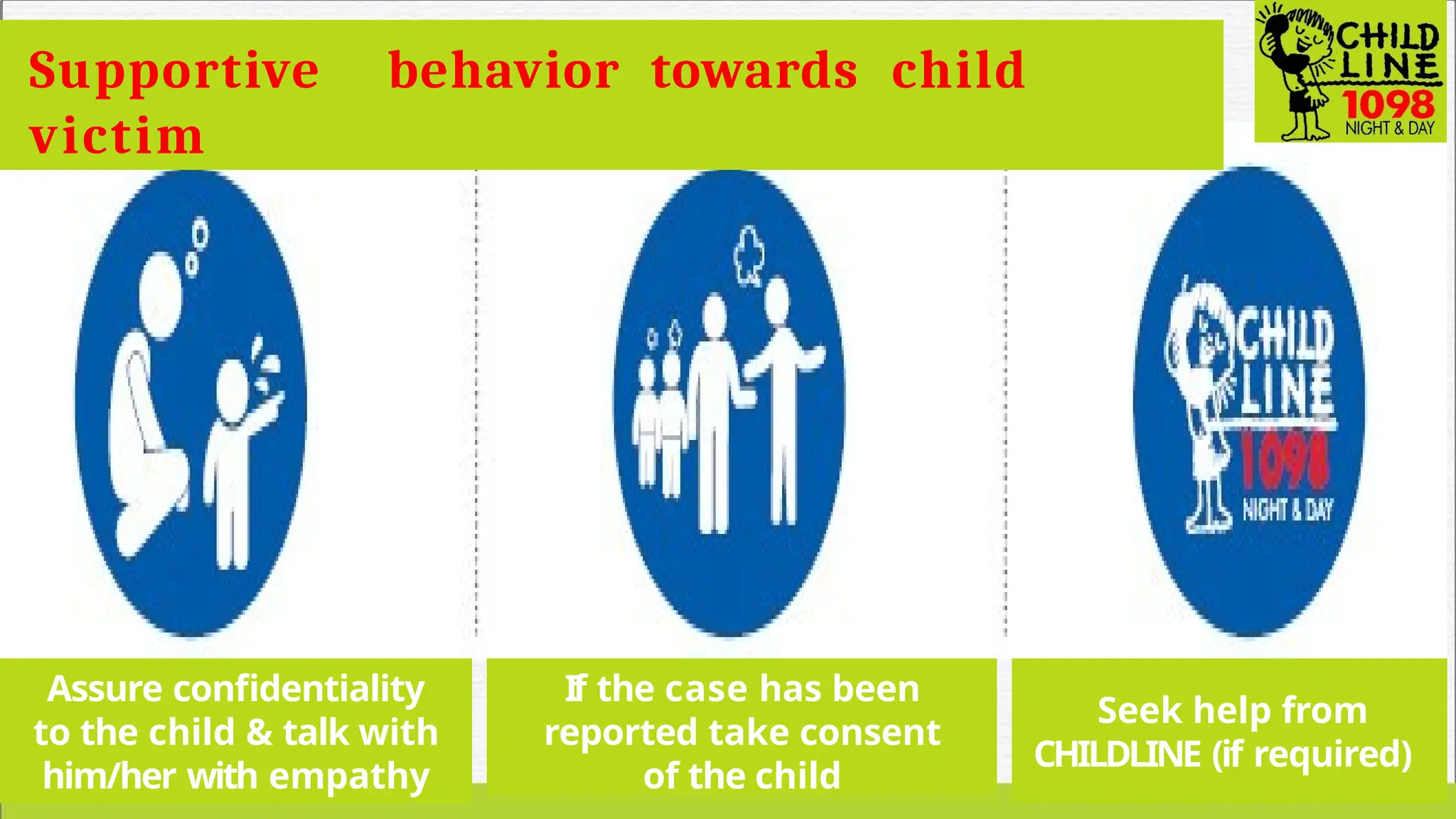
Supportive behavior towards child
victim
Assure confidentiality
to the child & talk with
him/her with empathy
If the case has been
reported take consent
of the child
Seek help from
CHILDLINE (if required)
Supportive behavior towards child
victim
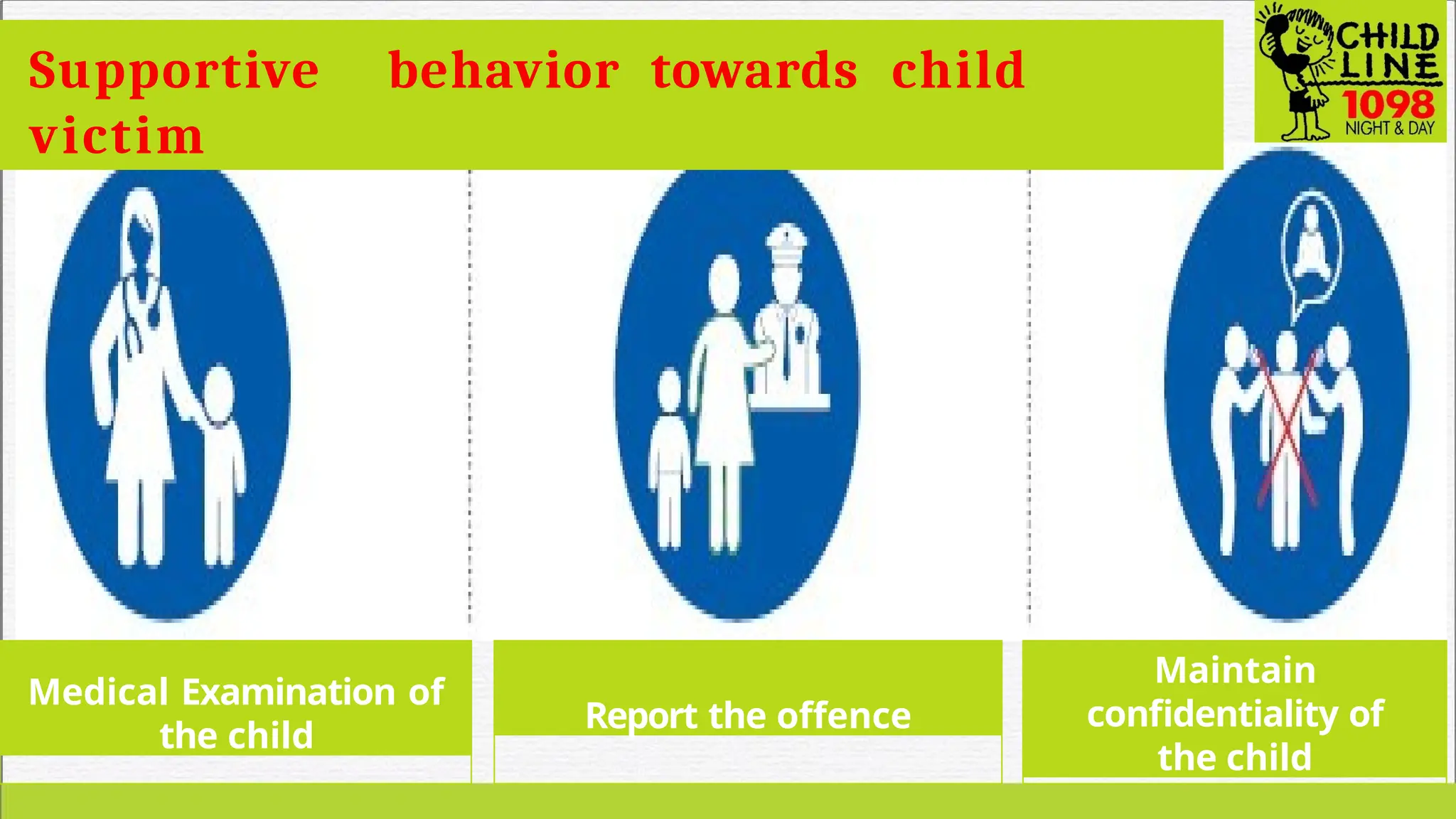
Medical Examination of
the child
Report the offence
Maintain
confidentiality of
the child
Unsupportive behavior towards child victim
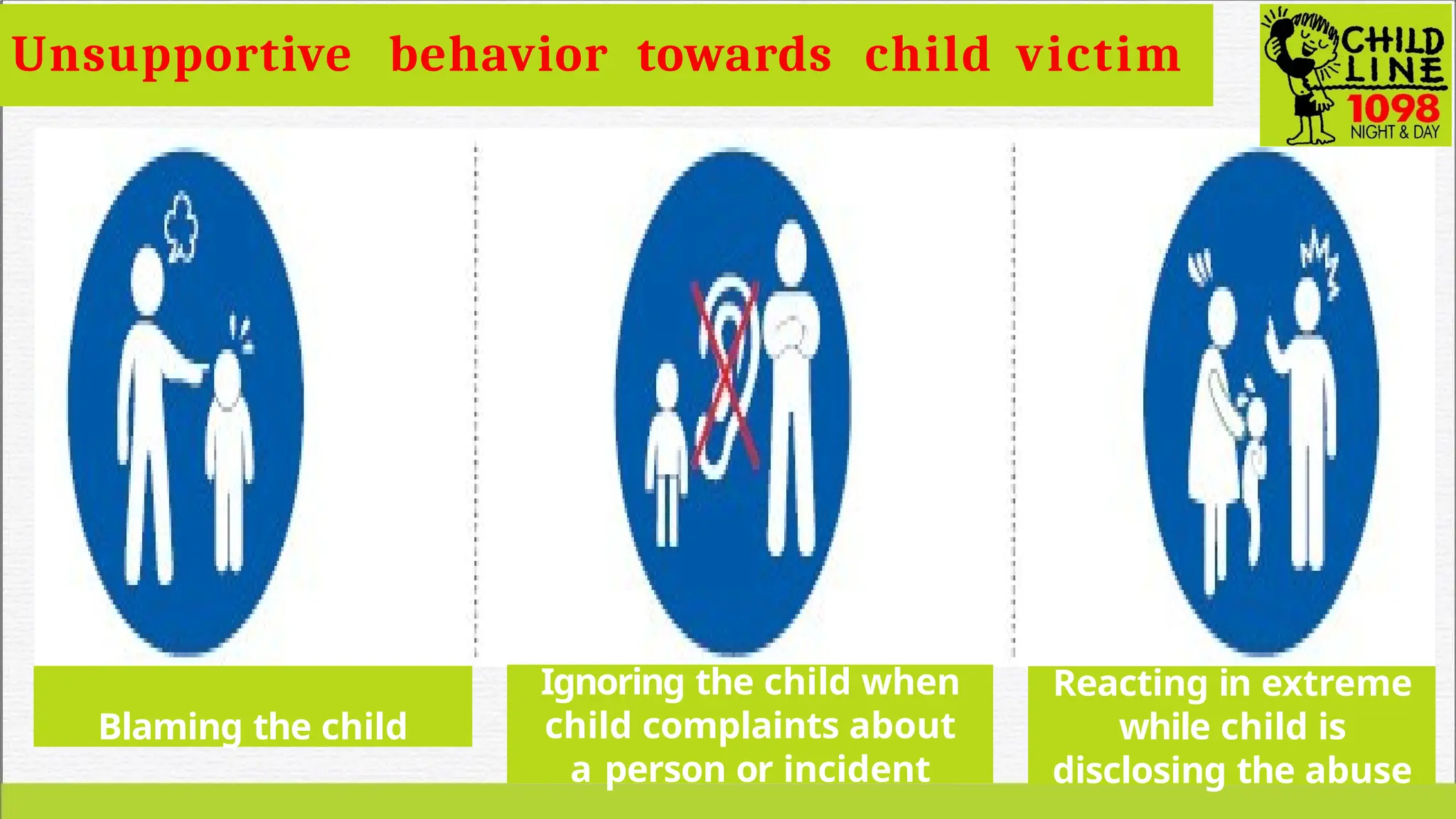
Blaming the child
Reacting in extreme
while child is
disclosing the abuse
Ignoring the child when
child complaints about
a person or incident
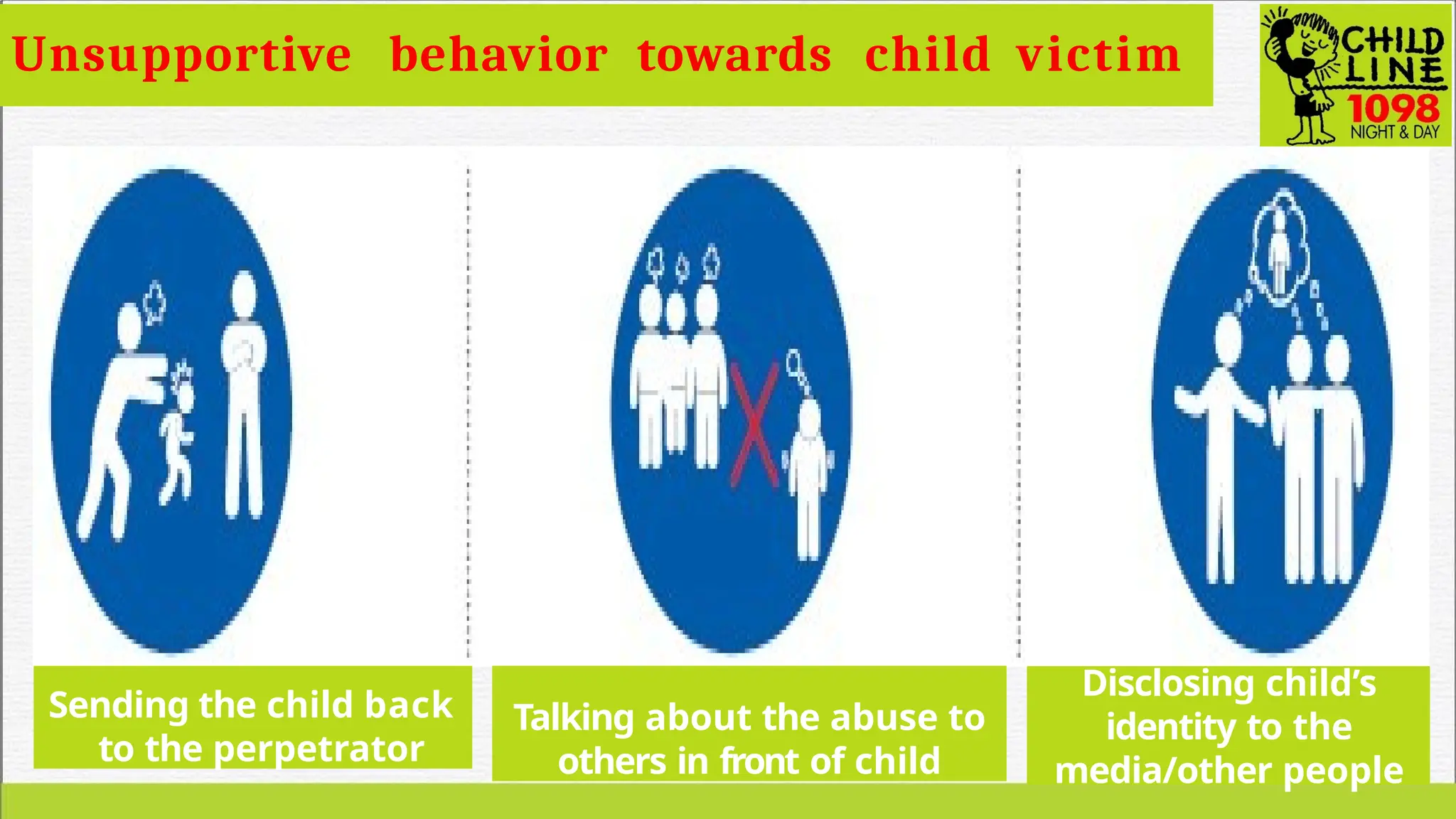
Sending the child back
to the perpetrator
Talking about the abuse to
others in front of child
Disclosing child’s
identity to the
media/other people
Unsupportive behavior towards child victim
Contact us..
• Write to: dial1098@childlineindia.org.in
• http://www.childlineindia.org.in
Thank
You…!

Law is a set of rules that are created and are enforceable by social

  • 1.
    Understanding - TheProtection Of Children from Sexual Offences (POCSO) Act 2012 and Child Sexual Abuse (CSA) CHILDLINE India Foundation Supported by Ministry of Women & Child Development Government of India
  • 2.
  • 3.
    …Any person whohas not completed eighteen years of age; Juvenile Justice (Care and Protection of Children) Act, 2015 - Section 2(12) This is a universally accepted definition of a child and comes from the United Nations Convention on the Rights of the Child (UNCRC, 30 Years) Child is defined as …
  • 4.
  • 5.
    Child Rights United NationsConvention on Rights of Children (UNCRC) UNCRC: ▶ 54 articles altogether ▶ Articles 1-40 defines rights Child Rights can be broadly classified into 4 sets of rights  Survival  Development  Protection  Participation Article 41-54 defines state responsibility vis-a vis child
  • 6.
  • 7.
    Child Abuse Child abuseconstitutes different forms…. Emotional Sexual Physical Neglect Resulting in actual or potential harm to the child’s health, survival, development or dignity
  • 8.
    What is ChildSexual Abuse (CSA)? Any act, using a child for sexual Gratification of / by the more powerful person Acts of abuse may or may not include touch CSA takes place in the context of a relationship where responsibility, trust or power are abused by the
  • 9.
    Statistics on CSA Studyon Child Abuse by Ministry of Women and Child Development- 2007- 13 states More than 53.22 % of children in India reported one or more forms of sexual abuse, 52.94% (boys) & 47.06% (girls)  Both girls and boys are equally vulnerable  More number of reported cases in age group 12 – 15yrs  50% of sexual offenders were known to the child or were in positions of trust National Crime Record Bureau Statistics in 2016 → A total 1,06,958 cases of crime against children were reported, a rise of 13.6% from the previous year (94,172 cases in 2015) → There has been continuous progression in crime against children → A total of 36,022 children abused were cases under the Protection of Children from Sexual Offences (POCSO) Act, 2012, which accounted for 33.68% of all cases of crimes against children → In 95% cases of women and girl victims of rape, offenders were known to the victim Child Sexual Abuse reported to CHILDLINE in 2017- 19 14034
  • 10.
  • 11.
    Injuries especially in theprivate parts of the Child Child walks and sits with difficulty Fatigue and sleeping difficulties Signs & Symptoms for identification of victims of CSA
  • 12.
    Signs & Symptomsfor identification of victims of CSA Poor attendance in class Unexpected behaviour Changes Regressive behaviour such as bed wetting
  • 13.
    Signs & Symptomsfor identification of victims of CSA Sudden dislike from certain person /places Sudden accumulation of gifts Child starts paying too much /too little attention to his/her appearance
  • 15.
    Protection Of Childrenfrom Sexual Offences (POCSO)Act, 2012 , Amendment (2019)
  • 16.
    Different Sexual offences Mandatory reporting and recording False reporting Emergency medicalcare Care and protection Child-friendly procedure Presumption of guilt Special Court Compensation Child = 18 years Salient Features of POCSO Act
  • 17.
    Offences Covered inthe Act Penetrative Sexual Assault (Sec.3) Aggravated Penetrative Sexual Assault (Sec.5) Sexual Assault (sec.7) Aggravated Sexual Assault (Sec.9) Sexual Harassment (Sec.11) Using a child for pornographic purposes (sec. 13) Other than the components mentioned above, the act also recognizes that; • Abetment and attempt to commit an offence (sec.16), even when unsuccessful will be penalized.
  • 18.
    Types of SexualAbuse Contact Abuse (Section 3,5,7,9) Non – Contact Abuse (Section 11,13) Penetrative - vaginal intercourse, Anal sex, oral sex, inserting objects into vagina or any other private body part of the child Exposing child to pornographic content Touching of the child's private body parts, making the child touch the powerful person's private body parts Making the child watch others while indulging in sexual activity or showing private body parts of others. Fondling of the child's body with an intention of sexual gratification of the powerful person Talking about sex and sexual activity with the child. Passing comments of sexual nature. Sending messages/ images which are sexual in nature Showing the child the private body parts, looking at a child's private body parts while the child is undressing or bathing for sexual Gratification Online abuse Recent Amendment - Penetrative sexual assault - imprisonment between 20 Storage of pornographic material – years to life, along with a fine (if a person commits - failing to destroy, or delete, or report pornographic penetrative sexual assault on a child below the a g e of 16 years) material involving a child Aggravated penetrative sexual assault - minimum punishment - transmitting, propagating, or administering such material excep t for the purpose of reporting
  • 19.
     It ismandatory for every individual to report the cases of child sexual abuse (Sec 19.1)  It is mandatory for police to register an FIR in all cases of child sexual abuse. Mandatory Reporting Failure to report child abuse Any person who fails to report the commission of offence or who fails to record such offence-imprisonment which may extends six month/fine or both. Section 21(1) Failure of person in-charge of a company or institution to report offence allegedly committed by a subordinate –imprisonment six month/fine or both. Section 21(2) Reporting false abuse with the intension to humiliate, threaten etc. - imprisonment six month/fine or both. Section 22 (1) False complaints or information provided by a child - No punishment shall be imposed on child. Section 22(2) False complaint or false information against a Child - punishment may extend to one
  • 20.
    Responsible for Reporting Parents  Public Servant  CHILDLINE  Doctors / Hospitals Competent authority in Schools, Hostels & CCIs  Teachers  Social Workers / Counselors  Concerned Adult  Any Child  General Public Punishment clause for Non Reporting Persons in the position of responsibility such as the Principal/ Hospital Administrator, Child Care Institution Incharge etc. could be booked or charged under Abetment.
  • 21.
    Whom to Report? LocalPolice/ Special Juvenile Police Unit Child Welfare Committee CHILDLINE 1098 State Commission for Protection of Child Rights (SCPCR) National Commission for Protection of Child Rights (NCPCR) - (e-box)- http://ncpcronline.info/OnlineForm/onlineform.aspx
  • 22.
    Role of Schoolsin Preventing Child Sexual Abuse
  • 23.
    Role of Schoolin addressing CSA PREVENTION • Creating safe spaces for disclosure • Providing awareness to teaching & non teaching staff and parents • Child Protection Policy is a must including safe recruitment policy • Providing awareness to children to protect themselves as well as report • Doing regular safety audits of schools including of staff , infrastructure INTERVENTION • Noticing the signs and symptoms and identifying any victims of CSA • Extending their support to the child to build their confidence to disclose/ refer to counsellor • Mandatory reporting – following the protocol of reporting in school • Maintaining confidentiality of the child victim • Extending any other support to child or family/ accompany the child • Ensure that child is not getting in contact abuser
  • 24.
    Supportive behavior towardschild victim Assure confidentiality to the child & talk with him/her with empathy If the case has been reported take consent of the child Seek help from CHILDLINE (if required)
  • 25.
    Supportive behavior towardschild victim Medical Examination of the child Report the offence Maintain confidentiality of the child
  • 26.
    Unsupportive behavior towardschild victim Blaming the child Reacting in extreme while child is disclosing the abuse Ignoring the child when child complaints about a person or incident
  • 27.
    Sending the childback to the perpetrator Talking about the abuse to others in front of child Disclosing child’s identity to the media/other people Unsupportive behavior towards child victim
  • 28.
    Contact us.. • Writeto: dial1098@childlineindia.org.in • http://www.childlineindia.org.in Thank You…!