Launching a Management
       Consulting Practice

             A Webinar Conducted by
        Mark R. Haas CMC, FIMC
IMC USA Academy for Professional Development
                October 20, 2009
Desired Outcomes
1.    Understand Management Consulting
        Profession, Industry, Consultant, Client
2.    Understand How to Become a Consultant
        Competency framework
        Starting a consulting business
3.    Understand How to Be a Consultant
        Marketing and selling services
        Delivering consulting services
        Managing the consulting business
4.    Decide If Consulting Is For You
        Lifestyle, risks, alternatives, benefits and costs

10/20/2009          Institute of Management Consultants USA   2
Part 1: Understand Management Consulting
   Why Does Management Consulting Exist?
   What is Management Consulting?
   Where Does a Consultant Work?
   What Does a Consultant Do?
   How Is Consulting Changing?


10/20/2009     Institute of Management Consultants USA   3
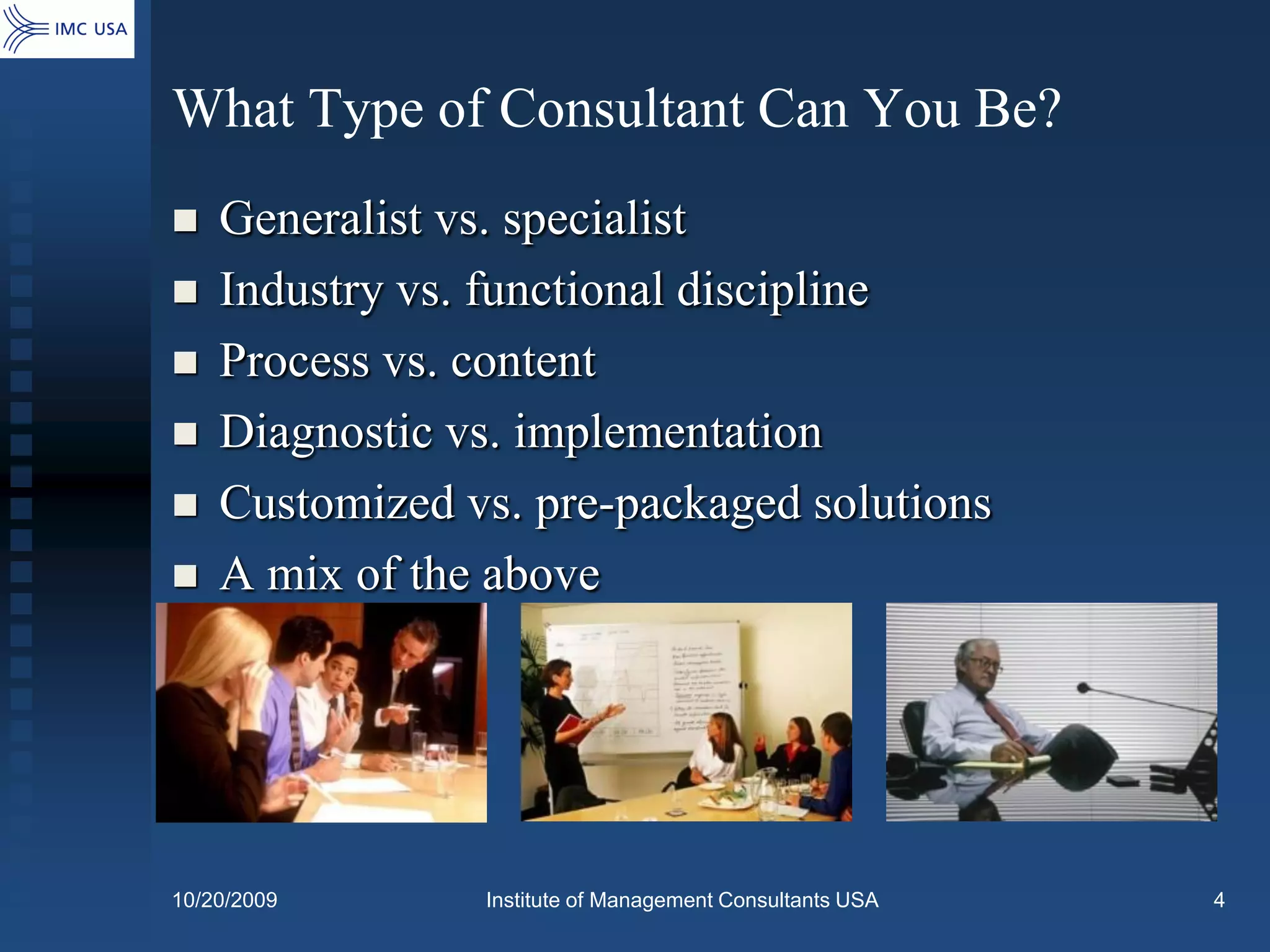
What Type of Consultant Can You Be?
   Generalist vs. specialist
   Industry vs. functional discipline
   Process vs. content
   Diagnostic vs. implementation
   Customized vs. pre-packaged solutions
   A mix of the above


10/20/2009      Institute of Management Consultants USA   4
Consulting Experiences Vary Considerably
   Facilitate kickoff planning for US military’s World War
    IV “Cognitive Dominance” strategy
   Assess operations and advise reorganization of the
    world’s largest biomedical research enterprise
   Facilitate planning to recover commercial operations after
    nuclear terrorism in LA
   Reorganize a major city school system
   Advise on governance and operations at an environmental
    nonprofit
   Develop a business plan/strategy for health care startup
   Revitalize administration and programs for a national
    volunteer organization
10/20/2009         Institute of Management Consultants USA       5
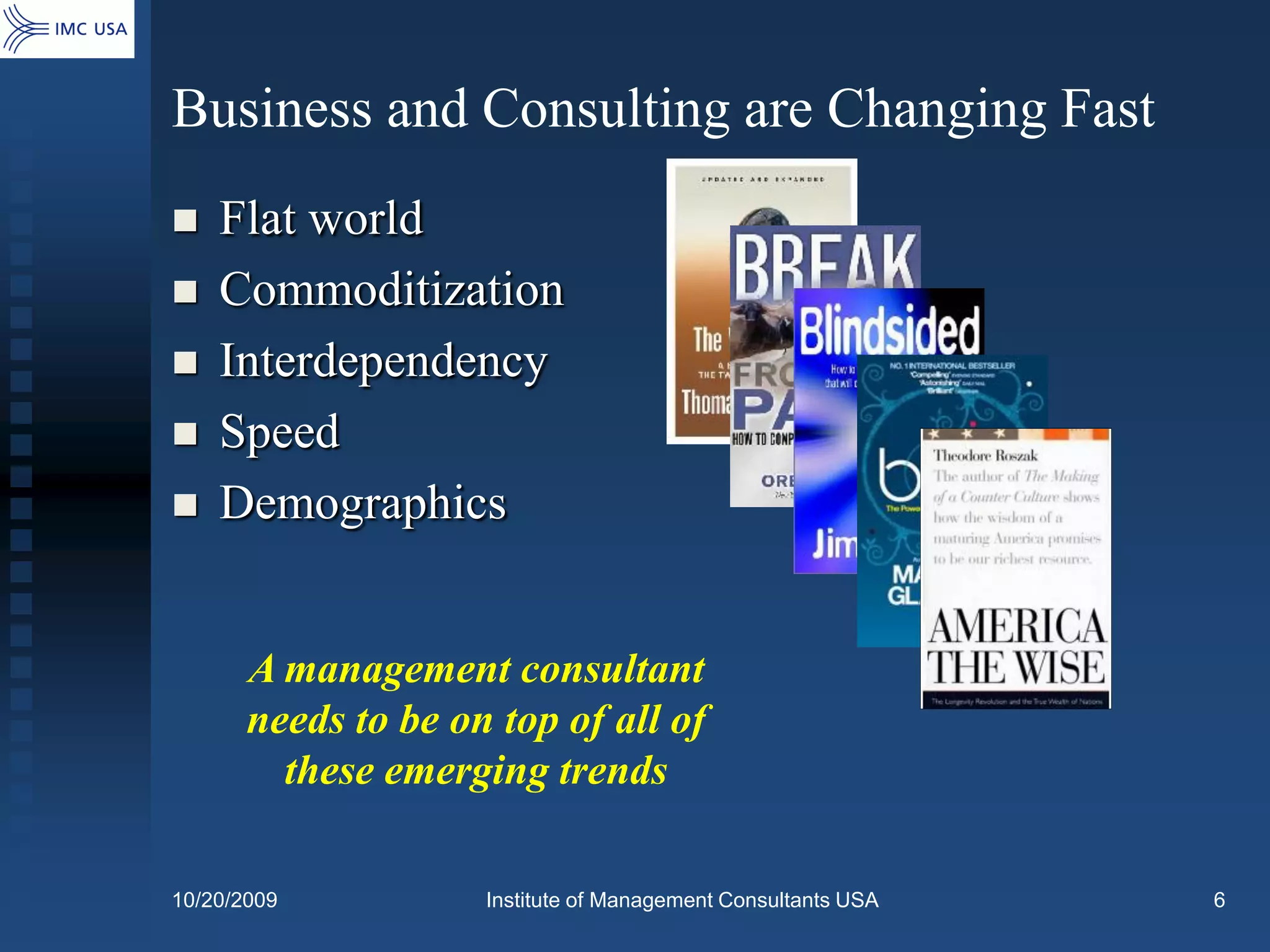
Business and Consulting are Changing Fast
   Flat world
   Commoditization
   Interdependency
   Speed
   Demographics


       A management consultant
       needs to be on top of all of
         these emerging trends

10/20/2009           Institute of Management Consultants USA   6
Part 2: How to Become a Consultant
   The “What” and “How” of consulting
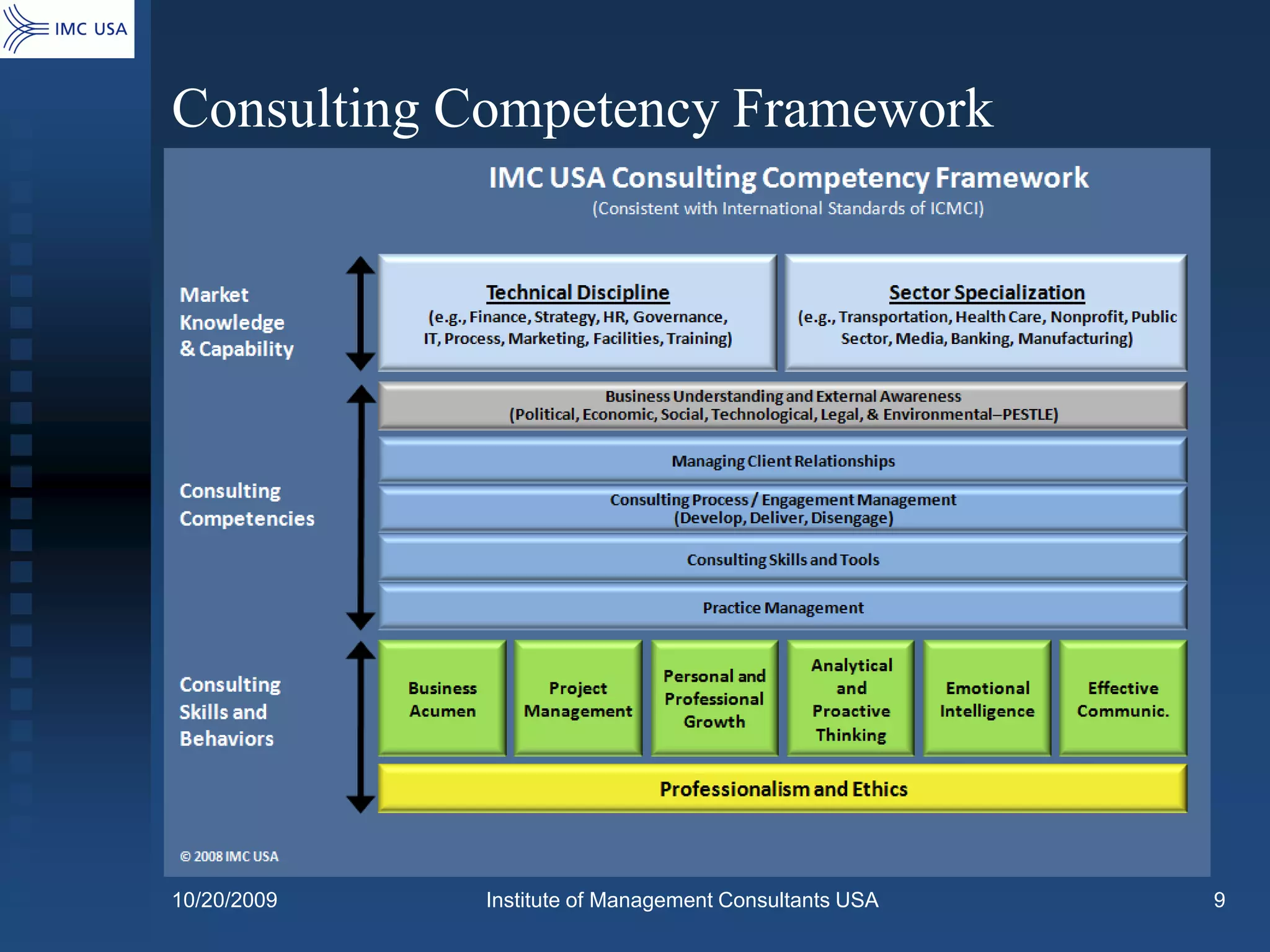
   Consulting competency framework
   Professionalism and ethics
   The consultant’s reputation
   Certification


10/20/2009      Institute of Management Consultants USA   7
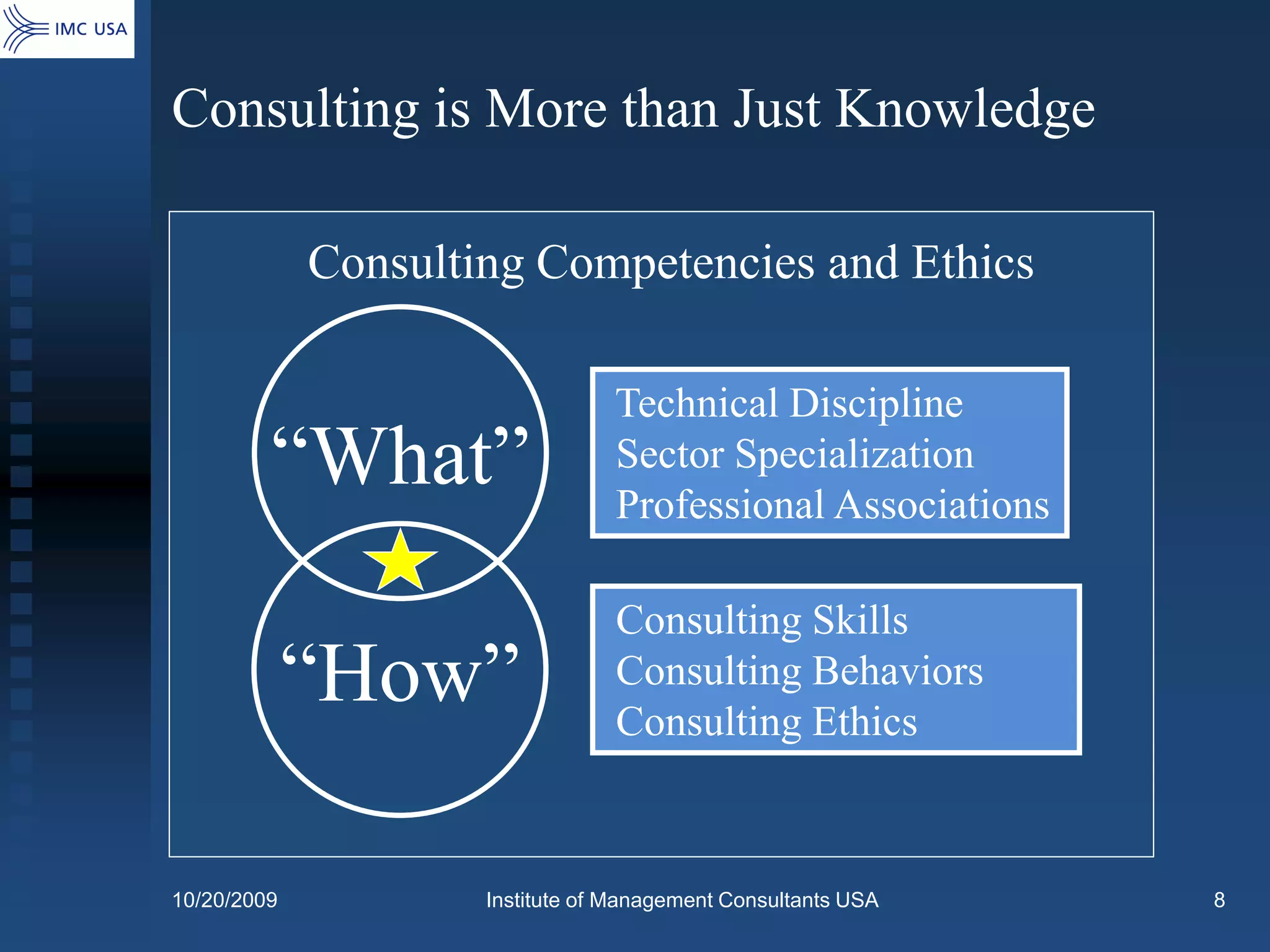
Consulting is More than Just Knowledge

             Consulting Competencies and Ethics

                                 Technical Discipline
         “What”                  Sector Specialization
                                 Professional Associations

                                 Consulting Skills
             “How”               Consulting Behaviors
                                 Consulting Ethics


10/20/2009           Institute of Management Consultants USA   8
Consulting Competency Framework


10/20/2009   Institute of Management Consultants USA   9
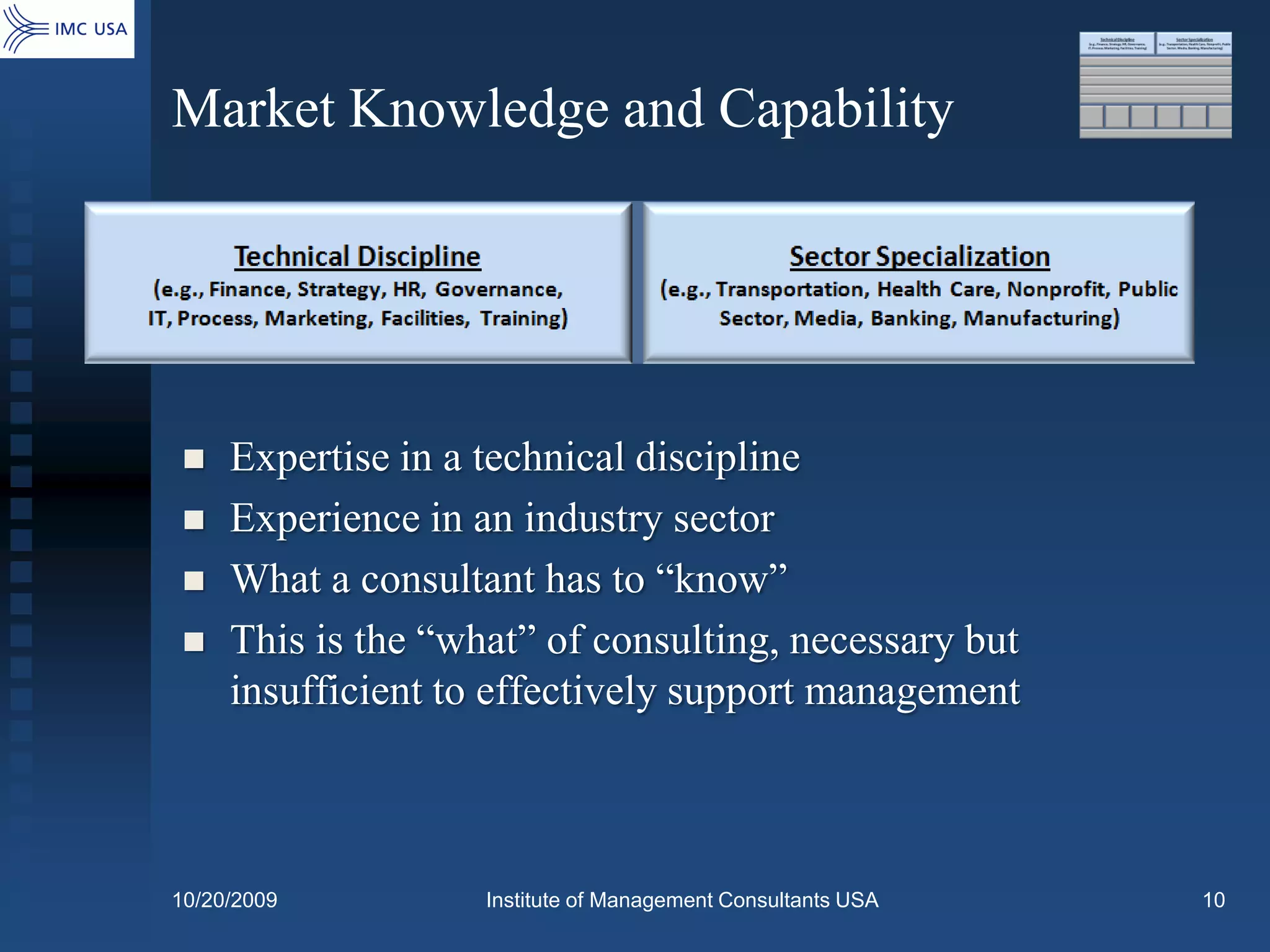
Market Knowledge and Capability


    Expertise in a technical discipline
    Experience in an industry sector
    What a consultant has to “know”
    This is the “what” of consulting, necessary but
     insufficient to effectively support management


10/20/2009          Institute of Management Consultants USA   10
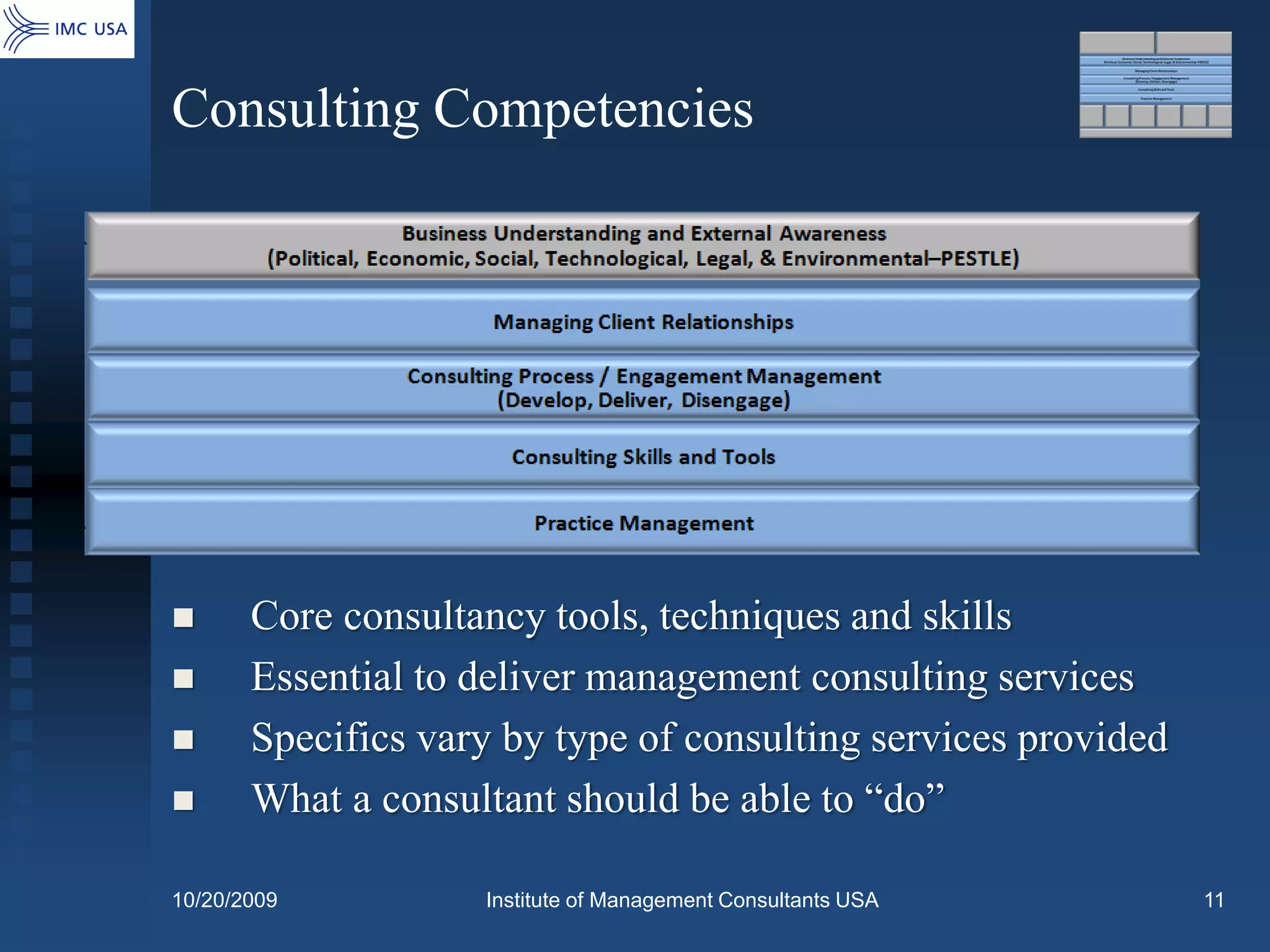
Consulting Competencies


      Core consultancy tools, techniques and skills
      Essential to deliver management consulting services
      Specifics vary by type of consulting services provided
      What a consultant should be able to “do”

10/20/2009          Institute of Management Consultants USA     11
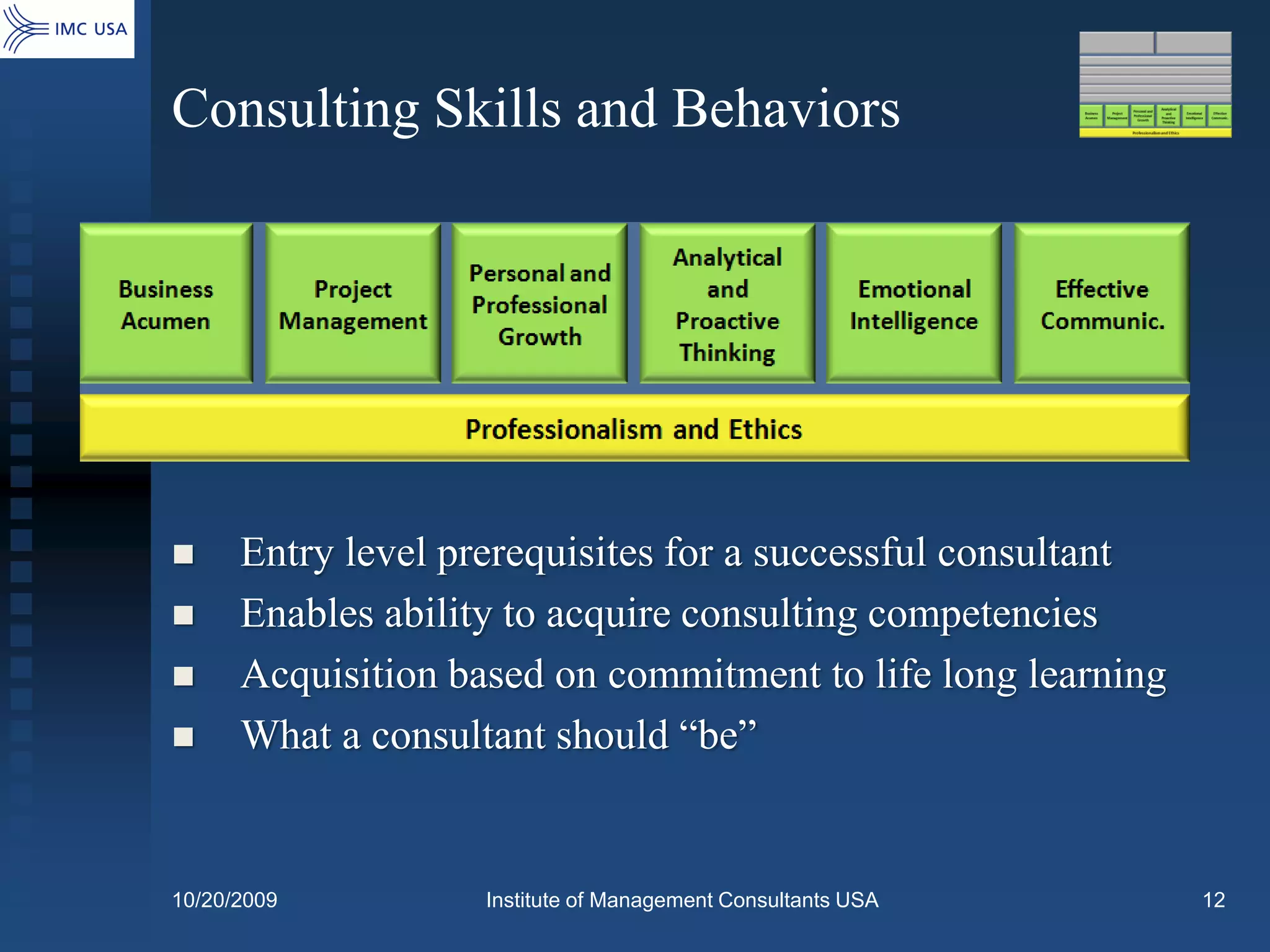
Consulting Skills and Behaviors


     Entry level prerequisites for a successful consultant
     Enables ability to acquire consulting competencies
     Acquisition based on commitment to life long learning
     What a consultant should “be”


10/20/2009          Institute of Management Consultants USA   12
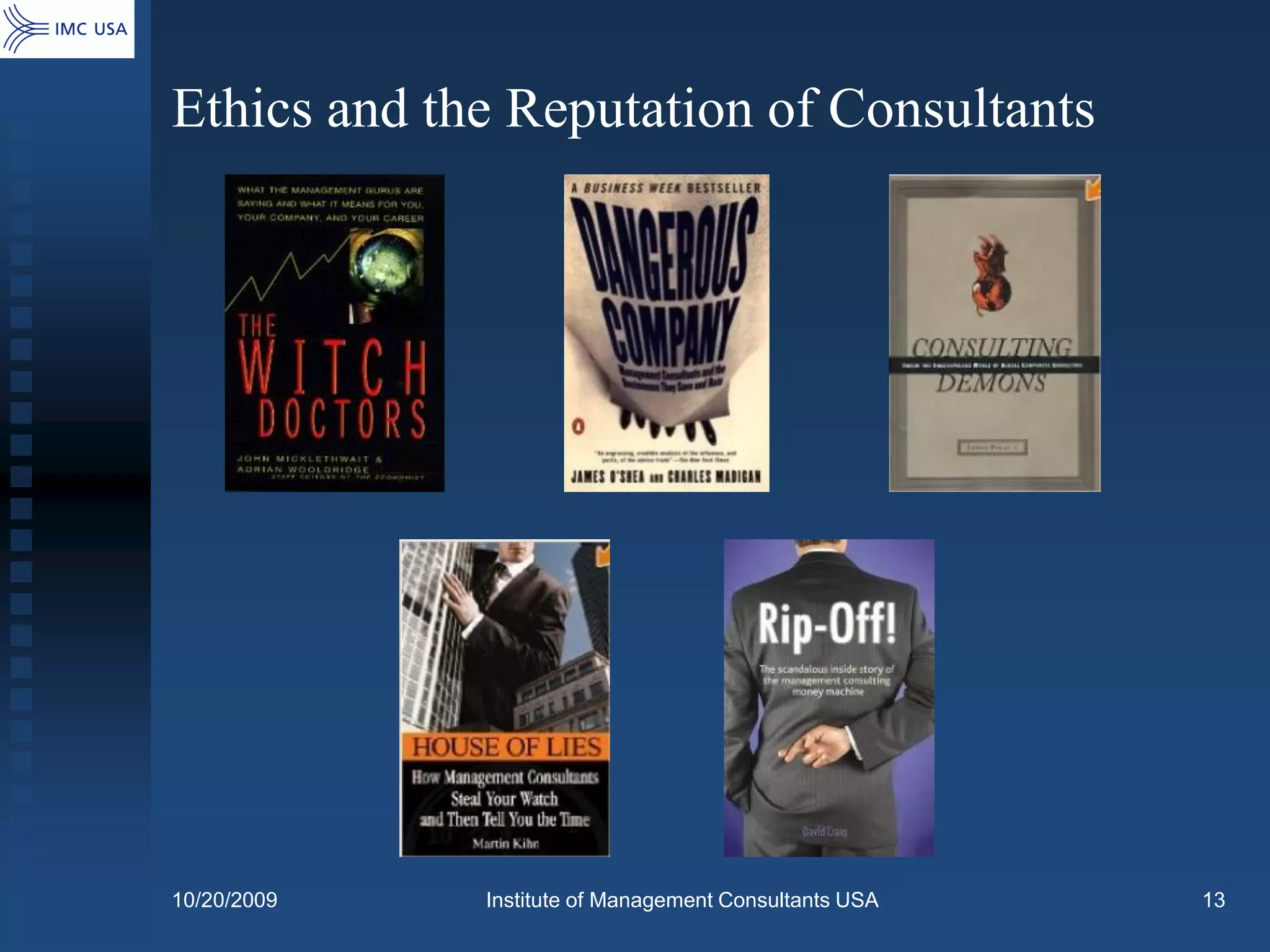
Ethics and the Reputation of Consultants


10/20/2009   Institute of Management Consultants USA   13
Value of Certification

   Consulting is unlicensed – for now
   The Certified Management Consultant (CMC®) is
    evidence of meeting international standards
   More than 10,000 CMCs worldwide
   Instant network to other accomplished consultants
   A CMC does not guarantee consulting success
   Expectation to contribute to the profession


10/20/2009       Institute of Management Consultants USA   14
Part 3: How to Be a Consultant
   Understand the consulting enterprise
   Starting a consulting business or joining a firm
   Why clients pick you and not other consultants
   Networks and pipelines to generate leads
   From lead to prospect to client
   Delivering consulting services
   Managing a consulting practice


10/20/2009       Institute of Management Consultants USA   15
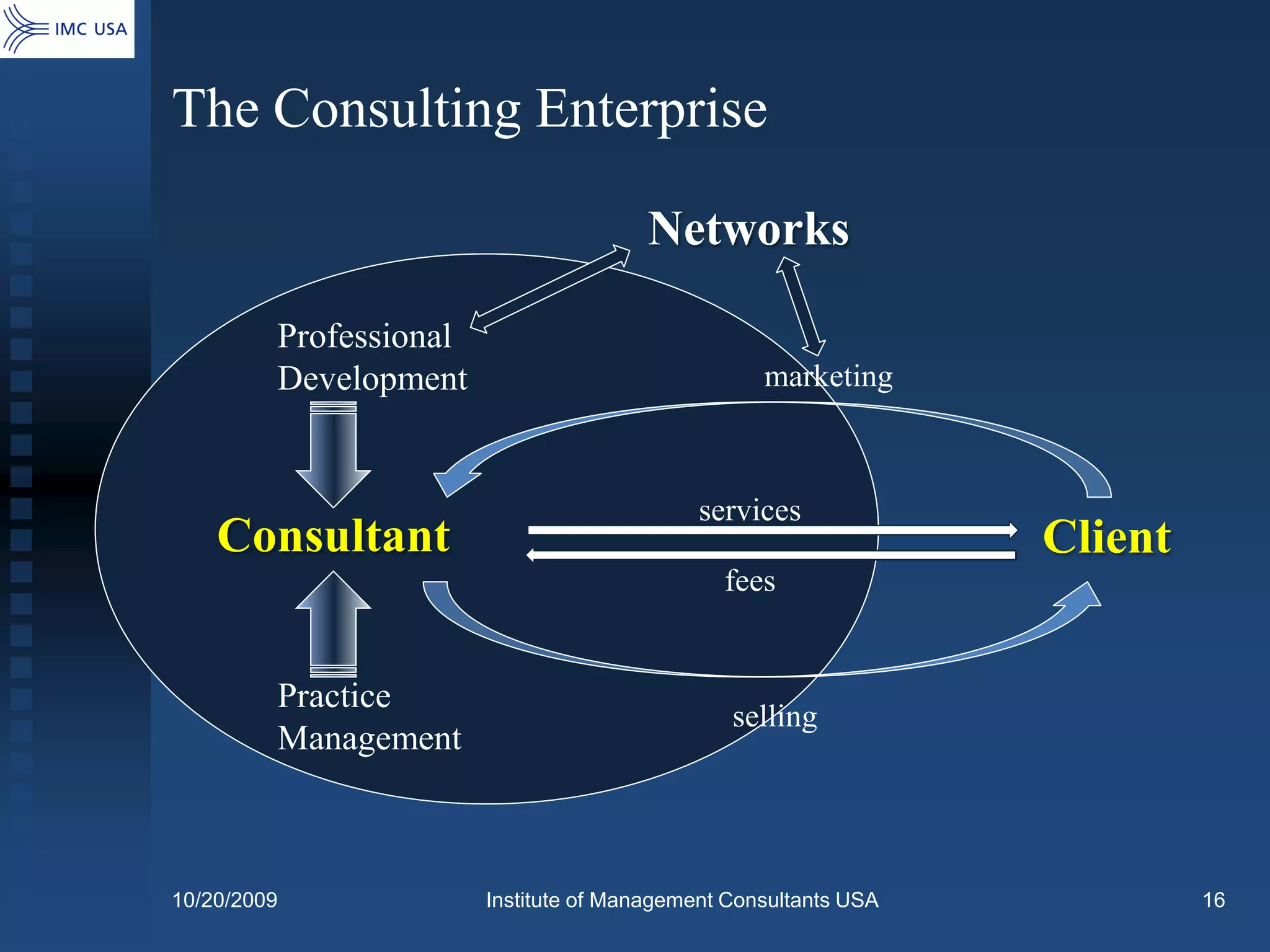
The Consulting Enterprise

                                        Networks

         Professional
         Development                               marketing


                                             services
    Consultant                                                    Client
                                               fees


         Practice
                                                selling
         Management


10/20/2009              Institute of Management Consultants USA            16
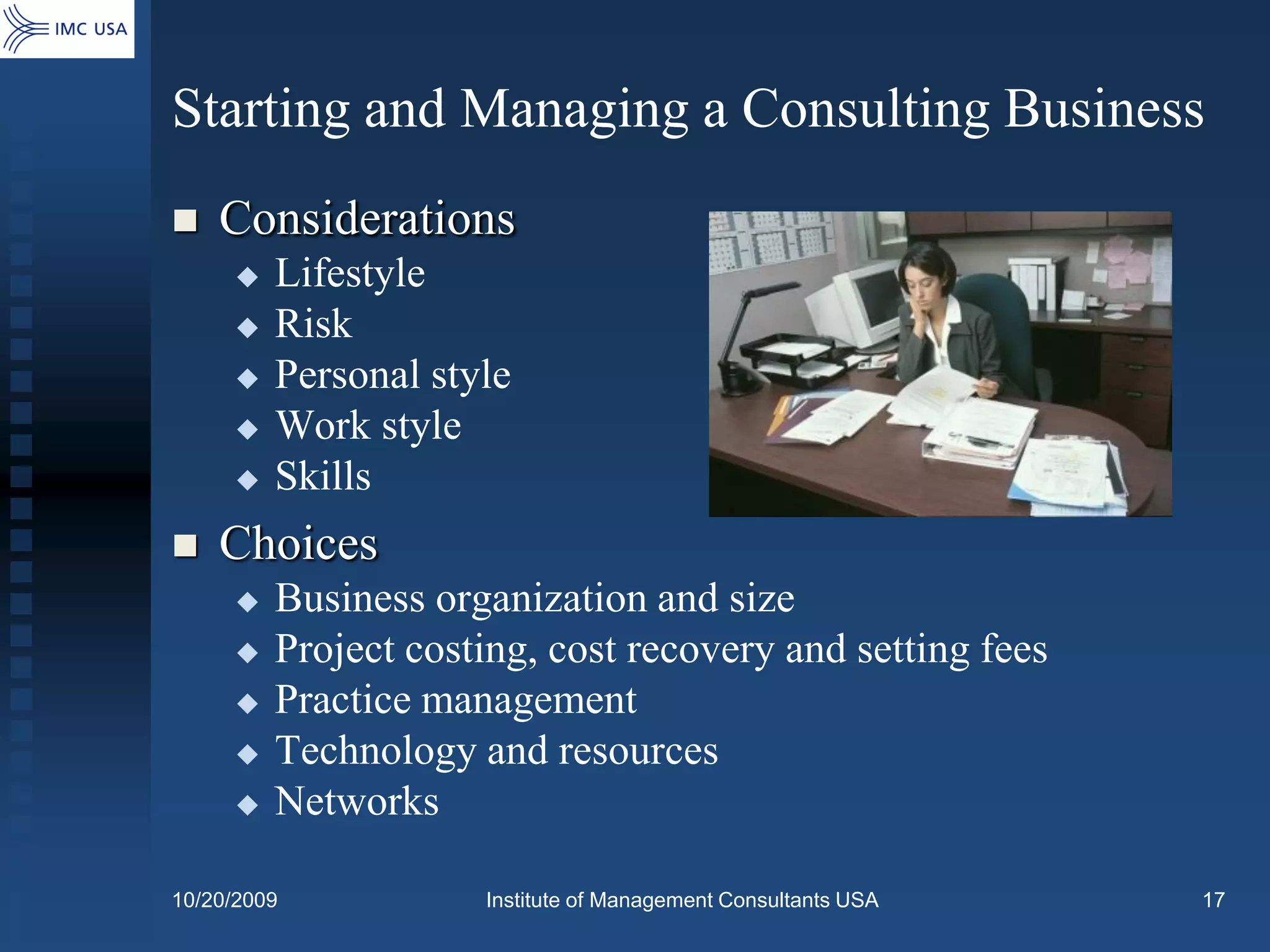
Starting and Managing a Consulting Business
   Considerations
        Lifestyle
        Risk
        Personal style
        Work style
        Skills
   Choices
        Business organization and size
        Project costing, cost recovery and setting fees
        Practice management
        Technology and resources
        Networks

10/20/2009           Institute of Management Consultants USA   17
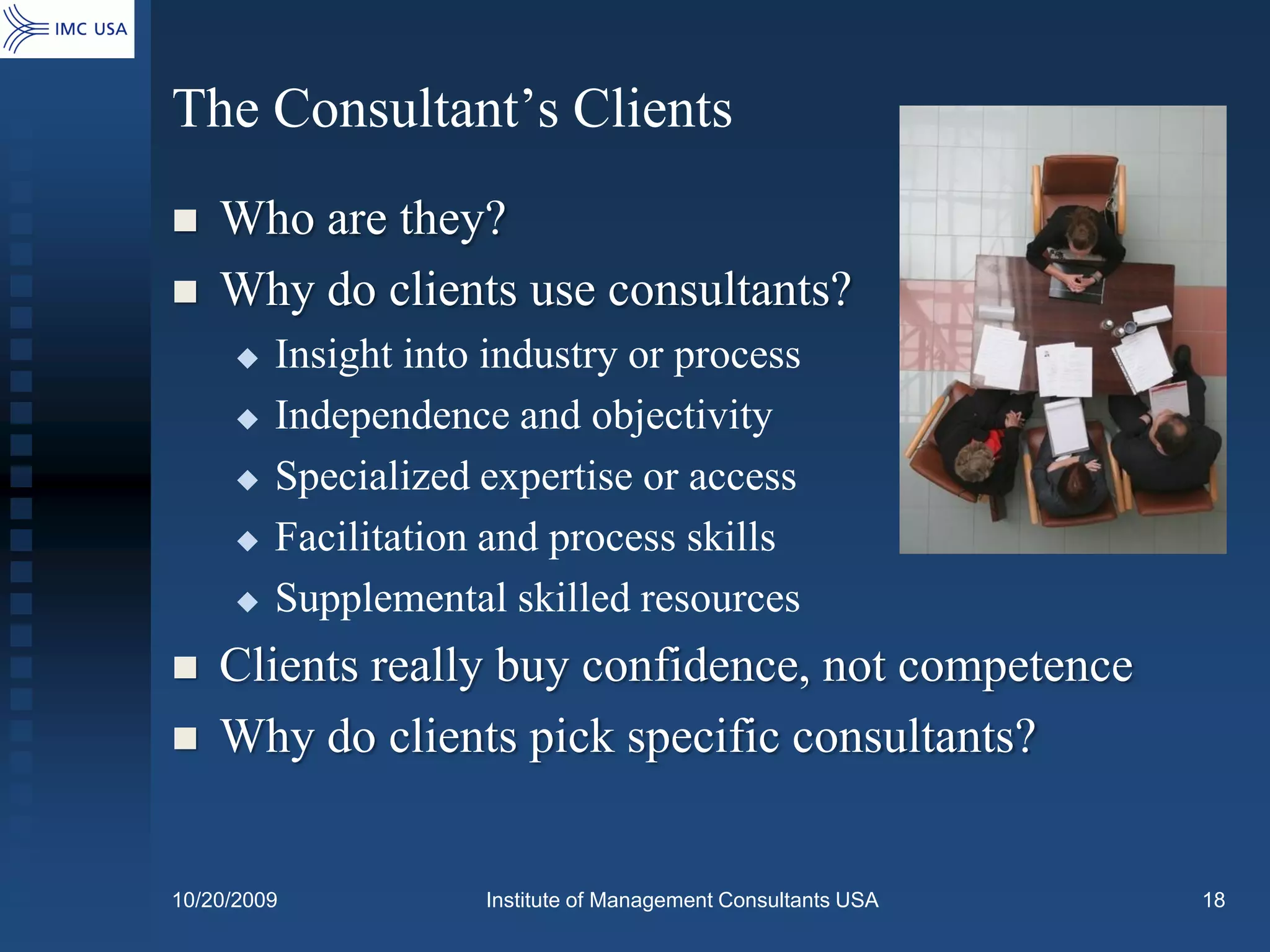
The Consultant’s Clients
   Who are they?
   Why do clients use consultants?
        Insight into industry or process
        Independence and objectivity
        Specialized expertise or access
        Facilitation and process skills
        Supplemental skilled resources
   Clients really buy confidence, not competence
   Why do clients pick specific consultants?


10/20/2009           Institute of Management Consultants USA   18
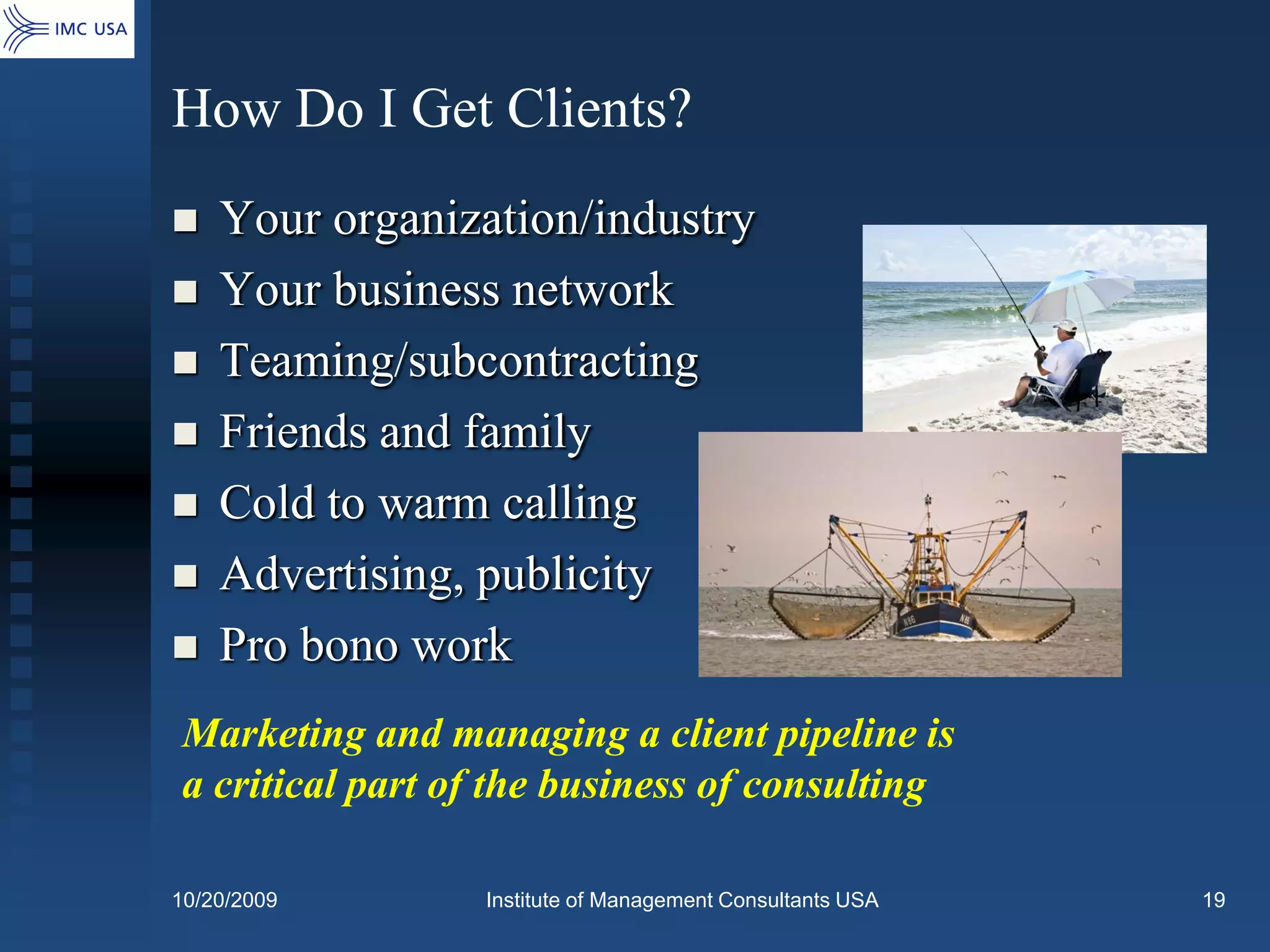
How Do I Get Clients?
   Your organization/industry
   Your business network
   Teaming/subcontracting
   Friends and family
   Cold to warm calling
   Advertising, publicity
   Pro bono work
Marketing and managing a client pipeline is
a critical part of the business of consulting

10/20/2009       Institute of Management Consultants USA   19
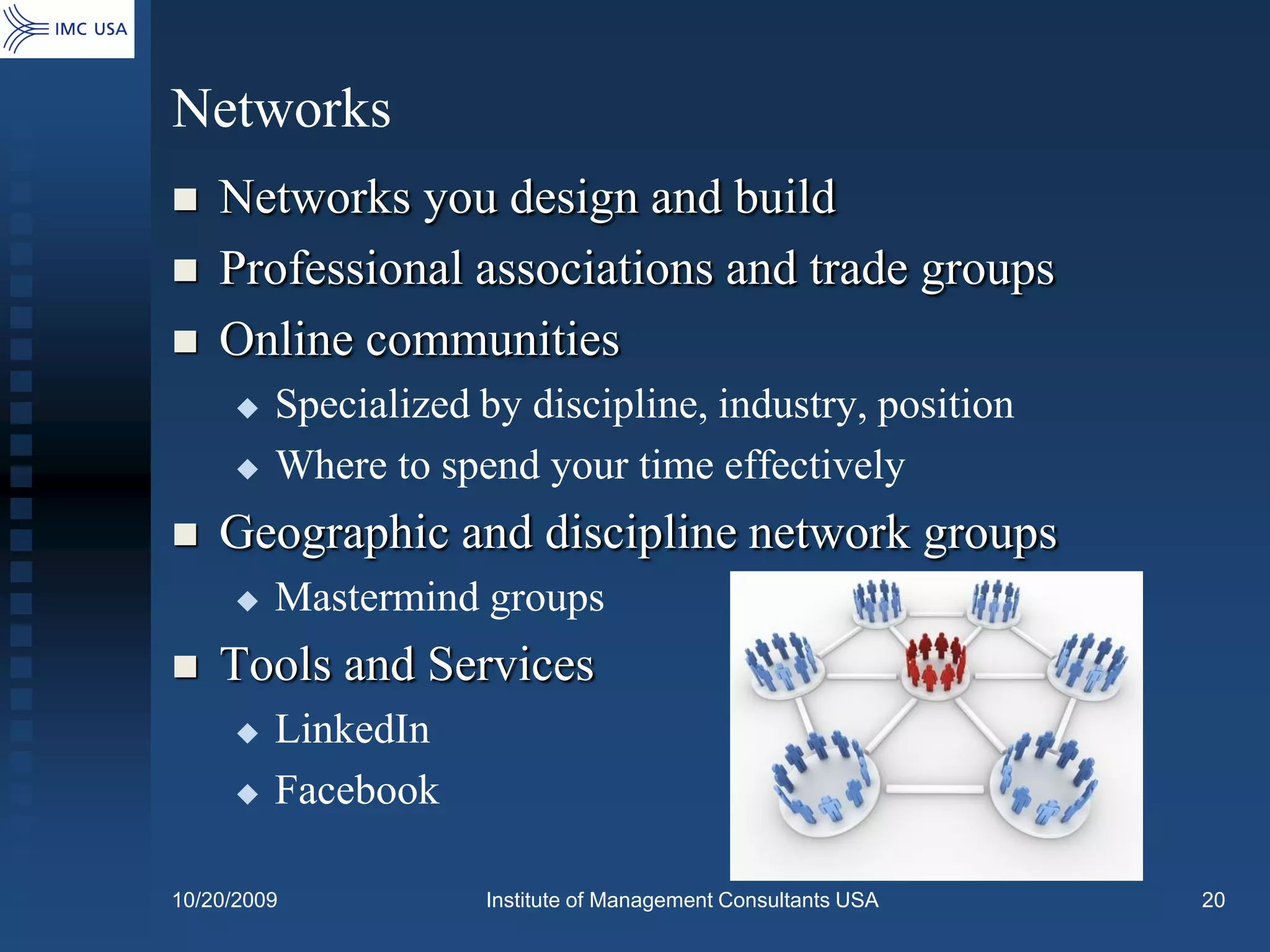
Networks
   Networks you design and build
   Professional associations and trade groups
   Online communities
        Specialized by discipline, industry, position
        Where to spend your time effectively
   Geographic and discipline network groups
        Mastermind groups
   Tools and Services
        LinkedIn
        Facebook

10/20/2009           Institute of Management Consultants USA   20
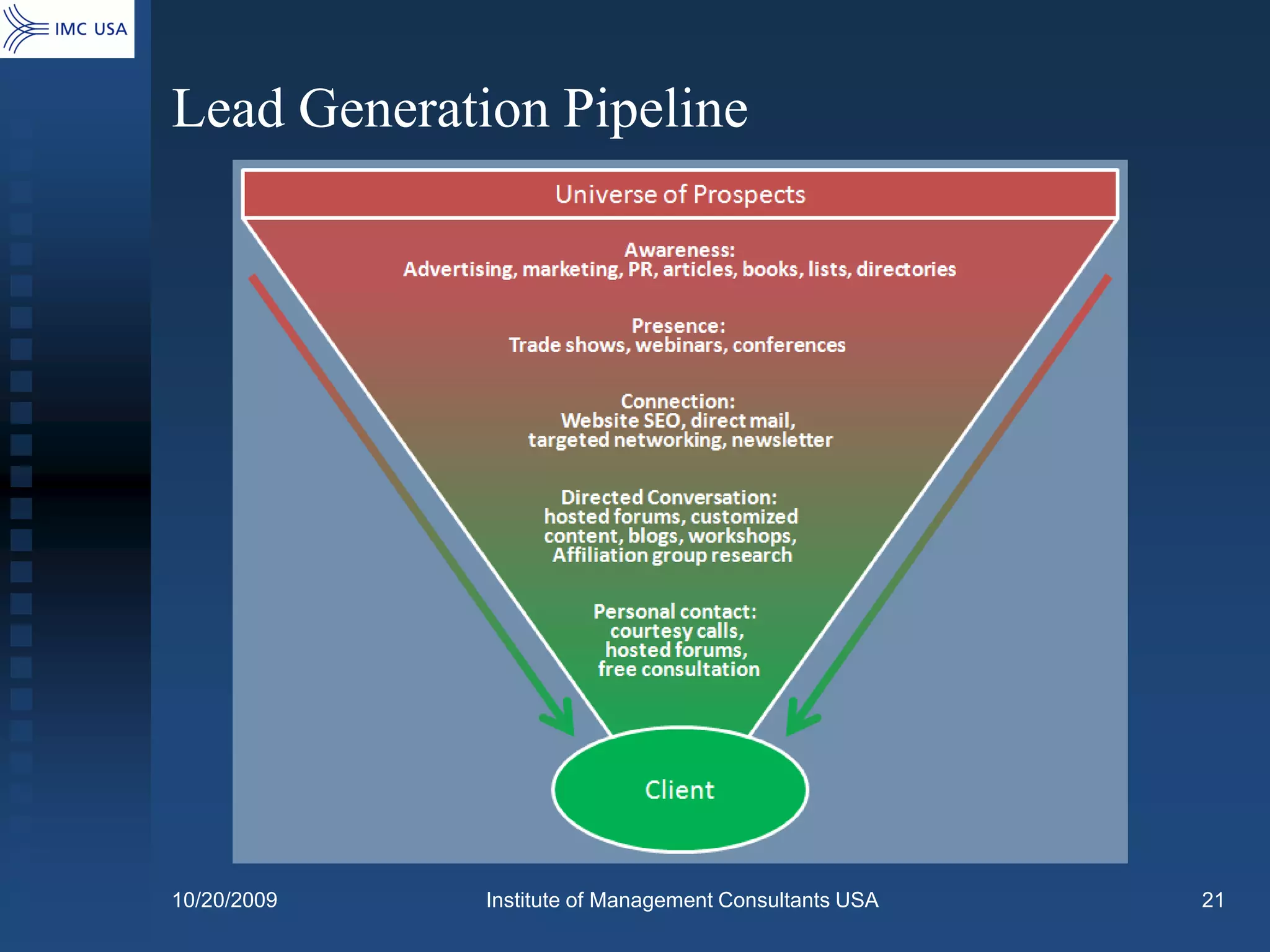
Lead Generation Pipeline


10/20/2009   Institute of Management Consultants USA   21
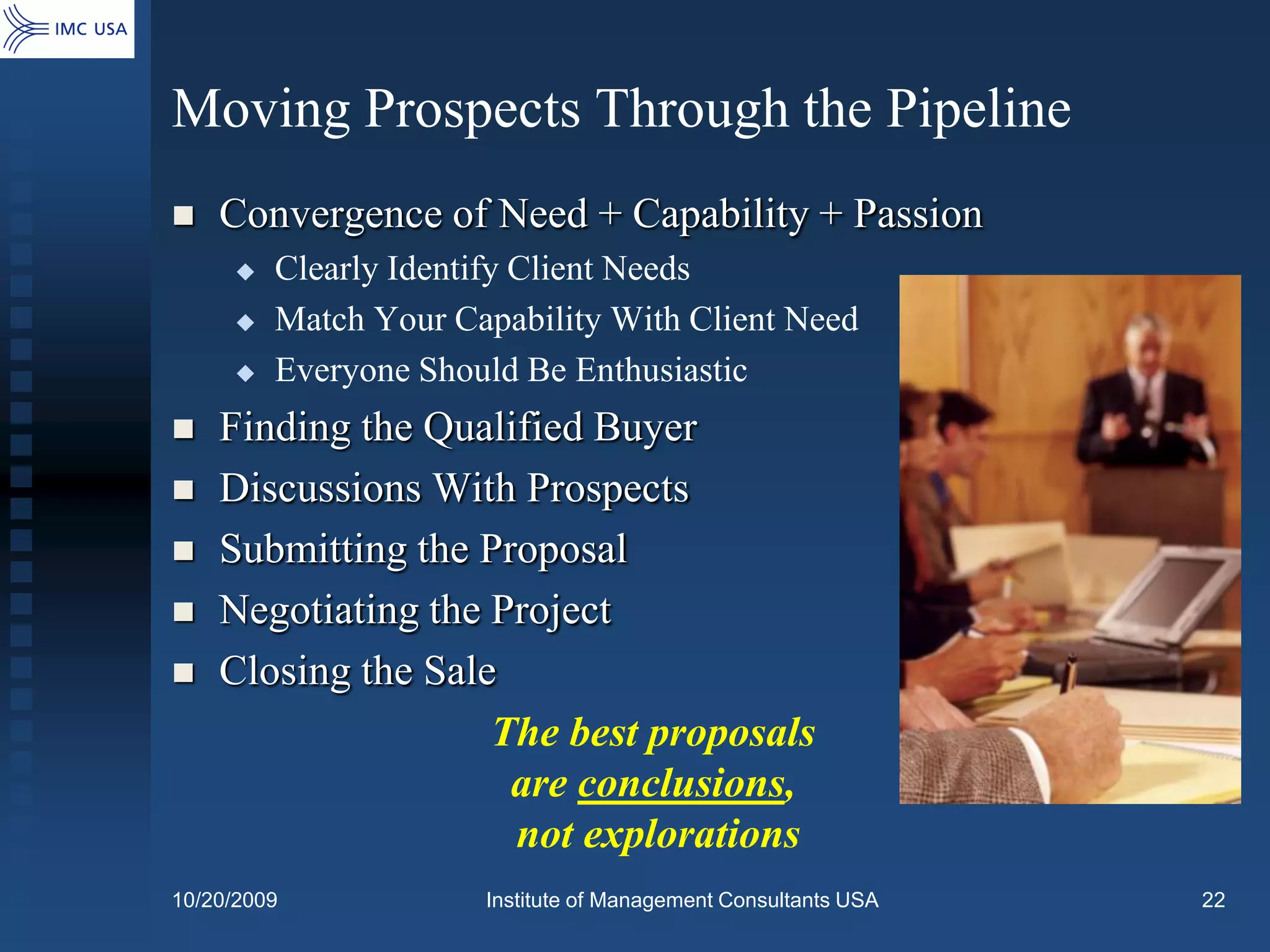
Moving Prospects Through the Pipeline
   Convergence of Need + Capability + Passion
        Clearly Identify Client Needs
        Match Your Capability With Client Need
        Everyone Should Be Enthusiastic
   Finding the Qualified Buyer
   Discussions With Prospects
   Submitting the Proposal
   Negotiating the Project
   Closing the Sale
                    The best proposals
                     are conclusions,
                     not explorations
10/20/2009            Institute of Management Consultants USA   22
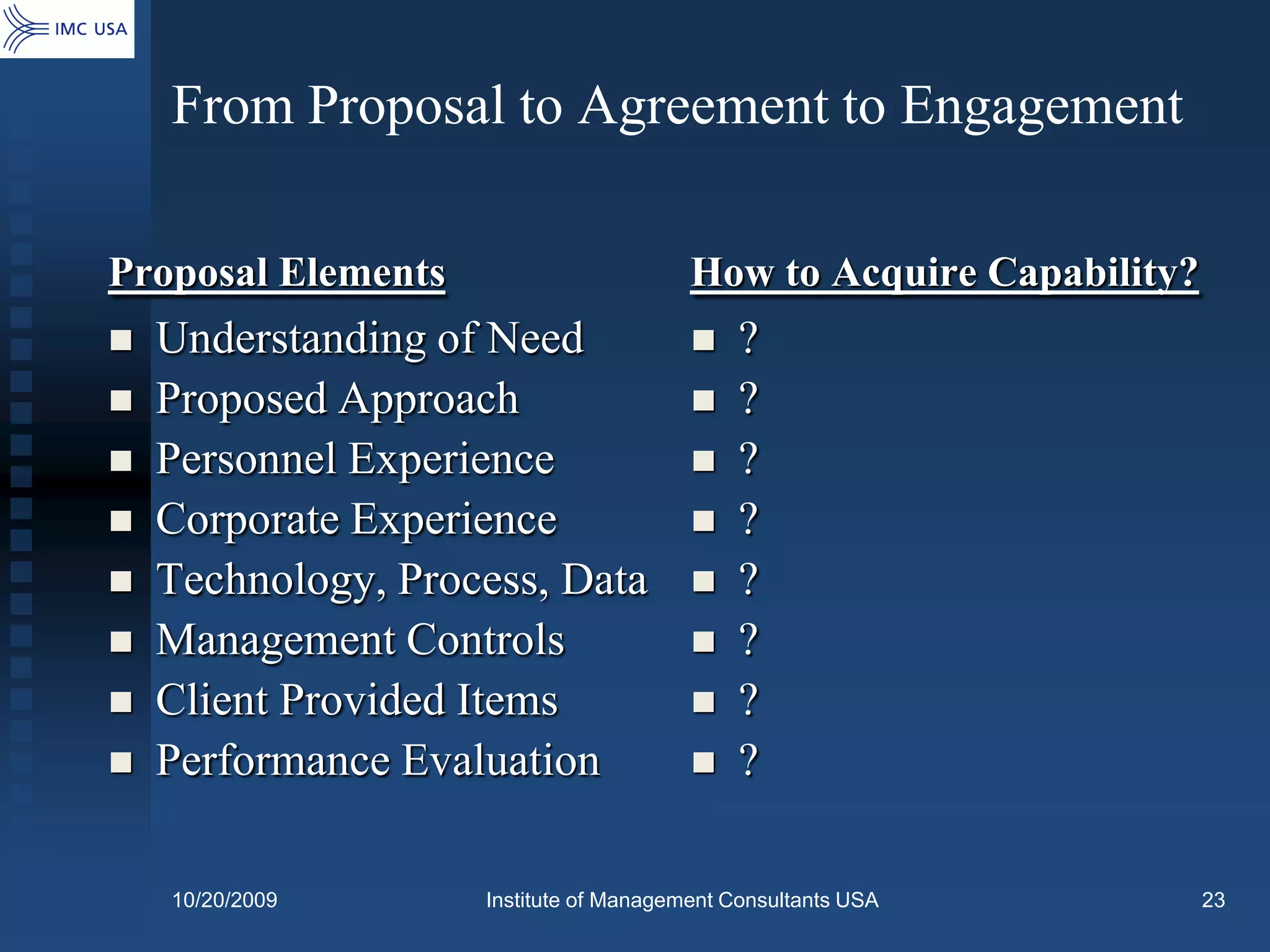
From Proposal to Agreement to Engagement

Proposal Elements                       How to Acquire Capability?
   Understanding of Need                   ?
   Proposed Approach                       ?
   Personnel Experience                    ?
   Corporate Experience                    ?
   Technology, Process, Data               ?
   Management Controls                     ?
   Client Provided Items                   ?
   Performance Evaluation                  ?

    10/20/2009      Institute of Management Consultants USA          23
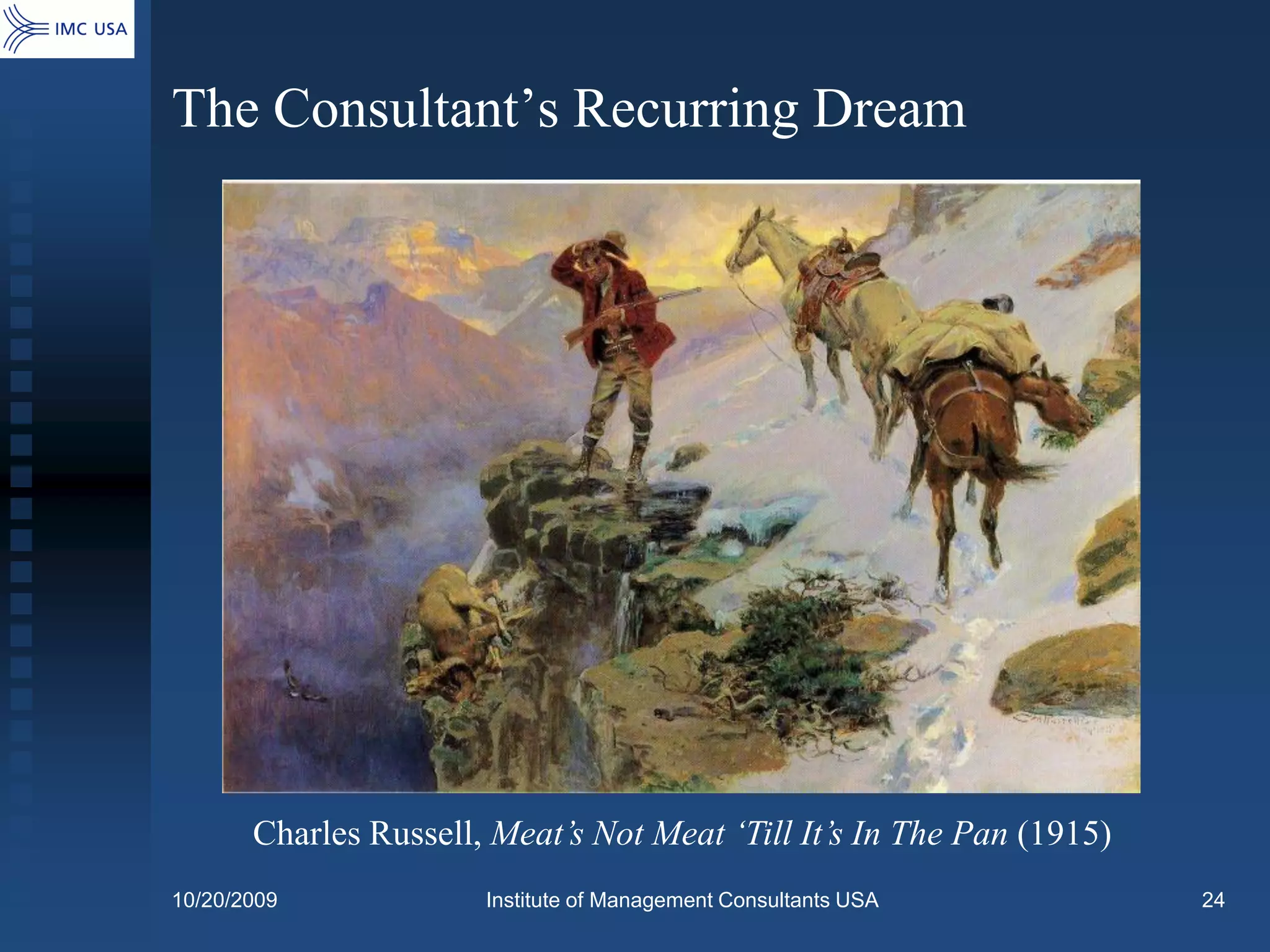
The Consultant’s Recurring Dream


       Charles Russell, Meat’s Not Meat ‘Till It’s In The Pan (1915)
10/20/2009             Institute of Management Consultants USA         24
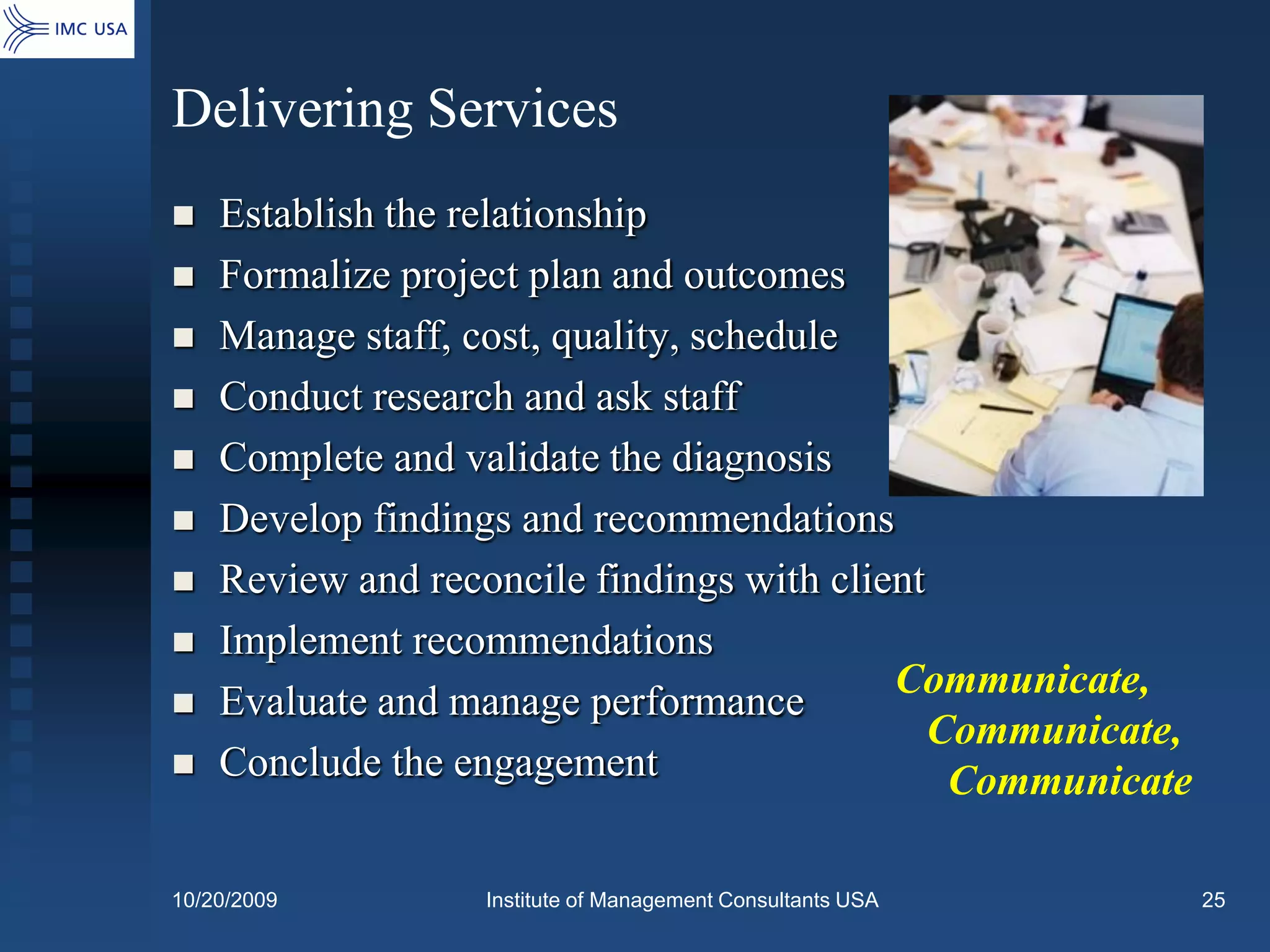
Delivering Services
   Establish the relationship
   Formalize project plan and outcomes
   Manage staff, cost, quality, schedule
   Conduct research and ask staff
   Complete and validate the diagnosis
   Develop findings and recommendations
   Review and reconcile findings with client
   Implement recommendations
                                           Communicate,
   Evaluate and manage performance
                                              Communicate,
   Conclude the engagement                    Communicate

10/20/2009        Institute of Management Consultants USA    25
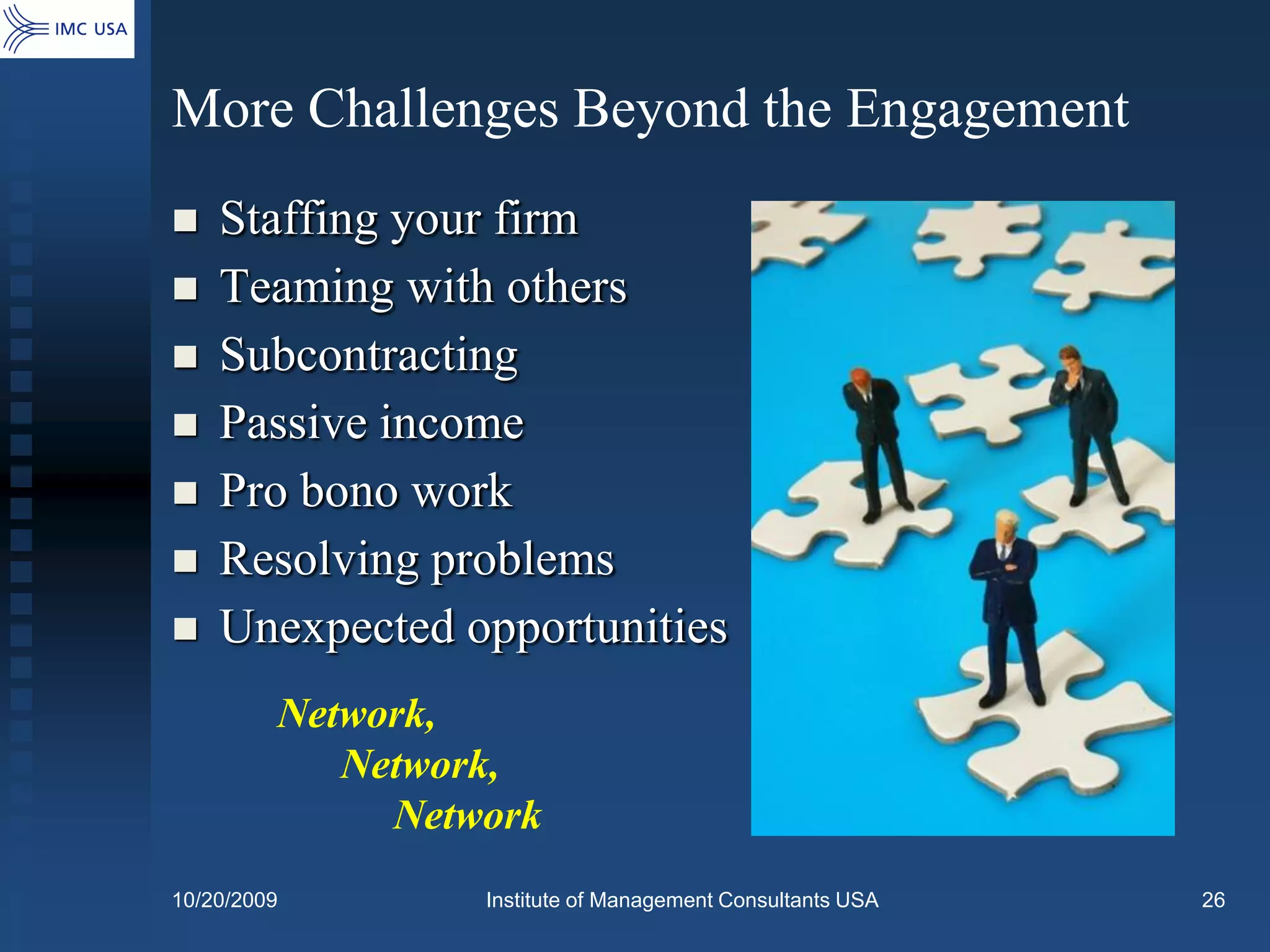
More Challenges Beyond the Engagement
   Staffing your firm
   Teaming with others
   Subcontracting
   Passive income
   Pro bono work
   Resolving problems
   Unexpected opportunities
         Network,
            Network,
              Network
10/20/2009        Institute of Management Consultants USA   26
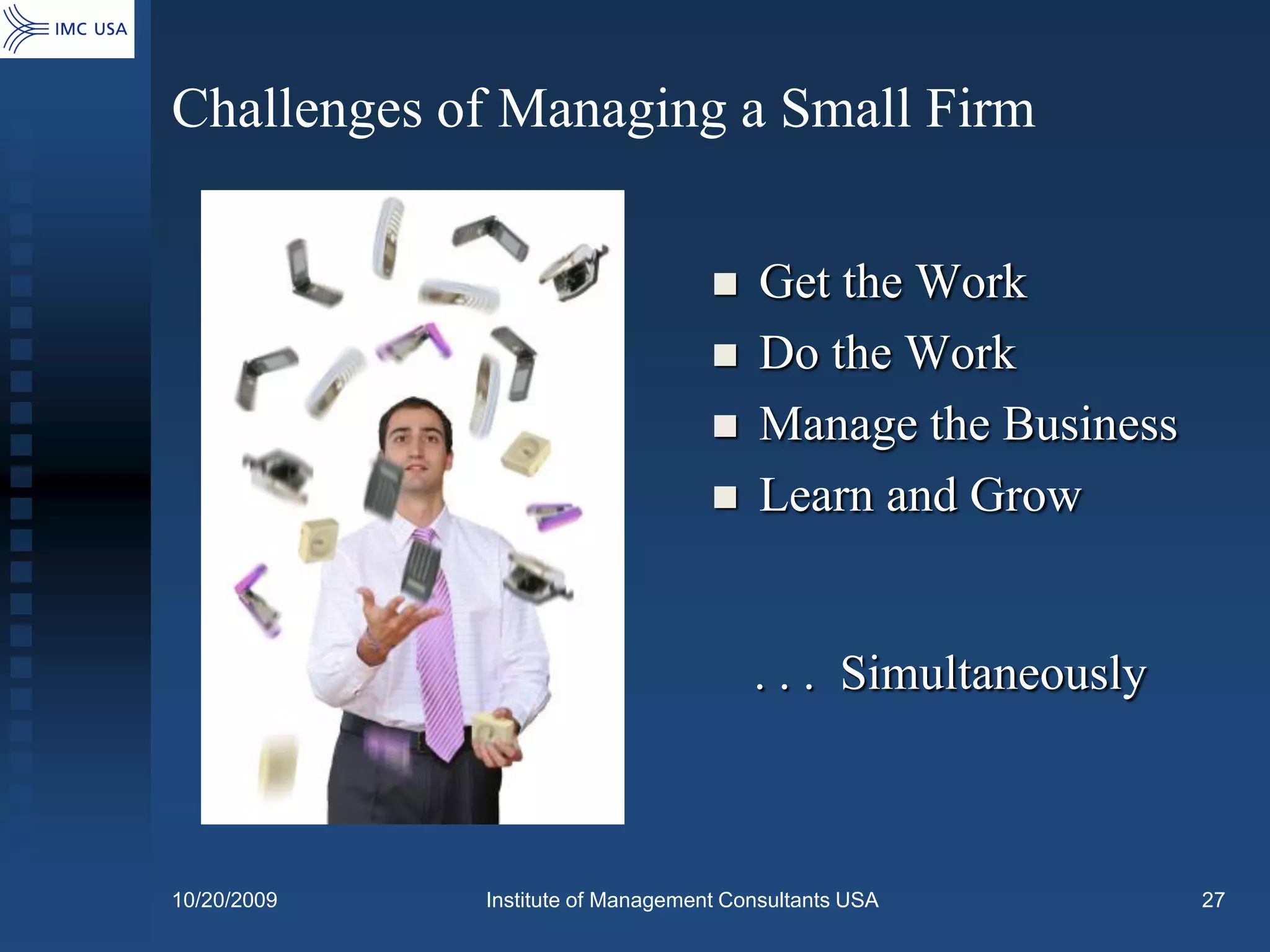
Challenges of Managing a Small Firm


                                       Get the Work
                                       Do the Work
                                       Manage the Business
                                       Learn and Grow


                                       . . . Simultaneously


10/20/2009   Institute of Management Consultants USA          27
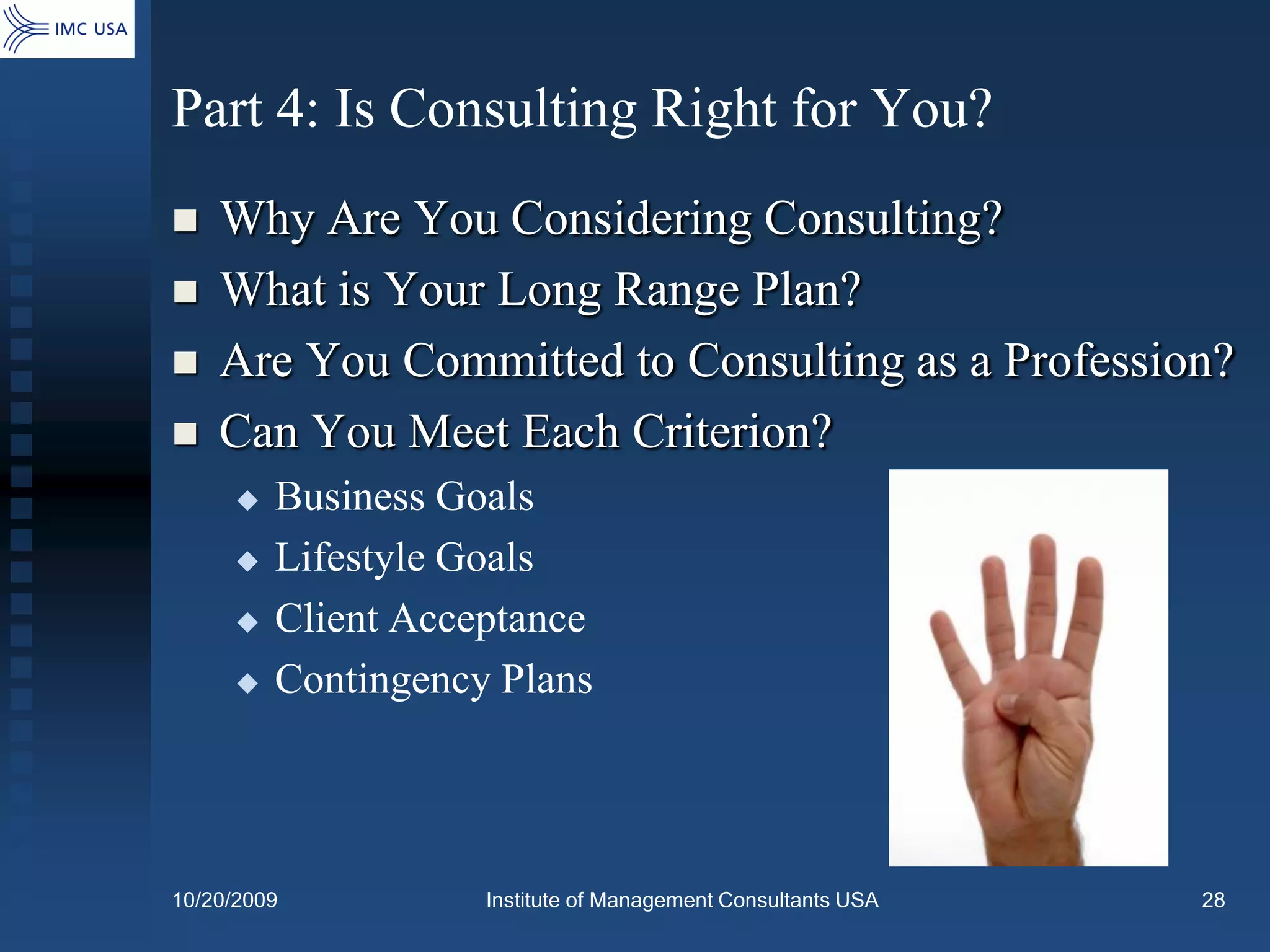
Part 4: Is Consulting Right for You?
   Why Are You Considering Consulting?
   What is Your Long Range Plan?
   Are You Committed to Consulting as a Profession?
   Can You Meet Each Criterion?
        Business Goals
        Lifestyle Goals
        Client Acceptance
        Contingency Plans


10/20/2009          Institute of Management Consultants USA   28
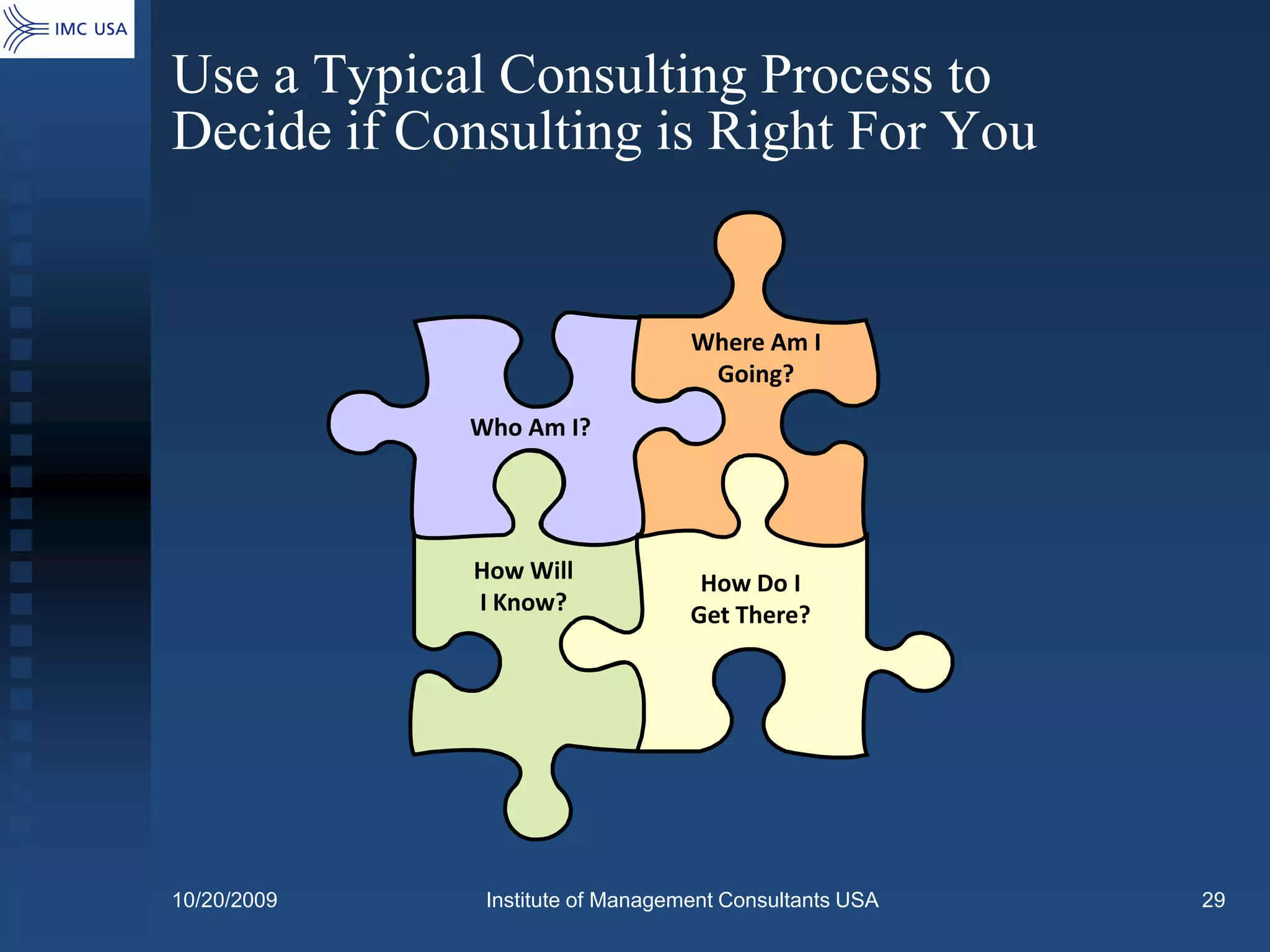
Use a Typical Consulting Process to
Decide if Consulting is Right For You


                                  Where Am I
                                   Going?

             Who Am I?


             How Will              How Do I
             I Know?              Get There?


10/20/2009    Institute of Management Consultants USA   29
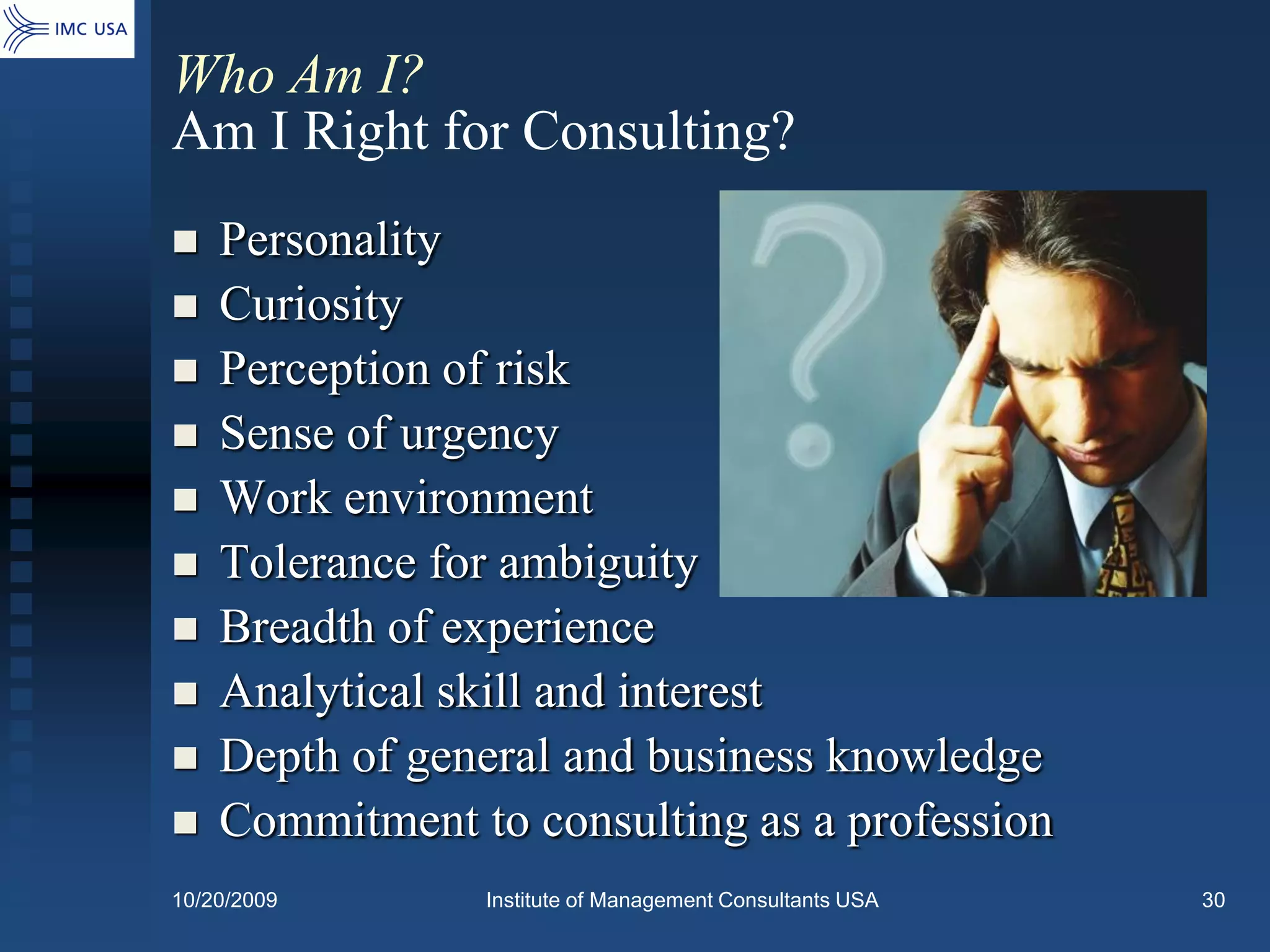
Who Am I?
Am I Right for Consulting?
   Personality
   Curiosity
   Perception of risk
   Sense of urgency
   Work environment
   Tolerance for ambiguity
   Breadth of experience
   Analytical skill and interest
   Depth of general and business knowledge
   Commitment to consulting as a profession
10/20/2009      Institute of Management Consultants USA   30
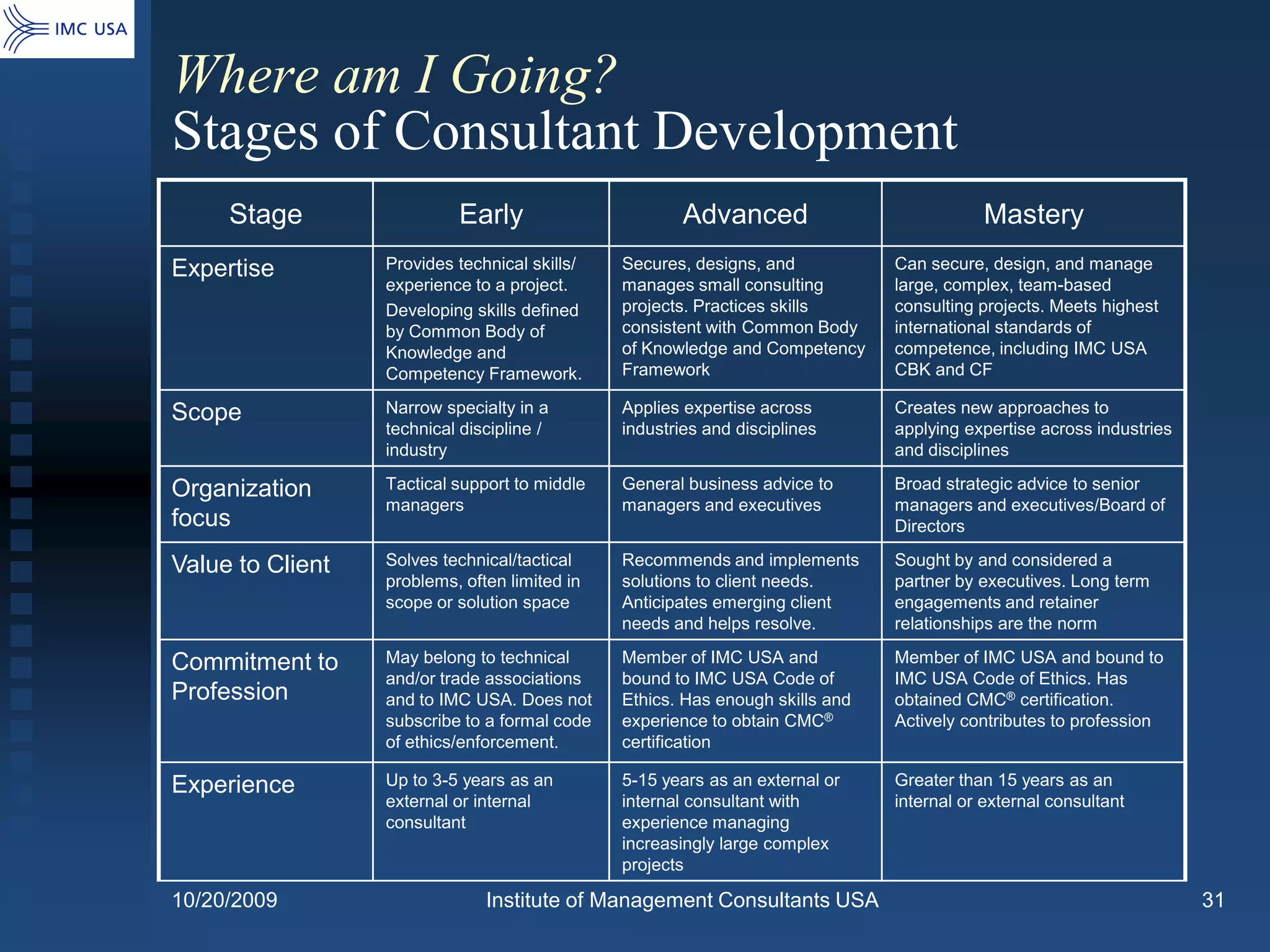
Where am I Going?
Stages of Consultant Development
     Stage                 Early                       Advanced                            Mastery
Expertise         Provides technical skills/   Secures, designs, and           Can secure, design, and manage
                  experience to a project.     manages small consulting        large, complex, team-based
                  Developing skills defined    projects. Practices skills      consulting projects. Meets highest
                  by Common Body of            consistent with Common Body     international standards of
                  Knowledge and                of Knowledge and Competency     competence, including IMC USA
                  Competency Framework.        Framework                       CBK and CF

Scope             Narrow specialty in a        Applies expertise across        Creates new approaches to
                  technical discipline /       industries and disciplines      applying expertise across industries
                  industry                                                     and disciplines

Organization      Tactical support to middle   General business advice to      Broad strategic advice to senior
                  managers                     managers and executives         managers and executives/Board of
focus                                                                          Directors

Value to Client   Solves technical/tactical    Recommends and implements       Sought by and considered a
                  problems, often limited in   solutions to client needs.      partner by executives. Long term
                  scope or solution space      Anticipates emerging client     engagements and retainer
                                               needs and helps resolve.        relationships are the norm

Commitment to     May belong to technical      Member of IMC USA and           Member of IMC USA and bound to
                  and/or trade associations    bound to IMC USA Code of        IMC USA Code of Ethics. Has
Profession        and to IMC USA. Does not     Ethics. Has enough skills and   obtained CMC® certification.
                  subscribe to a formal code   experience to obtain CMC®       Actively contributes to profession
                  of ethics/enforcement.       certification

Experience        Up to 3-5 years as an        5-15 years as an external or    Greater than 15 years as an
                  external or internal         internal consultant with        internal or external consultant
                  consultant                   experience managing
                                               increasingly large complex
                                               projects

10/20/2009                     Institute of Management Consultants USA                                                31
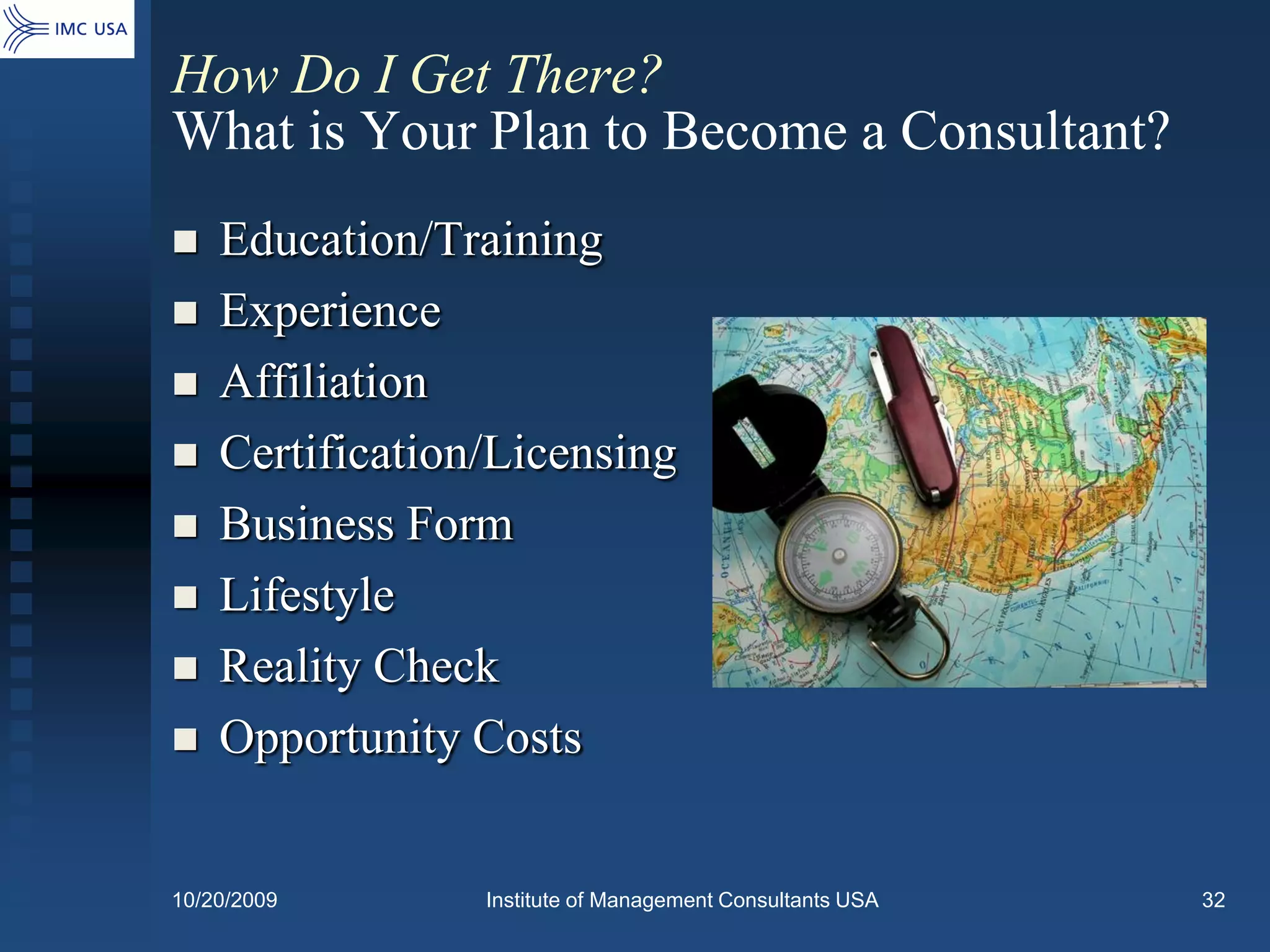
How Do I Get There?
What is Your Plan to Become a Consultant?
   Education/Training
   Experience
   Affiliation
   Certification/Licensing
   Business Form
   Lifestyle
   Reality Check
   Opportunity Costs


10/20/2009       Institute of Management Consultants USA   32
How Will I Know?
Success Measures of Professional Consultants?
   Your Formal Plan
        Identify and Develop Consulting Skills and Behaviors
        Prepare and Confirm Business and Marketing Plans
        Test by Partnering With Experienced Consultants
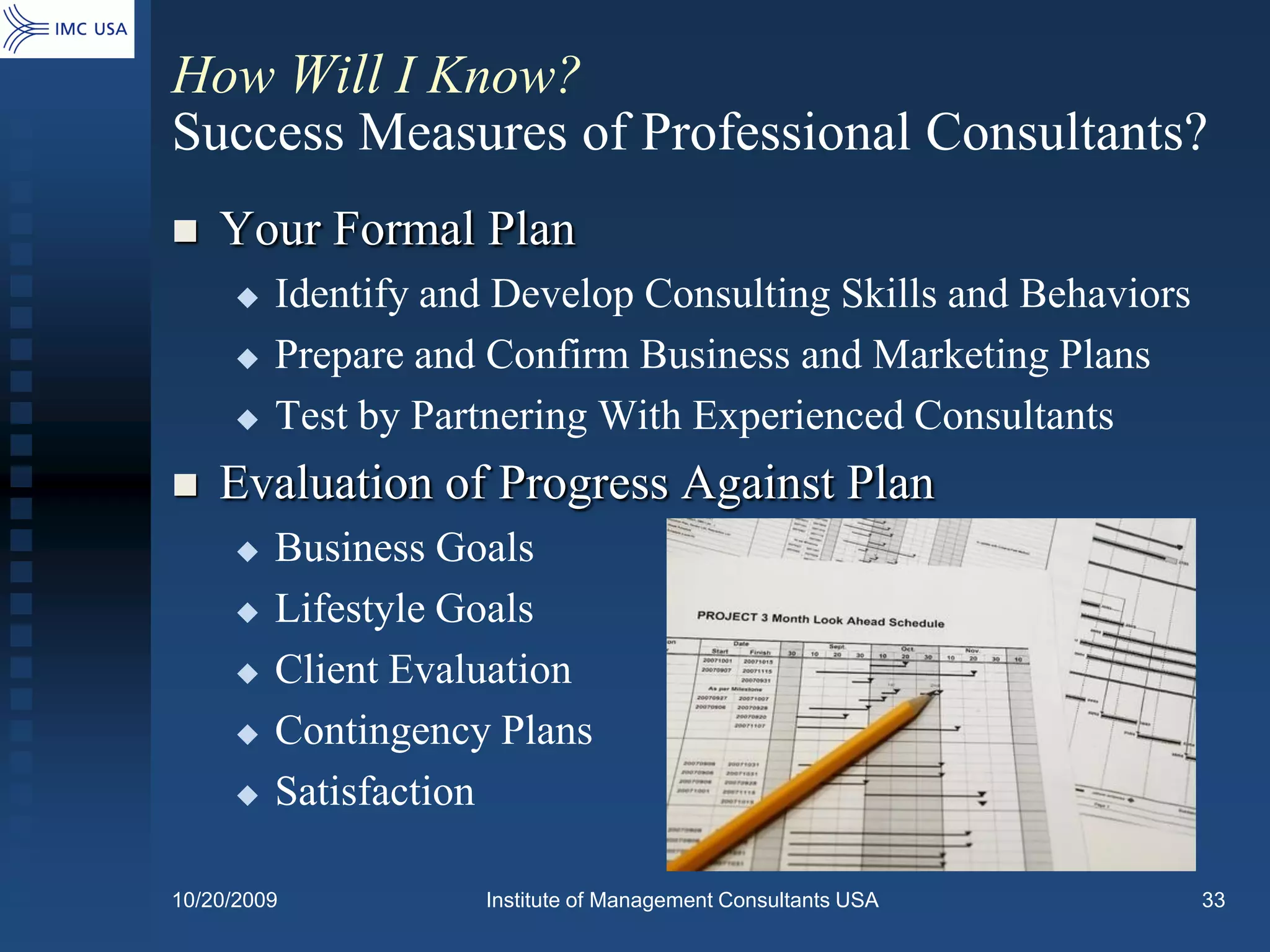
   Evaluation of Progress Against Plan
        Business Goals
        Lifestyle Goals
        Client Evaluation
        Contingency Plans
        Satisfaction

10/20/2009          Institute of Management Consultants USA     33
Consulting Can Be a Rewarding Profession
     You know about consulting as a profession
     You have the basics of how to become a consultant
     You appreciate what it takes to be a consultant
     You can now decide if consulting is right for you
     You have resources available to help you
        Bibliography (with pre-reading materials)
        Associations (particularly IMC USA)
        People (other consultants and your business associates)


10/20/2009           Institute of Management Consultants USA   34
Thank You for Your Attention
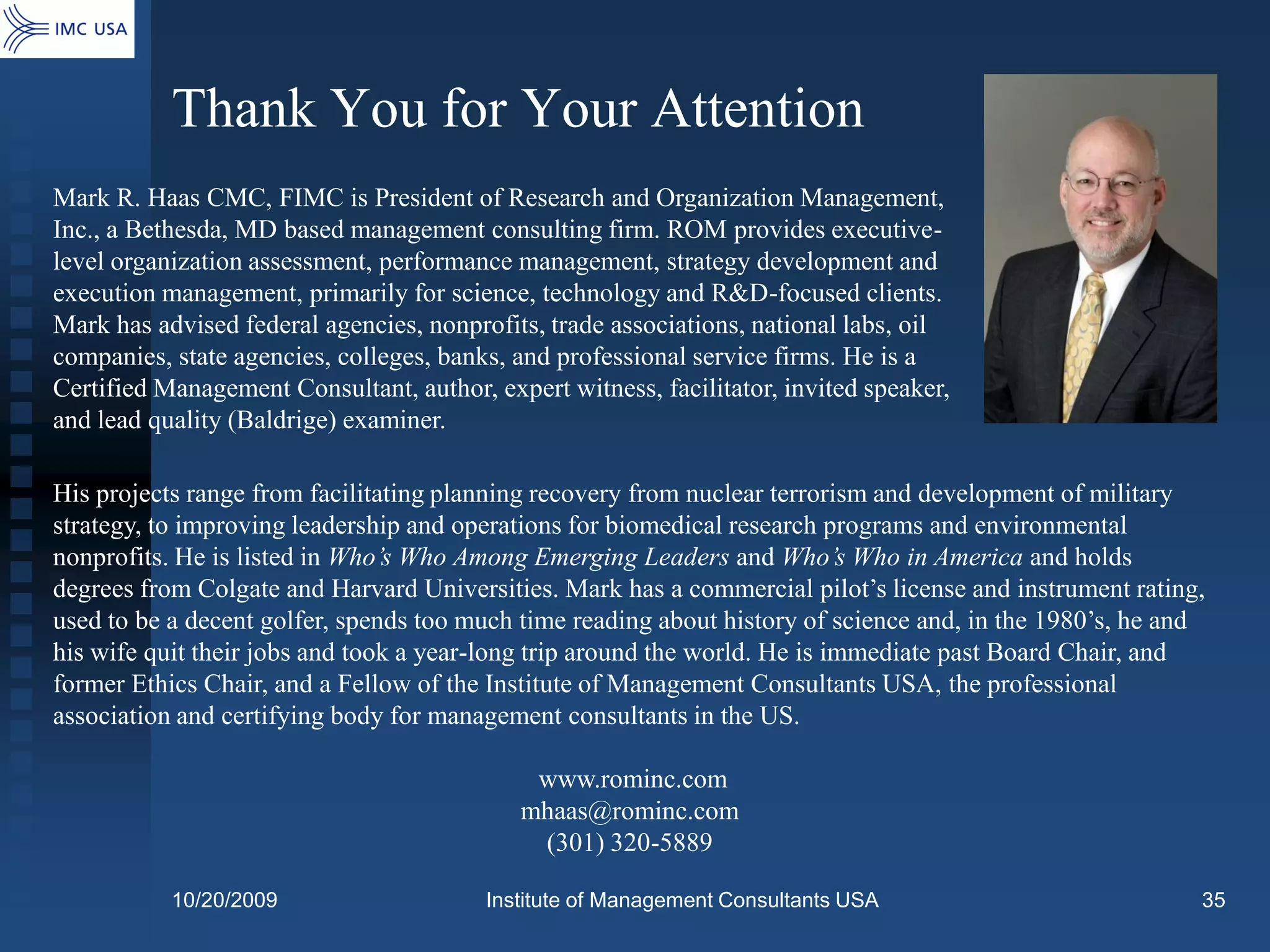
Mark R. Haas CMC, FIMC is President of Research and Organization Management,
Inc., a Bethesda, MD based management consulting firm. ROM provides executive-
level organization assessment, performance management, strategy development and
execution management, primarily for science, technology and R&D-focused clients.
Mark has advised federal agencies, nonprofits, trade associations, national labs, oil
companies, state agencies, colleges, banks, and professional service firms. He is a
Certified Management Consultant, author, expert witness, facilitator, invited speaker,
and lead quality (Baldrige) examiner.

His projects range from facilitating planning recovery from nuclear terrorism and development of military
strategy, to improving leadership and operations for biomedical research programs and environmental
nonprofits. He is listed in Who’s Who Among Emerging Leaders and Who’s Who in America and holds
degrees from Colgate and Harvard Universities. Mark has a commercial pilot’s license and instrument rating,
used to be a decent golfer, spends too much time reading about history of science and, in the 1980’s, he and
his wife quit their jobs and took a year-long trip around the world. He is immediate past Board Chair, and
former Ethics Chair, and a Fellow of the Institute of Management Consultants USA, the professional
association and certifying body for management consultants in the US.

                                             www.rominc.com
                                            mhaas@rominc.com
                                             (301) 320-5889

           10/20/2009                    Institute of Management Consultants USA                           35

Launching A Management Consulting Practice (2009)

  • 1.
    Launching a Management Consulting Practice A Webinar Conducted by Mark R. Haas CMC, FIMC IMC USA Academy for Professional Development October 20, 2009
  • 2.
    Desired Outcomes 1. Understand Management Consulting  Profession, Industry, Consultant, Client 2. Understand How to Become a Consultant  Competency framework  Starting a consulting business 3. Understand How to Be a Consultant  Marketing and selling services  Delivering consulting services  Managing the consulting business 4. Decide If Consulting Is For You  Lifestyle, risks, alternatives, benefits and costs 10/20/2009 Institute of Management Consultants USA 2
  • 3.
    Part 1: UnderstandManagement Consulting  Why Does Management Consulting Exist?  What is Management Consulting?  Where Does a Consultant Work?  What Does a Consultant Do?  How Is Consulting Changing? 10/20/2009 Institute of Management Consultants USA 3
  • 4.
    What Type ofConsultant Can You Be?  Generalist vs. specialist  Industry vs. functional discipline  Process vs. content  Diagnostic vs. implementation  Customized vs. pre-packaged solutions  A mix of the above 10/20/2009 Institute of Management Consultants USA 4
  • 5.
    Consulting Experiences VaryConsiderably  Facilitate kickoff planning for US military’s World War IV “Cognitive Dominance” strategy  Assess operations and advise reorganization of the world’s largest biomedical research enterprise  Facilitate planning to recover commercial operations after nuclear terrorism in LA  Reorganize a major city school system  Advise on governance and operations at an environmental nonprofit  Develop a business plan/strategy for health care startup  Revitalize administration and programs for a national volunteer organization 10/20/2009 Institute of Management Consultants USA 5
  • 6.
    Business and Consultingare Changing Fast  Flat world  Commoditization  Interdependency  Speed  Demographics A management consultant needs to be on top of all of these emerging trends 10/20/2009 Institute of Management Consultants USA 6
  • 7.
    Part 2: Howto Become a Consultant  The “What” and “How” of consulting  Consulting competency framework  Professionalism and ethics  The consultant’s reputation  Certification 10/20/2009 Institute of Management Consultants USA 7
  • 8.
    Consulting is Morethan Just Knowledge Consulting Competencies and Ethics Technical Discipline “What” Sector Specialization Professional Associations Consulting Skills “How” Consulting Behaviors Consulting Ethics 10/20/2009 Institute of Management Consultants USA 8
  • 9.
    Consulting Competency Framework 10/20/2009 Institute of Management Consultants USA 9
  • 10.
    Market Knowledge andCapability  Expertise in a technical discipline  Experience in an industry sector  What a consultant has to “know”  This is the “what” of consulting, necessary but insufficient to effectively support management 10/20/2009 Institute of Management Consultants USA 10
  • 11.
    Consulting Competencies  Core consultancy tools, techniques and skills  Essential to deliver management consulting services  Specifics vary by type of consulting services provided  What a consultant should be able to “do” 10/20/2009 Institute of Management Consultants USA 11
  • 12.
    Consulting Skills andBehaviors  Entry level prerequisites for a successful consultant  Enables ability to acquire consulting competencies  Acquisition based on commitment to life long learning  What a consultant should “be” 10/20/2009 Institute of Management Consultants USA 12
  • 13.
    Ethics and theReputation of Consultants 10/20/2009 Institute of Management Consultants USA 13
  • 14.
    Value of Certification  Consulting is unlicensed – for now  The Certified Management Consultant (CMC®) is evidence of meeting international standards  More than 10,000 CMCs worldwide  Instant network to other accomplished consultants  A CMC does not guarantee consulting success  Expectation to contribute to the profession 10/20/2009 Institute of Management Consultants USA 14
  • 15.
    Part 3: Howto Be a Consultant  Understand the consulting enterprise  Starting a consulting business or joining a firm  Why clients pick you and not other consultants  Networks and pipelines to generate leads  From lead to prospect to client  Delivering consulting services  Managing a consulting practice 10/20/2009 Institute of Management Consultants USA 15
  • 16.
    The Consulting Enterprise Networks Professional Development marketing services Consultant Client fees Practice selling Management 10/20/2009 Institute of Management Consultants USA 16
  • 17.
    Starting and Managinga Consulting Business  Considerations  Lifestyle  Risk  Personal style  Work style  Skills  Choices  Business organization and size  Project costing, cost recovery and setting fees  Practice management  Technology and resources  Networks 10/20/2009 Institute of Management Consultants USA 17
  • 18.
    The Consultant’s Clients  Who are they?  Why do clients use consultants?  Insight into industry or process  Independence and objectivity  Specialized expertise or access  Facilitation and process skills  Supplemental skilled resources  Clients really buy confidence, not competence  Why do clients pick specific consultants? 10/20/2009 Institute of Management Consultants USA 18
  • 19.
    How Do IGet Clients?  Your organization/industry  Your business network  Teaming/subcontracting  Friends and family  Cold to warm calling  Advertising, publicity  Pro bono work Marketing and managing a client pipeline is a critical part of the business of consulting 10/20/2009 Institute of Management Consultants USA 19
  • 20.
    Networks  Networks you design and build  Professional associations and trade groups  Online communities  Specialized by discipline, industry, position  Where to spend your time effectively  Geographic and discipline network groups  Mastermind groups  Tools and Services  LinkedIn  Facebook 10/20/2009 Institute of Management Consultants USA 20
  • 21.
    Lead Generation Pipeline 10/20/2009 Institute of Management Consultants USA 21
  • 22.
    Moving Prospects Throughthe Pipeline  Convergence of Need + Capability + Passion  Clearly Identify Client Needs  Match Your Capability With Client Need  Everyone Should Be Enthusiastic  Finding the Qualified Buyer  Discussions With Prospects  Submitting the Proposal  Negotiating the Project  Closing the Sale The best proposals are conclusions, not explorations 10/20/2009 Institute of Management Consultants USA 22
  • 23.
    From Proposal toAgreement to Engagement Proposal Elements How to Acquire Capability?  Understanding of Need  ?  Proposed Approach  ?  Personnel Experience  ?  Corporate Experience  ?  Technology, Process, Data  ?  Management Controls  ?  Client Provided Items  ?  Performance Evaluation  ? 10/20/2009 Institute of Management Consultants USA 23
  • 24.
    The Consultant’s RecurringDream Charles Russell, Meat’s Not Meat ‘Till It’s In The Pan (1915) 10/20/2009 Institute of Management Consultants USA 24
  • 25.
    Delivering Services  Establish the relationship  Formalize project plan and outcomes  Manage staff, cost, quality, schedule  Conduct research and ask staff  Complete and validate the diagnosis  Develop findings and recommendations  Review and reconcile findings with client  Implement recommendations Communicate,  Evaluate and manage performance Communicate,  Conclude the engagement Communicate 10/20/2009 Institute of Management Consultants USA 25
  • 26.
    More Challenges Beyondthe Engagement  Staffing your firm  Teaming with others  Subcontracting  Passive income  Pro bono work  Resolving problems  Unexpected opportunities Network, Network, Network 10/20/2009 Institute of Management Consultants USA 26
  • 27.
    Challenges of Managinga Small Firm  Get the Work  Do the Work  Manage the Business  Learn and Grow . . . Simultaneously 10/20/2009 Institute of Management Consultants USA 27
  • 28.
    Part 4: IsConsulting Right for You?  Why Are You Considering Consulting?  What is Your Long Range Plan?  Are You Committed to Consulting as a Profession?  Can You Meet Each Criterion?  Business Goals  Lifestyle Goals  Client Acceptance  Contingency Plans 10/20/2009 Institute of Management Consultants USA 28
  • 29.
    Use a TypicalConsulting Process to Decide if Consulting is Right For You Where Am I Going? Who Am I? How Will How Do I I Know? Get There? 10/20/2009 Institute of Management Consultants USA 29
  • 30.
    Who Am I? AmI Right for Consulting?  Personality  Curiosity  Perception of risk  Sense of urgency  Work environment  Tolerance for ambiguity  Breadth of experience  Analytical skill and interest  Depth of general and business knowledge  Commitment to consulting as a profession 10/20/2009 Institute of Management Consultants USA 30
  • 31.
    Where am IGoing? Stages of Consultant Development Stage Early Advanced Mastery Expertise Provides technical skills/ Secures, designs, and Can secure, design, and manage experience to a project. manages small consulting large, complex, team-based Developing skills defined projects. Practices skills consulting projects. Meets highest by Common Body of consistent with Common Body international standards of Knowledge and of Knowledge and Competency competence, including IMC USA Competency Framework. Framework CBK and CF Scope Narrow specialty in a Applies expertise across Creates new approaches to technical discipline / industries and disciplines applying expertise across industries industry and disciplines Organization Tactical support to middle General business advice to Broad strategic advice to senior managers managers and executives managers and executives/Board of focus Directors Value to Client Solves technical/tactical Recommends and implements Sought by and considered a problems, often limited in solutions to client needs. partner by executives. Long term scope or solution space Anticipates emerging client engagements and retainer needs and helps resolve. relationships are the norm Commitment to May belong to technical Member of IMC USA and Member of IMC USA and bound to and/or trade associations bound to IMC USA Code of IMC USA Code of Ethics. Has Profession and to IMC USA. Does not Ethics. Has enough skills and obtained CMC® certification. subscribe to a formal code experience to obtain CMC® Actively contributes to profession of ethics/enforcement. certification Experience Up to 3-5 years as an 5-15 years as an external or Greater than 15 years as an external or internal internal consultant with internal or external consultant consultant experience managing increasingly large complex projects 10/20/2009 Institute of Management Consultants USA 31
  • 32.
    How Do IGet There? What is Your Plan to Become a Consultant?  Education/Training  Experience  Affiliation  Certification/Licensing  Business Form  Lifestyle  Reality Check  Opportunity Costs 10/20/2009 Institute of Management Consultants USA 32
  • 33.
    How Will IKnow? Success Measures of Professional Consultants?  Your Formal Plan  Identify and Develop Consulting Skills and Behaviors  Prepare and Confirm Business and Marketing Plans  Test by Partnering With Experienced Consultants  Evaluation of Progress Against Plan  Business Goals  Lifestyle Goals  Client Evaluation  Contingency Plans  Satisfaction 10/20/2009 Institute of Management Consultants USA 33
  • 34.
    Consulting Can Bea Rewarding Profession  You know about consulting as a profession  You have the basics of how to become a consultant  You appreciate what it takes to be a consultant  You can now decide if consulting is right for you  You have resources available to help you  Bibliography (with pre-reading materials)  Associations (particularly IMC USA)  People (other consultants and your business associates) 10/20/2009 Institute of Management Consultants USA 34
  • 35.
    Thank You forYour Attention Mark R. Haas CMC, FIMC is President of Research and Organization Management, Inc., a Bethesda, MD based management consulting firm. ROM provides executive- level organization assessment, performance management, strategy development and execution management, primarily for science, technology and R&D-focused clients. Mark has advised federal agencies, nonprofits, trade associations, national labs, oil companies, state agencies, colleges, banks, and professional service firms. He is a Certified Management Consultant, author, expert witness, facilitator, invited speaker, and lead quality (Baldrige) examiner. His projects range from facilitating planning recovery from nuclear terrorism and development of military strategy, to improving leadership and operations for biomedical research programs and environmental nonprofits. He is listed in Who’s Who Among Emerging Leaders and Who’s Who in America and holds degrees from Colgate and Harvard Universities. Mark has a commercial pilot’s license and instrument rating, used to be a decent golfer, spends too much time reading about history of science and, in the 1980’s, he and his wife quit their jobs and took a year-long trip around the world. He is immediate past Board Chair, and former Ethics Chair, and a Fellow of the Institute of Management Consultants USA, the professional association and certifying body for management consultants in the US. www.rominc.com mhaas@rominc.com (301) 320-5889 10/20/2009 Institute of Management Consultants USA 35