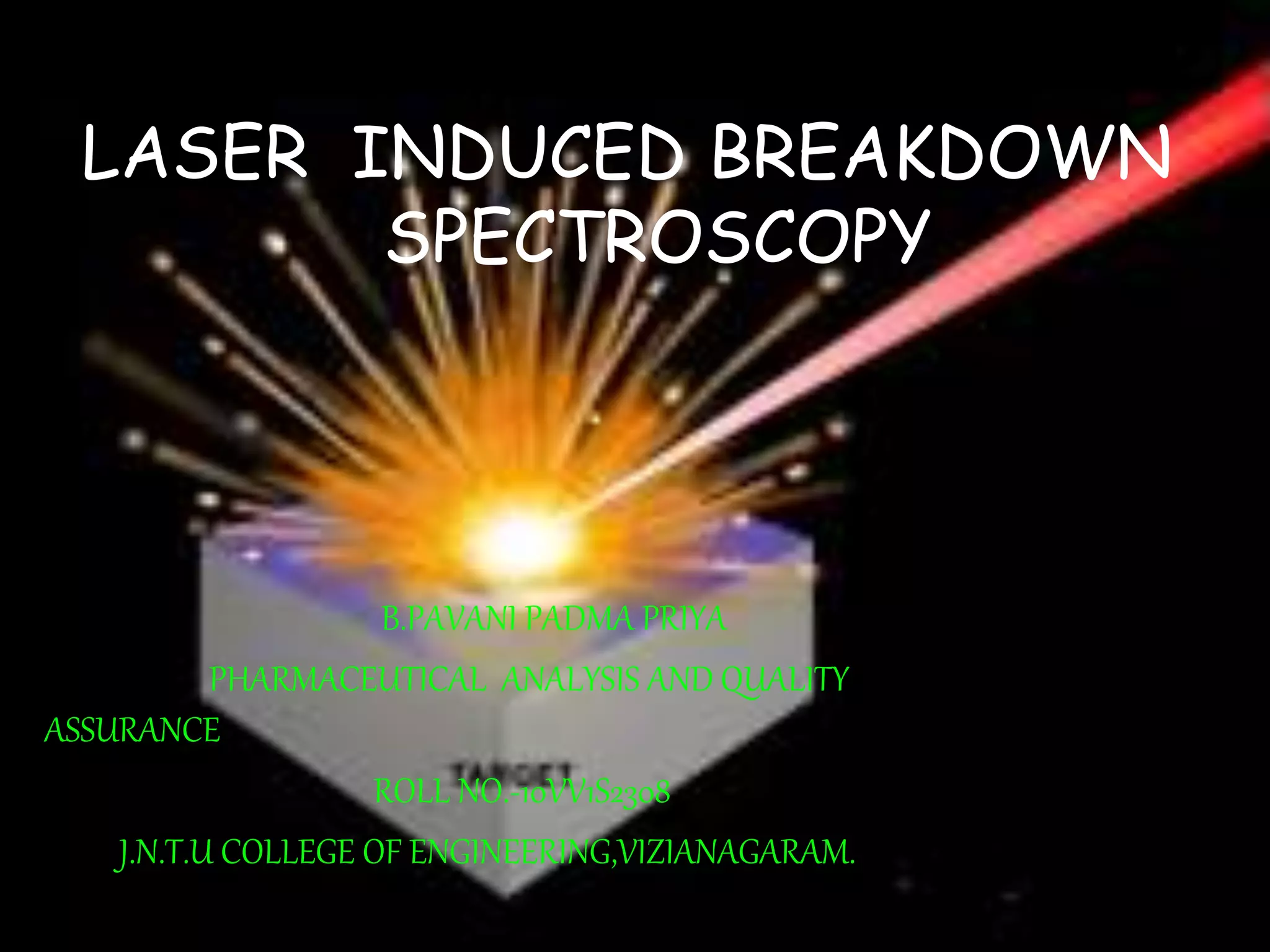
LASER INDUCED BREAKDOWN
SPECTROSCOPY
B.PAVANI PADMA PRIYA
PHARMACEUTICAL ANALYSIS AND QUALITY
ASSURANCE
ROLL NO.-10VV1S2308
J.N.T.U COLLEGE OF ENGINEERING,VIZIANAGARAM.
contents
 Introduction
Principle
Instrumentation: Design
Operation
Advantages
Limitations
Applications
Recent scientific and technological
developments
Research articles
References
LASER-INDUCEDBREAKDOWN
SPECTROSCOPY (LIBS)
INTRODUCTION:
 Laser Ablation : Removing material from a sample surface by
irradiating it with a laser beam.
 After nearly 30 years of study, laser ablation has become the
basis of a new chemical analysis technology.
 Two approaches are: 1) LIBS,(part-per-million sensitivity)
2) LA-ICP-MS(parts-per-billion sensitivity).
Principle
LIBS: TYPE of AES which uses a highly energetic laser pulse as
the excitation source.
Laser is focused to form a plasma, which atomizes and excites
samples until it ionises and analysed by a spectrometer.
The obtained spectra consist of lines corresponding to the
elements evaporated from the sample surface.
INSTRUMENTATION: DESIGN
 LIBS system consists of :
 Laser :- Nd:YAG, and Eximer.
 Spectrometer :- either a monochromator / a polychromator
 Fiber optics
 Detector:- PMT / CCD(respectively to the spectrometer used)
attached to a spectrograph analyzes the collected plasma
light and this is coupled to a PC which can rapidly process
and interpret the acquired data.
INSTRUMENTATION: OPERATION
 Operate by focusing the laser onto a small area at the
surface of the specimen; generates a plasma plume with
temperatures in excess of 1,00,000 K.
•
 Based on physical composition, laser induced plasma can
be divided into three regions
 Region-I: (central or core region) the
temperature is maximum and species
are in ionised state.
 Region-II: (mid region) apart from ionised
species, both neutral and certain number
of molecular species are present.
 Region-III: (extended region) temperature
is comparatively lower and larger density
of molecular species present.
 As the plasma plume expands, constituent atoms in the ionized
gas become excited.
 Over just a few microseconds, the excited atoms began to relax,
resulting in characteristic spectral emissions by accompanying the
spectrometer and detector (delay generator) which accurately
gates the detector's response time.
ADVANTAGES
 Versatile sampling of solids, gases or liquids.
 Little or no sample preparation.
 Very small amounts of sample material.
 Analysis of extremely hard materials.
 Local analysis in micro regions offers a spatial resolving power.
 Possibility of simultaneous multi-elemental analysis.
 Potential for direct detection in aerosols.
 Simple and rapid analysis.
LIMITATIONS
 Increased cost and system complexity.
 Difficulty in obtaining suitable standards (semi-quantitative).
 Large interference effects ( in the case of LIBS in aerosols,
the potential interference of particle size).
 Detection limits are generally not as good as established
solution techniques.
 Poor precision.
 Possibility of ocular damage by the high-energy laser pulses.
APPLICATIONS
• LIBS at the Industries:
Pharmaceuticals**:-
-analysis of drug and lubricant in tablets
-analysis of saline solution
-drug mapping
-homogeneity of samples
Environment:-
-detection of contaminants
-industrial effluents
Metallurgy:- solid or molten alloys (Al, Cu, Zn, Mg, steel, Co, Ni,Cr)
- process fluids
- galvanized steel
- molten salts
- depth profiling
Other Organics:- paper
- polymer
- wood
Minerals:- detection of various elements (Au, Cu, Ni, Fe, C, Ca, Al,
Mg, Si,Ti) in ore and ore slurry.
RecentScientificand Technological
Developments
• Increase in sensitivity by 1 to 2 orders of magnitude using
double-pulse laser bursts or mixed-wavelength pulses.
• LIBS analysis of multilayer samples with high depth resolution
micro-mapping of heterogeneous samples.
• One-shot multielemental analysis using Échelle spectrograph
tunable laser.
• Hyphenated techniques with Raman and fluorescence
spectroscopy.
• Use of femtosecond laser for LIBS applications.
RESEARCH ARTICLES
 Quantitative analysis of gallstones using laser-induced breakdown
spectroscopy.
• VK Singh, V Singh, AK Rai, SN Thakur ;Applied Optics, Vol. 47, Issue 31,
pp. G38-G47 (2008), opticsinfobase.org.
 Identification and discrimination of Pseudomonas aeruginosa
bacteria grown in blood and bile by laser-induced breakdown
spectroscopy.
SJ Rehse, J Diedrich; Received 23 May 2007; Accepted 23 July 2007,Science
direct.com.
 Variational study of the constituents of cholesterol stones by laser-
induced breakdown spectroscopy.
VK Singh, V Rai - Lasers in Medical Science, 2009 – Springer.com.
CONCLUSION
 After nearly many years of study, LIBS has become the basis of
a new chemical analysis technology.
 Mars science laboratory mission are planning to take the LIBS
instrument to the mars in 2012.
REFERENCES
• www.appliedspectra.com/technology/LIBS.html
• www.springer.com
• www.ncbi.nlm.nih.gov
• www.appliedspectra.com
• www.rsc.org/publishing/journals
• www.oceanoptics.com/products/libs.asp
• en.wikipedia.org/wiki/Laserinducedbreakdownspectroscopy
• www.eproceedings.org
• www.photonics.cusat.edu/Research_Laser Induced
Plasma.html
Laser  induced breakdown spectroscopy

Laser induced breakdown spectroscopy

  • 1.
    LASER INDUCED BREAKDOWN SPECTROSCOPY B.PAVANIPADMA PRIYA PHARMACEUTICAL ANALYSIS AND QUALITY ASSURANCE ROLL NO.-10VV1S2308 J.N.T.U COLLEGE OF ENGINEERING,VIZIANAGARAM.
  • 2.
  • 3.
    LASER-INDUCEDBREAKDOWN SPECTROSCOPY (LIBS) INTRODUCTION:  LaserAblation : Removing material from a sample surface by irradiating it with a laser beam.  After nearly 30 years of study, laser ablation has become the basis of a new chemical analysis technology.  Two approaches are: 1) LIBS,(part-per-million sensitivity) 2) LA-ICP-MS(parts-per-billion sensitivity).
  • 4.
    Principle LIBS: TYPE ofAES which uses a highly energetic laser pulse as the excitation source. Laser is focused to form a plasma, which atomizes and excites samples until it ionises and analysed by a spectrometer. The obtained spectra consist of lines corresponding to the elements evaporated from the sample surface.
  • 5.
    INSTRUMENTATION: DESIGN  LIBSsystem consists of :  Laser :- Nd:YAG, and Eximer.  Spectrometer :- either a monochromator / a polychromator  Fiber optics  Detector:- PMT / CCD(respectively to the spectrometer used) attached to a spectrograph analyzes the collected plasma light and this is coupled to a PC which can rapidly process and interpret the acquired data.
  • 7.
    INSTRUMENTATION: OPERATION  Operateby focusing the laser onto a small area at the surface of the specimen; generates a plasma plume with temperatures in excess of 1,00,000 K. •
  • 8.
     Based onphysical composition, laser induced plasma can be divided into three regions  Region-I: (central or core region) the temperature is maximum and species are in ionised state.  Region-II: (mid region) apart from ionised species, both neutral and certain number of molecular species are present.  Region-III: (extended region) temperature is comparatively lower and larger density of molecular species present.
  • 9.
     As theplasma plume expands, constituent atoms in the ionized gas become excited.  Over just a few microseconds, the excited atoms began to relax, resulting in characteristic spectral emissions by accompanying the spectrometer and detector (delay generator) which accurately gates the detector's response time.
  • 10.
    ADVANTAGES  Versatile samplingof solids, gases or liquids.  Little or no sample preparation.  Very small amounts of sample material.  Analysis of extremely hard materials.  Local analysis in micro regions offers a spatial resolving power.  Possibility of simultaneous multi-elemental analysis.  Potential for direct detection in aerosols.  Simple and rapid analysis.
  • 11.
    LIMITATIONS  Increased costand system complexity.  Difficulty in obtaining suitable standards (semi-quantitative).  Large interference effects ( in the case of LIBS in aerosols, the potential interference of particle size).  Detection limits are generally not as good as established solution techniques.  Poor precision.  Possibility of ocular damage by the high-energy laser pulses.
  • 12.
    APPLICATIONS • LIBS atthe Industries: Pharmaceuticals**:- -analysis of drug and lubricant in tablets -analysis of saline solution -drug mapping -homogeneity of samples Environment:- -detection of contaminants -industrial effluents
  • 13.
    Metallurgy:- solid ormolten alloys (Al, Cu, Zn, Mg, steel, Co, Ni,Cr) - process fluids - galvanized steel - molten salts - depth profiling Other Organics:- paper - polymer - wood Minerals:- detection of various elements (Au, Cu, Ni, Fe, C, Ca, Al, Mg, Si,Ti) in ore and ore slurry.
  • 14.
    RecentScientificand Technological Developments • Increasein sensitivity by 1 to 2 orders of magnitude using double-pulse laser bursts or mixed-wavelength pulses. • LIBS analysis of multilayer samples with high depth resolution micro-mapping of heterogeneous samples. • One-shot multielemental analysis using Échelle spectrograph tunable laser. • Hyphenated techniques with Raman and fluorescence spectroscopy. • Use of femtosecond laser for LIBS applications.
  • 15.
    RESEARCH ARTICLES  Quantitativeanalysis of gallstones using laser-induced breakdown spectroscopy. • VK Singh, V Singh, AK Rai, SN Thakur ;Applied Optics, Vol. 47, Issue 31, pp. G38-G47 (2008), opticsinfobase.org.  Identification and discrimination of Pseudomonas aeruginosa bacteria grown in blood and bile by laser-induced breakdown spectroscopy. SJ Rehse, J Diedrich; Received 23 May 2007; Accepted 23 July 2007,Science direct.com.  Variational study of the constituents of cholesterol stones by laser- induced breakdown spectroscopy. VK Singh, V Rai - Lasers in Medical Science, 2009 – Springer.com.
  • 16.
    CONCLUSION  After nearlymany years of study, LIBS has become the basis of a new chemical analysis technology.  Mars science laboratory mission are planning to take the LIBS instrument to the mars in 2012.
  • 17.
    REFERENCES • www.appliedspectra.com/technology/LIBS.html • www.springer.com •www.ncbi.nlm.nih.gov • www.appliedspectra.com • www.rsc.org/publishing/journals • www.oceanoptics.com/products/libs.asp • en.wikipedia.org/wiki/Laserinducedbreakdownspectroscopy • www.eproceedings.org • www.photonics.cusat.edu/Research_Laser Induced Plasma.html