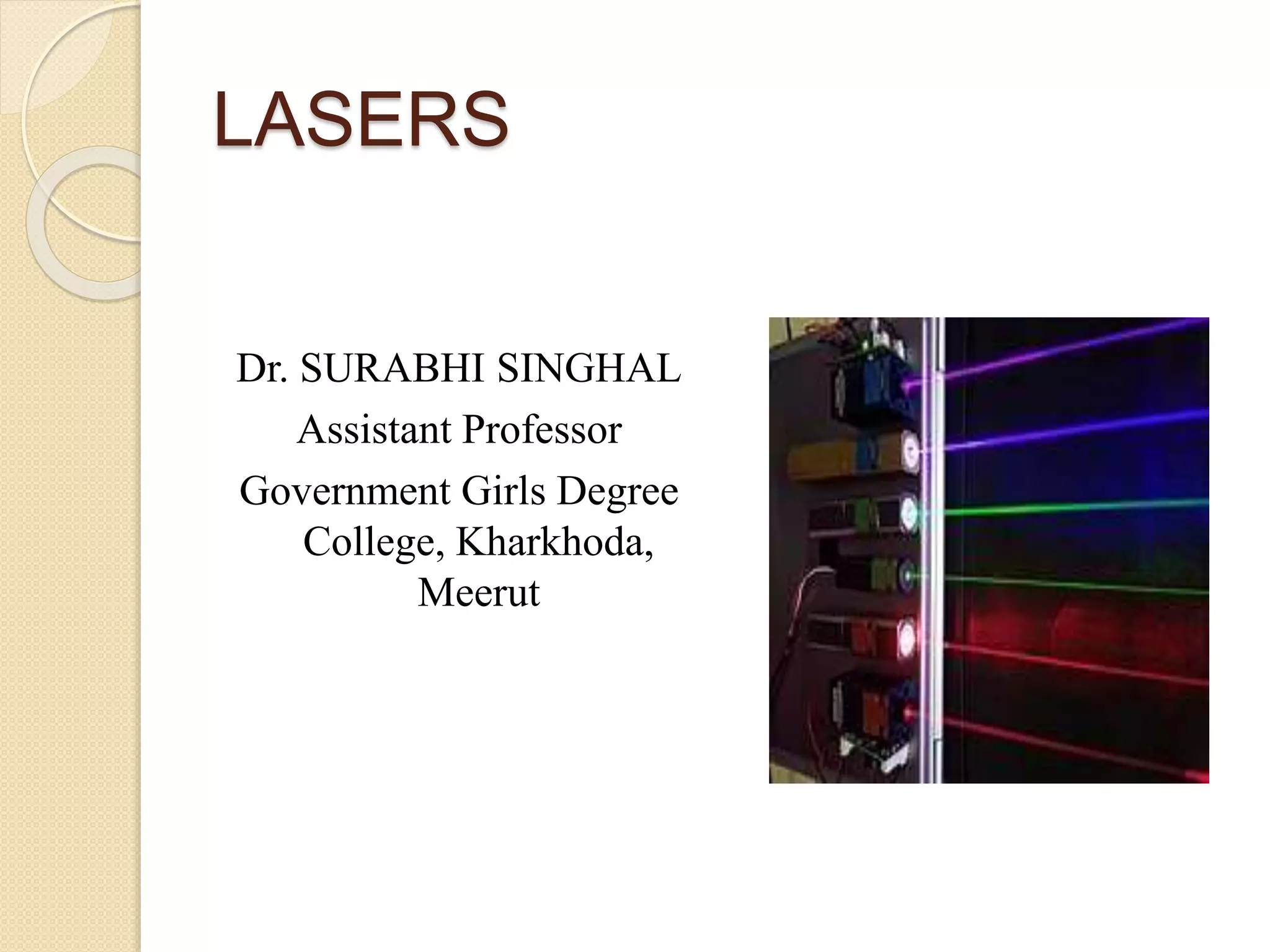
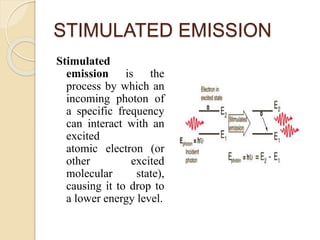
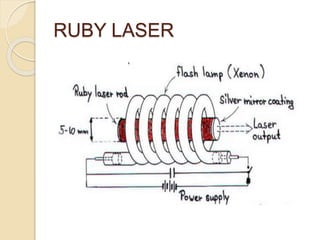
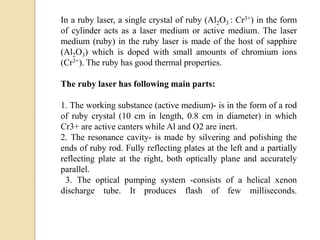
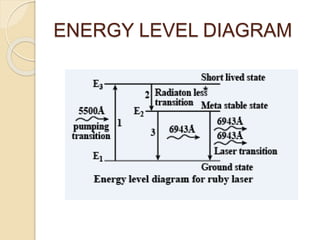
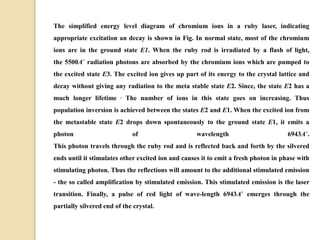
This document summarizes the ruby laser. It begins by explaining that a ruby laser uses a synthetic ruby crystal as its laser medium, which was the first successful laser developed in 1960. It emits deep red light at a wavelength of 694.3 nm. The ruby crystal is doped with small amounts of chromium ions, which provide the necessary population inversion to achieve lasing. When optically pumped by a flash lamp, chromium ions are excited to higher energy states and decay to a metastable state, building up population inversion between that state and the ground state. Stimulated emission then produces coherent red light that is amplified as it reflects within the ruby crystal's resonance cavity and emerges through the partially reflective end.



![Polymer [ बहुलक ] Chemistry Notes PDF - Irfanullah Mehar - JJ Sir Chemistry.pdf](https://cdn.slidesharecdn.com/ss_thumbnails/polymerchemistrynotespdf-irfanullahmehar-jjsirchemistry-260210172118-3f9b37f7-thumbnail.jpg?width=640&height=640&fit=bounds)
