Reasons to Choose Laravel
Frameworks For Web
Development Project
CHOOSING THE RIGHT FRAMEWORK IS KEY TO
BUILDING SCALABLE AND SECURE WEB
APPLICATIONS. WITH ITS ELEGANT SYNTAX AND
POWERFUL FEATURES, LARAVEL ENSURES A
SMOOTH DEVELOPMENT PROCESS, MAKING IT A
TOP CHOICE FOR DEVELOPERS.
0 3 / 1 0 / 2 0 2 5
What is the Laravel Framework?
Laravel is an open-source web application framework
built with PHP, designed to simplify and enhance the web
development process. It offers powerful features such as
MVC architecture, Blade templating engine, ORM
(Eloquent), robust security, a flexible routing system,
middleware, and more. Over a decade since its launch,
Laravel remains one of the most popular frameworks
among developers.
0 3 / 1 0 / 2 0 2 5
MVC Architecture Support
One of Laravel's key advantages is its robust support for the Model-View-
Controller (MVC) architecture, which ensures a well-structured and organized
web application. By dividing the application logic into three interconnected
components—Model, View, and Controller—Laravel enhances code
readability, maintainability, and scalability.
• Model: ManageAs data and database interactions, ensuring efficient data
handling.
• View: Handles the presentation layer, making it easier to manage UI
components separately.
• Controller: Acts as a bridge between the Model and View, processing user
requests and defining business logic.
0 3 / 1 0 / 2 0 2 5
Built-in Templating Engine - Blade
Laravel comes with its own powerful templating engine called Blade, which
simplifies the process of defining and managing templates, layouts, and
sections. It allows developers to create clean, readable, and reusable code,
enhancing the overall development experience. Key features of Blade
include:
• Template Inheritance: Enables developers to create master templates
and extend them, reducing redundancy.
• Data Parsing: Easily integrates dynamic data into templates without
affecting performance.
• Control Structures: Supports loops, conditionals, and other logic directly
within templates.
0 3 / 1 0 / 2 0 2 5
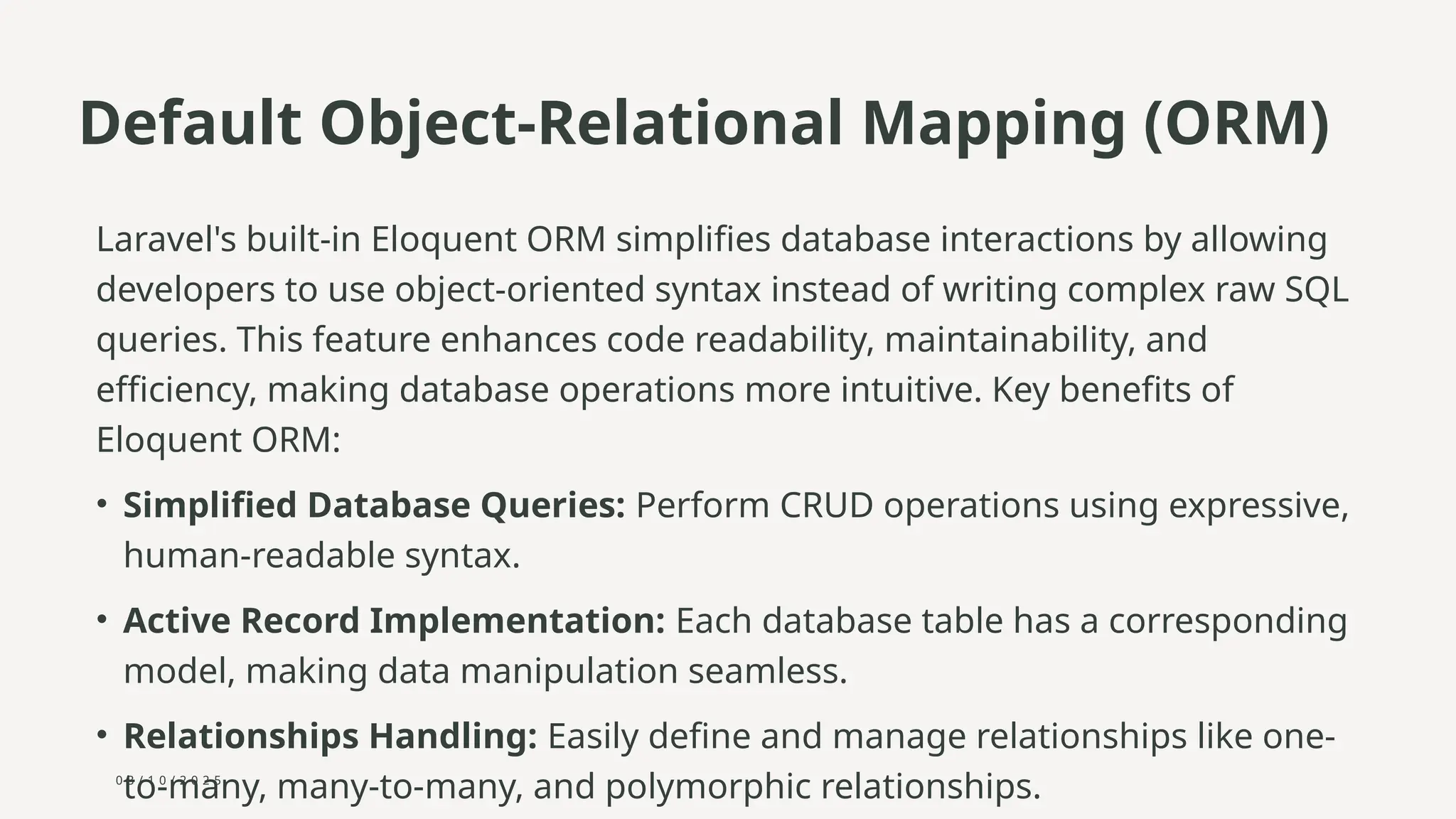
Default Object-Relational Mapping (ORM)
Laravel's built-in Eloquent ORM simplifies database interactions by allowing
developers to use object-oriented syntax instead of writing complex raw SQL
queries. This feature enhances code readability, maintainability, and
efficiency, making database operations more intuitive. Key benefits of
Eloquent ORM:
• Simplified Database Queries: Perform CRUD operations using expressive,
human-readable syntax.
• Active Record Implementation: Each database table has a corresponding
model, making data manipulation seamless.
• Relationships Handling: Easily define and manage relationships like one-
to-many, many-to-many, and polymorphic relationships.
0 3 / 1 0 / 2 0 2 5
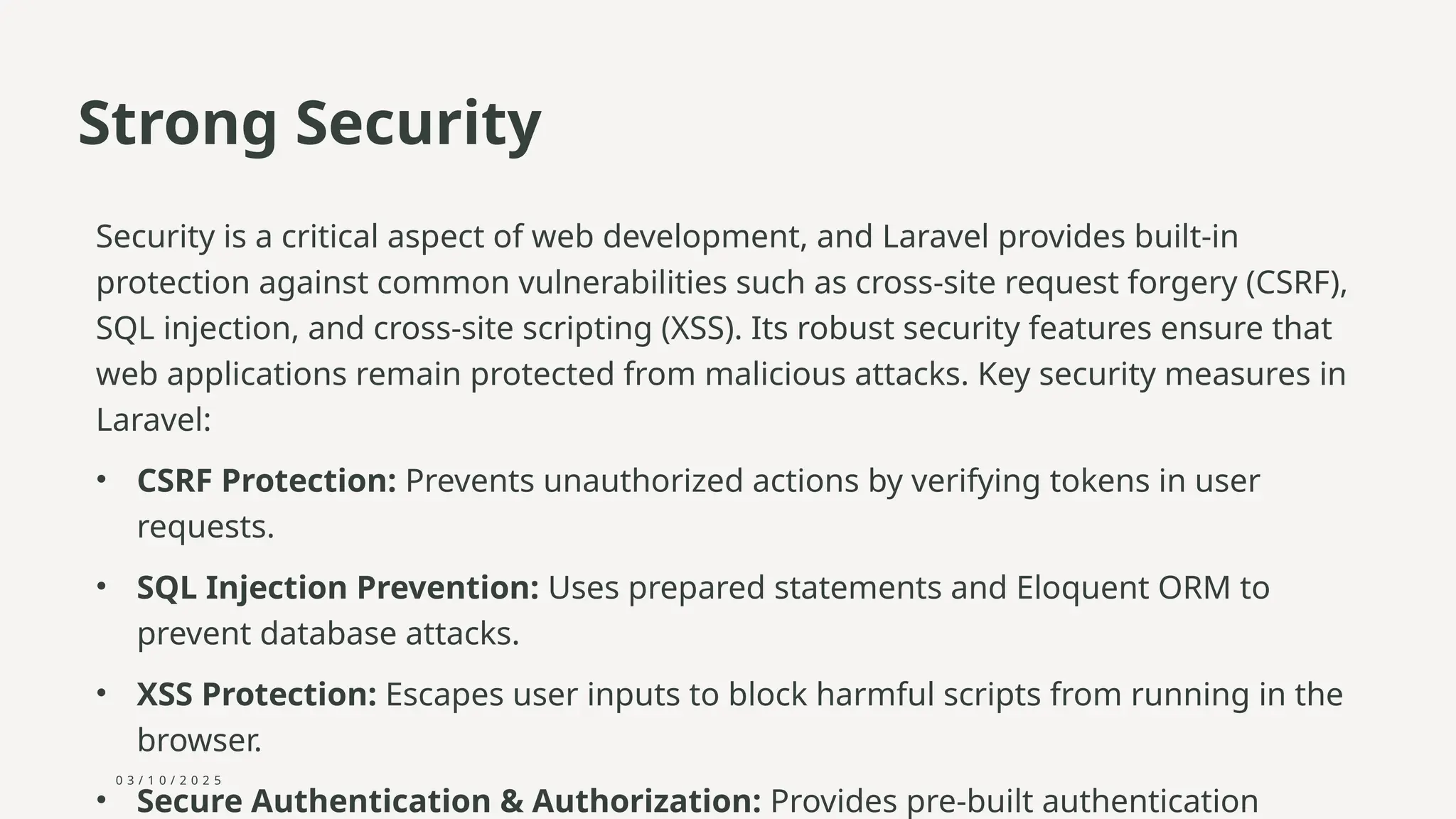
Strong Security
Security is a critical aspect of web development, and Laravel provides built-in
protection against common vulnerabilities such as cross-site request forgery (CSRF),
SQL injection, and cross-site scripting (XSS). Its robust security features ensure that
web applications remain protected from malicious attacks. Key security measures in
Laravel:
• CSRF Protection: Prevents unauthorized actions by verifying tokens in user
requests.
• SQL Injection Prevention: Uses prepared statements and Eloquent ORM to
prevent database attacks.
• XSS Protection: Escapes user inputs to block harmful scripts from running in the
browser.
• Secure Authentication & Authorization: Provides pre-built authentication
0 3 / 1 0 / 2 0 2 5
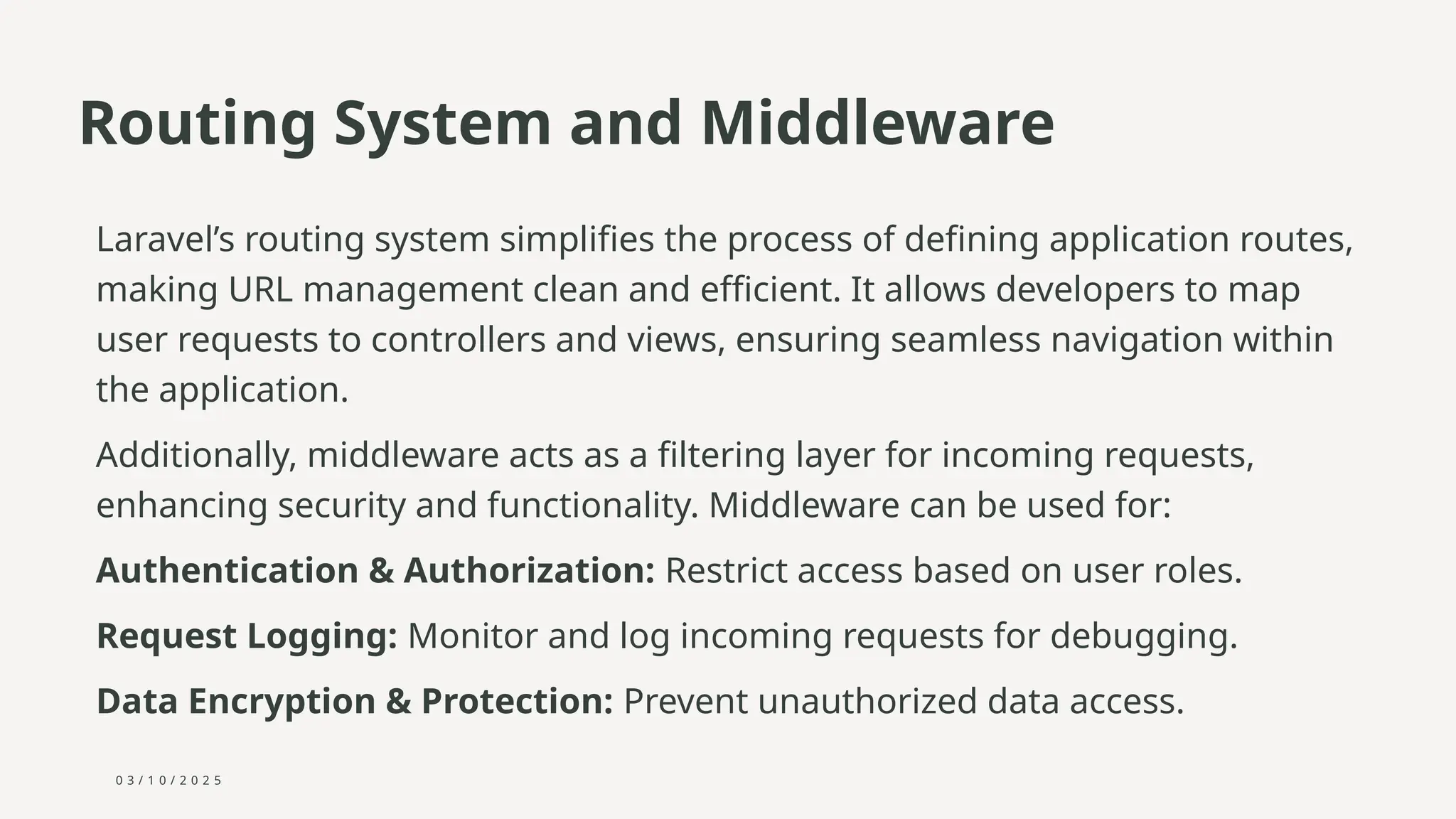
Routing System and Middleware
Laravel’s routing system simplifies the process of defining application routes,
making URL management clean and efficient. It allows developers to map
user requests to controllers and views, ensuring seamless navigation within
the application.
Additionally, middleware acts as a filtering layer for incoming requests,
enhancing security and functionality. Middleware can be used for:
Authentication & Authorization: Restrict access based on user roles.
Request Logging: Monitor and log incoming requests for debugging.
Data Encryption & Protection: Prevent unauthorized data access.
0 3 / 1 0 / 2 0 2 5
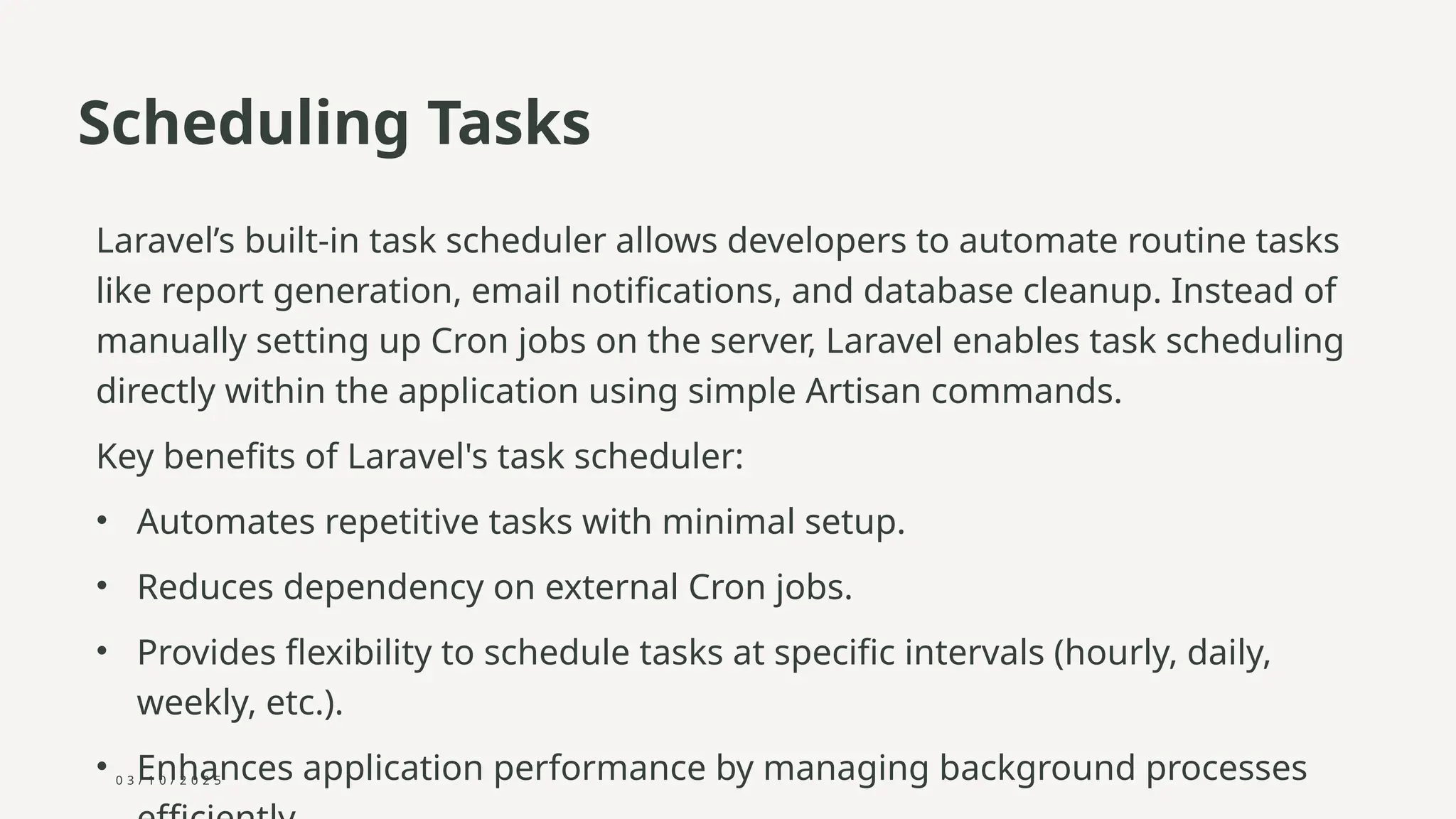
Scheduling Tasks
Laravel’s built-in task scheduler allows developers to automate routine tasks
like report generation, email notifications, and database cleanup. Instead of
manually setting up Cron jobs on the server, Laravel enables task scheduling
directly within the application using simple Artisan commands.
Key benefits of Laravel's task scheduler:
• Automates repetitive tasks with minimal setup.
• Reduces dependency on external Cron jobs.
• Provides flexibility to schedule tasks at specific intervals (hourly, daily,
weekly, etc.).
• Enhances application performance by managing background processes
0 3 / 1 0 / 2 0 2 5
Seeding and Database Migrations
Laravel’s database migrations and seeding features make it a
preferred choice for web development by simplifying database
management.
• Migrations allow developers to define, modify, and track
database schemas in a version-controlled manner, ensuring
consistency across different environments.
• Seeding enables the population of databases with default or
sample data, making testing and development more
efficient.
0 3 / 1 0 / 2 0 2 5
Thank You For Your Time
Any Question? Contact Us
Original Blog: Python Frameworks
Website: https://www.devacetech.com/
Email: info@devacetech.com
Phone: (848) 208-659

Laravel Framework for web development.pptx

  • 1.
    Reasons to ChooseLaravel Frameworks For Web Development Project CHOOSING THE RIGHT FRAMEWORK IS KEY TO BUILDING SCALABLE AND SECURE WEB APPLICATIONS. WITH ITS ELEGANT SYNTAX AND POWERFUL FEATURES, LARAVEL ENSURES A SMOOTH DEVELOPMENT PROCESS, MAKING IT A TOP CHOICE FOR DEVELOPERS.
  • 2.
    0 3 /1 0 / 2 0 2 5 What is the Laravel Framework? Laravel is an open-source web application framework built with PHP, designed to simplify and enhance the web development process. It offers powerful features such as MVC architecture, Blade templating engine, ORM (Eloquent), robust security, a flexible routing system, middleware, and more. Over a decade since its launch, Laravel remains one of the most popular frameworks among developers.
  • 3.
    0 3 /1 0 / 2 0 2 5 MVC Architecture Support One of Laravel's key advantages is its robust support for the Model-View- Controller (MVC) architecture, which ensures a well-structured and organized web application. By dividing the application logic into three interconnected components—Model, View, and Controller—Laravel enhances code readability, maintainability, and scalability. • Model: ManageAs data and database interactions, ensuring efficient data handling. • View: Handles the presentation layer, making it easier to manage UI components separately. • Controller: Acts as a bridge between the Model and View, processing user requests and defining business logic.
  • 4.
    0 3 /1 0 / 2 0 2 5 Built-in Templating Engine - Blade Laravel comes with its own powerful templating engine called Blade, which simplifies the process of defining and managing templates, layouts, and sections. It allows developers to create clean, readable, and reusable code, enhancing the overall development experience. Key features of Blade include: • Template Inheritance: Enables developers to create master templates and extend them, reducing redundancy. • Data Parsing: Easily integrates dynamic data into templates without affecting performance. • Control Structures: Supports loops, conditionals, and other logic directly within templates.
  • 5.
    0 3 /1 0 / 2 0 2 5 Default Object-Relational Mapping (ORM) Laravel's built-in Eloquent ORM simplifies database interactions by allowing developers to use object-oriented syntax instead of writing complex raw SQL queries. This feature enhances code readability, maintainability, and efficiency, making database operations more intuitive. Key benefits of Eloquent ORM: • Simplified Database Queries: Perform CRUD operations using expressive, human-readable syntax. • Active Record Implementation: Each database table has a corresponding model, making data manipulation seamless. • Relationships Handling: Easily define and manage relationships like one- to-many, many-to-many, and polymorphic relationships.
  • 6.
    0 3 /1 0 / 2 0 2 5 Strong Security Security is a critical aspect of web development, and Laravel provides built-in protection against common vulnerabilities such as cross-site request forgery (CSRF), SQL injection, and cross-site scripting (XSS). Its robust security features ensure that web applications remain protected from malicious attacks. Key security measures in Laravel: • CSRF Protection: Prevents unauthorized actions by verifying tokens in user requests. • SQL Injection Prevention: Uses prepared statements and Eloquent ORM to prevent database attacks. • XSS Protection: Escapes user inputs to block harmful scripts from running in the browser. • Secure Authentication & Authorization: Provides pre-built authentication
  • 7.
    0 3 /1 0 / 2 0 2 5 Routing System and Middleware Laravel’s routing system simplifies the process of defining application routes, making URL management clean and efficient. It allows developers to map user requests to controllers and views, ensuring seamless navigation within the application. Additionally, middleware acts as a filtering layer for incoming requests, enhancing security and functionality. Middleware can be used for: Authentication & Authorization: Restrict access based on user roles. Request Logging: Monitor and log incoming requests for debugging. Data Encryption & Protection: Prevent unauthorized data access.
  • 8.
    0 3 /1 0 / 2 0 2 5 Scheduling Tasks Laravel’s built-in task scheduler allows developers to automate routine tasks like report generation, email notifications, and database cleanup. Instead of manually setting up Cron jobs on the server, Laravel enables task scheduling directly within the application using simple Artisan commands. Key benefits of Laravel's task scheduler: • Automates repetitive tasks with minimal setup. • Reduces dependency on external Cron jobs. • Provides flexibility to schedule tasks at specific intervals (hourly, daily, weekly, etc.). • Enhances application performance by managing background processes
  • 9.
    0 3 /1 0 / 2 0 2 5 Seeding and Database Migrations Laravel’s database migrations and seeding features make it a preferred choice for web development by simplifying database management. • Migrations allow developers to define, modify, and track database schemas in a version-controlled manner, ensuring consistency across different environments. • Seeding enables the population of databases with default or sample data, making testing and development more efficient.
  • 10.
    0 3 /1 0 / 2 0 2 5 Thank You For Your Time Any Question? Contact Us Original Blog: Python Frameworks Website: https://www.devacetech.com/ Email: info@devacetech.com Phone: (848) 208-659