


Assignment 1


   Professional Development


      Diego Ulloa Iglesias


English Methodology (DID0412-1)


          Mss. Correa


      December 22nd, 2011
Language Learner Profile | 1


English Background


The interviewed lived in Ecuador for a few time but he’s currently living in Concepción
with his mother and his two brothers. When Juan was in Secondary school, he failed the
same course twice and he’s currently studying Public Relations at Virginio Gómez Institute.


He attributes his English level mainly to his passion for watching films and also for
listening to music most of the time. He believes this is one of many ways to learn English
or other languages; you’re interested in a specific song and you have to comprehend it by
looking for the meaning of every single word or phrases in times that are contained in that
particular song. He also believes that, when a person is talking to him in English, he can
understand the general idea by picking some words he already knows and linking them
with the new ones he do not know but are similar to some Spanish words (what we know
as “cognates”). The only problem with his spoken English is that he cannot reproduce a
long fluent answer, but short paused ones.
Language Learner Profile | 2


Interview


Interviewer: D
Interviewee: J


D: First of all, I’d like to know your name.
J: My name is Juan Diego Pinos


D: How old are you?
J: I’m twenty three years old


D: Where are you from?
J: I’m from Chile.


D: But the city?
J: My city is Concepción.


D: Concepción... Are you still living in Concepcion?
J: Yep.


D: What thing do you like most about your country? Why?
J: Uhmm, the party and people… how the people have fun... and this.


D: How would you define your relationship with your parents?
J: It’s pretty good.
Language Learner Profile | 3


D: Do you get along with both of them?
J: Yep.


D: What subject did you dislike when you were in Elementary School?
J: Math, I hate.


D: What kind of game did you use to play when you were a 6-year-old boy?
L: Basketball.


D: Where did you go on holiday last year?
J: Ecuador… to Ecuador.


D: Have you ever visited another country?
J: Yep. Ecuador.


D: How was that experience?
J: It’s amazing; it’s a really beautiful country.


D: Well, about your future… what do you think you will be doing in 10 years?
J: Working in a huge magazine like public relation… no sé, and this.


D: I know you’re working at Telepizza, right? So, will you have to work tomorrow?
J: Yep.


D: What time will you have to get there?
J: Three o’clock.
Language Learner Profile | 4


D: Finally I’d like to thank you for your time. Also, thanks for answering all of my
questions. I know it could have been something odd to you but, you know, you have to
break the ice with those situations which make you feel kind of nervous. So thanks again.
J: Ok. It’s ok (laugh).
Language Learner Profile | 5


Transcription


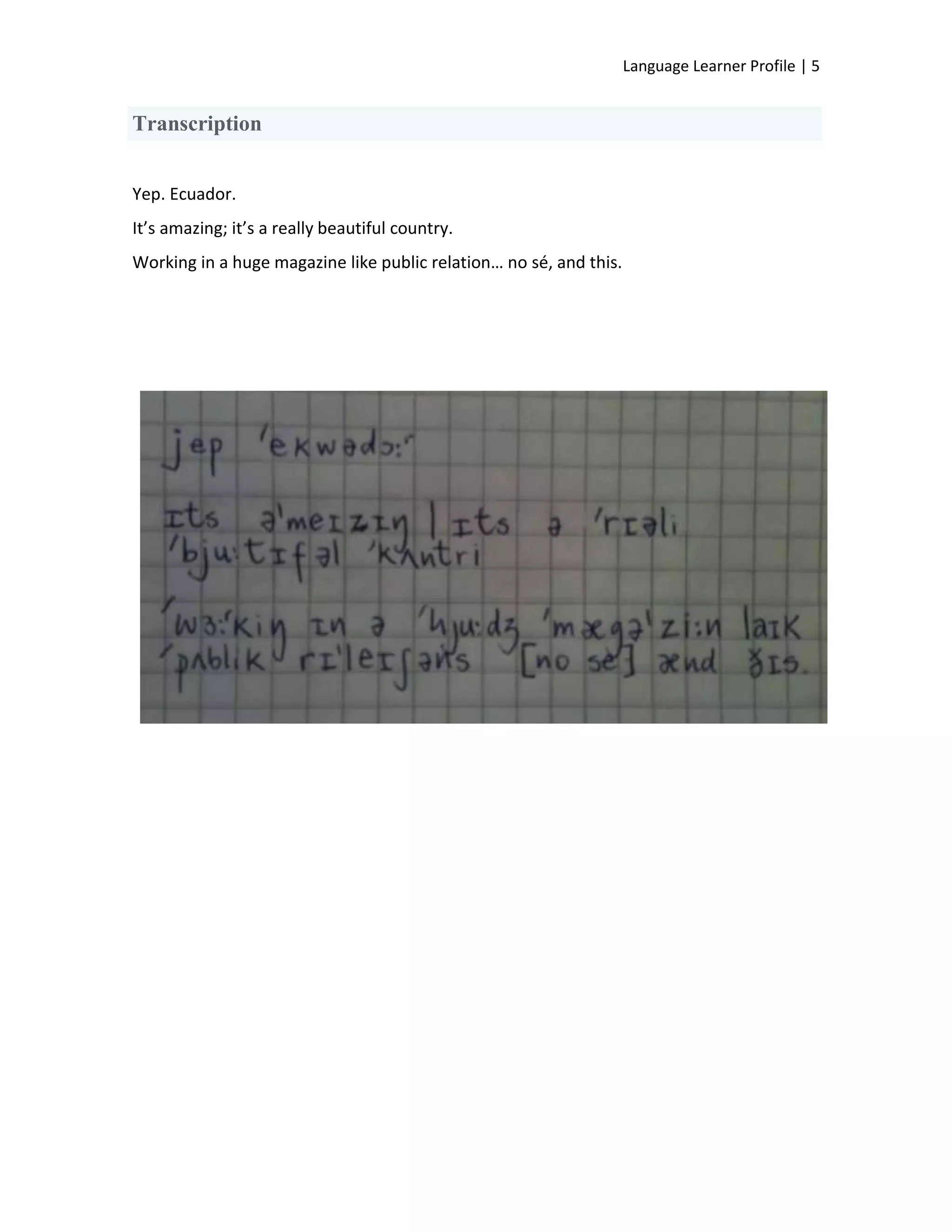
Yep. Ecuador.
It’s amazing; it’s a really beautiful country.
Working in a huge magazine like public relation… no sé, and this.
Language Learner Profile | 6


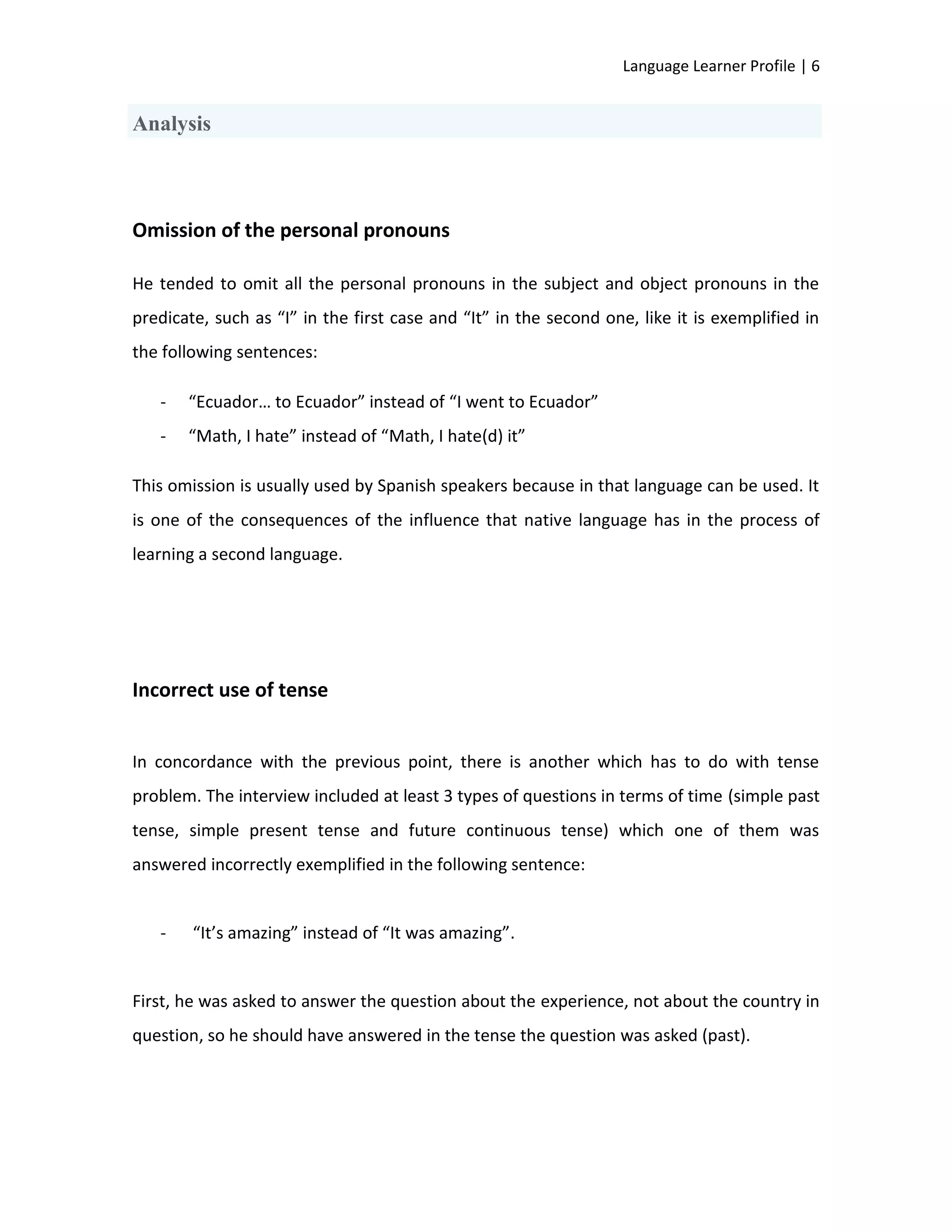
Analysis


Omission of the personal pronouns

He tended to omit all the personal pronouns in the subject and object pronouns in the
predicate, such as “I” in the first case and “It” in the second one, like it is exemplified in
the following sentences:

   -   “Ecuador… to Ecuador” instead of “I went to Ecuador”
   -   “Math, I hate” instead of “Math, I hate(d) it”

This omission is usually used by Spanish speakers because in that language can be used. It
is one of the consequences of the influence that native language has in the process of
learning a second language.


Incorrect use of tense


In concordance with the previous point, there is another which has to do with tense
problem. The interview included at least 3 types of questions in terms of time (simple past
tense, simple present tense and future continuous tense) which one of them was
answered incorrectly exemplified in the following sentence:


   -    “It’s amazing” instead of “It was amazing”.


First, he was asked to answer the question about the experience, not about the country in
question, so he should have answered in the tense the question was asked (past).
Language Learner Profile | 7


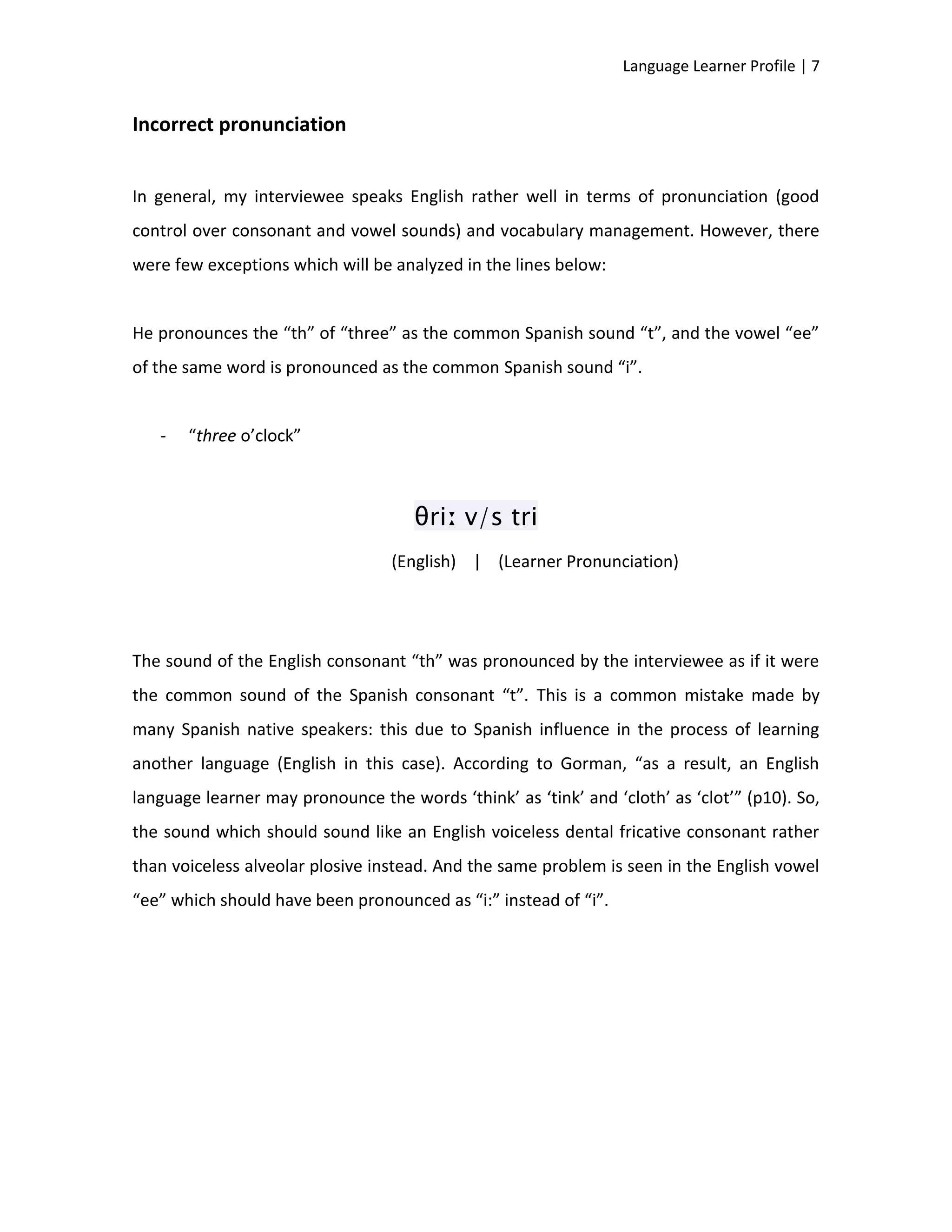
Incorrect pronunciation


In general, my interviewee speaks English rather well in terms of pronunciation (good
control over consonant and vowel sounds) and vocabulary management. However, there
were few exceptions which will be analyzed in the lines below:


He pronounces the “th” of “three” as the common Spanish sound “t”, and the vowel “ee”
of the same word is pronounced as the common Spanish sound “i”.


   -   “three o’clock”


                                     θriː v/s tri
                                  (English) | (Learner Pronunciation)


The sound of the English consonant “th” was pronounced by the interviewee as if it were
the common sound of the Spanish consonant “t”. This is a common mistake made by
many Spanish native speakers: this due to Spanish influence in the process of learning
another language (English in this case). According to Gorman, “as a result, an English
language learner may pronounce the words ‘think’ as ‘tink’ and ‘cloth’ as ‘clot’” (p10). So,
the sound which should sound like an English voiceless dental fricative consonant rather
than voiceless alveolar plosive instead. And the same problem is seen in the English vowel
“ee” which should have been pronounced as “i:” instead of “i”.
Language Learner Profile | 8


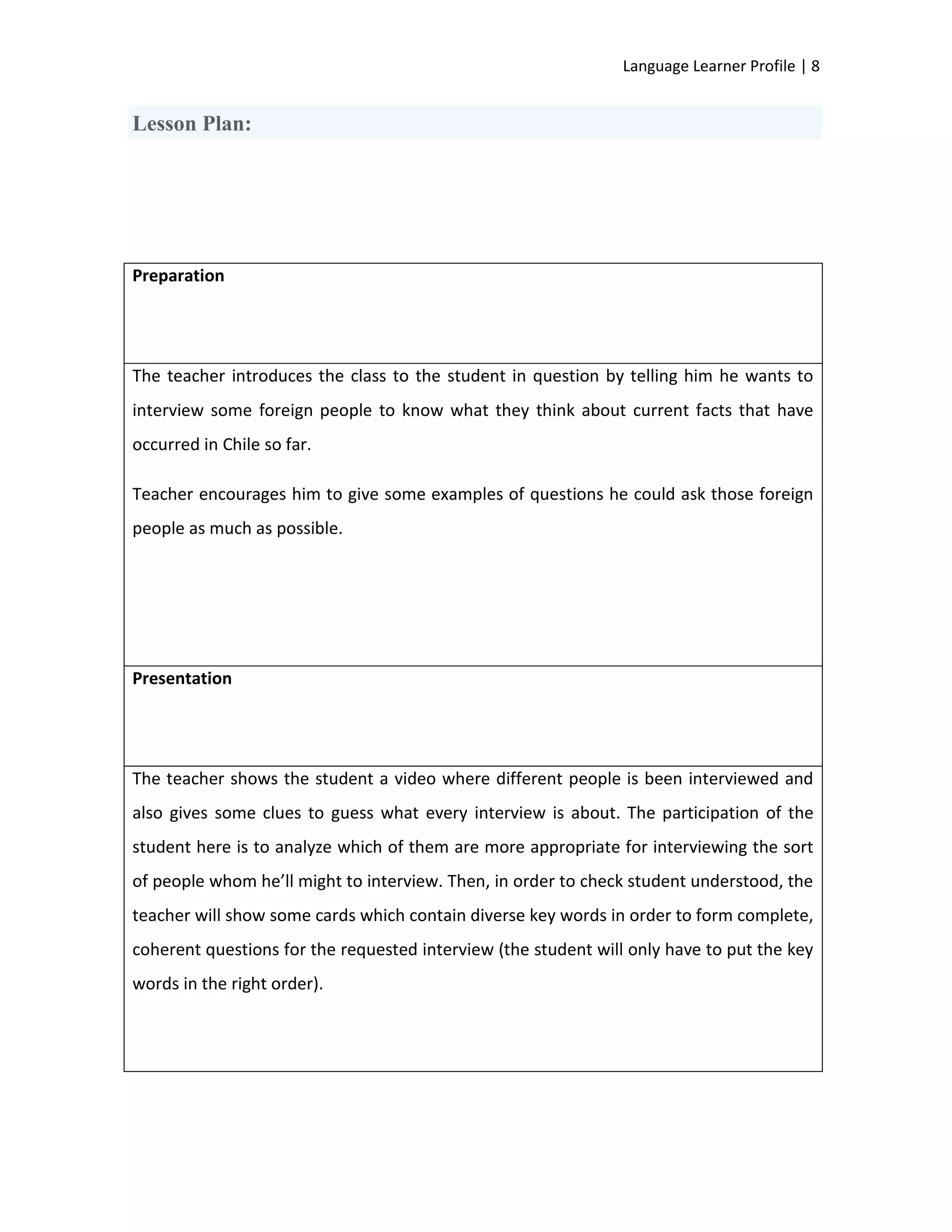
Lesson Plan:


Preparation


The teacher introduces the class to the student in question by telling him he wants to
interview some foreign people to know what they think about current facts that have
occurred in Chile so far.

Teacher encourages him to give some examples of questions he could ask those foreign
people as much as possible.


Presentation


The teacher shows the student a video where different people is been interviewed and
also gives some clues to guess what every interview is about. The participation of the
student here is to analyze which of them are more appropriate for interviewing the sort
of people whom he’ll might to interview. Then, in order to check student understood, the
teacher will show some cards which contain diverse key words in order to form complete,
coherent questions for the requested interview (the student will only have to put the key
words in the right order).
Language Learner Profile | 9


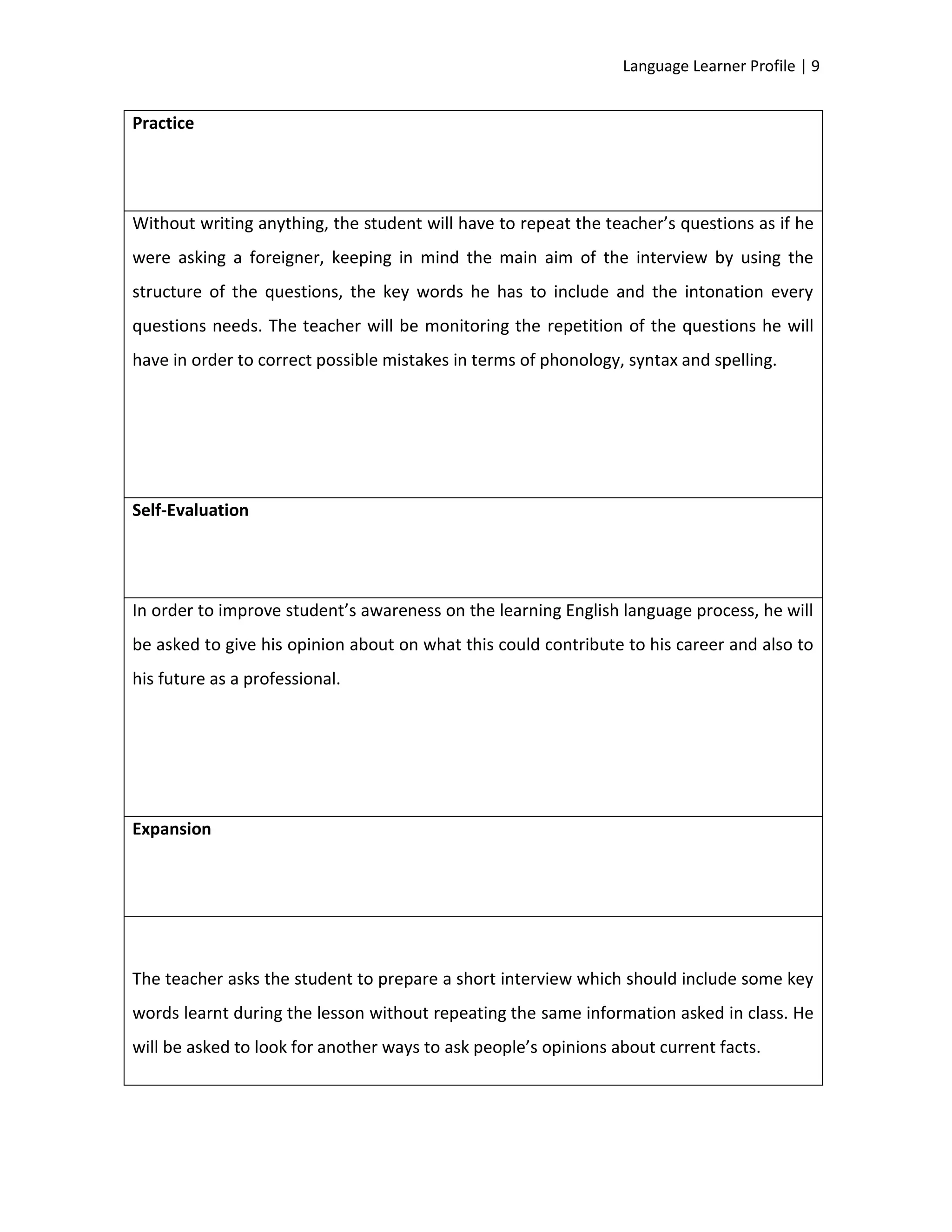
Practice


Without writing anything, the student will have to repeat the teacher’s questions as if he
were asking a foreigner, keeping in mind the main aim of the interview by using the
structure of the questions, the key words he has to include and the intonation every
questions needs. The teacher will be monitoring the repetition of the questions he will
have in order to correct possible mistakes in terms of phonology, syntax and spelling.


Self-Evaluation


In order to improve student’s awareness on the learning English language process, he will
be asked to give his opinion about on what this could contribute to his career and also to
his future as a professional.


Expansion


The teacher asks the student to prepare a short interview which should include some key
words learnt during the lesson without repeating the same information asked in class. He
will be asked to look for another ways to ask people’s opinions about current facts.
Language Learner Profile | 10


Future Needs


The interviewee in question should take advantage of his English knowledge in terms of

vocabulary. He knows lots of English words but, at the moment of reproducing those

words, he does not know how to use them. According to Brown, one of the aims of

learning English is to learn to be competent; this can only be reached by communicating in

the language in question. That is to say, he should dare to speak in English more

frequently in order to expand the development of his ability to learn other languages.


Following the same line, and considering Juan has to be a communicator with critical

thinking above all, he has to be trained in the way that he has the elementary

competences to communicate properly with others. In this case, something which could

contribute to his career would be the creation of a monthly magazine where interviews

would take prominent part in it; this way he would develop deeper almost all the skills by

covering all the linguistic systems’ needs at the same level. Also, in a training project to

develop monitoring and self-evaluation strategies, Wenden (1987) reports that providing

students with a checklist of criteria to self-evaluate their oral production resulted in

successful use of self-evaluation as a learning strategy. This training project and other

investigations have probed that by training language learners to use some language

learning strategies possibly have a positive effect on the learning process in question.
Language Learner Profile | 11


Finally, in order to get a better feedback about what he has done, the interviewee should

resort to Cooperation, in which by working together with another person to solve a pool

information (considering he is involved in a magazine project) he—and also his partner,

would reach an increased level of English due to that process of cooperating and enriching

their knowledge each other.
Language Learner Profile | 12


References


     Brown, H. D. Principles of Language Learning and Teaching. New Jersey: Prentice

             Hall Regent, 1994, n.p 36.

     Chamot, Anna & Küpper, L. Learning Strategies in Foreign Language Instruction,

             1989 n.p 247.

     Gorman, Brenda K. Spanish-influenced English; Typical phonological patterns in the

             English language learner, 2004, n.p 10.

Language Learner Profile

  • 1.
    Assignment 1 Professional Development Diego Ulloa Iglesias English Methodology (DID0412-1) Mss. Correa December 22nd, 2011
  • 2.
    Language Learner Profile| 1 English Background The interviewed lived in Ecuador for a few time but he’s currently living in Concepción with his mother and his two brothers. When Juan was in Secondary school, he failed the same course twice and he’s currently studying Public Relations at Virginio Gómez Institute. He attributes his English level mainly to his passion for watching films and also for listening to music most of the time. He believes this is one of many ways to learn English or other languages; you’re interested in a specific song and you have to comprehend it by looking for the meaning of every single word or phrases in times that are contained in that particular song. He also believes that, when a person is talking to him in English, he can understand the general idea by picking some words he already knows and linking them with the new ones he do not know but are similar to some Spanish words (what we know as “cognates”). The only problem with his spoken English is that he cannot reproduce a long fluent answer, but short paused ones.
  • 3.
    Language Learner Profile| 2 Interview Interviewer: D Interviewee: J D: First of all, I’d like to know your name. J: My name is Juan Diego Pinos D: How old are you? J: I’m twenty three years old D: Where are you from? J: I’m from Chile. D: But the city? J: My city is Concepción. D: Concepción... Are you still living in Concepcion? J: Yep. D: What thing do you like most about your country? Why? J: Uhmm, the party and people… how the people have fun... and this. D: How would you define your relationship with your parents? J: It’s pretty good.
  • 4.
    Language Learner Profile| 3 D: Do you get along with both of them? J: Yep. D: What subject did you dislike when you were in Elementary School? J: Math, I hate. D: What kind of game did you use to play when you were a 6-year-old boy? L: Basketball. D: Where did you go on holiday last year? J: Ecuador… to Ecuador. D: Have you ever visited another country? J: Yep. Ecuador. D: How was that experience? J: It’s amazing; it’s a really beautiful country. D: Well, about your future… what do you think you will be doing in 10 years? J: Working in a huge magazine like public relation… no sé, and this. D: I know you’re working at Telepizza, right? So, will you have to work tomorrow? J: Yep. D: What time will you have to get there? J: Three o’clock.
  • 5.
    Language Learner Profile| 4 D: Finally I’d like to thank you for your time. Also, thanks for answering all of my questions. I know it could have been something odd to you but, you know, you have to break the ice with those situations which make you feel kind of nervous. So thanks again. J: Ok. It’s ok (laugh).
  • 6.
    Language Learner Profile| 5 Transcription Yep. Ecuador. It’s amazing; it’s a really beautiful country. Working in a huge magazine like public relation… no sé, and this.
  • 7.
    Language Learner Profile| 6 Analysis Omission of the personal pronouns He tended to omit all the personal pronouns in the subject and object pronouns in the predicate, such as “I” in the first case and “It” in the second one, like it is exemplified in the following sentences: - “Ecuador… to Ecuador” instead of “I went to Ecuador” - “Math, I hate” instead of “Math, I hate(d) it” This omission is usually used by Spanish speakers because in that language can be used. It is one of the consequences of the influence that native language has in the process of learning a second language. Incorrect use of tense In concordance with the previous point, there is another which has to do with tense problem. The interview included at least 3 types of questions in terms of time (simple past tense, simple present tense and future continuous tense) which one of them was answered incorrectly exemplified in the following sentence: - “It’s amazing” instead of “It was amazing”. First, he was asked to answer the question about the experience, not about the country in question, so he should have answered in the tense the question was asked (past).
  • 8.
    Language Learner Profile| 7 Incorrect pronunciation In general, my interviewee speaks English rather well in terms of pronunciation (good control over consonant and vowel sounds) and vocabulary management. However, there were few exceptions which will be analyzed in the lines below: He pronounces the “th” of “three” as the common Spanish sound “t”, and the vowel “ee” of the same word is pronounced as the common Spanish sound “i”. - “three o’clock” θriː v/s tri (English) | (Learner Pronunciation) The sound of the English consonant “th” was pronounced by the interviewee as if it were the common sound of the Spanish consonant “t”. This is a common mistake made by many Spanish native speakers: this due to Spanish influence in the process of learning another language (English in this case). According to Gorman, “as a result, an English language learner may pronounce the words ‘think’ as ‘tink’ and ‘cloth’ as ‘clot’” (p10). So, the sound which should sound like an English voiceless dental fricative consonant rather than voiceless alveolar plosive instead. And the same problem is seen in the English vowel “ee” which should have been pronounced as “i:” instead of “i”.
  • 9.
    Language Learner Profile| 8 Lesson Plan: Preparation The teacher introduces the class to the student in question by telling him he wants to interview some foreign people to know what they think about current facts that have occurred in Chile so far. Teacher encourages him to give some examples of questions he could ask those foreign people as much as possible. Presentation The teacher shows the student a video where different people is been interviewed and also gives some clues to guess what every interview is about. The participation of the student here is to analyze which of them are more appropriate for interviewing the sort of people whom he’ll might to interview. Then, in order to check student understood, the teacher will show some cards which contain diverse key words in order to form complete, coherent questions for the requested interview (the student will only have to put the key words in the right order).
  • 10.
    Language Learner Profile| 9 Practice Without writing anything, the student will have to repeat the teacher’s questions as if he were asking a foreigner, keeping in mind the main aim of the interview by using the structure of the questions, the key words he has to include and the intonation every questions needs. The teacher will be monitoring the repetition of the questions he will have in order to correct possible mistakes in terms of phonology, syntax and spelling. Self-Evaluation In order to improve student’s awareness on the learning English language process, he will be asked to give his opinion about on what this could contribute to his career and also to his future as a professional. Expansion The teacher asks the student to prepare a short interview which should include some key words learnt during the lesson without repeating the same information asked in class. He will be asked to look for another ways to ask people’s opinions about current facts.
  • 11.
    Language Learner Profile| 10 Future Needs The interviewee in question should take advantage of his English knowledge in terms of vocabulary. He knows lots of English words but, at the moment of reproducing those words, he does not know how to use them. According to Brown, one of the aims of learning English is to learn to be competent; this can only be reached by communicating in the language in question. That is to say, he should dare to speak in English more frequently in order to expand the development of his ability to learn other languages. Following the same line, and considering Juan has to be a communicator with critical thinking above all, he has to be trained in the way that he has the elementary competences to communicate properly with others. In this case, something which could contribute to his career would be the creation of a monthly magazine where interviews would take prominent part in it; this way he would develop deeper almost all the skills by covering all the linguistic systems’ needs at the same level. Also, in a training project to develop monitoring and self-evaluation strategies, Wenden (1987) reports that providing students with a checklist of criteria to self-evaluate their oral production resulted in successful use of self-evaluation as a learning strategy. This training project and other investigations have probed that by training language learners to use some language learning strategies possibly have a positive effect on the learning process in question.
  • 12.
    Language Learner Profile| 11 Finally, in order to get a better feedback about what he has done, the interviewee should resort to Cooperation, in which by working together with another person to solve a pool information (considering he is involved in a magazine project) he—and also his partner, would reach an increased level of English due to that process of cooperating and enriching their knowledge each other.
  • 13.
    Language Learner Profile| 12 References Brown, H. D. Principles of Language Learning and Teaching. New Jersey: Prentice Hall Regent, 1994, n.p 36. Chamot, Anna & Küpper, L. Learning Strategies in Foreign Language Instruction, 1989 n.p 247. Gorman, Brenda K. Spanish-influenced English; Typical phonological patterns in the English language learner, 2004, n.p 10.