Language and Literature Assessment
Ignatius Joseph N. Estroga, EdD
School of Graduate Studies
College of Education
LICEO DE CAGAYAN UNIVERSITY
What is Language?
What is Literature?
What is Assessment?
Why do we assess students?
In creating a quality test, the teacher
should consider the characteristics of
a good test.
A good test should have a positive effect
on learning, and teaching should
result in improve d learning habits.
The test should enable the teacher to find
out which parts of the language program
cause difficulty for the class. This way the
teacher can evaluate the effectiveness of the
syllabus as well as the methods and materials
used during the lesson proper
A good test should also motivate by measuring
student performance without in any way
setting “traps” for them.
A well –developed language test should provide
an opportunity for students to show their
ability to perform certain language tasks.
A test should be constructed with the goal
of having students learn from their
weaknesses. If this is followed, a good test can
be used as a valuable teaching tool.
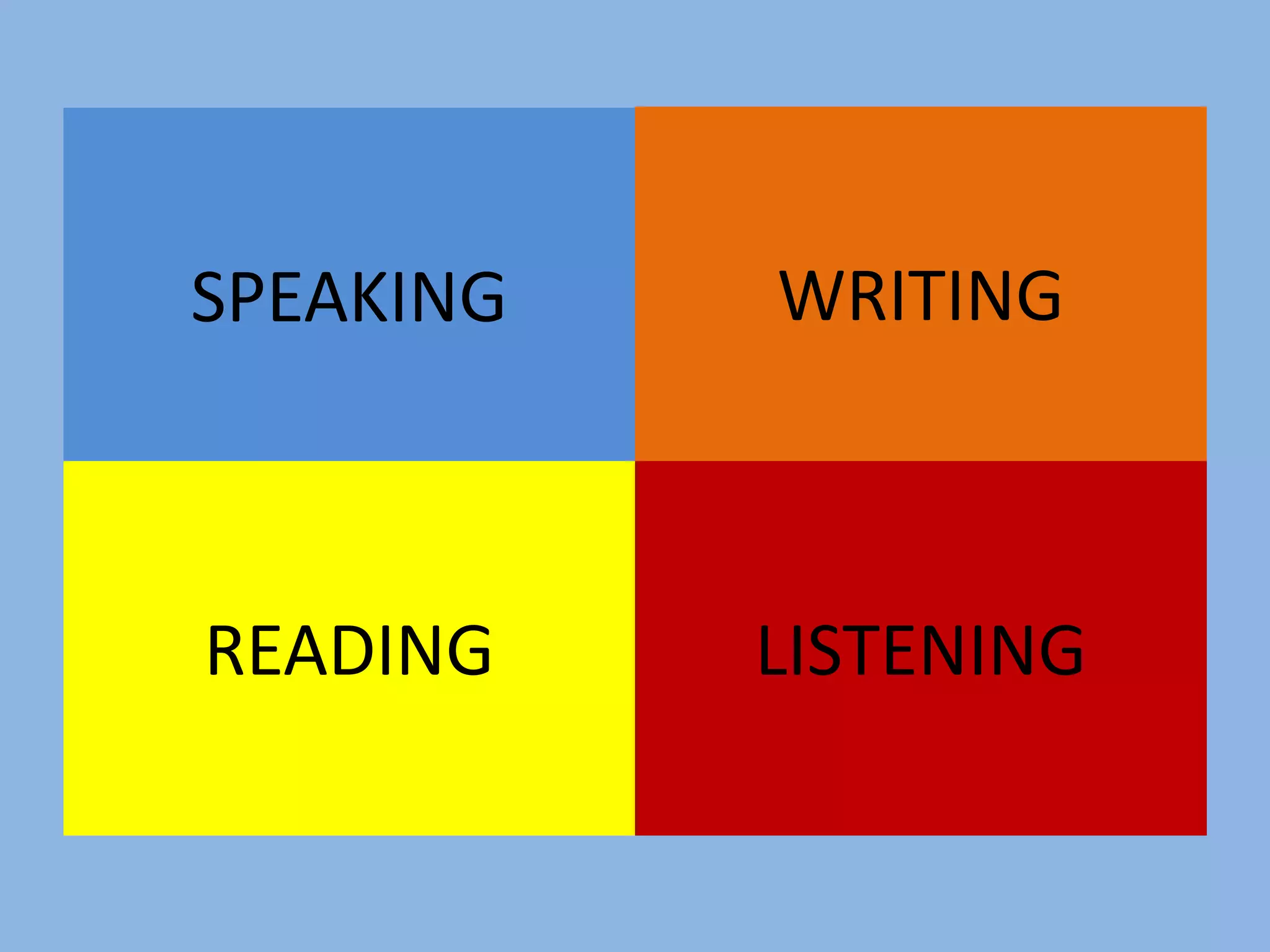
Major Skill Areas
SPEAKING WRITING
READING LISTENING
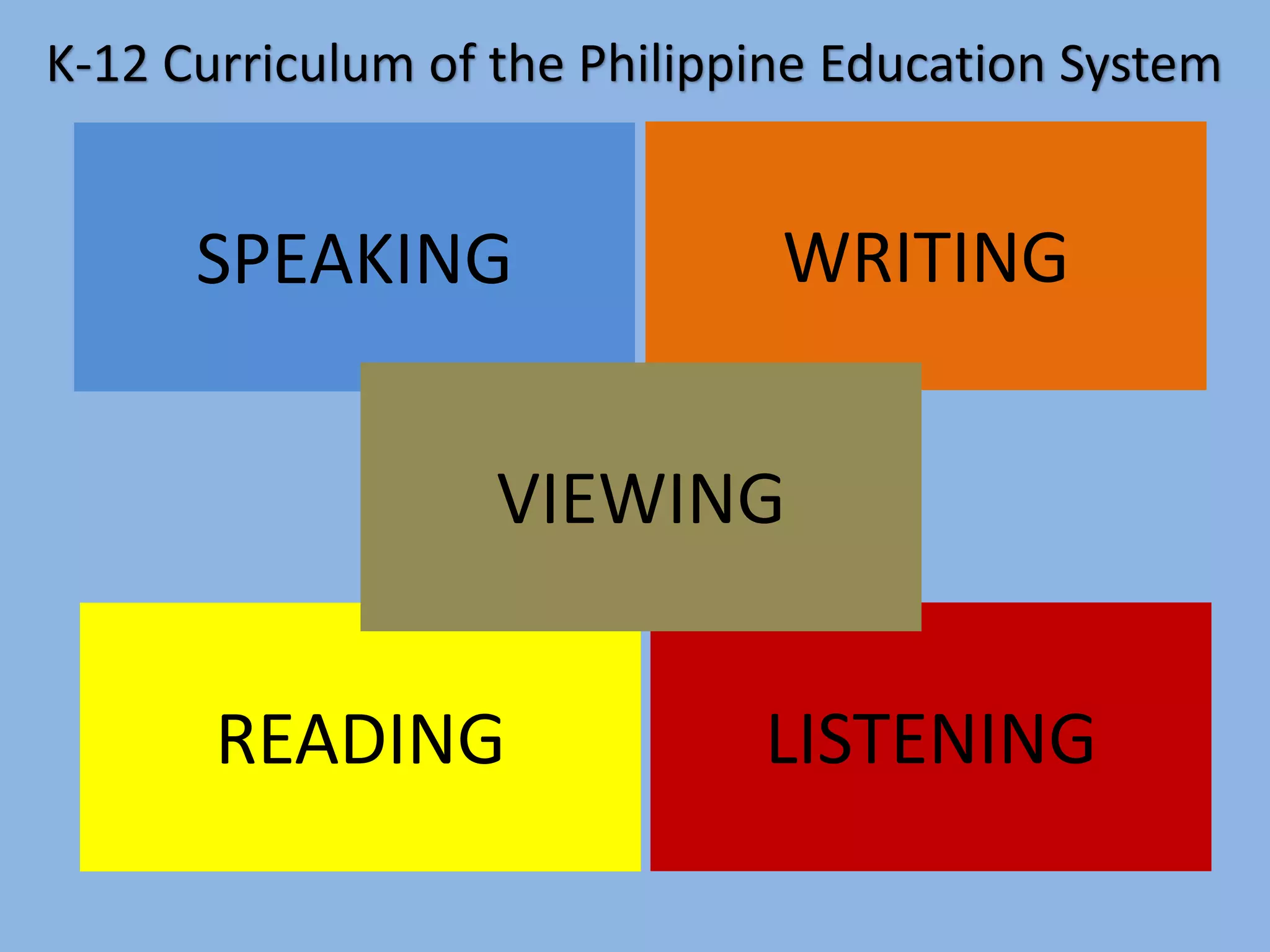
SPEAKING WRITING
READING LISTENING
VIEWING
K-12 Curriculum of the Philippine Education System
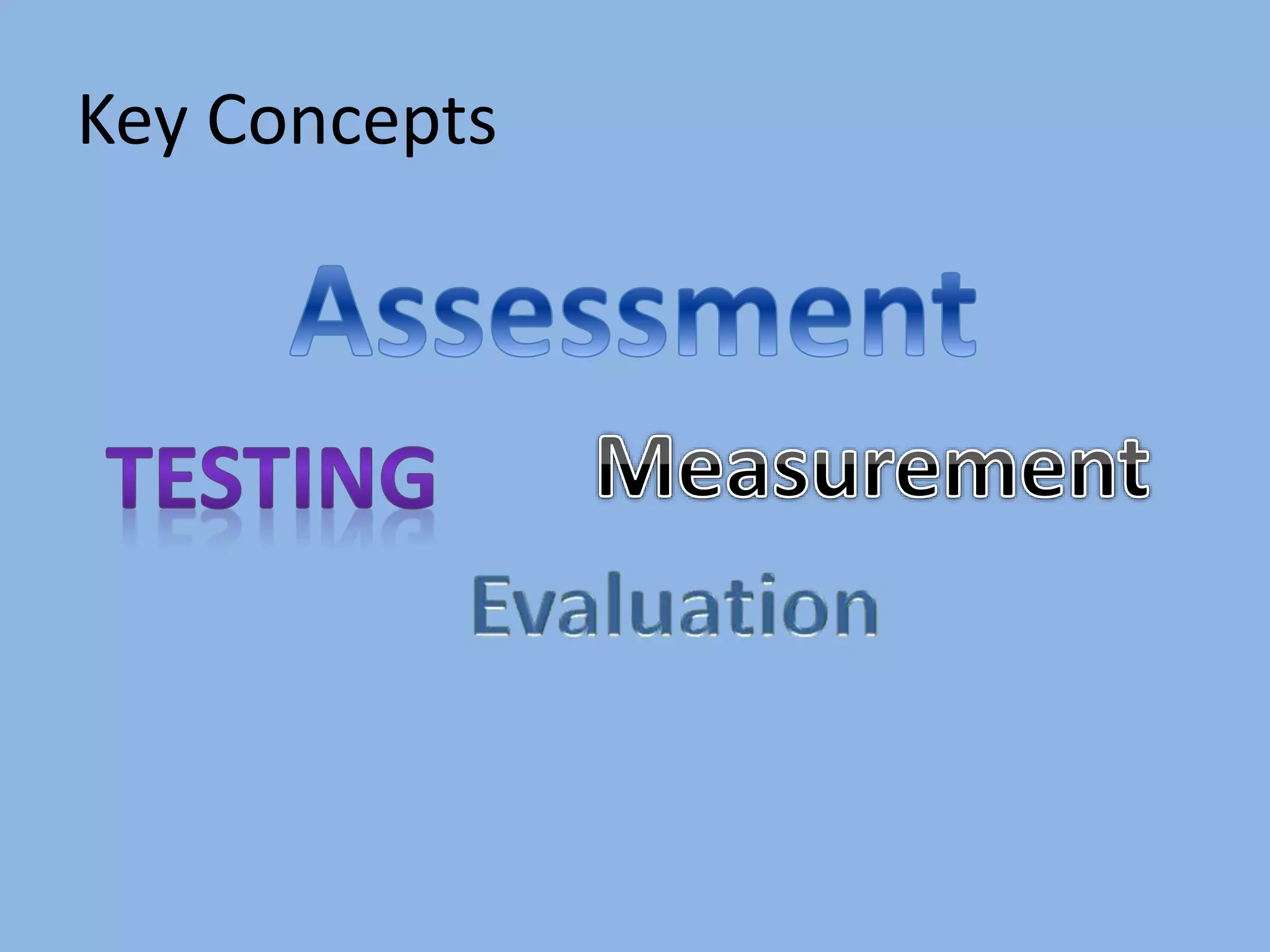
Key Concepts
• Assessment is the act of gathering information in
order to understand the individuals learning and
needs. In the context of language teaching and
learning, it refers to the act of collecting information
and making judgment about the learners knowledge
of language and ability to use it.
• Testing refers to the procedures that are based on
tests. In learning it is a salient part of assessment.
• Measurement broadly includes testing and other
types of measurement, as well as other types of
information that result in quantitative data such as
attendance, records, questionnaires, teacher ratings
of students, etc.
• Evaluation refers to the culminating act of
interpreting the gathered information for the
purpose of making judgment abut student’s learning
and needs. It forms as part of assessment.
Key Concepts
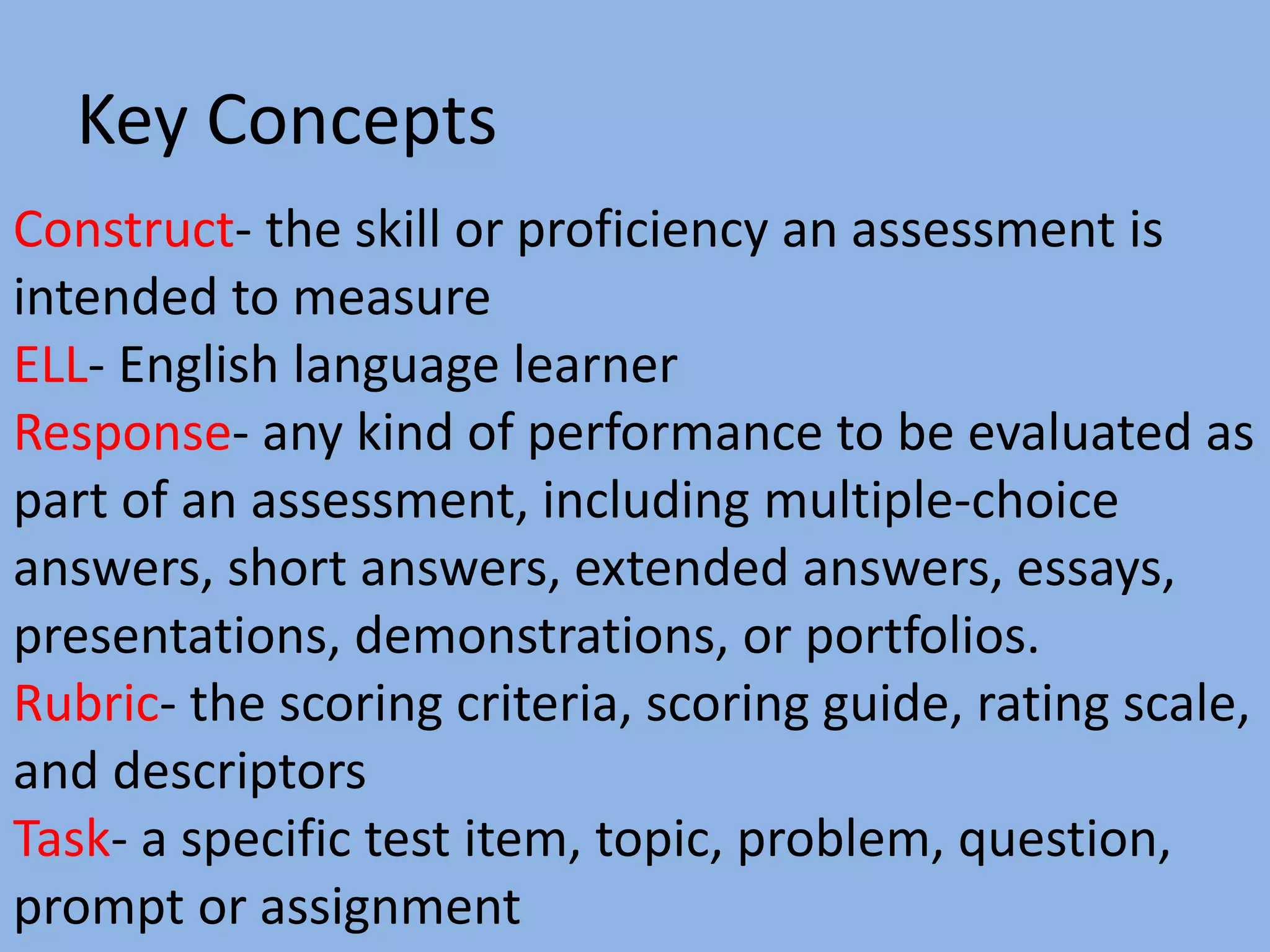
Construct- the skill or proficiency an assessment is
intended to measure
ELL- English language learner
Response- any kind of performance to be evaluated as
part of an assessment, including multiple-choice
answers, short answers, extended answers, essays,
presentations, demonstrations, or portfolios.
Rubric- the scoring criteria, scoring guide, rating scale,
and descriptors
Task- a specific test item, topic, problem, question,
prompt or assignment
Assessment and Evaluation Principles
1. Assessment and evaluation are essential
components of the teaching-learning process.
They should be planned and continuous
activities should be derived from curriculum
objectives and consistent with instructional
and learning strategies.
2. A variety of assessment and evaluation
techniques should be used. Techniques should
be selected for their appropriateness to
student’s styles and to the intended purposes.
Assessment and Evaluation Principles
3. Teachers should communicate assessment
and evaluation strategies and plan in advance,
informing the students of the objectives and
assessment procedures.
Assessment and Evaluation Principles
4. Assessment and evaluation should be fair and
equitable.
Assessment and Evaluation Principles
5. Assessment and evaluation should help
students. They should provide positive
feedback and encourage students to
participate actively in their own assessment in
order to foster lifelong learning and enable
them to transfer knowledge and abilities to
their life experiences.
Assessment and Evaluation Principles
6. Assessment and evaluation data and results
should be communicated to students and
parents/ guardians regularly, in meaningful
ways.
Assessment and Evaluation Principles
7. Assessment and evaluation should use variety
of techniques and tools.
Activity 1
1. What essential principles about assessment
and evaluation should educators, especially
classroom teachers bear in mind?
2. Based from your experiences, what do you
think are the functions of tests in learning?
List down as many as you can.
Purposes of Assessment
1. Assessment for Learning
Focuses on the gap between where the learner
in in his learning, and where he needs to be-
the desired goal. This can be achieved through
processes such as sharing criteria with
learners, effective questioning and feedback.
“All those activities undertaken by teachers an/or by students, which provide
information to be used as feedback to modify the teaching and learning activities
in which they are engaged.”(Black and William)
Learners learn best when…
• they understand clearly what they are trying to
learn, and what is expected of them.
• they are given feedback about the quality of their
work and what they can do to make it better.
• they are given advice about how to go about
making improvements.
• they are fully involved in deciding what needs to
be done next, and who can give them help if they
need it.
3. Assessment As Learning
It is about reflecting the evidence of learning. This
is part of the cycle of assessment where pupils
and staff set learning goals, share learning
intentions and success criteria, and evaluate their
learning through dialogue and self and peer
assessment.
Through this, learners become more aware of;
• What they learn
• How they learn, and
• What helps them learn
3. Assessment of Learning
This involves working with the range of available
evidence that enables staff and the wider
assessment community to check on students’
progress and using this information in a
number of ways.
• Assessment of Learning also provides an arena
for the management and planning of assessment,
and for teachers to work collaboratively with the
evidence. It connects assessment with the
curriculum.
• Judgment about students’ learning need to be
dependable. This means that;
a. They are valid
b. They are reliable
c. They are comparable
Functions of Language Tests
In Learning
• Tests are used to measure students’ language
ability, to discover how much they have been
learning, to diagnose students’ strengths and
weaknesses and to motivate students in
learning.
In Teaching
• Tests are used in teaching as a means to ensure
effective teaching, to improve teaching quality
and to obtain feedback on student learning
• Tests can have a backwash effect, which means
that they may result in changes of instructional
programs or teaching practices to reflect the test
contents because language teachers want their
students to do well on high stakes tests for many
different reasons.
In Research
• Language tests have a potentially important
role in virtually all research, both basic and
applied, that is related to the nature of
language proficiency, language processing,
language acquisition, language attrition, and
language teaching.
Kinds of Assessment And
Evaluation
1. Diagnostic Assessment and
Evaluation
This usually occurs at the beginning of the
school year and before each unit of study.
Purpose: to determine students’ knowledge and
skills; learning needs, motivational and
interest levels.
By examining the results of diagnostic
assessment, teachers can determine where to
begin instruction and what concepts or skills
to emphasize.
• Diagnostic assessment provides information
essential to teachers in selecting relevant
learning objectives and in designing
appropriate learning experiences for all
students, individually and as a group.
• Keeping diagnostic instruments for
comparison and further reference enables
teachers and students to determine progress
and future direction.
2. Formative Assessment and
Evaluation
• Focus on the processes and products of
learning. Formative assessment is continuous
and is meant to inform the student, the
parent/guardian, and the teacher of the
student’s progress toward the curriculum
objectives. This type of assessment and
evaluation provides information upon which
instructional decisions and adaptations can be
made and provides students with directions
for future learning
Involvement in constructing their own
assessment instruments or in adapting the
ones the teacher has made allows students to
focus on what they are trying to achieve,
develops their thinking skills, and helps them
to become reflective learners
For peer assessment to be successful, students
must be provided with assistance and the
opportunity to observe a model peer
assessment session. Through peer
assessment, students have the opportunity to
become critical and creative thinkers who can
clearly communicate ideas and thoughts to
others. Instruments such as checklists or
learning logs, and interviews or conferences
provide useful data.
3. Summative Assessment and
Evaluation
This occur most often at the end of a unit of
instruction and at term or year end when
students are ready to demonstrate
achievement of curriculum objectives.
Main Purposes:
1. Determine knowledge, skills, abilities and
attitudes that have developed over a given
period of time
Types of Assessment Tools
Assessment data can be collected and recorded
by both the teacher and the students in a
variety of ways. Through observation of
students, and in interviews or conferences
with students, teachers can discover much
about their students’ knowledge, abilities,
interests, and needs.
• Whatever method of data collection is used,
teachers should:
 meet with students regularly to discuss their
progress
adjust rating criteria as learners change and
progress
Observation
This occurs during students’ daily reading,
writing, listening and speaking experiences. It
is an unobtrusive means by which teachers
(and students) can determine their progress
during learning.
Anecdotal records
Checklists
Rating scales
Anecdotal Records
These are notes written by the teacher
regarding students language behavior, or
learning.
document and describe significant daily
events, and relevant aspects of student
activity and progress
notes can be taken during student activities or
at the end of the day.
Checklists
• Observation checklists are usually completed
while students are engaged in specific criteria
that teachers focus on at a particular time or
during a particular process.
used to record whether students have acquired
specific knowledge, skills, processes, abilities and
attitudes
inform teachers about where their instruction
had been successful and where students need
assistance or further instruction.
Rating Scales and Rubrics
Rating Scales record the extent to which specific
criteria have been achieved by the student or
are present in the student’s work. They record
the quality of the student’s performance at a
given time in a given process. Rating scales are
similar to checklist, its just that teachers can
assign number values to the criteria listed.
• Rubrics include criteria that describe each
level of the rating scale and are used to
determine student progress in comparison to
these expectations.
Portfolios
• Are collections of relevant works that reflect
student’s individual efforts, development and
progress over a designated period of time.
• It provides a broad picture of the student’s
growth overtime, including abilities,
knowledge, skills and attitudes.
• Students should be involved in the selection of
work to be included.
Speaking and Listening
• Oral presentations and incidental observations
provide opportunities to gather information
about the students’ two abilities.
• It may be more heavily emphasized depending
upon the particular unit or activity
Projects and Presentations
Quizzes, Tests and Examinations
Kinds of Language Tests
• Proficiency Tests
• Achievements Tests
• Diagnostic Tests
• Placement Tests
Activity
• For you, what is the most essential principle
about assessment and evaluation should
educators, especially teachers bear in mind.
Portfolio
Anecdotal
Running
Event sampling
Time sampling
Interview
Checklist
Standardized

language and literature assessment

  • 1.
    Language and LiteratureAssessment Ignatius Joseph N. Estroga, EdD School of Graduate Studies College of Education LICEO DE CAGAYAN UNIVERSITY
  • 2.
    What is Language? Whatis Literature? What is Assessment? Why do we assess students?
  • 3.
    In creating aquality test, the teacher should consider the characteristics of a good test. A good test should have a positive effect on learning, and teaching should result in improve d learning habits.
  • 4.
    The test shouldenable the teacher to find out which parts of the language program cause difficulty for the class. This way the teacher can evaluate the effectiveness of the syllabus as well as the methods and materials used during the lesson proper
  • 5.
    A good testshould also motivate by measuring student performance without in any way setting “traps” for them. A well –developed language test should provide an opportunity for students to show their ability to perform certain language tasks.
  • 6.
    A test shouldbe constructed with the goal of having students learn from their weaknesses. If this is followed, a good test can be used as a valuable teaching tool.
  • 7.
  • 8.
  • 9.
    SPEAKING WRITING READING LISTENING VIEWING K-12Curriculum of the Philippine Education System
  • 10.
  • 11.
    • Assessment isthe act of gathering information in order to understand the individuals learning and needs. In the context of language teaching and learning, it refers to the act of collecting information and making judgment about the learners knowledge of language and ability to use it. • Testing refers to the procedures that are based on tests. In learning it is a salient part of assessment. • Measurement broadly includes testing and other types of measurement, as well as other types of information that result in quantitative data such as attendance, records, questionnaires, teacher ratings of students, etc. • Evaluation refers to the culminating act of interpreting the gathered information for the purpose of making judgment abut student’s learning and needs. It forms as part of assessment.
  • 12.
    Key Concepts Construct- theskill or proficiency an assessment is intended to measure ELL- English language learner Response- any kind of performance to be evaluated as part of an assessment, including multiple-choice answers, short answers, extended answers, essays, presentations, demonstrations, or portfolios. Rubric- the scoring criteria, scoring guide, rating scale, and descriptors Task- a specific test item, topic, problem, question, prompt or assignment
  • 13.
  • 14.
    Assessment and EvaluationPrinciples 1. Assessment and evaluation are essential components of the teaching-learning process. They should be planned and continuous activities should be derived from curriculum objectives and consistent with instructional and learning strategies.
  • 15.
    2. A varietyof assessment and evaluation techniques should be used. Techniques should be selected for their appropriateness to student’s styles and to the intended purposes. Assessment and Evaluation Principles
  • 16.
    3. Teachers shouldcommunicate assessment and evaluation strategies and plan in advance, informing the students of the objectives and assessment procedures. Assessment and Evaluation Principles
  • 17.
    4. Assessment andevaluation should be fair and equitable. Assessment and Evaluation Principles
  • 18.
    Assessment and EvaluationPrinciples 5. Assessment and evaluation should help students. They should provide positive feedback and encourage students to participate actively in their own assessment in order to foster lifelong learning and enable them to transfer knowledge and abilities to their life experiences.
  • 19.
    Assessment and EvaluationPrinciples 6. Assessment and evaluation data and results should be communicated to students and parents/ guardians regularly, in meaningful ways.
  • 20.
    Assessment and EvaluationPrinciples 7. Assessment and evaluation should use variety of techniques and tools.
  • 21.
    Activity 1 1. Whatessential principles about assessment and evaluation should educators, especially classroom teachers bear in mind? 2. Based from your experiences, what do you think are the functions of tests in learning? List down as many as you can.
  • 22.
  • 23.
    1. Assessment forLearning Focuses on the gap between where the learner in in his learning, and where he needs to be- the desired goal. This can be achieved through processes such as sharing criteria with learners, effective questioning and feedback. “All those activities undertaken by teachers an/or by students, which provide information to be used as feedback to modify the teaching and learning activities in which they are engaged.”(Black and William)
  • 24.
    Learners learn bestwhen… • they understand clearly what they are trying to learn, and what is expected of them. • they are given feedback about the quality of their work and what they can do to make it better. • they are given advice about how to go about making improvements. • they are fully involved in deciding what needs to be done next, and who can give them help if they need it.
  • 25.
    3. Assessment AsLearning It is about reflecting the evidence of learning. This is part of the cycle of assessment where pupils and staff set learning goals, share learning intentions and success criteria, and evaluate their learning through dialogue and self and peer assessment. Through this, learners become more aware of; • What they learn • How they learn, and • What helps them learn
  • 26.
    3. Assessment ofLearning This involves working with the range of available evidence that enables staff and the wider assessment community to check on students’ progress and using this information in a number of ways.
  • 27.
    • Assessment ofLearning also provides an arena for the management and planning of assessment, and for teachers to work collaboratively with the evidence. It connects assessment with the curriculum. • Judgment about students’ learning need to be dependable. This means that; a. They are valid b. They are reliable c. They are comparable
  • 28.
  • 29.
    In Learning • Testsare used to measure students’ language ability, to discover how much they have been learning, to diagnose students’ strengths and weaknesses and to motivate students in learning.
  • 30.
    In Teaching • Testsare used in teaching as a means to ensure effective teaching, to improve teaching quality and to obtain feedback on student learning • Tests can have a backwash effect, which means that they may result in changes of instructional programs or teaching practices to reflect the test contents because language teachers want their students to do well on high stakes tests for many different reasons.
  • 31.
    In Research • Languagetests have a potentially important role in virtually all research, both basic and applied, that is related to the nature of language proficiency, language processing, language acquisition, language attrition, and language teaching.
  • 32.
    Kinds of AssessmentAnd Evaluation
  • 33.
    1. Diagnostic Assessmentand Evaluation This usually occurs at the beginning of the school year and before each unit of study. Purpose: to determine students’ knowledge and skills; learning needs, motivational and interest levels. By examining the results of diagnostic assessment, teachers can determine where to begin instruction and what concepts or skills to emphasize.
  • 34.
    • Diagnostic assessmentprovides information essential to teachers in selecting relevant learning objectives and in designing appropriate learning experiences for all students, individually and as a group. • Keeping diagnostic instruments for comparison and further reference enables teachers and students to determine progress and future direction.
  • 35.
    2. Formative Assessmentand Evaluation • Focus on the processes and products of learning. Formative assessment is continuous and is meant to inform the student, the parent/guardian, and the teacher of the student’s progress toward the curriculum objectives. This type of assessment and evaluation provides information upon which instructional decisions and adaptations can be made and provides students with directions for future learning
  • 36.
    Involvement in constructingtheir own assessment instruments or in adapting the ones the teacher has made allows students to focus on what they are trying to achieve, develops their thinking skills, and helps them to become reflective learners
  • 37.
    For peer assessmentto be successful, students must be provided with assistance and the opportunity to observe a model peer assessment session. Through peer assessment, students have the opportunity to become critical and creative thinkers who can clearly communicate ideas and thoughts to others. Instruments such as checklists or learning logs, and interviews or conferences provide useful data.
  • 38.
    3. Summative Assessmentand Evaluation This occur most often at the end of a unit of instruction and at term or year end when students are ready to demonstrate achievement of curriculum objectives. Main Purposes: 1. Determine knowledge, skills, abilities and attitudes that have developed over a given period of time
  • 39.
  • 40.
    Assessment data canbe collected and recorded by both the teacher and the students in a variety of ways. Through observation of students, and in interviews or conferences with students, teachers can discover much about their students’ knowledge, abilities, interests, and needs.
  • 41.
    • Whatever methodof data collection is used, teachers should:  meet with students regularly to discuss their progress adjust rating criteria as learners change and progress
  • 42.
    Observation This occurs duringstudents’ daily reading, writing, listening and speaking experiences. It is an unobtrusive means by which teachers (and students) can determine their progress during learning. Anecdotal records Checklists Rating scales
  • 43.
    Anecdotal Records These arenotes written by the teacher regarding students language behavior, or learning. document and describe significant daily events, and relevant aspects of student activity and progress notes can be taken during student activities or at the end of the day.
  • 44.
    Checklists • Observation checklistsare usually completed while students are engaged in specific criteria that teachers focus on at a particular time or during a particular process. used to record whether students have acquired specific knowledge, skills, processes, abilities and attitudes inform teachers about where their instruction had been successful and where students need assistance or further instruction.
  • 45.
    Rating Scales andRubrics Rating Scales record the extent to which specific criteria have been achieved by the student or are present in the student’s work. They record the quality of the student’s performance at a given time in a given process. Rating scales are similar to checklist, its just that teachers can assign number values to the criteria listed.
  • 46.
    • Rubrics includecriteria that describe each level of the rating scale and are used to determine student progress in comparison to these expectations.
  • 47.
    Portfolios • Are collectionsof relevant works that reflect student’s individual efforts, development and progress over a designated period of time. • It provides a broad picture of the student’s growth overtime, including abilities, knowledge, skills and attitudes. • Students should be involved in the selection of work to be included.
  • 48.
    Speaking and Listening •Oral presentations and incidental observations provide opportunities to gather information about the students’ two abilities. • It may be more heavily emphasized depending upon the particular unit or activity
  • 49.
  • 50.
    Kinds of LanguageTests • Proficiency Tests • Achievements Tests • Diagnostic Tests • Placement Tests
  • 51.
    Activity • For you,what is the most essential principle about assessment and evaluation should educators, especially teachers bear in mind.
  • 52.